Sovereignty Module: Master the Anvil
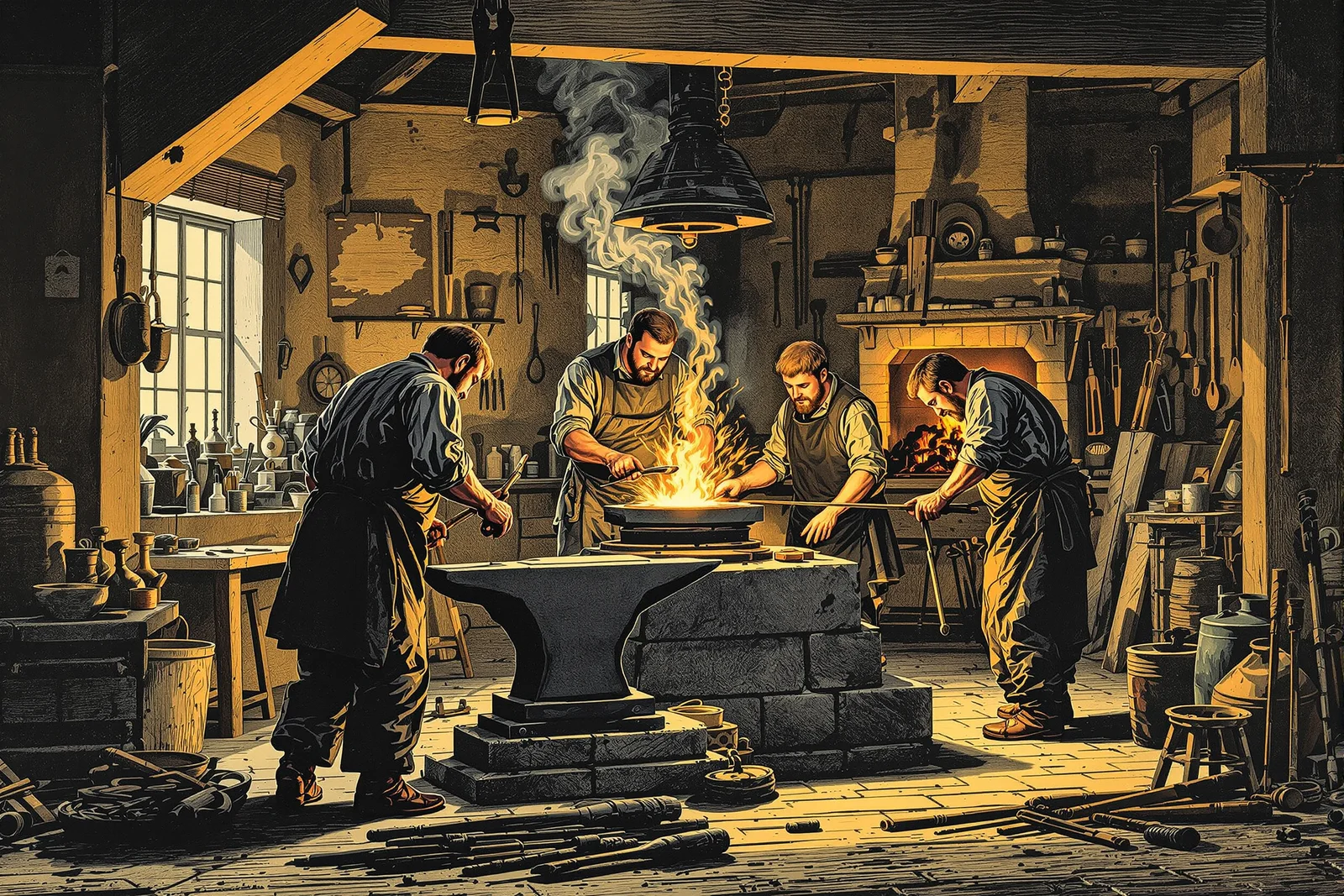
Complete Blacksmithing: From Forge to Finished Product
The blacksmith is the backbone of civilization. Every tool, every fastener, every blade passes through the forge. This campaign covers forge construction, metallurgy, techniques, and essential projects.
Chapter 1: Forge Construction
| Type | Fuel | Temperature | Cost | Portability | Best For |
|---|---|---|---|---|---|
| Side-blast coal forge | Coal/charcoal | 2,500°F+ | Low-moderate | Stationary | General blacksmithing |
| Bottom-blast coal forge | Coal/charcoal | 2,800°F+ | Moderate | Stationary | Heavy work, welding |
| Gas forge (propane) | Propane | 2,300°F | Moderate | Portable | Knife making, small work |
| Brake drum forge | Charcoal/coal | 2,300°F+ | Very low | Semi-portable | Beginner, field work |
| Japanese box bellows | Charcoal | 2,500°F+ | Low | Portable | Traditional, no electricity |
Brake drum forge (simplest start): Car brake drum as fire pot. Steel pipe (2") as tuyere (air inlet). Hand-crank blower or hair dryer for air. Steel table or legs welded on. Charcoal fuel. Total cost: $20-50 in scrap. Produces welding heat with good charcoal and sufficient air.
Chapter 2: Essential Tools
| Tool | Function | Size/Weight | Priority | Can Make? |
|---|---|---|---|---|
| Anvil | Work surface, shaping | 100-300 lbs | Critical | Difficult (use railroad track) |
| Hammer (cross peen) | Primary forming tool | 2-3 lbs | Critical | Yes (after basic skill) |
| Tongs (flat jaw) | Hold hot metal | 18-24" | Critical | Yes (first project) |
| Tongs (wolf jaw) | Hold round stock | 18-24" | Important | Yes |
| Hardy (hot cut) | Cut hot metal on anvil | Fits hardy hole | Critical | Yes |
| Punch (round) | Make holes in hot metal | 3/8-1/2" | Important | Yes |
| Drift (round) | Enlarge/true holes | Various sizes | Important | Yes |
| Swage block | Shaping, forming | 50-100 lbs | Useful | Difficult |
| Vise (post/leg) | Hold work for filing, bending | 4-6" jaw | Important | No (acquire) |
| File (bastard, 12") | Smooth, shape cold metal | 12" | Critical | No (acquire) |
| Wire brush | Clean scale from work | Standard | Important | No (acquire) |
| Quench tank | Cool/harden metal | 5+ gallons | Critical | Any metal container |
Chapter 3: Fundamental Techniques
| Technique | Purpose | Heat Color | Hammer Weight | Notes |
|---|---|---|---|---|
| Drawing out | Make metal longer/thinner | Yellow-orange | Heavy (3 lb) | Work over horn or edge of anvil |
| Upsetting | Make metal shorter/thicker | Yellow-orange | Heavy, on end | Heat only section to upset |
| Bending | Change direction | Orange-red | Medium (2 lb) | Bend over horn or in vise |
| Punching | Create holes | Yellow-orange | Medium, on punch | Punch from both sides |
| Drifting | Enlarge/shape holes | Orange-red | Medium, on drift | Lubricate drift with coal dust |
| Splitting | Divide metal | Yellow-orange | Medium, on chisel | Hot cut on hardy or with chisel |
| Forge welding | Join two pieces | White (sparkling) | Heavy, quick blows | Flux with borax, clean surfaces |
| Scrolling | Decorative curves | Orange-red | Light (1.5 lb) | Work from tip, gradual curve |
| Fullering | Create grooves/necks | Orange-red | Medium, on fuller | Use top and bottom fullers |
| Swaging | Shape to form | Orange-red | Medium, in swage | Produces consistent shapes |
Heat colors (steel): Black (room temp). Dark red (1,000°F). Cherry red (1,400°F). Bright cherry (1,500°F). Orange (1,700°F). Light orange (1,900°F). Yellow (2,000°F). Light yellow (2,100°F). White (2,300°F+). Sparkling white (2,500°F+ welding heat). NEVER heat above white — metal burns and is ruined.
Chapter 4: Heat Treatment
| Process | Purpose | Procedure | Result |
|---|---|---|---|
| Hardening | Make steel hard (but brittle) | Heat to critical temp (cherry red for high carbon), quench in oil or water | Hard, brittle, holds edge |
| Tempering | Reduce brittleness, set toughness | After hardening: polish, heat slowly until color appears, quench | Tough, less brittle, functional |
| Annealing | Make steel soft (for working) | Heat to critical temp, cool very slowly (in ash or vermiculite) | Soft, easy to file/drill/work |
| Normalizing | Relieve stress, refine grain | Heat to critical temp, cool in still air | Uniform grain, stress-free |
Temper colors (polished steel): Pale yellow (400°F) — scrapers, razors. Straw (440°F) — knives, chisels. Dark straw (480°F) — axes, plane blades. Bronze (500°F) — cold chisels, punches. Purple (530°F) — springs, swords. Blue (570°F) — springs, screwdrivers. Light blue (600°F) — soft springs.
Chapter 5: Essential Projects (Priority Order)
| Project | Difficulty | Time | Steel | Purpose |
|---|---|---|---|---|
| Tongs (flat jaw) | Beginner | 2-3 hours | Mild steel (3/8" round) | Hold work (enables all other projects) |
| S-hooks | Beginner | 15-30 min each | Mild steel (1/4" round) | Hanging, connecting |
| Nails/rivets | Beginner | 5-10 min each | Mild steel (1/4" square) | Fastening, construction |
| Hot cut hardy | Beginner-intermediate | 1-2 hours | High carbon (old file/spring) | Cutting hot metal |
| Knife (simple) | Intermediate | 4-8 hours | High carbon (old file) | Cutting tool |
| Axe head | Intermediate-advanced | 6-12 hours | Medium-high carbon | Chopping, splitting |
| Hammer head | Intermediate | 4-6 hours | Medium carbon | Striking tool |
| Hinge (strap) | Intermediate | 2-3 hours | Mild steel (1/4" × 1") | Door/gate hardware |
| Chain links | Intermediate | 30-60 min/link | Mild steel (3/8" round) | Pulling, hanging, securing |
| Sword/large blade | Advanced | 20-40 hours | High carbon or pattern weld | Weapon, ceremony |
Chapter 6: Metallurgy Basics
| Steel Type | Carbon Content | Properties | Sources (scrap) | Best For |
|---|---|---|---|---|
| Mild/low carbon | 0.05-0.25% | Soft, tough, weldable, won't harden | Rebar, car body, structural steel | Hooks, brackets, decorative |
| Medium carbon | 0.25-0.60% | Harder, stronger, some hardenability | Axles, railroad rail, some springs | Axes, hammers, tools |
| High carbon | 0.60-1.0% | Hard, holds edge, brittle if not tempered | Files, springs, saw blades, ball bearings | Knives, chisels, cutting tools |
| Tool steel | 0.7-1.5%+ (alloys) | Very hard, wear resistant | Drill bits, taps, dies, punches | Precision tools, dies |
| Wrought iron | <0.08% | Very soft, fibrous, forge welds easily | Old fences, gates (pre-1900) | Decorative, forge welding |
Spark test: Grind metal on grinder, observe sparks. Mild steel: long orange streamers, few forks. Medium carbon: shorter, more forks and bursts. High carbon: short, many explosive bursts (star-like). Stainless: short, orange, few forks. Cast iron: short, red, many small stars.
Reference Card
- Start with a brake drum forge: cheapest entry. Car brake drum + pipe + blower + charcoal. Makes welding heat.
- First project: tongs. You need tongs to hold everything else. Make flat-jaw tongs from 3/8" round mild steel.
- Heat colors: cherry red (1,400°F) for bending. Orange (1,700°F) for drawing out. Yellow (2,000°F) for heavy work. White for welding only.
- Never quench mild steel: it won't harden anyway and thermal shock can crack it. Only quench high-carbon steel for hardening.
- Temper after hardening: hardened steel is brittle. Always temper (reheat to color) before use. Straw color for knives.
- Spark test: identify unknown steel. More sparks/bursts = more carbon = hardenable. Essential skill for using scrap.
- Forge welding: surfaces must be clean (wire brush), fluxed (borax), and at welding heat (white, sparkling). Quick, firm blows.
- Safety: leather apron, safety glasses, ear protection. Never look at white-hot metal without eye protection. Keep water nearby.