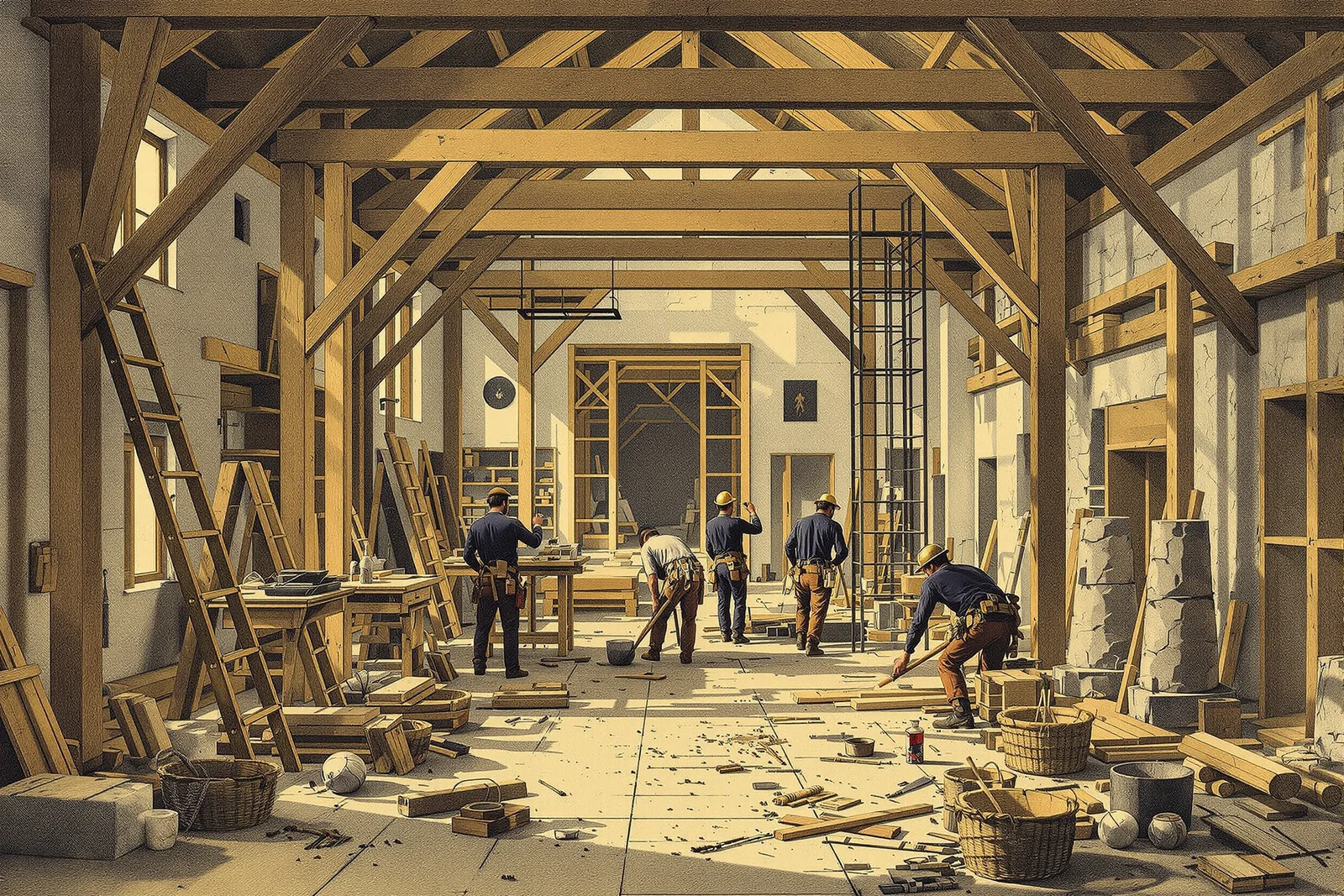
Complete Timber Framing: From Standing Tree to Standing Structure
⟁ cover painted for this edition — the source module carried no illustrations
Complete Timber Framing: From Standing Tree to Standing Structure
Timber framing creates buildings that last centuries using only wood and joinery — no nails, no steel. This campaign covers tree selection, layout, joinery, raising, and structural principles.
Chapter 1: Timber Selection and Preparation
Species
Strength
Weight
Rot Resistance
Workability
Availability
Best Use
White oak
Very high
Heavy
Excellent
Moderate
Eastern forests
Sills, posts, major beams
Douglas fir
Very high
Medium
Moderate
Good
Western forests
All structural
Eastern white pine
Moderate
Light
Poor
Excellent
Eastern forests
Rafters, purlins, boards
Hemlock
Moderate
Medium
Poor
Good
Eastern forests
General framing
Cedar (red)
Low-moderate
Light
Excellent
Excellent
Various
Sills, shingles, siding
Larch/tamarack
High
Medium-heavy
Good
Moderate
Northern forests
Sills, ground contact
Chestnut
High
Medium
Excellent
Good
(Rare now)
All structural
Timber preparation: 1) Fell in winter (less sap, fewer insects, ground frozen for skidding). 2) Hew or saw to square section (broadaxe for hewing, pit saw or sawmill for sawing). 3) Size timbers to plan (standard: posts 8×8, beams 8×10 or 8×12, rafters 6×8). 4) Air dry minimum 6 months per inch of thickness (green timber shrinks and checks). 5) Alternatively: frame green and allow to dry in place (traditional method — joints tighten as wood shrinks). 6) Mark each timber with layout marks (Roman numerals or scribe marks for assembly).
Chapter 2: Layout and Design
Component
Typical Size
Span Capacity
Function
Joinery
Sill beam
8×8 to 8×10
Foundation perimeter
Base of frame, sits on foundation
Mortise and tenon at corners
Posts (corner)
8×8
N/A (vertical)
Carry roof load to foundation
Tenon into sill, receive beam
Posts (intermediate)
6×6 to 8×8
N/A (vertical)
Support between corners
Tenon into sill and plate
Girts (wall beams)
6×8 to 8×8
8-16 ft
Connect posts, support floor
Tenon into posts
Summer beam
8×10 to 10×12
12-20 ft
Main floor support
Tenon into girts
Plate (top wall)
6×8 to 8×8
Wall length
Top of wall, receives rafters
Tenon into post tops
Tie beam
8×8 to 8×10
Building width
Prevents walls from spreading
Tenon into plates
Rafters
6×6 to 6×8
Roof span
Support roof covering
Birdsmouth at plate, peak joint
Purlins
4×6 to 6×8
Rafter spacing
Support roof boards between rafters
Tenon into rafters
Braces
4×6 to 6×6
3-5 ft
Triangulate frame (prevent racking)
Tenon into post and beam
King post
8×8
N/A
Center of truss, supports ridge
Tenon into tie beam
Chapter 3: Timber Frame Joinery
Joint
Use
Strength
Difficulty
Tools
Pegged?
Mortise and tenon
Universal connection
Very high
Moderate-high
Chisel, mallet, auger
Yes
Housed joint
Beam into post (partial)
High
Moderate
Chisel, saw
Sometimes
Scarf joint
Extend timber length
Moderate-high
High
Chisel, saw
Yes
Lap joint
Crossing timbers
Moderate
Low-moderate
Chisel, saw
Sometimes
Birdsmouth
Rafter on plate
High
Moderate
Saw, chisel
No (gravity)
Dovetail
Resist pulling out
Very high
High
Chisel, saw
Sometimes
Tusk tenon
Through-tenon with wedge
Very high
High
Chisel, saw, wedge
Wedged
Mortise and tenon (timber scale): 1) Tenon: typically 1/3 width of timber, 2/3 depth. 2) Mark tenon with framing square and marking gauge. 3) Cut tenon cheeks with handsaw (tenon saw or frame saw). 4) Cut shoulders cleanly (defines visible joint line). 5) Mortise: mark from tenon (transfer dimensions exactly). 6) Bore out waste with auger (series of overlapping holes). 7) Chop to lines with framing chisel (wide, heavy chisel). 8) Pare walls smooth and square. 9) Test fit (should require mallet to seat — snug, not forced). 10) Drill for peg: offset peg hole in tenon slightly toward shoulder (drawbore — pulls joint tight when pegged).
Chapter 4: Raising the Frame
Phase
Crew Size
Equipment
Time
Safety
Sequence
Layout (on ground)
2-4
Tape, square, chalk line
1-2 days
Low risk
First
Cut joinery
2-4
Chisels, saws, augers
1-4 weeks
Moderate
Second
Pre-assemble bents
4-8
Mallets, pegs
1-2 days
Low risk
Third
Raise bents
10-20+
Pike poles, ropes, gin pole
1-2 days
HIGH risk
Fourth
Connect bents
4-8
Mallets, pegs, ladders
1-2 days
High risk
Fifth
Add braces
2-4
Mallets, pegs
1 day
Moderate
Sixth
Roof structure
4-8
Ropes, ladders
1-2 days
High risk
Seventh
Raising procedure: 1) Assemble bent (cross-section of frame) flat on ground. 2) Peg all joints in bent. 3) Position bent at foundation edge (bottom will pivot on sill). 4) Attach ropes to top of bent. 5) Crew pushes with pike poles (long poles with metal tips). 6) Other crew pulls ropes from opposite side. 7) Guide bent vertical — do NOT let it go past vertical. 8) Brace immediately with temporary diagonal braces. 9) Repeat for each bent. 10) Connect bents with girts, plates, and tie beams. 11) Add permanent braces. 12) Traditional: entire community helps raise — "barn raising."
Chapter 5: Enclosure and Finishing
System
Insulation
Difficulty
Cost
Appearance
Lifespan
Board and batten
None (add separately)
Low
Low
Rustic
30-50 years
Clapboard siding
None (add separately)
Moderate
Moderate
Traditional
40-60 years
Straw bale infill
R-30 (excellent)
Low-moderate
Low
Plastered (smooth)
50-100 years
SIP panels
R-20-40
Moderate
High
Modern
50+ years
Wattle and daub
R-3-5 (low)
Low
Very low
Rustic/plastered
20-40 years
Brick infill
R-4-8
Moderate-high
Moderate-high
Classic
100+ years
Reference Card
Braces make it rigid (without diagonal braces, a frame racks and collapses — triangulation is structural). 2. Drawbore pulls tight (offset peg hole in tenon pulls joint together — no clamps needed). 3. Layout is everything (measure twice, cut once applies tenfold — a miscut timber is wasted). 4. Green framing is traditional (frame with green wood, joints tighten as wood shrinks around pegs). 5. Sill on stone (wood touching ground rots — always elevate sill beams on stone or concrete foundation). 6. Raise with community (a bent raising requires 10-20 people — this is a community event by necessity). 7. Oak for strength, pine for ease (oak is strongest but hardest to work; pine is easy but weaker — choose wisely). 8. Pegs not nails (wooden pegs flex with the frame; metal fasteners corrode and work loose over centuries).