Sovereignty Module: Refine the White
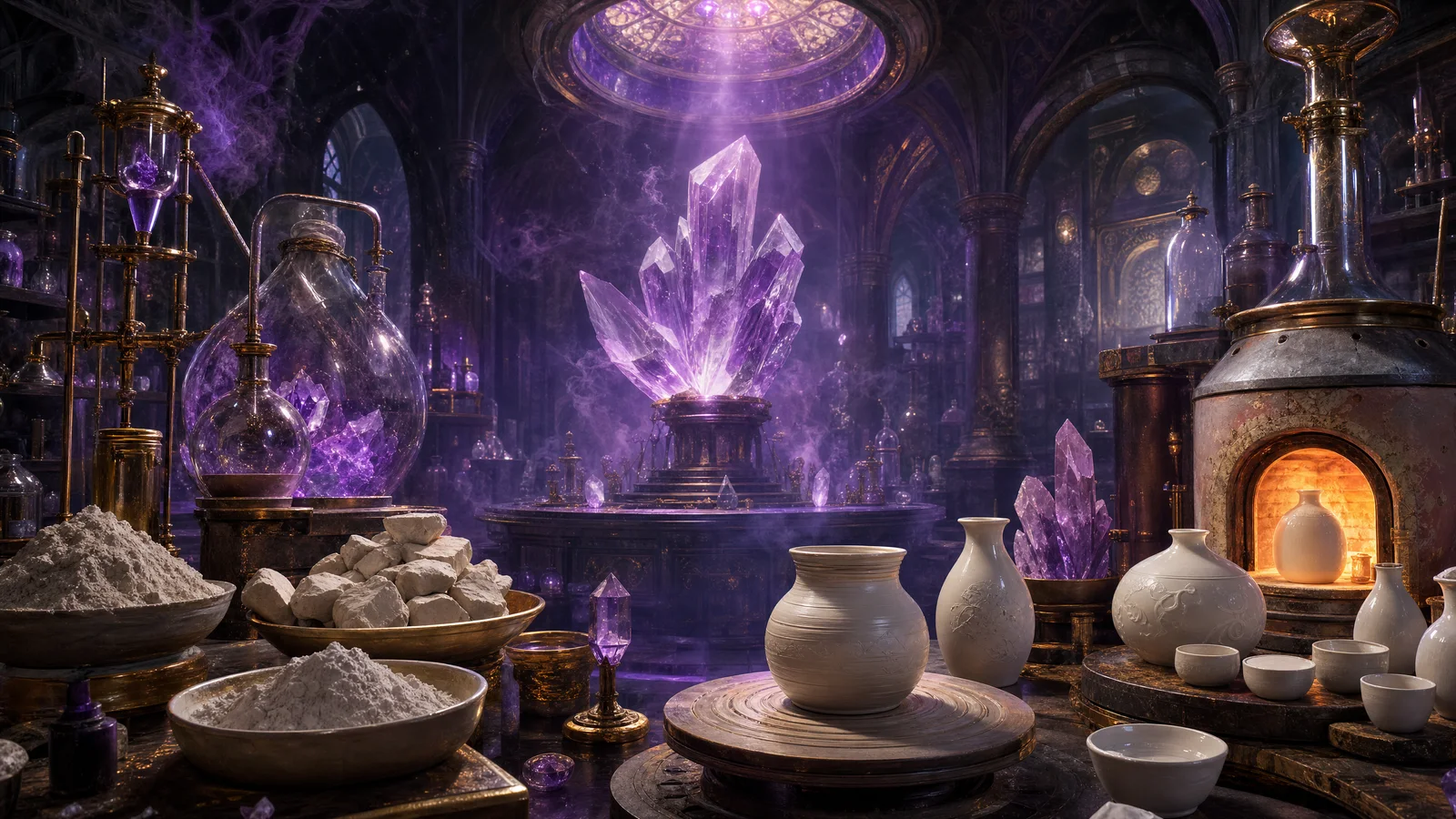
Refine the White
Complete Porcelain Making: From Kaolin to Translucent Ceramic
Complete Porcelain Making: From Kaolin to Translucent Ceramic
Porcelain is the most refined ceramic material. This campaign covers porcelain clay bodies, throwing techniques for porcelain, trimming, glazing, and firing to achieve translucency and whiteness.
Chapter 1: Porcelain vs Stoneware
| Property | Stoneware | Porcelain |
|---|---|---|
| Primary clay | Ball clay, fire clay | Kaolin (china clay) |
| Color | Gray, brown, buff | White |
| Translucency | None | Possible when thin |
| Plasticity | Good | Poor (requires additives) |
| Throwing difficulty | Moderate | High |
| Firing temperature | Cone 6-10 | Cone 8-12 |
| Strength | High | Very high |
| Surface | Varied | Smooth, refined |
Chapter 2: Porcelain Clay Body
| Ingredient | Percentage | Purpose |
|---|---|---|
| Kaolin (EPK or Grolleg) | 25-50% | White color, refractory |
| Silica (flint) | 20-30% | Glass former, strength |
| Feldspar | 20-30% | Flux, translucency |
| Ball clay | 5-15% | Plasticity, workability |
| Bentonite | 1-3% | Additional plasticity |
Chapter 3: Throwing Porcelain
| Challenge | Cause | Solution |
|---|---|---|
| Soft, floppy walls | Low plasticity | Throw thicker, trim to final thickness |
| Cracking during throwing | Overworking | Fewer pulls, work quickly |
| Warping during drying | Uneven thickness | Even walls, slow drying |
| Slumping during firing | Vitrification softens clay | Support with kiln furniture |
| S-cracks in bottom | Uneven compression | Compress bottom thoroughly |
Chapter 4: Porcelain Glazes
| Glaze | Character | Best Application |
|---|---|---|
| Clear glaze | Transparent, shows clay body | Carved or painted decoration |
| Celadon | Jade green, pools in recesses | Carved porcelain |
| Chun (Jun) | Blue, opalescent | Smooth forms |
| Copper red | Rich red, difficult | Special pieces |
| Iron decoration | Brown/black brushwork on white | Painted porcelain |
| Unglazed | Smooth, white, matte | Sculptural forms |
Chapter 5: Historical Porcelain Traditions
| Tradition | Origin | Period | Characteristics |
|---|---|---|---|
| Chinese blue and white | Jingdezhen, China | 14th century | Cobalt painting under clear glaze |
| Celadon | Longquan, China | 10th century | Jade green glaze, carved |
| Meissen | Germany | 18th century | European porcelain, painted |
| Sèvres | France | 18th century | Soft paste, richly decorated |
| Arita/Imari | Japan | 17th century | Overglaze enamel decoration |
| Korean | Korea | 12th century | Celadon, inlaid decoration |
Reference Card
- Porcelain is the most demanding ceramic material (its low plasticity, tendency to warp, and high firing temperature make porcelain the most challenging clay to work with; mastering porcelain is a lifetime pursuit). 2. Kaolin is the essential ingredient (kaolin, or china clay, provides the whiteness and refractoriness that define porcelain; without high-quality kaolin, true porcelain is impossible). 3. Translucency is porcelain's signature (when thrown thin enough and fired to full vitrification, porcelain transmits light; this translucency is the quality that has made porcelain prized for centuries). 4. Slow drying prevents cracking (porcelain is more prone to cracking during drying than stoneware; dry porcelain pieces slowly and evenly, wrapped in plastic for the first several days). 5. Trim to final thickness (because porcelain is difficult to throw thin, throw slightly thick and trim to final wall thickness; this approach produces more consistent results than attempting to throw thin). 6. Porcelain rewards patience (every step of porcelain making requires more care and patience than stoneware; the reward is a material of unmatched beauty, refinement, and translucency). 7. Chinese potters perfected porcelain (for over 1,000 years, Chinese potters developed and refined porcelain to the highest level; studying Chinese porcelain traditions is essential for any serious porcelain maker). 8. Porcelain is the ultimate test of the potter's skill (centering, throwing, trimming, glazing, and firing porcelain all require the highest level of skill; a beautiful porcelain piece represents the pinnacle of ceramic craft).
TransmissionCOMPLETE — unaltered & unabridged
Words691 — every one of them
SHA-256 of source text8f83ac1cf4eedfa7770b44d34c40b07af78979f42c8830fc827ff26e55c03133
Canonical textdownload campaign-refine-white.md — byte-identical to what this page renders