Sovereignty Module: Tame the Cold
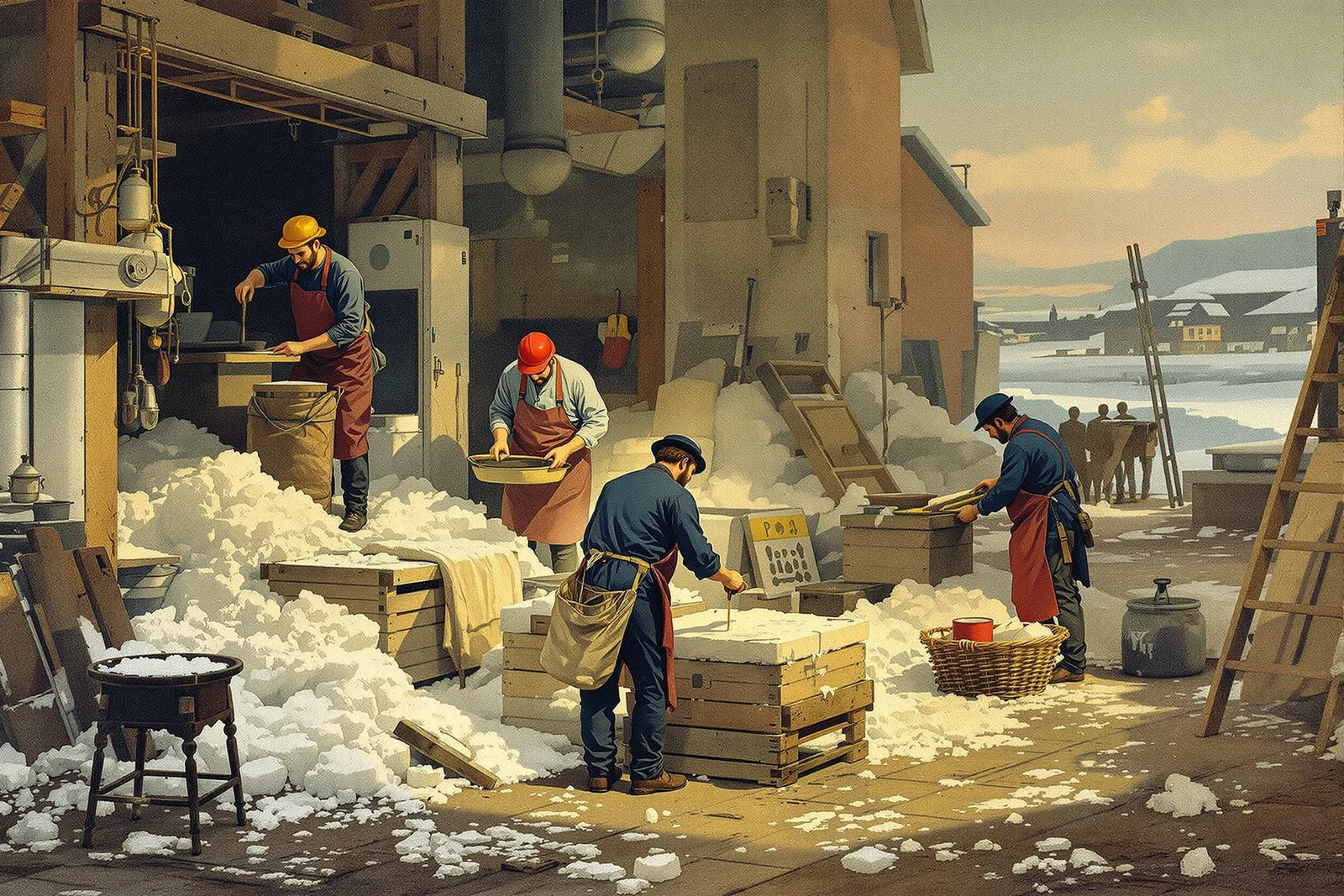
Complete Refrigeration, Ice Production, and Cold Storage Guide
Refrigeration preserves food, stores medicine, and enables chemical processes. This campaign covers ice harvesting, mechanical refrigeration, evaporative cooling, and cold storage construction.
Chapter 1: Cooling Methods
| Method | Temperature Achieved | Power Required | Complexity | Scale |
|---|---|---|---|---|
| Evaporative cooling (pot-in-pot) | 15-20F below ambient | None | Minimal | Small (food storage) |
| Root cellar | 50-60F year-round | None | Low (excavation) | Medium (household) |
| Ice harvesting (winter) | 32F (with ice) | Labor only | Low | Large (community) |
| Absorption refrigeration (ammonia) | 0-40F | Heat source (fire, solar) | Moderate | Small-medium |
| Mechanical compression | -20 to 40F | Engine or electric motor | High | Any scale |
| Thermoelectric (Peltier) | 30-40F below ambient | Electricity | Low (if modules available) | Very small |
Chapter 2: Evaporative Cooling
Pot-in-pot cooler (Zeer pot): Place a small clay pot inside a larger one. Fill gap with wet sand. Cover with wet cloth. Evaporation draws heat from inner pot, cooling contents 15-20F below ambient. Works best in dry climates.
| Parameter | Specification |
|---|---|
| Inner pot | Glazed (holds food, prevents moisture contact) |
| Outer pot | Unglazed (allows evaporation through walls) |
| Gap | 2-3 inches, filled with sand |
| Sand moisture | Keep wet (add water 2-3 times daily) |
| Placement | Shaded, with air circulation |
| Temperature drop | 15-20F in dry climate; 5-10F in humid climate |
Chapter 3: Root Cellar Construction
| Feature | Specification | Purpose |
|---|---|---|
| Depth | 6-10 feet below grade | Below frost line, stable temperature |
| Size | 8x10 feet minimum (household) | Adequate storage |
| Walls | Stone, concrete, or earth-bermed | Insulation, moisture control |
| Floor | Gravel over earth (not concrete) | Maintains humidity |
| Ventilation | Two vents (high and low) | Air circulation, temperature control |
| Door | Insulated, tight-fitting | Prevents warm air entry |
| Shelving | Wood (not metal, which conducts heat) | Storage organization |
| Temperature | 32-40F (winter), 50-60F (summer) | Food preservation range |
| Humidity | 85-95% | Prevents produce from drying out |
Chapter 4: Ice Harvesting and Storage
| Step | Action | Details |
|---|---|---|
| 1 | Wait for 8+ inches of clear ice on pond/lake | Thinner ice is unsafe and melts too fast in storage |
| 2 | Score ice into blocks (24x24 or 24x36 inches) | Use ice plow or hand saw |
| 3 | Cut blocks free | Ice saw (long, coarse-toothed) |
| 4 | Float blocks to shore | Push with pike poles |
| 5 | Load onto sled/wagon | Transport to ice house |
| 6 | Stack in ice house with sawdust between layers | Sawdust insulates (12 inches between layers and walls) |
Ice house construction: heavily insulated building (double walls filled with sawdust, straw, or cork). Drainage for meltwater. Roof ventilated. North-facing if possible. A well-built ice house preserves ice from winter through the following summer.
Chapter 5: Absorption Refrigeration
The ammonia-water absorption cycle uses heat (not electricity) to drive refrigeration.
| Component | Function | Material |
|---|---|---|
| Generator (boiler) | Heats ammonia-water solution, boils off ammonia gas | Steel vessel over heat source |
| Condenser | Cools ammonia gas back to liquid | Coiled steel tube with air or water cooling |
| Evaporator | Liquid ammonia evaporates, absorbing heat (creates cold) | Coiled tube inside insulated box |
| Absorber | Water reabsorbs ammonia gas (completing cycle) | Steel vessel, water-cooled |
Heat sources: wood fire, kerosene burner, solar concentrator, waste heat from engine. No moving parts (except gravity and heat). The original refrigerators (1850s-1930s) used this principle.
Chapter 6: Mechanical Compression Refrigeration
| Component | Function | Material |
|---|---|---|
| Compressor | Compresses refrigerant gas (raises pressure and temperature) | Piston or rotary, driven by engine/motor |
| Condenser | Cools compressed gas to liquid (releases heat) | Coiled tube with fins, air or water cooled |
| Expansion valve | Drops pressure (liquid partially evaporates, temperature drops) | Needle valve or capillary tube |
| Evaporator | Remaining liquid evaporates, absorbing heat from surroundings | Coiled tube inside insulated space |
Refrigerants: Ammonia (NH3, traditional, effective, toxic), propane (flammable but effective), CO2 (safe but high pressure), salvaged Freon/R134a (if available).
Chapter 7: Cold Storage for Food
| Food Type | Storage Temperature | Humidity | Storage Life |
|---|---|---|---|
| Fresh meat | 32-36F | 80-85% | 1-2 weeks |
| Fresh fish | 32F (on ice) | 90-95% | 3-5 days |
| Dairy (milk, cheese) | 35-40F | 80-85% | 1-4 weeks |
| Eggs | 35-40F | 70-80% | 3-5 months |
| Root vegetables | 32-40F | 90-95% | 2-6 months |
| Apples | 32-36F | 90-95% | 3-8 months |
| Frozen meat | 0F or below | N/A | 6-12 months |
| Frozen vegetables | 0F or below | N/A | 8-12 months |
Reference Card
- Evaporative cooling (pot-in-pot) drops temperature 15-20F with zero energy in dry climates
- Root cellars maintain 50-60F year-round at 6-10 feet depth
- Ice harvested in winter and stored in sawdust-insulated ice houses lasts through summer
- Absorption refrigeration uses HEAT (not electricity) to produce cold (ammonia-water cycle)
- Mechanical refrigeration: compress gas, condense (release heat), expand (absorb heat), repeat
- Ammonia is the most effective traditional refrigerant but is toxic (ventilate and contain leaks)
- Most produce stores best at 32-40F and 85-95% humidity
- Insulation is the key to all cold storage: sawdust, straw, cork, or double walls with air gap