Sovereignty Module: Seal the Vessel
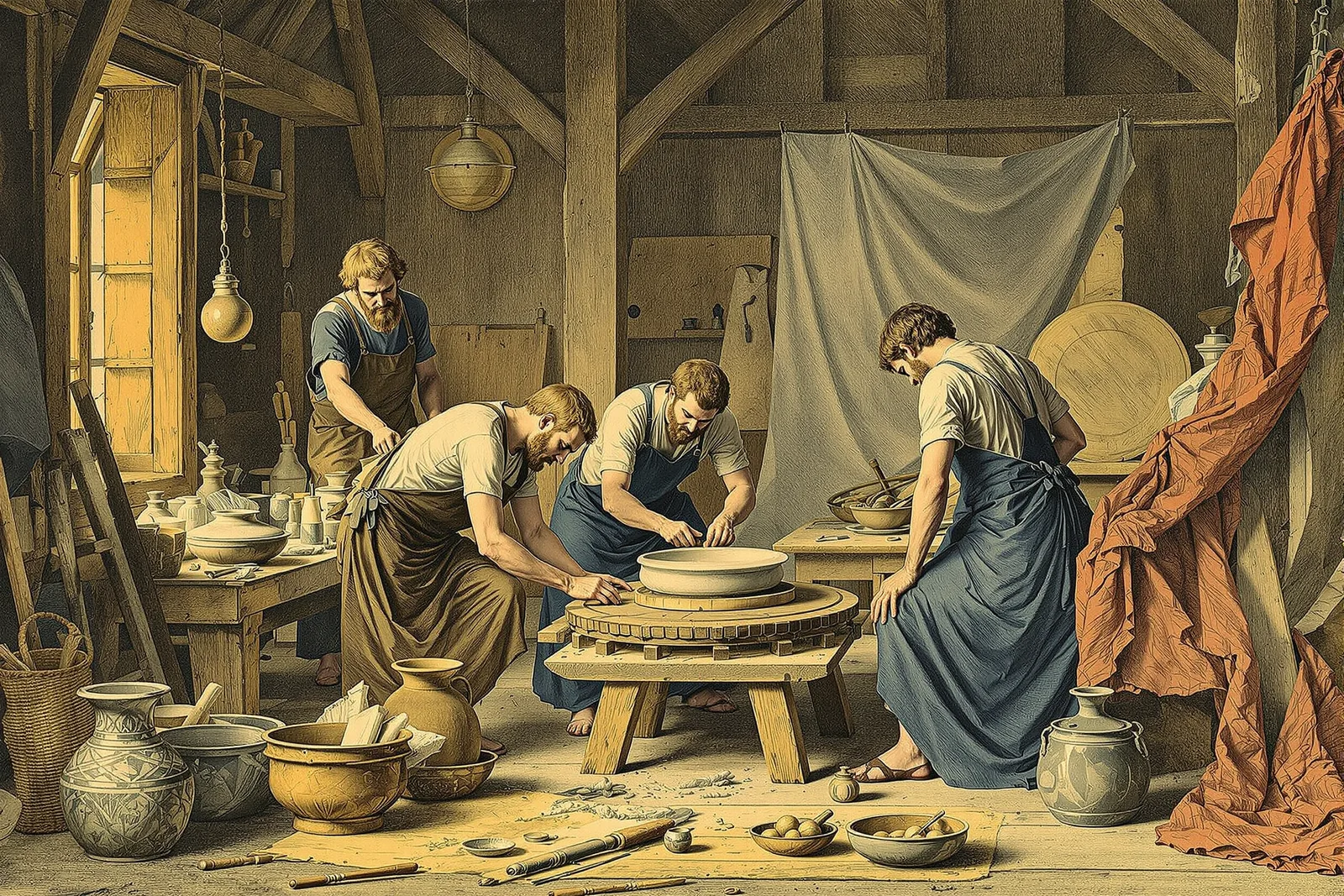
Complete Lid and Cover Making: From Wheel to Fitted Closure
Lids transform open vessels into storage containers. This campaign covers lid types, gallery fitting, knob making, and the critical art of matching lid to pot.
Chapter 1: Lid Types
| Type | Fit Method | Use | Complexity |
|---|---|---|---|
| Flat lid (drop-in) | Sits inside rim | Casserole, jar | Simple |
| Flanged lid | Flange drops inside rim | Teapot, canister | Moderate |
| Domed lid | Sits on top of rim | Cookie jar, urn | Moderate |
| Gallery lid | Fits into gallery (ledge) | Teapot, ginger jar | Complex |
| Cork lid | Clay disc with cork insert | Storage jar | Simple |
| Knobbed lid | Any type with thrown knob | All | Varies |
Chapter 2: Throwing Lids
Flat drop-in lid: 1) Measure inside diameter of pot rim precisely. 2) Throw lid slightly larger (shrinkage). 3) Center 1/2-1 pound of clay. 4) Flatten into disc. 5) Pull up short rim (flange) at edge. 6) Flange drops inside pot rim. 7) Flange height: 3/8-1/2 inch. 8) Trim top surface flat. 9) Attach knob at center.
| Lid Type | Throwing Direction | Trimming | Knob Attachment |
|---|---|---|---|
| Flat (drop-in) | Right-side up | Minimal | After trimming |
| Flanged | Right-side up | Trim top | After trimming |
| Domed | Upside-down | Trim dome shape | Thrown integral or attached |
| Gallery | Right-side up | Trim gallery edge | After trimming |
Chapter 3: Fitting
| Fit Factor | Specification | Why |
|---|---|---|
| Clearance | 1/16 inch all around | Allows easy removal |
| Shrinkage matching | Same clay body | Lid and pot shrink equally |
| Firing together | Fire lid on pot | Ensures fit after firing |
| Glaze consideration | Wax contact surfaces | Prevents lid fusing to pot |
| Gallery depth | 1/4-3/8 inch | Secure fit without jamming |
Fitting process: 1) Throw lid and pot from same clay body. 2) Measure pot opening at leather-hard stage. 3) Trim lid to fit (1/16 inch clearance). 4) Test fit: lid should drop in easily and sit level. 5) Mark lid and pot (they are a matched pair). 6) Fire together (lid sits on pot during firing). 7) Wax any surfaces where lid contacts pot (prevents glaze fusion).
Chapter 4: Knob Making
| Knob Type | Method | Size | Grip |
|---|---|---|---|
| Thrown knob | Throw on lid (integral) | 1-2 inches | Good |
| Pulled knob | Pull from lid surface | 1-1.5 inches | Good |
| Attached knob | Throw separately, attach | 1-2 inches | Excellent |
| Loop handle | Pulled clay loop | 1.5-2 inches | Excellent |
| Animal/figure | Hand-sculpted | Varies | Decorative |
Thrown integral knob: 1) Leave extra clay at center when throwing lid. 2) Shape knob from this clay. 3) Knob should be comfortable to grip with wet or greasy fingers. 4) Minimum knob height: 3/4 inch (enough to grip). 5) Undercut slightly (fingers can grip underneath). 6) Smooth all surfaces (no sharp edges).
Chapter 5: Specialized Lids
Teapot lid: 1) Must have steam hole (1/8 inch hole in lid). 2) Steam hole prevents vacuum when pouring. 3) Without steam hole, tea dribbles instead of pouring. 4) Gallery fit: precise (lid must not rattle or fall out when tilting). 5) Knob must stay cool (heat rises; knob should be tall enough to stay cool). 6) Fire lid on teapot (ensures perfect fit).
| Specialized Feature | Purpose | Application |
|---|---|---|
| Steam hole | Prevents vacuum | Teapot |
| Locking flange | Prevents lid falling | Tilting vessels |
| Rubber gasket groove | Airtight seal | Storage canisters |
| Overlapping rim | Dust protection | Storage jars |
| Recessed knob | Stackable | Nesting vessels |
Reference Card
- Throw lid and pot from the same clay (different clay bodies shrink at different rates; a lid thrown from a different clay than the pot will not fit after firing). 2. Fire lid on pot (firing the lid sitting on the pot ensures they shrink together and maintain their fit; firing separately risks a lid that no longer fits). 3. Wax contact surfaces before glazing (if glaze gets between the lid and pot rim, they will fuse permanently during firing; wax resist prevents glaze from reaching contact surfaces). 4. Allow 1/16 inch clearance (a lid that fits too tightly jams and cannot be removed; a lid that fits too loosely rattles and falls off; 1/16 inch clearance provides a secure but removable fit). 5. The knob must be grippable with wet hands (a knob that is too small, too smooth, or too flat cannot be gripped when hands are wet or greasy; undercut the knob slightly for finger purchase). 6. Teapot lids need a steam hole (without a small hole in the teapot lid, pouring creates a vacuum that causes tea to dribble instead of stream; this tiny hole is essential for function). 7. Lids transform vessels (an open pot is a bowl; add a lid and it becomes a storage container, a cooking vessel, or a serving piece; the lid is the difference between display and function). 8. Lid making is the art of precision (a well-fitted lid demonstrates the potter's ability to measure, calculate shrinkage, and execute with precision; it is one of the most demanding skills in pottery).