Sovereignty Module: Tend the Garden
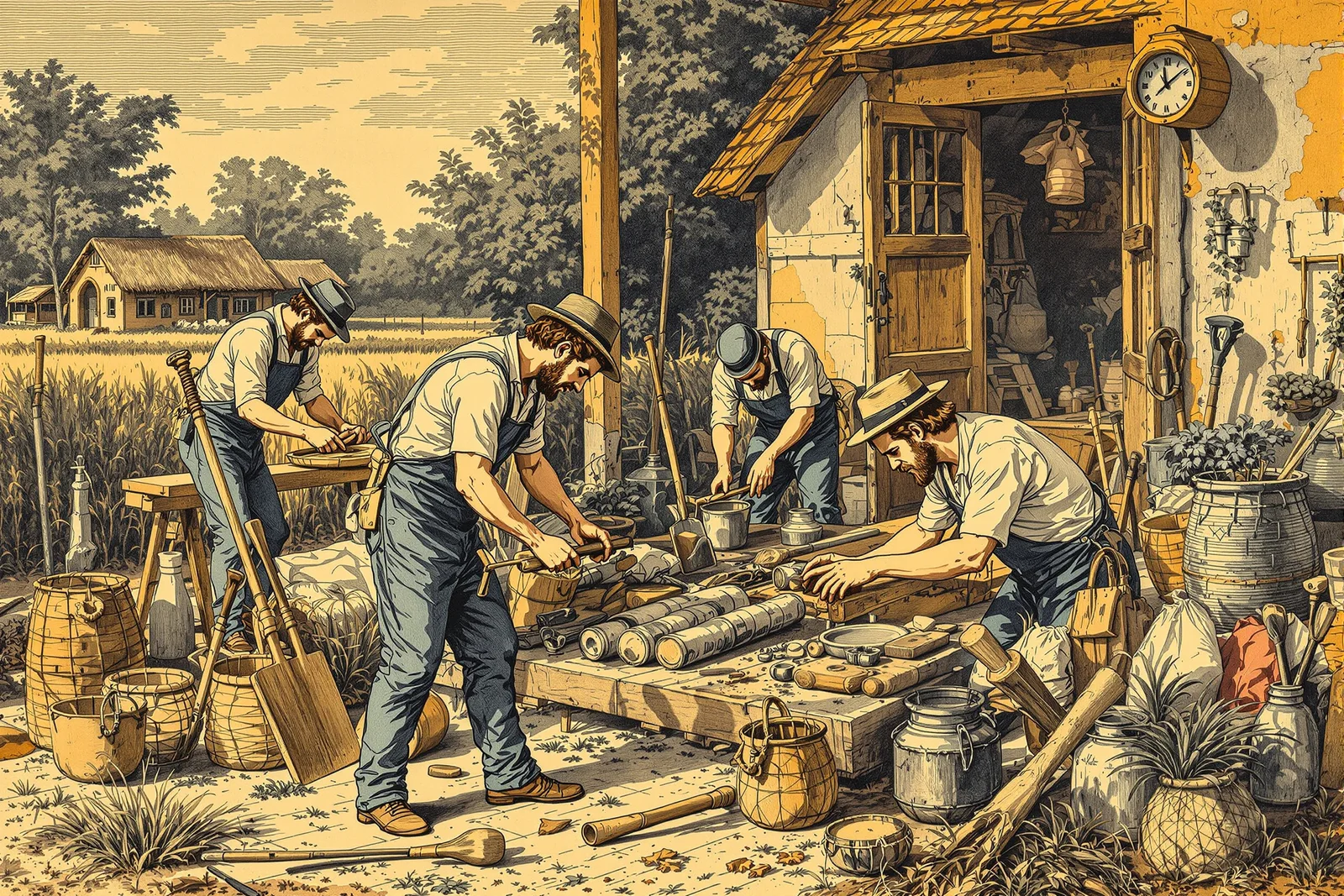
Complete Garden Tool Making: From Bar to Cultivating Implements
Garden tools are the blacksmith's most consistently demanded products. This campaign covers trowels, cultivators, hoes, rakes, and dibbers for the home gardener.
Chapter 1: Garden Tool Types
| Tool | Function | Size | Steel |
|---|---|---|---|
| Hand trowel | Digging, transplanting | 12-14 inches | Medium carbon |
| Hand fork | Loosening soil, weeding | 12-14 inches | Medium carbon |
| Cultivator | Breaking crust, weeding | 12-14 inches (hand) | Medium carbon |
| Hoe (draw) | Weeding, furrowing | 54-60 inches (long) | Medium carbon |
| Hoe (stirrup) | Weeding (push-pull) | 54-60 inches (long) | Medium carbon |
| Garden rake | Leveling, debris removal | 54-60 inches (long) | Mild steel |
| Dibber | Making planting holes | 10-12 inches | Mild steel |
Chapter 2: Hand Trowel Forging
Hand trowel: 1) Start with 1045 steel plate (3/16 inch thick, 3 x 8 inches). 2) Cut blade shape: pointed oval. 3) Forge slight dish (scoop shape). 4) Draw out tang from base of blade. 5) Tang: 4-5 inches long, 1/4 inch square. 6) Bend tang upward 15-20 degrees (knuckle clearance). 7) Fit wooden handle to tang. 8) Sharpen blade edges slightly (cuts through soil). 9) Polish blade (soil releases from smooth surface).
| Dimension | Hand Trowel | Hand Fork | Hand Cultivator |
|---|---|---|---|
| Blade/head length | 5-6 inches | 4-5 inches | 3-4 inches |
| Blade/head width | 2.5-3 inches | 2-3 inches (3 tines) | 3-4 inches (3 tines) |
| Tang length | 4-5 inches | 4-5 inches | 4-5 inches |
| Handle length | 4-5 inches | 4-5 inches | 4-5 inches |
| Total length | 12-14 inches | 12-14 inches | 12-14 inches |
Chapter 3: Draw Hoe Forging
Draw hoe: 1) Start with medium-carbon steel (1045). 2) Blade: 6-8 inches wide, 4-5 inches deep. 3) Forge from flat plate or draw from bar. 4) Forge socket or eye at top of blade. 5) Socket receives handle (1-1.25 inch diameter). 6) Blade angle: 60-70 degrees from handle. 7) Sharpen bottom edge (cutting edge for weeds). 8) Handle: 54-60 inches (ash or hickory).
| Hoe Type | Blade Width | Blade Depth | Blade Angle | Use |
|---|---|---|---|---|
| Draw hoe | 6-8 inches | 4-5 inches | 60-70 degrees | General weeding |
| Collinear hoe | 7-8 inches | 1 inch | 70-80 degrees | Precision weeding |
| Stirrup hoe | 5-7 inches | 1 inch (loop) | 70-80 degrees | Push-pull weeding |
| Warren hoe | 3-4 inches | 5-6 inches (pointed) | 60-70 degrees | Furrowing |
Chapter 4: Garden Rake
Garden rake: 1) Head: flat bar, 14-16 inches long. 2) Forge tines: 12-14 tines, 2-3 inches long. 3) Tines spaced 1-1.25 inches apart. 4) Forge or weld tines to head bar. 5) Or punch tines from single piece (traditional). 6) Forge socket at center of head (receives handle). 7) Handle: 54-60 inches. 8) Tines should be slightly curved (gathers debris).
Chapter 5: Dibber and Specialty Tools
Dibber: 1) Start with 1/2 inch round bar, 10-12 inches long. 2) Forge point at one end (tapered, smooth). 3) Forge handle at other end (T-handle or ball). 4) Depth marks: forge notches at 1-inch intervals. 5) Used to make planting holes for seeds and seedlings.
| Specialty Tool | Design | Use |
|---|---|---|
| Dibber | Pointed rod with handle | Making planting holes |
| Weeder | Forked blade, long handle | Extracting deep-rooted weeds |
| Bulb planter | Cylindrical scoop | Planting bulbs |
| Edger | Half-moon blade | Cutting lawn edges |
| Soil knife | Wide, serrated blade | Cutting roots, dividing plants |
Reference Card
- Garden tools must be comfortable for extended use (a gardener uses hand tools for hours; handles must fit the hand, tang offsets must clear knuckles, and weight must be balanced). 2. Polish the blade surface (soil, clay, and mud release easily from a polished surface; a rough surface causes soil to stick, making the tool heavy and inefficient). 3. Sharpen the cutting edges (hoe blades, trowel edges, and cultivator tines work better when sharp; sharp edges cut through soil and roots with less effort). 4. The draw hoe is the gardener's most important tool (the draw hoe weeds, furrows, hills, and cultivates; a well-made draw hoe with a sharp edge and comfortable handle transforms garden work). 5. Socket connections are stronger than tang connections for long-handled tools (a socket wraps around the handle, distributing stress; a tang concentrates stress at one point; sockets last longer under heavy use). 6. Match the steel to the task (cutting tools like hoes need medium-carbon steel for edge retention; rakes and dibbers can use mild steel since they do not need a cutting edge). 7. Garden tools are the blacksmith's most reliable income (every gardener needs tools; tools wear out and need replacement; a blacksmith who makes quality garden tools has a steady, year-round customer base). 8. A set of handmade garden tools is a joy to use (the weight, balance, and feel of handmade tools cannot be matched by mass-produced alternatives; gardeners who use handmade tools never go back).