Sovereignty Module: Set the Post
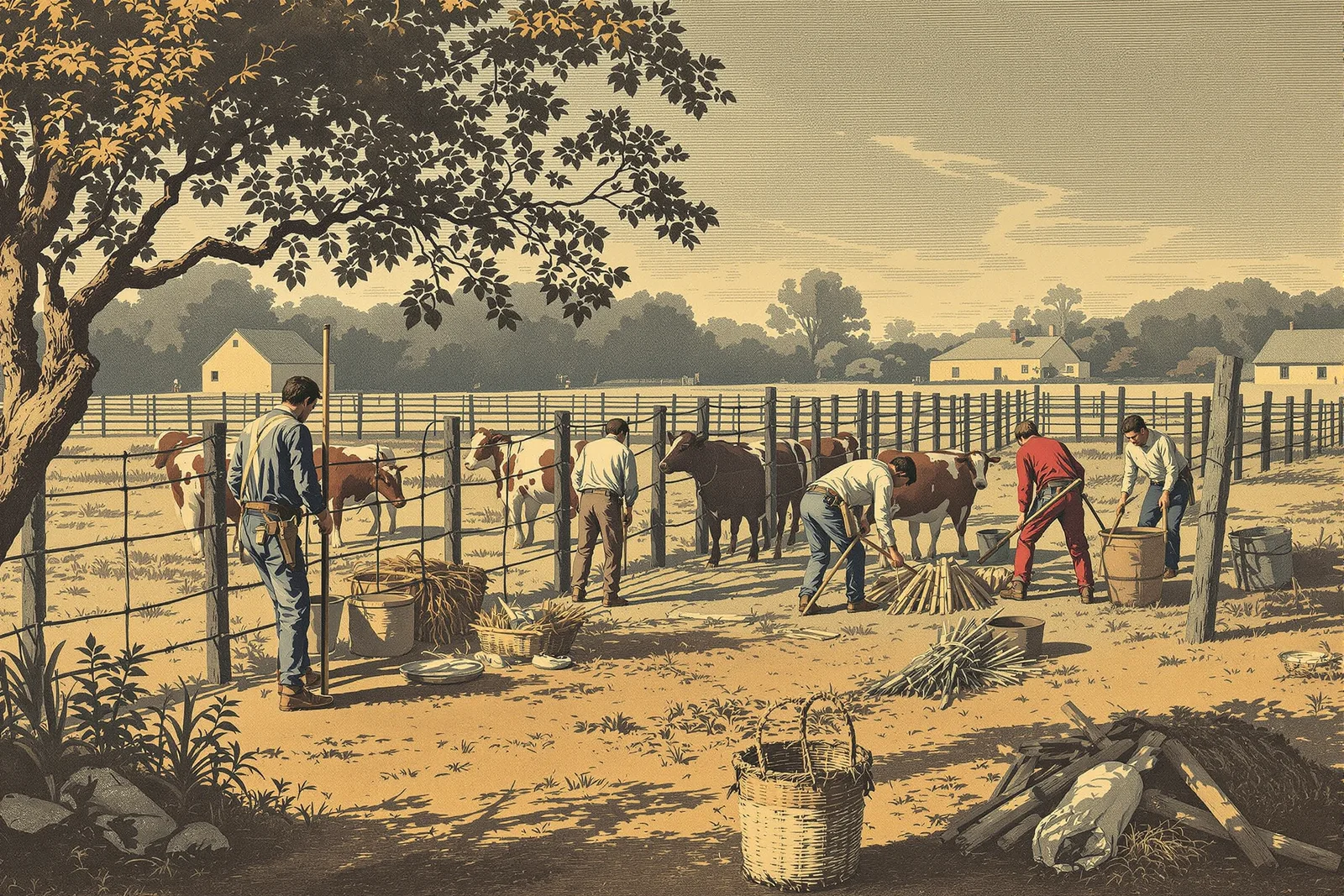
Complete Fence Building and Livestock Containment: From Post to Pasture
Fences define property, protect crops, and contain livestock. This campaign covers fence types, post setting, wire stringing, gate construction, and animal-specific requirements.
Chapter 1: Fence Types
| Fence Type | Cost | Durability | Difficulty | Best For | Lifespan |
|---|---|---|---|---|---|
| Split rail | Low | Good | Moderate | Cattle, horses, decoration | 20-50 years |
| Post and rail | Moderate | Good | Moderate | Horses, cattle | 15-30 years |
| Woven wire (field fence) | Moderate | Very good | Moderate | Sheep, goats, cattle | 20-30 years |
| Barbed wire | Low | Good | Low-moderate | Cattle, property lines | 15-25 years |
| Electric (single wire) | Very low | Good (if maintained) | Low | Cattle, horses, pigs | 10-20 years (wire) |
| Electric (netting) | Moderate | Good | Low | Poultry, sheep, goats | 5-10 years |
| Board fence | High | Good | Moderate | Horses, aesthetics | 15-25 years |
| Wattle (woven) | Very low | Low-moderate | Moderate | Garden, small livestock | 3-10 years |
| Stone wall | Very low (material) | Excellent | High (labor) | All livestock, permanent | 100+ years |
| Hedge (living fence) | Very low | Excellent (when mature) | Low (patience) | All livestock (when thick) | Indefinite |
Chapter 2: Post Setting
| Post Type | Diameter | Depth | Spacing | Lifespan | Cost |
|---|---|---|---|---|---|
| Cedar | 4-6 inch | 2.5-3 ft | 8-12 ft | 15-25 years | Moderate |
| Locust (black) | 4-6 inch | 2.5-3 ft | 8-12 ft | 25-50+ years | Moderate |
| Osage orange | 4-6 inch | 2.5-3 ft | 8-12 ft | 25-50+ years | Low (if local) |
| Treated pine | 4-6 inch | 2.5-3 ft | 8-12 ft | 20-30 years | Low-moderate |
| Steel T-post | 1.25-1.33 lb/ft | 2-2.5 ft | 8-12 ft | 25-40 years | Moderate |
| Concrete | 4-5 inch | 2.5-3 ft | 8-12 ft | 50+ years | Moderate-high |
Post setting procedure: 1) Mark post locations (string line for straight fence). 2) Dig holes: 2.5-3 feet deep, 3x post diameter wide. 3) Set corner and end posts first (these take the most strain). 4) Corner posts: 6-8 inch diameter minimum, 3.5 ft deep. 5) Brace corner posts (H-brace or diagonal brace). 6) Set post in hole, check plumb (vertical). 7) Backfill: tamp soil in 6-inch layers (or use concrete for corners). 8) Set line posts between corners (string line for alignment). 9) Post tops should be level (use string line or transit).
H-brace construction: 1) Set corner post (8 inch diameter, 3.5 ft deep, concrete). 2) Set brace post 8 ft away (6 inch diameter, 2.5 ft deep). 3) Horizontal brace rail: notch into both posts at 2/3 height. 4) Diagonal wire: from top of corner post to bottom of brace post. 5) Twist wire tight with stick (Spanish windlass). 6) The diagonal wire transfers the pull of the fence into downward force on the brace post. 7) A properly braced corner can hold thousands of pounds of wire tension.
Chapter 3: Wire Fencing
| Wire Type | Gauge | Tensile Strength | Use | Spacing |
|---|---|---|---|---|
| Barbed wire (2-point) | 12.5 gauge | 1,350 lbs | Cattle, property | 4-5 strands, 10-12 inches apart |
| High-tensile smooth | 12.5 gauge | 1,800+ lbs | Cattle, horses (with electric) | 5-8 strands |
| Woven wire (field fence) | 11-14.5 gauge | Variable | Sheep, goats, cattle | 32-47 inch height |
| Chicken wire (poultry netting) | 20 gauge | Low | Poultry only | 4-6 ft height |
| Welded wire | 14 gauge | Moderate | Garden, small animals | Various mesh sizes |
| Electric polytape | N/A | Low (visual barrier) | Horses, temporary | 1-3 strands |
Barbed wire stringing: 1) Start at corner post (staple wire to post). 2) Unroll wire along fence line (on ground). 3) At far end: attach wire stretcher (come-along or fence stretcher). 4) Pull wire tight (should deflect 3-4 inches when pushed at midspan). 5) Staple to each line post (drive staple at 45 degrees, leave slight play). 6) Bottom wire first, then work up. 7) Standard cattle fence: 4-5 strands, bottom wire 10-12 inches from ground. 8) Splice wire with proper wire splice (not just twisted together).
Chapter 4: Electric Fencing
| Component | Function | Selection | Cost |
|---|---|---|---|
| Energizer (charger) | Produces pulsed high voltage | Match to fence length and vegetation | $50-500 |
| Wire/tape | Conducts pulse | High-tensile wire or polytape | Low per foot |
| Insulators | Prevent grounding to posts | Plastic, porcelain | Very low each |
| Ground rods | Complete circuit through earth | Galvanized steel, 6-8 ft | Low each |
| Ground wire | Returns current to energizer | Galvanized wire | Low per foot |
Electric fence principles: 1) Energizer sends pulse (1 per second, 5,000-10,000 volts, very low amperage). 2) Animal touches wire: current flows through animal, through ground, back to energizer via ground rods. 3) Animal receives shock (painful but not harmful). 4) Animal learns to avoid fence (psychological barrier after 1-2 shocks). 5) Grounding is critical: minimum 3 ground rods, 6-8 ft long, 10 ft apart. 6) Poor grounding = weak shock = animals push through. 7) Vegetation touching wire drains power (keep fence line clear). 8) Test with voltmeter: should read 3,000+ volts on fence line.
Chapter 5: Animal-Specific Requirements
| Animal | Fence Height | Type | Special Needs | Escape Method |
|---|---|---|---|---|
| Cattle | 4-5 ft | Barbed, electric, woven wire | Strong corners, tight wire | Push through, lean on |
| Horses | 4.5-5 ft | Board, electric tape, smooth wire | Visible fence (no barbed wire) | Jump, run through |
| Sheep | 4 ft | Woven wire (small mesh) | Small mesh at bottom | Squeeze through |
| Goats | 4-5 ft | Woven wire + electric top | Very secure (goats test everything) | Climb, squeeze, jump |
| Pigs | 3-4 ft | Electric (low), woven wire, board | Wire at nose height (8-12 inches) | Root under |
| Poultry | 4-6 ft | Chicken wire, electric netting | Buried apron (predator protection) | Fly over, predators dig under |
| Dogs | 4-6 ft | Chain link, board, welded wire | Buried wire or concrete footer | Dig under, jump over |
Reference Card
- Corner posts make the fence (weak corners = sagging fence; invest in heavy corner posts with proper H-braces). 2. Tamp in layers (backfill post holes in 6-inch layers, tamping each; loose fill = leaning posts). 3. Barbed wire is not for horses (horses panic and thrash when caught; use smooth wire, board, or electric tape). 4. Grounding makes electric fence work (poor grounding is the number one cause of electric fence failure; use 3+ ground rods). 5. Goats test everything (if a fence won't hold water, it won't hold goats; use woven wire with electric top strand). 6. Pigs root under (pigs lift fences from below; run electric wire at nose height, 8-12 inches from ground). 7. Fence the perimeter first (secure the boundary before dividing into paddocks; escaped animals are the priority). 8. Maintain or replace (a neglected fence is no fence; walk the line monthly, fix problems immediately).