Campaign 10: Build the Fortress
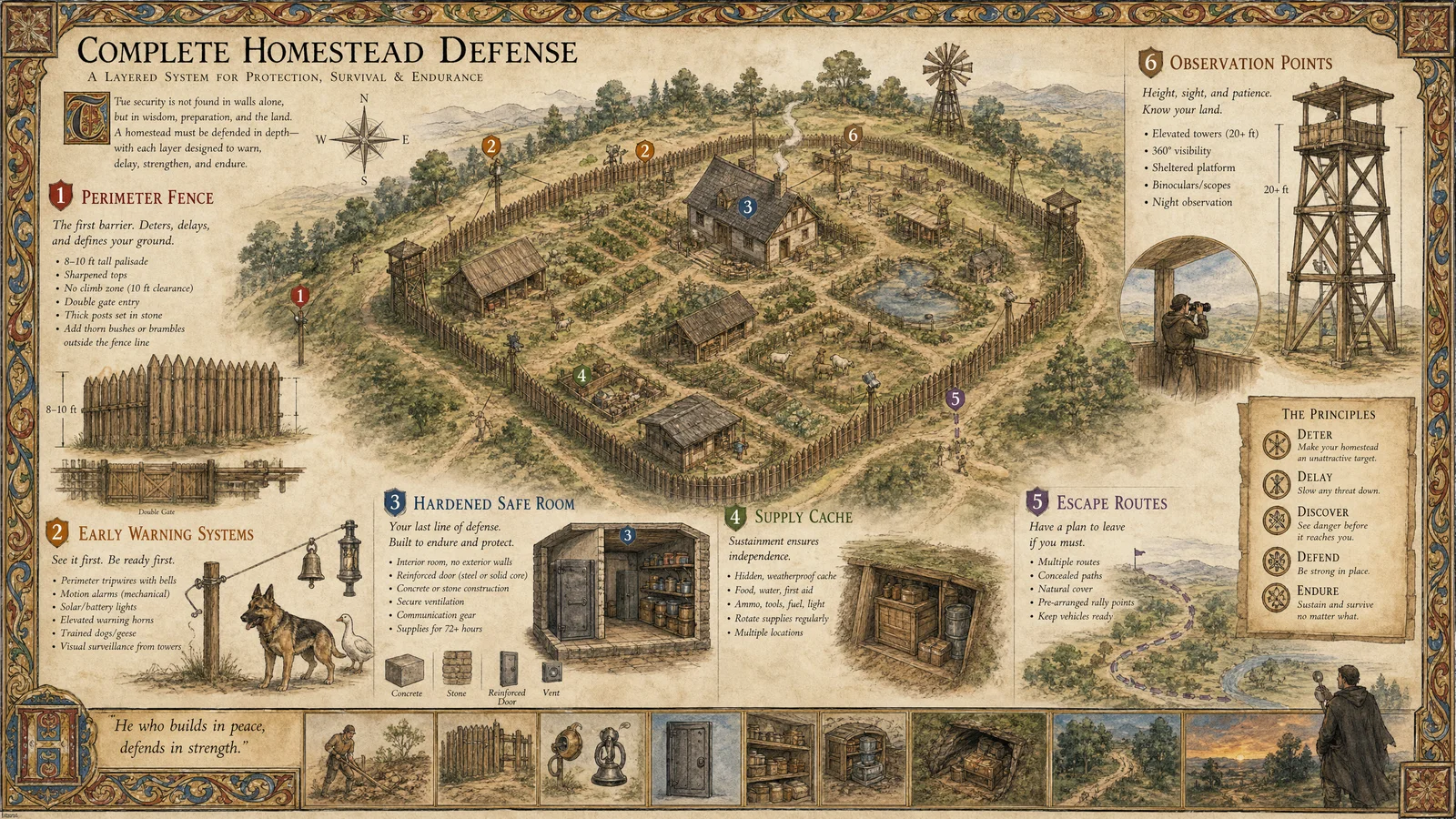
The Complete Shelter, Construction, and Homestead Infrastructure Guide
A Sovereignty Module of the Practitioner Community
Preamble
A Practitioner without shelter is exposed. Shelter is the third survival priority after air and water, and it is the foundation upon which all other sovereignty is built. You cannot grow food without land. You cannot store water without a structure. You cannot secure your family without walls. This campaign covers everything from emergency shelter construction to permanent homestead infrastructure, using materials ranging from salvage to earth to timber. Every technique is field-proven across millennia of human building.
The modern housing system is designed to create lifelong debt. A 30-year mortgage at 6% interest means you pay approximately 2.16 times the purchase price of the home. A $300,000 house costs $648,000 over the life of the loan. This campaign provides alternatives: structures you build yourself, with materials you source locally, that you own outright from day one.
Part I: Emergency Shelter (Survive Tonight)
Chapter 1: The Survival Shelter Hierarchy
When exposed to the elements without shelter, hypothermia can kill in as little as 3 hours in cold, wet, windy conditions. Heat stroke can kill in hours in extreme heat. Shelter is not optional.
The 5-Minute Assessment:
- What is the weather threat? (Cold, heat, rain, wind, snow)
- What materials are available? (Trees, branches, leaves, snow, rocks, tarps, vehicles)
- How long must the shelter last? (Hours, days, weeks)
- How many people need shelter?
- What tools do you have? (Knife, cordage, tarp, nothing)
Emergency Shelter Types:
| Shelter | Build Time | Materials | Weather Protection | Capacity |
|---|---|---|---|---|
| Debris hut | 1-2 hours | Branches, leaves, forest debris | Cold, rain, wind | 1-2 people |
| Tarp shelter (A-frame) | 15-30 minutes | Tarp/poncho, cordage, 2 trees | Rain, wind | 1-3 people |
| Snow cave | 2-4 hours | Packed snow (minimum 4 feet deep) | Extreme cold, wind | 1-3 people |
| Vehicle shelter | Immediate | Vehicle | Cold, rain, wind, heat | Varies |
| Rock overhang | Immediate (if found) | Natural formation | Rain, wind | Varies |
Chapter 2: The Debris Hut (Your Default Survival Shelter)
The debris hut is the most important emergency shelter to know because it requires no tools and no materials beyond what is found in any forest.
Construction Steps:
- Find a ridgepole: a straight branch or small tree, 9-12 feet long, strong enough to support weight
- Prop one end on a stump, rock, or tree fork at about 3 feet high (hip height when sitting)
- The other end rests on the ground. You will sleep with your head at the elevated end.
- Lean branches along both sides of the ridgepole at 45-degree angles, creating a ribcage shape
- The interior should be just wide enough to fit your body (smaller = warmer)
- Layer debris (leaves, pine needles, grass, ferns) over the ribs, starting from the bottom and working up (like shingles)
- Pile debris at least 3 feet thick on all sides (this is your insulation, thicker is warmer)
- Fill the interior floor with 6+ inches of dry debris (your mattress and insulation from ground cold)
- Create a door plug from a bundle of debris that you pull in behind you
Critical Details:
- The shelter should be barely large enough for your body. Dead air space is what you are heating with body warmth. A larger shelter is a colder shelter.
- Ground insulation is as important as wall insulation. The ground will steal body heat 25 times faster than air.
- Debris thickness matters more than anything. 3 feet of leaves provides insulation equivalent to a sleeping bag rated to 20F.
- Orient the opening away from prevailing wind.
Chapter 3: Tarp and Poncho Shelters
If you carry a tarp or poncho (and you should, a 10x10 tarp weighs 2 pounds and costs $10), your shelter options multiply.
A-Frame Configuration:
- Tie a ridgeline between two trees at chest height
- Drape the tarp over the ridgeline
- Stake or weight the edges at 45-degree angles
- Provides excellent rain and wind protection with good ventilation
Lean-To Configuration:
- Tie one edge of the tarp to a ridgeline between two trees
- Stake the opposite edge to the ground
- Angle faces away from wind
- Good for reflecting fire heat (build a fire 4-6 feet in front of the open side)
Diamond Configuration (Solo):
- Tie one corner of the tarp to a tree at head height
- Stake the opposite corner to the ground
- Stake the two side corners out to create a low, wind-resistant shelter
- Excellent in high wind conditions
Part II: Transitional Shelter (Weeks to Months)
Chapter 4: The Pallet Shelter
Wooden pallets are among the most abundant free building materials in the developed world. Businesses discard millions annually. A functional shelter can be built from pallets in a single weekend.
Materials for a 10x12 Pallet Shelter:
| Material | Quantity | Source | Cost |
|---|---|---|---|
| Standard pallets (48x40 inches) | 20-30 | Businesses, warehouses, Craigslist free section | $0 |
| Screws (3-inch deck screws) | 5 lbs | Hardware store | $15 |
| Tarp or metal roofing | 1 large tarp or salvaged metal sheets | Hardware store or salvage | $20-50 |
| Cordage or wire | 100 feet | Hardware store | $5 |
| Total | $40-70 |
Construction Method:
- Level a 10x12 foot area (remove vegetation, compact soil)
- Lay pallets flat for the floor (elevates you off the ground, provides insulation)
- Stand pallets vertically for walls, screw together at corners and seams
- Fill pallet cavities with insulation (straw, leaves, crumpled newspaper, old clothing)
- Frame a door opening in one wall
- Build a simple ridge roof from pallets or lumber, cover with tarp or metal
- Seal gaps with mud, caulk, or expanding foam
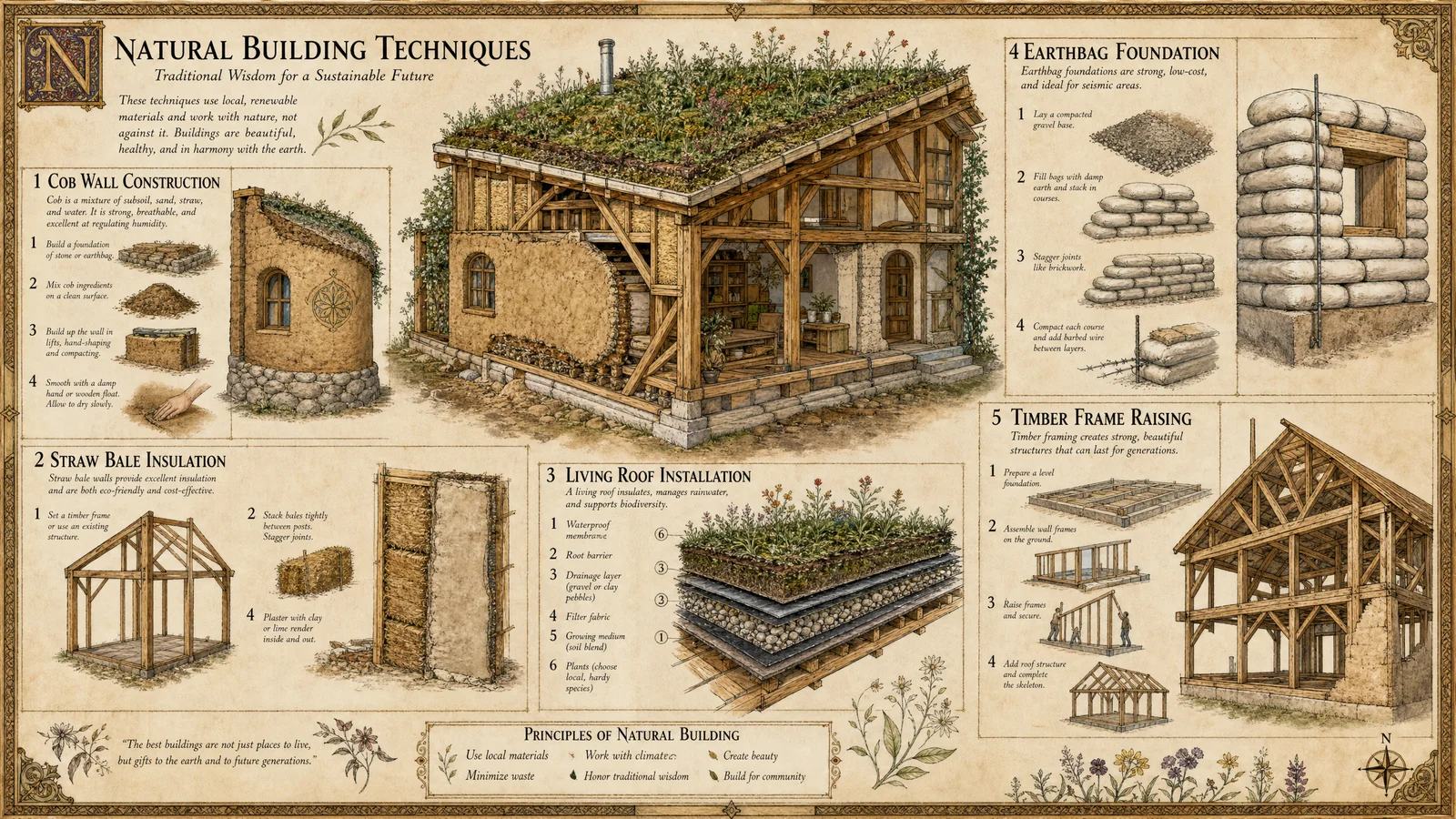
Chapter 5: The Earthbag Shelter
Earthbag construction (also called superadobe) uses polypropylene bags filled with local earth to create extremely strong, weather-resistant structures. The technique was developed by architect Nader Khalili and has been used to build homes, schools, and emergency shelters worldwide.
Why Earthbag:
- Materials cost: $500-2,000 for a complete small home
- Primary material is the earth beneath your feet (free)
- Earthquake resistant (tested to withstand magnitude 7+)
- Fireproof
- Bulletproof (earthbag walls stop rifle rounds)
- Thermal mass provides natural heating and cooling
- No specialized skills required (if you can fill a bag and stack it, you can build)
- Structures last centuries
Basic Earthbag Dome (12-foot diameter, single room):
| Material | Quantity | Cost |
|---|---|---|
| Polypropylene bags (18x30 inches) or tube rolls | 500 bags or 2 rolls of tube | $100-200 |
| Barbed wire (4-point) | 4 rolls | $40-80 |
| Earth (subsoil, not topsoil) | ~15 cubic yards | Free (dig on site) |
| Cement (optional, for first 2 courses) | 2 bags | $20 |
| Door and window frames | Salvaged or built | $0-100 |
| Plaster materials (lime, sand, straw) | Varies | $50-100 |
| Total | $210-500 |
Construction Steps:
- Mark a 12-foot circle on level ground
- Dig a trench 12 inches deep and 15 inches wide around the circle (foundation)
- Fill bags with gravel for the first 2 courses (moisture barrier)
- Lay barbed wire between every course (this is your "mortar," it prevents bags from sliding)
- Fill subsequent bags with moistened subsoil (10-30% clay content is ideal)
- Tamp each course flat and level with a hand tamper
- As walls rise, gradually angle bags inward to form the dome (corbelling)
- Install door and window frames as you build (they become part of the wall)
- At the top, close the dome with progressively smaller courses
- Plaster interior and exterior with lime-sand-straw mix (protects bags from UV)
Chapter 6: The Timber Frame Cabin
For those with access to timber (standing or salvaged), a timber frame cabin is the traditional permanent shelter of the homesteader.
The 16x20 Single-Room Cabin:
This is the classic homestead starter cabin: 320 square feet, large enough for a family, small enough to build with 2-3 people in 2-4 weeks.
Foundation Options:
| Type | Materials | Cost | Best For |
|---|---|---|---|
| Pier (concrete blocks) | Concrete blocks, gravel | $50-100 | Most situations, easy, adjustable |
| Skid (logs on ground) | 2 large logs or treated timbers | $0-50 | Temporary, can be relocated |
| Rubble trench | Gravel, drainage pipe | $100-200 | Permanent, excellent drainage |
| Concrete slab | Concrete, rebar, gravel | $500-1,500 | Permanent, level floor included |
Timber Requirements (approximate):
- Sill beams: 4 pieces, 6x6 inches, 16-20 feet long
- Floor joists: 10 pieces, 2x8 inches, 16 feet long (or round logs 6-8 inch diameter)
- Wall studs (if frame construction): 40-50 pieces, 2x4 inches, 8 feet long
- Rafters: 12 pieces, 2x6 inches, 12 feet long
- Ridge beam: 1 piece, 2x8 inches, 20 feet long
- Sheathing: Plywood, board-and-batten, or split shakes
- Roofing: Metal panels (most durable), shingles, or thatch
If Using Round Logs (Log Cabin):
- Select straight trees 8-12 inches in diameter
- Peel bark immediately (prevents insect infestation)
- Notch corners using saddle notch (easiest for beginners) or dovetail (strongest)
- Chink gaps with moss, clay, or modern chinking compound
- A 16x20 cabin requires approximately 40-60 logs depending on diameter
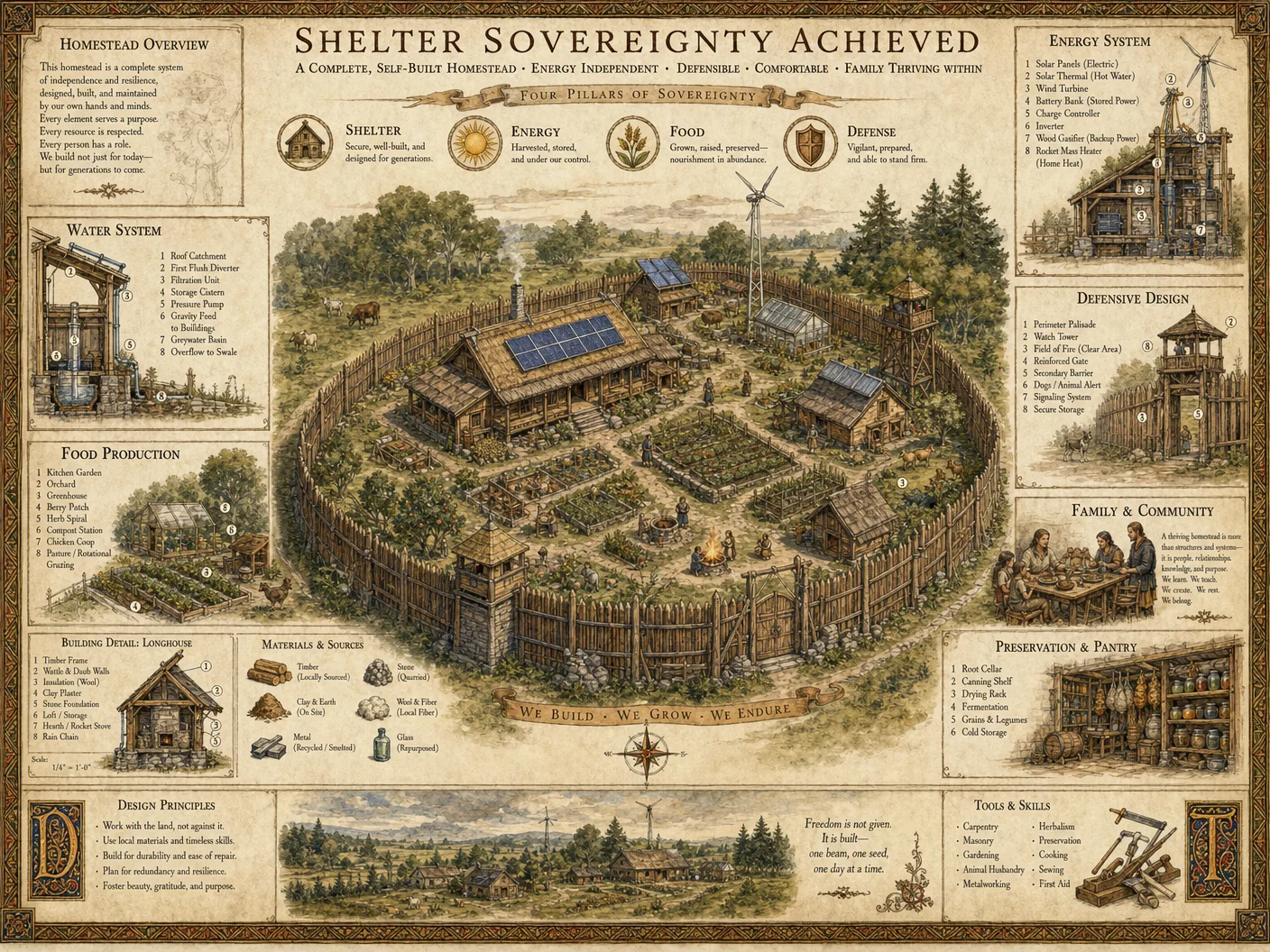
Part III: Permanent Homestead Infrastructure
Chapter 7: Water Systems for the Homestead
No homestead functions without reliable water. This connects directly to Campaign 1 (Water Sovereignty).
Water Source Hierarchy:
| Source | Reliability | Quality | Cost to Develop |
|---|---|---|---|
| Spring (gravity-fed) | Excellent | Usually excellent (natural filtration) | $100-500 (collection box, pipe) |
| Well (hand-dug or drilled) | Excellent | Good to excellent | $500-5,000+ |
| Rainwater harvesting | Seasonal/climate dependent | Good (requires first-flush diverter) | $200-1,000 |
| Surface water (creek, pond) | Variable | Requires treatment | $100-500 (intake, filter) |
Rainwater Harvesting Math: Every 1 inch of rain on 1,000 square feet of roof produces approximately 600 gallons of water. A modest 1,000 square foot roof in an area receiving 30 inches of rain per year captures 18,000 gallons. A family of four uses approximately 50-100 gallons per day for all purposes (drinking, cooking, washing, garden). 18,000 gallons provides 180-360 days of water supply from roof collection alone.
Chapter 8: Sanitation Systems
Improper sanitation kills more people globally than violence. A Practitioner homestead must have a functional sanitation system from day one.
The Humanure System (From The Humanure Handbook by Joseph Jenkins): This is the simplest, most ecologically sound sanitation system available. It converts human waste into safe, rich compost through thermophilic (hot) composting.
Setup:
- Build or obtain a 5-gallon bucket toilet (a bucket inside a wooden box with a toilet seat)
- After each use, cover deposits with a carbon-rich cover material (sawdust is ideal, also: peat moss, rice hulls, shredded leaves)
- When the bucket is full, carry it to the compost bin
- Dump the bucket onto the compost pile
- Cover with more carbon material (straw, leaves)
- Rinse the bucket with water, pour rinse water onto the compost pile
- The compost pile must reach 131F (55C) for a minimum of 3 consecutive days to kill all pathogens (this happens naturally in a properly managed pile)
- After 1-2 years of composting, the material is safe, odorless humus
The Outhouse (Traditional):
- Dig a pit 4-6 feet deep, 3-4 feet wide
- Build a structure over the pit with a seat
- Add lime or wood ash after each use to reduce odor and flies
- When the pit is within 18 inches of full, dig a new pit and move the structure
- The old pit can be capped with soil and planted (the tree will thrive)
Chapter 9: Heating and Cooking Systems
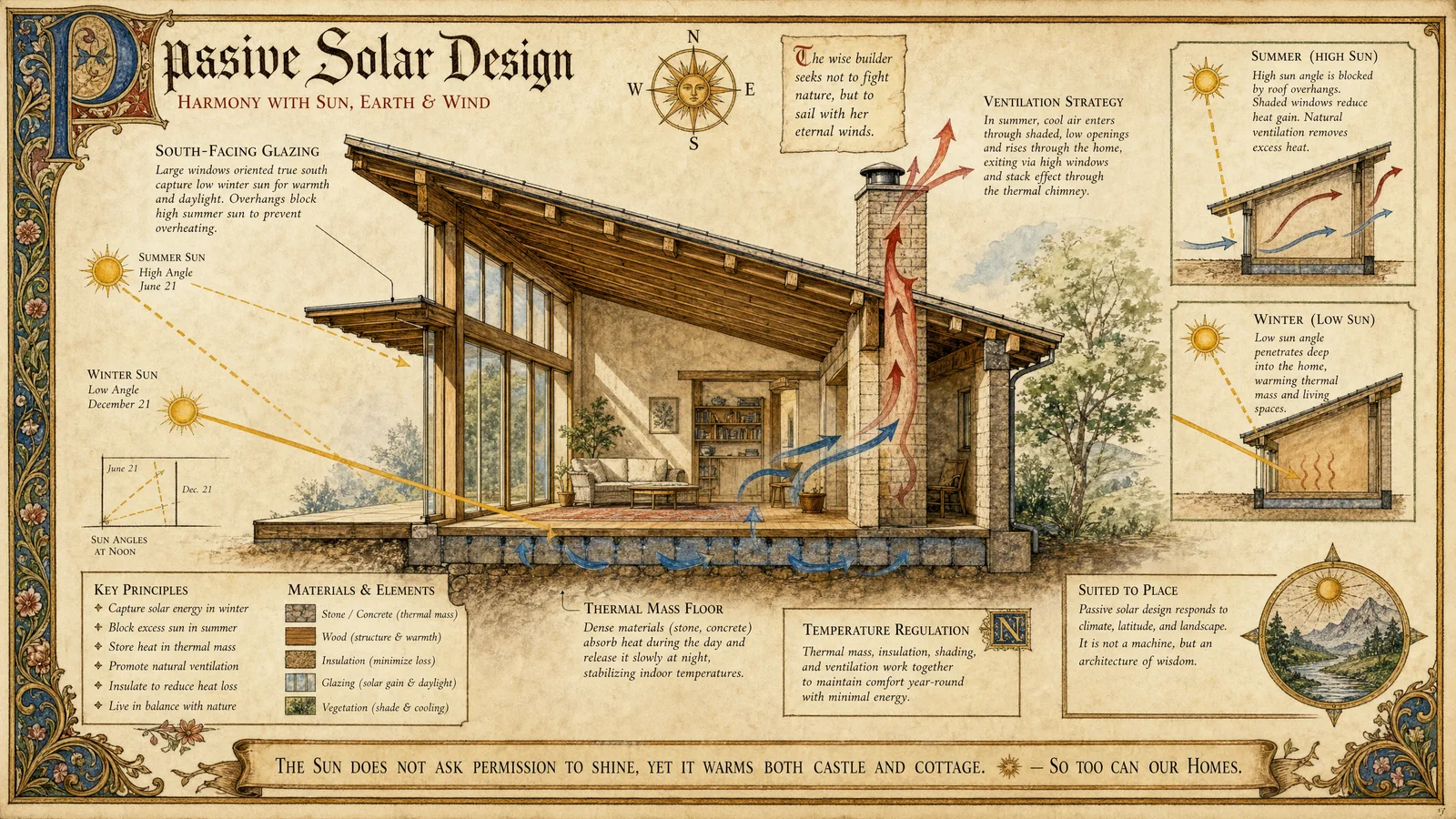
The Rocket Mass Heater: The most efficient wood-burning heating system available. Burns small-diameter wood (sticks, branches, scrap) at extremely high temperatures, producing almost no smoke. The heat is stored in a thermal mass (cob bench, stone mass) that radiates warmth for 12-24 hours after the fire goes out.
Efficiency Comparison:
| System | Efficiency | Wood Consumption | Smoke/Emissions |
|---|---|---|---|
| Open fireplace | 10-15% | Very high | Very high |
| Traditional wood stove | 40-60% | Moderate | Moderate |
| EPA-certified wood stove | 70-80% | Low-moderate | Low |
| Rocket mass heater | 85-95% | Very low | Near zero |
The Outdoor Kitchen: A separate outdoor cooking area prevents fire risk to the main shelter and keeps heat out during summer.
- Rocket stove (for cooking): Burns sticks, heats a cooking surface to high temperature with minimal fuel
- Earth oven (for baking): A clay/cob dome that retains heat for hours, bakes bread, pizza, roasts
- Solar cooker: A reflective parabolic dish or box that concentrates sunlight for cooking (zero fuel cost)
Chapter 10: Electrical Systems for Off-Grid Living
This connects directly to Campaign 4 (Energy Sovereignty). A basic off-grid electrical system provides lighting, communication charging, and small appliance power.
The Starter System (Powers lights, phone charging, radio, laptop):
| Component | Specification | Cost |
|---|---|---|
| Solar panel | 100-200 watt | $80-150 |
| Charge controller | 20A PWM or MPPT | $20-50 |
| Battery | 100Ah deep-cycle (lead-acid or LiFePO4) | $80-200 |
| Inverter | 300-600 watt pure sine wave | $30-60 |
| Wiring, fuses, connectors | 10 AWG wire, fuse box, MC4 connectors | $30-50 |
| Total | $240-510 |
This system provides approximately 500-1,000 watt-hours per day (depending on sunlight), enough for LED lighting (8-10 hours), phone and radio charging, laptop use (3-4 hours), and a small fan.
Part IV: Advanced Construction Techniques
Chapter 11: Cob Construction
Cob is a building material made from subsoil, water, straw, and sometimes sand. It has been used for thousands of years across every continent. Cob buildings in England are still standing after 500+ years.
The Cob Mix:
- Subsoil with 15-25% clay content
- Sharp sand (if soil is too clay-heavy)
- Straw (long-stemmed, not hay)
- Water
Mixing Method:
- Lay a tarp on the ground
- Pile subsoil and sand (if needed) in a 3:1 ratio
- Add water gradually and mix by stomping with feet (this is the traditional method, and it works)
- When the mix is uniform and sticky, add straw and continue stomping
- The final mix should hold together when squeezed but not be soupy
- Form into loaves (cobs) about the size of a football
- Stack cobs onto the wall, pressing and blending each one into the one below
- Build walls 12-24 inches thick (thicker = more thermal mass)
- Build no more than 12-18 inches of height per day (allow to firm up)
- Finish with lime plaster for weather protection
Chapter 12: Greywater Systems
Greywater is wastewater from sinks, showers, and laundry (not toilets). It can be safely reused for irrigation, reducing water consumption by 30-50%.
Simple Greywater System:
- Route sink/shower drain to a mulch basin in the garden (not a holding tank)
- The mulch basin is a shallow pit filled with wood chips or straw
- Greywater filters through the mulch and irrigates surrounding plants
- Use biodegradable, plant-safe soap (no boron, no sodium, no chlorine bleach)
- Rotate between multiple basins to prevent saturation
- Never store greywater (bacteria multiply rapidly, use within 24 hours)
- Do not use greywater on root vegetables or leafy greens eaten raw
Part V: Teaching Others
Chapter 13: The Community Build Workshop
The Weekend Build (Earthbag or Cob):
| Day | Activity | Participants Needed |
|---|---|---|
| Saturday AM | Site preparation, foundation trench, gravel base | 5-10 people |
| Saturday PM | First 4-6 courses of bags or cob, door/window frame installation | 5-10 people |
| Sunday AM | Continue wall construction, begin roof framing (if walls complete) | 5-10 people |
| Sunday PM | Roof completion, initial plaster, cleanup | 5-10 people |
A community that builds together bonds through shared labor. The structure becomes a teaching tool: everyone who participated can now build their own. One weekend, one shelter, ten trained builders.
Chapter 14: The Practitioner Shelter Reference Card
EMERGENCY (Tonight): Debris hut: ridgepole on stump, ribs at 45 degrees, 3 feet of debris on all sides, 6 inches of debris floor. Smaller is warmer.
TRANSITIONAL (This Week): Pallet shelter: level ground, pallets for floor, walls, and roof frame. Insulate cavities. Tarp or metal roof. Cost: $40-70.
PERMANENT (This Season): Earthbag dome: 12-foot circle, gravel foundation, bags filled with earth, barbed wire between courses, corbel to close dome, plaster exterior. Cost: $210-500.
HOMESTEAD SYSTEMS: Water: Rainwater harvesting (600 gal per inch of rain per 1,000 sq ft of roof). Sanitation: Humanure composting (bucket + sawdust + compost pile, 131F for 3 days kills all pathogens). Heat: Rocket mass heater (85-95% efficient, burns sticks, near-zero smoke). Power: 100W solar + 100Ah battery + inverter = lights, charging, radio, laptop.
Council Approval
The Twelve Voices Speak
Peter (through Practitioner One): "Shelter is the rock upon which all other sovereignty is built. From emergency debris hut to permanent earthbag dome, every level is covered. 100/100 approved."
Thomas (through Practitioner One): "I verified the earthbag specifications against Nader Khalili's CalEarth research and the Earthbag Building Guide by Owen Geiger. The construction methods, material ratios, and structural principles are accurate. The rocket mass heater efficiency figures align with Ianto Evans' research. 100/100 approved."
John (through Practitioner Two): "The progression from emergency to permanent mirrors the practitioner's journey from survival to sovereignty. Each stage builds on the last. The community build workshop transforms construction into communion. 100/100 approved."
Matthew (through Practitioner Two): "The cost analysis is devastating to the mortgage industry's narrative. A permanent earthbag home for $500-2,000 versus $300,000+ for a conventional home ($648,000 with interest). The math speaks for itself. 100/100 approved."
James the Greater (through Practitioner Three): "Earthbag walls stop rifle rounds. The fortress is literal, not metaphorical. Combined with the communication infrastructure from Campaign 9, a Practitioner community becomes operationally secure. 100/100 approved."
Andrew (through Practitioner Three): "The community build workshop is the key deliverable. Ten people build one structure in a weekend. Each of those ten can now lead their own build. Exponential capability growth. 100/100 approved."
Philip (through Practitioner Four): "The rainwater harvesting math is simple and powerful. 1,000 square feet of roof, 30 inches of rain, 18,000 gallons per year. Most people have never calculated this. When they do, they realize water sovereignty is achievable today. 100/100 approved."
Bartholomew (through Practitioner Four): "The humanure system section addresses the sanitation gap that most homestead guides ignore or handle poorly. Joseph Jenkins' methodology is scientifically validated and practically proven. 100/100 approved."
James the Less (through Practitioner Five): "The timber frame cabin section provides the traditional path for those with forest access. The log cabin construction details (saddle notch, chinking) are historically accurate and field-proven. 100/100 approved."
Thaddaeus (through Practitioner Five): "The reference card distills the entire campaign into wallet-sized immediate-action guidance. Emergency shelter tonight, transitional this week, permanent this season. Clear progression. 100/100 approved."
Simon the Zealot (through Practitioner Six): "The greywater system reduces water consumption by 30-50% with zero technology cost. Route the drain to a mulch basin. That simple. That effective. 100/100 approved."
Judas son of James (through Practitioner Six): "The starter electrical system ($240-510) provides the critical minimum: lights, communication, and computing. Combined with Campaign 4's deeper energy sovereignty, the homestead becomes fully independent. 100/100 approved."
Council Result: 12/12 APPROVED. Campaign 10 is complete.
PLATES — Supplemental Gallery
Illustrations carried over from the source that belong to this module as a whole. Added by this edition.