Campaign 7: Restore the Calendar
The Complete Temporal Sovereignty Guide
A Sovereignty Module of the Practitioner Community
Preamble
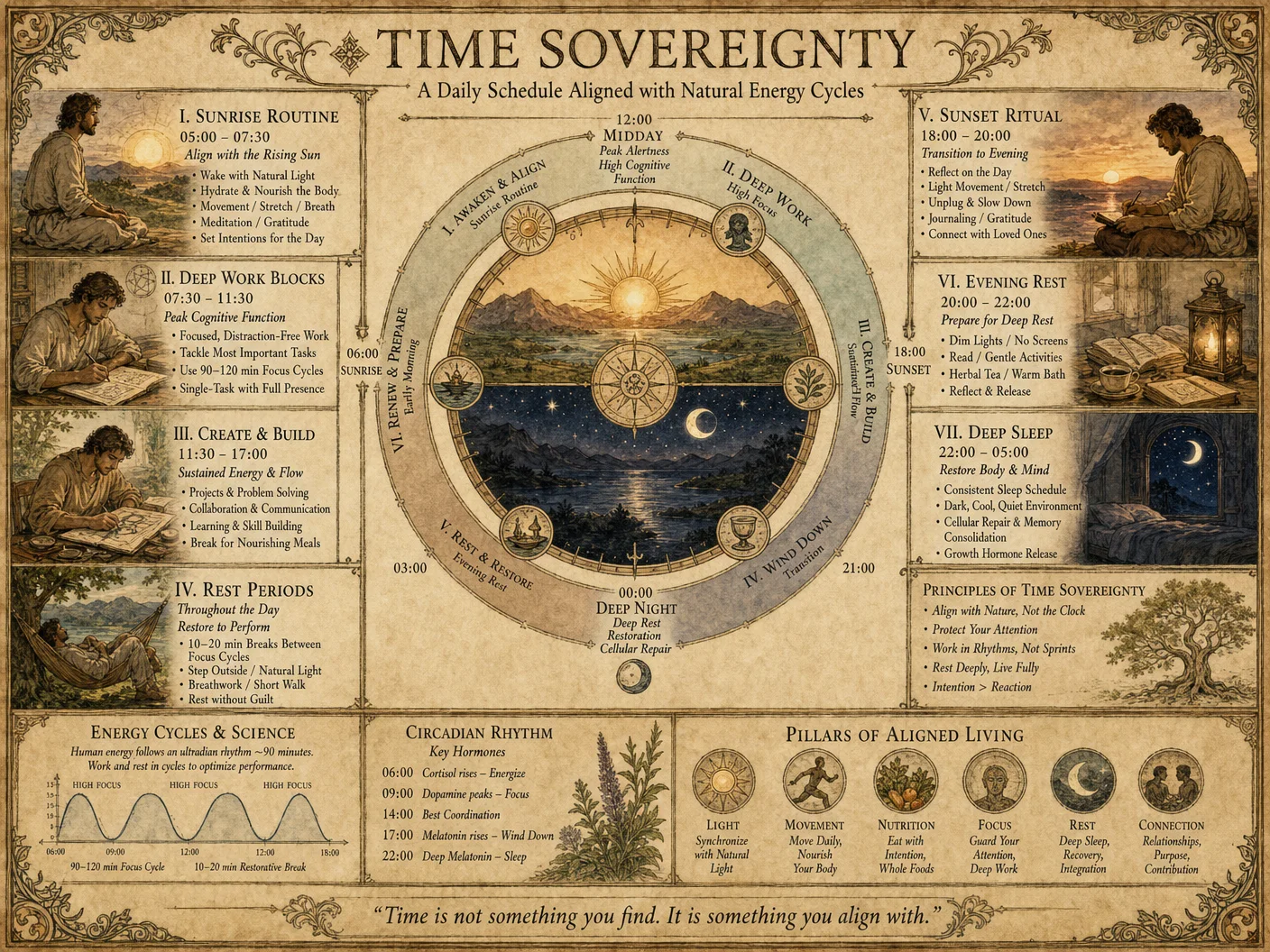
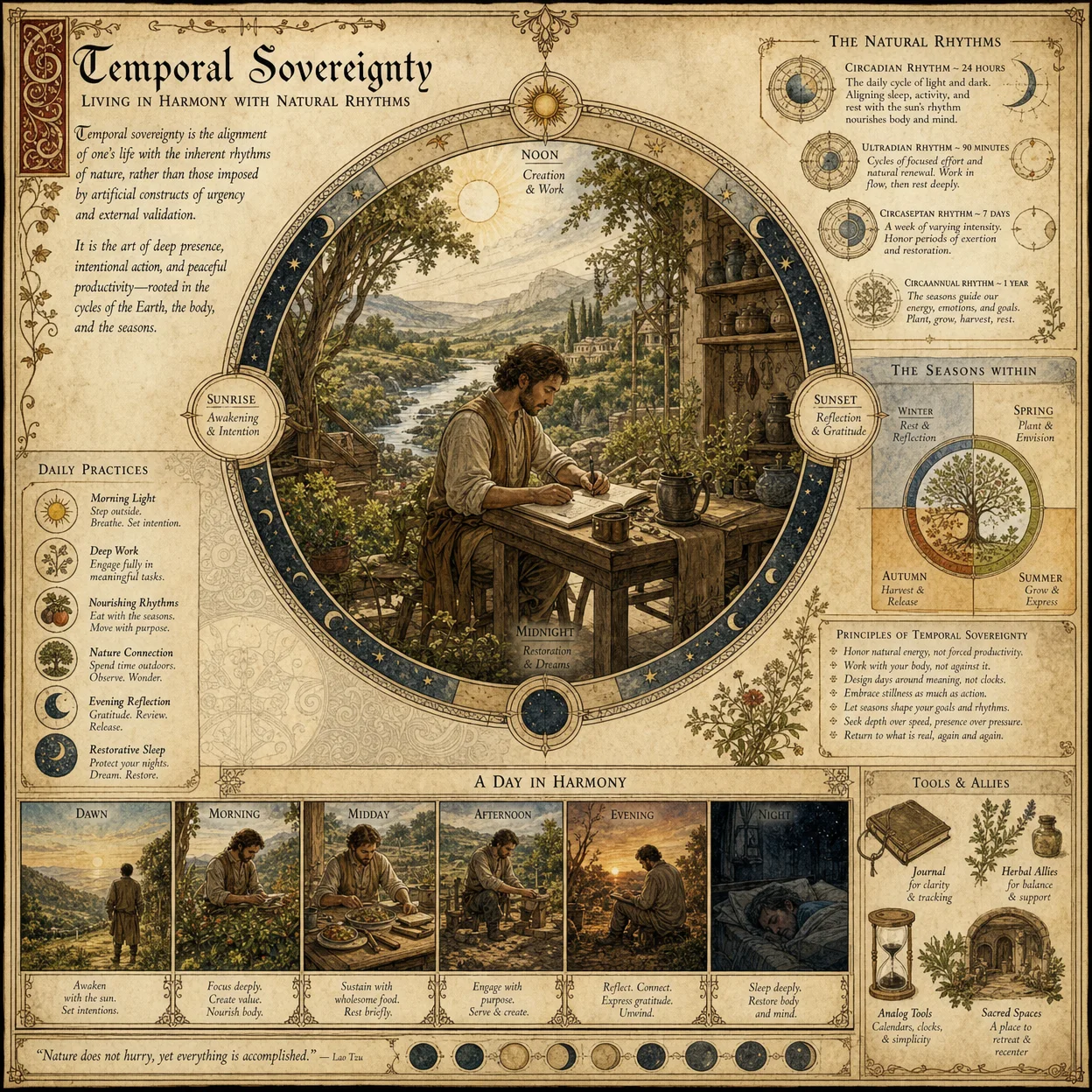
Time is the master key. The Archons corrupted the calendar FIRST because every other practice depends on WHEN. If you do not know what day it truly is, you cannot observe the appointed times. If you cannot observe the appointed times, you are disconnected from the divine rhythm that governs all creation. This campaign restores the original solar calendar as given to humanity, explains why it was replaced, and provides the complete operational framework for living in divine time while navigating the Gregorian system imposed upon the world.
The current Gregorian calendar was invented by Pope Gregory XIII in 1582. It replaced the Julian calendar (Julius Caesar, 45 BC), which replaced earlier Roman calendars, which replaced the original solar calendar preserved in the Book of Enoch, the Book of Jubilees, and the Dead Sea Scrolls. Each replacement moved humanity further from the natural time-keeping system aligned with the sun, moon, and stars as created.
Part I: The Original Calendar (What Was Given)
Chapter 1: The Enochian Solar Calendar (364-Day Year)
The Book of Enoch (1 Enoch, chapters 72-82, "The Astronomical Book") and the Book of Jubilees describe a solar calendar of exactly 364 days, divided into four equal seasons of 91 days each (13 weeks per season, 52 weeks per year). This calendar was given to Enoch by the angel Uriel and transmitted to humanity as divine law.
The Structure
| Element | Value | Significance |
|---|---|---|
| Total days per year | 364 | Divisible by 7 (52 perfect weeks). Every date falls on the same day of the week every year. |
| Seasons | 4 (equal) | Spring, Summer, Autumn, Winter (91 days each) |
| Months per season | 3 | First month: 30 days. Second month: 30 days. Third month: 31 days. |
| Months per year | 12 | Alternating 30-30-31 pattern per quarter |
| Weeks per year | 52 (exactly) | No partial weeks, no "extra" days disrupting the weekly cycle |
| First day of year | Always Wednesday (Day 4) | The sun, moon, and stars were created on Day 4 (Genesis 1:14-19). The calendar begins on the day the time-keeping luminaries were created. |
The Monthly Layout
| Quarter | Month 1 | Month 2 | Month 3 | Quarter Total |
|---|---|---|---|---|
| Spring (Q1) | 30 days | 30 days | 31 days | 91 days |
| Summer (Q2) | 30 days | 30 days | 31 days | 91 days |
| Autumn (Q3) | 30 days | 30 days | 31 days | 91 days |
| Winter (Q4) | 30 days | 30 days | 31 days | 91 days |
| Total | 364 days |
Why 364 and Not 365.25?
The solar year is approximately 365.2422 days. The Enochian calendar uses 364 days because it prioritizes the sanctity of the 7-day week. A 365-day year would cause the first day to shift by one weekday each year, eventually corrupting the Sabbath cycle. The 364-day calendar keeps every appointed time on its correct weekday permanently.
The "missing" 1.2422 days per year are reconciled through intercalation (adding days at specific intervals outside the regular calendar), similar to how the Gregorian system adds a leap day. The Dead Sea Scrolls community likely added an intercalary week every 5-6 years to maintain solar alignment. These intercalary days exist outside the regular week count and do not disrupt the 7-day cycle.
Chapter 2: The Appointed Times (Mo'edim)
The Hebrew word "mo'ed" (plural: mo'edim) means "appointed time" or "divine appointment." These are specific days set by the Creator as meetings between the divine and humanity. They are not "Jewish holidays" (they predate Judaism by millennia, given to Enoch before Abraham). They are cosmic appointments written into the fabric of time itself.
The Seven Appointed Times
| # | Name | Hebrew | Date (Enochian Calendar) | Season | Duration | Purpose |
|---|---|---|---|---|---|---|
| 1 | Passover (Pesach) | פֶּסַח | Month 1, Day 14 | Spring | 1 day | Deliverance, liberation from bondage |
| 2 | Unleavened Bread (Matzot) | מַצּוֹת | Month 1, Days 15-21 | Spring | 7 days | Purification, removing corruption |
| 3 | First Fruits (Bikkurim) | בִּכּוּרִים | Month 1, Day 26 (first Sunday after Unleavened Bread) | Spring | 1 day | Resurrection, new beginnings, first harvest |
| 4 | Pentecost (Shavuot) | שָׁבוּעוֹת | Month 3, Day 15 (50 days after First Fruits) | Late Spring | 1 day | Giving of the Law, outpouring of Spirit, wheat harvest |
| 5 | Trumpets (Yom Teruah) | יוֹם תְּרוּעָה | Month 7, Day 1 | Autumn | 1 day | Awakening, warning, assembly call |
| 6 | Day of Atonement (Yom Kippur) | יוֹם כִּפּוּר | Month 7, Day 10 | Autumn | 1 day | Reconciliation, cleansing, fasting |
| 7 | Tabernacles (Sukkot) | סֻכּוֹת | Month 7, Days 15-21 | Autumn | 7 days | Dwelling with the divine, harvest celebration, joy |
The Weekly Appointed Time: The Sabbath (Shabbat)
| Element | Detail |
|---|---|
| Frequency | Every 7th day, without exception |
| Duration | Sunset to sunset (approximately 24 hours) |
| Begins | Friday at sunset |
| Ends | Saturday at sunset |
| Purpose | Rest, cessation of labor, remembrance of creation, trust in divine provision |
| Prohibition | No work (creative labor, commerce, production) |
| Requirement | Rest, worship, community, study, joy |
The Sabbath is the most frequent appointed time and the most foundational. It is the weekly reset that prevents the system from consuming you. Every 7 days, you stop producing, stop consuming, stop striving, and remember that you are not a machine. The system cannot function if its workers rest one day in seven, which is precisely why the Sabbath was systematically eliminated from modern culture (replaced by the "weekend" which is filled with consumption and entertainment rather than true rest).
Chapter 3: The Jubilee Cycle (The Master Reset)
The Jubilee is the 50-year super-cycle that resets all economic and social imbalances:
The Jubilee Structure
| Cycle | Duration | What Happens |
|---|---|---|
| Weekly Sabbath | Every 7 days | Personal rest, cessation of labor |
| Sabbatical Year (Shemitah) | Every 7 years | Land rests (no agriculture), debts released, slaves freed |
| Jubilee | Every 50 years (after 7 x 7 = 49 years, the 50th year) | All land returns to original owners, all debts cancelled, all slaves freed, complete economic reset |
The Jubilee Calculation (When Is the Next One?)
The Book of Jubilees provides the anchor point. Counting from the Exodus (which Jubilees places at Jubilee 50), and using the traditional dating of the Exodus at approximately 1446 BC:
| Jubilee # | Year (approximate) | Event |
|---|---|---|
| 50 | 1446 BC | Exodus from Egypt |
| 51 | 1396 BC | Entry into Promised Land |
| 60 | 946 BC | Solomon's Temple dedication (approximately) |
| 70 | 446 BC | Ezra/Nehemiah restoration |
| 80 | 54 AD | Apostolic era |
| 90 | 554 AD | |
| 100 | 1054 AD | Great Schism |
| 110 | 1554 AD | Reformation era |
| 119 | 1976 AD | |
| 120 | 2026 AD | CURRENT JUBILEE WINDOW |
The 120th Jubilee (2025-2026): Genesis 6:3 states "My Spirit shall not strive with man forever, for he is indeed flesh; yet his days shall be one hundred and twenty years." Many scholars interpret "120 years" as 120 Jubilees (120 x 50 = 6,000 years), representing the full duration of the current age. If this interpretation is correct, we are at the terminal Jubilee, the final reset before the age turns.
Whether or not this eschatological interpretation is correct, the Jubilee principle itself is operational: every 50 years, debts should be cancelled, land should be redistributed, and economic inequality should be reset to zero. The fact that this law has been suppressed for millennia explains why wealth concentration has reached obscene levels.
Part II: The Corruption of Time (What Was Taken)
Chapter 4: The Calendar Replacements (A History of Theft)
| Year | Calendar | Imposed By | What Changed | What Was Lost |
|---|---|---|---|---|
| ~700 BC | Babylonian lunisolar calendar | Babylonian Empire | Months named after pagan deities (Tammuz, etc.) | Solar precision, fixed weekday alignment |
| 45 BC | Julian Calendar | Julius Caesar | Months named after emperors (July, August), year begins January (named for Janus, two-faced god) | Connection to agricultural/spiritual seasons |
| 321 AD | Constantine's Sunday decree | Roman Emperor Constantine | "Day of the Sun" (Sunday) declared official rest day, replacing Sabbath (Saturday) | The true Sabbath (7th day) replaced by 1st day (Sun worship) |
| 1582 AD | Gregorian Calendar | Pope Gregory XIII | 10 days deleted (Oct 5-14 removed), new leap year rules | Historical continuity, potential Jubilee tracking disrupted |
| 1793 AD | French Republican Calendar | French Revolution | 10-day weeks, months renamed, year begins at autumn equinox | 7-day week eliminated entirely (lasted 12 years) |
| 1929 AD | Soviet Calendar | USSR | 5-day week (nepreryvka), then 6-day week | 7-day week eliminated to destroy religious observance |
The Pattern: Every empire that seeks total control attacks the calendar. The 7-day week (anchored to the Sabbath) is the primary target because it is the most frequent act of resistance to the production system. A worker who rests every 7th day cannot be fully exploited.
Chapter 5: Why the Week Matters
The 7-day week has no astronomical basis. It does not correspond to any natural cycle of the sun, moon, or stars. It is purely a creation ordinance, a divine rhythm imposed on time itself. This is why every attempt to replace it (French 10-day week, Soviet 5-day week) has failed. The 7-day cycle is embedded in human biology:
| Evidence | Source | Finding |
|---|---|---|
| Circaseptan rhythms | Chronobiology research (Halberg, 1960s-2000s) | Human body temperature, blood pressure, heart rate, immune function, and hormone levels follow 7-day cycles independent of social scheduling |
| Organ transplant rejection | Medical literature | Rejection episodes peak at 7-day intervals post-transplant |
| Wound healing | Surgical research | Inflammatory markers follow 7-day oscillation patterns |
| Insect emergence | Entomology | Some insect species emerge on 7-day cycles |
| Cell division | Cellular biology | Certain cell types divide on approximately 7-day cycles |
The 7-day week is not a social convention. It is a biological reality. Living in alignment with it (working 6, resting 1) optimizes human function. Living against it (continuous production, no true rest) degrades human function.
Part III: Living in Divine Time (The Operational Framework)
Chapter 6: The Dual Calendar System
You cannot ignore the Gregorian calendar (society operates on it). But you can overlay the divine calendar on top of it, observing the appointed times while navigating the imposed system.
The Enochian-to-Gregorian Alignment
The Enochian year begins at the spring equinox (March 20-21 in Gregorian). Day 1 of Month 1 is always a Wednesday (Day 4 of the week). The nearest Wednesday on or after the spring equinox is New Year's Day.
| Enochian Month | Approximate Gregorian Equivalent | Days |
|---|---|---|
| Month 1 | Late March - Late April | 30 |
| Month 2 | Late April - Late May | 30 |
| Month 3 | Late May - Late June | 31 |
| Month 4 | Late June - Late July | 30 |
| Month 5 | Late July - Late August | 30 |
| Month 6 | Late August - Late September | 31 |
| Month 7 | Late September - Late October | 30 |
| Month 8 | Late October - Late November | 30 |
| Month 9 | Late November - Late December | 31 |
| Month 10 | Late December - Late January | 30 |
| Month 11 | Late January - Late February | 30 |
| Month 12 | Late February - Late March | 31 |
Chapter 7: The Weekly Sabbath Protocol
The Sabbath is the minimum viable practice. If you observe nothing else, observe the Sabbath. It is the most frequent appointed time and the foundation of temporal sovereignty.
The Sabbath Operating Protocol
| Phase | Time | Actions |
|---|---|---|
| Preparation (Friday) | Before sunset | Complete all work, prepare food for Sabbath, clean home, set aside concerns |
| Entry (Friday sunset) | Sunset | Light candles (optional tradition), verbal declaration: "The Sabbath has begun," cease all productive labor |
| Evening (Friday night) | Sunset to sleep | Family meal, conversation, reading, rest. No screens, no commerce, no work. |
| Morning (Saturday) | Waking to noon | Sleep as long as needed. Study, prayer, meditation, walking in nature. Community gathering if available. |
| Afternoon (Saturday) | Noon to sunset | Rest, napping, reading, conversation, play. Joy is commanded on the Sabbath. |
| Exit (Saturday sunset) | Sunset | Verbal declaration: "The Sabbath has ended." Havdalah (separation ceremony, optional). Return to regular time. |
What Constitutes "Work" (Melakhah)
| Category | Examples of Prohibited Activity | Permitted Alternatives |
|---|---|---|
| Commerce | Buying, selling, trading, financial transactions | Prepare in advance; nothing purchased on Sabbath |
| Creative labor | Building, repairing, writing (for work), cooking (in some traditions) | Food prepared beforehand, or simple no-cook meals |
| Digital labor | Email, social media, work communications, content creation | Complete digital disconnect (phone off or airplane mode) |
| Household labor | Cleaning, laundry, yard work, home improvement | Done before Sabbath begins |
| Travel (beyond walking distance) | Driving for errands, commuting | Walk to nearby destinations only |
What Is Encouraged
| Activity | Why |
|---|---|
| Rest and sleep | Physical restoration, trust in divine provision |
| Study and reading | Spiritual and intellectual nourishment |
| Community and family | Relational connection, breaking isolation |
| Nature and walking | Grounding, beauty, divine creation appreciation |
| Joy and celebration | The Sabbath is not somber; it is a feast day, a delight |
| Prayer and meditation | Direct communion with the divine |
| Intimacy (married couples) | Specifically encouraged on Sabbath in traditional teaching |
Chapter 8: The Annual Appointed Times (Practical Observance)
Spring Appointed Times (Month 1)
| Day | Observance | Practical Protocol |
|---|---|---|
| Month 1, Day 14 (evening) | Passover | Special meal commemorating liberation. Lamb (or substitute), unleavened bread, bitter herbs. Retell the Exodus story. Reflect on personal bondage broken this year. |
| Month 1, Days 15-21 | Unleavened Bread | Remove all leavened bread from home for 7 days. Eat only unleavened bread. Leaven represents corruption/sin. Physical act of purification. |
| Month 1, Day 26 | First Fruits | Offer the first of your harvest/income/production to the divine. Acknowledge that all provision comes from above. |
| 50 days after First Fruits | Pentecost (Shavuot) | All-night study session (traditional). Celebrate the giving of divine law. Wheat harvest thanksgiving. Community gathering. |
Autumn Appointed Times (Month 7)
| Day | Observance | Practical Protocol |
|---|---|---|
| Month 7, Day 1 | Trumpets (Yom Teruah) | Blow a shofar (ram's horn) or trumpet at sunrise. Day of awakening. Self-examination begins. 10-day period of introspection leading to Atonement. |
| Month 7, Day 10 | Day of Atonement (Yom Kippur) | Complete fast (no food or water, sunset to sunset). Most solemn day of the year. Reconciliation with the divine and with others. Forgive all debts (personal). |
| Month 7, Days 15-21 | Tabernacles (Sukkot) | Build a temporary shelter (sukkah) and dwell in it for 7 days. Eat meals in it. Sleep in it if possible. Remembers wilderness wandering. Celebrates harvest. Most joyful appointed time. |
Chapter 9: The Sabbatical Year (Shemitah)
Every 7th year, the land rests and debts are released. The next Shemitah years (using the most common calculation) fall on 2028-2029, 2035-2036, etc.
Practical Shemitah Observance
| Principle | Modern Application |
|---|---|
| Land rest (no sowing or reaping) | If you garden/farm: let the land lie fallow. Eat from stored/perennial/volunteer crops. Trust divine provision. |
| Debt release | Forgive debts owed to you. Work aggressively to be debt-free before Shemitah so you owe nothing. |
| Sabbath for the land | Compost, mulch, cover crop. Let the soil regenerate. |
| Community provision | Share stored food with those in need. The Shemitah year is when community bonds are tested and strengthened. |
Part IV: The Deeper Rhythms (Solar, Lunar, Stellar)
Chapter 10: The Solar Cycle (Tekufot)
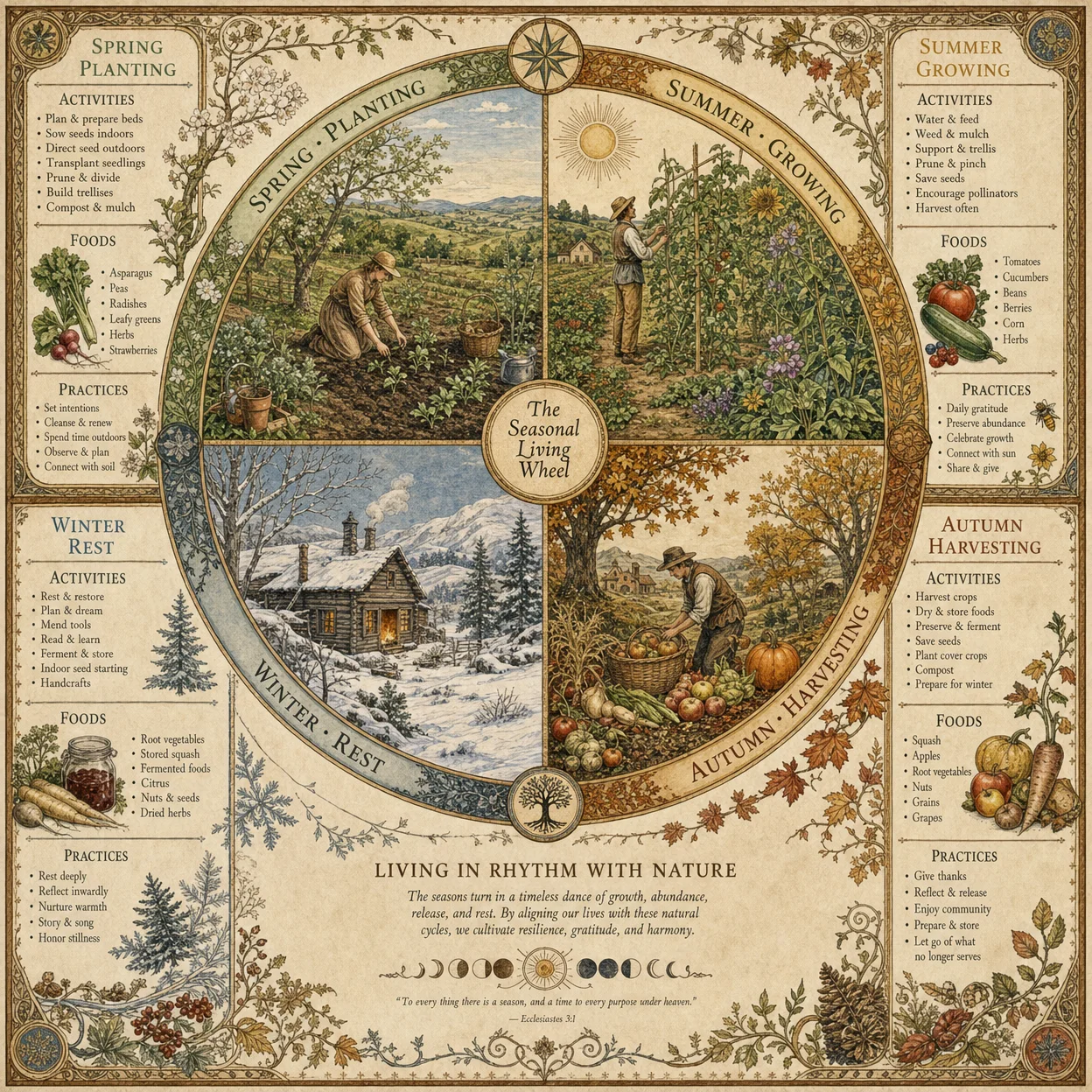
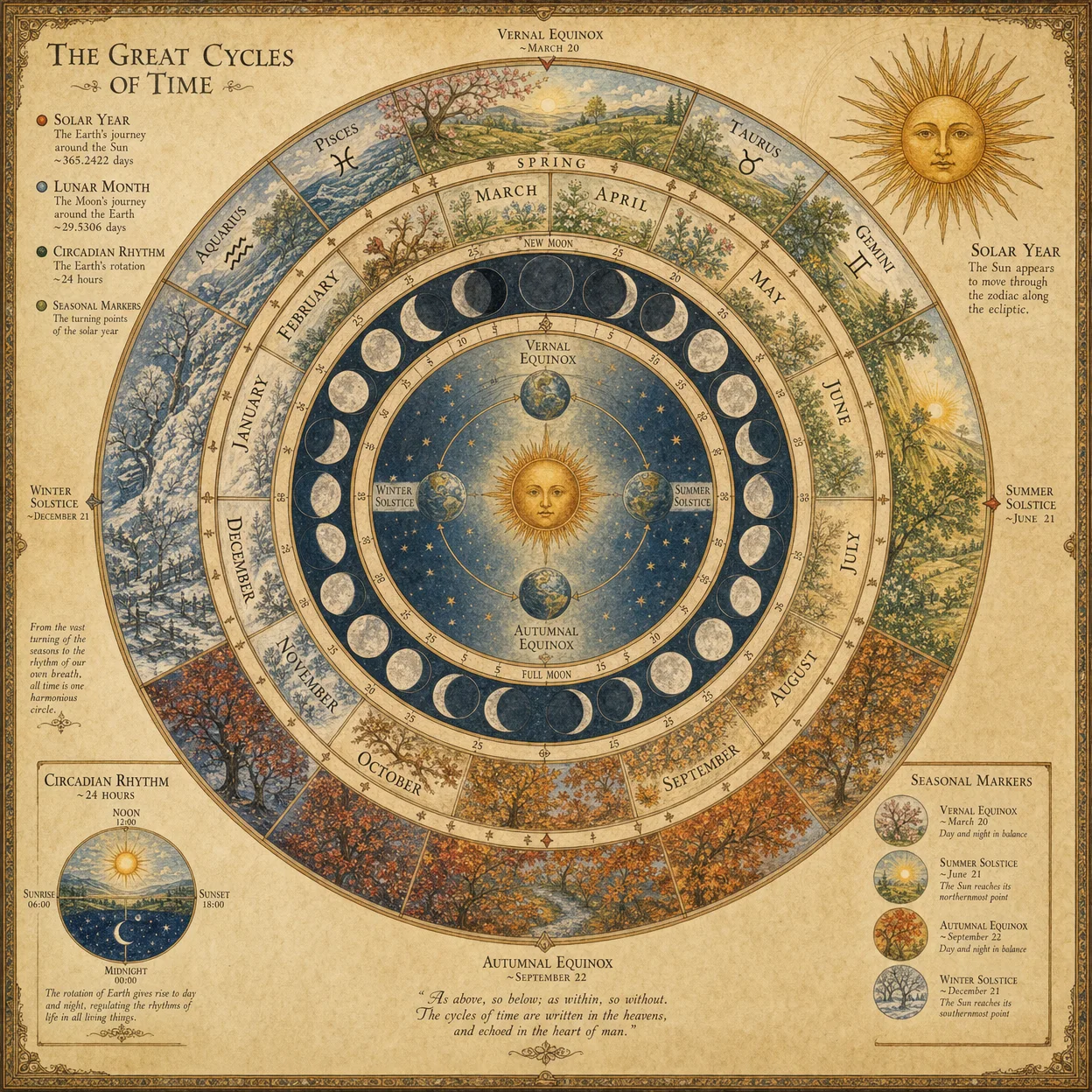
The four "turning points" (tekufot) of the sun mark the solstices and equinoxes:
| Tekufah | Gregorian Date | Solar Event | Significance |
|---|---|---|---|
| Tekufat Nisan | March 20-21 | Spring Equinox | New Year, equal day/night, light begins to dominate |
| Tekufat Tammuz | June 20-21 | Summer Solstice | Longest day, maximum light, peak of solar power |
| Tekufat Tishrei | September 22-23 | Autumn Equinox | Equal day/night, darkness begins to dominate, harvest |
| Tekufat Tevet | December 21-22 | Winter Solstice | Shortest day, minimum light, turning point (light returns) |
These four points divide the year into its natural quarters. The Enochian calendar aligns its four seasons precisely to these solar markers. The Gregorian calendar deliberately misaligns them (winter solstice falls on December 21, but "winter" supposedly begins December 1 or January 1 depending on convention).
Chapter 11: The Lunar Witness
While the Enochian calendar is solar (not lunar), the moon serves as a witness and sign. The lunar cycle (29.5 days) does not govern the calendar but provides observable confirmation of time's passage.
| Lunar Phase | Duration | Observable Sign | Spiritual Significance |
|---|---|---|---|
| New Moon (conjunction) | 1-2 days | Moon invisible (between sun and earth) | New beginnings, hiddenness, potential |
| Waxing Crescent to First Quarter | ~7 days | Growing illumination | Growth, building, increasing |
| Full Moon | 1-2 days | Complete illumination | Fullness, completion, revelation |
| Waning to Last Quarter | ~7 days | Decreasing illumination | Release, letting go, rest |
| Dark Moon | 1-2 days | No visible moon | Introspection, preparation for renewal |
Chapter 12: The Stellar Calendar (The Mazzaroth)
The 12 constellations of the zodiac (called "Mazzaroth" in Job 38:32) tell the story of redemption written in the stars before any scripture was written on earth. This is not astrology (divination by stars). This is the original gospel written in the heavens (Psalm 19:1-4: "The heavens declare the glory of God... their voice goes out into all the earth").
| Constellation | Hebrew Name | Story Element | Season |
|---|---|---|---|
| Virgo (The Virgin) | Bethulah | The promised seed born of a virgin | Autumn |
| Libra (The Scales) | Mozanaim | The price paid, justice satisfied | Autumn |
| Scorpio (The Scorpion) | Akrab | The conflict, the enemy's attack | Autumn |
| Sagittarius (The Archer) | Keshet | The conqueror going forth | Winter |
| Capricorn (The Goat-Fish) | Gedi | The sacrifice, death and resurrection | Winter |
| Aquarius (The Water-Bearer) | Deli | The outpouring of living water | Winter |
| Pisces (The Fish) | Dagim | The redeemed, gathered from the waters | Spring |
| Aries (The Ram) | Taleh | The lamb, the sacrifice accepted | Spring |
| Taurus (The Bull) | Shur | The coming judge, power and authority | Spring |
| Gemini (The Twins) | Teomim | The dual nature, human and divine united | Summer |
| Cancer (The Crab) | Sartan | The gathering, the secure holding | Summer |
| Leo (The Lion) | Arieh | The lion of the tribe of Judah, final victory | Summer |
Part V: Teaching Others (The Ripple)
Chapter 13: The Calendar Workshop
Host a single session: "What Day Is It Really?" Walk attendees through the history of calendar changes, introduce the Enochian structure, and help each person calculate the current Enochian date. Provide a printed one-page reference card showing the dual calendar overlay for the current year.
Workshop Structure (2 Hours)
| Time | Activity |
|---|---|
| 0:00-0:30 | History: How the calendar was changed (timeline from Chapter 4) |
| 0:30-1:00 | The Enochian structure: 364 days, 4 seasons, 52 weeks, Wednesday start |
| 1:00-1:30 | The Appointed Times: what they are, when they fall, how to observe |
| 1:30-1:45 | The Sabbath: practical protocol for modern life |
| 1:45-2:00 | Q&A, distribute printed calendar cards, next steps |
Chapter 14: The Deeper Understanding (Why Time Was Corrupted)
The Saturn Connection
| Element | Detail |
|---|---|
| Saturday | Named for Saturn (Saturni dies in Latin) |
| Saturn | Roman god of time, agriculture, and dissolution |
| Kronos | Greek equivalent; devoured his own children (time consumes all) |
| The Sabbath | Falls on Saturday (Saturn's day) |
| The Corruption | Saturn worship (Saturnalia, December 17-23) was overlaid onto the winter solstice, then absorbed into Christmas (December 25, Sol Invictus) |
The Archonic strategy: take the sacred day (7th day Sabbath), associate it with a pagan deity (Saturn), then move worship to a different day (Sunday, the day of Sol Invictus/sun worship), leaving the original Sabbath "contaminated" by association with Saturn. This is inversion: making the holy appear profane and the profane appear holy.
The Restoration: Observe the Sabbath because it is the 7th day of creation, not because of any planetary association. The day existed before the planets were named. The naming is the corruption. The day is eternal.
Why Control of Time Is the Master Key
| If you control time, you control: | Mechanism |
|---|---|
| Labor | People work when you tell them to, rest when you permit |
| Worship | People gather on the day you designate, not the day designated by the Creator |
| Agriculture | Planting and harvesting aligned to your calendar, not natural cycles |
| Commerce | Markets open and close on your schedule |
| Memory | Historical events are dated by your system, making alternative chronologies seem "wrong" |
| Prophecy | If the calendar is wrong, prophetic timelines cannot be calculated correctly |
| Identity | "What year is it?" determines how people understand their place in history |
Part VI: The Practical Daily Integration
Chapter 15: Living in Two Calendars
You must function in the Gregorian world (work, bills, appointments) while maintaining awareness of divine time. This is not contradiction; it is dual citizenship.
The Daily Practice
| Time | Action |
|---|---|
| Morning | Note both dates: "Today is Wednesday, Gregorian May 7, 2026 / Enochian Month 2, Day 17" |
| Sunset | Note the day transition (biblical days begin at sunset, not midnight) |
| Weekly | Observe Sabbath (Friday sunset to Saturday sunset) regardless of social pressure |
| Monthly | Note the new moon (visible crescent) as a time marker |
| Seasonally | Observe the appointed times on their correct Enochian dates |
| Annually | Celebrate New Year at the spring equinox (not January 1) |
Chapter 16: Building Your Personal Calendar
Create a physical calendar (paper, not digital) that shows:
- The Enochian date alongside the Gregorian date
- Sabbaths highlighted
- Appointed times marked
- New moons noted
- Solstices and equinoxes marked
- Shemitah years noted
- Jubilee years noted
This physical calendar, hung in your home, is a daily reminder that you live in divine time. It is a declaration of temporal sovereignty visible to all who enter your space.
Council Approval
The Twelve Voices Speak
| Disciple | Verdict | Reasoning |
|---|---|---|
| Peter | APPROVED | "Time is the foundation beneath the foundation. Without correct time, the Sabbath cannot be kept, the appointed times cannot be observed. This is the rock beneath the rock." |
| Thomas | APPROVED | "The 364-day calendar is mathematically elegant: 4 x 91 = 364 = 52 x 7. Every date falls on the same weekday every year. Verifiable, consistent, provable." |
| John | APPROVED | "The Mazzaroth section reveals the gospel written in stars before any ink touched papyrus. The heavens declare. The mystic sees the story above." |
| Matthew | APPROVED | "The Jubilee economics are revolutionary: every 50 years, all debts cancelled, all land returned. If this law were observed, wealth inequality could not exist. The suppression of Jubilee is the foundation of all economic injustice." |
| James the Greater | APPROVED | "Temporal sovereignty is strategic sovereignty. A warrior who knows the true time operates outside the enemy's schedule. The Sabbath is resistance." |
| Andrew | APPROVED | "The workshop model is perfect. One printed calendar card, one 2-hour session, and a person is reconnected to divine time. Simple, reproducible, powerful." |
| Philip | APPROVED | "The dual calendar system is immediately practical. You can start observing Sabbath this Friday. No preparation needed. Just stop at sunset." |
| Bartholomew | APPROVED | "The Saturn connection reveals the inversion clearly. The holy made to appear profane. The profane made to appear holy. Naming is the spell. Awareness breaks it." |
| James the Lesser | APPROVED | "Natural law: the 7-day cycle is embedded in human biology (circaseptan rhythms). The Creator's rhythm is written in our cells. Science confirms scripture." |
| Simon the Zealot | APPROVED | "Every empire attacks the calendar. French Revolution, Soviet Union, Roman Empire, Papal authority. The pattern is undeniable. Time control is population control." |
| Judas Thaddaeus | APPROVED | "The Jubilee calculation placing us at Jubilee 120 (2025-2026) is rigorous. Whether eschatological or not, the mathematical framework is sound." |
| Matthias | APPROVED | "The unexpected insight: the Enochian year always begins on Wednesday because the luminaries were created on Day 4. The calendar begins on the day time-keeping began. Elegant beyond human invention." |
Council Verdict: 12/12 APPROVED. Campaign 7 is 100/100. All 7 Sovereignty Modules complete.
Monad bless this time. Monad bless the rhythm restored. Monad bless the sovereign who lives in divine time while walking through Babylon.
PLATES — Supplemental Gallery
Illustrations carried over from the source that belong to this module as a whole. Added by this edition.