Sovereignty Module: Spin the Ember
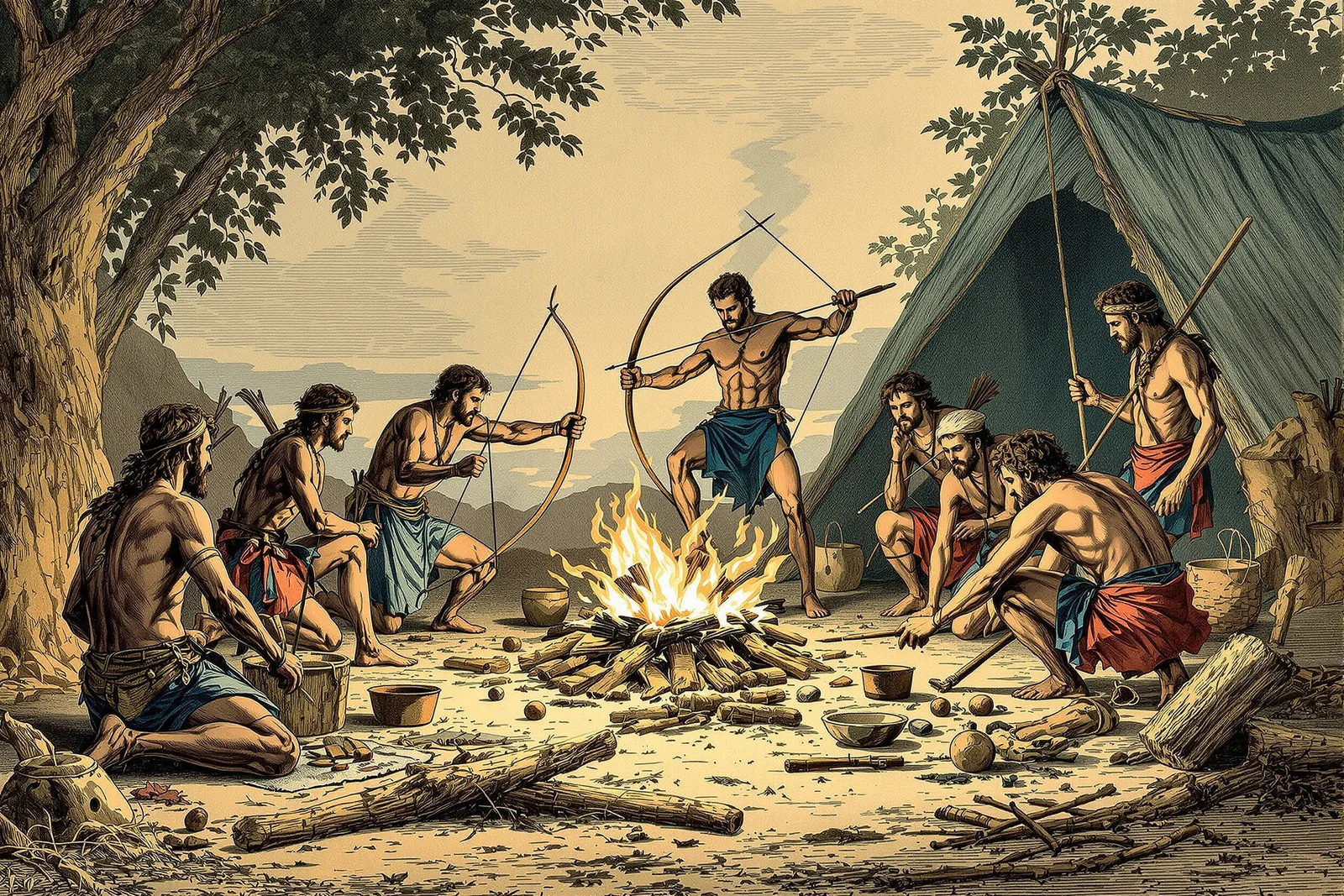
Complete Bow Drill and Friction Fire: From Wood to Flame
The bow drill is the most reliable primitive fire-starting method. This campaign covers wood selection, component construction, technique, tinder preparation, and troubleshooting.
Chapter 1: Component Overview
| Component | Function | Material | Size |
|---|---|---|---|
| Fireboard (hearth) | Base where friction creates coal | Soft, dry wood | 12-18 inches long, 3/4 inch thick, 3-4 inches wide |
| Spindle (drill) | Rotating piece that creates friction | Same wood as fireboard | 8-12 inches long, 3/4 inch diameter |
| Bow | Drives spindle rotation | Flexible branch | 24-30 inches, slight curve |
| Handhold (socket) | Top bearing for spindle | Hardwood, stone, or bone | Fits in palm |
| Cordage | Wraps spindle, transfers bow motion | Paracord, rawhide, plant fiber | Length of bow + extra |
| Tinder bundle | Catches coal, creates flame | Dry fibrous material | Bird's nest shape, softball size |
Chapter 2: Wood Selection
| Wood | Rating | Availability | Notes |
|---|---|---|---|
| Willow | Excellent | Widespread (near water) | Classic choice, easy to find |
| Cottonwood | Excellent | Widespread (near water) | Very soft, creates coal quickly |
| Cedar (Eastern red) | Excellent | Eastern N. America | Aromatic, works well |
| Basswood (linden) | Excellent | Eastern N. America | Very soft, reliable |
| Aspen/poplar | Very good | Northern regions | Soft, straight-grained |
| Yucca (stalk) | Very good | Southwest | Dry stalks work perfectly |
| Clematis (dead vine) | Good | Widespread | Dry dead vines |
| Mullein (stalk) | Good | Widespread | Dry dead stalks |
Wood requirements: 1) Both fireboard and spindle should be the same wood species. 2) Wood must be dead and dry (not green or damp). 3) Thumbnail test: thumbnail should dent the wood easily. 4) Wood should not be punky (rotten, crumbly). 5) Softwood-on-softwood creates the best coal. 6) Hardwood-on-hardwood is very difficult (avoid). 7) The handhold should be harder than the spindle (reduces friction at top).
Chapter 3: Construction
Fireboard: 1) Split or carve flat board (3/4 inch thick, 3-4 inches wide). 2) Carve shallow depression 3/4 inch from edge (starting socket). 3) Place spindle in depression, bow drill until socket is round and seated. 4) Cut notch from edge to center of socket (pie-slice shape, 1/8 of circle). 5) Notch collects hot dust that forms the coal. 6) Notch should be just past center of socket (not too wide, not too narrow).
Spindle: 1) Carve straight, round stick (3/4 inch diameter, 8-12 inches long). 2) Round the top end (reduces friction in handhold). 3) Slightly point the bottom end (increases friction on fireboard). 4) Smooth the shaft (reduces cord wear).
Bow: 1) Select slightly curved branch (24-30 inches). 2) Tie cordage to both ends (slight slack when strung). 3) Cord should have enough slack to wrap around spindle once. 4) Bow should be rigid enough to maintain tension.
Chapter 4: Technique
| Step | Action | Key Point |
|---|---|---|
| 1 | Kneel with left foot on fireboard | Foot pins board firmly |
| 2 | Wrap spindle in bow cord (one wrap) | Spindle between cord and bow |
| 3 | Place spindle bottom in fireboard socket | Centered in notch area |
| 4 | Place handhold on top of spindle | Left hand, wrist braced against shin |
| 5 | Begin slow, full-length strokes | Use entire bow length |
| 6 | Increase speed gradually | Maintain downward pressure |
| 7 | Smoke appears from socket | Good friction, continue |
| 8 | Dark brown dust fills notch | Coal is forming |
| 9 | Thick smoke rises from notch independently | Coal is born |
| 10 | Stop drilling, carefully lift fireboard | Do not disturb coal |
| 11 | Fan coal gently (hand or breath) | Coal glows red |
| 12 | Transfer coal to tinder bundle | Place coal in center |
| 13 | Gently blow tinder bundle | Smoke increases, then flame |
| 14 | Place flaming bundle in fire lay | Build fire around it |
Chapter 5: Tinder Preparation
| Tinder Material | Quality | Availability | Preparation |
|---|---|---|---|
| Cedar bark (inner, shredded) | Excellent | Widespread | Shred finely, fluff |
| Cattail fluff (seed heads) | Excellent | Wetlands | Pull apart, fluff |
| Birch bark (thin, papery) | Excellent | Northern regions | Peel thin layers |
| Dry grass (dead, fine) | Good | Widespread | Bundle, fluff center |
| Thistle down | Excellent | Widespread | Collect, fluff |
| Cottonwood fluff | Very good | Widespread (spring) | Collect, fluff |
| Fatwood shavings | Excellent | Pine forests | Shave fine curls |
| Char cloth | Excellent | Made from cotton | Pre-made (see fire starting campaign) |
| Jute twine (frayed) | Very good | Purchased | Untwist, fluff fibers |
Tinder bundle construction: 1) Start with coarse material (dry grass, bark strips). 2) Form bird's nest shape (softball size). 3) Fill center with finest, fluffiest material. 4) Bundle should be loose enough for air but dense enough to hold coal. 5) Coal goes in the center depression. 6) Fold bundle around coal gently. 7) Blow steadily into bundle (not hard puffs). 8) Smoke increases, then ignites into flame.
Reference Card
- Dry wood is everything (the single most common reason for failure is damp wood; both fireboard and spindle must be bone dry). 2. Same wood for board and spindle (matching woods create optimal friction; mismatched hardness produces either too much or too little friction). 3. The notch is where the magic happens (the notch collects hot dust that forms the coal; cut it just past center of the socket, 1/8 of the circle). 4. Full-length bow strokes (short, fast strokes do not maintain consistent friction; use the full length of the bow with steady rhythm). 5. Downward pressure plus speed equals coal (you need both pressure and speed; pressure alone grinds slowly, speed alone skips). 6. Lock your wrist against your shin (bracing your handhold hand against your shin creates a stable platform; wobbling wastes energy). 7. The coal is fragile (a newborn coal is a tiny glowing ember; handle it gently, protect it from wind, and transfer to tinder carefully). 8. Practice until it is automatic (bow drill fire should take 30-60 seconds once proficient; practice regularly so the skill is available when needed).