Sovereignty Module: Spin the Thread
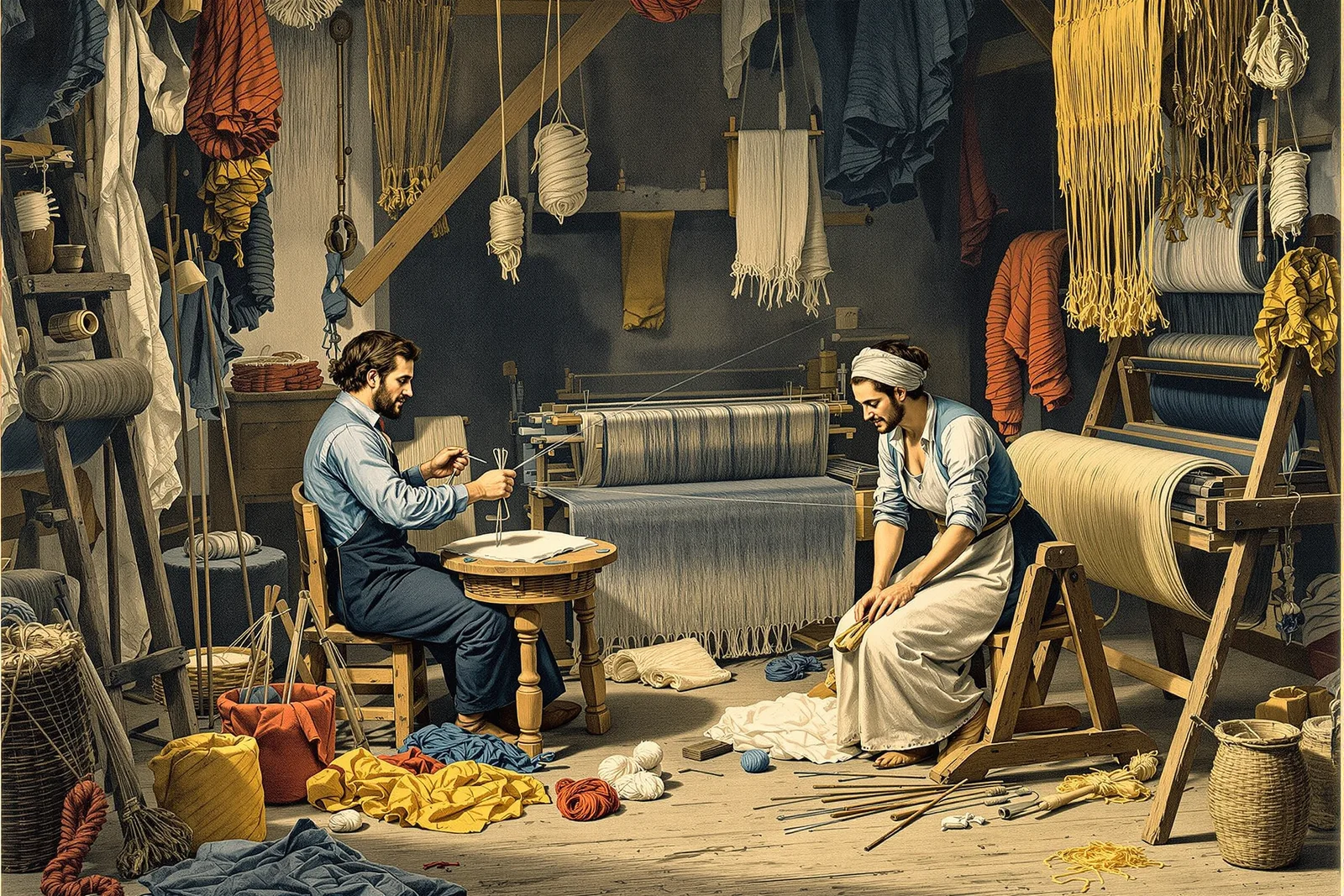
Complete Spinning and Yarn Production: From Raw Fiber to Finished Yarn
Spinning transforms loose fibers into strong, continuous thread — the foundation of all textiles. This campaign covers fiber preparation, spinning techniques, wheel construction, and plying.
Chapter 1: Fiber Sources
| Fiber | Source | Staple Length | Fineness | Warmth | Strength | Difficulty |
|---|---|---|---|---|---|---|
| Wool (sheep) | Sheep fleece | 2-14 inches | Fine-coarse | Excellent | Moderate | Low-moderate |
| Cotton | Cotton bolls | 0.5-2.5 inches | Very fine | Moderate | Moderate | Moderate-high |
| Flax (linen) | Flax plant stems | 12-36 inches | Fine | Cool (wicking) | Very high | High |
| Hemp | Hemp plant stems | 12-36 inches | Medium-coarse | Moderate | Very high | High |
| Alpaca | Alpaca fleece | 3-12 inches | Very fine | Excellent | Moderate | Low-moderate |
| Angora (rabbit) | Rabbit fur | 2-5 inches | Extremely fine | Excellent | Low | Moderate |
| Silk | Silkworm cocoons | Continuous (1,000+ ft) | Extremely fine | Moderate | Very high | Very high |
| Nettle | Nettle plant stems | 12-24 inches | Fine-medium | Moderate | High | High |
| Dog hair | Dog undercoat | 1-4 inches | Variable | Excellent | Low-moderate | Moderate |
Chapter 2: Fiber Preparation
| Step | Wool | Cotton | Flax | Purpose |
|---|---|---|---|---|
| Shearing/harvesting | Shear sheep | Pick bolls | Pull/cut plants | Obtain raw fiber |
| Sorting | Grade by quality/body area | Remove seeds/debris | Bundle stalks | Separate quality levels |
| Washing/scouring | Hot water + soap (remove lanolin) | Not needed (usually) | Ret (soak to loosen fiber) | Clean fiber |
| Picking/opening | Pull apart locks | Gin (remove seeds) | Break/scutch (separate fiber from woody core) | Open and loosen |
| Carding | Card with hand cards or drum carder | Card | Hackle (comb through pins) | Align fibers, remove debris |
| Combing (optional) | Wool combs (for worsted) | N/A | N/A | Align fibers parallel, remove short fibers |
Wool carding: 1) Place small amount of washed wool on one hand card. 2) Draw second card across first (teeth catch and separate fibers). 3) Transfer fiber back to first card. 4) Repeat 3-5 times (fibers become aligned, debris falls out). 5) Roll fiber off card into rolag (loose tube of prepared fiber). 6) Rolag is ready for spinning. 7) Carding produces woolen yarn (lofty, warm, slightly fuzzy). 8) For smoother yarn: comb instead of card (produces worsted preparation — fibers parallel).
Chapter 3: Spinning Methods
| Method | Speed | Yarn Quality | Portability | Cost | Difficulty |
|---|---|---|---|---|---|
| Hand twisting | Very slow | Low | Maximum | Free | Very low |
| Drop spindle (bottom whorl) | Slow | Good | High | Very low | Low |
| Drop spindle (top whorl) | Slow | Good | High | Very low | Low |
| Supported spindle | Slow | Very good (fine yarn) | High | Very low | Low-moderate |
| Great wheel (walking wheel) | Moderate | Good | None (large) | Moderate | Moderate |
| Treadle wheel (Saxony) | Fast | Very good | Low (heavy) | Moderate-high | Moderate |
| Charkha (Indian wheel) | Moderate | Good (cotton) | Moderate | Low | Moderate |
Drop spindle spinning: 1) Attach leader yarn to spindle (18 inches of existing yarn). 2) Draft fiber: pull small amount from rolag/roving (thin it to desired yarn thickness). 3) Overlap drafted fiber with leader yarn end. 4) Spin spindle clockwise (Z-twist — standard for singles). 5) Twist travels up into drafted fiber, binding it into yarn. 6) Draft more fiber as twist enters (keep drafting zone ahead of twist). 7) When arm's length of yarn is spun: wind onto spindle shaft. 8) Repeat. 9) Rhythm: spin, draft, wind. Spin, draft, wind. 10) A skilled spinner produces 50-100 yards per hour on a drop spindle.
Chapter 4: Spinning Wheel Construction
| Component | Material | Function | Precision | Difficulty |
|---|---|---|---|---|
| Drive wheel | Wood (turned or built-up) | Provides momentum and speed | Moderate (round, balanced) | Moderate |
| Spindle/flyer | Hardwood or metal | Twists fiber, winds onto bobbin | High | High |
| Bobbin | Hardwood (turned) | Stores spun yarn | Moderate | Moderate |
| Maidens (uprights) | Hardwood | Hold spindle/flyer bearings | Moderate | Low |
| Mother-of-all | Hardwood | Supports maidens, adjustable | Moderate | Moderate |
| Treadle | Wood | Foot pedal drives wheel | Low | Low |
| Crank/pitman | Wood + metal | Converts treadle motion to rotation | Moderate | Moderate |
| Drive band | Cotton cord or leather | Connects wheel to flyer | Low | Very low |
| Frame/bench | Hardwood | Holds everything together | Moderate | Moderate |
Spinning wheel ratio: Drive wheel circumference ÷ flyer whorl circumference = ratio. Example: 60-inch wheel ÷ 3-inch whorl = 20:1 ratio. This means one treadle revolution = 20 spindle revolutions. Higher ratio = more twist per treadle = finer yarn. Lower ratio = less twist = thicker yarn. Typical ratios: 5:1 (bulky yarn) to 20:1 (fine yarn).
Chapter 5: Plying and Finishing
| Process | Purpose | Method | Effect |
|---|---|---|---|
| Plying (2-ply) | Strength, balance twist | Spin 2 singles together counter-clockwise | Balanced, stronger yarn |
| Plying (3-ply) | Round, strong yarn | Spin 3 singles together counter-clockwise | Round cross-section, very strong |
| Setting twist | Stabilize yarn | Soak in warm water, hang to dry with weight | Yarn holds shape |
| Skeining | Storage, measurement | Wind onto niddy-noddy or swift | Organized, measurable |
| Washing | Clean, bloom yarn | Warm water + mild soap, no agitation | Clean, lofty yarn |
Plying: 1) Spin two (or more) bobbins of singles yarn (all spun in same direction — typically Z-twist/clockwise). 2) Place bobbins on lazy kate (holder that lets them spin freely). 3) Thread both singles through spinning wheel orifice together. 4) Spin wheel in OPPOSITE direction (S-twist/counter-clockwise for Z-spun singles). 5) The two singles wrap around each other. 6) Balanced 2-ply: when a loop of yarn hangs without twisting on itself. 7) Plied yarn is stronger, more even, and more durable than singles. 8) Traditional: spin singles Z (clockwise), ply S (counter-clockwise).
Reference Card
- Draft before twist (pull fibers thin BEFORE twist enters — twist locks fibers in place). 2. Consistent drafting = consistent yarn (even thickness comes from even drafting — practice this most). 3. Spin Z, ply S (singles clockwise, plying counter-clockwise — this is the universal standard). 4. Wool is the beginner fiber (forgiving, grips itself, available everywhere — start with medium wool). 5. Drop spindle first (learn on a spindle before investing in a wheel — same skills, lower cost). 6. Card for woolen, comb for worsted (carding = lofty warm yarn; combing = smooth strong yarn). 7. Balanced yarn hangs straight (a loop of properly plied yarn doesn't twist on itself — test frequently). 8. One sheep = one sweater (approximately 5-8 lbs of fleece = enough yarn for a sweater — plan accordingly).