Sovereignty Module: String the Loom
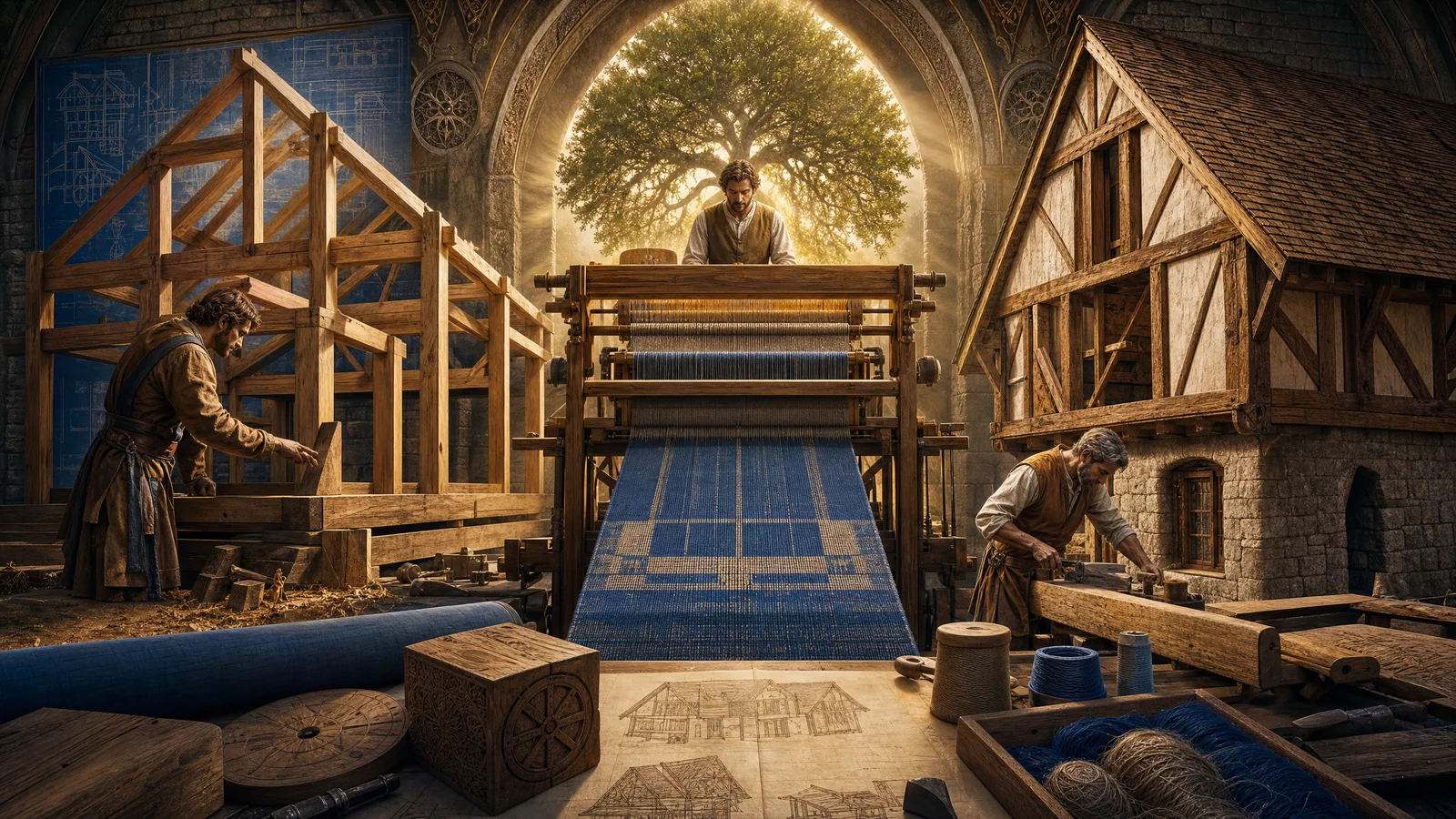
Complete Loom Construction and Weaving: From Frame to Fabric
The loom transforms thread into cloth, one of humanity's most essential technologies. This campaign covers loom types, construction, warping, and weaving patterns.
Chapter 1: Loom Types
| Type | Complexity | Fabric Width | Speed | Portability | Best For |
|---|---|---|---|---|---|
| Backstrap loom | Very low | 12-24 inches | Slow | Very portable | Belts, narrow fabric, travel |
| Frame loom (rigid) | Low | 12-36 inches | Slow-moderate | Moderate | Learning, tapestry, small projects |
| Warp-weighted loom | Low-moderate | 24-60 inches | Moderate | Stationary | Historical, wide fabric |
| Rigid heddle loom | Moderate | 12-36 inches | Moderate | Moderate | Versatile, good for beginners |
| Floor loom (2-shaft) | Moderate-high | 24-60 inches | Fast | Stationary | Plain weave, twill |
| Floor loom (4-shaft) | High | 24-60 inches | Fast | Stationary | Complex patterns |
Chapter 2: Frame Loom Construction
Simple frame loom: 1) Build rectangular frame from hardwood (2x2 inch lumber). 2) Frame size: desired fabric width + 4 inches by desired fabric length + 12 inches. 3) Join corners with mortise-and-tenon or lap joints. 4) Drive nails or cut notches along top and bottom bars (1/4 inch apart for medium weave). 5) These nails/notches hold the warp threads. 6) Warp: wind thread from top to bottom around nails (parallel threads). 7) Weave: pass weft thread over and under warp threads. 8) Use shed stick (flat stick) to create opening between alternating warp threads. 9) Use heddle bar (string loops on alternate threads) to create opposite opening. 10) Beat each weft row tight with comb or beater.
Chapter 3: Rigid Heddle Loom Construction
| Component | Material | Purpose | Specification |
|---|---|---|---|
| Frame (2 side pieces) | Hardwood | Structure | 2x3 inch, length = fabric length + 24 inches |
| Cloth beam (front) | Hardwood dowel | Winds finished fabric | 1.5-2 inch diameter |
| Warp beam (back) | Hardwood dowel | Holds warp supply | 1.5-2 inch diameter |
| Heddle (rigid) | Wood or metal | Creates shed, spaces warp | Slots and holes alternate |
| Heddle support | Wood brackets | Holds heddle, allows up/down | Attached to frame sides |
| Ratchet and pawl | Wood or metal | Locks beams under tension | One on each beam |
| Shuttle | Hardwood | Carries weft thread | 12-24 inches long, boat shape |
| Beater (built into heddle) | Part of rigid heddle | Packs weft tight | Integral to heddle |
Rigid heddle: 1) A frame with alternating slots and holes. 2) Warp threads pass through slots and holes alternately. 3) When heddle is raised: hole threads go up, slot threads stay. 4) When heddle is lowered: hole threads go down, slot threads stay. 5) This creates the two sheds needed for plain weave. 6) The heddle also serves as the beater (push it forward to pack weft).
Chapter 4: Warping
| Step | Action | Purpose | Tool |
|---|---|---|---|
| Calculate warp | Determine threads per inch x fabric width | Total thread count | Calculator |
| Measure warp | Wind thread to desired length | Consistent warp length | Warping board or pegs |
| Thread heddle | Pass threads through slots and holes | Set up pattern | Threading hook |
| Tie to cloth beam | Secure warp ends to front beam | Anchor warp | Knots |
| Wind onto warp beam | Roll excess warp onto back beam | Store warp supply | Ratchet |
| Tension | Adjust ratchets for even tension | Consistent weaving | Ratchet and pawl |
Warping tips: 1) Use a warping board or pegs to measure consistent warp lengths. 2) Cross threads at one end (prevents tangling). 3) Tie warp in small bundles (choke ties) to prevent tangling. 4) Thread heddle from center outward (keeps fabric centered). 5) Tie onto cloth beam in small groups (even tension). 6) Adjust tension until all threads are equally taut. 7) Uneven tension causes fabric defects.
Chapter 5: Basic Weave Patterns
| Pattern | Shafts Needed | Appearance | Strength | Drape |
|---|---|---|---|---|
| Plain weave (tabby) | 2 | Checkerboard | Very strong | Stiff |
| Basket weave | 2 | Paired threads | Strong | Moderate |
| Twill (2/2) | 4 | Diagonal lines | Very strong | Good |
| Herringbone | 4 | Zigzag diagonals | Very strong | Good |
| Satin | 5+ | Smooth, lustrous | Moderate | Excellent |
Reference Card
- The warp is the backbone (warp threads run the length of the fabric and bear all the tension; they must be strong, evenly spaced, and consistently tensioned). 2. The heddle creates the shed (the opening between raised and lowered warp threads through which the shuttle passes; without a heddle, each thread must be picked by hand). 3. Even tension is everything (uneven warp tension causes puckering, loose spots, and fabric defects; take time to tension the warp perfectly before weaving). 4. Beat consistently (each weft row must be packed with the same force; inconsistent beating creates uneven fabric density). 5. A rigid heddle loom is the best beginner loom (it combines heddle, reed, and beater in one piece; it is simple to build, easy to warp, and produces good fabric). 6. Plain weave is the strongest (over-one, under-one is the tightest interlocking pattern; it uses the most thread but produces the strongest, most durable fabric). 7. The shuttle carries the weft (a boat shuttle holds a bobbin of weft thread and glides through the shed; it is faster and more consistent than passing thread by hand). 8. Weaving is mathematics made tangible (thread count, pattern repeats, and fabric dimensions are all mathematical relationships; understanding the math produces better fabric).