Complete Sausage Making and Meat Curing: From Grind to Cure
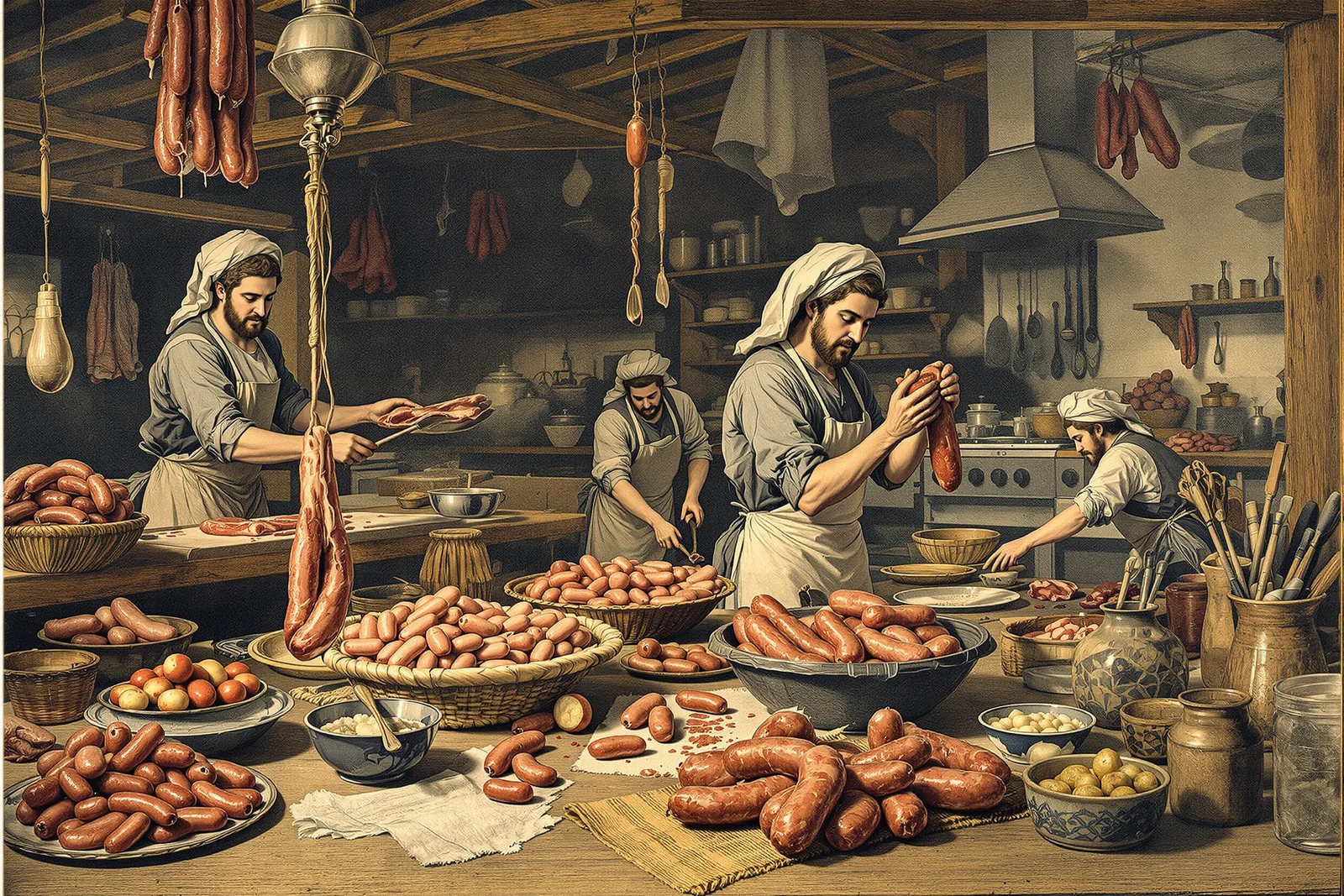
⟁ cover painted for this edition — the source module carried no illustrations
Complete Sausage Making and Meat Curing: From Grind to Cure
Sausage making transforms scraps into delicacies and extends meat preservation. This campaign covers grinding, seasoning, casing, smoking, and dry curing.
Chapter 1: Sausage Fundamentals
Factor
Specification
Why
Meat-to-fat ratio
70-80% lean, 20-30% fat
Fat provides flavor, moisture, texture
Temperature
Keep meat cold (below 40°F)
Prevents bacterial growth, better binding
Salt
1.5-2% of total weight
Flavor, preservation, protein extraction
Grind size
Coarse (3/8"), medium (1/4"), fine (1/8")
Texture preference
Mixing
Mix until tacky/sticky
Protein extraction creates bind
Casing
Natural (intestine) or collagen
Holds shape during cooking/curing
Sausage Type
Curing
Cooking
Smoking
Shelf Life
Examples
Fresh
No cure
Must cook before eating
Optional
3-5 days (refrigerated)
Breakfast sausage, bratwurst, Italian
Cooked
Optional
Fully cooked during production
Optional
1-2 weeks (refrigerated)
Hot dogs, bologna, mortadella
Smoked
Cured (nitrite)
Smoked and cooked
Yes
2-4 weeks (refrigerated)
Kielbasa, andouille
Dry-cured
Cured (nitrite/nitrate)
Not cooked (dried)
Optional
Months (room temp)
Salami, sopressata, chorizo
Semi-dry
Cured
Partially dried, may be smoked
Often
2-4 weeks
Summer sausage, cervelat
Chapter 2: Fresh Sausage Making
Basic fresh sausage: 1) Cut meat and fat into 1-inch cubes. 2) Chill meat to near-freezing (34-36°F). 3) Grind through coarse plate (3/8 inch). 4) Add seasonings and salt (2% of meat weight). 5) Mix thoroughly until tacky (protein extraction). 6) Stuff into natural casings (hog casings for most sausage). 7) Twist into links (5-6 inch links). 8) Refrigerate immediately. 9) Cook within 2-3 days or freeze.
Sausage
Meat
Seasonings
Grind
Casing
Italian (sweet)
Pork shoulder
Fennel, garlic, red pepper, parsley
Coarse
Hog
Italian (hot)
Pork shoulder
Fennel, garlic, hot pepper flakes
Coarse
Hog
Breakfast
Pork shoulder
Sage, thyme, black pepper, maple syrup
Medium
None (patties) or sheep
Bratwurst
Pork + veal
Nutmeg, ginger, white pepper, mace
Fine
Hog
Chorizo (Mexican)
Pork shoulder
Chile peppers, vinegar, garlic, cumin
Medium
Hog
Merguez
Lamb
Harissa, cumin, coriander, garlic
Medium
Sheep
Chapter 3: Curing and Smoking
Curing Agent
Function
Amount
Safety
Salt
Preservation, flavor
2-3% of meat weight
Safe at food levels
Cure #1 (Prague powder #1)
Prevents botulism, color, flavor
1 tsp per 5 lbs meat
Precise measurement critical
Cure #2 (Prague powder #2)
Long-term curing (dry sausage)
1 tsp per 5 lbs meat
For dry-cured only
Sugar
Feeds beneficial bacteria, flavor
0.5-1% of meat weight
Safe
Starter culture
Acidifies (lowers pH, safety)
Per manufacturer directions
Required for dry-cured
Smoking: 1) Cold smoking (60-90°F): flavor only, no cooking. Used for dry-cured sausage. 2) Hot smoking (150-185°F): cooks and flavors simultaneously. Used for smoked sausage. 3) Wood: hardwood only (hickory, apple, cherry, oak, maple). 4) Never use softwood (pine, cedar, spruce: toxic resins). 5) Smoke time: 2-8 hours depending on product and temperature. 6) Internal temperature for cooked sausage: 155-165°F.
Chapter 4: Dry-Cured Sausage
Dry-cured salami process: 1) Grind meat and fat (keep very cold). 2) Mix with salt (2.5-3%), cure #2, sugar, starter culture, and spices. 3) Stuff into large casings (beef middles or fibrous). 4) Ferment at 70-75°F, 85-90% humidity for 24-72 hours (culture acidifies). 5) Move to drying chamber: 55-60°F, 70-75% humidity. 6) Dry for 4-12 weeks (until 30-40% weight loss). 7) White mold on exterior is normal and desirable (Penicillium nalgiovense). 8) Done when firm throughout and has lost target weight. 9) Shelf-stable at room temperature (the acid, salt, and low moisture prevent spoilage).
Chapter 5: Natural Casings
Casing
Source
Diameter
Use
Preparation
Hog
Pig small intestine
32-35mm
Most sausage (bratwurst, Italian, kielbasa)
Soak in water 30 min, flush
Sheep
Sheep small intestine
20-24mm
Breakfast links, snack sticks, merguez
Soak, flush (delicate)
Beef rounds
Cow intestine
40-45mm
Bologna, large sausage
Soak, flush
Beef middles
Cow intestine
55-65mm
Salami, dry sausage
Soak, flush
Beef bung
Cow appendix
100-130mm
Capicola, large salami
Soak, flush
Collagen
Manufactured (hide)
Various
Any (not for dry curing)
Ready to use
Reference Card
Keep everything cold (warm meat smears fat instead of cutting it; keep meat, grinder, and bowls near freezing). 2. Fat is flavor (20-30% fat is essential; lean sausage is dry and crumbly; embrace the fat). 3. Salt precisely (too little = unsafe; too much = inedible; weigh salt as percentage of meat weight). 4. Mix until tacky (thorough mixing extracts myosin protein, which binds the sausage; undermixed = crumbly). 5. Cure #1 prevents botulism (sodium nitrite is essential for any sausage that will be smoked or held at room temperature). 6. Dry curing requires precision (temperature, humidity, and pH must be controlled; this is food science, not guessing). 7. White mold is good, other colors are bad (white Penicillium mold protects dry sausage; green, black, or pink mold means problems). 8. Sausage making is waste elimination (historically, sausage turned every scrap of the animal into preserved, delicious food).