Sovereignty Module: Perfect the Lather
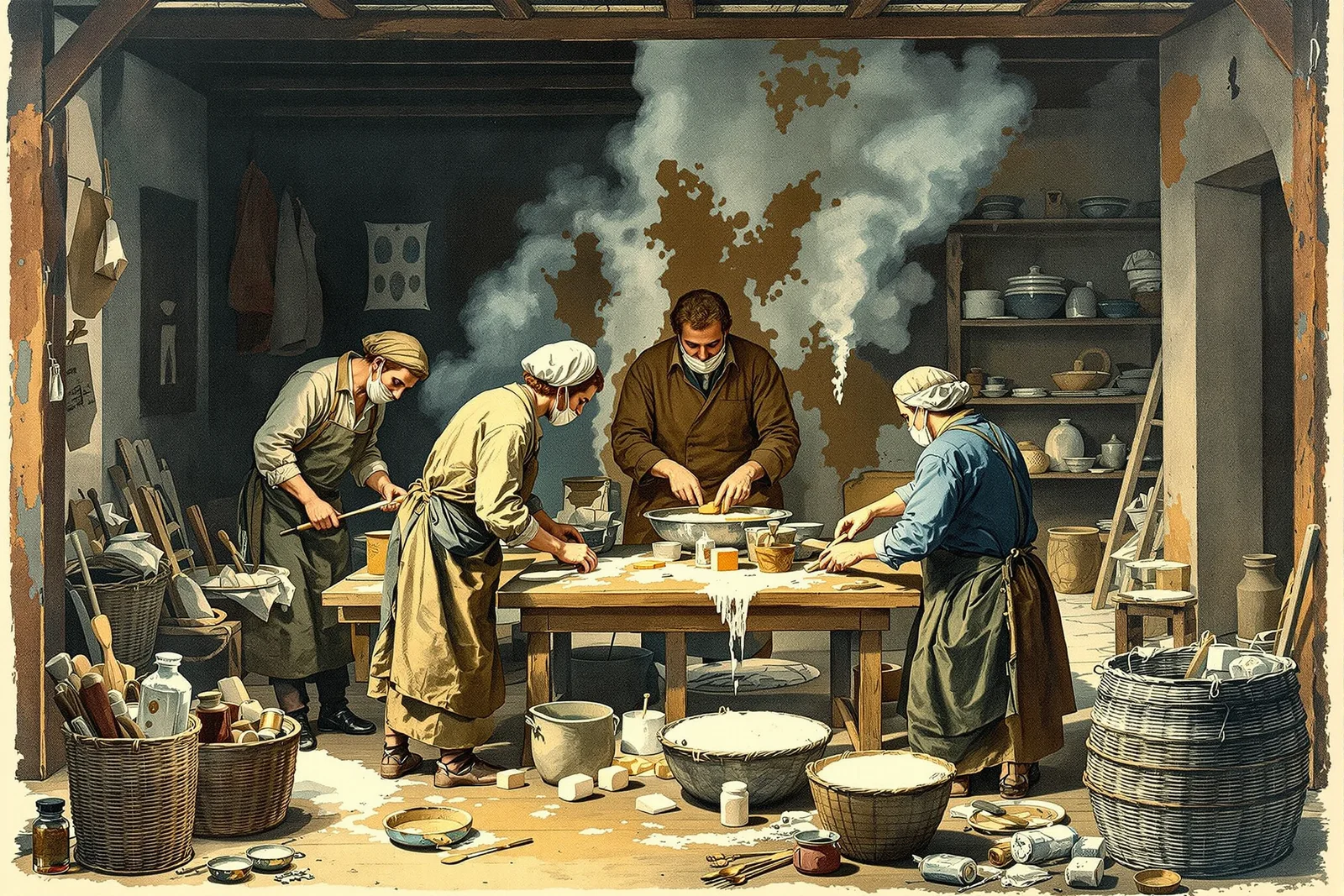
Complete Soap Making Advanced: From Lye to Luxury
Advanced soap making goes beyond basic cold process to create specialty soaps, liquid soap, and cleaning products. This campaign covers formulation, advanced techniques, and troubleshooting.
Chapter 1: Oil Properties in Soap
| Oil | Hardness | Cleansing | Conditioning | Lather | Max % | Cost |
|---|---|---|---|---|---|---|
| Coconut | Very hard | Very high | Low (drying) | Big, bubbly | 20-30% | Moderate |
| Palm | Hard | Moderate | Moderate | Creamy | 25-35% | Low |
| Olive | Soft | Low | Very high | Creamy (slow) | 40-100% | Moderate |
| Lard/tallow | Hard | Moderate | Good | Creamy, stable | 30-50% | Very low |
| Castor | Soft | Low | High | Bubbly (booster) | 5-10% | Moderate |
| Shea butter | Hard | Low | Very high | Creamy | 5-15% | High |
| Cocoa butter | Very hard | Low | High | Creamy | 5-15% | High |
| Sweet almond | Soft | Low | Very high | Light | 5-15% | High |
| Avocado | Soft | Low | Very high | Creamy | 5-15% | High |
| Sunflower | Soft | Low | Good | Light | 10-20% | Low |
Balanced recipe formula: 1) Hard oils (coconut, palm, tallow): 40-60% (provides hardness, cleansing). 2) Soft oils (olive, sweet almond): 30-50% (provides conditioning). 3) Luxury additions (shea, cocoa butter, castor): 5-15% (enhances lather, conditioning). 4) Example beginner recipe: 30% olive, 30% coconut, 30% palm, 10% castor. 5) Run every recipe through a lye calculator (essential for safety).
Chapter 2: Cold Process Technique
| Step | Temperature | Time | Critical Factor |
|---|---|---|---|
| Prepare lye solution | Mix lye into water (never reverse) | Cool to 100-110°F | ALWAYS add lye TO water |
| Melt/warm oils | Melt solid oils, add liquid oils | 100-110°F | Match lye temperature |
| Combine | Pour lye into oils | Stir/blend to trace | Stick blender speeds this |
| Add extras | At light trace | Quick mixing | Fragrance, color, additives |
| Pour into mold | At medium trace | Immediately | Tap mold to remove air |
| Insulate | Cover mold, wrap in towels | 24-48 hours | Keeps warm for saponification |
| Unmold | When firm | 24-48 hours after pour | Should be firm but not hard |
| Cut | Into bars | Immediately after unmold | Use straight edge or wire |
| Cure | Open air, spaced apart | 4-6 weeks | Evaporation, crystal formation |
Trace stages: 1) Light trace: thin pudding consistency, faint trail when drizzled. 2) Medium trace: pudding consistency, clear trail on surface. 3) Heavy trace: thick pudding, holds shape. 4) Most additives go in at light trace. 5) Pour at medium trace (too thin = separation; too thick = hard to pour).
Chapter 3: Hot Process Soap
| Advantage | Detail | Comparison to Cold Process |
|---|---|---|
| Faster cure | Usable in 1-2 weeks (vs 4-6 weeks) | Saponification completed during cooking |
| Superfat control | Add superfat oils after cook | More precise than cold process |
| Rustic appearance | Textured, chunky look | Less smooth than cold process |
| Fragrance retention | Add after cook (less evaporation) | Better for delicate fragrances |
Hot process method: 1) Follow cold process through trace. 2) Cook in slow cooker on low for 1-3 hours. 3) Stir every 15-20 minutes. 4) Soap goes through stages: separation, applesauce, mashed potato, vaseline. 5) Done when translucent and pH tests neutral (or zap test: touch to tongue, no zap). 6) Add superfat oils and fragrance. 7) Spoon into mold quickly (sets fast). 8) Unmold when cool and firm. 9) Usable immediately but improves with 1-2 weeks cure.
Chapter 4: Liquid Soap
| Factor | Bar Soap | Liquid Soap |
|---|---|---|
| Alkali | Sodium hydroxide (NaOH) | Potassium hydroxide (KOH) |
| Consistency | Solid | Liquid/gel |
| Process | Cold or hot process | Hot process (required) |
| Dilution | None | Dilute paste with water |
| Clarity | N/A | Can be clear or opaque |
| Cure time | 4-6 weeks | 1-2 weeks (after dilution) |
Liquid soap process: 1) Use potassium hydroxide (KOH) instead of NaOH. 2) Use lye calculator set for liquid soap. 3) Combine lye and oils, bring to trace. 4) Cook in slow cooker 3-6 hours (longer than bar soap). 5) Soap paste forms (translucent, taffy-like). 6) Test for completion (dissolve small amount in water; should be clear). 7) Dilute paste with hot distilled water (ratio varies: start 1:1 paste to water). 8) Stir gently (avoid bubbles). 9) Let sit 1-2 weeks (clarity improves). 10) Add fragrance and preservative. 11) Bottle.
Chapter 5: Troubleshooting
| Problem | Cause | Fix | Prevention |
|---|---|---|---|
| Lye-heavy (caustic) | Too much lye, calculation error | Rebatch with additional oils | Always use lye calculator |
| Soft bars (won't harden) | Too much soft oil, too much water | Longer cure, or rebatch | Balance hard/soft oils |
| Soda ash (white powder on surface) | Exposure to air during saponification | Spray with alcohol, or wash off | Cover mold, spray with alcohol |
| Glycerin rivers (clear streaks) | Titanium dioxide + fragrance reaction | Cosmetic only (safe to use) | Use less titanium dioxide |
| Rancid spots (DOS - dreaded orange spots) | Unsaturated oils oxidizing | Cut away affected area | Use fresh oils, add antioxidant |
| Separation (oil on top) | Didn't reach trace, or false trace | Rebatch (re-melt and re-blend) | Ensure true trace before pouring |
| Overheating (volcano) | Too much fragrance, high sugar content | Let cool, rebatch if needed | Reduce fragrance, don't insulate |
Reference Card
- Always add lye to water (never water to lye; the reaction is violent and can cause boiling, splashing, and burns). 2. Run every recipe through a lye calculator (even small errors in lye amount make soap caustic or soft; never guess). 3. Cure for 4-6 weeks minimum (curing evaporates water and completes crystal formation; uncured soap is harsh). 4. Balance hard and soft oils (too much coconut = drying; too much olive = soft and slimy; balance is key). 5. Trace is the checkpoint (don't pour before trace; don't add fragrance after heavy trace; learn to read trace stages). 6. Superfat for skin (5-8% extra oil beyond what lye can saponify provides conditioning; this is the luxury factor). 7. KOH makes liquid soap (potassium hydroxide produces soft/liquid soap; sodium hydroxide produces bar soap). 8. Soap is chemistry (saponification is a chemical reaction; respect the process, measure precisely, and understand the science).