Complete Fireplace Crane and Pot Hanger: From Bar to Hearth Cooking System
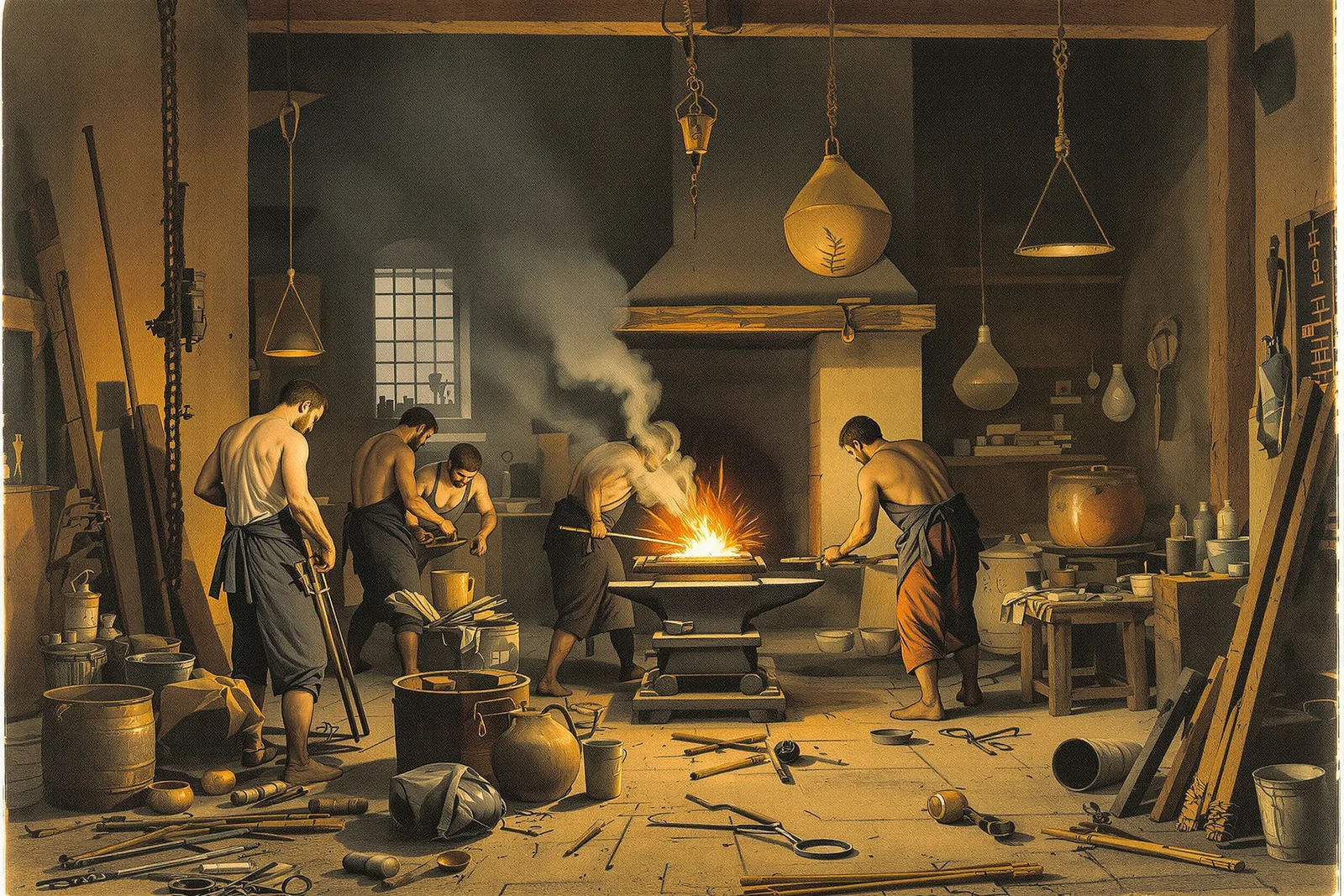
⟁ cover painted for this edition — the source module carried no illustrations
Complete Fireplace Crane and Pot Hanger: From Bar to Hearth Cooking System
The fireplace crane is the heart of hearth cooking, allowing pots to swing over and away from the fire. This campaign covers crane design, pivot mechanisms, adjustable hangers, and the complete hearth cooking system.
Chapter 1: Crane Components
Component
Material
Function
Vertical post
3/4-1 inch bar
Pivot axis, mounts in fireplace
Horizontal arm
3/4 inch bar
Swings over fire, holds hangers
Pivot pins
1/2 inch rod
Top and bottom pivot points
Trammel hook
3/8-1/2 inch bar
Adjustable pot height
S-hooks
3/8 inch bar
Hang pots from arm
Pot hooks
3/8 inch bar
Various lengths for different heights
Chapter 2: Crane Construction
Fireplace crane: 1) Vertical post: 3/4 inch square bar, height of fireplace opening. 2) Forge pivot points at top and bottom of post. 3) Top pivot: tapered point fits into hole in lintel. 4) Bottom pivot: tapered point sits in hole in hearth stone. 5) Horizontal arm: 3/4 inch bar, extends 2/3 across fireplace width. 6) Forge arm perpendicular to post (forge weld or collar joint). 7) Arm must be rigid (no flex under load). 8) Arm swings in and out of fireplace on post pivots. 9) Maximum load: 30-50 pounds (full pot of stew).
Dimension
Small Fireplace
Medium Fireplace
Large Fireplace
Post height
24-28 inches
28-34 inches
34-40 inches
Arm length
18-24 inches
24-30 inches
30-36 inches
Arm bar size
3/4 inch
3/4 inch
1 inch
Load capacity
30 lbs
40 lbs
50 lbs
Chapter 3: Trammel Hook
Trammel hook (adjustable hanger): 1) Two flat bars, one inside the other. 2) Outer bar: 1 inch wide, 18-24 inches long. 3) Inner bar: 3/4 inch wide, slides inside outer. 4) Holes punched in both bars at 1-inch intervals. 5) Pin locks bars at desired length. 6) Hook at bottom holds pot. 7) Hook at top hangs from crane arm. 8) Allows precise height adjustment (controls cooking temperature).
Trammel Type
Adjustment Range
Complexity
Historical Period
Ratchet trammel
Continuous
High
17th-18th century
Pin trammel
1-inch increments
Moderate
Medieval onward
Chain trammel
Link-by-link
Low
All periods
Sawtooth trammel
1/2-inch increments
Moderate
18th century
Chapter 4: Complete Hearth Cooking System
Item
Function
Hangs From
Crane arm
Swings pots over fire
Fireplace wall
Trammel hook
Adjusts pot height
Crane arm
S-hooks (various lengths)
Quick pot hanging
Crane arm
Pot chains
Heavy pot support
Crane arm
Griddle
Flat cooking surface
Crane arm or trivet
Toasting fork
Toast bread at fire
Hand-held
Roasting spit
Rotate meat
Andirons
Drip pan
Catches meat drippings
Below spit
Chapter 5: Installation
Installation Step
Method
Critical Factor
Mark pivot points
Plumb bob from lintel to hearth
Must be perfectly vertical
Drill top pivot hole
Masonry bit into lintel
Hole must be plumb
Drill bottom pivot hole
Masonry bit into hearth stone
Aligned with top hole
Install post
Insert pivots into holes
Must swing freely
Test swing
Swing arm full range
No binding, smooth motion
Load test
Hang maximum weight
No deflection, smooth swing
Reference Card
The crane must swing freely (the entire purpose of the crane is to swing pots over the fire for cooking and away from the fire for serving; any binding or stiffness defeats this purpose). 2. Pivot points must be perfectly aligned (the top and bottom pivot holes must be vertically aligned; misalignment causes binding and uneven wear that eventually prevents the crane from swinging). 3. The trammel hook controls cooking temperature (raising the pot moves it away from the fire, lowering temperature; lowering the pot brings it closer, raising temperature; the trammel is the hearth cook's thermostat). 4. The arm must not flex under load (a full pot of stew weighs 20-40 pounds; if the arm flexes, the pot swings unpredictably and may spill into the fire; the arm must be rigid). 5. The crane transforms a fireplace into a kitchen (without a crane, cooking over a fire requires awkward reaching and dangerous lifting; the crane makes hearth cooking safe, efficient, and enjoyable). 6. S-hooks of different lengths provide quick height adjustment (while the trammel provides precise adjustment, a set of S-hooks in 2-inch increments allows quick pot changes without adjusting the trammel). 7. The complete hearth cooking system is the blacksmith's greatest domestic commission (crane, trammel, hooks, spit, andirons, and tools together represent a major project that showcases every forging skill). 8. Hearth cooking produces extraordinary food (the radiant heat of an open fire, the slow cooking on a crane, and the smoke flavor create dishes that no modern oven can replicate; the crane enables this ancient culinary art).