Sovereignty Module: Swing the Crane
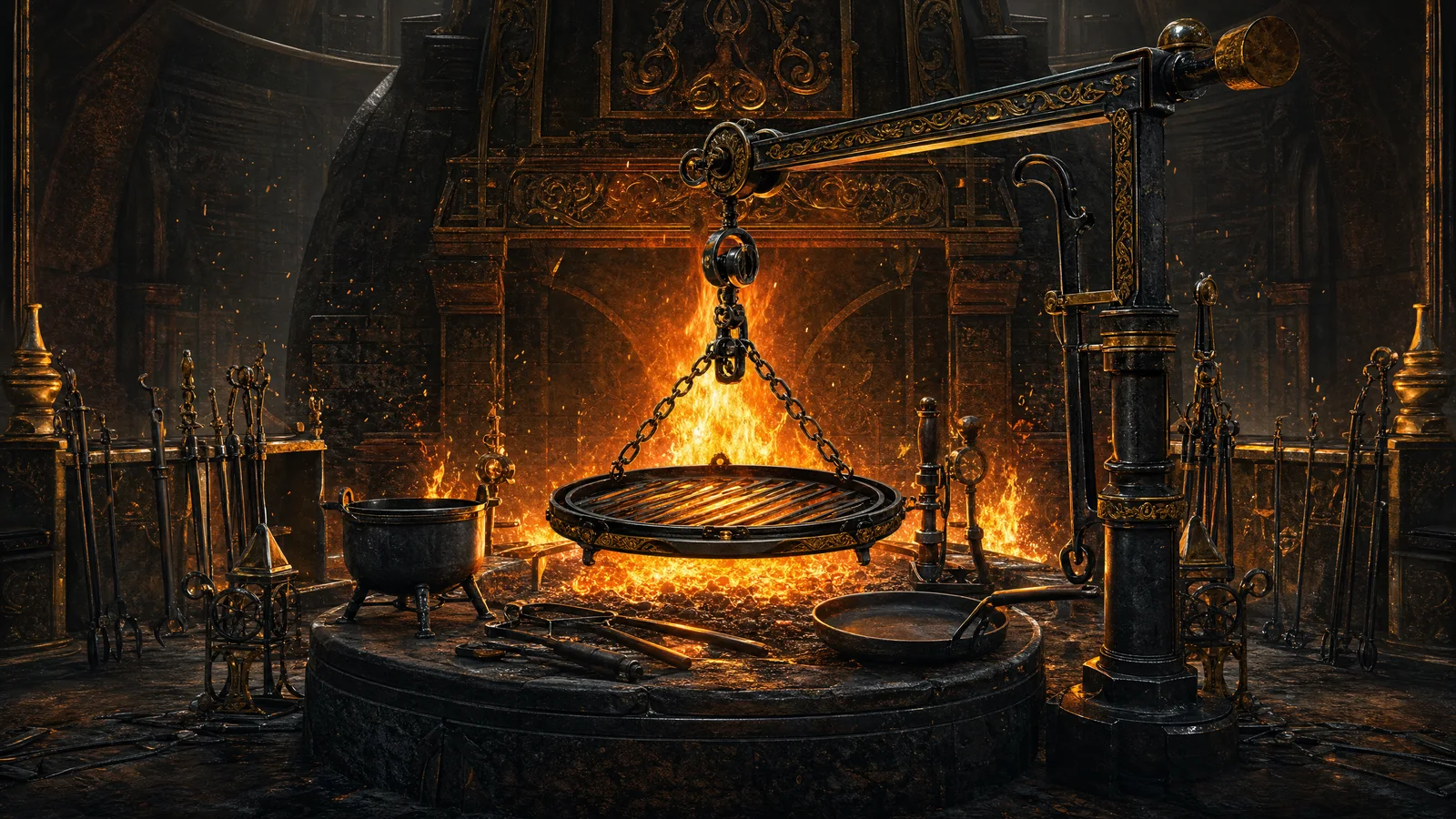
Complete Fireplace Crane and Cooking Hardware: From Bar to Kitchen
The fireplace crane is the centerpiece of a hearth kitchen, allowing pots to be swung over the fire and adjusted for heat. This campaign covers crane forging, trammel making, pot hooks, and cooking hardware.
Chapter 1: Hearth Cooking Hardware
| Item | Purpose | Stock | Difficulty |
|---|---|---|---|
| Fireplace crane | Swing pots over fire | 3/4-1 inch square bar | Moderate-high |
| Trammel (pot hanger) | Adjustable height pot hanging | 1/4-3/8 inch flat bar | Moderate |
| S-hook | Hang pots from crane | 3/8-1/2 inch round | Low |
| Pot hook (adjustable) | Hang pots at various heights | 3/8 inch round | Low-moderate |
| Trivet | Hold pots above coals | 3/8-1/2 inch round | Low-moderate |
| Toasting fork | Toast bread at fire | 1/4-3/8 inch round | Low |
| Spit (rotisserie) | Rotate meat over fire | 1/2-3/4 inch square | Moderate |
| Griddle | Flat cooking surface | 1/4 inch plate | Low-moderate |
| Dutch oven stand | Hold Dutch oven in coals | 3/8 inch round | Low |
Chapter 2: Fireplace Crane Construction
Fireplace crane: 1) The crane is an L-shaped arm that pivots on a vertical pin. 2) Vertical pin (pintle): 3/4 inch round bar, 24-30 inches long. 3) Pin mounts in fireplace wall (top and bottom sockets). 4) Horizontal arm: 3/4-1 inch square bar, 24-36 inches long. 5) Arm attaches to pin with forge-welded or riveted joint. 6) Arm swings in and out of fireplace. 7) Pots hang from arm on trammels or S-hooks. 8) Swing pot over fire to heat, swing out to serve.
| Component | Stock | Length | Purpose |
|---|---|---|---|
| Pintle (vertical pivot) | 3/4 inch round | 24-30 inches | Pivot point, mounts in wall |
| Arm (horizontal) | 1 inch square | 24-36 inches | Holds pots over fire |
| Top socket | 1 inch pipe or forged eye | 2-3 inches | Holds top of pintle |
| Bottom socket | 1 inch pipe or forged eye | 2-3 inches | Holds bottom of pintle |
| Brace (diagonal) | 1/2 inch square | 18-24 inches | Strengthens arm joint |
Assembly: 1) Forge pintle (round bar with pointed bottom end). 2) Forge arm (square bar). 3) Join arm to pintle at 90 degrees (forge weld or rivet). 4) Add diagonal brace (prevents arm from drooping under load). 5) Forge top and bottom sockets (eyes or pipe sections). 6) Mount sockets in fireplace masonry (mortared in). 7) Insert pintle into sockets. 8) Arm should swing freely 180 degrees. 9) Test with loaded pot (50-75 lbs capacity).
Chapter 3: Trammel Construction
Trammel (adjustable pot hanger): 1) Two flat bars (1/4 x 1 inch, 18-24 inches each). 2) One bar has a series of holes or notches (ratchet). 3) Other bar has a hook or pin that engages the holes. 4) Bars slide past each other to adjust length. 5) Hook at bottom holds pot handle. 6) Hook at top hangs from crane arm. 7) Adjust height: lift pot, slide bars, set pin in new hole. 8) Lower pot = more heat, higher pot = less heat.
| Trammel Type | Adjustment Method | Range | Difficulty |
|---|---|---|---|
| Sawtooth | Flat bar with sawtooth edge + hook | 12-18 inches | Moderate |
| Pin and hole | Two bars with matching holes + pin | 12-18 inches | Moderate |
| Ratchet | Toothed bar with spring catch | 12-18 inches | High |
| Chain | Chain links with S-hook | Any length | Low |
| Simple hook | Fixed length S-hook | None | Very low |
Chapter 4: Trivets and Stands
| Type | Legs | Height | Top | Use |
|---|---|---|---|---|
| Three-leg trivet | 3 | 4-6 inches | Ring or grid | Hold pot above coals |
| Four-leg trivet | 4 | 4-6 inches | Grid | Stable platform |
| Rotating trivet | 3-4 | 4-6 inches | Rotating top | Turn pot without lifting |
| Tall trivet | 3 | 8-12 inches | Ring | Hold pot above fire |
| Gridiron (grill) | 4 | 4-6 inches | Parallel bars | Grill meat and vegetables |
Trivet forging: 1) Forge three legs from 3/8 inch round bar, 6 inches each. 2) Forge ring from 3/8 inch round bar (6-8 inch diameter). 3) Forge weld or rivet legs to ring at equal spacing (120 degrees apart). 4) Legs should be slightly splayed outward (stability). 5) All three feet must touch flat surface (no rocking). 6) Optional: add decorative scrolls or penny feet.
Chapter 5: Spit and Rotisserie
| Component | Stock | Purpose | Specification |
|---|---|---|---|
| Spit bar | 1/2 inch square | Hold meat | 30-48 inches long |
| Spit dogs (supports) | 3/4 inch square | Hold spit at fire height | Two, adjustable height |
| Spit forks | 1/4 inch round | Secure meat on spit | Two, sliding and locking |
| Drip pan | 1/8 inch plate | Catch drippings | Under spit, 12x24 inches |
| Handle/crank | 3/8 inch round | Turn spit | At one end of spit bar |
Reference Card
- The crane swings pots in and out (the fireplace crane pivots on a vertical pin, allowing the cook to swing heavy pots over the fire to heat and out of the fire to serve or add ingredients; this is safer and easier than lifting). 2. The trammel adjusts pot height (a trammel is an adjustable hanger that raises or lowers the pot above the fire; lower means more heat, higher means less; this is the primary temperature control in hearth cooking). 3. The crane must be strong (a loaded pot can weigh 50-75 pounds; the crane arm, pintle, and wall sockets must be forged from heavy stock and securely mounted). 4. Three-legged trivets never rock (a three-legged trivet always sits stable on an uneven hearth surface; four-legged trivets rock if the surface is not perfectly flat). 5. The spit rotates meat evenly (turning meat on a spit ensures even cooking and self-basting as juices flow over the surface; without rotation, one side burns while the other is raw). 6. A complete hearth kitchen needs a crane, trammel, trivets, and hooks (these four items allow the cook to hang pots at any height, set pots directly over coals, and adjust heat for any recipe). 7. Forge all kitchen hardware from the same stock (using consistent bar sizes creates a unified visual style; 3/8-1/2 inch round and square bar handles most hearth hardware). 8. Hearth cooking hardware lasts generations (properly forged iron cooking equipment does not wear out; the same crane, trammels, and trivets serve a family for centuries).