Sovereignty Module: Temper the Edge
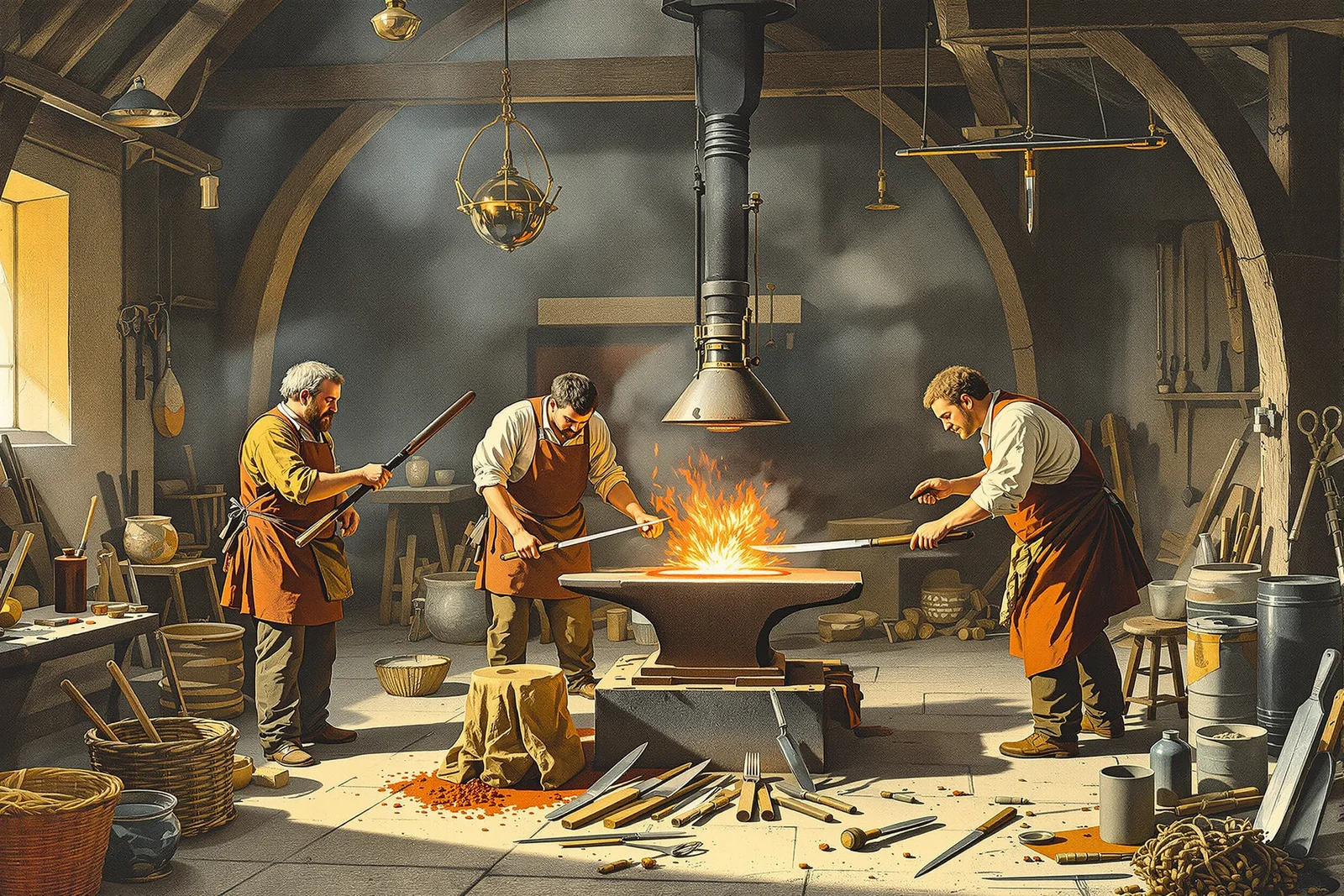
Complete Heat Treatment and Blade Tempering: From Soft to Sharp
Heat treatment transforms soft iron and steel into hard, tough tools and blades. This campaign covers hardening, tempering, annealing, normalizing, and quenching.
Chapter 1: Heat Treatment Processes
| Process | Purpose | Temperature | Cooling | Result |
|---|---|---|---|---|
| Normalizing | Relieve stress, refine grain | Above critical (1475-1500°F for medium carbon) | Air cool | Uniform, stress-free structure |
| Annealing | Soften for machining/filing | Above critical | Slow cool (in ash or vermiculite) | Softest possible state |
| Hardening | Maximum hardness | Above critical | Quench (water, oil, or brine) | Hard but brittle |
| Tempering | Reduce brittleness, add toughness | 350-600°F (below critical) | Air cool | Balanced hardness and toughness |
| Case hardening | Hard surface, tough core | Pack in carbon, heat to critical | Quench | Hard outside, soft inside |
Chapter 2: Steel and Carbon Content
| Steel Type | Carbon % | Hardenability | Use | Examples |
|---|---|---|---|---|
| Low carbon (mild) | 0.05-0.25% | Cannot harden | Nails, wire, chain | 1018, 1020 |
| Medium carbon | 0.25-0.60% | Moderate | Axes, hammers, springs | 1045, 1060 |
| High carbon | 0.60-1.00% | High | Knives, chisels, saws | 1075, 1084, 1095 |
| Very high carbon | 1.00-1.50% | Very high (brittle) | Files, razors | 1095, W1 |
| Tool steel | Various + alloys | Excellent | Precision tools, dies | O1, W2, A2 |
The spark test: 1) Touch steel to grinding wheel. 2) Low carbon: few sparks, orange, long streaks. 3) Medium carbon: moderate sparks, some forks. 4) High carbon: abundant sparks, many forks and bursts. 5) Cast iron: short, red sparks, few forks. 6) Stainless steel: short, orange sparks, few forks. 7) The spark test identifies unknown steel for heat treatment.
Chapter 3: Hardening Process
Hardening a blade: 1) Heat blade evenly to critical temperature (non-magnetic point). 2) Test with magnet: when steel stops attracting magnet, it is at critical temperature. 3) The color at critical temperature is cherry red to bright cherry (1475-1500°F for most carbon steel). 4) Quench immediately in appropriate medium. 5) Plunge blade edge-first into quenchant. 6) Move blade in figure-8 pattern (prevents vapor jacket). 7) Hold in quenchant until cool to touch. 8) Blade is now at maximum hardness (and maximum brittleness). 9) Do not use blade in this state (it will shatter). 10) Temper immediately after hardening.
| Quenchant | Cooling Speed | Best For | Risk | Availability |
|---|---|---|---|---|
| Water | Very fast | Low-carbon steel, simple shapes | High (cracking, warping) | Everywhere |
| Brine (10% salt water) | Faster than water | Low-carbon steel | Very high | Easy to make |
| Oil (vegetable or mineral) | Moderate | Medium and high carbon steel | Low | Common |
| Air | Slow | Air-hardening tool steel (A2) | Very low | Free |
| Tallow/fat | Moderate-slow | Historical quenchant | Low | Animal fat |
Chapter 4: Tempering
Tempering colors (oxide colors on polished steel surface): 1) After hardening, polish a section of the blade bright. 2) Heat gently (in oven, over coals, or with torch). 3) Watch the polished surface for color changes. 4) Colors indicate temperature and resulting hardness.
| Color | Temperature | Hardness (HRC) | Use |
|---|---|---|---|
| Pale straw | 350°F | 62-64 | Razors, engraving tools |
| Straw | 400°F | 60-62 | Knives, chisels (fine) |
| Dark straw | 430°F | 58-60 | Knives, plane irons |
| Bronze/brown | 460°F | 56-58 | Axes, heavy chisels |
| Purple | 500°F | 52-56 | Cold chisels, punches |
| Blue | 560°F | 48-52 | Springs, screwdrivers |
| Light blue/gray | 600°F | 44-48 | Springs, saws |
Tempering process: 1) Polish blade after hardening (remove scale to see colors). 2) Heat blade gently from spine toward edge. 3) Watch for tempering colors to appear. 4) When desired color reaches the edge, quench in water. 5) For knives: straw to dark straw at the edge. 6) For axes: bronze to purple at the edge. 7) For springs: blue at the working area. 8) Differential tempering: spine can be softer (blue) while edge is harder (straw).
Chapter 5: Troubleshooting
| Problem | Cause | Solution |
|---|---|---|
| Blade cracked during quench | Too fast cooling, too high carbon, uneven thickness | Use oil instead of water, normalize first, even out thickness |
| Blade warped during quench | Uneven heating, uneven quench entry | Heat evenly, plunge straight and edge-first |
| Edge too soft (won't hold edge) | Insufficient carbon, didn't reach critical temp, too high temper | Verify steel type, use magnet test, temper at lower temp |
| Edge too brittle (chips) | Temper too low, grain too coarse | Temper at higher temp, normalize before hardening |
| Decarburization (soft skin) | Heated too long at high temp | Minimize time at critical temp, use anti-scale compound |
| Soft spots | Uneven heating | Heat evenly, rotate in forge |
Reference Card
- The magnet test finds critical temperature (when steel stops attracting a magnet, it has reached the critical temperature for hardening; this is the most reliable field test). 2. Quench immediately after reaching critical (delay between reaching critical temperature and quenching allows the grain to grow; large grain makes brittle steel). 3. Always temper after hardening (a hardened blade is glass-hard and glass-brittle; tempering reduces brittleness while retaining most of the hardness). 4. Tempering colors tell the temperature (oxide colors on polished steel indicate the tempering temperature; straw for knives, purple for chisels, blue for springs). 5. Oil is safer than water (oil quenches more slowly and gently than water; it produces fewer cracks and less warping; use oil for most carbon steel). 6. Normalize before hardening (heating to critical and air cooling refines the grain structure; normalized steel hardens more evenly and with less risk of cracking). 7. The spark test identifies the steel (touching unknown steel to a grinding wheel produces sparks that indicate carbon content; more forks and bursts mean more carbon). 8. Heat treatment is the blacksmith's secret (the same piece of steel can be soft as copper or hard as glass depending on heat treatment; mastering heat treatment is the difference between a blacksmith and a metalworker).