Complete Arch and Vault Construction: From Brick to Span
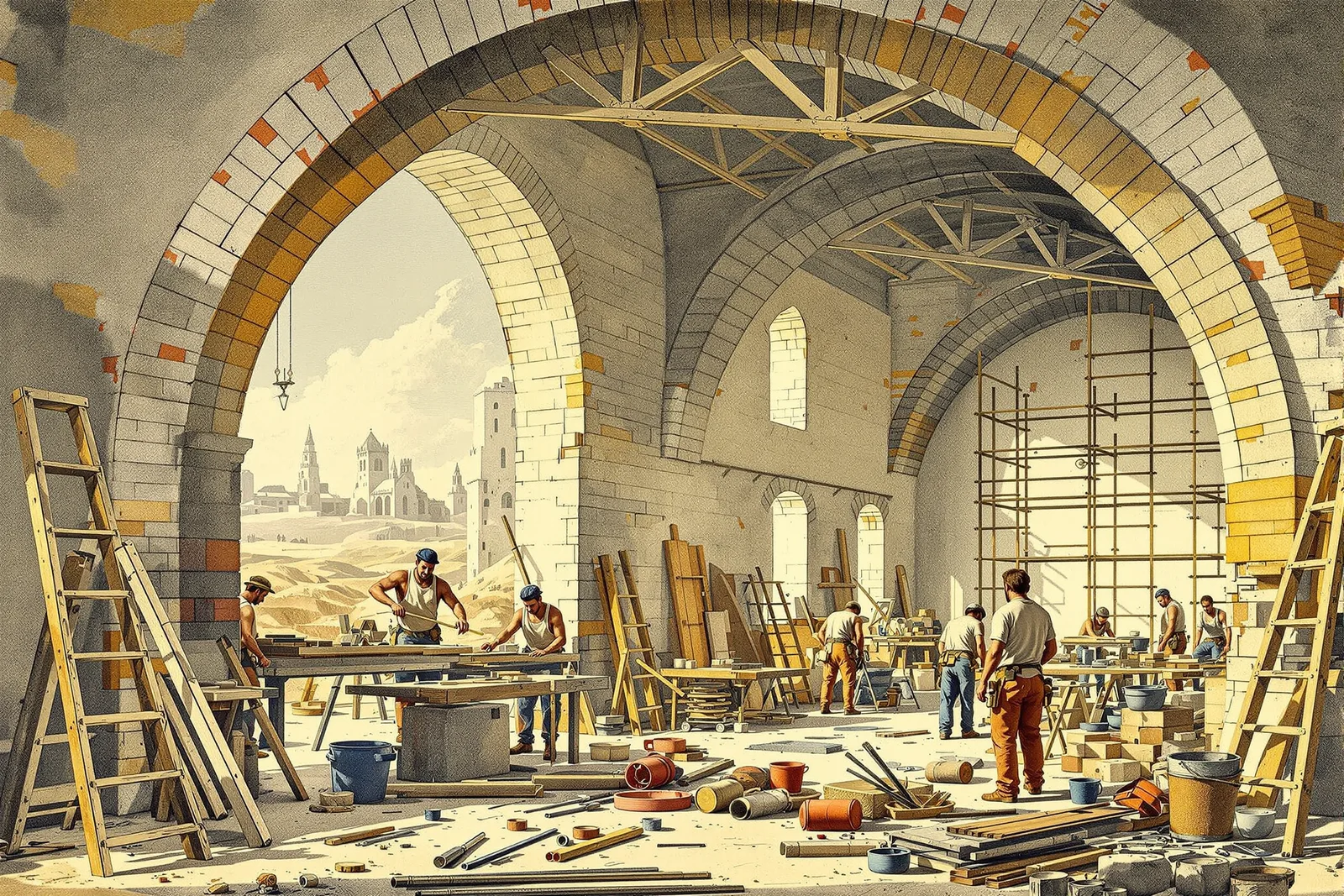
⟁ cover painted for this edition — the source module carried no illustrations
Complete Arch and Vault Construction: From Brick to Span
The arch is one of humanity's greatest structural inventions, spanning openings that flat beams cannot. This campaign covers arch types, centering, construction, and vault building.
Chapter 1: Arch Types
Type
Shape
Span Ratio
Strength
Difficulty
Historical Period
Round (Roman)
Semicircle
Height = 1/2 span
Very high
Moderate
Roman, 500 BCE+
Segmental
Arc less than semicircle
Height < 1/2 span
High
Moderate
Medieval+
Pointed (Gothic)
Two arcs meeting at point
Variable
Very high
Moderate-high
Gothic, 1100+
Flat (jack arch)
Nearly flat with slight rise
Height = 1/20 span
Moderate
High
All periods
Parabolic
Parabola
Variable
Very high
High
Modern
Corbelled
Stepped overhang
Variable
Moderate
Low
Ancient, 3000 BCE+
Chapter 2: Centering (Formwork)
Centering construction: 1) Centering is the temporary wooden form that supports the arch during construction. 2) Build two identical curved ribs from lumber (cut to arch profile). 3) Connect ribs with cross pieces (spacers at arch width). 4) Cover top surface with thin boards or plywood (lagging). 5) Support centering on posts or wedges at correct height. 6) Centering must be strong enough to support all bricks until keystone is placed. 7) After keystone is placed and mortar cures, remove centering. 8) Remove by knocking out wedges (centering drops slightly, separates from arch).
Component
Material
Purpose
Specification
Ribs
2x lumber, cut to curve
Define arch shape
Two per arch, match arch profile
Lagging
Thin boards or plywood
Support bricks during laying
Cover top of ribs
Cross pieces
2x lumber
Space ribs at arch width
Same width as wall
Support posts
4x4 or timber
Hold centering at correct height
Plumb, on solid base
Wedges
Wood wedges
Allow centering removal
Under support posts
Chapter 3: Brick Arch Construction
Round arch construction: 1) Build wall to spring line (where arch begins). 2) Set centering in place at correct height. 3) Verify centering is level and at correct span. 4) Begin laying bricks from both sides simultaneously. 5) Bricks radiate from center point (all joints point to center of circle). 6) Use tapered mortar joints (wider on outside, thinner on inside). 7) Or use tapered bricks (voussoirs) for uniform joints. 8) Work from both sides toward the top. 9) Place keystone (center brick at top) last. 10) Keystone locks the arch and transfers load to both sides. 11) Allow mortar to cure 7 days minimum. 12) Remove centering by knocking out wedges.
Principle
Rule
Why
Radial joints
All joints point to arch center
Even load distribution
Symmetrical loading
Build both sides equally
Prevents centering from tipping
Keystone last
Center stone placed last
Locks arch, transfers all loads
Mortar cure before striking
Wait 7+ days
Mortar must reach strength before centering removal
Adequate abutment
Walls beside arch must be thick enough
Arch pushes outward (thrust); walls must resist
Chapter 4: Vault Construction
Vault Type
Shape
Complexity
Span
Best For
Barrel vault
Extended arch (tunnel)
Moderate
Up to 20 feet
Cellars, tunnels, long rooms
Groin vault
Two barrel vaults crossing
High
Up to 20 feet
Square rooms, intersections
Ribbed vault
Ribs at edges, thin fill
Very high
Up to 40 feet
Large spaces, Gothic
Dome
Rotated arch
High
Up to 30 feet
Round rooms, cisterns
Catalan vault (tile vault)
Thin tile layers
Moderate
Up to 15 feet
Floors, roofs, stairs
Barrel vault: 1) Build two parallel walls to desired height. 2) Set centering (full-length arch form) between walls. 3) Lay bricks in arched courses from one end to the other. 4) Each course is a complete arch. 5) Courses stack from one end of vault to the other. 6) Backfill above vault with rubble and earth. 7) Remove centering after mortar cures.
Chapter 5: Structural Principles
Force
Direction
Resistance
Design Response
Compression
Along arch curve
Stone/brick are strong in compression
Arch works entirely in compression
Thrust
Outward at base (horizontal)
Thick walls, buttresses, tie rods
Abutments must resist outward push
Dead load
Downward (gravity)
Arch transfers to abutments
Arch converts vertical load to diagonal
Live load
Variable (people, wind, snow)
Distributed through arch
Symmetrical loading is ideal
Reference Card
The keystone locks the arch (the center stone at the top of the arch is placed last; it wedges between the two halves and transfers all loads to the abutments). 2. All joints point to the center (every mortar joint in a round arch radiates from the center point of the circle; this ensures even compression throughout the arch). 3. Build both sides equally (laying bricks from both sides simultaneously keeps the centering balanced; loading one side causes the centering to tip). 4. The arch works in compression (stone and brick are strong in compression but weak in tension; the arch shape converts all loads into compression, which is why arches can span great distances). 5. Thrust pushes outward (an arch pushes outward at its base; the walls or buttresses beside the arch must be thick and heavy enough to resist this outward thrust). 6. Wait before removing centering (mortar must cure for at least 7 days before the centering is removed; premature removal causes the arch to collapse). 7. A corbelled arch is the simplest (each course of brick or stone overhangs the one below until the two sides meet; it requires no centering but spans less distance than a true arch). 8. The arch enabled civilization (without the arch, buildings were limited to the span of a single beam; the arch allowed Romans to build aqueducts, bridges, and buildings that still stand 2,000 years later).