Complete Anvil Stand and Blacksmith Shop Setup: From Ground to Workshop
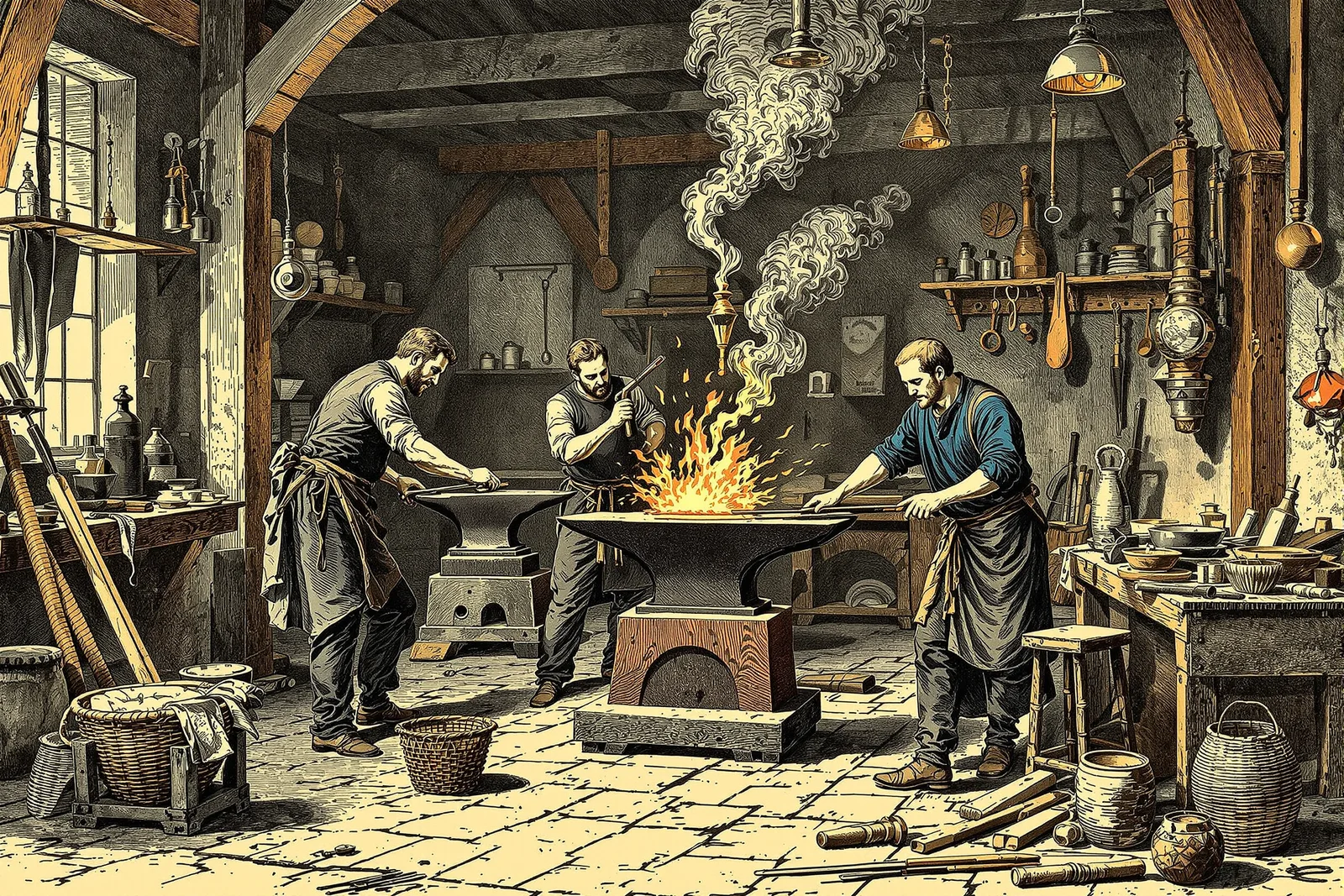
⟁ cover painted for this edition — the source module carried no illustrations
Complete Anvil Stand and Blacksmith Shop Setup: From Ground to Workshop
A properly set up blacksmith shop is the foundation of all metalworking. This campaign covers anvil selection, stand construction, forge layout, and shop organization.
Chapter 1: Anvil Selection
Type
Weight
Material
Use
Availability
London pattern
100-300 lbs
Cast/forged steel
General blacksmithing
Traditional, best
Farrier anvil
75-150 lbs
Steel
Horseshoeing, light work
Specialized
Railroad track (improvised)
30-80 lbs (section)
High carbon steel
Emergency, light work
Salvage
Large rock (primitive)
50-200 lbs
Granite, basalt
Primitive metalworking
Everywhere
Stake anvil
10-30 lbs
Steel
Sheet metal, jewelry
Specialized
Swage block
50-150 lbs
Cast iron
Forming, bending
Specialized
Anvil features: 1) Face: flat top surface (hardened steel, smooth). 2) Horn: pointed end (for bending curves). 3) Hardy hole: square hole in face (holds hardy tools). 4) Pritchel hole: round hole in face (for punching through). 5) Step: shelf between face and horn (for cutting). 6) Heel: back end of face. 7) Waist: narrow section between face and base. 8) Base: bottom (sits on stand).
Chapter 2: Anvil Stand Construction
Stand Type
Material
Height
Stability
Difficulty
Hardwood stump
Oak, elm, or maple log
Knuckle height
Excellent
Low
Fabricated steel
Steel plate and tube
Adjustable
Very good
Moderate
Concrete-filled drum
55-gallon drum + concrete
Fixed
Excellent
Low
Timber frame
6x6 timbers bolted together
Knuckle height
Very good
Moderate
Log round (short section)
Large diameter log
Knuckle height
Good
Very low
Hardwood stump stand: 1) Select hardwood log 18-24 inches diameter. 2) Cut to height: anvil face at knuckle height (when standing with arm at side, fist closed). 3) Typical height: 28-32 inches (including anvil). 4) Level top surface. 5) Set anvil on top. 6) Secure anvil: chain around waist, bolted to stump, or steel straps. 7) Bury stump base 6-12 inches in ground (stability). 8) Or set on concrete pad (prevents settling). 9) Stump absorbs hammer blows (reduces vibration and noise). 10) Hardwood is essential (softwood splits and compresses).
Chapter 3: Forge Layout
Station
Position
Distance from Anvil
Purpose
Forge (fire)
To smith's left (right-handed)
2-3 feet (one step)
Heat metal
Anvil
Center of work area
N/A
Shape metal
Vise (post vise)
To smith's right
3-4 feet
Hold work for filing, bending
Quench tank
Between forge and anvil
Within arm's reach
Cool work, harden
Tool rack
Behind anvil
Within arm's reach
Hold hammers, tongs, tools
Stock rack
Along wall
6-10 feet
Store bar stock
Workbench
Along wall
6-10 feet
Layout, filing, assembly
Layout principles: 1) Forge and anvil are the primary work triangle. 2) Smith should move between forge and anvil with one step. 3) Quench tank within arm's reach of anvil. 4) Vise close but not blocking movement. 5) Tool rack behind smith (reach without turning). 6) Clear floor around anvil (no trip hazards). 7) Good lighting on anvil face (natural light from side, not behind). 8) Ventilation: forge hood and chimney directly above forge.
Chapter 4: Essential Tools
Tool
Purpose
Minimum Quantity
Priority
Cross-peen hammer (2-3 lbs)
General forging
1
Essential
Ball-peen hammer (1-2 lbs)
Riveting, light work
1
Essential
Flat-jaw tongs
Hold flat stock
1 pair
Essential
V-bit tongs
Hold round and square stock
1 pair
Essential
Hardy (hot cut)
Cut hot metal on anvil
1
Essential
Punch (round)
Make holes in hot metal
1
Essential
Wire brush
Clean scale from work
1
Essential
Fire tools (poker, rake)
Manage forge fire
1 set
Essential
Drift (round)
Open and size holes
1
Important
Flatter
Smooth flat surfaces
1
Important
Fuller (top and bottom)
Create grooves, spread metal
1 set
Important
Swage (top and bottom)
Form round shapes
1 set
Useful
Chapter 5: Safety
Hazard
Protection
Rule
Burns (hot metal)
Tongs, leather apron, awareness
Never touch metal without testing (back of hand near, not on)
Eye injury (scale, sparks)
Safety glasses (always)
Wear eye protection whenever forge is lit
Hearing damage
Ear protection
Wear hearing protection during heavy hammering
Fire
Fire extinguisher, clear floor
Keep combustibles away from forge, have water available
Carbon monoxide
Ventilation, forge hood
Never operate forge in enclosed space without ventilation
Tripping
Clear floor, organized shop
Keep floor clear around anvil and forge
Reference Card
Anvil face at knuckle height (when standing with arm relaxed at your side and fist closed, the anvil face should be at knuckle height; this allows the hammer to strike flat with a relaxed arm). 2. One step from forge to anvil (the smith moves between forge and anvil hundreds of times per day; one step between them saves energy and maintains work rhythm). 3. Hardwood absorbs the blow (a hardwood stump stand absorbs hammer energy and reduces vibration; metal stands ring and transmit shock to the smith's arm). 4. The forge is to the left (for a right-handed smith, the forge is to the left so the left hand holds tongs in the fire while the right hand is free to manage the fire). 5. Eye protection is non-negotiable (hot scale flies from every hammer blow; a single piece of scale in the eye can cause permanent damage; wear safety glasses whenever the forge is lit). 6. Ventilation prevents death (a coal or charcoal forge produces carbon monoxide; without a hood and chimney, CO accumulates and kills; never forge in an enclosed space). 7. The quench tank within reach (after hardening, the blade must be quenched immediately; the quench tank must be within arm's reach of the anvil). 8. A well-organized shop is a productive shop (every tool in its place, clear floor, good lighting, and logical layout allow the smith to work efficiently and safely).