Sovereignty Module: Tile the Floor
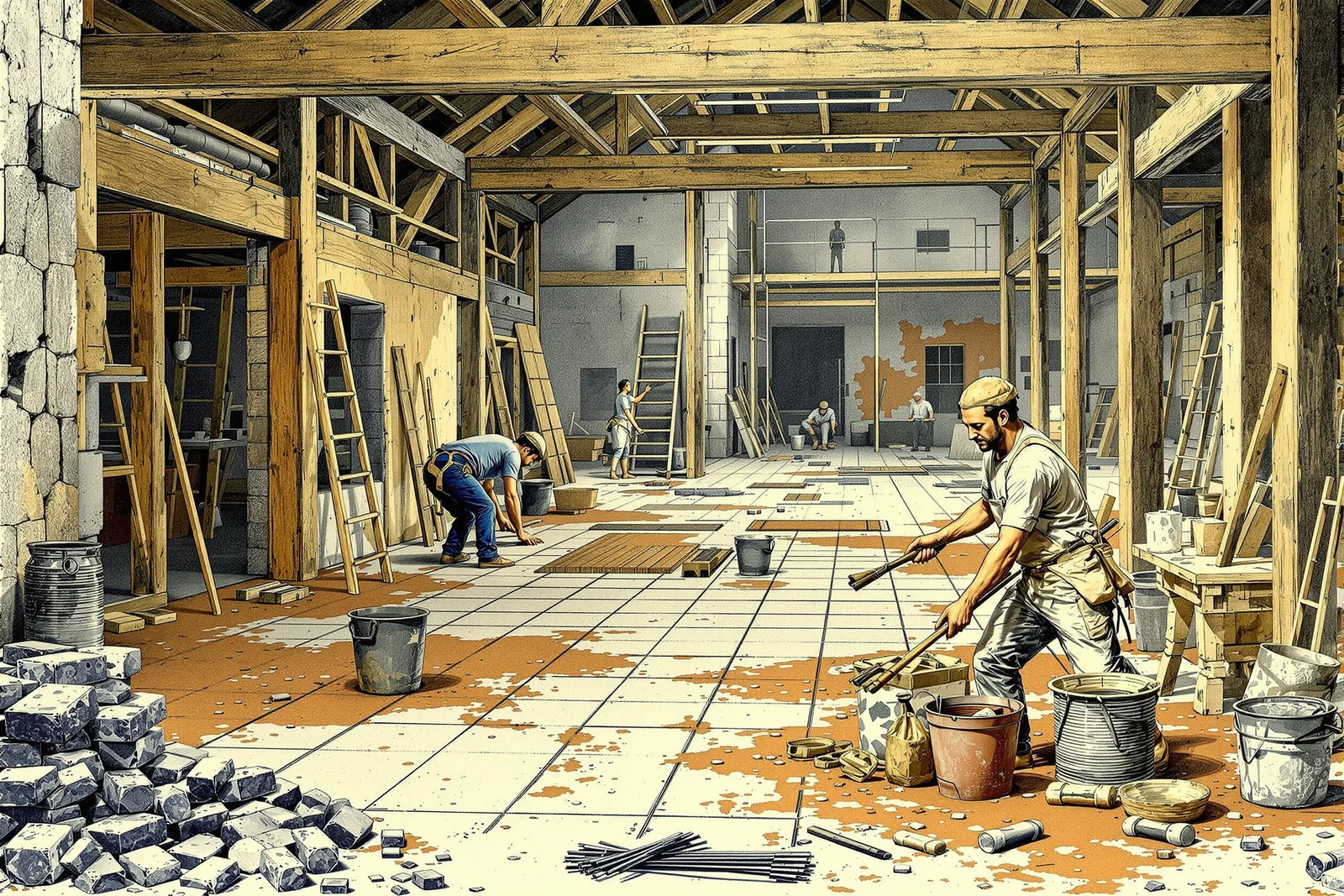
Complete Clay Tile Floor Construction: From Clay to Paved Surface
Clay floor tiles are durable, beautiful, and made from local materials. This campaign covers tile forming, drying, firing, laying, and grouting.
Chapter 1: Tile Types
| Type | Thickness | Size | Shape | Difficulty | Use |
|---|---|---|---|---|---|
| Square tile | 1/2-3/4 inch | 4x4 to 12x12 inches | Square | Low | Floors, walls |
| Rectangular tile | 1/2-3/4 inch | 4x8 to 6x12 inches | Rectangle | Low | Floors, herringbone |
| Hexagonal tile | 1/2-3/4 inch | 4-8 inch across | Hexagon | Moderate | Decorative floors |
| Quarry tile (thick) | 3/4-1 inch | 6x6 to 8x8 inches | Square | Low | Heavy-traffic floors |
| Encaustic tile | 3/4 inch | 4x4 to 6x6 inches | Square with inlay | High | Decorative floors |
| Roof tile (for comparison) | 1/2 inch | 6x10 to 8x14 inches | Flat or curved | Moderate | Roofing |
Chapter 2: Tile Forming
Slab-cut method (simplest): 1) Prepare clay body: 50% clay, 45% sand (fine), 5% grog (ground fired clay). 2) Wedge clay thoroughly (remove air bubbles). 3) Roll clay slab to uniform thickness (use guide sticks). 4) Thickness: 1/2-3/4 inch (thicker for floor tiles). 5) Cut tiles to size with straight edge and wire or knife. 6) Place tiles on flat boards to dry. 7) Flip tiles daily (prevents warping). 8) Dry slowly: 1-2 weeks (cover loosely with plastic first few days). 9) Tiles must be bone-dry before firing.
| Method | Production Speed | Uniformity | Equipment | Best For |
|---|---|---|---|---|
| Slab-cut (rolled) | Moderate | Good | Rolling pin, guide sticks | Small batches |
| Press-molded | Fast | Excellent | Wooden mold/frame | Large batches |
| Extruded (pugmill) | Very fast | Excellent | Pugmill with die | Production |
| Ram press | Fast | Excellent | Hydraulic press + mold | Industrial |
Press mold method: 1) Build wooden frame (mold) to tile dimensions. 2) Frame interior = tile size + 8-10% shrinkage allowance. 3) Dust mold with sand (prevents sticking). 4) Press clay into mold firmly. 5) Strike off excess with wire or straight edge. 6) Flip mold, tap out tile. 7) Repeat for each tile. 8) Consistent size and thickness.
Chapter 3: Firing
| Temperature | Result | Porosity | Strength | Color |
|---|---|---|---|---|
| 1600-1800°F (low fire) | Terracotta | Porous | Moderate | Red-orange |
| 1800-2100°F (mid fire) | Semi-vitreous | Low | High | Red-brown |
| 2100-2300°F (high fire) | Vitrified | Very low | Very high | Brown-dark brown |
Kiln loading for tiles: 1) Stack tiles on edge (not flat) in kiln. 2) Use kiln shelves or tile setters to separate layers. 3) Leave 1/2 inch gap between tiles (air circulation). 4) Fire slowly: 100°F per hour to 400°F (drives off moisture). 5) Increase to 200°F per hour to peak temperature. 6) Hold at peak for 1-2 hours (heat soak). 7) Cool slowly: do not open kiln until below 400°F. 8) Total firing cycle: 24-48 hours.
Chapter 4: Tile Laying
| Step | Action | Material | Specification |
|---|---|---|---|
| Subfloor prep | Level and compact base | Gravel + sand | 4 inch gravel, 2 inch sand |
| Mortar bed | Spread setting mortar | 1:3 cement:sand | 1/2-3/4 inch thick |
| Set tiles | Press tiles into mortar | N/A | Level, even spacing |
| Spacers | Maintain consistent gaps | Wood strips or crosses | 1/4-3/8 inch gaps |
| Grout | Fill gaps between tiles | 1:2 cement:fine sand | Press into joints |
| Seal | Apply sealant to tiles | Linseed oil or commercial sealer | 2-3 coats |
Laying process: 1) Prepare subfloor (level, compacted gravel and sand). 2) Snap chalk lines for layout (start from center of room). 3) Dry-lay tiles to check fit and pattern. 4) Mix setting mortar (1 part cement, 3 parts sand). 5) Spread mortar bed (1/2-3/4 inch thick). 6) Set tiles into mortar, pressing firmly. 7) Use spacers for consistent gaps. 8) Check level frequently. 9) Allow mortar to set (24 hours). 10) Mix grout (1 part cement, 2 parts fine sand). 11) Press grout into joints with rubber float. 12) Wipe excess grout with damp sponge. 13) Allow grout to cure (48 hours). 14) Seal tiles with linseed oil (2-3 coats).
Chapter 5: Patterns and Layouts
| Pattern | Tiles Needed | Difficulty | Appearance |
|---|---|---|---|
| Straight grid | All same size | Very low | Simple, clean |
| Brick bond (offset) | All same size | Low | Traditional, strong |
| Herringbone | Rectangular tiles | Moderate | Elegant, dynamic |
| Basket weave | Rectangular tiles | Moderate | Woven appearance |
| Diagonal grid | All same size (45° rotation) | Low-moderate | Dynamic, spacious |
| Pinwheel | Square + small square | Moderate | Decorative, interesting |
Reference Card
- Shrinkage must be calculated (clay shrinks 8-12% from wet to fired; tiles cut at 6 inches will fire to approximately 5.5 inches; calculate mold size accordingly). 2. Uniform thickness prevents warping (tiles of uneven thickness dry and fire unevenly, causing warping; use guide sticks when rolling and check thickness frequently). 3. Dry slowly to prevent cracking (rapid drying causes the outside to shrink while the inside is still wet, creating cracks; dry tiles slowly over 1-2 weeks). 4. Fire on edge, not flat (tiles stacked flat in the kiln can warp under their own weight; standing tiles on edge allows even heat distribution and prevents warping). 5. Start layout from center (starting tile layout from the center of the room ensures that cut tiles at the edges are symmetrical; starting from a wall often results in a thin sliver at the opposite wall). 6. Seal terracotta tiles (unglazed terracotta is porous and stains easily; sealing with linseed oil or commercial sealer protects the surface and enhances the color). 7. Grog prevents cracking (adding ground fired clay (grog) to the tile body reduces shrinkage and thermal shock; grog opens the clay body and allows moisture to escape during drying and firing). 8. Handmade tiles have character (the slight variations in handmade tiles create a warm, organic appearance that machine-made tiles cannot replicate; each tile is unique).