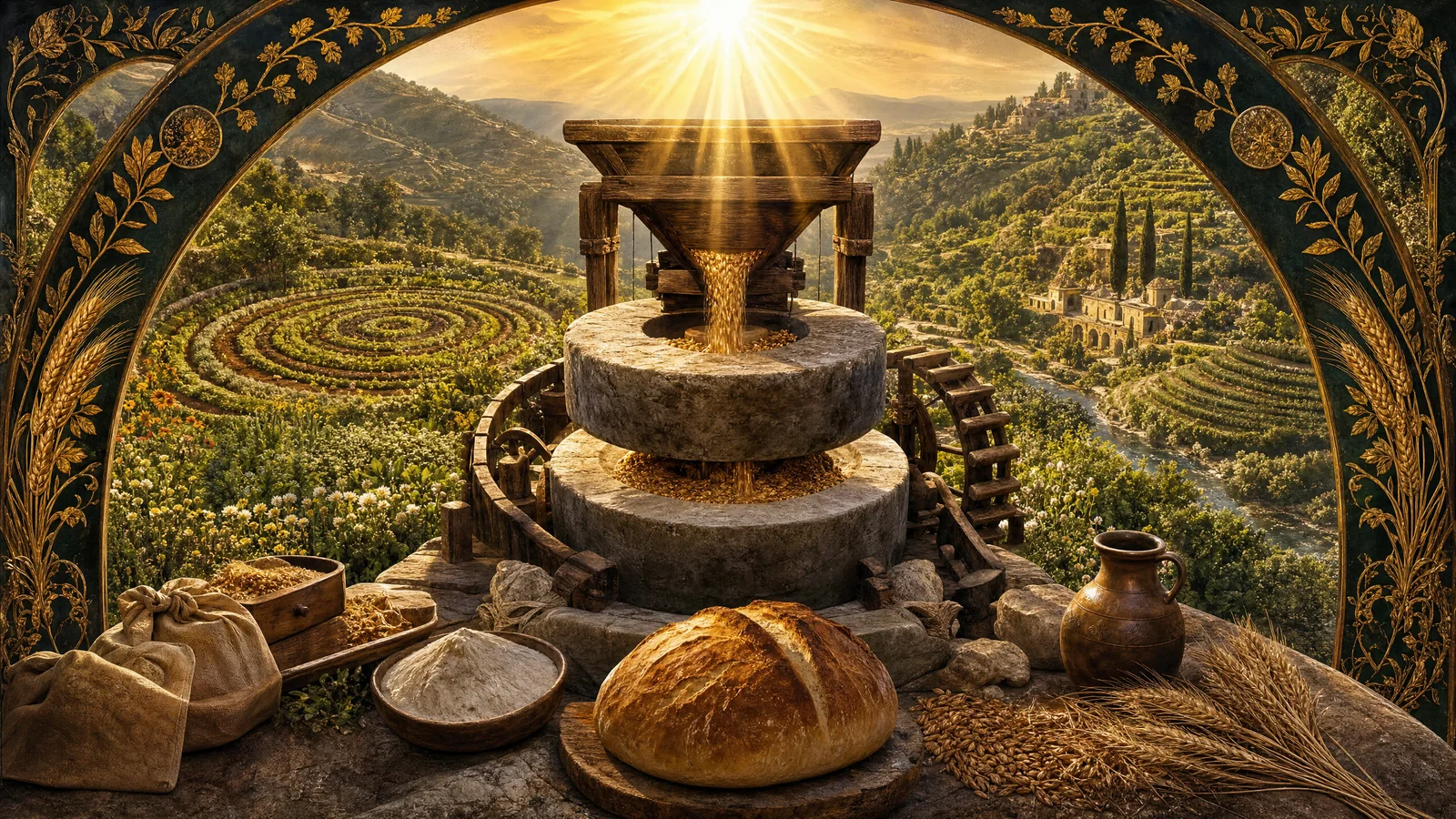
Complete Flour Milling and Grain Processing: From Kernel to Loaf
Milling transforms raw grain into flour, the foundation of bread and civilization. This campaign covers millstone dressing, hand milling, water-powered mills, and flour grading.
Chapter 1: Milling Methods
Method
Output (lbs/hour)
Power Source
Difficulty
Flour Quality
Saddle quern (rubbing stone)
1-2
Hand
Very low
Coarse
Rotary quern (hand mill)
3-5
Hand
Low
Medium
Mortar and pestle
0.5-1
Hand
Very low
Variable
Stone burr mill (hand-cranked)
5-15
Hand
Moderate
Good
Water-powered stone mill
50-200
Water
High
Excellent
Wind-powered stone mill
30-100
Wind
Very high
Excellent
Chapter 2: Millstone Construction
Component
Material
Purpose
Specification
Bedstone (bottom)
Granite, quartzite, or burr stone
Stationary grinding surface
24-48 inches diameter, 4-6 inches thick
Runner stone (top)
Same as bedstone
Rotating grinding surface
Same diameter, slightly lighter
Rynd (iron cross)
Wrought iron
Connects runner to spindle
Fits into eye of runner
Spindle
Hardwood or iron
Rotates runner stone
Vertical shaft through bedstone
Hopper
Wood
Feeds grain to stones
Above runner stone
Shoe (feed trough)
Wood
Meters grain flow
Vibrates to control feed rate
Tun (casing)
Wood
Contains flour
Surrounds stones
Millstone dressing: 1) Furrows (grooves) cut into grinding face of both stones. 2) Pattern: radial furrows from center to edge (8-12 furrows per stone). 3) Furrows are deeper at center, shallower at edge. 4) Furrows shear grain (scissor action between upper and lower furrows). 5) Lands (flat areas between furrows) grind flour fine. 6) Furrows also channel flour outward to edge. 7) Re-dress stones every 100-200 hours of use (furrows wear smooth). 8) Dressing tool: mill bill (specialized chisel). 9) Stone gap: adjust for flour fineness (closer = finer flour). 10) Too close: stones touch, overheat, damage grain.
Chapter 3: Water Mill Design
Component
Material
Purpose
Specification
Dam or weir
Earth, stone, timber
Create head (water height)
Minimum 4-6 feet head
Millrace (channel)
Earthen or lined
Carry water to wheel
Slight downward slope
Water wheel
Wood, iron
Convert water energy to rotation
6-15 feet diameter
Gearing
Wood or iron
Change speed and direction
4:1 to 6:1 ratio
Millstones
Stone
Grind grain
24-48 inches diameter
Tailrace
Earthen
Return water to stream
Below wheel
Water wheel types: 1) Overshot wheel: water enters at top (most efficient, 60-90%, needs high head). 2) Breastshot wheel: water enters at mid-height (moderate efficiency, 50-70%). 3) Undershot wheel: water pushes bottom of wheel (least efficient, 20-40%, works with low head). 4) Turbine: enclosed wheel (very efficient, 80-95%, requires engineering).
Chapter 4: Flour Grading
Flour Type
Extraction Rate
Color
Protein
Use
Nutrition
Whole wheat
100%
Brown
12-14%
Bread, general
Highest (all bran, germ)
High extraction
85-95%
Tan
11-13%
Bread, general
Very good
White (patent)
70-75%
White
10-12%
Fine bread, pastry
Lower (bran removed)
Middlings (shorts)
Byproduct
Tan
Variable
Animal feed
Good
Bran
Byproduct
Brown
Variable
Animal feed, fiber
High fiber
Sifting process: 1) Ground flour passes through progressively finer sieves. 2) Coarse sieve: removes bran flakes and large particles. 3) Medium sieve: separates middlings. 4) Fine sieve: produces white flour. 5) Bolting cloth: finest sieve (silk or fine linen). 6) Each pass produces a different grade of flour. 7) Nothing is wasted: bran and middlings feed animals.
Chapter 5: Bread Baking
Bread Type
Flour
Leavening
Difficulty
Shelf Life
Flatbread (unleavened)
Any
None
Very low
1-3 days
Sourdough
Wheat, rye
Wild yeast (starter)
Moderate
5-7 days
Yeasted bread
Wheat
Commercial or cultured yeast
Low-moderate
3-5 days
Hardtack
White flour
None
Very low
Months-years
Cornbread
Cornmeal
Baking soda or eggs
Low
1-2 days
Reference Card
Furrows are the key to milling (the grooves cut into millstones shear grain like scissors; without properly dressed furrows, stones crush rather than cut, producing poor flour). 2. Stone gap controls fineness (the distance between runner and bedstone determines flour fineness; too close and stones overheat; too far and flour is coarse). 3. An overshot wheel is most efficient (water entering at the top of the wheel uses both weight and momentum; 60-90% efficiency versus 20-40% for undershot). 4. Whole wheat flour is most nutritious (100% extraction flour contains all the bran, germ, and endosperm; white flour removes the most nutritious parts). 5. Sifting grades the flour (passing ground flour through progressively finer sieves separates it into white flour, middlings, and bran; each has its use). 6. Re-dress stones regularly (millstone furrows wear smooth with use; re-dressing with a mill bill every 100-200 hours maintains cutting efficiency). 7. Sourdough is the original leavening (wild yeast captured in a flour-and-water starter has raised bread for thousands of years; no commercial yeast needed). 8. One bushel of wheat makes 42 pounds of flour (a bushel of wheat weighing 60 pounds yields approximately 42 pounds of whole wheat flour, enough for about 50 loaves).