Sovereignty Module: Roll the Load
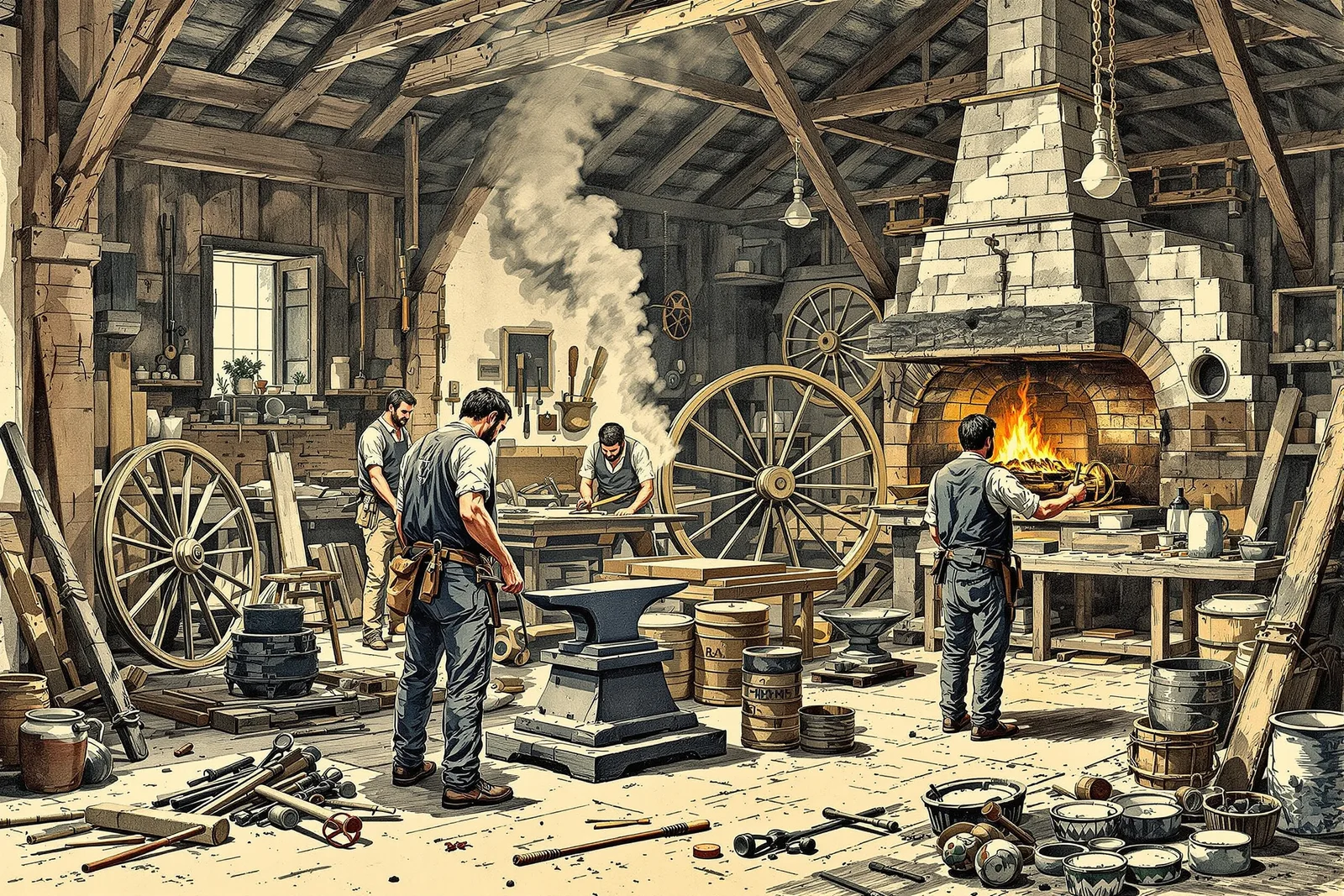
Complete Wagon, Cart, and Wheel Construction Guide
The wheel multiplied human transport capacity by a factor of ten. A single person can pull 300 lbs on a cart versus 50 lbs carried. This campaign covers wheel construction, cart building, and animal-drawn wagon design.
Chapter 1: Vehicle Types
| Vehicle | Wheels | Load | Draft | Terrain | Complexity |
|---|---|---|---|---|---|
| Wheelbarrow | 1 | 200-400 lbs | Human (push) | Rough paths | Low |
| Handcart (2-wheel) | 2 | 300-800 lbs | Human (pull/push) | Roads, paths | Low-moderate |
| Ox cart (2-wheel) | 2 | 1,000-3,000 lbs | Oxen (1-2) | Roads, rough | Moderate |
| Farm wagon (4-wheel) | 4 | 2,000-6,000 lbs | Horses/oxen (2-4) | Roads | High |
| Travois (no wheels) | 0 | 200-500 lbs | Horse or dog | Any terrain | Very low |
| Sled/sledge | 0 (runners) | 500-2,000 lbs | Horse/oxen | Snow, mud, grass | Low |
Chapter 2: Wheel Construction (Spoked)
| Component | Material | Function | Specification |
|---|---|---|---|
| Hub (nave) | Elm or hard maple (resists splitting) | Center, holds axle and spokes | Turned or carved cylinder, 8-12 inches diameter |
| Spokes | Oak or hickory (strong in bending) | Connect hub to rim, bear load | 12-14 per wheel, tapered, mortised into hub |
| Felloes (rim sections) | Ash or elm (bends well) | Form the outer rim | 6-7 curved sections, doweled together |
| Iron tire | Wrought iron or steel band | Protects rim, holds wheel together | Heated, shrunk onto rim (contracts when cooling) |
| Axle | Oak (hardwood) or iron | Supports wheel, bears load | Tapered end (wheel slides on) |
| Linchpin | Iron or hardwood | Holds wheel on axle | Pin through hole in axle end |
| Dish (cone shape) | Built into spoke angle | Resists lateral forces (camber) | Spokes angled 3-5 degrees outward from hub |
Wheel dishing: Spoked wheels are not flat — spokes angle slightly outward (like a shallow cone). This "dish" gives lateral strength. When weight is applied, the dish flattens slightly, distributing load across all spokes rather than just the bottom ones.
Chapter 3: Simple Solid Wheel
| Step | Action | Details |
|---|---|---|
| 1 | Cut 3 planks (2-3 inches thick, hardwood) | Width = desired wheel diameter |
| 2 | Edge-join planks with dowels and glue | Creates solid disc |
| 3 | Cut circle (desired diameter: 18-36 inches) | Saw or adze to shape |
| 4 | Bore center hole for axle | Must be round and true |
| 5 | Round edges slightly (prevents chipping) | Plane or rasp |
| 6 | Optionally add iron bands around rim | Nailed on, protects from wear |
| 7 | Grease axle hole (tallow, grease, or tar) | Reduces friction |
Solid wheels are heavy but simple and strong. Suitable for slow, heavy loads (ox carts). Spoked wheels are lighter and faster but require skilled craftsmanship.
Chapter 4: Cart Frame Construction
| Component | Material | Dimensions | Function |
|---|---|---|---|
| Axle beam | Hardwood (oak) 4x6 inches | Width of cart + wheel overhang | Supports wheels and load |
| Shafts (for single animal) | Hardwood poles, 7-10 feet | Attach to axle, extend forward | Connect to harness |
| Bed frame | Hardwood lumber 2x4 or 3x4 | 4x6 feet typical | Load platform |
| Bed planks | Any lumber 1-2 inches thick | Cover frame | Floor surface |
| Side boards | Lumber 1x8 to 1x12 | Height as needed | Contain loose loads |
| Tailgate | Lumber, hinged or removable | Width of bed | Loading/unloading |
Chapter 5: Bearings and Lubrication
| Bearing Type | Material | Friction | Lifespan | Maintenance |
|---|---|---|---|---|
| Wood on wood (plain) | Hardwood hub on hardwood axle | High | Short (wears quickly) | Grease frequently |
| Wood on iron (plain) | Hardwood hub on iron axle | Moderate | Moderate | Grease daily in use |
| Iron on iron (plain) | Iron bushing in hub on iron axle | Low-moderate | Long | Grease weekly |
| Roller bearing | Steel rollers in race | Very low | Very long | Grease monthly |
Historical lubricants: Tallow (animal fat), pine tar, beeswax + tallow mix, lard, whale oil. Modern: axle grease (petroleum-based). Any fat or oil reduces friction and wear. Without lubrication, wooden axles can catch fire from friction heat.
Chapter 6: Harness and Hitching
| Harness Type | Animal | Load Type | Efficiency |
|---|---|---|---|
| Yoke (neck/head) | Oxen | Heavy pulling (plows, carts) | Good for oxen (strong necks) |
| Collar and hames | Horses | All loads | Best for horses (pushes against shoulders) |
| Breast strap | Horses, donkeys | Light-moderate loads | Simple, less efficient than collar |
| Pack saddle | Horses, mules, donkeys | No vehicle (direct load on animal) | Good for rough terrain |
| Dog harness | Dogs | Small sleds, travois | Moderate |
Horse collar revolution: Before the padded horse collar (invented ~800 AD), horses could only pull light loads (throat strap choked them under heavy load). The collar transfers force to the horse's shoulders, increasing pulling power by 4-5x. This single invention transformed agriculture and transport.
Reference Card
- Wheel dish (cone shape) provides lateral strength: spokes angle 3-5 degrees outward
- Iron tire shrunk on: heat expands iron band, place on wheel, cooling contracts and locks tight
- Solid wheels: simple, strong, heavy (ox carts). Spoked: light, fast, complex (horse wagons).
- Lubricate axles with any available fat/oil: dry axles wear fast and can catch fire
- Horse collar pushes against shoulders (4-5x more pulling power than throat strap)
- Ox yoke sits on neck/head: oxen have strong necks, horses do not
- Two-wheel cart: simpler, lighter, works on rough terrain. Four-wheel: more capacity, needs roads.
- Wheelbarrow: one person moves 200-400 lbs (4-8x carrying capacity)