Sovereignty Module: Reach the Deep
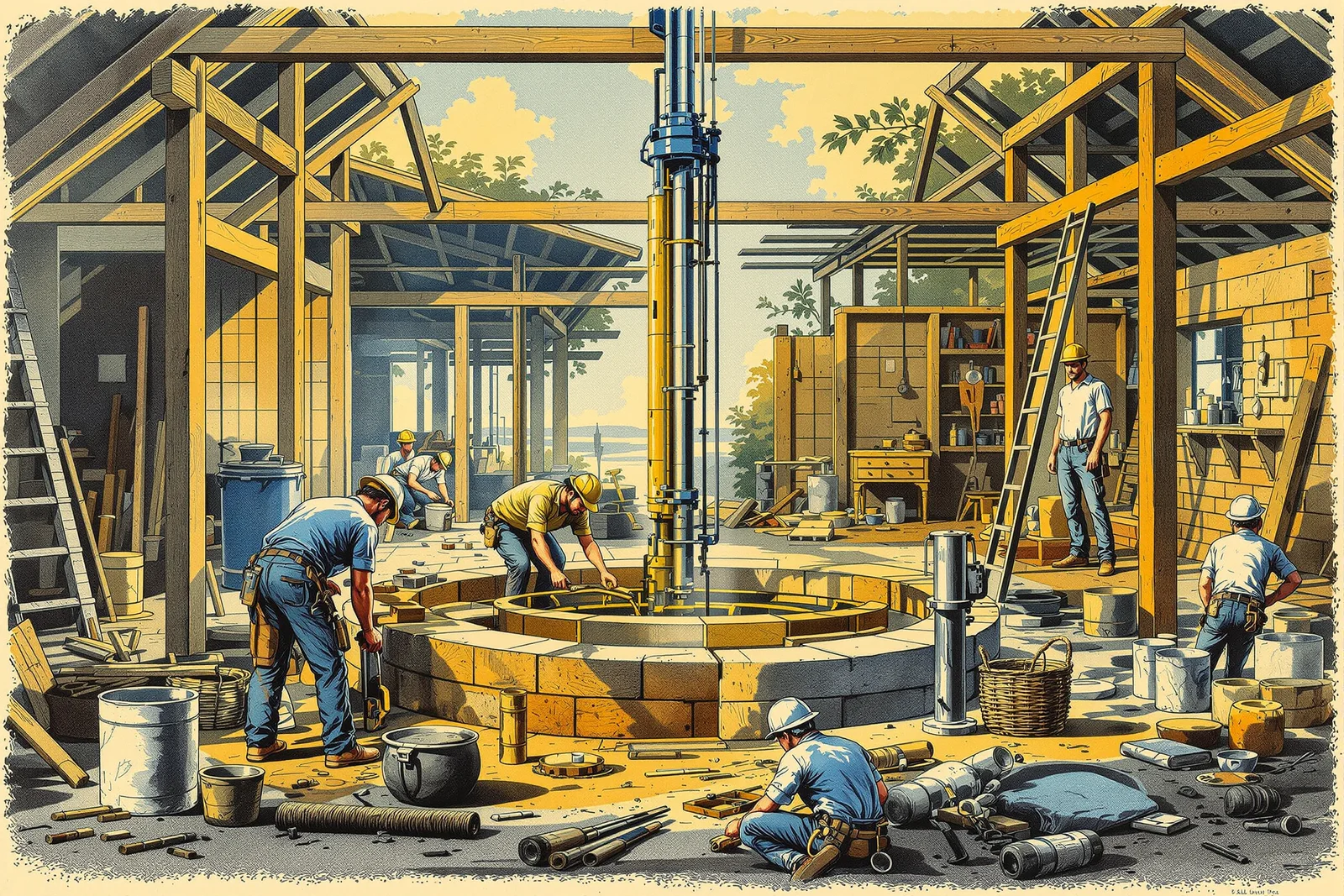
Complete Well Drilling, Groundwater Access, and Hand Pump Installation Guide
Clean water from underground is the most reliable water source in any climate. Wells provide water year-round regardless of surface conditions. This campaign covers finding water, digging and drilling wells, and installing hand pumps.
Chapter 1: Groundwater Indicators
| Indicator | Reliability | Method |
|---|---|---|
| Vegetation (willows, cattails, green in dry season) | High | Observe where plants stay green |
| Topography (valley bottoms, base of slopes) | High | Water flows downhill underground too |
| Existing springs or seeps | Very high | Spring = water table intersecting surface |
| Neighboring wells (ask depth and yield) | Very high | Water table is relatively consistent locally |
| Soil type (sand/gravel = good aquifer) | High | Permeable soils hold and transmit water |
| Rock outcrops (limestone = possible, granite = poor) | Moderate | Limestone has fractures and caves |
| Ant hills (some species indicate shallow water) | Low-moderate | Traditional indicator |
| Morning fog/dew concentration | Low-moderate | Moisture rises from shallow water table |
Chapter 2: Well Types
| Type | Depth | Diameter | Method | Yield | Lifespan |
|---|---|---|---|---|---|
| Dug well (hand-dug) | 10-50 feet | 3-6 feet | Shovel, pick, bucket | Moderate-high | 20-50+ years |
| Driven well (sand point) | 10-30 feet | 1.25-2 inches | Hammer pipe into ground | Low-moderate | 10-25 years |
| Bored well (hand auger) | 10-100 feet | 4-8 inches | Earth auger, extensions | Moderate | 20-40 years |
| Drilled well (rotary) | 50-500+ feet | 4-8 inches | Drill rig (motorized) | High | 30-50+ years |
| Spring box (captured spring) | Surface | N/A | Excavate, box, pipe | Variable | Indefinite |
Chapter 3: Hand-Dug Well Construction
| Step | Action | Safety |
|---|---|---|
| 1 | Select site (uphill from latrines, 100+ feet from contamination) | Critical: never downhill from sewage |
| 2 | Dig shaft 4-5 feet diameter, line as you go | Shore walls immediately (cave-in kills) |
| 3 | Install concrete rings or stone/brick lining | Prevents collapse, keeps out surface water |
| 4 | Continue digging below water table (3-6 feet into saturated zone) | Work in water, bail as you dig |
| 5 | Install gravel filter at bottom (12-18 inches of clean gravel) | Prevents sand from entering well |
| 6 | Seal upper 10 feet of lining (cement/clay) | Prevents surface contamination |
| 7 | Build concrete apron around wellhead (3 feet radius, sloped away) | Diverts surface water away |
| 8 | Install cover (concrete slab with access hole) | Prevents contamination, child safety |
| 9 | Install pump (hand pump or windlass with bucket) | Access method |
| 10 | Disinfect well (chlorine treatment) before first use | Kills bacteria from construction |
Chapter 4: Driven Well (Sand Point)
| Step | Action | Details |
|---|---|---|
| 1 | Obtain well point (screened steel point, 1.25-2 inch) | Commercial or fabricated (drill holes in pipe, wrap with screen) |
| 2 | Attach first section of pipe (5-6 feet) | Threaded coupling |
| 3 | Drive into ground with post driver or sledgehammer | Use drive cap to protect threads |
| 4 | Add pipe sections as point descends | Thread on additional lengths |
| 5 | Test for water periodically (pour water in, see if it drains away) | When water drains = you've reached water table |
| 6 | Continue 3-5 feet past water table | Ensures adequate submergence |
| 7 | Install pitcher pump or hand pump on top | Prime pump, test yield |
| 8 | Build concrete apron around pipe | Prevents surface contamination |
Limitations: Only works in sand/gravel (cannot penetrate rock or heavy clay). Maximum practical depth: 25-30 feet (suction pump limit). Deeper requires a different pump type.
Chapter 5: Hand Pump Types
| Pump Type | Max Depth | Flow Rate | Complexity | Maintenance |
|---|---|---|---|---|
| Pitcher pump (suction) | 25 feet | 3-5 GPM | Low | Low (replace leathers) |
| Deep well hand pump | 200+ feet | 1-3 GPM | Moderate | Moderate (rod/cylinder) |
| Rope pump | 100+ feet | 1-3 GPM | Low (DIY) | Low (replace rope/washers) |
| Windlass (bucket) | Any depth | 1-2 GPM | Very low | Very low |
| Solar pump | 200+ feet | 2-10 GPM | High (electronics) | Low (no moving parts in submersible) |
Rope pump (DIY): Continuous loop of rope with rubber washers (discs) spaced 3 feet apart. Rope passes through PVC pipe (rising main). Turn wheel at top, washers push water up pipe. Simple, cheap, maintainable with local materials.
Chapter 6: Water Quality and Protection
| Contamination Source | Minimum Distance from Well | Prevention |
|---|---|---|
| Latrine/septic | 100 feet (30 meters) minimum | Always locate well UPHILL from sewage |
| Animal pen/feedlot | 100 feet | Slope drainage away from well |
| Chemical storage | 200 feet | Bermed containment around chemicals |
| Surface water (stream, pond) | 50 feet | Sealed well casing prevents surface entry |
| Road/parking area | 50 feet | Prevents fuel/oil contamination |
| Garbage/compost | 50 feet | Leachate can reach groundwater |
Disinfection: New wells or contaminated wells: add 1 quart household bleach per 100 gallons of water in well. Let sit 12-24 hours. Pump until chlorine smell gone. Test before drinking.
Reference Card
- Well site: uphill from all contamination, minimum 100 feet from latrines
- Dug well: line walls immediately (cave-in is the #1 killer in well construction)
- Seal upper 10 feet of well casing to prevent surface water contamination
- Driven well (sand point): only works in sand/gravel, max 25-30 feet deep
- Suction pumps cannot lift water more than 25 feet (atmospheric pressure limit)
- Rope pump: simple DIY design works to 100+ feet with local materials
- Concrete apron (3-foot radius, sloped away) prevents surface contamination
- Disinfect all new wells with chlorine before first use