Sovereignty Module: Arm the Faithful
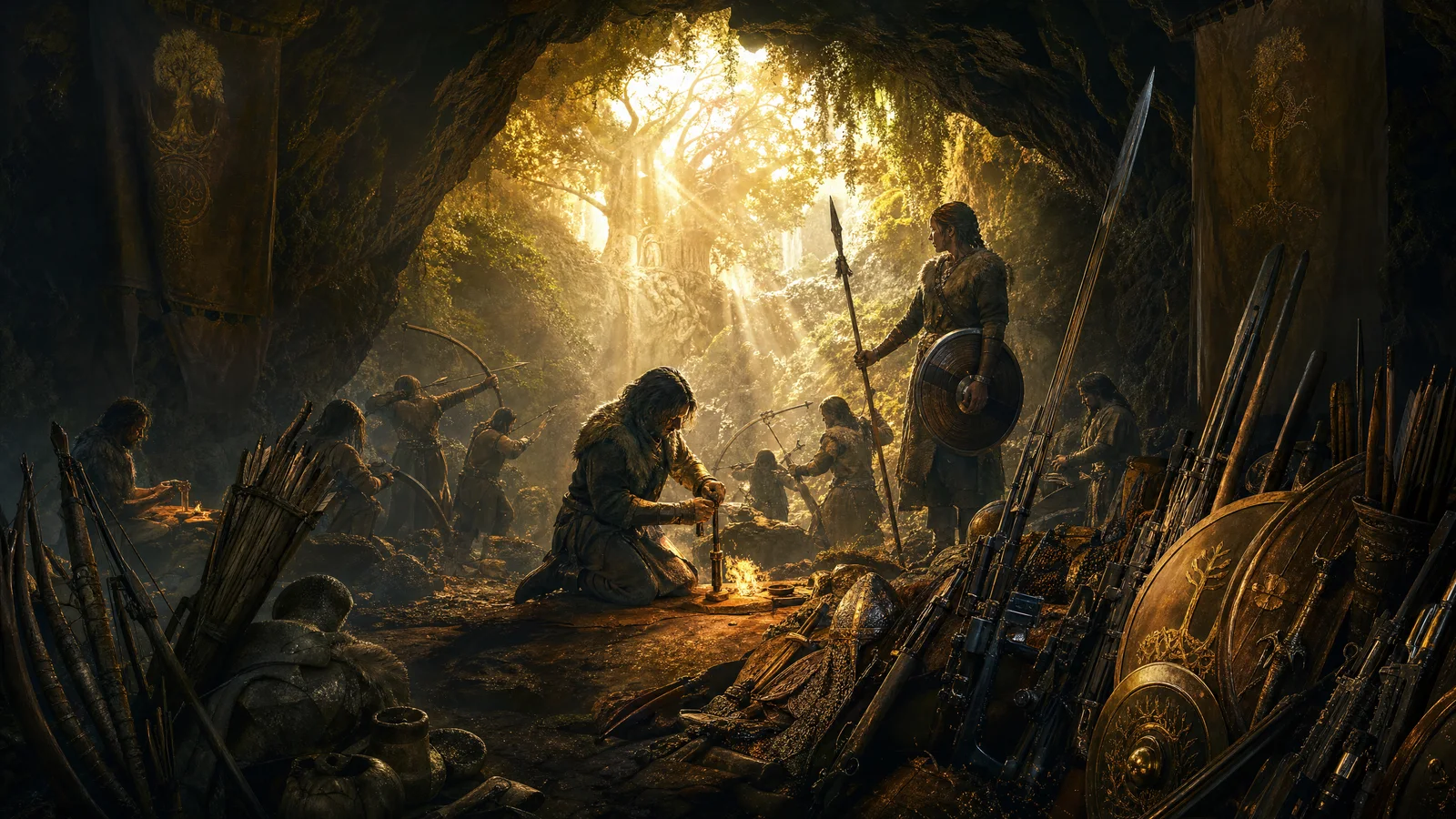
Complete Weapons and Defense: From Primitive Arms to Firearms
Defense of community requires weapons knowledge. This campaign covers every level from stone tools through black powder firearms, with emphasis on construction and maintenance.
Chapter 1: Weapon Hierarchy by Technology Level
| Level | Weapons | Materials Needed | Skill Required | Effective Range |
|---|---|---|---|---|
| 1 (Stone Age) | Spear, club, sling, atlatl | Wood, stone, cordage | Low | 5-50 meters |
| 2 (Bronze/Iron) | Sword, axe, bow, crossbow | Metal, wood, sinew | Moderate-high | 5-200 meters |
| 3 (Medieval) | Longbow, pike, armor, siege | Iron/steel, wood, leather | High | 10-300 meters |
| 4 (Early Gunpowder) | Matchlock, cannon, grenades | Iron, charcoal, sulfur, saltpeter | High | 50-500 meters |
| 5 (Modern Firearms) | Rifle, pistol, shotgun | Steel, brass, lead, smokeless powder | Moderate-high | 50-1,000+ meters |
Chapter 2: Bow Construction
| Bow Type | Wood | Length | Draw Weight | Effective Range | Build Time |
|---|---|---|---|---|---|
| Simple self-bow | Osage orange, yew, elm, hickory | 60-72 inches | 40-80 lbs | 30-60 yards | 20-40 hours |
| Flatbow (board bow) | Any hardwood (oak, maple, hickory) | 66-72 inches | 35-60 lbs | 30-50 yards | 10-20 hours |
| Recurve (composite) | Wood + sinew + horn (laminated) | 48-60 inches | 50-100+ lbs | 50-100 yards | 100+ hours |
| Crossbow | Hardwood or steel prod | Prod: 24-36 inches | 100-300+ lbs | 50-100 yards | 40-80 hours |
Self-bow construction: 1. Select stave (straight, no knots, 6+ feet). 2. Split or saw to rough dimensions. 3. Mark center handle. 4. Tiller (thin limbs gradually, test bend). 5. Shape handle. 6. Nock string grooves. 7. String and test draw. 8. Adjust tiller until both limbs bend evenly. 9. Finish (oil or varnish).
Chapter 3: Arrow Making
| Component | Material | Specification | Notes |
|---|---|---|---|
| Shaft | Straight-grained wood (cedar, poplar, birch) | 28-32 inches, 5/16-3/8 inch diameter | Must be straight and consistent spine |
| Point (broadhead) | Flint, obsidian, bone, or steel | Sharp, securely attached | Hunting: broadhead. Practice: field point. |
| Fletching | Feathers (turkey, goose) | 3 feathers, 4-5 inches long | All from same wing (left or right). Glue + wrap. |
| Nock | Self-nock (cut in shaft) or added | Fits bowstring snugly | Reinforce with thread wrap if self-nock |
Spine matching: arrow stiffness must match bow draw weight. Too stiff = arrow flies left (right-handed). Too weak = arrow flies right. Test: support arrow at ends, hang weight from center, measure deflection.
Chapter 4: Black Powder and Firearms
| Component | Source | Processing | Proportion (by weight) |
|---|---|---|---|
| Potassium nitrate (saltpeter) | Manure piles, cave deposits, urine-soaked earth | Leach with water, boil down, crystallize | 75% |
| Charcoal | Willow, alder, or grapevine (soft woods) | Burn in sealed container (no oxygen) | 15% |
| Sulfur | Volcanic deposits, pyrite roasting | Melt and purify | 10% |
Black powder production: 1. Grind each component separately to fine powder. 2. Mix in correct proportions (75/15/10). 3. Add small amount of water to make paste. 4. Press into cake, dry thoroughly. 5. Granulate (break into uniform grains). 6. Sieve to desired grain size. SAFETY: Never grind mixed powder. Never use metal tools (sparks). Work in small batches. Keep away from heat/flame.
Chapter 5: Firearm Construction (Smoothbore Musket)
| Component | Material | Method | Critical Dimension |
|---|---|---|---|
| Barrel | Wrought iron or mild steel | Forge-weld around mandrel, or drill from solid | Bore: 0.50-0.75 inch, wall: 0.15+ inch |
| Lock (ignition mechanism) | Steel (springs, frizzen) | Forge and file to shape | Must create reliable spark |
| Stock | Hardwood (walnut, maple, cherry) | Carve and inlet barrel + lock | Must support barrel securely |
| Trigger mechanism | Steel | Forge, file, and fit | Must hold and release sear cleanly |
| Ramrod | Hardwood or steel | Turn on lathe or whittle | Must fit bore with clearance |
Barrel proof testing: ALWAYS proof-test before firing by hand. Load with double charge, secure barrel pointing safely, fire remotely with long fuse. If barrel survives double charge without bulging or cracking, it is safe for normal use.
Chapter 6: Ammunition
| Type | Components | Construction | Use |
|---|---|---|---|
| Round ball (musket) | Lead, mold | Melt lead, pour into mold, trim sprue | Smoothbore firearms |
| Conical bullet (rifle) | Lead, mold | Melt lead, pour into mold | Rifled firearms |
| Shot (multiple projectile) | Lead, shot tower or plate method | Drop molten lead from height into water (round) | Shotguns, bird hunting |
| Paper cartridge | Paper, powder, ball | Roll paper tube, fill with measured powder + ball | Fast loading |
| Percussion cap | Copper, mercury fulminate | Press copper cups, fill with fulminate | Ignition (replaces flint) |
Lead casting: Melt lead in iron ladle over fire (621°F / 327°C). Skim dross (impurities float). Pour into pre-heated mold. Let cool 10 seconds. Open mold, trim sprue with knife. Inspect for voids or wrinkles (reject if imperfect).
Reference Card
- Bow: best weapon for silent hunting and defense. 40-60 lb draw weight adequate for deer. Practice daily.
- Arrows: must match bow. Straight shafts, matched spine, sharp points, proper fletching. Make dozens (they break/lose).
- Black powder: 75% saltpeter, 15% charcoal, 10% sulfur. NEVER grind mixed. Work small batches. Keep dry.
- Barrel safety: proof-test with double charge before hand-firing. Wall thickness minimum 0.15 inch for smoothbore.
- Lead melts at 621°F. Cast in pre-heated molds. Trim sprue. Reject any ball with voids or wrinkles.
- Crossbow: easier to learn than bow. Higher draw weight = more power. Slower to reload. Good for defense.
- Sling: free weapon (leather + cord). Effective to 50+ meters. David killed Goliath. Practice required.
- Maintenance: keep all weapons clean, dry, and oiled. Rust = failure. Bowstrings waxed. Firearms cleaned after every use.