Sovereignty Module: Reach the Aquifer
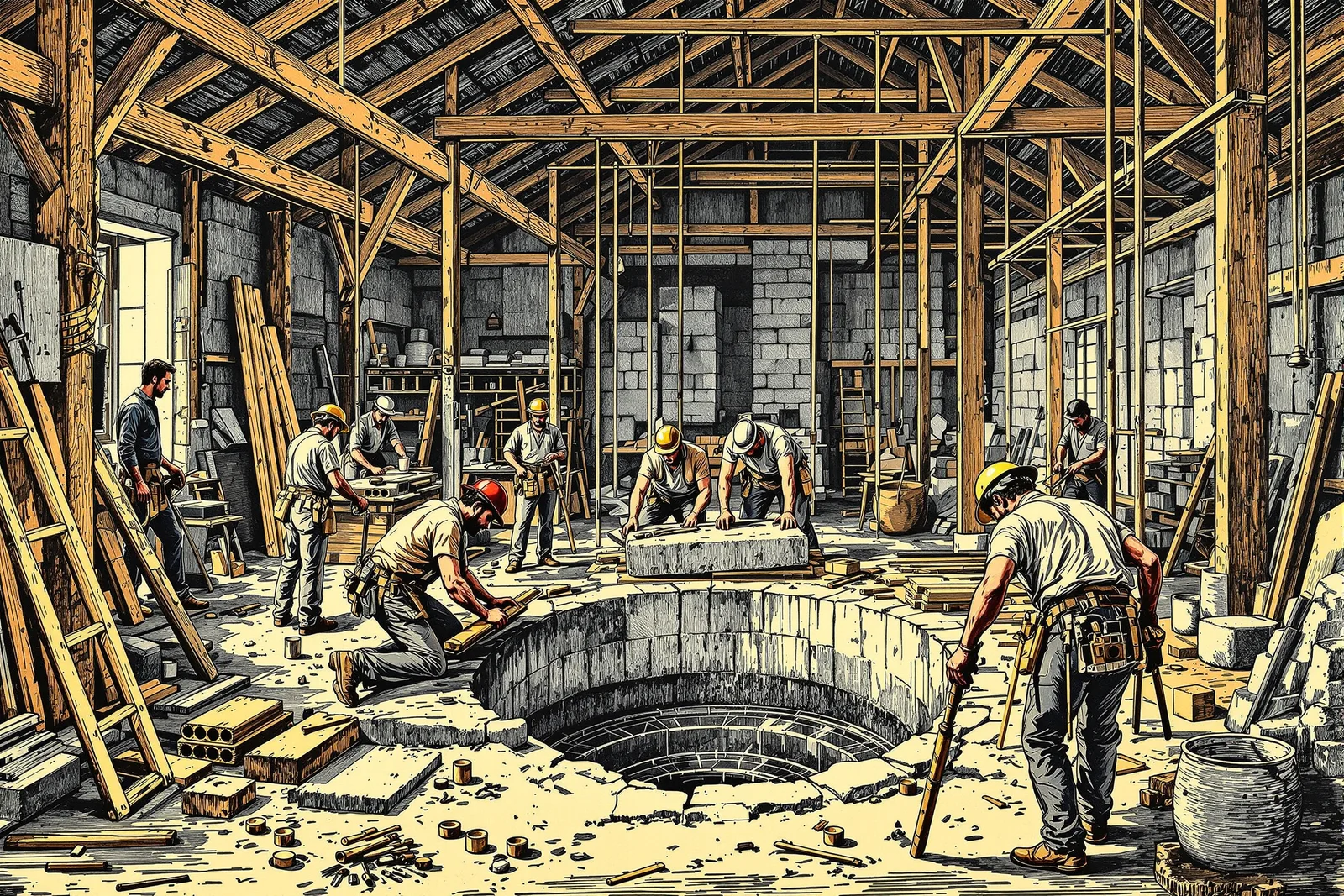
Complete Hand-Dug Well Construction: From Site Selection to Safe Drinking Water
A reliable water source is the foundation of permanent settlement. This campaign covers finding groundwater, digging safely, lining the well, and maintaining water quality.
Chapter 1: Groundwater Indicators
| Indicator | Reliability | What It Means | How to Observe |
|---|---|---|---|
| Vegetation patterns (lush green in dry area) | High | Shallow water table beneath | Observe from elevation. Green strips = underground water. |
| Existing springs/seeps nearby | Very high | Water table intersects surface | Walk low areas, look for wet ground |
| Topography (valley bottoms, drainage convergence) | High | Water collects at lowest points | Choose low ground between hills |
| Soil type (clay over gravel layers) | Moderate | Confined aquifer possible | Observe road cuts, stream banks |
| Ant hills (certain species) | Moderate | Insects detect moisture | Traditional indicator in many cultures |
| Morning fog/dew concentration | Moderate | Evaporation from shallow water | Observe early morning patterns |
| Dowsing/divining | Unproven | - | Traditional but no scientific basis |
| Test holes (auger boring) | Very high | Direct observation of water | Drill 4-inch test holes with hand auger |
Best approach: Dig test holes (3-6 feet deep) in multiple locations during dry season. If water seeps in = good location. Dig your well where water appears shallowest.
Chapter 2: Well Types
| Type | Depth | Diameter | Method | Lining | Best For |
|---|---|---|---|---|---|
| Hand-dug (open) | 10-60 feet | 3-5 feet | Shovel + bucket | Stone, brick, or concrete rings | High water table, stable soil |
| Driven point (well point) | 10-30 feet | 1.25-2 inches | Hammer pipe into ground | Steel pipe + screen | Sandy soil, shallow water |
| Bored (hand auger) | 10-100 feet | 4-8 inches | Hand auger/drill | PVC or steel casing | Any soil, deeper water |
| Spring development | Surface | Variable | Excavate + protect spring | Stone/concrete spring box | Where springs exist |
| Infiltration gallery | 3-10 feet | Trench | Dig trench near stream | Perforated pipe + gravel | Near streams/rivers |
Chapter 3: Hand-Dug Well Construction
| Step | Action | Safety | Details |
|---|---|---|---|
| 1 | Mark location (minimum 50 feet from any latrine/contamination) | - | Uphill from contamination sources |
| 2 | Dig shaft 4-5 feet diameter, circular | Shore walls as you go | Remove topsoil separately (don't mix with subsoil) |
| 3 | Install temporary shoring (boards/planks against walls) | CRITICAL: cave-in kills | Never dig deeper than 4 feet without shoring |
| 4 | Dig in lifts (3-4 feet at a time) | Always have escape route | Bucket + rope/windlass for soil removal |
| 5 | Line walls as you descend (stone, brick, or concrete rings) | Permanent support | Build lining from bottom up, or sink pre-cast rings |
| 6 | Continue until well into water-bearing layer | Monitor air quality | Dig 3-5 feet below first water appearance |
| 7 | Install gravel filter at bottom (6-12 inches) | - | Washed gravel prevents sand entering well |
| 8 | Build well head above ground (2-3 feet above grade) | Prevents surface contamination | Concrete apron, drainage away from well |
| 9 | Install cover (concrete slab or wooden lid) | Prevents contamination, falls | Lockable, sealed, with pump/bucket access |
| 10 | Develop well (pump/bail repeatedly) | - | Clears fine sediment, increases flow |
Chapter 4: Safety Protocols
| Hazard | Prevention | Emergency Response |
|---|---|---|
| Cave-in (soil collapse) | Shore walls continuously. Never undercut. | Dig victim out immediately. Call for help. |
| Bad air (CO2, methane, H2S) | Test with candle (goes out = bad air). Ventilate. | Remove victim to fresh air. Do NOT enter without ventilation. |
| Falling objects | Hard hat. Keep tools away from edge. | First aid for head injuries. |
| Drowning (sudden water inflow) | Monitor water level. Have escape plan. | Rope always attached to digger. Pull out immediately. |
| Falls | Secure ladder. Safety rope on digger. | Rope harness on digger at all times below 10 feet. |
CRITICAL RULE: Never work alone in a well. Minimum 2 people: one digging, one at surface with rope. Below 10 feet: safety harness + rope attached to digger at ALL times.
Chapter 5: Well Lining Materials
| Material | Durability | Cost | Skill Required | Permeability |
|---|---|---|---|---|
| Dry-stacked stone | 50-100+ years | Free (if stone available) | Moderate (masonry) | Allows water in through joints (good below water table) |
| Mortared stone/brick | 100+ years | Low-moderate | Moderate-high | Waterproof above water table, open joints below |
| Pre-cast concrete rings | 50-100 years | Moderate | Low (sink in place) | Waterproof (joints sealed above water table) |
| Poured concrete | 50-100 years | Moderate | High (formwork) | Waterproof |
| Timber crib (log) | 10-20 years | Low | Moderate | Short lifespan, eventual replacement needed |
| Woven wattle + clay | 5-10 years | Very low | Low | Temporary, shallow wells only |
Chapter 6: Water Quality and Treatment
| Contamination Source | Minimum Distance from Well | Direction |
|---|---|---|
| Latrine/outhouse | 50 feet (100 preferred) | Downhill from well |
| Animal pen/barn | 100 feet | Downhill from well |
| Septic system | 100 feet | Downhill from well |
| Garbage/compost | 50 feet | Downhill from well |
| Chemical storage | 200 feet | Downhill from well |
| Cemetery | 200 feet | Downhill from well |
Treatment methods for well water: 1. Boiling (1 minute rolling boil kills all pathogens). 2. Solar disinfection (SODIS): clear bottles in sun 6+ hours. 3. Chlorination: 2 drops bleach per quart, wait 30 minutes. 4. Slow sand filter: removes 99% of bacteria. 5. Ceramic filter: removes bacteria and protozoa.
Reference Card
- Location: minimum 50 feet from ANY contamination source. Uphill from latrines. Low ground between hills.
- Test first: dig 3-6 foot test holes in dry season. Water seeps in = good location for well.
- NEVER dig alone. Minimum 2 people. Safety rope on digger below 10 feet. Test air with candle.
- Shore walls continuously. Cave-in is the #1 killer in well digging. Never undercut walls.
- Dig 3-5 feet below first water appearance (ensures water during dry season).
- Gravel filter at bottom (6-12 inches washed gravel). Prevents sand entering well.
- Well head: 2-3 feet above ground, concrete apron sloping away, sealed cover. Prevents surface contamination.
- Develop well after construction: pump/bail repeatedly until water runs clear. May take days.