Sovereignty Module: Twist the Fiber
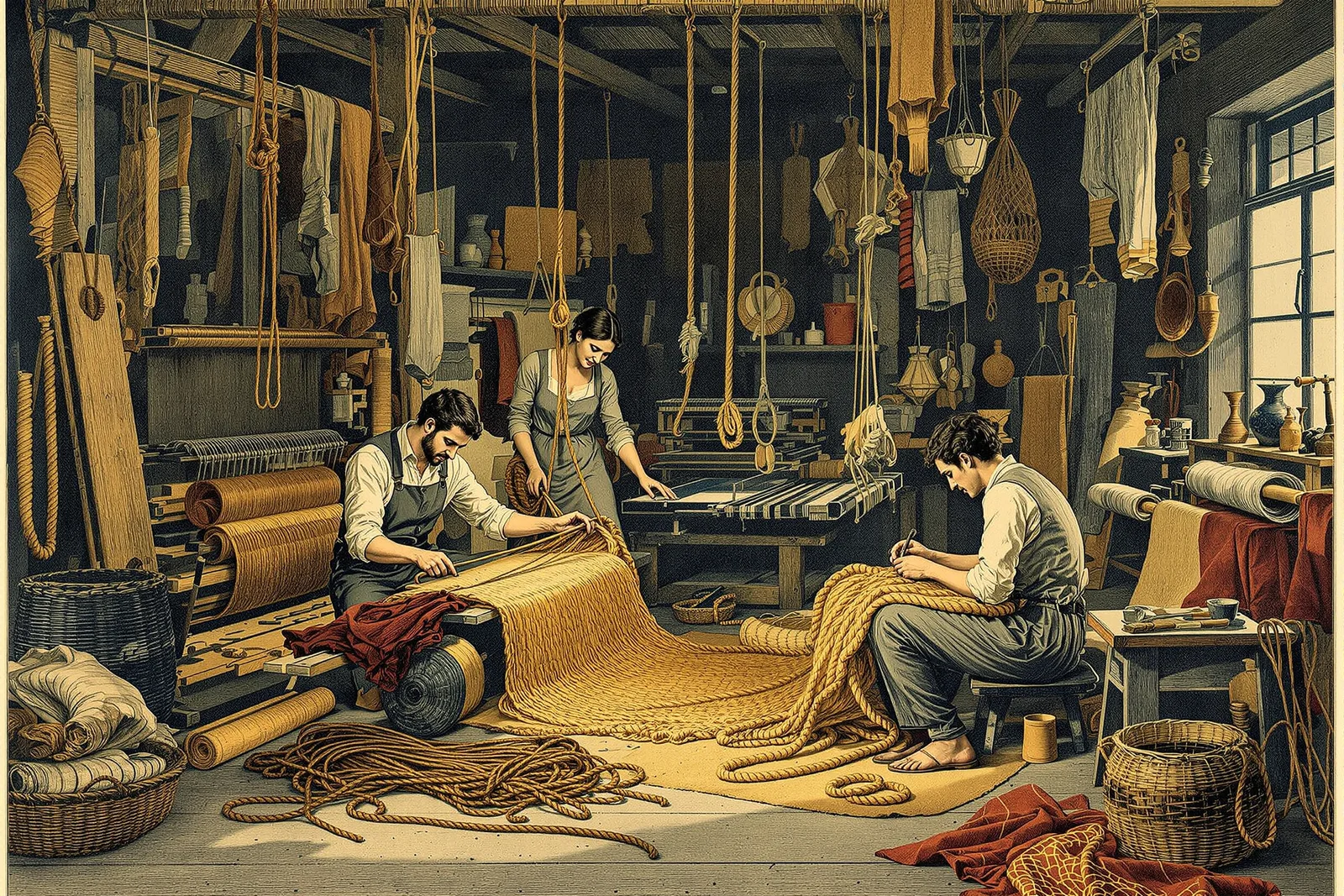
Twist the Fiber
Complete Cordage Making: From Plant Fiber to Rope Without Tools
Complete Cordage Making: From Plant Fiber to Rope Without Tools
Cordage is the universal connector — binding shelters, stringing bows, setting snares, lashing rafts. This campaign covers fiber extraction, spinning, and rope construction from wild plants.
Chapter 1: Fiber Plants (Ranked by Strength)
| Plant | Fiber Location | Strength | Availability | Processing Difficulty |
|---|---|---|---|---|
| Stinging nettle | Stem (bast fiber) | Excellent | Temperate forests, disturbed ground | Moderate (ret or break stems) |
| Dogbane/Indian hemp | Stem (bast fiber) | Excellent | Fields, roadsides (N. America) | Moderate (dry stems, strip bark) |
| Milkweed | Stem (bast fiber) | Good | Fields, roadsides | Moderate (similar to dogbane) |
| Yucca | Leaves | Excellent | Arid/semi-arid regions | Easy (pound and scrape leaves) |
| Cattail | Leaves | Moderate | Wetlands everywhere | Easy (twist green or dried leaves) |
| Basswood/linden | Inner bark | Good | Temperate forests | Easy (strip bark in spring) |
| Willow bark | Inner bark | Moderate | Near water | Easy (strip in spring) |
| Palm fiber | Leaf bases, husks | Good-excellent | Tropical/subtropical | Easy (already fibrous) |
| Grass (any tall species) | Whole stems | Low-moderate | Everywhere | Very easy (twist whole stems) |
| Rawhide | Animal skin | Excellent | Hunting | Moderate (cut spiral strips) |
| Sinew | Animal tendons | Excellent | Hunting (deer, elk legs/back) | Moderate (dry, pound, separate) |
Chapter 2: Reverse-Wrap Two-Ply Cordage (Universal Method)
| Step | Action | Details | Common Errors |
|---|---|---|---|
| 1 | Prepare fibers (separate, clean, slightly damp) | Fibers should be 6-18 inches long, flexible | Too dry = brittle. Too wet = slippery. |
| 2 | Take bundle of fibers, find center (or off-center) | Unequal legs = easier splicing | Equal legs = both run out at same time (weak) |
| 3 | Twist/kink at center point to create two legs | Pinch the kink between thumb and finger | Kink must be tight (starting point of cord) |
| 4 | Hold kink, twist AWAY from you (top leg, clockwise) | 2-3 twists | Not enough twist = loose cord. Too much = kinks. |
| 5 | Wrap twisted leg TOWARD you (over the bottom leg) | Top becomes bottom, bottom becomes top | This is the "reverse wrap" — twist one way, wrap other |
| 6 | Repeat: twist new top leg AWAY, wrap TOWARD you | Continuous rhythm | Maintain consistent tension |
| 7 | Splice: when one leg gets short, add new fibers | Lay new fibers alongside short leg, twist together | Splice both legs at DIFFERENT points (never same spot) |
| 8 | Continue until desired length | - | Consistent diameter = consistent strength |
Key principle: Each leg is twisted in ONE direction (Z-twist), but wrapped around each other in the OPPOSITE direction (S-wrap). This opposition locks the cord — it cannot untwist because the wrap holds the twist.
Chapter 3: Cordage Specifications
| Cordage Type | Diameter | Breaking Strength | Construction | Uses |
|---|---|---|---|---|
| Thread | 1/16 inch | 5-15 lbs | 2-ply, fine fibers | Sewing, fishing line, snare triggers |
| String | 1/8 inch | 15-40 lbs | 2-ply, medium fibers | Bow string, lashing, binding |
| Light cord | 1/4 inch | 40-100 lbs | 2-ply thick or 3-ply | Snares, fishing, light lashing |
| Heavy cord | 3/8 inch | 100-200 lbs | 3-ply or braided | Bow drill cord, heavy lashing |
| Rope | 1/2-1 inch | 200-1,000+ lbs | 3-strand laid or braided | Climbing, hauling, structural |
Chapter 4: Three-Strand Laid Rope
| Step | Action | Details |
|---|---|---|
| 1 | Make three equal lengths of heavy cord (Z-twist) | Each strand = 2-ply reverse-wrap cord |
| 2 | Tie three strands together at one end | Secure to fixed point |
| 3 | Twist each strand tightly (same direction as original twist) | Z-twist (clockwise when viewed from end) |
| 4 | Lay strands together in OPPOSITE direction (S-lay) | Counter-clockwise wrap |
| 5 | Maintain equal tension on all three strands | Unequal = weak rope |
| 6 | Whip or bind both ends to prevent unraveling | Wrap thin cord tightly around ends |
Rope-walk method (for long rope): Three people each twist one strand while walking backward. Fourth person at the joining point controls the lay. Traditional method for making rope over 20 feet long.
Chapter 5: Fiber Processing Methods
| Method | Applicable To | Procedure | Time |
|---|---|---|---|
| Retting (water) | Bast fibers (nettle, hemp, flax) | Submerge stems in water 1-3 weeks until bark separates | 1-3 weeks |
| Retting (dew) | Bast fibers | Lay stems on ground, turn regularly, until bark loosens | 2-6 weeks |
| Breaking/braking | Retted bast fibers | Crush dried stems to break woody core, strip fiber | Hours |
| Pounding | Yucca, agave leaves | Pound leaves with rock until pulp separates from fiber | 30-60 min per leaf |
| Scraping | Yucca, sisal, agave | Scrape leaf pulp away with shell/bone/knife edge | 15-30 min per leaf |
| Stripping | Bark fibers (basswood, willow) | Peel bark in spring (sap flowing), separate inner bark | Minutes |
| Drying and separating | Sinew, rawhide | Dry tendon, pound with rock, pull apart into threads | Hours |
Chapter 6: Knot Strength and Cordage Care
| Factor | Effect on Strength | Mitigation |
|---|---|---|
| Any knot | Reduces strength 30-60% | Use proper knots. Bowline retains 75%. |
| Sharp bends | Reduces strength 20-40% | Pad edges, use thimbles/toggles |
| Abrasion | Progressive weakening | Inspect regularly, protect from rough surfaces |
| UV exposure | Degrades plant fibers over months | Store in shade when not in use |
| Moisture cycling (wet/dry) | Weakens over time | Dry thoroughly after wetting. Oil/wax for preservation. |
| Overloading | Permanent stretch, weakening | Never exceed 1/4 of breaking strength for working load |
Reference Card
- Reverse-wrap method: twist AWAY from you, wrap TOWARD you. Opposition locks the cord.
- Splice at DIFFERENT points on each leg. Never splice both legs at same location (creates weak point).
- Best wild fibers: stinging nettle, dogbane, yucca (strength). Cattail, grass (availability/ease).
- Slightly damp fibers twist best. Too dry = brittle/breaks. Too wet = slippery/won't hold twist.
- Three-strand rope: twist each strand Z (clockwise), lay together S (counter-clockwise). Opposition = strength.
- Working load: never exceed 1/4 of breaking strength. Knots reduce strength 30-60%.
- Retting: soak bast fiber stems 1-3 weeks in water. Bacteria dissolve binding pectin. Fiber separates easily.
- Sinew: strongest natural cordage. Dry tendon from deer/elk legs, pound, separate into threads. Shrinks when drying (self-tightening lashing).
TransmissionCOMPLETE — unaltered & unabridged
Words1,188 — every one of them
SHA-256 of source textcb17d3b007e8f5f5e4b9ffb73c1e532a090d74f510be4343f6f7dc0624b7b9b0
Canonical textdownload campaign-cordage-making.md — byte-identical to what this page renders