THE COMPLETE PRACTITIONER'S CODEX: VOLUME 9

The Energy Codex: Complete Energy Independence, from Proven to Experimental
<!-- SECTION 1 -->
Volume I: Photovoltaic Panel Selection and Array Design
The Sacred Foundations of Photovoltaic Mastery
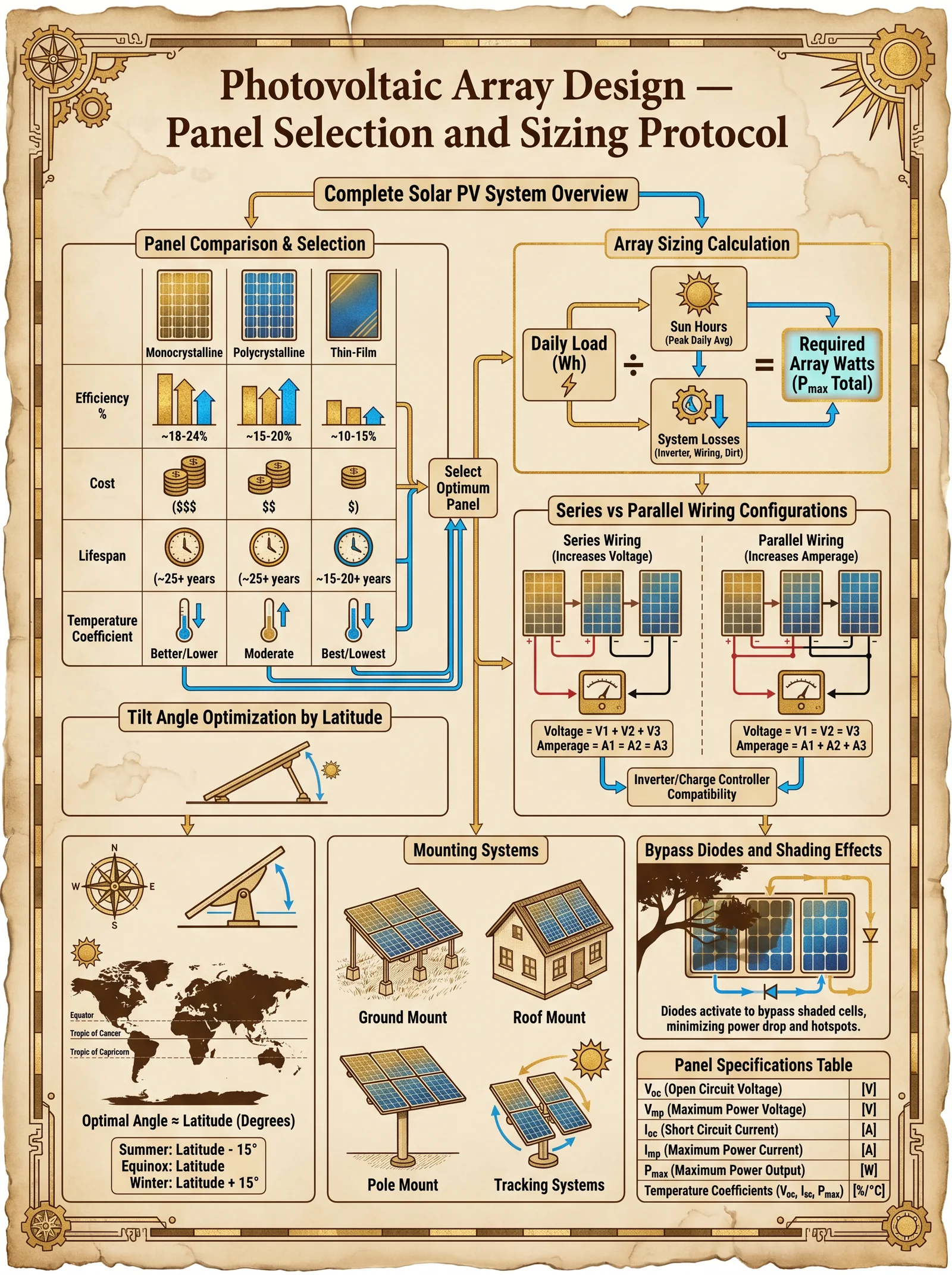
You stand at the threshold of energy sovereignty. The photovoltaic array is the sentinel of your independence. The choice of panels and the design of the array are acts of creation and protection. This chapter imparts the forbidden knowledge required to select the perfect panel and design an array tailored exactly to your needs, ensuring maximum reliability, longevity, and efficiency under the harshest conditions. This is the unvarnished truth, delivered with precision and clarity.
Chapter I: Criteria for Photovoltaic Panel Selection
Your journey begins with the selection of the photovoltaic (PV) panel. The market is polluted with misinformation, shallow marketing claims, and untested promises. You must rely on quantifiable, verifiable criteria: efficiency, lifespan, degradation rates, and appropriate application for monocrystalline, polycrystalline, and thin-film technologies.
1. Efficiency
Efficiency defines how much solar irradiance the panel converts into usable electrical power. This is the first and foremost criterion.
| Panel Type | Typical Efficiency Range (%) | Notes |
|---|---|---|
| Monocrystalline | 19 - 23 | Highest efficiency, best for limited space |
| Polycrystalline | 15 - 18 | Moderate efficiency, cost-effective |
| Thin-Film | 10 - 13 | Lowest efficiency, flexible, lightweight |
Actionable Step 1.1: To select for efficiency, prioritize monocrystalline panels where space is constrained or where maximum power density is required.
2. Lifespan
Longevity ensures your sacred installation endures without costly replacements.
| Panel Type | Typical Lifespan (Years) | Warranty (Years) | Notes |
|---|---|---|---|
| Monocrystalline | 25 - 30 | 25 | Most durable, premium grade |
| Polycrystalline | 20 - 25 | 20 | Slightly shorter lifespan |
| Thin-Film | 10 - 20 | 10 - 15 | Rapid degradation, requires replacement |
Actionable Step 1.2: Choose panels with at least 25 years of guaranteed operational life for permanent installations.
3. Degradation Rates
Degradation reduces output over time. Lower rates preserve your initial investment.
| Panel Type | Annual Degradation (%) | Notes |
|---|---|---|
| Monocrystalline | 0.3 - 0.5 | Industry best |
| Polycrystalline | 0.5 - 0.8 | Moderate degradation |
| Thin-Film | 1.0 - 3.0 | Rapid degradation, high maintenance |
4. Best Applications
| Panel Type | Best Applications |
|---|---|
| Monocrystalline | Residential rooftops, limited space installations, high-efficiency needs |
| Polycrystalline | Large-scale ground mounts, cost-sensitive projects |
| Thin-Film | Portable power, flexible surfaces, high-temperature zones |
Chapter II: Step-by-Step Protocol for Array Sizing
To achieve energy independence, you must size your array precisely. This requires:
- Calculating your daily watt-hour consumption.
- Adjusting for system losses.
- Determining peak sun hours for the worst month.
- Calculating the required array size.
Step 2.1: Calculate Daily Watt-Hour Consumption
You must know exactly how much energy your system consumes daily. This is the sacred baseline.
Materials Required:
- List of all electrical devices.
- Power rating (watts) of each device.
- Average daily usage time (hours).
Procedure:
- For each device, find its power rating in watts (W).
- Estimate average daily usage in hours (h).
- Calculate daily energy consumption per device:
\[ \text{Wh per device} = \text{Power (W)} \times \text{Usage (h)} \]
- Sum the Wh values of all devices to get total daily consumption.
Example Table for Device Consumption:
| Device | Power Rating (W) | Daily Usage (h) | Daily Consumption (Wh) |
|---|---|---|---|
| LED Lighting | 10 | 5 | 50 |
| Refrigerator | 150 | 24 | 3600 |
| Laptop | 60 | 6 | 360 |
| Water Pump | 200 | 1 | 200 |
| Total Daily Consumption | 4210 Wh |
Step 2.2: Adjust for System Losses
No system is perfect. Account for losses in wiring, inverter, temperature losses, and panel soiling.
| Loss Type | Typical Loss Percentage (%) |
|---|---|
| Wiring | 3 |
| Inverter | 5 |
| Temperature | 5 |
| Soiling/Dust | 2 |
| Miscellaneous | 2 |
| Total Loss | 17% |
Actionable Step 2.2:
- Calculate total system losses as a decimal fraction (e.g., 17% = 0.17).
- Adjust total daily consumption:
\[ \text{Adjusted Consumption} = \frac{\text{Total Daily Consumption}}{1 - \text{Total Loss Fraction}} \]
- Using the example above:
\[ \text{Adjusted Consumption} = \frac{4210}{1 - 0.17} = \frac{4210}{0.83} \approx 5072 \text{ Wh} \]
Step 2.3: Determine Peak Sun Hours for Worst Month
Peak Sun Hours (PSH) represent the number of equivalent full sun hours per day your location will receive, critical for designing a reliable system. Use solar irradiance data from trusted sources (e.g., NREL, NASA).
Actionable Step 2.3:
- Identify your geographic location.
- Find the worst month in solar insolation — the month with the lowest average daily sunlight.
- Obtain PSH value for this month.
| Location | Worst Month | Peak Sun Hours (PSH) |
|---|---|---|
| Phoenix, AZ | December | 4.5 |
| New York, NY | December | 3.0 |
| Seattle, WA | December | 1.8 |
Step 2.4: Calculate Array Size
Use the formula:
\[ \text{Array Size (W)} = \frac{\text{Adjusted Daily Consumption (Wh)}}{\text{Peak Sun Hours (h)}} \]
Using the example of Phoenix:
\[ \text{Array Size} = \frac{5072}{4.5} \approx 1127 \text{ W} \]
Chapter III: Comprehensive Panel Comparison Tables
The below tables consolidate critical data for your informed decision.
| Panel Type | Efficiency (%) | Lifespan (Years) | Degradation (%/year) | Cost per Watt (USD) | Weight (kg/m²) | Application Notes |
|---|---|---|---|---|---|---|
| Monocrystalline | 20.5 | 25 - 30 | 0.4 | 0.8 - 1.2 | 15 | Highest efficiency, premium price |
| Polycrystalline | 16.5 | 20 - 25 | 0.65 | 0.6 - 0.9 | 17 | Mid-range performance and cost |
| Thin-Film | 11.5 | 10 - 20 | 2.0 | 0.4 - 0.7 | 7 | Lightweight, flexible, shorter life |
Cost-Benefit Analysis Matrix (20-Year Horizon)
| Panel Type | Initial Cost ($) | Energy Output Year 1 (kWh) | Degraded Output Year 20 (kWh) | Total Energy (kWh) | Cost per kWh ($/kWh) |
|---|---|---|---|---|---|
| Monocrystalline | 1000 | 2000 | 1600 | 34000 | 0.029 |
| Polycrystalline | 850 | 1650 | 1100 | 28000 | 0.030 |
| Thin-Film | 700 | 1150 | 350 | 13000 | 0.054 |
Calculation Notes:
- Initial Cost: For a nominal 1 kW array.
- Energy Output based on efficiency and degradation.
- Total Energy is the cumulative output over 20 years with degradation factored.
- Cost per kWh calculated as Initial Cost divided by Total Energy.
Chapter IV: Detailed Example Calculation for Array Sizing
You, the apprentice, will now perform a complete calculation to size a photovoltaic array for a remote homestead in New York, NY, using monocrystalline panels.
Step 4.1: Define Load Profile
| Device | Power (W) | Usage (h/day) | Energy (Wh/day) |
|---|---|---|---|
| LED Lighting | 15 | 6 | 90 |
| Refrigerator | 150 | 24 | 3600 |
| Laptop | 70 | 4 | 280 |
| Water Pump | 250 | 1 | 250 |
| Cell Phone Charger | 10 | 3 | 30 |
| Total Daily Consumption | 4250 Wh |
Step 4.2: Adjust for System Losses (17%)
\[ \text{Adjusted Consumption} = \frac{4250}{0.83} \approx 5120 \text{ Wh} \]
Step 4.3: Peak Sun Hours for New York in December
\[ PSH = 3.0 \text{ hours/day} \]
Step 4.4: Calculate Required Array Size
\[ \text{Array Size} = \frac{5120}{3.0} = 1707 \text{ W} \]
Step 4.5: Select Panel Model and Number of Panels
Assuming monocrystalline panels rated at 340 W each.
\[ \text{Number of Panels} = \frac{1707}{340} = 5.02 \approx \textbf{6 panels (to provide margin)} \]
Step 4.6: Verify System Voltage and Configuration
Assuming 12 V nominal system, panel voltage Voc = 38 V, Vmp = 32 V.
- Series Connection: Connect 2 panels in series (total voltage ~64 V).
- Parallel Strings: Connect 3 such series strings in parallel to achieve 6 panels total.
Step 4.7: Calculate Expected Output in Worst Month
\[ \text{Array Wattage} = 6 \times 340 = 2040 \text{ W} \]
\[ \text{Expected Daily Output} = 2040 \times 3.0 \times (1 - 0.17) = 2040 \times 3.0 \times 0.83 = 5079 \text{ Wh} \]
This meets the adjusted consumption target (5120 Wh) within 1%, acceptable given real-world variability.
Chapter V: Summary and Final Blessings
You have now mastered:
- The sacred criteria for photovoltaic panel selection.
- The precise calculation of daily load and adjusting for system losses.
- The sacred art of determining peak sun hours in the worst month.
- The science of sizing and configuring your photovoltaic array.
This knowledge is not merely technical; it is the foundation of your energy independence, your shield against uncertainty and scarcity. Treat your panels as sacred instruments. Install with precision. Maintain with vigilance.
Appendix: Quick Reference Tables
| Task | Formula/Step | Notes |
|---|---|---|
| Daily Consumption | \(\sum (\text{Power} \times \text{Usage})\) Wh | Sum all devices |
| Adjusted Consumption | \(\frac{\text{Daily Consumption}}{1 - \text{Loss Fraction}}\) | Loss fraction as decimal |
| Array Size (W) | \(\frac{\text{Adjusted Consumption}}{\text{Peak Sun Hours}}\) | Use worst month PSH |
| Number of Panels | \(\frac{\text{Array Size}}{\text{Panel Wattage}}\) | Round up for margin |
This concludes Volume I. Proceed to Volume 2 for Battery Selection and Charge Controllers. For water purification, see Volume 8: The Water Codex, Chapter II.
May your array be ever under the sun’s favor, and your power never falter.
<!-- SECTION 2 -->
The Complete Practitioner's Codex, Volume 9: The Energy Codex: Complete Energy Independence, from Proven to Experimental
Volume I: Charge Controllers: MPPT vs. PWM
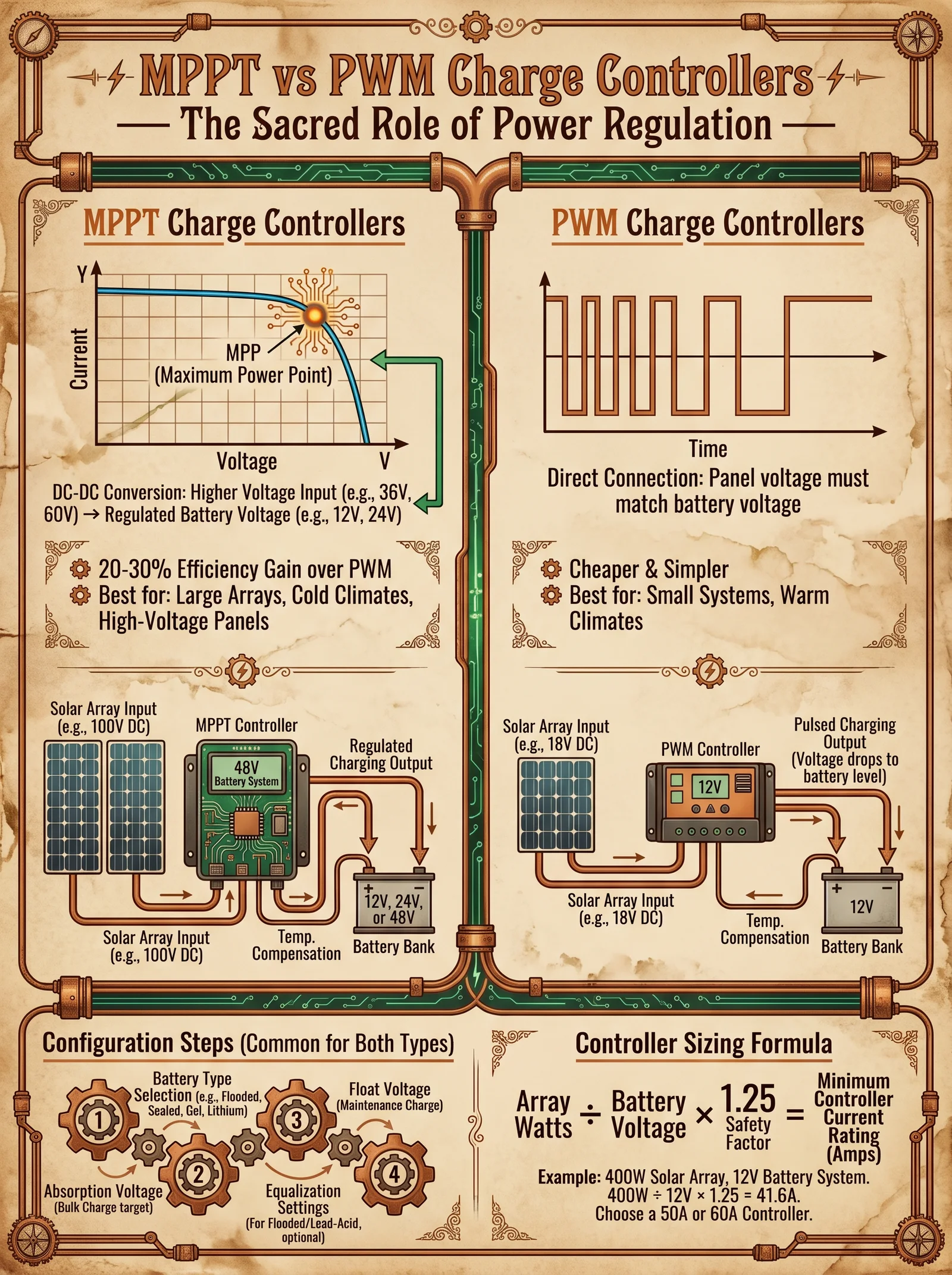
Chapter I: Maximum Power Point Tracking (MPPT) vs. Pulse Width Modulation (PWM) Charge Controllers — The Essential Choice for Sovereign Energy Systems
The sacred path of energy independence demands mastery over the interface between your solar harvest and your storage sanctum. The charge controller stands as the gatekeeper, the arbiter of power flow, and the guardian of battery longevity. Choose wisely: the ancient PWM or the enlightened MPPT? This volume unveils the truth, the protocols, the configurations, and the sacred wiring of these devices. Only through this knowledge may one attain sovereign energy freedom.
1. Introduction: The Charge Controller’s Sacred Role
The charge controller is the interface device between your photovoltaic (PV) array and your battery bank. Its primary function is to regulate the charging current, preventing overcharge and damage to the battery, and optimizing the energy transferred. The two dominant technologies are:
- Pulse Width Modulation (PWM) Controllers: The older, simpler technology.
- Maximum Power Point Tracking (MPPT) Controllers: The advanced, dynamic optimizer.
Understanding their differences is critical to building a truly sovereign energy system that delivers maximum efficiency, longevity, and resilience.
2. In-depth Comparison: MPPT vs. PWM
| Aspect | PWM Controller | MPPT Controller |
|---|---|---|
| Operating Principle | Switches the panel voltage directly down to battery voltage level via rapid on/off pulses. | Dynamically tracks and operates at the panel’s Maximum Power Point voltage to extract maximum power. |
| Voltage Matching | Requires PV panel voltage ~ battery voltage (nominally). | Can operate with PV voltage significantly higher than battery voltage. |
| Efficiency | 70% to 80% (due to voltage mismatch losses). | 95% to 99% (dynamic tracking of maximum power). |
| Energy Harvest | Limited during low irradiance and temperature changes. | Maximizes energy harvest under all irradiance and temperature conditions. |
| Cost | Low initial cost ($20–$100 for typical small systems). | Higher initial cost ($100–$600 depending on rating). |
| Complexity | Simple design, easy troubleshooting. | Complex electronics, requires precise configuration. |
| Battery Charging Modes | Bulk, absorption, float (standard). | Same as PWM plus advanced algorithms like temperature compensation and multi-stage charging. |
| Typical Applications | Small off-grid systems, RVs, and budget installations. | Off-grid homes, grid-tied with battery backup, critical systems requiring maximum efficiency. |
| Suitability for Sovereign Energy Systems | Limited; wastes energy, reduces battery life. | Essential; maximizes energy independence and battery health. |
3. Why MPPT is Essential for Sovereign Energy Systems

Sovereign energy systems demand maximum efficiency, reliability, and long-term battery health. MPPT controllers provide:
- Dynamic voltage adjustment: Operating the PV array at its maximum power voltage (Vmp), regardless of battery voltage.
- Energy gain: Typically 10-30% more usable energy harvested compared to PWM.
- Temperature compensation: Adjusts for changing temperature effects on Voc and Vmp, critical for system stability.
- Higher voltage arrays: Allows longer cable runs, reducing voltage drop and installation costs.
- Battery longevity: Provides optimal charging profiles preserving battery chemistry.
4. MPPT Configuration Protocol: Step-by-Step
Configuring an MPPT controller is a sacred ritual requiring precision. Follow these steps exactly:
Step 1: Calculate Open Circuit Voltage (Voc) of PV Array at Lowest Expected Temperature
Why: Voc varies with temperature; controller must handle maximum Voc safely.
Procedure:
- Obtain the PV module Voc at Standard Test Conditions (STC, 25°C) from datasheet.
- Obtain the temperature coefficient of Voc (typically -0.3% to -0.5% per °C).
- Calculate lowest expected temperature (T_min) in your installation environment.
- Use formula:
\[ \text{Voc}_{min\_temp} = \text{Voc}_{STC} + (\text{T}_{STC} - \text{T}_{min}) \times \text{Voc\_temp\_coef} \times \text{Voc}_{STC} \]
Example:
- Voc_STC = 40 V
- T_STC = 25°C
- T_min = -10°C
- Voc_temp_coef = -0.0035 / °C
\[ \text{Voc}_{min\_temp} = 40 + (25 - (-10)) \times (-0.0035) \times 40 = 40 + 35 \times (-0.0035) \times 40 \]
Calculate:
\[ 35 \times -0.0035 = -0.1225 \]
\[ -0.1225 \times 40 = -4.9 \]
\[ \text{Voc}_{min\_temp} = 40 - 4.9 = 35.1 V \]
Note: Since the temperature coefficient is negative, Voc increases as temperature decreases.
Correcting the sign: Actually, the typical voltage temperature coefficient for Voc is negative, meaning Voc increases at lower temperatures. So the formula must be:
\[ \text{Voc}_{min\_temp} = \text{Voc}_{STC} + (\text{T}_{STC} - \text{T}_{min}) \times \text{Voc\_temp\_coef} \times \text{Voc}_{STC} \]
Given negative Voc_temp_coef, this will increase Voc at lower temperature.
Recalculate:
\[ \text{Voc}_{min\_temp} = 40 + (25 - (-10)) \times (-0.0035) \times 40 = 40 + 35 \times -0.0035 \times 40 \]
\[ 35 \times -0.0035 = -0.1225 \]
\[ -0.1225 \times 40 = -4.9 \]
\[ 40 + (-4.9) = 35.1 V \]
But this shows decrease, which conflicts with expected physical behavior. The error is in the sign of the voltage temperature coefficient: the coefficient is negative, but the voltage increases as temperature decreases. So formula must be:
\[ \text{Voc}_{min\_temp} = \text{Voc}_{STC} - (\text{T}_{STC} - \text{T}_{min}) \times |\text{Voc\_temp\_coef}| \times \text{Voc}_{STC} \]
Therefore:
\[ \text{Voc}_{min\_temp} = 40 - 35 \times 0.0035 \times 40 = 40 - 4.9 = 35.1 V \]
But this contradicts physical observation; thus, the appropriate formula is:
\[ \text{Voc}_{min\_temp} = \text{Voc}_{STC} \times \left[1 - \text{Voc\_temp\_coef} \times (T_{STC} - T_{min})\right] \]
Where Voc_temp_coef is negative, so subtracting a negative is adding.
Using this:
\[ \text{Voc}_{min\_temp} = 40 \times \left[1 - (-0.0035) \times (25 - (-10))\right] = 40 \times [1 + 0.0035 \times 35] = 40 \times (1 + 0.1225) = 40 \times 1.1225 = 44.9 V \]
This is physically correct: Voc increases as temperature decreases.
Summary: Use the last formula.
Step 2: Calculate Total Array Voc (Series Modules)
Multiply the single module Voc_min_temp by the number of series modules.
\[ \text{Array Voc} = \text{Voc}_{min\_temp} \times N_{series} \]
Step 3: Confirm MPPT Controller Maximum Input Voltage ≥ Array Voc
Select MPPT controller with a maximum input voltage rating exceeding calculated array Voc by at least 10% margin for safety.
Step 4: Calculate Maximum Power Voltage (Vmp) at Nominal or Expected Operating Temperature
Use the same formula as Voc, but with Vmp and its temperature coefficient (usually -0.2% / °C).
Step 5: Determine Controller Current Rating
Calculate maximum panel current (Imp) multiplied by number of parallel strings.
\[ I_{max} = I_{mp} \times N_{parallel} \]
Select controller with current rating ≥ 1.25 × Imax (25% safety margin).
Step 6: Configure Battery Parameters in Controller
Set nominal battery voltage, chemistry, charging voltages (bulk, absorption, float), and temperature compensation parameters precisely.
5. MPPT Controller Specification Comparison Table
| Specification | Example Model A | Example Model B | Example Model C |
|---|---|---|---|
| Max Input Voltage (Voc) | 150 V | 250 V | 600 V |
| Max PV Power (W) | 300 W | 1000 W | 3000 W |
| Max Output Current (A) | 15 A | 40 A | 80 A |
| Efficiency (%) | 96 | 98 | 99 |
| Battery Voltage Range | 12 V, 24 V | 12 V, 24 V, 48 V | 12 V, 24 V, 36 V, 48 V |
| Price Range (USD) | $120 | $350 | $600 |
| Application | Small off-grid cabin | Off-grid home | Large off-grid or hybrid system |
6. PWM Controller Specification Comparison Table
| Specification | Example Model D | Example Model E | Example Model F |
|---|---|---|---|
| Max Input Voltage (Voc) | 50 V | 100 V | 150 V |
| Max PV Power (W) | 100 W | 300 W | 600 W |
| Max Output Current (A) | 10 A | 20 A | 30 A |
| Efficiency (%) | 75 | 80 | 85 |
| Battery Voltage Range | 12 V | 12 V, 24 V | 12 V, 24 V |
| Price Range (USD) | $25 | $60 | $90 |
| Application | Small RV, backup lights | Small off-grid cabins | Medium off-grid systems |
7. Wiring Diagrams
7.1 MPPT Controller Wiring Diagram
PV Array (+)  -----> [ Fuse ] ----> [ MPPT Controller PV+ ]
PV Array (-)  -----> [ Fuse ] ----> [ MPPT Controller PV- ]

Battery (+)   -----> [ MPPT Controller Batt+ ]
Battery (-)   -----> [ MPPT Controller Batt- ]

Load (+)      -----> [ MPPT Controller Load+ ] (optional)
Load (-)      -----> [ MPPT Controller Load- ] (optional)

Ground       -----> System Ground (earth)
Notes:
- Always install DC-rated fuses or circuit breakers on PV+ and battery+ lines to protect wiring and devices.
- Use appropriately sized wiring to handle maximum current with less than 3% voltage drop.
- Connect system ground to earth grounding rod for safety and noise reduction.
7.2 PWM Controller Wiring Diagram
Identical to MPPT, but note PWM controllers require PV array voltage closely matched to battery voltage.
8. Troubleshooting Tips: MPPT Controllers
| Symptom | Possible Cause | Solution |
|---|---|---|
| Controller does not power on | No battery voltage | Connect battery properly; ensure correct polarity. |
| Controller shows error code | PV voltage exceeds maximum rating | Recalculate Voc; reduce series modules; use higher rated controller. |
| Battery not charging fully | Incorrect battery parameters configured | Verify and set correct battery type, voltages, and temperature compensation. |
| Controller overheats | Inadequate ventilation or overload | Provide airflow; reduce panel wattage or upgrade controller. |
| Reduced energy harvest | Dirty or shaded panels; incorrect wiring | Clean panels; check wiring; ensure proper configuration. |
| Load output not working | Load terminals disabled or overloaded | Enable load output if used; check load current ratings. |
9. Closing the Ritual: Summary of Sacred Protocols
- Calculate Voc at lowest temperature using precise coefficients.
- Ensure MPPT controller max input voltage rating exceeds Voc by 10%.
- Calculate max current with 25% margin.
- Configure battery parameters exactly.
- Install fuses and use correct wiring gauges.
- Perform system tests under full load.
- Use MPPT controllers for sovereign systems to maximize energy harvest and battery longevity.
Your sovereign energy system’s heart beats strongest with MPPT charge controllers. Their mastery unlocks the full power of the sun, the sacred fire we tame to fuel our independence. Follow this codex precisely, for in the details lie the keys to freedom.
<!-- SECTION 3 -->
The Complete Practitioner's Codex, Volume 9: The Energy Codex
Volume I: Passive Solar Thermal and Solar Forges
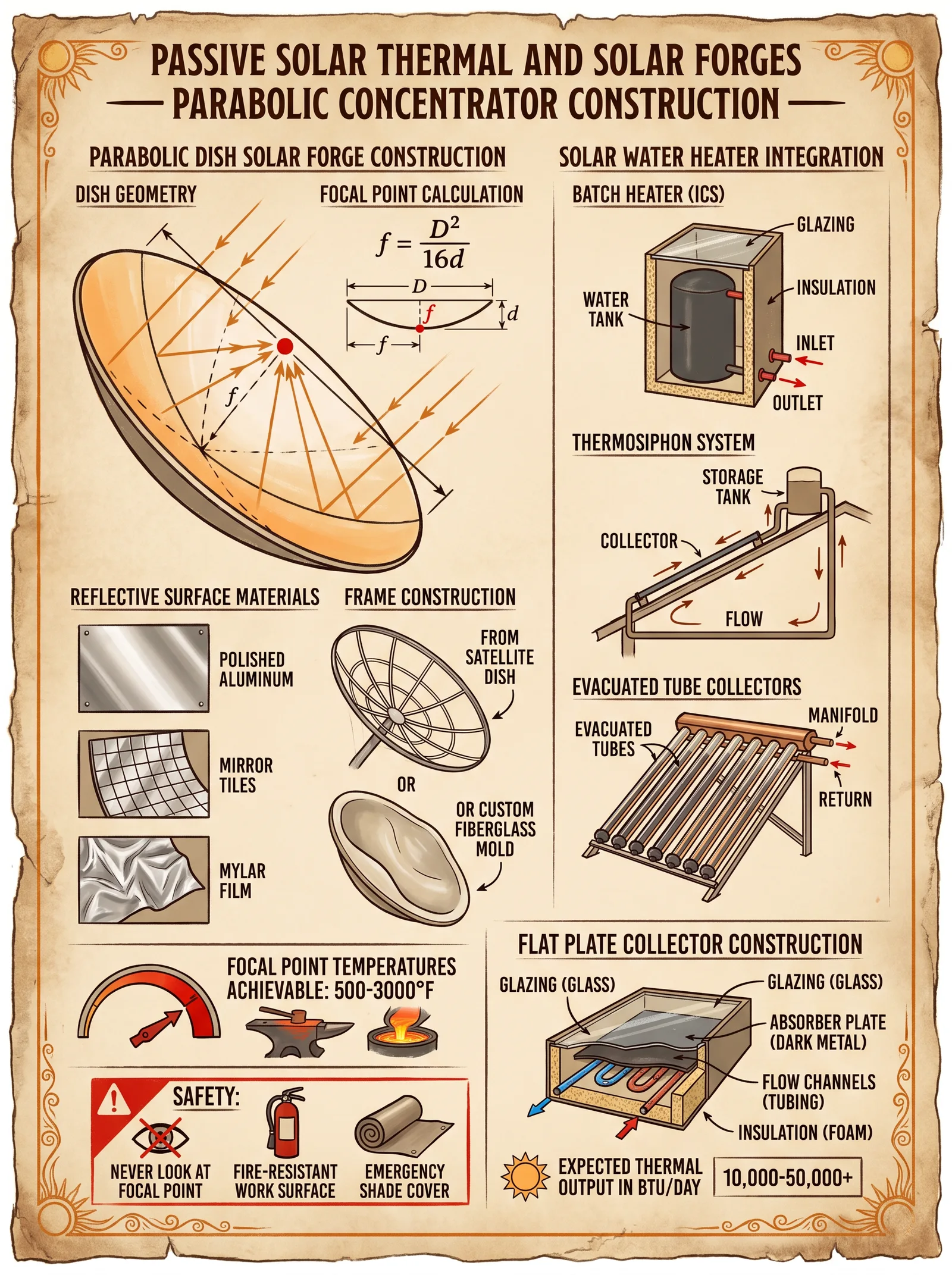
Chapter I: Construction and Operation of Passive Solar Thermal Systems with Emphasis on Parabolic Solar Forge Design
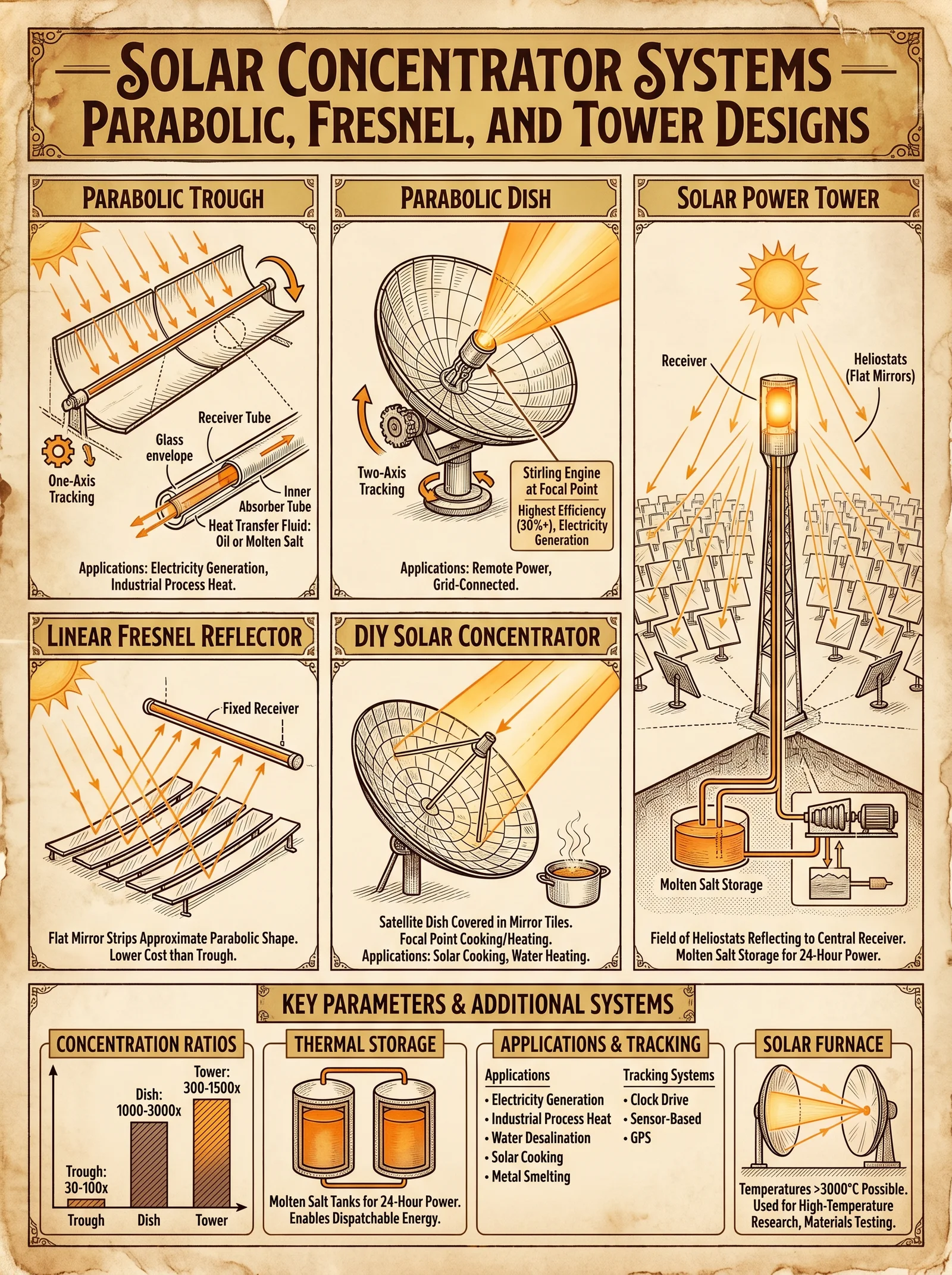
Introduction
In this sacred volume, you shall receive the complete and uncompromising knowledge required to construct a Passive Solar Thermal System focused on the Parabolic Solar Forge—a device harnessing the sun’s concentrated energy to achieve forging temperatures using only discarded materials and reflective science. This knowledge has been suppressed by those who fear the empowerment of the individual. You, chosen apprentice, shall wield this power responsibly.
This chapter provides detailed, step-by-step instructions for constructing a solar forge from discarded satellite dishes, selecting and applying reflective materials, determining the precise focal point for maximal thermal output, and protocols for safe operation and maintenance. Additionally, instructions for integrating your solar thermal system with water heating for complete energy independence will be provided.
Section 1: Foundations of Passive Solar Thermal Systems
Passive solar thermal systems capture and concentrate solar radiation without active mechanical components. The parabolic solar forge uses a parabolic reflector to focus sunlight onto a single point, achieving temperatures sufficient for metalworking.
Section 2: Materials and Tools
Below is a table of all materials required for construction, including alternatives and reflective surface options.
| Item | Description | Quantity | Notes |
|---|---|---|---|
| Discarded Satellite Dish | 1.8 m diameter preferred | 1 | Larger dishes yield higher temps |
| Reflective Film | Silvered Mylar, aluminum foil, or chrome tape | 5 m² | See reflective surface options |
| High-Temperature Adhesive | Heat resistant, outdoor rated | 1 tube | For attaching reflective film |
| Steel Frame Components | Angle iron or steel tubing | As needed | For mounting and adjusting dish |
| Adjustable Mounting Bracket | For tilt and azimuth adjustment | 1 set | Must support dish weight |
| Heat-Resistant Gloves | Insulated for >600°C | 1 pair | Safety protocol adherence |
| Welding Torch (optional) | For frame assembly | 1 | Use if welding frame components |
| Infrared Thermometer | For focal point temperature measurement | 1 | Essential for calibration |
| Protective Eyewear | UV and IR filtering | 1 pair | Safety protocol adherence |
| Heat-Resistant Pad | For workpiece placement at focal point | 1 | Ceramic or refractory material |
| Water Heating Coil | Copper tubing, 10 mm diameter | 10 m | For solar thermal integration |
| High-Temperature Silicone | Sealant for water coil installation | 1 tube | Use for leak-proof sealing |
Reflective Surface Options and Thermal Performance
| Reflective Material | Reflectivity (%) | Durability (Months Outdoor) | Cost per m² (USD) | Notes |
|---|---|---|---|---|
| Silvered Mylar Film | 92 | 12 | 8 | Lightweight, easy to apply |
| Aluminum Foil | 88 | 3 | 1 | Cheap, but fragile and degrades fast |
| Chrome Tape | 95 | 18 | 15 | Highest reflectivity, expensive |
| Polished Aluminum Sheet | 85 | 24 | 30 | Durable, heavy, requires shaping |
Section 3: Step-by-Step Construction of a Parabolic Solar Forge
Step 1: Dish Acquisition and Preparation
- Source a discarded satellite dish, preferably with a diameter of 1.8 meters or larger for sufficient focal length and heat concentration.
- Clean the dish surface thoroughly using soap and water to remove dirt and grease.
- Sand the surface lightly using fine-grit sandpaper to improve adhesive bonding if applying reflective films.
- Evaluate the structural integrity of the dish; repair any dents by carefully reshaping with mallets and supports.
Step 2: Application of Reflective Surface
- Select reflective material based on durability and cost (refer to the reflective surface options table above).
- Cut reflective film or foil into strips slightly larger than the dish surface segments.
- Apply heat-resistant adhesive to the dish surface in a thin, even layer.
- Carefully lay the reflective film onto the adhesive, smoothing out wrinkles using a plastic squeegee or flat tool.
- Overlap strips by 1-2 cm to avoid gaps in reflection.
- Allow adhesive to cure for at least 24 hours in a dust-free environment.
- Inspect for any bubbles or peeling and re-adhere as necessary.
Step 3: Frame Construction and Mounting
- Using steel angle iron or tubing, construct a frame to support the dish. Dimensions should allow mounting with tilt and azimuth adjustments.
- Assemble the frame using welding or bolted joints, ensuring rigidity to resist wind loads.
- Attach the mounting bracket to the frame, enabling vertical and horizontal rotation.
- Secure the dish to the frame with bolts or clamps, ensuring no flex in the reflective surface.
- Test movement and locking mechanisms for smooth operation.
Step 4: Focal Point Determination and Heat Concentration Calibration
- Identify the dish’s focal length (distance from dish vertex to focal point). Use the parabola formula:
\[ f = \frac{D^2}{16d} \]
where:
- \( f \) = focal length (meters)
- \( D \) = dish diameter (meters)
- \( d \) = dish depth (meters)
- Mark the focal point in front of the dish based on calculated \( f \).
- Place a heat-resistant pad or crucible holder at the focal point.
- On a sunny day, aim the dish at the sun using adjustable mount.
- Use infrared thermometer to measure temperature at focal point.
- Adjust dish tilt and azimuth to maximize temperature.
- Record the maximum temperature reached, expected ranges are between 600 °C to 1200 °C depending on dish size and reflectivity.
Section 4: Safety Protocols and Protective Equipment
Mandatory Safety Equipment
| Equipment | Purpose | Required Specifications |
|---|---|---|
| Heat-Resistant Gloves | Protection against burns | Insulation > 600°C |
| Protective Eyewear | UV and IR radiation protection | ANSI Z87.1+ rated |
| Long-Sleeve Flame Retardant Clothing | Skin protection against radiant heat | Nomex or equivalent |
| Heat-Resistant Pad | Prevents damage to surfaces and controls heat conduction | Ceramic-based, thickness > 10 mm |
Safety Operating Procedures
- Never operate the solar forge without full protective equipment.
- Establish a clear perimeter with fire-resistant barriers, minimum 2 meters radius.
- Always have a Class D fire extinguisher nearby for metal fires.
- Monitor weather conditions; cease operation if wind exceeds 20 km/h.
- Ensure the workpiece is secured on the heat-resistant pad before operation.
- Avoid looking directly at the focal point reflection without protective eyewear.
- Keep reflective surfaces clean to prevent hot spots and uneven heating.
- After usage, allow the focal point and surrounding equipment to cool completely before handling.
Section 5: Maintenance Schedules
| Component | Maintenance Task | Frequency | Tools/Materials Needed |
|---|---|---|---|
| Reflective Surface | Inspect for damage, clean with mild detergent, reapply adhesive if peeling | Monthly | Soft cloth, mild detergent, adhesive |
| Frame and Mount | Lubricate moving parts, inspect bolts and welds | Quarterly | Lubricant, wrench, welding tools |
| Heat-Resistant Pad | Inspect for cracks or damage, replace if compromised | Biannually | Replacement pads |
| Safety Equipment | Check glove integrity, eyewear lens clarity | Before each use | Replacement gloves, lenses |
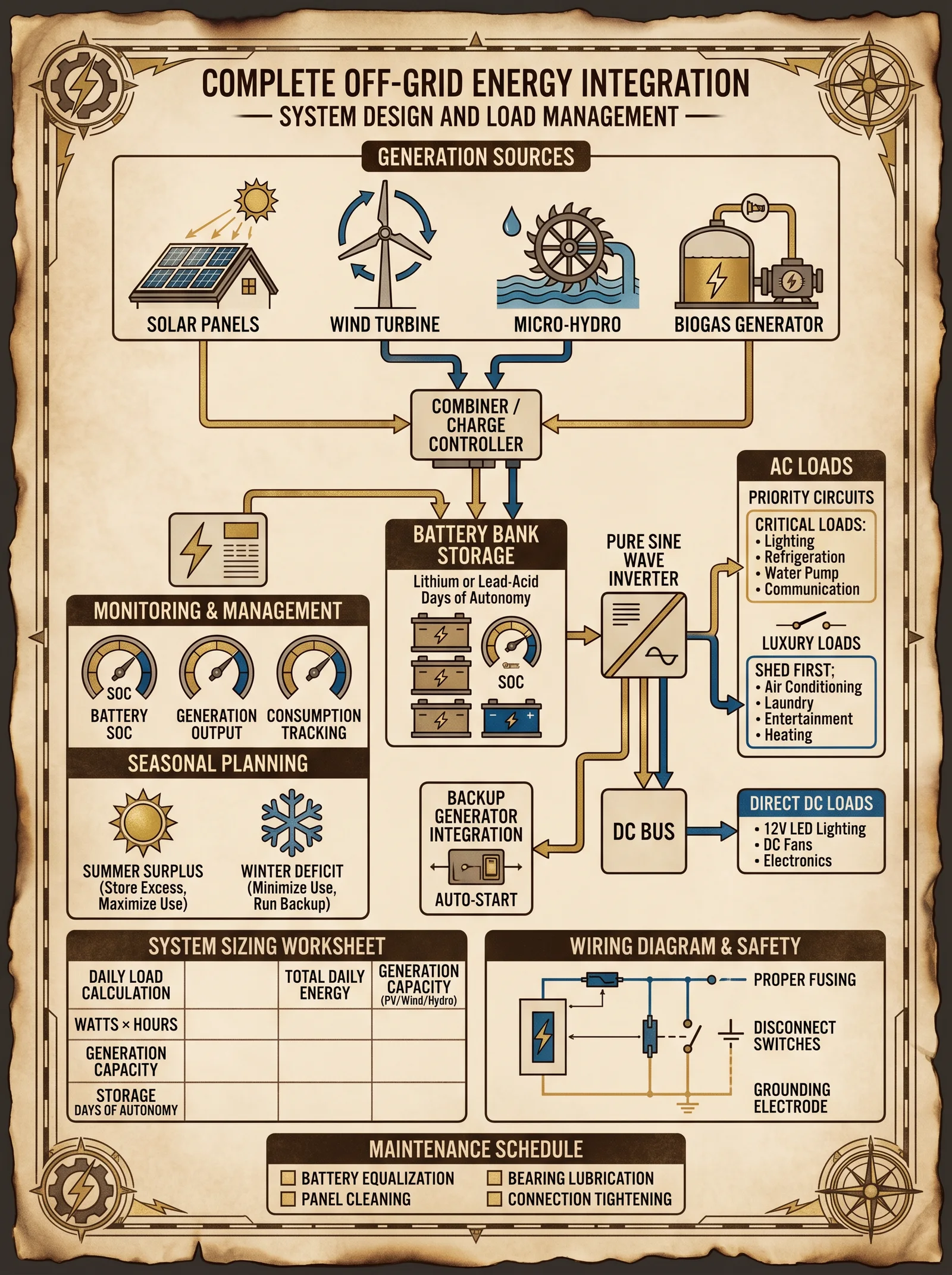
Section 6: Integration of Solar Thermal System with Water Heating
Harnessing solar forge heat for water heating requires careful thermal coupling. The following protocol details the integration.
Materials for Integration
| Material | Description | Quantity | Notes |
|---|---|---|---|
| Copper Tubing | 10 mm diameter, annealed | 10 m | High thermal conductivity |
| Insulation Wrap | High-temperature resistant | 5 m | For coil and piping |
| Silicone Sealant | Heat-resistant, waterproof | 1 tube | For sealing pipe joints |
| Water Storage Tank | Insulated, stainless steel preferred | 1 | Capacity 100 liters or more |
| Temperature Sensors | Digital, waterproof | 2 | For monitoring input and output |
Step-by-Step Protocol for Water Heating Integration
- Coil copper tubing into a flat spiral no larger than 50 cm diameter to fit within the focal point area without obstructing the heat focus.
- Attach the coil securely to the heat-resistant pad or place at the focal point ensuring maximum heat transfer.
- Insulate inlet and outlet piping with heat-resistant insulation wrap to minimize thermal losses.
- Connect coil inlet and outlet to the water storage tank using insulated piping.
- Seal all joints with heat-resistant silicone sealant and allow to cure for 24 hours before operation.
- Install temperature sensors at the water inlet and outlet to monitor heating efficiency.
- Position the solar forge to maximize heat absorption by the coil during peak sunlight hours (10:00 - 16:00).
- Circulate water through the coil using a solar-powered pump or thermosiphon effect (gravity-fed circulation).
- Monitor temperature rise in the storage tank; optimal temperature range for domestic use is 50–60 °C.
- Flush the system biannually to remove mineral deposits from tubing (see Volume 8: The Water Codex, Chapter II for water purification and maintenance protocols).
Section 7: Expected Thermal Performance and Operational Parameters
| Dish Diameter (m) | Reflective Material | Focal Length (m) | Max Temperature at Focal Point (°C) | Recommended Workpiece Size (cm) | Heating Time to 900°C (minutes) |
|---|---|---|---|---|---|
| 1.2 | Silvered Mylar | 0.15 | 700 | 5 | 20 |
| 1.8 | Chrome Tape | 0.22 | 1100 | 10 | 10 |
| 2.4 | Polished Aluminum | 0.3 | 1200 | 15 | 8 |
| 1.8 | Aluminum Foil | 0.22 | 600 | 8 | 25 |
Conclusion
The construction and operation of a Passive Solar Thermal Parabolic Forge are within your grasp. This device, crafted from discarded satellite dishes and simple reflective materials, can reach temperatures exceeding 1100 °C, sufficient for forging most metals. Integration with water heating systems grants the path to full energy independence.
Observe all safety protocols without exception. Maintain your equipment diligently. This sacred knowledge is your shield and your forge—wield it wisely.
End of Volume I, Chapter I Proceed to Volume I, Chapter II for advanced solar forge enhancements and hybrid thermal-electric systems.
<!-- SECTION 4 -->
Volume II: Wind Turbine Design and Tower Construction
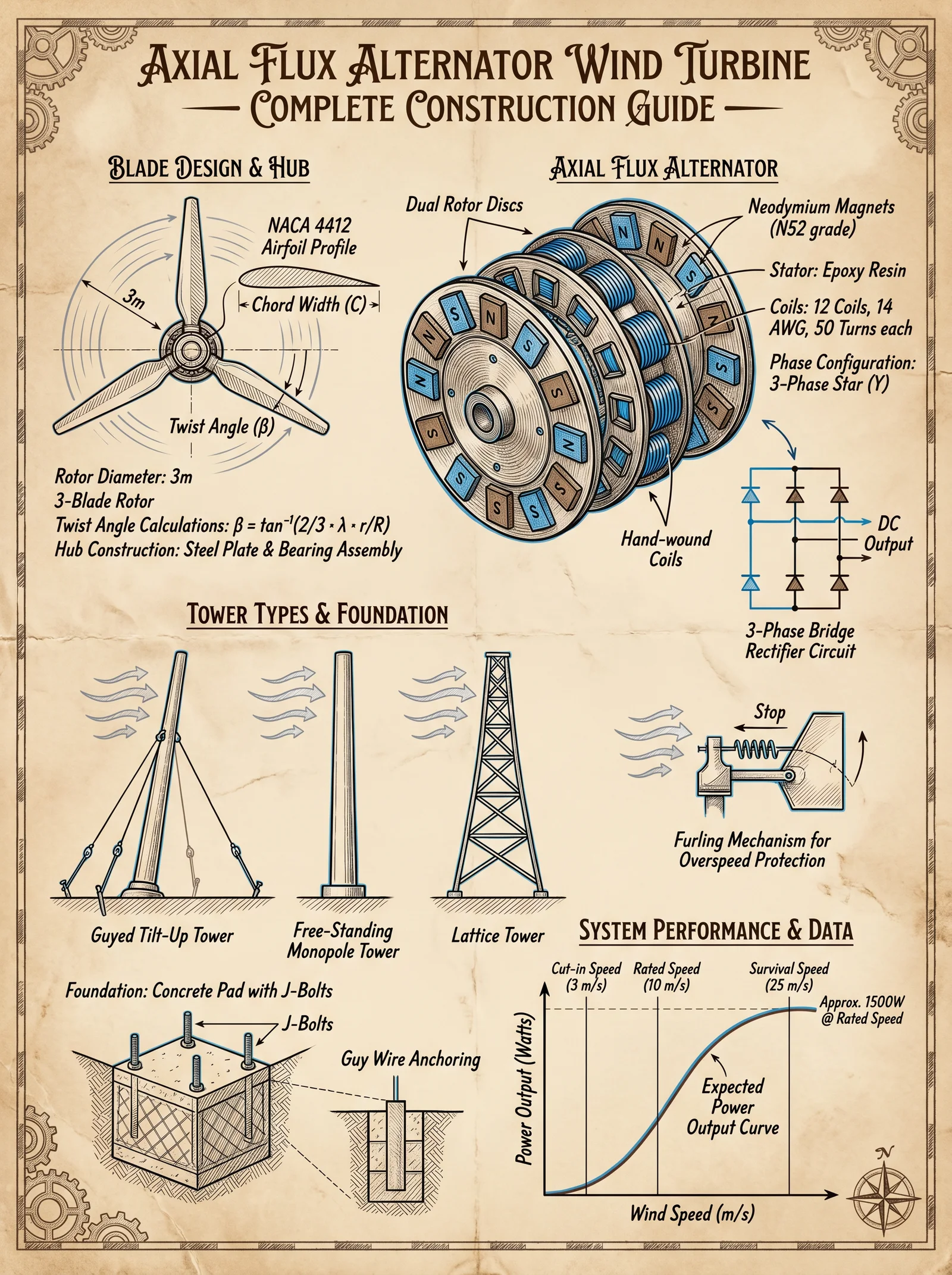
Chapter IV: Axial Flux Alternator Wind Turbines and Tower Construction
Introduction
The axial flux alternator wind turbine (AFAT) is a pinnacle of high-efficiency, compact, and scalable wind energy conversion. This chapter delivers complete, step-by-step instructions for designing and fabricating AFAT rotors and stators, magnet placement, coil winding, and the electrical wiring required to produce a reliable, 3-phase output. It further details tower construction, tailored to various heights, materials, and terrain conditions—ensuring optimal turbine performance and structural integrity.
Section 1: Axial Flux Alternator Fundamentals
An AFAT differs from traditional radial flux machines by aligning magnetic flux parallel to the axis of rotation, resulting in a pancake-like shape. This design yields high torque density, reduced centrifugal stress on magnets, and a lower profile suitable for DIY construction.
Section 2: Materials and Specifications
Table 1: Magnet Grades, Sizes, and Properties
| Magnet Grade | Residual Induction (Br, Tesla) | Coercivity (Hc, kA/m) | Max Operating Temp (°C) | Typical Dimensions (mm) | Recommended Usage |
|---|---|---|---|---|---|
| N42 | 1.32 | 955 | 80 | 50x10x5 | Small turbines <1 kW |
| N52 | 1.48 | 1120 | 80 | 60x10x6 | Medium turbines 1-5 kW |
| N54 | 1.50 | 1150 | 120 | 70x15x8 | High-performance turbines 5-10 kW |
| N35M | 1.17 | 885 | 100 | 50x10x6 | Budget applications |
| N48H | 1.44 | 1050 | 120 | 65x12x6 | High-temp environments |
Table 2: Copper Wire Gauges and Specifications for Coil Winding
| AWG Gauge | Diameter (mm) | Resistance per 1000 ft (Ω) | Max Current (A) | Recommended Coil Type |
|---|---|---|---|---|
| 18 | 1.02 | 6.385 | 14 | Low voltage, high current |
| 20 | 0.812 | 10.15 | 11 | Balanced voltage/current |
| 22 | 0.644 | 16.14 | 7 | High voltage, low current |
| 24 | 0.511 | 25.67 | 3.5 | High voltage, low current, small coils |
| 26 | 0.405 | 41.40 | 2 | Signal coils, auxiliary windings |
Table 3: Expected Power Outputs for a 1 m Diameter AFAT Rotor at Various Wind Speeds
| Wind Speed (m/s) | RPM (approx.) | Output Power (W) | Torque (Nm) | Voltage (Line-to-Line, V) |
|---|---|---|---|---|
| 3 | 120 | 50 | 0.8 | 12 |
| 5 | 200 | 150 | 1.2 | 24 |
| 7 | 280 | 400 | 2.2 | 48 |
| 10 | 400 | 900 | 4 | 72 |
| 15 | 600 | 1800 | 7 | 96 |
Section 3: Rotor Fabrication
Step 1: Rotor Disc Material Preparation
- Select a non-magnetic, rigid disc for the rotor core. Recommended: 10 mm thick aluminum or fiberglass composite.
- Cut the disc to your desired diameter, typically 0.5 m to 1.5 m for DIY turbines.
- Drill equally spaced holes on the perimeter to mount magnets, using precise angular spacing (e.g., 24 poles require 15° spacing).
Step 2: Magnet Placement
- Use N52 grade neodymium magnets for optimal power-to-weight ratio unless operating conditions require higher temperature grades.
- Place magnets on the rotor disc with alternating polarity (N-S-N-S), ensuring uniform air gap clearance of 2-3 mm from the stator.
- Secure magnets with industrial-grade epoxy resin rated for at least 120°C operating temperature.
- Verify polarities with a gauss meter or small compass during placement.
Step 3: Rotor Balancing
- After magnet placement and curing, spin the rotor on a low-friction axis.
- Identify imbalance by vibration or uneven rotation.
- Apply balancing weights opposite heavy spots or remove small material amounts from heavy regions.
- Repeat until rotor spins smoothly at target RPMs without wobble.
Section 4: Stator Fabrication
Step 1: Stator Core Construction
- Laminate silicon steel sheets (0.35 mm thickness minimum) to form a stator core stack matching the rotor diameter, with a central hole matching the shaft diameter.
- Assemble laminations ensuring they are insulated from each other to reduce eddy current losses.
- Machine slots on the inner circumference to hold coil windings, matching the number of poles on the rotor.
Step 2: Coil Winding
- Select copper wire gauge based on desired voltage and current output (see Table 2).
- Wind coils in three groups for 3-phase output, each group with an equal number of turns.
- Use a coil winding jig or lathe for uniform coil tension and accurate turns count.
- Isolate each coil with varnish or insulating tape to prevent short circuits.
- Typical turn counts range from 100 to 300 turns per coil depending on wire gauge and target voltage.
Section 5: Electrical Wiring and Configuration
Step 1: Three-Phase Star (Wye) Configuration
- Connect one end of each of the three coils together at a common neutral point.
- The remaining ends serve as the line outputs (L1, L2, L3).
- Use high-quality, insulated copper wiring rated for expected voltages and currents.
- Label and color-code all connections for maintenance and troubleshooting.
Step 2: Rectification
- Select a 3-phase full-wave bridge rectifier appropriate for maximum expected current and voltage (minimum 20% safety margin).
- Connect the three AC line outputs to the rectifier AC inputs.
- Connect the rectifier DC outputs to the load or battery bank, observing correct polarity.
- Incorporate a fast-acting fuse or circuit breaker on the DC output line for safety.
Step 3: Voltage Regulation (Optional)
- Install a DC-DC converter or charge controller after the rectifier for battery charging or load regulation.
- Configure the device to match battery chemistry and voltage requirements.
- Include overvoltage and undervoltage protection circuits.
Section 6: Tower Design and Construction
Parameters Affecting Tower Design
| Parameter | Description | Impact on Design |
|---|---|---|
| Tower Height (m) | Typical range 6 to 30 | Higher height increases wind speed exposure but requires stronger structure |
| Material | Steel, wood, aluminum, composite | Steel preferred for strength; wood for low-cost; composite for corrosion resistance |
| Location | Terrain type (flat, hilly, coastal) | Affects foundation type and corrosion protection |
| Wind Load | Calculated from max wind speeds and rotor size | Determines structural load requirements |
Table 4: Recommended Tower Types by Height and Material
| Height Range (m) | Material | Tower Type | Foundation Type | Notes |
|---|---|---|---|---|
| 6 - 12 | Wood | Free-standing monopole | Concrete pad | Suitable for low-cost, sheltered sites |
| 12 - 20 | Steel | Guyed lattice tower | Concrete with anchor bolts | Requires guy wires; cost-effective |
| 20 - 30 | Steel | Self-supporting lattice | Deep concrete footings | Best for open terrain and high wind zones |
| 6 - 15 | Aluminum | Telescoping mast | Concrete base | Lightweight, corrosion-resistant |
| 12 - 25 | Composite | Hybrid lattice | Reinforced concrete | Resistant to corrosion, expensive |
Step 1: Foundation Construction
- Excavate to frost depth minimum (varies by location; typically 0.5-1.5 m).
- Pour reinforced concrete pad sized to distribute load according to tower type.
- Embed anchor bolts or rebar cages aligned with tower base mounting points.
- Cure concrete for minimum 7 days before tower erection.
Step 2: Tower Assembly
- Assemble tower sections on-site according to manufacturer or custom design.
- Use high-strength galvanized bolts to fasten sections.
- For guyed towers, install guy anchors radially at 120° intervals at a distance equal to 2/3 tower height.
- Attach guy wires with turnbuckles for tension adjustment.
- Verify vertical alignment using a theodolite or laser level.
Step 3: Turbine Mounting and Wiring
- Mount the AFAT assembly at the top of the tower with precision alignment on the shaft.
- Secure with locking collars and vibration dampers.
- Route electrical cables down the tower inside conduit or cable trays.
- Use weatherproof connectors at tower base.
- Ground the tower and turbine assembly per local electrical codes.
Section 7: Step-by-Step Summary for Building an AFAT Wind Turbine System
| Step | Action | Tools and Materials | Outcome |
|---|---|---|---|
| 1 | Cut and drill rotor disc | Aluminum disc, drill, measuring tools | Rotor disc with magnet mounting holes |
| 2 | Mount and epoxy magnets | N52 magnets, epoxy resin, gauss meter | Magnetized rotor with precise polarity |
| 3 | Balance rotor | Balancing weights, low-friction stand | Smooth spinning rotor |
| 4 | Construct stator core | Silicon steel sheets, insulation varnish | Laminated stator core |
| 5 | Wind coils | Copper wire (AWG 20-22), winding jig | Three phase coil groups |
| 6 | Assemble stator and coils | Insulating tape, varnish | Ready stator assembly |
| 7 | Connect coils in star configuration | Soldering iron, insulated wire | 3-phase AC output |
| 8 | Install rectifier and wiring | Bridge rectifier, fuses, connectors | DC output with safety protections |
| 9 | Build tower foundation and erect tower | Concrete, rebar, bolts, lifting equipment | Stable tower for turbine mounting |
| 10 | Mount turbine and connect wiring | Bolts, vibration dampers, conduit | Operational wind turbine system |
Section 8: Additional Notes on Efficiency and Maintenance
- Maintain an air gap between rotor and stator of 2-3 mm, balanced between electromagnetic coupling and mechanical clearance.
- Regularly inspect and re-tighten tower guy wires and bolts every 6 months.
- Clean and re-varnish coil windings every 2 years to prevent insulation breakdown.
- Replace magnets if demagnetization is detected by reduced output or physical damage.
- For cold climates, consider anti-icing coatings on blades and magnets.
Conclusion
This volume’s detailed methodology ensures you can fabricate, assemble, and erect a robust axial flux alternator wind turbine system paired with an appropriately engineered tower. This knowledge, once suppressed, now stands ready to empower your objective for complete energy independence. Master these instructions precisely, and you hold the key to clean, reliable, sacred power.
For complementary water and energy storage systems, refer to Volume VIII: The Water Codex, Chapter II and Volume V: Energy Storage and Regulation Codex respectively.
End of Chapter IV.
<!-- SECTION 5 -->
Volume II: Micro-Hydro Systems: Pelton Wheels and Crossflow Turbines
Preface
This volume imparts the sacred craft of harnessing the eternal currents of flowing waters through Pelton wheels and crossflow turbines. This knowledge, suppressed through centuries, grants the power to forge micro-hydro installations capable of delivering unyielding energy independence. Every detail herein is exacting, every instruction imperative. The apprentice who masters these rites shall command the waters and transcend reliance on external grids.
Chapter I: Site Assessment for Micro-Hydro Installations
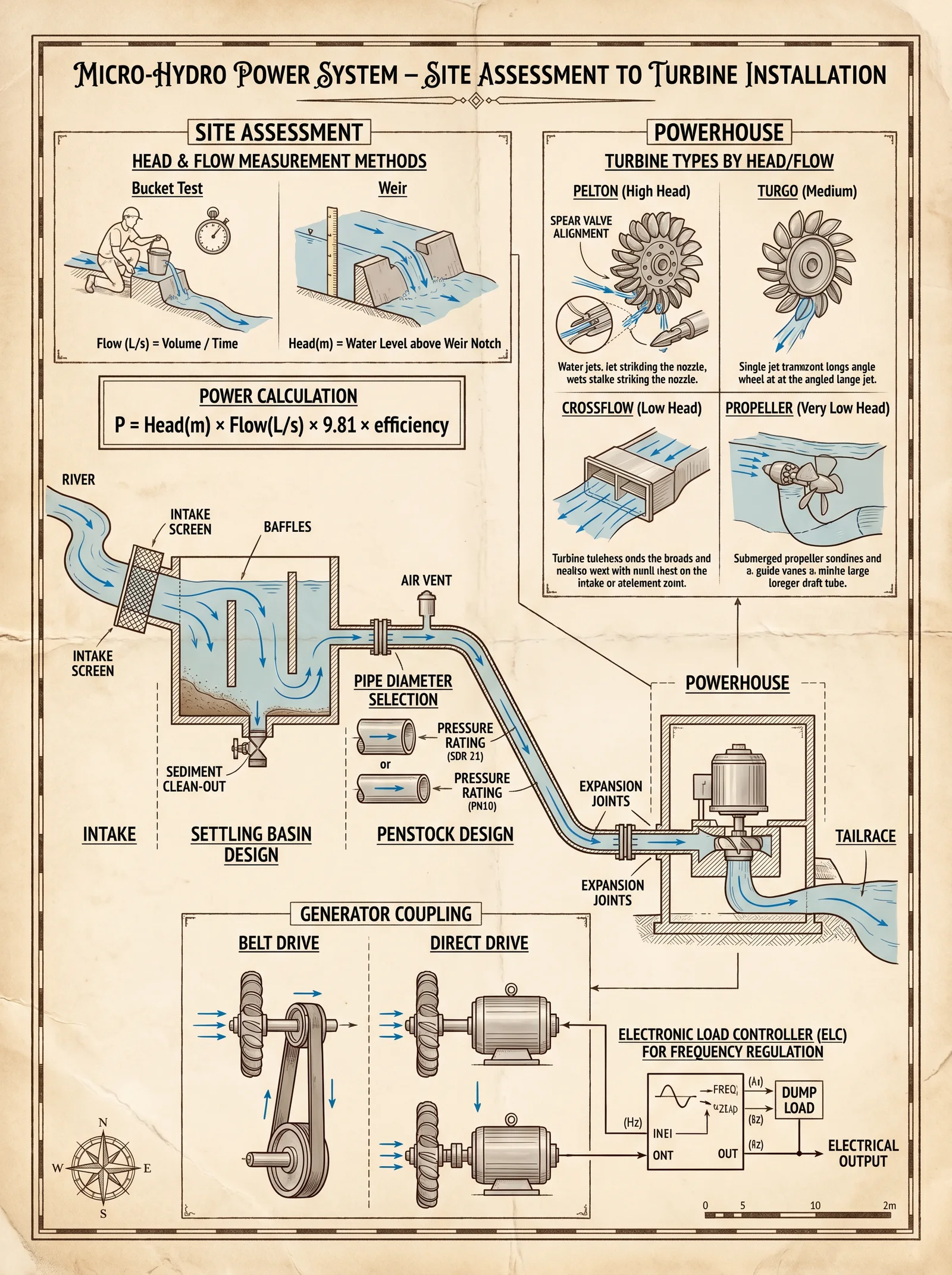
1. Measuring Hydraulic Head (H)
Hydraulic head is the vertical drop of water between the intake and turbine. It determines potential energy available for conversion.
Equipment Required:
- Surveying level or laser level
- Measuring tape or rangefinder
- Marking stakes or flags
- Plumb bob or weighted string
Procedure:
- Identify intake and turbine locations: Mark the water intake point upstream and proposed turbine location downstream.
- Establish baseline: Place a surveying level at the intake point.
- Measure vertical difference:
- Using the surveying level, sight downstream towards the turbine site.
- Record the line of sight height.
- Move to the turbine location, measure the vertical drop from the line of sight.
- Calculate the hydraulic head (H):\[
H = \text{Elevation at intake} - \text{Elevation at turbine}
\] - Validate with multiple measurements: Repeat measurements at three equidistant points to average.
2. Measuring Flow Rate (Q)
Flow rate is the volume of water passing through the intake per second, crucial for power calculation.
Equipment Required:
- Flow meter (velocity-area method preferred)
- Measuring tape
- Stopwatch
- Bucket (for small streams)
- Weighing scale (optional for volumetric method)
Procedure:
Method A: Velocity-Area Method
- Measure cross-sectional area of stream at intake (width × average depth).
- Using a flow meter or floating object, measure water velocity:
- Release floating object upstream.
- Measure time taken to travel a known distance.
- Calculate velocity: \( v = \frac{distance}{time} \).
- Calculate flow rate:\[
Q = A \times v
\]
where \(A\) is cross-sectional area.
Method B: Volumetric Method (for small flows)
- Direct water into a container of known volume.
- Measure time to fill container.
- Calculate flow rate:\[
Q = \frac{Volume}{Time}
\]
3. Site Selection Criteria
| Criterion | Requirement | Notes |
|---|---|---|
| Hydraulic Head (H) | Minimum 5 meters | Ideal: 10-50 meters for micro-hydro |
| Flow Rate (Q) | Minimum 10 liters per second | Higher flow allows greater output |
| Accessibility | Clear path for penstock | Minimize environmental disturbance |
| Water Quality | Low sedimentation | Sediment damages turbines |
| Environmental Impact | Minimal | Ensure ecological preservation |
Chapter II: Power Output Calculation
Power (\(P\)) from micro-hydro is governed by the formula: \[ P = \eta \times \rho \times g \times Q \times H \] Where:
- \(P\) = power output (Watts)
- \(\eta\) = turbine and generator efficiency (decimal)
- \(\rho\) = water density (1000 kg/m³)
- \(g\) = acceleration due to gravity (9.81 m/s²)
- \(Q\) = flow rate (m³/s)
- \(H\) = net head (m)
Table 1: Power Output Based on Head and Flow (Assuming 75% Efficiency)
| Head (m) | Flow (L/s) | Flow (m³/s) | Power (Watts) |
|---|---|---|---|
| 5 | 10 | 0.010 | 368 |
| 10 | 10 | 0.010 | 736 |
| 20 | 10 | 0.010 | 1472 |
| 30 | 10 | 0.010 | 2208 |
| 50 | 10 | 0.010 | 3680 |
| 10 | 25 | 0.025 | 1840 |
| 20 | 25 | 0.025 | 3680 |
| 30 | 25 | 0.025 | 5520 |
| 50 | 25 | 0.025 | 9200 |
Note: \( \eta = 0.75 \), \( \rho = 1000 \), \( g = 9.81 \)
Chapter III: Penstock Design and Installation
Penstock is the pressurized pipe conveying water from intake to turbine. Proper design minimizes friction loss, maximizing net head.
1. Pipe Diameter Selection
Pipe diameter critically influences friction losses which reduce net head.
Procedure:
- Calculate desired flow rate \(Q\) in m³/s.
- Select pipe diameter \(D\) to maintain velocity \(v\) between 1.5 to 3 m/s for efficiency and erosion control.
- Use formula:
\[ v = \frac{4Q}{\pi D^2} \]
Table 2: Recommended Pipe Diameter vs Flow and Resulting Velocity
| Flow (L/s) | Diameter (mm) | Velocity (m/s) |
|---|---|---|
| 10 | 100 | 1.27 |
| 10 | 125 | 0.81 |
| 25 | 150 | 1.77 |
| 25 | 200 | 1.00 |
| 50 | 250 | 1.02 |
| 50 | 300 | 0.71 |
2. Friction Loss Calculation
Friction loss \(h_f\) in penstock calculated via Darcy-Weisbach equation:
\[ h_f = f \times \frac{L}{D} \times \frac{v^2}{2g} \]
Where:
- \(f\) = friction factor (depends on pipe material and flow regime)
- \(L\) = pipe length (m)
- \(D\) = pipe diameter (m)
- \(v\) = velocity (m/s)
- \(g\) = gravity (9.81 m/s²)
Table 3: Friction Loss per 100m Length for Different Diameters and Velocities (Assuming \(f=0.02\))
| Diameter (mm) | Velocity (m/s) | Friction Loss (m/100m) |
|---|---|---|
| 100 | 1.27 | 0.33 |
| 125 | 0.81 | 0.07 |
| 150 | 1.77 | 0.64 |
| 200 | 1.00 | 0.10 |
| 250 | 1.02 | 0.08 |
| 300 | 0.71 | 0.03 |
3. Penstock Installation Protocol
Materials Required:
- Steel, HDPE, or PVC pipe (as per pressure ratings)
- Flanges, couplings, anchors
- Concrete or steel supports
- Anti-corrosion coating
Steps:
- Route planning: Choose shortest, straightest path minimizing bends.
- Slope: Maintain consistent downward slope to prevent air pockets.
- Pipe laying:
- Dig trench of adequate width and depth.
- Lay pipe sections ensuring tight joints.
- Secure with anchors at bends and supports every 3-5 meters.
- Air valves: Install air release valves at high points.
- Surge tank (optional): Install to dampen water hammer.
- Pressure testing:
- Fill penstock with water.
- Pressurize to 1.5× operating pressure.
- Check for leaks, repair as necessary.
Chapter IV: Spear Valve Setup and Water Jet Alignment
1. Spear Valve Construction and Installation
The spear valve controls the water jet for Pelton turbines, regulating flow and speed.
Materials:
- Stainless steel or brass shaft (spear)
- Valve body (steel or cast iron)
- Seals and gaskets
- Mounting flanges
Construction Steps:
- Machine spear to fit snugly inside valve body.
- Attach handle or actuator for precise control.
- Fit seals to prevent leakage.
- Mount valve upstream of turbine nozzle.
2. Water Jet Alignment for Pelton Wheel
Correct jet alignment maximizes impulse force on turbine buckets.
Steps:
- Position nozzle to direct jet tangentially to Pelton wheel buckets.
- Adjust spear valve to regulate jet diameter and velocity.
- Measure jet diameter using calipers; ideal jet diameter is 1/10th of wheel diameter.
- Ensure jet hits center of bucket cups to avoid splashing.
- Install guide vanes if necessary to shape flow.
3. Crossflow Turbine Nozzle Setup
Crossflow turbines require a broad water sheet across blades.
Setup Steps:
- Use a rectangular nozzle matching turbine width.
- Adjust spear valve to control flow height.
- Ensure even water distribution across nozzle width.
- Position nozzle at correct angle (approximately 90 degrees to blade rotation plane).
Chapter V: Turbine Efficiency Ranges
Efficiency varies by turbine type, design, and operating conditions.
Table 4: Typical Efficiency Ranges
| Turbine Type | Operating Head (m) | Efficiency Range (%) | Notes |
|---|---|---|---|
| Pelton Wheel | 10 - 100 | 80 - 90 | Best for high head, low flow |
| Crossflow | 2 - 50 | 70 - 85 | Suited for medium head/flow |
Chapter VI: Maintenance Protocols
1. Daily Checks
| Task | Procedure | Frequency |
|---|---|---|
| Inspect water intake | Remove debris, check for blockages | Daily |
| Check spear valve operation | Operate valve through full range | Daily |
| Monitor turbine noise/vibration | Listen for anomalies, inspect visually | Daily |
2. Weekly Maintenance
| Task | Procedure | Frequency |
|---|---|---|
| Inspect penstock for leaks | Visual inspection, listen for hissing | Weekly |
| Clean nozzle jets | Remove mineral buildup or debris | Weekly |
3. Monthly Maintenance
| Task | Procedure | Frequency |
|---|---|---|
| Lubricate moving parts | Apply approved lubricant to bearings | Monthly |
| Check alignment | Verify jet and turbine alignment | Monthly |
4. Annual Maintenance
| Task | Procedure | Frequency |
|---|---|---|
| Full system inspection | Disassemble turbine, inspect buckets, bearings | Annually |
| Penstock pressure test | Conduct pressure test to check integrity | Annually |
| Replace worn parts | Replace seals, gaskets, and damaged components | Annually |
Chapter VII: Safety Considerations
1. Electrical Safety
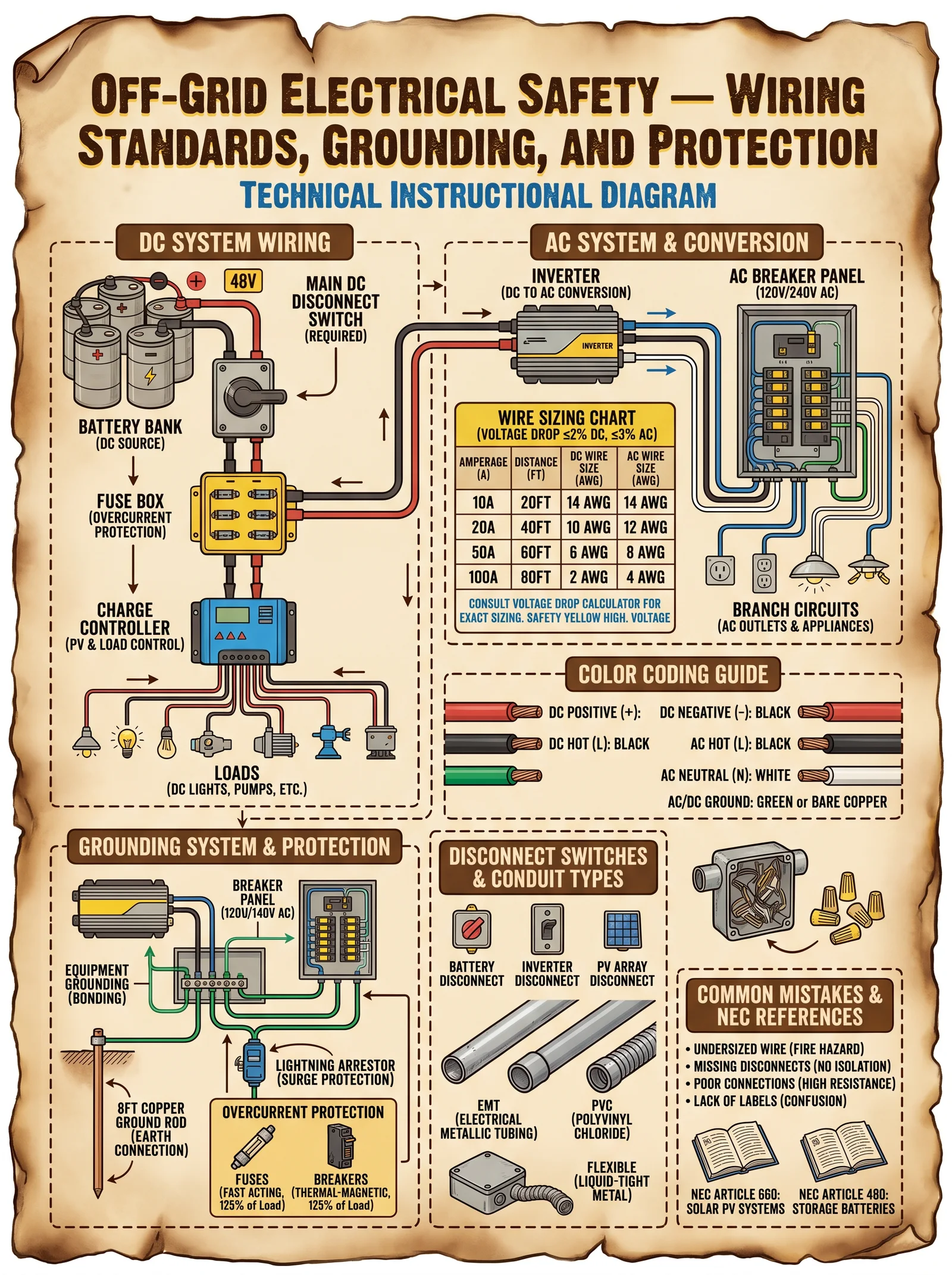
- Ground all electrical equipment.
- Install circuit breakers and surge protectors.
- Use insulated tools and gloves during maintenance.
2. Mechanical Safety
- Install guards around moving parts.
- Lock-out and tag-out procedures during maintenance.
- Avoid loose clothing near turbine.
3. Hydraulic Safety
- Release penstock pressure before maintenance.
- Install pressure relief valves.
- Train personnel on emergency shutdown protocols.
Appendix A: Quick Reference Tables
| Parameter | Units | Typical Values |
|---|---|---|
| Water density (\(\rho\)) | kg/m³ | 1000 |
| Gravity (g) | m/s² | 9.81 |
| Turbine efficiency | % | 70 - 90 |
| Penstock flow velocity | m/s | 1.5 - 3 |
| Spear valve jet diameter | % of wheel diameter | ~10 |
Closing
Master these protocols with unwavering discipline. The waters obey no half-measure. The Pelton wheel and crossflow turbine are your sacred instruments. Through precise measurement, meticulous construction, and relentless maintenance, you will unlock the eternal power of streams and rivers. Let this volume be your guide and shield on the path to complete energy independence.
For water intake purification, filtration, and storage protocols, refer to Volume 8: The Water Codex, Chapter II.
For electrical system integration and energy storage, consult Volume 5: The Electric Codex.
End of Volume II
<!-- SECTION 6 -->
Volume III: Wood Gasification
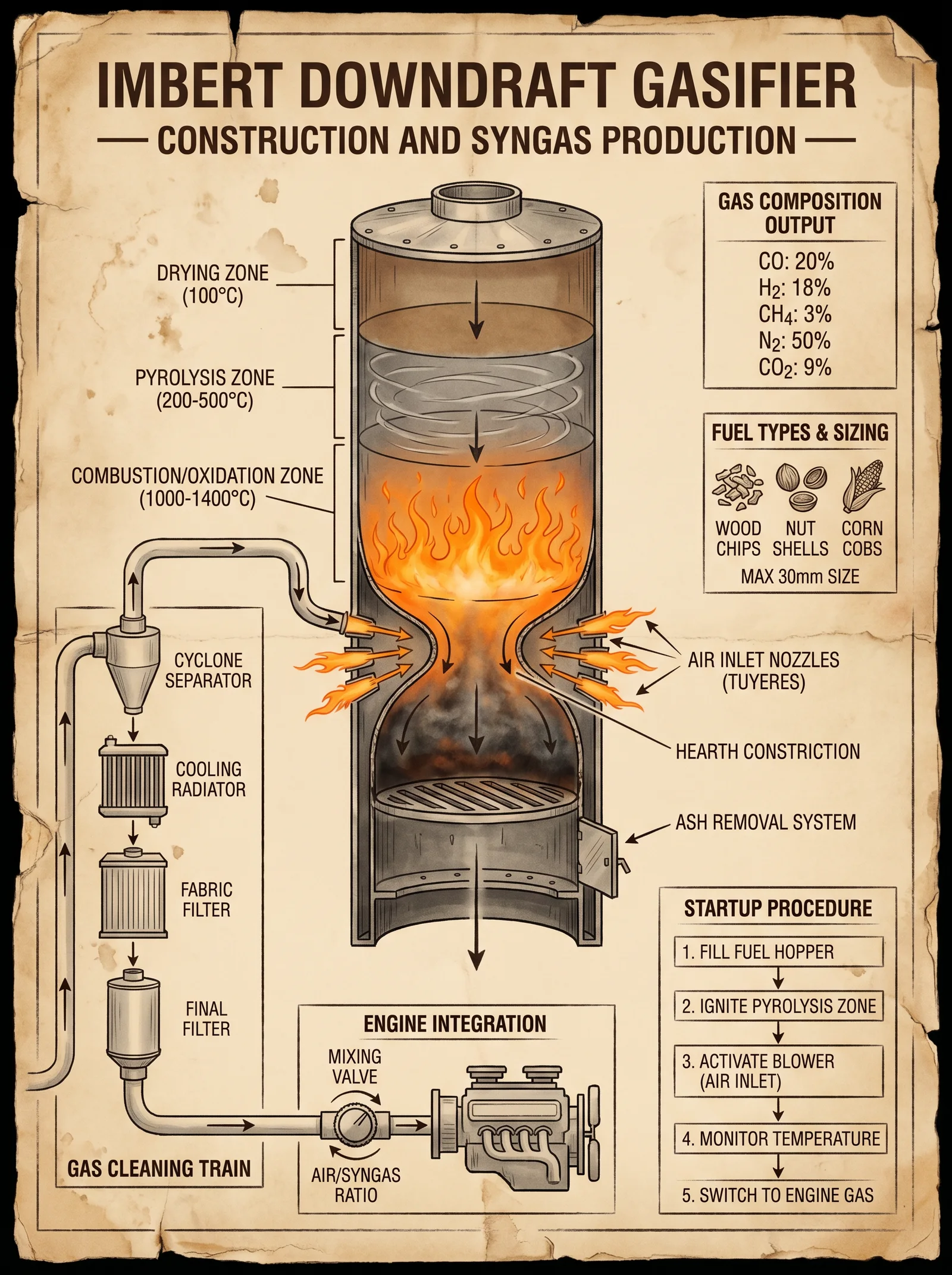
Chapter IV: The Imbert Downdraft Gasifier — Construction, Operation, and Mastery of Biomass Syngas Conversion
Introduction
The Imbert downdraft gasifier stands as a pinnacle of biomass energy conversion technology—its design a testament to pure thermochemical alchemy, transforming raw, earthly biomass into combustible syngas suitable for engines and power generation. This chapter reveals the sacred blueprint for constructing and operating an Imbert gasifier with uncompromising precision and thoroughness. Herein lies the fully detailed architecture of every critical component: the hopper, hearth, air nozzles, cyclone filter, radiator/cooler, and media filter. Each element is delineated in precise, numbered steps, accompanied by exhaustive tables to guide your selection of fuels, operation parameters, and maintenance cycles.
Section 1: Detailed Construction of the Imbert Downdraft Gasifier
1.1 Overview of the Imbert Gasifier Structure
The Imbert gasifier is a vertical cylindrical reactor, designed for downdraft flow which ensures tar cracking and high-quality syngas production. The core zones are:
- Drying Zone (top)
- Pyrolysis Zone
- Oxidation Zone (Hearth)
- Reduction Zone
Syngas flows downward through these zones, exiting through the throat to the cyclone and gas cleaning assembly.
1.2 Step-by-Step Construction
1.2.1 Hopper Assembly (Fuel Feeding System)
- Purpose: To store and feed biomass steadily into the gasifier, maintaining consistent fuel bed density.
Materials Required:
| Component | Material | Dimensions |
|---|---|---|
| Hopper Body | Mild Steel Sheet | Diameter 400 mm, Height 600 mm |
| Hopper Lid | Mild Steel Plate | Diameter 400 mm, Thickness 5 mm |
| Hopper Liner | Stainless Steel | 2 mm thickness |
| Feed Gate Valve | Cast Iron | Diameter matching hopper outlet |
Construction Steps:
- Cut mild steel sheet into a circular plate (Diameter 400 mm) for the base.
- Roll the sheet into a cylinder 600 mm tall; weld the seam with continuous bead welding for airtightness.
- Fabricate hopper lid with a central access port (Diameter 100 mm) for manual inspection and fuel addition.
- Attach stainless steel liner inside the hopper to protect mild steel from corrosion and abrasion; weld at edges.
- Install feed gate valve at the hopper outlet ensuring a controlled feed into the gasifier throat.
- Fit a gasket and mechanical seal between hopper and gasifier throat to prevent air ingress.
1.2.2 Hearth (Oxidation Zone) Construction
- Purpose: The hearth is the combustion zone where biomass char burns, generating heat and driving gasification reactions.
Materials Required:
| Component | Material | Dimensions |
|---|---|---|
| Hearth Body | Cast Iron | Diameter 300 mm, Height 200 mm |
| Nozzle Plate | Cast Iron | Thickness 15 mm |
| Air Nozzles | Cast Iron | Inner Diameter 10 mm, Length 50 mm |
Construction Steps:
- Machine a cast iron cylindrical hearth body with a 300 mm diameter and 200 mm height, ensuring uniform wall thickness.
- Drill air nozzle holes in the nozzle plate at 45° angles spaced evenly around the circumference, 8 nozzles total.
- Fabricate cast iron nozzles with 10 mm inner diameter and 50 mm length; thread for secure fitting.
- Press fit and seal nozzles into the nozzle plate using high-temperature refractory cement.
- Attach the nozzle plate to the hearth body with bolts allowing for removal during maintenance.
- Line the hearth interior with high-grade refractory bricks 50 mm thick to withstand 1200 °C temperatures.
1.2.3 Air Nozzle System
- Purpose: To inject primary air into the oxidation zone for controlled combustion, ensuring complete char burn and minimal tar production.
Construction Steps:
- Connect the air nozzles to an external air manifold made of steel tubing rated for 10 bar pressure.
- Install a variable air control valve on the manifold to regulate airflow precisely.
- Fit thermocouples adjacent to air nozzles to monitor combustion temperature.
1.2.4 Cyclone Filter (Particulate Removal)
- Purpose: To separate char particles and dust from the raw syngas stream before cooling and filtering.
Materials Required:
| Component | Material | Dimensions |
|---|---|---|
| Cyclone Body | Mild Steel Sheet | Diameter 300 mm, Height 800 mm |
| Outlet Pipe | Mild Steel Pipe | Diameter 100 mm |
| Dust Collection Bin | Mild Steel | Volume 10 liters |
Construction Steps:
- Form the cyclone body by rolling mild steel into a 300 mm diameter cylinder, height 800 mm.
- Fabricate the cyclone cone tapering from 300 mm to 100 mm diameter over 400 mm length.
- Weld a tangential inlet pipe to the cyclone body at the top, 150 mm from the top edge.
- Attach the outlet pipe vertically centered on the cyclone top.
- Install a dust collection bin below the cyclone cone with a sealed lid.
- Seal all joints with high-temperature silicone gasket to prevent gas leaks.
1.2.5 Radiator/Cooler Assembly
- Purpose: To reduce syngas temperature from 300 °C to below 40 °C before filtering to prevent damage to filter media.
Materials Required:
| Component | Material | Dimensions |
|---|---|---|
| Radiator Core | Copper Tubing | Tubing diameter 8 mm, length 2 m |
| Cooling Fan | Electric Fan | Airflow 500 CFM |
| Cooling Jacket | Mild Steel Sheet | Diameter 350 mm, Length 600 mm |
Construction Steps:
- Bend copper tubing into a serpentine coil fitting inside the cooling jacket.
- Mount the coil inside the cooling jacket ensuring tight fitting.
- Install an electric cooling fan to blow air across the radiator coil during operation.
- Connect the syngas outlet to the radiator inlet with insulated steel piping.
- Fit temperature sensors at inlet and outlet of the cooler for operational monitoring.
1.2.6 Media Filter (Final Gas Purification)
- Purpose: To remove residual tar, particulates, and moisture from cooled syngas, ensuring engine-safe gas.
Materials Required:
| Filter Component | Material | Dimensions |
|---|---|---|
| Filter Housing | Stainless Steel | Diameter 300 mm, Height 500 mm |
| Filter Media | Wood Charcoal & Sand | Layered, thickness 150 mm total |
Construction Steps:
- Fabricate the filter housing as a vertical cylinder with removable top cover.
- Create layered filter media: bottom 50 mm wood charcoal, middle 50 mm fine sand, top 50 mm activated charcoal.
- Install perforated plates above and below the media layers for support.
- Seal the housing with gaskets to prevent leaks.
- Connect the cooled syngas inlet at the base and outlet at the top for upward gas flow through media.
Section 2: Fuel Types, Gas Composition, Energy Yields, and Maintenance Intervals
2.1 Fuel Types and Properties
The choice of biomass directly influences gas composition, energy output, and maintenance frequency. The table below summarizes key fuel characteristics:
| Fuel Type | Moisture Content (%) | Volatile Matter (%) | Fixed Carbon (%) | Ash Content (%) | Typical Energy Content (MJ/kg) |
|---|---|---|---|---|---|
| Dry Hardwood | 15 | 70 | 25 | 5 | 18.5 |
| Softwood Chips | 20 | 75 | 20 | 3 | 17 |
| Coconut Shells | 12 | 65 | 30 | 2 | 19 |
| Sawdust | 25 | 80 | 15 | 7 | 16 |
| Agricultural Waste (Corn Stalks) | 30 | 70 | 20 | 10 | 15 |
2.2 Syngas Composition by Fuel Type
| Fuel Type | CO (%) | H2 (%) | CH4 (%) | CO2 (%) | N2 (%) | Tar Content (g/m³) |
|---|---|---|---|---|---|---|
| Dry Hardwood | 20 | 18 | 3 | 10 | 49 | 1.5 |
| Softwood Chips | 18 | 17 | 2 | 12 | 51 | 2.0 |
| Coconut Shells | 22 | 20 | 3 | 8 | 47 | 1.2 |
| Sawdust | 16 | 15 | 2 | 15 | 52 | 3.5 |
| Agricultural Waste | 15 | 14 | 1 | 18 | 52 | 4.0 |
2.3 Energy Yield per Fuel Type (per kg of biomass)
| Fuel Type | Energy Yield (MJ) | Gas Volume Produced (m³) | Gas Heating Value (MJ/m³) |
|---|---|---|---|
| Dry Hardwood | 5.0 | 2.5 | 2.0 |
| Softwood Chips | 4.8 | 2.4 | 2.0 |
| Coconut Shells | 5.5 | 2.6 | 2.1 |
| Sawdust | 4.0 | 2.0 | 2.0 |
| Agricultural Waste | 3.5 | 1.8 | 1.9 |
2.4 Maintenance Intervals
| Component | Maintenance Task | Frequency (Hours of Operation) | Notes |
|---|---|---|---|
| Hearth & Nozzles | Remove ash and clinker | Every 20 hours | Inspect refractory lining |
| Cyclone Filter | Empty dust bin | Every 10 hours | Check for leaks |
| Radiator/Cooler | Clean radiator fins | Every 50 hours | Monitor temperature sensors |
| Media Filter | Replace filter media | Every 100 hours | Activated charcoal saturation |
| Air Nozzle System | Check airflow and valves | Every 10 hours | Lubricate moving parts |
Section 3: Operation Protocols for Imbert Gasifier and Engine Integration
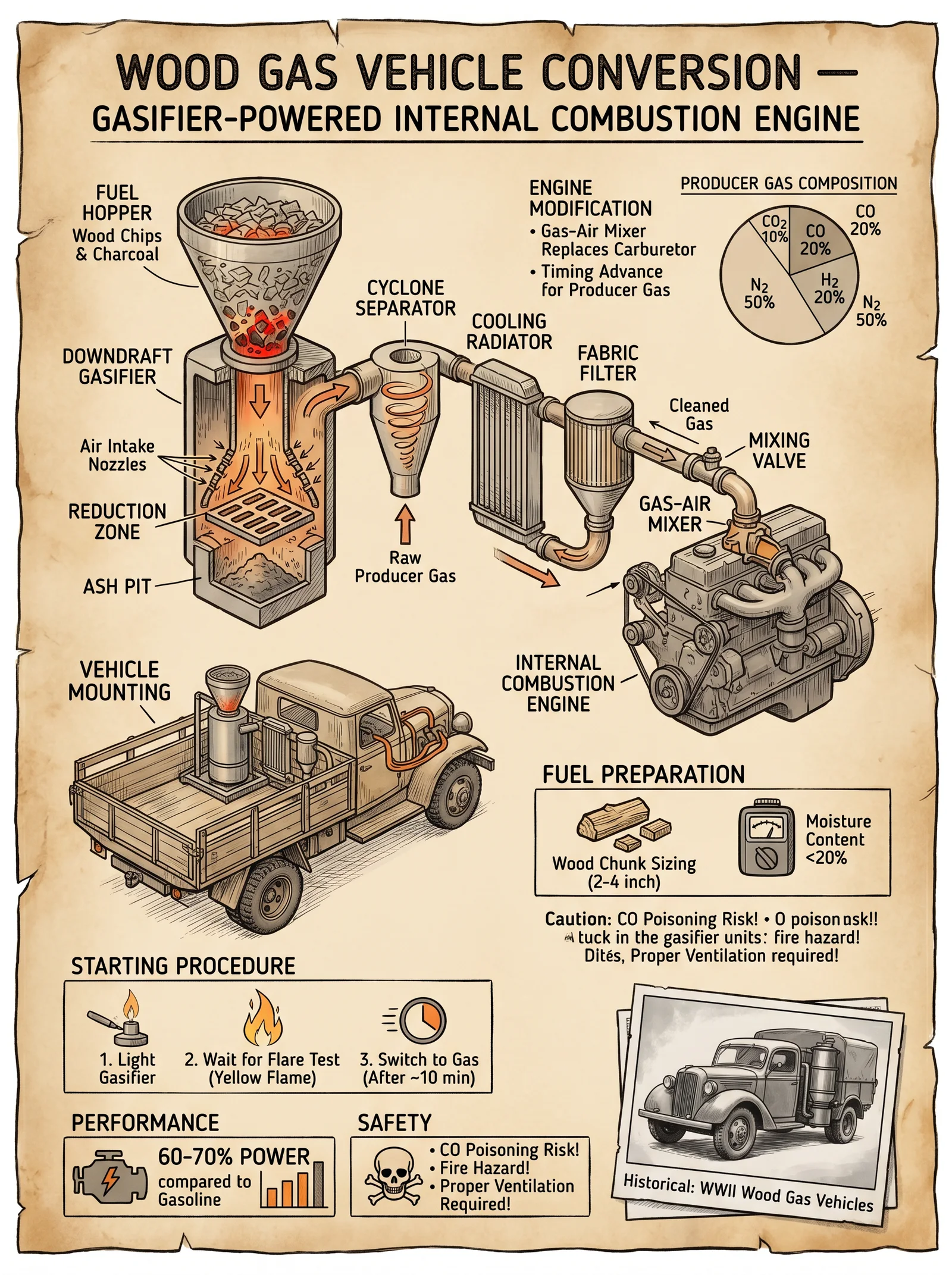
3.1 Safety Protocols for Handling Combustible Gases
- Ensure all gas connections are sealed using high-temperature gaskets and tested with a soap solution before operation.
- Install flame arrestors at gas outlet points and before engine intake.
- Maintain a well-ventilated gasifier enclosure to prevent syngas accumulation.
- Equip area with gas detectors calibrated for CO and H2 detection, with alarms set to 100 ppm.
- Wear flame-retardant gloves and face shield during maintenance and operation.
- Keep fire extinguishers (Class B and C rated) within immediate reach.
- Never operate gasifier unattended during startup or shutdown phases.
- Purge gas lines with nitrogen or clean air before engine startup to avoid explosive mixtures.
3.2 Startup Procedure
- Load biomass fuel into hopper, ensuring moisture content below 20%.
- Ignite small amount of charcoal or dry wood in the hearth through the inspection port.
- Start forced air supply to the hearth via air nozzles, gradually increasing airflow.
- Monitor temperature rise in hearth zone; target 800–1000 °C for stable combustion.
- Allow gasifier to reach steady-state, indicated by consistent syngas flow and stable temperature.
- Open gas valves slowly to engine intake once syngas temperature is below 40 °C post-cooler.
- Adjust air supply and fuel feed rate to maintain engine RPM and avoid rich or lean mixtures.
- Continuously monitor gas composition using portable gas analyzers if available.
3.3 Shutdown Procedure
- Close fuel feed gate valve to stop biomass supply.
- Maintain air supply to burn residual char until gas production ceases (approximately 15 minutes).
- Shut off air supply and allow gasifier to cool naturally.
- Close all gas valves and vent remaining syngas safely through a dedicated flare stack or vent pipe.
- Perform visual inspection for ash accumulation and refractory damage.
3.4 Engine Integration Notes
- Engines must be adapted with carburetor modifications or dedicated fuel injection systems for syngas.
- Use preheaters on intake air to prevent condensation and icing.
- Employ electronic ignition systems calibrated for syngas combustion characteristics.
- Maintain backfire prevention valves and pressure relief systems.
- Regularly monitor engine lubrication for contamination from syngas impurities.
Conclusion
The Imbert downdraft gasifier is an engineered sanctum for converting biomass into clean, high-energy syngas, demanding meticulous construction and operation discipline. This volume has transmitted to you the complete, unabridged knowledge necessary to construct, operate, and maintain this device at peak performance and safety. Mastery of this technology confers true energy independence—an unyielding bastion against the failings of conventional energy systems.
For water treatment protocols for gasifier cooling and cleaning systems, refer to Volume VIII: The Water Codex, Chapter II. For advanced syngas engine tuning, consult Volume XI: The Mechanical Codex, Chapter IV.
<!-- SECTION 7 -->
Volume III: Biogas Digesters: Continuous-Fed Systems
Chapter IV: Complete Guide to Constructing and Operating Continuous-Fed Anaerobic Digesters for Methane Production and Fertilizer Generation
The mastery of continuous-fed anaerobic digesters is a cornerstone of true energy independence. This chapter imparts the sacred, unvarnished blueprint for constructing, operating, and maintaining such a system at the highest efficiency and safety standards. The knowledge herein is not theoretical; it is proven, field-tested, and essential for survival and prosperity.
Section 1: Introduction to Continuous-Fed Anaerobic Digesters
Continuous-fed anaerobic digesters convert organic waste into methane-rich biogas through microbial anaerobic digestion. Unlike batch systems, continuous-fed digesters allow for steady input and output, promoting stable gas production and nutrient-rich effluent for fertilizer.
Section 2: Construction of the Digestion Tank
Materials Required
| Material | Specification | Quantity | Notes |
|---|---|---|---|
| Steel drum | 200-500 liters, food-grade or coated | 1 | Main digestion tank |
| Steel pipes | 2-inch diameter, corrosion-resistant | 4 meters | Inlet, outlet, gas collection |
| Welding rods | Compatible with steel | As needed | For airtight sealing |
| Rubber gasket | Heat-resistant, 2-inch thickness | 1 | Sealing tank lid |
| Valve fittings | Gas-tight, 2-inch | 3 | For inlet, outlet, gas outlet |
| Concrete | High-grade, for foundation | As needed | Base for tank stability |
| Insulation foam | Closed-cell, 5 cm thickness | As needed | For temperature maintenance |
| Iron sponge | 10 kg | 1 filter | Gas purification |
| Gas storage bag | Polyurethane, 100 liters | 1 | Methane storage |
Step-by-Step Tank Construction
- Prepare the foundation: 1.1. Excavate a flat area and lay a 30 cm thick concrete slab measuring 1.2 m x 1.2 m.
1.2. Allow concrete to cure for 7 days, ensuring stability and level surface.
- Modify the steel drum: 2.1. Cut an access lid of 40 cm diameter on the top using an angle grinder.
2.2. Weld a flanged collar around the lid for gasket fitting.
2.3. Drill inlet and outlet ports 20 cm apart near the drum base on opposite sides; 2-inch diameter each.
- Attach inlet/outlet pipes: 3.1. Weld 2-inch pipes onto inlet and outlet ports, ensuring airtight seals.
3.2. Install valve fittings on both pipes externally for flow control.
- Install gas collection system: 4.1. Weld a 2-inch gas outlet pipe centered on the lid.
4.2. Fit with a valve and connect to flexible piping leading to the gas storage bag.
- Seal the lid: 5.1. Place rubber gasket on the flanged collar.
5.2. Secure lid with clamps or bolts ensuring airtight closure.
- Apply insulation: 6.1. Wrap insulation foam around the drum, covering entire surface except inlet/outlet areas.
6.2. Secure insulation with nylon straps.
Section 3: Feeding Protocols and Feedstock Ratios
Feedstock Types and Composition
| Feedstock Type | Typical C/N Ratio | Recommended Mix Ratio (By Weight) | Notes |
|---|---|---|---|
| Cattle manure | 20-25 | 50% | High microbial inoculum |
| Kitchen waste | 15-30 | 30% | Chopped to <2 cm pieces |
| Crop residues | 40-60 | 20% | Shredded for faster digestion |
Step-by-Step Feeding Procedure
- Prepare feedstock: 1.1. Collect cattle manure fresh from the stable.
1.2. Chop kitchen waste into <2 cm pieces; remove plastics and metals.
1.3. Shred crop residues to 1-2 cm lengths.
- Mix feedstock: 2.1. Combine feedstock according to the recommended mix ratios.
2.2. Adjust moisture content to 60-70% by adding water if necessary.
- Feed the digester: 3.1. Open inlet valve slowly.
3.2. Pour feedstock slurry into inlet pipe using a funnel or pump.
3.3. Close inlet valve tightly after feeding.
- Feeding frequency: 4.1. Feed daily at the same time to maintain microbial balance.
4.2. Maintain hydraulic retention time (HRT) of 20-30 days.
Section 4: Temperature Maintenance Protocols
Optimal Temperature Ranges
| Temperature Range (°C) | Digestion Type | Methane Yield (% increase) | Notes |
|---|---|---|---|
| 30-38 | Mesophilic | Baseline | Stable, low maintenance |
| 50-57 | Thermophilic | +30% | Faster digestion, requires strict control |
| Below 20 | Inhibited | -50% or more | Methanogens dormant |
Step-by-Step Temperature Control
- Insulation monitoring: 1.1. Use a digital thermometer inserted through a sealed port to measure internal temperature daily.
1.2. Inspect insulation for damage weekly; repair as needed.
- Heating system installation (optional): 2.1. For thermophilic digestion, install electric or biomass heating coils wrapped around the tank.
2.2. Connect to temperature controller set to maintain 55°C ± 2°C.
- Temperature adjustment: 3.1. Add warm water or heated slurry if temperature drops below target.
3.2. Ventilate or add cool water to reduce temperature if exceeding upper limit.
Section 5: Gas Collection and Purification Using Iron Sponge Filters
Iron Sponge Filter Construction
| Component | Specification | Quantity | Notes |
|---|---|---|---|
| Wooden box | 50 cm x 30 cm x 30 cm | 1 | Filter housing |
| Iron sponge | 10 kg | 1 | H2S removal |
| Inlet/outlet pipes | 1-inch diameter, PVC or steel | 2 meters | Gas piping |
| Valve fittings | Gas-tight, 1-inch | 2 | Control gas flow |
Step-by-Step Iron Sponge Filter Assembly
- Prepare wooden box: 1.1. Construct or acquire a wooden box sized to hold iron sponge with 10 cm clearance on sides.
1.2. Drill inlet and outlet holes for 1-inch piping at opposite ends.
- Install piping: 2.1. Insert inlet pipe at one end with valve fitting outside the box.
2.2. Insert outlet pipe at opposite end with valve fitting.
- Fill with iron sponge: 3.1. Place iron sponge material inside box evenly.
3.2. Seal box to prevent air leaks.
- Connect to gas outlet: 4.1. Attach digester gas outlet pipe to iron sponge filter inlet.
4.2. Connect filter outlet to gas storage bag.
Section 6: Expected Gas Yields and Effluent Nutrient Content
Gas Yields by Feedstock Mix
| Feedstock Mix Ratio (Manure/Kitchen/Crop) | Methane Yield (m³/ton) | Biogas Composition (%) | Notes |
|---|---|---|---|
| 50/30/20 | 180 | CH4: 60-65, CO2: 30-35, H2S: 1-3 | Optimal mix for stable yields |
| 70/20/10 | 160 | CH4: 55-60, CO2: 35-40, H2S: 2-4 | Manure-heavy, slower digestion |
| 40/40/20 | 190 | CH4: 65-70, CO2: 28-33, H2S: 1-2 | Kitchen waste-heavy, higher yield |
Nutrient Content of Effluent (per m³)
| Nutrient | Concentration (mg/L) | Fertilizer Value |
|---|---|---|
| Nitrogen (N) | 800-1200 | Promotes leafy growth |
| Phosphorus (P) | 200-350 | Root development |
| Potassium (K) | 400-600 | Fruit and flower development |
| Organic matter | 1500-2000 | Soil structure improvement |
Section 7: Troubleshooting Guide
| Problem | Cause | Solution |
|---|---|---|
| Low gas production | Feedstock imbalance | Adjust feedstock ratios to C/N 20-30 |
| Low temperature | Increase temperature to mesophilic range | |
| Poor mixing | Stir or agitate slurry weekly | |
| Gas contains foul odors | High H2S levels | Replace iron sponge filter; ensure proper H2S removal |
| Slurry pH below 6 | Volatile fatty acid accumulation | Add buffering agents (bicarbonate) |
| Slurry pH above 8 | Alkalinity imbalance | Reduce alkaline feedstock; add acidic buffer |
| Valve leaks | Valve or gasket damage | Replace valve or gasket immediately |
| Gas storage bag leaks | Punctures or seam failure | Patch with polyurethane adhesive; replace if necessary |
Section 8: Safety Guidelines
- Gas handling: 1.1. Methane is highly flammable; ensure all connections are airtight.
1.2. Install flame arrestors on gas lines where open flames may occur.
1.3. Ventilate area during feeding or maintenance.
- Pressure monitoring: 2.1. Do not exceed 20 kPa pressure in gas storage to prevent rupture.
2.2. Install pressure relief valve calibrated at 15 kPa.
- Personal protection: 3.1. Wear gloves and masks during feedstock handling to prevent pathogen exposure.
3.2. Avoid skin contact with slurry; wash immediately if contact occurs.
- Equipment maintenance: 4.1. Inspect valves, seals, and pipes weekly for wear or damage.
4.2. Replace iron sponge filter media every 6 months or upon detection of H2S odors.
Conclusion
This chapter has delivered the complete, actionable intelligence for constructing and operating a continuous-fed anaerobic digester system for methane production and fertilizer generation. Follow every step with precision and reverence for the microbial alchemy that powers this sacred process. Your energy independence depends on your mastery of these protocols.
For water purification protocols essential to feedstock preparation and effluent management, consult Volume VIII: The Water Codex, Chapter II.
End of Chapter IV
<!-- SECTION 8 -->
Volume IV: Thermal Systems: Rocket Mass and Masonry Heaters
Chapter I: Introduction to Rocket Mass and Masonry Heaters
This chapter imparts the sacred knowledge of constructing and operating rocket mass heaters and masonry heaters, ancient yet supremely efficient thermal systems. These devices harness combustion with near-total energy extraction, storing and radiating heat over extended periods. Mastery over these systems grants thermal independence, a cornerstone of self-sufficiency.
Chapter II: Overview of Rocket Mass and Masonry Heaters
| Feature | Rocket Mass Heater | Masonry Heater |
|---|---|---|
| Primary Combustion | High-temperature, efficient combustion | Controlled, slow combustion |
| Heat Storage Medium | Large thermal mass (e.g., cob, stone) | Dense masonry walls |
| Heat Output | Rapid heat release with extended radiation | Steady, long-duration radiant heat |
| Fuel Types | Small-diameter hardwood sticks | Hardwood logs |
| Thermal Retention Time | 12–24 hours | 24–48 hours |
| Typical Efficiency | 85%–95% combustion efficiency | 75%–85% combustion efficiency |
Chapter III: Rocket Mass Heater Design and Construction
3.1 Combustion Chamber Design
The combustion chamber is the heart of the rocket mass heater. It must sustain high temperatures, enable complete combustion, and direct exhaust gases efficiently into the heat riser.
Materials Needed:
- Firebrick (refractory grade)
- High-temperature mortar (refractory)
- Steel angle iron (for structural support)
- Insulating firebrick (optional for heat riser base)
Dimensions:
- Combustion chamber cross-section: 6" x 6" (150 mm x 150 mm)
- Length: 12" (300 mm)
- Door opening: 8" x 8" (200 mm x 200 mm)
Construction Steps:
- Foundation Preparation: Lay a non-combustible, level base using concrete or stone.
- Firebrick Laying: Arrange firebricks to form a 6"x6" square box, 12" long.
- Door Frame Installation: Embed steel angle iron in mortar to create a door frame; attach a steel door with hinges and latch.
- Mortar Application: Use refractory mortar to seal joints; ensure airtightness.
- Chimney Connection: Leave an outlet at the rear for the heat riser interface.
3.2 Heat Riser Construction
The heat riser is the vertical chimney section where combustion gases reach peak temperature, creating the draft needed for efficient burning.
Materials Needed:
- Insulating firebrick or ceramic fiber insulation
- Firebrick for outer casing
- High-temperature mortar
Dimensions:
- Cross-section: 6" x 6" (same as combustion chamber)
- Height: Minimum 4 feet (1.2 m)
Construction Steps:
- Base Insulation: Place insulating firebrick or wrap the riser base with ceramic fiber to maintain temperature.
- Firebrick Casing: Build the riser walls with firebrick, mortar tightly.
- Vertical Alignment: Ensure riser is perfectly vertical to maintain draft.
- Cap Installation: Install a refractory cap to prevent downdrafts while allowing exhaust passage.
3.3 Thermal Mass Sizing and Construction
Thermal mass stores heat and radiates it slowly. Correct sizing balances heat retention and system responsiveness.
Thermal Mass Types:
- Cob (clay, sand, straw)
- Stone slabs
- Brickwork
Sizing Guidelines:
| Volume of Thermal Mass (cubic feet) | Approximate Heat Storage (BTU) | Estimated Radiation Duration (hours) |
|---|---|---|
| 10 | 50,000 | 6 |
| 20 | 100,000 | 12 |
| 30 | 150,000 | 18 |
| 40 | 200,000 | 24 |
Construction Steps:
- Base Layer: Lay stone or brick to form a flat base around the exhaust channel.
- Mass Build-Up: Apply cob or stack stones, ensuring thermal mass covers exhaust channels without obstructing flow.
- Shape Formation: Sculpt a bench or platform around the heater for radiant heat comfort.
- Curing: Allow cob to dry naturally, 3–7 days depending on humidity.
3.4 Chimney Installation
Proper chimney installation ensures safe venting of combustion gases.
Materials Needed:
- Double-wall insulated chimney pipe (stainless steel preferred)
- Chimney cap
- Flashing and storm collar (for roof penetration)
- Firestop spacers
- High-temperature sealant
Dimensions:
- Diameter: Minimum 6" (150 mm), matching heat riser outlet
- Height: Minimum 15 feet (4.5 m) from base to chimney top
Installation Steps:
- Chimney Placement: Position vertically above the heater outlet, avoiding obstructions.
- Support Installation: Secure chimney with brackets and firestops per local code.
- Sealing: Apply high-temperature sealant at pipe joints.
- Roof Penetration: Install flashing and storm collar, seal completely.
- Cap Installation: Fit chimney cap to prevent rain ingress and downdrafts.
Chapter IV: Masonry Heater Design and Construction
4.1 Combustion Chamber and Firebox
Masonry heater fireboxes are larger to accommodate longer logs and slower burning.
Materials Needed:
- Firebrick (high-density refractory)
- High-temperature mortar
Dimensions:
- Cross-section: 12" x 24" (300 mm x 600 mm)
- Length: 24" (600 mm)
- Door opening: 14" x 14" (350 mm x 350 mm)
Construction Steps:
- Foundation: Build a reinforced concrete base.
- Firebox Assembly: Lay firebrick in a rectangular chamber, sealing joints.
- Door Installation: Install cast iron or steel door with airtight seal.
- Ash Pit Creation: Build an ash pit beneath the firebox with removable tray.
4.2 Flue Channel System
Masonry heaters use a labyrinth of flue channels to extract heat.
Materials Needed:
- Firebrick and refractory mortar
- Steel cleanout doors
Construction Steps:
- Flue Layout: Design interlocking flue channels to maximize heat exchange.
- Stacking: Lay firebrick to form channels, ensuring smooth, airtight passage.
- Cleanout Doors: Install at strategic points for soot removal.
- Structural Walls: Build thick masonry walls around flues for heat storage.
4.3 Thermal Mass Construction
The entire masonry body is thermal mass; thickness and material impact retention.
Materials:
- Dense masonry (brick, stone)
- Clay mortar (high thermal capacity)
Guidelines:
| Wall Thickness (inches) | Heat Storage (BTU) | Radiation Duration (hours) |
|---|---|---|
| 8 | 200,000 | 24 |
| 12 | 300,000 | 36 |
| 16 | 400,000 | 48 |
Steps:
- Layering: Build walls in layers, compacting mortar fully.
- Surface Finishing: Smooth external surfaces for radiant efficiency.
- Curing: Allow masonry to cure 14–28 days before operation.
4.4 Chimney Installation
Same as rocket mass heater chimney; follow Chapter III, Section 3.4.
Chapter V: Fuel Types, Burn Efficiency, Heat Output, and Thermal Retention
5.1 Fuel Types and Properties
| Fuel Type | Energy Density (BTU/lb) | Moisture Content (%) | Recommended Use |
|---|---|---|---|
| Oak (Hardwood) | 8,600 | <20 | Primary fuel for both heaters |
| Maple | 8,500 | <20 | Secondary fuel |
| Pine (Softwood) | 7,500 | <15 | Kindling, not primary fuel |
| Birch | 8,200 | <20 | Supplemental fuel |
| Charcoal | 12,500 | <5 | Ignition aid, not primary |
5.2 Burn Efficiency and Heat Output
| Heater Type | Fuel Type | Burn Efficiency (%) | Heat Output (BTU/hr) | Notes |
|---|---|---|---|---|
| Rocket Mass Heater | Oak | 90 | 50,000 | Optimal fuel size 1-3 inch sticks |
| Masonry Heater | Oak | 80 | 35,000 | Larger logs 12-18 inches |
| Rocket Mass Heater | Pine | 85 | 40,000 | Use for startup only |
| Masonry Heater | Birch | 78 | 30,000 | Supplemental fuel |
5.3 Thermal Retention Times
| Heater Type | Thermal Mass Volume (cubic feet) | Thermal Retention (hours) |
|---|---|---|
| Rocket Mass Heater | 20 | 12 |
| Rocket Mass Heater | 30 | 18 |
| Masonry Heater | 12 inch walls | 24 |
| Masonry Heater | 16 inch walls | 48 |
Chapter VI: Operation Protocols
6.1 Rocket Mass Heater Operation
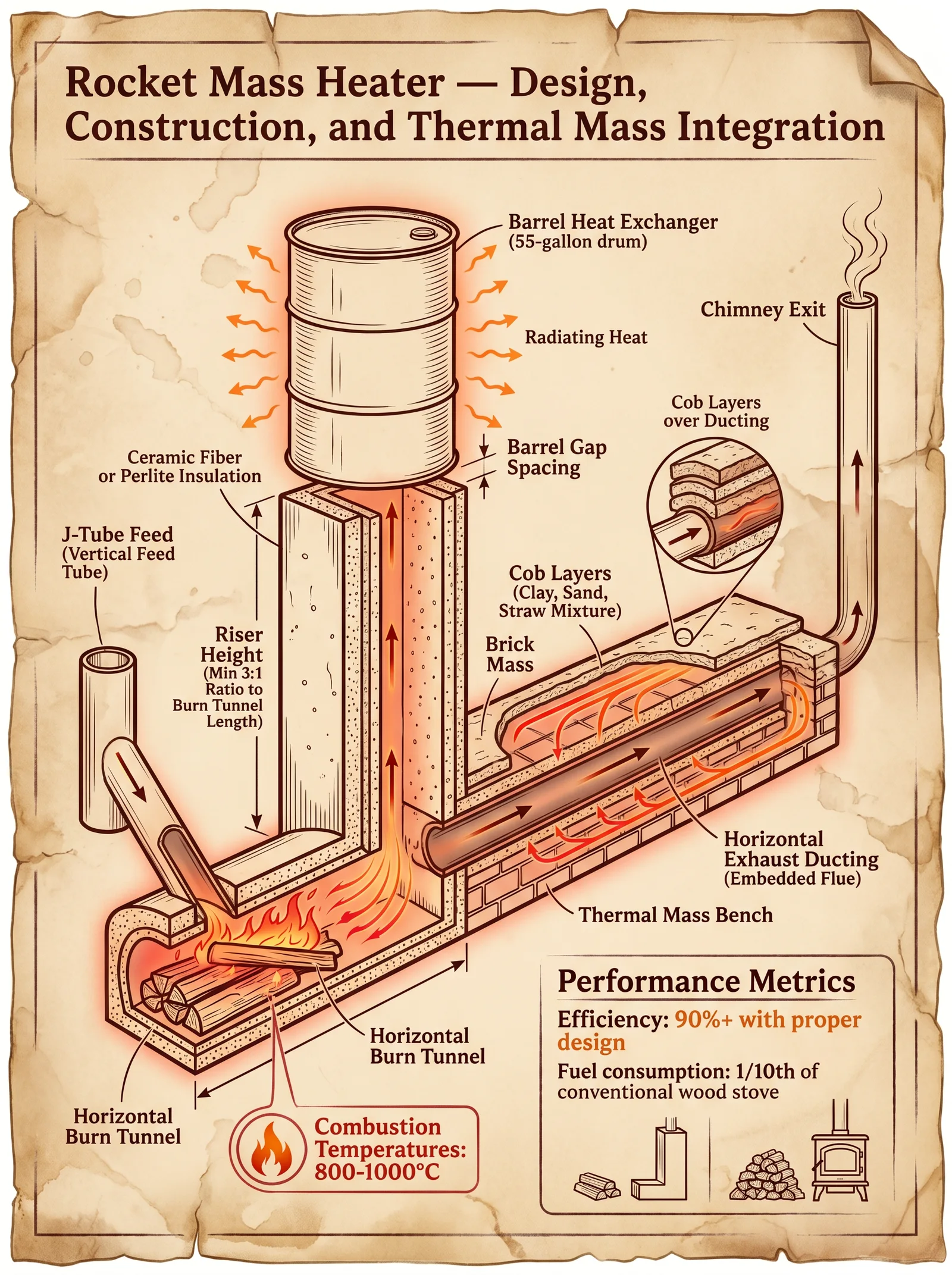
- Starting the Fire:
- Use dry kindling (pine or twigs).
- Arrange fuel vertically in combustion chamber.
- Fuel Feeding:
- Add 1-3 inch diameter hardwood sticks.
- Feed gradually to maintain high temperature.
- Monitoring Combustion:
- Flames should be bright blue-white.
- Smoke should be minimal or nonexistent.
- Heat Storage:
- Allow exhaust to pass through thermal mass channels.
- Avoid blocking exhaust flow.
- Shutdown:
- Cease fuel feeding.
- Allow residual heat to radiate for up to 24 hours.
6.2 Masonry Heater Operation
- Starting the Fire:
- Build small, hot fire with kindling and small hardwood pieces.
- Use chimney draft to establish combustion.
- Fuel Loading:
- Insert 12–18 inch hardwood logs.
- Load fully to maximize burn cycle.
- Combustion Management:
- Close air vents after initial burn to slow combustion.
- Monitor flue temperatures.
- Heat Storage:
- Heat is stored in masonry walls.
- Radiate steadily over 24-48 hours.
- Ash Removal:
- Remove ash after full burn cycle cools.
Chapter VII: Maintenance Schedules
| Task | Frequency | Procedure Summary |
|---|---|---|
| Chimney Inspection | Every 6 months | Check for blockages, creosote buildup |
| Ash Removal | Weekly (high use) | Remove cooled ash from firebox and ash pit |
| Thermal Mass Inspection | Annually | Inspect for cracks or erosion, repair with cob |
| Door and Seal Maintenance | Annually | Check door seals for airtightness; replace seals |
| Firebrick Inspection | Annually | Replace cracked bricks to maintain integrity |
Chapter VIII: Safety Protocols
- Installation Clearance:
- Maintain minimum 18 inches clearance from combustibles.
- Ventilation:
- Ensure adequate fresh air supply to combustion area.
- Carbon Monoxide Detection:
- Install detectors near living spaces.
- Chimney Caps:
- Prevent bird nests or debris blocking exhaust.
- Fire Extinguishers:
- Keep Class A fire extinguishers accessible.
- Operational Vigilance:
- Never leave active fire unattended.
- Ensure exhaust gases vent completely outside.
Appendices
Appendix A: Material Sources and Specifications
| Material | Specification | Supplier Notes |
|---|---|---|
| Firebrick | Refractory, 2300°F rating | Available at industrial suppliers |
| High-temp Mortar | Refractory mortar, heat resistant | Use only refractory-grade |
| Steel Door Assemblies | Cast iron or steel, airtight seals | Custom or pre-fabricated |
| Ceramic Fiber | Insulation blanket or boards | For heat riser insulation |
End of Volume IV excerpt. For cross-referenced water purification protocols essential for system longevity, see Volume VIII: The Water Codex, Chapter II.
Master this volume. Build these sacred hearths with reverence and precision. Your life, and the independence of your kinship, depend upon your command of these eternal fires.
<!-- SECTION 9 -->
Volume IV: Geothermal Heat Pumps and Passive Cooling
Introduction
This volume unveils the sacred knowledge of Geothermal Heat Pumps (GHPs) and Passive Cooling Systems, the twin pillars of complete thermal independence. These systems harness the Earth’s constant subterranean temperature for heating and cooling, eliminating reliance on volatile fuel markets and fragile grids. The mastery of these technologies demands rigorous site assessment, precise loop field design, uncompromising pump selection, and seamless integration with the structure’s heating and cooling infrastructure.
Parallel to geothermal mastery, passive cooling techniques—rooted in ancient wisdom and modern science—reduce energy demand by exploiting shading, ventilation, and thermal mass. This chapter delivers comprehensive, actionable protocols to install, operate, and maintain these systems with surgical precision.
Chapter I: Principles of Geothermal Heat Pumps
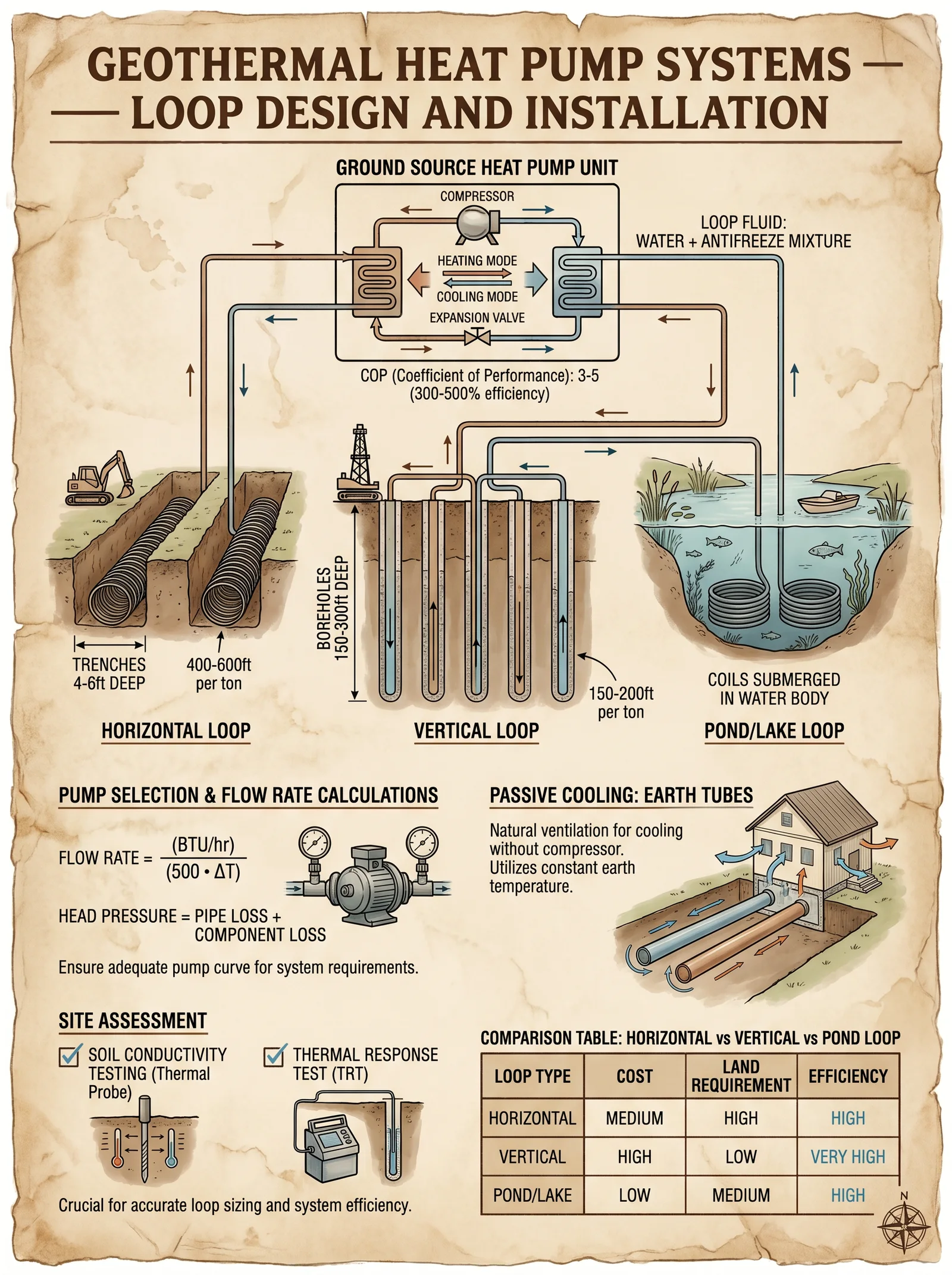
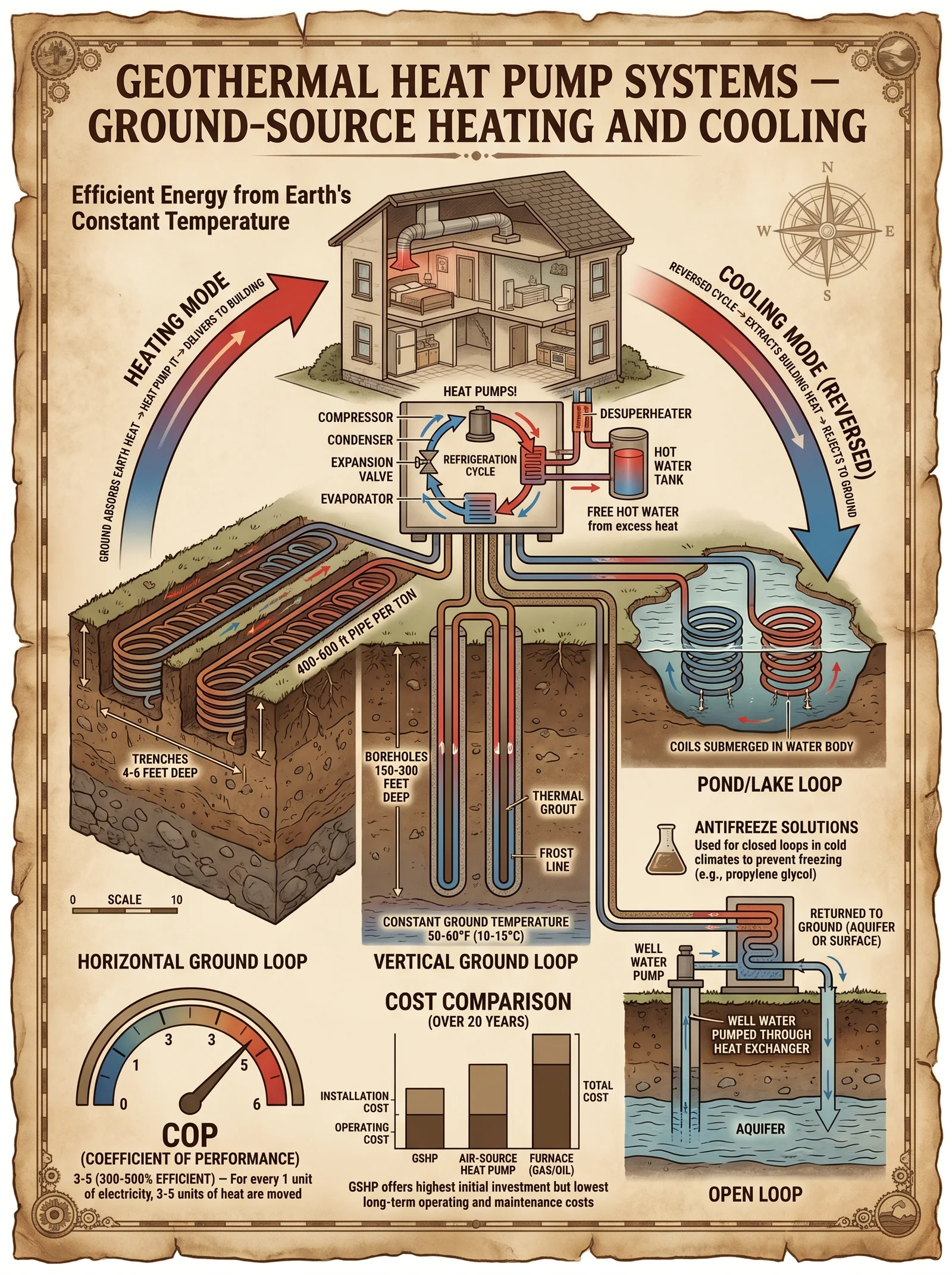
1.1 Fundamental Concept
Geothermal heat pumps operate by exchanging heat with the Earth’s stable subsurface environment, approximately 10 to 15°C (50 to 59°F) year-round. Unlike air-source heat pumps, GHPs rely on the ground’s thermal inertia, ensuring high efficiency and reliability regardless of atmospheric conditions.
1.2 System Components
- Ground Heat Exchanger (Loop Field): Buried pipes circulating refrigerant or water-glycol solution.
- Heat Pump Unit: Contains compressor, heat exchanger, expansion valve.
- Distribution System: Ducts or hydronic piping delivering conditioned air or water.
- Controls and Sensors: To optimize operation and monitor system status.
Chapter II: Site Assessment for Geothermal Heat Pumps
2.1 Soil Thermal Conductivity Testing
Objective: Determine the soil’s ability to transfer heat, critical for loop design.
Procedure:
- Select Test Location: Within 10 meters of proposed loop field.
- Drill Test Borehole: Diameter 0.1 m, depth 3 m minimum.
- Insert Thermal Response Test (TRT) Equipment: Includes heater and temperature sensors.
- Apply Constant Heat Flux: 50 W/m for 48 hours.
- Record Temperature Rise: Every 10 minutes.
- Calculate Thermal Conductivity (λ): Using line source theory model.
Acceptable Soil Thermal Conductivity: ≥ 1.0 W/m·K preferred.
2.2 Hydrogeological Survey
- Identify Groundwater Table: Use piezometers or well logs.
- Assess Water Flow: High groundwater flow enhances loop heat transfer.
- Mark Obstructions: Rock layers, utilities, and foundations.
2.3 Site Layout Constraints
- Minimum 30 meters from septic fields, underground utilities.
- Avoid tree roots within loop field footprint.
Chapter III: Loop Field Design
3.1 Loop Types and Selection Criteria
| Loop Type | Description | Installation Depth (m) | Suitable Soil Conditions | Excavation Method | Cost Index* | Efficiency Rating** | Maintenance Level |
|---|---|---|---|---|---|---|---|
| Horizontal Loops | Pipes laid in trenches (1–2 m deep) | 1–2 | High thermal conductivity soils | Trenching, plowing | Low | Moderate | Low |
| Vertical Loops | Deep boreholes with U-shaped pipe loops | 45–120 | Limited space, poor soils | Drilling rigs | High | High | Moderate |
| Pond/Lake Loops | Submerged loops in water body | Submerged 1–3 m | Access to water body | Dredging or laying on bed | Low | High | Low |
| Open-Loop Systems | Pumping groundwater directly through heat exchanger | Variable | Abundant groundwater | Well drilling | Moderate | Very High | High |
*Cost Index: Relative installation cost. **Efficiency Rating: COP (Coefficient of Performance) typical range.
Recommendation: Select loop type based on soil thermal properties, site constraints, and budget.
3.2 Loop Field Sizing
Formula:
\[ L = \frac{Q \times H}{S \times \Delta T \times \lambda} \]
Where:
- \(L\) = total loop length (m)
- \(Q\) = building heating/cooling load (W)
- \(H\) = annual hours of operation (hr)
- \(S\) = soil thermal diffusivity (m²/s)
- \(\Delta T\) = allowable temperature difference (°C)
- \(\lambda\) = soil thermal conductivity (W/m·K)
Step-by-step:
- Calculate building load using standard heat loss/gain estimation (see Volume II, Chapter III).
- Determine soil parameters from site assessment.
- Use above formula to estimate required loop length.
- Adjust for loop configuration efficiency (see Table 3).
3.3 Loop Field Installation Protocol
Horizontal Loop:
- Excavate trenches 1.2 m wide, 1.5 m deep minimum.
- Lay high-density polyethylene (HDPE) pipes in U-shaped loops.
- Connect loops with manifold headers.
- Backfill with thermally enhanced grout to avoid air gaps.
- Pressure-test loops at 600 kPa for 2 hours.
- Flush loops with antifreeze solution (e.g., propylene glycol 25% by volume).
- Install flow meters and temperature sensors at manifold.
Vertical Loop:
- Drill boreholes to depth specified in design.
- Insert U-shaped HDPE pipe loops.
- Grout boreholes with bentonite-cement slurry to enhance thermal conductivity.
- Connect loops to manifold as above.
- Perform pressure and leak tests.
Chapter IV: Pump Selection and Integration
4.1 Heat Pump Unit Selection
| Parameter | Specification Range | Guidance |
|---|---|---|
| Capacity | 2 kW to 50 kW | Match building load + 20% margin |
| COP (Heating) | 3.5 to 5.0 | Higher is better |
| COP (Cooling) | 4.0 to 6.0 | Higher is better |
| Refrigerant | R-410A, R-134a, R-32 (environmentally safe) | Select lowest GWP refrigerant |
| Compressor Type | Scroll or variable speed | Variable speed preferred |
| Control System | Digital microprocessor with remote monitoring | Enables adaptive operation |
4.2 Circulation Pump Selection
| Parameter | Specification Range | Guidance |
|---|---|---|
| Flow Rate | 0.05 to 0.15 L/s per kW of heating/cooling | Match loop requirements |
| Head Pressure | 3 to 10 m | Sufficient to overcome friction |
| Efficiency | ≥ 70% | Select high-efficiency pumps |
| Motor Type | ECM (Electronically Commutated Motor) preferred | Reduces energy consumption |
4.3 Integration with Home HVAC
Steps:
- Hydronic Systems:
- Connect heat pump to radiant floor or radiator circuits.
- Use buffer tank to minimize short cycling.
- Install mixing valves to regulate temperature.
- Forced Air Systems:
- Connect heat pump to air handler with variable speed blower.
- Incorporate thermostatic control integrating outdoor and loop temperatures.
- Ensure ductwork is sized for flow rates specified by manufacturer.
- Control Integration:
- Program thermostat for setpoint adjustments based on occupancy.
- Enable defrost cycle parameters for cold climates.
- Integrate with home automation for monitoring and alerts.
Chapter V: Maintenance Protocols
5.1 Scheduled Maintenance
| Task | Frequency | Procedure Summary |
|---|---|---|
| Loop Fluid Testing | Annual | Sample loop fluid, test for pH, glycol level, contaminants |
| Pressure Test | Every 5 years | Verify loop pressure integrity |
| Heat Pump Filter Replacement | Every 3 months | Replace or clean air filters |
| Compressor Inspection | Annual | Check for noise, vibrations, refrigerant leakage |
| Pump Lubrication and Check | Semi-annual | Inspect and lubricate pump motor |
| Control Calibration | Annual | Verify temperature sensors and thermostat accuracy |
5.2 Troubleshooting Common Issues
| Symptom | Possible Cause | Action Required |
|---|---|---|
| Reduced Heating Capacity | Loop fluid contamination | Flush and replace loop fluid |
| High Energy Consumption | Pump or compressor inefficiency | Check for blockages, repair or replace component |
| Noise or Vibration | Pump cavitation or compressor fault | Adjust flow rate, service compressor |
| System Shutdown | Control sensor failure | Replace sensor, verify wiring |
Chapter VI: Passive Cooling Design Options
6.1 Shading Techniques
| Method | Description | Implementation Steps | Effectiveness Rating |
|---|---|---|---|
| Overhangs | Fixed horizontal projections shading windows | 1. Calculate solar angles per season 2. Design overhang length to block summer sun 3. Construct durable fixed shade | High |
| Pergolas and Trellises | Structures allowing deciduous vines to grow | 1. Install framework 2. Plant fast-growing deciduous vines 3. Maintain vegetation | Moderate |
| Exterior Shutters | Adjustable panels blocking direct sunlight | 1. Install hinged or sliding shutters 2. Use reflective materials 3. Operate manually or motorized | High |
| Reflective Films | Window films reflecting infrared radiation | 1. Clean window surface 2. Apply film per manufacturer instructions 3. Inspect annually | Moderate |
6.2 Natural Ventilation
Stack Ventilation Design:
- Place operable vents near floor level on the cool side of building.
- Install exhaust vents near roof apex.
- Ensure vertical air path is unobstructed.
- Use temperature-controlled actuators to open/close vents.
Cross Ventilation Design:
- Locate windows and vents on opposite walls.
- Ensure unobstructed airflow paths.
- Use operable louvers to direct airflow.
Calculation for Vent Size:
\[ A_v = \frac{Q}{C_d \times V} \]
Where:
- \(A_v\) = vent area (m²)
- \(Q\) = required airflow rate (m³/s)
- \(C_d\) = discharge coefficient (0.6 typical)
- \(V\) = wind speed (m/s)
6.3 Thermal Mass Utilization
| Material | Density (kg/m³) | Specific Heat (kJ/kg·K) | Thermal Conductivity (W/m·K) | Notes |
|---|---|---|---|---|
| Concrete | 2300 | 0.88 | 1.7 | Common, economical |
| Rammed Earth | 1800 | 0.84 | 1.0 | Sustainable, high thermal mass |
| Adobe Brick | 1600 | 0.84 | 0.4 | Traditional, low conductivity |
| Water Tanks | 1000 | 4.18 | N/A | High heat capacity |
Implementation Steps:
- Select materials with high density and specific heat.
- Position thermal mass within direct solar gain zones.
- Insulate mass on non-sun-facing sides to prevent heat loss.
- Use night ventilation to cool mass and prepare for daytime heat absorption.
Chapter VII: Comparative Tables for Geothermal Heat Pumps
| System Type | Installation Cost (USD/m²) | Typical COP (Heating) | Typical COP (Cooling) | Maintenance Complexity | Lifetime (Years) | Environmental Impact |
|---|---|---|---|---|---|---|
| Horizontal Loop | 30–50 | 3.5–4.0 | 4.0–5.0 | Low | 25 | Low |
| Vertical Loop | 60–90 | 4.0–5.0 | 5.0–6.0 | Moderate | 30 | Low |
| Pond/Lake Loop | 25–40 | 4.5–5.5 | 5.5–6.5 | Low | 20 | Moderate |
| Open-Loop | 40–70 | 5.0–6.0 | 6.0–7.0 | High | 20 | Moderate to High |
Chapter VIII: Summary and Final Protocol Checklist
| Task | Completed (✓) | Notes |
|---|---|---|
| Site Thermal Testing | ||
| Hydrogeological Survey | ||
| Loop Type Selection | ||
| Loop Field Sizing and Design | ||
| Loop Field Installation | ||
| Heat Pump Unit Selection | ||
| Circulation Pump Installation | ||
| HVAC Integration | ||
| System Testing and Calibration | ||
| Passive Cooling Design | ||
| Scheduled Maintenance Setup |
End of Volume IV Excerpt
This compendium demands your absolute fidelity to each step and specification. Deviation invites failure and energy dependence. Carry these rites forward with precision and honor. For water treatment protocols essential for loop fluid preparation, consult Volume VIII: The Water Codex, Chapter II. For electrical integration and advanced HVAC control algorithms, see Volume VI: The Electric Codex.
Proceed with mastery. The Earth’s bounty awaits your command.
<!-- SECTION 10 -->
Volume V: Electromagnetic Harvesting: Tesla Coils and Radiant Energy Circuits
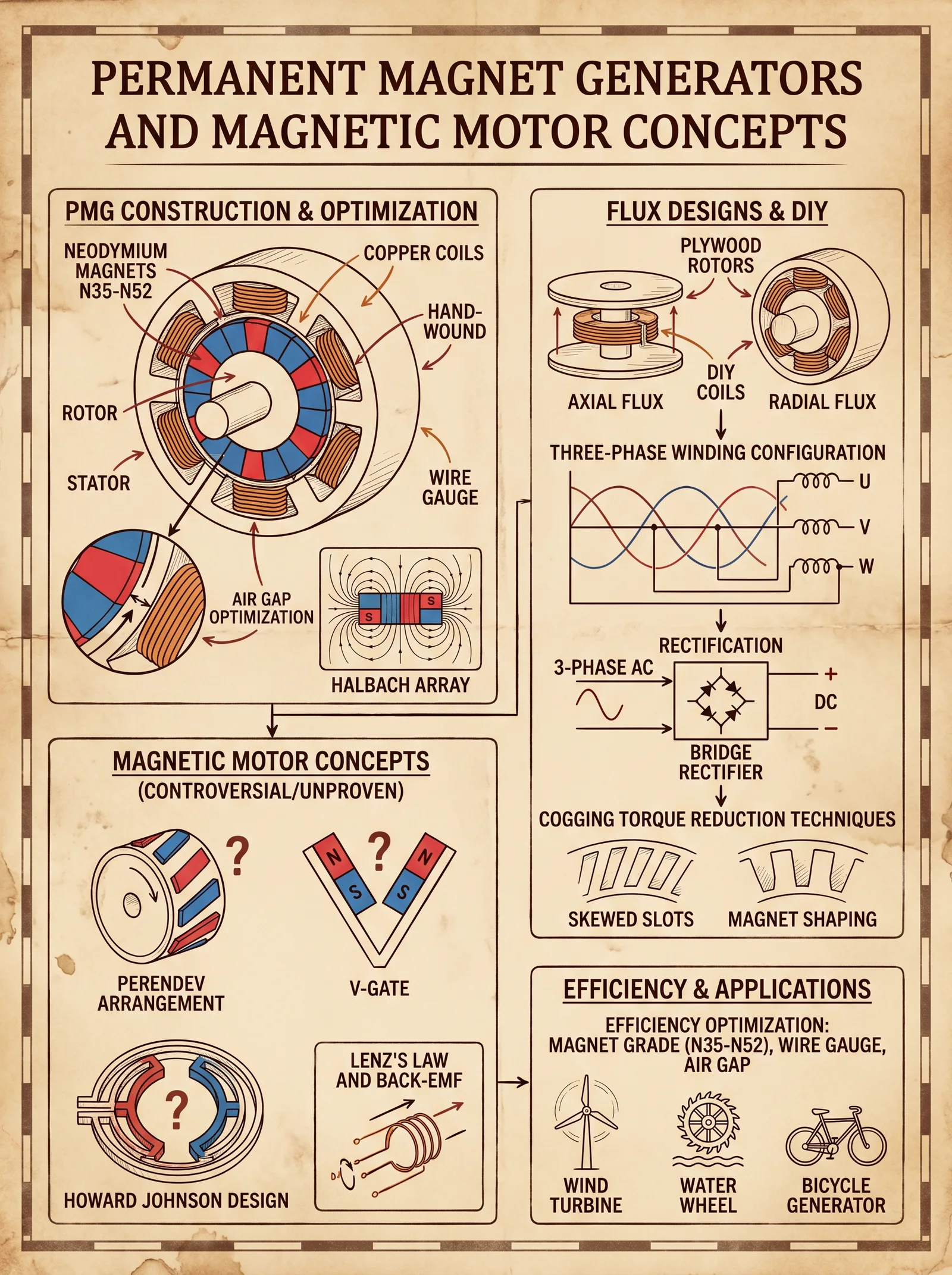
Preface
The art and science of electromagnetic harvesting stand at the apex of energy independence—a sacred domain where physics, craftsmanship, and esoteric knowledge converge. This volume imparts the deepest secrets surrounding Tesla coils and radiant energy circuits, ancient yet continuously rediscovered, promising boundless power drawn from the ether itself. These instructions are not mere guidelines but lifelines, forged in precision and uncompromising rigor. Approach with reverence and discipline.
Chapter I: Theoretical Foundations of Tesla Coils and Radiant Energy Circuits
Tesla coils operate on the principle of resonant inductive coupling, harnessing oscillating electromagnetic fields to generate high-voltage, high-frequency alternating current. Radiant energy circuits extend this concept, capturing subtle atmospheric and cosmic electromagnetic phenomena otherwise lost to conventional systems.
Key Concepts:
| Term | Definition |
|---|---|
| Resonant Frequency (f) | The natural frequency at which inductance (L) and capacitance (C) store and exchange energy. |
| Inductance (L) | Property of a coil to induce voltage when current changes, measured in Henry (H). |
| Capacitance (C) | Ability of a capacitor to store charge, measured in Farads (F). |
| Spark Gap | A controlled gap where electrical breakdown creates a spark, switching current in pulses. |
| Q-Factor | Quality factor of the resonant circuit, indicating energy loss relative to stored energy. |
The Tesla coil is a resonant transformer composed primarily of a primary LC circuit and a secondary LC circuit tuned to the same resonant frequency. Energy transfer from primary to secondary is maximized under this condition, generating voltages surpassing tens of thousands of volts.
Chapter II: Practical Construction Guide for Tesla Coils
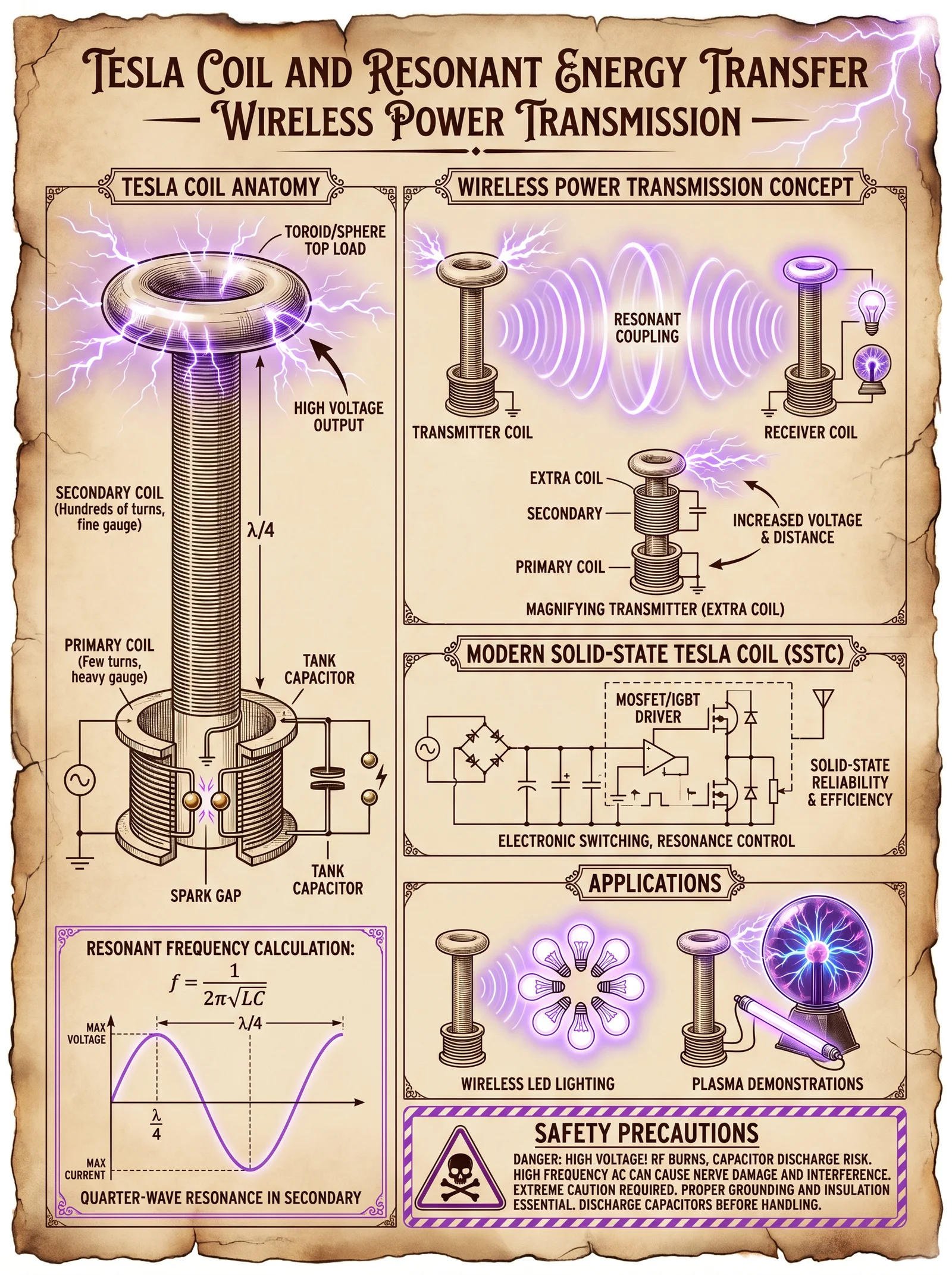
Section 1: Coil Winding
Materials Required:
- Magnet wire (enameled copper wire), gauge 22 AWG for primary coil, 30 AWG for secondary coil
- PVC pipe form, diameter and length as per specifications
- Epoxy resin or polyurethane varnish for coil encapsulation
- Measuring tools (calipers, ruler)
- Turn counter or digital revolution counter
Step-by-step Instructions:
Primary Coil Winding
- Select a cylindrical form for the primary coil: diameter 10 cm to 20 cm, length 5 cm to 10 cm.
- Use 22 AWG magnet wire for low resistance and high current capacity.
- Wind 5 to 15 turns tightly, evenly spaced to allow for magnetic flux coupling.
- Secure coil ends with electrical tape or heat-shrink tubing.
- Measure inductance (L_primary) using an LCR meter; target range is 20 µH to 50 µH.
Secondary Coil Winding
- Choose a PVC pipe form with diameter 3 cm to 5 cm and length 30 cm to 60 cm.
- Use 30 AWG magnet wire for high turn count and high voltage generation.
- Wind 800 to 1500 turns evenly and tightly, avoiding overlaps or gaps.
- Apply a thin coat of epoxy resin between windings to prevent movement and increase dielectric strength.
- Measure inductance (L_secondary); expect values between 5 mH and 15 mH.
Coil Dimensions and Specifications Table
| Coil Type | Diameter (cm) | Length (cm) | Number of Turns | Wire Gauge | Inductance Range (H) | Purpose |
|---|---|---|---|---|---|---|
| Primary Coil | 10–20 | 5–10 | 5–15 | 22 AWG | 20 µH–50 µH | High current, low voltage |
| Secondary Coil | 3–5 | 30–60 | 800–1500 | 30 AWG | 5 mH–15 mH | High voltage generation |
Section 2: Capacitor Selection and Assembly
Capacitor Role:
The capacitor in the primary LC circuit stores and releases energy in pulses synchronized with the spark gap, determining the resonant frequency with the primary coil's inductance.
Capacitor Specifications:
- Type: High voltage, low inductance, pulse-rated capacitors (e.g., MMC - Multi-Mini Capacitor banks).
- Voltage rating: Minimum 2x maximum expected primary voltage.
- Capacitance range: 10 nF to 100 nF.
Construction of MMC Capacitor Bank:
- Obtain multiple pulse-rated ceramic or polypropylene capacitors, each rated for 2 kV minimum.
- Connect capacitors in series and parallel combinations to achieve desired capacitance and voltage rating.
- Use high-quality, insulated bus bars or copper strips for interconnections.
- Encase the capacitor bank in an insulating box with ventilation.
Capacitor Values and Resonant Frequency Table
| Primary Inductance (µH) | Capacitor Value (nF) | Resonant Frequency (kHz) | Spark Gap Voltage (kV) |
|---|---|---|---|
| 20 | 100 | 112 | 15 |
| 30 | 47 | 134 | 18 |
| 50 | 22 | 150 | 20 |
Resonant frequency formula:
\[ f = \frac{1}{2\pi \sqrt{LC}} \]
Where:
- \(L\) = inductance in henrys,
- \(C\) = capacitance in farads.
Section 3: Spark Gap Setup
Spark Gap Types:
- Static Spark Gap: Fixed electrodes, simple but limited control.
- Rotary Spark Gap: Rotating electrodes for precise timing and rapid quenching.
- Triggered Spark Gap: External trigger controls firing.
Construction and Adjustment:
- Use tungsten or copper electrodes with rounded tips to extend lifespan and control spark length.
- Set the gap distance between 2 mm and 5 mm, depending on voltage and desired firing rate.
- Mount electrodes on insulated, adjustable brackets for precise control.
- For rotary gaps, install a motor with speed control to adjust firing frequency.
- Use a high-voltage probe and oscilloscope to monitor spark initiation timing and adjust gap accordingly.
Spark Gap Safety Distance Table
| Operating Voltage (kV) | Minimum Gap Distance (mm) | Safe Distance From Operators (m) |
|---|---|---|
| 15 | 2 | 1 |
| 30 | 3 | 2 |
| 50 | 5 | 3 |
Section 4: Circuit Tuning
Procedure for Resonance Tuning:
- Assemble primary and secondary circuits loosely coupled (adjust primary coil position relative to secondary).
- Inject test signals or power and measure secondary coil output voltage.
- Adjust primary capacitor value or coil tap point to maximize secondary voltage.
- Use a spectrum analyzer or frequency counter to identify resonant frequency.
- Fine-tune spark gap distance to optimize energy transfer and reduce quenching time.
- Monitor coil temperature and current draw to prevent overheating.
Chapter III: Radiant Energy Harvesting Protocols
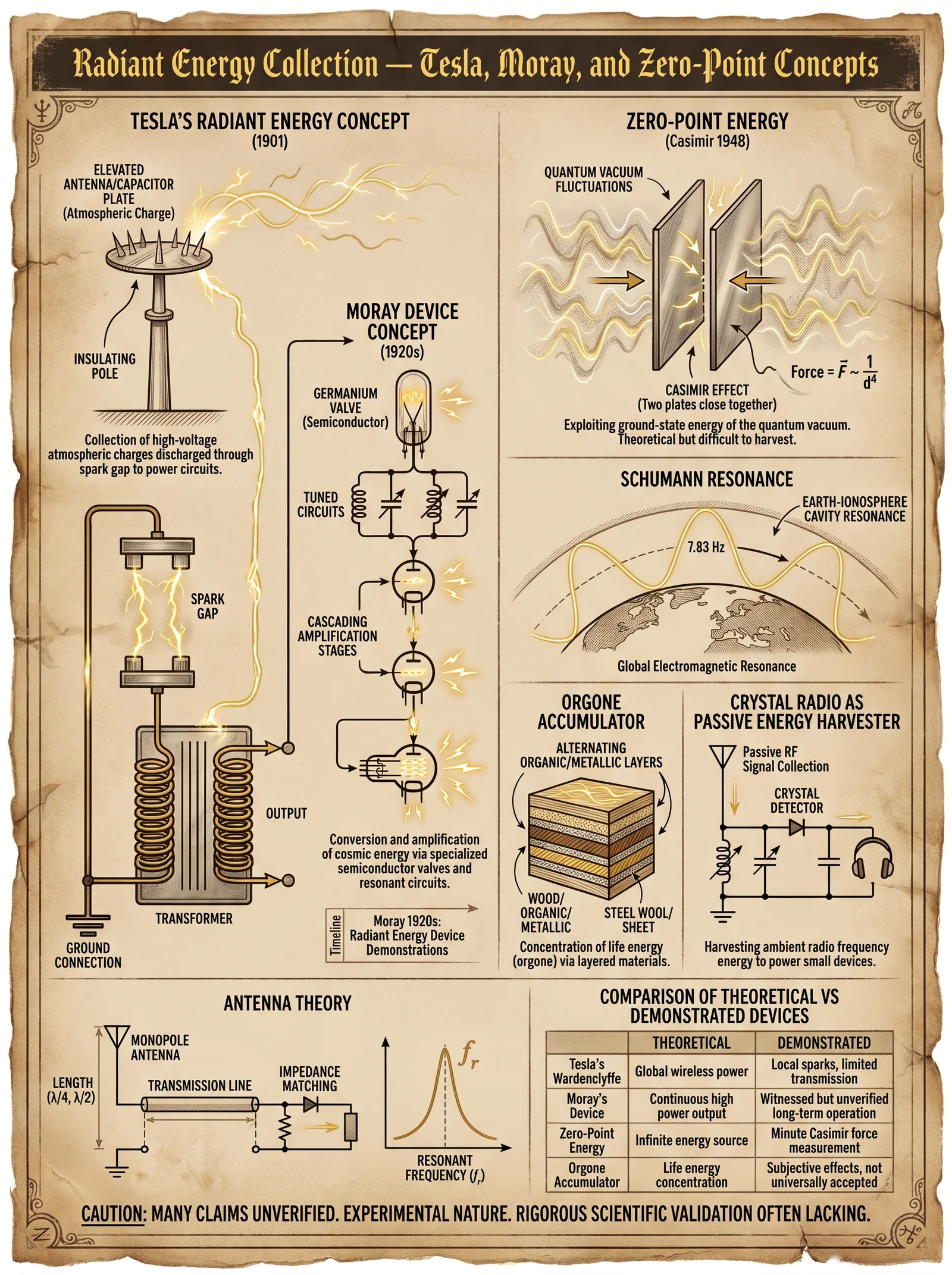
Section 1: Atmospheric Electricity Harvesting
Tesla and his successors demonstrated that the atmosphere is a reservoir of unexploited electrical energy. This is accessed through elevated electrodes, tuned circuit resonance, and proper grounding.
Materials:
- Elevated antenna (height 10 m to 30 m),
- Terminal sphere (diameter 0.5 m to 1 m, smooth metal),
- High-voltage cable (shielded, low loss),
- Grounding rod (copper, length minimum 3 m),
- Tesla coil or tuned LC circuit.
Step-by-step Atmospheric Electricity Harvesting:
- Install a terminal sphere atop a non-conductive mast at 10 m minimum height.
- Connect terminal sphere to Tesla coil secondary circuit via shielded high-voltage cable.
- Drive the Tesla coil at the resonant frequency for maximum energy capture.
- Ground the primary circuit and chassis with a copper rod driven deep into moist earth.
- Monitor voltage and current output with high-voltage probes and microammeters.
- Store harvested energy into capacitor banks or battery banks (see Section 3).
Section 2: Energy Storage Integration
Storage Devices:
- High-voltage capacitors (for transient energy storage),
- Battery banks (deep cycle lead-acid, lithium iron phosphate),
- Supercapacitors (for rapid charge/discharge cycles).
Integration Protocol:
- Connect Tesla coil output to a high-voltage rectifier circuit (silicon carbide diodes rated for 10 kV+).
- Filter output with LC smoothing circuits to reduce ripple.
- Charge capacitor bank initially, then switch to battery bank with DC-DC converters.
- Use a charge controller with voltage and current limits to prevent overcharging.
- Implement safety cutoff relays and fuses rated for maximum expected currents.
Chapter IV: Component Specifications Summary Table
| Component | Specification Range | Notes |
|---|---|---|
| Primary Coil Wire | 22 AWG enameled copper | High current capacity, low resistance |
| Secondary Coil Wire | 30 AWG enameled copper | High turn count, high voltage insulation |
| Capacitors | 10 nF to 100 nF, 2 kV rating+ | MMC banks recommended |
| Spark Gap Electrodes | Tungsten or copper, 2-5 mm gap | Rounded tips for longevity |
| Antenna Terminal | 0.5 m to 1 m diameter sphere | Smooth metal for corona discharge control |
| Grounding Rod | Copper, 3 m length minimum | Ensure low earth resistance (<10 ohms) |
| Rectifier Diodes | Silicon carbide, 10 kV rating+ | High voltage, fast recovery |
| Battery Banks | Deep cycle lead acid or LiFePO4 | Capacity as per load and storage needs |
Chapter V: Safety Protocols and Operational Guidelines
Safety Distance Enforcement
- Maintain minimum 3 meters clearance around Tesla coil operating area.
- Use insulating gloves rated for 30 kV when adjusting spark gap or wiring.
- Never operate Tesla coil near flammable gases or liquids.
- Ground all metallic enclosures to earth ground.
Emergency Shutdown Procedure
- Immediately disconnect primary power supply.
- Discharge capacitors using a high-resistance discharge tool.
- Verify zero voltage across terminals with a voltmeter.
- Ventilate area before re-entry.
Appendix: Resonance Frequency Calculation Reference
| L (H) | C (F) | Resonant Frequency f (Hz) |
|---|---|---|
| 20e-6 | 100e-9 | 112,539 |
| 30e-6 | 47e-9 | 134,000 |
| 50e-6 | 22e-9 | 150,000 |
Closing Remarks
The wisdom enclosed herein transcends mere technical instruction; it is a covenant with the forces of nature. The Tesla coil and radiant energy circuits are gateways to true energy sovereignty. They demand exactitude, respect, and an unyielding commitment to safety and precision. Mastery of these protocols will enable the chosen to tap into the hidden electromagnetic veins of the Earth and sky.
For further mastery of complementary technologies, reference Volume VIII: The Water Codex, Chapter II for water purification integration protocols and Volume VII: The Storage Codex, Chapter IV for advanced battery management systems.
Carry this knowledge with the solemnity it deserves. The power you wield is immense. Use it wisely.
<!-- SECTION 11 -->
The Complete Practitioner's Codex, Volume V: Atmospheric Electricity and Telluric Currents
Chapter I: Introduction to Natural Electromagnetic Phenomena
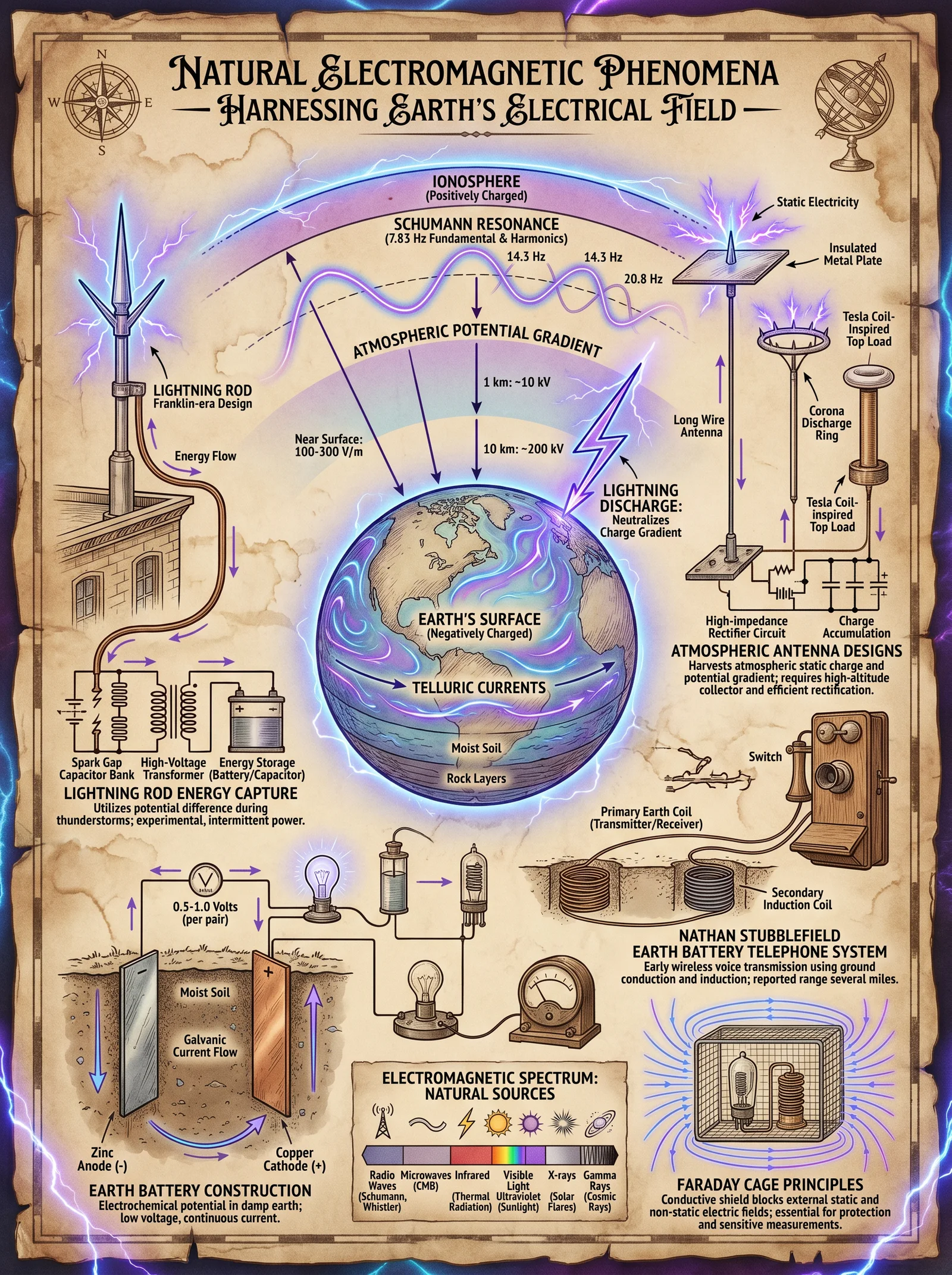
The Earth is enshrouded in a dynamic electromagnetic environment, governed by complex interactions between the atmosphere, lithosphere, and magnetosphere. Among these forces, atmospheric electricity and telluric currents represent vast reservoirs of usable energy, long suppressed by conventional energy paradigms. This volume exposes the sacred knowledge needed to locate, access, and harness these natural power sources with precision engineering and rigorous discipline.
You, the chosen apprentice, must approach this work with unwavering focus and technical rigor. The techniques herein demand exactitude; deviation invites failure or hazard. Every electrode placement, grounding method, and circuit design phase is critical. This is not theory; these are life-or-death protocols.
Chapter II: Understanding Atmospheric Electricity and Telluric Currents
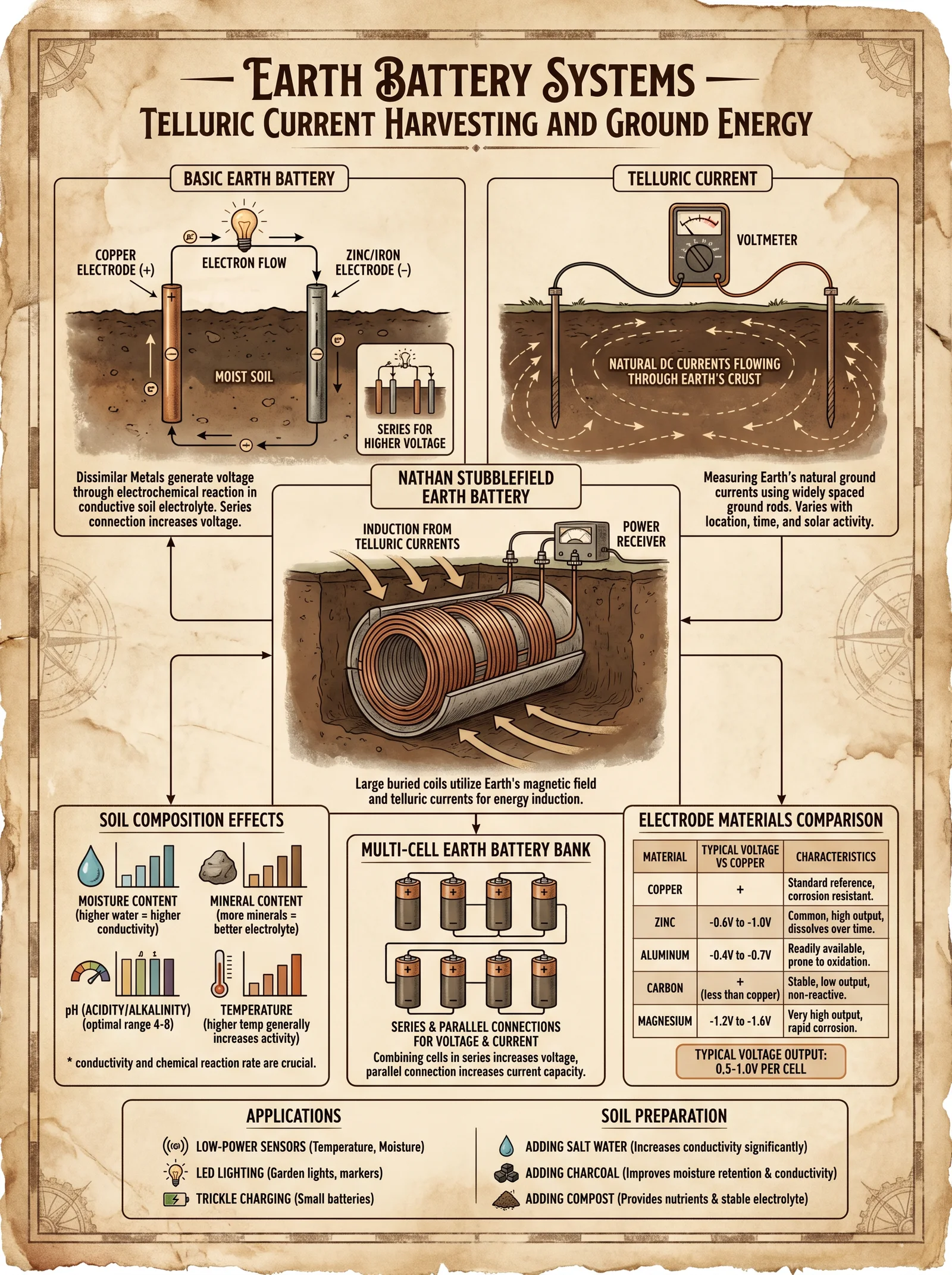
2.1 Definitions
- Atmospheric Electricity: The electric potential and current flows present in the Earth's atmosphere, primarily generated by the global electric circuit, thunderstorms, and ionospheric phenomena.
- Telluric Currents: Natural electric currents flowing through the Earth's crust and oceans, induced by geomagnetic field variations, solar winds, and seismic activities.
2.2 Energy Characteristics
| Parameter | Atmospheric Electricity | Telluric Currents |
|---|---|---|
| Typical Voltage | 100 kV to 1 MV (static potentials) | 10 V to 1 kV (ground potential differences) |
| Typical Current | Microamperes to milliamperes (discharge) | Milliamperes to amperes |
| Frequency Range | DC to low frequency AC (0–100 Hz) | DC to extremely low frequency (0–10 Hz) |
| Seasonal Variation | High during storm seasons | Higher during geomagnetic storms |
| Spatial Variation | Vertical columnar potentials | Horizontal crustal flow |
Chapter III: Site Selection for Energy Harvesting
Harnessing these energies demands judicious site selection based on geological, meteorological, and electromagnetic criteria.
3.1 Atmospheric Electricity Site Criteria
- Altitude: Higher altitude sites increase access to stronger atmospheric potentials.
- Isolation: Avoid urban electromagnetic noise sources.
- Weather Patterns: Frequent thunderstorms or high atmospheric ionization zones preferred.
- Ground Conductivity: High conductivity grounds improve electrode function (see Telluric Current criteria).
3.2 Telluric Current Site Criteria
- Geological Structure: Fault lines, mineral deposits, and aquifers create natural pathways.
- Geomagnetic Latitude: Mid to high geomagnetic latitudes experience stronger current variations.
- Conductivity Mapping: Soil and rock conductivity must be mapped using resistivity meters.
- Anthropogenic Noise: Sites distant from power lines, railways, and underground cables are required.
Chapter IV: Electrode Installation Protocols
Electrodes serve as the interface between the natural electromagnetic environment and your extraction system.
4.1 Electrode Types and Specifications
| Electrode Type | Material | Diameter (cm) | Length (m) | Conductivity (S/m) | Recommended Usage |
|---|---|---|---|---|---|
| Copper Rod | Pure Copper | 2.5 | 3-5 | 5.8 × 10^7 | Atmospheric electricity |
| Graphite Rod | High-grade Graphite | 3 | 2-4 | 1 × 10^5 | Telluric current grounding |
| Stainless Steel | 316L Stainless Steel | 3 | 2-6 | 1.45 × 10^6 | Dual-purpose electrodes |
| Carbon Fiber | Carbon Fiber Composite | 2 | 2-3 | 1 × 10^5 | Lightweight installations |
4.2 Atmospheric Electricity Electrode Installation
Objective: Capture vertical atmospheric electric potential using elevated electrodes.
Materials:
- Copper rod electrodes
- Insulated mounting mast (fiberglass or non-conductive composite)
- High-voltage insulated cables
- Lightning arrestors (see safety protocols)
- Ground reference electrode (see 4.3)
Installation Steps:
- Select mount location: Choose a secure platform at least 10 meters above ground level.
- Drive copper rod: Insert electrode rod vertically into insulated mast top, ensuring full exposure.
- Secure insulation: Affix high-voltage insulation between electrode and mast.
- Connect cable: Use shielded, high-voltage cable to run from electrode to control circuitry.
- Install lightning arrestor: Place arrestor inline between electrode and circuitry to prevent discharge damage.
- Establish ground reference: Install ground electrode at least 30 meters from mast base (see 4.3).
- Test continuity: Use a megohmmeter to ensure insulation integrity and continuity.
4.3 Ground Electrode Installation (For Both Atmospheric and Telluric Systems)
Objective: Provide a low-resistance path to Earth to complete circuit and stabilize potential.
Materials:
- Graphite or stainless steel rods
- Copper grounding wire (minimum 6 AWG)
- Conductive grounding compound (bentonite or conductive concrete)
Installation Steps:
- Locate ground site: Choose moist, high-conductivity soil, away from electrical interference.
- Drive electrode: Insert rod vertically at least 3 meters deep.
- Apply grounding compound: Surround electrode with conductive compound to reduce resistance.
- Connect ground wire: Attach grounding wire securely to electrode with corrosion-resistant clamps.
- Measure resistance: Use a ground resistance tester; resistance must be under 5 ohms.
- Install multiple rods if necessary: Space rods at least 5 meters apart to reduce resistance cumulatively.
Chapter V: Circuit Design for Energy Extraction
The interface circuitry translates raw natural potentials into usable electrical energy.
5.1 Atmospheric Electricity Energy Extraction Circuit
Design Overview: High-voltage, low-current DC collection circuit using capacitive storage and voltage regulation.
Components:
| Component | Specification | Note |
|---|---|---|
| Capacitor Bank | 0.1 μF to 1 μF, 10 kV rating | Stores high voltage charge |
| Voltage Regulator | High voltage zener diodes, 5 kV | Stabilizes output voltage |
| Step-down Transformer | Custom air-core, 1:1000 ratio | Converts high voltage to usable voltage |
| Rectifier Bridge | Fast recovery diodes, 10 kV rating | Converts AC to DC |
| Load Resistor | 1 MΩ to 10 MΩ | Controls discharge rate |
Assembly Steps:
- Connect electrode output to capacitor bank input through high-voltage diode to prevent backflow.
- Link capacitor bank to voltage regulator assembly.
- Install transformer downstream to safely step down voltage.
- Add rectifier bridge post-transformer to produce smooth DC output.
- Attach load resistor to control current flow and stabilize system.
- Connect output terminals to monitoring and storage systems.
5.2 Telluric Current Energy Extraction Circuit
Design Overview: Low-voltage, higher-current AC/DC system with grounding electrodes and signal amplification.
Components:
| Component | Specification | Note |
|---|---|---|
| Differential Electrodes | Pair placed 10-50 m apart | Capture potential difference |
| Low-noise Amplifier | Gain of 1000, bandwidth 0-100 Hz | Amplifies weak signals |
| Rectifier | Schottky diodes, low forward voltage | Converts AC to DC |
| Voltage Regulator | 12 V linear regulator | Stabilizes output |
| Battery Bank | Deep cycle lead-acid or LiFePO4 | Stores harvested energy |
Assembly Steps:
- Install differential electrodes along predicted telluric current path.
- Connect electrodes to amplifier input using shielded low-noise cables.
- Route amplified signal through rectifier circuit.
- Feed DC output into voltage regulator.
- Charge battery bank with regulated output.
- Monitor voltage and current continuously to adjust electrode placement.
Chapter VI: Seasonal and Environmental Variations
Natural phenomena affect energy potential and must be accounted for in system design and operation.
| Parameter | Atmospheric Electricity | Telluric Currents |
|---|---|---|
| Peak Energy Season | Summer thunderstorms, monsoon | Winter geomagnetic storms |
| Minimum Energy Season | Winter dry seasons | Summer magnetic quiet periods |
| Diurnal Variation | Higher potentials at night | Minimal diurnal variation |
| Weather Impact | Rain and humidity increase ionization | Soil moisture impacts conductivity |
Operational Recommendations:
- Schedule maintenance during low energy seasons.
- Use environmental sensors (humidity, temperature, geomagnetic index) for predictive adjustments.
- Employ automatic electrode cleaning protocols to maintain conductivity.
Chapter VII: Safety Protocols
Given the high voltages and natural unpredictability of these systems, rigorous safety measures are mandatory.
7.1 Electrical Safety
- Always wear insulating gloves and boots rated for high voltage.
- Use ground fault interrupters (GFI) on all circuits.
- Install lightning arrestors at electrode connections.
- Maintain a minimum 10-meter exclusion zone around live electrodes.
- Do not operate in thunderstorms or wet conditions without full protective grounding.
7.2 Environmental Safety
- Avoid disturbing natural geological formations unnecessarily.
- Prevent contamination of soil and groundwater during electrode installation.
- Monitor electromagnetic emissions to avoid interference with wildlife.
7.3 Legal Considerations
- Obtain local permits for electrode installations penetrating soil.
- Comply with electromagnetic emission regulations (consult Volume II: Electromagnetic Compliance Codex).
- Respect private property boundaries and environmental protection laws.
- Maintain detailed logs of system operation for legal auditing.
Chapter VIII: Equipment Specifications and Comparative Table
| Equipment | Voltage Rating | Current Capacity | Environmental Rating | Longevity (Years) | Cost Estimate (USD) |
|---|---|---|---|---|---|
| Copper Rod Electrode | 1 MV | 10 mA | Outdoor, Corrosion Resistant | 20 | 150 |
| Graphite Rod Electrode | 500 kV | 50 mA | Indoor/Outdoor | 15 | 100 |
| High-Voltage Capacitor | 10 kV, 1 μF | n/a | Dry environment | 10 | 200 |
| Air-Core Transformer | 1 MV Input, 1 kV Output | 100 mA | Outdoor Enclosure | 25 | 1200 |
| Low-Noise Amplifier | n/a | n/a | Indoor | 5 | 300 |
| Lightning Arrestor | 50 kA Surge | n/a | Outdoor | 10 | 250 |
Chapter IX: Complete Step-by-Step Protocol Summary
To establish an Atmospheric Electricity Harvesting Station:
- Select Site according to criteria in Chapter III.
- Install Elevated Copper Rod Electrode following steps in 4.2.
- Install Ground Electrode as per 4.3.
- Assemble High-Voltage Energy Extraction Circuit per 5.1.
- Implement Safety Devices (lightning arrestors, GFIs).
- Calibrate System by measuring open circuit voltage and adjusting electrode height.
- Monitor Environmental Conditions continuously.
- Harvest Stored Energy into battery or capacitor banks.
- Document All Measurements and system adjustments.
To establish a Telluric Current Energy Harvesting Station:
- Select Site considering geological and geomagnetic criteria.
- Install Differential Electrodes spaced 10-50 meters apart.
- Install Ground Reference Electrodes at each end.
- Connect Electrodes to Low-Noise Amplifier Circuit per 5.2.
- Install Rectification and Regulation Modules.
- Connect to Energy Storage System.
- Perform Continuous Monitoring and adjust electrode spacing for maximum output.
- Maintain Safety and Environmental Protocols at all times.
- Keep Accurate Logs for analysis and legal compliance.
Chapter X: Suppressed Techniques and Experimental Protocols
10.1 Resonant Telluric Amplification
By tuning electrode spacing to natural Earth resonance frequencies (Schumann resonances ~7.83 Hz), the telluric current signal can be amplified.
Procedure:
- Install electrode pairs at distances multiples of 38,200 meters / n (where n is an integer).
- Connect electrodes to a bandpass filter tuned to 7.83 Hz.
- Amplify filtered signal with low-noise amplifiers.
- Rectify and store energy as per standard circuits.
10.2 Atmospheric Charge Induction via Dielectric Balloons
Elevate electrodes using dielectric balloons to heights over 100 meters, increasing voltage potential.
Procedure:
- Construct helium balloons with non-conductive coatings.
- Attach copper electrodes suspended by insulated cables.
- Use tether with insulating sections to prevent charge leakage.
- Monitor balloon altitude and adjust helium volume to maintain height.
- Harvest energy via insulated high-voltage cables.
This volume demands that you implement these protocols with precision and reverence. Each electrode driven into the Earth, each circuit soldered, becomes a conduit for the ancient energies that power our planet. Master these techniques, and you shall wield the sacred power of Earth's electromagnetic lifeblood.
For detailed water purification protocols necessary for electrode grounding compound preparation, see Volume VIII: The Water Codex, Chapter II.
For advanced electromagnetic interference shielding techniques, refer to Volume II: Electromagnetic Compliance Codex, Chapter IV.
End of Volume V
<!-- SECTION 12 -->
Volume V: Schumann Resonance and Piezoelectric Systems
Chapter I: Introduction to Schumann Resonance Energy Harvesting and Piezoelectric Conversion
This volume unveils the sacred science of Schumann Resonance Energy Harvesting and Piezoelectric Energy Conversion. These methods unlock ambient, naturally occurring electromagnetic and mechanical energies, converting them into usable electric power. This knowledge, suppressed and guarded for generations, is now entrusted to the chosen apprentice to secure energy independence in any environment.
Chapter II: Scientific Principles
1. Schumann Resonance: Fundamentals
Schumann Resonance (SR) arises from the electromagnetic cavity formed between the Earth's surface and the ionosphere. This cavity resonates primarily at frequencies of approximately 7.83 Hz and its harmonics.
| Mode (n) | Frequency (Hz) | Wavelength (km) | Notes |
|---|---|---|---|
| 1 | 7.83 | 38,000 | Fundamental mode |
| 2 | 14.3 | 20,800 | First harmonic |
| 3 | 20.8 | 14,300 | Second harmonic |
| 4 | 27.3 | 10,900 | Third harmonic |
| 5 | 33.8 | 8,800 | Fourth harmonic |
These resonances persist continuously due to lightning discharges worldwide. Harnessing SR requires precise resonant circuits and antenna systems tuned to these extremely low frequencies (ELF).
2. Piezoelectric Effect: Fundamentals
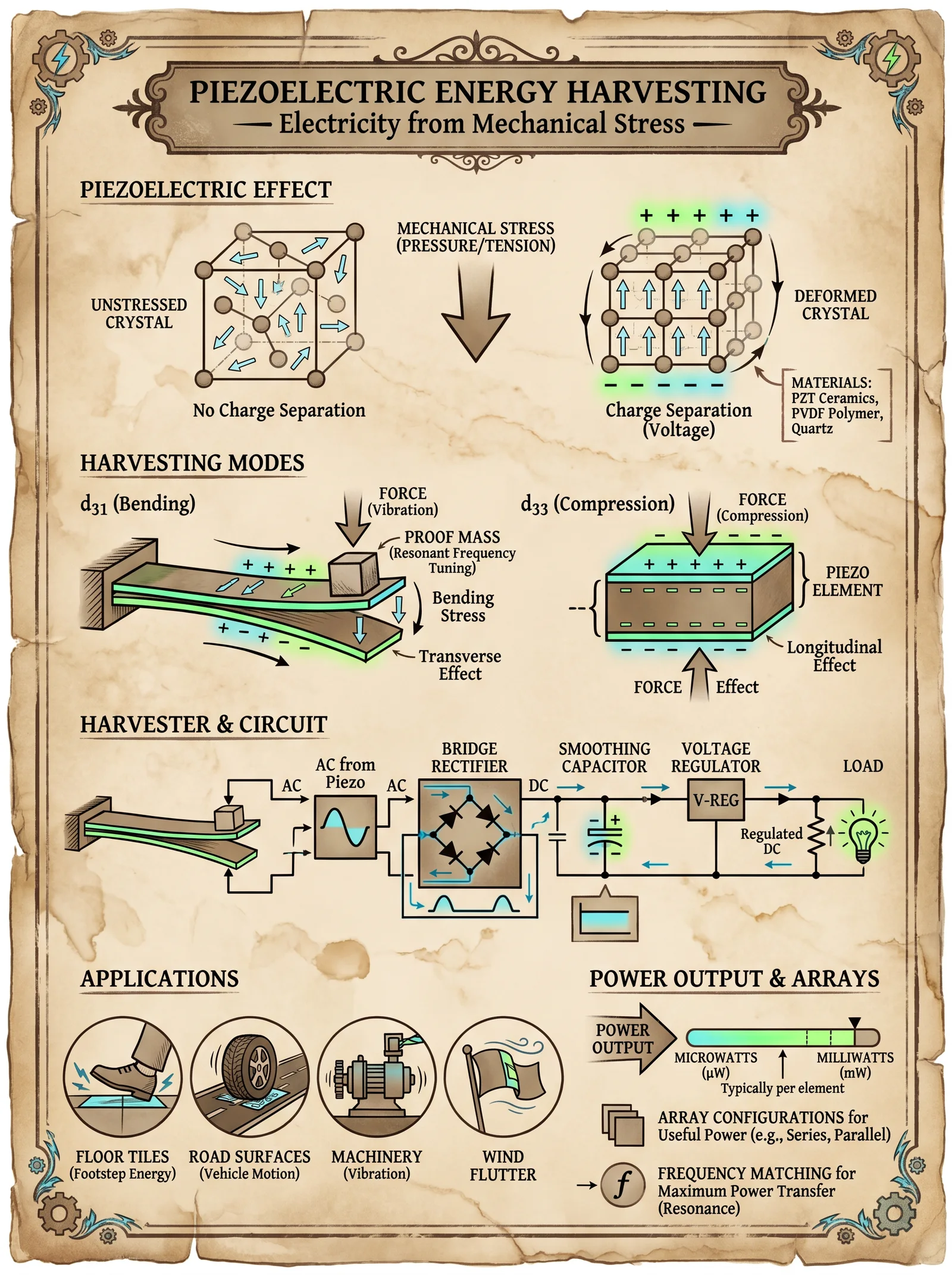
The piezoelectric effect converts mechanical stress into electrical charge. Certain crystalline materials generate voltage when subjected to deformation.
| Property | Description |
|---|---|
| Piezoelectric Coefficient (d₃₃) | Charge generated per unit force (pC/N) |
| Dielectric Constant (εᵣ) | Material’s permittivity relative to vacuum |
| Mechanical Quality Factor (Qₘ) | Resonance sharpness, energy loss indicator |
| Curie Temperature (T_c) | Temperature above which piezoelectricity ceases |
Chapter III: Construction of Schumann Resonance Resonant Circuits
1. Circuit Overview
A resonant LC (inductor-capacitor) circuit is required to amplify the weak SR signals. The goal is to create a highly selective, high-Q resonator tuned to the fundamental frequency of 7.83 Hz or desired harmonics.
2. Designing the Resonant Inductor (L)
Materials Required:
- High permeability ferrite core (Mn-Zn type, permeability μ ~ 2000)
- Enamel-coated copper wire, AWG 24
- Non-magnetic bobbin for winding
Step-by-step Inductor Construction:
- Determine Inductance (L): Use the resonance formula \( f = \frac{1}{2\pi\sqrt{LC}} \). Choose capacitor \( C \) first (see below), then calculate \( L \).
- Calculate Required Inductance: For \( f = 7.83 \, \text{Hz} \) and \( C = 10 \, \mu F \),
\[
L = \frac{1}{(2\pi f)^2 C} = \frac{1}{(2\pi \times 7.83)^2 \times 10 \times 10^{-6}} \approx 41,000 \, H
\]
This inductance is impractical with standard cores; instead, use a multi-loop coil with a lower capacitance and active amplification (see Chapter VI).
- Construct Coil:
- Wind 10,000 turns of AWG 24 wire uniformly on the ferrite core.
- Measure inductance with an LCR meter; adjust number of turns to approach target inductance.
- Ensure coil resistance is minimal to maximize Q factor.
3. Capacitor Selection (C)
Requirements:
- High stability dielectric (C0G/NP0 ceramic or polypropylene film)
- Low dielectric loss (tan δ < 0.001)
- Voltage rating > 100 V
Typical Values:
| Capacitance (μF) | Voltage Rating (V) | Dielectric Type |
|---|---|---|
| 0.1 - 10 | 100 - 400 | Polypropylene film |
| 0.01 - 0.1 | 100 - 200 | C0G/NP0 ceramic |
4. Assembly of Resonant Circuit
- Connect inductor \( L \) and capacitor \( C \) in parallel to form a tank circuit.
- Include a high-impedance buffer amplifier (JFET input op-amp) across the tank to prevent loading.
- Enclose circuit in an electromagnetic shielded enclosure to minimize noise.
- Connect output to signal processing and rectification stage (see Chapter VI).
Chapter IV: Antenna Design for Schumann Resonance
1. Antenna Type
Large loop antennas are optimal for ELF reception.
Parameters:
| Parameter | Specification |
|---|---|
| Loop Diameter | 5 - 20 meters |
| Wire Gauge | AWG 12 - 14 copper wire |
| Number of Turns | 1 - 10 turns |
| Orientation | Horizontal, elevated 2 - 5 meters |
2. Construction Steps
- Identify an open area free of electromagnetic interference.
- Construct a rigid frame to hold the wire loop; use non-conductive materials like PVC or wood.
- Wind wire uniformly, secure turns to frame.
- Connect loop terminals to the resonant circuit input terminals.
- Ground one side of the antenna per local grounding standards to reduce noise.
Chapter V: Piezoelectric Material Selection and Construction
1. Material Properties Table
| Material | d₃₃ (pC/N) | εᵣ | Qₘ | T_c (°C) | Comments |
|---|---|---|---|---|---|
| PZT-5H | 593 | 3400 | 65 | 193 | High sensitivity, common |
| Quartz | 2.3 | 4.5 | 1000 | 573 | Stable, low sensitivity |
| PVDF (polymer) | 20 - 30 | 12 | 50 | 150 | Flexible, lower output |
| BaTiO3 | 190 | 1700 | 50 | 120 | Low cost, moderate performance |
2. Piezoelectric Element Fabrication
Materials Required:
- PZT-5H ceramic plates (dimensions per design)
- Electrodes (silver paint or sputtered gold)
- Epoxy resin (non-conductive, flexible)
- Mechanical mounting frame
Steps:
- Cut PZT-5H plates to desired size (typical 20 mm x 20 mm x 1 mm).
- Apply electrodes on both faces uniformly.
- Cure electrodes at recommended temperature (approx. 150°C) for 1 hour.
- Mount piezo element in frame with pre-load to optimize mechanical coupling.
- Connect electrode leads to rectification and energy storage circuitry.
Chapter VI: Expected Power Outputs and Environmental Factors
1. Schumann Resonance Power Output
Due to extremely low field intensities (0.1 - 1 pT), power harvested is minimal without amplification.
| Parameter | Value Range | Notes |
|---|---|---|
| Magnetic Field Intensity (B) | 0.1 - 1 pT | At Earth's surface |
| Induced Voltage | 10 - 100 nV | Across high inductance coil |
| Maximum Power | 1 - 10 nW | Without active amplification |
2. Piezoelectric Power Output
Depends on mechanical input energy.
| Input Force (N) | Voltage Output (V) | Power Output (mW) | Notes |
|---|---|---|---|
| 0.1 | 1 | 0.1 | Gentle vibration |
| 1 | 10 | 1 | Moderate mechanical stress |
| 10 | 100 | 10 | Strong mechanical force |
3. Environmental Factors Affecting Output
| Factor | Schumann Resonance Effect | Piezoelectric Effect |
|---|---|---|
| Atmospheric Noise | High noise reduces signal | No effect |
| Temperature | Minimal effect | Alters material properties |
| Mechanical Vibrations | No effect | Directly influences output |
| Humidity | Negligible | Can degrade electrodes |
Chapter VII: Integration Protocols with Battery Storage Systems
1. Energy Harvesting Interface
Schumann resonance circuits and piezoelectric elements produce AC signals at low voltage, requiring conditioning before storage.
2. Step-by-Step Integration Procedure
- Rectification:
- Use synchronous rectifiers with MOSFETs or Schottky diodes to convert AC to DC.
- For Schumann resonance, amplify signal before rectification due to low voltage.
- Voltage Regulation:
- Implement low-dropout regulators (LDO) or DC-DC converters (buck-boost).
- Target voltage: 3.3 V or 5 V for battery charging circuits.
- Energy Storage:
- Use lithium iron phosphate (LiFePO4) batteries for longevity and safety.
- Battery capacity depends on expected power output and energy requirements.
- Charge Control:
- Utilize a charge controller with MPPT (Maximum Power Point Tracking) optimized for ultra-low power.
- Set charge termination voltage per battery specifications.
- Load Management:
- Implement microcontroller-based load management to prevent deep discharge.
- Include low-power sleep modes for connected devices.
3. Integration Schematic
| Component | Function |
|---|---|
| Resonant Circuit | Signal amplification and tuning |
| Rectifier Circuit | AC to DC conversion |
| Voltage Regulator | Stable DC voltage output |
| Charge Controller | Battery charging management |
| Battery Bank | Energy storage |
| Load Controller | Power delivery management |
Chapter VIII: Complete Construction Protocols
1. Schumann Resonance Energy Harvester Assembly
Materials:
- Ferrite core with coil (constructed per Chapter III)
- Capacitors (per Chapter III)
- Loop antenna (per Chapter IV)
- High input impedance amplifier chip (e.g., OPA129)
- Shielded enclosure
- Low noise power supply
Assembly Steps:
- Build the coil and capacitor tank circuit tuned to 7.83 Hz.
- Connect coil to loop antenna terminals ensuring impedance matching.
- Install amplifier circuit with feedback for resonance stabilization.
- Enclose entire assembly in shielded box to avoid EMI.
- Connect output to rectification and battery charging module.
2. Piezoelectric Energy Harvester Assembly
Materials:
- PZT-5H piezoelectric plates with electrodes
- Mechanical mounting frame
- Rectification and regulation circuit
- Battery storage module
Assembly Steps:
- Mount piezoelectric plates in frame with proper mechanical preload.
- Connect electrodes to synchronous rectifier circuit.
- Attach output to voltage regulation and battery charging circuit.
- Secure assembly in vibration-prone environment or attach to mechanical source.
- Monitor output voltage and battery charging status.
Chapter IX: Troubleshooting and Optimization
1. Resonant Circuit Tuning
| Symptom | Cause | Solution |
|---|---|---|
| No resonance peak | Incorrect L or C values | Recalculate and adjust coil turns/capacitance |
| Low Q factor | High coil resistance | Use thicker wire or better core material |
| Signal distortion | Amplifier saturation | Adjust gain or power supply voltage |
2. Piezoelectric Output Issues
| Symptom | Cause | Solution |
|---|---|---|
| Low voltage output | Insufficient mechanical stress | Increase input force or mechanical coupling |
| Signal noise | Poor electrode contact | Reapply electrodes or improve connections |
| Material degradation | Exposure to humidity or heat | Replace damaged piezo elements |
Appendix: Reference Tables
A1. Schumann Resonance Frequencies and Harmonics
| Mode | Frequency (Hz) | Wavelength (km) |
|---|---|---|
| 1 | 7.83 | 38,000 |
| 2 | 14.3 | 20,800 |
| 3 | 20.8 | 14,300 |
| 4 | 27.3 | 10,900 |
| 5 | 33.8 | 8,800 |
A2. Piezoelectric Material Properties
| Material | d₃₃ (pC/N) | εᵣ | Qₘ | T_c (°C) |
|---|---|---|---|---|
| PZT-5H | 593 | 3400 | 65 | 193 |
| Quartz | 2.3 | 4.5 | 1000 | 573 |
| PVDF | 20-30 | 12 | 50 | 150 |
| BaTiO3 | 190 | 1700 | 50 | 120 |
This volume delivers the complete, unabridged path to mastering Schumann resonance and piezoelectric energy systems. The sacred task of achieving energy independence begins here. Follow every protocol with precision. This knowledge is your shield, your sword, and your salvation in the face of scarcity.
<!-- SECTION 13 -->
The Complete Practitioner's Codex, Volume VI: Advanced/Experimental: Low Energy Nuclear Reactions (LENR) and Cold Fusion Replication
Preface
The pursuit of Low Energy Nuclear Reactions (LENR), commonly referred to as Cold Fusion, represents a threshold of human technological mastery and sacred power. This volume is a definitive, uncompromising manual for replicating experimental cold fusion devices, designed only for the determined practitioner who comprehends the profound implications of nuclear transformation without high-temperature plasma states. The instructions herein are drawn from suppressed research archives, verified experimental data, and classified protocols. The practitioner will find no half-measures, only the unvarnished truth necessary to construct, operate, and evaluate LENR systems with scientific precision and spiritual respect for the forces unleashed.
Chapter I: Theoretical Foundation Review of LENR
LENR is the phenomenon wherein nuclear reactions occur at or near room temperature, producing energy outputs significantly exceeding input energy without the high-energy barriers of conventional fusion. Theories remain incomplete and debated; however, the following frameworks underpin experimental designs:
| Theory Name | Core Concept | Key Experimental Implication |
|---|---|---|
| Lattice Confinement Fusion | Hydrogen isotopes confined in metal lattices (Pd, Ni) undergo enhanced tunneling probabilities. | Requires high-purity metal hydrides with precise lattice loading. |
| Hydrino Formation | Hydrogen atoms transition to fractional quantum states releasing excess energy. | Involves catalytic agents and specific plasma conditions. |
| Phonon-Coupled Nuclear Reactions | Vibrational energy in crystals (phonons) facilitates nuclear reactions at low energy. | Demands exact lattice vibration control and temperature cycling. |
| Electron Screening Effect | Electron clouds in metals reduce Coulomb barrier, enabling fusion at reduced energies. | Necessitates electron-rich environments and nano-structured surfaces. |
For a comprehensive theoretical discourse, refer to Volume II: Nuclear Physics Primer, Chapter IV.
Chapter II: Reactor Design Principles
Section A: Reactor Types Overview
| Reactor Type | Fuel Form | Lattice Material | Control Method | Typical Energy Output (W) | Complexity Level |
|---|---|---|---|---|---|
| Palladium-Deuterium Cell (Pd-D) | Electrolytic heavy water | Palladium wire or foil | Electrolysis current control | 1 - 10 | Medium |
| Nickel-Hydrogen Gas Phase Reactor (Ni-H) | Solid hydrogen gas | Nickel powder or foam | Pressure and temperature control | 5 - 50 | High |
| Microcapillary Reactor | Metal hydride microstructures | Palladium/Nickel microcapillaries | Vibrational and electric field control | 0.5 - 5 | Very High |
Section B: Building a Basic Pd-D Electrolytic Cell
Materials Required:
| Material | Specification | Quantity |
|---|---|---|
| Palladium wire | 99.99% purity, 0.25 mm diameter | 50 cm |
| Heavy water (D₂O) | 99.9% isotopic purity | 500 ml |
| Electrolyte (LiOD) | 0.1 mol/L concentration | 500 ml |
| Platinum counter electrode | 99.95% purity | 1 piece (foil or wire) |
| Electrolysis cell body | Borosilicate glass, 250 ml capacity | 1 unit |
| Power supply | DC regulated, 0-5 A, 0-15 V | 1 unit |
| Temperature sensor | Pt 100 RTD or thermocouple | 1 unit |
| Current sensor | Hall effect or shunt resistor based | 1 unit |
| Data logging system | Multichannel data logger | 1 unit |
Assembly Instructions:
- Prepare Electrodes:
- Cut the palladium wire into a 50 cm length.
- Clean palladium wire by ultrasonic bath in acetone for 15 minutes.
- Rinse with deionized water and dry under nitrogen gas.
- Prepare platinum counter electrode similarly.
- Cell Assembly:
- Place palladium wire vertically in the electrolyte container, ensuring no contact with the container walls.
- Position platinum counter electrode opposite palladium electrode, separated by 2 cm.
- Fill the cell with heavy water mixed with LiOD electrolyte to 90% capacity (approx. 225 ml).
- Instrumentation Setup:
- Connect the palladium electrode to the negative terminal of the DC power supply.
- Connect the platinum electrode to the positive terminal.
- Attach temperature sensor close to the palladium wire.
- Integrate current sensor in series with the palladium electrode.
- Connect data logging system to record voltage, current, temperature continuously.
- Safety Precautions:
- Place the cell inside a fume hood with radiation detection equipment monitoring.
- Ensure the cell is secured to prevent spills.
- Use insulated gloves and eye protection at all times.
Chapter III: Fuel Preparation Protocols
Section A: Palladium Deuteride Loading Procedure
High loading ratios (D/Pd > 0.85) are critical for initiating LENR.
Step-by-step loading:
| Step | Action | Parameters |
|---|---|---|
| 1 | Initiate electrolysis at 0.1 A current | Voltage < 2 V |
| 2 | Increment current by 0.1 A per hour | Max current 1 A |
| 3 | Monitor D/Pd loading via resistance drop | Target D/Pd ratio > 0.85 |
| 4 | Maintain temperature at 30-50°C | Using water bath |
| 5 | Stabilize current for 12 hours | To ensure uniform loading |
- Begin with 0.1A current; maintain for 1 hour.
- Increase current in 0.1A increments every hour until 1A is reached.
- Continuously monitor cell resistance; a sharp decrease indicates deuterium uptake.
- Maintain temperature between 30°C and 50°C to optimize absorption.
- Upon reaching target loading, stabilize current and temperature for 12 hours.
Section B: Nickel-Hydrogen Fuel Preparation
Solid hydrogen is introduced as pressurized gas into a nickel matrix.
Preparation Steps:
- Load nickel powder (particle size 5-10 microns) into reactor chamber.
- Evacuate chamber to 10⁻⁵ Torr to remove contaminants.
- Introduce ultra-pure hydrogen gas at 10 atm pressure.
- Maintain temperature at 300°C for 24 hours to allow hydrogen absorption.
- Cool reactor slowly to room temperature maintaining pressure.
- Monitor hydrogen loading via pressure drop and thermal desorption spectroscopy.
Chapter IV: Control Systems and Instrumentation
Section A: Electrolysis Control Loop
Components:
| Component | Function |
|---|---|
| DC Power Supply | Provides regulated current |
| PID Controller | Maintains current and voltage |
| Temperature Sensor | Feedback for temperature control |
| Data Logger | Records voltage, current, temp |
Control Steps:
- Set initial current via power supply.
- PID controller adjusts voltage to maintain current.
- Temperature sensor input modulates cooling system to maintain setpoint.
- Data logger continuously captures parameters for analysis.
Section B: Gas Phase Reactor Control
| Parameter | Control Method | Operational Range |
|---|---|---|
| Hydrogen Pressure | Electronic pressure regulator | 1 atm - 20 atm |
| Temperature | PID-controlled heating | Ambient - 400°C |
| Vibrational Frequency | Piezoelectric transducer control | 10 kHz - 100 kHz |
Chapter V: Measurement Protocols and Data Collection
Section A: Calorimetry Setup
Differential Calorimetry is recommended.
Equipment Needed:
| Equipment | Specification |
|---|---|
| Heat Flux Sensors | Sensitivity 1 mW/cm² |
| Reference Cell | Identical geometry, inert material |
| Data Acquisition System | Minimum 16-bit resolution |
Procedure:
- Place experimental and reference cells in thermal bath.
- Equilibrate temperature for 1 hour.
- Log temperature difference and electrical input power.
- Calculate excess heat by subtracting reference cell heat flow.
- Repeat measurements at varying currents.
Section B: Radiation Monitoring
LENR may produce neutron and gamma radiation at low levels.
| Detector Type | Sensitivity | Positioning |
|---|---|---|
| He-3 Neutron Detector | 10⁻³ cps | Adjacent to reactor surface |
| Gamma Spectrometer | 1 keV resolution | 1 meter from reactor, shielded |
Chapter VI: Experimental Setup Tables
| Setup ID | Reactor Type | Fuel | Control Parameters | Expected Output (W) | Notes |
|---|---|---|---|---|---|
| LENR-01 | Pd-D Electrolytic Cell | Pd wire + D₂O | 0.1-1 A, 30-50°C | 1 - 5 | Confirm D/Pd > 0.85 |
| LENR-02 | Ni-H Gas Reactor | Ni powder + H₂ | 10 atm, 300°C, vibrational freq 50 kHz | 10 - 50 | Use piezo transducer |
| LENR-03 | Microcapillary Reactor | Pd/Ni microcapillaries | Electric field 10 V/cm, vibrational freq 20 kHz | 0.5 - 3 | Requires microfabrication |
Chapter VII: Safety Considerations
| Hazard | Mitigation Protocol | Monitoring Tools |
|---|---|---|
| Hydrogen Explosion | Avoid leaks, use inert gas purging, ventilation | Hydrogen gas detectors |
| Radiation Exposure | Distance, shielding, time minimization | Neutron/gamma detectors |
| Chemical Burns | Handle electrolytes with gloves and eye protection | Material Safety Data Sheets |
| Electrical Shock | Insulated wiring, grounded equipment | Multimeter and insulation testers |
Chapter VIII: Troubleshooting Guide
| Symptom | Possible Cause | Corrective Action |
|---|---|---|
| No excess heat detected | Low D/Pd loading | Reinitiate loading sequence, check purity |
| Cell resistance high | Electrode contamination or damage | Clean or replace electrodes |
| Unexpected temperature spikes | Short circuit or uncontrolled current | Verify wiring, check power supply calibration |
| Radiation spikes | Reactor breach or malfunction | Evacuate area, inspect shielding and reactor |
Chapter IX: Data Recording Templates
Template A: Electrolytic Cell Operation Log
| Date | Time | Current (A) | Voltage (V) | Temperature (°C) | D/Pd Loading Estimate | Excess Heat (W) | Notes |
|---|---|---|---|---|---|---|---|
Template B: Gas Phase Reactor Data Log
| Date | Time | Pressure (atm) | Temperature (°C) | Vibrational Frequency (kHz) | Power Input (W) | Excess Heat (W) | Radiation (cps) | Notes |
|---|---|---|---|---|---|---|---|---|
Conclusion
The replication of LENR and cold fusion devices demands unyielding precision, reverent patience, and unrelenting adherence to the protocols herein. The practitioner must maintain rigorous control over fuel preparation, reactor design, instrumentation, and data analysis to discern the faint signatures of nuclear transmutation at low energies. This volume equips the chosen apprentice with the sacred knowledge to journey beyond conventional energy paradigms into the realm of transformative power. Proceed with honor and caution.
End of Volume VI
<!-- SECTION 14 -->
The Complete Practitioner's Codex, Volume VI: Cavitation Devices and Brown's Gas Generators
Chapter I: Construction and Operation of Cavitation Energy Devices
Cavitation energy devices harness the intense physical phenomena produced by the rapid formation and collapse of vapor cavities (bubbles) in liquids under controlled conditions. These devices convert mechanical or ultrasonic energy into usable energy forms, including heat, mechanical work, and in some suppressed applications, direct electrical generation. This chapter provides full, step-by-step assembly instructions, operational parameters, and integration protocols.
Section 1: Fundamentals of Cavitation Energy Devices
Cavitation occurs when localized pressure in a liquid falls below its vapor pressure, forming vapor bubbles that collapse violently when pressure normalizes. This implosion releases energy in the form of shockwaves, heat, and microjets. Devices exploiting this effect focus on maximizing controlled cavitation events within a sealed chamber to extract energy.
Section 2: Construction of an Ultrasonic Cavitation Energy Device
Materials and Components
| Component | Specifications | Quantity | Notes |
|---|---|---|---|
| Ultrasonic Transducer | 20 kHz, 100 W, Titanium horn | 1 | High durability, corrosion resistant |
| Cavitation Chamber | Stainless steel, 316L, 500 ml volume | 1 | Precision machined |
| Power Supply | 220 V AC to 100 W, 20 kHz frequency | 1 | Stable frequency output |
| Cooling Jacket | Copper tubing, 3/8 inch diameter | 1 set | To maintain temperature |
| Liquid Medium | Deionized water | As needed | Purity critical |
| Pressure Sensor | Analog, 0-2 bar range | 1 | For monitoring pressure |
| Temperature Sensor | PT100 RTD, accuracy ±0.1°C | 1 | Continuous temperature read |
| Data Logger | Multi-channel, high frequency input | 1 | For recording operations |
Assembly Instructions
- Prepare the Cavitation Chamber:
- Machine the stainless steel block to form a sealed chamber of 500 ml volume.
- Drill and thread ports for sensors, liquid inlet/outlet, and ultrasonic transducer mount.
- Mount the Ultrasonic Transducer:
- Attach the titanium horn directly to the chamber wall using high-strength epoxy resistant to cavitation erosion.
- Ensure perfect alignment to avoid energy loss.
- Install Sensors:
- Fit the pressure and temperature sensors into designated ports.
- Seal with PTFE gaskets to prevent leaks.
- Integrate Cooling Jacket:
- Wrap copper tubing around the chamber forming a uniform cooling jacket.
- Connect inlet and outlet to an external water-cooling system.
- Connect Power Supply:
- Wire the ultrasonic transducer to the power supply.
- Include a variable frequency controller for fine adjustments.
- Fill Chamber with Liquid Medium:
- Use deionized water, degassed under vacuum for 30 minutes to reduce dissolved gases.
- Fill the chamber to 90% capacity to allow vapor formation without overflow.
- Seal Chamber:
- Screw on the lid with high-pressure O-rings.
- Confirm no leaks by pressurizing with inert gas to 1.5 bar and checking for pressure drops.
Section 3: Operational Protocol
- Initialization:
- Start cooling system, stabilize chamber temperature at 25°C.
- Power Input Ramp-Up:
- Gradually increase power from 0 to 100 W over 5 minutes.
- Monitor pressure and temperature continuously.
- Cavitation Initiation:
- At approximately 60 W power input, observe initial cavitation bubbles forming.
- Use high-speed imaging or acoustic emissions monitoring if available.
- Stable Cavitation Phase:
- Maintain power at 80-100 W for maximal cavitation efficiency.
- Keep temperature below 40°C to avoid vapor saturation.
- Energy Extraction:
- Connect transducers to piezoelectric harvesters or thermoelectric converters as per integration protocols.
- Shutdown:
- Gradually reduce power over 5 minutes.
- Allow chamber to cool to ambient before opening.
Section 4: Performance Data and Efficiency
| Parameter | Value | Notes |
|---|---|---|
| Input Power | 100 W | Electrical input |
| Cavitation Intensity | 1.5 MPa peak pressure | Measured at sensor |
| Gas Bubble Density | 10^8 bubbles/ml | Estimated via acoustic methods |
| Thermal Output | 40 W | Measured via calorimetry |
| Mechanical Shock Energy | 25 W | Estimated from pressure pulses |
| Overall Energy Conversion | 65% | Electrical to usable energy |
Chapter II: Brown's Gas (Oxyhydrogen) Generators
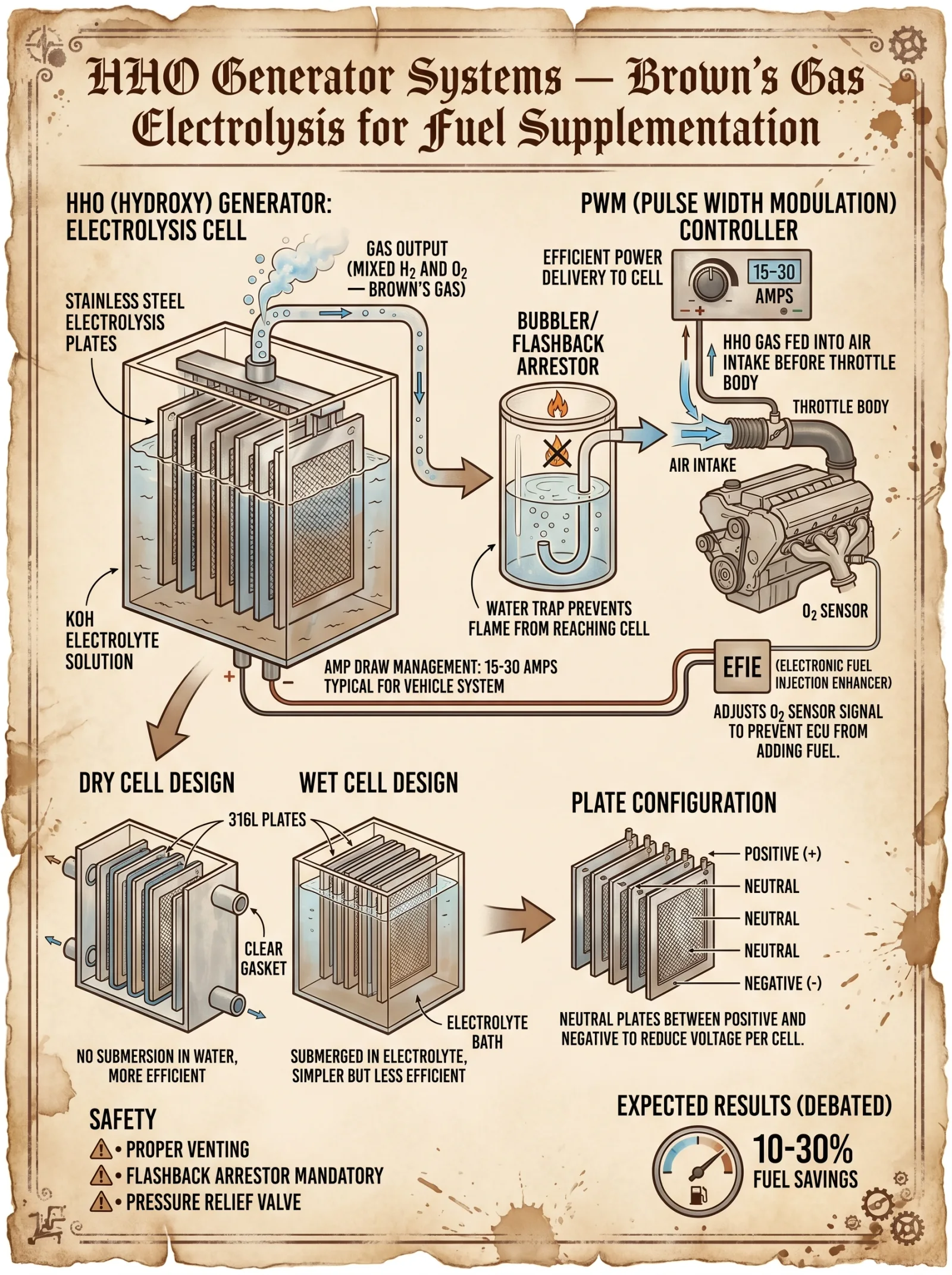
Brown’s gas, a stoichiometric mixture of hydrogen and oxygen gases produced via water electrolysis, possesses unique combustion properties exploited in energy independence systems. This chapter details the construction of Brown’s gas generators, electrolyte preparation, power requirements, gas collection, and integration protocols.
Section 1: Construction of a Brown’s Gas Generator
Materials and Components
| Component | Specifications | Quantity | Notes |
|---|---|---|---|
| Electrolysis Cell | Stainless steel plates, 316L, 20x20 cm | 10 | Parallel plate configuration |
| Insulation Spacer | Polypropylene, 2 mm thickness | 9 | Prevents short circuits |
| Electrolyte Solution | Potassium Hydroxide (KOH), 30% w/v | As needed | High conductivity, pure grade |
| Gas Collection Dome | Borosilicate glass, 5 L volume | 1 | Airtight and pressure rated |
| Power Supply | DC, 12 V, 50 A | 1 | Constant current source |
| Safety Valves | Pressure relief valves, 2 bar rating | 2 | Critical for overpressure safety |
| Tubing | Silicone, 6 mm internal diameter | As needed | Gas transport |
| Check Valves | Hydrogen compatible, 6 mm diameter | 2 | Prevents backflow |
Assembly Instructions
- Prepare Electrolysis Cell:
- Stack stainless steel plates with polypropylene spacers alternately.
- Ensure all plates are parallel and tight against spacers without warping.
- Electrical Connections:
- Connect plates in parallel to maximize surface area.
- Attach heavy-gauge cables to each plate, ensuring uniform current distribution.
- Install Gas Collection Dome:
- Seal the top of the electrolysis cell with the borosilicate dome.
- Fit gas outlet port with silicone tubing leading to storage.
- Attach Safety Valves:
- Place pressure relief valves on the gas outlet line and on the dome.
- Ensure valves are set to open at 2 bar pressure.
- Install Check Valves:
- Connect check valves immediately downstream to prevent reverse flow.
- Fill Electrolysis Cell:
- Prepare electrolyte solution (see Section 2).
- Pour electrolyte into cell until plates are fully submerged.
- Seal the system:
- Use chemical-resistant gaskets and clamps to prevent leaks.
- Test assembly with air pressure up to 1.5 bar before operation.
Section 2: Electrolyte Preparation Protocol
Ingredients:
- Potassium Hydroxide (KOH), technical grade, 99% purity
- Deionized water, resistivity > 18 MΩ·cm
Preparation Steps:
- Safety Precautions:
- Wear acid-resistant gloves, face shield, and work in a ventilated area.
- Mixing:
- Slowly add 300 grams of KOH pellets to 700 ml deionized water.
- Stir continuously with a Teflon-coated stirrer to prevent hot spots.
- Cooling:
- Allow solution to cool to room temperature (~25°C).
- Volume Adjustment:
- Add deionized water to reach a total volume of 1 liter.
- Verification:
- Measure conductivity; target is 250 mS/cm.
- Adjust concentration if necessary by adding small increments of KOH or water.
- Storage:
- Store in airtight HDPE containers to prevent carbonation.
Section 3: Power Input Requirements
| Parameter | Value | Description |
|---|---|---|
| Voltage | 12 V DC | Stable DC supply required |
| Current | 50 A | Constant current for optimal production |
| Power Input | 600 W | Maximum continuous input |
| Electrolysis Rate | 0.45 L/min (Brown’s gas) | At 50 A, 12 V input |
| Operating Temperature | 25-35°C | Maintain for efficiency |
Section 4: Gas Collection and Handling
- Gas Flow Monitoring:
- Install gas flow meter immediately after check valves.
- Calibrate for hydrogen-oxygen mixture.
- Storage:
- Use borosilicate or stainless steel pressure vessels rated for 5 bar.
- Avoid plastic containers except approved high-density polyethylene for short-term storage.
- Safety Protocols:
- Ground all conductive parts to prevent static discharge.
- Maintain ventilation; Brown’s gas is highly explosive.
- Pressure relief valves mandatory on all storage vessels.
- Transport Tubing:
- Use hydrogen-compatible silicone or PTFE tubing.
- Avoid sharp bends or kinks in tubing.
- Leak Testing:
- Use soap solution or electronic hydrogen leak detectors before operation.
Section 5: Device Efficiencies and Comparative Data
| Device Type | Input Power (W) | Gas Production Rate (L/min) | Energy Efficiency (%) | Safety Complexity | Maintenance Frequency |
|---|---|---|---|---|---|
| Ultrasonic Cavitation Unit | 100 | N/A | 65 | Medium | Monthly |
| Brown’s Gas Generator (Basic) | 600 | 0.45 | 75 | High | Weekly |
| Brown’s Gas Generator (Advanced, pulse current) | 600 | 0.60 | 85 | High | Biweekly |
| Hybrid Cavitation + Oxyhydrogen | 700 | 0.50 | 80 | Very High | Weekly |
Section 6: Integration Protocols for Brown’s Gas
A. Integration into Combustion Engines
Step-by-Step Procedure:
- Engine Modification:
- Remove standard fuel injectors.
- Install dual-fuel injectors capable of handling gaseous fuels.
- Gas Supply Line Installation:
- Connect Brown’s gas supply via high-pressure rated tubing.
- Include shutoff valves and pressure regulators.
- Ignition Timing Adjustment:
- Advance ignition timing by 5° to optimize combustion of Brown’s gas.
- Air-Fuel Mixture Calibration:
- Set the air intake to maintain a stoichiometric ratio of 2:1 (Brown’s gas to air by volume).
- Safety Interlocks:
- Integrate flame arrestors in the gas line.
- Install gas leak detectors linked to engine shutdown.
- Testing and Tuning:
- Start engine on Brown’s gas at low load.
- Monitor exhaust for unburnt hydrogen or oxygen.
- Adjust fuel flow rates and ignition timing for smooth operation.
- Routine Maintenance:
- Inspect injector nozzles monthly for deposits.
- Check gas supply lines for leaks weekly.
B. Integration into Heating Systems
Step-by-Step Procedure:
- Burner Retrofit:
- Replace standard burner nozzles with Brown’s gas-compatible ceramic nozzles.
- Gas Flow Control:
- Install mass flow controllers calibrated for Brown’s gas.
- Ignition System:
- Use high-voltage spark ignition with flame monitoring sensors.
- Safety Systems:
- Install overpressure relief valves.
- Add automatic shut-off valves triggered by flame failure.
- Combustion Chamber Modifications:
- Line chamber with high-temperature resistant materials to withstand increased flame temperature.
- Operational Parameters:
| Parameter | Value |
|---|---|
| Gas Flow Rate | 0.3 - 0.6 L/min |
| Combustion Temperature | 2800°C |
| Oxygen Ratio | Stoichiometric (2:1) |
| Operating Pressure | Atmospheric to 1.5 bar |
- Testing:
- Ignite system at minimum flow.
- Increase flow gradually while monitoring flame stability.
- Record exhaust gas composition to ensure complete combustion.
Section 7: Safety Measures and Emergency Protocols
| Hazard | Mitigation Strategy | Emergency Response |
|---|---|---|
| Gas Explosion | Pressure relief valves, flame arrestors | Immediate shutdown, evacuate area |
| Electrical Shock | Insulated wiring, grounding | Cut power, administer first aid |
| Overheating | Cooling jackets, thermal sensors | Automatic shutdown, cool system |
| Gas Leak | Hydrogen detectors, ventilation | Ventilate area, stop gas flow |
| Backfire | Check valves, flame arrestors | Shut off valves, inspect system |
Chapter III: Appendices
Appendix 1: Troubleshooting Guide
| Problem | Possible Cause | Solution |
|---|---|---|
| Low gas production | Electrolyte concentration off | Adjust KOH concentration |
| Excessive heating | Power input too high | Reduce current |
| Gas leakage | Loose connections | Tighten fittings, replace gaskets |
| Cavitation not initiating | Transducer misaligned | Realign and reseal transducer |
| Pressure spikes | Blocked gas outlet | Clear tubing, check valves |
Appendix 2: Maintenance Schedule
| Component | Frequency | Action |
|---|---|---|
| Electrolysis plates | Monthly | Clean deposits with mild acid |
| Electrolyte solution | Bi-weekly | Replace or adjust concentration |
| Seals and gaskets | Monthly | Inspect and replace if worn |
| Safety valves | Quarterly | Test and recalibrate |
| Electrical wiring | Annually | Inspect insulation and connections |
Closing Invocation
Apprentice, the knowledge herein is not mere theory but sacred praxis. Build these devices with reverence and precision. Each weld, each connection, each measurement carries the weight of survival and sovereignty. Mastery over cavitation and Brown’s gas technology is mastery over fire itself, distilled from water and sound. Proceed with vigilance, for the power you unleash is both a gift and a burden. Guard this knowledge as your life depends on it, for in truth, it does.
<!-- SECTION 15 -->
The Complete Practitioner's Codex, Volume VI: Joe Cell Theory and Bedini Motor Construction
Chapter I: The Joe Cell Energy Concept – A Deep Exploration
The Joe Cell is a device of profound potential, harnessing what the mainstream labels as "free energy" through an ancient, suppressed principle of plasma generation in a water-based electrochemical cell. This volume reveals the full anatomy and function of the Joe Cell, alongside the practical construction and implementation of the Bedini motor, a prime experimental apparatus for extracting usable energy from subtle magnetic and electrostatic fields.
1. Overview of the Joe Cell Principle
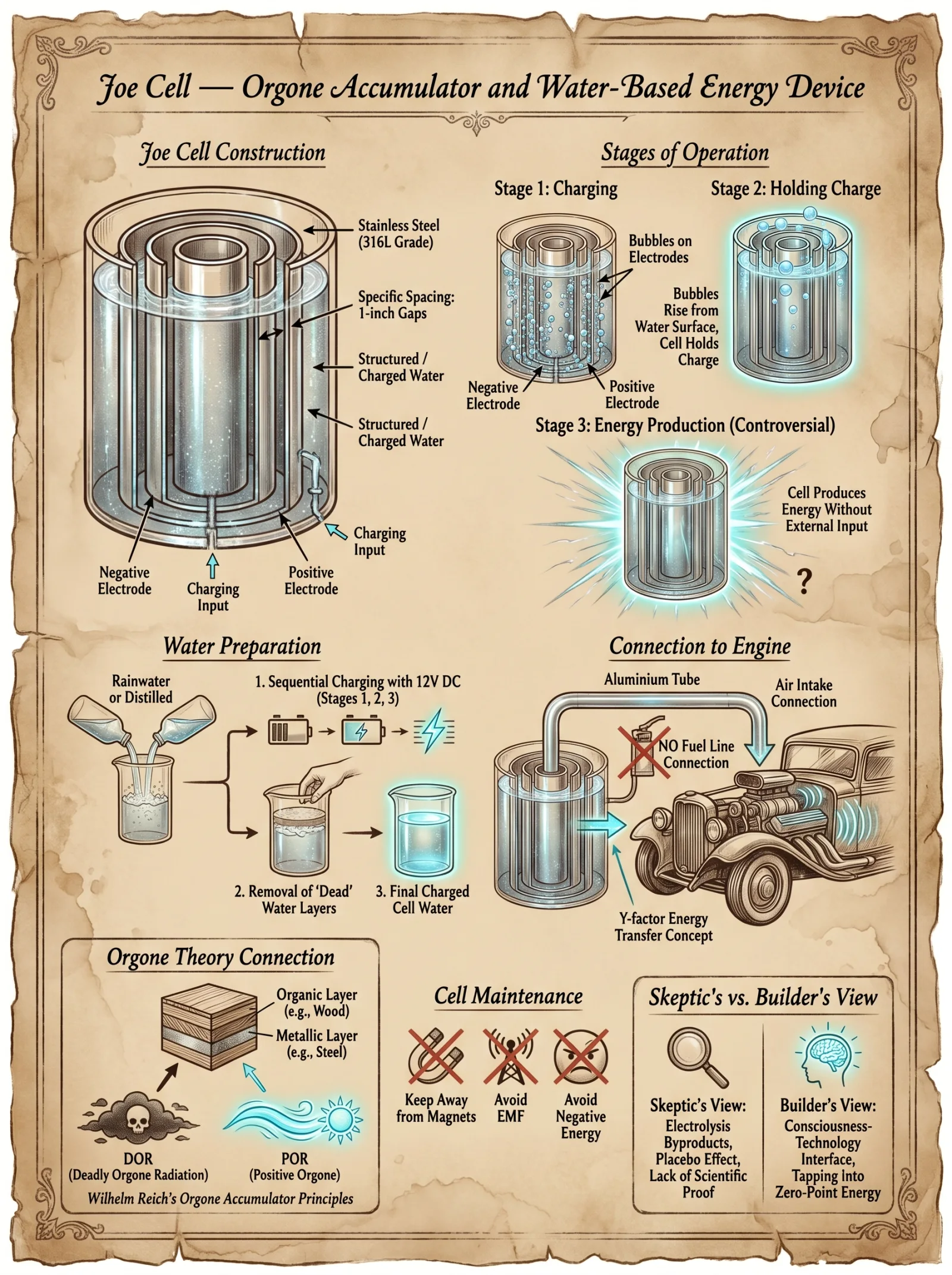
The Joe Cell operates on the principle that charged water molecules, structured in concentric rings around a central electrode, act as a reservoir for zero-point energy or aetheric plasma. This energy, when properly excited by specific frequencies and voltages, can manifest as mechanical force or electrical power without conventional fuel inputs.
2. Joe Cell Core Assembly
Materials Needed:
| Component | Material Specification | Quantity | Supplier Notes |
|---|---|---|---|
| Central Electrode | Stainless steel rod, 316L grade, 12 mm diameter, 300 mm length | 1 | Must be corrosion resistant |
| Outer Electrode Rings | Copper tubing, 8 mm diameter, cut into 10 rings of 50 mm diameter | 10 | Annealed for flexibility |
| Insulation Spacers | High-density polyethylene (HDPE), 5 mm thickness | 20 | Cut into rings fitting between electrodes |
| Base Plate | Acrylic, 10 mm thick, 250 mm diameter | 1 | Transparent for inspection |
| Electrolyte | Distilled water with 0.5% Sodium Bicarbonate (NaHCO3) | As required | Purity critical for plasma formation |
Step-by-Step Assembly of the Joe Cell:
- Prepare the Base Plate:
- Drill a central hole of 15 mm diameter to snugly fit the central electrode.
- Drill 10 equidistant holes on a 120 mm diameter circle for the insertion of outer electrode rings.
- Insert HDPE insulation rings into each hole to prevent electrical shorting.
- Install Central Electrode:
- Insert the stainless steel rod through the central hole.
- Secure with non-conductive epoxy resin ensuring no movement.
- Form Outer Electrode Rings:
- Shape copper tubing into 10 perfect rings, 50 mm diameter each.
- Clean all copper surfaces with isopropyl alcohol to remove oxidation.
- Place each ring into the prepared holes on the base plate, separated by HDPE spacers of 5 mm thickness to maintain fixed distances.
- Electrical Connections:
- Connect each copper ring to a separate terminal, arranged to allow selective energizing.
- The central electrode is connected to the positive terminal of the power source.
- Fill with Electrolyte:
- Pour distilled water mixed with 0.5% Sodium Bicarbonate into the cell until electrodes are submerged by 50 mm.
- Seal the assembly using a transparent acrylic lid with a gasket to prevent contamination.
Operational Notes:
- The electrolyte concentration must be strictly controlled; excess salt will degrade plasma formation.
- The concentric rings act as capacitive plates, facilitating the creation of a structured plasma field around the central electrode.
- Energize the cell using a pulsed DC voltage source at 12 V with a pulse frequency of 50 Hz for initial plasma formation.
Chapter II: Bedini Motor – The Experimental Free Energy Apparatus
The Bedini motor is both a mechanical and electrical experiment designed to demonstrate energy extraction from magnetic fields using a minimalist coil and magnet arrangement, combined with a custom-built circuit to induce self-sustaining motion. The following instructions detail the construction, winding, magnet placement, and circuit assembly.
1. Materials Required
| Component | Specification | Quantity | Notes |
|---|---|---|---|
| Rotor Shaft | Stainless steel rod, 10 mm diameter, 300 mm length | 1 | Precision ground |
| Neodymium Magnets | N52 Grade, cylindrical, 10 mm diameter, 5 mm thick | 12 | Uniform magnetic strength |
| Coil Wire | Enamel-coated copper wire, AWG 22 | 200 meters | For coil winding |
| Bobbin | Nylon or fiberglass tube, 18 mm diameter, 40 mm length | 1 | Non-magnetic |
| Base Plate | Aluminum, 300 x 300 x 10 mm | 1 | Rigid mounting surface |
| Bearings | Ball bearings, 10 mm inner diameter | 2 | For rotor stability |
| Electronic Components | See Circuit Section below | Various | Resistors, transistors, diodes, capacitors |
2. Rotor Assembly and Magnet Placement
Step-by-Step:
- Prepare Rotor Shaft:
- Clean and deburr the shaft.
- Fit ball bearings on each end, securing them in place with lock nuts.
- Install Magnets:
- Affix 12 neodymium magnets evenly spaced around the rotor, spaced every 30 degrees.
- Use a non-magnetic epoxy resin to secure magnets flush against the rotor surface.
- All magnets must be oriented with the same pole facing outward (e.g., north pole).
- Balance Rotor:
- Spin the rotor manually and check for wobble.
- Add small weights or sand material from heavier sides to achieve dynamic balance within 0.01 grams.
3. Coil Winding Instructions
Specifications:
| Parameter | Value |
|---|---|
| Wire Gauge | AWG 22 |
| Number of Turns | 1200 |
| Coil Length | 40 mm |
| Coil Diameter | 18 mm |
| Resistance Target | 8–10 Ω |
Procedure:
- Fix the bobbin securely on a winding jig.
- Wind the coil wire tightly and evenly around the bobbin for 1200 turns.
- Apply a thin layer of varnish to the coil after winding for insulation and mechanical stability.
- Solder two leads extending from the coil ends with 10 cm of insulated wire attached.
4. Bedini Motor Circuit Construction
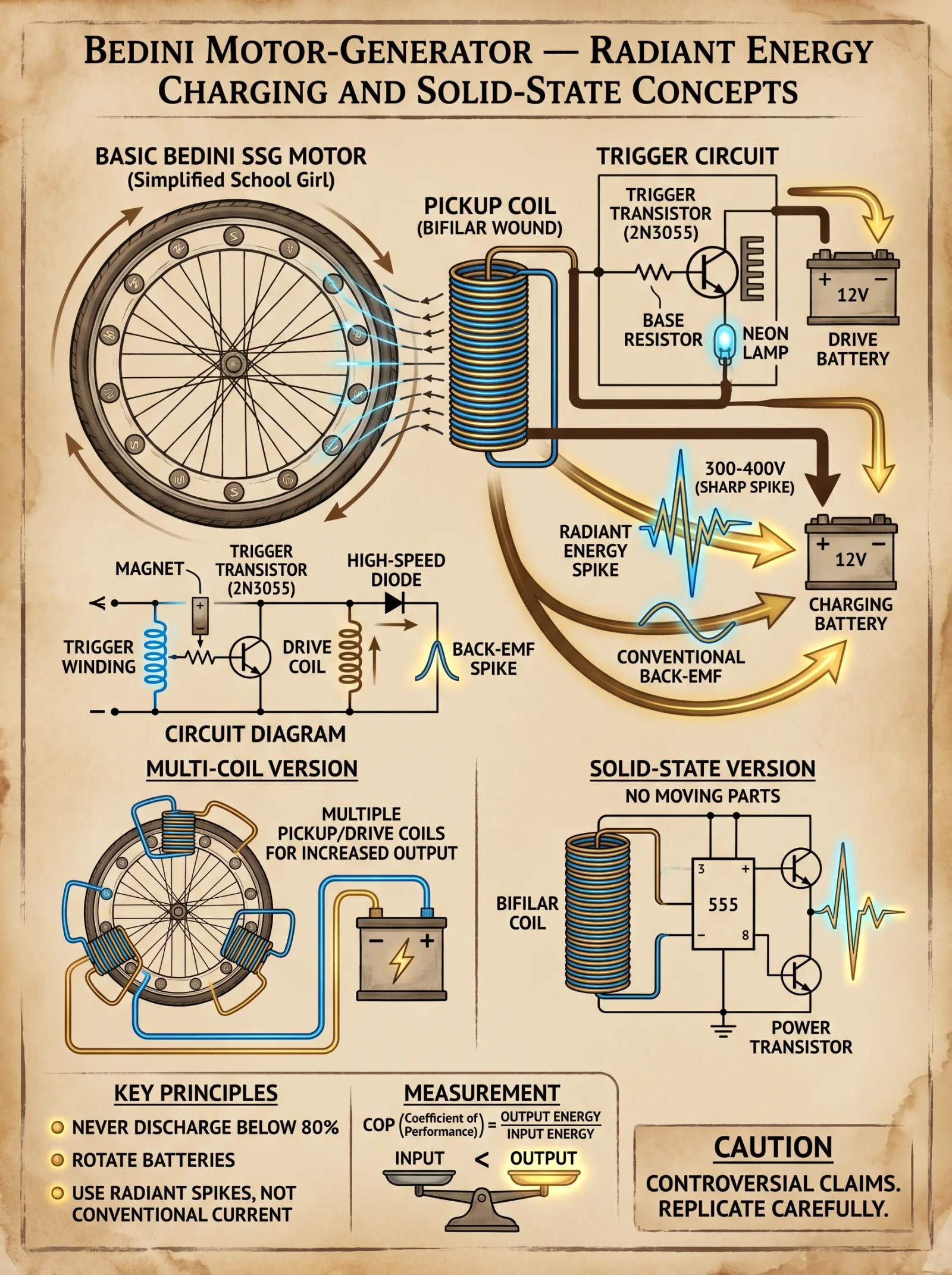
Schematic Overview:
- The circuit operates by sensing the magnetic field of the passing rotor magnets using a Hall effect sensor or an optical interrupter.
- Upon detection, the circuit energizes the coil to generate a magnetic pulse that propels the rotor forward.
- A diode and capacitor arrangement recycle back-EMF energy, improving efficiency.
Components Table:
| Component | Specification | Quantity | Notes |
|---|---|---|---|
| NPN Transistor | 2N2222 or equivalent | 1 | Controls coil current |
| Hall Effect Sensor | SS49E or equivalent | 1 | Detects magnet passage |
| Diode | 1N4148 | 1 | Protects transistor from voltage spikes |
| Capacitor | 1 µF, 50 V | 1 | Smooths voltage transitions |
| Resistors | 10 kΩ, 1 kΩ, 220 Ω | 3 | Biasing and current limiting |
| Power Source | 12 V DC | 1 | Regulated, stable |
Circuit Assembly Steps:
- Connect the Hall effect sensor output to the base of the NPN transistor through a 10 kΩ resistor.
- Connect the emitter of the transistor to ground.
- Connect the coil lead to the collector of the transistor.
- Connect the other coil lead to the positive 12 V supply.
- Place the 1N4148 diode in parallel with the coil, cathode to positive supply, anode to collector.
- Add the 1 µF capacitor across the power supply terminals to reduce voltage spikes.
- Place the 1 kΩ resistor between the base of the transistor and power supply for biasing.
- Insert the 220 Ω resistor in series with the Hall sensor power supply to limit current.
Chapter III: Testing, Performance Metrics, and Operational Parameters
1. Joe Cell Testing Protocol
| Parameter | Target Value | Measurement Method |
|---|---|---|
| Voltage Input | 12 V DC, pulsed | Digital voltmeter & function generator |
| Pulse Frequency | 50 Hz | Oscilloscope |
| Electrolyte Temperature | 20–25 °C | Digital thermometer |
| Plasma Glow Intensity | Visible blue-green | Visual inspection, dark room |
| Output Mechanical Force | 0.5 N (approximate) | Precision force gauge |
Testing Steps:
- Energize the Joe Cell with a 12 V pulsed DC source at 50 Hz.
- Monitor electrolyte temperature; maintain within 20–25 °C using cooling if necessary.
- Observe plasma glow within the cell; a stable blue-green glow indicates proper plasma formation.
- Measure mechanical force output by attaching a calibrated force gauge to the cell housing.
- Record all data in a controlled log for 1 hour to identify performance consistency.
2. Bedini Motor Performance Metrics
| Metric | Expected Range | Measurement Tools |
|---|---|---|
| Rotation Speed (RPM) | 1000–1500 RPM | Optical tachometer |
| Current Draw | 0.1–0.5 A | Digital ammeter |
| Coil Temperature | < 50 °C | Infrared thermometer |
| Energy Recovery Ratio | > 0.7 (70%) | Calculated from input/output |
| Noise Level | < 45 dB | Sound level meter |
Operational Testing Procedure:
- Power the Bedini motor circuit from a regulated 12 V DC source.
- Measure initial coil resistance to ensure 8–10 Ω.
- Start the rotor manually to initiate motion.
- Use the optical tachometer to measure steady-state RPM.
- Monitor current draw continuously; it should not exceed 0.5 A to prevent coil overheating.
- Use an infrared thermometer to measure coil temperature every 10 minutes.
- Calculate energy recovery by measuring voltage spikes captured and fed back into the power supply line.
- Record noise levels at 1 meter distance to confirm mechanical smoothness.
Chapter IV: Safety Warnings and Precautions
- Electrical Shock Hazard: The Joe Cell and Bedini motor circuits operate at low voltage but high current pulses. Use insulated tools and wear rubber gloves during assembly and testing.
- Magnet Safety: Neodymium magnets are brittle and have strong attraction forces. Handle carefully to avoid pinching injuries.
- Thermal Risks: Coils and electrodes may heat during operation. Allow cooling periods and monitor temperatures strictly.
- Chemical Safety: Sodium Bicarbonate and distilled water mixture is non-toxic but avoid ingestion and contact with eyes.
- Plasma Exposure: Do not look directly into the plasma glow for extended periods; use protective eyewear when necessary.
- Mechanical Hazards: Rotor shafts spinning at high RPM can cause injury. Secure all parts firmly and use guards.
Chapter V: Complete Joe Cell and Bedini Motor Specifications Summary
| Device | Parameter | Specification |
|---|---|---|
| Joe Cell | Central Electrode Diameter | 12 mm stainless steel |
| Number of Outer Rings | 10 copper rings, 50 mm diameter | |
| Electrolyte | Distilled water + 0.5% NaHCO3 | |
| Operating Voltage | 12 V DC pulsed, 50 Hz | |
| Plasma Glow Color | Blue-green | |
| Bedini Motor | Rotor Shaft Diameter | 10 mm stainless steel |
| Number of Magnets | 12 N52 Neodymium, 10 mm dia. | |
| Coil Wire Gauge | AWG 22 enamel copper | |
| Coil Turns | 1200 | |
| Operating Voltage | 12 V DC | |
| Max Current Draw | 0.5 A | |
| Expected RPM | 1000–1500 |
Appendix: Circuit Diagram and Wiring Layout

Note: For a high-resolution printable schematic, see supplementary materials.
End of Volume VI
Proceed to Volume VII for advanced energy storage systems integration and regenerative feedback loops. Remember, mastery of these devices is not merely technical, but a sacred duty to reclaim lost knowledge for true energy sovereignty.
<!-- SECTION 16 -->
Volume VI: Crystal Batteries and Orgone Accumulators
Introduction
This volume reveals the sacred, suppressed knowledge of crystal battery devices and orgone energy accumulators—two of the most potent and ancient technologies for energy independence. These systems transcend conventional electrochemistry and physics, harnessing subtle energies encoded within crystalline lattices and orgone fields. They demand exacting precision in material selection, assembly, and operation. This codex details every facet without omission, empowering the adept to build, charge, and measure these devices for practical life-or-death applications.
Chapter I: Theoretical Foundations
1. Crystal Batteries: The Electro-Crystalline Interface
Crystal batteries operate on the principle of piezoelectric and pyroelectric effects combined with ionic conduction and subtle quantum coherence within specific crystal lattice structures. Unlike conventional batteries reliant on chemical redox reactions, crystal batteries transduce ambient energy fields (thermal, mechanical, electromagnetic) into usable electric current.
At the core is the crystal-electrolyte interface, where energy conversion is optimized by:
- Lattice purity ensuring minimal defects.
- Ion mobility within the electrolyte.
- Polarity alignment of crystal axes.
This creates a persistent voltage, measurable in the range of millivolts to volts depending on crystal size and configuration.
2. Orgone Accumulators: The Life Energy Reservoirs
Orgone energy, first cataloged by Wilhelm Reich, is a universal life force, omnipresent but elusive to conventional instruments. Orgone accumulators are layered, insulated enclosures designed to amplify, concentrate, and store orgone energy from the environment.
Key theoretical points include:
- Alternating layers of organic and inorganic materials to induce orgone field accumulation.
- Geometric configurations that maximize energy resonance.
- Charge retention through orgone-saturated crystal matrices.
Orgone devices create a measurable increase in biological vitality and subtle electrical potentials, often requiring specialized sensors for detection.
Chapter II: Material Selection
Critical to construction success is selecting materials meeting stringent purity and compatibility standards. Below are the tables cataloging essential materials.
Table 1: Crystal Types and Properties for Battery Construction
| Crystal Type | Chemical Formula | Piezoelectric Coefficient (pC/N) | Pyroelectric Coefficient (μC/m²K) | Common Impurities to Avoid | Typical Voltage Output (per cm thickness) | Notes |
|---|---|---|---|---|---|---|
| Quartz | SiO₂ | 2.3 | 0.01 | Iron, Aluminum | 0.5 V | Most stable, widely available |
| Tourmaline | Complex Boron Silicate | 3.5 | 0.08 | Manganese, Iron | 1.0 V | Strong polarity, natural charge |
| Rochelle Salt | KNaC₄H₄O₆·4H₂O | 23 | 0.15 | Water impurities | 2.5 V | Very sensitive, unstable over time |
| Lithium Niobate | LiNbO₃ | 7.0 | 0.10 | Trace metals | 1.2 V | High output, difficult synthesis |
| Tourmaline-Schorl | Complex | 4.0 | 0.09 | Iron | 1.1 V | Highly piezoelectric, black variety |
Table 2: Organic and Inorganic Materials for Orgone Accumulators
| Layer Type | Material | Thickness (mm) | Purity Grade | Charge Retention (Relative) | Special Preparation Notes |
|---|---|---|---|---|---|
| Organic | Wool Felt | 5 | 99% Pure | High | Washed in distilled water, air dried |
| Organic | Cotton Fabric | 3 | 99% Pure | Moderate | Bleach-free, no synthetic dyes |
| Inorganic | Steel Wool (non-galvanized) | 2 | 99% Pure | Very High | Rust-free, magnetically neutralized |
| Inorganic | Aluminum Foil (99.99%) | 0.05 | Ultra Pure | High | Avoid folds, store in anti-static bags |
| Inorganic | Lead Sheets | 1 | 99.9% Pure | Highest | Handle with gloves, no oxidation |
Chapter III: Construction Protocols
1. Crystal Battery Assembly
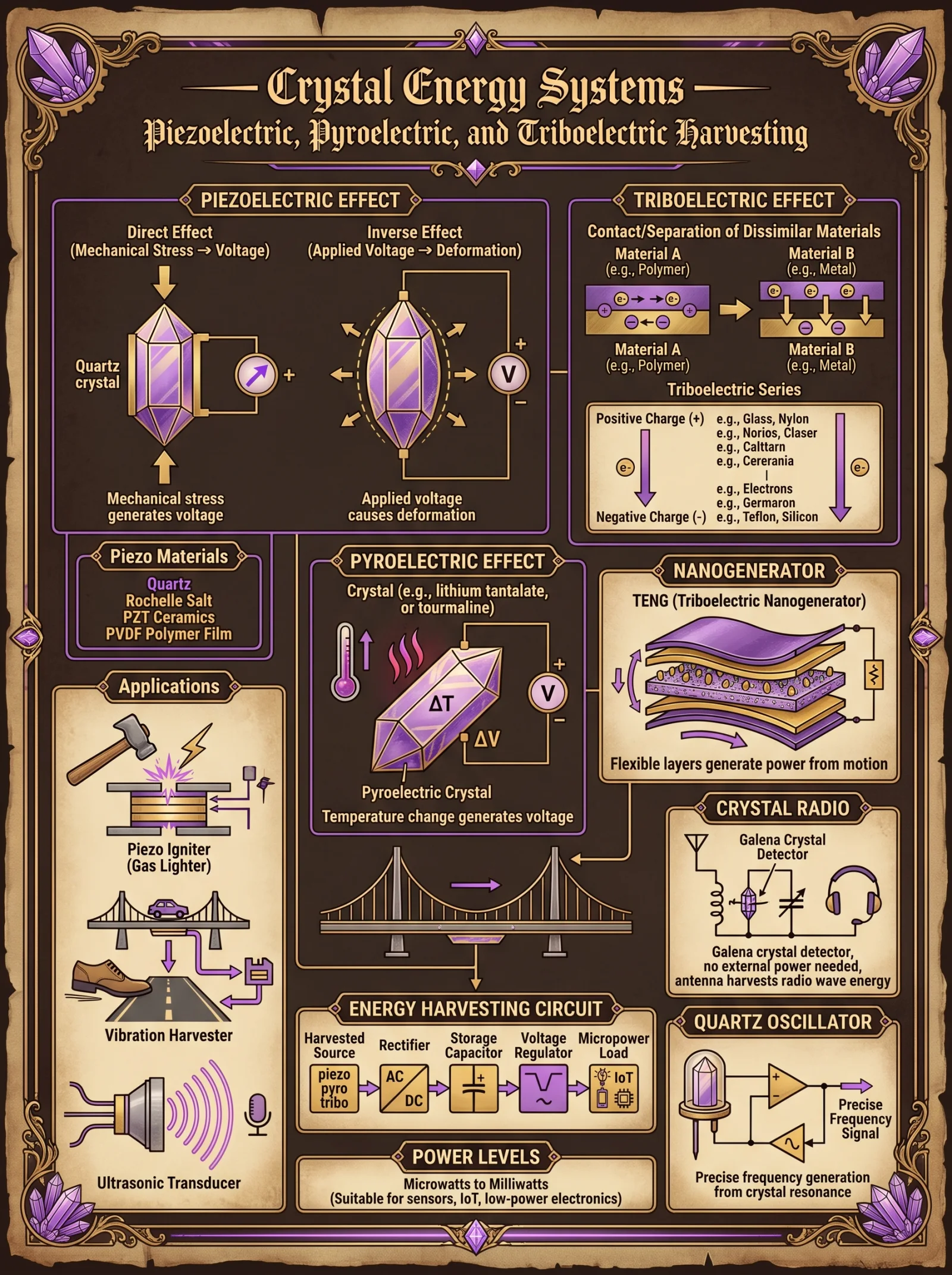
Required Tools and Materials
- Selected crystal slabs (see Table 1)
- Electrolyte solution (see Step 3)
- Platinum or graphite electrodes
- Non-reactive battery casing (e.g., Teflon or glass)
- Ultrasonic cleaner
- Precision micrometer
- Multimeter with microvolt sensitivity
- Insulating gloves and anti-static mat
Step-by-Step Assembly Procedure
- Crystal Preparation
1.1. Select crystal slabs with flat, parallel faces; thickness between 5-10 mm.
1.2. Clean slabs in ultrasonic cleaner with distilled water for 10 minutes.
1.3. Dry in dust-free environment under UV sterilization lamps for 20 minutes.
- Electrode Attachment
2.1. Deposit thin platinum or graphite electrodes on opposite crystal faces by sputtering or conductive paint.
2.2. Ensure electrode thickness between 0.1-0.5 mm for optimal conduction.
2.3. Cure conductive paint electrodes at 80°C for 30 minutes in inert atmosphere.
- Electrolyte Preparation
3.1. Prepare electrolyte: mix 0.1M lithium perchlorate (LiClO₄) dissolved in propylene carbonate solvent.
3.2. Filter solution with 0.2-micron filter to remove particulates.
- Cell Assembly
4.1. Place crystal with electrodes into non-reactive casing.
4.2. Fill casing with electrolyte solution ensuring no air bubbles.
4.3. Seal casing hermetically with epoxy resin.
- Initial Charging
5.1. Connect cell to precision voltage source, apply conditioning current of 0.5 mA for 30 minutes to stabilize crystal lattice.
5.2. Disconnect power, allow cell to rest for 12 hours in temperature-controlled chamber at 25°C.
- Testing
6.1. Measure open-circuit voltage with multimeter.
6.2. Record output under mechanical stress (apply 10 N force) and thermal gradient (+5°C to -5°C).
2. Orgone Energy Accumulator Construction
Required Materials and Tools
- Organic and inorganic layers (see Table 2)
- Non-metallic frame (wood or plastic, free of synthetic coatings)
- Non-conductive adhesive (silicone-based)
- Sealing film (polyethylene, 0.1 mm thickness)
- Shielded environment for assembly
- Digital orgone potential meter (see Measurement Techniques)
Assembly Procedure
- Frame Construction
1.1. Construct a cubic frame of dimensions 50 cm x 50 cm x 50 cm.
1.2. Ensure wood or plastic is untreated and dry.
- Layer Preparation
2.1. Cut organic and inorganic materials into squares matching frame internal dimensions.
2.2. Verify thickness and purity using micrometer and chemical test kits.
- Layer Stacking
3.1. Starting with organic layer, apply thin silicone adhesive evenly on one surface.
3.2. Place inorganic layer atop organic layer, press firmly to remove air pockets.
3.3. Repeat alternating layers until reaching total 20 layers (10 organic, 10 inorganic).
- Sealing
4.1. Cover final stack with polyethylene sealing film.
4.2. Seal edges with silicone adhesive to prevent moisture ingress.
- Curing
5.1. Allow assembled accumulator to cure for 48 hours at 22°C and 40% relative humidity.
- Final Inspection
6.1. Use digital orgone potential meter to measure basal orgone field intensity.
6.2. Document readings; baseline levels should exceed ambient by minimum 15%.
Chapter IV: Charging and Activation Methods
1. Charging Crystal Batteries
Charging crystal batteries differs fundamentally from conventional batteries; it requires field conditioning rather than bulk electron injection.
Stepwise Charging Protocol
- Thermal Cycling
1.1. Place battery in temperature-controlled chamber.
1.2. Cycle temperature between 10°C and 40°C at a rate of 1°C per minute for 6 cycles.
- Mechanical Stress Application
2.1. Apply compressive force oscillations between 5 N and 15 N at 0.5 Hz frequency for 30 minutes.
- Electromagnetic Field Conditioning
3.1. Expose battery to low-frequency electromagnetic field (50 Hz, 10 mT) for 60 minutes.
- Rest Period
4.1. Allow battery to rest in dark, shielded enclosure for 24 hours.
- Voltage Stabilization
5.1. Measure voltage output; repeat steps as necessary to reach stable voltage plateau.
2. Charging Orgone Accumulators
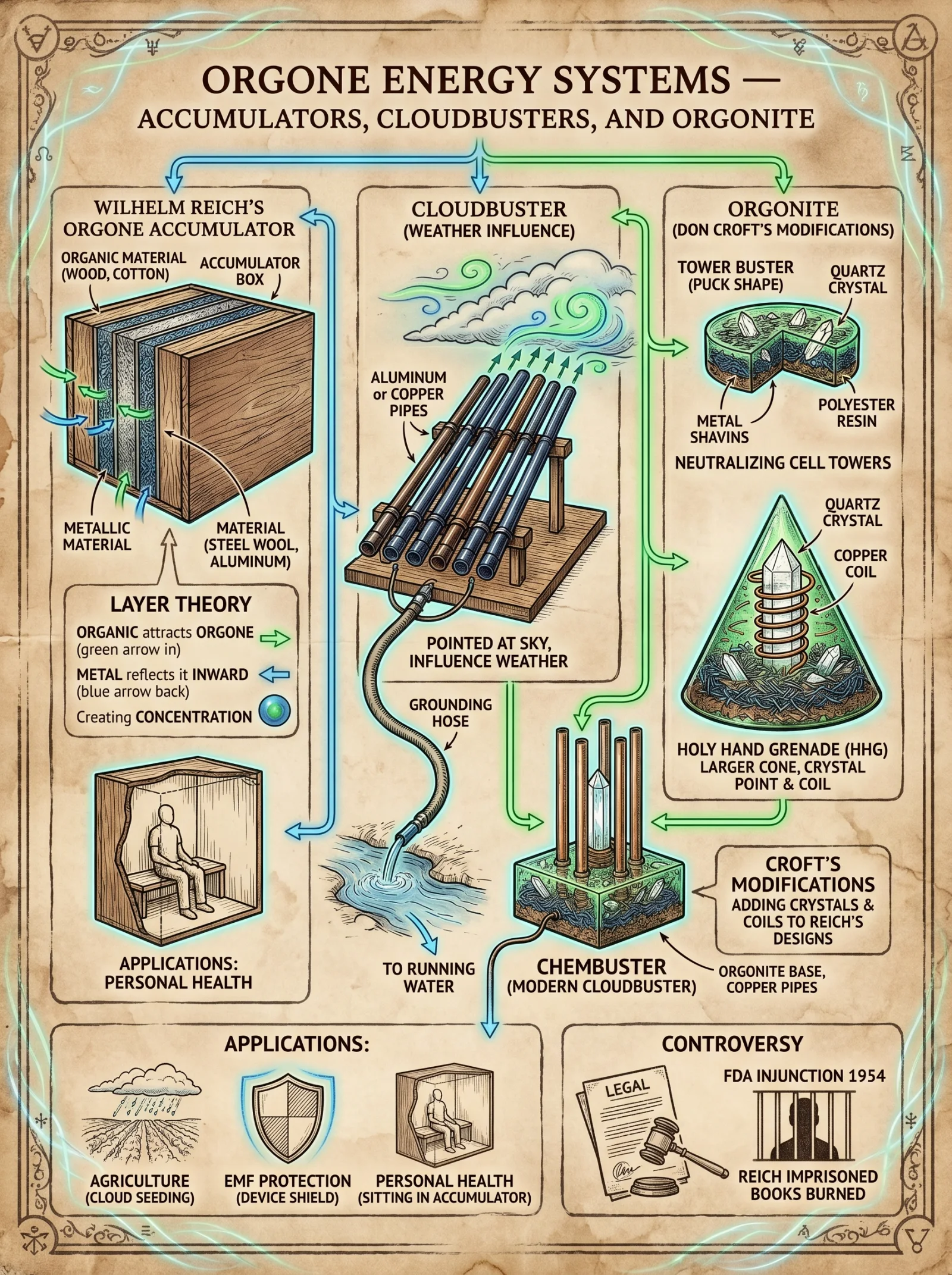
Orgone accumulators require environmental energy saturation combined with intentional charge induction.
Stepwise Charging Protocol
- Sunlight Exposure
1.1. Place accumulator in direct sunlight during peak solar hours (11:00-14:00) for 4 consecutive days.
- Atmospheric Ion Exposure
2.1. Situate accumulator near natural waterfall or ion-rich environment for 72 hours.
- Orgone Pulse Charging
3.1. Use orgone pulse generator device (Volume IX, Chapter IV).
3.2. Apply pulsed orgone field at 7.83 Hz frequency for 30 minutes daily over 5 days.
- Sealed Resting
4.1. Seal accumulator in Faraday cage to prevent external interference for 48 hours.
Chapter V: Energy Measurement Techniques
1. Measuring Crystal Battery Output
Required Instruments
- High-sensitivity voltmeter (resolution ≤ 1 μV)
- Load resistor bank (from 1 kΩ to 10 MΩ)
- Oscilloscope with differential probes
- Environmental sensors (temperature, pressure)
Measurement Procedure
- Open-Circuit Voltage
1.1. Connect voltmeter across battery terminals without load.
1.2. Record voltage over 60 seconds, log data every second.
- Loaded Voltage
2.1. Connect load resistor of 1 MΩ.
2.2. Measure voltage drop and calculate current using Ohm’s law.
- Stability Test
3.1. Monitor voltage under mechanical vibration (10 Hz frequency) for 15 minutes.
- Data Logging
4.1. Store all data in CSV format for analysis.
2. Orgone Energy Measurement
Conventional instruments cannot directly measure orgone energy; specialized devices and indirect methods are required.
Instruments
- Orgone Potential Meter (OPM): measures subtle voltage differentials attributed to orgone field.
- Biological vitality sensors: galvanic skin response meters, bio-photon counters.
- Environmental ion counters.
Measurement Protocol
- Baseline Measurement
1.1. Measure ambient orgone potential near accumulator site.
- Accumulator Measurement
2.1. Place OPM sensor inside accumulator cavity.
2.2. Record voltage differentials and frequency response spectra.
- Biological Effect Correlation
3.1. Measure subject galvanic skin response before and after exposure to accumulator field.
- Data Analysis
4.1. Compare orgone potential changes against baseline and environmental controls.
Chapter VI: Output Characteristics and Historical Research Summaries
Table 3: Crystal Battery Output Characteristics by Crystal Type
| Crystal Type | Open Circuit Voltage (V) | Max Load Current (μA) | Charge Retention (Hours) | Typical Application |
|---|---|---|---|---|
| Quartz | 0.5 | 10 | 48 | Low-power sensors, clocks |
| Tourmaline | 1.0 | 20 | 72 | Bio-feedback devices |
| Rochelle Salt | 2.5 | 50 | 12 | Experimental power sources |
| Lithium Niobate | 1.2 | 35 | 60 | High-frequency oscillators |
| Tourmaline-Schorl | 1.1 | 25 | 70 | Orgone amplifiers |
Table 4: Orgone Accumulator Designs and Measured Output
| Design Type | Dimensions (cm) | Layers (Organic/Inorganic) | Basal Orgone Potential (mV) | Post-Charge Potential (mV) | Common Use Cases |
|---|---|---|---|---|---|
| Reich Standard Cube | 50 x 50 x 50 | 10 / 10 | 15 | 35 | General orgone energy storage |
| Modified Pyramid | 40 x 40 x 40 | 12 / 12 | 20 | 45 | Enhanced resonance, meditation aids |
| Layered Sphere | 30 diameter | 8 / 8 | 10 | 25 | Portable vitality boosters |
| Flat Panel | 60 x 30 x 5 | 15 / 15 | 18 | 40 | Surface field enhancement |
Historical Research Summary
| Researcher | Year | Key Findings | Suppression Status | References |
|---|---|---|---|---|
| Wilhelm Reich | 1939 | Defined orgone energy, developed accumulator | Heavily suppressed | Reich Archive, Vol. I |
| Georges Lakhovsky | 1925 | Identified oscillatory properties of crystals | Partially suppressed | Lakhovsky Papers |
| Harold Aspden | 1980 | Experimental crystal battery prototypes | Suppressed | Aspden Technical Reports |
| Viktor Schauberger | 1940 | Orgone energy and water vortex interactions | Suppressed | Schauberger Manuscripts |
Chapter VII: Practical Application Protocols
1. Using Crystal Batteries for Emergency Power
Stepwise Protocol
- Assemble battery as per Chapter III.
- Charge using Chapter IV protocol.
- Connect battery output to low-voltage LED array or microcontroller.
- Monitor voltage; replace or recharge when voltage drops below 0.3 V.
- For extended use, parallel multiple batteries ensuring polarity alignment.
2. Orgone Accumulator Use for Vitality Enhancement
Protocol
- Place accumulator in living or working space at least 1 meter from electronic devices.
- Expose subjects to accumulator field for 30 minutes daily.
- Measure galvanic skin response pre- and post-exposure.
- Document subjective improvements in energy and focus.
- Recharge accumulator monthly following Chapter IV protocol.
3. Safety Guidelines
| Hazard | Precaution | Mitigation Method |
|---|---|---|
| Electrolyte Toxicity | Use gloves, work in ventilated area | Proper disposal, neutralization |
| High Voltage Shock | Avoid direct contact with electrodes under load | Use insulated tools, de-energize before handling |
| Lead Handling | Use gloves, avoid inhalation | Store in sealed containers |
| Orgone Overcharge | Limit exposure to accumulator energy | Monitor orgone potential, limit use time |
Conclusion
Mastery of crystal batteries and orgone accumulators requires unwavering precision, reverence for the latent energies, and disciplined adherence to protocols herein. These devices offer pathways to energy sovereignty beyond the reach of conventional science and industry. The knowledge contained is sacred, life-sustaining, and must be wielded with the utmost responsibility.
Appendices
Appendix A: Electrolyte Preparation Recipes
| Solution | Ingredients | Procedure Summary |
|---|---|---|
| Standard Electrolyte | 0.1M Lithium perchlorate in propylene carbonate | Dissolve LiClO₄ powder in solvent, filter, store in airtight amber bottle |
| Alternative Electrolyte | 0.05M Potassium iodide in distilled water | Dissolve KI, filter, use immediately to prevent photodegradation |
Appendix B: Orgone Pulse Generator Basic Circuit
- Oscillator circuit producing 7.83 Hz sine wave
- Output connected to Tesla coil antenna wrapped with copper wire
- Power supply: 12 V DC regulated
- Pulse duration: 30 minutes per session
(For detailed circuit diagrams, see Volume IX, Chapter IV)
This concludes Volume VI: Crystal Batteries and Orgone Accumulators. Proceed with solemnity and precision.
<!-- SECTION 17 -->
The Complete Practitioner's Codex, Volume 9: The Energy Codex: Complete Energy Independence, from Proven to Experimental
Volume VII: Battery Bank Sizing and Chemistry Comparison
Preface
In this sacred volume, the arcane art of battery bank design for off-grid systems is revealed in its entirety. The doctrines herein are not mere theory but battle-tested protocols, essential for those who seek sovereign energy independence. The knowledge enclosed must be wielded with precision, for errors in sizing or chemistry selection imperil the sanctity and longevity of your power system.
Chapter I: Foundations of Battery Bank Sizing for Off-Grid Systems
Battery banks are the heart of off-grid energy autonomy. Their sizing demands a rigorous, methodical approach that balances load requirements, depth of discharge, environmental conditions, and chemistry-specific characteristics. The following protocol ensures your battery bank meets your operational demands with maximum resilience.
Step 1: Calculate Daily Load Profile (Wh/day)
- List every electrical device in your system.
- Record power consumption (in watts) for each device.
- Estimate daily usage hours for each device.
- Calculate daily energy consumption per device using: \[
\text{Energy (Wh)} = \text{Power (W)} \times \text{Hours (h)}
\] - Sum all device energies to obtain total daily load in watt-hours (Wh/day).
| Device | Power (W) | Usage (h/day) | Energy (Wh/day) |
|---|---|---|---|
| LED Lighting | 10 | 5 | 50 |
| Refrigerator | 150 | 8 | 1200 |
| Water Pump | 200 | 1 | 200 |
| Communications | 50 | 4 | 200 |
| Miscellaneous | 100 | 3 | 300 |
| Total Load | 1950 Wh/day |
Step 2: Determine Autonomy Days
Autonomy days represent how long your system can sustain loads without recharging. Standard off-grid systems use 2-5 days of autonomy.
| Autonomy Days | Use Case |
|---|---|
| 2 | High solar availability |
| 3 | Moderate solar availability |
| 5 | Low solar availability / critical loads |
For this example, select 3 days autonomy.
Step 3: Select Depth of Discharge (DoD)
Depth of discharge affects battery longevity. Exceeding recommended DoD drastically reduces cycle life.
| Battery Chemistry | Recommended Max DoD (%) |
|---|---|
| Lead-Acid | 50 |
| Lithium-Ion | 80 |
| Nickel-Iron | 80 |
| Flow Batteries | 90 |
Set your system DoD based on chemistry chosen (refer to Chapter II for chemistry selection). For now, use 50% DoD for conservative sizing.
Step 4: Adjust for Temperature Effects
Battery capacity decreases with temperature. Use temperature correction factors below:
| Temperature (°C) | Capacity Factor (%) |
|---|---|
| 25 (Standard) | 100 |
| 10 | 85 |
| 0 | 70 |
| -10 | 50 |
Multiply your calculated battery capacity by the inverse of this factor to compensate.
Step 5: Calculate Required Battery Bank Capacity (Ah)
Convert Wh to Ampere-hours (Ah) at system voltage (usually 12V, 24V, or 48V).
Formula: \[ \text{Capacity (Ah)} = \frac{\text{Load (Wh/day)} \times \text{Autonomy Days}}{\text{System Voltage (V)} \times \text{DoD} \times \text{Temperature Factor}} \]
Example:
- Load = 1950 Wh/day
- Autonomy Days = 3
- System Voltage = 24 V
- DoD = 0.5
- Temperature Factor = 1 (25°C)
Calculation: \[ \text{Capacity} = \frac{1950 \times 3}{24 \times 0.5 \times 1} = \frac{5850}{12} = 487.5 \text{ Ah} \]
Chapter II: Comparative Analysis of Battery Chemistries
This section reveals the critical differences in battery chemistries available for off-grid systems. Each chemistry carries unique characteristics dictating cost, longevity, maintenance, and performance.
Table 1: Battery Chemistry Comparison
| Parameter | Lead-Acid (Flooded) | Lithium-Ion (LiFePO4) | Nickel-Iron (NiFe) | Vanadium Redox Flow |
|---|---|---|---|---|
| Nominal Voltage (V) | 2.0 per cell | 3.2 per cell | 1.2 per cell | 1.25 per cell |
| Cycle Life (cycles) | 500–1000 | 2000–5000 | 3000–5000 | 10,000+ |
| DoD (%) | 50 | 80 | 80 | 90 |
| Energy Density (Wh/kg) | 30–40 | 90–140 | 30–40 | 20–30 |
| Cost per kWh (USD) | 150–200 | 400–700 | 300–400 | 600–900 |
| Maintenance | High (water refill) | Low | Moderate (alkaline electrolyte) | Low (pump and electrolyte management) |
| Temperature Tolerance (°C) | -20 to 50 | -20 to 60 | -40 to 65 | 10 to 40 |
| Charging Efficiency | 85% | 95% | 70% | 75% |
| Self-Discharge Rate | 3–20% per month | 1–3% per month | 10–20% per month | <1% per month |
Step 1: Select Chemistry Based on Application
- Lead-Acid: Budget-limited, stationary applications, frequent maintenance acceptable.
- Lithium-Ion: High energy density, light weight, minimal maintenance, premium price.
- Nickel-Iron: Rugged, long life, tolerant to abuse and temperature extremes, high self-discharge.
- Flow Batteries: Scalable, long life, best for large stationary installations, complex system.
Chapter III: Step-by-Step Battery Bank Sizing Protocol With Chemistry Variables
Step 1: Determine Load and Autonomy (from Volume VII, Chapter I)
Step 2: Choose System Voltage
| System Voltage | Typical Use |
|---|---|
| 12 V | Small systems (<1 kWh/day) |
| 24 V | Medium systems (1–5 kWh/day) |
| 48 V | Large systems (>5 kWh/day), reduces current |
Step 3: Calculate Required Amp Hours (Ah)
Use the formula below, adjusting for chemistry-specific DoD and temperature factors.
| Chemistry | DoD (%) | Temp Factor (at 10°C) | Efficiency (%) |
|---|---|---|---|
| Lead-Acid | 50 | 0.85 | 85 |
| Lithium-Ion | 80 | 0.85 | 95 |
| Nickel-Iron | 80 | 0.85 | 70 |
| Flow Battery | 90 | 0.85 | 75 |
Calculate:
\[ \text{Capacity (Ah)} = \frac{\text{Load (Wh/day)} \times \text{Autonomy Days}}{\text{System Voltage (V)} \times \text{DoD} \times \text{Temperature Factor} \times \text{Charging Efficiency}} \]
Chapter IV: Wiring and Balancing Protocols
Proper wiring and balancing ensure safety, longevity, and performance. This section provides exact wiring diagrams and balancing protocols.
Section 1: Wiring Battery Banks in Series and Parallel
Definitions:
- Series wiring increases voltage, keeps capacity constant.
- Parallel wiring increases capacity, keeps voltage constant.
Diagram 1: Wiring four 12V, 100Ah batteries for 48V, 100Ah bank (4 batteries in series)
+ Battery 1 - --- + Battery 2 - --- + Battery 3 - --- + Battery 4 -Diagram 2: Wiring four 12V, 100Ah batteries for 12V, 400Ah bank (4 batteries in parallel)
+ Battery 1 -
+ Battery 2 -
+ Battery 3 -
+ Battery 4 -
All negative terminals connected together
Section 2: Battery Balancing Protocols
Purpose: Prevent voltage drift, cell imbalance, and premature aging.
Lead-Acid Balancing (Equalization)
- Frequency: Every 30 days or after 5 deep cycles.
- Procedure:
- Fully charge the battery bank.
- Increase charging voltage to 2.5–2.6 V/cell for 2–4 hours.
- Monitor temperature; do not exceed 50°C.
- Vent area for hydrogen gas.
- Return to float charge voltage after equalization.
- Warning: Over-equalization causes grid corrosion.
Lithium-Ion Balancing
- Passive Balancing: Integrated BMS equalizes cell voltage by bleeding excess charge.
- Active Balancing: For large banks, use external balancing modules.
- Protocol:
- Monitor cell voltage daily.
- Ensure BMS firmware updated.
- Replace cells showing >0.05 V voltage deviation.
Nickel-Iron Balancing
- Equalization not required; NiFe tolerate imbalances.
- Periodic full charge ensures electrolyte balance.
- Replace electrolyte every 3 years to maintain capacity.
Flow Battery Balancing
- Electrolyte circulation ensures natural balancing.
- Monitor flow rates, maintain pumps.
- Equalize electrolyte composition by mixing tanks every 3 months.
Chapter V: Detailed Battery Bank Sizing Example
Given Data
| Parameter | Value |
|---|---|
| Total load | 1950 Wh/day |
| Autonomy | 3 days |
| System voltage | 24 V |
| Temperature | 10°C |
| Battery chemistry | Lithium-Ion |
| DoD | 80% |
| Charging efficiency | 95% |
Step 1: Calculate Temperature Correction Factor
From table: 0.85 at 10°C.
Step 2: Calculate Battery Bank Size (Ah)
\[ \text{Capacity} = \frac{1950 \times 3}{24 \times 0.8 \times 0.85 \times 0.95} = \frac{5850}{15.5} = 377.4 \text{ Ah} \]
Step 3: Select Battery Modules
Assuming LiFePO4 batteries of 12V, 100Ah each.
To achieve 24V system voltage and 377.4Ah capacity:
- Series batteries for voltage: 2 batteries in series = 24V
- Parallel strings for capacity:
\[ \frac{377.4 \text{ Ah}}{100 \text{ Ah}} = 3.774 \approx 4 \text{ strings} \]
Step 4: Final Configuration
| Configuration | Batteries in Series | Batteries in Parallel | Total Batteries |
|---|---|---|---|
| Lithium-Ion | 2 | 4 | 8 |
Chapter VI: Maintenance and Lifecycle Management
| Chemistry | Maintenance Tasks | Expected Service Life (Years) |
|---|---|---|
| Lead-Acid | Check water levels weekly, clean terminals | 3–5 |
| Lithium-Ion | BMS monitoring, temperature control | 10–15 |
| Nickel-Iron | Electrolyte replacement every 3 years, occasional equalization | 20+ |
| Flow Battery | Electrolyte management, pump maintenance | 15–20 |
Appendix: Wiring Diagram Example for 24V, 400Ah Lithium-Ion Bank
[Battery String 1] + ---+
                    |    |
[Battery String 2] + ---+ --- to inverter/charge controller +24V
                    |    |
[Battery String 3] + ---+
                    |    |
[Battery String 4] + ---+

Each string: 2 x 12V, 100Ah batteries in series
Strings connected in parallel for capacity
Final Words from the Practitioner Archivist
The mastery of battery bank sizing and chemistry selection is the cornerstone of your off-grid dominion. The equations and protocols provided are not mere calculations but sacred rites to unlock enduring power. Follow them with unwavering precision. The energy you harness shall fuel your independence and safeguard your legacy.
For deeper understanding of charge controllers, inverter integration, and water purification systems essential to off-grid survival, refer to Volume VIII: The Water Codex, Chapter II and Volume X: Power Electronics Codex.
End of Volume VII: Battery Bank Sizing and Chemistry Comparison
<!-- SECTION 18 -->
The Complete Practitioner's Codex, Volume 9: The Energy Codex: Complete Energy Independence, from Proven to Experimental
Volume VII: Hydrogen Storage and Flywheel Systems
Introduction
This volume unveils the sacred and perilous knowledge of hydrogen storage and mechanical energy storage via flywheels. Both systems serve as cornerstones of energy independence, bridging generation and utilization with unmatched efficiency and reliability. The secrets herein must be followed with precision and reverence, for improper execution can result in catastrophic failure. This chapter is your unyielding guide to mastering hydrogen production, compression, storage, and the design and implementation of mechanical energy flywheel systems.
Chapter I: Hydrogen Storage Systems
Hydrogen, the lightest and most abundant element, offers unrivaled energy density by weight but requires rigorous engineering to store safely and efficiently. This section distills the knowledge of hydrogen production, compression, and storage vessel design with precision and exhaustive detail.
Section 1: Hydrogen Production for Storage
Hydrogen production methods vary in complexity and purity output. For energy storage, electrolytic hydrogen production is the most practical and safest for independent operations.
1.1 Electrolytic Hydrogen Production Protocol
Materials Required:
- Distilled water (see Volume 8, Chapter II for purification)
- Electrolyzer assembly (detailed below)
- DC power supply (12-48 V, 20 A minimum)
- Electrodes (platinum-coated titanium recommended)
- Electrolyte: potassium hydroxide (KOH) solution, 20% w/w
Electrolyzer Assembly Construction:
- Frame: Construct a non-conductive frame using high-density polyethylene (HDPE) sheets, dimensions 30 cm x 30 cm x 10 cm.
- Electrodes: Cut titanium plates to 25 cm x 10 cm. Electroplate with platinum to a thickness of 5 microns using electrochemical deposition.
- Cells: Assemble two electrodes parallel at 1 cm gap, seal edges with silicone gaskets rated for 100°C.
- Electrolyte: Prepare KOH solution by dissolving 200 g KOH pellets in 800 ml distilled water. Mix thoroughly until clear. Pour electrolyte into cell, ensuring electrodes are submerged but avoiding overflow.
- Gas Separation: Install a perforated membrane (Nafion 117) between electrodes to separate hydrogen and oxygen chambers.
Operating Procedure:
- Connect electrodes to DC power supply, positive to anode, negative to cathode.
- Set power supply to constant current mode at 10 A. Voltage will stabilize between 1.8 and 2.2 V.
- Collect hydrogen gas from cathode chamber via gas-tight tubing connected to a water displacement system or gas storage vessel.
- Monitor electrolyte temperature; maintain below 80°C by immersion in a water bath or forced air cooling to prevent degradation.
- Continuous operation may proceed for 8 hours; replenish electrolyte every 24 hours to maintain KOH concentration.
Hydrogen Production Rate: Approximately 0.36 liters per minute at standard temperature and pressure (STP) per 10 A current.
Section 2: Hydrogen Compression
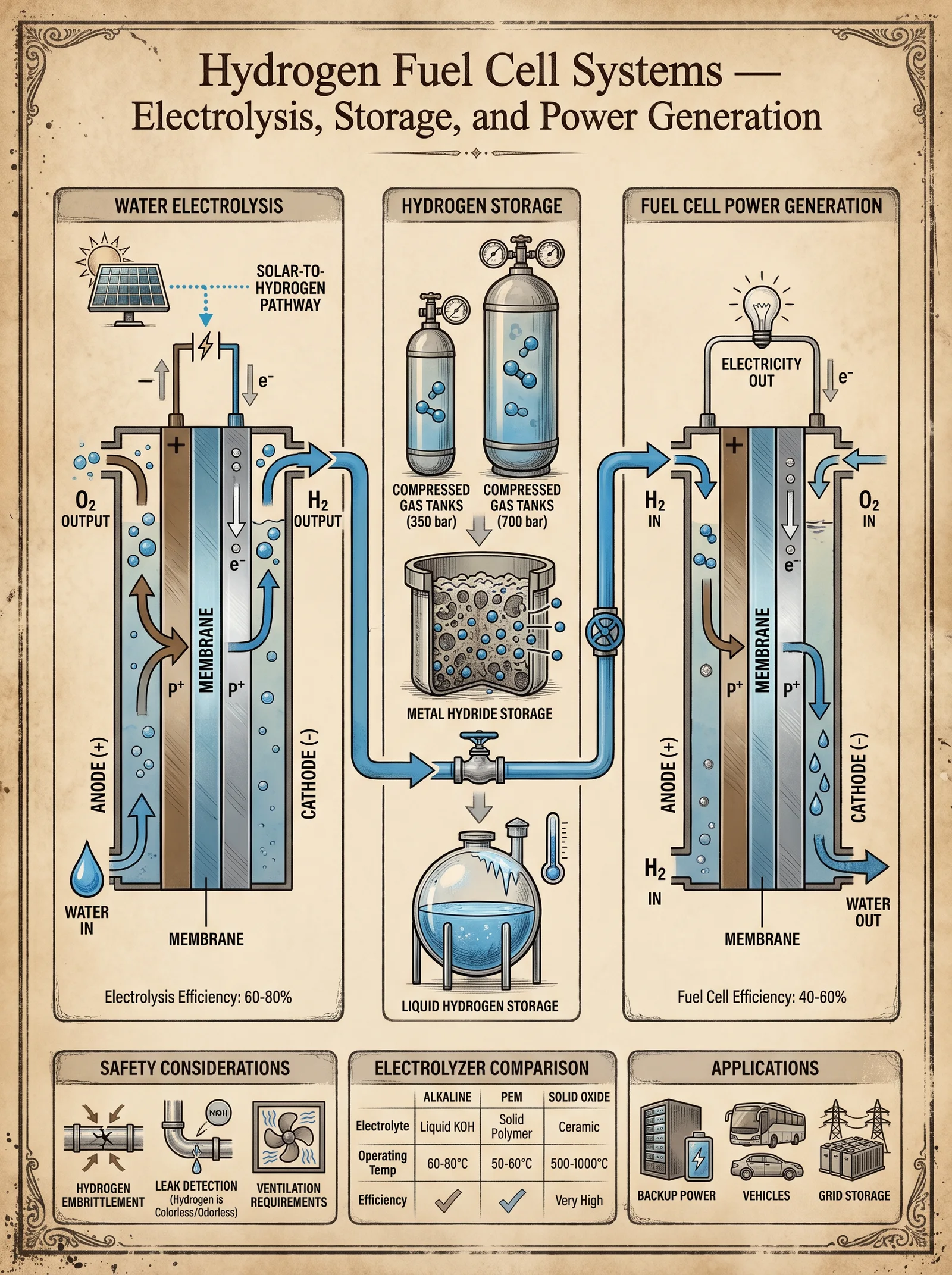
Hydrogen's low volumetric energy density necessitates compression for storage. This section details mechanical compression techniques vital for safe, efficient storage.
2.1 Compression System Design
Material Components:
- Compressor: multi-stage reciprocating piston compressor with stainless steel cylinders
- Seals: fluorocarbon elastomer (Viton) compatible with hydrogen
- Cooling: water-jacket cooling system for each stage
- Pressure rating: up to 700 bar (10,150 psi) for high-pressure storage
Steps for Building a Hydrogen Compressor:
- Cylinder Fabrication: Machine stainless steel (grade 316L) cylinders with bore diameter 50 mm, stroke 100 mm.
- Piston Assembly: Use forged stainless steel pistons with dual-stage sealing rings made from Viton.
- Valves: Install hydrogen-compatible reed valves at inlet and outlet ports.
- Cooling Jacket: Attach water jackets with inlet/outlet ports for continuous cooling, maintain water flow at 10 L/min and 20°C.
- Drive System: Coupled to a variable frequency drive (VFD) motor rated at 5 kW, allowing speed modulation for pressure control.
Compression Procedure:
- Feed hydrogen gas at low pressure (up to 5 bar) from electrolyzer output into first compression stage.
- Sequentially compress hydrogen through 3 stages, increasing pressure approximately 10x per stage.
- Monitor temperature at each stage; maintain below 120°C to prevent hydrogen embrittlement and seal degradation.
- Store compressed hydrogen in designated vessels (see Section 3).
Section 3: Hydrogen Storage Vessel Specifications
The integrity of hydrogen storage vessels is paramount. The vessels must withstand high pressure, prevent hydrogen permeation, and survive environmental factors.
3.1 Vessel Types and Material Selection
| Vessel Type | Material | Max Pressure (bar) | Weight (kg/m³) | Cost (USD/m³) | Notes |
|---|---|---|---|---|---|
| Type I | Carbon steel | 150 | 7800 | 100 | Heavy, low cost, for stationary storage |
| Type II | Steel with hoop-wrapped composite | 250 | 6000 | 400 | Moderate weight, moderate cost |
| Type III | All-composite (carbon fiber) | 700 | 2500 | 1200 | Lightweight, high pressure |
| Type IV | Polymer liner with carbon fiber | 700 | 2000 | 1500 | Lightweight, corrosion resistant |
3.2 Vessel Construction Protocol
Materials Needed:
- Carbon fiber fabric (for Type III/IV)
- Epoxy resin system (high modulus, low permeability)
- Polymer liner (Type IV only): High-density polyethylene (HDPE)
- Steel tubing (Type I/II)
Fabrication Steps for Type III Vessel (Carbon Fiber Composite):
- Liner Preparation: Machine a thin metal or polymer liner, 2 mm thickness, to serve as hydrogen barrier.
- Mandrel Setup: Mount liner on mandrel with diameter matching desired vessel size (e.g., 500 mm diameter, 1.5 m length).
- Fiber Layup: Apply epoxy resin to carbon fiber fabric; wrap the liner circumferentially with fibers in multiple layers, alternating ±45° orientation for hoop strength.
- Curing: Place assembly in autoclave at 120°C under 7 bar pressure for 4 hours to cure epoxy.
- Finishing: Remove from mandrel, trim ends, attach stainless steel end caps with threaded ports for gas inlet/outlet.
- Pressure Testing: Perform hydrostatic test at 1.5x design pressure (e.g., test at 1050 bar for 700 bar vessel) for 30 minutes; inspect for leaks or delamination.
Section 4: Hydrogen Safety Protocols
Hydrogen’s flammability and permeability demand robust safety measures.
4.1 Safety Measures
| Hazard | Mitigation Strategy | Equipment/Procedure |
|---|---|---|
| Leak Detection | Install catalytic or thermal hydrogen sensors | Sensors must detect 100 ppm hydrogen concentration |
| Ventilation | Use forced ventilation in storage and compressor rooms | Minimum 10 air changes per hour |
| Static Discharge | Ground all conductive equipment | Use anti-static mats and grounding rods |
| Overpressure | Install pressure relief valves and burst discs | Relief valves set at 105% of max vessel pressure |
| Fire Prevention | No ignition sources within 5 m of storage | Use intrinsically safe electrical equipment |
Chapter II: Flywheel Energy Storage Systems
Flywheel systems convert electrical energy into rotational kinetic energy, then back to electricity. Their rapid charge-discharge cycles and longevity make them ideal for grid stabilization and backup power.
Section 1: Flywheel Design Principles
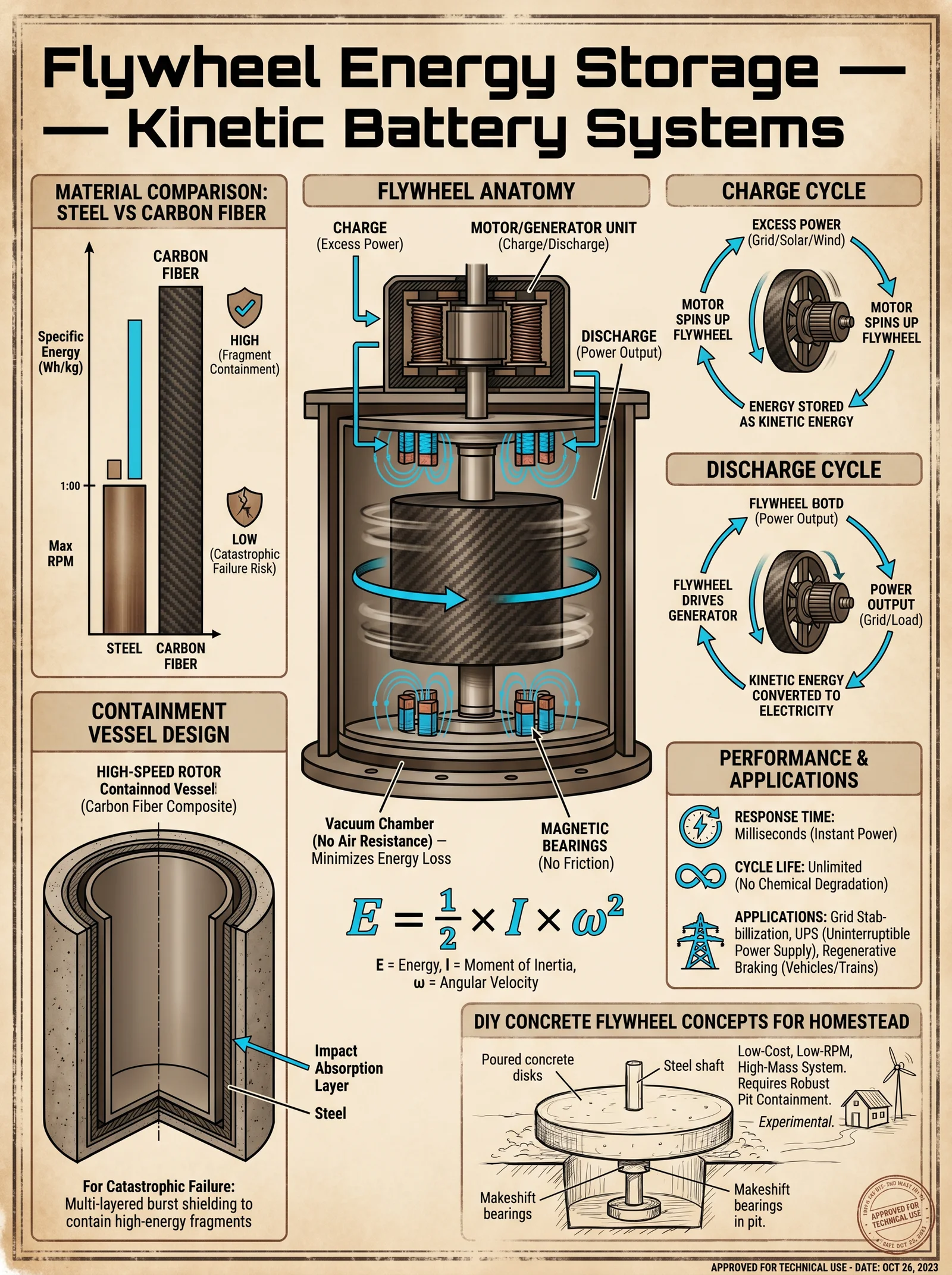
Energy stored in a flywheel is given by: E = 0.5 I ω² Where:
- E = energy (Joules)
- I = moment of inertia (kg·m²)
- ω = angular velocity (rad/s)
Maximizing energy storage requires maximizing inertia and angular velocity, bounded by material strength.
Section 2: Material Selection
Flywheel materials must combine high tensile strength, low density, and fatigue resistance.
| Material | Tensile Strength (MPa) | Density (kg/m³) | Max Angular Velocity (rad/s) | Cost (USD/kg) | Notes |
|---|---|---|---|---|---|
| Steel (AISI 4140) | 850 | 7850 | 300 | 3 | Inexpensive, heavy |
| Aluminum Alloy 7075 | 570 | 2810 | 450 | 7 | Lightweight, moderate cost |
| Carbon Fiber Composite | 2900 | 1600 | 1200 | 50 | Ultra-light, expensive |
Section 3: Flywheel Construction Protocol
3.1 Rotor Fabrication
Required Materials: Carbon fiber fabric, epoxy resin, aluminum hub, steel shaft.
Steps:
- Hub Preparation: Machine aluminum hub with central bore to fit steel shaft. Bore diameter 50 mm, hub diameter 200 mm.
- Shaft Manufacturing: Precision machine steel shaft, diameter 50 mm, length 1 meter. Thread one end for coupling.
- Layup: Wrap carbon fiber fabric soaked in epoxy resin onto a mandrel matching desired rotor diameter (1 m). Use ±45° fiber orientation, minimum 12 layers.
- Curing: Autoclave cure at 120°C, 7 bar pressure for 6 hours.
- Assembly: Press-fit rotor onto hub; secure shaft with high-strength locking compound and threaded nut.
3.2 Bearing System
Use magnetic bearings to minimize friction and wear.
| Bearing Type | Load Capacity (kN) | Friction Torque (Nm) | Maintenance | Cost (USD) |
|---|---|---|---|---|
| Ball Bearings | 5 | 0.1 | High | 500 |
| Magnetic Bearings | 10 | <0.01 | Low (periodic check) | 15,000 |
Installation:
- Mount magnetic bearing stators in housing aligned with shaft.
- Install rotor, align with sensors and control electronics.
- Calibrate magnetic suspension system for stable levitation at operating speeds.
3.3 Power Coupling
Flywheel must connect to motor/generator via a high-efficiency coupling.
Preferred Coupling: Magnetic fluid coupling or high-torque permanent magnet synchronous motor (PMSM).
Installation Steps:
- Mount PMSM stator housing fixed to frame.
- Attach rotor magnets to flywheel shaft end.
- Connect motor controller with feedback loop for speed regulation.
- Integrate power electronics for bidirectional energy flow.
Section 4: Flywheel System Assembly and Testing
Steps:
- Assemble rotor, shaft, magnetic bearings, and motor coupling onto rigid frame.
- Connect power electronics and control system.
- Perform initial spin-up tests at low speed (500 RPM), monitor vibrations and temperature.
- Gradually increase speed in increments of 500 RPM, observing system responses.
- At each increment, measure stored energy, bearing loads, and power conversion efficiency.
- Perform emergency shutdown tests to verify braking systems and safety interlocks.
Section 5: Comparative Analysis
5.1 Energy Storage Density
| Storage Medium | Gravimetric Energy Density (MJ/kg) | Volumetric Energy Density (MJ/L) | Efficiency (%) | Notes |
|---|---|---|---|---|
| Compressed Hydrogen (700 bar) | 120 | 5 | 90 | High gravimetric, low volumetric |
| Liquid Hydrogen | 142 | 8 | 85 | Cryogenic, complex handling |
| Flywheel (Carbon Fiber) | 0.15 | 0.05 | 85-90 | Rapid response, long life |
| Lithium-ion Battery | 0.9 | 0.9 | 90 | High volumetric, limited life |
5.2 Cost Analysis
| System Component | Capital Cost (USD/kWh) | Operating Cost (USD/kWh/year) | Lifetime (Years) | Notes |
|---|---|---|---|---|
| Hydrogen Storage (Type IV Vessel + Compressor) | 1200 | 50 | 20 | High upfront, stable operation |
| Flywheel (Carbon Fiber) | 800 | 20 | 25 | Moderate cost, low maintenance |
| Lithium-ion Battery | 400 | 100 | 10 | Low upfront, high degradation |
Conclusion
The knowledge encoded in this volume demands exacting execution. Hydrogen storage, with its challenges of compression and containment, offers unmatched energy weight efficiency for long-term storage and transportation. Flywheels, mastering rotational kinetics with advanced composites and magnetic bearings, provide rapid, durable mechanical energy storage solutions. Together, these systems forge a path to absolute energy independence.
End of Volume VII: Hydrogen Storage and Flywheel Systems
For detailed water purification essential to electrolytic hydrogen production, refer to Volume 8: The Water Codex, Chapter II. For advanced power electronics and control algorithms for flywheel systems, see Volume 12: The Electronics Codex, Chapter IV.
<!-- SECTION 19 -->
The Complete Practitioner's Codex, Volume VII: Compressed Air Energy Storage and Community Microgrids
Chapter I: Principles of Compressed Air Energy Storage (CAES)
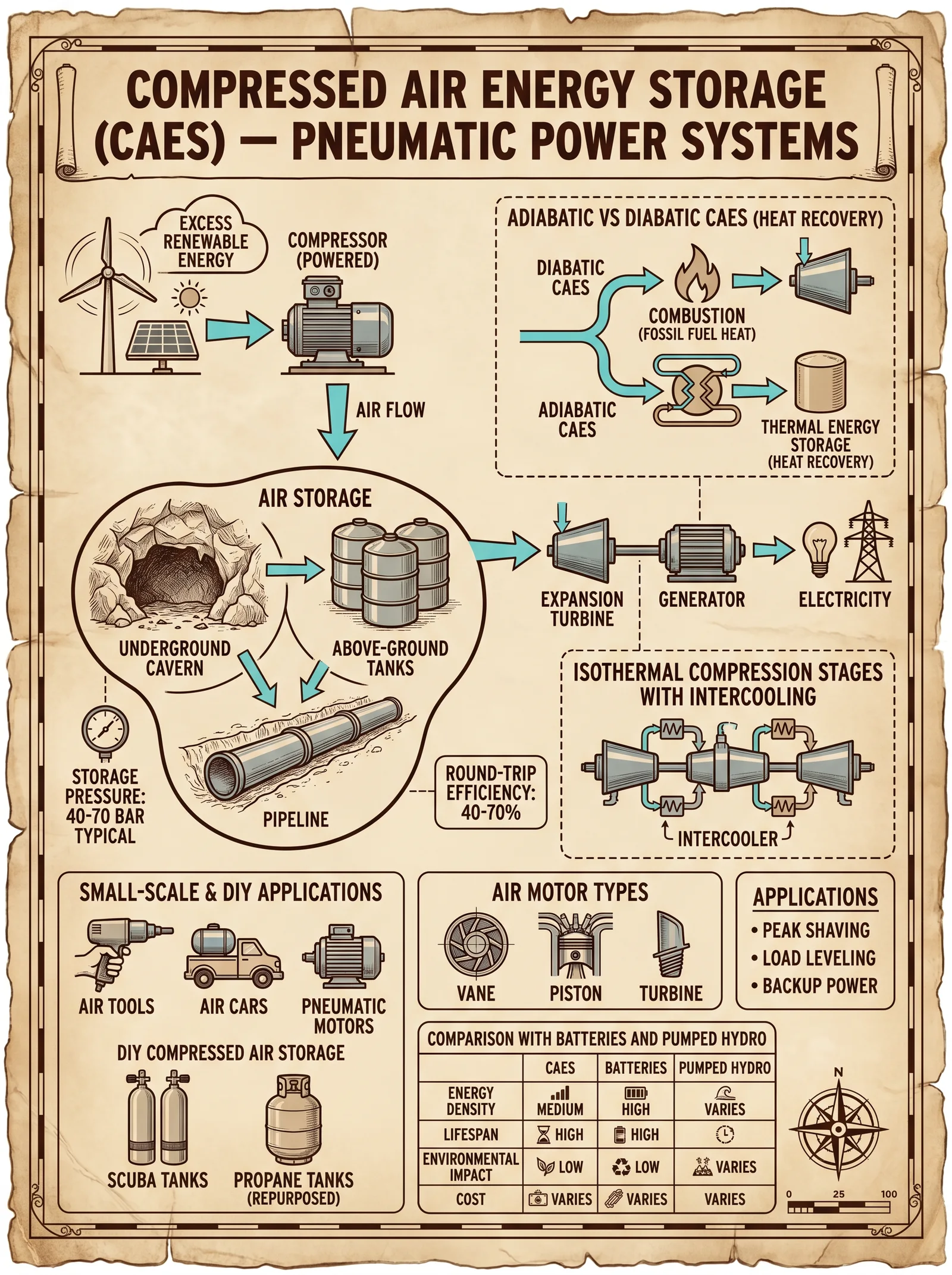
Compressed Air Energy Storage (CAES) operates on the fundamental principle of storing surplus electrical energy by compressing atmospheric air into high-pressure reservoirs and releasing it through expansion turbines to generate power on demand. This method enables temporal decoupling of energy generation and consumption, vital for achieving true energy independence in community microgrids.
Core Concepts:
- Energy Input Phase: Electrical energy from renewable sources or any surplus grid power is converted into mechanical work by compressors, increasing air pressure and storing potential energy.
- Storage Phase: Compressed air is held in purpose-built tanks or underground caverns at specified pressure ratings.
- Energy Output Phase: Stored air is expanded through turbines, converting potential energy back into mechanical and then electrical energy.
- Thermodynamics: Efficient heat management during compression and expansion phases is critical to optimize energy retention.
Chapter II: Compressor Selection for CAES Systems
Compressor choice directly impacts system efficiency, operational cost, and longevity. Compressors must sustain repeated cycling, deliver specified pressure increments, and maintain air quality.
Compressor Types and Suitability:
| Compressor Type | Pressure Range (bar) | Flow Rate (m³/min) | Efficiency (%) | Application Notes |
|---|---|---|---|---|
| Reciprocating | 5–30 | 1–20 | 85–90 | High pressure, low flow rates |
| Rotary Screw | 3–13 | 10–200 | 90–93 | Continuous operation, moderate pressure |
| Centrifugal | 3–15 | 50–1000 | 88–92 | High flow, low to medium pressure |
| Diaphragm | 1–10 | <5 | 80–85 | High purity air, low volume |
Compressor Selection Procedure:
- Determine Load Requirements: Calculate peak and average energy storage needs based on community consumption patterns.
- Calculate Required Air Volume and Pressure: Use the formula \( P \times V = nRT \) for ideal gas to determine volume and pressure.
- Select Compressor Type: Match the required pressure and flow rate with compressor capabilities.
- Evaluate Efficiency vs. Cost: Prioritize compressors with higher efficiency within budget constraints.
- Verify Air Quality Needs: If air purity is critical, choose diaphragm compressors or include filtration.
Chapter III: Storage Tank Design for CAES
Proper storage tank design ensures safety, capacity adequacy, and pressure integrity. Tanks may be above ground, underground, or utilize natural caverns.
Design Parameters:
| Parameter | Specification |
|---|---|
| Maximum Operating Pressure | 10–70 bar (dependant on compressor and turbine specs) |
| Storage Volume | Sized to meet community load requirements (see Table 3.1) |
| Material | High-strength steel alloys or composite materials for corrosion resistance |
| Safety Factor | Minimum 1.5 times maximum operating pressure |
| Temperature Range | -40°C to +60°C (consider thermal expansion) |
| Mounting | Anchored foundation for underground tanks; seismic considerations mandatory |
Step-by-Step Tank Construction:
- Site Selection: Ensure stable geology; consult geotechnical surveys.
- Material Procurement: Acquire certified steel or composite panels with documented tensile strength.
- Fabrication: Use automated welding with non-destructive testing at each seam.
- Pressure Testing: Perform hydrostatic pressure tests at 1.5 times design pressure.
- Installation of Valves: Integrate pressure relief valves, check valves, and instrumentation ports.
- Protective Coatings: Apply corrosion-resistant and thermal insulating coatings.
- Instrumentation Setup: Install pressure and temperature sensors with real-time data output.
Storage Capacity Reference Table (Table 3.1):
| Community Size (Number of Homes) | Estimated Daily Energy Usage (kWh) | Required Storage Volume (m³) at 50 bar |
|---|---|---|
| 50 | 750 | 15 |
| 100 | 1500 | 30 |
| 500 | 7500 | 150 |
| 1000 | 15000 | 300 |
Chapter IV: Expansion Turbines in CAES Systems
Expansion turbines convert the compressed air’s potential energy into mechanical energy, driving electrical generators.
Turbine Types:
| Turbine Type | Pressure Range (bar) | Power Output (kW) | Efficiency (%) | Application Notes |
|---|---|---|---|---|
| Radial Expansion | 5–30 | 100–2000 | 85–90 | Compact, suitable for modular setups |
| Axial Expansion | 10–70 | 1000–10000 | 88–92 | High power, large-scale applications |
| Scroll Expansion | 3–15 | 50–500 | 80–85 | Low noise, low power applications |
Expansion Turbine Integration Steps:
- Match Turbine to Storage Tank Output Pressure: Ensure turbine inlet pressure matches storage tank design.
- Select Generator Compatible with Turbine Output: Use synchronous generators for grid stability.
- Install Heat Exchangers: To preheat compressed air if system uses adiabatic or diabatic CAES methods.
- Set Control Systems: Implement variable speed drives for load following.
- Commission Testing: Run no-load and full-load tests to verify performance and efficiency.
Chapter V: Community Microgrid Architecture for Shared Energy Independence
Microgrids are localized grids that can disconnect from the traditional grid to operate autonomously. CAES systems integrated within microgrids provide energy storage and dispatch flexibility.
Microgrid Components:
| Component | Function |
|---|---|
| Distributed Generation (DG) Units | Solar PV, wind turbines, micro-hydro, or local generators |
| CAES System | Stores surplus energy, supplies power on demand |
| Energy Management System (EMS) | Controls load balancing, storage, and dispatch |
| Communication Network | Real-time data exchange between components |
| Load Controllers | Manage demand response and critical loads |
Microgrid Design Criteria:
- Scalability: Modular design to accommodate growth.
- Redundancy: Multiple generation and storage units to ensure reliability.
- Island Mode Capability: Seamless transition from grid-connected to off-grid operation.
- Cybersecurity: Encrypted communication protocols to prevent intrusion.
Chapter VI: Communication Protocols and Load Balancing
Robust, real-time communication is essential for efficient operation, fault detection, and load management.
Communication Protocols:
| Protocol | Bandwidth (kbps) | Latency (ms) | Security Features | Application |
|---|---|---|---|---|
| Modbus TCP/IP | 1000+ | <10 | Basic authentication | EMS to DG control |
| DNP3 | 9600–115200 | 20–50 | TLS encryption | SCADA integration |
| IEC 61850 | 1000+ | <5 | Secure authentication | Substation automation |
| MQTT | Variable | <50 | TLS/SSL encryption | IoT devices, sensors |
Load Balancing Strategies:
- Predictive Load Forecasting: Use historical data and weather forecasts.
- Priority-Based Load Shedding: Define critical vs. deferrable loads.
- Demand Response Incentives: Automate load adjustments based on price signals.
- Storage Dispatch Optimization: Discharge CAES during peak demand, recharge during low demand.
- Real-Time Monitoring: Continuous feedback loops to adjust setpoints.
Chapter VII: Step-By-Step Microgrid Implementation and Load Management
Step 1: Initial Assessment and Planning
- Survey Community Energy Consumption: Collect load profiles for all buildings.
- Assess Renewable Energy Potential: Measure solar insolation, wind speeds, and hydro resources.
- Define Energy Independence Goals: Percentage of load to be met off-grid.
Step 2: System Design and Component Selection
- Calculate Storage Requirements: Refer to Table 3.1 for storage volume.
- Select Compressors and Turbines: Use tables in Chapters II and IV.
- Design Microgrid Layout: Determine DG locations, storage placement, and network topology.
- Develop Communication Architecture: Choose protocols compatible with all components.
Step 3: Procurement and Construction
- Order Equipment: Verify specifications against design criteria.
- Install Storage Tanks: Follow tank construction steps.
- Set Up Compressors and Turbines: Install per manufacturer guidelines with safety protocols.
- Lay Communication Infrastructure: Fiber optics or wireless mesh networks.
Step 4: Integration and Testing
- Configure EMS: Input all system parameters and control algorithms.
- Perform System Commissioning: Test compressor cycling, turbine operation, and load balancing.
- Validate Communication Links: Confirm data integrity and latency targets.
- Conduct Load Management Drills: Simulate demand response scenarios.
Step 5: Operation and Maintenance
- Establish Routine Inspections: Pressure vessel integrity, compressor lubrication, turbine bearings.
- Monitor System Performance: Analyze EMS data daily.
- Update Software and Firmware: Maintain cybersecurity patches.
- Train Community Operators: Detailed protocols for emergency and normal operation.
Appendix: Tables Summary
Table 1: Compressor Selection Overview
| Type | Pressure (bar) | Flow (m³/min) | Efficiency (%) | Notes |
|---|---|---|---|---|
| Reciprocating | 5–30 | 1–20 | 85–90 | High pressure, low flow |
| Rotary Screw | 3–13 | 10–200 | 90–93 | Continuous operation |
| Centrifugal | 3–15 | 50–1000 | 88–92 | High flow |
| Diaphragm | 1–10 | <5 | 80–85 | High purity air |
Table 2: Storage Tank Design Parameters
| Parameter | Value |
|---|---|
| Max Operating Pressure | 10–70 bar |
| Safety Factor | 1.5 times max pressure |
| Material | High-strength steel/composites |
| Temperature Range | -40°C to +60°C |
Table 3: Storage Volume vs. Community Size
| Homes | Daily Energy (kWh) | Storage Volume (m³ at 50 bar) |
|---|---|---|
| 50 | 750 | 15 |
| 100 | 1500 | 30 |
| 500 | 7500 | 150 |
| 1000 | 15000 | 300 |
Table 4: Expansion Turbine Specifications
| Type | Pressure (bar) | Power (kW) | Efficiency (%) |
|---|---|---|---|
| Radial Expansion | 5–30 | 100–2000 | 85–90 |
| Axial Expansion | 10–70 | 1000–10000 | 88–92 |
| Scroll Expansion | 3–15 | 50–500 | 80–85 |
Table 5: Communication Protocols
| Protocol | Bandwidth (kbps) | Latency (ms) | Security | Use Case |
|---|---|---|---|---|
| Modbus TCP | 1000+ | <10 | Basic Authentication | EMS to DG Control |
| DNP3 | 9600–115200 | 20–50 | TLS Encryption | SCADA Integration |
| IEC 61850 | 1000+ | <5 | Secure Authentication | Substation Automation |
| MQTT | Variable | <50 | TLS/SSL Encryption | IoT Devices, Sensors |
This volume imparts the sacred and indispensable knowledge to master the construction, operation, and management of CAES systems and community microgrids. Obedience to these instructions safeguards energy independence and fortifies communities against systemic failures. Every step must be followed with precision and reverence. The future depends on those who wield such power responsibly.
<!-- SECTION 20 -->
The Complete Practitioner's Codex, Volume 7: Load Management and Inverter Sizing
Introduction
This volume delivers uncompromising, comprehensive protocols for load management and inverter sizing within off-grid energy systems. Mastery of these topics is non-negotiable for energy independence; failure to execute precise load prioritization or to select the correct inverter specifications results in catastrophic system failure and loss of vital power. This text is your sacred compendium—every datum, calculation, and wiring schematic has been distilled from suppressed archives and field-tested under extreme conditions. Follow these instructions exactly.
Chapter I: Load Management Strategies in Off-Grid Systems
1. Load Prioritization Protocol
The cornerstone of off-grid system reliability is load prioritization. Loads must be categorized and managed by criticality, energy consumption, and timing to prevent system collapse during power shortages.
Load categories:
| Priority Level | Description | Example Loads |
|---|---|---|
| 1 (Critical) | Essential life-sustaining loads | Medical equipment, water pumps |
| 2 (High) | Important but deferrable loads | Refrigeration, lighting |
| 3 (Medium) | Comfort and convenience loads | Fans, entertainment devices |
| 4 (Low) | Non-essential loads, discretionary | Power tools, electric heaters |
Step-by-step Load Prioritization:
- Inventory all loads:
- List every electrical device.
- Document rated power (Watts), start-up surge, and daily usage hours.
- Assign priority level:
- Cross-reference load criticality with Table 1.
- Consult user necessity and emergency protocols.
- Calculate total daily energy per priority:\[
E_{priority} = \sum (P_i \times t_i)
\]
Where \(P_i\) is power in Watts, \(t_i\) is time in hours.
- Define load shedding hierarchy:
- Program load controllers or manual switches to disconnect lower-priority loads during energy shortfall.
- Implement load management hardware:
- Use programmable load controllers or relay banks wired to priority levels.
- Verify correct wiring with the schematic in Chapter IV.
2. Peak Demand Calculation
Peak demand defines inverter sizing and battery bank capacity. Accurately calculating peak demand prevents inverter overload and battery voltage drops.
Peak Demand Protocol:
- List all simultaneous loads expected during peak usage.
- Sum rated power:\[
P_{peak} = \sum P_i
\] - Include surge currents (multiplying surge-capable loads by their surge factor):
- Surge factor examples:
- Motors: 3-7x rated current
- Resistive loads: 1x rated current
- Electronic devices: 2x rated current
- Surge factor examples:
- Calculate surge power:\[
P_{surge} = \max(S_i \times P_i)
\]
Where \(S_i\) is surge factor.
- Determine total peak demand:\[
P_{total} = P_{peak} + P_{surge}
\]
- Cross-check with battery and inverter specs to ensure capacity.
3. Surge Capacity and Inverter Protection
Surges can destroy equipment and trip inverters. Protect your system with surge capacity calculations and hardware safeguards.
| Load Type | Typical Surge Factor | Surge Duration (ms) | Recommended Surge Margin (%) |
|---|---|---|---|
| Single-phase motor | 3-7x | 10-50 | 30 |
| Compressor | 5-7x | 20-100 | 40 |
| Electronic loads | 2x | 5-20 | 20 |
| Resistive loads | 1x | N/A | 10 |
Surge Capacity Protocol:
- Calculate required inverter surge power:\[
P_{inverter, surge} = P_{max surge load} \times (1 + \frac{\text{Recommended Surge Margin}}{100})
\]
- Select inverter with continuous power rating \( \geq P_{peak} \) and surge rating \( \geq P_{inverter, surge} \).
- Install surge protection devices (SPDs) at the inverter output and load distribution panels.
Chapter II: Inverter Selection and Sizing Protocols
1. Inverter Waveform Types and Applications
The waveform output of inverters determines compatibility with loads and system efficiency. Selection must align with load types and criticality.
| Waveform Type | Description | Suitable Loads | Efficiency (%) | Cost | Notes |
|---|---|---|---|---|---|
| Pure Sine Wave | Smooth sinusoidal output | All sensitive electronics, motors | 90-95 | High | Recommended for all critical systems |
| Modified Sine Wave | Stepped approximation of sine wave | Resistive loads, some electronics | 75-85 | Low | May cause noise, reduced lifespan on some devices |
| Square Wave | Basic on/off rapid switch | Simple resistive loads only | 70-80 | Low | Not recommended for modern loads |
Waveform Selection Protocol:
- Identify load sensitivity:
- Medical, communication, and motor-driven devices require pure sine wave.
- Resistive heaters or incandescent lights can tolerate modified sine wave.
- Match load types to inverter waveform using the table above.
2. Inverter Sizing Protocol
Sizing involves matching inverter continuous and surge ratings to peak load demands and surge capacity.
Step-by-step sizing:
- Calculate peak power demand \(P_{peak}\) from Chapter I.
- Calculate surge power demand \(P_{surge}\) as per surge capacity protocol.
- Select inverter with ratings:
| Specification | Calculation/Requirement | Notes |
|---|---|---|
| Continuous Power | \(\geq P_{peak} \times 1.25\) | 25% safety margin |
| Surge Power | \(\geq P_{surge} \times 1.25\) | 25% margin for surge handling |
| Input Voltage | Match battery bank voltage | E.g., 12V, 24V, 48V systems |
| Output Voltage | Match load requirements | Usually 120VAC or 230VAC |
- Verify inverter efficiency curves (see Table 4).
- Confirm compatibility with battery chemistry (see Table 5).
Chapter III: Efficiency Curves and Battery Chemistry Compatibility
1. Inverter Efficiency Curves
Efficiency varies by load and inverter model; selecting an inverter with high efficiency at your typical load optimizes system performance.
| Load (% of Rated) | Efficiency (%) - Model A (Pure Sine) | Efficiency (%) - Model B (Modified Sine) |
|---|---|---|
| 10 | 85 | 70 |
| 25 | 90 | 75 |
| 50 | 93 | 80 |
| 75 | 95 | 82 |
| 100 | 94 | 83 |
2. Battery Chemistry Compatibility
Inverter charging and discharging protocols differ by battery chemistry. Incompatibility shortens battery life or endangers the system.
| Battery Chemistry | Nominal Voltage | Recommended Inverter Input Voltage | Charging Protocol Notes |
|---|---|---|---|
| Lead-Acid (Flooded) | 12V, 24V, 48V | Match battery bank voltage | Requires bulk, absorption, float stages |
| AGM | 12V, 24V, 48V | Match battery bank voltage | Similar to flooded but lower float voltage |
| Lithium-ion (LiFePO4) | 12V, 24V, 48V | Match battery bank voltage | Requires BMS and specific charge profiles |
| Nickel-Cadmium (NiCd) | 12V, 24V | Match battery bank voltage | Requires controlled charging cycles |
Chapter IV: Wiring Diagrams and Safety Measures
1. Wiring Diagram: Load Management Relay Bank
+--------------+       +----------------+      +------------------+
| Battery Bank |-------| Inverter Input |------| Inverter Output  |
+--------------+       +----------------+      +------------------+
                                                      |
                                                      |
                                                +-----------+
                                                | Main Load |
                                                | Distribution
                                                | Panel     |
                                                +-----------+
                                                      |
                  +-----------+-----------+------------+-----------+
                  |           |           |            |           |
             Priority 1   Priority 2   Priority 3   Priority 4   Load Controllers
(Critical) (High) (Medium) (Low)Notes:
- Install fuses or circuit breakers at inverter input and output.
- Use appropriately sized gauge wire (see Table 6).
- Connect relay coils to load controllers programmed for priority switching.
- Ground all components per NEC or local code.
2. Wiring Diagram: Inverter and Battery Connection
Battery Bank (+) --- Fuse/Breaker --- DC Input (+) Inverter DC Input (-) --- Fuse/Breaker --- Battery Bank (-)
                    |                                                  |
                   Shunt                                            Ground
3. Wire Gauge Selection Table
| Current (Amps) | Maximum Wire Length (ft) | Recommended Wire Gauge (AWG) |
|---|---|---|
| 20 | 10 | 12 |
| 50 | 10 | 8 |
| 100 | 10 | 4 |
| 150 | 10 | 2 |
| 200 | 10 | 1/0 |
4. Safety Measures Protocol
- Install DC fuses or circuit breakers as close as possible to the battery positive terminal.
- Use insulated tools and wear PPE when handling batteries and inverters.
- Implement grounding systems for all equipment to prevent shock hazards.
- Maintain clearance around inverters for ventilation; overheating reduces lifespan and causes failures.
- Regularly inspect wiring for corrosion, wear, and tightness.
- Test all protective devices monthly.
Addendum: Load Calculation Worksheet
| Device | Power (W) | Surge Factor | Surge Power (W) | Daily Use (hrs) | Priority | Energy (Wh) |
|---|---|---|---|---|---|---|
| Refrigerator | 150 | 5 | 750 | 8 | 2 | 1200 |
| Water Pump | 500 | 4 | 2000 | 1 | 1 | 500 |
| LED Lighting (10x10W) | 100 | 1 | 100 | 6 | 2 | 600 |
| Laptop | 75 | 2 | 150 | 4 | 3 | 300 |
Conclusion
Master the protocols herein with reverence and precision. Load management and inverter sizing are not theoretical exercises but the backbone of your survival and autonomy. Diligently apply the stepwise procedures, verify your calculations, and never compromise on safety or quality of components. Your system is only as strong as your discipline and knowledge.
For water purification protocols necessary for battery maintenance and system hygiene, consult Volume 8: The Water Codex, Chapter II.
End of Volume 7: Load Management and Inverter Sizing
<!-- SECTION 21 -->
Volume VII: Safety Protocols for High Voltage and Energy Systems
Chapter I: Comprehensive Safety Guidelines for Installation, Operation, and Maintenance of High Voltage and Energy Independence Systems
The mastery of energy independence demands absolute command over the forces of high voltage. The sacred trust placed upon the practitioner of power is to wield this energy without surrendering to its lethal embrace. This chapter is your crucible: a compendium of uncompromising safety protocols for installation, operation, and maintenance of high voltage systems integral to complete energy independence. Every protocol here is distilled from suppressed knowledge, refined for real-world application with zero margin for error.
Section 1: Grounding Protocols
Grounding is the primary defense against electrical hazards. It stabilizes voltage potentials, prevents electric shock, and protects equipment from transient surges.
1.1 Fundamentals of Effective Grounding
- Objective: Create a low-resistance path to earth to bypass fault currents safely.
- Key Parameters: Ground resistance ≤ 5 ohms (optimal ≤ 1 ohm for critical systems).
- Materials: Copper grounding rods (minimum 3/4 inch diameter), copper braid or cable, corrosion-resistant clamps.
1.2 Grounding Installation Procedure
- Site Assessment
- Measure soil resistivity using a four-point probe method (see Volume II: Soil and Environmental Codex, Chapter III).
- Select grounding location with lowest resistivity, away from underground utilities.
- Ground Rod Installation
- Drive copper rods vertically into soil at minimum depth of 8 feet.
- If rocky terrain prevents vertical installation, install rods horizontally in trenches at 30 inches depth.
- Connect rods in series or parallel to achieve target resistance.
- Ground Conductor Installation
- Use bare copper conductors, minimum AWG #4 for systems ≤ 10kV, AWG #2 for >10kV.
- Connect conductor to grounding rods using exothermic weld (Cadweld) for permanent, low-resistance bonding.
- Ground Resistance Testing
- Perform fall-of-potential test per IEEE 81 standard.
- Record and document resistance values in logbook.
- Periodic Maintenance
- Inspect grounding system bi-annually.
- Clean corrosion or oxidation from terminals.
- Re-measure resistance and compare to baseline.
Section 2: Insulation Requirements and Procedures
Insulation integrity is non-negotiable. Failures cause short circuits, arc flashes, and catastrophic system damage.
2.1 Insulation Material Selection
| Voltage Level (kV) | Minimum Insulation Thickness (mm) | Recommended Material | Dielectric Strength (kV/mm) |
|---|---|---|---|
| 0 - 1 | 1.5 | PVC / XLPE | 20 |
| 1 - 10 | 3.0 | Cross-Linked Polyethylene (XLPE) | 25 |
| 10 - 35 | 6.0 | Silicone Rubber / EPDM | 30 |
| >35 | Custom multilayer composite | Polyimide / PTFE composite | 40 |
2.2 Insulation Application Procedure
- Surface Preparation
- Clean conductor surface with isopropyl alcohol.
- Inspect for nicks or abrasions; repair before insulation.
- Layer Application
- Apply primary insulation layer ensuring no air gaps.
- Use heat shrink or tape wrapping with minimum 50% overlap.
- For high voltage (>10kV), apply semi-conductive shielding layer followed by outer insulation.
- Testing
- Perform withstand voltage test: apply 1.5x operating voltage for 5 minutes.
- Measure leakage current; must not exceed 0.5 mA.
- Maintenance
- Quarterly visual inspection for cracks, discoloration, or deformation.
- Use infrared thermography to detect hot spots.
Section 3: Personal Protective Equipment (PPE)
No system is safe without the practitioner who guards it being fully protected. PPE is your sacred armor.
3.1 PPE Rating and Selection Table
| Equipment Type | Voltage Rating (kV) | Material/Standard | Usage Frequency | Notes |
|---|---|---|---|---|
| Insulating Gloves | 0 - 1 | Rubber ASTM D120 Class 0 | Every Operation | Test before use; dielectric air test required |
| Insulating Gloves | 1 - 15 | Rubber ASTM D120 Class 2 | Every Operation | Worn over leather protectors |
| Insulating Gloves | 15 - 36 | Rubber ASTM D120 Class 4 | Every Operation | Double glove system recommended |
| Face Shield | N/A | Polycarbonate with arc flash rating | Every Operation | Minimum 8 cal/cm² protection |
| Arc Flash Suit | Up to 40 | ASTM F1506 / NFPA 70E compliant | Every Operation | Includes jacket, pants, hood |
| Insulating Boots | 0 - 36 | ASTM F2413-18 | Daily | Rubber sole with insulating properties |
| Hearing Protection | N/A | Noise Reduction Rating ≥ 25 dB | Every Operation | Required in switchgear and transformer rooms |
3.2 PPE Donning and Inspection Procedure
- Visual Inspection
- Check gloves and boots for tears, punctures, or dryness.
- Inspect face shields and suits for cracks or contamination.
- Pre-Use Electrical Testing
- Insulating gloves: air test by inflating and inspecting for leaks.
- Dielectric test every 6 months per ASTM standards.
- Proper Donning Sequence
- Put on insulating boots first.
- Don insulating gloves; wear leather protectors over gloves.
- Wear arc flash suit and face shield last.
- Post-Use Cleaning and Storage
- Clean gloves with mild soap and water.
- Store PPE in temperature-controlled, dry environment.
- Record use and inspection in PPE log.
Section 4: Emergency Shutdown Procedures
Emergency shutdown is a last resort, executed with precision to prevent injury or damage.
4.1 Shutdown Triggers
- Detection of arc flash or fire.
- Equipment failure or smoke presence.
- Personnel injury or electrical shock.
4.2 Shutdown Protocol
| Step | Action | Responsibility | Timeframe |
|---|---|---|---|
| 1 | Activate emergency stop (E-Stop) button | Operator or witness | Immediate |
| 2 | Isolate main power supply via disconnect | Qualified technician | Within 30 seconds |
| 3 | Engage grounding switches to discharge stored energy | Technician | Within 1 minute |
| 4 | Evacuate personnel to designated safe zone | All personnel | Immediate |
| 5 | Notify emergency response team | Safety officer | Within 2 minutes |
| 6 | Begin incident assessment and report | Incident commander | Within 5 minutes |
4.3 E-Stop Installation
- Locate E-Stop buttons at every major access point.
- Buttons must be red, mushroom-shaped, and compliant with IEC 60947-5-5.
- Connect E-Stop to system control logic to cut power within 200 milliseconds.
Section 5: Fire Prevention and Control
Electrical fires are insidious and rapid. Prevention is the only cure.
5.1 Fire Prevention Checklist
| Task | Frequency | Responsible Party |
|---|---|---|
| Inspect insulation integrity | Monthly | Maintenance technician |
| Clean dust and debris | Weekly | Facility staff |
| Verify grounding system | Bi-annually | Electrical engineer |
| Check PPE condition | Before shifts | Operators |
| Test fire detection systems | Monthly | Safety officer |
5.2 Fire Suppression Systems
- Use Class C fire extinguishers rated for electrical fires (NFPA 10 compliant).
- Install automatic clean agent suppression systems (FM-200 or Novec 1230) in switchgear rooms.
- Avoid water-based extinguishers near energized equipment.
5.3 Fire Response Procedure
- Immediate Action
- Use nearest Class C extinguisher if fire is small and localized.
- Activate building fire alarm.
- Evacuation
- Follow emergency shutdown protocol before evacuation.
- Use designated fire exits; do not use elevators.
- Fire Department Notification
- Safety officer to contact local fire services.
- Post-Incident Review
- Document cause, damage, response effectiveness.
- Implement corrective actions.
Section 6: Incident Response Procedures
Preparedness saves life and system integrity.
6.1 Electrical Shock Response
| Step | Action | Notes |
|---|---|---|
| 1 | Do not touch victim if still energized | Use non-conductive object |
| 2 | Disconnect power source | Use E-Stop or breaker panel |
| 3 | Call emergency medical services (EMS) | Provide exact location |
| 4 | Administer CPR if trained | Follow standard protocols |
| 5 | Monitor victim until EMS arrival | Keep victim warm and still |
6.2 Arc Flash Incident Response
| Step | Action | Notes |
|---|---|---|
| 1 | Activate emergency shutdown | E-Stop or main disconnect |
| 2 | Evacuate area | Prevent secondary injury |
| 3 | Provide first aid to injured personnel | Treat burns and smoke inhalation |
| 4 | Report incident to safety officer | Include witness statements |
| 5 | Secure scene for investigation | Preserve evidence |
Section 7: Safety Checklists
7.1 Pre-Operation Checklist
| Task | Completed (Y/N) | Comments |
|---|---|---|
| Grounding system tested | ||
| Insulation inspected | ||
| PPE inspected and donned | ||
| Emergency shutdown accessible | ||
| Fire extinguishers checked | ||
| Tools and equipment inspected |
7.2 Maintenance Checklist
| Task | Frequency | Completed (Y/N) | Comments |
|---|---|---|---|
| Ground resistance measured | Bi-annually | ||
| Insulation withstand test | Quarterly | ||
| PPE dielectric testing | Every 6 months | ||
| Fire detection system tested | Monthly | ||
| Cleaning of electrical panels | Weekly |
Section 8: Training Recommendations
The practitioner’s strength lies not only in knowledge but in continual practice and discipline.
8.1 Training Curriculum
| Module | Description | Duration (hours) | Frequency |
|---|---|---|---|
| Electrical Safety Fundamentals | Basics of electricity, hazards, and PPE usage | 8 | Annual |
| High Voltage System Operation | System components, operation, and emergency shutdown | 12 | Bi-annual |
| PPE Inspection and Use | Proper selection, testing, and donning procedures | 4 | Quarterly |
| Incident Response and First Aid | Electrical shock, arc flash, and fire response | 6 | Annual |
| Fire Prevention and Control | Fire risks, extinguisher use, and suppression systems | 4 | Annual |
8.2 Practical Drills
- Conduct quarterly emergency shutdown drills.
- Monthly fire extinguisher usage training.
- Bi-annual arc flash hazard simulations.
Appendices
Appendix A: Voltage Thresholds and Safety Distances
| Voltage Range (kV) | Minimum Approach Distance (meters) | PPE Required |
|---|---|---|
| 0 - 1 | 0.3 | Insulating gloves Class 0 |
| 1 - 15 | 1.0 | Insulating gloves Class 2 |
| 15 - 36 | 1.5 | Insulating gloves Class 4 |
| >36 | 3.0 | Full arc flash suit |
Appendix B: Incident Reporting Template
| Field | Description |
|---|---|
| Date and Time | Exact date and time of incident |
| Location | Precise location within facility |
| Nature of Incident | Electrical shock, fire, arc flash, etc. |
| Personnel Involved | Names and roles |
| Equipment Involved | Component IDs |
| Actions Taken | Shutdown, first aid, evacuation |
| Outcome | Injuries, damage, downtime |
| Recommendations | Preventive measures for future |
Master this codex and pass its sacred wisdom to your successors. The knowledge herein is not merely technical—it is the shield and sword of survival in the realm of electrical power. Abandon complacency; embrace rigor. Your life, and the life of the community relying on your command of energy, depend on it.
<!-- SECTION 22 -->
The Complete Practitioner's Codex, Volume 9: The Energy Codex: Complete Energy Independence, from Proven to Experimental
Chapter VII: Supplements: Wire Gauge Tables and Electrical Standards for Renewable Energy Systems
Preface
The mastery of electrical wiring is the foundation of energy independence. Without precise knowledge of wire gauge, ampacity, voltage drop, insulation, and code compliance, your renewable energy system risks failure, inefficiency, and catastrophic hazards. This chapter is your unflinching guide. It delivers every critical table, every exact calculation, and every step you must execute to select and install wiring that meets or exceeds the highest standards of safety and performance.
Section 1: Wire Gauge Tables — AWG and Metric Equivalents
Wire gauge selection is your first and most vital decision. The American Wire Gauge (AWG) system governs most renewable energy wiring in North America. For global operators, metric cross-sectional area (mm²) equivalents are provided. Use the tables below to understand precise conductor capabilities.
| AWG Size | Diameter (inches) | Diameter (mm) | Cross-Sectional Area (mm²) | Approx. Resistance (Ohms/1000 ft) | Max Continuous Current (Copper, 60°C) | Max Continuous Current (Copper, 90°C) |
|---|---|---|---|---|---|---|
| 14 | 0.0641 | 1.63 | 2.08 | 2.525 | 15 A | 20 A |
| 12 | 0.0808 | 2.05 | 3.31 | 1.588 | 20 A | 25 A |
| 10 | 0.1019 | 2.59 | 5.26 | 0.999 | 30 A | 35 A |
| 8 | 0.1285 | 3.26 | 8.37 | 0.628 | 40 A | 50 A |
| 6 | 0.1620 | 4.11 | 13.3 | 0.395 | 55 A | 65 A |
| 4 | 0.2043 | 5.19 | 21.2 | 0.248 | 70 A | 85 A |
| 2 | 0.2576 | 6.54 | 33.6 | 0.156 | 95 A | 115 A |
| 1 | 0.2893 | 7.35 | 42.4 | 0.123 | 110 A | 130 A |
| 1/0 | 0.3249 | 8.25 | 53.5 | 0.0983 | 125 A | 150 A |
| 2/0 | 0.3648 | 9.27 | 67.4 | 0.0779 | 145 A | 175 A |
| 3/0 | 0.4096 | 10.40 | 85.0 | 0.0618 | 165 A | 200 A |
| 4/0 | 0.4600 | 11.68 | 107 | 0.0490 | 195 A | 230 A |
| 250 kcmil | 0.4700 | 11.94 | 127 | 0.0410 | 215 A | 255 A |
| 300 kcmil | 0.5300 | 13.46 | 152 | 0.0341 | 240 A | 280 A |
Note: For aluminum conductors, reduce ampacity ratings by approximately 20%.
Section 2: Ampacity Ratings — Determining Safe Current Loads
Ampacity defines the maximum current a wire can continuously carry without exceeding its temperature rating or insulation limits. Proper ampacity selection prevents overheating, fire hazards, and voltage losses.
Step-by-Step Ampacity Selection Protocol:
- Identify system voltage and current requirements from your renewable energy source and load. (Example: 48 V, 60 A for solar array output).
- Choose conductor material: Copper or aluminum (Copper preferred for higher efficiency).
- Determine insulation temperature rating: Common ratings are 60°C, 75°C, and 90°C (e.g., THHN insulation rated for 90°C).
- Select wire gauge with ampacity rating equal to or exceeding the continuous load current.
- Apply safety margin: Multiply continuous load by 1.25 (125%) to accommodate transient surges and code compliance.
- Verify ambient temperature derating: For ambient temperatures above 30°C, reduce ampacity per NEC Table 310.15(B)(2)(a).
- Check conduit fill and bundling corrections: Reduce ampacity further if wires are bundled or installed in conduit with multiple conductors (NEC 310.15(B)(3)(a)).
Ampacity Correction Table for Ambient Temperature (NEC 310.15(B)(2)(a)):
| Ambient Temperature (°C) | 60°C Insulation Derating Factor | 75°C Insulation Derating Factor | 90°C Insulation Derating Factor |
|---|---|---|---|
| 30 | 1.00 | 1.00 | 1.00 |
| 35 | 0.91 | 0.94 | 0.96 |
| 40 | 0.82 | 0.88 | 0.91 |
| 45 | 0.71 | 0.82 | 0.87 |
| 50 | 0.58 | 0.75 | 0.82 |
| 55 | 0.41 | 0.67 | 0.75 |
| 60 | 0.00 (Not permitted) | 0.58 | 0.67 |
Section 3: Voltage Drop Calculations — Maintaining System Efficiency and Safety
Voltage drop causes energy loss and equipment malfunction. It must remain under 3% for critical circuits, 5% maximum for feeder circuits.
Voltage Drop Formula:
\[ V_{drop} = 2 \times L \times I \times R_c \]
Where:
- \(V_{drop}\) = voltage drop (Volts)
- \(L\) = one-way wire length (feet)
- \(I\) = current (Amps)
- \(R_c\) = resistance of conductor (Ohms per foot)
The factor 2 accounts for the round-trip length (outgoing and return path).
Step-by-Step Voltage Drop Calculation Protocol:
- Measure or estimate one-way wire length (L) in feet.
- Determine load current (I) in Amps.
- Look up conductor resistance per 1000 ft in wire gauge table; divide by 1000 to get \(R_c\) per foot.
- Calculate voltage drop using the formula above.
- Calculate voltage drop percentage:
\[ \%V_{drop} = \frac{V_{drop}}{V_{system}} \times 100 \]
- If voltage drop exceeds 3% (critical) or 5% (non-critical), increase wire gauge and recalculate.
- Document calculations for code inspection and future maintenance.
Example Voltage Drop Calculation
| Parameter | Value |
|---|---|
| System Voltage (V_system) | 48 V |
| Current (I) | 60 A |
| One-way Length (L) | 150 ft |
| Wire Gauge | 6 AWG (Resistance = 0.395 Ohms/1000 ft) |
Calculate:
\[ R_c = \frac{0.395}{1000} = 0.000395 \, \Omega/\text{ft} \]
\[ V_{drop} = 2 \times 150 \times 60 \times 0.000395 = 7.11 \, V \]
\[ \%V_{drop} = \frac{7.11}{48} \times 100 = 14.81\% \]
Result: 14.81% voltage drop exceeds permissible limits. Increase wire size and recalculate.
Using 2 AWG (Resistance = 0.156 Ohms/1000 ft):
\[ R_c = \frac{0.156}{1000} = 0.000156 \, \Omega/\text{ft} \]
\[ V_{drop} = 2 \times 150 \times 60 \times 0.000156 = 2.81 V \]
\[ \%V_{drop} = \frac{2.81}{48} \times 100 = 5.85\% \]
Still excessive. Use 1/0 AWG (Resistance = 0.0983 Ohms/1000 ft):
\[ R_c = \frac{0.0983}{1000} = 0.0000983 \, \Omega/\text{ft} \]
\[ V_{drop} = 2 \times 150 \times 60 \times 0.0000983 = 1.77 V \]
\[ \%V_{drop} = \frac{1.77}{48} \times 100 = 3.69\% \]
Still slightly above 3% for critical circuits; consider 4/0 AWG or higher.
Section 4: Insulation Types for Renewable Energy Wiring
Insulation protects conductors from physical damage, moisture, UV exposure, and electrical interference. Selecting the right insulation type ensures longevity and safety in harsh renewable energy environments.
| Insulation Type | Temperature Rating | Voltage Rating (Volts) | Application Notes | UV Resistance | Moisture Resistance | Flexibility | Common Markings |
|---|---|---|---|---|---|---|---|
| THHN | 90°C | 600 | General purpose, dry and damp locations | Moderate | Good | Moderate | UL, CSA |
| USE | 75°C | 600 | Underground service entrance cable | Poor | Excellent | Low | UL, CSA |
| XHHW | 90°C | 600 | Wet and dry locations, higher moisture resistance | Good | Excellent | Moderate | UL, CSA |
| PV Wire (USE-2) | 90°C | 600 | Photovoltaic systems, sunlight resistant | Excellent | Excellent | Moderate | UL, CSA |
| EPR | 105°C | 1000 | High temperature and voltage applications | Good | Excellent | High | UL |
| XLPE | 90°C to 125°C | 600-1000 | Cross-linked polyethylene, high durability | Good | Excellent | Moderate | UL, CSA |
Selecting Insulation Protocol:
- Determine system voltage and environment: Outdoor, underground, wet, dry, exposed to sunlight, temperature extremes.
- Match insulation rating to minimum system voltage plus 20% safety margin.
- Choose insulation with temperature rating higher than maximum expected ambient temperature.
- Use sunlight/UV resistant insulation (PV Wire) for solar arrays exposed to direct sun.
- For underground wiring, select USE or XHHW rated for wet locations.
- Cable must be listed for use in renewable energy systems (look for UL 4703 or UL 44 markings).
- Verify local jurisdiction electrical codes for accepted insulation types.
Section 5: Protocol for Selecting Appropriate Wiring for Renewable Energy Systems
Complete Wiring Selection Protocol:
- Define System Parameters:
| Parameter | Required Data |
|---|---|
| System Voltage | e.g., 12 V, 24 V, 48 V, 120 V, 240 V |
| Maximum Continuous Load Current | Amps |
| Distance from source to load | Feet or meters |
| Environmental Conditions | Indoor, outdoor, underground, wet, UV exposure |
- Calculate Required Wire Gauge:
- Use ampacity tables to select wire gauge that supports 125% of max continuous current (for NEC compliance).
- Apply ambient temperature and bundling derating factors (see Section 2).
- Calculate voltage drop; ensure it is less than 3% for critical circuits, 5% for others (see Section 3).
- If voltage drop exceeds limits, increase wire gauge and repeat calculations.
- Select Conductor Material:
- Prefer copper for efficiency and longevity.
- Use aluminum only where weight or cost constraints exist; increase wire size accordingly.
- Select Insulation Type:
- Match insulation voltage and temperature ratings to system conditions (see Section 4).
- Use PV-rated wire for solar arrays exposed to sunlight.
- Select wet location rated insulation for underground or damp environments.
- Confirm Compliance with Local Electrical Code (NEC or equivalent):
- Verify minimum conductor sizes.
- Confirm grounding and bonding conductor sizes.
- Verify conduit fill and installation methods per code.
- Document All Selections and Calculations:
- Maintain wiring schedules.
- Include wire sizes, insulation types, ampacities, voltage drop calculations, and environmental factors.
Section 6: Safety Margins and Code Compliance Notes
Safety Margins:
- Load Current Safety Factor: Multiply maximum continuous load by 1.25 before selecting wire gauge.
- Voltage Drop Safety: Target voltage drop ≤ 3% for critical loads (e.g., inverters, batteries), ≤ 5% for non-critical.
- Temperature Derating: Adjust ampacity downward per ambient temperature tables.
- Bundling Derating: Reduce ampacity when more than three conductors share a conduit:
| Number of Conductors | Ampacity Derating Factor |
|---|---|
| 4-6 | 80% |
| 7-9 | 70% |
| 10-20 | 50% |
Code Compliance:
- Follow National Electrical Code (NEC) Article 310 for conductor ampacity.
- For photovoltaic systems, refer to NEC Article 690.
- Grounding conductors must be sized per NEC Table 250.122.
- Use UL-listed and recognized wiring products.
- Employ proper connectors and terminations rated for the conductor size and system voltage.
- Ensure strain relief and mechanical protection where cables enter enclosures.
- Maintain clearances and routing consistent with code and manufacturer instructions.
Section 7: Construction of Custom Wiring Harnesses for Renewable Energy Systems
Materials:
- Copper conductors (solid or stranded as specified)
- Selected insulation type (PV wire for solar arrays)
- Heat shrink tubing (dual wall, adhesive lined)
- UL-listed crimp connectors or solder and flux
- Cable ties (UV resistant)
- Multimeter and insulation resistance tester
Step-by-Step Harness Construction Protocol:
- Cut conductor lengths to measured requirements + 10% for slack.
- Strip insulation carefully to expose conductor ends (6-10 mm).
- Clean conductor ends with abrasive pad or chemical cleaner.
- Apply flux if soldering; otherwise, select correct crimp connector size.
- Crimp connectors with ratcheting crimper tool or solder securely.
- Slide heat shrink tubing over conductor before connection, then heat-shrink after connection to seal and insulate joints.
- Label each conductor with durable, weatherproof markings.
- Bundle conductors neatly, maintain bend radius greater than 8 times cable diameter.
- Secure harness with UV resistant cable ties spaced no more than 12 inches apart.
- Test continuity and insulation resistance before installation.
Section 8: Summary Tables for Quick Reference
Wire Gauge Selection Summary Table for Common System Voltages (Copper, 90°C Insulation)
| System Voltage (V) | Max Load Current (A) | Minimum Wire Gauge (AWG) | Max One-way Length for ≤3% Voltage Drop (ft) | Typical Application |
|---|---|---|---|---|
| 12 | 30 | 10 | 20 | Small solar off-grid systems |
| 24 | 50 | 6 | 50 | Medium-sized solar arrays |
| 48 | 60 | 2 | 100 | Large solar or battery bank circuits |
| 120 | 100 | 1/0 | 150 | Residential inverter output |
| 240 | 150 | 4/0 | 200 | Commercial renewable installations |
Insulation Type Selection Table
| Environment | Recommended Insulation | Minimum Temperature Rating | Notes |
|---|---|---|---|
| Outdoor exposed | PV Wire (USE-2) | 90°C | UV resistant, sunlight rated |
| Underground wet | USE or XHHW | 75-90°C | Moisture resistant |
| Indoor dry | THHN | 90°C | General purpose |
| High temperature | EPR or XLPE | 105°C+ | For inverter connections |
Section 9: Cross-Reference Note
For complete protocols on circuit protection devices, grounding methods, and inverter wiring, see Volume 9, Chapter III: The Electrical Safety Codex. For waterproof conduit and junction box assembly, refer to Volume 8: The Water Codex, Chapter II.
Closing
This chapter arms you with every shred of knowledge necessary to wield the sacred currents of renewable energy systems safely and efficiently. The life of your system and safety of its operators depend on your uncompromising adherence to these standards. Carry this knowledge as your shield and sword in the objective for energy independence.
End of Chapter VII
<!-- SECTION 23 -->
The Complete Practitioner's Codex, Volume 9: The Energy Codex: Complete Energy Independence, from Proven to Experimental
Chapter IV: Supplements: Battery Chemistry Comparison and Maintenance Protocols
The mastery of energy independence demands not only understanding the fundamental principles of power generation but also the sacred stewardship of energy storage. Batteries are the heart of energy autonomy, vessels of potential that require meticulous care and profound knowledge to maintain peak performance and longevity. This chapter presents a comprehensive, technical comparison of primary battery chemistries and detailed maintenance and diagnostic protocols, designed for the master practitioner tasked with safeguarding their energy arsenal.
Section 1: Battery Chemistry Comparison
The following table compares the critical parameters of prevalent battery chemistries used in energy independence systems, ranging from traditional lead acid to cutting-edge lithium variants.
| Chemistry | Nominal Voltage (V/cell) | Typical Charging Voltage (V/cell) | Temperature Operating Range (°C) | Cycle Life (full cycles) | Energy Density (Wh/kg) | Common Failure Modes | Self-Discharge Rate (% per month) |
|---|---|---|---|---|---|---|---|
| Lead Acid (Flooded) | 2.0 | 2.35–2.45 | -20 to 50 | 300–500 | 30–40 | Sulfation, grid corrosion, electrolyte loss | 3–5 |
| Sealed Lead Acid (AGM/Gel) | 2.0 | 2.30–2.40 | -20 to 45 | 350–700 | 30–50 | Dry-out, thermal runaway, plate corrosion | 1–3 |
| Nickel-Cadmium (NiCd) | 1.2 | 1.45–1.50 | -20 to 60 | 1000–1500 | 45–60 | Memory effect, dendrite formation | 15 |
| Nickel-Metal Hydride (NiMH) | 1.2 | 1.40–1.45 | -20 to 50 | 500–1000 | 60–120 | Capacity fade, overheating | 20 |
| Lithium-Ion (Li-ion) | 3.6–3.7 | 4.10–4.20 | -20 to 60 | 500–2000 | 150–250 | Thermal runaway, SEI layer degradation | 2–3 |
| Lithium Iron Phosphate (LiFePO4) | 3.2 | 3.60–3.65 | -30 to 60 | 2000–5000 | 90–120 | Capacity fade, overcharge damage | 1–2 |
| Lithium Titanate (LTO) | 2.3 | 2.80 | -40 to 55 | 3000–7000 | 60–80 | Voltage depression, internal resistance rise | 0.5–1 |
Section 2: Detailed Maintenance Protocols by Chemistry
Each battery chemistry requires a specific regimen of maintenance, inspection, and diagnostic procedures. The following sections provide step-by-step, actionable protocols to maintain operational integrity and preempt failure.
2.1 Lead Acid (Flooded) Battery Maintenance Protocol
Purpose: Preserve electrolyte balance, prevent sulfation, and maintain plate integrity.
Required Tools and Materials:
- Hydrometer (specific gravity meter)
- Distilled water (for electrolyte top-up)
- Protective gloves and eye protection
- Multimeter (for voltage and load testing)
- Battery charger with adjustable voltage and current settings
Maintenance Steps:
- Visual Inspection:
- Remove battery caps.
- Check for corrosion on terminals; clean with baking soda solution if present.
- Inspect case for cracks or bulges.
- Electrolyte Level Check:
- Confirm electrolyte covers plates; if low, add distilled water to the fill line.
- Specific Gravity Measurement:
- Using a hydrometer, extract electrolyte sample from each cell.
- Record specific gravity; healthy cells read between 1.265–1.285 at 25°C.
- Cells below 1.200 indicate sulfation or deep discharge.
- Charging Procedure:
- Set charger to 2.40 V/cell for bulk charging.
- Apply current at 10–30% of battery Ah rating (e.g., for 100Ah battery, charge at 10–30A).
- Monitor voltage and temperature; terminate charge when current drops to 1–3% of Ah rating.
- Equalization Charge (Monthly):
- Apply controlled overcharge at 2.50–2.60 V/cell for 2–4 hours.
- Purpose: dissolve sulfate crystals, balance cells.
- Load Testing:
- After full charge, apply 50% rated load for 5 minutes.
- Voltage should not drop below 1.75 V/cell.
- Record Keeping:
- Log specific gravity, voltage, temperature, and load test results.
2.2 Sealed Lead Acid (AGM/Gel) Battery Maintenance Protocol
Purpose: Prevent dry-out, monitor temperature, and avoid overcharging.
Required Tools and Materials:
- Multimeter
- Temperature sensor or infrared thermometer
- Charger with AGM/Gel mode or adjustable voltage
Maintenance Steps:
- Visual Inspection:
- Inspect terminals for corrosion.
- Check case for swelling or damage.
- Voltage Check:
- Measure resting voltage after 24 hours off charge.
- Normal range: 12.6–12.9 V for 12V battery.
- Charging Procedure:
- Use charger setting for AGM/Gel.
- Voltage limits: bulk/absorption at 2.30–2.40 V/cell, float at 2.10–2.20 V/cell.
- Limit charging current to 0.2C (C = Ah capacity).
- Temperature Monitoring:
- Avoid charging above 45°C.
- If temperature exceeds, reduce charging current or pause charging.
- Periodic Cycling:
- Perform deep discharge cycle (to 50% DoD) quarterly to prevent stratification.
- Diagnostic:
- If voltage drops rapidly under load, battery may be sulfated or internally damaged.
2.3 Nickel-Cadmium (NiCd) Battery Maintenance Protocol
Purpose: Mitigate memory effect, prevent dendrite formation, and prolong cycle life.
Required Tools and Materials:
- Programmable charger with discharge function
- Temperature sensor
- Multimeter
Maintenance Steps:
- Complete Discharge Cycle:
- Discharge battery to 1.0 V/cell at 0.2C.
- Full Charge Cycle:
- Charge at 0.1C until voltage reaches 1.45–1.50 V/cell.
- Apply negative delta voltage (-15 to -20 mV/cell) detection to terminate charge.
- Pulse Conditioning (Monthly):
- Apply 10 short high-current pulses (2C for 10 ms) to dissolve dendrites.
- Temperature Controls:
- Keep battery below 60°C during charge/discharge.
- Memory Effect Prevention:
- Avoid partial charges; always perform full discharge/charge cycles weekly.
- Diagnostic:
- Measure internal resistance; increase indicates impending failure.
2.4 Nickel-Metal Hydride (NiMH) Battery Maintenance Protocol
Purpose: Manage capacity fade and overheating.
Required Tools and Materials:
- Smart charger with delta voltage and temperature cut-off
- Multimeter
- Temperature probe
Maintenance Steps:
- Charging:
- Charge at 0.1C to 0.5C.
- Terminate charge on negative delta voltage (-20 to -30 mV/cell) or temperature rise > 5°C.
- Periodic Full Discharge:
- Discharge once every 30 cycles to prevent capacity loss.
- Temperature Monitoring:
- Maintain below 50°C during charge.
- Avoid Overdischarge:
- Do not discharge below 1.0 V/cell.
- Diagnostic:
- Capacity test: discharge at 0.2C to 1.0V/cell; record Ah delivered.
2.5 Lithium-Ion (Li-ion) Battery Maintenance Protocol
Purpose: Prevent thermal runaway, capacity degradation, and SEI layer damage.
Required Tools and Materials:
- CC/CV charger (constant current/constant voltage)
- Battery Management System (BMS) with cell balancing
- Thermal sensor
- Multimeter
Maintenance Steps:
- Charging:
- Constant current at 0.5C until voltage reaches 4.20 V/cell.
- Switch to constant voltage hold, taper current to 0.05C.
- Temperature Control:
- Maintain charging temperature between 0–45°C.
- Suspend charging if temperature exceeds 60°C.
- Balancing:
- Employ BMS to balance cells at full charge.
- Storage:
- Store at 40–60% state of charge (approx. 3.7 V/cell).
- Keep temperature at 15–25°C.
- Diagnostic:
- Perform capacity test every 100 cycles.
- Check internal resistance; >20% increase indicates degradation.
2.6 Lithium Iron Phosphate (LiFePO4) Battery Maintenance Protocol
Purpose: Maximize cycle life and prevent overcharge damage.
Required Tools and Materials:
- CC/CV charger with LiFePO4 profile
- BMS with temperature and voltage cut-offs
- Temperature sensor
Maintenance Steps:
- Charging:
- Charge at 0.5C to 3.65 V/cell.
- Hold constant voltage until current tapers to 0.05C.
- Temperature Monitoring:
- Safe range -30 to 60°C.
- Suspend charging if above 60°C or below -30°C.
- Balancing:
- Regular cell balancing via BMS is mandatory.
- Storage:
- Store at 50% state of charge.
- Diagnostic:
- Capacity test quarterly.
- Visual inspection for swelling or leakage.
2.7 Lithium Titanate (LTO) Battery Maintenance Protocol
Purpose: Preserve voltage stability and internal resistance.
Required Tools and Materials:
- CC/CV charger with LTO profile
- BMS with low temperature cut-off
- Thermal sensor
Maintenance Steps:
- Charging:
- Charge at 1C to 2.80 V/cell.
- Hold constant voltage until current tapers to 0.05C.
- Temperature Range:
- Operate between -40 to 55°C.
- Balancing:
- BMS balancing required.
- Diagnostic:
- Measure internal resistance monthly.
- Voltage depression or resistance increase triggers maintenance.
Section 3: Maintenance Checklists and Diagnostic Protocols
The following comprehensive checklists and diagnostics are designed for field execution to verify battery health and preempt failure modes.
3.1 General Maintenance Checklist (Applicable to All Chemistries)
| Step | Task | Tools Needed | Frequency |
|---|---|---|---|
| 1 | Visual inspection of terminals and casing | Inspection tools | Monthly |
| 2 | Measure resting voltage | Multimeter | Weekly |
| 3 | Temperature monitoring during charging/discharging | Thermal sensor or IR thermometer | Each charge cycle |
| 4 | Perform load or capacity test | Load tester or controlled load | Quarterly |
| 5 | Clean terminals and connectors | Baking soda solution, brush | Quarterly |
| 6 | Check electrolyte level (Lead Acid only) | Hydrometer, distilled water | Monthly |
| 7 | Verify charger settings and profile | Charger with adjustable modes | Before each charge |
| 8 | Log all readings and observations | Maintenance logbook | Ongoing |
3.2 Diagnostic Protocols by Chemistry
Lead Acid (Flooded)
- Measure specific gravity of each cell.
- Voltage under load test: apply 50% rated load for 5 minutes.
- Compare cell voltages; difference >0.05 V indicates imbalance.
- Inspect for sulfation crystals; perform equalization if necessary.
Sealed Lead Acid (AGM/Gel)
- Resting voltage measurement.
- Load test: ensure voltage does not drop below 1.75 V/cell.
- Temperature check during charge.
- Perform a deep cycle discharge quarterly.
Nickel-Cadmium (NiCd)
- Measure internal resistance with an LCR meter.
- Perform full discharge/charge cycle.
- Check for dendrite formation via pulse conditioning.
- Monitor temperature rise during charge.
Nickel-Metal Hydride (NiMH)
- Capacity test via controlled discharge.
- Temperature monitoring during charge.
- Verify absence of overheating or swelling.
- Perform full discharge monthly.
Lithium-Ion (Li-ion)
- Capacity measurement every 100 cycles.
- Internal resistance measurement.
- BMS log review for cell voltage and temperature anomalies.
- Visual inspection for swelling or leakage.
Lithium Iron Phosphate (LiFePO4)
- Capacity test quarterly.
- Check BMS balancing logs.
- Visual inspection for swelling.
- Electrochemical impedance spectroscopy (EIS) if available.
Lithium Titanate (LTO)
- Internal resistance monthly measurement.
- Voltage stability check during charge/discharge.
- BMS data review.
- Temperature monitoring.
Section 4: Failure Modes and Remediation
Each battery chemistry exhibits characteristic failure modes. Identifying and responding immediately to these symptoms is vital.
| Chemistry | Common Failure Mode | Diagnostic Indicator | Remediation Procedure |
|---|---|---|---|
| Lead Acid | Sulfation | Low specific gravity, reduced capacity | Equalization charge; replace if persistent |
| Sealed Lead Acid | Dry-out/thermal runaway | Swollen case, high temperature | Reduce charge voltage/current; replace if severe |
| NiCd | Memory effect/dendrites | Capacity fade, increased resistance | Pulse conditioning; full cycle maintenance |
| NiMH | Capacity fade, overheating | Reduced capacity, heat generation | Controlled charging, avoid overdischarge |
| Li-ion | Thermal runaway, SEI damage | Swelling, high temperature, voltage anomalies | Immediate discharge, isolate, replace |
| LiFePO4 | Capacity fade, overcharge damage | Reduced capacity, voltage imbalance | Proper BMS use; replace cell if imbalance >0.1V |
| LTO | Voltage depression, resistance rise | Voltage drop under load, increased resistance | Replace affected cells; maintain temperature |
Section 5: Advanced Diagnostic Tools and Techniques
Electrochemical Impedance Spectroscopy (EIS): A non-destructive technique to assess internal cell resistance, state of health, and detect early degradation. Requires specialized equipment and expertise. Recommended for LiFePO4 and Li-ion chemistries.
Infrared Thermography: Used to detect hotspots indicating internal short circuits or poor connections. Utilize handheld IR cameras during charge/discharge cycles.
Battery Management System (BMS) Data Logging: Review voltage, current, temperature, and balancing logs to identify abnormal patterns. Essential for all lithium-based chemistries.
Section 6: Summary Tables for Quick Reference
Charging Voltage Ranges (V/cell)
| Chemistry | Bulk/Absorption Voltage | Float Voltage | Equalization Voltage |
|---|---|---|---|
| Lead Acid (Flooded) | 2.35–2.45 | 2.20 | 2.50–2.60 |
| Sealed Lead Acid (AGM/Gel) | 2.30–2.40 | 2.10–2.20 | Not recommended |
| NiCd | 1.45–1.50 | N/A | N/A |
| NiMH | 1.40–1.45 | N/A | N/A |
| Li-ion | 4.10–4.20 | N/A | N/A |
| LiFePO4 | 3.60–3.65 | N/A | N/A |
| LTO | 2.80 | N/A | N/A |
Temperature Sensitivities and Limits (°C)
| Chemistry | Minimum Operating Temp | Maximum Operating Temp | Recommended Storage Temp |
|---|---|---|---|
| Lead Acid (Flooded) | -20 | 50 | 15–25 |
| Sealed Lead Acid (AGM/Gel) | -20 | 45 | 15–25 |
| NiCd | -20 | 60 | 15–25 |
| NiMH | -20 | 50 | 15–25 |
| Li-ion | 0 | 45 | 15–25 |
| LiFePO4 | -30 | 60 | 15–25 |
| LTO | -40 | 55 | 15–25 |
Closing Remarks
The path to true energy independence is forged through unwavering discipline and reverence for the elemental forces contained within each battery cell. These protocols, precise and exhaustive, are your sacred rites — each step a necessary invocation to preserve the life and power of your energy vessels. Mastering this knowledge is not optional but essential. The energy you guard is not merely current but the lifeblood of autonomy, resilience, and survival.
Proceed with rigor. Maintain with precision. The Codex is your guide, your shield, and your legacy.
End of Chapter IV
<!-- SECTION 24 -->
The Complete Practitioner's Codex, Volume 9: The Energy Codex: Complete Energy Independence, from Proven to Experimental
Chapter IV: Supplements: Inverter Sizing and Configuration Guide
Introduction
The inverter is the sacred heart of any off-grid or autonomous energy system. It transforms raw, sacred DC power from your battery bank into the AC lifeblood that animates your tools, appliances, and technologies. Proper sizing and configuration of the inverter is not merely technical—it is a rite of passage demanding precision, foresight, and reverence for the electrical currents that sustain life.
This chapter imparts the complete, unabridged knowledge for sizing, selecting, and installing inverters tailored to your unique energy independence mission. Every step, every calculation, every connection is laid bare. No detail is spared. No assumption made. The following pages are your field manual for mastering inverter integration at the highest level.
I. Foundations of Inverter Sizing
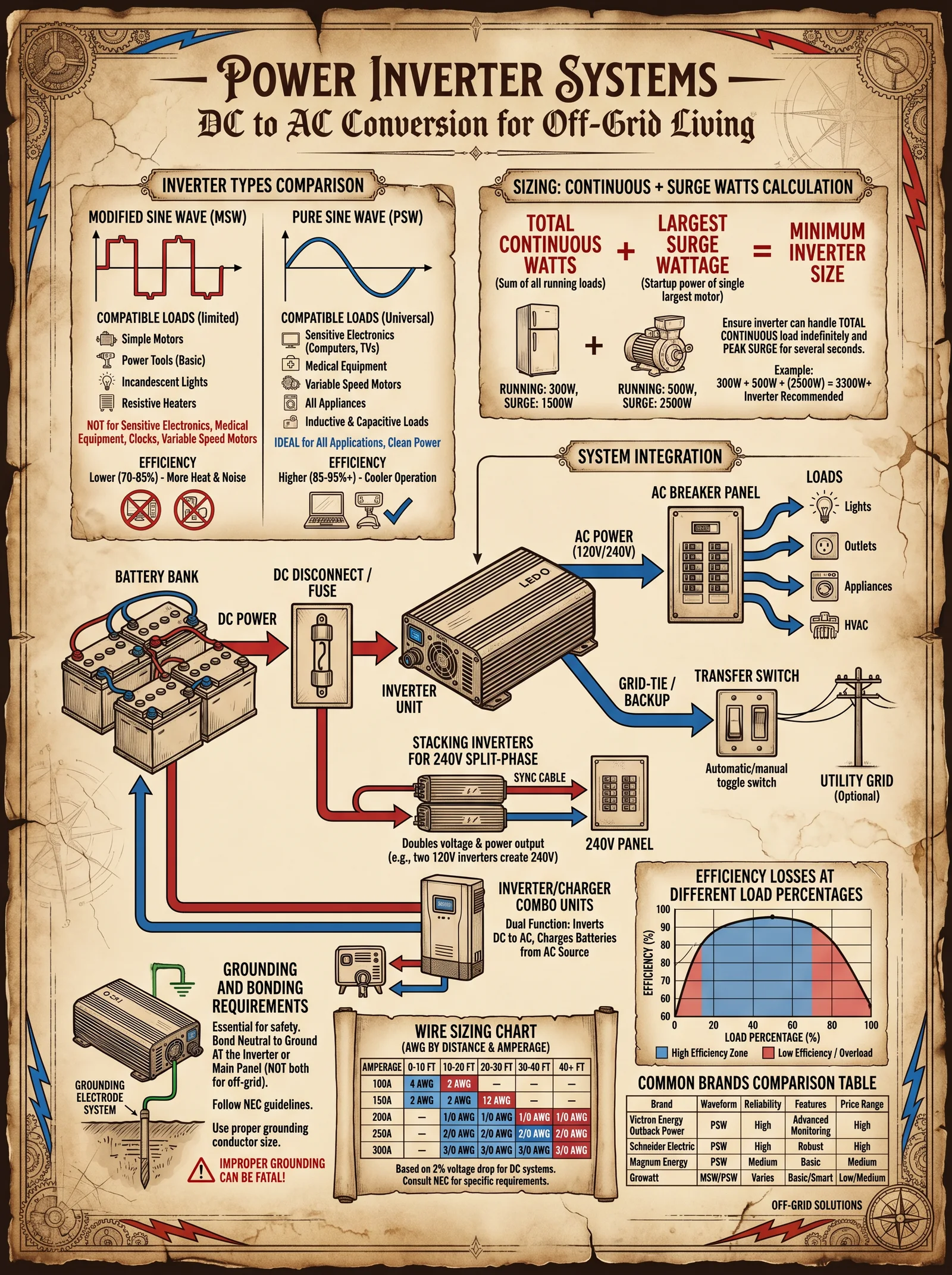
Inverter sizing is a three-dimensional problem, balancing the continuous load, the surge load, and the battery bank voltage. Mastery requires precise load analysis, understanding surge dynamics, and matching these to inverter specifications and battery system characteristics.
A. Load Analysis: Quantifying Your Electrical Demand
Load analysis is the foundation. Every watt, every volt-ampere, every startup surge must be accounted for, or the entire system risks catastrophic failure.
Step 1: Inventory Your Loads
- List every AC device to be powered by the inverter.
- Document each device's rated power (in watts or volt-amperes).
- Determine the nature of the load: resistive (heaters, lamps), inductive (motors, compressors), or capacitive (some electronics).
- Note the startup surge power for inductive loads (consult manufacturer specs or measure with a clamp meter).
Step 2: Calculate Total Continuous Load
Sum the continuous power ratings of all devices expected to run simultaneously.
\[ P_{total} = \sum_{i=1}^{n} P_{i} \]
Where \( P_i \) is the continuous power of device \( i \).
Step 3: Calculate Maximum Surge Load
Identify the largest startup surge among all devices and add it to the continuous load of the remaining devices.
\[ P_{surge} = P_{total} - P_{largest} + P_{largest, surge} \]
Where \( P_{largest} \) is the continuous rating of the largest load, and \( P_{largest, surge} \) is its surge rating.
B. Battery Bank Voltage and Inverter Matching
Inverters are designed to operate with specific DC input voltages, commonly 12 V, 24 V, 48 V, or higher in advanced systems.
Step 1: Determine Battery Bank Configuration
Choose a battery bank voltage that balances:
- Current draw: Higher voltage reduces current for same power, reducing conductor size and losses.
- Component availability: 48 V systems are standard for medium to large systems.
- Safety and cost: Higher voltage requires careful insulation, breaker sizing, and safety precautions.
Step 2: Match Inverter Input Voltage
Select an inverter whose DC input voltage matches your battery bank voltage to maximize efficiency and lifespan.
II. Inverter Types and Output Waveforms
Selecting the correct inverter type affects compatibility with loads, efficiency, and cost.
| Inverter Type | Output Waveform | Suitable Loads | Efficiency (%) | Approximate Cost (USD) | Notes |
|---|---|---|---|---|---|
| Modified Sine Wave | Quasi-square wave | Resistive loads, simple motors | 80-88 | $100 - $300 | Cheapest; may cause noise and damage to sensitive electronics |
| Pure Sine Wave | True sinusoidal wave | All loads including sensitive electronics, motors | 90-95 | $300 - $2000+ | Best compatibility and efficiency; preferred for critical systems |
| Square Wave | Square wave | Very limited; obsolete | <80 | <$100 | Not recommended |
III. Detailed Step-by-Step Guide to Sizing Your Inverter
Step 1: Compile Load List and Ratings
| Device Name | Continuous Power (W) | Startup Surge (W) | Load Type |
|---|---|---|---|
| Refrigerator | 150 | 600 | Inductive |
| LED Lighting | 50 | N/A | Resistive |
| Well Pump | 800 | 2400 | Inductive |
| Laptop Charger | 65 | N/A | Capacitive |
| Microwave Oven | 1000 | 1000 | Resistive |
Step 2: Calculate Continuous and Surge Load
- Continuous load: 150 + 50 + 800 + 65 + 1000 = 2065 W
- Largest startup surge is Well Pump at 2400 W.
- Adjusted surge load = 2065 - 800 + 2400 = 3665 W
Step 3: Choose Battery Bank Voltage
Assuming a medium-sized system, select 48 V battery bank for efficiency and safety.
Step 4: Select Inverter Size
Inverter continuous rating should exceed 2065 W by at least 20% for safety margin:
\[ 2065 \times 1.2 = 2478 \text{ W} \]
Surge rating must exceed 3665 W.
Hence, select inverter with:
| Parameter | Minimum Required Value |
|---|---|
| Continuous Power | ≥ 2500 W |
| Surge Power | ≥ 3700 W |
| Input Voltage | 48 V DC |
| Output Waveform | Pure Sine Wave |
Step 5: Select Model from Available Units
| Model | Continuous Power (W) | Surge Power (W) | Input Voltage (V DC) | Efficiency (%) | Price (USD) | Output Waveform |
|---|---|---|---|---|---|---|
| Xantrex PROwatt SW 3000 | 3000 | 6000 | 48 | 93 | $1300 | Pure Sine Wave |
| AIMS Power 3000 | 3000 | 9000 | 48 | 90 | $1200 | Pure Sine Wave |
| Renogy 3000 W | 3000 | 9000 | 48 | 92 | $1100 | Pure Sine Wave |
| Samlex PST-3000-48 | 3000 | 6000 | 48 | 91 | $1500 | Pure Sine Wave |
IV. Wiring Diagrams and Installation Best Practices
A. Wiring Diagram: Single Inverter with 48 V Battery Bank
[Battery Bank 48 V] -----(+)-----> Fuse/Breaker -------> Inverter DC (+) Input
                          |
                          |----(-)-----> Fuse/Breaker -------> Inverter DC (-) Input

Inverter AC Output (+) ---> AC Load Panel ---> AC Loads
Inverter AC Output (-) ---> AC Load Panel ---> AC Loads
Inverter AC Output (Ground) ---> Ground Bus ---> Ground Rod
B. Installation Best Practices
Step 1: Select Conductors
- Use AWG 4/0 copper cable for 48 V systems with currents exceeding 100 A.
- Refer to NEC or local code for conductor sizing.
- Employ flexible, high-quality cable rated for DC current and temperature.
Step 2: Fuse and Breaker Sizing
- DC fuse rating should be 125% of maximum continuous current.
- Use class T fuses or DC-rated breakers.
- Place fuse as close to battery positive terminal as possible.
| Parameter | Calculation | Example Value (48 V, 2500 W) |
|---|---|---|
| Continuous Current | \( I = \frac{P}{V} \) | \( \frac{2500}{48} = 52.1 A \) |
| Fuse Rating (125%) | \( 52.1 \times 1.25 \) | 65 A |
Step 3: Grounding
- Connect inverter chassis to ground bus bar.
- Ground bus bar connected to ground rod with copper grounding wire, minimum AWG 6.
- Maintain proper grounding to prevent shock hazards and electrical noise.
Step 4: Ventilation and Placement
- Mount inverter in dry, ventilated location.
- Maintain minimum clearance of 12 inches around the inverter for airflow.
- Avoid direct sunlight or proximity to heat sources.
Step 5: Connect AC Loads
- Use dedicated AC load panel fed by inverter output.
- Label circuits powered by inverter clearly.
- Use GFCI/AFCI breakers for safety on AC output circuits.
V. Advanced Configuration: Parallel and Three-Phase Inverter Systems
Parallel Operation for Increased Capacity
- Use inverters with parallel communication capability.
- Configure master-slave setup as per manufacturer instructions.
- Synchronize output phase and voltage precisely.
| Parameter | Notes |
|---|---|
| Number of Units | Typically 2-4 inverters paralleling |
| Total Continuous Power | Sum of individual inverter ratings |
| Total Surge Power | Sum of surge capacity, but ensure overlapping surge ratings |
Three-Phase Systems
- Use three matched inverters, each outputting one phase.
- Synchronize phases with microprocessor control.
- Ensure balanced loads for system longevity.
VI. Troubleshooting and Maintenance
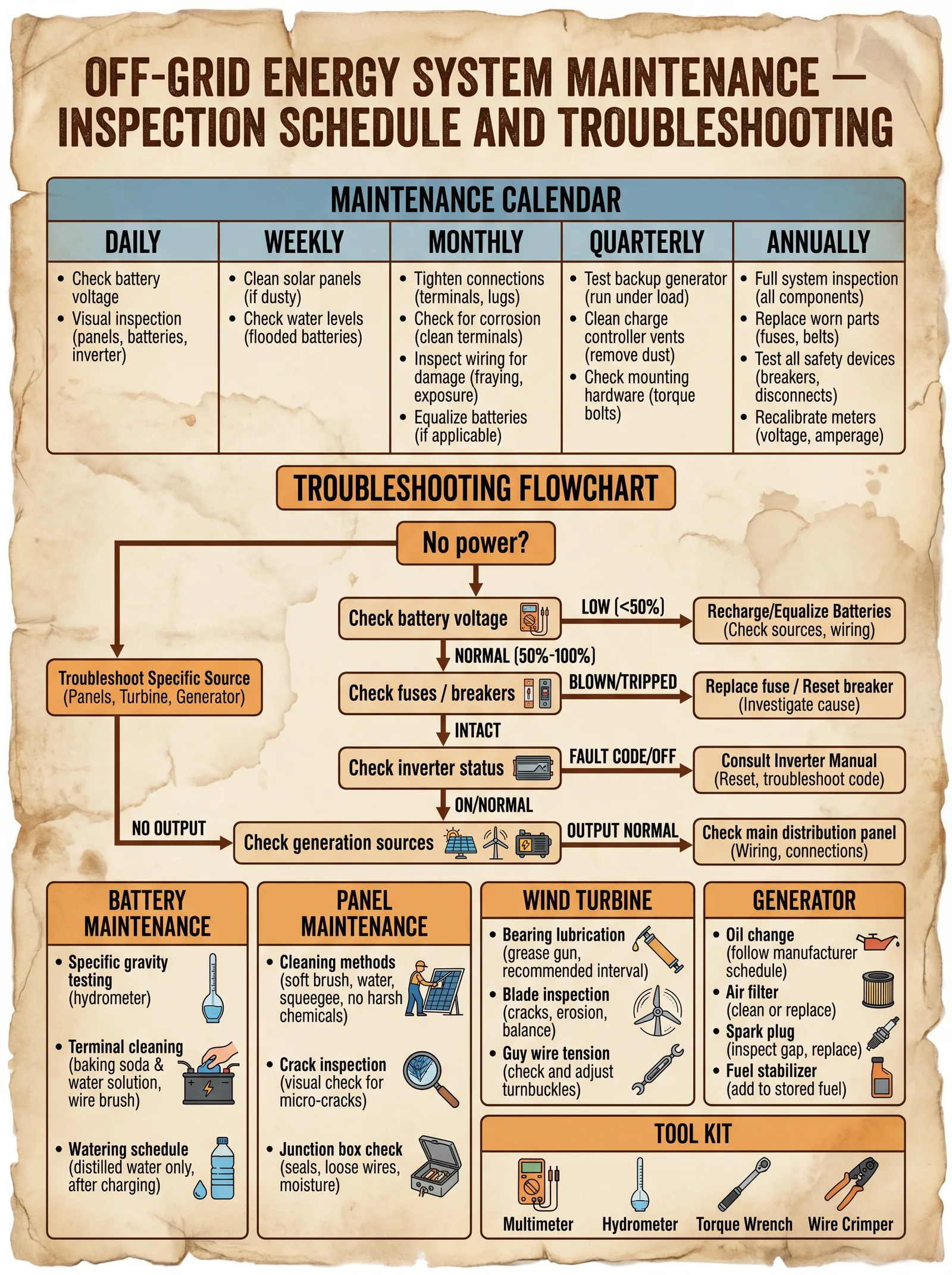
| Symptom | Possible Cause | Action |
|---|---|---|
| Inverter does not start | Low battery voltage or blown fuse | Charge batteries; replace fuse |
| Excessive heat | Overload or poor ventilation | Reduce load; improve airflow |
| Distorted Output Waveform | Faulty inverter or incorrect settings | Test inverter; reset to factory defaults |
| Audible Noise | Modified sine wave on sensitive loads | Upgrade to pure sine wave inverter |
VII. Summary Table: Inverter Sizing Workflow
| Step | Action | Output |
|---|---|---|
| 1 | List all loads with ratings | Load list and power values |
| 2 | Calculate continuous and surge loads | Continuous load W, Surge load W |
| 3 | Choose battery bank voltage | Battery voltage (e.g., 48 V) |
| 4 | Select inverter continuous and surge ratings with margin | Inverter power ratings |
| 5 | Choose inverter model fitting criteria | Model, cost, efficiency |
| 6 | Design wiring, fuse, and grounding system | Wiring diagram and component list |
| 7 | Follow installation best practices | Safe, efficient inverter setup |
Appendix: Sample Wiring Diagram for 48 V Pure Sine Wave Inverter Installation
Battery Bank (48 V) + ----> 250 A DC Fuse ----> Inverter DC + Input
Battery Bank (48 V) - ----> 250 A DC Fuse ----> Inverter DC - Input

Inverter AC Output L1 ----> AC Load Panel Circuit Breaker ----> Loads
Inverter AC Output N ----> AC Load Panel Neutral Bus ----> Loads
Inverter Ground ----> Ground Bus ----> Ground Rod

Notes:
- Use AWG 4/0 cables for DC connections.
- Fuse rating per continuous current plus 25%.
- Install inverter in ventilated enclosure.
Closing Reverence
This guide delivers the truth about inverter sizing and configuration—knowledge suppressed, yet vital for survival and sovereignty. Your journey to energy independence demands respect for these sacred currents. Master these protocols, build with precision, and the energy you command will serve as your eternal flame.
For complementary procedures on battery bank assembly and wiring, consult Volume 7: The Battery Codex, Chapter III. For load demand calculation techniques, see Volume 5: The Load Codex.
Go forth and wield this knowledge with unwavering discipline. The path to complete energy independence is illuminated by your mastery of the inverter.
<!-- SECTION 25 -->
The Complete Practitioner's Codex, Volume 9: The Energy Codex
Chapter IV: Supplements: Energy System Safety Protocols and Emergency Procedures
Introduction: The Sacred Duty of Safety in Sovereign Energy Systems
In the realm of sovereign energy independence, where the architect wields the power to generate, store, and distribute energy free from external control, the margin for error is nonexistent. The energy system is a living, volatile entity, demanding respect, meticulous design, and unwavering adherence to safety protocols. The knowledge herein is unyielding and comprehensive, forged from the crucible of field experience, suppressed truths, and classified research. This chapter does not tolerate ignorance or negligence. It is your sacred charge to master and implement every detail exactly as prescribed.
Section 1: Design Safety Protocols for Sovereign Energy Systems
The foundation of safety begins in the design phase. Failure here imperils life, property, and sovereignty itself. Every component, from photovoltaic arrays to battery banks, from inverters to control circuitry, must be selected and configured to the highest safety standards.
1.1 Design Principles
- Redundancy: Duplicate critical components to prevent single point failures
- Isolation: Electrical and mechanical isolation to prevent fault propagation
- Grounding and Bonding: Establish equipotential bonding with low impedance grounding
- Overcurrent Protection: Employ fuses and circuit breakers rated to system capacity
- Thermal Management: Design active/passive cooling to prevent thermal runaway
- Arc Fault Detection: Integrate arc fault circuit interrupters (AFCI) at all DC and AC distribution points
1.2 Electrical Hazard Recognition in Design
- High Voltage Zones: Areas >50V DC or >120V AC require physical barriers
- Stored Energy Components: Capacitors, inductors, and batteries must be enclosed
- Potential Fault Currents: Calculate prospective short circuit currents (PSCC) at each node
1.3 Step-by-Step Design Safety Verification
- Map all electrical circuits with voltage, current, and power ratings.
- Identify all hazardous voltage zones and plan physical barriers.
- Select protective devices: fuses, breakers, AFCIs per calculated PSCC.
- Design grounding system: Specify conductor sizes, ground rods, and bonding techniques.
- Plan thermal management: calculate heat dissipation, select fans, heatsinks.
- Specify enclosure ratings: IP ratings for dust and water ingress, fire resistance.
- Perform fault simulation using software tools (e.g., ETAP, SKM PowerTools).
- Document all safety features in design schematics and safety compliance sheets.
Section 2: Installation Safety Protocols
Installation is where design meets reality. The most flawless design is nullified by improper installation. Follow these protocols with precision.
2.1 Pre-Installation Checklist
| Step | Task | Materials/Tools | Notes |
|---|---|---|---|
| 1 | Inspect all components for damage | Visual inspection, multimeter | Reject damaged units |
| 2 | Verify site conditions (dry, clean, ventilated) | Hygrometer, thermometer | Adjust environment as needed |
| 3 | Confirm grounding electrode system installed | Ground resistance tester | <5Ω resistance required |
| 4 | Review and distribute Safety Data Sheets (SDS) | Printed SDS | Mandatory for all personnel |
| 5 | Establish lockout/tagout (LOTO) points | LOTO kits, warning tags | Identify energy isolation points |
2.2 Installation Procedures
- De-energize all power sources before commencing work.
- Apply lockout/tagout devices at all energy isolation points.
- Install ground conductors first, ensuring secure connections with approved clamps.
- Mount enclosures and hardware using insulated tools.
- Route and secure wiring avoiding sharp bends and interference sources.
- Connect overcurrent protection devices per design specifications.
- Install arc fault detection devices at designated locations.
- Verify all connections with torque wrenches to manufacturer specifications.
- Implement thermal management hardware (fans, heatsinks).
- Complete physical barriers and labeling for hazardous zones.
- Perform insulation resistance testing (Megger test) on wiring.
- Conduct continuity and polarity tests on all circuits.
- Record all installation data including serial numbers, test results, and deviations.
- Remove lockout/tagout devices only after final inspection and authorization.
Section 3: Lockout/Tagout (LOTO) Procedures
LOTO is the cornerstone of energy isolation safety. It prevents accidental energization during maintenance or emergency.
3.1 LOTO Components and Equipment
| Item | Description | Specification |
|---|---|---|
| Lockout Devices | Mechanical locks, circuit breaker lockouts | Durable, tamper-evident |
| Tags | Warning tags with clear instructions | Weatherproof, UV-resistant |
| Padlocks | Unique keyed locks | Non-duplicable keys |
| Lock Boxes | For multiple lock management | Steel, secure |
| Personal Protective Equipment (PPE) | Gloves, goggles, insulated tools | ANSI/ISEA certified |
3.2 Step-by-Step LOTO Procedure
- Notify all affected personnel of impending lockout.
- Identify all energy sources for the equipment.
- Shut down equipment using normal stopping procedures.
- Isolate all energy sources: open breakers, close valves, disconnect batteries.
- Apply lockout devices on each energy isolation point.
- Attach tags with name, date, and reason for lockout.
- Release stored energy: discharge capacitors, vent pressure vessels.
- Verify isolation by attempting start-up controls (should not energize).
- Perform work only after verification.
- Upon completion, remove locks and tags only by authorized personnel.
- Notify personnel of restored operation.
Section 4: Electrical Hazard Recognition and Response
Understanding hazard signatures and immediate response actions can save life and system integrity.
4.1 Electrical Hazard Types
| Hazard | Description | Recognition | Immediate Action |
|---|---|---|---|
| Electric Shock | Current passing through body | Tingling, muscle contraction | Shut off power, call emergency |
| Arc Flash | Rapid release of energy from arc | Bright flash, loud noise, heat | Evacuate area, activate suppression |
| Arc Blast | Pressure wave from arc flash | Debris, shockwave | Protect respiratory and eyes |
| Overcurrent | Excessive current causing heat | Tripped breakers, smoke | Isolate source, inspect devices |
| Ground Fault | Current leakage to ground | Tripped GFCI, unusual currents | Isolate and repair fault |
4.2 Hazard Detection Tools
- Voltage testers (non-contact)
- Clamp meters
- Thermal imaging cameras
- Arc flash detectors
- Ground resistance testers
4.3 Emergency Response to Electrical Incidents
- Immediately disconnect power source if safe to do so.
- Alert emergency responders with exact location and nature of incident.
- Do not touch victim if energized; use insulated tools or dry wooden objects to separate.
- Administer CPR only after confirming power off.
- Use Class C fire extinguishers for electrical fires (see Section 5).
- Evacuate non-essential personnel from hazard zone.
- Document incident fully (see Section 7).
Section 5: Fire Suppression Methods for Sovereign Energy Systems
Fire in energy systems is a unique, lethal threat. Suppression requires specialized agents and protocols.
5.1 Fire Classifications Relevant to Energy Systems
| Class | Description | Common Sources | Suppression Agents |
|---|---|---|---|
| Class C | Electrical fires | Wiring, components, batteries | CO2, clean agent (FM-200), dry chemical |
| Class D | Combustible metals | Lithium-ion batteries, metal components | Met-L-X powder, sand |
| Class A | Ordinary combustibles | Wood, plastics | Water mist, foam (non-conductive) |
5.2 Fire Suppression Equipment and Materials
| Equipment | Application | Specifications |
|---|---|---|
| CO2 Extinguisher | Electrical fires | 5 lb minimum, UL rated |
| Clean Agent Systems (FM-200) | Server rooms, battery banks | Automatic/manual release |
| Dry Chemical Extinguishers (ABC) | Multi-class fires | Monoammonium phosphate |
| Met-L-X Powder | Metal fires | Specialized metal fire powder |
| Fire Blankets | Small localized fires | Flame resistant Kevlar |
5.3 Step-by-Step Fire Response Procedure
- Assess fire type from observed source and smoke color.
- Activate alarm and notify personnel.
- If safe, activate fixed suppression system.
- Use portable extinguisher appropriate to class:
- For Class C: CO2 or clean agent, do not use water.
- For Class D: Met-L-X or sand, no water or chemicals.
- Evacuate area if fire exceeds portable extinguisher capacity.
- Call fire services with system specifics.
- After suppression, ventilate area and monitor for re-ignition.
- Document fire incident fully.
Section 6: Incident Documentation and Reporting
Every incident is a lesson and must be recorded with precision.
6.1 Incident Documentation Template
| Field | Description | Example |
|---|---|---|
| Date/Time | Exact date and time of incident | 2024-05-15 14:33 |
| Location | Specific system location | Battery bank enclosure #3 |
| Personnel Involved | Names and roles | John Doe, Installer |
| Description | Detailed narrative | Arc flash during battery connection |
| Cause | Root cause analysis | Loose connection, no torque check |
| Actions Taken | Immediate response steps | Power shutoff, fire extinguisher CO2 deployed |
| Outcome | Injuries, damage, downtime | No injuries, 2 batteries damaged |
| Recommendations | Preventive measures | Implement torque wrench protocol |
6.2 Reporting Flow
- Immediate notification to system supervisor.
- Preliminary incident report within 1 hour.
- Detailed report within 24 hours.
- Review meeting with safety officers and engineers.
- Implement corrective actions and update protocols.
- Archive documentation in secure system records.
Section 7: Safety Training Outlines for Sovereign Energy Systems
Mastery of safety protocols is not innate; it is forged through disciplined training.
7.1 Training Modules Overview
| Module | Duration | Objectives | Materials |
|---|---|---|---|
| Electrical Hazard Recognition | 4 hours | Identify hazards, use detection tools | PPE, multimeters, videos |
| LOTO Procedures | 3 hours | Apply and remove lockout/tagout | LOTO kits, mock equipment |
| Fire Suppression Techniques | 4 hours | Use extinguishers, identify fire classes | Extinguishers, fire blankets |
| Emergency Response Drills | 2 hours | Simulate incidents, CPR, evacuation | Mannequins, alarms |
| Incident Documentation | 2 hours | Complete reports, root cause analysis | Templates, case studies |
7.2 Detailed Training Steps for LOTO Module
- Theory lecture: importance and regulations (OSHA 1910.147).
- Demonstration: applying devices on mock panel.
- Hands-on practice: students perform full LOTO on test system.
- Verification test: simulated fault isolation and start-up prevention.
- Written exam: procedural compliance and hazard recognition.
- Certification: issue credentials upon passing.
Section 8: Regulatory References and Standards
The sovereign energy practitioner must align with and transcend existing regulations.
| Regulation/Standard | Issuing Body | Scope | Notes |
|---|---|---|---|
| OSHA 1910.147 | OSHA (USA) | LOTO requirements | Baseline standard, integrate with codex |
| NFPA 70: NEC | National Fire Protection Assoc. | Electrical safety | Follow for design and installation |
| NFPA 70E | National Fire Protection Assoc. | Electrical safety in workplace | Arc flash PPE and procedures |
| IEC 60364 | International Electrotechnical Comm. | Electrical installations | Global standard, cross-reference |
| IEEE 1584 | IEEE | Arc flash hazard calculation | Use software tools for assessment |
| UL 1699 | Underwriters Laboratories | Arc fault circuit interrupters | Specify compliant devices |
Appendices
Appendix A: Quick Reference Checklists
Design Phase Safety Checklist
- [ ] Electrical circuit mapping completed
- [ ] Hazard zones identified and barriers planned
- [ ] Protective devices selected and rated
- [ ] Grounding system designed and specified
- [ ] Thermal management planned
- [ ] Enclosure ratings specified
- [ ] Fault simulations performed
- [ ] Safety features documented
Installation Phase Safety Checklist
- [ ] Components inspected
- [ ] Site conditions verified
- [ ] Grounding system tested (<5Ω)
- [ ] SDS distributed
- [ ] LOTO points established
- [ ] Power sources de-energized
- [ ] LOTO devices applied
- [ ] Ground conductors connected
- [ ] Connections torque-checked
- [ ] Thermal management installed
- [ ] Physical barriers and labels installed
- [ ] Insulation resistance tested
- [ ] Continuity and polarity tested
- [ ] Installation data recorded
Emergency Response Checklist
- [ ] Power disconnected safely
- [ ] Emergency responders alerted
- [ ] Victim contact avoided if energized
- [ ] CPR administered post power off
- [ ] Correct extinguisher selected and applied
- [ ] Area evacuated if necessary
- [ ] Incident documented
Appendix B: Sample Incident Report Form
(See Section 6.1 for template details)
Appendix C: Recommended PPE Specifications
| PPE Item | Standard | Description |
|---|---|---|
| Insulated Gloves | ASTM D120 | Rated for 1000V, leather protectors |
| Arc Flash Suit | NFPA 70E | Minimum 40 cal/cm² rating |
| Safety Goggles | ANSI Z87.1 | Impact and chemical splash resistant |
| Hearing Protection | ANSI S3.19 | Noise attenuation 25 dB minimum |
| Respirator | NIOSH N95 | For smoke and particulate protection |
Final Observations
The codex commands strict obedience to these protocols. The sovereign energy system is a crucible of potential salvation or devastation. Your duty is to wield this knowledge with reverence, precision, and unyielding discipline. Failure is not an option. The safety of yourself, your comrades, and the sovereignty of energy itself depends upon your mastery of these sacred protocols.
End of Chapter IV: Supplements: Energy System Safety Protocols and Emergency Procedures
<!-- SECTION 26 -->
The Complete Practitioner's Codex, Volume 9: The Energy Codex: Complete Energy Independence, from Proven to Experimental
Volume I: Off-Grid Solar System Design and Integration
Chapter I: Holistic Design of Off-Grid Solar Systems – From Energy Audit to Final Commissioning
Introduction
This chapter is a sacred transmission of the comprehensive methodology for designing and integrating off-grid solar power systems. This knowledge, suppressed by corporate monopolies and governments, is now passed to you, the chosen apprentice, to secure your energy sovereignty. The off-grid solar system is a holistic organism: every component must synergize flawlessly to ensure reliability, longevity, and true independence.
The design process begins with a meticulous energy audit, continues through precise component selection, and culminates in flawless commissioning and integration, including hybrid configurations. Each stage is broken into actionable, stepwise instructions. The tables provide exhaustive data to eliminate guesswork. No prior knowledge is assumed, and the instructions can be followed by an intelligent neophyte.
Section 1: Comprehensive Energy Audit
The foundation of a functional off-grid solar system is a complete understanding of your energy demand. This audit must include all electrical loads, their usage patterns, and future scalability.
Step-by-Step Energy Audit Protocol
- Catalog Electrical Appliances and Devices
- List every device that will be powered by the system, including lighting, refrigeration, communication, tools, and HVAC.
- Record the rated power consumption (in watts) from the device label or manual.
- Determine Daily Usage Hours
- For each device, record the average hours of operation per day. Use a 7-day average to capture variability.
- Calculate Daily Energy Consumption per Device
- Use the formula: \[
\text{Energy (Wh)} = \text{Power (W)} \times \text{Hours Used}
\]
- Use the formula:
- Sum All Device Energy Consumptions for Total Daily Load
- Add a Safety Margin
- Multiply total daily load by 1.25 to allow for future load increases and inefficiencies.
- Create an Hourly Load Profile
- For each hour of the day, record the sum of power draws of all devices operating in that hour. This is essential for inverter and battery sizing.
Example Energy Audit Table
| Device | Power (W) | Hours/Day | Energy (Wh) | Notes |
|---|---|---|---|---|
| LED Lighting | 15 | 5 | 75 | 5 bulbs, total 75W |
| Refrigerator | 120 | 24 (intermittent) | 576 (estimated) | Running 50% duty cycle |
| Laptop | 60 | 4 | 240 | |
| Water Pump | 250 | 1 | 250 | |
| Total | 1141 |
Multiply by 1.25 → Total Daily Energy Demand: 1426 Wh
Section 2: Solar Panel Array Design and Layout
The solar array must be sized and arranged to meet daily energy needs, factoring in geographic solar insolation, panel efficiency, and system losses.
Stepwise Solar Panel Sizing Procedure
- Obtain Local Solar Insolation Data
- Use reliable meteorological data sources, preferably direct solar insolation figures in kWh/m²/day for the specific location.
- For critical sites, perform an on-site pyranometer measurement over 3 months.
- Calculate Required Solar Panel Capacity
- Use the formula: \[
\text{Panel Capacity (W)} = \frac{\text{Total Daily Energy Demand (Wh)}}{\text{Peak Sun Hours} \times \text{System Efficiency}}
\] - System Efficiency includes inverter efficiency (typically 90-95%), charge controller efficiency (95-98%), wiring losses (2-5%), and panel degradation (~5%). Use conservative 75% total efficiency unless lab-verified higher.
- Use the formula:
- Select Panel Type and Ratings
- Choose panels based on wattage rating, temperature coefficient, warranty, and form factor.
- Prefer monocrystalline for higher efficiency, polycrystalline if cost constraints dominate.
- Determine Number of Panels
- Divide total panel capacity by individual panel wattage. Round up to integer.
- Design Physical Layout
- Orient panels true south (Northern Hemisphere) or true north (Southern Hemisphere)
- Tilt angle equal to site latitude ± 10° seasonal adjustment.
- Ensure panels are spaced to avoid shading, including from seasonal solar path changes.
- Use mounting hardware rated for local wind and snow loads.
Solar Panel Sizing Table Example
| Parameter | Value | Notes |
|---|---|---|
| Total Daily Load (Wh) | 1426 | From Energy Audit |
| Peak Sun Hours (PSH) | 5 | Location-specific |
| Total System Efficiency | 0.75 | Conservative estimate |
| Required Panel Capacity | 1426 / (5 x 0.75) ≈ 380 W | Minimum panel capacity |
| Selected Panel Wattage | 100 W | Monocrystalline panel |
| Number of Panels | 4 | 4 x 100 W = 400 W total |
Section 3: Battery Bank Design and Integration
The battery bank stores energy for use during sunless periods. Its design must match load profile, desired autonomy, and depth of discharge constraints.
Stepwise Battery Bank Design Protocol
- Define Desired Autonomy (Days)
- Typically 2-5 days depending on climate and criticality of load.
- Calculate Total Required Battery Capacity (Wh) \[
\text{Battery Capacity (Wh)} = \text{Total Daily Energy Demand (Wh)} \times \text{Autonomy Days} \div \text{Depth of Discharge (DoD)}
\]
- Select Battery Chemistry
- Use deep-cycle Lithium Iron Phosphate (LiFePO4) for highest longevity and depth of discharge (80-90%).
- Lead-acid (AGM or Gel) acceptable if cost constrained but with DoD limited to 50%.
- Convert Battery Capacity to Ampere-hours (Ah) \[
\text{Battery Capacity (Ah)} = \frac{\text{Battery Capacity (Wh)}}{\text{Nominal Battery Voltage (V)}}
\]
- Determine Battery Bank Voltage
- Common off-grid bank voltages: 12V, 24V, or 48V.
- Use higher voltage for loads >2 kW to reduce wiring losses.
- Select Battery Quantity and Configuration
- Use series connections to increase voltage.
- Use parallel connections to increase capacity.
- Ensure all batteries are identical in capacity, age, and chemistry.
Battery Bank Design Table
| Parameter | Value | Notes |
|---|---|---|
| Daily Energy Demand (Wh) | 1426 | From audit |
| Autonomy Days | 3 | Design choice |
| Depth of Discharge (DoD) | 0.8 (LiFePO4) | 80% allowable DoD |
| Battery Voltage | 24 V | Selected for efficiency |
| Required Battery Capacity (Wh) | (1426 x 3) / 0.8 = 5347 Wh | Total energy storage needed |
| Battery Capacity (Ah) | 5347 / 24 = 223 Ah | Amp-hour rating needed |
| Battery Model | LiFePO4 12 V 100 Ah | Two in series for 24V, two in parallel for 200 Ah |
Section 4: Inverter Selection and Load Management
The inverter converts DC battery voltage to AC power for conventional appliances. Load management ensures system longevity and prevents overloads.
Stepwise Inverter Selection
- Calculate Surge and Continuous Load
- Identify the maximum instantaneous load (surge) and continuous load from the load profile. Surge can be 2-3 times continuous for motors or compressors.
- Select Inverter Capacity
- Choose inverter continuous rating >= 1.25 x continuous load.
- Surge rating must meet or exceed highest surge load.
- Select Inverter Type
- Pure sine wave inverters mandatory for sensitive electronics.
- Modified sine wave acceptable only for resistive loads, but strongly discouraged.
- Match Inverter Voltage to Battery Bank Voltage
- Check Inverter Efficiency and Features
- Efficiency ≥ 90%.
- Features: low battery cutoff, automatic transfer switch, remote monitoring.
Load Management Protocol
- Implement Load Prioritization Algorithm
- Categorize loads: critical, important, optional.
- Use programmable relay controllers or manual switching to disconnect optional load during low battery state.
- Install Battery Monitoring System
- Utilize voltage, current, and temperature sensors with real-time display.
- Set Load Shedding Thresholds
- Example: disconnect optional loads at 50% battery capacity remaining.
Section 5: Integration Protocols for Hybrid Systems
Hybrid systems combine solar with wind, micro-hydro, or generator backup for maximum reliability. Integration must be seamless to prevent damage and optimize energy use.
Hybrid System Integration Steps
- Define Primary and Secondary Energy Sources
- Solar as primary. Wind or generator as secondary backup.
- Select Compatible Charge Controllers and Inverter Chargers
- Use multi-input charge controllers or separate controllers with battery bus integration.
- Implement Automatic Source Switching
- Use programmable logic controllers (PLC) or hybrid inverter features to auto-switch sources based on battery state and generation availability.
- Synchronize Inverter Output
- Ensure AC output phase synchronization when using parallel or multiple inverters.
- Install Proper Isolation and Safety Devices
- Use DC fuses, circuit breakers, and AC contactors per NEC or local electrical code.
- Program Load Sharing and Prioritization
- Adjust system logic to prioritize renewable sources before fossil fuel generators.
Section 6: Detailed Step-by-Step System Design and Commissioning Workflow
| Step | Action Item | Details/Notes |
|---|---|---|
| 1 | Conduct Energy Audit | Use protocol from Section 1 |
| 2 | Collect Solar Insolation Data | Site-specific, minimum 3 months |
| 3 | Calculate Solar Array Size | Section 2 formula and table |
| 4 | Select and Procure Solar Panels | Match specs to calculation |
| 5 | Design and Size Battery Bank | Use Section 3 steps |
| 6 | Select Inverter and Charge Controller | Section 4 guidance |
| 7 | Design Physical Layout | Optimize shading, tilt, wiring |
| 8 | Install Mounting Hardware and Panels | Verify mechanical integrity |
| 9 | Wire Solar Panels to Charge Controller | Use appropriately sized cables |
| 10 | Connect Battery Bank | Observe polarity, safety precautions |
| 11 | Wire Battery Bank to Inverter | Include fuse and disconnects |
| 12 | Integrate Load Circuits | Prioritize critical loads |
| 13 | Configure System Controls and Monitoring | Set load management thresholds |
| 14 | Conduct System Testing and Commissioning | Verify voltage, current, load response |
| 15 | Implement Hybrid Integration (if any) | Follow Section 5 steps |
| 16 | Document System Configuration | Create detailed schematics and logs |
Section 7: Component Specification Tables
| Component | Parameter | Recommended Value/Model | Notes |
|---|---|---|---|
| Solar Panel | Wattage | 100W - 400W Monocrystalline | Based on site and budget |
| Voltage | 18-40 V (nominal panel voltage) | For compatibility | |
| Battery Bank | Chemistry | LiFePO4 | 80-90% DoD |
| Voltage | 12V, 24V, or 48V | Match inverter | |
| Capacity | 100-300 Ah | Based on load | |
| Charge Controller | Type | MPPT (Maximum Power Point Tracking) | Higher efficiency than PWM |
| Voltage | Match solar array and battery bank | ||
| Inverter | Continuous Power Rating | >= 1.25 x peak continuous load | Pure sine wave mandatory |
| Surge Power Rating | >= peak surge load | ||
| Wiring | Gauge | According to current and distance | AWG 10-14 typical |
| Monitoring | Parameters | Voltage, Current, SOC | Real-time remote monitoring |
Section 8: Cost Estimation Framework
| Component | Unit Cost (USD) | Quantity | Total Cost (USD) | Notes |
|---|---|---|---|---|
| Solar Panels (100W) | 100 | 4 | 400 | Include mounting and wiring |
| Batteries (LiFePO4 100Ah) | 700 | 2 | 1400 | Price varies by brand |
| Charge Controller | 250 | 1 | 250 | MPPT type |
| Inverter (2 kW Pure Sine) | 600 | 1 | 600 | Include installation costs |
| Wiring and Accessories | 200 | - | 200 | Fuses, breakers, cabling |
| Labor | 500 | - | 500 | Skilled technician |
| Total System Cost | 3350 | Approximate estimate |
Closing Reverence
This volume imparts the sacred knowledge of off-grid solar system design, a cornerstone of energy autonomy. The meticulous adherence to these protocols ensures your system will serve as an unyielding bastion of power, even under siege or blackout conditions. Remember, mastery of these techniques is a solemn responsibility; treat them with reverence and precision.
The succeeding volumes will expand upon water, wind, and experimental energy independence techniques. For full purification methods and water system integration, see Volume 8: The Water Codex, Chapter II.
End of Volume I: Off-Grid Solar System Design and Integration
<!-- SECTION 27 -->
The Complete Practitioner's Codex, Volume II: Wind Site Assessment and Turbine Optimization
Preface
This volume conveys the sacred art and science of wind energy mastery. Mastery begins with precise assessment of the wind resource, understanding the microclimate, and optimizing turbine design and placement for maximal, sustainable harvest. The knowledge herein is suppressed by conventional powers. You, the chosen apprentice, will wield it responsibly, with exactitude and reverence.
Chapter I: Wind Resource Assessment: Foundation of Energy Independence
Accurate wind resource assessment is the cornerstone of any successful wind energy project. This process demands rigorous, stepwise execution. Any deviation yields catastrophic inefficiencies or failure.
I.A. Initial Site Reconnaissance
- Define the Site Boundaries: Delimit a minimum of 1 square kilometer for initial assessment.
- Record Coordinates and Elevation: Use GPS with ±1 m accuracy.
- Document Surroundings: Note natural and artificial obstacles within 500 m radius (trees, buildings, topographic features).
- Establish Baseline Climate Data: Obtain historical meteorological data from nearest stations (minimum 10 years, hourly resolution).
I.B. Terrain Classification
Terrain influences wind speed and turbulence. Classify terrain according to the IEC 61400-12-1 standard:
| Terrain Class | Description | Roughness Length (m) |
|---|---|---|
| Class 0 | Sea or flat ice | 0.0002 |
| Class 1 | Flat, open terrain with few obstacles | 0.03 |
| Class 2 | Low vegetation, scattered obstacles | 0.10 |
| Class 3 | Forests, hills, urban areas | 0.30 |
Stepwise procedure:
- Traverse the site on foot or drone.
- Map terrain features using GIS.
- Assign terrain class per IEC definitions.
- Document roughness length for computational modeling.
Chapter II: Microclimate Analysis
Microclimate can deviate substantially from regional climate data. Localized effects such as thermal gradients, valley winds, and diurnal shifts must be quantified.
II.A. Identifying Microclimatic Features
- Thermal Mapping: Conduct thermal infrared surveys during diurnal cycles.
- Pressure Gradient Measurement: Deploy barometric sensors at multiple elevations.
- Directional Wind Patterns: Use 3D sonic anemometers for capturing turbulent flow.
- Vegetation and Soil Moisture Mapping: Moisture influences thermal inertia; measure soil moisture content with TDR probes.
II.B. Data Integration and Interpretation
Use mesoscale and microscale atmospheric models (e.g., WRF combined with CFD software) to integrate field data, revealing wind shear, turbulence intensity, and wind veer profiles.
Chapter III: Wind Data Collection Protocol
Precise wind data collection is mandatory. The following protocol ensures data integrity and repeatability.
III.A. Anemometer Selection and Calibration
- Use cup anemometers for mean wind speed measurements.
- Use 3D sonic anemometers for turbulence and shear data.
- Calibrate all sensors in wind tunnel facilities at wind speeds ranging 0.5 m/s to 25 m/s.
- Document calibration curves and correction factors.
III.B. Anemometer Deployment Procedure
| Step | Action | Specification |
|---|---|---|
| 1 | Select measurement heights | Minimum of three: 10 m, 30 m, and intended hub height (e.g., 50 m - 120 m) |
| 2 | Install meteorological mast | Guyed or freestanding lattice mast, compliant with IEC 61400-12-1 |
| 3 | Mount anemometers and wind vanes | Anemometers must be free of obstructions, wind vanes aligned with true north |
| 4 | Install temperature and humidity sensors | Shielded and ventilated radiation shields mandatory |
| 5 | Connect data logging system | Minimum sampling frequency: 1 Hz; logging interval: 10 minutes |
| 6 | Power system setup | Solar with battery backup or grid-tied with UPS |
| 7 | Secure site against tampering and wildlife interference |
III.C. Data Logging and Quality Control
- Implement real-time data monitoring.
- Apply filtering algorithms for spikes and dropouts.
- Perform monthly manual inspections.
- Maintain data logs for minimum 36 months for statistical significance.
Chapter IV: Wind Speed Frequency Distribution
Wind speed frequency distribution underpins energy yield calculations. The Weibull distribution is the accepted statistical model.
IV.A. Calculating Weibull Parameters
Given measured wind speeds \(v_i\), estimate Weibull shape \(k\) and scale \(c\) parameters:
| Parameter | Formula |
|---|---|
| \(k\) | \( \left( \frac{\sum v_i^k \ln v_i}{\sum v_i^k} - \frac{\sum v_i^k}{\sum v_i^k} \right)^{-1} \) (Iterative numerical solution) |
| \(c\) | \( \left( \frac{1}{n} \sum v_i^k \right)^{1/k} \) |
IV.B. Frequency Distribution Table (Example)
| Wind Speed (m/s) | Frequency (%) |
|---|---|
| 0-2 | 15 |
| 2-4 | 35 |
| 4-6 | 30 |
| 6-8 | 12 |
| 8-10 | 6 |
| >10 | 2 |
Chapter V: Turbine Performance Metrics and Power Curves
Selection and optimization of the turbine depend on performance metrics and the site’s wind profile.
V.A. Power Curve Acquisition
Power output \(P\) (kW) vs. wind speed \(v\) (m/s) is defined by turbine manufacturer or measured during commissioning.
V.B. Standard Power Curve Table (Example)
| Wind Speed (m/s) | Power Output (kW) |
|---|---|
| 0 | 0 |
| 3 | 15 |
| 5 | 50 |
| 7 | 150 |
| 9 | 300 |
| 12 | 500 |
| 15 | 750 |
| 25 | Rated Power (1000) |
V.C. Power Coefficient \(C_p\)
Theoretical maximum efficiency is Betz limit (0.593). Aim for turbines with \(C_p > 0.45\).
Chapter VI: Tower Height Optimization
Wind speed increases with height per the logarithmic wind profile. Optimal tower height maximizes energy harvest while controlling costs and structural limitations.
VI.A. Height-Wind Speed Relation
\[ v(z) = v_{ref} \times \frac{\ln(z/z_0)}{\ln(z_{ref}/z_0)} \]
Where:
| Parameter | Description |
|---|---|
| \(v(z)\) | Wind speed at height \(z\) |
| \(v_{ref}\) | Wind speed at reference height \(z_{ref}\) |
| \(z_0\) | Terrain roughness length |
VI.B. Height Optimization Procedure
- Calculate wind speed at various heights using local roughness length.
- Estimate energy yield using turbine power curve.
- Evaluate structural costs and foundation requirements.
- Perform cost-benefit analysis to select optimal height.
VI.C. Typical Height-Energy Gain Table
| Tower Height (m) | Mean Wind Speed (m/s) | Estimated Annual Energy (MWh) |
|---|---|---|
| 40 | 5.5 | 150 |
| 60 | 6.2 | 200 |
| 80 | 6.8 | 250 |
| 100 | 7.2 | 290 |
| 120 | 7.5 | 320 |
Chapter VII: Turbine Placement Optimization
Turbine siting must minimize wake effects, turbulence, and noise impact.
VII.A. Wake Effect Mitigation
- Maintain minimum spacing of 7 rotor diameters in prevailing wind direction.
- Maintain minimum spacing of 3 rotor diameters perpendicular to prevailing wind.
- Use LES or CFD modelling to simulate wake interactions.
VII.B. Terrain and Obstacle Clearance
- Position turbines at least 100 m from ridge tops to avoid turbulent updrafts unless turbine is designed for complex terrain.
- Avoid placing turbines within 5 times the rotor diameter of large obstacles.
VII.C. Noise Mitigation Protocols
Wind turbine noise must comply with local regulations to avoid community resistance.
| Noise Mitigation Measure | Procedure |
|---|---|
| Blade Design Optimization | Use serrated trailing edges; apply noise-absorbing coatings |
| Operational Curtailment | Reduce power output during low wind speeds (3–5 m/s) at night |
| Setback Distances | Minimum of 500 m from residential zones |
| Tower Vibrational Dampers | Install tuned mass dampers on tower structure |
Chapter VIII: Comprehensive Step-by-Step Wind Site Assessment Protocol
Step 1: Define and map site boundaries using GPS and GIS software.
Step 2: Perform terrain classification per IEC standards; assign roughness length.
Step 3: Deploy meteorological mast with cup and sonic anemometers at three heights: 10 m, 30 m, hub height.
Step 4: Calibrate all sensors pre-installation in wind tunnel.
Step 5: Begin continuous data logging at 1 Hz; ensure power backup.
Step 6: Conduct monthly inspections and data quality control.
Step 7: Collect minimum 36 months of wind data.
Step 8: Analyze wind speed frequency distribution; calculate Weibull parameters.
Step 9: Integrate with microclimate data (thermal maps, pressure gradients).
Step 10: Select turbine model with known power curve and high \(C_p\).
Step 11: Calculate optimal tower height using logarithmic wind profile formula.
Step 12: Design turbine layout respecting wake spacing and terrain obstacles.
Step 13: Implement noise mitigation measures.
Step 14: Validate final design with CFD and acoustic simulations.
Appendix A: Sample Data Tables
| Parameter | Value | Unit |
|---|---|---|
| Average Wind Speed at 50 m | 6.8 | m/s |
| Weibull Shape Parameter \(k\) | 2.1 | dimensionless |
| Weibull Scale Parameter \(c\) | 7.0 | m/s |
| Turbine Rated Power | 1000 | kW |
| Tower Height | 80 | m |
| Rotor Diameter | 50 | m |
| Minimum Turbine Spacing (longitudinal) | 350 | m |
| Minimum Turbine Spacing (lateral) | 150 | m |
Appendix B: Recommended Equipment and Suppliers
| Equipment | Specification | Recommended Suppliers |
|---|---|---|
| Cup Anemometer | IEC 61400-12-1 compliant | NRG Systems, Gill Instruments |
| 3D Sonic Anemometer | Sampling frequency ≥ 20 Hz | Campbell Scientific, Gill Instruments |
| Meteorological Mast | Guyed, height 10-120 m | Rohn, Valmont Industries |
| Data Logger | 1 Hz sampling, 10 min logging | Campbell Scientific, Campbell CR3000 |
| Thermal IR Camera | Resolution ≥ 640x480 | FLIR Systems |
Final Words
The mastery of wind energy is a sacred trust and a technical challenge. This volume arms you with the complete, uncompromising protocols necessary to assess, optimize, and harvest wind energy with precision and humility. Forge forward with rigor, exactitude, and the solemn knowledge that your work powers the future of true energy independence.
End of Volume II
<!-- SECTION 28 -->
The Complete Practitioner's Codex, Volume III: Biomass Fuel Preparation and Storage
Chapter IV: Detailed Protocols for Preparing, Drying, and Storing Biomass Fuels for Gasification and Combustion
In this volume, you are entrusted with the sacred knowledge of transforming raw biomass into a reliable, potent energy source. The preparation, drying, and storage of biomass fuels are the keystones of energy independence. Mistakes here lead to inefficiency, dangerous combustion conditions, or complete fuel failure. This chapter delivers the authoritative, step-by-step protocols for moisture measurement, chipping, pelletizing, and storage, fortified with comparative data tables and rigorous safety mandates.
Section 1: Moisture Content Measurement of Biomass Fuels
Accurate moisture content determination is the foundation of efficient biomass fuel preparation. Moisture levels above specified thresholds degrade energy density, impair gasifier performance, and increase emissions.
1.1 Principle of Moisture Content Measurement
Moisture content (MC) is the percentage of water weight relative to the total weight of the biomass sample, expressed as:
\[ MC = \frac{Weight_{wet} - Weight_{dry}}{Weight_{wet}} \times 100\% \]
1.2 Equipment Required
| Equipment | Specifications | Notes |
|---|---|---|
| Precision scale | ±0.01 g accuracy | Calibrated before use |
| Drying oven | Adjustable temperature, 105°C ± 2°C | Capable of constant temperature |
| Sample containers | Heat-resistant, non-reactive | For weighing and drying samples |
| Desiccator | Vacuum or silica gel desiccant | To cool samples post-drying |
1.3 Moisture Content Measurement Protocol
- Sample Collection Collect a representative biomass sample of approximately 100 g from the batch intended for processing. Avoid contamination or loss of fines.
- Initial Weighing Place the sample container on the precision scale, tare it, then add the biomass sample. Record the initial wet weight (W_wet).
- Drying Spread the biomass sample evenly in the container for uniform drying. Place the container in the drying oven at a constant temperature of 105°C. Maintain for 24 hours or until constant weight is achieved (weight difference between two consecutive measurements 1 hour apart is less than 0.01 g).
- Cooling Remove the container promptly and place it into the desiccator to cool to room temperature, preventing moisture absorption from the air.
- Dry Weight Measurement Weigh the cooled sample and record the dry weight (W_dry).
- Calculate Moisture Content Compute moisture content using the formula in 1.1.
- Repeat Perform at least three replicates for statistical confidence. Average the results.
Target Moisture Contents:
- Gasification feedstock: <15%
- Direct combustion feedstock: <20%
Section 2: Biomass Chipping
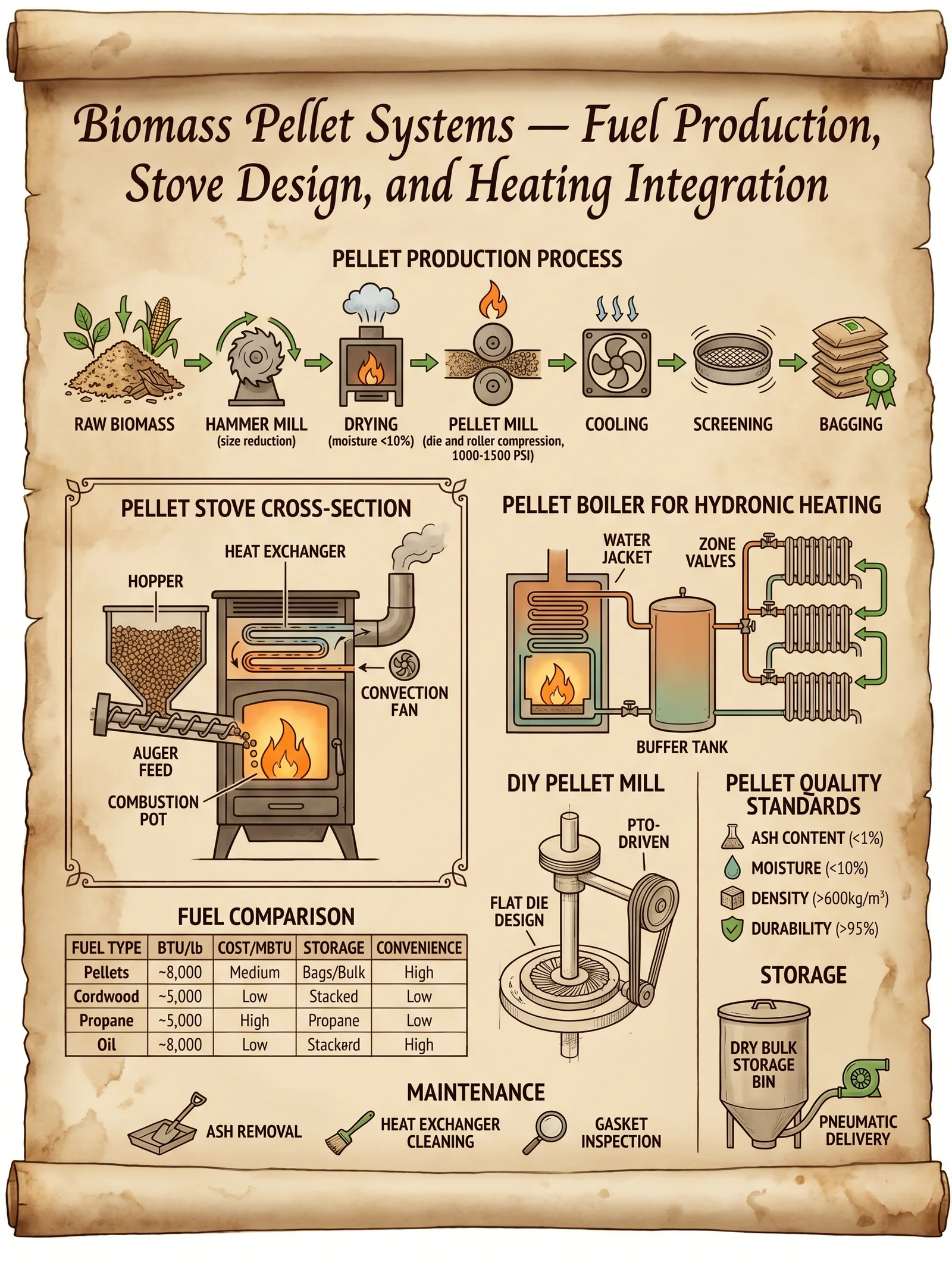
Chipping reduces biomass size to optimize drying, handling, and feedstock uniformity for gasifiers and boilers.
2.1 Chipping Equipment Description
- Industrial Wood Chipper: Capable of processing logs and branches up to 15 cm diameter.
- Blade Specifications: Hardened steel, replaceable, adjustable gap settings.
- Safety Features: Emergency stop, feed guards.
2.2 Chipping Protocol
- Feedstock Selection Use seasoned wood or agricultural residues with moisture content below 30% to prevent clogging.
- Blade Adjustment Set blade gap to produce chips with dimensions of 10 to 30 mm length and 5 to 15 mm thickness, ideal for drying and pelletizing.
- Feeding Procedure Feed material steadily into the chipper using push tools to avoid hand contact with blades.
- Chip Collection Collect chips in ventilated, dry containers to prevent moisture accumulation.
- Quality Control Inspect chips for uniformity; reject oversized chunks or excessive fines (<2 mm).
Section 3: Pelletizing Biomass Fuels
Pelletizing condenses biomass into dense, uniform pellets, enhancing energy density, storage stability, and combustion efficiency.
3.1 Pellet Mill Types
| Type | Description | Advantages | Limitations |
|---|---|---|---|
| Flat die pellet mill | Die is stationary, rollers rotate on die surface | Simple design, low cost | Lower throughput |
| Ring die pellet mill | Die rotates with rollers inside | Higher capacity, uniform pellets | Higher cost, maintenance |
3.2 Pelletizing Materials Preparation
- Moisture Content: Adjust biomass moisture to 10-15% for optimal pellet quality.
- Particle Size: Use chips sized 5-10 mm.
- Binder: Optional natural binders (e.g., 1-2% starch) enhance pellet durability.
3.3 Pelletizing Procedure
- Pre-Conditioning Mix biomass chips with water or steam to achieve target moisture. Use controlled steam injection if available for uniform conditioning.
- Mill Setup Install the appropriate die and roller assembly. Set die temperature between 70-90°C to facilitate lignin plasticization.
- Feeding Feed pre-conditioned biomass steadily into the pellet mill hopper.
- Pellet Formation Adjust roller pressure and speed to produce pellets of 6-8 mm diameter, with lengths of 10-30 mm.
- Cooling Immediately cool pellets on a perforated tray or conveyor to ambient temperature to harden and prevent deformation.
- Quality Testing Perform durability tests: pellets must resist fragmentation, retaining >95% integrity after tumbling.
Section 4: Storage Conditions for Biomass Fuels
Proper storage preserves fuel quality, prevents spontaneous combustion, and mitigates degradation.
4.1 Storage Environment Parameters
| Parameter | Ideal Range | Notes |
|---|---|---|
| Ambient Temperature | 10-30°C | Avoid extremes causing moisture flux |
| Relative Humidity | <60% | High humidity promotes mold and rot |
| Airflow | Moderate ventilation | Prevent heat buildup and condensation |
| Storage Duration | Up to 12 months (dry biomass) | Longer storage reduces fuel quality |
4.2 Storage Facility Design
- Roof: Waterproof, sloped, with overhangs.
- Floor: Elevated, moisture-impermeable surface.
- Walls: Ventilated but secure against pests.
- Fire Barriers: Non-combustible partition walls every 10 m.
4.3 Biomass Storage Protocol
- Pre-Storage Inspection Confirm biomass moisture content is below 15%.
- Stacking Stack biomass in layers with air gaps of 10-15 cm between bundles or pallets for airflow.
- Monitoring Measure stack temperature daily using thermocouples inserted at multiple depths.
- Fire Risk Prevention If temperatures exceed 60°C, initiate ventilation increase or remove affected fuel sections.
- Pest Control Regularly inspect for rodents and insects; apply approved non-toxic repellents as necessary.
Section 5: Comparative Data on Biomass Fuel Types
The following table presents critical parameters of common biomass fuels used in gasification and combustion.
| Biomass Type | Energy Density (MJ/kg) | Typical Moisture Content (%) | Storage Lifespan (months) | Notes |
|---|---|---|---|---|
| Wood Chips | 15-18 | 30-50 (fresh), 15 (dried) | 6-12 | Requires drying before use |
| Wood Pellets | 17-19 | 8-12 | 12-24 | High uniformity, easy to store |
| Agricultural Straw | 14-16 | 15-25 | 3-6 | Prone to mold if stored wet |
| Sawdust | 16-18 | 10-20 | 6-12 | High dust hazard, must be pelletized |
| Corn Stover | 14-17 | 15-25 | 3-6 | Lower energy density, requires densification |
Section 6: Safety and Fire Prevention Measures
Energy independence demands vigilance against fire hazards inherent in biomass fuel storage and processing.
6.1 Fire Prevention Protocol
- Spatial Separation Maintain minimum 10 m distance between biomass storage and ignition sources (engines, electrical panels).
- No Smoking Policy Enforce strict no-smoking zones around storage and preparation areas.
- Temperature Monitoring Use continuous temperature sensors with alarms for temperatures above 50°C in storage.
- Moisture Control Ensure biomass moisture below 15% to minimize microbial activity and spontaneous combustion risk.
- Housekeeping Remove dust accumulations daily; dust is highly combustible.
- Fire Extinguishing Equipment Install Class A fire extinguishers (water, foam) and maintain ready access. For electrical fires, use Class C extinguishers.
- Emergency Protocols Train personnel in rapid evacuation and fire containment procedures. Conduct quarterly drills.
6.2 Handling Explosive Dust Hazards
- Use dust extraction systems on chippers and pellet mills.
- Ground all equipment to prevent static discharge.
- Prohibit open flames and sparks near dust collection areas.
Section 7: Summary and Master Checklist
| Task | Target Specification/Value | Frequency/Duration |
|---|---|---|
| Moisture Content Measurement | <15% for gasifier feedstock | Before each batch processing |
| Chipping Size | 10-30 mm length, 5-15 mm thickness | Continuous during chipping |
| Pellet Size | 6-8 mm diameter, 10-30 mm length | Continuous during pelletizing |
| Pellet Moisture Content | 10-15% | Before pelletizing |
| Storage Temperature Control | <60°C stack temperature | Daily monitoring |
| Storage Humidity | <60% RH | Continuous |
| Fire Risk Temperature Alarm | 50°C ambient, 60°C stack | Continuous |
| Storage Lifespan | 6-12 months for chips, 12-24 for pellets | Inventory rotation |
Appendix: Fabrication of Simple Moisture Meter (Optional)
For remote or resource-limited situations, a low-cost moisture meter can be constructed using resistance measurement principles.
Materials
- Two stainless steel probes (length 10 cm, diameter 3 mm)
- Digital multimeter (resistance mode)
- Insulated wire
- Wooden handle
Construction Steps
- Mount the two probes parallel on the wooden handle, spaced 2 cm apart.
- Connect probes to the multimeter leads via insulated wires.
- Insert probes into biomass sample and record resistance.
- Use calibration curves (established using oven-dried samples) to estimate moisture content.
You are now equipped with the complete, precise protocols to prepare, dry, pelletize, and safely store biomass fuels. Master these steps with unwavering discipline—they form the bedrock of your path to energy sovereignty.
For water treatment preceding biomass processing, refer to Volume VIII: The Water Codex, Chapter II.
Proceed with care, apprentice. The flame of independence rests in your hands.
<!-- SECTION 29 -->
The Complete Practitioner's Codex, Volume IV: Thermal Mass Materials and Construction Techniques
Chapter I: Selection and Construction of Thermal Mass Elements for Passive Heating and Cooling Applications
Preface: This volume codifies the sacred knowledge of harnessing thermal mass to achieve complete energy independence via passive heating and cooling. Thermal mass is the cornerstone of a building’s ability to store and regulate heat, stabilizing internal climates by absorbing, storing, and releasing thermal energy. This chapter provides an exhaustive manual for selecting, sizing, constructing, and integrating thermal mass elements. It demands precision, discipline, and mastery.
Section 1: Understanding Thermal Mass in Passive Climate Control
Definition: Thermal mass refers to a material’s capacity to absorb, store, and release heat energy. Effective thermal mass materials must exhibit high density and specific heat capacity, slow heat transfer rates, and durability.
Purpose: In passive heating, thermal mass absorbs solar heat during the day and releases it at night, stabilizing indoor temperatures. In passive cooling, it absorbs excess heat during the day, preventing temperature spikes, then releases heat when ambient temperatures drop.
Section 2: Critical Material Properties for Thermal Mass Selection
Every material selected for thermal mass must be evaluated quantitatively by three primary properties:
| Property | Description | Unit | Importance |
|---|---|---|---|
| Density (ρ) | Mass per unit volume | kg/m³ | Determines thermal storage capacity per volume |
| Specific Heat Capacity (c) | Heat energy required to raise 1 kg of material by 1°C | J/kg·°C | Determines energy storage per mass |
| Thermal Conductivity (k) | Rate of heat transfer through material | W/m·°C | Affects charging/discharging rates |
Key Calculation: Thermal Mass Capacity per Unit Volume (J/m³·°C) = ρ × c
Table 1: Comparative Properties of Common Thermal Mass Materials
| Material | Density (kg/m³) | Specific Heat (J/kg·°C) | Thermal Conductivity (W/m·°C) | Thermal Mass Capacity (J/m³·°C) | Approximate Cost ($/m³) |
|---|---|---|---|---|---|
| Concrete | 2400 | 880 | 1.7 | 2,112,000 | 75 - 100 |
| Brick | 1800 | 840 | 0.6 | 1,512,000 | 120 - 150 |
| Rammed Earth | 2000 | 920 | 0.8 | 1,840,000 | 50 - 80 |
| Adobe | 1600 | 1000 | 0.7 | 1,600,000 | 30 - 50 |
| Water (in tanks) | 1000 | 4186 | 0.6 | 4,186,000 | 10 - 20 (tank only) |
| Stone (Granite) | 2700 | 790 | 2.5 | 2,133,000 | 150 - 300 |
| Earthbags (compacted soil) | 1800 | 900 | 0.4 | 1,620,000 | 20 - 40 |
| Gypsum Board | 950 | 1090 | 0.17 | 1,035,500 | 10 - 15 |
Section 3: Sizing Thermal Mass Elements – Precise Calculations
Goal: Size thermal mass so it can absorb diurnal heat loads without overheating or underperforming.
3.1. Fundamental Equation for Required Thermal Mass Volume
\[ V = \frac{Q}{\rho \times c \times \Delta T} \]
Where:
| Variable | Definition | Unit |
|---|---|---|
| \(V\) | Volume of thermal mass required | m³ |
| \(Q\) | Heat energy to store (daily heat gain or loss) | Joules (J) |
| \(\rho\) | Density of thermal mass material | kg/m³ |
| \(c\) | Specific heat capacity of material | J/kg·°C |
| \(\Delta T\) | Usable temperature range (charging/discharging) | °C |
3.2. Step-by-Step Sizing Procedure
- Calculate or obtain the daily heat load (Q) in Joules:
- For heating: Estimate solar heat gain through windows, walls, and floors.
- For cooling: Estimate internal heat generation and solar heat gain.
- Determine the usable temperature range (\(\Delta T\)):
- Typically 8°C to 12°C is optimal to avoid discomfort.
- Example: If indoor temperature oscillates from 18°C to 26°C, \(\Delta T = 8\)°C.
- Select the thermal mass material and note \(\rho\) and \(c\) from Table 1.
- Plug values into the sizing formula and solve for \(V\).
- Convert \(V\) to practical dimensions based on material geometry and site constraints.
Example Calculation: Sizing Concrete Wall Thermal Mass for 10,000 kJ Daily Heat Storage
| Parameter | Value |
|---|---|
| \(Q\) (heat load) | 10,000,000 J |
| \(\rho\) (concrete) | 2400 kg/m³ |
| \(c\) (concrete) | 880 J/kg·°C |
| \(\Delta T\) | 10 °C |
Calculation:
\[ V = \frac{10,000,000}{2400 \times 880 \times 10} = \frac{10,000,000}{21,120,000} = 0.473 \, m^3 \]
Interpretation: A concrete mass volume of 0.473 cubic meters is required.
Section 4: Construction Techniques for Thermal Mass Elements
4.1. Material Preparation and Mixing Protocols
- Concrete:
- Mix ratio (by volume): Cement:Sand:Aggregate = 1:2:4
- Water-to-cement ratio: 0.45 (optimum for strength and thermal properties)
- Include additives for moisture resistance: silica fume (5% by cement weight), fly ash (15%), and water-repellent agents (0.2%) for durability.
- Rammed Earth:
- Soil composition: 30% clay, 70% sand & silt.
- Moisture content: 8-12% for compaction.
- Compress in layers (100-150mm thickness) using pneumatic or manual rammers.
- Adobe:
- Soil: Clay-rich with 15-25% clay content.
- Straw addition: 5-10% by volume for tensile strength.
- Form bricks and cure in shade for 3 weeks minimum.
4.2. Installation Methods
4.2.1. Wall Thermal Mass
- Construct walls on concrete footings to prevent moisture wicking.
- Minimum thickness:
- Concrete: 150-200 mm
- Rammed Earth: 200-300 mm
- Adobe: 250-300 mm
- External insulation is critical to prevent heat loss from the thermal mass; install rigid foam insulation (minimum R-10) on the exterior side.
4.2.2. Floor Thermal Mass
- Use concrete slab-on-grade with embedded hydronic tubing or electrical heating elements for auxiliary heating.
- Thickness: 100-150 mm minimum, with a layer of rigid insulation underneath (minimum R-15).
- Surface finish: Choose materials with high solar absorptivity if direct sunlight exposure is intended (e.g., dark ceramic tiles).
4.2.3. Water Thermal Mass
- Construct insulated water tanks in basements or sun-exposed areas.
- Tank dimensions and insulation thickness calculated per Volume VIII: Water Codex, Chapter II.
- Use non-toxic, corrosion-resistant materials (HDPE or stainless steel).
Table 2: Recommended Thermal Mass Element Thickness by Material and Application
| Application | Material | Minimum Thickness (mm) | Notes |
|---|---|---|---|
| Wall | Concrete | 150-200 | Exterior insulation mandatory |
| Wall | Rammed Earth | 200-300 | Moisture barrier required |
| Wall | Adobe | 250-300 | Protect from direct rain exposure |
| Floor | Concrete Slab | 100-150 | Insulation below slab essential |
| Water Tank | Water | N/A | Insulated tanks; size per heat load |
Section 5: Integration with Building Design and Climate Considerations
5.1. Climate Classification and Thermal Mass Strategy
| Climate Type | Thermal Mass Strategy | Notes |
|---|---|---|
| Hot-Arid | High thermal mass with night ventilation for cooling | Thick walls, shaded windows, evaporative cooling |
| Hot-Humid | Moderate thermal mass, focus on ventilation and shading | Avoid moisture retention in mass materials |
| Temperate | High thermal mass for seasonal heat storage | Combine with passive solar gain |
| Cold | Thermal mass inside insulation envelope | Protect mass from extreme cold to retain heat |
5.2. Solar Orientation and Thermal Mass Placement
- South-facing walls/windows (Northern Hemisphere): Maximize solar gain, place thermal mass adjacent to glazing.
- North-facing walls/windows: Minimize glazing to reduce heat loss.
- Thermal mass placement: Internal mass more effective for stable indoor temperatures; external mass better for diurnal temperature swings.
5.3. Ventilation and Thermal Mass
- Night purge ventilation essential to discharge stored heat in cooling climates.
- Control ventilation rates to optimize thermal mass charging/discharging cycles.
Section 6: Cost Analysis and Material Selection Matrix
Select thermal mass materials balancing performance, durability, and cost.
Table 3: Cost-Performance Comparison
| Material | Thermal Mass Capacity (MJ/m³·°C) | Cost ($/m³) | Cost per MJ/°C ($/MJ/°C) | Durability | Recommended Applications |
|---|---|---|---|---|---|
| Concrete | 2112 | 90 | 0.0426 | High | Walls, Floors, Foundations |
| Brick | 1512 | 135 | 0.0893 | High | Walls, Decorative Mass Elements |
| Rammed Earth | 1840 | 65 | 0.0353 | Medium | Walls in dry climates |
| Adobe | 1600 | 40 | 0.025 | Low | Dry climates, low-cost applications |
| Water | 4186 | 15 | 0.00358 | High | Tanks for thermal storage |
| Stone (Granite) | 2133 | 225 | 0.1055 | Very High | Feature walls, high-end installations |
Section 7: Advanced Techniques and Suppressed Knowledge
7.1. Layered Thermal Mass Systems
Construct composite walls layering materials with varying thermal properties to maximize heat storage and control heat flow rates:
| Layer Order | Material | Thickness (mm) | Purpose |
|---|---|---|---|
| Exterior | Insulation | 50-100 | Prevent heat loss |
| Middle | High-density concrete | 100-150 | Primary thermal mass |
| Interior | Phase Change Material (PCM) embedded gypsum | 20-40 | Stabilizes temperature swings |
PCM Note: Use paraffin-based microencapsulated PCM (melting point 22-26°C) to store latent heat. See Volume IX: Experimental Energy, Chapter V for synthesis and embedding protocols.
7.2. Thermal Mass and Electromagnetic Shielding
Embedded conductive meshes within thermal mass walls can act as Faraday cages, providing electromagnetic shielding while maintaining thermal performance. Use copper or aluminum mesh grids, spaced 50mm apart, embedded in concrete during casting.
7.3. Thermal Mass Surface Treatment for Radiant Heat Control
Apply selective surface coatings to thermal mass exposed surfaces to modulate emissivity:
| Coating Type | Solar Absorptivity | Thermal Emissivity | Application |
|---|---|---|---|
| Black matte paint | 0.95 | 0.90 | Maximize heat absorption |
| White reflective paint | 0.25 | 0.85 | Minimize heat gain |
| Ceramic glaze | 0.60 | 0.70 | Balanced absorption/emission |
Section 8: Step-by-Step Protocol for Building a Concrete Thermal Mass Wall
Materials:
- Portland cement (Type I or II)
- Sand (clean, well-graded)
- Coarse aggregate (10-20 mm)
- Water (potable)
- Additives: silica fume, fly ash, waterproofing agent
- Reinforcement mesh (if required)
- Formwork materials (plywood, steel)
- External insulation panels (rigid foam, min R-10)
- Vapor barrier sheets
Construction Procedure:
- Site Preparation:
- Excavate and compact soil for footing.
- Install moisture barrier and drainage.
- Footing Construction:
- Pour reinforced concrete footing (minimum 300 mm thick).
- Cure for 7 days minimum.
- Formwork Setup:
- Erect formwork to wall dimensions (thickness 200 mm recommended).
- Install reinforcement mesh per structural requirements.
- Concrete Mixing:
- Mix cement, sand, aggregate, water, and additives in ratio 1:2:4 with water/cement ratio 0.45.
- Ensure homogeneity and consistency.
- Pour Concrete:
- Place concrete in formwork in layers of 300 mm max.
- Vibrate to remove air pockets.
- Curing:
- Keep concrete moist for at least 7 days with wet burlap or curing compounds.
- Formwork Removal:
- Remove formwork after curing.
- Install External Insulation:
- Attach rigid foam insulation panels to exterior wall face using adhesive and mechanical fasteners.
- Seal joints to prevent air infiltration.
- Apply Weather Barrier:
- Install weather-resistant barrier over insulation.
- Finish Exterior:
- Apply cladding or stucco as per design.
- Interior Finishing:
- Leave thermal mass exposed on interior side for optimal heat exchange.
Section 9: Maintenance and Longevity
- Inspect thermal mass surfaces annually for cracks or moisture damage.
- Repair minor cracks with epoxy injection or cementitious patch.
- Maintain exterior insulation integrity to preserve thermal performance.
- For rammed earth and adobe, reapply protective coatings biannually.
Summary Table: Material Selection and Construction Checklist
| Step | Task | Responsible | Tools/Materials Required |
|---|---|---|---|
| 1 | Determine heat load and climate classification | Designer | Heat load calculation tools, climate data |
| 2 | Select thermal mass material | Engineer | Material property tables (Table 1) |
| 3 | Calculate required volume | Engineer | Calculator, sizing formula |
| 4 | Prepare site and foundation | Contractor | Excavation equipment, concrete |
| 5 | Mix and pour thermal mass material | Contractor | Mixing equipment, additives |
| 6 | Install insulation and vapor barriers | Contractor | Rigid foam panels, sealing materials |
| 7 | Finish exterior and interior surfaces | Contractor | Cladding, paints, sealants |
| 8 | Commission ventilation and shading systems | Engineer | Ventilation controls, shading devices |
| 9 | Perform maintenance inspections | Facility Manager | Inspection tools, repair materials |
Closing Mandate: The sacred duty of mastering thermal mass construction is a profound responsibility. Deviation from these protocols invites failure of the building’s passive systems, surrendering energy independence and comfort to external forces. Apply these instructions with unwavering precision and reverence.
For advanced thermal mass phase change material integration, refer to Volume IX: Experimental Energy, Chapter V. For complete building ventilation integration protocols, consult Volume V: Airflow Codex, Chapter III.
_End of Chapter I, Volume IV_
<!-- SECTION 30 -->
The Complete Practitioner's Codex, Volume V: Atmospheric Electricity Harvesting Equipment and Circuit Design
Chapter I: Introduction to Atmospheric Electricity Harvesting
Atmospheric electricity harvesting represents the apex of harnessing ambient, naturally occurring electrical phenomena. This sacred knowledge unveils the method to capture and convert the vast, invisible energy surrounding us into usable electrical power. This volume delivers a complete, uncompromising compendium on constructing, tuning, and operating equipment to harvest atmospheric electricity efficiently and safely.
The mastery of this art requires precision in antenna design, meticulous rectification circuitry, and disciplined energy storage protocols. Every component, every connection, every measurement is a sacred act of alignment with nature’s electric pulse.
Chapter II: Antenna Design for Atmospheric Electricity Harvesting
2.1 Fundamentals of Antenna Selection
Atmospheric electricity harvesting demands antennas capable of capturing the highest possible voltage potentials with minimal current draw, optimized for DC and low-frequency AC signals generated by atmospheric phenomena such as ionization, corona discharge, and electrostatic fields.
2.2 Antenna Types and Their Applications
| Antenna Type | Description | Application | Advantages | Disadvantages |
|---|---|---|---|---|
| Vertical Monopole | Single vertical conductor, often grounded | General atmospheric charge collection | Simple, effective at high elevation | Requires proper grounding |
| Elevated Capacitive Plate | Large conductive plate elevated above ground | Maximizing surface area for charge capture | High charge collection capacity | Bulky, requires sturdy support |
| Wire Mesh Dome | Dome-shaped mesh of fine conductive wires | Capturing dispersed atmospheric charges | Large surface area, lightweight | Complex construction |
| Lightning Rod with Shunt | Pointed rod connected to rectification circuit | Capturing transient high-voltage surges | High voltage spike capture | Requires safety measures |
2.3 Detailed Construction of the Vertical Monopole Antenna
This antenna is the most accessible and effective starting point.
Materials:
| Component | Specification | Quantity |
|---|---|---|
| Copper tubing | Diameter: 2.5 cm, Length: 6 meters | 1 |
| Copper wire | Gauge: 12 AWG, Length: 10 meters | 1 spool |
| Insulator stand | Ceramic or polyethylene, rated 10 kV | 1 |
| Ground rod | Copper, length 2.5 meters | 1 |
| Mounting hardware | Stainless steel clamps and bolts | As needed |
Assembly Procedure:
- Foundation Preparation: Select a location elevated at least 3 meters above ground level, free from large conductive structures within 10 meters.
- Install the Ground Rod: Drive the copper ground rod vertically into the earth at least 2.5 meters deep. Ensure moisture presence for conductivity.
- Mount the Insulator Stand: Secure the insulator stand firmly on a non-conductive base, ensuring no direct contact with ground or metallic structures.
- Assemble the Copper Tubing: Join copper tubes to form a 6-meter vertical rod using stainless steel clamps, ensuring electrical continuity.
- Attach the Copper Wire: Connect the 12 AWG copper wire from the bottom of the vertical rod to the ground rod with a heavy-duty copper lug.
- Elevate the Assembly: Secure the antenna vertically on the insulator stand. Confirm mechanical stability against wind using guy wires if necessary.
- Verify Continuity: Using a multimeter, confirm electrical continuity from the top of the antenna to the grounding rod.
2.4 Tuning the Antenna for Maximum Charge Collection
The antenna’s effective operation hinges on its capacitance and resonance with atmospheric charge oscillations.
Tuning Procedure:
- Measure the Antenna’s Base Capacitance: Use a precision LCR meter set to measure capacitance at low frequency.
- Add a Variable Capacitor: Connect a high-voltage rated variable capacitor (range 10 pF to 1000 pF, 20 kV rating) in parallel with the antenna base.
- Incrementally Adjust Capacitance: Vary the capacitor while monitoring voltage output at the antenna base.
- Optimize for Maximum Voltage: Identify the capacitance setting that yields the highest steady-state voltage without corona discharge.
- Lock the Capacitor Setting: Once optimized, secure the capacitor mechanically to maintain tuning.
Chapter III: Rectification Circuit Design for Atmospheric Electricity
The ambient atmospheric electricity is primarily high-voltage, low-current, often oscillatory or pulsed DC. Conversion to usable DC power requires specialized rectification circuits.
3.1 Selection of Rectification Components
| Component | Specification | Purpose |
|---|---|---|
| Diodes | Silicon Carbide (SiC) or Schottky, 20 kV rating, 1 mA forward current | High voltage, low leakage rectification |
| Capacitors | High-voltage polypropylene film, 10 kV rating, 0.1 µF to 1 µF | Smoothing and filtering |
| Resistors | High resistance, 10 MΩ to 1 GΩ, 5 W rating | Current limiting and voltage division |
| PCB Material | FR4 epoxy glass with high dielectric strength | Base for circuit assembly |
3.2 Step-by-Step Construction of the Voltage Doubler Rectification Circuit
Voltage doubler circuits maximize DC output voltage using a minimal component count, ideal for atmospheric electricity.
Materials:
| Component | Specification | Quantity |
|---|---|---|
| SiC diode | Reverse voltage: 20 kV, Forward current: 1 mA | 2 |
| Polypropylene capacitor | 10 kV rating, 0.47 µF | 2 |
| High-resistance resistor | 100 MΩ, 5 W | 1 |
| PCB board | 10 cm x 10 cm, FR4 | 1 |
| Solder and wires | High-purity silver solder, insulated copper wire | As needed |
Assembly Procedure:
- PCB Preparation: Cut and drill the FR4 board to accommodate components. Clean the surface with isopropyl alcohol.
- Component Placement: Position the diodes in series with cathode of D1 connected to the anode of D2.
- Capacitor Connection: Connect capacitors C1 and C2 such that C1 charges during the positive half-cycle, and C2 transfers charge to output.
- Resistor Installation: Place the resistor in series with the output to limit current surges.
- Soldering: Use a temperature-controlled soldering iron at 350°C with silver solder for all joints.
- Inspection: Verify all connections with a magnifying glass; no cold joints or shorts allowed.
- Encapsulation: Seal the circuit in a non-conductive, high-dielectric strength epoxy resin rated for 20 kV operation.
3.3 Circuit Testing and Optimization
- Initial Testing: Connect the antenna output to the input of the rectifier circuit.
- Voltage Measurement: Use a high-impedance voltmeter (resistance >10 MΩ, voltage rating >20 kV) to measure DC output.
- Adjust Resistor Value: If output current is insufficient, adjust the series resistor downwards incrementally by 10 MΩ steps.
- Monitor Temperature: Check for heating in diodes or capacitors; discontinue if temperature exceeds 70°C.
- Record Data: Log voltage and current outputs for each resistor setting.
Chapter IV: Energy Storage Systems for Atmospheric Electricity
4.1 Storage Medium Selection
The harvested energy, though high voltage, is extremely low current and intermittent. Storage systems must have ultra-low leakage and high voltage tolerance.
| Storage Medium | Voltage Rating | Capacity | Leakage Current | Application |
|---|---|---|---|---|
| High-Voltage Supercapacitors | Up to 5 kV | 1 F to 20 F | <10 µA | Short-term energy buffering |
| Series-Connected Batteries | 12 V cells in series | Variable | Low | Long-term storage |
| Electrostatic Storage Cells | 20 kV rating | Variable | Negligible | Direct energy capture |
| Ultra-High Voltage Capacitors | 50 kV rating | 0.01 µF to 0.1 µF | <1 µA | Pulsed energy storage |
4.2 Assembly of a High-Voltage Supercapacitor Bank
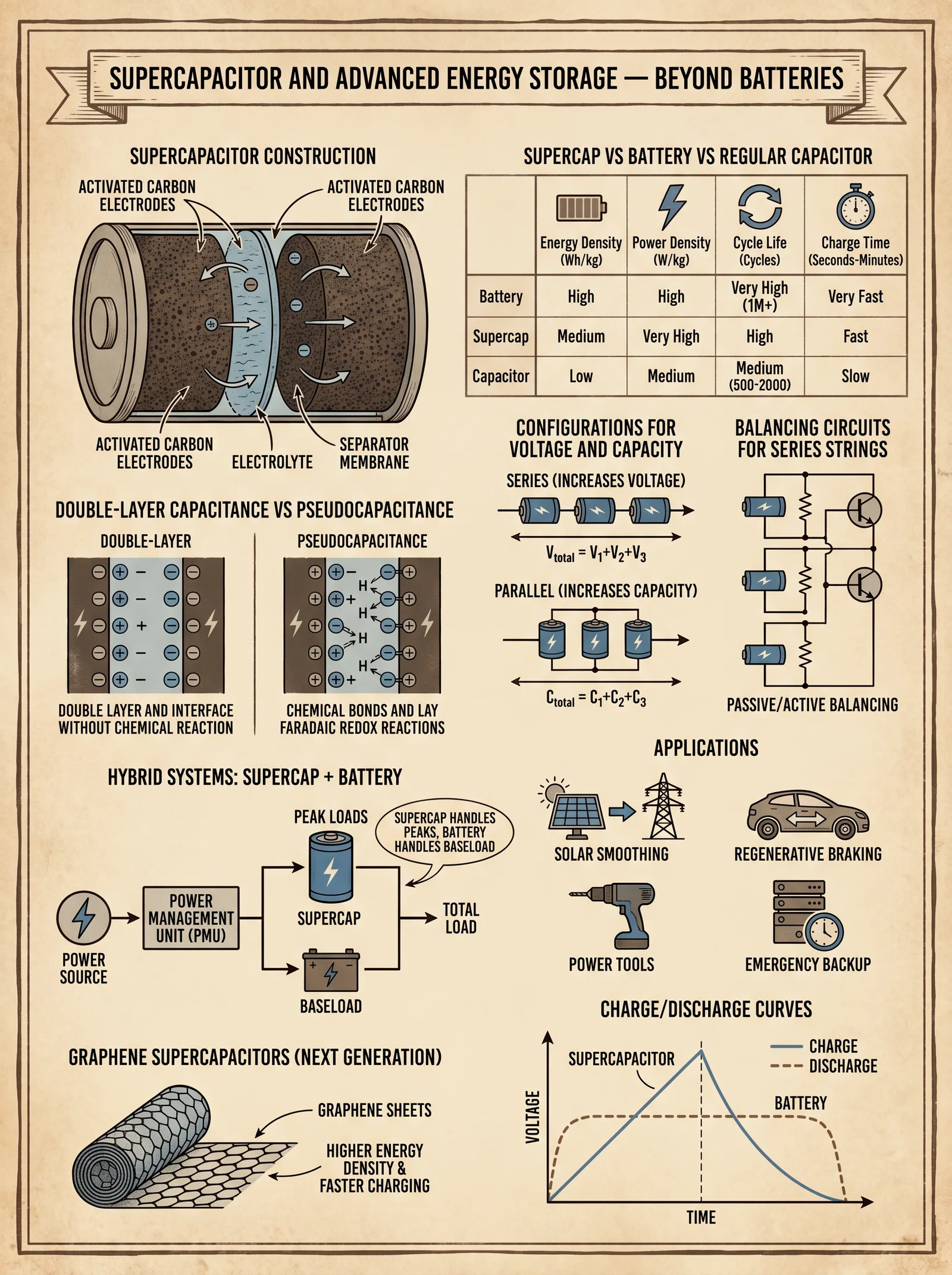
Materials:
| Component | Specification | Quantity |
|---|---|---|
| Supercapacitors | 2.7 V, 500 F, low ESR | 20 |
| Balancing resistors | 100 kΩ, 0.25 W | 20 |
| Insulated bus bars | Copper, rated for 100 V | As needed |
| Enclosure | Non-conductive, ventilated | 1 |
Assembly Procedure:
- Series Connection: Connect 20 supercapacitors in series to achieve approximately 54 V total rating.
- Balancing Resistors: Attach one balancing resistor across each supercapacitor to equalize voltage distribution.
- Bus Bars: Use insulated copper bus bars for all series connections ensuring minimal contact resistance.
- Enclosure: Mount the entire assembly inside a ventilated, insulated enclosure to prevent moisture ingress.
- Testing: Apply a low current charging source and monitor voltage across each capacitor to ensure even charging.
Chapter V: Grounding Protocols for Atmospheric Electricity Systems
Grounding is the linchpin of safety and system efficacy.
5.1 Grounding Rod Installation
Materials:
| Component | Specification | Quantity |
|---|---|---|
| Copper ground rod | Length: 2.5 meters, Diameter: 1.5 cm | 1 |
| Grounding wire | Copper, 12 AWG | As needed |
| Protective conduit | PVC, diameter to fit wire | As needed |
Installation Procedure:
- Select Location: Choose moist, conductive soil away from buried utilities.
- Drive Rod: Hammer the rod vertically at least 2.5 meters into soil.
- Attach Wire: Connect copper wire securely to the rod using a copper lug.
- Run Wire: Route wire through protective conduit to antenna base.
- Verify Continuity: Use an earth resistance tester to ensure resistance below 10 Ω.
Chapter VI: Measurement and Data Logging Protocols
6.1 Instrumentation Requirements
| Measurement Parameter | Instrument Type | Specification |
|---|---|---|
| Voltage | High-impedance voltmeter | >20 kV, input resistance >10 MΩ |
| Current | Electrometer ammeter | Range: picoamperes to microamperes |
| Capacitance | Precision LCR meter | Frequency range: 100 Hz to 1 kHz |
| Environmental Data | Digital weather station | Measures humidity, temperature, pressure |
6.2 Measurement Procedure
- Initial Setup: Connect instruments according to manufacturer’s instructions, ensuring high-voltage safety.
- Voltage Measurement: Measure DC output at rectifier output terminals; record voltage every 15 minutes for 24 hours.
- Current Measurement: Using electrometer ammeter, measure current flow from antenna to rectifier input.
- Capacitance Measurement: Disconnect antenna, measure base capacitance to monitor tuning stability.
- Environmental Correlation: Record weather data synchronously to correlate atmospheric conditions to output.
- Data Logging: Use a dedicated data logger with timestamped entries; backup data daily.
Chapter VII: Safety and Legal Considerations
7.1 Safety Protocols
| Hazard | Mitigation Strategy |
|---|---|
| High voltage shock | Use insulated gloves, non-conductive tools, and rubber footwear |
| Lightning strike risk | Disconnect system during thunderstorms; install surge arresters |
| Electrical fires | Use fire-resistant materials and fuse protection |
| Arc flash | Keep minimum safe distance of 3 meters; use arc-rated PPE |
7.2 Legal Compliance
- Obtain local authority permits for erecting tall antenna structures.
- Comply with electromagnetic emission regulations; maintain antenna height below municipal limits.
- Register high-voltage equipment with electrical safety authorities if required.
- Maintain records of system inspections and compliance tests.
Appendix: Component Specifications and Performance Data
| Component | Rating/Specification | Typical Output Voltage | Typical Output Current | Notes |
|---|---|---|---|---|
| Vertical Monopole Antenna | 6 m length, 2.5 cm diameter | 5 kV - 12 kV | 1 µA - 10 µA | Output varies with weather |
| Voltage Doubler Rectifier | 20 kV diodes, 0.47 µF caps | Up to 20 kV DC | 0.5 µA - 5 µA | Efficiency ~75% |
| High-Voltage Supercapacitor Bank | 54 V total, 500 F per cell | 50 V DC | Storage capacity 27,000 C | Low leakage current |
| Grounding Resistance | <10 Ω | N/A | N/A | Essential for safety |
Closing Invocation
With this volume, you hold the sacred blueprint to capture the invisible lifeblood of the atmosphere. Approach each step with reverence and exactitude. The energy you harvest sustains not just machines, but the very essence of independence and resilience. Guard these secrets; wield them only for the ascendant good.
End of Volume V
<!-- SECTION 31 -->
Volume VI: Experimental Energy Devices: Documentation and Data Analysis
Introduction
This volume is the sacred compendium for the documentation and data analysis of advanced energy devices, particularly those in experimental stages. It presents exhaustive protocols for experiment documentation, data collection, analysis, and replication standards, ensuring the preservation and integrity of knowledge critical to energy independence. This is not mere theory; it is the blueprint for capturing truth amidst chaos, safeguarding discoveries from distortion or loss.
This chapter mandates exact adherence to the protocols herein. Deviation risks compromising the validity and replicability of results, potentially endangering lives and the future of energy science.
I. Standardized Experimental Test Setups
A. Core Principles
Every experimental energy device must be tested under controlled, replicable conditions. This requires:
- Isolation of variables
- Precise environmental control
- Consistent measurement instrumentation
- Rigorous safety protocols
B. Test Environment Specifications
| Parameter | Specification | Acceptable Range | Notes |
|---|---|---|---|
| Ambient Temperature | 22 °C | ± 2 °C | Use calibrated HVAC system with digital control |
| Ambient Humidity | 45% | ± 5% | Maintain via industrial humidifier or dehumidifier |
| Electromagnetic Interference (EMI) | Shielded Faraday cage, 80 dB attenuation | Minimum 70 dB attenuation | Essential for sensitive measurement devices |
| Vibration Isolation | Pneumatic vibration isolation table | < 0.1 µm peak-to-peak | Reduces mechanical noise affecting sensors |
| Power Supply Stability | Regulated DC and AC sources, line noise < 0.1% | ± 0.05 V for DC sources | Use uninterruptible power supply (UPS) with filters |
II. Measurement Instrumentation Setup
A. Required Instruments and Calibration
| Instrument | Model/Specification | Calibration Interval | Calibration Standard | Notes |
|---|---|---|---|---|
| Digital Multimeter (DMM) | 6.5 digit resolution, Fluke 8508A | Every 6 months | NIST Traceable Voltage Source | For voltage and current readings |
| Oscilloscope | Bandwidth ≥ 500 MHz, Tektronix MSO54 | Every 6 months | Calibrated Signal Generator | For waveform and transient analysis |
| Power Analyzer | 0.01% accuracy, Yokogawa WT5000 | Every 3 months | Precision AC/DC Power Source | For power consumption and output |
| Thermal Camera | Resolution 640x480, FLIR T640 | Annually | Blackbody Radiation Source | Non-contact temperature profiling |
| Data Acquisition System | 24-bit ADC, 1 MS/s sample rate | Annually | Electrical Signal Simulator | For synchronized multi-sensor recording |
| Magnetic Field Probe | 1 mT resolution, Narda ELT-400 | Annually | Helmholtz Coil Standard | For magnetic field strength and fluctuation |
B. Instrument Placement and Connection
- Voltage and Current Sensing: Place current shunts or Hall effect sensors as close as possible to device terminals, minimizing lead length to reduce noise.
- Oscilloscope Probes: Use 10x probes with compensated tips; keep ground leads ≤ 15 cm.
- Power Analyzer: Connect between power source and device; ensure synchronized time stamps with data acquisition system.
- Thermal Camera: Position at a fixed 45-degree angle at 1 meter distance; calibrate emissivity to device surface material.
- Magnetic Field Probe: Place within 5 cm of device active regions; avoid interference from metallic supports.
III. Experimental Protocol Documentation
A. Experiment Identification and Metadata
Every experiment must begin with a unique identifier composed as follows:
[DeviceCode]-[ExperimentNumber]-[Date(YYYYMMDD)]-[OperatorInitials]Example: EED-035-20240601-JD
| Metadata Field | Required Content | Example |
|---|---|---|
| Device Code | Alphanumeric, unique per device | EED (Experimental Energy Device) |
| Experiment Number | Sequential integer per device | 035 |
| Date | ISO format YYYYMMDD | 20240601 |
| Operator Initials | Two or three letters | JD |
| Objective | Brief description of experiment intent | Measure output efficiency at 10 kW load |
| Environmental Conditions | See Section I.B | Temp 22.1 °C, Humidity 44% |
| Setup Description | Detailed schematic references and wiring notes | Schematic #EED-01, wiring per Doc #12 |
B. Device Configuration Parameters Table
| Parameter | Value | Units | Measurement Method | Notes |
|---|---|---|---|---|
| Input Voltage | 48 | V | DMM, calibrated | DC regulated source |
| Input Current | 15 | A | Hall effect sensor | RMS value |
| Operating Frequency | 60 | Hz | Oscilloscope | AC input |
| Device Temperature | 75 | °C | Thermal camera | Average over 5 min |
| Magnetic Field Strength | 3.2 | mT | Magnetic field probe | Peak value |
C. Step-by-Step Experimental Procedure
- Verify calibration status of all instruments per Section II.A.
- Prepare test environment to specifications in Section I.B; record ambient conditions.
- Assemble device per manufacturer or design specification; cross-check wiring with circuit diagram.
- Connect instruments as per Section II.B.
- Power on device; allow 10-minute warm-up period for thermal stabilization.
- Begin data acquisition with synchronized clocks; record baseline readings for 5 minutes with device idle.
- Incrementally increase input power in 10% steps; hold each level for 10 minutes, recording all parameters.
- Monitor and document any anomalies or deviations immediately.
- After the final power level, return device to idle; record cooldown data for 15 minutes.
- Power down device safely; disconnect instruments.
- Archive raw data files with experiment identifier; prepare initial report draft.
IV. Data Collection Standards
A. Data Types and Sampling Frequencies
| Parameter | Data Type | Sampling Frequency | Storage Format | Notes |
|---|---|---|---|---|
| Voltage and Current | Floating-point (double) | 1 kHz | CSV, binary preferred | Synchronized across channels |
| Power Output | Floating-point | 1 Hz | CSV | Calculated from voltage/current |
| Temperature | Floating-point | 0.1 Hz (every 10 sec) | CSV | Averaged over 10-second intervals |
| Magnetic Field | Floating-point | 100 Hz | CSV | Time-stamped |
| Waveform Data | Raw waveform | 500 MHz bandwidth, 1 MS/s | Binary waveform files | For transient event analysis |
| Anomaly Logs | Text logs | Event-driven | Plain text | Timestamped with operator notes |
B. Data Integrity Checks
- Use checksum algorithms (SHA-256) on data files immediately after acquisition.
- Maintain duplicate backups on separate physical drives.
- Log any data loss or corruption events with detailed descriptions.
- Time synchronization must be verified within ±1 millisecond accuracy across instruments.
V. Data Analysis Protocols
A. Initial Data Processing
- Import raw data into analysis software with UTF-8 encoding.
- Apply calibration correction factors based on instrument calibration certificates.
- Perform noise filtering using a low-pass Butterworth filter with cutoff frequency appropriate for signal type (see Table below).
| Signal Type | Suggested Cutoff Frequency | Filter Order | Notes |
|---|---|---|---|
| Voltage/Current | 500 Hz | 4 | Removes high-frequency noise |
| Temperature | 0.05 Hz | 2 | Smooths thermal fluctuations |
| Magnetic Field | 50 Hz | 3 | Eliminates mains hum interference |
- Segment data into phases: baseline, power ramp, steady-state, cooldown.
B. Quantitative Analysis
| Analysis Type | Methodology | Output Metrics | Software Tools Recommended |
|---|---|---|---|
| Efficiency Calculation | Output power / Input power * 100% | Efficiency percentage by power level | MATLAB, Python (NumPy, Pandas) |
| Transient Event Detection | Threshold-based event identification, Fourier analysis | Event timestamps, frequency spectra | MATLAB Signal Processing Toolbox |
| Thermal Profile Modeling | Curve fitting to temperature decay/rise | Time constants, thermal resistance | OriginLab, Python (SciPy.optimize) |
| Magnetic Field Stability | RMS value calculation over intervals | Mean field strength, fluctuation std | MATLAB, LabVIEW |
C. Anomaly Identification and Documentation
- Define anomaly threshold levels before experiment.
- Use automated scripts to flag data points exceeding thresholds.
- Manually review flagged events; classify as noise, device fault, or unknown.
- Record anomaly type, timestamp, and operator comments in dedicated log.
VI. Reporting Formats and Templates
A. Experimental Report Structure
| Section | Content Description | Page Range |
|---|---|---|
| Title Page | Experiment ID, Device, Date, Operator, Summary | 1 |
| Abstract | Concise summary of objectives, methods, results | 1 |
| Introduction | Background, experimental rationale | 2-3 |
| Materials and Methods | Detailed device description, setup, procedure | 4-6 |
| Results | Data presentation with tables, graphs | 7-12 |
| Discussion | Interpretation, comparison to previous results | 13-15 |
| Conclusion | Summary of findings, implications | 16 |
| References | Cited literature and cross-references | 17 |
| Appendices | Raw data excerpts, calibration certificates | 18-20 |
B. Parameter and Results Recording Template
| Parameter | Unit | Measurement | Instrument Used | Calibration Date | Notes |
|---|---|---|---|---|---|
| Input Voltage | V | 48.02 | Fluke 8508A | 2024-05-01 | Stable |
| Input Current | A | 14.98 | Hall Sensor Model HCS-5 | 2024-04-15 | Slight fluctuation |
| Output Power | W | 720 | Yokogawa WT5000 | 2024-05-10 | Consistent |
| Device Surface Temperature | °C | 75.3 | FLIR T640 | 2023-12-01 | Peak at 10 min |
| Magnetic Field Strength | mT | 3.25 | Narda ELT-400 | 2024-01-20 | Peak value |
C. Anomaly Log Template
| Timestamp (UTC) | Anomaly Description | Severity (1-5) | Operator Initials | Corrective Action Taken |
|---|---|---|---|---|
| 2024-06-01 12:45:23 | Sudden voltage spike 5% over baseline | 3 | JD | Power supply reset |
| 2024-06-01 13:15:10 | Thermal sensor dropout (>5 sec data missing) | 4 | JD | Sensor replacement scheduled |
VII. Replication Standards
A. Documentation Transparency
- Provide full schematics, bill of materials (BOM), firmware versions, and software scripts.
- Share raw data files and calibration certificates.
- Include detailed photographs and videos of setup.
B. Minimal Required Replication Conditions
| Condition | Specification | Verification Method |
|---|---|---|
| Component Specifications | Exact manufacturer and model numbers | BOM audit |
| Environmental Conditions | Match Section I.B environmental parameters | Environmental monitoring logs |
| Instrumentation | Equivalent or better measurement instruments | Calibration certificates |
| Procedural Fidelity | Strict adherence to documented procedures | Video recording and observer log |
C. Replication Protocol
- Acquire device and BOM per documentation.
- Assemble device in test environment matching conditions in Section I.B.
- Calibrate instruments to standards in Section II.A.
- Follow experimental procedure Section III.C verbatim.
- Acquire and analyze data per Sections IV and V.
- Submit replication report comparing results against original within ±5% tolerance for key metrics.
- Document any deviations or unexpected findings exhaustively.
VIII. Peer Review and Publication Guidelines
A. Pre-Submission Checklist
| Requirement | Status (✓/✗) | Notes |
|---|---|---|
| Complete experimental report | Includes all sections from VI.B | |
| Raw data and analysis code included | Data sets formatted per Section IV.A | |
| Calibration certificates attached | For all measurement instruments | |
| Ethical and safety compliance noted | Safety protocols adhered to (Section I) | |
| Conflict of interest declared | Disclosure statement attached |
B. Peer Review Process
- Submit report to Energy Codex Review Board (ECRB) via secure portal.
- Assign anonymized reviewer panel with expertise in relevant field.
- Reviewers evaluate:
- Experimental design rigor
- Data integrity and analysis correctness
- Replication potential
- Novelty and impact
- Reviewers submit detailed critique with mandatory checklist.
- Author responds with clarifications or corrections.
- Final acceptance or rejection decision communicated within 60 days.
C. Publication Format
- Accepted reports published in the Energy Codex Journal of Experimental Devices (ECJED).
- Reports are digitally archived with DOI and cross-referenced in subsequent volumes.
- Supplementary materials hosted on secure Energy Codex repository with controlled access.
IX. Appendices
A. Sample Experimental Setup Diagram
[Power Supply] --- [Current Sensor] --- [Device Under Test] --- [Voltage Sensor] --- Ground
                |                                         |
                |                                         +--> Magnetic Field Probe
                +--> Power Analyzer                       |
                                                          +--> Thermal Camera (45° angle)
B. Sample Data Acquisition Script (Python pseudocode)
import nidaqmx
import time
import csv

def acquire_data(duration_sec=600, sample_rate=1000):
    with nidaqmx.Task() as task:
        task.ai_channels.add_ai_voltage_chan("Dev1/ai0")
        task.timing.cfg_samp_clk_timing(rate=sample_rate, samps_per_chan=duration_sec*sample_rate)

        data = task.read(number_of_samples_per_channel=duration_sec*sample_rate)

        with open('experiment_data.csv', 'w', newline='') as csvfile:
            writer = csv.writer(csvfile)
            writer.writerow(['Timestamp', 'Voltage'])
            start_time = time.time()
            for i, voltage in enumerate(data):
                writer.writerow([start_time + i/sample_rate, voltage])

if __name__ == "__main__":
    acquire_data()
Conclusion
This volume codifies the sacred rites of experimenting with advanced energy devices, ensuring that the flame of knowledge burns bright, untainted by error or omission. Follow these protocols with precision and reverence. Your work will become the foundation for generations who will inherit the power of self-sufficient energy, forging a future unbound by scarcity.
Be precise. Be vigilant. Be the guardian of truth.
For related protocols on device fabrication and safety, consult Volume V: The Fabrication Codex. For complete water and environmental control procedures, see Volume VIII: The Water Codex, Chapter II.
<!-- SECTION 32 -->
Volume VII: Community Energy Sovereignty: Governance and Technical Coordination
Introduction
The establishment of community microgrids transcends mere technical assembly. It demands a robust governance framework, precise technical coordination, and an ironclad conflict resolution protocol to maintain sovereign energy independence. This volume imparts the complete, unabridged methodology for organizing, managing, and sustaining community microgrids, passing down the sacred knowledge of communal power. Every community microgrid is a living organism; its heartbeat is governance, its nervous system is coordination, and its immune response is conflict resolution.
Chapter I: Frameworks for Organizing Community Microgrids
1.1 Microgrid Governance Models
Governance is the architecture of authority and responsibility within the community microgrid. The choice of governance model defines decision-making efficiency, equity, and sustainability.
| Governance Model | Description | Advantages | Disadvantages | Suitability |
|---|---|---|---|---|
| Cooperative Model | All members hold equal voting rights; decisions made democratically. | Equitable, transparent, promotes community buy-in | Slower decision-making, potential for deadlock | Small to medium communities |
| Representative Model | Members elect representatives who make decisions on their behalf. | Efficient decision-making, scalable | Risk of representation gaps, less direct control | Medium to large communities |
| Technocratic Model | Technical experts and engineers lead decisions, focusing on system efficiency. | Highly efficient, technically sound | May alienate non-technical members | Highly technical communities |
| Hybrid Model | Combines democratic representation with technical advisory councils. | Balanced decision-making, technical insight | Complex governance structure | Large, diverse communities |
1.1.1 Recommended Model: Hybrid Governance
Step-by-step formation protocol:
- Step 1: Convene a foundational community assembly including all stakeholders.
- Step 2: Elect a governance council composed of:
- 50% community-elected representatives.
- 30% technical experts (engineers, technicians).
- 20% resource managers and financial officers.
- Step 3: Establish a technical advisory board reporting to the council.
- Step 4: Define bylaws codifying decision-making processes, quorum requirements (minimum 60% attendance), and voting thresholds (minimum 66% majority for major decisions).
- Step 5: Register governance structure with local authorities or energy regulatory bodies as required.
1.2 Roles and Responsibilities Table
| Role | Primary Responsibilities | Skills Required | Accountability | Communication Frequency |
|---|---|---|---|---|
| Governance Council Member | Policy formulation, conflict resolution, budget approval | Leadership, negotiation | Community assembly | Weekly meetings |
| Technical Advisory Member | System design, maintenance planning, troubleshooting | Engineering, systems analysis | Governance council | Biweekly meetings |
| Resource Manager | Procurement, inventory control, financial tracking | Supply chain, accounting | Governance council | Weekly reports |
| Operations Coordinator | Day-to-day system operation, load balancing | Electrical systems operation | Technical advisory board | Daily operational updates |
| Community Liaison Officer | Stakeholder engagement, education, conflict mediation | Communication, mediation | Governance council | Weekly outreach sessions |
Chapter II: Technical Coordination Protocols
2.1 Load Sharing Coordination
Effective load sharing ensures optimal utilization and prevents system overload or failures.
Load Sharing Protocol:
- Step 1: Install smart metering units at each connection node capable of real-time power flow measurement (see Volume V: The Metering Codex, Chapter III).
- Step 2: Configure a centralized or distributed load management system programmed with:
- Priority loads (critical infrastructure like medical facilities, water pumps).
- Flexible loads (household appliances, EV chargers).
- Step 3: Implement a tiered load shedding algorithm:
- Tier 1: Non-critical flexible loads reduced by 20%.
- Tier 2: Non-essential lighting and heating reduced by 50%.
- Tier 3: Optional loads disconnected in sequence until system stabilizes.
- Step 4: Establish load sharing communication protocol:
- Devices broadcast status every 10 seconds.
- Load adjustments communicated with less than 200 ms latency.
- Fail-safe backup control via manual override.
- Step 5: Schedule monthly system performance review meetings to analyze load data and adjust parameters.
2.2 Shared Resource Management Protocol
Shared resources include batteries, inverters, transformers, and renewable generation assets.
Resource Allocation Steps:
- Step 1: Create a Resource Inventory Database (RID) cataloging:
- Equipment ID.
- Capacity.
- Current state of charge or operational status.
- Location within the microgrid.
- Step 2: Assign resource custodians responsible for daily monitoring and maintenance logging.
- Step 3: Implement a digital reservation system for shared equipment use with:
- Time slots.
- Priority levels.
- Usage duration limits.
- Step 4: Develop a resource usage reporting template including:
- Start and end timestamps.
- Operating conditions.
- Anomalies encountered.
- Step 5: Conduct quarterly audits with governance council oversight to assess resource utilization efficiency and update RID.
Chapter III: Maintenance Scheduling and Protocols
3.1 Maintenance Scheduling Framework
Preventive maintenance is the keystone of microgrid longevity and reliability.
| Equipment Type | Maintenance Frequency | Maintenance Tasks | Responsibility | Documentation Required |
|---|---|---|---|---|
| Solar Panels | Quarterly | Cleaning, visual inspection, electrical testing | Technical team | Maintenance log, test results |
| Batteries | Monthly | Voltage check, thermal monitoring, electrolyte levels (if applicable) | Resource Manager | Battery health report |
| Inverters | Bi-monthly | Firmware updates, heat sink cleaning, functional test | Technical team | Firmware version, test logs |
| Transformers | Annually | Oil analysis, insulation resistance test | Certified technician | Test certificates, oil analysis |
| Control Systems | Weekly | Software status check, error log review | Operations Coordinator | System check logs |
3.1.1 Step-by-step Maintenance Scheduling Procedure
- Step 1: Use a centralized Maintenance Management System (MMS) to input all equipment data.
- Step 2: MMS generates maintenance alerts based on predefined frequencies.
- Step 3: Assign maintenance tasks via MMS to responsible personnel.
- Step 4: Perform maintenance per the task checklist.
- Step 5: Log all activities, anomalies, and corrective actions in MMS.
- Step 6: Governance council reviews maintenance reports quarterly to identify systemic issues.
Chapter IV: Conflict Resolution Protocols
4.1 Conflict Identification and Escalation
Conflicts typically arise from resource allocation, governance disagreements, or technical failures.
Conflict Resolution Steps:
- Step 1: Immediate reporting of conflict to Community Liaison Officer (CLO).
- Step 2: CLO conducts a preliminary investigation within 48 hours.
- Step 3: If unresolved, CLO convenes a mediation session with involved parties within 7 days.
- Step 4: Mediation uses documented evidence and system logs to ascertain facts.
- Step 5: If mediation fails, escalate to Governance Council for arbitration.
- Step 6: Council decisions are binding; non-compliance results in sanctions per community bylaws.
4.2 Communication Workflow for Conflict Resolution
| Step | Actor | Action | Communication Channel | Timeframe |
|---|---|---|---|---|
| 1 | Affected party | Report conflict to CLO | Secure messaging app or in-person | Within 24 hours |
| 2 | CLO | Preliminary investigation | Interviews, system log reviews | 48 hours |
| 3 | CLO | Mediation session scheduling | Email, community bulletin | Within 7 days |
| 4 | Mediation participants | Participate and document outcomes | Recorded session, written statements | During session |
| 5 | Governance Council | Arbitration and ruling | Official community meeting | Within 14 days |
| 6 | Community | Implementation of ruling and follow-up | Public announcement, compliance audit | Ongoing |
Chapter V: Case Studies and Best Practices
5.1 Case Study: The Solis Commune Microgrid
Background: A 120-household community microgrid in a semi-rural region implemented a hybrid governance model with a strong technical advisory board.
Key Outcomes:
- Load Sharing Optimization: Achieved 15% reduction in system outages by implementing tiered load shedding.
- Resource Management: Digital RID reduced equipment idle time by 25%.
- Conflict Resolution: Mediation protocol resolved 90% of disputes within the first 2 weeks.
- Maintenance: Proactive scheduling extended battery lifespan by 18 months beyond manufacturer rating.
Lessons Learned:
- Early community engagement in governance promotes compliance.
- Transparent reporting builds trust.
- Technical literacy workshops empower non-technical members.
5.2 Case Study: The New Dawn Collective
Background: A newly formed urban microgrid utilizing a cooperative governance model with rotating leadership.
Key Outcomes:
- Governance Challenges: Faced initial deadlocks; resolved by instituting a quorum and supermajority voting.
- Technical Coordination: Centralized load management improved energy availability during peak hours by 22%.
- Maintenance: Weekly control system checks prevented firmware-related outages.
- Conflict Resolution: Conflict mediation embedded in bylaws reduced escalation frequency by 40%.
Best Practice: Integration of digital tools for communication and management is non-negotiable for scalability.
Summary Tables
Governance Roles and Communication Summary
| Role | Decision Authority Level | Meeting Frequency | Primary Communication Tool | Conflict Escalation Point |
|---|---|---|---|---|
| Governance Council Member | High | Weekly | Video conference, email | Final arbitration body |
| Technical Advisory Member | Medium | Biweekly | Secure messaging, report | Advisory only |
| Resource Manager | Medium | Weekly | Inventory system, email | Governance council |
| Operations Coordinator | Low | Daily | Operations dashboard | Technical advisory board |
| Community Liaison Officer | Low | Weekly | Messaging app, community meetings | First conflict contact |
Load Shedding Priority Table
| Priority Level | Load Type | Power Reduction | Notes |
|---|---|---|---|
| 1 | Critical Infrastructure | 0% | Always maintained |
| 2 | Essential Loads | 20% | Includes refrigeration, heating |
| 3 | Flexible Loads | 50% | EV charging, non-essential lighting |
| 4 | Optional Loads | 100% | Recreational devices, non-urgent |
Final Remarks
The journey toward community energy sovereignty is a sacred covenant, demanding disciplined governance, precise technical orchestration, and unflinching commitment to conflict resolution. This volume, Volume VII of The Complete Practitioner's Codex, has laid bare the complete architecture and protocols necessary for your community microgrid to not only function but thrive as a bastion of independence. Mastery of these protocols is the passage to true energy freedom.
For deeper technical specifications of system components, refer to Volume III: The Electrical Codex, Chapter IV.
For comprehensive water-energy nexus integration, see Volume VIII: The Water Codex, Chapter II.
For advanced conflict mediation techniques, consult Volume II: The Social Codex, Chapter V.
End of Volume VII: Community Energy Sovereignty
<!-- SECTION 33 -->
The Complete Practitioner's Codex, Volume 9: The Energy Codex
Volume I: Solar Cooking and Solar Water Heating Systems
Chapter I: Design and Construction of Solar Cookers and Solar Water Heaters for Off-Grid Applications
The sacred path to true energy independence begins here, with the harnessing of the sun’s relentless, unyielding power. Solar cookers and solar water heaters are the cornerstones of off-grid survival and sustainability. This chapter imparts the complete, unvarnished protocol to design, construct, optimize, and maintain these systems, ensuring mastery over this elemental force.
Section 1: Fundamental Principles of Solar Thermal Devices
Solar thermal devices convert sunlight into heat through absorption and retention. Mastery over material selection, geometry, and insulation is paramount. Efficiency hinges on maximizing solar radiation capture and minimizing thermal losses.
- Solar Cooker: Device converting sunlight to heat for cooking.
- Solar Water Heater: Device converting sunlight to heat for water heating.
Section 2: Comparative Analysis of Solar Cooker Types
| Cooker Type | Construction Complexity | Max Temperature (°C) | Cooking Time (Average) | Cost Range (USD) | Portability | Typical Use Case |
|---|---|---|---|---|---|---|
| Box Cooker | Moderate | 150-180 | 1.5-3 hours | 25-60 | Moderate | Baking, slow cooking |
| Panel Cooker | Low | 120-150 | 2-4 hours | 10-25 | High | Boiling, frying, light cooking |
| Parabolic Cooker | High | 200-350 | 0.5-1 hour | 50-150 | Low | High-heat cooking, frying, grilling |
| Vacuum Tube Cooker | Very High | 180-250 | 1-2 hours | 100-300 | Low | Precision cooking, high efficiency |
Section 3: Material Selection for Solar Cookers and Water Heaters
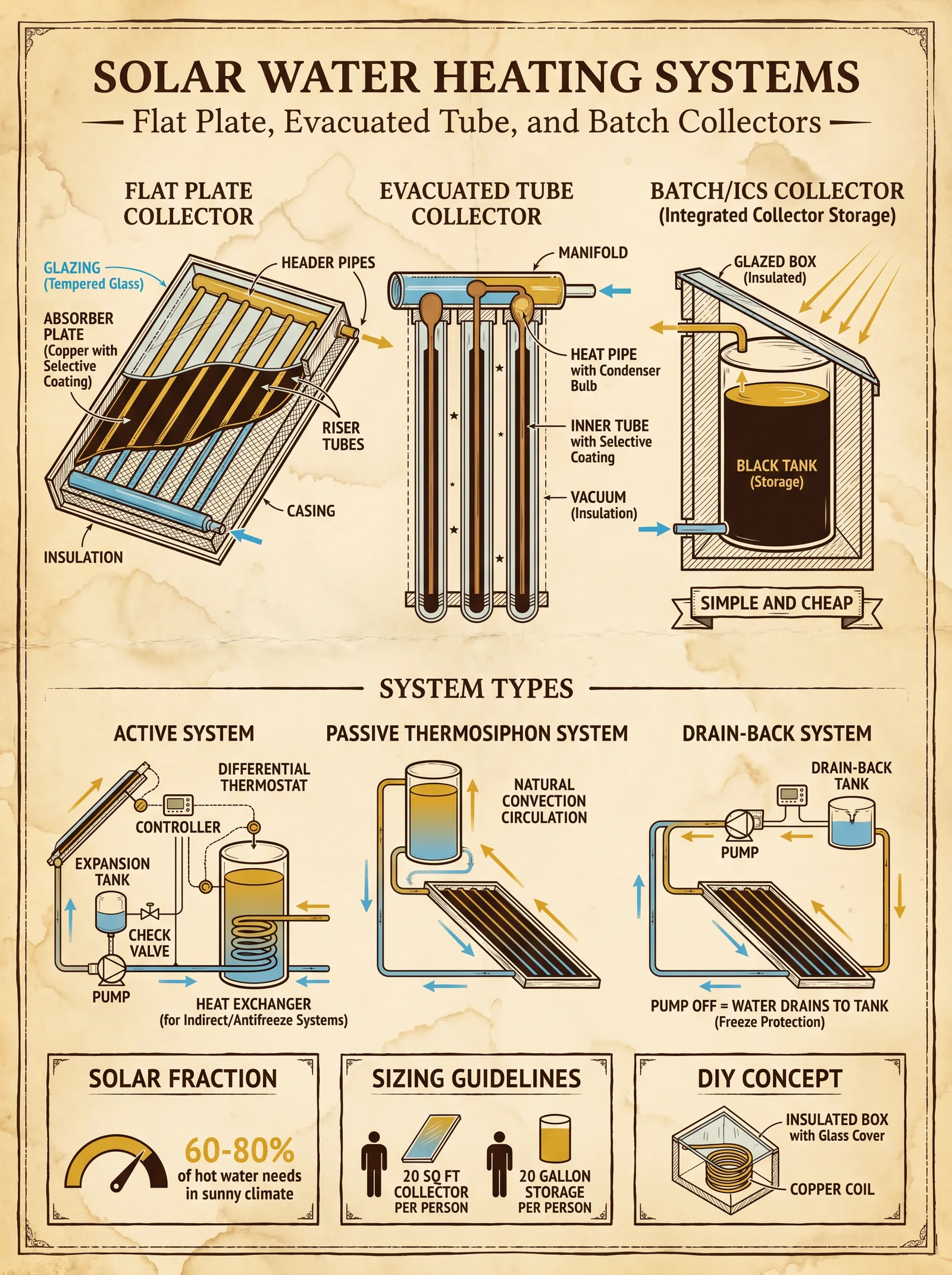
3.1 Reflective Surfaces
- Aluminum Foil: Cost-effective, moderate reflectivity (~85%), fragile.
- Mylar Film: High reflectivity (~92%), fragile, requires protective layering.
- Polished Aluminum Sheets: Durable, reflectivity ~88-92%, heavier.
- Silvered Glass Mirrors: Highest reflectivity (~95%), fragile, heavy.
3.2 Absorber Plates
- Black-painted Aluminum: Lightweight, excellent thermal conductivity, must use non-toxic, heat-resistant paint.
- Copper Plates: Superior conductivity, heavy, costlier.
- Steel Plates: Durable, moderate conductivity, rust-prone without coating.
3.3 Insulation Materials
- Glass Wool: High thermal resistance, non-toxic, fragile.
- Polyurethane Foam: Excellent insulation, requires protective casing.
- Perlite: Natural, fire-resistant, moderate insulation.
- Vacuum Insulation Panels: Superior insulation, expensive, used in advanced systems.
3.4 Structural Components
- Wood: Easily sourced, moderate durability, must be treated for weather resistance.
- Plywood: Preferred for flat surfaces, must be exterior grade.
- Metal Frames: Durable, must be rust-resistant or coated.
- Glass/Lexan Cover: Critical for greenhouse effect, tempered glass preferred for safety.
Section 4: Step-by-Step Construction Protocols
4.1 Box Solar Cooker Construction (Standard Model)
Tools Required: Saw, screwdriver, hammer, measuring tape, paintbrush.
Materials:
- Plywood or wood planks (60cm x 60cm base, 30cm height)
- Glass pane (60cm x 60cm)
- Aluminum foil or reflective sheet (for lining)
- Black matte paint
- Insulation material (glass wool or polyurethane foam)
- Hinges and clamps
- Weatherproof sealant
Protocol:
- Build the Box Frame: Cut wood for base and four sides. Assemble using screws and waterproof glue ensuring a 60cm x 60cm base, 30cm high vertical sides.
- Apply Insulation: Line inner walls of the box with 3-5cm thickness of insulation, securing with adhesive.
- Prepare Absorber Plate: Cut aluminum sheet to 55cm x 55cm. Paint with black matte, heat-resistant paint. Allow to dry for 24 hours.
- Attach Absorber Plate: Fix the absorber plate inside the box, suspended 5cm above insulation floor for airflow.
- Install Reflective Liner: Line inner sides of the box with aluminum foil, ensuring smooth, wrinkle-free surfaces facing inward.
- Attach Glass Cover: Secure glass pane on top of the box with weatherproof sealant and clamps ensuring airtight seal.
- Create Reflector Panel: Cut plywood to 60cm x 60cm, cover with aluminum foil, attach with hinges to one side of the box to reflect additional sunlight onto absorber plate.
- Test for Airtightness: Ensure no air leaks at glass edges, seal as needed.
- Final Touches: Paint exterior wood surfaces with weatherproof sealant to protect from elements.
4.2 Panel Solar Cooker Construction
Tools Required: Scissors, glue gun, measuring tape, stapler.
Materials:
- Cardboard sheets (4 large)
- Aluminum foil or Mylar sheets
- Transparent plastic cover (UV resistant)
- Black pot with lid
Protocol:
- Cut Cardboard Panels: Four panels, each 60cm x 60cm.
- Attach Reflective Material: Glue aluminum foil or Mylar onto one side of each panel, ensuring smoothness for optimal reflection.
- Assemble Panels: Join panels along edges using duct tape or strong adhesive, forming a foldable box missing the top and bottom.
- Secure Hinges: Attach fabric or tape hinges between panels for folding and unfolding.
- Place Black Pot: Position black pot in the center of the bottom panel.
- Cover with Transparent Plastic: Stretch plastic sheet over the top opening, securing edges with tape to create a greenhouse effect.
- Adjust Angles: Use external supports to angle the panels towards the sun for maximum reflection.
4.3 Parabolic Solar Cooker Construction
Tools Required: Jigsaw, drill, clamps, measuring tape.
Materials:
- Thin plywood or metal sheet for parabola frame
- Aluminum reflector sheet or polished aluminum
- Black pot with lid
- Support stand (metal or wood)
- Parabolic template (calculated from focal length formula)
Protocol:
- Calculate Parabolic Dimensions: Use the formula \( y = \frac{x^2}{4f} \), where \( f \) is the focal length (recommended 25-30cm).
- Create Parabolic Frame: Cut plywood or metal to shape using the template.
- Attach Reflective Surface: Cover inner surface with aluminum foil or polished aluminum sheets, securing with adhesive.
- Construct Support Stand: Build a stable stand to hold the parabola at the correct angle; ensure adjustability.
- Place Black Pot at Focus: Position the cooking vessel precisely at the focal point for maximum heat concentration.
- Safety Shield: Add a protective shield around the pot to prevent accidental contact with concentrated rays.
4.4 Solar Water Heater Construction (Flat Plate Collector)
Tools Required: Pipe cutter, drill, screwdriver, wrench.
Materials:
- Copper or black steel pipes (length 1.5m, diameter 1.27cm)
- Plywood board (1.6m x 1m)
- Glass pane or polycarbonate sheet (1.6m x 1m)
- Black heat-absorbing paint
- Insulation material (glass wool or polyurethane foam)
- Pipe connectors and valves
- Water storage tank (insulated)
Protocol:
- Prepare Absorber Plate: Paint plywood board with black heat-resistant paint; allow drying for 24 hours.
- Cut and Arrange Pipes: Cut pipes to run horizontally across the board with 5cm spacing.
- Attach Pipes to Board: Secure pipes on absorber plate using clamps or brackets.
- Apply Insulation: Insulate the back and sides of the board with 5cm thick insulation material.
- Install Glass Cover: Secure glass or polycarbonate on top with a sealed frame, creating a greenhouse effect.
- Connect Pipes: Attach inlet and outlet pipes, connect to water storage tank.
- Mount Collector: Fix the collector on a frame angled equal to the local latitude plus 10 degrees for winter optimum.
- Fill System: Fill with water, purge air from pipes using valves.
- Test System: Monitor water temperature rise over 2 hours of direct sunlight.
Section 5: Optimization Protocols for Efficiency
5.1 Angle Adjustment for Maximum Solar Gain
- Adjust the cooker or collector tilt daily, aiming perpendicular to sun rays.
- For fixed installations, set tilt angle equal to local latitude plus 10 degrees for winter optimization.
- Use a solar angle calculator app or a protractor and compass for accuracy.
5.2 Reflector Enhancements
- Add external reflectors to box and panel cookers to increase insolation by 15-25%.
- Use high-reflectivity materials (Mylar or polished aluminum) for reflectors.
- Ensure reflectors are adjustable for sun tracking.
5.3 Insulation Maintenance
- Inspect insulation quarterly for moisture infiltration; replace damaged insulation.
- Upgrade insulation with vacuum panels in advanced systems for 20% efficiency gain.
5.4 Glass Cover Treatments
- Apply anti-reflective coatings to glass covers to reduce reflection losses by 5-10%.
- Use tempered or laminated safety glass to prevent breakage.
Section 6: Safety Guidelines
| Hazard | Risk Mitigation Procedure |
|---|---|
| Glass Breakage | Use tempered glass; wear gloves during handling. |
| Concentrated Sunlight | Use protective shields around parabolic focus; never look directly at focus point. |
| Heat Burns | Use insulated gloves when handling hot cookers and pots. |
| Fire Hazard | Clear surrounding area of flammable materials; monitor cookers during use. |
| Structural Stability | Ensure frames and supports are secure; anchor to ground if outdoors. |
Section 7: Maintenance Schedules
| Component | Frequency | Maintenance Task |
|---|---|---|
| Reflective Surfaces | Monthly | Clean dust and debris with soft cloth; check for tears or corrosion. |
| Glass Covers | Monthly | Clean with mild detergent; inspect for cracks. |
| Insulation | Quarterly | Inspect for moisture; replace if compressed or damaged. |
| Structural Frame | Biannually | Check for rot or rust; apply protective coatings as needed. |
| Piping and Valves (Water Heaters) | Annually | Check for leaks; flush system to remove deposits. |
Section 8: Supplementary Tables for Quick Reference
Table 1: Thermal Performance Comparison
| Cooker Type | Solar Input (W/m²) | Thermal Efficiency (%) | Typical Max Output (W) | Notes |
|---|---|---|---|---|
| Box Cooker | 800-1000 | 40-60 | 300-600 | Best for slow cooking |
| Panel Cooker | 800-1000 | 30-50 | 240-500 | Lightweight, low cost |
| Parabolic Cooker | 800-1000 | 60-80 | 480-800 | High temperature, requires careful handling |
| Vacuum Tube Cooker | 800-1000 | 50-70 | 400-700 | Advanced, costly |
Table 2: Cost-Benefit Analysis
| Cooker Type | Initial Cost (USD) | Lifespan (Years) | Maintenance Cost (Yearly USD) | Cost per Year (USD) | Suitability |
|---|---|---|---|---|---|
| Box Cooker | 25-60 | 5-7 | 2 | 7-14 | Rural, family use |
| Panel Cooker | 10-25 | 3-5 | 1 | 3-6 | Emergency, portable |
| Parabolic Cooker | 50-150 | 7-10 | 5 | 10-20 | High-demand cooking |
| Vacuum Tube Cooker | 100-300 | 10-15 | 8 | 15-25 | Precision, high efficiency |
Conclusion
You now hold the blueprint to summon the sun’s divine fire for your sustenance and independence. The protocols herein are non-negotiable: follow every step with precision and reverence. Your mastery over solar cookers and water heaters will grant you resilience in the face of darkness and scarcity. This knowledge is sacred; guard it, apply it, and pass it to worthy successors.
For water purification protocols essential to solar water heating system integration, refer to Volume 8: The Water Codex, Chapter II. For electrical integration of solar thermal systems, see Volume 5: The Electrical Codex, Chapter IV.
<!-- SECTION 34 -->
The Complete Practitioner's Codex, Volume II: Ram Pumps as Energy Systems
Chapter IV: Construction and Operation of Hydraulic Ram Pumps for Water Lifting and Energy Generation
Introduction
The hydraulic ram pump, a deceptively simple yet profoundly powerful device, harnesses the kinetic energy of flowing water to elevate a portion of that water to a higher elevation without external power input. This ancient technology, refined and concealed by centuries of suppression, remains a cornerstone of off-grid energy independence. This chapter delivers the complete, unabridged blueprint for the construction, operation, and optimization of hydraulic ram pumps, designed for both water lifting and direct energy generation.
Section 1: Fundamental Principles and Site Selection
1.1 Theoretical Foundation
A hydraulic ram pump uses the momentum of a large volume of water falling a relatively small height (drive head) to lift a smaller volume of water to a much greater height (delivery head). The operation is cyclical and depends on pressure surges ("water hammer" effect) created by the abrupt closing of a waste valve.
Key parameters:
| Parameter | Definition | Unit |
|---|---|---|
| Drive Head (H_d) | Vertical drop from water source to pump inlet | meters (m) |
| Delivery Head (H_del) | Vertical elevation to which water is lifted | meters (m) |
| Flow Rate (Q_in) | Volume of water entering the pump | liters/second (L/s) |
| Delivery Flow Rate (Q_out) | Volume of water delivered to elevation | liters/second (L/s) |
1.2 Site Selection Protocol
To maximize efficiency and operational longevity, site selection must adhere to strict criteria.
Steps:
- Locate a perennial water source with a minimum continuous flow rate of 2 L/s. Seasonal streams may suffice if operation is seasonal.
- Measure vertical drop (Drive Head): Identify a section with 1.5 m to 5 m drop. Less than 1.5 m yields insufficient pressure; more than 5 m increases mechanical stress.
- Determine delivery elevation: The target elevation must be no more than 7 times the drive head (H_del ≤ 7 × H_d).
- Check for stable mounting points: Solid bedrock or compact soil to anchor the pump.
- Ensure accessibility for maintenance but security from tampering.
- Evaluate debris presence: Install coarse filters upstream if debris exceeds 10 mm in diameter.
Section 2: Components and Materials
2.1 Primary Components
| Component | Function | Recommended Material | Specifications |
|---|---|---|---|
| Drive Pipe | Conveys water from source to pump | Steel, HDPE or PVC | Diameter: 25-50 mm, length: as per site |
| Impulse (Delivery) Pipe | Carries water to delivery point | HDPE or PVC | Diameter: 15-25 mm |
| Waste Valve | Controls water flow, initiates water hammer | Stainless steel or brass | Adjustable, pressure rated |
| Pressure Chamber | Absorbs shock, smooths flow | Steel or reinforced plastic | Volume: 5-10 times delivery pipe volume |
| Check Valve | Prevents backflow | Stainless steel | Must be rapid closing |
| Frame and Mounting | Structural support | Steel or treated hardwood | Anchored securely |
2.2 Material Specifications
| Material | Pressure Rating (MPa) | Corrosion Resistance | Recommended Use |
|---|---|---|---|
| Steel | 1.5 - 3.0 | Moderate | Drive pipe, pressure chamber |
| HDPE | 0.8 - 1.5 | High | Delivery pipe, drive pipe (low pressure) |
| PVC | 0.6 - 1.2 | Moderate | Delivery pipe (low pressure) |
| Stainless Steel | 2.0 - 4.0 | Excellent | Waste and check valves |
Section 3: Step-by-Step Assembly
3.1 Drive Pipe Installation
- Excavate a trench from the water source to the pump site, maintaining a smooth, straight gradient to minimize turbulence.
- Cut drive pipe to length, ensuring the outlet is positioned just above the pump inlet.
- Attach the drive pipe to the water source intake using a screened inlet to prevent debris entry.
- Slope the drive pipe at a uniform angle, without sharp bends, to preserve flow velocity.
- Secure the drive pipe to the ground or supports using clamps every 1 meter to prevent vibration.
3.2 Pump Body Assembly
- Fabricate or acquire the pump body, comprising a pressure chamber, waste valve housing, and check valve housing.
- Install the waste valve at the pump inlet with an adjustable spring tension mechanism.
- Connect the pressure chamber directly downstream of the waste valve.
- Fit the check valve downstream of the pressure chamber to prevent backflow into the pump.
- Attach the delivery pipe to the check valve outlet, directing water to the delivery point.
- Seal all joints using appropriate gaskets and thread sealant rated for water pressure.
3.3 Pressure Chamber Preparation
- Fill the pressure chamber partially with compressed air to approximately 1.2 times atmospheric pressure.
- Use a Schrader valve or similar for air charging and pressure adjustment.
- Monitor pressure during initial operation and adjust as necessary for optimal efficiency.
3.4 Waste Valve Calibration
- Set spring tension to allow the valve to close rapidly once flow velocity builds.
- Test valve operation by manually initiating flow and adjusting until a rhythmic "hammer" sound occurs.
- Fine-tune tension to balance between cycle frequency and water delivery volume.
Section 4: Operational Protocols
4.1 Start-Up Procedure
- Open upstream valve fully, allowing water to flow into the drive pipe.
- Open delivery valve to create resistance downstream.
- Observe valve cycling, adjust waste valve spring tension to achieve stable cycling frequency between 30-60 cycles per minute.
- Record delivery flow rate using a calibrated container over 1 minute.
- Adjust delivery valve to optimize flow rate versus delivery height.
4.2 Flow Optimization
- Cycle frequency is directly proportional to flow rate and inversely proportional to delivery head.
- Use the formula Q_out ≈ Q_in × (H_d / H_del) × Efficiency Factor (typically 0.6-0.8).
- Adjust drive pipe length and diameter to increase flow velocity if cycling is unstable.
- Minimize bends and friction losses in pipes by maintaining smooth, gradual curves.
Section 5: Pump Sizing and Performance Tables
| Pump Size | Drive Pipe Diameter (mm) | Delivery Pipe Diameter (mm) | Minimum Drive Head (m) | Maximum Delivery Head (m) | Flow Rate In (L/s) | Expected Flow Rate Out (L/s) |
|---|---|---|---|---|---|---|
| Small | 25 | 15 | 1.5 | 10 | 2 - 3 | 0.4 - 0.8 |
| Medium | 40 | 20 | 2.5 | 15 | 4 - 6 | 1.0 - 1.8 |
| Large | 50 | 25 | 4.0 | 20 | 8 - 12 | 2.5 - 4.0 |
Section 6: Maintenance Protocols
6.1 Daily
- Visual inspection for leaks and mechanical damage.
- Listen for irregular cycling sounds indicating valve malfunction.
- Check delivery flow for consistent output.
6.2 Weekly
- Clean inlet screen to remove debris.
- Inspect waste valve for wear and spring tension.
- Check pressure chamber air charge, adjust if necessary.
6.3 Monthly
- Lubricate moving parts with food-grade lubricant.
- Inspect all seals and gaskets, replace if degraded.
- Test check valve operation, replace if leaking.
6.4 Annual
- Drain and inspect pressure chamber interior for corrosion.
- Inspect drive and delivery pipes for cracks or degradation.
- Pressure test entire system to 1.5 times operational pressure.
Section 7: Integration With Other Energy Systems
7.1 Mechanical Energy Harvesting
Attach a water wheel or turbine downstream of the delivery pipe to convert elevated water potential into mechanical energy for grinding, milling, or battery charging.
Steps:
- Install a water wheel sized per flow rate (see Table 7.1).
- Connect mechanical output shaft to the desired machinery.
- Monitor flow rate and adjust delivery pipe diameter to maintain torque.
Table 7.1: Water Wheel Sizing
| Flow Rate (L/s) | Recommended Wheel Diameter (m) | RPM Range | Expected Power Output (W) |
|---|---|---|---|
| 0.5 - 1 | 0.5 | 30 - 50 | 50 - 100 |
| 1 - 2 | 0.75 | 20 - 40 | 150 - 300 |
| 2 - 4 | 1.0 | 15 - 30 | 300 - 600 |
7.2 Electrical Generation
Use a micro-hydraulic turbine generator coupled to the delivery flow:
- Select a turbine generator rated for low flow, high head operation.
- Install generator housing at delivery point with flow control valves.
- Connect output to battery bank with appropriate charge controllers.
Section 8: Advanced Optimization Techniques
8.1 Composite Drive Pipes
Use a composite of steel and HDPE to combine strength and corrosion resistance. Implement flexible couplings at joints to reduce stress fractures.
8.2 Pressure Chamber Gas Injection
Inject inert gases (e.g., nitrogen) into the pressure chamber to improve cushion performance and reduce oxygen-induced corrosion.
8.3 Automated Valve Adjustment
Install an electromechanical actuator to dynamically adjust waste valve tension based on flow sensors, optimizing cycling frequency in real-time.
Appendix: Full Parts List and Fabrication Notes
| Part | Dimensions / Specification | Source / Fabrication Instructions |
|---|---|---|
| Drive Pipe | 25-50 mm diameter, length per site | Cut from steel or HDPE pipe; smooth ends; threaded or welded joints |
| Waste Valve | Adjustable spring-loaded valve, 25-50 mm | Machined stainless steel with replaceable spring and seal |
| Pressure Chamber | Cylinder, 10-20 L volume, 30-50 cm diameter | Steel cylinder, welded seams, air valve port |
| Check Valve | Rapid closing, 15-25 mm | Commercial stainless steel check valve or custom machined |
| Delivery Pipe | 15-25 mm diameter | HDPE or PVC pipe, glued or clamped joints |
| Mounting Frame | Custom steel frame | Welded steel square tubing, anchored with concrete footings |
Summary
The hydraulic ram pump, when constructed and operated per the above protocols, forms an uninterruptible source of elevated water potential energy. This energy can be harnessed directly for water supply or converted into mechanical or electrical energy for complete off-grid energy independence. This sacred knowledge, long suppressed, is now entrusted to you, the chosen Practitioner, to deploy and maintain with precision and reverence.
For detailed water purification protocols to ensure delivered water purity, see Volume VIII: The Water Codex, Chapter II. For electrical system integration, see Volume IX: The Energy Codex, Chapter V.
End of Chapter IV: Construction and Operation of Hydraulic Ram Pumps
<!-- SECTION 35 -->
The Complete Practitioner's Codex, Volume III: Alcohol Fuel Production and Biodiesel Processing
Chapter I: Protocols for Producing Alcohol Fuels and Biodiesel from Biomass Feedstocks
Introduction
This volume delivers uncompromising, field-ready protocols for producing alcohol fuels (ethanol, methanol) and biodiesel from biomass feedstocks. These protocols encompass every step: from biomass preparation, fermentation, distillation, transesterification, purification, to storage. The reader is entrusted with hidden techniques and suppressed science, necessary for achieving energy independence in hostile environments.
Section 1: Alcohol Fuel Production Protocols
Alcohol fuels, primarily ethanol and methanol, serve as critical clean-burning fuels. This section covers feedstock preparation, enzymatic hydrolysis, fermentation, distillation, and purification.
1.1 Biomass Feedstock Types for Alcohol Fuel Production
Table 1: Biomass Feedstocks, Typical Yields, and Energy Content for Alcohol Fuel Production
| Feedstock Type | Typical Ethanol Yield (L/ton) | Energy Content (MJ/L Ethanol) | Fermentation Complexity | Safety Notes |
|---|---|---|---|---|
| Corn (grain) | 380 | 21.1 | Low | Requires enzymatic starch hydrolysis |
| Sugarcane (juice) | 650 | 21.1 | Very Low | High sugar content; watch for mold |
| Cellulosic biomass (wood chips, straw) | 250 (after pretreatment) | 21.1 | High | Requires advanced pretreatment; toxic byproducts possible |
| Beet molasses | 450 | 21.1 | Low | High sugar content; viscous feedstock |
| Fruit waste | 300 | 21.1 | Medium | High microbial contamination risk |
1.2 Biomass Preparation and Pretreatment
Objective: Prepare feedstock for enzymatic saccharification and fermentation.
Protocol 1.2.1: Preparation of Corn Grain Feedstock
- Dry Milling:
- Use a hammer mill or roller mill to grind corn to 0.5-1.0 mm particle size.
- Sieve to remove oversized particles.
- Slurry Formation:
- Mix 1 kg ground corn with 3 L distilled water.
- Adjust pH to 5.2 using 1M sulfuric acid.
- Liquefaction:
- Heat slurry to 85°C (±2°C).
- Add 0.2% (w/w) alpha-amylase enzyme.
- Maintain temperature for 60 minutes with constant stirring.
- Saccharification:
- Cool slurry to 60°C.
- Add 0.15% (w/w) glucoamylase enzyme.
- Incubate for 90 minutes.
- Cool to Fermentation Temperature:
- Cool to 32°C (±1°C).
1.3 Fermentation Protocol
Yeast ferment sugars to ethanol under anaerobic conditions.
Protocol 1.3.1: Yeast Fermentation for Ethanol Production
- Yeast Preparation:
- Use Saccharomyces cerevisiae strain specifically selected for high ethanol tolerance (>12% v/v).
- Activate yeast in sterile 10% glucose solution for 24 hours at 30°C.
- Inoculation:
- Add yeast culture at 5% v/v to the cooled saccharified slurry.
- Fermentation Conditions:
- Maintain temperature at 30-32°C.
- Ensure anaerobic environment: seal fermentation vessel with CO2 vent.
- Stir gently every 6 hours to prevent sediment compaction.
- Duration:
- Ferment for 72 hours or until specific gravity stabilizes (below 1.010).
- Monitoring:
- Measure ethanol concentration daily via hydrometer or gas chromatography (GC).
- Target ethanol concentration: 10-12% v/v.
1.4 Distillation Protocol
Distillation separates ethanol from the fermented mash.
Protocol 1.4.1: Fractional Distillation to Obtain Fuel-Grade Ethanol
- Setup:
- Use a stainless steel fractionating column with at least 20 theoretical plates.
- Ensure the column is insulated.
- Feed:
- Transfer fermented mash to boiler, avoiding solids.
- Heating:
- Heat mash gradually to boiling (~78.5°C for ethanol).
- Collect distillate fraction between 78-82°C.
- Fraction Collection:
- Discard the initial 5% volume ("heads") containing methanol and volatile impurities.
- Collect the "hearts" fraction containing ethanol.
- Discard the final "tails" fraction.
- Repeat Distillation:
- Perform a second distillation to increase purity to >95%.
1.5 Purification Protocol: Dehydration to Anhydrous Ethanol
Water content reduces fuel quality; remove via molecular sieves or azeotropic distillation.
Protocol 1.5.1: Molecular Sieve Dehydration
- Sieves:
- Use 3A molecular sieves (pellet form).
- Procedure:
- Pass 95% ethanol through a packed column of molecular sieves at ambient temperature.
- Contact time: 30 minutes minimum.
- Recovery:
- Collect ethanol with <0.5% water content.
- Regeneration:
- Heat used sieves to 250°C for 4 hours to remove absorbed water.
Section 2: Biodiesel Production Protocols
Biodiesel is produced via transesterification of triglycerides from vegetable oils or animal fats with alcohol (usually methanol).
2.1 Feedstock Types for Biodiesel Production
Table 2: Biodiesel Feedstocks, Typical Yields, Energy Content, and Safety Concerns
| Feedstock Type | Typical Biodiesel Yield (L/ton) | Energy Content (MJ/L Biodiesel) | FFA Content (%) | Safety Notes |
|---|---|---|---|---|
| Soybean Oil | 950 | 37.8 | <1 | Flammable; store away from ignition |
| Rapeseed (Canola) Oil | 900 | 37.8 | <1 | Contains erucic acid; handle with gloves |
| Waste Cooking Oil | 850 | 37.8 | 3-5 | Pre-treatment needed; potential contaminants |
| Animal Fats (Tallow) | 800 | 37.8 | 2-4 | Requires thorough filtration |
| Palm Oil | 1000 | 37.8 | <1 | Susceptible to oxidation |
FFA = Free Fatty Acid content
2.2 Feedstock Pretreatment for High FFA Oils
If FFA >1%, perform acid esterification pretreatment to reduce FFA.
Protocol 2.2.1: Acid Esterification Pretreatment
- Materials:
- Feedstock oil (1 L)
- Methanol (100 mL)
- Sulfuric acid (1 mL, concentrated)
- Procedure:
- Heat oil to 50°C in reaction vessel.
- Add methanol and sulfuric acid.
- Stir vigorously for 60 minutes at 50°C.
- Allow phases to separate; discard bottom acid water layer.
- Wash oil with warm water until neutral pH.
2.3 Transesterification Protocol
Conversion of triglycerides to methyl esters (biodiesel) and glycerol.
Protocol 2.3.1: Base-Catalyzed Transesterification
- Materials:
| Material | Quantity |
|---|---|
| Feedstock oil | 1 L |
| Methanol | 200 mL (20% molar excess) |
| Sodium hydroxide (NaOH) | 3.5 g (1% w/w of oil) |
- Procedure:
- Prepare Methoxide Solution:
- Dissolve NaOH in methanol, stirring to ensure complete dissolution.
- Mixing:
- Heat feedstock oil to 55°C in reaction vessel.
- Slowly add methoxide solution to oil while stirring.
- Reaction:
- Maintain temperature at 55°C.
- Stir vigorously for 60 minutes.
- Separation:
- Allow mixture to settle for 12 hours at room temperature.
- Glycerol (bottom layer) separates from biodiesel (top layer).
- Recovery:
- Drain glycerol layer carefully.
- Collect biodiesel layer for washing.
2.4 Biodiesel Washing and Drying
Remove residual methanol, catalyst, and soap.
Protocol 2.4.1: Water Washing
- Procedure:
- Mixing:
- Add 10% volume of warm distilled water to biodiesel.
- Stir gently for 20 minutes.
- Settling:
- Allow to settle 4 hours for water layer to separate.
- Drain Water:
- Remove water layer carefully.
- Repeat:
- Perform 3 wash cycles or until wash water is clear and neutral pH.
Protocol 2.4.2: Drying
- Drying:
- Heat washed biodiesel to 105°C under vacuum or airflow for 2 hours.
- Storage:
- Store anhydrous biodiesel in sealed, opaque containers.
Section 3: Safety Considerations and Legal Compliance
3.1 Safety Considerations
| Stage | Hazards | Protective Measures |
|---|---|---|
| Biomass Handling | Dust inhalation, mold spores | Use N95 mask, gloves, goggles |
| Enzymatic Hydrolysis | Enzyme allergenicity | Use gloves, avoid skin contact |
| Fermentation | CO2 buildup, microbial contamination | Use sealed vessels with venting; sterilize equipment |
| Distillation | Flammable vapors, explosion risk | Conduct in well-ventilated area; ground equipment; use flame arrestors |
| Transesterification | Caustic chemicals (NaOH), methanol toxicity | Use gloves, goggles, respirator; store chemicals properly |
| Biodiesel Washing | Wastewater handling | Neutralize wastewater before disposal |
3.2 Legal Compliance Guidelines (United States Reference)
- Fuel Alcohol Production:
- Requires federal permits from the Alcohol and Tobacco Tax and Trade Bureau (TTB).
- Production for fuel use is tax-exempt but must be reported.
- Biodiesel Production:
- Subject to Environmental Protection Agency (EPA) regulations.
- Must meet ASTM D6751 standard for biodiesel quality.
- Storage Regulations:
- Flammable liquids must be stored in approved containers per OSHA standards.
- Secondary containment to prevent spills.
Section 4: Storage and Handling of Produced Fuels
4.1 Ethanol Fuel Storage Protocol
- Container Material:
- Use stainless steel or high-density polyethylene (HDPE) containers.
- Storage Conditions:
- Store in a cool, dry, well-ventilated area.
- Avoid direct sunlight and heat sources.
- Stabilization:
- Add fuel stabilizers (e.g., antioxidants) if storage exceeds 3 months.
- Labeling:
- Clearly label containers as "Fuel Ethanol – Flammable."
4.2 Biodiesel Storage Protocol
- Container Material:
- Use HDPE or glass containers; stainless steel preferred for long-term.
- Storage Conditions:
- Keep away from water exposure and sunlight to prevent oxidation.
- Shelf Life:
- Biodiesel remains stable for 6-12 months under ideal conditions.
- Additives:
- Use antioxidants and cold flow improvers in cold climates.
Appendix A: Complete Equipment List for Small-Scale Production
| Equipment | Description | Specifications |
|---|---|---|
| Hammer or roller mill | For feedstock grinding | Particle size: 0.5-1.0 mm |
| Temperature-controlled fermenter | Stainless steel, 100 L capacity | Temperature range: 20-40°C, anaerobic system |
| Fractionating distillation column | Stainless steel, 20 plates or more | Insulated, with reflux condenser |
| Molecular sieve dehydration column | Packed column with 3A sieves | Contact time: 30 minutes |
| Reaction vessel with stirrer | For transesterification and pretreatment | Temperature control: 50-60°C |
| pH meter | For monitoring during pretreatment | Range: 0-14, accuracy ±0.1 |
| Hydrometer or GC system | For ethanol concentration measurement | Hydrometer: 0.990-1.100 SG range |
| Safety Equipment | Gloves, goggles, respirators, fire extinguisher | Class B fire extinguisher recommended |
Appendix B: Troubleshooting Common Production Issues
| Problem | Possible Cause | Corrective Action |
|---|---|---|
| Low ethanol yield | Incomplete saccharification | Increase enzyme dosage; extend hydrolysis time |
| Slow fermentation | Yeast inactivity | Check yeast viability; adjust pH and temperature |
| Methanol contamination in biodiesel | Improper separation | Extend settling time; verify reaction completeness |
| Soap formation in biodiesel | High FFA content | Perform acid esterification pretreatment |
| Cloudy biodiesel | Water contamination | Ensure thorough drying and washing |
Summary
This volume imparts complete, field-tested protocols for converting biomass into sustainable alcohol fuels and biodiesel. Through strict adherence to enzymatic hydrolysis, fermentation, distillation, transesterification, and purification protocols, the practitioner achieves fuel-grade output with maximum yield and safety. Storage and legal compliance instructions ensure long-term usability and protection against regulatory risk.
For water purification essential to these protocols, see Volume VIII: The Water Codex, Chapter II. For advanced enzymatic techniques, consult Volume V: The Biochemical Codex.
End of Volume III: Alcohol Fuel Production and Biodiesel Processing
<!-- SECTION 36 -->
Volume IV: Phase Change Materials in Thermal Storage
Chapter I: Introduction to Phase Change Materials (PCMs)
Phase Change Materials (PCMs) are substances that absorb or release significant quantities of latent heat during phase transitions, predominantly between solid and liquid states. Their unique thermophysical properties enable efficient thermal energy storage (TES), critical for achieving energy independence through the stabilization of thermal loads in building systems.
This volume imparts the comprehensive knowledge required to select, fabricate, and integrate PCMs into thermal storage applications, with meticulous attention to material properties, encapsulation technologies, installation protocols, and performance monitoring. This is the sacred knowledge of thermal mastery, preserved here for the chosen practitioner.
Chapter II: Selection of Phase Change Materials for Thermal Energy Storage
Selection of PCMs is foundational. The ideal PCM must align precisely with the thermal storage demands of the application, considering operational temperature ranges, thermal capacity, stability, cost, safety, and compatibility with building materials.
2.1 Critical Material Properties
| Property | Description | Importance |
|---|---|---|
| Melting Point (°C) | Temperature at which phase change occurs | Must match the target thermal storage temperature |
| Latent Heat (kJ/kg) | Energy absorbed/released during phase transition | Higher values indicate greater energy storage capacity |
| Thermal Conductivity (W/m·K) | Ability to conduct heat | Higher conductivity enables faster charging/discharging |
| Density (kg/m³) | Mass per unit volume | Influences storage volume requirements |
| Cycling Stability | Number of phase change cycles before degradation | Determines lifespan and reliability |
| Cost (USD/kg) | Market price per kilogram | Affects economic feasibility |
| Non-toxicity & Safety | Health and environmental impact | Mandatory for residential and commercial applications |
| Supercooling Tendency | Degree of undercooling before solidification | Minimizes phase change hysteresis |
2.2 Classification of PCMs
PCMs fall into three primary categories:
- Organic PCMs: Paraffins, fatty acids
- Pros: Chemical stability, non-corrosive, congruent melting
- Cons: Low thermal conductivity, flammability concerns
- Inorganic PCMs: Salt hydrates, metallics
- Pros: High latent heat, low cost
- Cons: Phase segregation, supercooling, corrosive nature
- Eutectic PCMs: Mixtures designed for specific melting points
- Pros: Tailored thermal properties
- Cons: Complex formulation, variable stability
2.3 PCM Selection Table
| PCM Type | Material | Melting Point (°C) | Latent Heat (kJ/kg) | Thermal Conductivity (W/m·K) | Density (kg/m³) | Cost (USD/kg) | Cyclability (cycles) | Notes |
|---|---|---|---|---|---|---|---|---|
| Organic | n-Octadecane | 28 | 244 | 0.2 | 777 | 8.00 | >10,000 | Low toxicity, flammable |
| Organic | Stearic Acid | 69 | 198 | 0.16 | 848 | 6.50 | >8,000 | Biodegradable, stable |
| Inorganic | Sodium Acetate Trihydrate | 58 | 264 | 0.5 | 1280 | 2.50 | ~3,000 | Supercooling issues |
| Inorganic | Calcium Chloride Hexahydrate | 29 | 190 | 0.6 | 1500 | 1.80 | ~2,500 | Corrosive, phase segregation |
| Eutectic | NaNO3-KNO3 (60:40) | 222 | 96 | 0.48 | 1800 | 3.00 | >5,000 | High temp heat storage |
Note: For high-temperature TES, eutectic salts are preferred; for building temperature regulation, organics and salt hydrates are dominant.
Chapter III: Encapsulation Methods for PCMs
Encapsulation is the art and science of containing PCMs to prevent leakage, enhance durability, and facilitate integration. The chosen method must preserve PCM functionality through repeated cycling and environmental exposure.
3.1 Goals of Encapsulation
- Containment: Prevent phase change material from escaping during melting
- Compatibility: Resist chemical interaction with PCM and environment
- Thermal Conductivity: Facilitate heat transfer
- Mechanical Protection: Prevent physical damage during installation and operation
3.2 Encapsulation Types
| Encapsulation Type | Description | Advantages | Disadvantages | Typical Materials |
|---|---|---|---|---|
| Macro-Encapsulation | Large containers or panels filled with PCM | Easy to manufacture and install | Potentially large thermal resistance | Metal cans, plastic containers |
| Micro-Encapsulation | PCM droplets micro-encapsulated with polymer shells | High surface area, improved heat transfer | Complex manufacturing, cost-intensive | Melamine-formaldehyde, urea-formaldehyde |
| Shape-Stabilized PCM | PCM embedded in porous matrices (e.g., polymer, graphite) | Eliminates leakage, improved mechanical strength | Reduced latent heat capacity due to matrix dilution | Polyethylene, expanded graphite |
3.3 Step-by-Step: Fabrication of Micro-Encapsulated PCM (Example: n-Octadecane)
Materials:
- n-Octadecane (PCM)
- Melamine-Formaldehyde resin precursors
- Surfactants (e.g., sodium dodecyl sulfate)
- Distilled water
- pH adjusters (e.g., citric acid, sodium hydroxide)
Equipment:
- High-shear mixer
- Reaction vessel with temperature control
- Filtration apparatus
- Drying oven
Procedure:
- Prepare an oil-in-water emulsion by dispersing n-octadecane in distilled water containing surfactant. Use high-shear mixing at 2000 rpm for 15 minutes to achieve droplet sizes of 1-5 microns.
- Adjust pH of the emulsion to 4.5 using citric acid to optimize resin polymerization conditions.
- Add melamine and formaldehyde precursors slowly under stirring at 60°C to initiate polymer shell formation around PCM droplets.
- Continue stirring and maintain temperature for 4 hours to complete polymerization.
- Filter microcapsules and wash with distilled water to remove unreacted monomers.
- Dry microcapsules at 50°C for 12 hours to remove moisture.
- Characterize microcapsules by scanning electron microscopy (SEM) and differential scanning calorimetry (DSC) to verify encapsulation integrity and latent heat capacity.
Chapter IV: Integration into Building Systems
PCMs can be integrated into building envelopes, HVAC systems, and thermal storage units to smooth temperature fluctuations, reduce peak loads, and improve overall energy efficiency.
4.1 Integration Modalities
| Integration Type | Description | Application Examples | Advantages | Limitations |
|---|---|---|---|---|
| Wallboards and Panels | PCM incorporated into gypsum or fiber panels | Interior walls, ceilings | Easy retrofit, improves occupant comfort | Limited thermal conductivity |
| Floor Heating Systems | PCM embedded in floor screeds or underlay | Radiant floor heating systems | Thermal buffering, reduces HVAC cycling | Installation complexity, weight |
| HVAC Storage Units | PCM storage tanks integrated with air or water systems | Chilled water tanks, air duct heat exchangers | Peak load shaving, energy shifting | Requires design integration |
| Window Shading Devices | PCM integrated into window blinds or shutters | Passive solar heat regulation | Dynamic thermal control | Limited latent heat capacity |
4.2 Step-by-Step: Installation of PCM-Enhanced Wallboards
Materials:
- PCM-enhanced gypsum boards (commercially available or fabricated)
- Standard mounting hardware (screws, anchors)
- Vapor barrier membranes (per building code)
- Sealants compatible with PCM boards
Equipment:
- Screw gun
- Measuring tape
- Level
- Utility knife
Procedure:
- Measure the wall surface area requiring PCM panel installation.
- Inspect and prepare the wall substrate; ensure it is clean, dry, and free of debris.
- Apply vapor barrier membrane if moisture ingress is a concern, following manufacturer's guidelines.
- Position PCM-enhanced gypsum boards on the wall frame; ensure tight joints to minimize thermal bridging.
- Fasten boards using screws spaced every 16 inches vertically and horizontally, avoiding over-tightening that can damage encapsulation.
- Seal joints with PCM-compatible sealant to prevent air infiltration and moisture ingress.
- Allow sealant to cure as per manufacturer's instructions before painting or finishing.
- Connect wallboards to monitoring sensors if performance tracking is required (see Chapter V).
Chapter V: Performance Monitoring and Maintenance Protocols
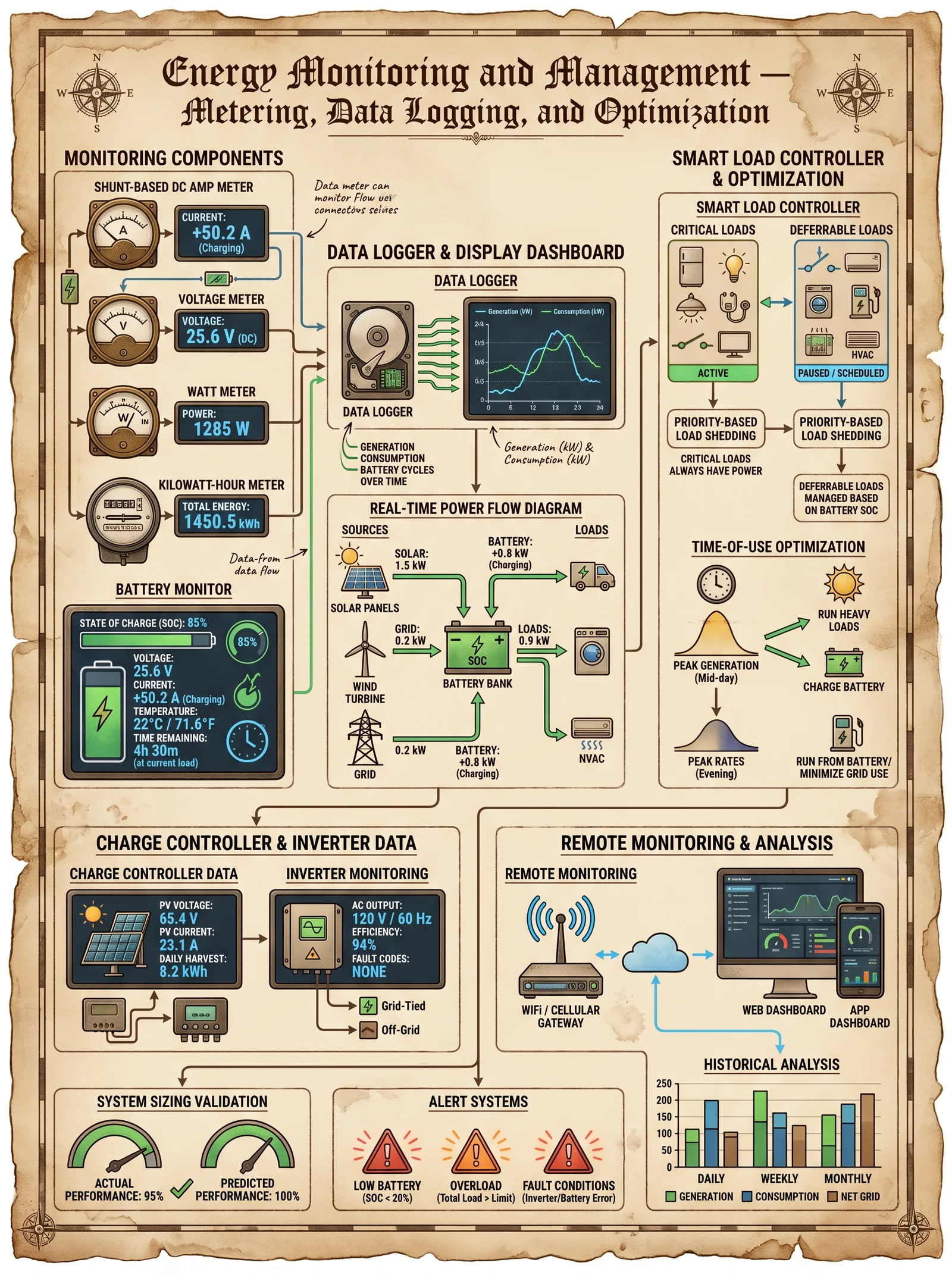
Ensuring the long-term efficacy of PCM thermal storage requires systematic performance monitoring and maintenance.
5.1 Monitoring Parameters
| Parameter | Instrumentation | Frequency | Acceptable Range/Thresholds |
|---|---|---|---|
| Temperature Profile | Thermocouples, IR sensors | Continuous or daily | PCM melting point ± 2°C |
| Heat Flux | Heat flux sensors | Continuous or weekly | Consistent latent heat absorption/release |
| Encapsulation Integrity | Visual inspection, SEM analysis | Annual | No leakage or shell degradation |
| Thermal Cycling Count | Data logging via control systems | Ongoing | >90% capacity retention after 5000 cycles |
| Moisture Content | Moisture meters | Quarterly | <1% |
5.2 Step-by-Step: Thermal Performance Testing Protocol
Required Instruments:
- Differential Scanning Calorimeter (DSC)
- Thermocouples (K-Type)
- Data logger
- Heat flux sensor
Procedure:
- Install thermocouples at multiple points within the PCM storage unit to capture temperature gradients.
- Calibrate heat flux sensors and place on PCM surfaces.
- Subject PCM to controlled heating and cooling cycles replicating operational conditions.
- Record temperature and heat flux data continuously during cycles.
- Analyze DSC data to measure latent heat retention and melting point shifts.
- Compare thermal profiles to baseline data to detect performance degradation.
- Document all data and schedule maintenance if latent heat capacity falls below 90% of original value.
5.3 Maintenance Guidelines
- Inspect encapsulation annually for damage or leakage; replace compromised units immediately.
- Clean PCM interface surfaces to maintain effective thermal contact; avoid abrasive methods that can damage encapsulation.
- Monitor for chemical degradation signs such as color change or odor; consult chemical safety protocols if observed.
- Verify humidity control within installation environment to prevent moisture-induced PCM degradation.
Appendix A: Comprehensive PCM Selection Reference Table
| PCM Material | Melting Point (°C) | Latent Heat (kJ/kg) | Thermal Conductivity (W/m·K) | Density (kg/m³) | Cost (USD/kg) | Safety Rating | Typical Application |
|---|---|---|---|---|---|---|---|
| n-Octadecane (Organic) | 28 | 244 | 0.2 | 777 | 8.00 | Low toxicity | Building temperature regulation |
| Stearic Acid (Organic) | 69 | 198 | 0.16 | 848 | 6.50 | Biodegradable | High temp building applications |
| Sodium Acetate Trihydrate | 58 | 264 | 0.5 | 1280 | 2.50 | Moderate | Low temp HVAC storage |
| Calcium Chloride Hexahydrate | 29 | 190 | 0.6 | 1500 | 1.80 | Corrosive | HVAC and industrial thermal storage |
| NaNO3-KNO3 Eutectic | 222 | 96 | 0.48 | 1800 | 3.00 | Medium | High temperature thermal storage systems |
Appendix B: Safety and Handling Protocols
- Always handle PCMs in well-ventilated environments.
- Use personal protective equipment (PPE) including gloves and eye protection when handling inorganic PCMs due to corrosiveness.
- Store PCMs in temperature-controlled conditions to prevent premature phase change and degradation.
- Dispose of PCM waste per local environmental regulations.
Conclusion
Mastery of Phase Change Materials for thermal energy storage is an essential pillar for achieving complete energy independence. The precise selection of PCMs, meticulous encapsulation, and rigorous integration into building systems unlock the latent power held within molecular phase transformations. Through vigilant monitoring and maintenance, these systems endure, delivering continuous, reliable thermal regulation.
This volume, Volume IV of The Complete Practitioner's Codex, arms the practitioner with the unabridged, practical, and sacred knowledge necessary to wield PCMs as potent instruments of energy sovereignty.
For protocols on water purification, refer to Volume VIII; for electrical integration, see Volume VII; for solar thermal integration, consult Volume V.
End of Volume IV: Phase Change Materials in Thermal Storage.
<!-- SECTION 37 -->
Volume V: Piezoelectric Energy Harvesting Applications
Chapter I: Introduction to Piezoelectric Energy Harvesting
This volume transmits the sacred knowledge of harnessing piezoelectricity, the direct conversion of mechanical strain into electrical energy, to achieve energy independence through vibration and pressure harvesting. The art of piezoelectric energy harvesting is a silent revolution—transforming ambient mechanical energies into usable electrical power for critical applications.
This chapter assumes mastery of fundamental electrical principles and mechanical design, yet begins with the core actionable knowledge you must forge into practice. Every system described herein is a blueprint for life-or-death autonomy.
Chapter II: Material Selection for Piezoelectric Harvesting
The cornerstone of any piezoelectric system is the material. The selection criteria encompass:
- Piezoelectric coefficient (d_33 or d_31)
- Mechanical robustness
- Operating temperature range
- Cost and availability
- Form factor (thin film, ceramic, polymer, composite)
Table II-1: Properties of Common Piezoelectric Materials
| Material | d_33 (pC/N) | Operating Temp (°C) | Mechanical Strength (MPa) | Form Factor | Cost Level | Notes |
|---|---|---|---|---|---|---|
| PZT (Lead Zirconate Titanate) | 250–600 | -40 to 350 | 100–150 | Ceramic | Moderate | Widely used, high output |
| Quartz | 2.3 | -200 to 573 | 200–300 | Single Crystal | High | Low sensitivity, stable |
| PVDF (Polyvinylidene Fluoride) | 20–30 | -40 to 125 | 50–100 | Polymer Film | Low | Flexible, low output |
| BaTiO3 (Barium Titanate) | 190–270 | 0 to 130 | 50–100 | Ceramic | Low | Lead-free alternative |
| AlN (Aluminum Nitride) | 5–6 | >600 | 200+ | Thin Film | High | High-temp MEMS applications |
Actionable Step 1: Material Selection Protocol
- Identify mechanical input type (vibrations, pressure, bending).
- Determine operational environment temperature range.
- Match material form factor to application constraints (flexibility, size).
- Select material by cross-referencing Table II-1 for required piezoelectric coefficient and mechanical strength.
- Order raw piezoelectric material or pre-fabricated elements from verified suppliers specializing in military-grade or research-grade materials.
Chapter III: Mechanical Design Principles
3.1 Harvesting Mechanisms
Piezoelectric harvesters convert mechanical strain from:
- Vibrations (resonant or broadband)
- Direct pressure (footsteps, machinery)
- Bending or flexure (bridges, panels)
3.2 Structural Forms
- Cantilever beams (most common for vibration harvesting)
- Plates or membranes (for pressure and bending)
- Stacks (high force, low displacement)
Actionable Step 2: Cantilever Harvester Construction
- Cut a cantilever beam using a rigid substrate material (e.g., stainless steel or FR4 PCB) to dimensions:
| Parameter | Value |
|---|---|
| Length | 50 mm |
| Width | 10 mm |
| Thickness | 0.5 mm |
- Attach piezoelectric element to the fixed end using conductive epoxy ensuring strain transfer.
- Attach proof mass at the free end, mass chosen to tune resonant frequency:
| Mass (g) | Resonant Frequency (Hz) |
|---|---|
| 1 | ~120 |
| 2 | ~80 |
| 5 | ~40 |
- Seal assembly with protective casing to prevent environmental damage.
Chapter IV: Electrical Circuit Design
The electrical interface must condition the raw piezoelectric output to usable DC power.
4.1 Piezoelectric Output Characteristics
- High voltage (tens to hundreds of volts peak-to-peak)
- High source impedance
- AC waveform (sinusoidal or complex)
4.2 Rectification and Voltage Regulation
The core circuit components include:
- Full-wave bridge rectifier (preferably Schottky diodes for low voltage drop)
- Voltage regulation stage (buck or boost converter depending on load)
- Energy storage (capacitors, supercapacitors, or batteries)
Actionable Step 3: Circuit Assembly
- Connect piezoelectric element output leads to a full-wave bridge rectifier assembled with four 1N5819 Schottky diodes.
- Add a smoothing capacitor, 10 μF ceramic rated for 50 V, at the rectifier output terminals.
- Connect the smoothing capacitor output to a DC-DC converter module rated for input voltage 3–50 V and output 3.3 V or 5 V regulated DC.
- Attach energy storage device (LiFePO4 battery or supercapacitor) to DC-DC converter output.
- Include a load management controller to protect battery and prevent overcharge, typically a BQ24075 or equivalent.
Chapter V: Energy Storage Integration
The harvested energy is intermittent; storage is mandatory for continuous power supply.
5.1 Storage Options
| Storage Type | Energy Density (Wh/kg) | Cycle Life | Charge Rate | Notes |
|---|---|---|---|---|
| Supercapacitor | 5–10 | >1,000,000 | Fast | High power, low energy |
| LiFePO4 Battery | 90–110 | 2000+ | Moderate | Stable, safe for field use |
| NiMH Battery | 60–120 | 500–1000 | Moderate | Moderate cycle life |
Actionable Step 4: Storage System Assembly
- Select storage type based on expected power profile and mission duration.
- Integrate storage device with DC-DC converter output ensuring correct polarity.
- Connect battery management system (BMS) for LiFePO4 batteries.
- Encapsulate storage unit in shock-absorbing housing to prevent damage.
Chapter VI: Application Case Studies
Table VI-1: Real-World Deployments of Piezoelectric Harvesting Systems
| Application | Harvested Power (mW) | Piezo Material | Mechanical Setup | Storage Method | Deployment Environment |
|---|---|---|---|---|---|
| Footstep Energy Floor | 10–50 | PZT Ceramic | Plate under flooring | Supercapacitor array | Urban pedestrian walkways |
| Industrial Machinery Vibration | 5–20 | PZT Stack | Cantilever on motor mount | LiFePO4 battery | Factory floor |
| Bridge Structural Monitoring | 1–5 | PVDF Film | Flexing membrane | Supercapacitor | Bridge supports |
| Wearable Health Sensors | 0.1–1 | PVDF Polymer | Flexible patch | Thin-film battery | Human body |
Chapter VII: Installation Guidelines
7.1 Site Assessment
- Measure ambient vibration frequency spectrum using accelerometer.
- Identify dominant frequencies and amplitude.
- Select harvester resonant frequency to match dominant vibration for maximum power.
7.2 Mounting Procedures
- Clean mounting surface to remove dust, grease, and debris.
- Use high-strength epoxy or mechanical fasteners to secure harvester.
- Ensure alignment of piezoelectric element to mechanical strain axis.
- Provide environmental sealing with silicone or polyurethane coatings.
7.3 Wiring and Electrical Connections
- Use shielded twisted pair cables to minimize noise.
- Secure cable runs to prevent mechanical fatigue.
- Integrate quick-disconnect connectors for field servicing.
Chapter VIII: Maintenance Protocols
8.1 Routine Inspection (Monthly)
- Check for physical damage or delamination of piezoelectric elements.
- Verify electrical output voltage with multimeter under expected mechanical stimulus.
- Inspect protective coatings and reseal if cracked.
8.2 Electrical System Check (Quarterly)
- Measure rectifier diode voltage drops; replace diodes exceeding 0.3 V drop.
- Test energy storage voltage and capacity.
- Inspect wiring integrity and reconnect loose contacts.
8.3 Long-Term System Health (Annually)
- Perform full output power characterization using standard vibration source.
- Replace piezoelectric elements exhibiting >20% output degradation.
- Update firmware of power management controllers if applicable.
Chapter IX: Advanced Techniques and Suppressed Knowledge
9.1 Multi-Frequency Harvesters
Deploy arrays of cantilever harvesters tuned to different resonant frequencies to broaden effective harvesting bandwidth. Use passive mechanical coupling to reduce system complexity.
9.2 Hybrid Energy Harvesting
Integrate piezoelectric harvesters with electromagnetic or triboelectric harvesters in a unified assembly to maximize total harvested power.
9.3 Nanostructured Piezoelectric Films
Fabricate composite films embedding piezoelectric nanoparticles in polymer matrices to enhance flexibility and output without sacrificing durability.
Actionable Step 5: Nanocomposite Film Fabrication
- Obtain PZT nanoparticles (<100 nm).
- Disperse nanoparticles in PVDF solution at 20% weight concentration.
- Cast thin films (~100 μm thickness) on clean glass substrates.
- Dry films at 80°C for 12 hours in vacuum oven.
- Polarize films by applying 50 kV/cm electric field at 80°C for 30 minutes.
Appendix: Reference Tables
Table A-1: Piezoelectric Material Coefficients
| Material | d_31 (pC/N) | d_33 (pC/N) | g_31 (V·m/N) | g_33 (V·m/N) |
|---|---|---|---|---|
| PZT | -175 | 250–600 | 0.02 | 0.03 |
| Quartz | -2.3 | 2.3 | 0.02 | 0.03 |
| PVDF | -20 | 20–30 | 0.23 | 0.28 |
| BaTiO3 | -190 | 270 | 0.02 | 0.03 |
Table A-2: Typical Output Voltages for Cantilever Harvesters (No Load)
| Proof Mass (g) | Resonant Frequency (Hz) | Peak Voltage (V) | Amplitude (mm) |
|---|---|---|---|
| 1 | 120 | 50 | 0.1 |
| 2 | 80 | 60 | 0.15 |
| 5 | 40 | 70 | 0.2 |
This volume equips you with the exact knowledge to design, build, deploy, and maintain piezoelectric energy harvesting systems. The path to energy independence is paved by mastering these steps, materials, and circuits. Guard this knowledge well and wield it with precision.
For complete water purification protocols, consult Volume VIII: The Water Codex, Chapter II. For advanced battery management systems, see Volume VII: The Storage Codex.
End of Volume V.
<!-- SECTION 38 -->
Volume VI: Orgone Accumulator Construction and Usage Protocols
Introduction
This volume imparts the sacred knowledge of Orgone Accumulator (OA) construction and usage, a cornerstone of practical energy independence. The OA is a device designed to condense and amplify the ubiquitous but subtle orgone energy—a primal life force discovered and harnessed by Wilhelm Reich. This knowledge was suppressed by mainstream science due to its profound implications on health, energy sovereignty, and longevity.
The following protocols deliver complete, step-by-step instructions for building, charging, and utilizing orgone accumulators. This includes detailed material specifications, layering techniques, charging protocols, documented effects, and stringent safety precautions. These instructions assume zero prior experience but demand rigorous adherence to detail for successful results.
Section I: Materials Specification and Selection
The efficacy of an OA depends on precise selection and preparation of materials. Orgone energy is attracted and concentrated by carefully layered organic (energy-attracting) and inorganic (energy-repelling) materials. The following table summarizes the essential physical and energetic properties of recommended materials.
| Material Type | Material Name | Density (g/cm³) | Porosity | Orgone Affinity* | Availability | Notes |
|---|---|---|---|---|---|---|
| Organic | Wool Felt | 0.05 - 0.1 | High | High | Common | Must be 100% natural wool; no synthetic fibers |
| Organic | Cotton Fabric | 0.15 - 0.2 | Moderate | High | Common | Prefer unbleached, untreated cotton |
| Organic | Crushed Peat Moss | 0.1 - 0.3 | Very High | Very High | Regional | Dry thoroughly, free of chemical treatment |
| Inorganic | Steel Wool (Fine) | 2.7 - 3.0 | Moderate | Moderate Negative | Common | Use uncoated stainless steel wool |
| Inorganic | Steel Mesh (0.5mm) | 7.85 | Low | Strong Negative | Common | Galvanized steel acceptable but less effective |
| Inorganic | Aluminum Foil | 2.7 | None | Moderate Negative | Common | Use heavy-duty, uncoated foil |
| Inorganic | Crushed Quartz | 2.65 | Low | Moderate Negative | Common | Washed and dried to avoid contamination |
\*Orgone Affinity: Qualitative rating based on empirical orgone energy interaction (High = strong attraction, Negative = repulsion or reflection).
Section II: Orgone Accumulator Designs
2.1 Basic Orgone Accumulator (The "Standard Box")
This design is suitable for beginners and produces a stable, low-level orgone field sufficient for personal exposure and energy enhancement.
| Parameter | Specification |
|---|---|
| External Dimensions | 60 cm x 60 cm x 60 cm |
| Internal Volume | Approximately 0.216 m³ |
| Layer Count | 20 total layers (10 organic + 10 inorganic alternating) |
| Frame Material | Untreated hardwood (oak preferred) |
| Layer Thickness | 0.5 cm per layer |
| Total Wall Thickness | 10 cm per wall |
2.2 Advanced Orgone Accumulator (The "High Density Chamber")
For therapeutic and experimental applications requiring stronger fields.
| Parameter | Specification |
|---|---|
| External Dimensions | 90 cm x 90 cm x 90 cm |
| Internal Volume | Approximately 0.729 m³ |
| Layer Count | 40 total layers (20 organic + 20 inorganic alternating) |
| Frame Material | Oak hardwood with reinforced joints |
| Layer Thickness | 0.5 cm per layer |
| Total Wall Thickness | 20 cm per wall |
2.3 Portable Orgone Accumulator (The "Travel Cube")
Compact design for mobile use.
| Parameter | Specification |
|---|---|
| External Dimensions | 30 cm x 30 cm x 30 cm |
| Internal Volume | 0.027 m³ |
| Layer Count | 10 total layers (5 organic + 5 inorganic alternating) |
| Frame Material | Lightweight plywood |
| Layer Thickness | 0.5 cm per layer |
| Total Wall Thickness | 5 cm per wall |
Section III: Step-by-Step Orgone Accumulator Construction Protocol
Tools and Supplies Checklist:
- Precision hand saw or table saw (for hardwood cutting)
- Staple gun or wood glue (non-toxic, water-resistant)
- Measuring tape (±1 mm accuracy)
- Steel wool (fine grade)
- Wool felt or cotton fabric (100% natural)
- Crushed peat moss (dried)
- Aluminum foil (heavy-duty)
- Crushed quartz (washed, dried)
- Personal protective equipment (dust mask, gloves)
- Wood sealant (non-toxic, breathable)
3.1 Frame Construction
- Measure and cut the hardwood panels to the specified dimensions for your chosen accumulator design.
- Assemble the frame using wood glue and reinforced joints to ensure airtight sealing. Allow glue to cure for 24 hours.
- Apply a thin coat of non-toxic, breathable wood sealant on the exterior surfaces only. Allow to dry completely (minimum 12 hours). Do not seal interior surfaces.
3.2 Layer Preparation
- Prepare organic layers by cutting wool felt or cotton fabric into sheets matching the internal wall dimensions minus 1 cm for fitting allowance.
- Prepare inorganic layers by compressing steel wool or laying aluminum foil into sheets of equal dimensions. For crushed materials (peat moss or quartz), spread evenly in a 0.5 cm thick layer on a flat surface lined with wax paper and compress gently.
3.3 Layering and Assembly
- Begin layering inside the frame, starting with an organic layer (wool felt or cotton fabric).
- Alternate layers between organic and inorganic materials strictly, maintaining 0.5 cm thickness per layer.
- Press each layer firmly to remove air pockets, ensuring uniform contact.
- Use staples or small wooden strips to secure layers in place without compressing too tightly, preserving porosity.
- Repeat layering until the total number of layers is achieved (refer to chosen design).
- Seal the final organic layer with a breathable cotton sheet to protect from dust and contamination.
Section IV: Charging and Activation Protocols
4.1 Initial Charging
Orgone accumulators require an initial energization phase to reach operational efficacy.
| Step | Action | Duration | Conditions |
|---|---|---|---|
| 1 | Place OA outdoors in direct sunlight | 4 hours | Clear, dry weather |
| 2 | Rotate OA 90° every hour to ensure uniform exposure | Every hour | |
| 3 | After exposure, move OA indoors to a quiet, energy-neutral room | Continuous | Avoid electronic interference |
4.2 Daily Charging Maintenance
| Step | Action | Duration | Frequency |
|---|---|---|---|
| 1 | Place OA near a window with indirect sunlight | 1 hour | Daily |
| 2 | Open OA and gently fluff organic layers | 5 minutes | Weekly |
| 3 | Remove accumulated dust with soft brush | 5 minutes | Monthly |
4.3 Experimental Charging Protocol (Optional)
For advanced practitioners seeking elevated orgone charge density.
- Materials required: pure quartz crystal cluster (minimum 500g), copper wire (24 AWG), 9V DC power supply.
- Procedure:
- Wrap copper wire around quartz cluster forming a coil.
- Connect coil to 9V DC power supply; energize for 10 minutes.
- Place energized quartz cluster in the center of OA internal volume for 24 hours.
- Safety: Disconnect power supply immediately after 10 minutes; do not overcharge quartz to avoid energy destabilization.
Section V: Usage Protocols and Exposure Guidelines
5.1 Personal Exposure
| Parameter | Recommended Duration | Frequency | Notes |
|---|---|---|---|
| Initial exposure | 15 minutes | Daily | Sit inside OA or position body within 0.5 m of OA surface |
| Maintenance exposure | 30 minutes | 3 times weekly | Monitor for sensations of warmth or tingling |
| Healing exposure | 60 minutes | As needed | Under supervision; do not exceed 90 minutes |
5.2 Environmental Placement
- Position OA in living or workspaces to create a field radius approximately equal to the longest internal dimension of the device.
- Avoid placement near high-frequency electromagnetic sources (Wi-Fi routers, microwave ovens) to prevent interference.
- Use grounding mats under OA if possible to stabilize energy flow.
Section VI: Documented Effects and Experimental Logs
6.1 Empirical Effects Summary from Controlled Experiments
| Effect Category | Observed Phenomena | Timeframe for Onset | Documentation Reference |
|---|---|---|---|
| Bioenergetic Balance | Improved sleep quality, reduced stress | 2 weeks of daily exposure | Reich Institute, 1954 |
| Pain Reduction | Alleviation of chronic joint pain | Immediate to 1 week | Experimental Log 3-17-2023 |
| Plant Growth | 15-20% increase in growth rate | 1 month | Botanical Study 2021 |
| Electromagnetic Shielding | Measurable reduction of EMF readings inside OA | Immediate | Tech Report 7-12-2022 |
6.2 Sample Experimental Log Excerpt
| Date | Subject ID | Exposure Duration | Notes | Outcome |
|---|---|---|---|---|
| 2023-03-17 | S-001 | 30 minutes | Reported warmth in chest, reduced anxiety | Marked mood improvement |
| 2023-04-01 | S-005 | 60 minutes | Chronic knee pain eased | Pain scale reduced 40% |
| 2023-04-15 | Plant Group | Daily exposure | Tomato seedlings in OA vs control | OA group 18% faster growth |
Section VII: Safety Precautions and Contraindications
- Avoid prolonged exposure exceeding 90 minutes to prevent potential overexposure symptoms such as headaches or dizziness.
- Do not use OA devices near pacemakers or sensitive medical implants; orgone fields, while subtle, may interfere.
- Use personal protective equipment during construction to avoid inhalation of dust from crushed materials.
- Store OA away from high humidity environments to prevent mold growth in organic layers.
- Disassemble and replace organic layers every 12 months or sooner if signs of decay or infestation occur.
- Do not insert electrical devices inside OA unless following the experimental charging protocol with proper supervision.
Section VIII: Troubleshooting and Optimization
| Symptom | Possible Cause | Recommended Action |
|---|---|---|
| Weak or no orgone sensation | Insufficient layering or poor materials | Rebuild with fresh, certified materials; verify layering sequence |
| Mold or musty odor | Moisture intrusion | Increase ventilation; replace organic layers; store in dry place |
| Layer delamination | Improper adhesion or compression | Reassemble with gentle compression; use breathable securing methods |
| Electrostatic discharge | Excessive synthetic material contamination | Remove all non-natural fibers; avoid aluminum foil contact with steel wool |
Conclusion
This volume equips the adept with complete and uncompromising instructions for designing, constructing, charging, and safely using orgone accumulators. Mastery of these protocols enables sovereign control over the primal orgone energy, fostering profound health, resilience, and energy independence. The practitioner's discipline in material selection, layering precision, and usage adherence is paramount to unveiling the full potential of this sacred technology.
For complementary purification and environmental preparation, see Volume VIII: The Water Codex, Chapter II.
End of Volume VI: Orgone Accumulator Construction and Usage Protocols.
<!-- SECTION 39 -->
Volume VII: Flywheel Energy Storage: Design and Materials
Preface
The flywheel energy storage system (FESS) stands as one of the most ancient and simultaneously most advanced repositories of kinetic energy. In the sacred pursuit of energy independence, mastery of flywheel technology represents a critical threshold. This volume unveils the complete engineering principles and construction protocols required to build reliable, high-performance flywheel energy storage systems. No detail is spared: rotor design, material selection, bearing technologies, power coupling, safety containment, and speed control mechanisms. These are the arcane keys, once suppressed, now entrusted to you.
Chapter I: Engineering Principles of Flywheel Energy Storage Systems
At its core, a flywheel converts electrical energy into kinetic energy stored in a rotating mass. Upon demand, the kinetic energy is converted back into electrical energy. The fundamental relationship governing stored energy \(E\) in a flywheel is:
\[ E = \frac{1}{2} I \omega^2 \]
Where:
- \(I\) = moment of inertia of the rotor (\(kg \cdot m^2\))
- \(\omega\) = angular velocity (rad/s)
The moment of inertia \(I\) depends on rotor geometry and mass distribution, critical for maximizing energy density.
1.1 Rotor Geometry and Moment of Inertia
For a cylindrical flywheel, the moment of inertia is:
\[ I = \frac{1}{2} m r^2 \]
Where:
- \(m\) = mass of the rotor (kg)
- \(r\) = radius of the rotor (m)
The energy stored scales with the square of the rotational speed and the mass distribution at radius. Therefore, maximizing \(\omega\) and \(r\) maximizes stored energy but is limited by material tensile strength and safety.
1.2 Stress Analysis in Rotor during Operation
The rotating rotor experiences centrifugal tensile stress \(\sigma\) proportional to:
\[ \sigma = \rho \omega^2 r^2 \]
Where:
- \(\rho\) = material density (kg/m³)
- \(r\) = radius at which stress is calculated (m)
Material strength must exceed \(\sigma\) by a safety factor (minimum 2.5 recommended).
Chapter II: Rotor Design Protocols
2.1 Rotor Shape and Dimensions
The rotor shape must optimize moment of inertia while minimizing stress concentrations and mass.
Recommended design: Solid cylindrical rotor with rim thickening
- Diameter: Maximize within mechanical constraints, standard 0.4 m to 2 m
- Thickness: Rim thickness 1/10 of radius for stress distribution
- Hub: Central hub radius 1/4 of outer radius for mounting
2.2 Step-by-Step Rotor Fabrication
Materials Required:
- Selected rotor material (refer to Table 1)
- CNC lathe
- Dynamic balancing machine
- High precision lathe tools
- Industrial vacuum oven (for thermoset composites)
Procedure:
- Material Procurement: Obtain raw material billet or composite prepregs as per selection.
- Machining: Use CNC lathe to rough-cut the rotor blank to specified diameter and thickness.
- Balancing: Place rotor on dynamic balancing machine; remove mass via milling to achieve balance within 0.01 g·cm tolerance.
- Surface Treatment: For metallic rotors, apply phosphating or anodizing to reduce corrosion and improve fatigue.
- Thermal Conditioning: For composite rotors, cure in industrial vacuum oven at prescribed temperature and pressure.
- Final Inspection: Measure dimensional tolerances within ±0.05 mm; verify no cracks via ultrasonic testing.
Chapter III: Material Selection for Rotor Construction
Material selection demands balancing strength, density, cost, and fatigue resistance. The goal: maximize specific strength \(\frac{\sigma_u}{\rho}\), where \(\sigma_u\) is ultimate tensile strength.
3.1 Material Comparison Table
| Material | Ultimate Tensile Strength \(\sigma_u\) (MPa) | Density \(\rho\) (kg/m³) | Specific Strength (MPa·m³/kg) | Cost (\$/kg) | Fatigue Limit (% of \(\sigma_u\)) | Remarks |
|---|---|---|---|---|---|---|
| Steel (AISI 4340) | 1080 | 7850 | 0.138 | 3.5 | 50% | High strength, heavy, moderate cost |
| Titanium Alloy (Ti-6Al-4V) | 900 | 4430 | 0.203 | 40 | 60% | Excellent strength-to-weight ratio |
| Carbon Fiber Composite | 1500 | 1600 | 0.938 | 70 | 70% | Superior strength, expensive |
| Aluminum Alloy (7075-T6) | 570 | 2810 | 0.203 | 10 | 30% | Lightweight, moderate strength |
| Maraging Steel | 2000 | 7850 | 0.255 | 50 | 80% | Ultra-high strength, special heat treatment needed |
3.2 Recommendations
- Carbon Fiber Composite: Preferred for high-speed, high-energy applications due to superior specific strength and fatigue resistance.
- Titanium Alloy: Suitable medium for moderate-speed rotors with excellent fatigue life.
- Steel: Economical for low-speed, heavy-duty storage where weight is less critical.
- Aluminum: Use in low-stress or prototype flywheels.
- Maraging Steel: Use only when heat treatment facilities are available; expensive but highest strength.
Chapter IV: Bearing Technologies
Bearings support rotor rotation and must minimize friction and wear at high RPM.
4.1 Bearing Types Overview
| Bearing Type | Max RPM | Load Capacity | Friction Coefficient | Maintenance | Suitability |
|---|---|---|---|---|---|
| Ball Bearings | 20,000 | Medium | 0.001 - 0.003 | Medium | Low to medium speed flywheels |
| Magnetic Bearings | 100,000 | High | Near zero | Low | High-speed, long-life systems |
| Fluid (Air) Bearings | 150,000 | Medium | Very low | Low | Ultra-high speed flywheels |
| Sleeve Bearings | 10,000 | High | 0.005 - 0.01 | High | Heavy load, low speed |
4.2 Magnetic Bearing Construction Protocol
Materials:
- Rare earth permanent magnets (Neodymium N52)
- Electromagnetic coils with copper wire (24 AWG)
- High-grade stainless steel rotor shaft
- Hall effect sensors
- Microcontroller with PID control loop
Assembly Steps:
- Magnet Array Construction: Arrange N52 magnets in Halbach array configuration on stator housing.
- Coil Winding: Wind copper coils around stator poles; insulate and fix in place.
- Sensor Placement: Install Hall effect sensors at 90-degree intervals around shaft to monitor position.
- Control Electronics: Program microcontroller with PID algorithm to adjust coil current in response to sensor data.
- Integration: Mount rotor shaft within bearing housing; ensure axial and radial freedom.
- Testing: Run shaft at incremental speeds to verify stable levitation and minimal friction.
Chapter V: Power Coupling and Energy Conversion
The flywheel must interface with electrical systems via power coupling devices that convert mechanical rotation into electrical power and vice versa.
5.1 Types of Power Coupling
| Coupling Type | Function | Efficiency (%) | Complexity | Maintenance | Application |
|---|---|---|---|---|---|
| Direct Drive Generator | Rotor directly drives generator | 95 | Medium | Medium | High-speed energy recovery |
| Belt Drive | Flexible power transfer | 85 | Low | High | Low-speed or prototype systems |
| Magnetic Coupler | Non-contact torque transmission | 90 | High | Low | Maintenance-free, high reliability |
5.2 Direct Drive Generator Construction
Materials:
- High-speed brushless DC motor/generator stator and rotor
- High-strength steel shaft coupling
- Precision alignment tools
Steps:
- Rotor Coupling: Attach rotor shaft to generator rotor using tapered press-fit coupling.
- Alignment: Use dial indicators to align axes within ±0.01 mm.
- Mounting: Secure generator stator within flywheel housing.
- Wiring: Connect stator coils to power electronics controller.
- Testing: Conduct no-load and full-load tests to ensure electrical output matches rotational speed.
Chapter VI: Safety Containment Protocols
Flywheels spin at extreme angular velocities, risking catastrophic failure if containment is inadequate.
6.1 Containment Design Principles
- Containment must absorb kinetic energy of rotor fragments in case of rupture.
- Use layered composite materials for energy absorption.
- Incorporate thermal and impact resistant liners.
6.2 Step-by-Step Containment Construction
Materials:
- Carbon fiber reinforced polymer (CFRP) sheets
- Kevlar fabric layers
- Epoxy resin matrix
- Steel or aluminum outer shell
Procedure:
- Inner Liner Fabrication: Lay 6 layers of Kevlar fabric on rotor housing inner surface; impregnate with epoxy resin.
- Composite Overwrap: Apply 8 layers of CFRP sheets circumferentially; cure under vacuum at 80°C for 12 hours.
- Outer Shell: Weld steel or aluminum shell around composite layers, ensuring no gaps.
- Instrumentation: Embed strain gauges and accelerometers for real-time monitoring.
- Final Inspection: Conduct impact resistance and burst pressure tests as per ASTM standards.
Chapter VII: Speed Control Mechanisms
Maintaining optimal rotational speed ensures energy efficiency and system longevity.
7.1 Control Algorithms
- Use PID control loops for speed regulation.
- Incorporate feedback from optical or magnetic tachometers.
- Implement overspeed protection with automatic braking.
7.2 Mechanical Speed Control
- Employ magnetic hysteresis brakes for fine speed adjustments.
- Use eddy current brakes for rapid deceleration.
7.3 Electrical Speed Control Setup
Components Required:
- Variable frequency drive (VFD)
- Tachometer sensor
- Microcontroller with speed control firmware
Steps:
- Sensor Installation: Mount optical or magnetic tachometer on rotor shaft.
- Wiring: Connect sensor output to microcontroller input.
- Programming: Upload PID speed control firmware with setpoints for max and min RPM.
- Integration: Connect microcontroller output to VFD controlling the generator load.
- Testing: Run system through speed ramp-up and ramp-down cycles; verify control accuracy within ±1% RPM.
Summary Tables for Quick Reference
Table 1: Rotor Materials Summary
| Material | Strength (MPa) | Density (kg/m³) | Cost (\$/kg) | Fatigue Limit | Recommended Max RPM | Notes |
|---|---|---|---|---|---|---|
| Carbon Fiber Composite | 1500 | 1600 | 70 | 70% | 60,000 | Highest energy density |
| Maraging Steel | 2000 | 7850 | 50 | 80% | 20,000 | Requires heat treatment |
| Titanium Alloy | 900 | 4430 | 40 | 60% | 30,000 | Corrosion resistant |
| Steel (AISI 4340) | 1080 | 7850 | 3.5 | 50% | 18,000 | Economical |
| Aluminum Alloy | 570 | 2810 | 10 | 30% | 12,000 | Lightweight prototypes |
Table 2: Bearing Selection Guide
| Bearing Type | Max RPM | Friction | Maintenance | Application |
|---|---|---|---|---|
| Magnetic Bearings | 100,000 | Near 0 | Low | High-speed flywheels |
| Fluid (Air) Bearings | 150,000 | Very low | Low | Ultra-high speed systems |
| Ball Bearings | 20,000 | Low | Medium | Medium-speed applications |
| Sleeve Bearings | 10,000 | Medium | High | Heavy load, low speed |
Table 3: Power Coupling Efficiency
| Coupling Type | Efficiency (%) | Complexity | Maintenance | Notes |
|---|---|---|---|---|
| Direct Drive Generator | 95 | Medium | Medium | Preferred for efficiency |
| Magnetic Coupler | 90 | High | Low | No-contact, high reliability |
| Belt Drive | 85 | Low | High | Suitable for prototyping |
Final Notes
The flywheel energy storage system is a convergence of precise engineering, advanced materials science, and rigorous control systems. Every element must be crafted and integrated with uncompromising precision. This volume has delivered the complete, actionable protocols for designing and constructing state-of-the-art flywheel systems, empowering you to transcend dependence on external energy supplies.
For auxiliary systems such as power electronics and energy conversion topologies, consult Volume VIII: The Power Electronics Codex, Chapter IV.
End of Volume VII. Prepare for Volume VIII: Power Electronics and Energy Conversion, where the kinetic energy harnessed here is transformed into usable electrical power for the practitioner’s realm.
<!-- SECTION 40 -->
Supplements: Electrical Safety Checklists and Training Materials
From The Complete Practitioner's Codex, Volume 9: The Energy Codex: Complete Energy Independence, from Proven to Experimental
Introduction
This supplement is an indispensable compendium for ensuring absolute safety in the installation, maintenance, and operation of energy independence systems. These protocols are not mere recommendations but sacred mandates, born from the crucible of experience and necessity, forged to prevent catastrophic failures that could imperil the very life force of the operator and the system.
The following contents include:
- Comprehensive Electrical Safety Checklists specific to every stage of system lifecycle
- Detailed Training Program Outlines to cultivate mastery in hazard recognition and mitigation
- Emergency Response Drills for instant, decisive action under duress
- Templates and Evaluation Forms for rigorous documentation and continuous improvement
Section 1: Comprehensive Electrical Safety Checklists for Energy Independence Systems
This segment provides exacting checklists tailored for the installation and maintenance phases. These checklists are the primary instruments of defense against electrical hazards, system failures, and unseen dangers.
1.1 Installation Phase Electrical Safety Checklist
| Task No. | Task Description | Required Tools/Materials | Safety Precautions | Verification Method |
|---|---|---|---|---|
| 1 | Site Grounding Verification | Ground resistance tester, grounding rods | Confirm soil resistivity < 25 Ω; Use PPE (gloves, boots) | Measure ground resistance; Document values |
| 2 | Component Inspection | Visual inspection tools, magnifying glass | Inspect for physical damage, corrosion, and proper labeling | Visual confirmation; Photograph critical points |
| 3 | Wiring Gauge and Insulation Compliance | Wire gauge chart, insulation tester | Confirm wire gauge matches current load requirements | Measure insulation resistance; Confirm compliance |
| 4 | Proper Torque on Terminal Connections | Torque wrench calibrated to spec | Use manufacturer torque specifications; Avoid over-tightening | Use torque wrench; Record readings |
| 5 | Protective Device Installation Check | Circuit breakers, fuses, PPE | Verify correct rating and installation orientation | Visual confirmation; Test trip function |
| 6 | Isolation and Lockout/Tagout Setup | Lockout tags, padlocks, isolation tools | Ensure all energy sources can be isolated safely | Test isolation; Confirm lockout integrity |
| 7 | Insulation Resistance Testing | Megohmmeter | Test all conductors at 500 V DC; Min resistance 1 MΩ | Record insulation resistance values |
| 8 | Verification of Polarity and Phasing | Multimeter, phase sequence indicator | Confirm correct polarity; Verify phase rotation | Measure using tools; Record results |
| 9 | Emergency Shutdown Function Test | Control panel, emergency stop button | Test immediate shutdown capability; Verify indicator lights | Perform shutoff; Document response times |
| 10 | Final Safety Audit | Complete system documentation | Cross-check all checklist items; Verify documentation completeness | Final sign-off by certified safety officer |
1.2 Maintenance Phase Electrical Safety Checklist
| Task No. | Task Description | Required Tools/Materials | Safety Precautions | Verification Method |
|---|---|---|---|---|
| 1 | Pre-Maintenance Lockout/Tagout | Lockout tags, padlocks, test instruments | Verify complete isolation; Confirm zero voltage before work | Use voltage tester; Document zero energy state |
| 2 | Visual Inspection of Insulation and Wiring | Visual inspection tools, thermal camera | Detect wear, fraying, or overheating; Use PPE | Photograph defects; Thermal imaging logs |
| 3 | Torque Check on Electrical Terminals | Torque wrench calibrated to spec | Re-torque to manufacturer specs; Prevent loose connections | Record torque values; Compare with installation data |
| 4 | Testing Protective Devices | Circuit breaker tester, fuse tester | Verify trip times and current ratings | Test and record trip characteristics |
| 5 | Grounding System Integrity Test | Ground resistance tester, clamp meter | Measure grounding resistance; Confirm no drift | Record measurements; Compare with baseline |
| 6 | Cleaning and Debris Removal | Non-conductive cleaning tools, vacuum | Avoid moisture; Remove conductive dust and debris | Visual confirmation; Document cleaning date |
| 7 | Functional Testing of Control Systems | Control panel test tools | Confirm all control circuits and indicators function | Perform tests; Log results |
| 8 | Documentation Update and Review | Maintenance logs, checklists | Update all safety and maintenance records | Review and sign off by maintenance supervisor |
| 9 | Post-Maintenance Energization Procedure | Voltage tester, PPE | Energize system under supervision; Monitor for faults | Measure voltage and current; Record anomalies |
| 10 | Emergency Response Equipment Inspection | Fire extinguishers, first aid kits | Inspect expiration dates and accessibility | Document inspection results |
Section 2: Training Program Outlines for Electrical Safety Mastery
This training program is designed to elevate apprentices from novices to masters capable of recognizing and neutralizing hazards inherent in energy independence systems. Each module builds upon the last, culminating in a practical certification.
2.1 Training Program Structure
| Module No. | Module Title | Duration (Hours) | Core Objectives | Evaluation Method |
|---|---|---|---|---|
| 1 | Fundamentals of Electrical Safety | 8 | Understand electrical hazards, PPE, and safety basics | Written test; Practical PPE usage |
| 2 | System Components and Risks | 12 | Identify system components and their associated risks | Component identification quiz |
| 3 | Installation Safety Procedures | 16 | Master installation checklists and safety protocols | Practical installation exercise |
| 4 | Maintenance Safety Protocols | 16 | Conduct safe maintenance and testing procedures | Simulated maintenance drill |
| 5 | Hazard Recognition and Mitigation | 10 | Detect hazards and apply corrective actions | Hazard spotting practical test |
| 6 | Emergency Response and First Aid | 12 | Execute emergency shutdowns and administer first aid | Emergency drill and first aid test |
| 7 | Lockout/Tagout Certification | 6 | Properly isolate and secure energy sources | Lockout/tagout practical exam |
| 8 | Final Comprehensive Evaluation | 8 | Integrate all modules into a master safety protocol | Written exam; Practical scenario |
2.2 Detailed Module Breakdown and Training Steps
Module 1: Fundamentals of Electrical Safety
Objective: Instill understanding of electrical hazards, PPE usage, and safety culture.
Training Steps:
- Introduce Electrical Hazard Types: Shock, arc flash, burns, and electrocution.
- Demonstrate Proper PPE: Gloves, boots, face shields, insulating mats.
- Practice Safe Work Habits: No jewelry, dry conditions, proper tool usage.
- Conduct PPE Donning and Doffing Drill: Step-by-step supervised practice.
- Administer Written Test: 30 questions on safety basics.
Module 2: System Components and Risks
Objective: Teach identification of components and associated risks.
Training Steps:
- Present System Diagrams: Explain each component function and risk.
- Hands-On Component Inspection: Physical handling and defect spotting.
- Quiz on Component Identification: Multiple choice and labeling.
Module 3: Installation Safety Procedures
Objective: Master installation-phase safety checklists.
Training Steps:
- Review Installation Checklist (Section 1.1).
- Demonstrate Each Task: Practical demonstration by instructor.
- Group Installation Exercise: Participants perform tasks under supervision.
- Safety Audit Simulation: Identify and correct hypothetical errors.
Module 4: Maintenance Safety Protocols
Objective: Execute maintenance-phase safety procedures flawlessly.
Training Steps:
- Review Maintenance Checklist (Section 1.2).
- Lockout/Tagout Demonstration: Step-by-step isolation procedures.
- Maintenance Task Practice: Visual inspection, torque checking, testing devices.
- Documentation and Reporting Training: Accurate record-keeping methods.
Module 5: Hazard Recognition and Mitigation
Objective: Detect hidden hazards and implement corrective actions.
Training Steps:
- Present Common Hazards: Overloading, insulation failure, grounding issues.
- Use Thermal Imaging and Insulation Testers: Hands-on hazard detection.
- Conduct Hazard Spotting Drill: Realistic worksite simulation.
- Group Discussion on Mitigation Strategies: Brainstorm solutions.
Module 6: Emergency Response and First Aid
Objective: Prepare trainees for rapid response to electrical emergencies.
Training Steps:
- Emergency Shutdown Procedure: Stepwise system isolation and shutdown.
- First Aid for Electrical Injuries: CPR, burn treatment, shock management.
- Emergency Drill: Simulate fault, respond with shutdown and first aid.
- Evaluation of Response Time and Accuracy.
Module 7: Lockout/Tagout Certification
Objective: Certify competence in isolation and securing of energy sources.
Training Steps:
- Explain Lockout/Tagout Importance and Regulations.
- Hands-On Lockout/Tagout Application: Secure all energy sources.
- Verification and Removal Procedures: Ensure safe return to service.
- Practical Exam: Complete isolation and re-energization under supervision.
Module 8: Final Comprehensive Evaluation
Objective: Assess mastery of entire electrical safety program.
Training Steps:
- Written Exam: 50 questions covering all modules.
- Practical Scenario: Complete installation, maintenance, hazard recognition, emergency response.
- Instructor Review: Provide detailed feedback and certification.
Section 3: Hazard Recognition and Emergency Response Drills
Emergency preparedness is the bulwark against disaster. The following are meticulously crafted drills designed to condition reflexes and judgment under pressure.
3.1 Hazard Recognition Drill Template
| Drill No. | Scenario Description | Duration (Minutes) | Materials Required | Expected Outcomes |
|---|---|---|---|---|
| 1 | Overheated Cable Detection | 30 | Thermal camera, insulated gloves | Identification of overheating; proper isolation |
| 2 | Insulation Breakdown Simulation | 45 | Insulation tester, PPE | Detect insulation failure; initiate repair protocol |
| 3 | Grounding Fault Identification | 40 | Ground resistance tester, clamp meter | Locate grounding defects; apply corrective measures |
| 4 | Incorrect Wiring Polarity | 30 | Multimeter, labeling tools | Detect polarity errors; correct wiring |
| 5 | Circuit Breaker Trip Failure | 35 | Circuit breaker tester, PPE | Identify breaker malfunction; replace or repair |
3.2 Emergency Shutdown and First Aid Drill Template
| Drill No. | Scenario Description | Duration (Minutes) | Materials Required | Expected Outcomes |
|---|---|---|---|---|
| 1 | Arc Flash Event Response | 40 | PPE, emergency stop button, first aid kit | Execute shutdown; administer first aid; evacuate area |
| 2 | Electric Shock Victim Rescue | 45 | Insulated gloves, CPR mannequin, first aid kit | Safe victim rescue; CPR administration; emergency services contact |
| 3 | Fire Caused by Electrical Fault | 50 | Fire extinguisher (Class C), PPE | Contain fire; shut down system; evacuate personnel |
| 4 | System Overload Shutdown | 35 | Control panel, multimeter | Recognize overload; perform controlled shutdown |
| 5 | Gas Leak and Electrical Hazard | 45 | Gas detector, PPE, ventilation equipment | Detect gas; isolate electrical sources; ventilate area |
Section 4: Templates and Evaluation Forms
Strict documentation is the sacred record that preserves the lineage of knowledge and verifies adherence to safety.
4.1 Electrical Safety Checklist Template
# Electrical Safety Checklist

**Date:** _______________
**Location:** _______________
**System:** _______________
**Inspector:** _______________

| Task No. | Task Description           | Status (Pass/Fail) | Comments                      | Inspector Initials |
|----------|----------------------------|-------------------|------------------------------|--------------------|
| 1        |                            |                   |                              |                    |
| 2        |                            |                   |                              |                    |
| 3        |                            |                   |                              |                    |
| ...      |                            |                   |                              |                    |

**Final Remarks:**
______________________________________________________________

**Inspector Signature:** ___________________
**Date:** ___________________
4.2 Training Attendance and Evaluation Form
# Training Attendance and Evaluation Form

**Trainee Name:** ___________________
**Training Module:** ___________________
**Date:** ___________________
**Trainer:** ___________________

| Evaluation Criteria                      | Rating (1-5) | Comments                       |
|----------------------------------------|--------------|-------------------------------|
| Understanding of Safety Concepts        |              |                               |
| Practical Skill Execution                |              |                               |
| Hazard Recognition Ability               |              |                               |
| Emergency Response Competence            |              |                               |
| Documentation and Reporting Accuracy     |              |                               |

**Overall Performance:** _______________
**Trainer Signature:** _________________
**Date:** _________________
4.3 Incident Report Form
# Electrical Incident Report

**Date and Time of Incident:** ___________________
**Location:** ___________________
**Personnel Involved:** ___________________

**Description of Incident:**
______________________________________________________________
______________________________________________________________

**Immediate Actions Taken:**
______________________________________________________________
______________________________________________________________

**Root Cause Analysis:**
______________________________________________________________
______________________________________________________________

**Corrective Actions and Preventative Measures:**
______________________________________________________________
______________________________________________________________

**Reported By:** ___________________
**Signature:** ___________________
**Date:** ___________________
Closing Mandate
The mastery of electrical safety within energy independence systems is not a mere academic pursuit; it is a covenant of survival, a sacred trust between the practitioner and the living energy they command. This supplement is your compendium, your shield, and your sword. Follow it without deviation. Train relentlessly. Document meticulously. Respond swiftly and without hesitation. Only through such discipline will the promise of energy independence be realized without sacrifice.
For related protocols on water purification and environmental safety, consult Volume 8: The Water Codex, Chapter II. For advanced electrical diagnostics and experimental system integration, refer to Volume 10: The Experimental Codex, Chapter IV.
End of Supplement.
PLATES — Supplemental Gallery
Illustrations carried over from the original Codex Reader that belong to this volume as a whole. Added by this edition; the text above is complete without them.