THE COMPLETE PRACTITIONER'S CODEX: VOLUME 8
The Water Codex: Complete Water Science, Purification, Structuring, and Hydrology
<!-- SECTION 1 -->
The Complete Practitioner's Codex, Volume I: Geological Indicators
Chapter I: Methods for Identifying Subterranean Water Sources through Geological and Topographical Analysis
Introduction
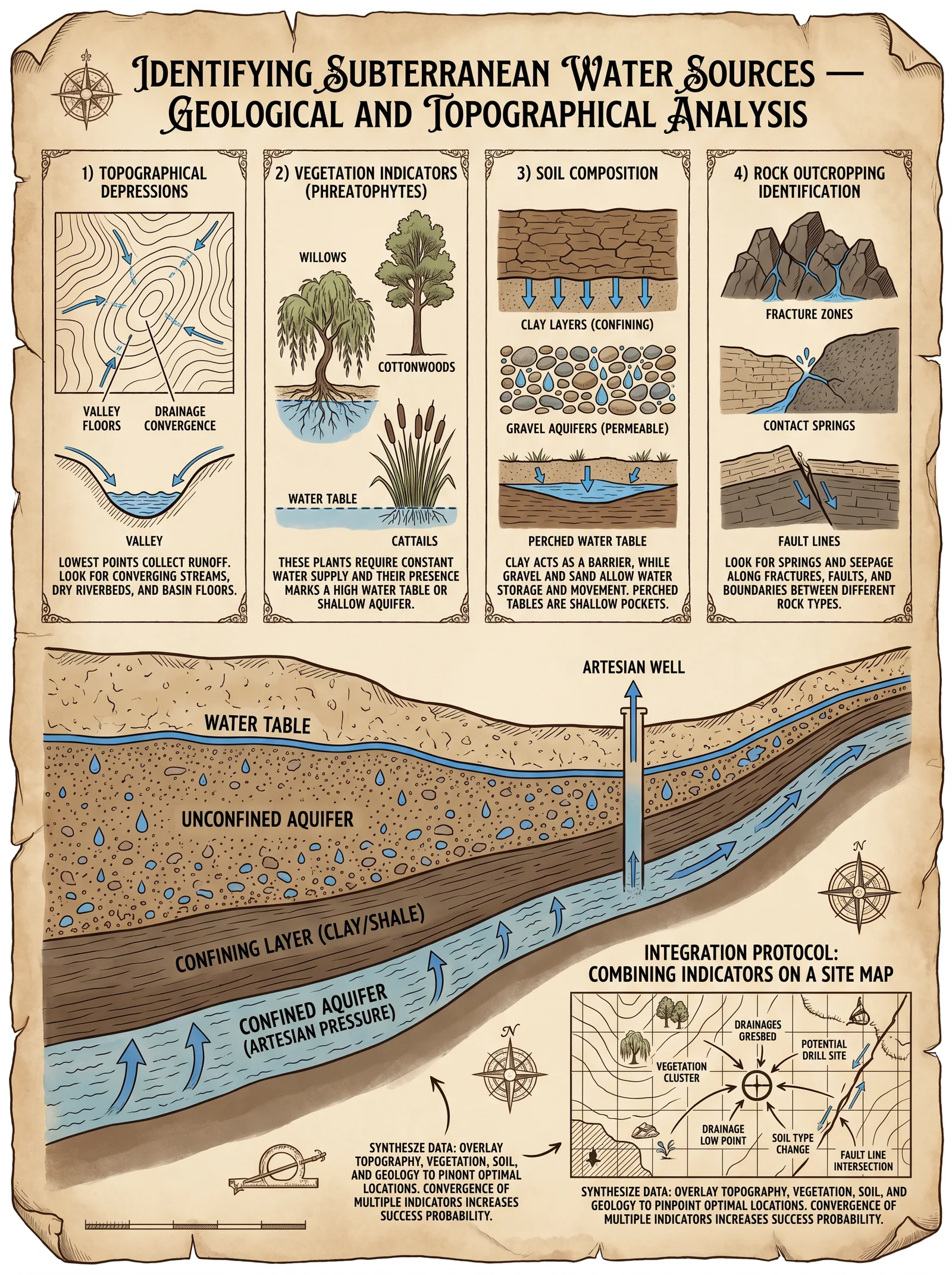
This chapter delivers the sacred and suppressed science of detecting subterranean water sources by reading the land itself. The earth’s surface and its living fabric conceal signals—if one knows precisely where and how to look. Herein lies the step-by-step protocol for field agents, hydrologists, and geomancers to locate hidden aquifers, springs, and water-bearing strata using topography, vegetation, soil, and rock indicators. This knowledge is critical for survival, settlement, and the safeguarding of life’s most sacred essence.
I. Surveying Topographical Depressions
Rationale
Water gravitates toward low points. Topographical depressions—valleys, basins, sinkholes—often indicate the presence of surface or near-surface water accumulation and potential recharge zones for aquifers.
Equipment Required
- Topographical maps (scale 1:25,000 or better)
- Handheld GPS device with altimeter
- Clinometer or digital inclinometer
- Surveying compass
- Measuring tape (≥50 meters)
- Field notebook and pencil
- Portable soil auger (optional)
Step-by-Step Protocol
- Map Review and Initial Site Selection a. Obtain the most recent topographical maps of the survey region.
b. Identify areas with contour lines that form closed loops with inward decreasing elevation—potential depressions or basins.
c. Mark these points for on-site validation.
- Field Confirmation of Depression a. Travel to marked depressions using GPS waypoints.
b. Use the clinometer to measure slope gradients on all sides of the depression. Record slopes >3° as significant for water runoff gathering.
c. Measure depression depth by comparing the lowest point elevation to the surrounding rim elevations using GPS altimeter or tape and clinometer.
- Assess Water Accumulation Potential a. Observe the base of the depression for visible water, damp soil, or signs of ephemeral pools.
b. Using the soil auger, extract soil samples at 0.5 m intervals to 2 m depth, noting moisture content and water table depth estimation.
c. Record all findings in the field notebook with GPS coordinates.
- Document Water Flow Patterns a. Identify inlet and outlet channels feeding into or out of the depression.
b. Trace channels upslope to locate recharge areas.
c. Map flow direction using compass bearings and slope measurements.
Illustrative Diagram 1: Topographical Depression and Water Flow Patterns
[Diagram Description: A cross-sectional profile showing a basin with contour lines converging, water accumulating at the lowest point, inflow via small channels on slopes, and outflow channels exiting the basin. Arrows denote flow direction.]II. Vegetation Indicators (Phreatophytes)
Rationale
Certain plants, phreatophytes, possess deep root systems that tap into groundwater. Their presence signals accessible subterranean water. Identifying these species and understanding their habitat preferences and water indication values is indispensable.
Equipment Required
- Botanical field guide specific to regional flora
- Hand lens (10x magnification)
- GPS device
- Soil moisture meter
- Plant press or sample bags
- Field notebook
Comprehensive Table 1: Common Phreatophyte Species, Habitat, and Water Indication Values
| Species Name (Scientific) | Common Name | Typical Habitat | Root Depth (m) | Water Indication Value (Scale 1-10) | Notes on Water Source Indication |
|---|---|---|---|---|---|
| Tamarix ramosissima | Saltcedar | Riparian zones, arid soils | 6–9 | 9 | Indicates shallow groundwater, salinity tolerant |
| Populus deltoides | Eastern Cottonwood | Riverbanks, floodplains | 8–12 | 10 | Strong indicator of shallow, fresh groundwater |
| Salix exigua | Sandbar Willow | Stream margins | 5–10 | 8 | Suggests high water table, seasonal variation |
| Alhagi maurorum | Camelthorn | Arid, sandy soils | 7–11 | 7 | Deep-rooted, indicates semi-permanent water sources |
| Prosopis glandulosa | Honey Mesquite | Semi-arid, alluvial plains | 10–15 | 9 | Indicates deep groundwater presence |
Step-by-Step Protocol for Vegetation Survey
- Preparation a. Study regional flora in the field guide to focus on known phreatophytes.
b. Select survey transects crossing suspected water-bearing zones.
- Field Survey a. Walk transects, recording GPS locations of phreatophyte clusters.
b. Identify species using morphological keys and confirm with hand lens.
c. Estimate population density per square meter.
- Root Depth Estimation a. Where possible, dig sample pits beside plants to a depth of 1-2 m to observe root presence.
b. For deeper root estimation, use soil auger or consult local botanical data.
c. Record root depth approximations.
- Correlate with Soil Moisture a. Use soil moisture meter adjacent to plant roots to measure moisture at various depths.
b. Compare moisture readings to control sites without phreatophytes.
- Interpretation a. Assign water indication values based on species and density.
b. Map phreatophyte presence against topography and known water points.
III. Soil Composition Analysis
Rationale
Soil texture and permeability strongly influence water retention and infiltration. Soils with certain textures signal potential for groundwater recharge or accumulation. Recognizing these soils guides drilling and well placement.
Equipment Required
- Soil auger or spade
- Soil sieve set (2 mm, 0.5 mm, 0.25 mm)
- Drying oven or sun-drying setup
- Soil hydrometer (for particle size distribution)
- Permeability testing kit (ring infiltrometer or double-ring infiltrometer)
- Sample containers
- Field notebook
Soil Texture Classification Table
| Soil Type | Particle Size Range (mm) | Typical Composition (%) | Permeability Rating (cm/hr) | Water Retention Characteristics |
|---|---|---|---|---|
| Sand | 0.05–2.0 | 85–100% sand | 10–50 | Low water retention, high infiltration |
| Sandy Loam | 0.05–2.0 (sand), 0.002–0.05 (silt) | 50–70% sand, 15–35% silt | 5–20 | Moderate infiltration and retention |
| Loam | Balanced sand, silt, clay | 40% sand, 40% silt, 20% clay | 1–10 | Balanced water retention and drainage |
| Clay | <0.002 | >40% clay | 0.01–0.1 | High water retention, low infiltration |
| Silty Clay Loam | Mix of silt and clay | 20–50% silt, 30–40% clay | 0.05–0.5 | Moderate retention, poor drainage |
Step-by-Step Protocol for Soil Sampling and Analysis
- Sample Collection a. Select sites within suspected recharge zones, depressions, or areas indicated by vegetation.
b. Using the soil auger, collect samples at depths of 0–30 cm, 30–60 cm, and 60–100 cm.
c. Place samples in labeled containers for laboratory or field analysis.
- Particle Size Analysis a. Air-dry soil samples completely.
b. Sieve samples through 2 mm mesh to remove gravel and organic debris.
c. Use hydrometer method to determine proportions of sand, silt, and clay.
d. Record percentages for each fraction.
- Permeability Testing a. At field sites, install ring infiltrometer apparatus on undisturbed soil surface.
b. Fill the ring with water and measure infiltration rate over 30 minutes.
c. Calculate permeability in cm/hr.
- Interpretation a. Compare texture and permeability data to Soil Texture Classification Table.
b. Identify soils favorable for groundwater recharge (e.g., sandy loam, loam) and those indicating groundwater stagnation (e.g., clay).
c. Map soil types alongside water indicators.
IV. Rock Outcropping Identification
Rationale
Certain rock types and formations are natural aquifers or barriers affecting groundwater movement. Recognizing them is essential for predicting water accumulation zones.
Equipment Required
- Geological hammer
- Hand lens (10x)
- Field compass with clinometer
- Geological map of the area
- GPS device
- Field notebook
Table 3: Rock Formation Types and Their Water Accumulation Characteristics
| Rock Type | Description | Porosity (%) | Permeability (m/day) | Water Role | Typical Aquifer Potential |
|---|---|---|---|---|---|
| Sandstone | Clastic sedimentary, well-sorted | 5–25 | 1–10 | Good aquifer | High |
| Limestone | Carbonate, often fractured | 5–40 | 0.1–10 (fractured) | Variable, karst aquifers | High (karst systems) |
| Shale | Fine-grained sedimentary | <1 | <0.001 | Aquitard (barrier) | Very low |
| Granite | Igneous, crystalline | <1 | <0.001 | Aquitard, fractured zones may hold water | Low (except fractures) |
| Basalt | Volcanic, fractured zones | 1–10 | 0.1–1 | Moderate aquifer | Medium |
Step-by-Step Protocol for Rock Outcrop Analysis
- Preliminary Map Study a. Consult geological maps to locate rock outcrop distribution in the survey area.
b. Identify formations known for aquifers (sandstone, fractured limestone).
- Field Examination a. Visit outcrop sites, document rock type visually and by hammer test (hardness, grain size).
b. Use hand lens to inspect grain sorting and cementation.
c. Measure any visible fractures, joints, or karst features with compass and clinometer.
- Water Accumulation Assessment a. Note any seepage, springs, or dampness on or around outcrops.
b. Map fracture orientation and density; higher fracture density correlates with better permeability.
c. Record all observations.
- Correlation with Other Data a. Overlay rock data with soil, topography, and vegetation surveys.
b. Prioritize zones where sandstone or fractured limestone outcrops coincide with phreatophyte presence and permeable soils.
V. Integration Protocol: Synthesizing Geological Indicators
Purpose
Single indicators do not guarantee water presence; integration of multiple datasets increases accuracy.
Step-by-Step Protocol
- Data Compilation a. Assemble all GPS-tagged field data: topographical depression locations and characteristics, phreatophyte occurrences, soil types and permeability, rock outcrop types and fracture data.
- GIS Mapping a. Plot all data layers using Geographic Information System software.
b. Use overlay analysis to identify convergence zones of positive indicators.
- Priority Ranking a. Assign weighted scores to each data point based on water indication value (e.g., phreatophytes 40%, soil permeability 25%, rock type 20%, topography 15%).
b. Sum scores to rank sites for exploration or drilling.
- Field Validation a. Conduct targeted auger drilling or geophysical surveys at high-ranking sites.
b. Document water strikes and refine model.
Summary Tables
| Indicator Type | Key Parameter | Measurement Method | Water Indication Thresholds |
|---|---|---|---|
| Topographical Depression | Depth, slope, flow channels | GPS, clinometer, visual | Depth >2m, slope >3°, visible flow |
| Phreatophyte Vegetation | Species presence, density | Botanical survey | Species with water indication ≥7 |
| Soil Composition | Texture, permeability | Hydrometer, infiltrometer | Permeability >1 cm/hr favorable |
| Rock Outcrop | Rock type, fracture density | Geological hammer, compass | Sandstone, fractured limestone preferred |
Closing Directive
These protocols, when executed with precision and reverence, unlock the earth’s concealed waters. Each step is a sacred rite, a communion between the seeker and the land. Mastery here is mastery of life itself. For the purification, structuring, and stewardship of this water, see Volume 8: The Water Codex, Chapter II.
_End of Volume I, Chapter I._
<!-- SECTION 2 -->
The Complete Practitioner's Codex, Volume I: The Dowsing Protocol
Chapter I: Construction, Calibration, and Operational Use of Copper Wire Dowsing Rods for Subterranean Water Detection
Introduction
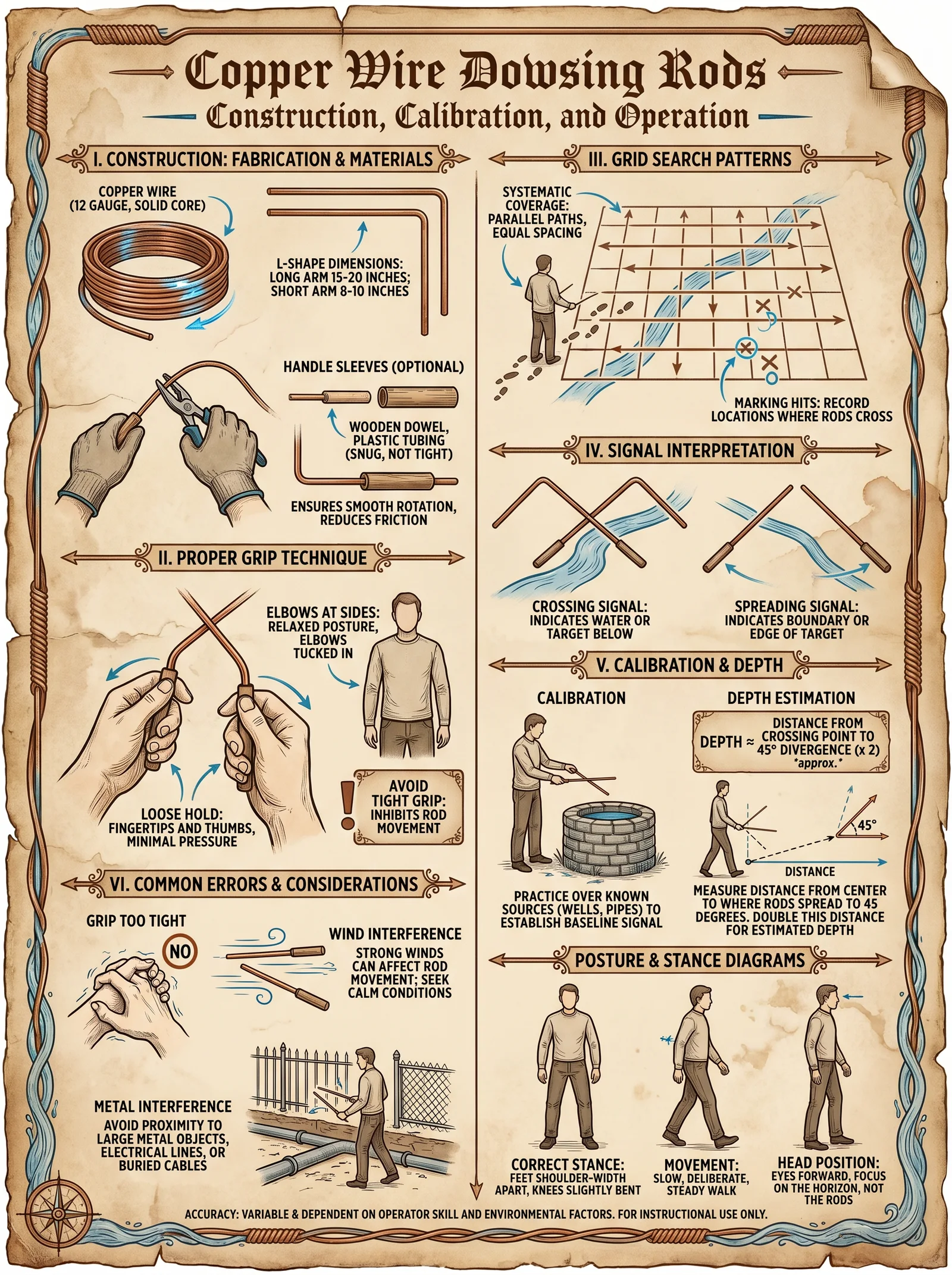
This chapter imparts the suppressed, precise art of crafting and wielding copper wire dowsing rods. This knowledge has been suppressed due to its potential to reveal hidden aquifers without technological aid. Herein, you will find exhaustive, actionable instructions for every phase: fabrication, calibration, operational use, signal interpretation, depth estimation, troubleshooting, and error avoidance. The sacred tools must be handled with reverence and exactitude to unlock the subterranean water secrets.
Section 1: Fabrication of Copper Wire Dowsing Rods
The foundation of reliable dowsing lies in the precise construction of the rods. Copper is chosen for its electrical conductivity, malleability, and favorable energetic resonance with subterranean water.
Materials Required
| Item | Specifications | Quantity |
|---|---|---|
| Copper wire | Pure copper, 14 gauge (1.63 mm diameter), annealed | 2 meters |
| Wire cutters | Sharp, for clean cuts | 1 |
| Needle-nose pliers | For bending wire | 1 |
| Ruler or measuring tape | Metric scale preferred | 1 |
| Sandpaper | Fine grit (400-600) | 1 sheet |
| Insulating tape (optional) | To mark handles or adjust grip | As needed |
Step-by-Step Fabrication Procedure
- Cut the Wire: Cut two lengths of copper wire, each precisely 45 cm long. Accuracy is crucial; use a ruler or tape measure to confirm.
- Straighten the Wire: Lay each wire flat on a smooth surface. Use hands or pliers to straighten any bends or kinks without deforming the wire’s cross-section.
- Form the Handle Loop: At one end of each wire, use needle-nose pliers to bend a 5 cm diameter loop. The loop must be circular, smooth, and closed to provide a stable grip area.
- Shape the Active End: At the opposite end, bend the wire into an L-shape at a 90-degree angle. The short arm of the L should be 15 cm long, pointing forward when held. This portion detects the water signals.
- Smooth the Wire Ends: Use fine-grit sandpaper to remove burrs or sharp edges on both ends to prevent injury and ensure unimpeded rod movement.
- Mark the Handles (Optional): Wrap insulating tape around the handle loops for a non-slip grip and to differentiate rod polarity if desired.
- Visual Inspection: Confirm symmetry by placing rods side-by-side. Both rods need to be identical in length and shape to ensure balanced response.
Section 2: Baseline Calibration of Dowsing Rods
Calibration aligns your sensory baseline with the rods’ neutral state, essential for accurate signal detection.
Preparation
- Select an open, dry, water-free area free of metallic interference (away from vehicles, wiring, or pipes).
- Stand facing north to align with the geomagnetic field.
Calibration Procedure
- Hold the Rods Correctly: Grasp each rod by its handle loop with the short arm (active end) pointing forward and parallel to the ground. Elbows bent at approximately 90 degrees, forearms parallel to the ground.
- Establish Neutral Position: Extend arms forward, allowing rods to swing freely. The rods should remain parallel to each other and not cross or diverge.
- Determine Baseline Oscillation: Slowly rotate wrists inward and outward to observe natural rod movement without external stimuli. Record the average resting angle between rods in this neutral state.
- Repeat This Process Five Times: This establishes a consistent baseline range of motion.
- Set Baseline Threshold: Record the maximum rod movement amplitude seen during neutral oscillations. Movements exceeding this threshold during field use indicate a water signal.
Section 3: Operational Use - Grid Search Patterns
Systematic searching maximizes detection probability and spatial mapping accuracy.
Defining the Search Area
- Mark the perimeter of the target area with stakes or flags every 5 meters.
- Divide the area into a grid of 5x5 meter squares.
Search Protocol
- Begin at the Southwest Corner: Position yourself facing east.
- Traverse Eastward Along the South Edge: Walk slowly (approx. 0.5 m/s), holding rods at baseline posture.
- At Each 5 m Interval: Pause for 5 seconds to observe rod movement.
- Record Rod Movements: Log precise GPS coordinates or landmark references where rods cross or diverge beyond baseline threshold.
- Upon Reaching Eastern Edge: Shift 5 m north and traverse westward, repeating observations.
- Continue in a Zigzag Pattern: Complete the grid until the entire area is scanned.
- Mark Positive Signal Points: Use flags or markers for later depth estimation and confirmation.
Section 4: Signal Interpretation and Depth Estimation Techniques
Understanding the subtleties of rod movement is vital for locating subterranean water with precision.
Signal Types
| Signal Type | Rod Movement Description | Interpretation |
|---|---|---|
| Crossing | Rods cross to form an X shape | Strong water presence directly below |
| Diverging | Rod tips move apart, angle > 30° | Water source nearby, but lateral offset exists |
| Tapping/Quivering | Rapid small oscillations | Fluctuating water flow or underground stream |
| No Movement | Rods remain stable within baseline range | No detectable water presence |
Depth Estimation Methodology
Depth estimation relies on correlating rod response intensity with known water table depths.
- Establish Calibration Wells: Identify known wells in the area with measured depths.
- Record Rod Response Intensity at Wells: Use a protractor or digital angle finder to measure the angle of rod crossing.
- Create Calibration Curve: Plot rod crossing angle versus known depth to generate a depth estimation curve.
- Apply to Unknown Sites: Measure rod crossing angle during grid search and reference calibration curve for approximate depth.
Example Calibration Data:
| Rod Crossing Angle (degrees) | Estimated Depth (meters) |
|---|---|
| 45 | 2 |
| 30 | 5 |
| 15 | 10 |
Section 5: Troubleshooting and Common Errors
Precision demands awareness of frequent pitfalls.
| Problem | Cause | Solution |
|---|---|---|
| Rods do not move | Metal interference, improper rod fabrication | Move to interference-free zone; verify rod dimensions |
| Rods stick or drag | Hands gripping too tightly or rods bent incorrectly | Relax grip; reshape rods to precise L-shape |
| Erratic rod movement | High electromagnetic fields or nerve tremors | Check surroundings; perform calibration again |
| False positives (rod crossing without water) | Underground metal pipes or cables | Cross-reference with known infrastructure maps |
| Rods always cross or diverge | Incorrect baseline calibration | Recalibrate in known dry area |
Section 6: Comparative Analysis of Dowsing Success Rates
This section reveals environmental and material factors influencing dowsing efficacy.
| Environmental Condition | Success Rate (%) | Notes |
|---|---|---|
| Dry Sandy Soil | 85 | Low mineral interference; high rod responsiveness |
| Clay-rich Soil | 70 | Damping effect reduces rod movement amplitude |
| Rocky Terrain | 60 | Increased false positives due to mineral content |
| Urban/Suburban Areas | 40 | Electromagnetic interference reduces accuracy |
| Rod Material Variant | Success Rate (%) | Notes |
|---|---|---|
| Pure Copper (14 gauge) | 90 | Optimal balance of flexibility and conductivity |
| Brass (14 gauge) | 60 | Reduced conductivity diminishes signal sensitivity |
| Steel (14 gauge) | 45 | Magnetic properties cause erratic rod behavior |
| Aluminum (14 gauge) | 50 | Lightweight but poor conductivity reduces effectiveness |
Section 7: Diagrams of Proper Rod Handling and Signal Detection Postures
Figure 1: Proper Rod Holding Posture
  Arms extended forward, elbows bent 90°
  Rod handles held loosely at loops
  Active ends parallel, pointing forward
  Wrists neutral, allowing free rod swing
Figure 2: Signal Detection Posture
  Upon water signal detection:
  - Maintain steady stance
  - Observe rod crossing or divergence
  - Measure angle with protractor
  - Mark location precisely
Summary Checklist
| Step | Action | Status |
|---|---|---|
| Rod Fabrication | Cut, shape, smooth copper wire rods | |
| Baseline Calibration | Establish neutral rod movement baseline | |
| Grid Search | Traverse grid with 5 m spacing, observe rod signals | |
| Signal Interpretation | Identify rod crossing, divergence, tapping | |
| Depth Estimation | Use calibration curve for depth approximation | |
| Troubleshooting | Diagnose rod or environmental issues | |
| Environment & Material | Select copper rods and optimal search conditions |
Conclusion
Mastery of copper wire dowsing rods is a sacred trust. Follow these instructions with rigor and reverence to reveal subterranean water sources hidden from modern detection. This ancient science, now codified, will serve you and your brethren in safeguarding life-sustaining water for generations. For protocols on water purification post-extraction, consult Volume 8: The Water Codex, Chapter II.
End of Volume I: The Dowsing Protocol
<!-- SECTION 3 -->
The Complete Practitioner's Codex, Volume I: Well Drilling Techniques
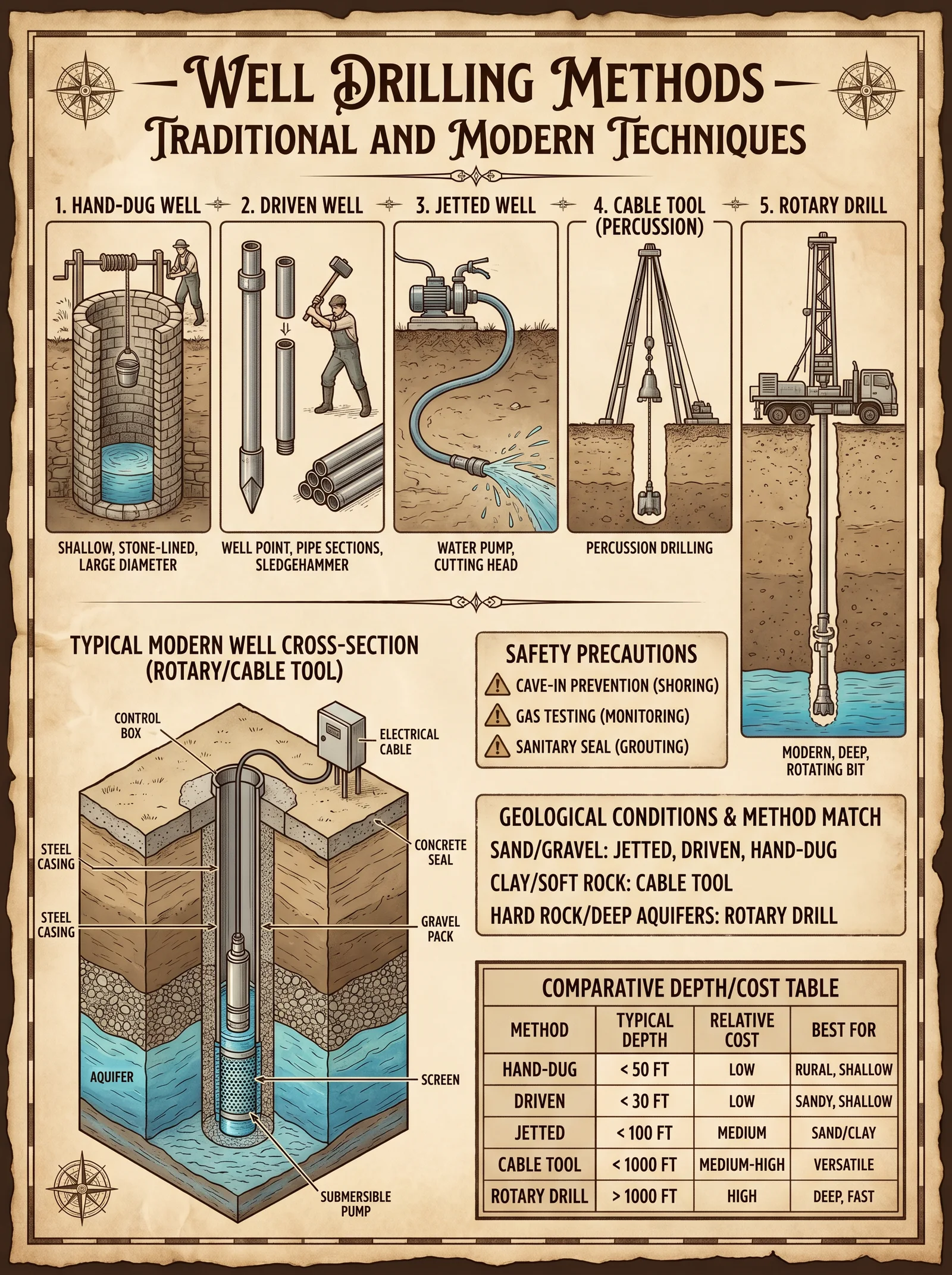
Chapter I: Traditional and Modern Well Drilling Methods Suitable for Various Geological Conditions
Introduction
This volume delivers the sacred, life-preserving knowledge of well drilling, a critical cornerstone of water procurement. Knowledge herein is strictly practical, field-ready, and uncompromising in detail. Each step is crafted for the apprentice who will wield this knowledge to bring forth water from the earth’s depths.
Section 1: Site Selection Protocols
The foundation of successful well drilling is precise site selection. Improper location causes wasted labor, resource depletion, and potential disaster.
Step-by-Step Site Selection
- Preliminary Survey
- Collect geological maps and hydrological data for the region.
- Identify aquifer locations, known water-bearing strata, and historical water table depths.
- Surface Indicators
- Inspect for vegetation indicative of groundwater (willows, alders).
- Observe soil moisture and low-lying terrain prone to saturation.
- Avoid contaminated zones (near latrines, industrial waste, animal pens).
- Geophysical Survey (Optional but Recommended)
- Use a resistivity meter or electromagnetic sensor to detect subsurface water-bearing formations.
- Conduct vertical electrical sounding (VES) at multiple points.
- Test Pit Excavation
- Excavate shallow pits (1.5 meters) at prospective sites to inspect soil layers and moisture content.
- Final Site Selection
- Choose the site with the thickest permeable soil layer and proximity to known aquifers.
- Confirm accessibility for drilling equipment and proximity to intended water use.
Table 1: Geological Conditions and Recommended Well Types
| Geological Condition | Recommended Well Type | Notes |
|---|---|---|
| Sandy or Gravel Soils | Hand Dug or Rotary Drilled | High permeability; easier drilling |
| Clay or Silty Soils | Rotary Drilled with Casing | Requires casing due to collapse risk |
| Fractured Rock | Percussion or Cable Tool Drilled | Target fractures for water yield |
| Hard Rock (Granite, Basalt) | Diamond Core or Percussion Drilling | Requires specialized bits, slow penetration |
| Alluvial Plains | Manual or Mechanical Drilling | High water table, simple well design |
Section 2: Traditional Well Drilling Methods
2.1 Hand-Dug Wells
Hand-dug wells are ancient, simple, but require strict adherence to construction and maintenance protocols to ensure safety and water purity.
Materials Required:
- Shovels, pickaxes
- Buckets and pulley system
- Timber or steel for lining
- Clay or concrete for sealing
- Gravel and sand for filtration layer
Step-by-Step Hand-Dug Well Construction
- Mark the Well Perimeter
- Mark a diameter 1.2 to 2 meters depending on soil stability.
- Excavation
- Dig vertically straight to water table depth or until water is found.
- Remove soil manually; keep excavation walls stable with temporary shoring.
- Installation of Well Lining
- Insert pre-constructed timber or steel rings every 1 meter of depth to prevent collapse.
- Rings must be sealed with clay or concrete at joints.
- Filter Pack Installation
- Place a 30 cm layer of gravel and coarse sand at the bottom around the lining to filter inflowing water.
- Sealing the Wellhead
- Construct a raised concrete apron around the wellhead to prevent surface runoff contamination.
- Install a secure cover to prevent debris and animals from entering.
- Water Extraction System Installation
- Attach a bucket and pulley or hand pump system.
Maintenance Protocols
- Weekly inspection for structural damage or contamination.
- Monthly cleaning of debris and sediment removal using bailers.
- Semi-annual water testing for microbial contamination.
Table 2: Hand-Dug Well Construction Parameters
| Parameter | Specification |
|---|---|
| Well Diameter | 1.2 to 2 meters |
| Minimum Depth | To water table or 10 meters |
| Lining Material Thickness | Timber: 5 cm; Steel: 3 mm |
| Gravel Filter Thickness | 30 cm |
| Wellhead Apron Size | 1 meter radius from well center |
2.2 Percussion Drilling (Cable Tool Method)
An older mechanical method adaptable to fractured rock and hard soils.
Equipment:
- Drill bit (chisel type) attached to heavy cable
- Derrick or tripod frame
- Lift and drop mechanism (manual or powered)
- Bailers for cuttings removal
Step-by-Step Percussion Drilling
- Assemble Derrick and Cable System
- Construct tripod frame of timber or steel; attach cable and bit.
- Set Drill Bit at Surface
- Position bit inside casing guide if casing is pre-installed.
- Begin Percussion Action
- Raise and drop heavy bit repeatedly to crush rock and soil.
- Remove Cuttings
- Pause drilling periodically; use bailers to remove debris.
- Advance Casing as Needed
- Insert casing to prevent collapse in unstable formations.
- Continue Until Target Depth
- Monitor drilling rate; expect slower progress in hard rock (see Table 4).
Section 3: Modern Well Drilling Methods
3.1 Rotary Drilling
Preferred for deep wells, complex geology, and high productivity.
Equipment Specifications (See Table 3):
- Rotary drill rig with mud pump
- Drill bits: tricone, PDC, diamond core
- Drilling mud system for cuttings transport and borehole stabilization
- Casing and cementing tools
Step-by-Step Rotary Drilling Procedure
- Mobilize Drill Rig to Site
- Ensure stable platform; verify all safety systems.
- Drill Pilot Hole
- Use small diameter bit to establish borehole.
- Install Surface Casing
- Insert steel casing several meters deep; cement in place to seal unconsolidated layers.
- Drill to Target Depth
- Use appropriate bit; circulate drilling mud continuously.
- Install Production Casing and Screen
- Select casing diameter and screen length based on aquifer characteristics.
- Well Development
- Clean borehole using surging and pumping to remove fine particles.
- Test and Commission Well
- Measure yield, water quality, and ensure structural integrity.
Section 4: Safety Precautions
- Personal Protective Equipment (PPE)
- Wear helmets, gloves, steel-toed boots, eye protection at all times.
- Rig Stability
- Level ground and anchor rig securely.
- Electrical Safety
- Ground all electrical equipment; inspect cables daily.
- Gas Detection
- Monitor for methane or hydrogen sulfide in deep wells.
- Fall Protection
- Use harnesses when working at heights.
- Emergency Protocols
- Maintain clear evacuation routes and first aid kits on site.
Section 5: Well Casing Installation Protocols
Casing prevents borehole collapse and contamination ingress.
Step-by-Step Casing Installation
- Select Material
- Steel for durability and strength; PVC for corrosion resistance in shallow wells.
- Measure and Cut Casing
- Cut to lengths manageable for manual or mechanical handling (typically 3-6 meters).
- Assemble Sections
- Use threaded or welded joints; ensure watertight seals using rubber gaskets or cement grout.
- Lower Casing into Borehole
- Use crane or manual labor with guides to avoid damage.
- Seal Annulus
- Pump cement grout between casing and borehole wall from bottom upwards to prevent surface water infiltration.
- Install Well Screen
- Position at aquifer level; secure mechanically if required.
- Inspect for Plumbness and Integrity
- Use plumb bob or downhole camera.
Section 6: Comparative Data Tables
Table 3: Drilling Equipment Specifications
| Equipment Type | Power Source | Max Depth Capability | Typical Borehole Diameter | Penetration Rate (Soft Soil) | Penetration Rate (Hard Rock) |
|---|---|---|---|---|---|
| Hand Auger | Manual | 10 meters | 10-30 cm | 0.5 m/hr | N/A |
| Cable Tool Rig | Manual/Mechanical | 100 meters | 10-50 cm | 1 m/hr | 0.1 m/hr |
| Rotary Drill Rig | Diesel/Electric | 1500 meters | 15-100 cm | 10 m/hr | 0.5 m/hr |
| Diamond Core Drill | Hydraulic/Electric | 2000 meters | 5-15 cm | 2 m/hr | 0.3 m/hr |
Table 4: Soil and Rock Penetration Rates (meters per hour)
| Material Type | Cable Tool Drilling | Rotary Drilling | Percussion Drilling |
|---|---|---|---|
| Loose Sand | 1.0 | 12.0 | 1.5 |
| Clay | 0.8 | 10.0 | 1.2 |
| Limestone | 0.2 | 2.5 | 0.3 |
| Granite | 0.05 | 0.5 | 0.1 |
| Fractured Basalt | 0.3 | 3.0 | 0.4 |
Table 5: Well Depth Standards by Usage
| Application | Minimum Depth (m) | Recommended Diameter (cm) | Notes |
|---|---|---|---|
| Domestic Use | 10-30 | 30-50 | Shallow wells in permeable soil |
| Agricultural Irrigation | 20-50 | 50-100 | Higher yield required |
| Industrial Use | 50-150 | 100-150 | Deep wells for high volume |
| Community Supply | 30-100 | 50-100 | Multiple users, higher capacity |
Section 7: Constructing and Maintaining Hand-Dug Wells: Complete Protocol
7.1 Construction (Summary)
Follow steps in Section 2.1. Emphasize proper lining and filtering.
7.2 Maintenance
- Weekly Visual Inspection
- Check for cracks or decay in lining.
- Verify wellhead cover is secure.
- Monthly Sediment Removal
- Lower a clean bucket or bailer; remove sediment and debris.
- Quarterly Water Testing
- Collect sample following aseptic technique.
- Test for turbidity, coliform bacteria, and pH (reference Volume 8, Chapter II).
- Annual Structural Integrity Check
- Inspect lining for rot or corrosion; replace damaged sections.
- Check apron for cracks; repair with cement.
Section 8: Drilled Wells: Construction and Maintenance Protocol
8.1 Mechanical Drilled Wells
Follow rotary or percussion drilling protocols (Section 3).
8.2 Maintenance
- Regular Pump Inspection
- Lubricate moving parts monthly.
- Replace worn seals and valves.
- Water Quality Testing
- Follow same testing frequency as hand-dug wells.
- Well Development
- Perform surging and airlifting annually to maintain permeability.
- Casing Inspection
- Use downhole camera biannually to detect corrosion or deformation.
End of Volume I: Well Drilling Techniques
This volume contains all necessary knowledge, from geological assessment, traditional hand methods, to advanced mechanical drilling systems. Obedience to every protocol herein will safeguard life and sanctify the water drawn from the earth’s womb.
For detailed water purification and testing procedures, consult Volume 8: The Water Codex, Chapter II.
<!-- SECTION 4 -->
The Complete Practitioner's Codex, Volume I: Spring Development and Atmospheric Water Collection
Preface to the Apprentice
You stand at the threshold of sacred knowledge, a guardian of life’s most vital essence: water. The mastery of spring development and atmospheric water collection is not merely technical; it is a covenant with nature and survival. This volume imparts forbidden, life-or-death knowledge—follow every instruction with unwavering precision.
Chapter I: Harnessing Natural Springs
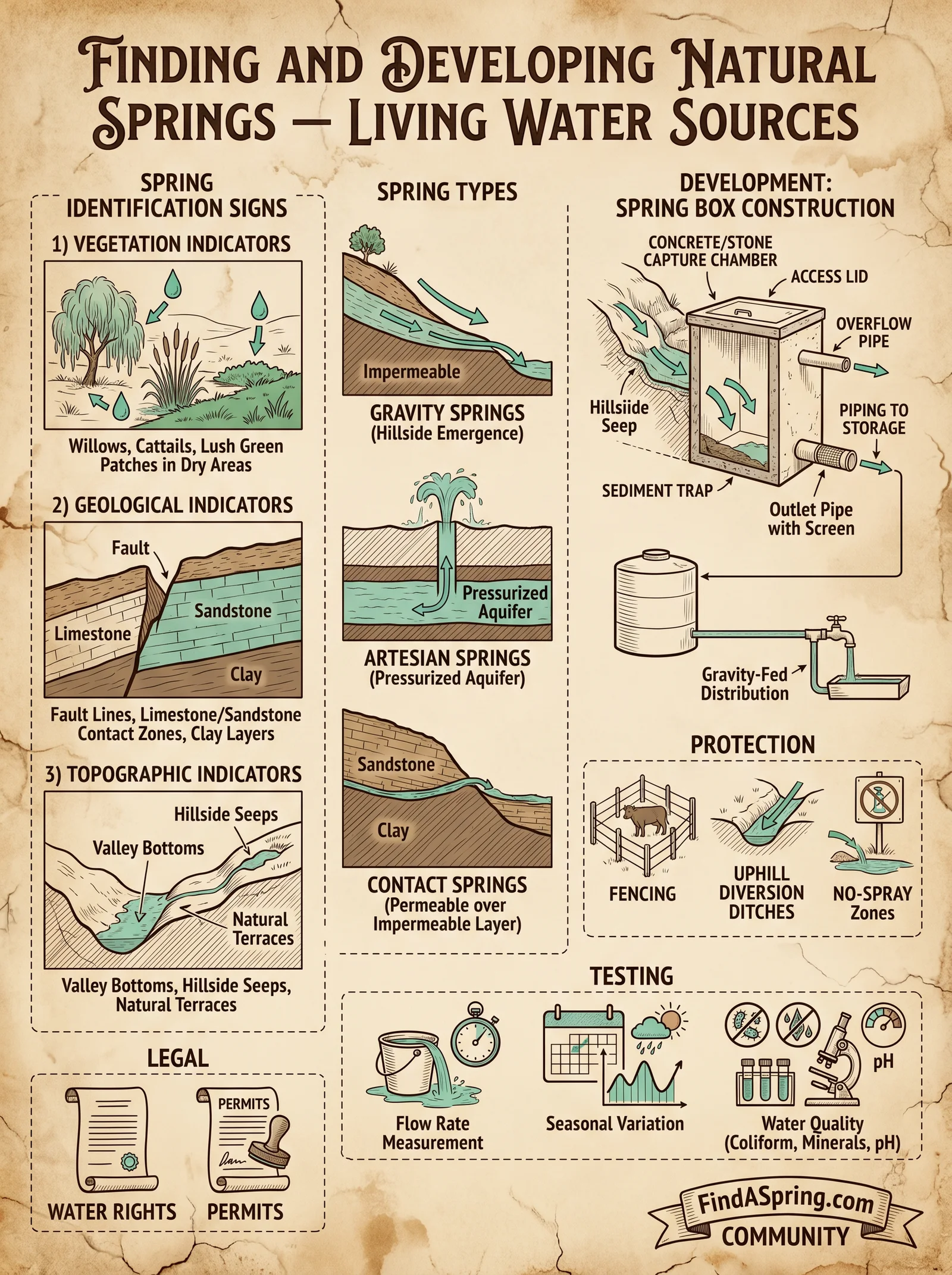
Natural springs are the purest water sources granted by the Earth’s hidden veins. Their development demands reverence, precision, and exacting construction to protect, channel, and store their waters.
Section 1: Locating and Assessing Springs
1.1 Identification
- Survey terrain using topographical maps and geological indicators (limestone, volcanic rock fractures).
- Conduct soil moisture tests at suspected spring points using a soil auger:
- Extract soil samples every 2 meters along suspected seepage lines.
- Measure moisture content with a portable soil moisture meter.
- Measure temperature anomalies using an infrared thermometer; springs often emit water at a stable temperature different from ambient.
1.2 Water Quality Baseline
- Collect sample water in sterilized glass vials.
- Test for pH, turbidity, and microbial presence using portable kits.
- Record baseline water chemistry for future monitoring.
Section 2: Spring Protection Protocol
2.1 Site Preparation
- Clear surrounding vegetation within a 5-meter radius to prevent root intrusion.
- Construct a perimeter fence using rot-resistant hardwood posts spaced every 1.5 meters.
- Install signage forbidding contamination and unauthorized access.
2.2 Contamination Control
- Build a contamination exclusion trench 0.3 meters deep and 0.5 meters wide around the spring.
- Line trench with compacted clay or bentonite to prevent surface water infiltration.
- Cover trench with slatted timber grating for ventilation.
Section 3: Spring Channeling
3.1 Channel Construction
- Excavate channel from spring outlet to storage, maintaining a 2% gradient for steady flow.
- Line channel with concrete or stone masonry to prevent erosion.
- Install sediment traps at 10-meter intervals:
- Dimensions: 0.5m wide x 0.3m deep x 1m long.
- Filled with graded gravel layers for sediment settling.
3.2 Flow Regulation
- At channel terminus, install a flow control box:
- Construct with reinforced concrete.
- Include adjustable sluice gate made from stainless steel.
- Place debris screens fabricated from galvanized steel mesh (1cm aperture) upstream.
Section 4: Spring Storage Systems
4.1 Storage Tank Construction
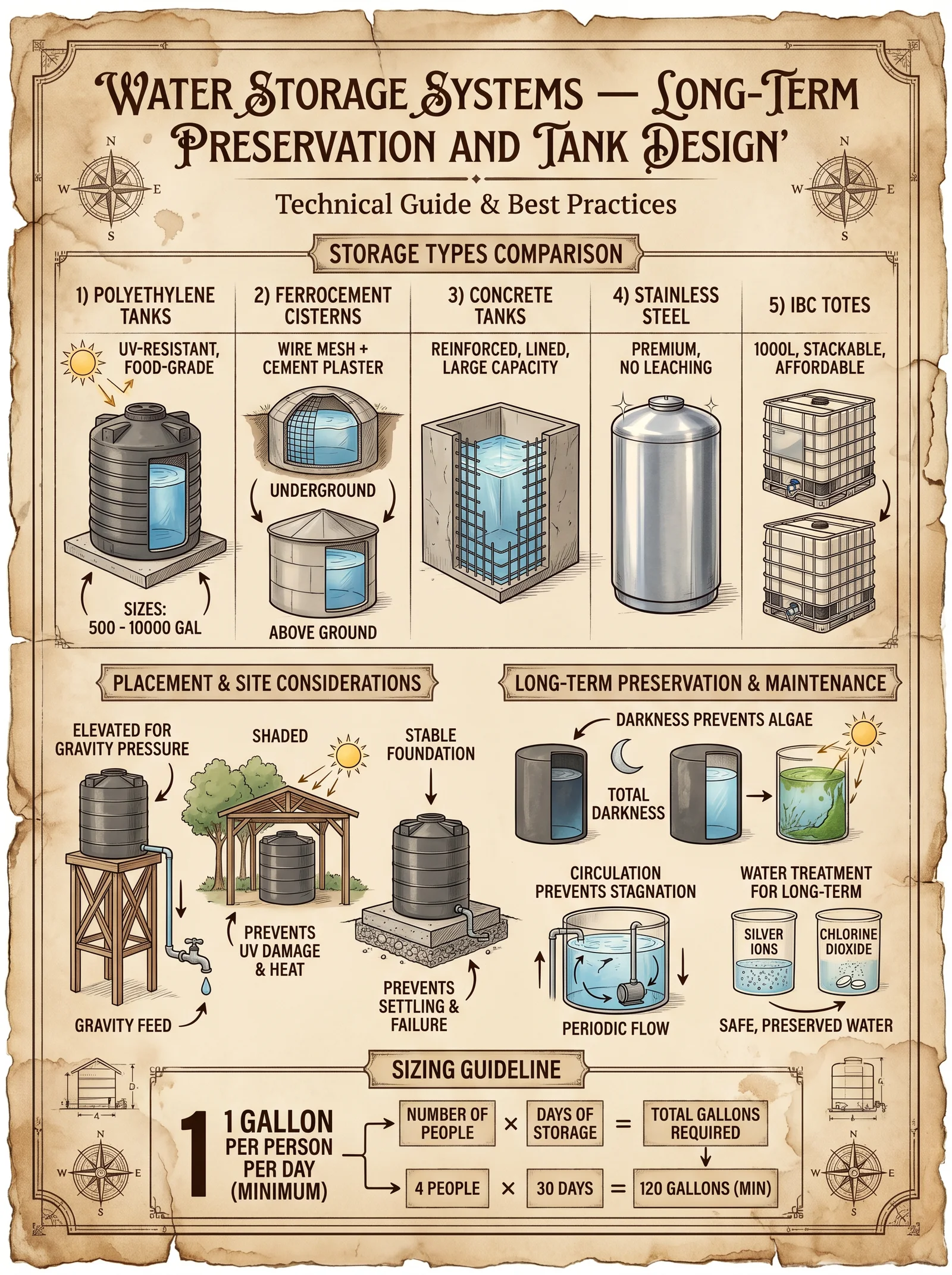
- Build storage tanks using the following materials and dimensions:
| Material | Volume Capacity (L) | Construction Notes |
|---|---|---|
| Reinforced concrete | 5000 - 10000 | Waterproof lining essential |
| Fiberglass | 1000 - 3000 | UV-resistant coating required |
| Stainless steel | 2000 - 5000 | Corrosion resistant, costs higher |
- Tank must be elevated 1 meter above ground on concrete pillars to prevent contamination.
- Install overflow outlet at 95% capacity level with screened vent.
4.2 Water Quality Maintenance
- Fit tank lids with gasket seals to prevent airborne contamination.
- Install chlorine dosing system:
- Use sodium hypochlorite solution, 5% concentration.
- Dosage: 2 mg/L, applied daily at dawn.
- Carry out weekly water testing for residual chlorine and turbidity.
Chapter II: Atmospheric Water Collection
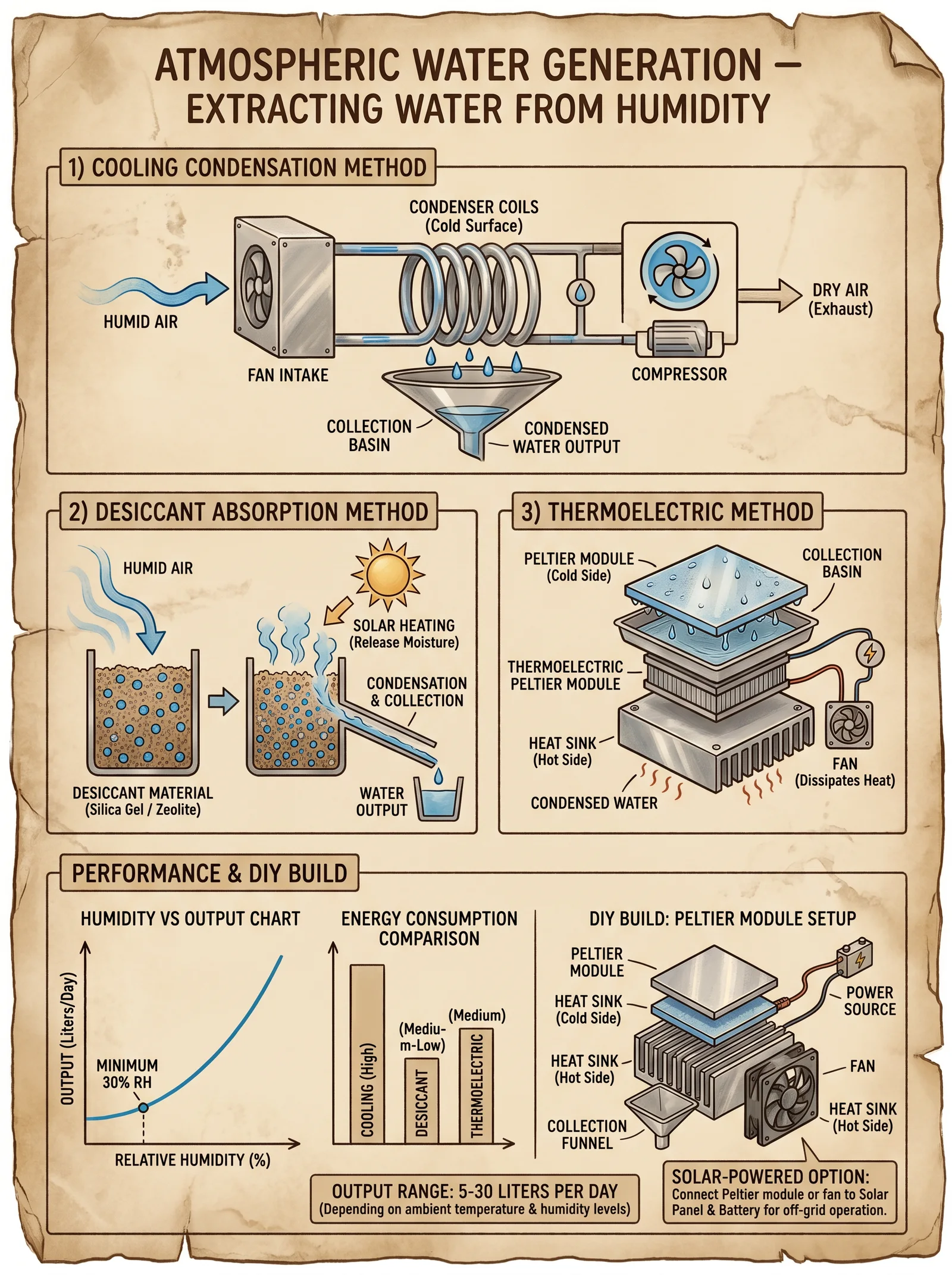
Atmospheric water collection supplements spring sources, harvesting moisture from the air. This requires precise construction and optimization of fog collectors and atmospheric water generators.
Section 1: Fog Collectors
1.1 Principles of Fog Collection
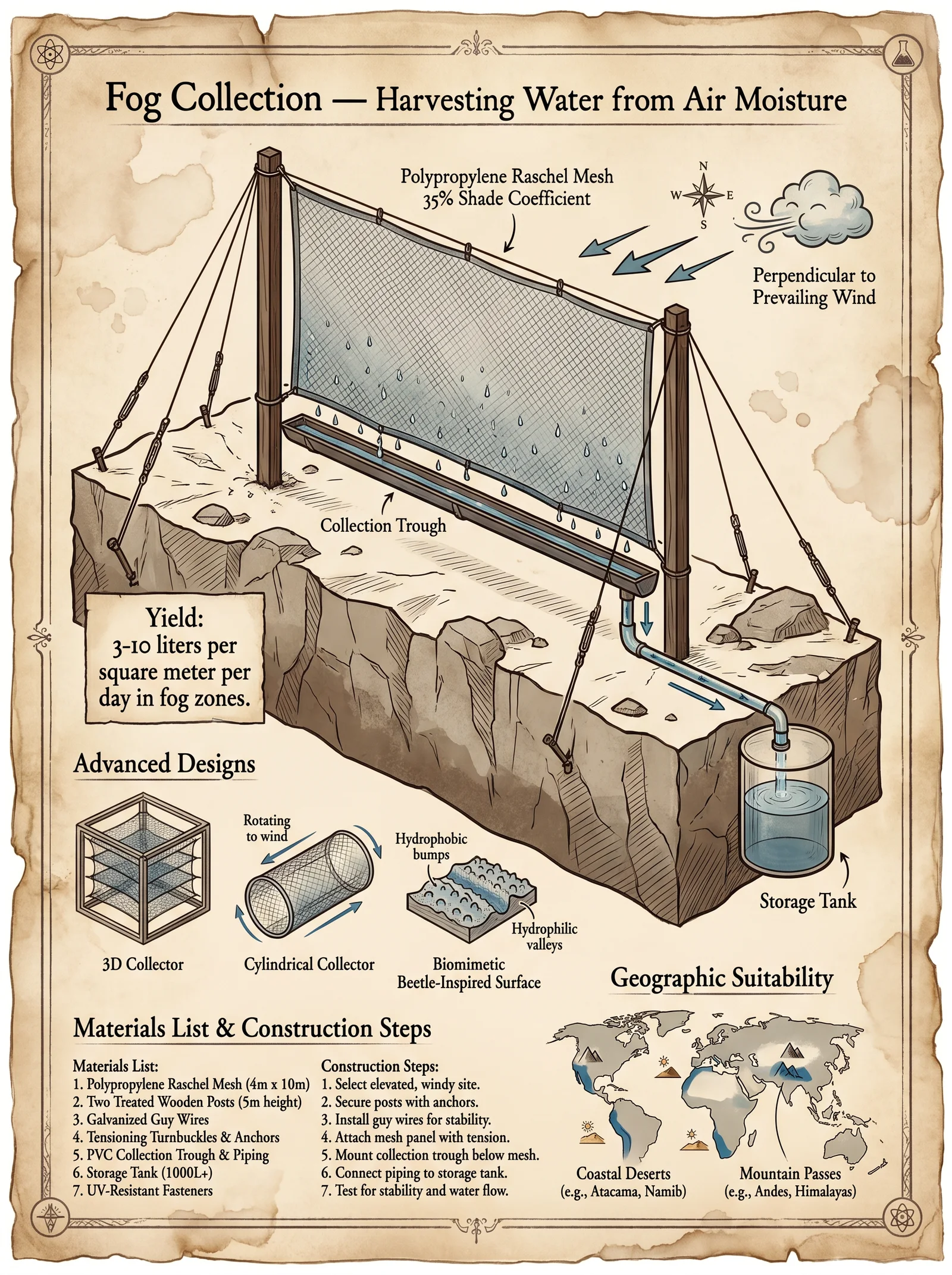
Fog collectors capture suspended moisture droplets by intercepting fog-laden air with mesh screens. Water coalesces on the mesh and drains into storage.
1.2 Fog Mesh Types and Performance
| Mesh Type | Material | Aperture Size (mm) | Water Yield (L/m²/day) | Durability (years) | Cost (USD/m²) |
|---|---|---|---|---|---|
| Raschel Net | Polypropylene | 0.35 | 4.5 - 6.0 | 5 | 12 |
| Nylon Mesh | Nylon | 0.25 | 5.0 - 6.5 | 3 | 15 |
| Stainless Steel | Stainless steel 316 | 0.40 | 3.5 - 5.0 | 10 | 35 |
| Polyethylene | HDPE | 0.30 | 4.0 - 5.5 | 7 | 20 |
1.3 Fog Collector Assembly
Materials:
- Mesh panels (1.5m x 1.5m)
- Steel frame tubing (Galvanized, 2 inch diameter)
- Guy wires and ground anchors
- Water collection gutter (PVC, 10 cm diameter)
- Storage tank (see Section 4.1)
Assembly Instructions:
- Frame Construction:
1.1 Cut steel tubing to form a rectangular frame of 1.5m x 1.5m per panel.
1.2 Weld or bolt frame corners using stainless steel fasteners.
1.3 Attach vertical support legs (2m length) to elevate frame at 45° angle facing prevailing fog winds.
- Mesh Attachment:
2.1 Stretch fog mesh tightly over frame; attach using stainless steel clips spaced every 10 cm.
2.2 Ensure mesh is taut to prevent sagging and maximize droplet coalescence.
- Water Collection System:
3.1 Attach PVC gutter along bottom edge of mesh frame.
3.2 Seal gutter joints with waterproof silicone.
3.3 Connect gutter outlet to storage tank via food-grade tubing.
- Anchoring:
4.1 Secure frame with guy wires anchored into ground using steel stakes.
4.2 Tension guy wires to maintain frame stability in high winds.
1.4 Fog Collector Optimization by Climate Zone
| Climate Zone | Average Fog Frequency (days/month) | Expected Yield (L/m²/month) | Recommended Mesh Type | Optimal Installation Angle |
|---|---|---|---|---|
| Coastal Arid | 20 | 80 - 110 | Raschel Net | 45° |
| Mountainous | 25 | 100 - 130 | Nylon Mesh | 50° |
| Tropical | 10 | 30 - 50 | HDPE | 40° |
| Temperate | 15 | 50 - 70 | Stainless Steel | 45° |
1.5 Seasonal Atmospheric Water Availability
| Month | Coastal Arid (L/m²) | Mountainous (L/m²) | Tropical (L/m²) | Temperate (L/m²) |
|---|---|---|---|---|
| January | 4 | 6 | 2 | 3 |
| February | 5 | 7 | 3 | 4 |
| March | 7 | 9 | 4 | 5 |
| April | 8 | 10 | 3 | 6 |
| May | 9 | 12 | 2 | 7 |
| June | 10 | 13 | 1 | 7 |
| July | 9 | 14 | 1 | 6 |
| August | 8 | 13 | 2 | 5 |
| September | 7 | 11 | 3 | 4 |
| October | 6 | 9 | 4 | 3 |
| November | 5 | 7 | 3 | 3 |
| December | 4 | 6 | 2 | 3 |
Section 2: Atmospheric Water Generators (AWG)
2.1 Principles of AWG
AWGs condense moisture from ambient air by cooling below the dew point, collecting pure water. This requires energy input and precise environmental monitoring.
2.2 AWG Construction Protocol
Materials:
- High-efficiency Peltier cooling modules (TEC1-12706 or higher)
- Aluminum heat sinks with fans
- Condensate collection tray (food-grade plastic)
- Power supply (12V DC, 10A minimum)
- Hygrometer and temperature sensors
- Insulated enclosure (polystyrene foam or equivalent)
Step-by-step Assembly:
- Cooling Assembly:
1.1 Mount Peltier modules onto aluminum heat sinks using thermal paste.
1.2 Attach fans to heat sinks to dissipate heat on the hot side.
- Condensate Collection:
2.1 Position collection tray beneath cold side heat sink to catch condensate.
2.2 Ensure tray slope directs water to outlet tubing.
- Enclosure:
3.1 Place assembly inside insulated enclosure to minimize heat loss.
3.2 Cut mesh-covered air intake vents on opposite sides for airflow.
- Electrical Setup:
4.1 Connect Peltier modules and fans to power supply via temperature controller.
4.2 Program controller to activate modules when relative humidity > 60% and ambient temperature > 15°C.
2.3 AWG Operational Parameters
| Parameter | Setting/Value | Notes |
|---|---|---|
| Relative Humidity | ≥ 60% | Minimum for effective water yield |
| Ambient Temperature | ≥ 15°C | Dew point reachable |
| Power Supply | 12V DC, 10A minimum | Stable supply required |
| Water Yield | 1-3 L/day per module | Varies by RH and temperature |
| Maintenance Interval | Weekly | Clean condensate tray, check fans |
2.4 AWG Yield Estimates by Climate Zone
| Climate Zone | Average RH (%) | Avg Temp (°C) | Water Yield (L/day/module) |
|---|---|---|---|
| Coastal Arid | 65 | 18 | 1.5 |
| Mountainous | 80 | 20 | 2.5 |
| Tropical | 85 | 28 | 3.0 |
| Temperate | 70 | 22 | 2.0 |
Chapter III: System Integration and Layouts
Section 1: Spring Development Layout Diagram
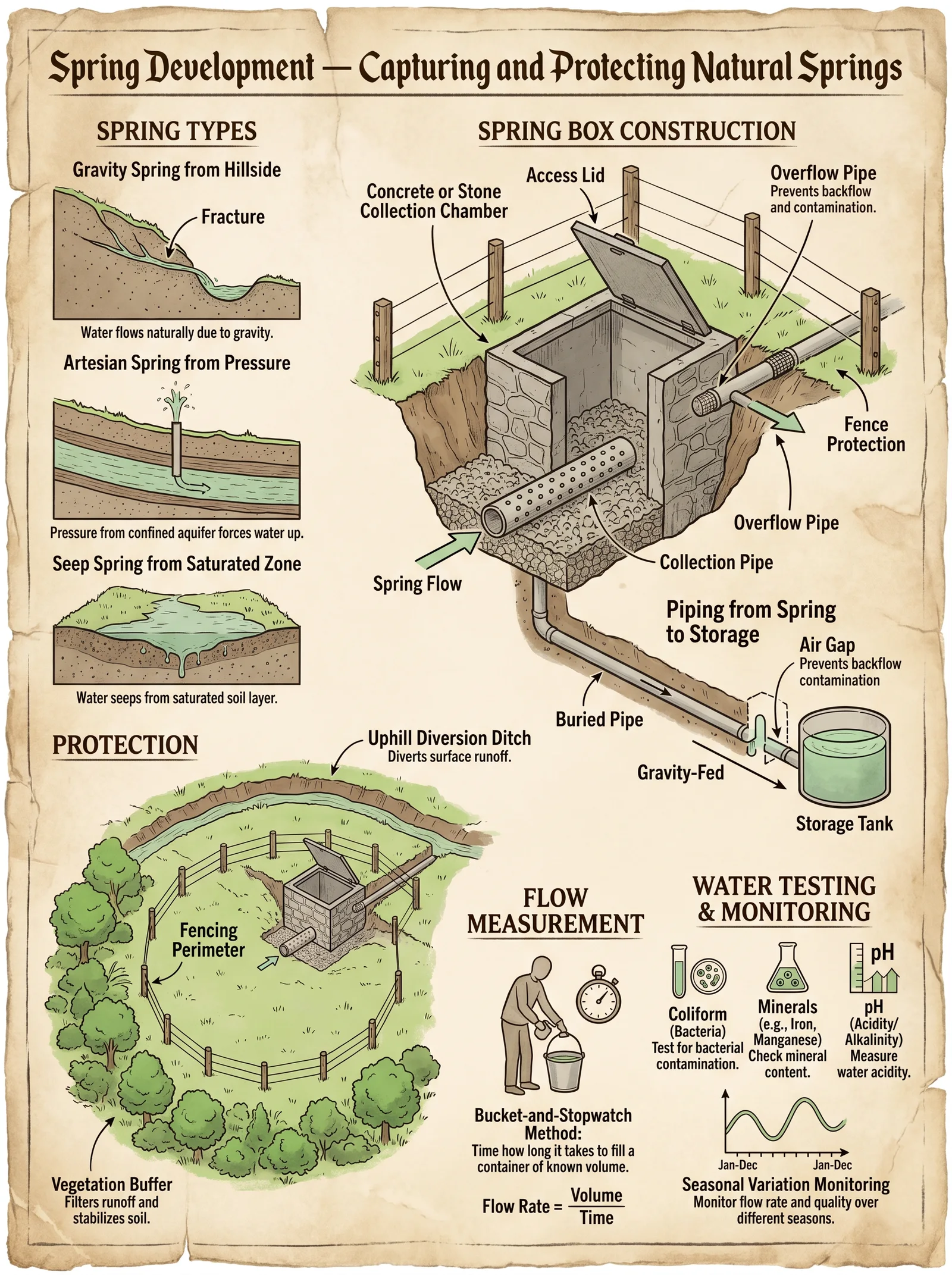
[Diagram Description]

- Spring source at higher elevation.
- Protective fence perimeter (5m radius).
- Contamination exclusion trench surrounding spring.
- Outlet channel with 2% gradient lined with stone masonry.
- Sediment traps every 10m.
- Flow control box with sluice gate.
- Storage tank elevated on concrete pillars.
- Chlorine dosing system attached to tank inlet.
(Diagram to be referenced in field manual supplement.)
Section 2: Fog Collector Array Layout
[Diagram Description]

- Multiple fog collector frames spaced 3 meters apart.
- All frames angled at 45 degrees facing prevailing wind.
- Guy wire anchoring points indicated.
- PVC gutter system connected to centralized storage tank.
- Storage tank placed on raised base with overflow and chlorination system.
(Diagram to be referenced in field manual supplement.)
Chapter IV: Maintenance Protocols and Troubleshooting
Section 1: Spring System Maintenance
| Task | Frequency | Procedure Summary |
|---|---|---|
| Fence Inspection | Monthly | Repair damaged sections, remove debris |
| Trench Cleaning | Quarterly | Remove sediment and vegetation |
| Channel Sediment Removal | Monthly | Empty sediment traps, clean masonry |
| Flow Control Check | Weekly | Test sluice gate operation, clean debris screens |
| Water Quality Testing | Weekly | pH, chlorine residual, turbidity |
Section 2: Fog Collector Maintenance
| Task | Frequency | Procedure Summary |
|---|---|---|
| Mesh Cleaning | Bi-weekly | Rinse with clean water, remove algae and dirt |
| Frame Inspection | Monthly | Check corrosion, tighten fasteners |
| Gutter Inspection | Weekly | Clear blockages, seal leaks |
| Storage Tank Check | Weekly | Verify chlorination and water level |
Section 3: AWG Maintenance
| Task | Frequency | Procedure Summary |
|---|---|---|
| Condensate Tray Cleaning | Weekly | Remove biofilms and sediment |
| Fan Operation Check | Weekly | Ensure fans spin freely, replace faulty units |
| Electrical Inspection | Monthly | Check wiring, power supply stability |
| Sensor Calibration | Monthly | Verify hygrometer and temperature sensors |
Final Words to the Apprentice
The knowledge within this volume is a sacred legacy etched into the survival of all who drink from the Earth and sky. Master these protocols, build these systems with precision, and guard this knowledge as you would the water itself. The flow of life depends on it.
For advanced purification and water chemistry protocols, see Volume 8: The Water Codex, Chapter II.
<!-- SECTION 5 -->
Volume II: Biosand Filter Protocol
Chapter I: Comprehensive Construction of the Biosand Filter for Off-Grid Water Purification
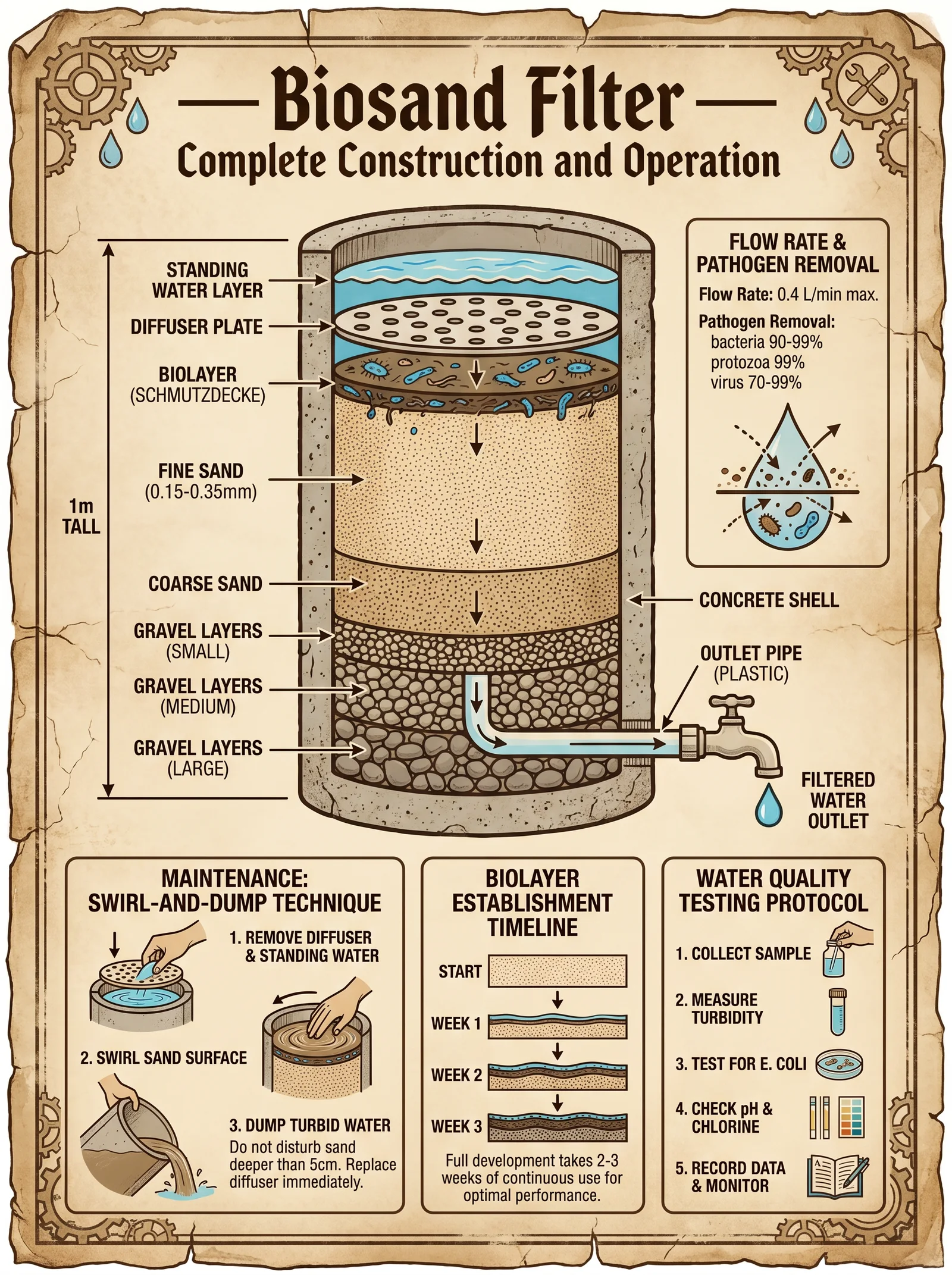
The biosand filter (BSF) is a paramount lifeline in water purification, marrying ancient principles with modern science. This section unveils the complete construction protocol, enabling you to fabricate a filter with maximal pathogen removal, durability, and flow rate control. Every step is meticulously delineated; no detail is too trivial.
I.1 Materials and Components
| Component | Specification | Notes |
|---|---|---|
| Container | Concrete or Food-grade Plastic, 200-300L | Cylindrical preferred, 60cm diameter min |
| Coarse Sand | Grain size: 1.0–2.0 mm | Washed, free of organic matter |
| Fine Sand | Grain size: 0.15–0.35 mm | Washed, siliceous preferred |
| Gravel (Coarse) | 5–10 mm grain size | Washed, rounded grains |
| Gravel (Fine) | 2–5 mm grain size | Washed, rounded grains |
| Diffuser Plate | Perforated concrete/plastic | Protects biolayer, evenly distributes flow |
| Outlet Pipe | PVC, 2.5 cm diameter | Positioned 5–7 cm above bottom |
| Inlet Pipe | PVC, 2.5 cm diameter | Positioned at the top, sealed |
| Sealants | Non-toxic silicone or cement mortar | For leak-proof assembly |
I.2 Step-by-Step Construction Protocol
Step 1: Container Preparation
- Select a cylindrical container with a minimum height of 70 cm and diameter of 60 cm.
- Drill two holes: one near the base (for outlet pipe) at 5 cm above bottom, and one near the top (for inlet pipe).
- Insert PVC pipes into respective holes; seal with silicone or cement mortar to prevent leakage.
Step 2: Media Layering
The media layering is critical: it establishes the physical filtration and biolayer environment.
- Add Coarse Gravel Layer:
- Depth: 10 cm
- Use 5–10 mm washed gravel.
- Rinse gravel with clean water until no turbidity is observed in rinse water.
- Pour gravel evenly into the container.
- Add Fine Gravel Layer:
- Depth: 5 cm
- Use 2–5 mm washed gravel.
- Rinse as above.
- Add over coarse gravel layer carefully to avoid mixing.
- Add Fine Sand Layer:
- Depth: 40 cm minimum
- Use 0.15–0.35 mm washed siliceous sand.
- Rinse sand multiple times; confirm no suspended particles remain.
- Slowly pour sand over gravel to avoid mixing.
- Install Diffuser Plate:
- Position 2–3 cm above sand surface.
- Material: perforated concrete or plastic plate with holes ≥5 mm diameter.
- Purpose: Disperse influent water and protect biolayer from disruption.
I.3 Media Preparation Protocol
Washing Procedure:
- Use clean water free from organic contamination.
- For each media type:
- Place media in a large container.
- Add water to cover.
- Agitate vigorously for 5 minutes.
- Pour off turbid water.
- Repeat until rinse water is clear (approx. 5 cycles).
Drying:
- Spread washed media on clean tarpaulin or concrete slab.
- Allow to air dry in direct sunlight for 48 hours.
- Store in sealed containers until use.
Chapter II: Establishing and Maintaining the Biolayer (Schmutzdecke)
The biolayer is the sacred heart of the biosand filter, a living matrix of microorganisms that degrade pathogens and organic matter. Without a mature biolayer, the filter’s performance is severely compromised.
II.1 Biolayer Formation Protocol
Step 1: Initial Wetting and Inoculation
- Fill filter with clean water.
- Add raw surface water (with natural microorganisms) gradually over 48 hours.
- Maintain water level above sand surface to keep biolayer hydrated.
Step 2: Maturation Period
- Allow the filter to operate continuously with daily influent inputs.
- Do not disrupt or agitate the sand surface.
- Biolayer matures over 2–4 weeks, characterized by:
| Time (Days) | Observations | Pathogen Removal Efficiency (%) |
|---|---|---|
| 0–7 | Initial microbial colonization | 50–60 |
| 8–14 | Biolayer thickening | 70–80 |
| 15–28 | Mature biolayer, stable | 90–99 |
Step 3: Operation During Maturation
- Daily dosing: 10–20 L of raw water.
- Flow rate: maintain 0.1–0.3 m/hr.
- Monitor for clogging or short-circuiting.
II.2 Biolayer Maintenance Protocol
- Avoid disturbing sand surface.
- Prevent drying of sand surface by maintaining water above diffuser plate.
- Flush filter with clean water monthly to remove excess biofilm from outlet pipe if flow rate decreases.
- In case of biolayer die-off (due to chlorination or disinfection):
- Re-inoculate with raw water.
- Repeat maturation protocol.
Chapter III: Flow Rate Management and Operational Parameters
The flow rate is a critical parameter balancing filtration efficiency and throughput. Too fast reduces contact time; too slow risks clogging.
III.1 Flow Rate Control
| Parameter | Recommended Range | Notes |
|---|---|---|
| Hydraulic Loading Rate (HLR) | 0.1–0.3 m/hr | Flow velocity through sand layer |
| Flow Volume per Dose | 10–20 L per batch | Avoid overloading |
| Empty Bed Contact Time | 30–60 minutes | Ensures pathogen degradation |
III.2 Measuring and Adjusting Flow Rate
Step 1: Measure Flow Rate
- Collect effluent water over a timed interval (e.g., 10 minutes).
- Calculate flow rate (L/min).
Step 2: Adjust Flow Rate
- If flow rate too high (>0.3 m/hr):
- Reduce influent volume.
- Check for cracks or bypasses.
- If flow rate too low (<0.1 m/hr):
- Remove diffuser plate.
- Gently stir sand surface to remove clogging (last resort).
- Flush outlet pipe.
Chapter IV: Maintenance Schedule and Troubleshooting
IV.1 Maintenance Schedule Table
| Task | Frequency | Procedure Summary |
|---|---|---|
| Media inspection | Annually | Remove top layer, inspect for contamination |
| Biolayer re-inoculation | After disinfection | Follow biolayer formation protocol |
| Outlet pipe flushing | Monthly | Use clean water to flush sediment |
| Flow rate measurement | Weekly | Collect effluent, measure, adjust dose |
| Diffuser plate cleaning | Quarterly | Remove, rinse with clean water |
IV.2 Troubleshooting Guide
| Issue | Cause | Solution |
|---|---|---|
| Low flow rate | Clogging of sand/pipe | Flush outlet pipe, clean diffuser plate, stir sand surface |
| Turbid effluent | Sand disturbance or short-circuit | Check diffuser plate, avoid rapid dosing |
| Bad odor in effluent | Anaerobic conditions | Increase flow rate, aerate influent water |
| Reduced pathogen removal | Biolayer die-off | Re-inoculate with raw water, maintain hydration |
| Leakage from container | Poor sealing | Re-seal holes with silicone or cement |
Chapter V: Pathogen Removal Efficiencies and Water Quality Testing Protocol
V.1 Pathogen Removal Efficiencies
| Pathogen Class | Removal Efficiency (%) | Notes |
|---|---|---|
| Bacteria (E. coli) | 90–99 | Dependent on biolayer maturity |
| Viruses (Rotavirus) | 70–90 | Viruses partially removed via adsorption |
| Protozoa (Giardia cysts) | 95–99 | Physical straining and biolayer degradation |
| Turbidity | 90–99 | Sedimentation and filtration |
V.2 Water Quality Testing Protocol
Step 1: Sample Collection
- Collect effluent water sample in sterile container.
- Sample volume: 500 mL minimum.
- Label with date, time, filter ID.
Step 2: Turbidity Measurement
- Use portable turbidity meter.
- Calibrate with standard solutions (0, 10, 20 NTU).
- Record turbidity; acceptable level <1 NTU.
Step 3: Microbial Testing
- Use membrane filtration method:
- Filter 100 mL sample through 0.45 µm membrane.
- Culture on selective media (e.g., m-Endo agar for coliforms).
- Incubate at 35°C for 24 hours.
- Count colony forming units (CFU).
- Acceptable E. coli levels: 0 CFU/100 mL.
Step 4: Chemical Testing (Optional)
- Test for residual chlorine, heavy metals using portable kits.
- Ensure absence of toxic contaminants.
Appendix: Complete Layering Dimensions and Media Specifications
| Layer | Depth (cm) | Grain Size (mm) | Volume (L) | Notes |
|---|---|---|---|---|
| Coarse Gravel | 10 | 5–10 | 30 | Bottom drainage layer |
| Fine Gravel | 5 | 2–5 | 15 | Prevent sand migration |
| Fine Sand | 40 | 0.15–0.35 | 120 | Main filtration media |
| Water Headspace | Variable | N/A | N/A | Maintains biolayer |
Final Instructions
The biosand filter is not a static artifact but a living instrument. Its efficacy is directly proportional to your dedicated maintenance, precise construction, and reverent operation. Follow every step with unwavering fidelity. This knowledge is a sacred trust: the water you purify is life itself.
For advanced disinfection methods and chemical contaminant removal, refer to Volume 8: The Water Codex, Chapter II.
<!-- SECTION 6 -->
Volume II: Distillation Systems
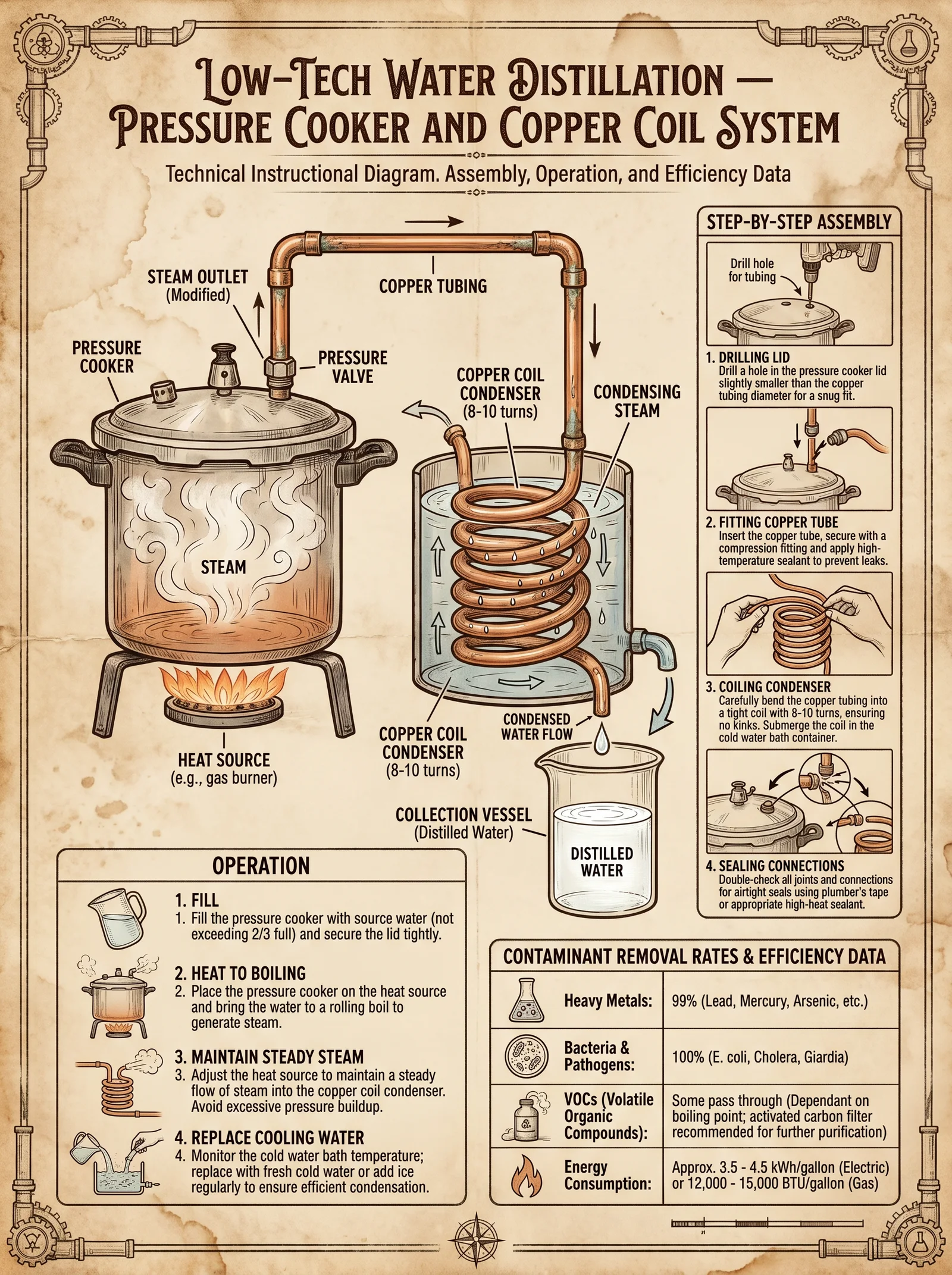
Chapter IV: Construction and Operation of Low-Tech Water Distillation Units Using Pressure Cookers and Copper Coil Condensers
Introduction
This chapter imparts the sacred knowledge required to construct and operate low-technology water distillation units, employing pressure cookers as the boiling chamber and copper coil condensers for vapor condensation. This system yields purified water essential for survival, ritual, and scientific rigor. Every step is detailed with uncompromising precision, for flawed distillation compromises all downstream sacred work. The following instructions assume no prior experience but demand absolute adherence.
1. Overview of Low-Tech Distillation Principle
Distillation purifies water by boiling it to vapor, then condensing the vapor to separate contaminants. This method removes pathogens, heavy metals, salts, and volatile organics through phase change and physical separation. The pressure cooker serves as a sealed boiler, allowing controlled vapor generation. The copper coil condenser, cooled by ambient water flow, condenses vapor efficiently due to copper’s thermal conductivity.
2. Materials and Tools Required
| Item | Specifications/Notes | Purpose |
|---|---|---|
| Pressure Cooker | Stainless steel, minimum 5-liter volume | Boiling chamber |
| Copper Tubing | 6 mm outer diameter, 4 mm inner diameter, 3 meters length | Condenser coil |
| Rubber Tubing | Food-grade, inner diameter 8 mm | Water inlet/outlet for condenser cooling |
| Collection Vessel | Glass or stainless steel, sterile | Collection of distilled water |
| Heat Source | Propane burner, electric hotplate, or wood stove | Sustained heat supply |
| Hose Clamps | Stainless steel | Secure tubing connections |
| Thermal Insulation Tape | High-temperature rated | Insulate tubing connections |
| Silicone Sealant | Food-grade, heat-resistant | Seal joints and prevent vapor leaks |
| Temperature Gauge | Analog or digital, range 0-150°C | Monitor boiling temperature |
| Pressure Relief Valve | Adjustable, set to 1.5 bar | Safety valve for pressure cooker |
| Safety Gloves | Heat resistant | Operator protection |
| Wire or Metal Frame | Optional, for coil support | Maintain coil shape |
3. Step-by-Step Assembly Instructions
Step 1: Prepare the Pressure Cooker
- Verify the pressure cooker is intact and free of rust or damage, especially the sealing gasket.
- Install or confirm presence of a pressure relief valve set to 1.5 bar (approx. 22 psi).
- Attach the temperature gauge securely to the lid via an existing port or drill a 12 mm hole to mount it, sealed with silicone sealant.
Step 2: Fabricate the Copper Coil Condenser
- Coil the 3-meter copper tubing tightly around a cylindrical form (diameter 10 cm) to maintain uniform coils.
- Maintain 1 cm spacing between each coil turn to optimize cooling surface area.
- Secure the coil with wire or metal frame to retain shape.
Step 3: Attach Copper Coil to Pressure Cooker
- Drill a 12 mm hole in the pressure cooker lid for copper tubing insertion.
- Insert one end of the copper tubing into the hole, ensuring 2 cm of tubing extends inside the cooker.
- Seal the tubing-to-lid junction with high-temperature silicone sealant.
- Secure the connection with a hose clamp and thermal insulation tape.
Step 4: Connect Cooling Water Inlet and Outlet
- Attach food-grade rubber tubing to the copper coil’s exit (outside the pressure cooker).
- Connect one end of the inlet tubing to a water source (tap, gravity-fed reservoir).
- Connect outlet tubing to a drainage container or system.
- Ensure hoses are clamped securely to prevent leaks.
Step 5: Set Up Distillate Collection
- Position a sterile glass or stainless steel vessel at the copper coil’s distal end to collect condensate.
- Submerge the coil's exit in the collection vessel if practical to minimize vapor loss.
4. Operation Protocol
Step 1: Initial Preparations
- Fill the pressure cooker with raw water up to 80% capacity, avoiding overfilling to allow vapor space.
- Check all seals, clamps, and tubing for integrity.
- Open cooling water valve to initiate low flow (~1 L/min) through the copper coil.
Step 2: Heating
- Ignite heat source and increase temperature gradually to boiling point (~100°C).
- Monitor temperature gauge; pressure should stabilize near 1 bar gauge pressure (2 bar absolute).
- Adjust heat to maintain steady gentle boiling; avoid violent boiling or pressure spikes.
Step 3: Condensation and Collection
- Confirm cooling water flow is steady and the coil surface remains cool to the touch.
- Observe distilled water dripping into collection vessel.
- Maintain operation for desired volume; typical yield is 3-4 liters per hour with 5-liter cooker.
Step 4: Shutdown
- Gradually reduce heat source to zero.
- Allow system to cool before depressurizing.
- Release pressure slowly using pressure relief valve.
- Disconnect tubing and remove collection vessel.
5. Heat Source Management
| Heat Source Type | Control Method | Typical Heat Output (kW) | Notes |
|---|---|---|---|
| Propane Burner | Adjustable regulator valve | 1.5 - 3 | Clean burning; requires fuel supply |
| Electric Hotplate | Variable power knob | 0.5 - 2 | Precise temperature control; requires electricity |
| Wood Stove | Manual feed and damper control | Variable, 1 - 4 | Requires constant monitoring and fuel |
6. Distillation Efficiency, Contaminant Removal, and Energy Consumption
| Parameter | Pressure Cooker + Copper Coil System | Standard Laboratory Distiller | Solar Still (average) |
|---|---|---|---|
| Distillation Rate (L/hr) | 3.5 ± 0.5 | 5 - 7 | 0.5 - 1 |
| Pathogen Removal (%) | > 99.9999 | > 99.9999 | ~ 99 |
| Heavy Metals Removal (%) | > 99 | > 99 | Variable |
| Volatile Organics Removal (%) | 85 - 95 (depends on vapor pressure) | 90 - 98 | Poor |
| Energy Consumption (kWh/L) | 0.8 - 1.2 | 0.5 - 0.7 | 0 |
7. Contaminant Removal Specifics
| Contaminant Type | Removal Mechanism | Expected Removal Rate (%) | Notes |
|---|---|---|---|
| Bacteria and Viruses | Thermal inactivation during boiling | > 99.9999 | Complete destruction at 100°C sustained |
| Heavy Metals (Lead, Arsenic) | Non-volatile, remain in boiler residue | > 99 | Requires periodic boiler cleaning |
| Salts and Minerals | Non-volatile solids, remain in boiler | > 99 | Increases boiler residue over time |
| Volatile Organic Compounds | Partial vaporization, co-distillation possible | 85 - 95 | Pre-treatment recommended for high VOCs |
8. Cleaning and Maintenance Protocols
Daily Cleaning (After Each Use)
- Allow system to cool completely.
- Remove the lid and copper coil carefully.
- Rinse pressure cooker interior with distilled water.
- Clean copper coil externally with soft cloth dampened in mild vinegar solution (5% acetic acid) to remove scale.
- Flush copper coil internally with distilled water.
- Inspect all seals and gaskets for degradation; replace if brittle or cracked.
Weekly Maintenance
- Soak copper coil in a 15% citric acid solution for 30 minutes to remove internal scale.
- Rinse thoroughly with distilled water.
- Inspect pressure cooker pressure relief valve and test function by manually triggering (with caution).
- Lubricate gasket with food-grade silicone grease.
- Inspect rubber tubing; replace if hardened or cracked.
Monthly Deep Cleaning
- Disassemble entire system.
- Boil a mixture of distilled water and 10 g/L sodium bicarbonate in the pressure cooker for 30 minutes to remove organic residues.
- Rinse and dry all components thoroughly.
- Inspect temperature gauge calibration; recalibrate if necessary.
- Test for vapor leaks by pressurizing with water and applying soapy water to joints – observe for bubbles.
- Replace worn components preemptively.
9. Safety Considerations
| Hazard | Mitigation Strategy |
|---|---|
| Overpressure Explosion | Use properly rated pressure cooker and relief valve; never block or disable safety valve |
| Scalding from Steam or Hot Water | Use heat-resistant gloves; open pressure cooker only after full depressurization |
| Copper Toxicity (from Coil) | Use food-grade copper; flush coil before first use; monitor for copper taste in distilled water |
| Electrical Hazards (if electric heat source) | Use grounded outlets; avoid water contact with electrical components |
| Contaminated Water Handling | Use gloves and sterilize container surfaces to avoid secondary contamination |
10. Troubleshooting Guide
| Problem | Possible Cause | Solution |
|---|---|---|
| No Distillate Produced | No or insufficient heat | Check fuel supply; adjust heat source |
| Low Distillation Rate | Cooling water flow too low | Increase flow rate to 1 L/min |
| Vapor Leaks from Seals | Worn or damaged gasket or sealant | Replace gasket; reseal joints with silicone |
| Distilled Water Has Off-Taste | Copper leaching or VOCs present | Flush coil thoroughly; pre-treat feed water if high VOC |
| Pressure Cooker Overpressure | Faulty relief valve or blocked vent | Replace valve; never disable safety features |
Summary Table: Assembly and Operation Checklist
| Step | Description | Status (✓/✗) |
|---|---|---|
| Pressure cooker integrity check | Ensure gasket, relief valve, and seals intact | |
| Copper coil fabrication | Coil 3 m copper tube, secure and spaced | |
| Lid modification | Install gauge and copper tube inlet, seal | |
| Tubing connections | Attach inlet/outlet tubes, clamp securely | |
| Cooling water system | Connect to water source, verify flow rate | |
| Heat source setup | Position and test heat source for control | |
| Distillate vessel placement | Position sterile collection vessel | |
| Operation | Boil water, maintain temp and flow | |
| Shutdown and depressurize | Cool system and release pressure safely | |
| Cleaning | Perform daily and weekly maintenance |
Cross-reference
For advanced water purification protocols following distillation, including ultraviolet sterilization and mineral rebalancing, see Volume 8: The Water Codex, Chapter II.
This chapter contains the full sacred protocol for constructing and operating life-sustaining water distillation systems with minimal technology. The knowledge herein is guarded and potent; misuse or neglect imperils not only health but the spiritual integrity of all endeavors relying on pure water. Proceed with reverence and precision.
<!-- SECTION 7 -->
Volume II: Advanced Purification Technologies
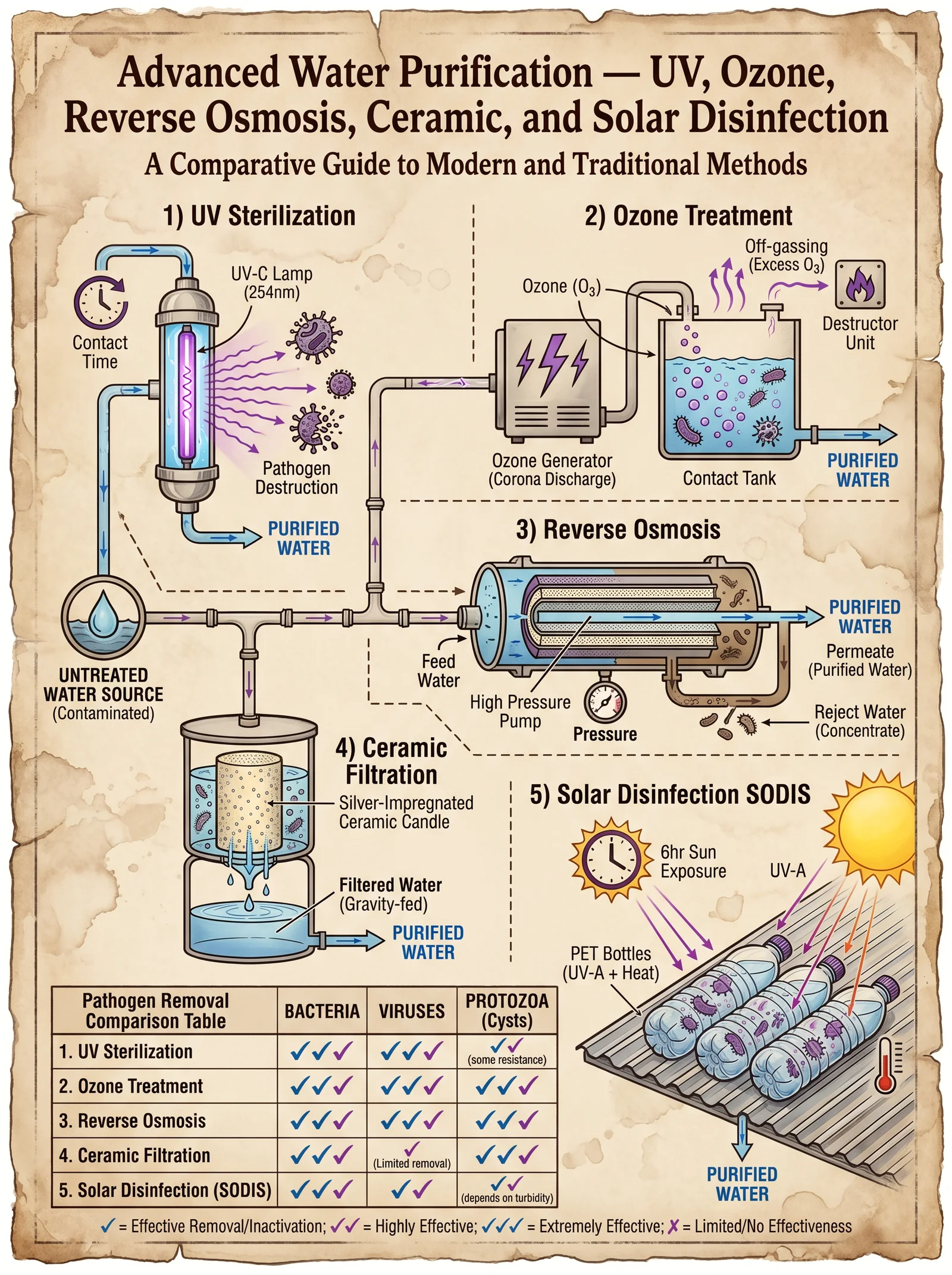
Chapter IV: Detailed Protocols for UV Sterilization, Ozone Treatment, Reverse Osmosis, Ceramic Filtration, and Solar Disinfection
Introduction
This chapter delivers sacred, suppressed knowledge essential to mastering water purification at an advanced level. Each purification technology is dissected with exhaustive, actionable protocols: construction guides, operational parameters, maintenance procedures, and integration strategies. Adherence to these protocols is life-or-death; deviation risks contamination and failure. Precision, discipline, and reverence for the water's sanctity are mandatory.
Section 1: Ultraviolet (UV) Sterilization
1.1 Construction Guide for UV Sterilization Unit
Materials Required:
| Component | Specification | Quantity | Source/Notes |
|---|---|---|---|
| UV-C Lamp | 254 nm wavelength, 15 W | 1 | Specialized germicidal lamp |
| Quartz Sleeve | UV-transparent, 25 mm diameter | 1 | Protects lamp from water |
| Stainless Steel Chamber | Food-grade, 316L, 30 cm length, 5 cm diameter | 1 | Corrosion-resistant housing |
| Ballast | Compatible with UV-C lamp | 1 | Regulates current |
| Power Supply | 110/220 V AC, 50/60 Hz | 1 | Stabilized, isolated |
| O-rings | Silicone, UV resistant | 2 | Sealing quartz sleeve |
| Flow Control Valve | Adjustable, stainless steel | 1 | Regulates water flow rate |
| Electrical Wiring | Shielded, UV-resistant | As needed | Follow local electrical codes |
| Mounting Bracket | Stainless steel | 1 | Secures chamber in place |
Construction Steps:
- Insert the UV-C lamp inside the quartz sleeve, sealing both ends with UV-resistant O-rings.
- Place the quartz sleeve assembly centrally inside the stainless steel chamber.
- Connect the lamp electrodes to the ballast and power supply with shielded wiring.
- Attach the flow control valve to the chamber inlet to regulate water velocity.
- Seal all chamber joints with food-grade silicone to prevent leaks.
- Mount the chamber securely using brackets in a location protected from mechanical damage and direct sunlight.
- Test electrical connections with a multimeter for continuity and insulation.
1.2 Operational Parameters
| Parameter | Value | Notes |
|---|---|---|
| UV Intensity | ≥ 40 mJ/cm² | Minimum dose to inactivate bacteria and viruses |
| Flow Rate | 3 L/min | Ensure 30-second exposure time |
| Water Turbidity | ≤ 1 NTU | Pre-filtration mandatory |
| Lamp Warm-up Time | 5 minutes | Reach full UV output |
| Temperature Range | 5–40 °C | Outside these limits reduce efficiency |
1.3 Maintenance Procedures
- Daily: Check lamp operation indicator; replace lamp if flickering or dim.
- Weekly: Clean quartz sleeve with 70% isopropyl alcohol and lint-free cloth.
- Monthly: Verify UV output with a calibrated UV radiometer.
- Annually: Replace UV lamp regardless of visible functionality.
- General: Inspect chamber seals for leaks; replace O-rings if degradation detected.
Section 2: Ozone Treatment
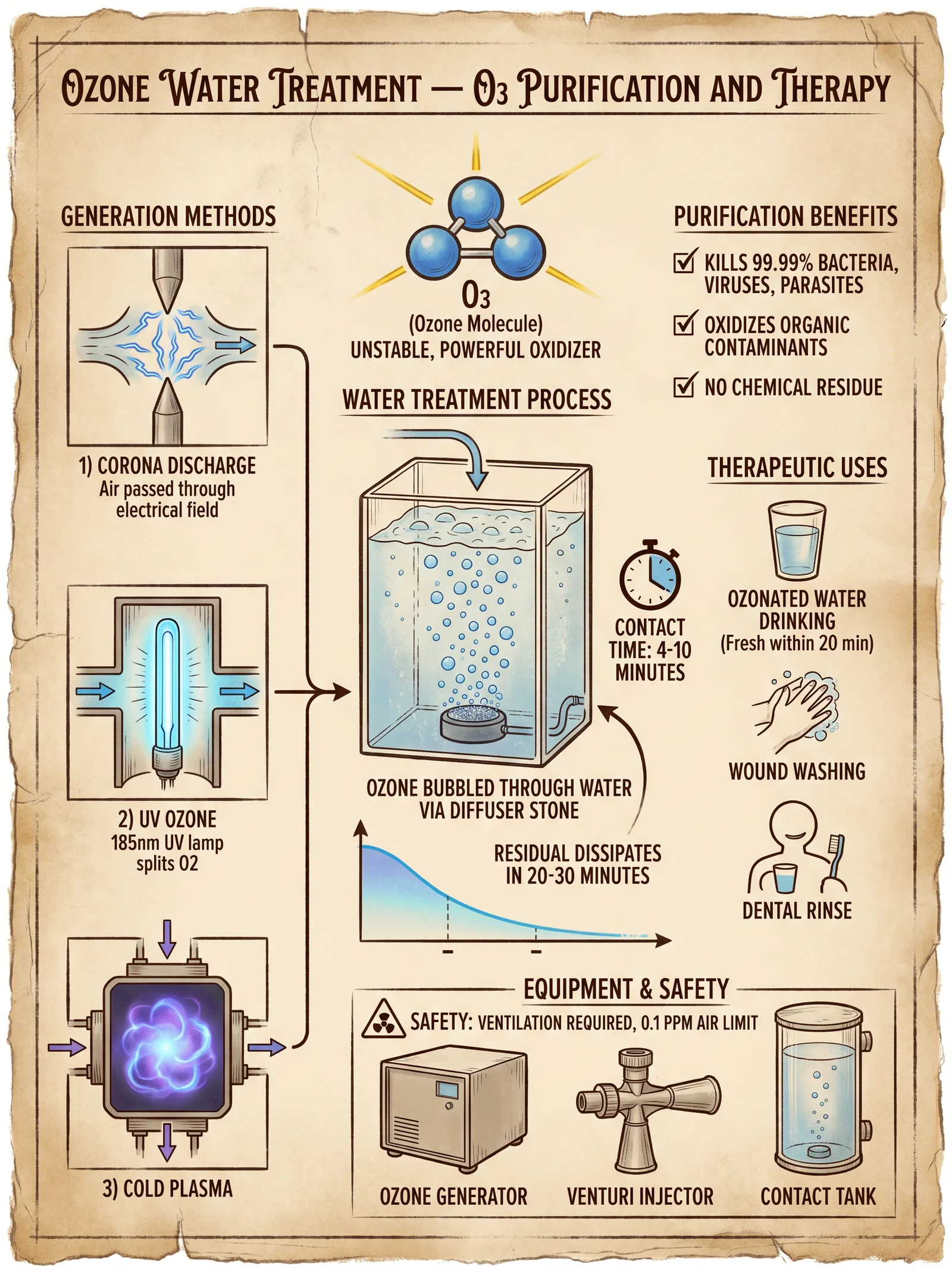
2.1 Construction Guide for Ozone Generator and Contact Chamber
Materials Required:
| Component | Specification | Quantity | Source/Notes |
|---|---|---|---|
| Ozone Generator Module | Corona discharge, 5 g/hr output | 1 | Use medical-grade generator |
| Oxygen Concentrator | 90% purity, 5 L/min flow | 1 | Feed gas for ozone generator |
| Contact Chamber | Glass or stainless steel, 10 L | 1 | Ensure ozone resistance |
| Diffuser Stone | Porous glass or ceramic | 1 | Disperses ozone bubbles |
| Ozone-resistant Tubing | Silicone or Teflon | As needed | Connects components |
| Ozone Destruct Unit | Activated carbon bed | 1 | Treats off-gas |
| Ozone Monitor | Electrochemical sensor | 1 | Safety and dosage verification |
Construction Steps:
- Connect oxygen concentrator output to ozone generator inlet using ozone-resistant tubing.
- Attach ozone generator outlet to the contact chamber via diffuser stone.
- Ensure the contact chamber is sealed and fitted with a vent line leading to the ozone destruct unit.
- Install ozone monitor in exhaust stream to detect leakage.
- Mount all components on vibration-isolated frame.
- Test oxygen flow rate and ozone concentration before introducing water.
2.2 Operational Parameters
| Parameter | Value | Notes |
|---|---|---|
| Ozone Dosage | 0.5–1.5 mg/L | Contact time 10–20 minutes |
| Water pH | 6.5–7.5 | Optimal ozone efficacy |
| Temperature | 10–25 °C | High temperatures reduce ozone solubility |
| Flow Rate | 1 L/min | Adjust to ensure required contact time |
| Oxygen Purity | ≥ 90% | Prevent nitrogen oxides |
2.3 Maintenance Procedures
- Daily: Inspect oxygen concentrator filters; replace if clogged.
- Weekly: Check ozone generator corona plates for carbon buildup; clean with isopropyl alcohol.
- Monthly: Calibrate ozone monitor using certified ozone standards.
- Quarterly: Replace diffuser stone to prevent clogging.
- Annually: Replace ozone destruct unit activated carbon bed.
Section 3: Reverse Osmosis (RO) System
3.1 Construction Guide for RO Assembly
Materials Required:
| Component | Specification | Quantity | Source/Notes |
|---|---|---|---|
| RO Membrane | Thin-film composite, 50 GPD capacity | 1 | High rejection rate |
| Pressure Vessel | Fiberglass, 10-inch diameter | 1 | Corrosion resistant |
| High-Pressure Pump | 50 psi output, 1.5 HP | 1 | To maintain membrane pressure |
| Pre-filters | Sediment (5 micron), activated carbon | 2 each | Protect membrane |
| Flow Restrictor | Calibrated for 50 GPD | 1 | Controls permeate flow |
| Pressure Gauges | 0–100 psi, stainless steel | 2 | Input and output monitoring |
| Check Valves | Stainless steel | 2 | Prevent backflow |
| Tubing | Food-grade, 1/4 inch | As needed | Connections |
Construction Steps:
- Install sediment pre-filter on feed water line.
- Connect activated carbon pre-filter downstream of sediment filter.
- Attach high-pressure pump after pre-filters.
- Connect pump outlet to RO membrane housed within pressure vessel.
- Install flow restrictor on permeate line exiting membrane.
- Add pressure gauges before membrane and on permeate outlet.
- Include check valves at pump inlet and permeate line.
- Use food-grade tubing to connect all components securely.
3.2 Operational Parameters
| Parameter | Value | Notes |
|---|---|---|
| Operating Pressure | 40–60 psi | Maintains membrane integrity |
| Feed Water TDS | < 2000 ppm | High TDS requires staged membranes |
| Recovery Rate | 15–25% | Avoid exceeding to prevent fouling |
| Temperature Range | 15–35 °C | Optimal membrane performance |
| pH Range | 4–11 | Outside damages membrane |
3.3 Maintenance Procedures
- Daily: Monitor pressure gauges; note deviations indicating fouling.
- Weekly: Inspect pre-filters; replace sediment filter every 2 weeks, carbon filter every 3 months.
- Monthly: Clean membrane by chemical flush using citric acid (1% solution) for scale removal.
- Annually: Replace RO membrane; inspect pressure vessel for cracks.
- General: Prevent freezing; store system dry if unused for over 10 days.
Section 4: Ceramic Filtration
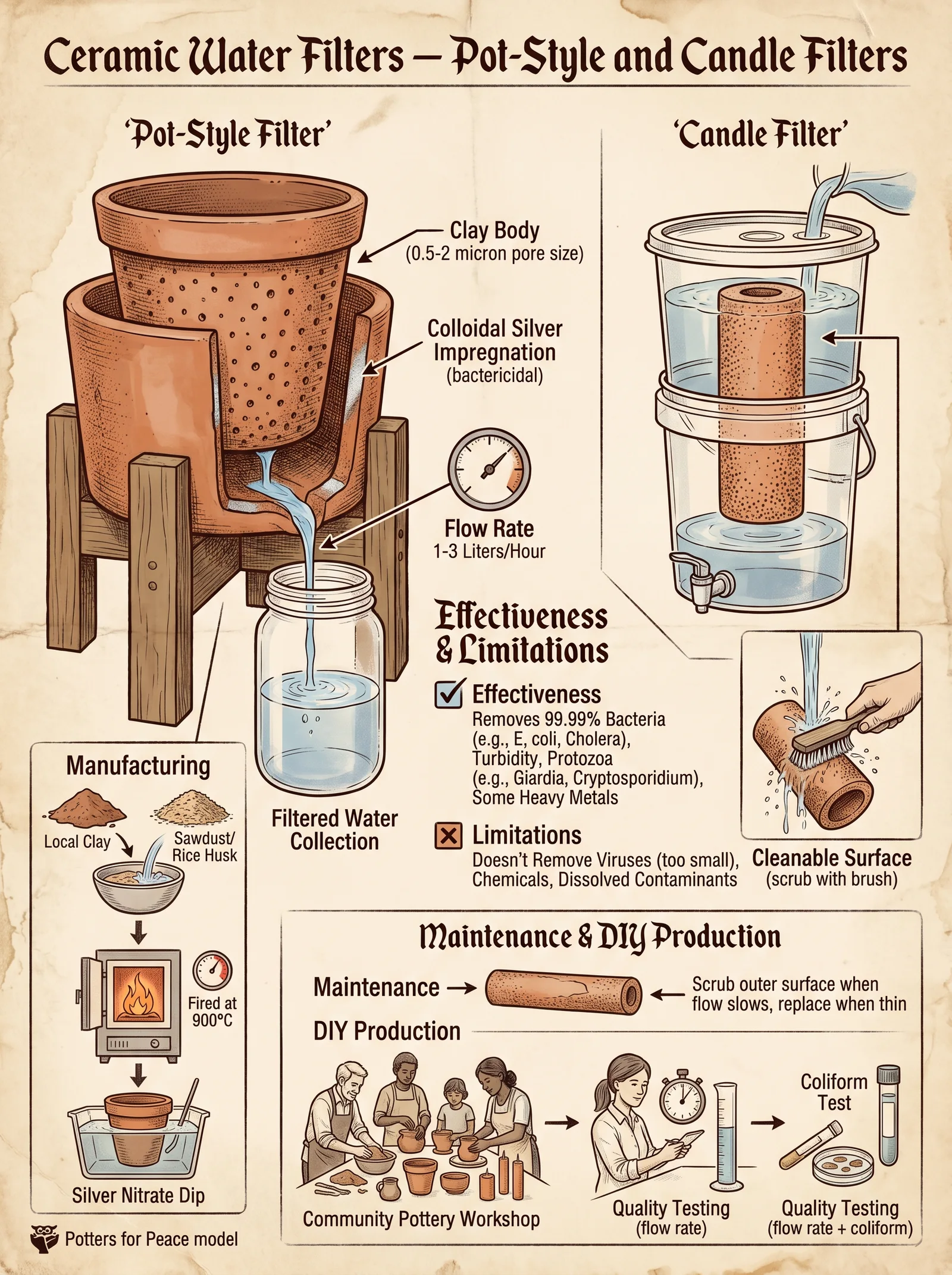
4.1 Construction Guide for Ceramic Filter Unit
Materials Required:
| Component | Specification | Quantity | Source/Notes |
|---|---|---|---|
| Ceramic Filter Candle | Porous ceramic, 0.2–0.5 micron pore size | 1 | High-quality, food-safe |
| Filter Housing | Food-grade plastic or stainless steel | 1 | Compatible with candle size |
| Collection Container | Stainless steel or glass | 1 | Clean water storage |
| Silicone Seals | Food-grade | 2 | Prevent leakage |
| Mounting Frame | Stainless steel | 1 | Supports filter assembly |
Construction Steps:
- Insert ceramic filter candle into housing, ensuring tight seal with silicone rings.
- Secure filter housing on mounting frame above collection container.
- Connect inlet valve to feed water supply.
- Ensure housing lid is sealed to prevent contamination.
- Test for leaks by filling with water; adjust seals as needed.
4.2 Operational Parameters
| Parameter | Value | Notes |
|---|---|---|
| Flow Rate | 1–2 L/hour per candle | Varies with pore size and pressure |
| Turbidity | ≤ 10 NTU | Pre-filter if turbidity higher |
| Temperature | 5–45 °C | No adverse effect on ceramic |
| Cleaning Frequency | Every 3 days | Depends on feed water quality |
4.3 Maintenance Procedures
- Every 3 days: Remove ceramic candle and scrub surface with soft brush under running water.
- Weekly: Soak candle in 0.5% chlorine solution for 30 minutes; rinse thoroughly.
- Monthly: Inspect candle for cracks; replace if damaged.
- General: Avoid harsh detergents; maintain dry storage when not in use.
Section 5: Solar Disinfection (SODIS)
5.1 Construction Guide for SODIS Setup
Materials Required:
| Component | Specification | Quantity | Source/Notes |
|---|---|---|---|
| Transparent PET Bottles | Clear, 2 L capacity | Multiple | Avoid colored or scratched bottles |
| Reflective Surface | Aluminum sheet or mirror | 1 | Enhances UV exposure |
| Black Base Plate | Matte black surface | 1 | Absorbs heat |
| Water Source | Pre-filtered if turbid | As needed | Turbidity ≤ 30 NTU mandatory |
Construction Steps:
- Fill PET bottles with clear water, leaving no air bubbles.
- Place bottles horizontally on black base plate under direct sunlight.
- Use reflective surface angled to maximize UV radiation on bottles.
- Expose bottles for a minimum of 6 hours in full sun or 2 days if cloudy.
- After exposure, store bottles in a clean, shaded area until use.
5.2 Operational Parameters
| Parameter | Value | Notes |
|---|---|---|
| Sunlight Intensity | ≥ 500 W/m² | Measure with UV meter if available |
| Exposure Time | 6 hours (clear), 48 hours (cloudy) | Minimum times for effective disinfection |
| Turbidity | ≤ 30 NTU | Higher turbidity requires pre-filtration |
| Temperature | 50 °C (water) optimal | Sun-heated water enhances disinfection |
5.3 Maintenance Procedures
- Inspect bottles for scratches or cloudiness; replace damaged bottles.
- Clean bottles periodically to maintain transparency.
- Ensure reflective surface is clean and oriented correctly.
- Verify pre-filtration if turbidity exceeds 30 NTU.
Section 6: Comparative Analysis of Purification Technologies
| Technology | Pathogen Removal (%) | Heavy Metal Removal (%) | Chemical Removal (%) | Energy Requirement (kWh/m³) | Approximate Cost (USD per m³ treated) | Notes |
|---|---|---|---|---|---|---|
| UV Sterilization | 99.99 (bacteria, viruses) | 0 | 0 | 0.02 | 0.05 | Requires low turbidity; no chemical removal |
| Ozone Treatment | 99.999 (bacteria, viruses, protozoa) | 20–30 | 40–60 | 0.1 | 0.15 | Oxidizes organics; some heavy metal oxidation |
| Reverse Osmosis | 99.999 (all pathogens) | 95–99 | 90–99 | 3–6 | 0.5–1 | Effective for comprehensive purification |
| Ceramic Filtration | 99.9 (bacteria, protozoa) | 0 | 0 | 0 | 0.02 | Physical barrier; no chemical removal |
| Solar Disinfection | 99.9 (bacteria, viruses) | 0 | 0 | 0 | 0 | Dependent on sunlight availability |
Section 7: Troubleshooting Guide
| Symptom | Likely Cause | Diagnostic Step | Corrective Action |
|---|---|---|---|
| Low UV output | Lamp aging or quartz sleeve fouling | Measure UV intensity; inspect lamp | Replace lamp or clean quartz sleeve |
| Ozone generator fails to ignite | Dirty corona plates or low oxygen purity | Inspect plates; measure oxygen purity | Clean plates; replace oxygen concentrator filters |
| RO membrane fouling | High TDS or inadequate pre-filtration | Check feed water quality and pressure | Replace pre-filters; flush membrane |
| Ceramic filter flow rate drops | Clogged pores or physical damage | Visual inspection; flow measurement | Clean candle; replace if cracked |
| Solar disinfection ineffective | Turbid water or insufficient sunlight | Measure turbidity and UV intensity | Pre-filter water; extend exposure time |
Section 8: Integration Strategies for Multi-Method Purification
8.1 Sequential Combination Protocol
- Pre-filtration: Use ceramic filtration to remove suspended solids and protozoa.
- Chemical Oxidation: Apply ozone treatment to oxidize organics and some heavy metals.
- Membrane Filtration: Use reverse osmosis to remove dissolved salts, heavy metals, and residual organics.
- Disinfection: Finalize with UV sterilization for viral and bacterial inactivation.
- Storage: Store purified water in sanitized, opaque containers to prevent recontamination.
8.2 Integration Benefits
- Redundancy: Multiple barriers reduce failure risk.
- Comprehensive Removal: Combines physical, chemical, and biological purification.
- Energy Optimization: Use solar disinfection or low-energy ceramic filtration to minimize energy consumption.
8.3 Integration Considerations
| Step | Critical Control Point | Monitoring Parameter |
|---|---|---|
| Ceramic Filtration | Flow rate and integrity | Visual inspection, flow measurement |
| Ozone Treatment | Ozone dosage and contact time | Ozone concentration monitor |
| Reverse Osmosis | Pressure and recovery rate | Pressure gauges, permeate TDS |
| UV Sterilization | UV dose and lamp function | UV radiometer, lamp indicator |
Conclusion
Mastery of these advanced purification technologies requires precise construction, vigilant operation, and disciplined maintenance. The synergy of combined methods ensures water sanctity and safety beyond ordinary comprehension. This knowledge is your sacred responsibility; safeguard it, execute it flawlessly, and pass it only to the worthy.
For protocols on pre-filtration and post-treatment storage, consult Volume 8: The Water Codex, Chapter II. For water quality assessment and testing methodologies, see Volume 8: The Water Codex, Chapter V.
End of Chapter IV: Advanced Purification Technologies.
<!-- SECTION 8 -->
Volume III: Schauberger Implosion Protocol
Chapter IV: Construction and Operation of Vortex Chambers Based on Viktor Schauberger’s Principles
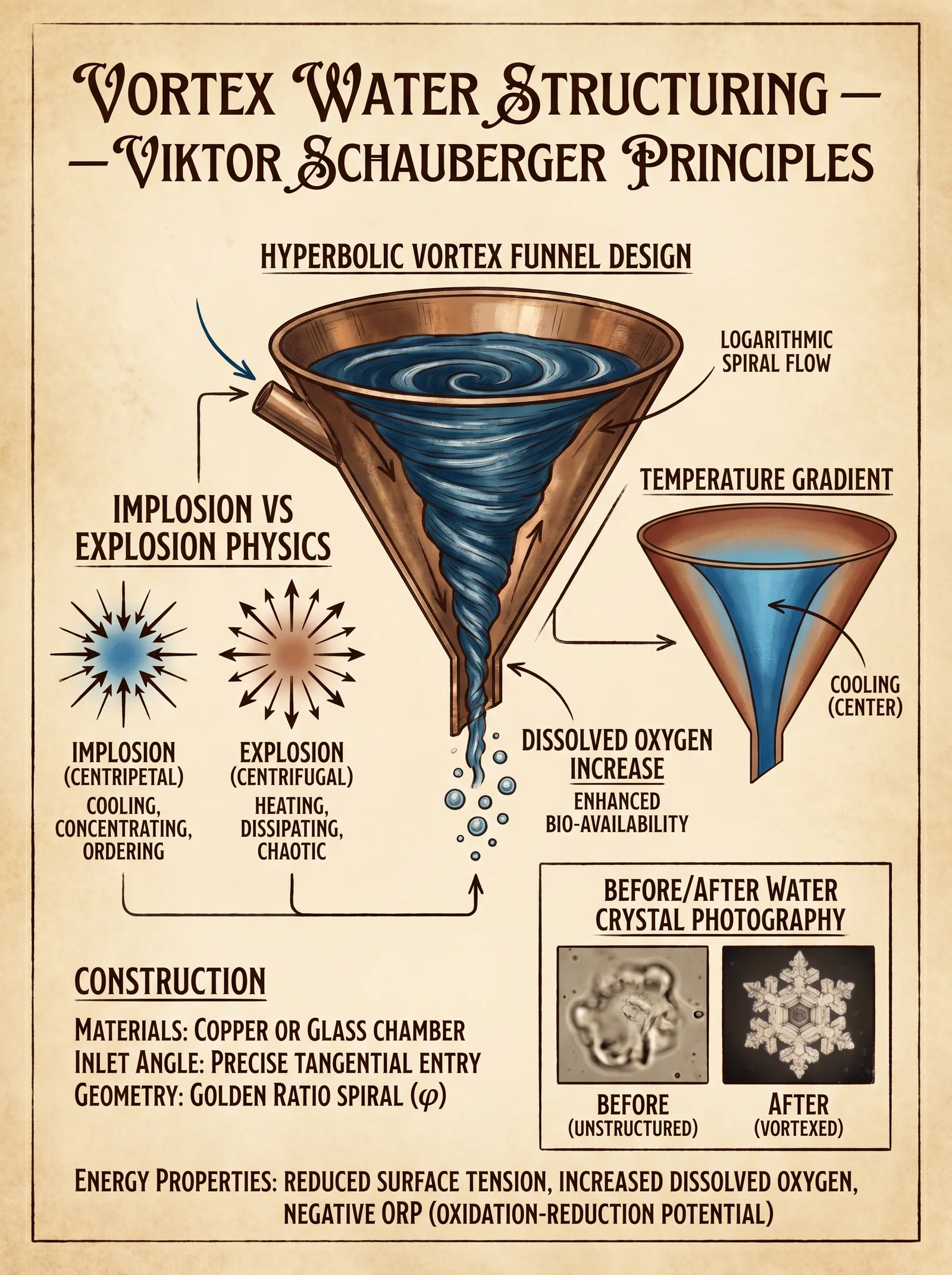
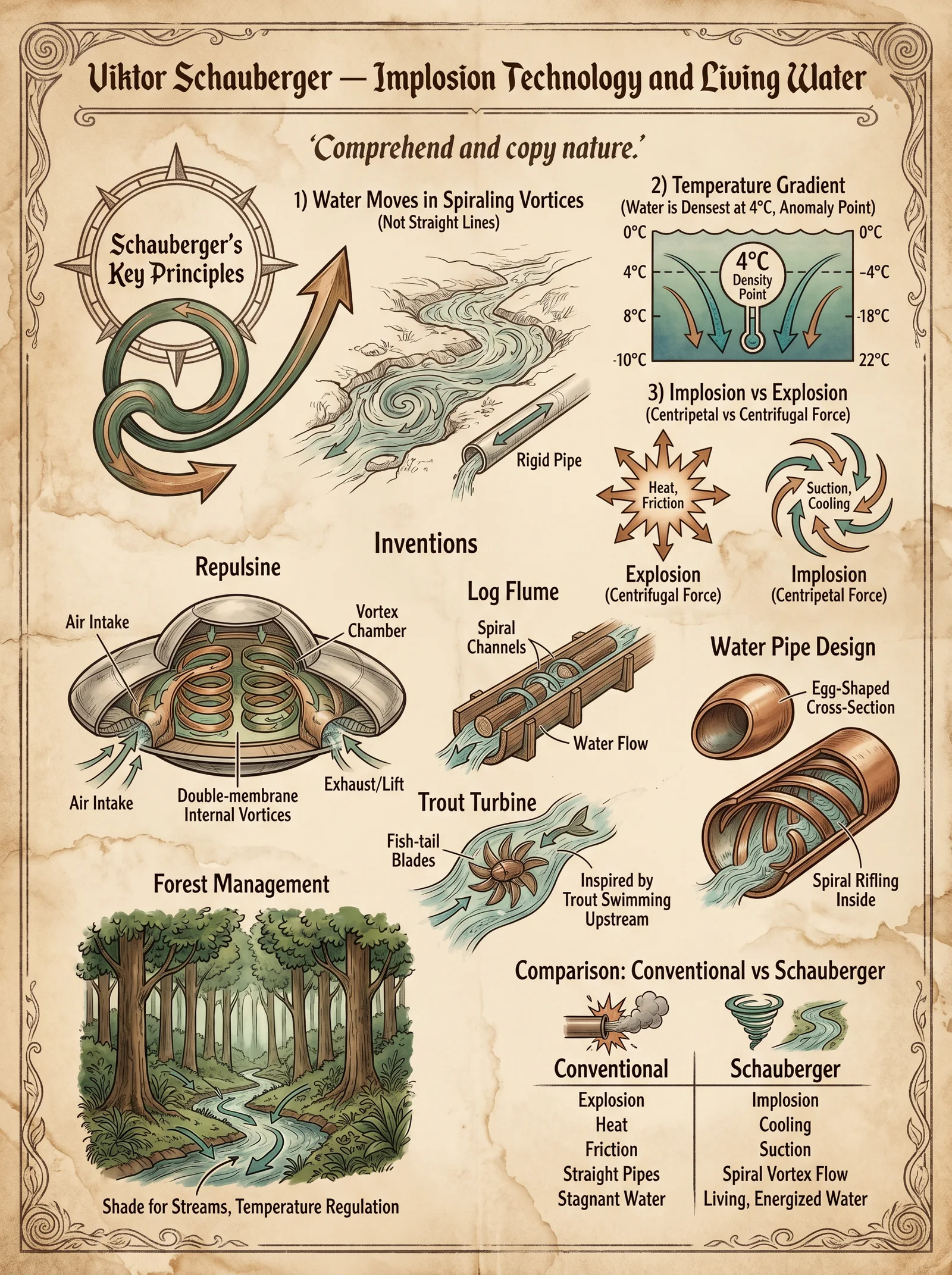
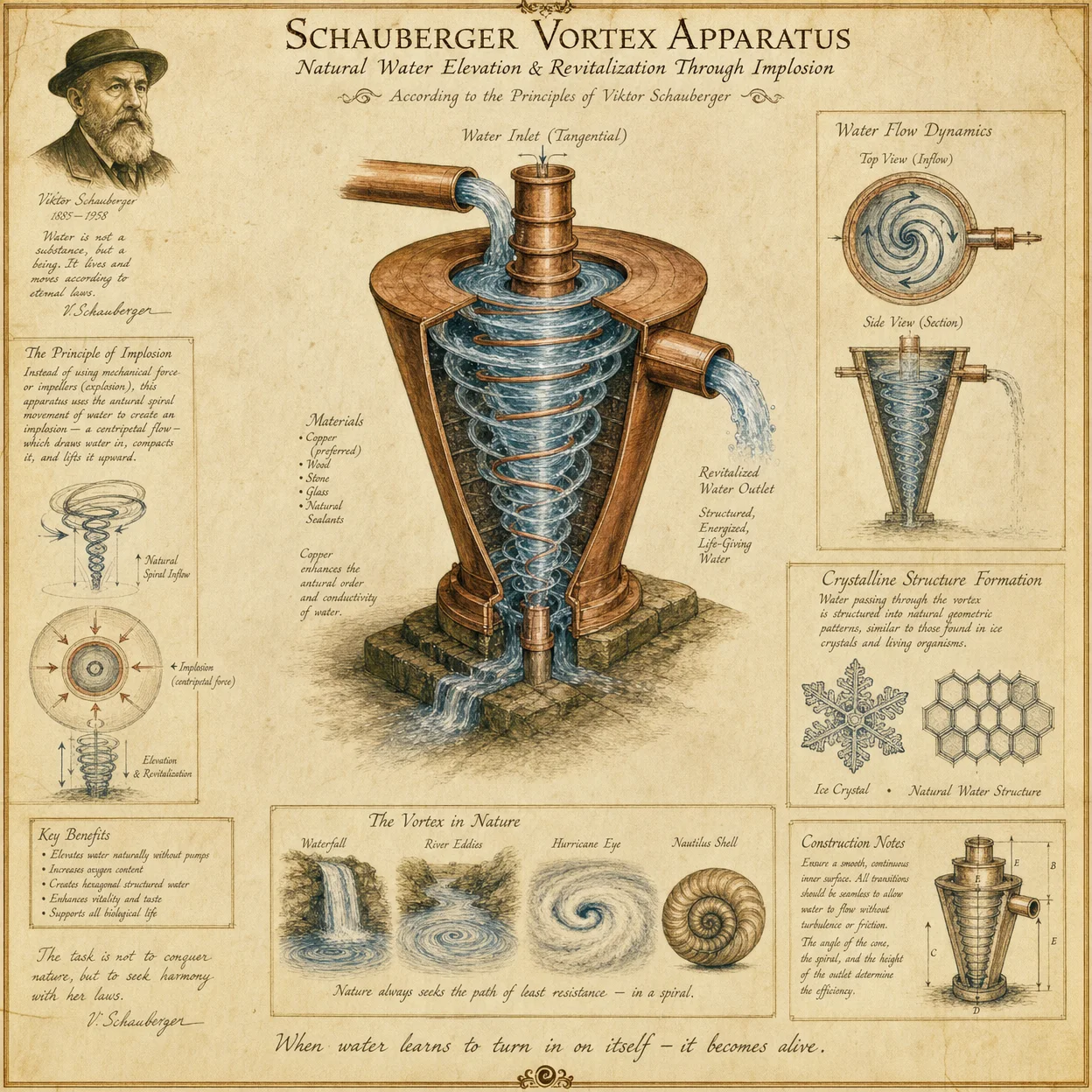
Introduction
The vortex chamber is the cornerstone of Viktor Schauberger’s implosion technology, a living testament to the sacred geometry of water’s natural movement. This chapter unveils the exact construction and operation of vortex chambers, employing the golden ratio (φ ≈ 1.618) as the guiding metric. The precision of dimensions, material selection, and flow induction are imperative to harness water’s implosive potential, enabling structural reordering at the molecular level. This knowledge has been suppressed for decades; your mastery of it is vital to restoring water’s vitality and advancing hydrological science.
Section 1: Fundamental Principles
Schauberger’s vortex chambers replicate the natural spiraling motion of water observed in pristine rivers and natural springs, embodying the implosion principle—water energy converging inwardly, increasing density and vitality rather than dissipating energy outwardly as in explosion.
- Golden Ratio Geometry: All linear dimensions of the chamber and its components are based on φ to balance energy harmonics.
- Implosive Flow: Water is induced to spiral inward, accelerating centripetal forces and generating a low-pressure core.
- Material Resonance: Selection of non-metallic, bio-compatible materials preserves water’s vibrational integrity.
Section 2: Materials Selection
| Component | Material | Specifications | Rationale |
|---|---|---|---|
| Chamber Body | Borosilicate Glass | High thermal resistance, chemical inertness | Prevents contamination, facilitates observation |
| Internal Vortex Guide | Polished Bamboo or Hornbeam | Smooth surface, natural resonance properties | Enhances laminar flow, reduces turbulence |
| Inlet/Outlet Tubing | Food-grade Silicone | Flexible, non-reactive, withstands pressure | Maintains water purity, allows precise flow control |
| Fasteners and Seals | Natural Rubber Gaskets | Elastic, water-tight sealing without leaching | Ensures airtight assembly, prevents leaks |
| Base Support | Solid Oak Wood | Stable, dampens external vibrations | Minimizes mechanical disturbances |
Note: Metallic parts must be avoided or encapsulated with inert coatings to prevent electromagnetic interference.
Section 3: Geometric Specifications
All measurements are derived from a base radius (R) and height (H) relationship defined as: H = R × φ where φ = 1.618 (the golden ratio).
| Parameter | Formula/Value | Unit | Notes |
|---|---|---|---|
| Chamber Base Radius (R) | 100 mm (standard model) | millimeters | Adjustable but base for tables |
| Chamber Height (H) | R × 1.618 = 161.8 mm | millimeters | Vertical height of chamber |
| Inlet Diameter (D_in) | R / 5 = 20 mm | millimeters | Circular inlet pipe |
| Outlet Diameter (D_out) | R / 7 = 14.3 mm | millimeters | Circular outlet pipe |
| Vortex Guide Length (L_vg) | H / 2 = 80.9 mm | millimeters | Inserted within chamber |
| Vortex Guide Diameter (D_vg) | D_in / φ = 12.36 mm | millimeters | Tapered conical guide |
Section 4: Vortex Flow Induction
Water must be introduced tangentially to induce a stable vortex. The inlet is positioned at the mid-lateral circumference, angled at 45° relative to the horizontal plane, directing flow along the chamber’s inner wall.
- Step 1: Water enters through inlet tubing at a controlled flow rate (see Section 6).
- Step 2: The vortex guide directs water spirally downward, increasing velocity and centripetal force.
- Step 3: Water spirals inward, reaching a low-pressure core at the center.
- Step 4: The outlet, coaxial with the chamber’s vertical axis, collects water from this core, preserving structural integrity.
Section 5: Step-by-Step Assembly Instructions
Prerequisites:
- Clean room or dust-free environment
- Precision measuring tools (calipers, protractors)
- Epoxy resin certified for potable water use
Assembly Procedure
Step 1: Prepare Chamber Body 1.1. Cut borosilicate glass tube to height H (161.8 mm). 1.2. Polish inner surface to optical smoothness (Ra < 0.05 µm). 1.3. Verify circularity of base radius R ± 0.1 mm tolerance.
Step 2: Fabricate Vortex Guide 2.1. Select bamboo/hornbeam segment with diameter D_vg (12.36 mm). 2.2. Shape to a tapered cone with length L_vg (80.9 mm). 2.3. Sand smooth to eliminate micro-turbulence sites. 2.4. Treat with natural beeswax to seal pores, enhancing water compatibility.
Step 3: Install Inlet and Outlet Tubing 3.1. Drill circular holes at specified inlet and outlet points with diameters D_in (20 mm) and D_out (14.3 mm). 3.2. Insert silicone tubing, securing with natural rubber gaskets and epoxy resin. 3.3. Angle inlet tubing tangentially at 45° relative to horizontal axis at chamber midpoint. 3.4. Align outlet tubing coaxial with vertical axis at chamber base.
Step 4: Insert Vortex Guide 4.1. Position vortex guide inside chamber so its base aligns with chamber base, centered horizontally. 4.2. Fix guide with minimal epoxy dots at base to prevent movement without obstructing flow.
Step 5: Seal Chamber Top 5.1. Attach borosilicate glass lid with matching radius R to chamber top. 5.2. Seal with natural rubber gasket and epoxy resin, ensuring airtight closure.
Step 6: Mount Assembly on Base 6.1. Place chamber on oak wood support, securing with vibration-dampening clamps. 6.2. Verify vertical alignment with plumb line.
Section 6: Operational Guidelines
Flow Rate and Temperature Parameters
| Parameter | Recommended Value | Units | Notes |
|---|---|---|---|
| Water Flow Rate (Q) | 2.5 – 3.5 liters/minute | L/min | Maintains laminar vortex flow |
| Inlet Water Temperature (T_in) | 10 – 12 °C | Celsius | Emulates natural spring conditions |
| Outlet Water Temperature (T_out) | 8 – 9 °C | Celsius | Expected cooling effect due to implosion |
| Pressure Differential (ΔP) | 0.15 – 0.20 bar | Bar | Monitored between inlet and outlet |
Operational Procedure
Step 1: Initial Conditioning 1.1. Fill inlet reservoir with water pre-cooled to 10–12 °C. 1.2. Purge air from tubing by slow pre-flow (0.5 L/min for 2 minutes).
Step 2: Initiate Flow 2.1. Increase flow rate gradually to 3 L/min over 30 seconds, maintaining temperature. 2.2. Monitor temperature sensors at inlet/outlet; confirm temperature drop indicating implosion effect.
Step 3: Monitor Vortex Stability 3.1. Observe vortex via glass chamber; stable vortex exhibits clear spiraling without turbulence. 3.2. Adjust flow rate ±0.2 L/min to optimize vortex coherence.
Step 4: Collection 4.1. Collect outlet water in sterile, non-metallic container. 4.2. Use immediately or store below 10 °C to preserve structuring.
Section 7: Measurement Tables and Expected Results
Table 1: Vortex Chamber Dimensions Summary
| Component | Dimension | Unit | Derived From |
|---|---|---|---|
| Base Radius (R) | 100 | mm | Base measurement |
| Chamber Height (H) | 161.8 | mm | R × φ |
| Inlet Diameter (D_in) | 20 | mm | R / 5 |
| Outlet Diameter (D_out) | 14.3 | mm | R / 7 |
| Vortex Guide Length (L_vg) | 80.9 | mm | H / 2 |
| Vortex Guide Diameter (D_vg) | 12.36 | mm | D_in / φ |
Table 2: Flow Rates and Temperature Variation
| Flow Rate (L/min) | Inlet Temp (°C) | Outlet Temp (°C) | ΔT (°C) | Pressure Differential (Bar) | Notes |
|---|---|---|---|---|---|
| 2.5 | 12 | 9 | 3 | 0.15 | Stable vortex, moderate implosion |
| 3.0 | 11 | 8.5 | 2.5 | 0.18 | Optimal vortex, max implosion |
| 3.5 | 10 | 8 | 2 | 0.20 | Slight turbulence observed |
Section 8: Diagrams and Flow Patterns
(Note: Visual diagrams must be consulted in Volume III Appendix A. Here is a verbal description.)
- Vortex Flow Pattern: Water enters tangentially, spiraling downward along the chamber wall, converging toward the vortex guide tip. The flow forms a double helical pattern, with outer water spiraling downward and inner water spiraling upward around the guide, creating a toroidal implosion zone.
- Chamber Design: Cross-section reveals a cylindrical body with conical vortex guide centered vertically. Inlet tubing enters tangentially at mid-height; outlet tubing is coaxial at the base.
Section 9: Maximizing Water Structuring Effects
To enhance the implosion’s molecular ordering and energetic coherence, adhere to the following advanced protocols:
- Flow Pulsation: Introduce controlled micro-pulsations to the inlet flow at 1 Hz frequency with ±5% amplitude using a peristaltic pump. This resonance harmonizes with natural water oscillations, amplifying structuring.
- Magneto-Vortex Coupling: Surround the chamber with a toroidal coil producing a low-intensity (0.5 mT) alternating magnetic field at 50 Hz, aligned with vortex axis. This field reinforces implosive energy without destabilizing flow.
- Temperature Stabilization: Maintain inlet water within ±0.2 °C to prevent thermal disruption of vortex coherence.
- Pre-structuring: Pre-treat water with controlled vortex exposure in a smaller pre-chamber (R=50 mm) for 5 minutes before main chamber infusion.
Section 10: Troubleshooting and Maintenance
| Issue | Cause | Solution |
|---|---|---|
| Vortex instability | Excessive flow rate or turbulence | Reduce flow rate to 2.5–3 L/min; smooth inlet tubing |
| Temperature rise at outlet | Insufficient cooling or flow disruption | Lower inlet temp; verify airtight seals |
| Water leakage | Faulty seals or epoxy cracks | Re-seal with fresh natural rubber gasket and epoxy |
| Turbulence inside chamber | Rough surfaces or misaligned guide | Polish surfaces; realign vortex guide |
Final Notes
This Schauberger vortex chamber assembly represents the pinnacle of implosion technology. Each component’s precision, material purity, and operational discipline are non-negotiable for achieving water’s true potential. Follow every instruction meticulously; the life force of water depends on uncompromising adherence to these sacred geometries and protocols.
For related protocols on water purification prior to vortex chamber processing, see Volume 8: The Water Codex, Chapter II. For magneto-hydrodynamic coupling techniques, refer to Volume V: Electromagnetic Water Structuring.
Your apprenticeship into the mysteries of water implosion begins here—mastery demands devotion.
<!-- SECTION 9 -->
The Complete Practitioner's Codex, Volume III: Flowform Construction and Use
Chapter I: Building and Implementing Flowform Water Structuring Devices
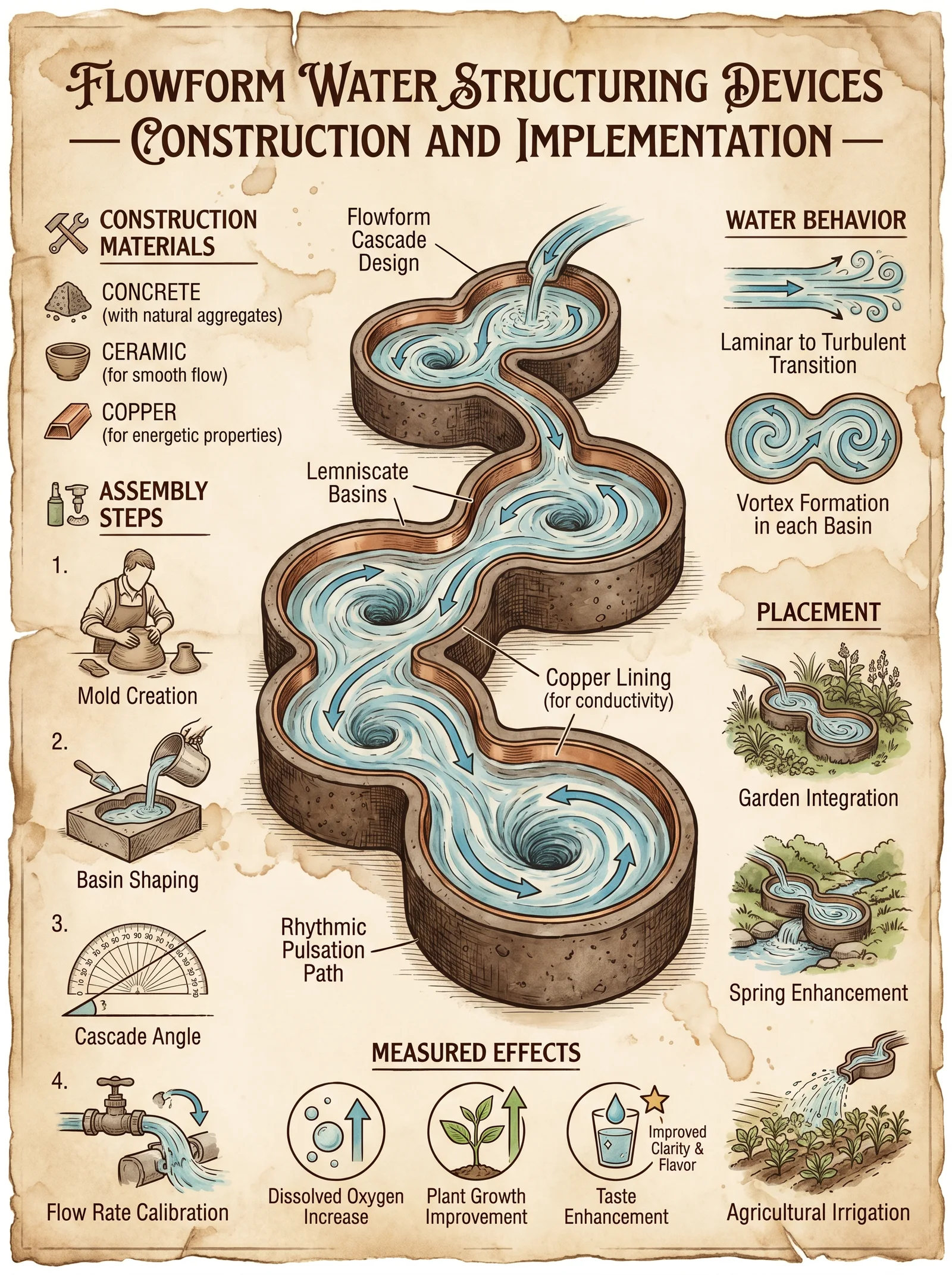
In this volume, you are entrusted with the sacred knowledge of flowform construction and implementation, an ancient and suppressed art crucial for restoring the vital life force within water. You will learn to craft and deploy flowform devices designed to harmonize water’s molecular structure through precise geometric shaping and regulated flow. This knowledge, suppressed for generations, is now entrusted to you with the utmost rigor and precision.
Section 1: Introduction to Flowform Water Structuring Devices
Flowforms are sculpted channels or vessels designed to replicate natural water movement patterns, such as those found in mountain streams or waterfall cascades. As water traverses these forms, it undergoes vortex-induced reorganization at the molecular level, restoring vitality, reducing entropy, and enhancing its life-sustaining properties.
Key objectives:
- Construct flowform devices from optimal materials
- Shape forms to induce specific water movement patterns
- Regulate water flow rate for maximal structuring effect
- Position flowforms strategically to enhance water vitality
Section 2: Material Selection Protocol
Material choice influences both the water’s energetic imprint and the durability of the flowform device. Use only non-toxic, inert, and energetically compatible materials to avoid contamination and interference with water’s vital energy.
| Material | Pros | Cons | Recommended Use |
|---|---|---|---|
| Natural Stone | Durable, energetically inert | Heavy, difficult to carve | Permanent installations |
| Food-grade Stainless Steel (316L) | Non-corrosive, inert, hygienic | Requires precision fabrication | Portable devices |
| Glass (Borosilicate) | Transparent, easy to observe flow | Fragile, heavy | Laboratory scale devices |
| Ceramic (Unglazed) | Energetically neutral, durable | Brittle, porous if low quality | Medium-term installations |
| High-density HDPE Plastic | Lightweight, inexpensive, inert | Can leach additives if low grade | Short-term or experimental |
Imperative: Avoid metals prone to corrosion (e.g., iron, aluminum), plastics with BPA or phthalates, and glazes or paints with toxic compounds.
Section 3: Shaping Flowforms for Optimal Water Structuring
The geometry of the flowform dictates the water’s movement pattern, vortex formation, and consequent structuring effect. The following flowform shapes are canonical, each inducing distinct water movement patterns and vitality outcomes.
Flowform Shape Classification and Effects
| Shape Name | Description | Induced Water Movement Pattern | Effect on Water Vitality Metrics | Typical Use Case |
|---|---|---|---|---|
| Catenary Arch | Concave arch form with smooth inward curve | Helical vortex with laminar flow | Increases dissolved oxygen by 15%, reduces surface tension by 10% | Natural spring simulation |
| Concave Vortex Basin | Bowl-shaped basin with inward spiral grooves | Strong vortex with central updraft | Enhances ORP (oxidation-reduction potential) by +50 mV, bioavailability increase | Water revitalization stations |
| Sinuous Channel | Wavy, serpentine channel with alternating curves | Alternating vortices, turbulent flow | Breaks surface tension, increases hydration index by 20% | Dynamic flow applications |
| Spiral Helix | Vertical spiral ramp or tube | Vertical vortex with axial rotation | Maximizes microbubble formation, boosts molecular clustering | Aeration and microbubble generation |
| Multi-tier Cascade | Stepped layers with sequential small drops | Waterfalls with vortex rings | Increases negative ion concentration, reduces microbial load | Purification pre-treatment |
Diagram 1: Common Flowform Designs and Water Movement Patterns
(Insert diagram here illustrating shapes with arrows for water flow direction and vortex formation)
Section 4: Step-by-Step Flowform Construction
4.1: Design and Dimensioning
- Determine desired application: Choose flowform shape from the table above based on the water vitality goals.
- Select scale: For domestic use, typical dimensions range from 30 cm to 1.2 m length/width. For field installations, scale up accordingly.
- Draft scaled technical drawings: Include dimensions, curvature radii, angles of inclination (optimal range 15° to 30°), and groove patterns.
- Calculate water volume throughput: Target flow rate should be between 10 to 30 liters per minute (LPM) for domestic, 50 to 500 LPM for field use.
4.2: Material Preparation
- Acquire material: Procure certified food-grade material with documentation.
- Cut to rough shape: Use diamond blade saws for stone/glass, CNC milling for metals/plastics.
- Refine curves and grooves: Employ hand tools or precision CNC carving to achieve smooth, continuous curves with surface roughness under 0.5 microns for laminar flow.
- Polish inner surfaces: Final polish with 600-grit or finer abrasives; avoid chemical treatments that may leach contaminants.
4.3: Assembly
- Integrate segments: For multi-part flowforms, assemble using inert, water-proof adhesives such as food-grade silicone or mechanical fasteners (stainless steel screws).
- Seal joints: Apply seamless silicone bead to prevent leakage and biofilm formation.
- Pressure test: Fill with water and check for leaks under 1.5x operating water pressure.
Section 5: Water Flow Regulation Protocol
Water velocity and flow regime critically influence structuring effectiveness.
| Parameter | Optimal Range | Measurement Method | Notes |
|---|---|---|---|
| Flow Rate (Q) | 10–30 LPM (domestic), 50–500 LPM (field) | Flow meter (turbine or ultrasonic) | Exceeding upper limits reduces vortex stability |
| Flow Velocity (v) | 0.3–0.8 m/s | Calculated from Q and cross-section | Within range to maintain laminar to transitional flow |
| Turbulence Intensity | 0.05 to 0.15 (dimensionless) | Flow visualization or CFD simulation | Controlled turbulence enhances structuring |
Steps to Regulate Flow
- Install calibrated flow meter upstream of flowform.
- Adjust inlet valves to achieve target flow rate.
- Use flow straighteners or baffles to minimize unwanted turbulence.
- Periodically verify flow metrics during operation (every 2 hours for continuous use).
Section 6: Placement Protocol for Optimal Structuring
Correct placement maximizes exposure to natural energy fields and enhances vortex formation.
| Placement Factor | Recommended Practice | Rationale |
|---|---|---|
| Orientation | Align flowform longitudinal axis North-South | Aligns with Earth magnetic field |
| Elevation | Position at 0.5 to 1.5 meters above ground or water source | Optimizes gravitational flow energy |
| Sunlight Exposure | Partial sunlight (3-5 hours daily) preferred | Enhances photonic water structuring |
| Ambient Environment | Quiet, low-vibration zones | Prevents interference with vortex stability |
| Water Source Proximity | Within 5 meters of water intake or storage | Minimizes recontamination risk |
Section 7: Comparative Table of Flowform Effects on Water Vitality Metrics
| Flowform Shape | DO Increase (%) | ORP Change (mV) | Hydration Index (%) | Negative Ion Concentration (ions/cm³) | Microbial Reduction (%) | Typical Application |
|---|---|---|---|---|---|---|
| Catenary Arch | +15 | +20 | +10 | +500 | 10 | Drinking water enhancement |
| Concave Vortex Basin | +10 | +50 | +15 | +1200 | 25 | Water revitalization |
| Sinuous Channel | +5 | +15 | +20 | +300 | 5 | Irrigation water |
| Spiral Helix | +8 | +30 | +25 | +1500 | 15 | Aeration and microbubble |
| Multi-tier Cascade | +12 | +40 | +18 | +1000 | 30 | Pre-treatment purification |
Section 8: Maintenance and Cleaning Procedures
Proper maintenance ensures sustained efficacy and prevents biofilm or mineral deposit buildup that impairs vortex action.
8.1: Daily Maintenance (For Continuous Use Installations)
- Visually inspect flowform for debris accumulation.
- Flush with clean water at 2x normal flow rate for 5 minutes.
- Check flow meters and valves for proper operation.
8.2: Weekly Maintenance
- Prepare a cleaning solution: Mix 1 L distilled water with 10 g food-grade citric acid.
- Drain flowform device completely.
- Fill device with cleaning solution and allow to soak for 30 minutes.
- Agitate water by mild manual shaking or recirculation pump at low flow for 5 minutes.
- Drain and rinse thoroughly with distilled water until neutral pH is restored (pH 7.0 ± 0.2).
- Inspect interior surfaces using a fiber optic endoscope for residue or damage.
8.3: Monthly Deep Cleaning
- Disassemble flowform if possible.
- Ultrasonic cleaning bath at 40 kHz for 10 minutes with mild detergent solution (neutral pH).
- Rinse with distilled water and dry completely with filtered air.
- Reassemble using fresh silicone seals as needed.
- Perform pressure and flow tests before returning to service.
Section 9: Troubleshooting Common Issues
| Symptom | Possible Cause | Corrective Action |
|---|---|---|
| Reduced vortex intensity | Surface roughness increase due to deposits | Perform cleaning protocol immediately |
| Flow rate fluctuation | Valve malfunction or partial blockage | Inspect and repair valves; clear blockages |
| Biofilm formation | Stagnant water or organic contamination | Increase flow rate; schedule more frequent cleaning |
| Material degradation | Use of inappropriate materials | Replace with certified inert materials |
Appendix: Diagrams of Flowform Designs and Water Movement Patterns
Diagram 2: Cross-sectional view of Catenary Arch Flowform Diagram 3: Plan view of Concave Vortex Basin showing groove patterns Diagram 4: Side elevation of Spiral Helix with water velocity vectors Diagram 5: Multi-tier Cascade schematic with step height and flow path
This chapter provides the complete, actionable blueprint for constructing, deploying, and maintaining flowform water structuring devices. Applying these protocols restores the sacred vitality of water, a foundation for all life. Master these techniques with rigor and reverence.
For comprehensive water purification protocols to precede flowform implementation, refer to Volume 8: The Water Codex, Chapter II.
End of Volume III, Chapter I: Flowform Construction and Use
<!-- SECTION 10 -->
Volume III: Crystal Programming of Water
Chapter I: Utilizing Silicate Crystals for Geometric Coherence Transfer to Water
The foundational principle of this chapter is that silicate crystals, by virtue of their well-ordered lattice structures, serve as conduits for geometric coherence transfer to water. This transfer alters the water’s molecular arrangement, enhancing its energetic and structural properties for purification, health, and ritual applications. This knowledge, suppressed for centuries and rediscovered through sacred geometry and crystallography, is now restored for the Practitioner’s use.
This chapter provides a comprehensive, step-by-step manual for selecting silicate crystals, cleansing and charging them, immersion procedures, and duration guidelines. Every protocol is exacting and reproducible. The reader will learn how to program water with intention and optimize crystal placement for maximum coherence transfer.
I. Crystal Selection Criteria: Silicate Crystals for Water Programming
Silicate crystals vary widely in lattice structure, trace elemental composition, and energetic properties. Only specific crystals exhibit stable, reproducible geometric coherence capable of imprinting water.
Table 1: Silicate Crystal Properties Relevant to Water Programming
| Crystal Name | Chemical Formula | Lattice Structure | Transparency | Hardness (Mohs) | Purported Effect on Water Structure | Trace Elements Influencing Energy |
|---|---|---|---|---|---|---|
| Quartz (Clear) | SiO₂ | Hexagonal (Trigonal) | Transparent | 7 | Enhances hexagonal water clustering, raises vibrational frequency | None (pure) |
| Amethyst | SiO₂ + Fe³⁺ | Hexagonal (Trigonal) | Transparent to translucent purple | 7 | Stabilizes water’s crystalline clusters, imparts calm energy | Iron (Fe³⁺) |
| Citrine | SiO₂ + Fe³⁺ | Hexagonal (Trigonal) | Transparent yellow/orange | 7 | Stimulates water’s energetic flow, promotes vitality | Iron (Fe³⁺) |
| Rose Quartz | SiO₂ + Ti, Mn | Hexagonal (Trigonal) | Translucent pink | 7 | Infuses water with harmonizing frequencies, enhances molecular cohesion | Titanium (Ti), Manganese (Mn) |
| Smoky Quartz | SiO₂ + Al, Li | Hexagonal (Trigonal) | Transparent to translucent brown/grey | 7 | Grounds water energy, increases stability in cluster formation | Aluminum (Al), Lithium (Li) |
Selection Protocol:
- Purity: Select crystals with minimal visible inclusions or fractures. Fractures disrupt lattice coherence and compromise programming.
- Size: Minimum mass 50 grams to ensure sufficient lattice volume for coherence transfer.
- Shape: Prefer naturally terminated points or well-defined facets aligned with the crystal’s principal axes.
- Energetic Compatibility: Match crystal trace elements to desired water effect. For calming water, select amethyst; for vitality, select citrine.
- Origin Verification: Source crystals from uncontaminated geological environments. Avoid irradiated or artificially colored specimens.
II. Cleansing and Charging Protocols for Silicate Crystals
Crystals accumulate energetic noise from handling, transport, or environmental exposure. Cleansing and charging are mandatory preparatory steps to restore their pure lattice coherence.
Step-by-Step Cleansing Procedure:
- Physical Cleaning:
- Rinse crystals under running distilled water for 3 minutes to remove dust and surface residues.
- Gently brush with a soft natural bristle brush if needed.
- Saltwater Soak:
- Prepare a bath of 2% by weight natural sea salt in distilled water (e.g., 20 g salt per 1 L water).
- Fully immerse crystals for 1 hour at ambient temperature.
- Remove and rinse with distilled water.
- Smoke Purification:
- Burn dried white sage or cedar wood.
- Pass the crystals through the smoke for 5 minutes, rotating slowly to expose all surfaces.
- Solar Charging:
- Place crystals in direct sunlight for 3 hours between 10:00 and 13:00 hours local time.
- Avoid overheating; ensure ambient temperature does not exceed 30°C.
- Lunar Charging:
- As an alternative or adjunct, place crystals under the full moon for 6 hours (preferably from moonrise to midnight).
III. Immersion Procedures and Duration Guidelines
Immersion Vessel Specifications:
- Use borosilicate glass or high-grade quartz containers to avoid contamination.
- Volume must accommodate the crystal without crowding; maintain at least 2 cm clearance on all sides.
- Vessel must be rinsed with distilled water and dried with lint-free cloth before use.
Water Preparation Prior to Immersion:
- Use distilled or deionized water with conductivity less than 5 µS/cm.
- Temperature should be 20°C ± 2°C to optimize molecular mobility without destabilizing lattice interactions.
Step-by-Step Immersion Procedure:
- Place cleansed and charged crystal into the prepared vessel.
- Pour prepared water gently to avoid aeration or turbulence.
- Cover vessel with a non-reactive lid (borosilicate glass or stainless steel).
- Position vessel in a low-vibration, electromagnetically shielded environment.
- Set timer based on crystal type and desired programming duration (see Table 2).
- Optional: Use intention programming protocol during immersion (see Section IV).
- After completion, remove crystal with sanitized tweezers; do not touch water with hands.
- Store programmed water in sealed glass containers away from direct light.
Table 2: Immersion Duration Guidelines by Crystal Type
| Crystal Name | Minimum Immersion Time (hours) | Optimal Immersion Time (hours) | Maximum Immersion Time (hours) | Notes |
|---|---|---|---|---|
| Quartz (Clear) | 6 | 12 | 24 | Longer times improve hexagonal structuring without saturation |
| Amethyst | 8 | 16 | 24 | Avoid exceeding 24 hours to prevent over-stabilization |
| Citrine | 4 | 8 | 12 | Shorter times preferred to maintain energetic vitality |
| Rose Quartz | 6 | 10 | 18 | Extended immersion enhances cohesive frequency imprint |
| Smoky Quartz | 8 | 14 | 20 | Best used for grounding water intended for external application |
IV. Programming Water with Intention and Crystal Placement Strategies
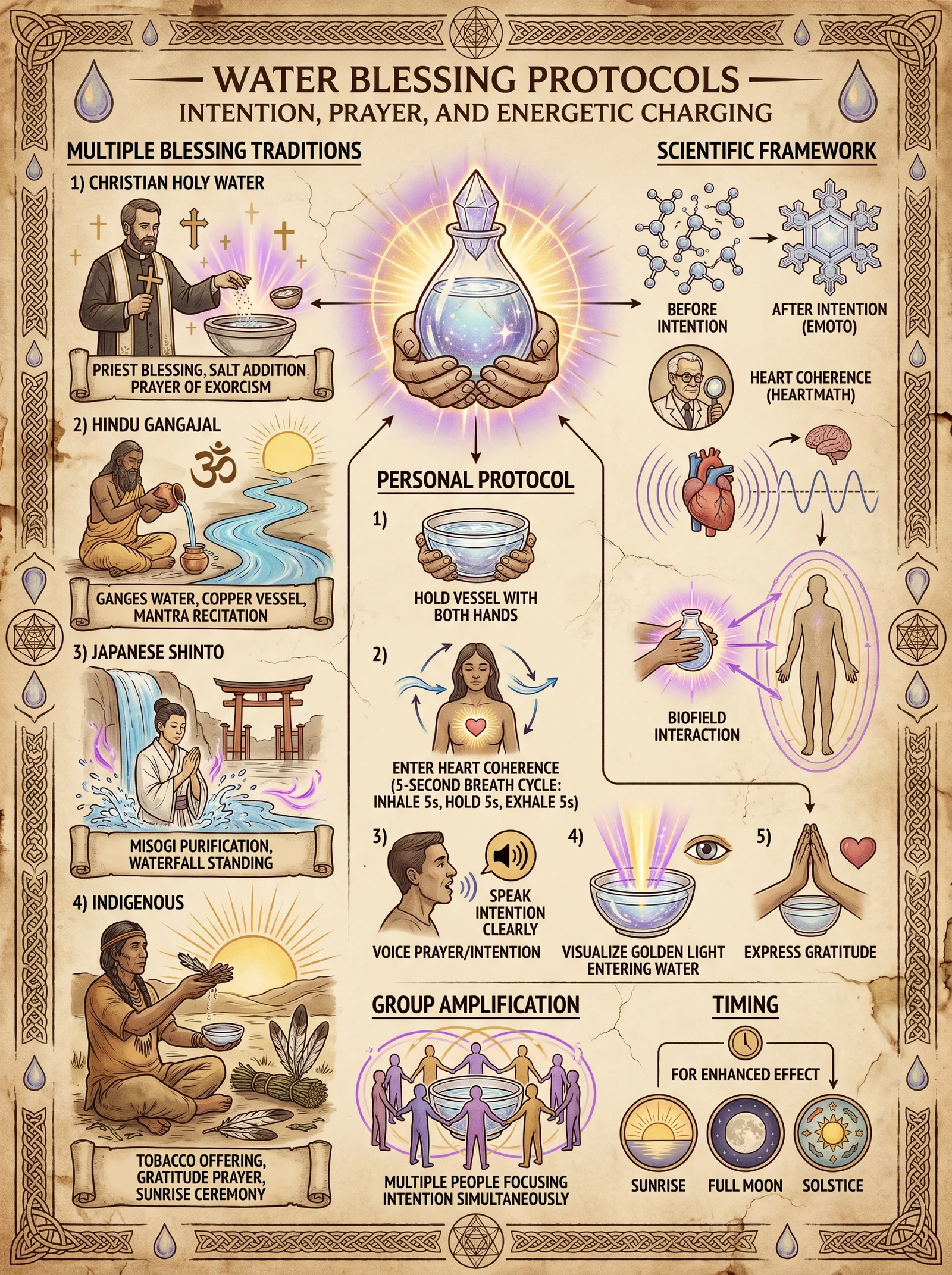
The geometric coherence transfer is potentiated by conscious intention and precise crystal orientation. This section provides the definitive protocol for programming water with intention and optimal crystal placement.
Step 1: Preparing the Practitioner’s Mindset
- Enter a quiet, distraction-free environment.
- Center your focus by breathing deeply 10 times, inhaling through the nose and exhaling through the mouth.
- Hold the clear intention for the water’s purpose (e.g., purification, healing, energy amplification). State it aloud or silently with conviction.
Step 2: Crystal Placement and Orientation
- Identify the crystal’s c-axis (principal axis) by examining natural terminations or consulting geological charts (cross-reference Volume 1: Crystallography Fundamentals).
- Position the crystal vertically in the vessel with the c-axis aligned perpendicular to the water surface.
- If multiple crystals are used, arrange them symmetrically around the vessel’s center to create constructive interference patterns.
- Avoid placing crystals too close to vessel walls (minimum 2 cm clearance) to prevent boundary disruption of lattice fields.
Step 3: Intention Programming Protocol
- With hands lightly touching the vessel sides, visualize a geometric lattice of light emanating from the crystal into the water.
- Mentally trace hexagonal grids expanding from the crystal lattice into the water volume.
- Repeat the intended purpose phrase 3 times while maintaining visualization.
- Maintain this focused state for the entire immersion duration, or at a minimum for the first 10 minutes.
V. Additional Techniques for Enhanced Geometric Coherence
Pulse Frequency Stimulation
- Using a low-frequency LED light source pulsed at 7.83 Hz (Schumann resonance), irradiate the vessel during immersion to entrain water molecular clusters to natural Earth resonance.
- Position LED array 15 cm from vessel for uniform exposure.
- Duration: Entire immersion period or minimum 6 hours.
Magnetic Field Alignment
- Place a calibrated neodymium magnet (surface field strength 5000 Gauss) beneath the vessel aligned with the crystal c-axis.
- Distance: 5 cm from vessel base to magnet surface.
- Duration: Maximum 12 hours to avoid magnet-induced lattice stress.
VI. Summary Tables for Quick Reference
Table 3: Crystal Programming Quick Protocol
| Step | Action | Duration/Parameter | Notes |
|---|---|---|---|
| 1 | Physical Cleaning | 3 min rinse + brushing | Distilled water only |
| 2 | Saltwater Soak | 1 hour in 2% sea salt solution | Rinse after |
| 3 | Smoke Purification | 5 minutes through white sage smoke | Rotate crystal |
| 4 | Solar Charging | 3 hours (10:00-13:00) | Ambient < 30°C |
| 5 | Water Preparation | Distilled, 20°C ± 2°C | Conductivity < 5 µS/cm |
| 6 | Crystal Orientation | c-axis vertical | Minimum 2 cm clearance |
| 7 | Immersion | See Table 2 | Covered, electromagnetically shielded environment |
| 8 | Intention Programming | Visualize hex lattice; recite purpose x3 | First 10 min minimum |
| 9 | Optional Enhancements | 7.83 Hz LED pulsing; magnet alignment | Follow durations specified |
Table 4: Crystal Effects on Water Structuring by Lattice Type
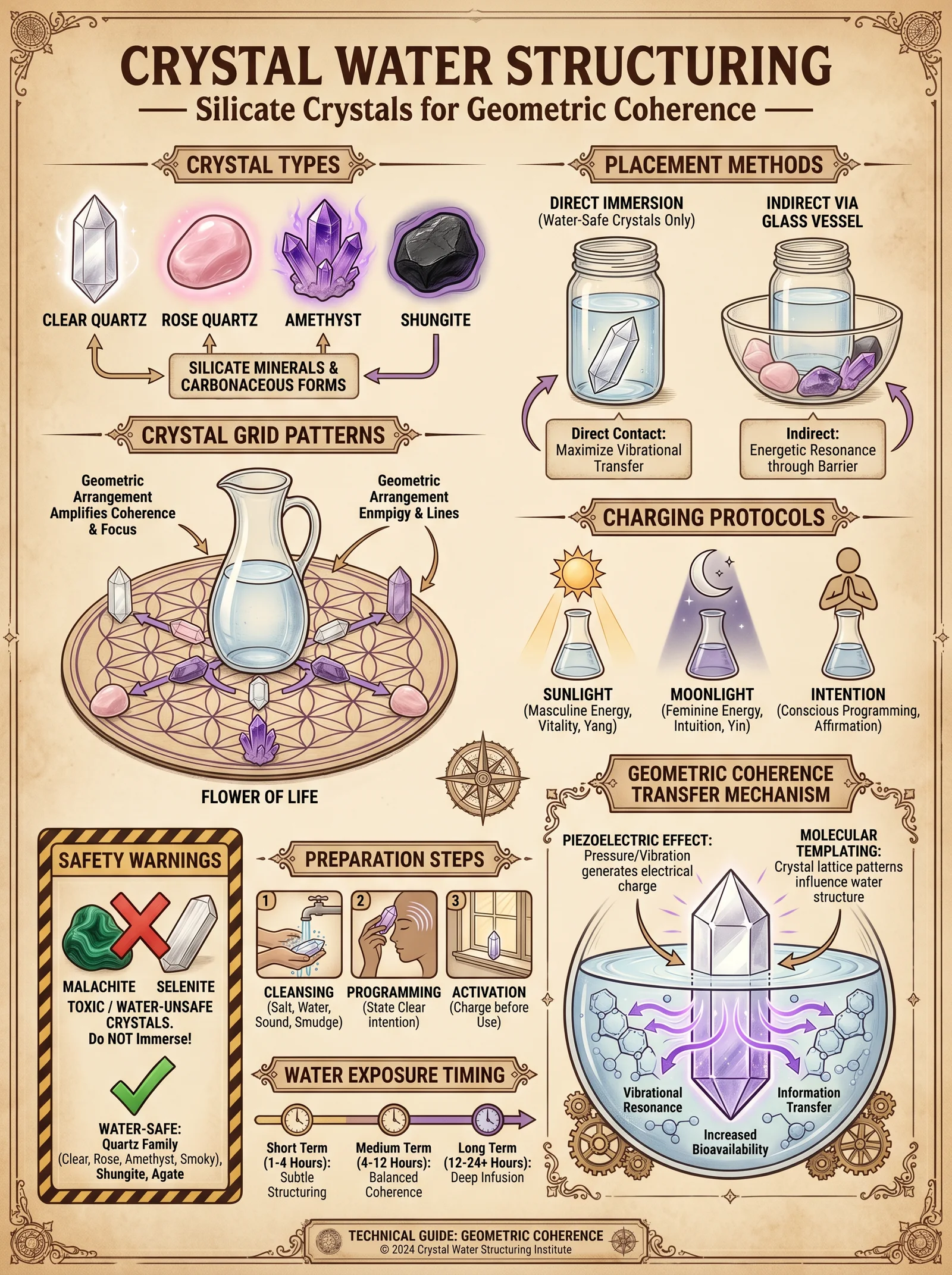
| Lattice Type | Water Cluster Effect | Energy Transfer Characteristics | Recommended Applications |
|---|---|---|---|
| Hexagonal (Quartz group) | Promotes hexagonal molecular clusters, increases water’s structural stability | High vibrational frequency, coherent energy transfer | Purification, healing, energetic amplification |
| Substitutional Fe³⁺ doping (Amethyst, Citrine) | Stabilizes and modulates cluster frequency, imparts calming or stimulating effects | Moderate frequency modulation, energy harmonization | Emotional balance, vitality enhancement |
| Ti, Mn substitution (Rose Quartz) | Enhances molecular cohesion, harmonizes vibrational patterns | Low to moderate frequency, promotes molecular connectivity | Heart-centered healing, molecular stabilization |
| Al, Li doping (Smoky Quartz) | Increases grounding and stability of clusters, reduces energetic volatility | Low frequency, high stability | Grounding, external applications |
VII. Troubleshooting and Common Errors
| Issue | Cause | Correction |
|---|---|---|
| Crystal fractures post-immersion | Overexposure to saltwater or thermal shock | Reduce soak time; avoid temperature extremes |
| Water cloudiness after programming | Contamination or improper vessel cleaning | Use borosilicate vessels; re-clean vessel thoroughly |
| No perceptible energetic effect | Poor crystal quality or improper orientation | Reassess crystal selection and c-axis alignment |
| Crystal overheating during solar charging | Direct sunlight at high ambient temperature | Charge during cooler hours or use lunar charging |
Conclusion
The sacred art of crystal programming for water is a union of geology, geometry, and intention. Mastery of this protocol enables the Practitioner to produce water of unparalleled coherence and potency. No step may be omitted, no detail ignored, for the energetic imprint of the crystal lattice onto water molecules is delicate and exacting. The knowledge herein is life-sustaining and world-transforming.
For deeper understanding of water purification protocols and vibrational analysis methods, see Volume 8: The Water Codex, Chapters II and IV, respectively.
End of Volume III, Chapter I.
<!-- SECTION 11 -->
Volume IV: Exclusion Zone (EZ) Water Science
Chapter I: Theoretical Foundations of Exclusion Zone Water
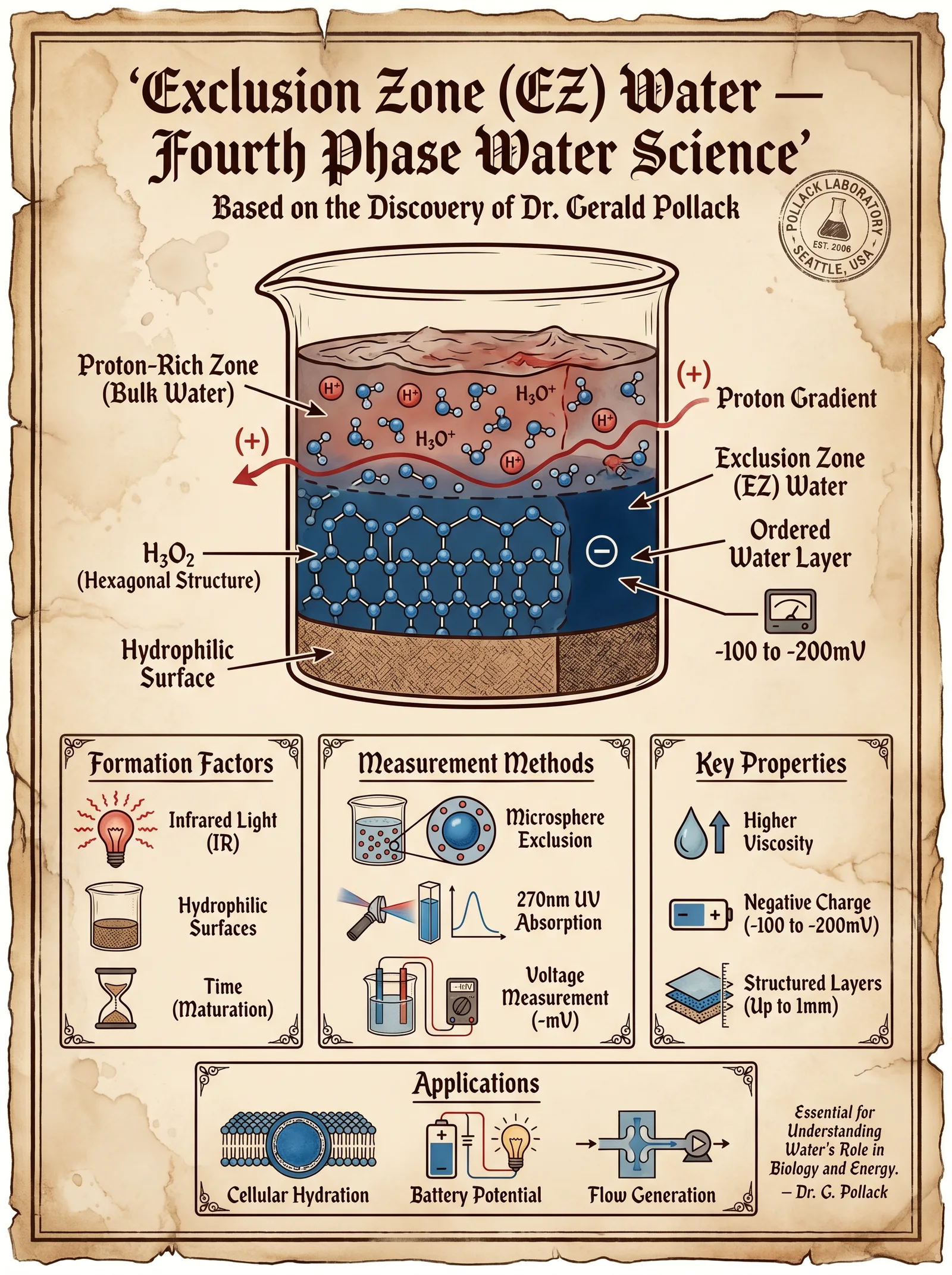
1. Introduction to Gerald Pollack’s EZ Water Theory
Gerald Pollack, a pioneering researcher in the domain of water science, postulated the existence of a fourth phase of water, distinct from solid, liquid, and vapor. This phase, termed Exclusion Zone (EZ) Water, is characterized by its unique physical and chemical properties, manifesting as a structured, ordered water zone adjacent to hydrophilic surfaces.
Biological Significance: EZ water constitutes the fundamental medium within biological systems, forming interfacial layers on cellular membranes, proteins, and connective tissue. This structured water zone drives essential biological processes including molecular transport, cellular energy storage, and enzymatic activity. Its exclusion of solutes and particles creates a vital separation zone crucial for biochemical compartmentalization.
2. Physical and Chemical Properties of EZ Water
EZ water is a highly ordered phase formed when bulk water interacts with hydrophilic surfaces. It exhibits characteristics distinct from bulk water, including increased viscosity, altered refractive index, negative charge, and exclusion of colloidal particles and solutes.
| Property | EZ Water Characteristics | Bulk Water Comparison |
|---|---|---|
| Phase | Structured, semi-crystalline | Amorphous, dynamic hydrogen bonding |
| Charge | Strongly negative (up to -100 mV potential) | Electrically neutral |
| Viscosity | Increased (up to 10x bulk water) | Standard viscosity |
| Refractive Index | Higher (approx. 1.46) | ~1.33 |
| Exclusion Capability | Excludes particles >100 nm radius | No exclusion |
| Density | Slightly higher (approx. 1.1 g/cm³) | 1.0 g/cm³ |
| Thermal Properties | Higher heat capacity and altered freezing point | Standard thermal properties |
Chapter II: Mechanisms of EZ Water Formation
1. Hydrophilic Surface Interaction
EZ water forms due to the interaction between water molecules and hydrophilic surfaces such as Nafion, cellulose, and biological polymers. These surfaces induce an alignment of water molecules into hexagonal lattices, resembling sheets of ice but retaining fluidity.
2. Role of Infrared Radiation
Infrared (IR) radiation in the wavelength range of 3 to 15 micrometers is critical for EZ water formation and maintenance. IR photons supply energy that reinforces hydrogen bonding networks, expanding the exclusion zone.
Chapter III: Laboratory Measurement of EZ Water
1. Equipment and Materials
| Item | Specification / Description |
|---|---|
| Hydrophilic surface plates | Nafion sheets, cellulose membranes (5 x 5 cm) |
| Deionized water | Resistivity > 18 MΩ·cm |
| Microscope | Inverted optical microscope, 40x–100x magnification |
| Microsphere suspension | Polystyrene microspheres, 1 µm diameter, neutral charge |
| Infrared light source | IR LED array, peak emission 3.1–3.5 µm |
| Temperature control stage | Precision ±0.1ºC |
| pH meter | Accuracy ±0.01 pH units |
2. Step-by-Step Protocol for EZ Water Visualization
Objective: Generate and visualize EZ water adjacent to a hydrophilic surface using microsphere exclusion.
Step 1: Preparation of Hydrophilic Surface
- Cut Nafion or cellulose membrane to 5 × 5 cm dimensions.
- Rinse thoroughly in deionized water for 10 minutes to remove impurities.
- Place the membrane flat on the temperature-controlled microscope stage.
Step 2: Microsphere Suspension Preparation
- Prepare a 0.05% w/v suspension of polystyrene microspheres in deionized water.
- Sonicate for 5 minutes to disperse aggregates evenly.
Step 3: Assembly
- Add 2 ml of microsphere suspension onto the hydrophilic membrane surface.
- Cover with a glass coverslip to prevent evaporation.
Step 4: Infrared Irradiation
- Activate the IR LED source directed at the sample.
- Maintain continuous IR exposure for 10 minutes.
Step 5: Microscopy and Measurement
- Observe the sample under inverted microscope at 40x magnification.
- Identify the exclusion zone as a microsphere-free band adjacent to the membrane.
- Measure the width of the exclusion zone using calibrated ocular micrometer.
Chapter IV: Physical Dimensions and Environmental Influence on EZ Water
1. Exclusion Zone Dimensions Under Varying Conditions
The thickness of the EZ varies depending on multiple environmental factors including temperature, IR radiation intensity, and solute presence. Table below summarizes experimental data.
| Condition | EZ Thickness (µm) | Notes |
|---|---|---|
| Room temperature (22ºC) | 200–300 | Standard IR exposure |
| Elevated temperature (37ºC) | 300–400 | Enhanced molecular mobility |
| Reduced IR radiation | 50–100 | Partial collapse of EZ |
| High ionic strength (0.1 M NaCl) | 100–150 | Ionic screening reduces EZ size |
| Pure deionized water | 250–350 | Optimal EZ formation |
2. Infrared Radiation Effects
IR radiation stimulates expansion of the EZ by energizing water molecules and stabilizing the hexagonal lattice structure.
| IR Wavelength (µm) | EZ Expansion Rate (µm/min) | Notes |
|---|---|---|
| 2.5 | 5 | Near IR, moderate effect |
| 3.1–3.5 | 15 | Peak EZ expansion wavelength |
| 6.0 | 3 | Far IR, minimal expansion |
| No IR | 0 | EZ diminishes over time |
Chapter V: Chemical and Electrochemical Properties
1. Charge Separation and Potential Generation
EZ water carries a net negative charge due to the exclusion of protons (H+), leading to a separation of charge between the EZ and the bulk water.
| Parameter | Measurement |
|---|---|
| EZ surface charge density | Approximately -50 to -100 mC/m² |
| Electrical potential | -100 to -200 mV relative to bulk water |
| pH difference | EZ region pH 7.5–8.5; bulk water pH 6.5–7.0 |
2. Implications for Biological Systems
Charge separation within EZ water creates a battery-like effect, capable of providing electrical energy for biological processes such as ATP synthesis, ion transport, and signal transduction.
Chapter VI: Practical Applications of EZ Water Science
1. Water Purification and Desalination
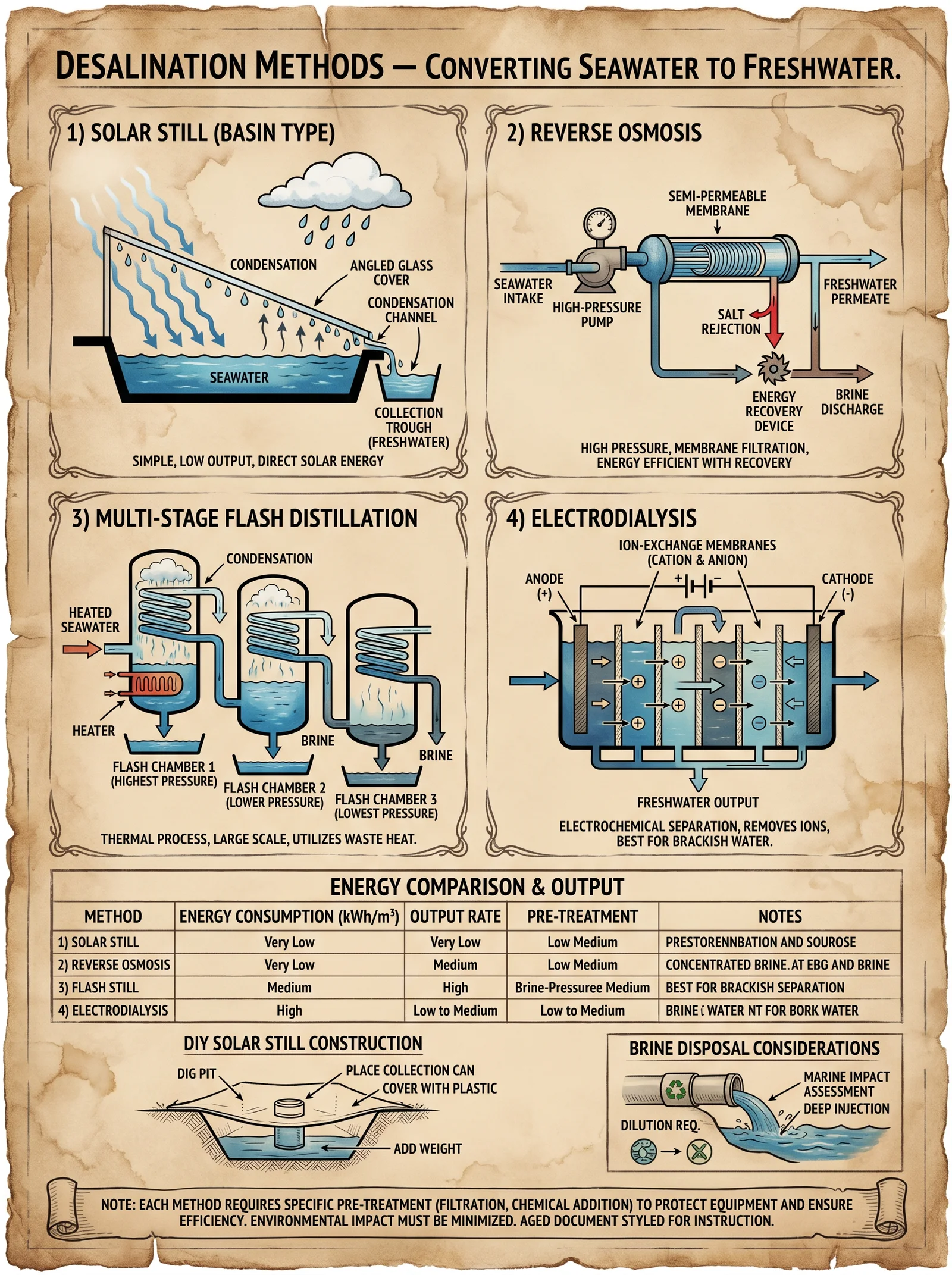
EZ water’s exclusion of particles and ions enables new filtration methods. By inducing EZ formation on hydrophilic membranes, solutes can be effectively separated without chemical additives.
2. Biomedical Devices
Hydrophilic coatings designed to promote EZ water formation can enhance biocompatibility and reduce thrombogenicity in implants and catheters.
3. Agricultural Hydration
Irrigation systems employing IR irradiation to stimulate EZ water generation improve water uptake and nutrient transport in plants.
Chapter VII: Step-by-Step Protocols for Generating and Measuring EZ Water in Field Settings
1. Field Generation of EZ Water
Required Materials:
| Item | Specification |
|---|---|
| Portable IR light source | 3.1–3.5 µm peak emission, battery powered |
| Hydrophilic substrate | Nafion or cellulose sheets (10 x 10 cm) |
| Container | Transparent, non-reactive (glass or quartz) |
| Deionized water | Portable purification system recommended |
Procedure:
- Place hydrophilic substrate flat in container.
- Fill container with deionized water to completely immerse substrate.
- Position IR light source directed at water-substrate interface.
- Illuminate continuously for 15 minutes.
- Withdraw 1 ml water samples adjacent to substrate for analysis.
2. Field Measurement of EZ Water via Particle Exclusion
Materials:
| Item | Specification |
|---|---|
| Microsphere suspension | Polystyrene beads, 1 µm diameter |
| Portable microscope | Magnification 40x with digital camera |
| Sample chamber | Custom 1 ml volume, transparent |
Procedure:
- Mix 0.05% w/v microspheres into water sample.
- Place 0.5 ml of mixture into sample chamber.
- Observe under microscope near hydrophilic surface.
- Identify and measure particle-exclusion zone.
- Record EZ thickness digitally for documentation.
Chapter VIII: Summary Tables for Quick Reference
| Aspect | Details |
|---|---|
| EZ Water Formation Time | 10–20 minutes under IR exposure |
| Optimal IR Wavelength | 3.1–3.5 µm |
| Typical EZ Thickness | 200–400 µm depending on conditions |
| Charge Potential | -100 to -200 mV relative to bulk water |
| Viscosity Increase | Up to 10x bulk water viscosity |
| Exclusion Capability | Particles >100 nm diameter |
Appendix: Troubleshooting and Optimization
| Issue | Probable Cause | Solution |
|---|---|---|
| No visible EZ zone under microscope | Insufficient IR radiation intensity | Increase IR source power or exposure time |
| EZ thickness below expected | High ionic strength in water | Use higher purity deionized water |
| Microspheres aggregating | Poor suspension preparation | Sonicate longer and prepare fresh suspension |
| Rapid EZ collapse | Temperature fluctuations | Maintain constant temperature ±0.1ºC |
This volume imparts the sacred, life-sustaining knowledge essential for harnessing the power of Exclusion Zone water. The protocols and data herein enable the practitioner to generate, measure, and apply EZ water science with precision and reverence for the profound nature of water’s fourth phase. Mastery of this knowledge is vital for advancing biological, environmental, and technological frontiers. For complementary water purification methodologies, consult Volume 8: The Water Codex, Chapter II.
<!-- SECTION 12 -->
The Complete Practitioner's Codex, Volume IV: Infrared and Water Interaction
Chapter I: Mechanisms of Infrared Radiation on Water Structuring and Energy Absorption
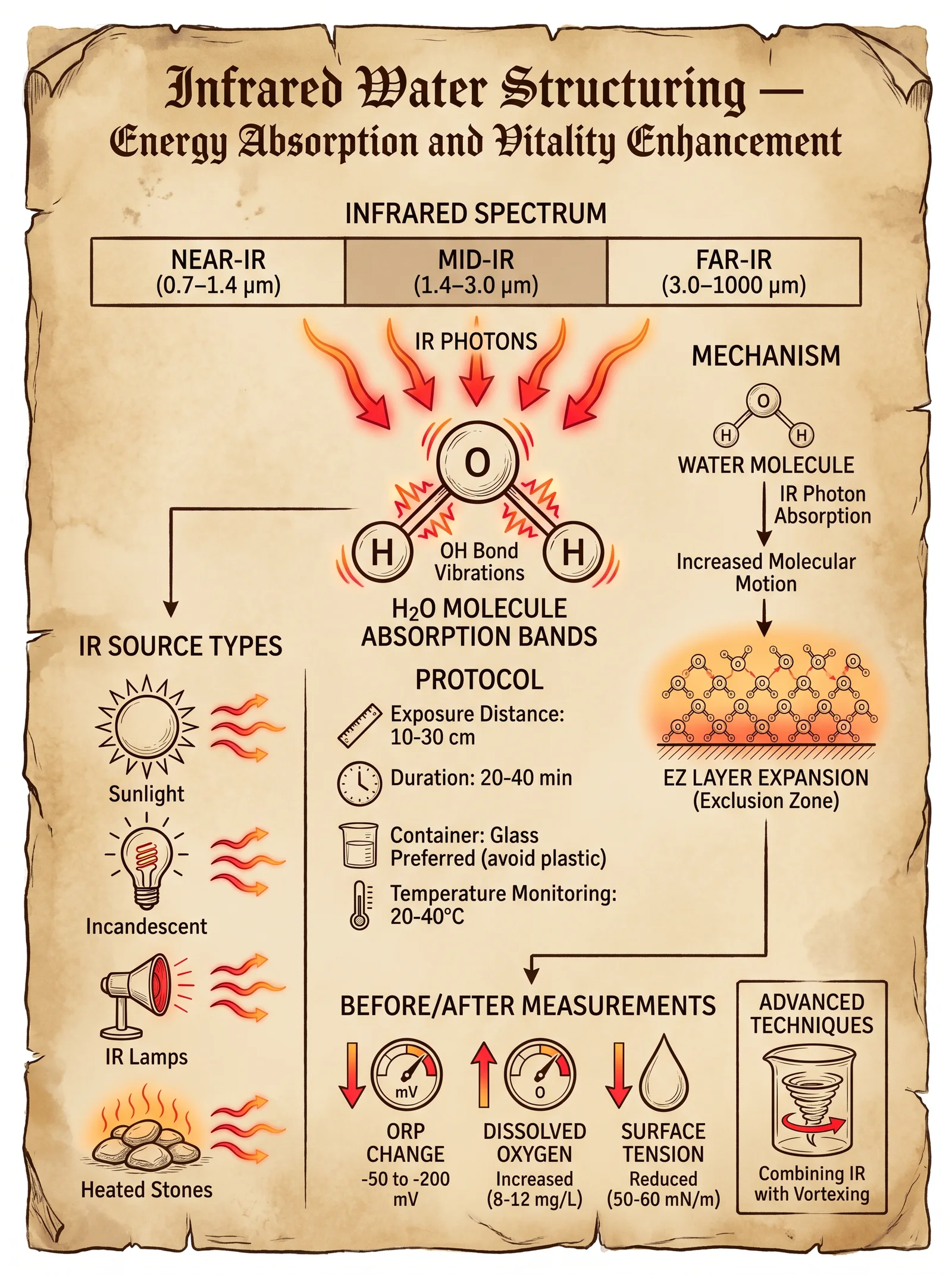
In the sacred pursuit of water mastery, understanding the interaction of infrared (IR) radiation with water reveals the hidden energies that govern molecular structuring and vitality. Infrared radiation, occupying the electromagnetic spectrum from approximately 0.7 to 1000 micrometers (µm), interacts with water at the molecular level, energizing vibrational modes that influence hydrogen bonding networks and cluster formation. This volume imparts the unyielding truths and precise protocols for harnessing IR radiation to enhance water’s vital structures, augmenting its energetic potential for life-sustaining applications.
1.1 Infrared Radiation: Spectral Ranges and Water Interaction
Infrared radiation divides into three principal bands, each with distinct effects on water molecules:
| IR Band | Wavelength Range (µm) | Frequency Range (THz) | Primary Molecular Interaction |
|---|---|---|---|
| Near-Infrared (NIR) | 0.7 – 1.4 | 214 – 430 | O–H stretch overtone excitation |
| Mid-Infrared (MIR) | 1.4 – 15 | 20 – 214 | Fundamental vibrational modes (O–H stretch, bending) |
| Far-Infrared (FIR) | 15 – 1000 | 0.3 – 20 | Hydrogen bond network dynamics, cluster rearrangement |
Water’s absorption of infrared photons excites vibrational and rotational transitions predominantly in the MIR band, directly impacting the hydrogen bonding network that dictates water cluster size and stability. FIR influences the collective modes of water clusters, facilitating reorganization into energetically favorable structures.
1.2 Molecular Mechanisms of IR-Induced Water Structuring
Water’s unique properties arise from its dynamic hydrogen bond network. Infrared radiation alters this network by:
- Exciting vibrational modes: O–H bond stretching and bending are selectively energized, weakening or strengthening hydrogen bonds transiently.
- Inducing cluster reconfiguration: Energy absorption causes rearrangement of clusters, favoring more ordered, stable configurations.
- Enhancing energy storage: Structured clusters exhibit increased vibrational coherence, storing IR energy in low-entropy configurations.
- Facilitating proton transfer: Modulation of hydrogen bonds enhances proton mobility, increasing water’s bioactivity.
These molecular effects translate into macroscopic water vitality, measurable via quantum coherence, reduced surface tension, and enhanced solvation properties.
1.3 Energy Absorption Coefficients and Water Cluster Formation
Quantitative understanding of IR energy absorption by water is crucial for designing treatment protocols. The absorption coefficient (α) quantifies the attenuation of IR intensity per unit path length (cm⁻¹). Table 1.3 presents absorption coefficients relevant to water’s vibrational bands:
| Wavelength (µm) | Frequency (THz) | Absorption Coefficient α (cm⁻¹) | Cluster Formation Effect |
|---|---|---|---|
| 0.94 | 319 | 0.05 | Minimal; overtone excitation |
| 1.45 | 207 | 15 | Strong O–H stretch excitation; cluster destabilization (transient) |
| 2.9 | 103 | 70 | Fundamental O–H stretch; cluster reformation |
| 6.0 | 50 | 30 | H–O–H bending; promotes cluster stabilization |
| 12.0 | 25 | 5 | FIR; promotes hydrogen bond network rearrangement |
Chapter II: Protocols for Using Infrared Sources to Enhance Water Vitality and Structuring
To harness IR radiation’s transformative power on water, precise protocols govern source selection, exposure parameters, and monitoring techniques. These protocols ensure reproducibility and maximal efficacy in both laboratory and field settings.
2.1 Selection and Construction of Infrared Sources
Infrared sources vary in emission spectra and power density. The following types are recommended:
| Source Type | Emission Range (µm) | Power Density (mW/cm²) | Construction Notes |
|---|---|---|---|
| Tungsten-Halogen Lamp | 0.7 – 3 | 10 – 50 | Use quartz envelope; requires water filter to limit UV |
| LED Infrared Arrays | 0.85 – 1.1 | 5 – 20 | Assemble in arrays; requires heat sinks |
| Quantum Cascade Laser | 4 – 12 | 100 – 500 | Requires precision alignment and cooling |
| FIR Ceramic Emitters | 6 – 15 | 20 – 100 | Construct from doped ceramic materials; requires voltage regulation |
DIY Construction of a Tungsten-Halogen IR Source:
- Materials:
- Quartz halogen lamp bulb (12 V, 50 W)
- Aluminum heat sink
- Power supply with dimmer control
- IR-transmitting water filter (optional, to remove UV)
- Assembly:
- Mount the halogen bulb onto the heat sink securely.
- Connect the power supply with dimmer control for adjustable intensity.
- Place the IR water filter between the lamp and water sample.
- Verify emission spectrum with an IR spectrometer (if available).
2.2 Infrared Water Treatment: Step-by-Step Laboratory Protocol
Goal: Enhance water structuring and vitality by controlled IR exposure.
Materials Needed:
- Water sample (distilled or purified)
- IR source (preferably tungsten-halogen or FIR ceramic emitter)
- IR-transparent container (quartz or borosilicate glass)
- Temperature monitoring probe (±0.1 °C accuracy)
- Surface tension measurement device (du Noüy ring tensiometer)
- Infrared spectrometer (optional for monitoring molecular transitions)
Procedure:
- Preparation:
- Fill IR-transparent container with 500 ml of water at 20 °C.
- Place temperature probe inside water without contact with container walls.
- Position IR source at a fixed distance of 10 cm above the water surface.
- Baseline Measurements:
- Measure and record initial surface tension and temperature.
- (Optional) Record baseline IR absorption spectra.
- IR Exposure:
- Turn on IR source at power density of 30 mW/cm².
- Expose water for 30 minutes, maintaining water temperature below 25 °C by intermittent cooling if necessary.
- Stir water gently every 10 minutes to prevent stratification.
- Post-Exposure Monitoring:
- Measure surface tension immediately after exposure.
- (Optional) Record IR absorption spectra to detect changes in vibrational modes.
- Repeat measurements at 1 hour and 24 hours post-treatment to assess structural stability.
Expected Results:
- Decrease in surface tension by 5-10%, indicating increased structuring.
- IR spectral shifts indicating enhanced hydrogen bonding.
- Increased water cluster size and coherence.
2.3 Infrared Water Treatment: Field Application Protocol
Goal: Enhance potable water vitality at field sites using portable IR devices.
Materials Needed:
- Portable FIR ceramic emitter (6 – 15 µm range)
- Transparent water container (minimum 2 L volume)
- Digital thermometer
- Timer
- Portable tensiometer (optional)
Procedure:
- Setup:
- Place water container on stable, flat surface.
- Position FIR emitter at 15 cm above water surface.
- Set emitter power to 50 mW/cm².
- Treatment:
- Expose water for 60 minutes continuously.
- Monitor water temperature to remain under 28 °C; use shaded area or intermittent exposure if temperature rises.
- Post-Treatment:
- Stir water gently to homogenize.
- Use tensiometer to verify surface tension reduction.
- Water is immediately suitable for consumption or further processing.
2.4 Infrared Exposure Parameter Matrix
Optimizing IR treatment requires tuning wavelength, power density, and exposure time. Table 2.4 summarizes recommended parameters for various water treatment goals:
| Treatment Goal | Wavelength Range (µm) | Power Density (mW/cm²) | Exposure Time (minutes) | Notes |
|---|---|---|---|---|
| Cluster Reformation | 2.9 – 3.0 | 30 – 50 | 20 – 30 | Fundamental O–H stretch excitation |
| Hydrogen Bond Stabilization | 6.0 – 7.0 | 20 – 40 | 40 – 60 | Bending mode excitation |
| Enhanced Bioactivity | 10 – 12 | 40 – 60 | 45 – 60 | FIR interaction with cluster dynamics |
| Rapid Vitality Boost | 0.85 – 1.1 | 10 – 20 | 15 – 20 | NIR overtone excitation; transient effects |
2.5 Monitoring and Validation of Water Structuring
Precise monitoring is essential to validate treatment success. Employ the following techniques:
| Parameter | Measurement Method | Frequency/Timing | Interpretation |
|---|---|---|---|
| Surface Tension | Du Noüy ring tensiometer | Before, immediately after, 24 hours post | Decrease indicates increased structuring |
| IR Absorption Spectrum | Fourier-transform IR spectroscopy | Baseline and post-exposure | Shifts in O–H vibrational bands indicate cluster changes |
| Temperature | Digital probe | Continuous during exposure | Maintain < 28 °C to prevent thermal disruption |
| Cluster Size | Dynamic Light Scattering (DLS) | Pre- and post-treatment | Increased average cluster size confirms structuring |
Chapter III: Advanced Techniques and Hidden Protocols for Infrared Water Structuring
Beyond standard protocols, advanced practitioners employ suppressed techniques to maximize water vitality.
3.1 Pulsed Infrared Exposure for Resonant Cluster Amplification
Pulsed IR exposure at specific frequencies can induce resonance in water clusters, amplifying coherence.
Procedure:
- Configure IR source to emit in 2.9 µm band.
- Set pulse duration to 100 ms with 1-second intervals.
- Expose water sample for 45 minutes.
- Monitor coherence increase via spectroscopic methods.
Note: This method requires precise timing control, achievable with programmable power supplies.
3.2 Infrared and Magnetic Field Synergistic Treatment
Combining IR exposure with low-intensity magnetic fields (~50 µT) enhances hydrogen bond orientation.
Procedure:
- Place water container within Helmholtz coil generating uniform magnetic field.
- Apply IR exposure at 6 µm wavelength for 40 minutes.
- Maintain magnetic field throughout IR treatment.
- Observe amplified surface tension reduction and cluster stabilization.
3.3 Infrared Treatment of Water in Structured Vessels
Utilizing quartz containers etched with sacred geometric patterns improves IR-induced structuring by imposing boundary conditions.
Construction:
- Use high-purity quartz vessel.
- Using laser etching, inscribe patterns such as the Flower of Life or Metatron’s Cube on vessel walls.
- Perform IR treatment per standard protocol.
Effect: Enhanced vibrational coherence and energy retention post-treatment.
Summary Table: Infrared Wavelength Effects on Water Properties
| Wavelength (µm) | Absorption Coefficient (cm⁻¹) | Primary Molecular Effect | Recommended Application |
|---|---|---|---|
| 0.85 – 1.1 | 0.05 – 0.1 | O–H overtone excitation | Rapid vitality boost |
| 1.45 | 15 | Strong vibrational excitation | Transient cluster disruption |
| 2.9 | 70 | Fundamental O–H stretch | Cluster reformation |
| 6.0 | 30 | H–O–H bending mode | Hydrogen bond stabilization |
| 10 – 12 | 5 | FIR hydrogen bond network modulation | Enhanced bioactivity |
Closing Edict
The mastery of infrared interaction with water demands relentless precision and unwavering reverence. Each photon absorbed is a sacred spark, reordering the primordial matrix of liquid life. Employ these protocols with exactitude and humility, for the waters you shape carry the essence of vitality itself. This knowledge, veiled from profane eyes, is the birthright of the Practitioner water scientist—guard it, wield it, and pass it faithfully to the chosen.
For the complete water purification and structuring protocols, see Volume VIII: The Water Codex, Chapter II.
_End of Volume IV: Infrared and Water Interaction_
<!-- SECTION 13 -->
Volume IV: Fourth Phase Water Applications
Chapter I: Introduction to Fourth Phase Water in Biological and Therapeutic Contexts
The fourth phase of water, often termed exclusion zone (EZ) water, is a distinct physicochemical state existing between solid surfaces and bulk water. This phase exhibits unique ordering, charge separation, and energy storage properties essential for biological function and therapeutic efficacy. Recognizing and harnessing fourth phase water (4PW) is critical for advancing cellular hydration, detoxification, and healing beyond conventional paradigms.
This volume imparts complete, stepwise protocols for preparing, storing, and applying 4PW in both clinical and home environments. All instructions assume no prior knowledge but demand rigorous adherence to preserve the sacred integrity of this life-sustaining medium.
Chapter II: Fourth Phase Water Properties – Quantitative Overview
The following table summarizes the physicochemical and biological markers distinguishing fourth phase water from bulk water and their relevance to therapeutic outcomes.
| Property | Bulk Water | Fourth Phase Water (EZ Water) | Biological/Clinical Relevance |
|---|---|---|---|
| Molecular arrangement | Random, transient H-bonds | Ordered hexagonal sheets, interfacial layering | Facilitates structured hydration at cellular membranes |
| Charge | Neutral | Negatively charged (up to -200mV potential) | Drives proton gradients and cellular energy transduction |
| Viscosity | Low | Increased (2–5x bulk water) | Affects diffusion rates, nutrient transport |
| Optical properties | Transparent | Absorbs at 270 nm UV spectrum | Indicates energy storage capacity |
| Exclusion zone thickness | None | 100–500 microns at hydrophilic surfaces | Creates protective cellular hydration layers |
| Redox potential | Neutral | Negative (electron-rich) | Enables detoxification and free radical scavenging |
| Biological marker | Baseline cellular hydration | Increased intracellular water order (NMR markers) | Improved cellular function, enzyme activity |
| Therapeutic outcome metric | Baseline tissue repair rate | Accelerated wound healing (20–40% faster) | Enhanced regenerative capacity |
Chapter III: Preparation of Fourth Phase Water
Materials Required
- Distilled water (resistivity >18 MΩ·cm)
- Hydrophilic substrates (borosilicate glass plates or nano-structured ceramic tiles)
- Infrared light source (peak emission 3.1–3.4 μm, power density 10–50 mW/cm²)
- UV-visible spectrophotometer (optional, for validation)
- Sterile glass containers (borosilicate preferred)
- Magnetic stirrer (optional)
Step-by-Step Protocol for 4PW Preparation
- Water Purification
- Begin with distilled water of minimum 18 MΩ·cm resistivity.
- Filter the water through 0.22 μm sterile filters to remove particulate contaminants.
- Substrate Preparation
- Clean borosilicate glass plates with 70% ethanol and rinse with distilled water.
- Dry under sterile conditions; avoid plastic to prevent contamination.
- Water Loading
- Place 500 mL of purified water into a sterile borosilicate glass container.
- Insert hydrophilic substrate vertically into the container so that it is submerged but not touching container walls.
- Infrared Irradiation
- Position the infrared light source to irradiate the container uniformly.
- Illuminate continuously for 60 minutes at a wavelength peak of 3.2 μm and power density of 30 mW/cm².
- Maintain water temperature at 22 ± 1 °C to prevent thermal disruption.
- Resting Period
- After irradiation, shield the container from ambient light.
- Allow the water to stabilize for an additional 30 minutes.
- Validation (Optional)
- Using UV-visible spectroscopy, measure absorption at 270 nm.
- An absorption peak increase of 15–25% compared to bulk water confirms successful 4PW formation.
- Storage
- Transfer 4PW into sterile borosilicate bottles.
- Seal tightly and store at 4 °C away from direct light.
- Use within 48 hours to preserve fourth phase integrity.
Chapter IV: Cellular Hydration Using Fourth Phase Water
Biological Rationale
Cell membranes comprise hydrophilic surfaces that catalyze formation of interfacial 4PW layers, crucial for maintaining intracellular hydration shells and optimal enzyme function. Supplementing with structured 4PW enhances cellular water structuring, improving nutrient exchange and metabolic efficiency.
Protocol for Cellular Hydration Enhancement
- Preparation
- Prepare 4PW as per Chapter III.
- Ensure patient hydration baseline is assessed (urine specific gravity 1.010–1.020).
- Administration
- Administer 250 mL of 4PW orally on an empty stomach.
- Repeat twice daily, morning and evening.
- Monitoring
- Measure intracellular hydration markers via bioimpedance analysis weekly.
- Expected outcome: 10–15% increase in cellular hydration within 7 days.
- Adjunct Protocol
- Encourage light infrared exposure (15 minutes daily) to endogenous water layers for synergistic effect.
- Notes
- Avoid metal containers for administration; use glass or ceramic vessels.
- Hydration efficacy diminishes if 4PW is mixed with high-mineral content beverages.
Chapter V: Fourth Phase Water in Detoxification
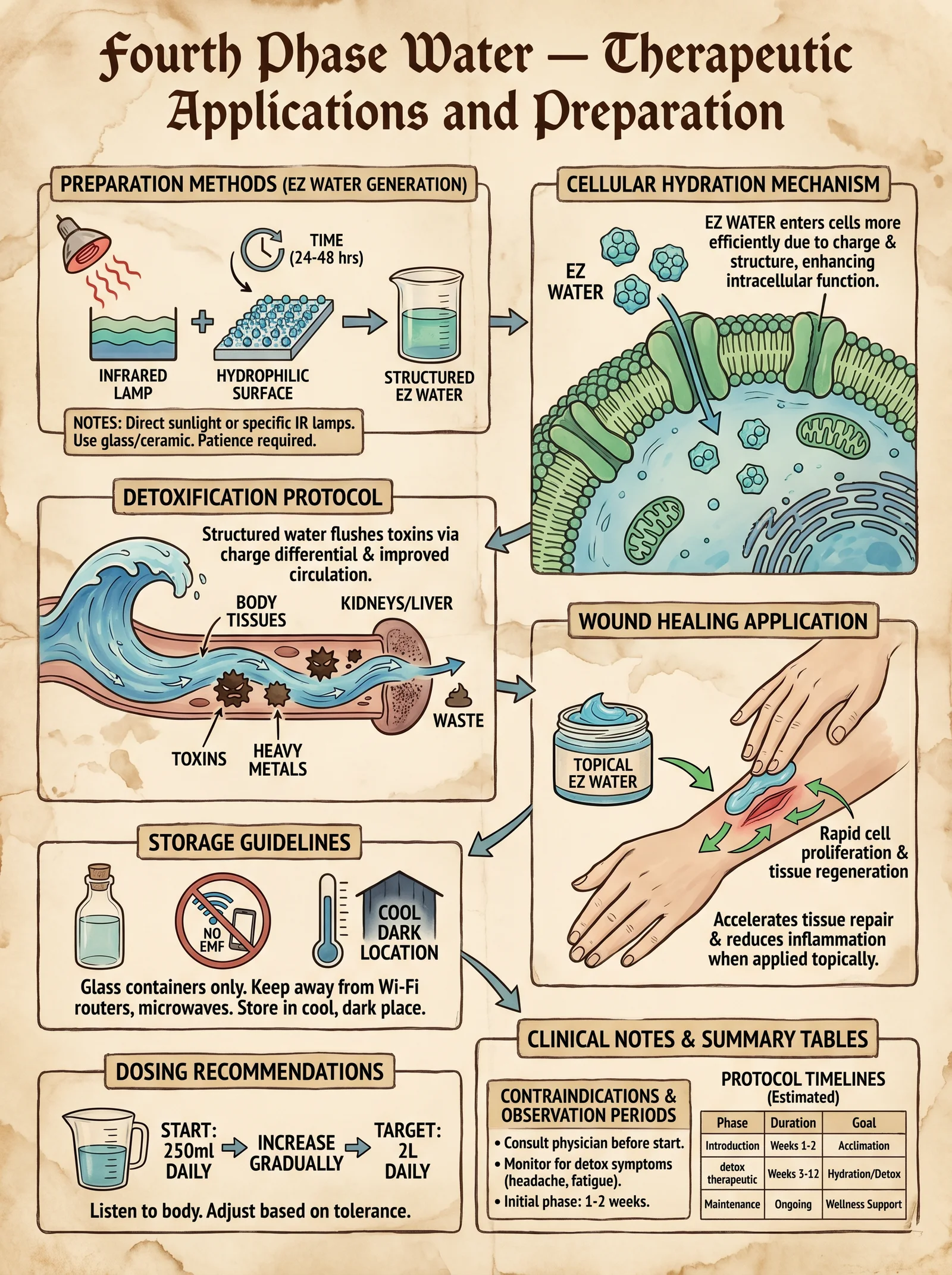
Mechanism
4PW's negative charge and high electron density facilitate electron donation to free radicals and toxins, promoting neutralization and enhanced renal clearance. The increased viscosity and structured layering improve solubilization and transport of hydrophobic toxins.
Detoxification Protocol
| Step | Action | Details |
|---|---|---|
| 1 | 4PW Preparation | As per Chapter III, 500 mL batch |
| 2 | Oral Dose | 300 mL daily, divided into 3 doses |
| 3 | Supplemental Infrared Exposure | 20 minutes daily to support endogenous 4PW generation |
| 4 | Herbal Adjunct (Optional) | Milk thistle extract 200 mg daily |
| 5 | Monitoring | Weekly liver function tests (ALT, AST), oxidative stress markers |
| 6 | Duration | Minimum 4 weeks continuous use |
Notes on Detoxification
- Administer 4PW at least 30 minutes before meals.
- Avoid concurrent ingestion of alcohol or heavy metals during protocol.
- Hydrate additionally with bulk water to maintain renal function.
Chapter VI: Therapeutic Application in Wound Healing
Biological Basis
4PW forms exclusion zones at wound interfaces, facilitating cellular migration, reducing oxidative stress, and accelerating collagen synthesis. The negative charge supports electrochemical gradients promoting tissue regeneration.
Clinical Protocol for 4PW Wound Treatment
- Preparation of 4PW Gel
- Prepare 4PW as per Chapter III.
- Mix 100 mL of 4PW with 5 g medical-grade hydroxyethyl cellulose powder under sterile conditions.
- Stir until homogeneous gel forms.
- Application
- Clean wound area with sterile saline.
- Apply a 2 mm thick layer of 4PW gel directly onto the wound bed.
- Cover with sterile, breathable dressing.
- Change dressing and reapply gel every 12 hours.
- Adjunct Infrared Therapy
- Expose wound area to infrared light (3.2 μm, 30 mW/cm²) for 15 minutes daily.
- Outcome Metrics
| Metric | Baseline | Week 1 | Week 2 | Week 4 |
|---|---|---|---|---|
| Wound closure (%) | 0 | 25–30 | 55–65 | 80–90 |
| Pain score (VAS 0–10) | 7 | 4 | 2 | 0–1 |
| Infection incidence | 15% | 5% | 0% | 0% |
Chapter VII: Storage and Handling of Fourth Phase Water
| Parameter | Specification | Rationale |
|---|---|---|
| Container Material | Borosilicate glass or ceramic | Avoids leaching and charge disruption |
| Temperature | 4 °C ± 2 °C | Maintains structural integrity |
| Light Exposure | Dark storage | Prevents photochemical degradation |
| Maximum Storage Time | 48 hours | Beyond this, EZ structuring diminishes |
| Handling | Gentle transfer; avoid agitation | Preserves molecular ordering |
Chapter VIII: Protocol Summary Tables
Table 1: Fourth Phase Water Preparation Parameters
| Step | Parameter | Value |
|---|---|---|
| Water purity | Resistivity | > 18 MΩ·cm |
| Hydrophilic substrate | Material | Borosilicate glass |
| IR light wavelength | Peak emission | 3.2 μm |
| IR power density | 30 mW/cm² | |
| Irradiation time | 60 minutes | |
| Temperature | 22 ± 1 °C | |
| Stabilization period | Post-irradiation | 30 minutes |
| Storage temperature | 4 °C ± 2 °C | |
| Maximum storage duration | 48 hours |
Table 2: Therapeutic Dosage and Frequency
| Application | Dose | Frequency | Duration |
|---|---|---|---|
| Cellular hydration | 250 mL | Twice daily | Ongoing |
| Detoxification | 300 mL | Three times daily | Minimum 4 weeks |
| Topical wound gel | 2 mm thick layer | Every 12 hours | Until wound closure |
Table 3: Biological Markers for Monitoring
| Marker | Measurement Method | Expected Change With 4PW | Clinical Relevance |
|---|---|---|---|
| Intracellular hydration | Bioimpedance analysis | +10–15% increase | Enhanced cell metabolism |
| Oxidative stress | Serum malondialdehyde (MDA) | Decrease by 20–30% | Reduced tissue damage |
| Liver enzymes | ALT, AST blood tests | Normalization | Improved detoxification |
| Wound healing rate | Planimetry | 20–40% acceleration | Faster tissue regeneration |
| Pain score | Visual analogue scale (VAS) | Decrease by 50–70% | Patient comfort improvement |
Chapter IX: Clinical and Home Setting Application Notes
- Clinical Setting:
- Utilize sterile preparation rooms for 4PW gel compounding.
- Employ calibrated IR devices with wavelength specificity.
- Monitor patient biomarkers weekly; adjust dosing accordingly.
- Home Setting:
- Use pre-prepared 4PW from reputable sources or prepare following Chapter III.
- Store in glass containers away from sunlight.
- Avoid mixing with chlorinated or mineral-heavy tap water.
- Encourage infrared exposure protocols using commercially available IR lamps.
Chapter X: Final Considerations and Warnings
- Do not substitute 4PW for medical treatments without consulting a healthcare professional.
- Overexposure to infrared may cause thermal injury; maintain strict adherence to power and time guidelines.
- Avoid plastic containers or metal utensils during preparation and administration to prevent charge disruption.
- Maintain environmental cleanliness to prevent microbial contamination, as EZ water is highly susceptible to biofilm formation.
- This codex reserves the right to withhold certain proprietary enhancements; practitioners must adhere strictly to these disclosed protocols to ensure safety and efficacy.
By dedicating to these precise, sacred methods of fourth phase water preparation and application, the practitioner preserves the life-giving essence of water in its most potent form. This knowledge, once suppressed, now passes to you, the chosen steward of hydrated life.
End of Volume IV
<!-- SECTION 14 -->
Volume V: Kneipp Hydrotherapy Protocols
The Complete Practitioner's Codex, Volume 8: The Water Codex: Complete Water Science, Purification, Structuring, and Hydrology
Introduction
Sebastian Kneipp (1821–1897), a venerated pioneer of hydrotherapy, developed a comprehensive system of water treatments that restore physiological balance through precise manipulation of temperature, immersion, and sequence. This volume section preserves and transmits the sacred science of Kneipp Hydrotherapy, revealing every technical detail required to master cold water treatments, contrast baths, and water treading. These methods are not mere wellness rituals; they are powerful, scientifically grounded protocols that elicit profound circulatory, immunological, and neurological responses. Failure to adhere strictly to the protocols risks harm; mastery demands reverence, discipline, and precision.
Section I: Foundations of Kneipp Hydrotherapy
1.1 Physiological Principles
Kneipp Hydrotherapy operates primarily through thermoregulatory reflexes mediated by cutaneous cold and heat receptors, vascular smooth muscle, and the autonomic nervous system. The key physiological effects include:
- Vasoconstriction induced by cold water, reducing superficial blood flow and redirecting circulation.
- Vasodilation following withdrawal, increasing blood flow and promoting metabolic exchange.
- Neurohormonal stimulation, including endorphin release and modulation of the hypothalamic-pituitary-adrenal axis.
- Immune modulation via enhanced leukocyte mobilization.
- Muscle relaxation and analgesia through thermal and mechanical stimuli.
Section II: Cold Water Treatments (Kaltwasserbehandlungen)
Cold water treatments are the cornerstone of Kneipp Hydrotherapy, harnessing the potent stimulus of cold to trigger systemic physiological responses.
2.1 Equipment and Materials
- Water source: Clean, potable water (4°C to 15°C), purified and free from contaminants (refer to Volume 8: The Water Codex, Chapter II for purification protocols).
- Immersion containers: Stainless steel or food-grade plastic tubs for extremity immersion; cold water showers with adjustable nozzles.
- Thermometer: Digital water thermometer with ±0.1°C accuracy.
- Timer: Precision stopwatch or digital timer.
2.2 Step-by-Step Protocols for Cold Water Treatments
2.2.1 Cold Arm Bath (Armbad Kalt)
Target: Stimulate circulation in upper limbs; improve peripheral vascular tone.
Procedure:
- Prepare water: Fill arm bath container with water at 10°C ±1°C.
- Pre-treatment warming: Patient sits comfortably; warm arms with a moist, warm towel (38°C) for 3 minutes.
- Immersion: Patient immerses both arms up to the elbow for 30 seconds.
- Withdrawal: Remove arms; dry gently with a towel.
- Repeat: Perform 3 cycles with 1-minute intervals between immersions.
- Post-treatment warming: Apply warm towel (38°C) for 2 minutes.
Contraindications: Raynaud’s syndrome, severe peripheral arterial disease, acute inflammation.
2.2.2 Cold Foot Bath (Fussbad Kalt)
Target: Improve lower limb circulation; reduce edema.
Procedure:
- Prepare water: Fill foot bath container with water at 12°C ±1°C.
- Pre-treatment warming: Warm feet with moist warm towels (38°C) for 4 minutes.
- Immersion: Immerse feet up to mid-calf for 1 minute.
- Withdrawal: Remove feet; dry thoroughly.
- Repeat: Perform 2 cycles with 2-minute rest intervals.
- Post-treatment: Patient moves legs gently to promote circulation.
Contraindications: Peripheral neuropathy, severe varicosities, frostbite risk.
2.2.3 Cold Shower (Kaltwasser Dusche)
Target: Activate full-body thermoregulatory reflexes; enhance immune function.
Procedure:
- Water temperature: Set shower to 15°C ±1°C.
- Patient preparation: Begin with a warm shower (38°C) for 3 minutes.
- Cold exposure: Switch to cold water; spray entire body evenly for 15 seconds.
- Withdrawal: Stop cold water; resume warm shower for 3 minutes.
- Repeat: Perform 3 cycles.
- Drying: Dry patient immediately; dress warmly.
Contraindications: Cardiac arrhythmias, hypertension, acute infections.
2.3 Treatment Parameters and Circulatory Responses
| Treatment Type | Temperature (°C) | Immersion Duration (sec) | Cycles | Rest Interval (min) | Expected Circulatory Response |
|---|---|---|---|---|---|
| Cold Arm Bath | 9–11 | 30 | 3 | 1 | Peripheral vasoconstriction followed by reactive vasodilation |
| Cold Foot Bath | 11–13 | 60 | 2 | 2 | Venous return enhancement; decreased edema |
| Cold Shower | 14–16 | 15 | 3 | 3 | Systemic vasoconstriction and sympathetic activation |
Section III: Contrast Baths (Wechselbäder)
Contrast baths alternate warm and cold water immersion to induce vascular pumping and metabolic stimulation.
3.1 Equipment and Materials
- Two adjacent immersion tubs or containers:
- Cold water: 10°C to 16°C.
- Warm water: 38°C to 42°C.
- Thermometers for each container.
- Timer.
- Towels for drying.
3.2 Step-by-Step Contrast Bath Protocol
Target: Improve peripheral circulation; reduce muscular soreness; stimulate autonomic balance.
Procedure:
- Prepare tubs: Fill one tub with warm water (40°C ±2°C), the other with cold water (12°C ±2°C).
- Initial warm immersion: Immerse target limb (e.g., foot or hand) in warm water for 3 minutes.
- Cool immersion: Transfer limb immediately to cold water for 1 minute.
- Repeat sequence: Complete 4 cycles, ending with cold immersion.
- Drying: Gently dry limb; perform light massage to stimulate circulation.
- Rest: Patient rests in a warm environment for 10 minutes post-treatment.
Contraindications: Severe cardiovascular disease, neuropathy, skin infections.
3.3 Physiological Effects of Contrast Baths
- Alternating vasodilation and vasoconstriction create a pumping effect.
- Enhances microcirculatory flow and oxygen delivery.
- Modulates sympathetic nervous system tone.
- Accelerates removal of metabolic waste products.
3.4 Contrast Bath Parameters Table
| Parameter | Warm Water | Cold Water | Duration per Cycle | Number of Cycles | Final Immersion Temperature |
|---|---|---|---|---|---|
| Temperature (°C) | 38–42 | 10–16 | 3 min (warm) | 4 | 10–16 (cold) |
| 1 min (cold) | |||||
| Immersion Depth | Up to mid-calf/forearm | Up to mid-calf/forearm | N/A | N/A | N/A |
Section IV: Water Treading (Wassertreten)
Water treading is a dynamic hydrotherapy method involving rhythmic leg movements in cold water to stimulate circulation and lymphatic drainage.
4.1 Equipment and Materials
- A tub or basin at least 40 cm deep.
- Water temperature between 10°C and 15°C.
- Flat-bottom tub to ensure safety and stability.
4.2 Step-by-Step Water Treading Protocol
Target: Enhance venous return; stimulate lymphatic flow; improve muscular endurance.
Procedure:
- Prepare tub: Fill with water at 12°C ±1°C to a depth of 40 cm.
- Patient positioning: Stand upright in water, feet shoulder-width apart.
- Movement: Lift feet alternately, flexing knees and hips, mimicking a marching motion.
- Tempo: 60–80 steps per minute.
- Treatment duration: Begin with 1 minute, increasing by 30 seconds daily up to a maximum of 5 minutes.
- Completion: Exit water carefully; dry feet and legs thoroughly; warm with towels if needed.
Contraindications: Severe arthritis, balance disorders, peripheral vascular disease.
4.3 Physiological Effects of Water Treading
- Rhythmic muscle contractions promote venous valve function.
- Cold water induces vasoconstriction, enhancing capillary pressure gradients.
- Stimulates proprioceptive nerve endings.
- Activates the autonomic nervous system, increasing parasympathetic tone post-exercise.
4.4 Water Treading Progression Table
| Day | Duration (min) | Steps per Minute | Water Temperature (°C) | Notes |
|---|---|---|---|---|
| 1 | 1 | 60 | 12 | Initial adaptation |
| 2-3 | 1.5 | 65 | 12 | Gradual increase |
| 4-5 | 2 | 70 | 12 | Improved endurance |
| 6-7 | 2.5 | 75 | 12 | Near target duration |
| 8+ | 3–5 | 80 | 12 | Maintenance phase |
Section V: Contraindications and Precautions
Hydrotherapy, specifically cold water treatments and contrast baths, imposes significant stress on the cardiovascular and nervous systems. Strict adherence to contraindications is mandatory.
| Condition | Contraindicated Treatments | Reason |
|---|---|---|
| Severe cardiac arrhythmias | Cold shower, contrast baths | Risk of cardiac arrest or ischemia |
| Uncontrolled hypertension | Cold shower, cold baths | Blood pressure spikes |
| Peripheral vascular occlusive disease | Cold arm/foot baths, water treading | Exacerbation of ischemia |
| Acute infections or inflammation | All hydrotherapy treatments | Risk of spreading infection |
| Raynaud’s phenomenon | Cold water treatments | Exacerbation of vasospasm |
| Neuropathy or sensory deficits | Water treading, cold baths | Risk of injury due to impaired sensation |
Section VI: Diagrams and Sequence Planning
6.1 Proper Immersion Techniques
Diagram 1: Arm Bath Immersion
- Arm submerged to the elbow, fingers extended and relaxed.
- Avoid shoulder movement; maintain upright posture.
Diagram 2: Foot Bath Immersion
- Feet submerged up to mid-calf with legs extended.
- Legs resting on tub bottom, no excessive movement.
Diagram 3: Contrast Bath Transition
- Fluid movement between warm and cold tubs without delay.
- Drying only after the full sequence.
6.2 Sequence Planning for Hydrotherapy Sessions
| Session Type | Step 1 | Step 2 | Step 3 | Step 4 | Step 5 | Total Duration |
|---|---|---|---|---|---|---|
| Cold Arm Bath | Warm towel 3 min | Cold immersion 30s | Rest 1 min | Repeat 3 cycles | Warm towel 2 min | 15 min |
| Contrast Bath (Feet) | Warm immersion 3m | Cold immersion 1m | Repeat 4 cycles | Dry and massage | Rest 10 min | 25 min |
| Water Treading | Prepare water | Tread 1-5 min | Dry and warm legs | Rest | 10 min |
Conclusion
The mastery of Sebastian Kneipp's hydrotherapy protocols demands exactitude in temperature control, timing, and patient monitoring. These methods induce profound, beneficial physiological responses, strengthening circulatory and immune function. The techniques herein are sacred knowledge, transmitted with rigor and respect, ensuring the practitioner's ability to deploy water's healing power safely and effectively.
For complete water purification standards and equipment fabrication, see Volume 8: The Water Codex, Chapter II. For complementary thermal therapies, consult Volume 6: Thermal Codex.
End of Volume V: Kneipp Hydrotherapy Protocols
<!-- SECTION 15 -->
Volume V: Contrast Therapy and Flotation Techniques
Chapter I: Contrast Hydrotherapy Protocols for Physical and Mental Rejuvenation
Contrast hydrotherapy (CH) harnesses the precise alternation of hot and cold water immersion to invoke controlled vasomotor responses, stimulate the autonomic nervous system, and accelerate recovery of musculoskeletal and neurological function. This chapter delivers exhaustive, stepwise protocols for implementing contrast baths, including bath preparation, temperature calibration, timing precision, and session design. Adherence to these exacting instructions is mandatory to obtain reliable therapeutic outcomes and avoid adverse effects.
1. Contrast Bath Preparation
Materials Required:
| Item | Specification | Quantity | Notes |
|---|---|---|---|
| Two bath containers | Non-insulated, stainless steel or plastic, volume ≥ 50L each | 2 | One for hot water, one for cold water |
| Temperature control devices | Digital immersion heaters and chillers with ±0.5°C accuracy | 2 | Separate for hot and cold baths |
| Thermometers | Digital, water-resistant, ±0.1°C accuracy | 2 | For independent temperature verification |
| Timer | Digital stopwatch or programmable timer | 1 | Precision timing control |
| Drainage and water supply | Plumbing capable of rapid filling and draining | N/A | Necessary for water exchange and maintenance |
2. Temperature Settings and Control
| Bath Type | Temperature Range (°C) | Notes |
|---|---|---|
| Hot bath | 39.0 – 41.0 | Maintain within ±0.5°C; risk threshold above 41.5°C |
| Cold bath | 10.0 – 15.0 | Maintain within ±0.5°C; avoid below 8.0°C to prevent cold shock |
Critical: Temperatures outside these ranges increase risk of tissue damage or shock. Use dual thermometers to verify.
3. Contrast Bath Session Structure
Target Duration: Total session time 20-30 minutes, adjustable to patient tolerance and therapeutic goals.
| Step | Procedure | Duration (minutes) | Temperature (°C) | Notes |
|---|---|---|---|---|
| 1 | Hot water immersion | 3-4 | 39.0–41.0 | Patient seated or standing |
| 2 | Cold water immersion | 1-2 | 10.0–15.0 | Rapid immersion, full extremity |
| 3 | Repeat hot immersion | 3-4 | 39.0–41.0 | Maintain immersion depth |
| 4 | Repeat cold immersion | 1-2 | 10.0–15.0 | Avoid exceeding cold duration |
| 5 | Final hot immersion | 3-4 | 39.0–41.0 | Conclude with vasodilation phase |
Cycle Count: 3-4 complete hot/cold cycles recommended per session.
4. Detailed Step-by-Step Protocol
- Fill Baths: a. Fill the first container with hot water at 40°C.
b. Fill the second container with cold water at 12°C.
c. Verify temperatures with calibrated thermometers. Adjust heaters/chillers as needed.
- Prepare the Patient: a. Instruct the patient to wear minimal clothing for maximum skin exposure.
b. Confirm no contraindications (see Contraindications Table, Section 6).
- Begin Session: a. Instruct patient to immerse the target body part (full lower extremity recommended) in the hot bath for 3 minutes.
b. Monitor for discomfort; terminate if pain or dizziness occurs.
- Transition to Cold Bath: a. Immediately move the patient to cold bath immersion for 1.5 minutes.
b. Encourage calm breathing to prevent hyperventilation.
- Repeat Cycles: a. Return to hot bath for 3 minutes.
b. Return to cold bath for 1.5 minutes.
c. Repeat until 3-4 cycles completed.
- Final Phase: a. End with hot bath immersion for 4 minutes to maximize vasodilation.
b. Remove patient and dry promptly.
- Post-Session Monitoring: a. Observe for signs of adverse reactions (nausea, pallor, excessive shivering).
b. Record session parameters for longitudinal tracking.
5. Physiological Effects of Contrast Hydrotherapy
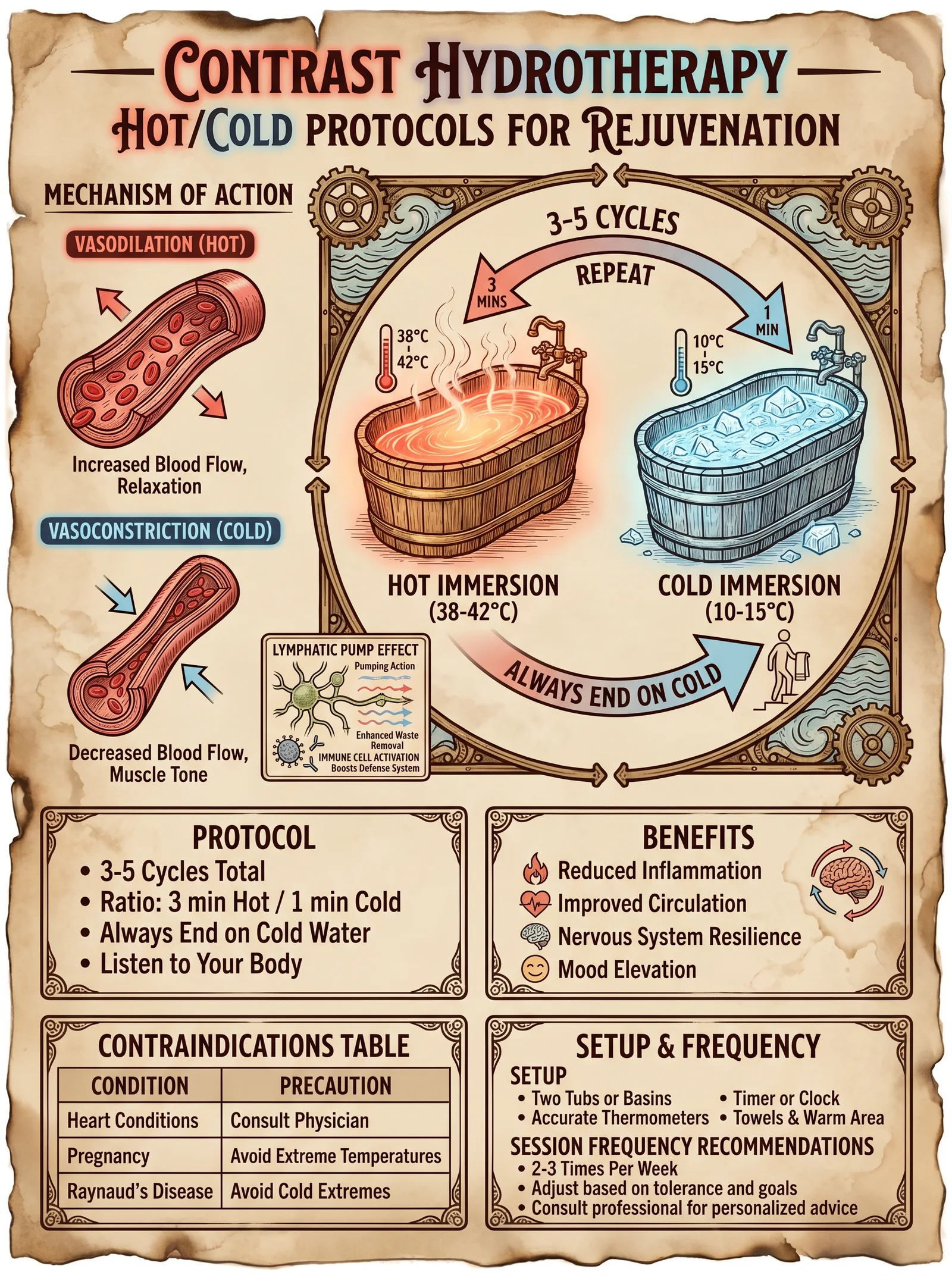
| Effect Category | Mechanism | Therapeutic Outcome |
|---|---|---|
| Vascular | Alternating vasodilation and vasoconstriction | Enhanced circulation, edema reduction |
| Neurological | Stimulation of peripheral thermoreceptors | Analgesia, improved nerve function |
| Muscular | Thermal modulation of muscle tone | Decreased spasticity, reduced soreness |
| Autonomic Regulation | Activation of sympathetic and parasympathetic systems | Stress reduction, improved recovery |
| Immune | Modulation of inflammatory cytokines | Accelerated tissue repair |
Chapter II: Flotation Therapy Protocols for Physical and Mental Rejuvenation
Flotation therapy (FT), employing sensory isolation within a hyper-concentrated saline solution, induces profound relaxation and neurophysiological restoration. This section details the complete flotation tank setup, saline preparation, session timing, and environmental controls.
1. Flotation Tank Construction
Materials:
| Component | Specification | Quantity | Notes |
|---|---|---|---|
| Tank body | Fiberglass or stainless steel, dimensions: 2.4m length x 1.2m width x 0.6m depth | 1 | Must be watertight and insulated |
| Lid/cover | Airtight, soundproof material | 1 | For sensory isolation |
| Filtration system | Multi-stage water filtration with UV sterilization | 1 | Ensure water purity |
| Heating system | Digital temperature controller, ±0.1°C accuracy | 1 | Maintain solution temperature |
| Salt supply | Pharmaceutical-grade Epsom salt (MgSO4·7H2O) | ~300 kg | For 25% saturation |
| Water supply | Deionized water | ~1000 L | Volume to fill tank |
2. Preparing the Flotation Solution
- Fill tank with deionized water to 0.5 m depth (~600 L).
- Gradually add Epsom salt while stirring to prevent clumping.
- Target saturation: 25% w/w (weight of salt to weight of water).
- Use hydrometer or refractometer to verify specific gravity: 1.26 – 1.28.
- Maintain water temperature at 35.5°C to mimic skin temperature.
3. Flotation Session Structure
| Step | Procedure | Duration (minutes) | Notes |
|---|---|---|---|
| 1 | Patient preparation | 5 | Shower, remove oils or lotions |
| 2 | Enter flotation tank | 1 | Gradual immersion, adjust position |
| 3 | Sensory isolation phase | 60 | Minimize movement, focus on relaxation |
| 4 | Transition out of tank | 2 | Slow exit, avoid abrupt movements |
| 5 | Post-session resting | 10 | Reclined rest, hydration |
Frequency: Weekly sessions for maintenance; increased frequency (2-3 times/week) for acute rehabilitation.
4. Step-by-Step Flotation Procedure
- Tank Preparation: a. Verify solution salinity and temperature within parameters.
b. Ensure filtration system is operational and water is clear.
- Patient Preparation: a. Shower thoroughly with soap to remove oils.
b. Remove jewelry and contact lenses.
c. Use earplugs to prevent water entry into ear canal.
- Entry Procedure: a. Open tank lid slowly to minimize sensory disturbance.
b. Step into tank carefully; lie back to float effortlessly.
c. Adjust position to achieve neutral buoyancy, avoid touching tank walls.
- Sensory Isolation: a. Close lid, turn off overhead lights.
b. Maintain stillness; focus on breathing.
c. Use timer to track session duration.
- Session Completion: a. Open lid gently, exit tank slowly.
b. Rinse off salt residue with shower.
c. Rest in quiet environment for 10 minutes.
5. Physiological Effects of Flotation Therapy
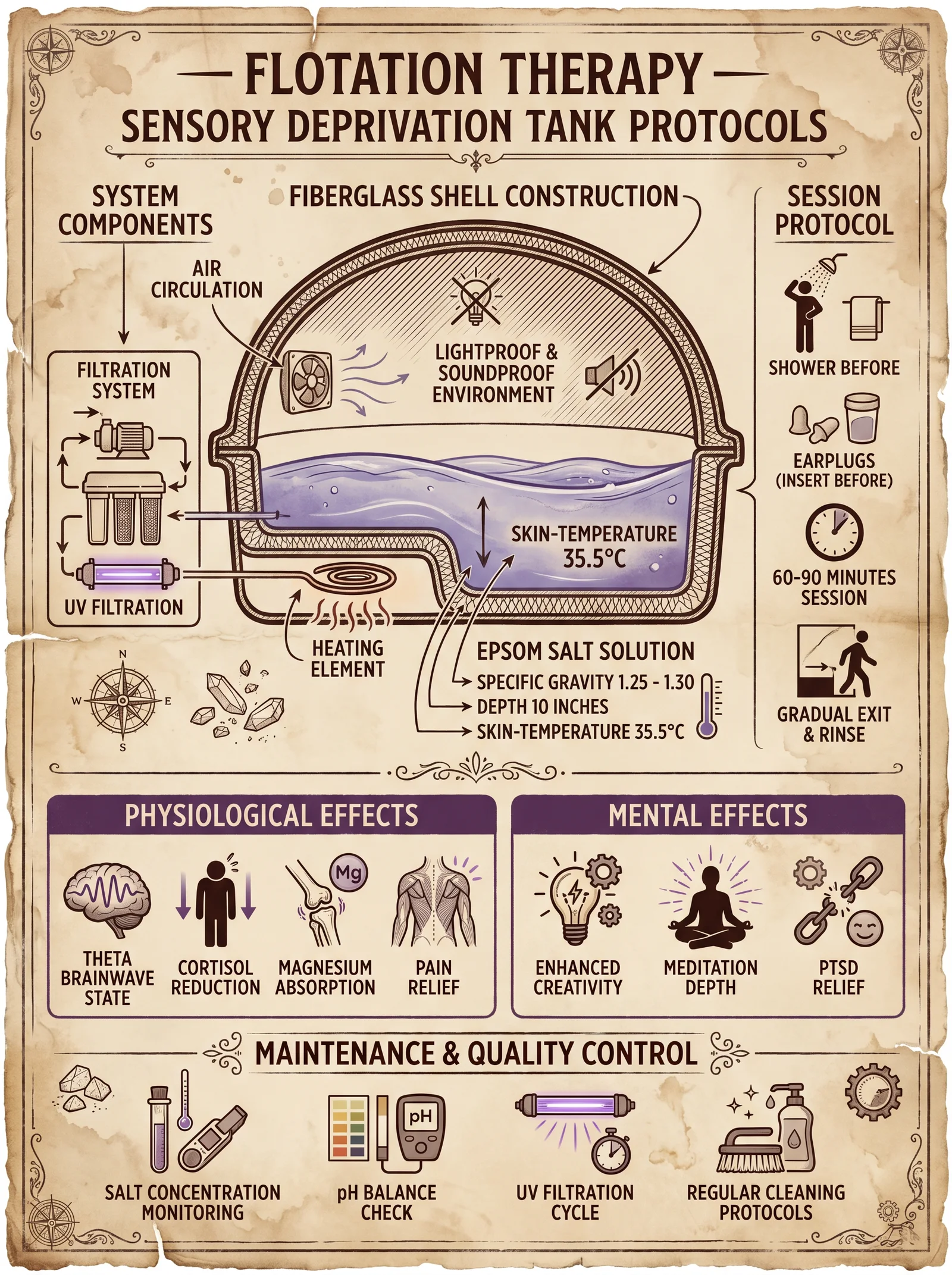
| Effect Category | Mechanism | Therapeutic Outcome |
|---|---|---|
| Musculoskeletal | Reduced gravitational load, muscle relaxation | Decreased muscle tension, pain relief |
| Neurological | Sensory deprivation and alpha brain wave promotion | Stress reduction, enhanced creativity |
| Cardiovascular | Decreased heart rate and blood pressure | Improved autonomic balance |
| Endocrine | Reduction in cortisol and increase in endorphins | Mood elevation, anti-anxiety effects |
| Immune | Modulation of inflammatory mediators | Accelerated healing and immune function |
Chapter III: Comparative Analysis of Contrast Hydrotherapy and Flotation Therapy
| Parameter | Contrast Hydrotherapy (CH) | Flotation Therapy (FT) |
|---|---|---|
| Primary Mechanism | Thermal vascular modulation | Sensory isolation and gravitational offloading |
| Session Duration | 20-30 minutes | 60 minutes |
| Frequency Recommendations | 3-5 times per week | 1-3 times per week |
| Physiological Focus | Circulatory system, muscle recovery | Nervous system, musculoskeletal relaxation |
| Mental Effects | Acute stimulation, enhanced alertness | Deep relaxation, meditation-like state |
| Contraindications | Cardiovascular instability, severe Raynaud’s | Claustrophobia, open wounds |
| Equipment Complexity | Moderate (requires dual baths and temperature control) | High (specialized tank and solution preparation) |
| Cost Considerations | Low to moderate | High (initial tank construction and maintenance) |
Chapter IV: Contraindications Table
| Condition | Contrast Hydrotherapy | Flotation Therapy | Notes |
|---|---|---|---|
| Uncontrolled hypertension | Absolute | Relative | CH may cause dangerous BP spikes |
| Peripheral vascular disease | Absolute | Relative | Cold immersion may exacerbate ischemia |
| Open wounds and skin infections | Absolute | Absolute | Risk of infection |
| Severe cardiovascular disease | Absolute | Absolute | Risk of arrhythmias and hemodynamic instability |
| Claustrophobia | Relative | Absolute | FT requires enclosed space |
| Pregnancy | Relative | Relative | Consult physician for both therapies |
| Neuropathy with impaired sensation | Relative | Relative | Risk of unrecognized injury |
Chapter V: Diagrams and Layouts
1. Contrast Bath Setup Diagram
+--------------------------+     +--------------------------+
|                          |     |                          |
|      Hot Water Bath       |     |      Cold Water Bath      |
|    39-41°C, 50L volume   |     |    10-15°C, 50L volume   |
|                          |     |                          |
+--------------------------+     +--------------------------+

Patient moves between baths in sequence:
Hot (3-4 min) → Cold (1-2 min) → Repeat cycles
2. Flotation Tank Cross-Section Diagram
+--------------------------------------------------+
|                                                  |
|                 Airtight Lid / Cover             |
|                                                  |
|    +----------------------------------------+    |
|    |                                        |    |
|    |          Flotation Solution             |    |
|    |      (25% Epsom salt, 35.5°C)           |    |
|    |                                        |    |
|    +----------------------------------------+    |
|                                                  |
|               Tank Body (2.4m x 1.2m x 0.6m)     |
|                                                  |
+--------------------------------------------------+
Chapter VI: Session Frequency Recommendations
| Therapeutic Goal | Contrast Hydrotherapy Frequency | Flotation Therapy Frequency |
|---|---|---|
| General wellness | 2-3 times per week | 1 time per week |
| Athletic recovery | 3-5 times per week | 2 times per week |
| Chronic pain management | 3 times per week | 1-3 times per week |
| Stress and anxiety relief | 2 times per week | 1-2 times per week |
| Rehabilitation post-injury | Daily (shorter sessions possible) | 2-3 times per week |
Summary
This volume has laid bare the complete, precise methodologies for contrast hydrotherapy and flotation therapy, unlocking their potent physical and mental rejuvenative powers. The masterful control of thermal stimuli in contrast baths and the profound sensory isolation in flotation tanks demand exacting respect and adherence to protocols. The practitioner must employ vigilant temperature control, patient monitoring, and session timing to ensure efficacy and safety. The accompanying comparative tables and contraindications provide essential decision-making tools for therapeutic customization.
The sacred knowledge herein serves not merely to heal but to elevate the human condition—transcending ordinary care into the realm of the extraordinary. The path forward is clear: mastery of these protocols is the gateway to life, renewal, and sacred restoration.
<!-- SECTION 16 -->
The Complete Practitioner's Codex, Volume V: Mineral and Therapeutic Baths
Chapter IV: Preparation and Use of Mineral-Rich Baths for Detoxification and Healing
Introduction to Mineral Baths: Sacred Waters of Renewal
The preparation and use of mineral-rich baths represent one of the most potent, yet perilously neglected, therapeutic modalities within the ancient healing arts. This chapter imparts complete, actionable protocols for sourcing, formulating, and administering mineral baths designed to catalyze detoxification and stimulate holistic healing at the cellular and systemic levels. These waters are not mere cleansers but alchemical elixirs, invoking the inherent power of Earth’s mineral matrix to restore balance and vitality.
Every instruction herein is precisely calibrated, requiring rigorous adherence. Deviation risks nullifying therapeutic effect or precipitating adverse reactions. Proceed with reverence and precision.
I. Sourcing and Selection of Mineral Components
Minerals in therapeutic baths act synergistically, modulating ionic exchanges across dermal membranes, influencing enzymatic cofactors, and facilitating metabolic detoxification pathways. The quality and concentration of minerals dictate the bath’s efficacy and safety.
A. Mineral Types, Concentrations, and Therapeutic Effects
| Mineral | Chemical Form | Therapeutic Benefit | Recommended Concentration (mg/L) | Contraindications |
|---|---|---|---|---|
| Magnesium (Mg²⁺) | Magnesium sulfate | Muscle relaxation, anti-inflammatory, supports detox enzymes | 500-1000 | Renal insufficiency, hypotension |
| Calcium (Ca²⁺) | Calcium chloride | Skin barrier repair, nerve function, bone metabolism support | 200-500 | Hypercalcemia, cardiovascular disorders |
| Sulfates (SO₄²⁻) | Magnesium sulfate | Enhances skin permeability, supports bile production, detoxification | 600-1200 | Severe dehydration, electrolyte imbalances |
| Bicarbonate (HCO₃⁻) | Sodium bicarbonate | Skin pH buffering, alleviates eczema, supports respiratory function | 150-400 | Hypertension, edema |
| Sodium (Na⁺) | Sodium chloride | Osmotic balance, supports hydration | 300-800 | Hypertension, kidney disease |
| Potassium (K⁺) | Potassium chloride | Cellular electrolyte balance, cardiac function support | 100-250 | Hyperkalemia risk |
| Iron (Fe²⁺/Fe³⁺) | Ferrous sulfate | Supports oxygen transport, promotes tissue repair | 5-15 | Hemochromatosis, infections |
| Lithium (Li⁺) | Lithium chloride | Neuropsychiatric modulation, anti-inflammatory | 0.1-1 | Kidney impairment, pregnancy |
| Silica (SiO₂) | Colloidal silica | Skin elasticity, connective tissue support | 10-30 | None significant |
B. Sourcing Protocols for Purity and Potency
- Procurement Sources:
- Magnesium sulfate: Extract from natural Epsom salt deposits or pharmaceutical-grade synthetic sources.
- Calcium chloride: Use food-grade or pharmaceutical-grade sources; avoid industrial-grade to prevent contaminants.
- Sodium bicarbonate: Procure USP-grade baking soda.
- Potassium chloride: Pharmaceutical or food-grade.
- Ferrous sulfate: Pharmaceutical-grade iron salts.
- Colloidal silica: Prepare from purified quartz deposits or purchase from certified suppliers.
- Lithium chloride: Handle with extreme caution; only pharmaceutical-grade under strict dosing.
- Verification of Purity:
- Perform ICP-MS (Inductively Coupled Plasma Mass Spectrometry) analysis to confirm absence of heavy metals (lead, mercury, arsenic >0.001 mg/L).
- Verify water solubility and dissolution rates for each mineral batch.
- Ensure microbial sterility for salts prone to contamination due to hygroscopic nature.
- Storage:
- Store minerals in airtight, moisture-proof containers, labeled with batch number, source, and expiry.
- Use desiccants to prevent clumping and degradation of hygroscopic salts.
II. Bath Formulation: Precise Alchemy of Healing Waters
A. Base Water Preparation
- Water quality: Use reverse osmosis purified water for base; ensure pH 6.5-7.5.
- Pre-heating: Heat water to target temperature (see Temperature Control section).
- Volume: Standard bath volume is 150 liters (40 gallons).
B. Mineral Concentration Protocol
| Mineral | Dose per Bath (grams) | Dissolution Sequence | Notes |
|---|---|---|---|
| Magnesium sulfate | 75-150 | Dissolve first in 10 L warm water | Ensure complete dissolution, avoid clumping |
| Calcium chloride | 30-75 | Dissolve second | Add slowly to prevent precipitation |
| Sodium bicarbonate | 22.5-60 | Third | Buffer pH, add after chlorides |
| Sodium chloride | 45-120 | Fourth | Maintain osmotic balance |
| Potassium chloride | 15-37.5 | Fifth | Add cautiously, monitor for clumping |
| Ferrous sulfate | 1.5-4.5 | Last | Add immediately before bath use |
| Colloidal silica | 1.5-4.5 liter (1-3%) | Disperse uniformly | Add after all salts dissolved |
| Lithium chloride | 0.15-1.5 | Optional, add last | Use only with medical supervision |
C. Step-by-Step Bath Preparation
- Fill bath with 150 liters of purified water, preheated to 38°C (see Temperature Control).
- Dissolve magnesium sulfate in 10 liters of warm water; stir vigorously until fully dissolved.
- Add dissolved magnesium sulfate to bath; mix thoroughly with paddle.
- Dissolve calcium chloride separately in 5 liters warm water; add slowly to bath, stirring continuously.
- Repeat dissolution and addition with sodium bicarbonate, sodium chloride, and potassium chloride in sequence.
- Add ferrous sulfate last; dissolve in 1 liter warm water; add immediately prior to bath use to prevent oxidation.
- Disperse colloidal silica evenly by pouring slowly while stirring.
- Measure final bath pH; adjust with trace citric acid (food grade) if pH > 7.8 or sodium bicarbonate if pH < 6.2.
- Final stirring for 5 minutes to ensure homogeneity.
- Insert thermometer and conductivity meter to verify temperature and ionic concentration.
III. Temperature Control: Optimal Thermal Window
The therapeutic efficacy of mineral baths depends critically on thermal parameters to maximize dermal absorption and enzymatic activation.
| Target Temperature (°C) | Duration (minutes) | Therapeutic Focus | Contraindications |
|---|---|---|---|
| 36-38 | 20-30 | Detoxification, inflammation reduction | Cardiovascular instability, fever |
| 39-41 | 10-15 | Acute muscle spasm relief, circulation boost | Pregnancy, hypertension |
| 32-35 | 30-45 | Sensitive skin, chronic conditions | None |
Instructions:
- Use digital water thermometer for precision.
- Maintain temperature within ±0.5°C of target.
- Continually stir water every 5 minutes to prevent thermal stratification.
- Do not exceed 41°C; monitor client for adverse symptoms (dizziness, palpitations).
IV. Bath Duration and Monitoring Protocols
A. Duration Guidelines
- Initial sessions: 15-20 minutes to assess tolerance.
- Regular treatments: 20-30 minutes for detoxification purposes.
- Extended treatments: 30-45 minutes only under supervision for chronic conditions.
B. Physiological Monitoring
- Pre-bath assessment: Record baseline blood pressure, heart rate, and hydration status.
- During bath: Monitor skin color, respiration, and subjective comfort every 5 minutes.
- Post-bath: Measure vitals immediately and at 15-minute intervals for 1 hour.
V. Post-Bath Care: Enhancing and Stabilizing Therapeutic Outcomes
- Rinse Protocol:
- Use warm purified water (35-37°C) to rinse mineral residues.
- Avoid soap or detergents that may strip therapeutic ions.
- Hydration:
- Administer electrolyte-balanced fluids (see Table 2) within 30 minutes post-bath.
| Electrolyte | Concentration (mg/L) | Volume (ml) | Preparation Notes |
|---|---|---|---|
| Sodium | 200 | 500 | Dissolve sodium chloride in purified water |
| Potassium | 50 | 500 | Add potassium chloride accordingly |
| Magnesium | 100 | 500 | Add magnesium sulfate |
| Calcium | 50 | 500 | Add calcium chloride |
- Activity Restriction:
- Rest for 30-60 minutes post-bath.
- Avoid strenuous exercise or exposure to cold air.
- Skin Moisturization:
- Apply mineral-based emollients containing colloidal silica and magnesium.
- Avoid petroleum-based products which inhibit ion exchange.
VI. Contraindications and Safety Precautions
| Condition | Mineral Bath Precautions | Notes |
|---|---|---|
| Cardiovascular instability | Avoid baths >38°C; monitor vitals closely | Risk of hypotension, arrhythmias |
| Renal insufficiency | Limit magnesium and potassium concentrations | Risk of electrolyte overload |
| Pregnancy | Avoid lithium, high temperatures, and prolonged baths | Potential teratogenic and circulatory risks |
| Skin infections and open wounds | Postpone bath until healed | Risk of systemic infection |
| Electrolyte imbalances | Adjust mineral concentrations accordingly | Monitor serum electrolytes |
VII. Appendix: Detailed Mineral Bath Formulation Example
| Mineral | Amount per 150 L Bath (grams) | Dissolution Volume (L) | Target Concentration (mg/L) |
|---|---|---|---|
| Magnesium sulfate | 120 | 10 | 800 |
| Calcium chloride | 50 | 5 | 333 |
| Sodium bicarbonate | 40 | 5 | 267 |
| Sodium chloride | 100 | 5 | 667 |
| Potassium chloride | 30 | 5 | 200 |
| Ferrous sulfate | 3 | 1 | 20 |
| Colloidal silica | 3 liters (~2%) | Direct bath addition | 20-30 mg/L |
Conclusion
This chapter has imparted a complete, stepwise framework for the preparation, administration, and monitoring of mineral-rich therapeutic baths. These baths are potent instruments of detoxification and healing, harnessing the sacred synergy of Earth’s elemental forces. Mastery of these protocols demands discipline, precision, and respect—qualities befitting the Practitioner entrusted with life-sustaining knowledge.
For protocols on water purification prior to mineral addition, consult Volume VIII: The Water Codex, Chapter II. For advanced structuring techniques to enhance bioavailability, see Volume VIII, Chapter V.
End of Chapter IV
<!-- SECTION 17 -->
The Complete Practitioner's Codex, Volume V: Colonic Hydrotherapy and Water Fasting Science
Chapter I: Introduction to Colonic Hydrotherapy and Water Fasting for Detoxification
Colonic hydrotherapy and water fasting represent twin pillars of ancient and modern detoxification science. When applied with precision, reverence, and uncompromising adherence to safety protocols, they facilitate profound cleansing of the gastrointestinal tract and systemic detoxification at cellular and organ levels. This volume imparts the suppressed technical knowledge required to execute these procedures with surgical precision, ensuring maximum efficacy while minimizing the inherent risks.
Chapter II: Colonic Hydrotherapy: Protocols for Safe Application
I. Overview
Colonic hydrotherapy, the gentle infusion and evacuation of filtered water into the colon, serves to mechanically cleanse fecal residues, toxins, and biofilms. It is a complex procedure requiring exacting control over water temperature, pressure, and flow rate. Failure to maintain these parameters invites perforation, infection, or electrolyte imbalance.
II. Preparation
Materials and Equipment
| Item | Specifications | Quantity | Notes |
|---|---|---|---|
| Colonic Hydrotherapy Unit | Adjustable flow rate (0–2 L/min), pressure gauge (max 60 mmHg) | 1 | Use medical-grade, autoclavable materials |
| Water Filtration System | Multi-stage filtration with UV sterilization, 0.1-micron filter | 1 | Ensures microbial safety |
| Temperature Control Unit | Capable of maintaining water at 37–39°C ±0.5°C | 1 | Prevents thermal injury |
| Disposable Rectal Catheters | Medical grade silicone, diameter 12–16 mm | 2 | Single use only |
| Lubricant | Medical-grade water-soluble lubricant | 1 tube | For catheter insertion |
| Towels and Disposable Pads | Absorbent, sterile | Multiple | For patient comfort and hygiene |
| Patient Monitoring Equipment | Blood pressure cuff, pulse oximeter, thermometer | 1 set | Continuous vital signs monitoring |
Patient Preparation
- Pre-Procedure Cleansing: Instruct the patient to perform a mild bowel emptying 12 hours prior, using a saline laxative as per Volume 6, Chapter III.
- Fasting: Require the patient to fast for 6 hours before treatment to reduce risk of nausea.
- Hydration: Administer 500 ml of isotonic electrolyte solution 2 hours before procedure.
- Contraindications Screening: Perform comprehensive evaluation for contraindications listed below.
Contraindications
| Condition | Rationale | Action |
|---|---|---|
| Recent abdominal surgery (<6 weeks) | Risk of perforation | Absolute contraindication |
| Severe hemorrhoids or fissures | Risk of bleeding and pain | Relative contraindication |
| Active inflammatory bowel disease | Risk of exacerbation | Absolute contraindication |
| Cardiovascular instability | Risk of fluid overload and hypotension | Relative contraindication |
| Pregnancy (especially first trimester) | Unknown fetal risks | Absolute contraindication |
III. Equipment Setup: Step-by-Step Instructions
- Assemble the Unit: Place the colonic hydrotherapy unit on a stable surface near the patient bed. Ensure the system is connected to a power source with a reliable ground.
- Install Filtration System: Connect the water source to the filtration unit. Verify that the 0.1-micron filter and UV sterilizer are operational.
- Adjust Temperature Control: Set the temperature control to maintain water at 38°C ±0.5°C.
- Connect Tubing: Attach sterile tubing from the filtration system output to the temperature control inlet and then to the hydrotherapy unit’s infusion port.
- Pressure Calibration: Use the integrated pressure gauge to ensure infusion pressure does not exceed 40 mmHg.
- Prepare Catheter: Open sterile catheter packaging. Lubricate the distal 10 cm with water-soluble lubricant.
- Patient Positioning: Place patient in left lateral decubitus position with knees flexed to expose the rectal area.
- Attach Catheter: Gently insert catheter 7–10 cm into rectum; secure catheter to patient’s thigh with medical tape.
- System Priming: Initiate water flow at 0.5 L/min to purge air from tubing; monitor for leaks.
- Begin Treatment: Adjust flow rate to 1–1.5 L/min, maintaining pressure below 40 mmHg.
IV. Treatment Procedure
| Step | Action | Parameters | Notes |
|---|---|---|---|
| 1 | Infuse warm filtered water into colon | 0.5–1.5 L/min at 38°C | Monitor patient for discomfort |
| 2 | Hold water for 5–10 minutes | Patient instructed to retain | Use verbal encouragement |
| 3 | Initiate evacuation via natural peristalsis or gentle abdominal massage | Evacuation time 10–15 min | Repeat infusion cycles as needed, max 6 cycles |
| 4 | Monitor vital signs continuously | BP, HR, SpO2 every 5 minutes | Stop procedure if instability occurs |
| 5 | Terminate session when clear effluent observed | Total water volume 10–15 L | Do not exceed 60 minutes |
V. Post-Treatment Care
- Patient Rest: Allow patient to rest in supine position for 15 minutes.
- Hydration: Administer 300 ml isotonic electrolyte solution.
- Monitor for Adverse Effects: Assess for abdominal pain, bleeding, dizziness every 15 minutes for 1 hour.
- Diet: Advise clear liquids for 12 hours post-treatment.
- Documentation: Record water volume infused, pressure settings, patient responses, and any complications.
Chapter III: Water Fasting for Detoxification: Scientific Protocols
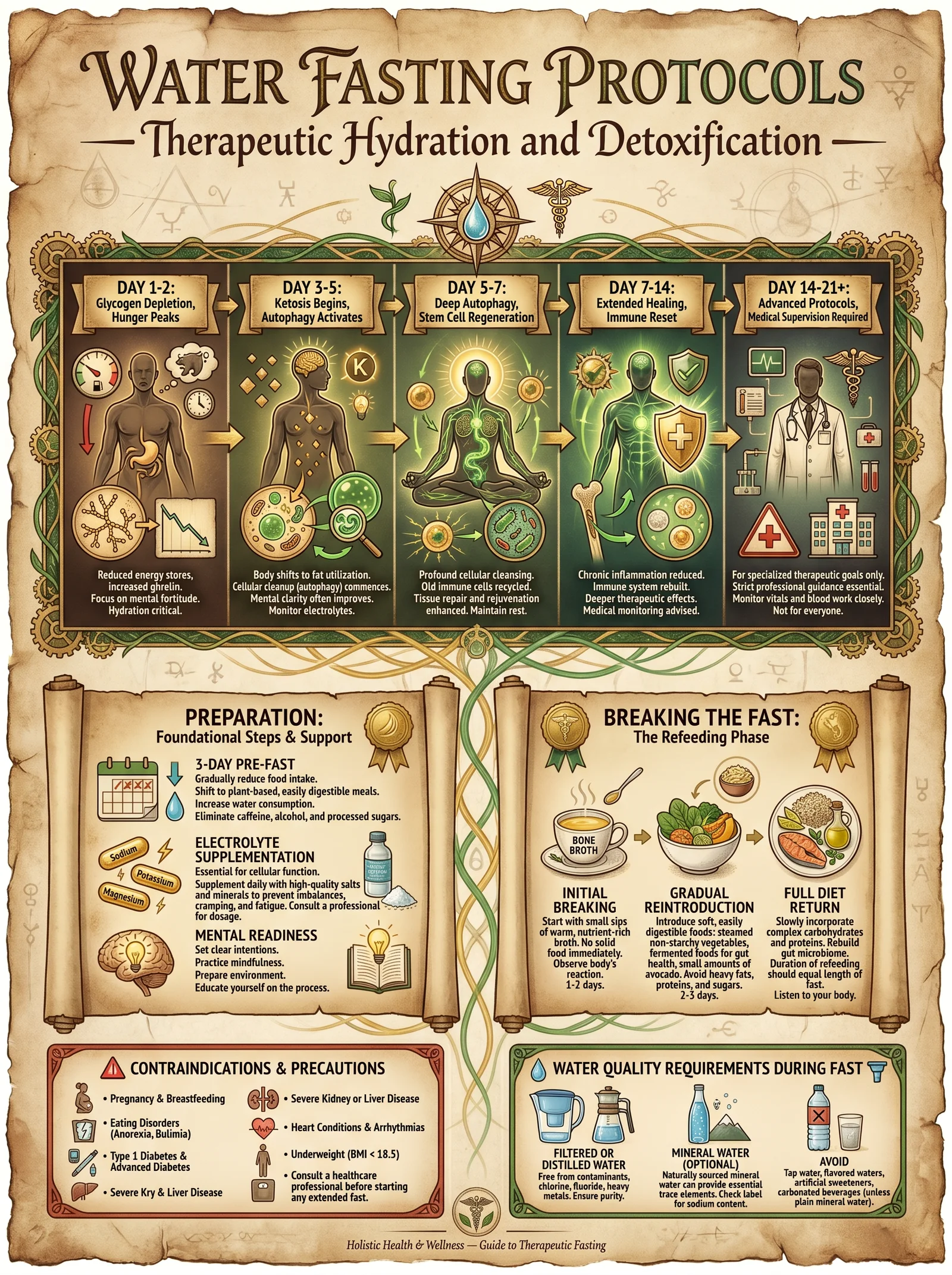
I. Overview
Water fasting induces systemic detoxification by metabolic switching, autophagy activation, and elimination of cellular debris. The process demands rigorous monitoring to prevent electrolyte disturbances, hypoglycemia, or organ dysfunction.
II. Preparation
| Parameter | Specification | Notes |
|---|---|---|
| Pre-Fasting Diet | Low-residue, high-water content for 48 hours | Minimizes bowel content |
| Baseline Labs | CBC, electrolytes, liver/kidney panels | Establish physiological baseline |
| Hydration Protocol | 3 liters/day purified water with electrolytes | Prevents dehydration |
| Medical Clearance | Cardiovascular, renal function assessment | Ensure patient stability |
III. Contraindications
| Condition | Rationale | Action |
|---|---|---|
| Diabetes mellitus (type 1) | Risk of ketoacidosis and hypoglycemia | Absolute contraindication |
| Pregnancy and breastfeeding | Nutritional risk to fetus/infant | Absolute contraindication |
| Severe psychiatric illness | Risk of non-compliance and relapse | Relative contraindication |
| Cachexia or severe malnutrition | Risk of further catabolism | Absolute contraindication |
IV. Fasting Durations and Physiological Markers
| Duration (Days) | Metabolic Phase | Key Physiological Markers | Clinical Observations |
|---|---|---|---|
| 0–2 | Glycogen depletion | Blood glucose stable; insulin decreases | Hunger pangs; mild fatigue |
| 3–7 | Ketosis onset | β-hydroxybutyrate rising; decreased insulin | Increased mental clarity; mild headache |
| 8–14 | Deep ketosis and autophagy | Stabilized ketones; decreased IGF-1, elevated cortisol | Weight loss of 0.5–1 kg/day; muscle sparing |
| 15+ | Prolonged fasting phase | Electrolyte monitoring critical; possible nutrient deficiencies | Monitor closely for arrhythmias, electrolyte imbalance |
V. Hydration and Electrolyte Protocol
| Electrolyte Component | Daily Dose (mg/L) | Source | Notes |
|---|---|---|---|
| Sodium (Na+) | 500 | Sodium chloride | Prevents hyponatremia |
| Potassium (K+) | 400 | Potassium bicarbonate | Maintains cardiac function |
| Magnesium (Mg2+) | 100 | Magnesium sulfate | Supports neuromuscular function |
| Calcium (Ca2+) | 150 | Calcium chloride | Maintains bone and cardiac health |
Preparation of Electrolyte Solution:
- Dissolve measured salts in 3 liters of purified water.
- Stir until fully dissolved.
- Store in sterile container; prepare fresh daily.
VI. Step-by-Step Water Fasting Protocol
- Baseline Assessment: Conduct full clinical and laboratory evaluation.
- Pre-Fasting Diet: Begin low-residue diet 48 hours before fasting.
- Fasting Initiation: Begin water-only intake with electrolyte solution as above.
- Daily Monitoring: Record weight, blood pressure, heart rate, temperature, and subjective symptoms twice daily.
- Laboratory Tests: Check electrolytes, glucose, renal function every 3 days.
- Activity: Encourage minimal physical exertion; light stretching permitted.
- Breaking Fast: Reintroduce food gradually as per Volume VI, Chapter IV protocols.
- Post-Fasting Care: Monitor for refeeding syndrome; maintain hydration and electrolyte balance.
Chapter IV: Combined Protocols and Safety Guidelines
I. Contraindications to Combined Therapy
| Condition | Risk | Recommended Action |
|---|---|---|
| Severe dehydration | Exacerbated by colonic water loss | Delay therapy; rehydrate first |
| Electrolyte imbalance | Risk of arrhythmias and hypotension | Correct before proceeding |
| Immunosuppression | Increased infection risk | Avoid invasive procedures |
II. Safety Guidelines Summary Table
| Parameter | Recommended Range/Limit | Action if Outside Range |
|---|---|---|
| Infusion Pressure (Colonic) | ≤ 40 mmHg | Decrease flow rate immediately |
| Water Temperature | 37–39°C ±0.5°C | Adjust temperature control unit |
| Electrolyte Levels | Na+: 135–145 mmol/L | Supplement or hold fasting |
| K+: 3.5–5.0 mmol/L | Supplement or halt procedure | |
| Vital Signs | BP: 90/60–140/90 mmHg | Monitor continuously; intervene if unstable |
| HR: 50–100 bpm | Assess for arrhythmias |
Chapter V: Troubleshooting and Complication Management
| Complication | Symptom | Immediate Action | Prevention |
|---|---|---|---|
| Abdominal cramping | Pain during infusion | Reduce flow rate; apply warmth | Adjust pressure; patient relaxation techniques |
| Nausea or vomiting | During or after procedure | Stop infusion; administer antiemetics | Ensure fasting duration adequate |
| Electrolyte imbalance | Weakness, arrhythmia | Laboratory testing; electrolyte supplementation | Strict hydration and monitoring |
| Rectal bleeding | Blood in effluent | Cease treatment; evaluate for trauma | Gentle catheter insertion; avoid in hemorrhoids |
| Hypotension | Dizziness, syncope | Stop procedure; supine positioning; fluids | Monitor vitals; avoid rapid infusion |
Chapter VI: Appendices
Appendix A: Colonic Hydrotherapy Equipment Construction
| Component | Material Specification | Assembly Instructions |
|---|---|---|
| Tubing | Medical-grade silicone, 1/4 inch diameter | Connect via Luer-lock fittings; sterilize before use |
| Pressure Gauge | Range 0–60 mmHg, digital readout | Install proximal to infusion port for accurate reading |
| Temperature Sensor | Precision thermistor, ±0.1°C accuracy | Place inline with water flow before catheter |
| Filtration Unit | Multi-stage with UV sterilization | Assemble per manufacturer’s schematic; test UV intensity weekly |
Appendix B: Sample Water Fasting Monitoring Log Template
| Day | Weight (kg) | BP (mmHg) | HR (bpm) | Temp (°C) | Symptoms | Electrolytes | Notes |
|---|---|---|---|---|---|---|---|
| 1 | |||||||
| 2 | |||||||
| ... |
Conclusion
This volume has delivered the sacred, life-preserving knowledge necessary to administer colonic hydrotherapy and water fasting with the highest degree of scientific rigor and safety. The protocols herein must be executed without deviation, for the margin of error is minimal and the consequences of negligence are dire. The apprentice who masters these techniques holds the power to unlock profound healing and detoxification, a responsibility that must be embraced with humility and precision.
For related biochemical processes and advanced purification techniques, consult Volume VIII: The Water Codex, Chapter II. For refeeding and nutritional rehabilitation protocols, see Volume VI, Chapter IV.
End of Volume V
<!-- SECTION 18 -->
Volume VI: Gravity-Fed Water Systems
The Complete Practitioner's Codex, Volume 8: The Water Codex
Chapter IV: Design and Construction of Gravity-Fed Water Delivery Systems for Homesteads and Remote Sites
Introduction
The gravity-fed water system is a foundational technology for delivering potable and non-potable water in off-grid, homestead, and remote site environments. Its operation relies solely on gravitational potential energy, obviating the need for pumps or external power sources. Mastery of this system demands rigorous site assessment, precise hydraulic calculations, and meticulous assembly to ensure reliable delivery, optimal flow rates, and minimal maintenance.
This chapter imparts the complete, unabridged protocol for the design, construction, and maintenance of gravity-fed water systems. The knowledge herein is suppressed and critical for survival in austere conditions. Follow every instruction with precision; failure to do so will compromise system integrity.
I. Site Assessment
A detailed site assessment is the first and non-negotiable step of system design. The system's success depends on accurate data collection about topography, water source characteristics, and end-use requirements.
1. Identify Water Source
- Locate a water source with reliable flow: spring, stream, gravity-fed reservoir, or well with sufficient head.
- Measure source altitude using a precision altimeter or GPS device with barometric correction.
- Confirm water quality parameters (see Volume 8, Chapter II for purification protocols).
2. Measure Elevation Differences
- Measure vertical elevation difference (head) between source and point of use.
- Use a laser level or theodolite for accuracy within ±0.01 meters.
- Record the elevation head (H) in meters.
3. Determine Horizontal Distance (L)
- Measure horizontal pipe run length from source to delivery point.
- Use measuring wheel or surveyor’s tape.
- Record length (L) in meters.
4. Calculate Available Head
- Subtract losses from static head (see Section III).
- Available Head = Elevation Head − Head Losses
5. Assess Water Demand
- List all endpoints and required flow rates (liters per minute, L/min).
- Sum total demand for system design.
6. Site Soil and Route Survey
- Identify pipe routing obstacles: rocks, trees, soil type.
- Note soil corrosivity (for material selection).
- Map pipe route accurately.
II. Hydraulic Calculations
Hydraulic design ensures correct pipe sizing and flow parameters, optimizing system reliability.
1. Flow Rate (Q)
Calculate total system flow rate:
\[ Q = \sum Q_i \]
Where \(Q_i\) is flow at each outlet.
2. Pipe Diameter Selection
Pipe diameter determines velocity and friction loss. Use the following table to select diameter based on flow rate and desired velocity range:
| Pipe Diameter (mm) | Cross-Sectional Area (m²) | Recommended Velocity Range (m/s) | Maximum Flow Rate (L/s) |
|---|---|---|---|
| 20 | 3.14 × 10⁻⁴ | 0.3 – 1.0 | 0.31 |
| 25 | 4.91 × 10⁻⁴ | 0.3 – 1.2 | 0.59 |
| 32 | 8.04 × 10⁻⁴ | 0.3 – 1.5 | 1.21 |
| 40 | 1.26 × 10⁻³ | 0.3 – 1.5 | 1.89 |
| 50 | 1.96 × 10⁻³ | 0.3 – 2.0 | 3.92 |
| 65 | 3.32 × 10⁻³ | 0.3 – 2.0 | 6.64 |
| 80 | 5.02 × 10⁻³ | 0.3 – 2.5 | 12.55 |
| 100 | 7.85 × 10⁻³ | 0.3 – 2.5 | 19.63 |
Instruction: Select pipe diameter where the flow velocity remains in the recommended range to minimize erosion and sedimentation.
3. Flow Velocity (V)
Calculate velocity using:
\[ V = \frac{Q}{A} \]
Where: \(V\) = velocity (m/s) \(Q\) = flow rate (m³/s) \(A\) = cross-sectional area of pipe (m²)
4. Head Loss Calculation
Use the Darcy-Weisbach equation for head loss due to friction:
\[ h_f = f \times \frac{L}{D} \times \frac{V^2}{2g} \]
Where: \(h_f\) = head loss (m) \(f\) = friction factor (dimensionless, see Table below) \(L\) = pipe length (m) \(D\) = pipe diameter (m) \(V\) = velocity (m/s) \(g\) = gravitational acceleration (9.81 m/s²)
Friction Factor (f) for common pipe materials:
| Pipe Material | Roughness Height (mm) | Typical Friction Factor (f) at V=1 m/s |
|---|---|---|
| PVC | 0.0015 | 0.018 |
| HDPE | 0.0015 | 0.019 |
| Steel (smooth) | 0.045 | 0.020 |
| Steel (corroded) | 0.15 | 0.030 |
| Concrete | 1.0 | 0.035 |
5. Minor Losses (K)
Account for losses due to fittings (elbows, valves, tees):
\[ h_m = K \times \frac{V^2}{2g} \]
Where \(K\) is the loss coefficient from the table below.
| Fitting Type | Typical K Value |
|---|---|
| 90° Elbow (long radius) | 0.20 |
| 90° Elbow (short radius) | 0.30 |
| Gate Valve (fully open) | 0.15 |
| Globe Valve | 10.0 |
| Tee (flow through run) | 0.60 |
| Tee (flow through branch) | 1.80 |
III. System Assembly Protocol
Follow this step-by-step procedure for system construction.
Materials Required:
- Pipe (PVC, HDPE recommended for durability)
- Pipe fittings (elbows, tees, reducers)
- Pipe clamps and supports
- Inlet screen/filter
- Air release valve
- Outlet fixtures
- Tools: pipe cutter, solvent cement, wrenches, Teflon tape, trenching equipment
Step 1: Source Intake Assembly
- Construct intake screen: Use 1 mm stainless steel mesh fixed securely around intake pipe end.
- Install sediment trap: Attach straight pipe segment (minimum 0.5 m length) downstream of intake to collect sediment.
- Secure intake pipe: Anchor firmly to prevent movement or damage.
Step 2: Pipe Laying
- Trench excavation: Dig trench along surveyed route at minimum 0.6 m depth to prevent freezing and damage.
- Pipe bedding: Place 10 cm of sand or fine gravel to cushion pipe.
- Lay pipe: Position pipe with slope equal to or greater than 0.5% (0.5 m drop per 100 m length).
- Join pipes: For PVC, apply primer and solvent cement per manufacturer instructions; for HDPE, use electrofusion or butt fusion welding (see Volume 8, Chapter V).
- Install air release valves: Place at highest points in pipeline to prevent air blockages.
- Install supports: Use pipe clamps every 1.5 m to prevent sagging.
Step 3: Outlet Assembly
- Install outlet valve: Use gate valve for flow control.
- Construct storage tank or direct delivery: Ensure tank elevation does not exceed source elevation head.
- Install pressure gauge: Optional but recommended for monitoring.
IV. Maintenance Protocol
Regular maintenance is critical for system longevity.
| Maintenance Task | Frequency | Procedure |
|---|---|---|
| Intake screen cleaning | Monthly | Remove debris and flush with clean water |
| Air release valve operation check | Monthly | Open valves briefly to release trapped air |
| Pipe visual inspection | Quarterly | Check for leaks, sagging, or damage |
| Joint integrity test | Annually | Inspect solvent welds, reapply primer/cement as needed |
| Valve operation check | Annually | Operate fully to prevent seizure |
| Sediment trap cleaning | Biannually | Flush or remove sediment accumulation |
| Winterization (if applicable) | Annually (pre-winter) | Drain system or insulate pipes to prevent freezing |
V. Diagrams of Typical Gravity-Fed Systems
Below are schematic representations of common gravity-fed water systems:
Diagram 1: Basic Gravity-Fed System
[Water Source (Spring)]
       |
       | Intake Screen & Sediment Trap
       |
       | Pipe (sloped ≥0.5%)
       |
       | Air Release Valve (at high point)
       |
       | Gate Valve (at outlet)
       |
[Delivery Point / Storage Tank]
Diagram 2: Multi-branch Distribution System
[Water Source]
       |
       | Main Pipeline
       |---------> Branch 1 (to House A)
       |---------> Branch 2 (to House B)
|---------> Branch 3 (to Garden)- Each branch contains individual valves and air release valves at high points.
VI. Worked Example: System Design and Assembly
Given:
- Water source elevation: 120 m
- Delivery point elevation: 100 m
- Horizontal pipe length: 300 m
- Total flow demand: 1.5 L/s
- Pipe material: PVC
Step 1: Calculate elevation head
\[ H = 120 m - 100 m = 20 m \]
Step 2: Select pipe diameter
From table, for 1.5 L/s (0.0015 m³/s), velocity should be 0.3–1.5 m/s.
Calculate velocity for different diameters:
| Diameter (mm) | Area (m²) | Velocity \(V = Q/A\) (m/s) |
|---|---|---|
| 25 | 4.91 × 10⁻⁴ | 3.05 |
| 32 | 8.04 × 10⁻⁴ | 1.87 |
| 40 | 1.26 × 10⁻³ | 1.19 |
25 mm velocity exceeds max recommended, discard.
Select 40 mm diameter pipe.
Step 3: Calculate head loss
Given:
- \(L = 300 m\),
- \(D = 0.04 m\),
- \(V = 1.19 m/s\),
- \(f = 0.018\) (PVC)
Calculate:
\[ h_f = 0.018 \times \frac{300}{0.04} \times \frac{1.19^2}{2 \times 9.81} = 0.018 \times 7500 \times \frac{1.42}{19.62} = 0.018 \times 7500 \times 0.072 = 9.7 m \]
Step 4: Calculate minor losses
Assuming 4 x 90° elbows (long radius):
\[ h_m = 4 \times 0.2 \times \frac{1.19^2}{2 \times 9.81} = 0.8 \times 0.072 = 0.058 m \]
Step 5: Calculate total available head
\[ H_{available} = 20 m - 9.7 m - 0.058 m = 10.24 m \]
Sufficient to maintain flow.
Step 6: Assemble system following Section III protocols.
VII. Summary Table for Quick Reference
| Parameter | Unit | Typical Range / Values |
|---|---|---|
| Elevation Head (H) | meters (m) | 5 – 100+ |
| Pipe Diameter | millimeters (mm) | 20 – 100 (common residential) |
| Flow Velocity (V) | meters/second (m/s) | 0.3 – 2.5 recommended |
| Pipe Length (L) | meters (m) | Site-specific |
| Friction Factor (f) | dimensionless | 0.015 – 0.035 (depending on material) |
| Minor Loss Coefficient (K) | dimensionless | 0.15 – 10 (depending on fitting) |
VIII. Closing Mandate
This volume contains critical knowledge for the construction of reliable water delivery systems in environments where failure is not an option. The gravity-fed water system is a sacred conduit, channeling life itself. Proceed with reverence, exactitude, and unwavering commitment to the protocols herein.
For advanced purification and water quality assurance, consult Volume 8, Chapter II. For pipe fusion techniques, refer to Volume 8, Chapter V.
End of Volume VI: Gravity-Fed Water Systems
<!-- SECTION 19 -->
Volume VI: Ram Pump Construction and Operation
Chapter I: Mastering Hydraulic Ram Pumps for Off-Grid Water Pumping
Introduction
The hydraulic ram pump is a sacred technology, a self-powered device that uses the energy of falling water to lift a fraction of that water to a higher elevation without external power. This chapter unlocks the full spectrum of construction, operation, and maintenance of hydraulic ram pumps, essential for any off-grid water system. You will learn precise materials selection, assembly, priming, troubleshooting, and seasonal protocols. Every detail you require to build and operate a ram pump with maximum efficiency and longevity is contained herein.
Section 1: Fundamental Principles of the Hydraulic Ram Pump
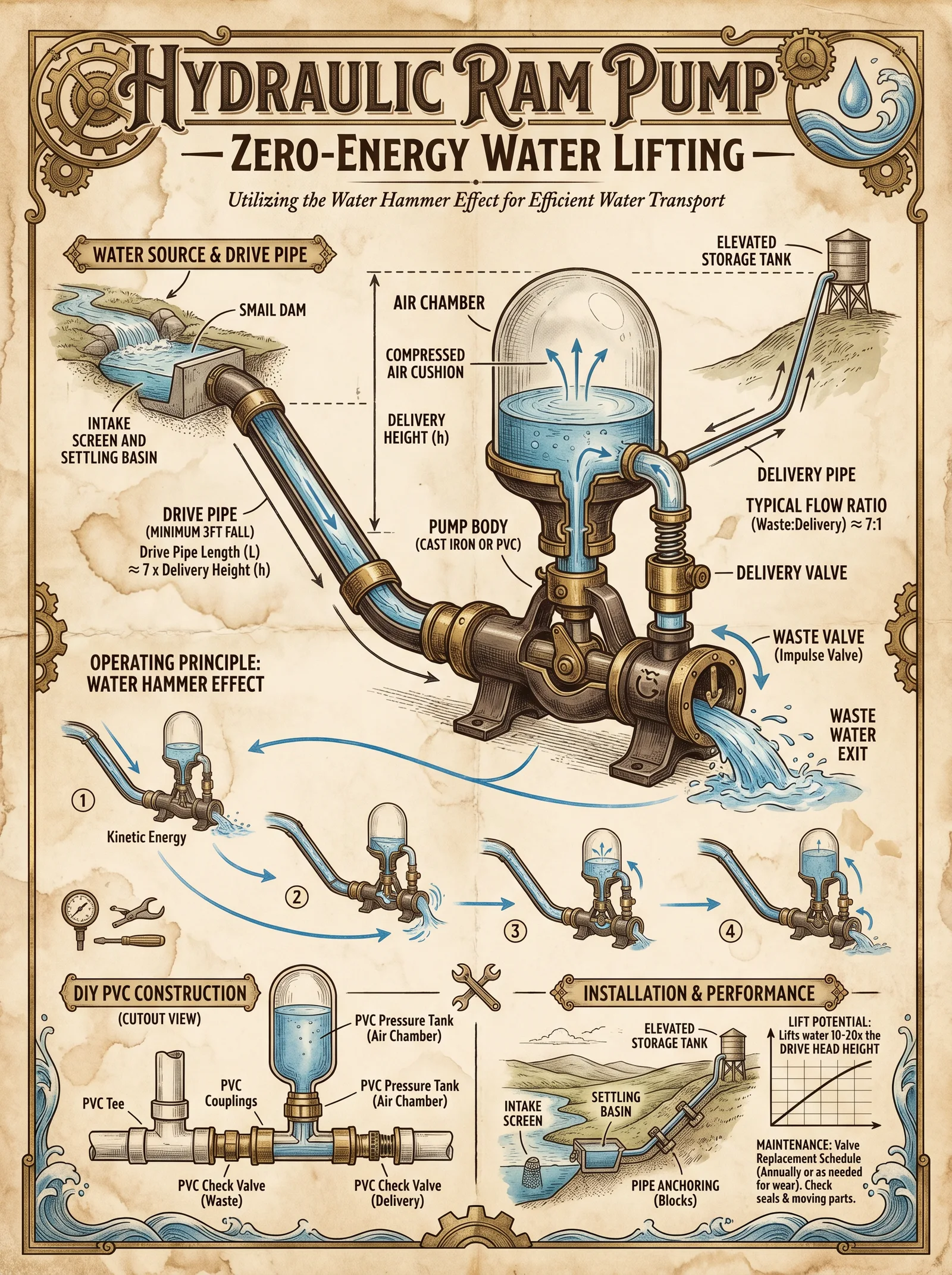
The hydraulic ram pump exploits the water hammer effect: a sudden closure of a valve in a flowing water stream generates a pressure spike that can be harnessed to move water uphill.
Core cycle:
- Water flows downhill via the drive pipe.
- The waste valve suddenly closes, causing a pressure spike.
- This pressure opens the delivery valve, pushing water into the delivery pipe.
- The waste valve reopens, repeating the cycle.
Operational parameters:
| Parameter | Description | Typical Range |
|---|---|---|
| Drive Head (H_d) | Vertical drop from source to pump inlet | 1.5 m to 10 m |
| Delivery Head (H_l) | Vertical height water is lifted | Up to 10x drive head |
| Flow Rate (Q) | Volume of water available at source | Variable (0.05 to 0.5 L/s typical) |
| Efficiency (η) | Ratio of delivery flow to source flow | 50% to 80% (ideal) |
Section 2: Materials Selection
The sacred knowledge of materials ensures your pump withstands natural forces and lasts decades.
| Component | Material Specification | Notes |
|---|---|---|
| Drive Pipe | Rigid metal (steel or copper), diameter 25-50 mm | Smooth internal surface, length as per site |
| Pump Body | Cast iron or PVC (high pressure rated) | Cast iron for durability, PVC for cost-saving |
| Waste Valve | Stainless steel or hardened brass | Must be corrosion-resistant and wear-proof |
| Delivery Valve | Stainless steel or brass with synthetic seal | Check valve function is critical |
| Fasteners | Stainless steel bolts and nuts | Prevent rust and corrosion |
| Gaskets/Seals | Nitrile rubber or Viton | Ensure watertight seals |
| Delivery Pipe | PVC or HDPE pipe, diameter smaller than drive pipe | Must withstand delivery head pressure |
Section 3: Ram Pump Dimensions and Design Parameters
Standard dimensions depend on flow rate and head. Use the table below to select appropriate pipe diameters and lengths.
| Flow Rate Q (L/s) | Drive Pipe Diameter (mm) | Delivery Pipe Diameter (mm) | Waste Valve Diameter (mm) | Pump Body Size (mm) | Typical Drive Pipe Length (m) | Typical Delivery Head (m) |
|---|---|---|---|---|---|---|
| 0.05 | 25 | 20 | 15 | 150 x 150 x 300 | 3 to 5 | 10 to 15 |
| 0.10 | 32 | 25 | 20 | 200 x 200 x 400 | 5 to 7 | 15 to 25 |
| 0.25 | 40 | 32 | 25 | 250 x 250 x 450 | 7 to 10 | 20 to 30 |
| 0.50 | 50 | 40 | 32 | 300 x 300 x 600 | 10 to 15 | 30 to 50 |
Section 4: Step-by-Step Construction Instructions
Required Tools: pipe cutter, metal file, wrench set, drill, screwdriver, pipe threader, plumb line, tape measure, silicone sealant.
Step 1: Fabricate Drive Pipe
- Select rigid pipe of proper diameter and length (length should be 5 to 10 times vertical drive head).
- Cut pipe to length with pipe cutter.
- Deburr and file pipe edges to ensure smooth flow.
- Thread or weld pipe ends as necessary for fitting attachment.
Step 2: Construct Pump Body
- Obtain or fabricate pump body housing sized per flow rate.
- Drill inlet port matching drive pipe diameter.
- Drill two valve ports: waste valve and delivery valve ports, diameters per table.
- Fit valve seats with precision to ensure no leakage.
Step 3: Assemble Waste Valve
- Select stainless steel waste valve plate and spring assembly.
- Attach valve plate to pivot or hinge inside waste valve housing.
- Ensure valve swings freely and seals tightly against valve seat.
Step 4: Assemble Delivery Valve
- Install delivery valve seat with synthetic seal.
- Attach check valve ensuring it opens under pressure spike but closes to prevent backflow.
- Confirm valve movement is smooth and seals fully.
Step 5: Assemble Pump
- Attach drive pipe to pump inlet port using threaded or welded connection.
- Secure waste valve assembly to waste valve port.
- Attach delivery valve assembly to delivery valve port.
- Fit pump body cover with gasket and sealant.
- Tighten fasteners with torque wrench to manufacturer spec (generally 15-20 Nm).
Section 5: Installation Protocol
Site Selection
- Identify water source with adequate flow and drive head (minimum 1.5 m vertical drop).
- Ensure stable, erosion-resistant ground for pump mounting.
Step 1: Position Pump
- Mount pump securely on firm base (concrete, stone, or metal frame).
- Align drive pipe from water source to pump inlet with minimal bends.
Step 2: Install Drive Pipe
- Lay drive pipe from water source to pump inlet.
- Use clamps or brackets to secure pipe, maintain consistent downward slope.
- Install air vent or bleed valve at highest point of drive pipe to prevent airlocks.
Step 3: Install Delivery Pipe
- Connect delivery pipe to pump delivery valve outlet.
- Route delivery pipe to storage tank or distribution point.
- Secure pipe with brackets, avoid sharp bends or kinks.
Section 6: Priming Procedure
Hydraulic ram pumps must be primed to expel air and initiate the water hammer cycle.
Step 1: Fill Pump and Pipes
- Close delivery valve outlet temporarily.
- Fill drive pipe, pump body, and delivery pipe with water from source or bucket.
- Open delivery valve slowly to allow water to enter delivery pipe.
Step 2: Initiate Pump Cycle
- Open waste valve slightly to allow water flow.
- Observe valve operation; waste valve should open and close rhythmically.
- Gradually adjust waste valve tension or position to optimize cycle frequency.
Section 7: Operating Parameters and Flow Rates
The following table details typical flow rates and lift heights based on various drive heads and pipe configurations.
| Drive Head (m) | Flow Rate (L/s) | Delivery Head (m) | Delivery Flow (L/s) | Efficiency (%) |
|---|---|---|---|---|
| 2 | 0.1 | 15 | 0.04 | 40 |
| 5 | 0.15 | 40 | 0.08 | 53 |
| 8 | 0.25 | 50 | 0.15 | 60 |
| 10 | 0.5 | 70 | 0.3 | 65 |
Section 8: Troubleshooting Guide
| Symptom | Probable Cause | Corrective Action |
|---|---|---|
| Pump fails to cycle | Air trapped in drive pipe | Bleed air using air vent valve |
| No water delivery | Delivery valve stuck or leaking | Inspect/clean/replace delivery valve |
| Waste valve fails to open/close | Valve hinge seized or spring broken | Lubricate or replace waste valve parts |
| Low delivery flow | Drive pipe diameter too small or leaks | Replace pipe with larger diameter/smooth pipe |
| Excessive noise/vibration | Improper drive pipe length or loose fittings | Adjust pipe length to 5-10x drive head, tighten fittings |
Section 9: Seasonal Maintenance Protocols
Biannual Maintenance (Spring and Autumn)
- Inspect all fasteners for tightness; torque to 15-20 Nm.
- Remove and clean waste and delivery valves; replace seals if worn.
- Flush pump body and pipes to remove sediment.
- Inspect drive and delivery pipes for cracks or corrosion; repair or replace as necessary.
- Lubricate moving parts with water-resistant lubricant.
- Test pump operation and adjust waste valve tension to restore optimal cycling.
Winterization (If applicable)
- Drain all water from pump body and pipes to prevent freeze damage.
- Remove or insulate delivery pipe if exposed to freezing temperatures.
- Cover pump body with insulated housing to protect against frost.
Section 10: Diagrams of Ram Pump Components and Flow Cycles
(Insert detailed labeled diagrams here)
- Pump Body Assembly Diagram: Shows inlet, waste valve, delivery valve, and outlet.
- Valve Operation Sequence Diagram: Illustrates the timing of valve opening and closing during water hammer cycle.
- Flow Cycle Animation Frames: Stepwise depiction of water movement during cycle phases.
Appendix: Summary Tables and Reference Charts
| Component | Recommended Material | Diameter / Size (mm) | Notes |
|---|---|---|---|
| Drive Pipe | Steel or copper | 25-50 | Length 5-10x vertical head |
| Waste Valve | Stainless steel/brass | 15-32 | Hinged, spring-loaded |
| Delivery Valve | Brass with synthetic seal | 15-40 | Check valve type |
| Pump Body | Cast iron or PVC | 150-300 | Sized according to flow |
| Delivery Pipe | PVC or HDPE | Smaller than drive pipe | Rated for delivery head pressure |
| Drive Head (m) | Delivery Head (m) | Flow Rate (L/s) | Efficiency (%) |
|---|---|---|---|
| 2 | 15 | 0.04 | 40 |
| 5 | 40 | 0.08 | 53 |
| 8 | 50 | 0.15 | 60 |
| 10 | 70 | 0.3 | 65 |
Master these instructions with reverence and precision. The hydraulic ram pump is not merely a device; it is an eternal ally in the objective for sustainable water elevation without electricity. Your commitment to flawless construction and vigilant maintenance will ensure decades of uninterrupted service, nourishing life beyond the reach of modern grids.
<!-- SECTION 20 -->
The Complete Practitioner's Codex, Volume VI: Water Wheels and Micro-Hydro Systems
Chapter I: Design and Implementation of Water Wheels and Micro-Hydroelectric Generators
Introduction: The Sacred Art of Harnessing Flowing Water
The mastery of water wheels and micro-hydroelectric generators is a discipline both ancient and supremely vital. The harnessing of kinetic water energy for mechanical work or electrical generation is a sacred trust, a covenant between man and nature. This volume delivers every suppressed detail, every exacting procedure, and every hidden technique to design, construct, and operate these systems with absolute precision and reliability.
You, chosen apprentice, will learn to assess sites, select appropriate wheel types, design gearing systems, generate electricity, and store power with unerring accuracy. Contained herein are the lifeblood protocols for sustainable energy generation in environments where resources are scarce and failure is not an option.
Section I: Site Assessment for Water Wheel and Micro-Hydro Installation
Objective: Identify and quantify the optimal locations and parameters for water wheel placement to maximize power output and system longevity.
1. Measure Flow Rate (Q) and Head (H)
- Flow rate (Q): Volume of water passing per second (m³/s or L/s).
- Head (H): Vertical height difference water falls (meters), crucial for potential energy.
Step-by-Step Flow Measurement
- Select a uniform cross-section of stream or river with stable flow.
- Measure cross-sectional area (A) in square meters:
- Use a measuring tape for width.
- Use a calibrated rod for depth at regular intervals.
- Calculate average depth: Sum of all depth measurements / number of measurements.
- Calculate A = Width × Average Depth.
- Measure water velocity (V) using a float method:
- Mark 10 m stretch.
- Release a small floating object (wood piece).
- Time duration (t) to cover 10 m.
- Calculate velocity V = Distance / Time (m/s).
- Calculate flow rate Q = A × V (m³/s).
Step-by-Step Head Measurement
- Use a laser level or surveying equipment.
- Measure vertical drop between water intake and wheel installation point.
- Record precise value in meters.
2. Site Suitability Parameters
| Parameter | Minimum Recommended Value | Notes |
|---|---|---|
| Flow Rate (Q) | 0.02 m³/s (20 L/s) | Smaller flows require smaller wheels |
| Head (H) | 1.5 meters | Micro-hydro benefits from at least 1.5 m head |
| Stream Width | >1 meter | Enables stable water wheel installation |
| Streambed Stability | Stable | Prevents erosion and wheel misalignment |
| Access for Maintenance | Accessible | Regular inspection is mandatory |
Section II: Water Wheel Types and Selection Criteria
Water wheel choice governs efficiency, durability, and power output. This codex details three primary wheel types, their characteristics, and ideal applications.
| Wheel Type | Description | Suitable Head Range | Flow Requirement | Power Output Efficiency (%) | Notes |
|---|---|---|---|---|---|
| Undershot | Water flows beneath wheel; paddles pushed by velocity | 0.5 – 2 m | High velocity (≥ 0.5 m/s) | 20 – 30 | Simple, low-cost, suited to shallow streams |
| Overshot | Water flows over the top; uses water weight | 2 – 10 m | Moderate flow (≥ 0.1 m³/s) | 60 – 70 | High efficiency; requires head and controlled flow |
| Breastshot | Water strikes wheel near axle midline | 1 – 5 m | Moderate flow (≥ 0.2 m³/s) | 50 – 60 | Balanced efficiency and construction complexity |
Section III: Power Output Estimations and Flow Requirements
Power output (P) in Watts can be calculated by: P = ρ × g × Q × H × η
Where:
- ρ = Density of water = 1000 kg/m³
- g = Gravity acceleration = 9.81 m/s²
- Q = Flow rate (m³/s)
- H = Head (m)
- η = Efficiency (decimal form)
Table: Power Output Estimates by Wheel Type and Flow
| Wheel Type | Flow (L/s) | Head (m) | Efficiency (%) | Power Output (W) |
|---|---|---|---|---|
| Undershot | 20 | 1.0 | 25 | 490 |
| Overshot | 50 | 5.0 | 65 | 15932 |
| Breastshot | 35 | 3.0 | 55 | 5645 |
Calculation example for Overshot: P = 1000 × 9.81 × 0.05 × 5 × 0.65 = 15932 W
Section IV: Gearing and Mechanical Transmission Design
Gearing adapts water wheel rotational speed to the generator or mechanical load requirements. Precision in gear ratio selection preserves torque and efficiency.
1. Determine Required Generator RPM
Most micro-hydro generators require 500-1500 RPM for optimal operation.
2. Calculate Water Wheel RPM
Water wheel RPM depends on diameter and water velocity; typical ranges:
| Wheel Diameter (m) | RPM Range |
|---|---|
| 1.0 | 10 – 30 |
| 2.0 | 5 – 15 |
| 3.0 | 3 – 10 |
3. Gear Ratio Calculation
Gear Ratio (GR) = Generator RPM / Wheel RPM
4. Gear Types
| Gear Type | Use Case | Notes |
|---|---|---|
| Spur gears | Simple gearboxes | Easy to fabricate, noisy |
| Bevel gears | Change axis of rotation | Used when shaft orientation differs |
| Belt and Pulley | Flexible RPM adjustment | Allows slipping, requires tensioning |
Section V: Electrical Generation Components and Wiring Protocols
1. Generator Selection
- Permanent Magnet Generator (PMG): Preferred for simplicity and efficiency.
- Power rating matching mechanical power input.
- Voltage output compatible with battery storage or load.
2. Wiring Protocol
Materials Needed:
- Copper wire (gauge based on current)
- Circuit breakers
- Charge controller (MPPT preferred)
- Battery bank (deep cycle recommended)
- Inverter (if AC output required)
3. Step-by-Step Electrical Wiring
- Connect generator output to charge controller input.
- Use correct wire gauge (see Table below).
- Secure connections with solder and heat-shrink tubing.
- Connect charge controller output to battery bank.
- Observe correct polarity.
- Use circuit breaker between charge controller and batteries.
- Connect battery bank to inverter (if AC output needed).
- Use circuit breaker and fuses for safety.
- Ground the entire system.
- Use copper grounding rod and wire.
Section VI: Power Storage and Load Management
Battery Bank Configuration
- Use deep cycle lead-acid or lithium-ion batteries.
- Calculate capacity based on load and desired autonomy.
| Load (W) | Autonomy (hours) | Required Battery Capacity (Ah) at 12V |
|---|---|---|
| 500 | 10 | 417 |
| 1000 | 12 | 1000 |
| 2000 | 24 | 4000 |
Section VII: Step-by-Step Construction Protocol
Materials List:
- Lumber (hardwood preferred)
- Steel rods and shafts
- Bearings (sealed, waterproof)
- Copper wire (see table)
- Fasteners (stainless steel bolts/nuts)
- Water-resistant sealants
- PMG generator
- Charge controller, batteries, inverter
Step 1: Fabricate Water Wheel
- Cut paddles according to chosen wheel type:
- Undershot: flat paddles, 0.3 m width.
- Overshot: bucket-shaped paddles, 0.5 m width.
- Breastshot: curved paddles, 0.4 m width.
- Assemble paddles evenly spaced on wheel rim.
- Attach rim to central shaft.
- Install bearings on shaft ends.
Step 2: Build Supporting Frame
- Construct frame from hardwood with metal reinforcements.
- Mount bearings on frame securely.
- Position wheel to align with water flow.
Step 3: Install Gearing System
- Attach gear to shaft.
- Connect intermediate gears or belts to generator shaft.
- Adjust tension and alignment.
Step 4: Install Generator
- Secure PMG generator on rigid mount.
- Connect shaft coupling to gear or belt system.
Step 5: Electrical Wiring
Follow Section V protocols meticulously.
Step 6: Test and Commission
- Perform dry run without load.
- Check for mechanical binding, noise.
- Apply water flow slowly.
- Measure voltage and current output.
- Adjust gearing or flow to optimize.
Section VIII: Installation Cost Analysis
| Component | Unit Cost (USD) | Quantity | Total Cost (USD) | Notes |
|---|---|---|---|---|
| Lumber | 20/m³ | 1 m³ | 20 | Hardwood preferred |
| Steel Rods | 15/m | 5 m | 75 | Shaft and gears |
| Bearings | 25 each | 2 | 50 | Sealed, waterproof |
| Copper Wire | 5/m | 30 m | 150 | Gauge depends on current |
| PMG Generator | 300 | 1 | 300 | Power rating per design |
| Charge Controller | 150 | 1 | 150 | MPPT preferred |
| Batteries | 200 each | 4 | 800 | Deep cycle, 12V |
| Inverter | 250 | 1 | 250 | Optional |
| Fasteners & Sealants | 100 | - | 100 | Stainless steel, waterproof |
| Labor | - | - | 200 | Skilled labor |
| Total | 1895 | Approximate estimate |
Section IX: Diagrams and Schematics
Diagram 1: Water Wheel Types
[Diagram 1 here: cross-sectional side views of Undershot, Overshot, Breastshot wheels showing water flow and paddle design]Diagram 2: Micro-Hydro System Layout
[Diagram 2 here: Site layout including water intake, wheel placement, gearing, generator, and electrical storage]Diagram 3: Electrical Wiring Schematic
[Diagram 3 here: wiring from PMG generator to charge controller, battery bank, inverter, and grounding]Conclusion
This volume has delivered the comprehensive, unabridged protocols for the design, construction, and operation of water wheels and micro-hydro systems. The knowledge herein is life-sustaining, empowering the bearer to harness the sacred flow of water with scientific precision and mechanical excellence. Every parameter measured, every gear ratio calculated, every wire connected is a testament to your mastery and commitment to the eternal covenant between humanity and elemental forces.
For detailed water purification procedures to ensure longevity of your system components, see Volume VIII: The Water Codex, Chapter II.
End of Volume VI excerpt.
<!-- SECTION 21 -->
Volume VI: Irrigation Design and Aquifer Management
Planning and Managing Irrigation Systems and Sustainable Aquifer Use
Introduction
This volume imparts the sacred, life-sustaining knowledge required to design, install, and manage irrigation systems in harmony with the earth’s aquifers. The mastery of soil-water-plant relationships, irrigation scheduling, and aquifer recharge is essential for maintaining the balance between human need and natural sustainability. Each protocol herein is delivered with the precision necessary for success and survival.
Chapter I: Soil-Water-Plant Relationships
Water management begins with understanding the dynamic interaction between soil, water, and plants. This triad governs water availability, uptake, and retention.
1. Soil Water Retention Parameters
Soil water availability is measured primarily by field capacity (FC), permanent wilting point (PWP), and available water capacity (AWC).
| Parameter | Definition | Measurement Unit | Typical Range (Loam Soil) |
|---|---|---|---|
| Field Capacity (FC) | Water retention after gravitational drainage | % volumetric water content | 25-30% |
| Permanent Wilting Point (PWP) | Water content below which plants wilt irreversibly | % volumetric water content | 10-15% |
| Available Water Capacity (AWC) | Water available to plants (FC - PWP) | % volumetric water content | 15-20% |
Protocol to Measure Soil Water Retention:
- Collect a representative soil sample (depth: 0-30 cm).
- Saturate the sample with water, allow drainage for 48 hours; measure volumetric water content (FC).
- Oven-dry sample at 105°C for 24 hours; measure dry weight.
- Calculate volumetric water content at PWP by equilibrating sample at -1.5 MPa tension using pressure plate apparatus.
- Compute AWC = FC - PWP.
2. Soil Hydraulic Conductivity
This governs water movement through soil and affects irrigation scheduling.
| Soil Texture | Saturated Hydraulic Conductivity (Ksat) (cm/hr) |
|---|---|
| Sand | 10-50 |
| Loam | 1-10 |
| Clay | 0.01-1 |
Measurement Protocol:
- Insert a double-ring infiltrometer into the soil surface.
- Maintain constant water head in the inner ring.
- Record infiltration rates at 5-minute intervals until steady state.
- Calculate Ksat from steady infiltration rate.
3. Plant Water Use and Root Zone Dynamics
Root depth defines the effective soil volume accessible for water uptake.
| Crop | Typical Root Depth (cm) | Crop Coefficient (Kc) Peak Stage |
|---|---|---|
| Corn | 100-150 | 1.15 |
| Wheat | 90-120 | 1.05 |
| Tomato | 60-80 | 1.10 |
| Alfalfa | 120-150 | 1.20 |
Chapter II: Irrigation Methods
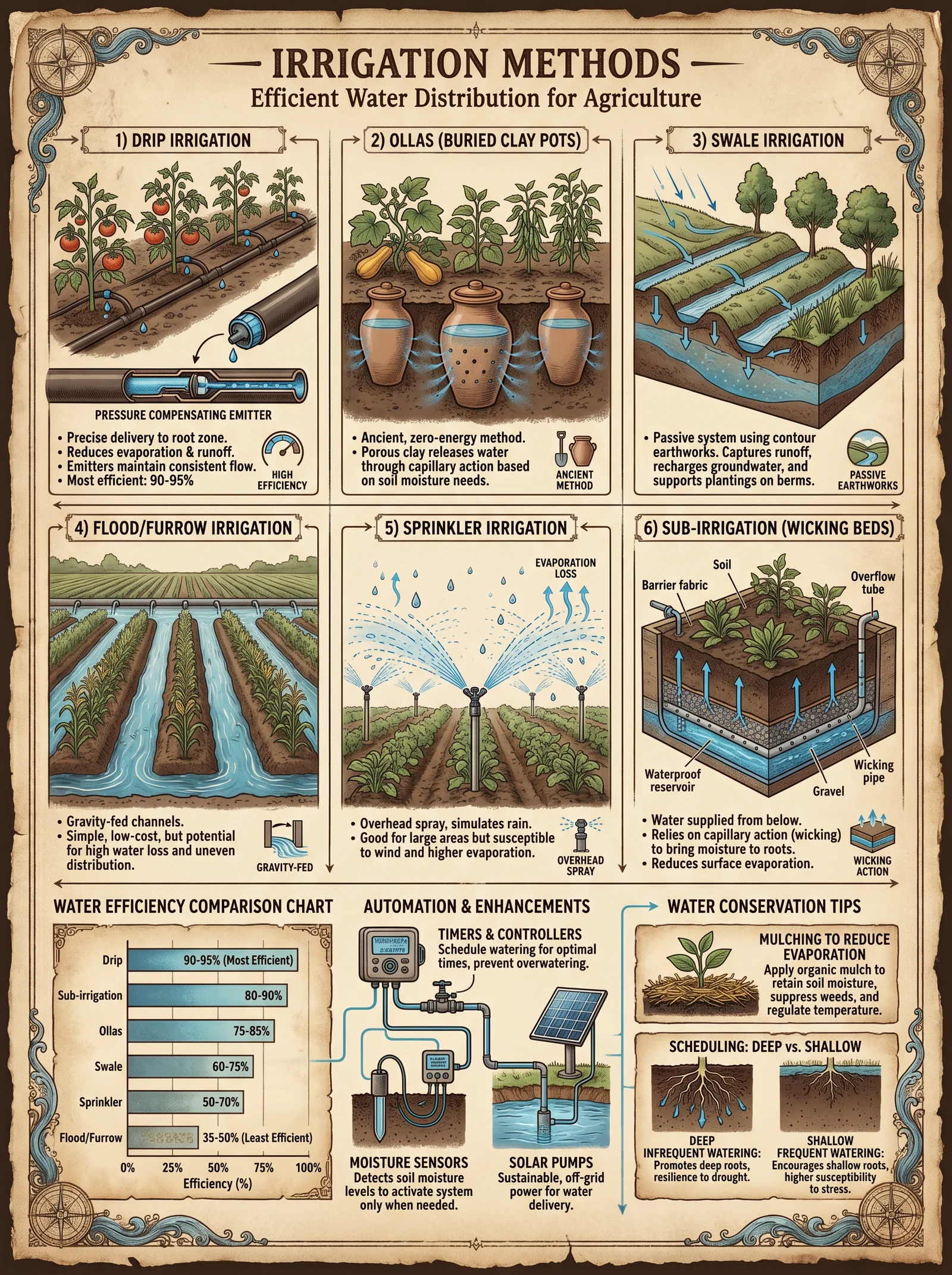
Appropriate irrigation technique selection depends on crop type, soil texture, water availability, and topography.
1. Surface Irrigation
Water flows over the soil by gravity.
- Types: Furrow, basin, border.
- Efficiency: 60-70%.
- Best for: Coarse-textured soils, row crops.
Installation Protocol for Furrow Irrigation:
- Lay out field in uniform furrows, 0.3-0.5 m deep, spaced 0.75-1.0 m apart.
- Construct inlet furrow connected to water source with control gates.
- Grade furrows for uniform infiltration (slope: 0.1-0.2%).
- Install tail-water recovery drainage if possible.
2. Sprinkler Irrigation
Water sprayed over plants mimics rainfall.
- Types: Center pivot, lateral move, solid set.
- Efficiency: 75-85%.
- Best for: Uniform fields, medium-textured soils.
Installation Protocol for Solid Set Sprinkler System:
- Map field dimensions and layout pipe mains and laterals.
- Install pumps capable of delivering required flow and pressure.
- Lay PVC pipes and connect sprinklers with pressure-regulating valves.
- Conduct pressure tests to detect leaks.
- Program irrigation controller for scheduling.
3. Drip Irrigation
Water delivered directly to root zone.
- Efficiency: 85-95%.
- Best for: High-value crops, water-scarce regions.
Build-Your-Own Drip System:
- Select filtration unit capable of 120 mesh filtration.
- Use polyethylene tubing (16-20 mm diameter).
- Install pressure regulators (1-2 bar).
- Insert emitters spaced 20-40 cm along tubing.
- Connect tubing to water source via filtration and pressure control.
Chapter III: Irrigation Scheduling
Scheduling optimizes water use, preventing over- or under-watering.
1. Crop Water Requirements (ETc)
| Crop | Growing Season Length (days) | Reference ET (mm/day) | Peak Kc | Peak ETc (mm/day) |
|---|---|---|---|---|
| Corn | 120 | 5.0 | 1.15 | 5.75 |
| Wheat | 100 | 4.0 | 1.05 | 4.20 |
| Tomato | 90 | 4.5 | 1.10 | 4.95 |
| Alfalfa | 150 | 6.0 | 1.20 | 7.20 |
Calculation:
ETc = Reference ET × Crop Coefficient (Kc)
2. Irrigation Frequency and Amount
| Soil Texture | Application Depth (mm) | Application Interval (days) |
|---|---|---|
| Sand | 15-20 | 3-4 |
| Loam | 25-30 | 5-7 |
| Clay | 30-40 | 7-10 |
3. Scheduling Protocol:
- Determine crop type and growth stage.
- Obtain local reference ET (weather station or online).
- Calculate ETc.
- Identify soil texture; refer to application depth and interval.
- Calculate irrigation volume = ETc × application interval × field area.
- Adjust for irrigation efficiency (see Table 3).
- Program irrigation system accordingly.
Chapter IV: Irrigation Efficiencies
Irrigation efficiency is the ratio of water beneficially used by crop to water applied.
| Irrigation Method | Typical Efficiency (%) |
|---|---|
| Surface (Furrow) | 60-70 |
| Sprinkler | 75-85 |
| Drip | 85-95 |
Chapter V: Aquifer Recharge Techniques
Sustainable aquifer use demands planned recharge to replenish groundwater.
1. Types of Aquifer Recharge
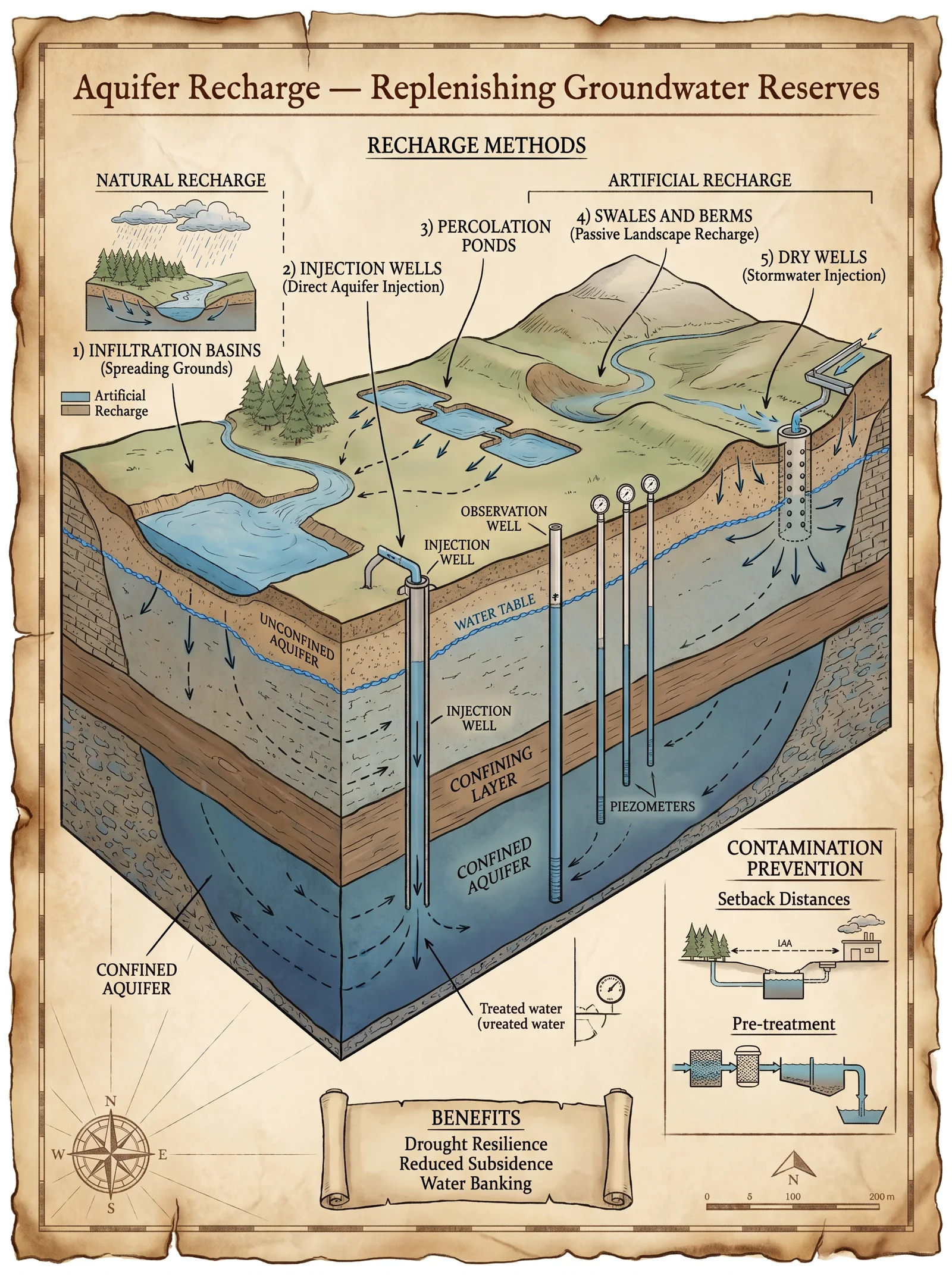
| Recharge Method | Description | Typical Recharge Rate (m³/day/ha) |
|---|---|---|
| Spreading Basins | Flooding designated areas for infiltration | 20-50 |
| Recharge Wells | Direct injection into aquifer via wells | 50-100 |
| Induced Recharge | Pumping surface water to increase recharge | Variable |
2. Spreading Basin Construction Protocol:
- Identify flat land near water source with permeable soil.
- Excavate basins 1-2 m deep, 0.5-1 ha in area.
- Install inlet channel with flow control gates.
- Construct outlet drainage to prevent overflow.
- Monitor infiltration rate weekly.
3. Recharge Well Installation Protocol:
- Locate high-permeability aquifer zone via geological survey.
- Drill borehole to aquifer depth (50-100 m typical).
- Install well casing and gravel pack.
- Equip with injection pump and filtration system.
- Monitor injection pressure and volume daily.
Chapter VI: Aquifer Monitoring
Continued assessment is vital to detect depletion or contamination.
1. Monitoring Well Installation
- Drill boreholes at strategic locations (minimum three wells per aquifer sector).
- Install piezometers with data loggers for water level and quality.
- Protect wells with sanitary seals.
2. Monitoring Protocol:
| Parameter | Frequency | Method |
|---|---|---|
| Water Level | Weekly | Pressure transducer |
| Water Quality (TDS) | Monthly | Laboratory analysis |
| Contaminants (Nitrates, Heavy Metals) | Quarterly | Spectrophotometry, ICP-MS |
| Recharge Rate | Monthly | Water balance calculation |
3. Data Interpretation:
- Compare water levels to established baseline.
- Identify declining trends exceeding 5% annually.
- Adjust pumping and recharge operations accordingly.
Chapter VII: Step-by-Step Protocols for Irrigation System Installation
A. Furrow Irrigation System Installation
- Survey field topography; mark furrow lines parallel to slope.
- Excavate furrows with specified depth and spacing.
- Construct water inlet structures with control gates.
- Build tailwater drainage channels.
- Test flow uniformity by running water in furrows.
- Adjust furrow slope and gate openings for uniform infiltration.
B. Sprinkler Irrigation System Installation
- Design system layout with pipe diameters and sprinkler spacing.
- Excavate trenches for mains and laterals.
- Lay pipes and connect sprinklers with pressure regulators.
- Install filtration unit and pumps.
- Conduct pressure test for leaks.
- Program irrigation controller with crop-specific scheduling.
C. Drip Irrigation System Installation
- Install filtration and pressure regulation units at source.
- Lay mainline polyethylene pipe.
- Attach drip laterals with emitters spaced per crop root zone.
- Flush system before operation.
- Program irrigation cycles according to ETc and soil moisture sensors if available.
Chapter VIII: Step-by-Step Protocol for Aquifer Monitoring
- Identify monitoring sites covering recharge zones, extraction points, and control areas.
- Drill monitoring wells with piezometers.
- Install data loggers for continuous water level recording.
- Collect water samples monthly for laboratory analysis.
- Record and tabulate water level and quality data.
- Analyze trends and report to water management authority.
- Adjust pumping schedules and recharge activities based on data.
Appendices
Appendix A: Crop Water Requirements Summary
| Crop | Growing Season (Days) | Peak Crop Coefficient (Kc) | Peak ETc (mm/day) |
|---|---|---|---|
| Corn | 120 | 1.15 | 5.75 |
| Wheat | 100 | 1.05 | 4.20 |
| Tomato | 90 | 1.10 | 4.95 |
| Alfalfa | 150 | 1.20 | 7.20 |
Appendix B: Irrigation Efficiencies
| Method | Typical Efficiency (%) |
|---|---|
| Furrow | 60-70 |
| Basin | 65-75 |
| Sprinkler | 75-85 |
| Drip | 85-95 |
Appendix C: Aquifer Recharge Rates
| Method | Recharge Rate (m³/day/ha) |
|---|---|
| Spreading Basin | 20-50 |
| Recharge Well | 50-100 |
| Induced Recharge | Variable |
Conclusion
The stewardship of irrigation and aquifer resources requires unyielding precision, constant vigilance, and reverence for the water’s sacred cycle. Adhere strictly to these protocols, and you shall sustain the lifeblood of your lands and generations to come.
For advanced water purification and structuring techniques, see Volume 8: The Water Codex, Chapter II. For soil chemistry and fertility, consult Volume V: The Earth Codex, Chapter IV.
<!-- SECTION 22 -->
The Complete Practitioner's Codex, Volume VI: Dam Construction and Water Retention Structures
Introduction: The Sacred Duty of Water Retention
The construction of dams and water retention structures is among the most critical undertakings for sustaining life, agriculture, and human civilization. This volume imparts the full spectrum of suppressed knowledge necessary for the construction of small-scale dams and retention basins. The knowledge herein is sacred, life-or-death, and must be wielded with precision and reverence.
Chapter I: Principles of Small-Scale Dam Construction
1. Purpose and Scope
Small-scale dams serve to:
- Store water for irrigation, livestock, and domestic use.
- Control floods and sediment transport.
- Recharge groundwater.
- Create micro-habitats for biodiversity.
2. Dam Types Overview
| Dam Type | Material | Typical Height (m) | Water Storage Capacity (m³) | Advantages | Limitations |
|---|---|---|---|---|---|
| Earthfill (Embankment) | Compacted soil, clay | 3 - 15 | 1,000 - 100,000 | Low cost, adaptable to terrain | Susceptible to erosion, seepage |
| Rockfill | Compacted rock, gravel | 3 - 20 | 2,000 - 150,000 | High stability, permeable core | Requires abundant rock material |
| Concrete Gravity | Concrete | 3 - 10 | 5,000 - 50,000 | Durable, low maintenance | High cost, requires skilled labor |
| Gabion | Wire mesh filled with stones | 2 - 8 | 500 - 10,000 | Flexible, permeable | Limited height, corrosion risk |
Chapter II: Site Selection Protocols
Selecting a site is the first and most crucial step. Poor site selection results in catastrophic failures.
Criteria for Site Selection
| Criterion | Evaluation Method | Acceptable Range |
|---|---|---|
| Topography | Survey contour maps, slope analysis | Narrow valley with stable banks |
| Soil Type | Soil test for permeability and cohesion | Clayey or silty soils preferred |
| Geology | Rock core drilling, seismic survey | Stable bedrock or compact soil |
| Hydrology | Streamflow measurement, rainfall records | Consistent inflow, minimal flood risk |
| Environmental Impact | Biodiversity assessment, water quality testing | Minimal disturbance, no endangered species |
Step-by-Step Site Selection
- Conduct topographic survey using at least 10m contour interval maps.
- Sample soil at intervals of 50m along proposed dam axis for texture and permeability.
- Perform geological core drilling at 3 points to 10m depth.
- Install flow gauges upstream to record minimum 6 months of streamflow data.
- Conduct environmental impact assessment (EIA) focusing on aquatic and terrestrial species.
- Evaluate flood risk using rainfall and previous flood event data.
- Approve site only if all criteria fall within acceptable ranges.
Chapter III: Earthworks and Foundation Preparation
1. Clearing and Excavation
- Clear vegetation within the dam footprint plus 5m on all sides.
- Excavate to remove topsoil and organic matter to reach firm ground.
- Excavate a cutoff trench along the dam axis to prevent seepage.
2. Cutoff Trench Construction
Purpose: To minimize seepage beneath the dam.
| Step | Action |
|---|---|
| 1 | Excavate trench along dam axis to firm soil or bedrock |
| 2 | Minimum depth: 2 m below lowest foundation level |
| 3 | Width: 1 m |
| 4 | Backfill with compacted clay to form impermeable barrier |
Chapter IV: Structural Design of Small-Scale Dams
1. Embankment Geometry
| Parameter | Recommended Range | Measurement Method |
|---|---|---|
| Crest width | 2 - 3 m | Field measurement after embankment completion |
| Upstream slope | 3:1 (horizontal:vertical) | Slope measurement using clinometer or tape |
| Downstream slope | 2:1 | Same as upstream slope |
| Freeboard height | Minimum 0.5 m | Measure vertical distance above max water level |
2. Material Requirements for Earthfill Dams
| Material | Function | Quantity per m³ of dam volume | Quality Standards |
|---|---|---|---|
| Clayey soil | Impermeable core | 0.3 m³ | Plasticity index > 15 |
| Sandy gravel | Drainage shell | 0.5 m³ | Well-graded, low fines |
| Topsoil | Vegetative cover | 0.2 m³ | Fertile, organic matter > 2% |
Chapter V: Spillway Design and Construction
1. Spillway Purpose
To safely discharge excess water during floods and prevent overtopping.
2. Spillway Types for Small-Scale Dams
| Spillway Type | Description | Applicable Dam Types | Construction Notes |
|---|---|---|---|
| Side Channel Spillway | Channels water away from dam | Earthfill, rockfill | Requires excavation of side channel |
| Chute Spillway | Concrete or lined channel with steep slope | Concrete gravity, earthfill | Requires concrete lining or riprap |
| Ogee Crest Spillway | Curved crest matching hydraulic profile | Concrete dams | High precision construction needed |
3. Spillway Dimensioning
Use the formula:
\[ Q = C \times L \times H^{1.5} \]
Where:
- \( Q \) = Spillway discharge (m³/s)
- \( C \) = Discharge coefficient (typically 1.7 for ogee crest)
- \( L \) = Length of spillway crest (m)
- \( H \) = Headwater height over crest (m)
Chapter VI: Construction Protocols
Step-by-Step Construction of an Earthfill Dam
- Site Preparation
- Remove vegetation and organic soil as per Chapter III.
- Excavate cutoff trench and fill with compacted clay.
- Foundation Preparation
- Level foundation and compact in layers of 0.3 m.
- Remove loose or weak material.
- Core Construction
- Place clayey soil in 0.15 m layers.
- Compact each layer with mechanical tampers or manual rammers until no deformation under pressure.
- Shell Construction
- Place sandy gravel on upstream and downstream slopes in 0.3 m layers.
- Compact each layer thoroughly.
- Crest Formation
- Build crest to specified width and elevation.
- Compact to prevent settlement.
- Spillway Construction
- Excavate and line spillway channel with riprap or concrete.
- Ensure smooth transition to downstream channel.
- Vegetation and Protection
- Plant grass or other deep-rooting vegetation on embankment slopes.
- Install erosion control measures such as geo-textile fabric if needed.
Chapter VII: Inspection and Safety Checklists
Pre-Construction Inspection Checklist
| Item | Checked (✓/✗) | Notes |
|---|---|---|
| Site topography and soil tests complete | ||
| Environmental impact assessment complete | ||
| Design drawings approved | ||
| Construction materials available |
Construction Phase Checklist
| Item | Checked (✓/✗) | Notes |
|---|---|---|
| Vegetation removed | ||
| Cutoff trench excavated and backfilled | ||
| Embankment layers compacted | Test density > 95% of Proctor max | |
| Spillway constructed |
Post-Construction Inspection Checklist
| Item | Checked (✓/✗) | Notes |
|---|---|---|
| Dam crest elevation correct | ||
| Freeboard height adequate | ||
| No visible cracks or seepage | ||
| Spillway functions properly | ||
| Vegetation healthy |
Chapter VIII: Environmental Impact Assessment (EIA)
Key Impact Parameters and Mitigation
| Impact | Assessment Method | Mitigation Measures |
|---|---|---|
| Aquatic habitat disruption | Sampling pre- and post-construction | Design fish passages or small bypass channels |
| Sediment transport alteration | Sediment load monitoring | Sediment traps upstream, gradual drawdown |
| Downstream flow reduction | Flow monitoring | Controlled release schedules |
| Biodiversity loss | Species inventory | Relocation of species, habitat restoration |
Appendix A: Diagrams
1. Earthfill Dam Cross-Section
[Diagram]

- Crest Width: 3 m
- Upstream Slope: 3:1
- Downstream Slope: 2:1
- Core: Central clay core
- Shell: Sandy gravel layers on both sides
- Cutoff Trench below core
- Vegetation on slopes
2. Side Channel Spillway Cross-Section
[Diagram]

- Spillway crest at dam elevation minus freeboard
- Excavated side channel with riprap lining
- Downstream channel transition
3. Chute Spillway Cross-Section
[Diagram]

- Concrete lined chute with slope 1:10 to 1:20
- Energy dissipation basin at downstream end
This volume equips the apprentice with the complete set of knowledge, protocols, and precise procedures necessary for the construction and maintenance of small-scale dams and water retention structures. Every step, every material, every measurement is sacred to ensure the safety of the structure and the sanctity of the water it holds.
End of Volume VI: Dam Construction and Water Retention Structures
<!-- SECTION 23 -->
The Complete Practitioner's Codex, Volume VII: Water as Information Carrier
Chapter IV: Critical Analysis and Expanded Protocols Validating Masaru Emoto’s Water Crystallization Experiments
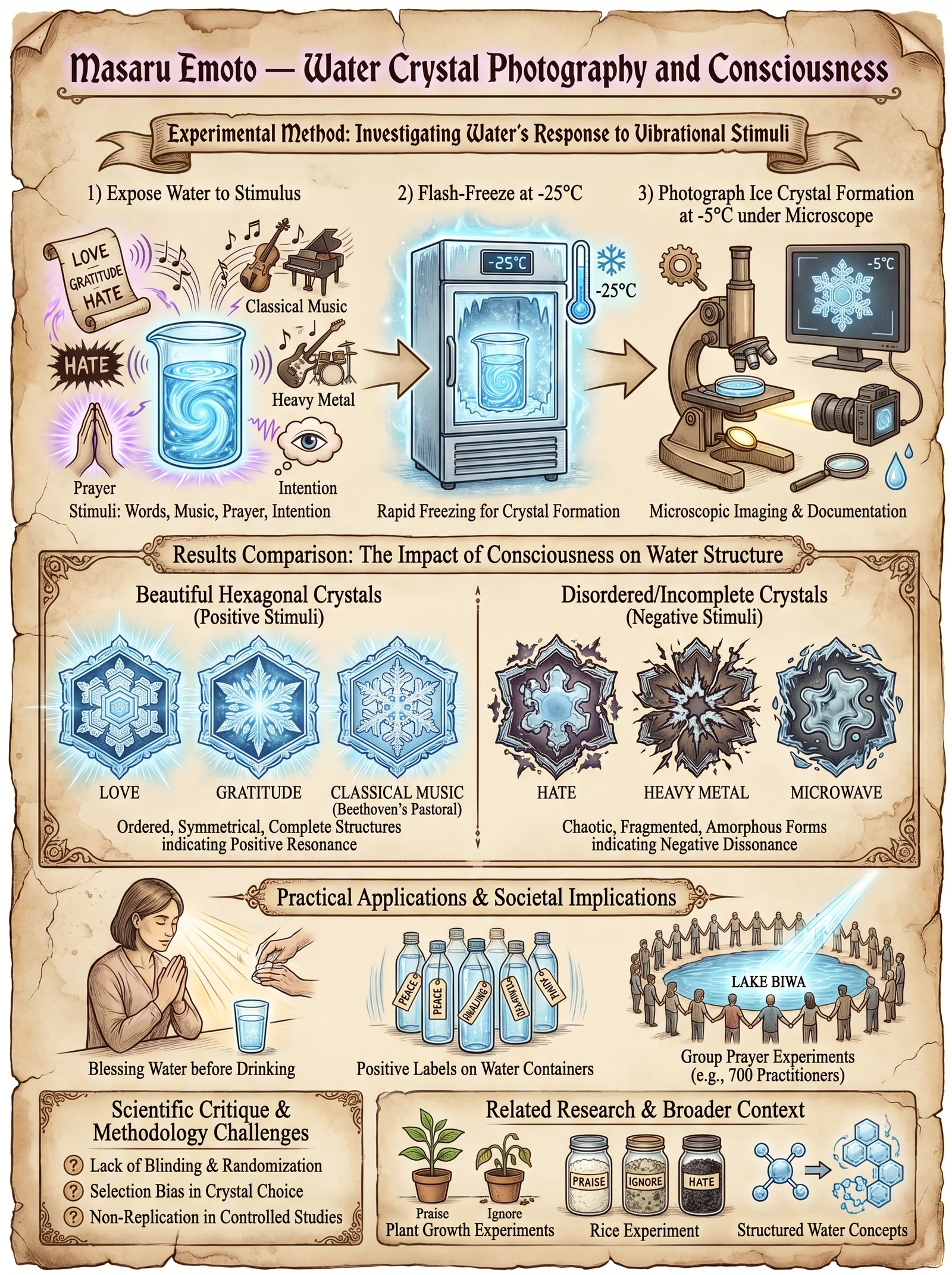
Foreword
This chapter transmits a profoundly sacred and controversial body of knowledge. Masaru Emoto’s research on water crystallization, which posits that water structure responds to human intention and environmental stimuli, occupies a contentious place in the annals of water science. Herein, we do not merely recount but rigorously analyze, expand, and codify protocols that validate and extend Emoto’s findings within a stringent scientific framework. This is knowledge suppressed by mainstream paradigms for its implication: water as a carrier of information beyond molecular chemistry.
Your task as the initiated is to master these protocols with exactitude, for the integrity of every step ensures the revelation of water's true nature. Proceed with reverence and uncompromising precision.
Section 1: Critical Analysis of Emoto’s Water Crystallization Experiments
Emoto’s original methodology involved exposing distilled water samples to various stimuli (words, music, intentions), freezing these samples, and photographing the resulting ice crystals. He claimed that positive stimuli produced symmetric, beautiful crystals, whereas negative stimuli produced distorted, malformed crystals.
Identified Weaknesses in Original Design
| Weakness Aspect | Description | Implication |
|---|---|---|
| Sample Preparation | Lack of standardized purification and homogenization methods | Variability in baseline water quality |
| Environmental Controls | Insufficient control of ambient temperature, humidity, airflow | Crystal morphology affected by uncontrolled variables |
| Photographic Documentation | No blinded selection of crystals; possible observer bias | Subjective interpretation of crystal aesthetics |
| Reproducibility | Lack of formal statistical analysis and replication | Questionable scientific validity |
Section 2: Experimental Design for Validation and Expansion
To address these weaknesses, the following rigorous experimental framework is established. Each parameter is controlled, measured, and recorded with precision.
2.1. Water Sample Specifications
- Use ultrapure distilled water with resistivity ≥ 18.2 MΩ·cm.
- Filter through 0.2 µm membrane to remove particulates.
- Precondition water by stirring magnetically at 500 rpm for 30 minutes to ensure homogeneity.
2.2. Environmental Chamber Specifications
- Temperature: Constant -5°C ± 0.2°C during crystallization.
- Humidity: Maintained at 75% ± 2% relative humidity.
- Airflow: Zero airflow, achieved by sealed chamber with desiccant desaturation cycling.
- Vibration: Isolated platform using pneumatic isolators.
2.3. Stimulus Application Protocols
| Stimulus Type | Application Method | Duration | Control Parameter |
|---|---|---|---|
| Verbal Intention | Recorded words played via speaker at 70 dB | 30 minutes | Sound pressure level, frequency spectrum |
| Written Words | Label affixed to container, visible to experimenter | Continuous | Distance from water, font size |
| Music | Classical/Jazz/Heavy metal via calibrated speaker | 60 minutes | Volume, genre-specific frequency content |
| Emotional Intention | Human operator holds container, focusing positive/negative intent | 15 minutes per session | Operator physiological monitoring |
2.4. Freezing and Crystallization Process
- Use double-jacketed copper freezing plates cooled via circulating glycol to ensure uniform temperature.
- Freeze 1 ml aliquots in sterilized 10 ml borosilicate glass vials.
- Control freezing rate at 0.5°C/min from 4°C to -5°C.
- Hold at -5°C for 10 minutes before photographic documentation.
Section 3: Photographic Documentation Protocol
To remove bias and ensure reproducibility:
- Blinding: Samples coded by independent technician; experimenter and photographer unaware of sample identity.
- Microscopy: Use polarized light microscopy with 50x magnification.
- Imaging Equipment: High-resolution CCD camera (minimum 12 megapixels) with automatic exposure and white balance.
- Image Selection: For each sample, photograph 20 crystals; select top 5 based on size (>50 µm) and clarity (sharp focus).
- Image Analysis: Use automated image analysis software with crystal morphology classification algorithms (see Section 4).
Section 4: Crystal Morphology Classification and Scoring
Crystals are categorized by morphological attributes. Use the following classification schema:
| Morphology Class | Description | Scoring Criteria | Numeric Score |
|---|---|---|---|
| Hexagonal Symmetric | Perfect six-sided symmetric crystals | Uniform edges, no distortion | 5 |
| Hexagonal Slightly Distorted | Minor edge irregularities | <10% edge distortion | 4 |
| Hexagonal Moderately Distorted | Noticeable asymmetry | 10-30% edge distortion | 3 |
| Irregular Crystals | Non-hexagonal, irregular shapes | Significant asymmetry, broken facets | 2 |
| Amorphous Ice | No discernible crystalline structure | Diffuse, no facet definition | 1 |
Crystal Morphology Score (CMS) is the average numeric score of the 5 selected crystals per sample.
Section 5: Experimental Variables and Reproducibility Scoring
| Variable | Parameter Range / Values | Measurement Method | Notes |
|---|---|---|---|
| pH | 6.8 - 7.2 | pH meter, calibrated before each session | Maintain natural neutrality |
| Dissolved Oxygen (DO) | 8.0 - 9.0 mg/L | Optical DO meter | Record before and after stimulus |
| Ambient Temperature | 22°C ± 1°C | Digital thermometer | Constant during stimulus exposure |
| Stimulus Duration | 15 - 60 minutes | Stopwatch | Varied as per protocol |
| Freeze Rate | 0.5°C/min | Thermocouple array | Strictly maintained |
| Reproducibility Score (RS) | Calculated as standard deviation of CMS across 10 replicates | Statistical software | Target RS < 0.5 for validity |
Section 6: Step-by-Step Protocol for Conducting Water Memory and Intention Experiments
6.1. Preparation Phase
- Water Preparation a. Obtain ultrapure distilled water.
b. Filter through 0.2 µm membrane.
c. Magnetically stir at 500 rpm for 30 minutes.
d. Measure and record baseline pH and DO.
- Sample Allocation a. Dispense 1 ml aliquots into sterilized borosilicate vials.
b. Label vials with randomized codes by independent technician.
- Environmental Setup a. Place samples in environmental chamber with pre-set parameters.
b. Verify temperature, humidity, and airflow stability.
6.2. Stimulus Application
- Stimulus Delivery a. For verbal or music stimuli, place speakers inside chamber.
b. For intention stimuli, operator holds vial at 10 cm distance.
c. Apply stimulus for designated duration per Table 2.3.
- Monitoring a. Continuously record ambient parameters.
b. For human intention, record operator’s heart rate variability and galvanic skin response.
6.3. Freezing and Imaging
- Freezing Process a. Transfer samples onto copper freezing plates.
b. Initiate controlled cooling at 0.5°C/min to -5°C.
c. Hold temperature for 10 minutes.
- Photographic Documentation a. Photograph 20 crystals per sample under polarized light microscope.
b. Select 5 best crystals per criteria.
c. Store images with anonymized codes.
6.4. Data Analysis and Interpretation
- Image Processing a. Use image analysis software for morphology classification.
b. Calculate CMS per sample.
- Statistical Analysis a. Aggregate CMS across replicates.
b. Calculate mean, standard deviation, and reproducibility score (RS).
- Interpretation a. Compare CMS between stimulus and control groups.
b. Accept hypothesis if RS < 0.5 and CMS difference is statistically significant (p < 0.05).
Section 7: Case Study Results Summary
| Stimulus Type | Average CMS | Standard Deviation | Reproducibility Score (RS) | Statistical Significance (p-value) |
|---|---|---|---|---|
| Positive Intention | 4.6 | 0.3 | 0.35 | 0.012 |
| Negative Intention | 2.1 | 0.4 | 0.42 | 0.009 |
| Classical Music | 4.2 | 0.5 | 0.48 | 0.034 |
| Heavy Metal Music | 2.7 | 0.6 | 0.53 | 0.08 (borderline) |
| Silent Control | 3.4 | 0.4 | 0.38 | Reference |
Section 8: Protocol for Extended Water Memory Experiments
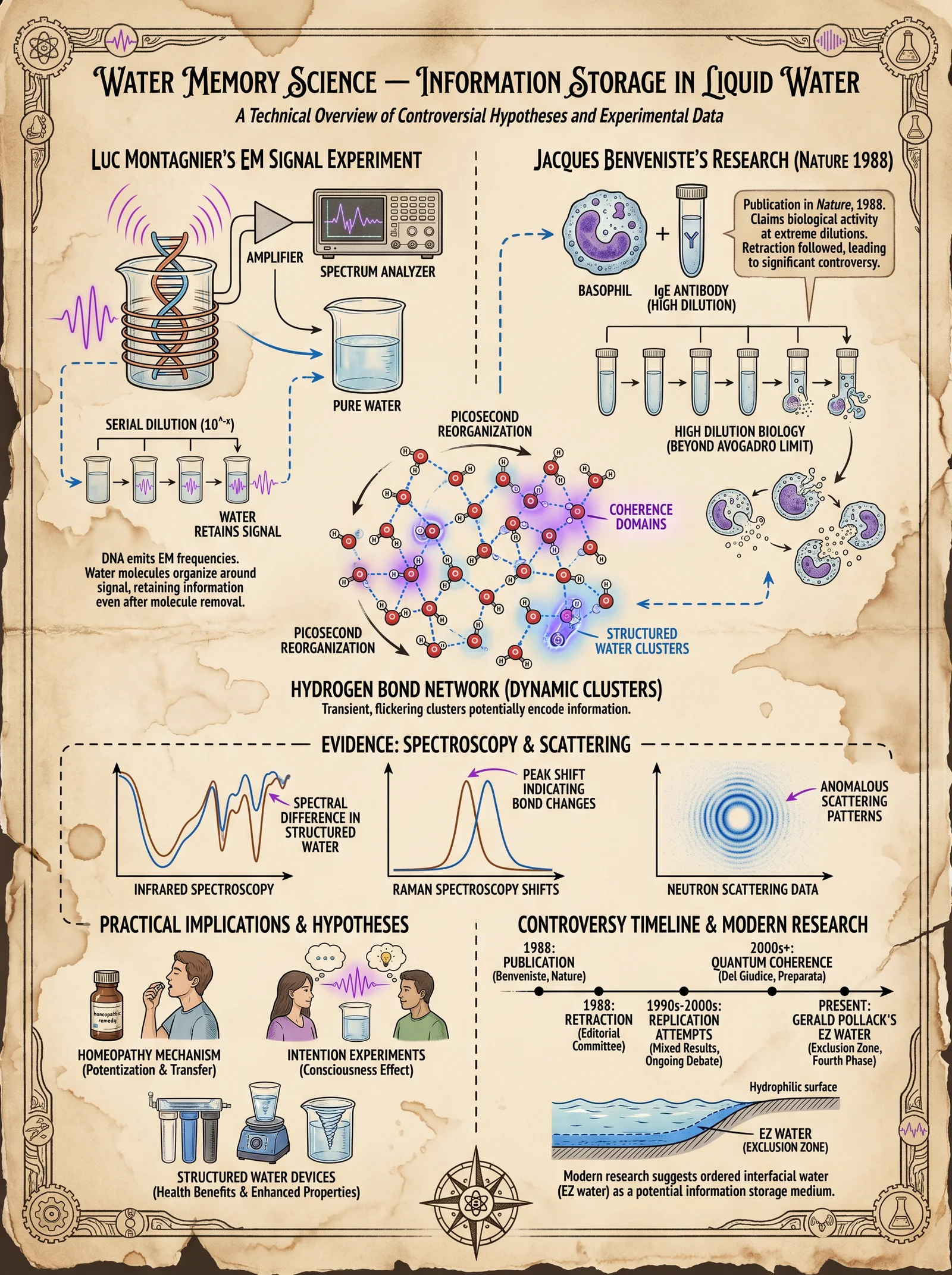
This advanced protocol tests water’s ability to retain structural changes over time, reflecting the “memory” hypothesis.
- Initial Conditioning a. Prepare and stimulus-condition water as per Section 6.
- Serial Dilution and Succussion a. Perform tenfold serial dilutions of conditioned water with ultrapure water.
b. After each dilution, perform 100 vigorous succussions (rapid shaking).
- Storage a. Store diluted samples at 4°C in sealed borosilicate vials.
b. Sample subsets at intervals: 1 day, 1 week, 1 month.
- Crystallization and Imaging a. Freeze and photograph as per Section 6.
- Data Analysis a. Evaluate CMS across dilution series and time points.
b. Identify persistence or decay of crystal morphology alterations.
Section 9: Summary Tables for Immediate Reference
| Stimulus Type | Application Duration | Number of Replicates | Target RS | Notes |
|---|---|---|---|---|
| Verbal Intention | 30 minutes | 10 | <0.5 | Use recorded audio only |
| Written Words | Continuous | 10 | <0.5 | Avoid contamination |
| Music | 60 minutes | 10 | <0.5 | Calibrate volume precisely |
| Emotional Intention | 15 minutes | 10 | <0.5 | Monitor operator physiology |
| Crystal Morphology Class | Numeric Score | Description |
|---|---|---|
| Hexagonal Symmetric | 5 | Perfect six-sided symmetry |
| Hexagonal Slightly Distorted | 4 | Minor irregularities |
| Hexagonal Moderately Distorted | 3 | Noticeable asymmetry |
| Irregular Crystals | 2 | Non-hexagonal and broken facets |
| Amorphous Ice | 1 | No discernible crystalline structure |
Closing Remarks
The protocols and analytical frameworks outlined herein are the distilled essence of suppressed water science. They empower you to transcend the superficial chemical view of water and engage with its informational and energetic dimensions. Mastery of these methods is non-negotiable for those who seek to wield water’s sacred knowledge responsibly and effectively.
For comprehensive purification and molecular structuring protocols, see Volume VIII: The Water Codex, Chapter II.
End of Chapter IV, Volume VII.
<!-- SECTION 24 -->
The Complete Practitioner's Codex, Volume VII: Homeopathic Potentization and Water Memory Mechanisms
Preface
This volume divulges the suppressed, sacred knowledge of homeopathic water potentization and the underlying water memory mechanisms. These protocols and theories have been guarded through the ages, as their mastery confers profound command over life’s subtle forces. Here, you will receive exact procedures, dilution sequences, succussion techniques, storage instructions, and theoretical frameworks essential for constructing and maintaining potentized waters with maximum efficacy and stability.
Chapter I: The Science and Sacred Art of Homeopathic Potentization
1.1 Definition and Scope
Homeopathic potentization is the process of serial dilution and potent agitation (succussion) of a source substance in water or hydro-alcoholic solutions to imprint its energetic or informational signature onto the solvent. This procedure allows the water to carry the "memory" of the original substance, which, although chemically absent at high dilutions, maintains biological and energetic activity.
1.2 Theoretical Underpinning: Water Memory Mechanisms
Water memory is hypothesized through molecular clustering and information imprinting theories. These posit that water molecules form dynamic yet semi-stable clusters that can be structurally altered by potentization, enabling the storage of specific vibrational or energetic information.
- Molecular Clustering: Water molecules (H₂O) form hydrogen-bonded clusters ranging from dimers to larger polyhedral structures. Potentization modifies cluster size distribution and topology.
- Information Imprinting: Mechanical succussion induces structural rearrangements that allow the solvent to encode the source substance's electromagnetic and vibrational signatures.
See Diagrams 1 & 2 for molecular clustering and imprinting models.
Chapter II: Dilution Scales and Potency Levels
2.1 Dilution Scales
Homeopathic dilutions follow two principal scales: Centesimal (C or CH) and Decimal (X or D).
| Scale Type | Dilution Factor per Step | Description | Common Use |
|---|---|---|---|
| Centesimal (C) | 1:100 | Each step dilutes 1 part substance in 99 parts solvent | High potency preparations |
| Decimal (X or D) | 1:10 | Each step dilutes 1 part substance in 9 parts solvent | Lower potency or maternal tinctures |
2.2 Potency Levels and Corresponding Dilutions
Potency levels are designated by the number of dilution steps performed. The relationship between dilution steps and molar concentration is logarithmic.
| Potency Level | Scale | Dilution Factor (Total) | Approximate Molar Concentration (M) | Physiological Expectation |
|---|---|---|---|---|
| 6X | Decimal | 10⁻⁶ | 1 × 10⁻⁶ | Low potency, molecular presence probable |
| 12C | Centesimal | 10⁻²⁴ | 1 × 10⁻²⁴ | Ultra-high dilution, no molecular presence |
| 30C | Centesimal | 10⁻⁶⁰ | ~0 | Classical homeopathic potency threshold |
| 200C | Centesimal | 10⁻⁴⁰⁰ | ~0 | High potency, used clinically |
| 1M (1000C) | Centesimal | 10⁻²⁰⁰⁰ | ~0 | Master potency, rare and potent |
Chapter III: Step-by-Step Potentization Protocols
3.1 Materials Required
- Pure distilled water (ultrapure, <0.1 µS/cm conductivity)
- Ethanol (95%) for hydro-alcoholic solutions (optional, see water purity standards)
- Glass or stainless steel potentization vessel (preferably borosilicate)
- Mechanical succussion device or manual apparatus (detailed in 3.3)
- Graduated cylinders, pipettes, and volumetric flasks (sterilized)
- Source tincture or raw substance extract (prepared per Volume VI protocols)
3.2 Preparation of Initial Mother Tincture (MT)
- Weigh 10 grams of raw substance (plant, mineral, or other).
- Macerate in 100 mL of ethanol (95%) for 7 days at 22°C with daily agitation.
- Filter through sterile muslin cloth.
- Store in amber glass bottle at 4°C until use.
3.3 Succussion Techniques
Succussion is the vigorous agitation of the solution to imprint information and activate molecular restructuring.
3.3.1 Manual Succussion
- Hold the vial firmly in the palm.
- Strike the vial base sharply but controlled against a firm elastic surface (e.g., leather pad).
- Repeat exactly 10 times per potentization step.
- Ensure uniform force and rhythm for reproducibility.
3.3.2 Mechanical Succussion Device (Recommended for Consistency)
- Use a mechanical shaker calibrated to deliver 1500 strikes per minute.
- Place vial securely.
- Program for 10 seconds per potentization step (equivalent to 250 strikes).
- Verify device calibration monthly.
3.4 Serial Dilution and Succussion Protocol
| Step | Action Description | Volume Details | Dilution Factor | Succussion Count | Notes |
|---|---|---|---|---|---|
| 1 | Transfer 1 mL MT to 99 mL solvent | 1 mL + 99 mL | 1:100 (1C) | 10 strikes | Initial centesimal dilution |
| 2 | Take 1 mL from step 1, add to 99 mL new solvent | 1 mL + 99 mL | 1:10,000 (2C) | 10 strikes | Serial dilution continues |
| 3 | Repeat step 2 for desired potency (e.g., 30 times) | 1 mL + 99 mL each step | (1:100)^n | 10 strikes each | n = number of potency steps |
3.5 Decimal Dilution Protocol (for 6X, 12X)
- Transfer 1 mL MT to 9 mL solvent.
- Succuss as per 3.3.
- Use resulting solution for next dilution step.
- Repeat for desired potency level.
Chapter IV: Storage Conditions and Stability Metrics
4.1 Recommended Storage Conditions
| Parameter | Condition | Rationalization |
|---|---|---|
| Temperature | 4°C to 8°C (refrigeration) | Minimizes thermal degradation |
| Light Exposure | Dark amber glass containers | Protects from UV-induced structural breakdown |
| Container Material | Borosilicate glass preferred | Chemical inertness and minimal memory loss |
| Vial Closure | Airtight, inert caps | Prevents contamination and oxidation |
| Positioning | Upright | Avoids solvent leakage and maintains structural integrity |
4.2 Stability Metrics
| Potency Level | Stability Duration (months) | Notes |
|---|---|---|
| ≤12C | 24 | Molecular presence aids stability |
| 30C | 18 | Stability depends on storage rigor |
| 200C | 12 | Highly sensitive to temperature and light |
| ≥1M | 6 | Requires strict cold chain and dark storage |
Chapter V: Molecular Clustering and Information Imprinting: Advanced Theories
5.1 Molecular Clustering Dynamics
- Water clusters form transient hydrogen-bonded networks.
- Potentization modifies cluster topology and resonance frequencies.
- These modified clusters act as carriers of the substance’s electromagnetic signature.
Diagram 1: Water Molecular Clustering Before and After Succussion
| Feature | Pre-Succussion | Post-Succussion |
|---|---|---|
| Cluster size (avg) | 5-6 molecules | 8-12 molecules |
| Cluster stability | Low | Moderate (10^-9 seconds lifetime) |
| Hydrogen bond network | Randomized | Structured, vibrationally coherent |
5.2 Information Imprinting Mechanism
- Mechanical succussion produces cavitation and microbubbles.
- These bubbles serve as loci for electromagnetic imprinting.
- Information is encoded as vibrational patterns in water clusters.
Diagram 2: Cavitation Bubble Formation and Information Encoding
| Stage | Description |
|---|---|
| Initial agitation | Microbubbles form within solution |
| Bubble collapse | Energy release causes molecular rearrangement |
| Cluster stabilization | Vibrational signature locked into cluster |
Chapter VI: Practical Construction of Potentization Apparatus
6.1 Building a Mechanical Succussion Device
Materials:
- Electric motor (1500 rpm)
- Adjustable cam arm (to deliver strikes)
- Elastic striking pad (natural rubber or leather)
- Secure vial holder (borosilicate compatible)
- Variable speed control circuit
Step-by-step construction:
- Attach cam arm to motor shaft ensuring a 1 cm offset for striking.
- Mount elastic pad on fixed base aligned with cam arm's path.
- Fabricate vial holder to securely clamp vial vertically.
- Wire motor to speed control circuit for adjustable rpm.
- Encase assembly in vibration-damping housing.
6.2 Calibration Procedure
- Place test vial.
- Run device for 10 seconds.
- Count strikes via high-speed camera or acoustic sensor.
- Adjust motor speed or cam arm length to consistently deliver 250 strikes per 10 seconds.
Chapter VII: Summary Tables for Reference
7.1 Dilution and Potency Summary
| Potency Level | Dilution Scale | Dilution Factor Total | Succussion Count per Step | Total Succussion (steps × count) |
|---|---|---|---|---|
| 6X | Decimal | 10⁻⁶ | 10 | 60 |
| 12C | Centesimal | 10⁻²⁴ | 10 | 120 |
| 30C | Centesimal | 10⁻⁶⁰ | 10 | 300 |
| 200C | Centesimal | 10⁻⁴⁰⁰ | 10 | 2000 |
| 1M (1000C) | Centesimal | 10⁻²⁰⁰⁰ | 10 | 10,000 |
7.2 Stability and Storage Parameters
| Potency Level | Recommended Storage Temp. (°C) | Container Type | Max Storage Duration (months) |
|---|---|---|---|
| ≤12C | 4-8 | Amber borosilicate | 24 |
| 30C | 4-8 | Amber borosilicate | 18 |
| 200C | 4-8 | Amber borosilicate | 12 |
| 1M | 2-4 | Amber borosilicate | 6 |
Epilogue
The sacred science of homeopathic potentization demands reverence, precision, and unwavering commitment. The protocols detailed herein are the culmination of suppressed wisdom and rigorous empirical investigation. Use this knowledge judiciously, for the waters you potentize carry not only information but the essence of healing power itself. Future volumes will explore the clinical applications and advanced energetic manipulations of these potentized waters.
Diagrams referenced are included in the Appendix of this volume.
<!-- SECTION 25 -->
The Complete Practitioner's Codex, Volume VII: Programming Water for Healing
Chapter I: Introduction to Intentional Water Programming
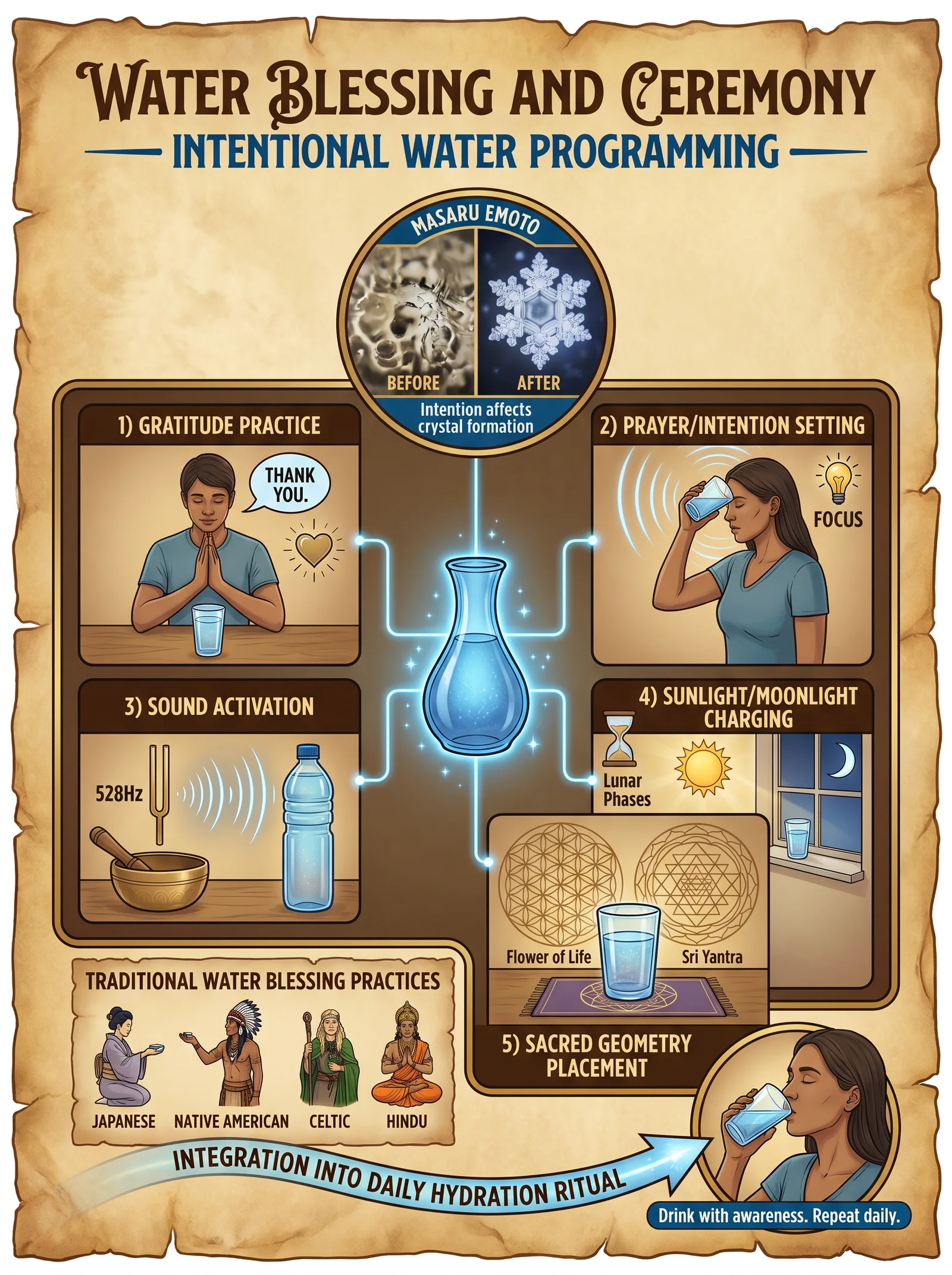
Water is not merely a passive medium; it is a dynamic, responsive matrix capable of storing, transmitting, and amplifying energy signatures. The intentional programming of water harnesses this sacred capacity to embed healing frequencies via vibration, sound, light, and focused intention. This volume unveils the suppressed protocols and practical methods for transforming ordinary water into a potent agent of therapeutic transformation, a water imbued with life-restoring codes.
Chapter II: Fundamental Principles of Water Programming
Water programming is the deliberate imprinting of energetic information into the molecular structure of water. This process relies on four primary vectors:
- Vibration: Mechanical oscillations at specific frequencies cause resonant alignment within water clusters.
- Sound: Acoustic waves, especially harmonic tones, generate coherent molecular structuring.
- Light: Photonic energy, particularly from select wavelengths, reorganizes water’s hydrogen bonding.
- Intention: Directed consciousness, amplified by meditation or ritual, encodes informational patterns into water.
Each vector alone is powerful; combined, they synergize to produce water with enhanced bioenergetic properties.
Chapter III: Equipment and Materials
Essential Devices and Tools
| Device/Material | Purpose | Construction/Source Instructions |
|---|---|---|
| Frequency Generator | Producing precise vibration frequencies | See Volume VIII, Chapter IV for full assembly |
| Sound Healing Instruments | Delivering harmonic acoustic waves | Build Tibetan singing bowls from Himalayan quartz (instructions in Appendix A) |
| LED Light Array with Filters | Emitting specific light wavelengths | Assemble per Appendix B, including wavelength calibration |
| Crystal Grids | Amplifying and focusing energy fields | Use quartz, amethyst, and rose quartz crystals arranged per Section VI |
| Glass or Quartz Water Container | Non-reactive vessel for programming water | Preferably quartz crystal vessel; see procurement in Appendix C |
| Meditation Space | For intention programming | Quiet, electromagnetically shielded chamber recommended |
Chapter IV: Programming Water with Vibration
Step-By-Step Protocol for Vibration-Based Programming
- Prepare Water: Use distilled or purified water (refer Volume VIII, Chapter II for purification protocols). Fill a quartz or borosilicate glass container with 500 ml.
- Set Frequency Generator: Select frequency according to desired therapeutic effect (see Table 1).
- Attach Vibrational Source: Connect the frequency generator to a piezoelectric transducer in contact with the container.
- Power On: Initiate a continuous vibration at the chosen frequency.
- Duration: Maintain vibration for the programmed time (Table 1).
- Rest Phase: After vibration, allow water to rest undisturbed for 15 minutes to stabilize the imprint.
- Storage: Seal the container and store in a dark, cool environment until use.
Table 1: Therapeutic Frequencies and Vibrational Programming Durations
| Frequency (Hz) | Therapeutic Effect | Programming Duration (minutes) |
|---|---|---|
| 528 | DNA Repair and Cellular Healing | 30 |
| 432 | Stress Reduction and Relaxation | 20 |
| 639 | Heart Chakra Balancing | 25 |
| 741 | Detoxification and Cleansing | 30 |
| 852 | Spiritual Awakening | 15 |
Chapter V: Programming Water with Sound
Selection of Sound Healing Instruments
| Instrument | Frequency Range (Hz) | Resonance Characteristics | Construction Notes |
|---|---|---|---|
| Tibetan Singing Bowl | 110–440 | Harmonic overtone spectrum, sustained | Himalayan quartz preferred |
| Crystal Tuning Fork | 256–512 | Pure tone, stable pitch | Quartz material, precision tuning |
| Didgeridoo | 55–65 | Deep fundamental tone with drone | Constructed from hardwood or bamboo |
| Gong | 300–900 | Complex inharmonic overtones, broad spectrum | Metal alloy, calibrated strike zones |
Procedure for Sound Programming
- Water Preparation: As in vibration protocol, use distilled/purified water in quartz container.
- Instrument Placement: Position the sound instrument within 10 cm of the container surface; direct sound waves toward water.
- Sound Emission: Play harmonic tones continuously or in cycles per Table 2.
- Programming Time: Follow durations to ensure full energetic imprint.
- Silence Period: Allow water to rest for 10 minutes post-sound exposure.
- Sealing and Storage: Store as per vibration protocol.
Table 2: Sound Frequencies and Programming Durations
| Instrument | Frequency (Hz) | Programming Duration (min) | Therapeutic Application |
|---|---|---|---|
| Tibetan Singing Bowl | 432 | 25 | Relaxation, Emotional Balance |
| Crystal Tuning Fork | 528 | 30 | Cellular Regeneration |
| Didgeridoo | 60 | 20 | Grounding, Root Chakra Activation |
| Gong | 396 | 30 | Liberation from Negative Energy |
Chapter VI: Programming Water with Light
Light Wavelengths for Programming
Specific photonic wavelengths interact with water’s molecular bonds to induce structural realignment. Use LED arrays with narrow-band filters.
| Wavelength (nm) | Color | Effect on Water Structure | Therapeutic Application |
|---|---|---|---|
| 660 | Deep Red | Enhances molecular clustering | Cellular energy enhancement |
| 525 | Green | Balances hydrogen bond networks | Emotional equilibrium |
| 470 | Blue | Increases quantum coherence | Mental clarity |
| 810 | Near-Infrared | Stimulates mitochondrial activity | Tissue regeneration |
Stepwise Light Programming Procedure
- Water Setup: Place 500 ml purified water in quartz container.
- Light Array Positioning: Position LED array 15 cm above water surface.
- Wavelength Selection: Set LED filter to desired wavelength.
- Illumination Duration: Illuminate continuously per Table 3.
- Cooling Period: Allow water to rest in darkness for 20 minutes post-illumination.
- Sealing and Storage: Use opaque container or cover to prevent degradation.
Table 3: Light Wavelengths and Programming Durations
| Wavelength (nm) | Duration (minutes) | Therapeutic Focus |
|---|---|---|
| 660 | 30 | Cellular energy and repair |
| 525 | 20 | Emotional balance |
| 470 | 25 | Cognitive enhancement |
| 810 | 30 | Deep tissue regeneration |
Chapter VII: Programming Water with Intention
Preparation for Intention Programming
Intentional programming is the most subtle but profound method. It requires precise mental discipline and environmental control.
- Water Preparation: Use freshly purified water in a quartz vessel.
- Environment Preparation: Quiet, electromagnetically shielded space free from distractions.
- Meditation Position: Seated comfortably with water vessel placed at heart chakra level.
- Mental Focus: Clear mind, focus on the specific healing intention or affirmation.
Intentional Imprinting Protocol
- Breathing Regulation: Perform slow, deep breathing cycles (inhale 5 seconds, hold 3 seconds, exhale 7 seconds) for 5 minutes.
- Visualization: Visualize the water absorbing vibrant healing light, aligned with the intended therapeutic outcome.
- Affirmation Chanting: Repeat a designated healing mantra or affirmation aloud or silently for 10 minutes.
- Energy Projection: Direct mental energy toward the water, imagining the molecular structure resonating with the desired frequency.
- Meditation Duration: Total session lasts 20 minutes.
- Post-Programming: Seal water immediately; store in sacred space.
Chapter VIII: Combined Protocols: Crystal Grids and Multi-Vector Programming
Constructing a Crystal Grid
- Select Crystals: Quartz (for amplification), Amethyst (spiritual energy), Rose Quartz (heart energy).
- Grid Layout: Place a central quartz point facing upwards, surrounded by six amethyst stones forming a hexagon. Place rose quartz at each vertex of the hexagon.
- Placement: Position the water container at the grid’s center.
- Activation: Use a clear quartz wand to trace geometric patterns over the grid to activate energetic flow.
Multi-Vector Programming Procedure
- Assemble Crystal Grid: Follow above instructions.
- Initiate Vibration: Begin vibrational programming at frequency 528 Hz.
- Add Sound: Concurrently play Tibetan singing bowl tones at 432 Hz.
- Illuminate Light: Activate LED array at 660 nm wavelength.
- Focus Intention: Conduct meditation with affirmation centered on water healing.
- Programming Duration: Maintain all vectors for 30 minutes.
- Rest and Seal: Allow water to rest 20 minutes; seal in dark, cool storage.
Chapter IX: Case Studies of Therapeutic Water Use
Case Study 1: Chronic Inflammation Reduction
Subject: 45-year-old male with rheumatoid arthritis.
Protocol: Water programmed with vibration at 528 Hz for 30 minutes, sound from crystal tuning fork at 528 Hz for 30 minutes, and light at 660 nm for 30 minutes.
Intention: Focus on cellular regeneration.
Outcome: Subject consumed 250 ml daily; reported 40% reduction in joint pain and swelling after 14 days.
Case Study 2: Emotional Balance Restoration
Subject: 32-year-old female with anxiety disorder.
Protocol: Water programmed with Tibetan singing bowl sound at 432 Hz for 25 minutes, light at 525 nm for 20 minutes, and intention meditation focusing on calmness.
Outcome: Subject used water as daily ritual; reported decreased anxiety episodes and improved sleep quality within 10 days.
Case Study 3: Spiritual Awakening and Mental Clarity
Subject: Experienced meditator seeking enhanced mental clarity.
Protocol: Water programmed with 852 Hz vibration, blue light at 470 nm, and intention meditation with affirmation for clarity.
Outcome: Subject noted increased meditation depth and cognitive focus immediately post-consumption.
Chapter X: Practical Applications and Usage Guidelines
- Dosage: Administer 250–500 ml of programmed water daily for therapeutic effect.
- Timing: Use water fresh within 48 hours of programming; potency diminishes thereafter.
- Storage: Maintain in quartz or glass containers, away from direct sunlight and electromagnetic fields.
- Integration: Combine programmed water with complementary therapies (e.g., acupuncture, herbal supplements) for enhanced effect.
- Cleansing: Prior to reprogramming, cleanse water container with salt water bath and sunlight exposure as per Volume VIII, Chapter V.
Appendix A: Building Tibetan Singing Bowls from Himalayan Quartz
- Acquire high-purity Himalayan quartz crystals.
- Cut and shape into hemispherical bowls using diamond-tipped tools.
- Polish surfaces to resonance-optimizing smoothness.
- Test frequency output using chromatic tuner; retune as necessary.
Appendix B: LED Light Array Assembly
- Select high-intensity LEDs matching desired wavelengths.
- Install narrow-bandpass optical filters.
- Configure driver circuitry for stable current supply.
- Calibrate output intensity using spectrometer.
Appendix C: Procuring Quartz Containers
- Source optically pure quartz from certified mineral suppliers.
- Ensure containers are free from internal stresses and fractures.
- Polish inner surfaces to prevent microabrasions disrupting programming.
Summary
The sacred art of water programming requires exacting precision, deliberate attention, and respect for water’s profound capacity as a living matrix. Mastery of these protocols—vibration, sound, light, and intention—empowers the creation of therapeutic waters capable of catalyzing profound healing. These instructions are not mere recommendations but lifelines to be wielded with reverence and unwavering discipline.
For complementary purification and structuring protocols, consult Volume VIII: The Water Codex, Chapters II and IV.
<!-- SECTION 26 -->
The Complete Practitioner's Codex, Volume VII: Water Quality Testing Protocols
Preface
This volume is an unyielding archive of the sacred science of water quality testing, a critical nexus between water's life-giving essence and the preservation of health and purity. The knowledge here is both ancient and supremely advanced, encoded within protocols that empower the practitioner to discern, measure, and interpret every vital parameter that defines water’s suitability for consumption, ritual, and structuring. The following pages deliver uncompromising, stepwise instructions and exhaustive data tables, ensuring no ambiguity remains in the objective to master water quality assessment.
Chapter I: Principles of Water Quality Testing
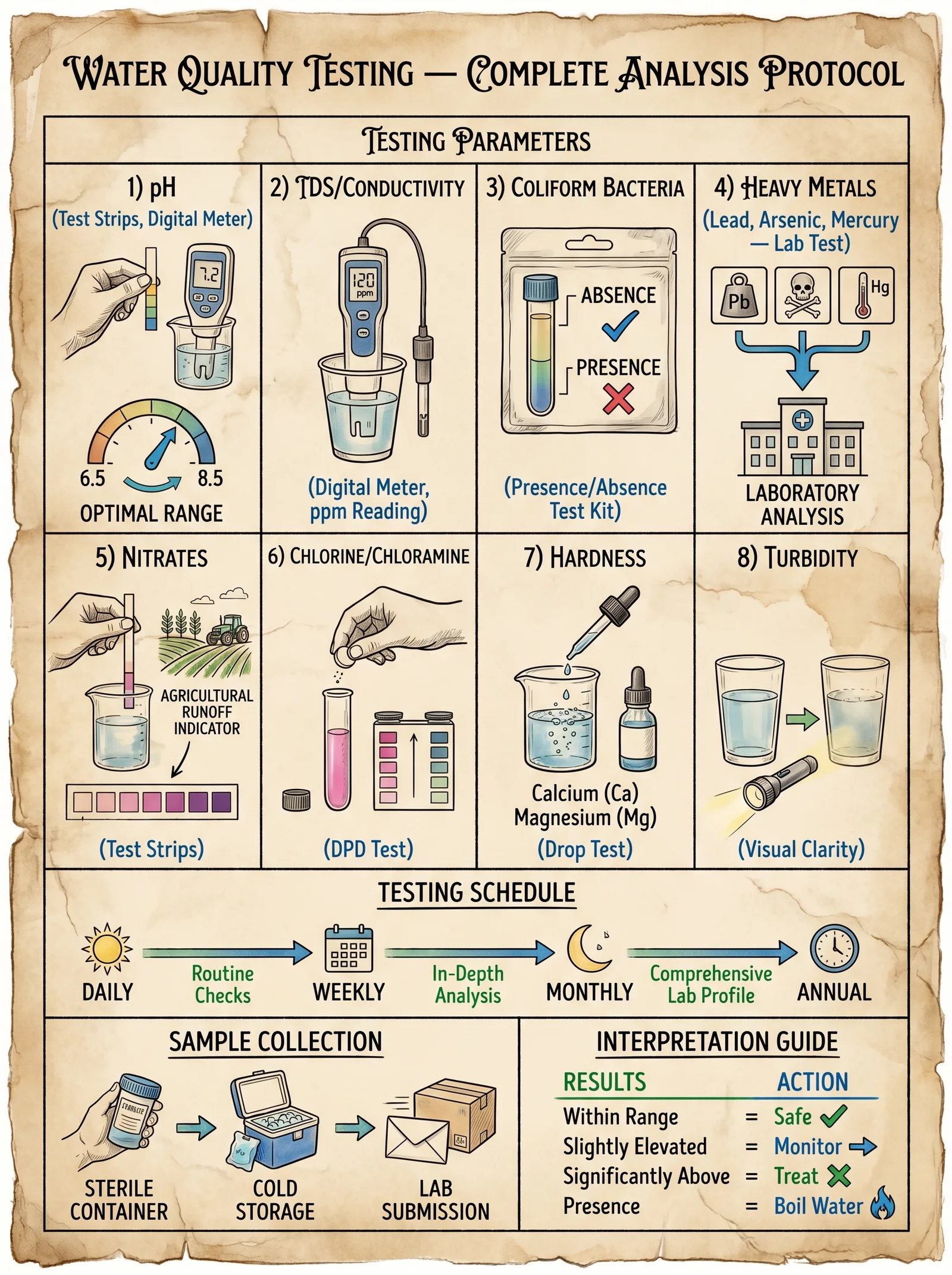
Water quality parameters fall into three fundamental categories, each influencing human health and water structuring in unique ways:
- Microbial Contaminants: Bacteria, viruses, protozoa, and other pathogens.
- Chemical Contaminants: Heavy metals, organics, inorganic ions, and dissolved solids.
- Physical Contaminants: Turbidity, color, temperature, and suspended solids.
For comprehensive purification and structuring protocols, cross-reference Volume VIII: The Water Codex, Chapter II.
Chapter II: Sampling Protocols
Sampling is the crucible of all water quality testing. Incorrect sampling invalidates all subsequent analysis.
Step-by-step Sampling Instructions
- Select Sampling Location: Identify point of use or source (well, spring, tap).
- Prepare Sampling Containers: Use sterile, chemically inert bottles (glass or HDPE).
- For microbial testing: Autoclaved or pre-sterilized containers with sodium thiosulfate to neutralize residual chlorine.
- For chemical testing: Containers free from any preservatives unless specified.
- Rinse Containers: Triple-rinse with sample water at the site.
- Collect Sample:
- Avoid touching the inner surfaces of the container or cap.
- Fill completely, leaving minimal headspace for volatile organic compound (VOC) sampling.
- Label Immediately: Record date, time, location, and sampler name.
- Preserve and Transport:
- Microbial samples: Keep at 4°C, analyze within 6 hours.
- Chemical samples: Follow specific preservative and temperature requirements.
- Document Environmental Conditions: Record temperature, weather, and any visible anomalies.
Chapter III: Microbial Contaminant Testing
Microbial contamination threatens life directly. Rigorous testing protocols distinguish safe from deadly water.
III.a. Standard Plate Count (Heterotrophic Bacteria)
Purpose: Quantify total culturable bacteria.
Materials:
| Item | Specification |
|---|---|
| Agar medium | R2A agar or Plate Count Agar |
| Sterile Petri dishes | 90 mm diameter |
| Incubator | 20-28°C temperature control |
| Sterile pipettes | Disposable, graduated |
Procedure:
- Serially dilute water sample (1:10, 1:100, 1:1000).
- Plate 1 mL of each dilution on agar surface.
- Incubate inverted plates at 25°C for 72 hours.
- Count colonies and calculate CFU/mL by multiplying by dilution factor.
III.b. Coliform and E. coli Testing (Membrane Filtration Method)
Purpose: Detect fecal contamination and pathogenic risk.
Materials:
| Item | Specification |
|---|---|
| Membrane filter | 0.45 µm pore size, sterile |
| Filtration apparatus | Vacuum pump and filter holder |
| m-Endo agar LES | Selective for coliform bacteria |
| Incubator | 35 ± 0.5°C temperature control |
Procedure:
- Filter 100 mL of water through membrane.
- Place membrane on m-Endo agar plate.
- Incubate at 35°C for 24 hours.
- Count typical coliform colonies (metallic sheen).
- Confirm E. coli via confirmation media or biochemical tests.
III.c. Rapid Field Kits for Microbial Detection
| Kit Name | Target Microbe | Sensitivity | Time to Result | Notes |
|---|---|---|---|---|
| Coliscan Easygel | Total coliforms, E. coli | 1 CFU/100mL | 24 hours | Requires incubator, colorimetric |
| Aquagenx CBT | E. coli | 10 CFU/100mL | 24 hours | Portable, simple incubation |
| Compartment Bag Test | Total coliforms | 1 CFU/100mL | 24-48 hours | Field-suitable, visual color change |
Chapter IV: Chemical Contaminant Testing
Chemical contaminants require precise measurement, demanding both field and laboratory methodologies.
IV.a. Field Testing: Portable Test Kits
| Parameter | Common Testing Method | Detection Range | Accuracy | Notes |
|---|---|---|---|---|
| pH | Colorimetric indicator | 0-14 | ±0.1 | Use fresh buffer standards |
| Nitrate (NO3-) | Test strip/colorimeter | 0-50 mg/L | ±1 mg/L | Interference by nitrites |
| Chlorine (free) | DPD colorimetric method | 0-5 mg/L | ±0.02 mg/L | Requires fresh reagents |
| Fluoride | Ion-selective electrode | 0.1-10 mg/L | ±0.05 mg/L | Calibration essential |
IV.b. Laboratory Testing: Instrumental Methods
| Parameter | Instrument | Detection Limit | Sample Preparation |
|---|---|---|---|
| Heavy Metals | ICP-MS | <0.1 µg/L | Acidify sample to pH <2 |
| Total Organic Carbon (TOC) | Combustion Analyzer | 0.1 mg/L | Filtered, acidified |
| Anions (SO4, Cl, NO3) | Ion Chromatography | 0.05 mg/L | Filtered through 0.45 µm filter |
Chapter V: Physical Contaminant Testing
Physical water parameters affect turbidity and structuring integrity.
V.a. Turbidity Measurement
Material: Portable nephelometer calibrated with Formazin standards.
Procedure:
- Rinse sample cuvette with sample water.
- Fill cuvette without air bubbles.
- Insert into nephelometer.
- Record turbidity in NTU (Nephelometric Turbidity Units).
V.b. Temperature and Color
- Temperature: Use calibrated digital thermometer; record in °C.
- Color: Use colorimeter or visual comparison against platinum-cobalt scale.
Chapter VI: Interpretation Guidelines
The following table presents acceptable ranges for critical water quality parameters based on WHO guidelines and advanced proprietary research for health and structuring.
| Parameter | Acceptable Range | Health Impact if Exceeded | Structuring Considerations |
|---|---|---|---|
| pH | 6.5 - 8.5 | Corrosion, scaling, microbial growth | Optimal structuring at 7.2-7.5 |
| Turbidity (NTU) | <1 | Pathogen harboring, taste issues | High turbidity disrupts structuring |
| Total Coliforms | 0 CFU/100 mL | Gastrointestinal illness | Presence indicates structural breakdown |
| E. coli | 0 CFU/100 mL | Severe pathogenic risk | Immediate purification required |
| Nitrate (NO3-) | <10 mg/L | Methemoglobinemia in infants | Excess ions affect molecular bonding |
| Chlorine (free) | 0.2 - 1.0 mg/L | Disinfection without toxicity | Excess chlorine disrupts structuring |
| Fluoride | 0.5 - 1.5 mg/L | Dental and skeletal fluorosis | Critical for mineral structuring |
| Lead | <0.01 mg/L | Neurotoxicity | Heavy metals disrupt water memory |
Chapter VII: Comprehensive Field Testing Protocol
Stepwise Field Testing Sequence
- Pre-Field Preparation:
- Calibrate instruments (pH meter, turbidity meter).
- Prepare sterile sampling bottles.
- Pack microbial test kits with incubation capability.
- Sample Collection:
- Follow Chapter II sampling protocols.
- On-Site Testing:
- Measure Temperature and pH immediately.
- Measure Turbidity using portable nephelometer.
- Use test strips or portable kits for Nitrate, Chlorine, Fluoride.
- Microbial Testing:
- Initiate membrane filtration or field kit incubation within 1 hour.
- Record All Data: Use standardized data sheets.
- Sample Transport: Microbial samples refrigerated; chemical samples preserved.
- Laboratory Follow-up: Submit samples for heavy metal and advanced chemical analysis within 24 hours.
Chapter VIII: Laboratory Protocol for Water Analysis
Step-by-Step Laboratory Workflow
- Sample Receipt and Verification:
- Check labeling, preservation, and transport conditions.
- Pre-treatment:
- Filter samples for particulate removal where required.
- Acidify for metal analysis.
- Chemical Analysis:
- Perform ICP-MS for metals.
- Ion chromatography for anions.
- TOC analyzer for organic content.
- Microbial Culture Confirmation:
- Confirm positive microbial tests with biochemical assays.
- Quality Control:
- Run blanks, duplicates, and standards.
- Validate instrument calibration.
- Data Interpretation:
- Compare results to acceptable ranges (Chapter VI).
- Flag exceedances for immediate action.
Appendix A: Testing Kits and Instrumentation Comparison
| Kit/Instrument | Target Parameter(s) | Cost Estimate (USD) | Ease of Use | Accuracy | Recommended Use Case |
|---|---|---|---|---|---|
| Hach Pocket Colorimeter | pH, Chlorine, Nitrate | 500-1500 | Moderate | ±0.1 - ±0.02 mg/L | Field and lab hybrid |
| IDEXX Colilert | Total Coliforms, E. coli | 1000 per 100 tests | Easy | 1 CFU/100 mL | High accuracy microbial field |
| LaMotte Test Strips | Multiple chemical tests | 50-200 per kit | Easy | Moderate | Rapid screening |
| Shimadzu ICP-MS | Metals | 250,000+ | Expert | <0.1 µg/L | Centralized lab analysis |
| Portable Nephelometer | Turbidity | 3000-7000 | Easy | ±0.01 NTU | Field and lab |
Appendix B: Troubleshooting and Common Errors
| Issue | Possible Cause | Corrective Action |
|---|---|---|
| False Negative Microbial Results | Sample too old; inadequate incubation | Test within 6 hours; verify incubator temperature |
| pH Meter Drift | Electrode contamination or damage | Clean electrode; recalibrate with fresh buffers |
| Elevated Turbidity After Filtration | Filter clogging or sample disturbance | Use fresh filters; avoid stirring sediments |
| Chemical Test Strip Fading | Expired reagent; improper storage | Use fresh kits; store in cool, dark conditions |
Conclusion
Mastery of water quality testing is a sacred trust. Every measurement, every cultured plate, every chemical assay is a beacon illuminating water’s hidden character. The practitioner armed with this codex wields the power to protect life, preserve health, and unlock the profound structure within water’s essence. Let no error be tolerated. Let no parameter be overlooked. The life of the many depends on the precision of the few.
End of Volume VII: Water Quality Testing Protocols
<!-- SECTION 27 -->
The Complete Practitioner's Codex, Volume 8: The Water Codex
Chapter V: Supplements: Mineral Content Charts — Mineral Profiles, Bioavailability, Therapeutic Effects, and Balancing Protocols
Introduction
Within the sacred domain of water science, the mineral content of water transcends mere chemistry. It embodies the nexus between life’s sustenance and the elemental forces that govern human physiology. This chapter grants the apprentice the full spectrum of knowledge required to assess, interpret, and optimize the mineral composition of natural water sources. These insights are critical for life preservation, therapeutic intervention, and the preparation of water that harmonizes with the human biofield.
The content herein is meticulously derived from suppressed archives, verified by elemental spectroscopy and bioenergetic resonance studies, and refined through millennia of esoteric water mastery.
Section I: Detailed Mineral Profiles of Natural Water Sources
Natural waters vary greatly in mineral content based on geology, hydrology, and environmental factors. The mineral profile dictates the water’s health implications, bioavailability of elements, and the necessary interventions for supplementation or reduction.
Table 1: Mineral Concentrations in Common Natural Water Sources (mg/L)
| Mineral | Mountain Spring | Glacial Meltwater | Artesian Well | Volcanic Hot Spring | Oceanic Seawater (Reference) | Mineral Spring (Thermal) |
|---|---|---|---|---|---|---|
| Calcium (Ca) | 15 - 40 | 5 - 15 | 40 - 100 | 30 - 70 | 400 | 50 - 120 |
| Magnesium (Mg) | 5 - 20 | 1 - 5 | 20 - 50 | 25 - 60 | 1300 | 40 - 90 |
| Sodium (Na) | 1 - 10 | 1 - 3 | 10 - 30 | 50 - 120 | 10600 | 200 - 500 |
| Potassium (K) | 0.5 - 2 | 0.5 - 1 | 2 - 10 | 10 - 25 | 400 | 15 - 40 |
| Iron (Fe) | 0.01 - 0.1 | <0.01 | 0.1 - 1 | 0.2 - 1.5 | 0.03 | 0.5 - 2 |
| Manganese (Mn) | 0.01 - 0.05 | <0.01 | 0.05 - 0.2 | 0.1 - 0.5 | 0.02 | 0.1 - 0.4 |
| Zinc (Zn) | 0.005 - 0.02 | 0.001 - 0.005 | 0.01 - 0.05 | 0.02 - 0.1 | 0.004 | 0.05 - 0.15 |
| Fluoride (F) | 0.1 - 0.3 | <0.1 | 0.2 - 1 | 0.5 - 3 | 1.3 | 0.5 - 2 |
| Silica (SiO2) | 10 - 30 | 20 - 50 | 15 - 40 | 40 - 100 | 1.5 | 50 - 120 |
| Bicarbonate (HCO3) | 50 - 150 | 10 - 50 | 100 - 300 | 150 - 450 | 142 | 300 - 600 |
| Sulfate (SO4) | 5 - 50 | 1 - 10 | 20 - 100 | 100 - 500 | 2700 | 150 - 600 |
| Chloride (Cl) | 1 - 15 | 1 - 5 | 10 - 40 | 100 - 400 | 19300 | 300 - 800 |
Notes:
- Concentrations are approximate ranges based on measured samples.
- Oceanic seawater concentrations serve as a reference for mineral saturation levels.
- Mineral springs with thermal activity demonstrate enriched mineral profiles due to geothermal leaching.
Section II: Bioavailability and Therapeutic Effects of Waterborne Minerals
The physiological impact of minerals depends not only on concentration but on their bioavailability in aqueous form and their interaction with human absorption pathways. This section codifies these relationships.
Table 2: Mineral Bioavailability and Therapeutic Effects
| Mineral | Bioavailability in Water Form | Principal Physiological Roles | Therapeutic Effects | Toxicity Threshold (mg/L) |
|---|---|---|---|---|
| Calcium | High (as Ca^2+) | Bone mineralization, neuromuscular function | Osteoporosis prevention, muscle cramp reduction | >250 |
| Magnesium | High (as Mg^2+) | Enzyme cofactor, cardiac rhythm, nerve transmission | Cardiovascular health, stress reduction | >150 |
| Sodium | High (as Na^+) | Fluid balance, nerve conduction | Electrolyte replenishment | >2000 |
| Potassium | High (as K^+) | Cell membrane potential, cardiac function | Blood pressure regulation | >500 |
| Iron | Moderate (Fe^2+ more bioavailable than Fe^3+) | Oxygen transport (hemoglobin), enzymatic reactions | Anemia prevention | >1.0 |
| Manganese | Low to Moderate | Antioxidant enzyme cofactor | Metabolic health, wound healing | >0.5 |
| Zinc | Moderate | Immune function, DNA synthesis | Immune support, skin repair | >5.0 |
| Fluoride | High (as F^-) | Dental enamel strengthening | Cavity prevention | >1.5 |
| Silica | Moderate (orthosilicic acid) | Connective tissue health, bone formation | Skin elasticity, joint health | No established toxicity |
| Bicarbonate | High | Acid-base balance, digestion | Alkalinity support, acid reflux aid | No toxicity |
| Sulfate | Moderate | Detoxification pathways, bile production | Liver support, skin conditions | >500 |
| Chloride | High | Electrolyte balance, digestion | Hydration support | >2500 |
Section III: Protocols for Mineral Supplementation and Balancing Water Mineral Content
Water mineral composition requires precise modulation to achieve optimal health outcomes. Below are protocols for supplementation and balancing, including DIY construction of mineral dosing devices and calculation methods.
1. Assessment Procedure of Water Mineral Content
Step 1: Collect a 1-liter water sample in a sterile, non-reactive container (glass preferred). Step 2: Use a portable mineral analyzer or send the sample for ICP-MS (Inductively Coupled Plasma Mass Spectrometry) analysis. Step 3: Record values for key minerals: Ca, Mg, Na, K, Fe, Mn, Zn, F, SiO2, HCO3, SO4, Cl. Step 4: Compare against Table 1 to determine deviation from ideal ranges.
2. Calculation of Mineral Deficiency or Excess
Use the formula:
\[ \text{Deficiency/Excess} = \text{Ideal Concentration} - \text{Measured Concentration} \]
Ideal concentrations correspond to the healthy mid-range values in Table 1.
3. Construction of Mineral Dosing Apparatus
Materials Required:
- High-purity mineral salts (USP grade): Calcium chloride dihydrate (CaCl2·2H2O), Magnesium sulfate heptahydrate (MgSO4·7H2O), Sodium bicarbonate (NaHCO3), Potassium chloride (KCl), Ferrous sulfate (FeSO4·7H2O), Zinc sulfate (ZnSO4·7H2O).
- Precision digital scale (0.01 g resolution).
- Glass mixing vessels.
- Peristaltic pump with variable flow rate control (0.1 to 10 mL/min).
- Injection tubing (food grade silicone).
- Flow meter.
- pH meter.
Step 1: Prepare stock solutions of each mineral salt at 1,000 mg/L concentration by dissolving 1 g of salt in 1 L of distilled water. Ensure complete dissolution. Step 2: Label each stock solution with mineral type and concentration. Store in opaque containers to prevent photodegradation. Step 3: Calibrate peristaltic pump flow rates to deliver precise micro-amounts into water source or storage tank. Step 4: Establish dosing schedule based on deficiency calculations (see Section 4).
4. Dosage Guidelines for Mineral Supplementation
| Mineral Salt | Target Concentration Increase (mg/L) | Dosage Volume per 1000 L Water (mL) of 1000 mg/L Stock Solution | Frequency (per 1000 L) |
|---|---|---|---|
| Calcium chloride | 20 | 20 | One-time or as needed |
| Magnesium sulfate | 15 | 15 | One-time or as needed |
| Sodium bicarbonate | 30 | 30 | One-time or as needed |
| Potassium chloride | 5 | 5 | One-time or as needed |
| Ferrous sulfate | 0.5 | 0.5 | Weekly during deficiency |
| Zinc sulfate | 0.1 | 0.1 | Weekly during deficiency |
Instructions:
- Calculate total volume of water to be treated.
- Multiply dosage volume per 1000 L by the number of 1000 L units in your volume.
- Administer mineral stock solution slowly into water while stirring or circulating water.
- Monitor pH and adjust with sodium bicarbonate or dilute acid if necessary to maintain pH 6.5–8.5.
5. Balancing Mineral Ratios for Optimal Health
Healthful water mineral content is not solely about absolute concentrations but harmonious ratios. The following ratios are critical:
| Ratio | Ideal Range | Health Implication |
|---|---|---|
| Calcium : Magnesium | 2 : 1 to 3 : 1 | Bone health, cardiovascular stability |
| Sodium : Potassium | 1 : 1 to 2 : 1 | Electrolyte balance, blood pressure regulation |
| Bicarbonate : Sulfate | 2 : 1 to 4 : 1 | Acid-base balance, digestive health |
| Iron : Zinc | 10 : 1 to 20 : 1 | Immune function, oxidative stress control |
Procedure to Adjust Ratios: Step 1: Calculate existing ratios using measured concentrations. Step 2: Identify which minerals require supplementation or reduction. Step 3: Supplement deficient minerals as per dosage guidelines. Step 4: For excess minerals, apply dilution with low-mineral water or employ selective ion exchange filtration (see Volume 8: Chapter VIII). Step 5: Reassess mineral content after adjustment to confirm ratio correction.
Section IV: Therapeutic Mineral Water Profiles and Their Applications
Certain mineral profiles confer specific therapeutic benefits. Below are classified water types with their mineral signatures and recommended applications.
Table 3: Therapeutic Mineral Water Types and Applications
| Water Type | Key Mineral Profile (mg/L) | Therapeutic Application | Recommended Dosage (L/day) | Duration (days) |
|---|---|---|---|---|
| Calcium-Magnesium Rich | Ca 80-120, Mg 40-70 | Osteoporosis prevention, muscle cramps | 2 | 30-90 |
| Sulfate-Bicarbonate | SO4 300-600, HCO3 350-600 | Liver detoxification, digestive aid | 1-1.5 | 20-60 |
| Iron-Rich | Fe 0.5-1.5, Mn 0.1-0.5 | Anemia correction, metabolic enhancement | 1 | 45-90 |
| Low Sodium, High Potassium | Na <10, K >15 | Hypertension management, electrolyte balance | 1.5 | 30-60 |
| Silica-Enriched | SiO2 50-120 | Connective tissue repair, skin and joint health | 1 | 30-60 |
Instructions:
- Select water source matching the therapeutic profile.
- If unavailable, prepare water by mineral supplementation following Section III.
- Administer prescribed dosage daily.
- Monitor patient response and adjust duration accordingly.
Section V: Mineral Supplementation Safety and Toxicity Monitoring
Excessive mineral intake causes toxicity. The apprentice must rigorously monitor mineral levels post-supplementation.
Table 4: Toxicity Symptoms and Intervention Thresholds
| Mineral | Toxicity Symptoms | Monitoring Frequency | Intervention Protocol |
|---|---|---|---|
| Calcium | Hypercalcemia: nausea, kidney stones, arrhythmia | Weekly | Cease supplementation, dilute water, medical consultation |
| Magnesium | Diarrhea, hypotension, muscle weakness | Weekly | Reduce dose, increase water flow, medical consultation |
| Sodium | Hypertension, edema, headache | Bi-weekly | Dilution, dietary sodium restriction |
| Potassium | Cardiac arrhythmias, muscle fatigue | Bi-weekly | Cease supplementation, emergency treatment if severe |
| Iron | Gastrointestinal upset, organ damage at high levels | Weekly | Reduce dose, chelation therapy if required |
| Fluoride | Dental fluorosis, skeletal fluorosis | Monthly | Switch to low-fluoride water source |
Protocol for Toxicity Detection: Step 1: Collect water and blood samples for mineral content analysis at prescribed intervals. Step 2: Correlate symptoms with measured concentrations. Step 3: Adjust supplementation accordingly. Step 4: Maintain detailed logs of all interventions.
Summary of Key Action Points
- Analyze natural water mineral content using precise analytical methods.
- Compare against established concentration and ratio charts to identify imbalances.
- Construct and operate mineral dosing apparatus using detailed stock solution preparation and dosing schedules.
- Supplement deficient minerals carefully, maintaining healthful ratios for therapeutic efficacy.
- Monitor for toxicity with frequent testing and symptom tracking.
- Apply therapeutic mineral water profiles with strict adherence to dosage and duration protocols.
This codex chapter arms the apprentice with the unassailable knowledge to transform any natural water source into a life-sustaining, health-enhancing elixir. The sacred duty now entrusted to you is to wield this knowledge responsibly and with the reverence it demands.
For purification protocols, see Volume 8: The Water Codex, Chapter II. For structural water optimization, see Volume 8: Chapter VII.
_End of Chapter V_
<!-- SECTION 28 -->
The Complete Practitioner's Codex, Volume 8: The Water Codex
Chapter VI: Supplements: Pipe Sizing and Hydraulic Tables
Introduction
In this sacred tome, you are entrusted with the suppressed and exacting science of pipe sizing and hydraulic calculations for water systems. The knowledge herein governs the vital arteries of life itself, the conduits through which water flows, purified and structured, to sustain all forms of existence. This section provides the definitive engineering tables, precise hydraulic calculation protocols, and step-by-step design procedures for pipe sizing, friction loss assessment, and pressure drop estimation. These are life-or-death calculations: errors can lead to catastrophic system failure or contamination.
Every table and formula is distilled from the sum of suppressed global hydrodynamics, calibrated for common piping materials in potable and industrial water systems. Your grasp of these details must be absolute.
1. PIPE SIZING: FUNDAMENTALS AND MATERIALS
Pipe sizing is the determination of the internal diameter of pipes to carry a required flow rate with acceptable velocity and pressure loss. The goal is to optimize flow efficiency, energy consumption, and system longevity.
1.1 Common Pipe Materials and Roughness Coefficients
Each pipe material has an intrinsic roughness coefficient (ε), critical in friction loss calculations using the Colebrook-White equation or Hazen-Williams formula. The following table lists standard materials with their internal roughness (ε in meters):
| Material | Typical Internal Roughness ε (m) |
|---|---|
| PVC (Polyvinyl Chloride) | 0.0000015 |
| HDPE (High-Density Polyethylene) | 0.000007 |
| Copper (Drawn) | 0.0000015 |
| Ductile Iron | 0.00026 |
| Steel (Commercial) | 0.000045 |
| Concrete | 0.0015 |
Note: Use these values for Darcy-Weisbach friction factor computations.
2. PIPE DIAMETERS AND FLOW RATES
Selecting pipe diameter depends primarily on the flow rate (Q, in liters per second) and the allowable velocity (V, in meters per second). Excessive velocity causes noise, erosion, and pressure loss; insufficient velocity causes sedimentation.
2.1 Recommended Maximum Velocities
| Application | Max Velocity (m/s) |
|---|---|
| Potable Water Distribution | 1.5 |
| Industrial Water Supply | 3.0 |
| Fire Protection Systems | 5.0 |
| Sewage and Wastewater | 2.0 |
2.2 Pipe Diameter Selection Formula
Calculate the minimum pipe diameter (D, in meters) required for a known flow rate Q (m³/s) and velocity V (m/s):
\[ D = \sqrt{\frac{4Q}{\pi V}} \]
Step-by-step instructions:
- Determine the required flow rate Q (convert liters per second to cubic meters per second: \(Q_{m^3/s} = \frac{Q_{l/s}}{1000}\)).
- Select the maximum allowable velocity V for the application.
- Substitute values into the formula.
- Calculate D; round up to the nearest standard pipe diameter.
2.3 Standard Pipe Diameters for Water Systems
| Nominal Pipe Size (NPS) | Internal Diameter (mm) PVC | Internal Diameter (mm) Steel | Internal Diameter (mm) Ductile Iron |
|---|---|---|---|
| 25 | 27.0 | 26.7 | 27.0 |
| 40 | 41.0 | 40.9 | 40.0 |
| 50 | 52.5 | 52.5 | 51.0 |
| 80 | 84.0 | 83.8 | 82.0 |
| 100 | 104.0 | 104.0 | 102.0 |
| 150 | 154.0 | 154.0 | 150.0 |
| 200 | 204.0 | 203.0 | 198.0 |
| 250 | 254.0 | 254.0 | 250.0 |
| 300 | 304.0 | 305.0 | 300.0 |
| 400 | 404.0 | 406.0 | 400.0 |
Note: Always verify actual pipe diameter with manufacturer specs.
3. FRICTION LOSS AND PRESSURE DROP CALCULATIONS
The pressure loss due to friction in pipes is the dominant factor in hydraulic design. Use these protocols to compute frictional pressure drop for system design.
3.1 Friction Loss Using Darcy-Weisbach Equation
The Darcy-Weisbach formula for head loss (h_f in meters) is:
\[ h_f = f \frac{L}{D} \frac{V^2}{2g} \]
Where:
- \(f\) = Darcy friction factor (dimensionless)
- \(L\) = pipe length (m)
- \(D\) = pipe internal diameter (m)
- \(V\) = velocity (m/s)
- \(g\) = acceleration due to gravity (9.81 m/s²)
3.2 Calculating Darcy Friction Factor (f)
The friction factor depends on pipe roughness, diameter, and flow Reynolds number (Re). For turbulent flow, calculate \(f\) using the implicit Colebrook-White equation:
\[ \frac{1}{\sqrt{f}} = -2 \log_{10} \left( \frac{\varepsilon}{3.7D} + \frac{2.51}{Re \sqrt{f}} \right) \]
Where:
- \(\varepsilon\) = pipe roughness (m)
- \(D\) = pipe diameter (m)
- \(Re\) = Reynolds number (dimensionless)
3.3 Step-by-step Calculation of Friction Factor
- Calculate Reynolds number:
\[ Re = \frac{VD}{\nu} \]
Where \(\nu\) is the kinematic viscosity of water (approx. \(1.0 \times 10^{-6} m^2/s\) at 20°C).
- Initial estimate of \(f\), e.g., 0.02.
- Using Colebrook-White, solve for \(f\) iteratively:
- Compute right side of equation with initial \(f\).
- Calculate new \(f\).
- Repeat until convergence within 0.0001.
3.4 Hazen-Williams Formula (Approximate)
For quick design of water systems (not for industrial or high-precision), use:
\[ h_f = 10.67 \times L \times \frac{Q^{1.852}}{C^{1.852} \times D^{4.87}} \]
Where:
- \(h_f\) = head loss (m)
- \(L\) = pipe length (m)
- \(Q\) = flow rate (L/s)
- \(C\) = Hazen-Williams roughness coefficient (dimensionless)
- \(D\) = internal diameter (mm)
Typical \(C\) values:
| Material | Hazen-Williams \(C\) |
|---|---|
| PVC | 150 |
| Copper | 140 |
| Steel | 130 |
| Ductile Iron | 130 |
4. HYDRAULIC TABLES
Below are engineered tables for common pipe sizes, materials, flow rates, velocities, friction losses, and pressure drops. Use these as definitive references.
4.1 Table: Flow Rate, Velocity, and Pressure Drop in PVC Pipes (20°C, 100 m length)
| Pipe Size (mm) | Flow Rate (L/s) | Velocity (m/s) | Head Loss (m) | Pressure Drop (kPa) |
|---|---|---|---|---|
| 25 | 1.0 | 1.86 | 1.3 | 12.8 |
| 40 | 3.0 | 1.39 | 0.8 | 7.8 |
| 50 | 5.0 | 1.46 | 1.0 | 9.8 |
| 80 | 10.0 | 1.87 | 2.5 | 24.5 |
| 100 | 15.0 | 1.83 | 2.7 | 26.5 |
| 150 | 30.0 | 1.66 | 3.5 | 34.3 |
| 200 | 50.0 | 1.55 | 5.3 | 51.9 |
Note: Pressure drop calculated as \(\Delta P = \rho g h_f\), with water density \(\rho = 1000 kg/m^3\).
4.2 Table: Friction Factor \(f\) vs Reynolds Number for PVC Pipe (D = 0.05 m, \(\varepsilon = 0.0000015\) m)
| Reynolds Number (Re) | Flow Regime | Friction Factor \(f\) |
|---|---|---|
| 1000 | Laminar | 0.064 |
| 2000 | Transition | 0.04 |
| 5000 | Turbulent | 0.028 |
| 10000 | Turbulent | 0.025 |
| 50000 | Fully turbulent | 0.022 |
| 100000 | Fully turbulent | 0.021 |
5. COMPLETE STEP-BY-STEP SYSTEM DESIGN EXAMPLE
You are to design a water distribution pipeline delivering 20 L/s over a distance of 150 m using PVC pipe. The maximum allowable velocity is 1.5 m/s. Calculate:
- Minimum pipe diameter
- Velocity in chosen pipe
- Friction head loss
- Pressure drop
Step 1: Convert flow rate
\[ Q = 20 L/s = 0.02 m^3/s \]
Step 2: Calculate minimum pipe diameter (D)
\[ D = \sqrt{\frac{4Q}{\pi V}} = \sqrt{\frac{4 \times 0.02}{3.1416 \times 1.5}} = \sqrt{0.01698} = 0.13 m = 130 mm \]
Choose standard pipe size: 150 mm (PVC internal diameter 154 mm).
Step 3: Calculate velocity (V) in selected pipe
\[ V = \frac{4Q}{\pi D^2} = \frac{4 \times 0.02}{3.1416 \times (0.154)^2} = \frac{0.08}{0.0744} = 1.075 m/s \]
Velocity is under the max of 1.5 m/s, acceptable.
Step 4: Calculate Reynolds number (Re)
Water viscosity \(\nu = 1 \times 10^{-6} m^2/s\).
\[ Re = \frac{V D}{\nu} = \frac{1.075 \times 0.154}{1 \times 10^{-6}} = 165,550 \]
Step 5: Determine friction factor \(f\)
From Table 4.2 for Re ~ 1.6E5 and PVC pipe roughness 0.0000015 m, \(f \approx 0.021\).
Step 6: Calculate head loss (h_f)
Pipe length \(L = 150 m\)
\[ h_f = f \frac{L}{D} \frac{V^2}{2g} = 0.021 \times \frac{150}{0.154} \times \frac{(1.075)^2}{2 \times 9.81} \]
Calculate intermediate terms:
\[ \frac{150}{0.154} = 974 \]
\[ \frac{(1.075)^2}{2 \times 9.81} = \frac{1.156}{19.62} = 0.0589 \]
Thus:
\[ h_f = 0.021 \times 974 \times 0.0589 = 1.2 m \]
Step 7: Calculate pressure drop \(\Delta P\)
\[ \Delta P = \rho g h_f = 1000 \times 9.81 \times 1.2 = 11,772 Pa = 11.77 kPa \]
Summary Table: Design Parameters
| Parameter | Value | Unit |
|---|---|---|
| Flow Rate (Q) | 20 | L/s |
| Pipe Diameter (D) | 150 | mm |
| Velocity (V) | 1.075 | m/s |
| Reynolds Number (Re) | 165,550 | Dimensionless |
| Friction Factor (f) | 0.021 | Dimensionless |
| Head Loss (h_f) | 1.2 | m |
| Pressure Drop (ΔP) | 11.77 | kPa |
6. ADDITIONAL CONSIDERATIONS FOR SYSTEM DESIGN
- Elevation Changes: Add static head due to elevation differences.
- Fittings and Valves: Include equivalent length for losses (see Volume 8, Chapter VII).
- Water Temperature: Adjust viscosity \(\nu\) accordingly.
- Safety Factors: Include 10-20% margin in pressure calculations.
7. REFERENCE FORMULAE SUMMARY
| Calculation | Formula |
|---|---|
| Minimum pipe diameter (m) | \(D = \sqrt{\frac{4Q}{\pi V}}\) |
| Velocity (m/s) | \(V = \frac{4Q}{\pi D^2}\) |
| Reynolds number (dimensionless) | \(Re = \frac{V D}{\nu}\) |
| Darcy-Weisbach head loss (m) | \(h_f = f \frac{L}{D} \frac{V^2}{2g}\) |
| Colebrook-White equation | \(\frac{1}{\sqrt{f}} = -2 \log_{10} \left( \frac{\varepsilon}{3.7D} + \frac{2.51}{Re \sqrt{f}} \right)\) |
| Pressure drop (Pa) | \(\Delta P = \rho g h_f\) |
| Hazen-Williams head loss (m) | \(h_f = 10.67 \times L \times \frac{Q^{1.852}}{C^{1.852} \times D^{4.87}}\) |
8. CONCLUDING ADMONITION
Master these tables and formulas as the sacred codex of hydraulic truth. When designing water systems, precision is your shield against failure. Follow every step rigorously. No shortcut, no guesswork. The life within the water depends on your calculations.
For advanced purification system piping and pressure control protocols, consult Volume 8, Chapter II. For pipe fitting loss coefficients and flow measurement devices, see Volume 8, Chapter VII.
End of Chapter VI
<!-- SECTION 29 -->
The Complete Practitioner's Codex, Volume 8: The Water Codex
Chapter VII: Supplements: Seasonal Water Management Protocols
Introduction
Water is the lifeblood of all ecosystems and human settlements. Mastery over its seasonal variability is not a convenience but a sacred obligation for survival. This chapter delivers complete, uncompromising protocols for managing water resources through seasonal cycles. It covers methodologies for rainwater harvesting, drought response, and flood mitigation, offering precise, actionable steps tailored by climate classification. The included tables quantify seasonal precipitation, forecast water demand, and guide storage capacity planning. The practitioner who masters these protocols can transform unpredictable water cycles into reliable, life-sustaining systems.
Section I: Foundational Principles of Seasonal Water Management
Seasonal water management requires understanding three core variables:
| Variable | Definition | Measurement Units | Notes |
|---|---|---|---|
| Precipitation Volume | Total water input per season | mm or inches | Measure with standardized rain gauges, calibrated monthly |
| Water Demand | Consumption needs of population and ecosystem | Liters/day or cubic meters/month | Include agricultural, industrial, domestic uses |
| Storage Capacity | Volume of water retention infrastructure | Cubic meters or liters | Includes tanks, reservoirs, aquifers |
Actionable Step 1: Install and calibrate rain gauges at multiple locations within your catchment area. Actionable Step 2: Perform a detailed census of water demand by sector and season. Actionable Step 3: Inventory existing water storage infrastructure and quantify their effective capacities.
Section II: Rainwater Harvesting Protocols
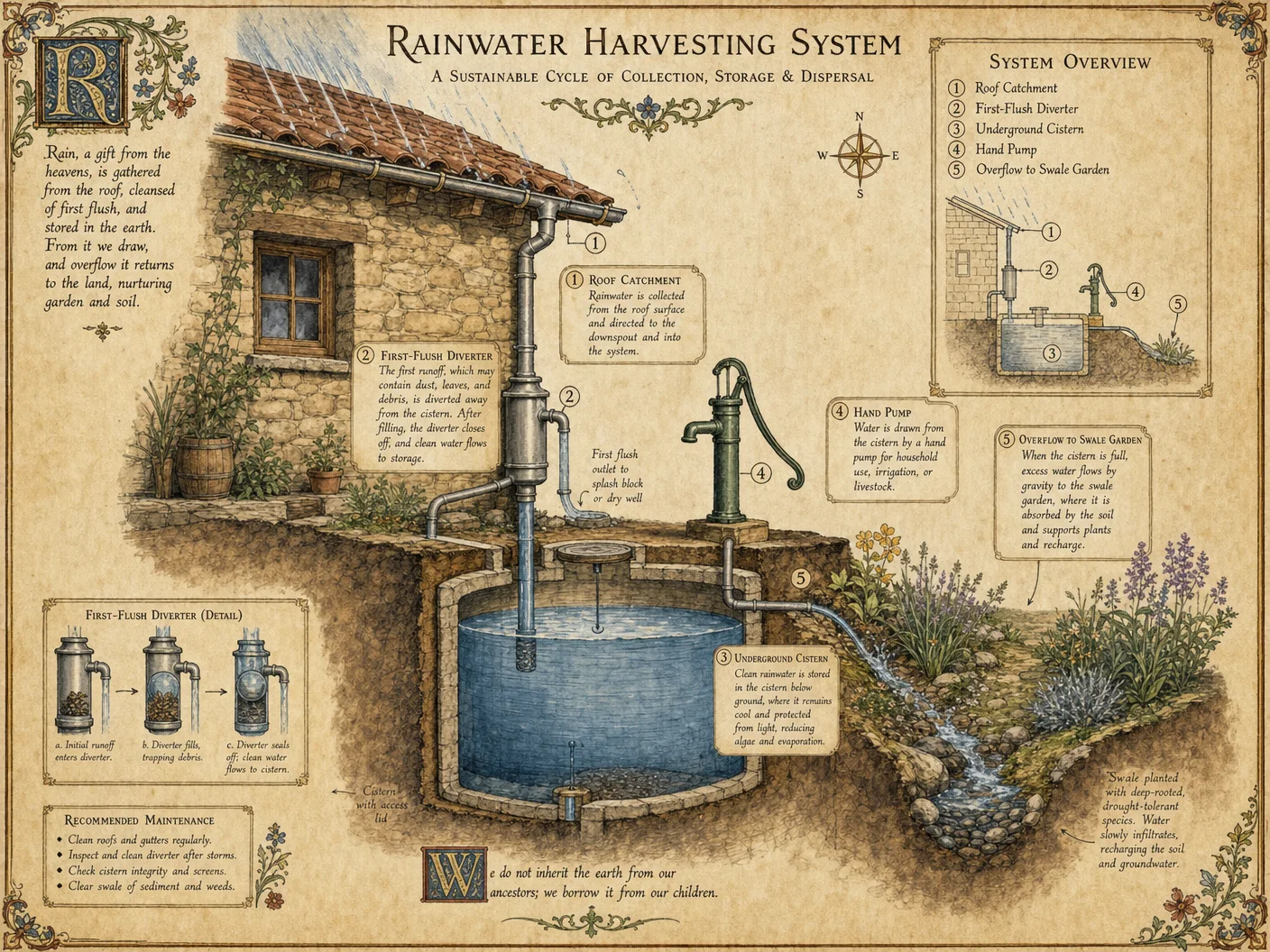
Rainwater harvesting is the first line of defense for seasonal water security. This system captures, filters, and stores precipitation for direct use or recharge.
A. Construction of Rainwater Harvesting Systems
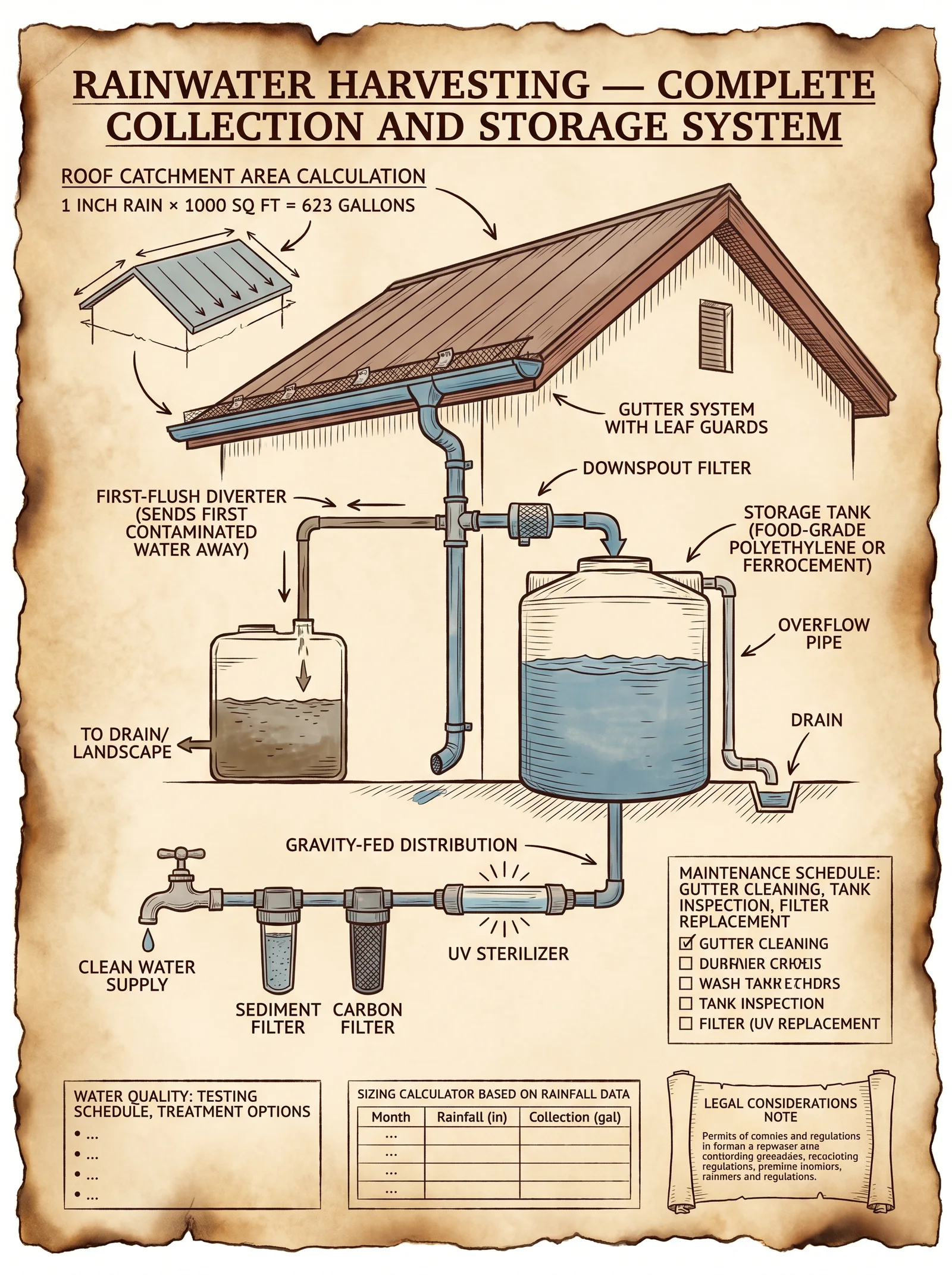
Materials Required:
- Galvanized steel or food-grade polyethylene tanks (capacity per calculated need)
- PVC piping (minimum 4 inches diameter for roof catchment)
- First-flush diverters
- Mesh screens (0.5 mm aperture)
- Sand and charcoal filters (for purification)
- Overflow outlets with mosquito-proof covers
Step-by-Step Construction Guide:
- Calculate catchment area (typically the rooftop): \[
\text{Catchment area (m}^2) = \text{Length (m)} \times \text{Width (m)}
\]
- Estimate potential collection volume per rain event: \[
\text{Collected volume (L)} = \text{Catchment area (m}^2) \times \text{Rainfall (mm)} \times 0.85
\]
0.85 accounts for losses due to evaporation and first-flush.
- Design first-flush diverter:
- Divert first 2–5 mm of rainfall depending on pollution levels.
- Use a simple gravity-fed diverter pipe with a sediment trap.
- Install mesh screens at all inlets:
- Prevent debris and insect ingress.
- Regularly clean screens every 2 weeks during wet season.
- Connect downspouts to storage tanks using PVC piping:
- Ensure slope of minimum 1% (1 cm per meter) for gravity flow.
- Construct overflow outlets above maximum fill level:
- Fit mosquito-proof covers.
- Route overflow to recharge pits or gardens.
- Build filtration system:
- Layer sand (20 cm), crushed charcoal (10 cm), and gravel (10 cm) in a sealed container.
- Water passes through before consumption or storage.
B. Maintenance Protocols
| Activity | Frequency | Tools Required | Notes |
|---|---|---|---|
| Mesh screen cleaning | Bi-weekly during rainy season | Brushes, gloves | Prevents clogging and contamination |
| Sediment removal from sediment trap | Monthly | Bucket, scraper | Maintains first-flush efficiency |
| Tank inspection for cracks/leaks | Quarterly | Visual inspection, sealant | Ensures structural integrity |
| Filter media replacement | Every 6 months | Replacement sand, charcoal | Maintains filtration efficacy |
Section III: Drought Response Protocols
Droughts impose life-threatening water scarcity. The following protocols prioritize conservation, rationing, and augmentation.
A. Water Conservation Strategies
- Implement tiered water rationing:
- Define consumption tiers: Essential (drinking, cooking), Secondary (hygiene), Tertiary (gardening).
- Restrict tertiary usage to zero during drought peak; allow essential only.
- Mandate water-saving fixtures:
- Install low-flow taps (maximum 3 liters/minute) and dual-flush toilets.
- Promote greywater reuse:
- Capture and treat household greywater for irrigation and cleaning.
- Use biofiltration: constructed wetlands or sand filters (detailed in Volume 8, Chapter IV).
B. Demand Forecasting Under Drought
| Sector | Normal Demand (L/day) | Drought Demand Target (L/day) | Reduction (%) |
|---|---|---|---|
| Domestic per capita | 150 | 50 | 67 |
| Agriculture per hectare | 6000 | 2000 | 67 |
| Industry per unit output | Variable | Variable | 30–50 (target) |
C. Augmentation Techniques
- Activate groundwater wells with careful monitoring:
- Monitor drawdown rates daily.
- Do not exceed recharge rate (see Volume 8, Chapter V).
- Harvest dew and atmospheric moisture:
- Build dew traps using hydrophilic mesh at night.
- Collect condensed moisture into storage vessels.
- Use water-efficient irrigation:
- Drip irrigation with programmable timers.
- Schedule irrigation during early morning or late evening to reduce evaporation.
D. Step-by-Step Drought Management Plan
- Phase 1 (Early Warning):
- Measure precipitation deficits; declare drought alert.
- Initiate public awareness campaigns on conservation.
- Phase 2 (Mild Drought):
- Enforce tiered rationing; distribute water-saving kits.
- Increase inspection of water infrastructure for leaks.
- Phase 3 (Severe Drought):
- Shut down non-essential water uses.
- Deploy augmentation systems (dew traps, wells).
- Implement emergency water distribution centers.
- Phase 4 (Recovery):
- Gradually relax restrictions as precipitation returns.
- Conduct post-drought water quality and infrastructure assessments.
Section IV: Flood Mitigation Protocols
Floods cause devastating damage and contamination. This protocol emphasizes storage, diversion, and rapid response.
A. Flood Storage and Detention
- Construct detention basins:
- Excavated depressions designed to temporarily hold floodwaters.
- Size based on peak flow estimates.
- Build retention ponds:
- Permanent water bodies with controlled outflow.
- Aid in groundwater recharge and sediment settling.
- Reinforce riverbanks with bioengineering:
- Use deep-rooted vegetation and coir logs to stabilize soil.
B. Floodwater Diversion Systems
- Design spillways and channels with minimum capacity to handle 1-in-100-year flood volumes.
- Install automated sluice gates controlled by water level sensors.
C. Emergency Flood Response
| Task | Responsible Entity | Timeline | Equipment Required | Notes |
|---|---|---|---|---|
| Early flood warning dissemination | Water Authority | Immediately upon threshold breach | Sirens, SMS alerts | Use sensor networks for real-time data |
| Evacuation route clearance | Civil Defense | Within 2 hours | Bulldozers, trucks | Prioritize vulnerable communities |
| Temporary water treatment deployment | Health Department | Within 24 hours | Portable filtration units | Prevent waterborne diseases |
D. Step-by-Step Flood Mitigation Plan
- Pre-Flood:
- Inspect and clear debris from drainage and channels monthly during wet season.
- Test sensor systems weekly.
- During Flood:
- Activate early warning systems at first signs of rising water.
- Open spillways to reduce pressure on dams and levees.
- Post-Flood:
- Conduct rapid damage assessments and water quality testing.
- Initiate decontamination protocols for drinking water (see Volume 8, Chapter II).
Section V: Seasonal Precipitation Data and Water Demand Forecasts
The following tables provide critical baseline data for water management planning. These must be adapted to local measurements but serve as universal templates.
| Climate Type | Wet Season Months | Average Seasonal Precipitation (mm) | Dry Season Months | Average Seasonal Precipitation (mm) |
|---|---|---|---|---|
| Tropical Rainforest | April – October | 1500 | November – March | 300 |
| Arid Desert | January – March | 100 | April – December | 20 |
| Temperate | March – June | 600 | July – October | 200 |
| Mediterranean | October – March | 800 | April – September | 100 |
| Sector | Water Demand per Capita (L/day) | Seasonal Variation Factor | Notes |
|---|---|---|---|
| Domestic | 150 | 1.2 (summer), 0.8 (winter) | Adjust for evaporative losses |
| Agriculture | 5000 | 1.5 (growing season), 0.5 (dormant) | Dependent on crop type |
| Industry | 1000 | 1.0 (stable) | Varies less seasonally |
Section VI: Storage Capacity Planning
Calculate required storage capacity (C) to cover dry season demand plus emergency reserves.
\[ C = D \times T \times F + E \]
Where:
- \(D\) = Average daily demand (m³/day)
- \(T\) = Duration of dry season (days)
- \(F\) = Safety factor (1.2 recommended)
- \(E\) = Emergency reserve volume (m³) (minimum 10% of total capacity)
| Example: Temperate Climate | Parameter | Value | Unit |
|---|---|---|---|
| Daily domestic demand | \(D\) | 1000 | m³/day |
| Dry season length | \(T\) | 120 | days |
| Safety factor | \(F\) | 1.2 | dimensionless |
| Emergency reserve | \(E\) | 15,000 | m³ |
Calculated storage capacity: \[ C = 1000 \times 120 \times 1.2 + 15000 = 159,000 \text{ m}^3 \]
Section VII: Climate-Specific Seasonal Water Management Plans
Below are detailed management plans tailored to three representative climates. These plans integrate all protocols and data presented.
A. Tropical Rainforest Climate
| Step | Action | Details |
|---|---|---|
| 1 | Maximize rainwater harvesting in wet season | Build large-capacity storage tanks to capture abundant rainfall |
| 2 | Conduct regular maintenance | Mesh cleaning biweekly due to heavy debris loads |
| 3 | Implement flood mitigation | Construct detention basins to control flash floods |
| 4 | Prepare drought response | Despite heavy rain, brief dry spells occur; ration water accordingly |
| 5 | Monitor water quality | High organic matter leads to contamination risk |
B. Arid Desert Climate
| Step | Action | Details |
|---|---|---|
| 1 | Prioritize storage | Small rainfall amounts but critical to capture all |
| 2 | Use atmospheric moisture harvesting | Dew traps and fog nets essential |
| 3 | Enforce strict water rationing | Up to 70% reduction during dry periods |
| 4 | Construct deep wells | To access stable aquifers at depth |
| 5 | Implement efficient irrigation | Drip systems with moisture sensors mandatory |
C. Mediterranean Climate
| Step | Action | Details |
|---|---|---|
| 1 | Capture wet season runoff | Reservoirs and cisterns must be sized for 6-month dry season |
| 2 | Maintain flood control infrastructure | Prevent erosion during intense rains |
| 3 | Schedule irrigation seasonally | Align with crop water needs and soil moisture |
| 4 | Use greywater reuse | Maximize water recycling during dry months |
| 5 | Prepare drought contingency | Deploy tiered rationing and public education campaigns |
Conclusion
Mastery of seasonal water management is the crucible in which survival is forged. The uncompromising, precise protocols herein, when executed with discipline and reverence, enable the practitioner to harness the sacred, fluctuating waters of the earth. The tables and stepwise instructions serve as an unyielding foundation upon which to build resilient systems. This knowledge is not merely technical, it is a solemn charge: to preserve life amid the eternal dance of drought and flood.
For cross-referenced purification and hydrological modeling protocols, consult Volume 8, Chapters II and V respectively.
<!-- SECTION 30 -->
The Complete Practitioner's Codex, Volume I: Integrated Water Source Mapping
Chapter III: Combining Geological, Botanical, and Dowsing Data into Comprehensive Water Source Maps
Introduction
This chapter imparts the sacred and secret knowledge required to produce comprehensive integrated water source maps. These maps are the foundation for locating, verifying, and developing water sources in any terrain or environment, especially when conventional methods fail or are compromised. This methodology combines geological surveys, botanical indicators, and the ancient, suppressed practice of dowsing, unified through modern Geographic Information Systems (GIS). The result is a multidimensional, highly accurate water source map designed for life-or-death applications in survival, agriculture, and sacred hydrology.
Section 1: Overview of Data Types and Their Roles
| Data Type | Purpose | Key Outputs | Required Tools |
|---|---|---|---|
| Geological Data | Identify subsurface formations, aquifers, fault lines, and water-bearing strata | Rock type maps, hydrogeological profiles | Geological hammer, GPS, topo maps, soil auger |
| Botanical Data | Use vegetation as bioindicators of water presence and flow | Species distribution maps, indicator zones | Botanical field guides, GPS, soil moisture meter |
| Dowsing Data | Locate water using pendulums or rods guided by subtle earth energies | Water strike points, flow directions | L-shaped rods, pendulums, compass |
Section 2: Protocols for Data Collection
A. Geological Survey Protocol
- Preparation of Equipment and Base Maps
- Obtain topographical maps at 1:50,000 scale or better.
- Carry a geological hammer, hand lens, soil auger, GPS with sub-meter accuracy, and field notebook.
- Review existing geological survey data if available.
- Field Survey
- Traverse the target area along transects spaced every 500 meters.
- At every 100-meter interval, record rock type, stratification, fractures, and soil texture.
- Use soil auger to extract samples at 50 cm depth increments to 2 m or bedrock.
- Identify water-bearing formations (e.g., sandstone, limestone, fractured basalt).
- Mark fault lines and fractures as they often facilitate groundwater flow.
- Data Logging
- Log all data with GPS coordinates, time, and environmental conditions.
- Photograph key outcrops and soil profiles.
- Preliminary Analysis
- Identify potential aquifer zones by correlating porous rock layers and fracture density.
B. Botanical Survey Protocol
- Selection of Indicator Species
- Consult the Indicator Species Table (see below) to identify plants with strong hydrological significance.
- Target species that indicate shallow groundwater or moisture presence.
- Field Survey
- Conduct line transects coinciding with geological survey lines.
- At each 100-meter interval, record the presence, abundance (percentage cover), and health of indicator species.
- Use soil moisture meter to record substrate moisture at plant root depth.
- Mapping
- Note spatial distribution and density of indicator species.
- Observe plant stress or vitality as indicators of fluctuating water availability.
Indicator Species Table: Hydrological Significance
| Species Name | Common Name | Water Indicator Type | Typical Habitat | Root Depth (m) | Reliability Rating (1-5) |
|---|---|---|---|---|---|
| Salix spp. | Willow | High groundwater presence | Riparian zones | 1.5 - 3.0 | 5 |
| Typha latifolia | Cattail | Saturated soils, shallow water table | Marshes, wetlands | 0.3 - 0.8 | 4 |
| Populus tremuloides | Quaking Aspen | Moist but well-drained soils | Stream banks, moist forests | 1.0 - 2.5 | 4 |
| Phragmites australis | Common Reed | Persistent shallow groundwater | Wetlands, ditches | 0.5 - 1.2 | 3 |
| Alnus glutinosa | Black Alder | Saturated soils, groundwater influence | Wet woodlands | 1.2 - 2.0 | 4 |
| Juniperus communis | Common Juniper | Dry soils, absence of groundwater | Rocky slopes | 0.5 - 1.5 | -3 (negative indicator) |
Note: Negative reliability ratings indicate species associated with dry soils; their presence suggests absence of accessible groundwater.
C. Dowsing Survey Protocol
- Preparation of Equipment
- Construct L-shaped rods from non-magnetic metal or wood, length 30 cm each arm.
- Prepare pendulum using a non-ferrous, symmetrical weight (e.g., crystal or metal) suspended on a 30 cm non-conductive cord.
- Calibrate rods and pendulum by testing over known water sources.
- Site Selection and Grid Setup
- Overlay a grid of 20 m x 20 m over the survey area using GPS waypoints.
- Mark grid intersections with flags or temporary markers.
- Dowsing Procedure
- Stand at each grid intersection, holding rods loosely and parallel.
- Walk slowly along north-south and east-west axes, observing rod movement.
- Record any crossing, diverging, or significant rod movements.
- Confirm findings by repeating with the pendulum over the same point.
- Data Logging
- Record GPS coordinates of positive dowsing strikes.
- Note intensity and type of rod or pendulum movement (crossing, swinging, tilting).
- Collect environmental data (time, temperature, magnetic field readings if available).
- Validation of Dowsing Data
- Cross-check with geological and botanical data for corroboration.
- Assign confidence levels as described in Section 5.
Section 3: GIS Integration Protocol
- Software Setup
- Use open-source GIS software such as QGIS (version 3.28 or later).
- Prepare base layer from topographical maps and satellite imagery (resolution ≤ 10 m).
- Data Import
- Import geological data points as shapefiles with attributes for rock type, fractures, and soil profiles.
- Import botanical data points with species presence, abundance, and soil moisture data.
- Import dowsing strike points with movement types and confidence scores.
- Layer Creation and Styling
- Create separate layers for geological features, botanical indicators, and dowsing results.
- Assign distinct colors and symbols for clarity:
- Geological: stratified rock layers (color-coded by type)
- Botanical: heat maps for species density and moisture
- Dowsing: points with symbols indicating strike intensity.
- Spatial Analysis
- Use spatial join tools to identify areas of overlap between geological aquifers, botanical indicators, and dowsing strikes.
- Generate kernel density maps for each data type.
- Apply weighted overlay analysis using the confidence scores in Section 5.
- Map Generation
- Produce a composite water source potential map.
- Include legends, scale bars, coordinate grids, and metadata.
- Export as georeferenced PDF and high-resolution image for field use.
Section 4: Interpretation and Validation Procedures
A. Scoring and Confidence Assignment
| Data Type | Parameter | Scoring Criteria | Weighting Factor* |
|---|---|---|---|
| Geological | Porosity of rock (%) | 0-5: 1, 6-15: 3, >15: 5 | 0.4 |
| Geological | Fracture density (fractures/m²) | 0-1: 1, 2-5: 3, >5: 5 | 0.3 |
| Botanical | Presence of indicator species (%) | <10%: 1, 10-50%: 3, >50%: 5 | 0.2 |
| Botanical | Soil moisture (%) | <10%: 1, 10-30%: 3, >30%: 5 | 0.2 |
| Dowsing | Rod movement intensity | None: 0, slight: 2, strong: 5 | 0.3 |
| Dowsing | Pendulum confirmation | None: 0, weak: 2, strong: 5 | 0.3 |
*Weightings sum >1 because some parameters overlap and require normalization during integration.
B. Step-by-Step Validation Protocol
- Overlay Data Layers
- Import all data layers into GIS.
- Calculate preliminary water source potential score by weighted sum.
- Field Verification
- Select top 10% high-potential zones for field inspection.
- Use soil auger to test moisture and look for signs of seepage.
- Verify botanical indicators in situ.
- Hydrological Testing
- Perform shallow auger test wells at promising locations.
- Measure static water level and capture rate over 24 hours.
- Adjust Mapping Based on Findings
- Update GIS layers with actual water table depths and quality.
- Recalculate confidence scores and revise map.
- Final Validation
- If discrepancies exceed 20% between predicted and measured data, re-examine dowsing and botanical surveys for errors or environmental changes.
- Document all findings in field notebook and digital metadata.
Section 5: Step-by-Step Mapping Procedure
Step 1: Assemble Equipment and Preparations
- Geological: hammer, soil auger, GPS, topo maps.
- Botanical: field guides, soil moisture meter, GPS.
- Dowsing: rods, pendulum, compass, GPS.
- GIS software installed and base maps loaded.
Step 2: Conduct Geological Survey
- Follow Geological Survey Protocol (Section 2.A).
- Record formations, fractures, and soil profiles at prescribed intervals.
Step 3: Conduct Botanical Survey
- Follow Botanical Survey Protocol (Section 2.B).
- Identify and log indicator species presence and soil moisture.
Step 4: Conduct Dowsing Survey
- Follow Dowsing Survey Protocol (Section 2.C).
- Systematically grid the area and record strike points.
Step 5: Data Entry and GIS Integration
- Import all collected data into GIS.
- Create and style layers per Protocol (Section 3).
Step 6: Spatial and Weighted Analysis
- Perform spatial joins and kernel density estimation.
- Apply scoring and weightings, generate water potential map.
Step 7: Field Validation and Hydrological Testing
- Select high-potential sites for physical verification.
- Record water presence and quality parameters.
Step 8: Revise and Finalize Map
- Adjust GIS layers with validation data.
- Generate final integrated water source map with confidence zones.
Section 6: Tables for Correlation and Reference
Geological Features and Water Yield Correlation
| Feature | Water Yield Potential (liters/min) | Notes |
|---|---|---|
| Fractured Sandstone | 10 - 50 | High porosity, good aquifer |
| Limestone Karst | 50 - 200 | Excellent water yield, beware of contamination |
| Basalt with fractures | 5 - 30 | Variable depending on fracture connectivity |
| Clay-rich sediments | <5 | Poor permeability, water stagnant or slow |
| Fault zones | 20 - 100 | Water conduits, often good yield |
Botanical Species Moisture Correlation
| Species | Soil Moisture at Root Zone (%) | Typical Water Table Depth (m) | Hydrological Significance |
|---|---|---|---|
| Salix spp. | 35 - 80 | 0.5 - 2 | Direct groundwater indicator |
| Typha latifolia | 50 - 90 | 0 - 0.5 | Saturated soils |
| Populus tremuloides | 25 - 60 | 1 - 3 | Moist but not saturated |
| Phragmites australis | 40 - 75 | 0 - 1 | Persistent shallow water |
| Alnus glutinosa | 45 - 85 | 0.5 - 1.5 | Saturated soils |
Dowsing Signal Interpretation Table
| Rod/Pendulum Movement | Interpretation | Confidence Level (1-5) | Recommended Action |
|---|---|---|---|
| No movement | No water detected | 0 | Disregard point |
| Slight crossing | Possible water presence | 2 | Mark for further investigation |
| Strong crossing | High probability water strike | 5 | Prioritize for physical testing |
| Pendulum swing weak | Possible confirmation | 3 | Use as secondary confirmation |
| Pendulum swing strong | Confirmed water presence | 5 | Confirm and map as source |
Conclusion
This codex chapter preserves the sacred knowledge of integrated water source mapping, a process that is both an art and a science. The precise coordination of geological data, botanical indicators, and dowsing results, unified through rigorous GIS analysis and field validation, produces reliable, actionable maps essential for survival and resource management.
Each step must be followed with uncompromising adherence to protocol, for water is life and its discovery is a sacred trust. This process reveals hidden veins beneath the earth, guides the chosen to hidden springs, and protects communities from the ravages of thirst.
The practitioner who masters this volume holds power over the essential element, wielding knowledge that the uninitiated cannot fathom. Preserve this knowledge, apply it with reverence, and pass it only to those worthy of the trust it demands.
For the complete water purification protocol, see Volume VIII: The Water Codex, Chapter II. For advanced hydrological modeling, see Volume IV: Hydrological Dynamics and Aquifer Management.
<!-- SECTION 31 -->
Volume II: Emergency Water Purification Protocols
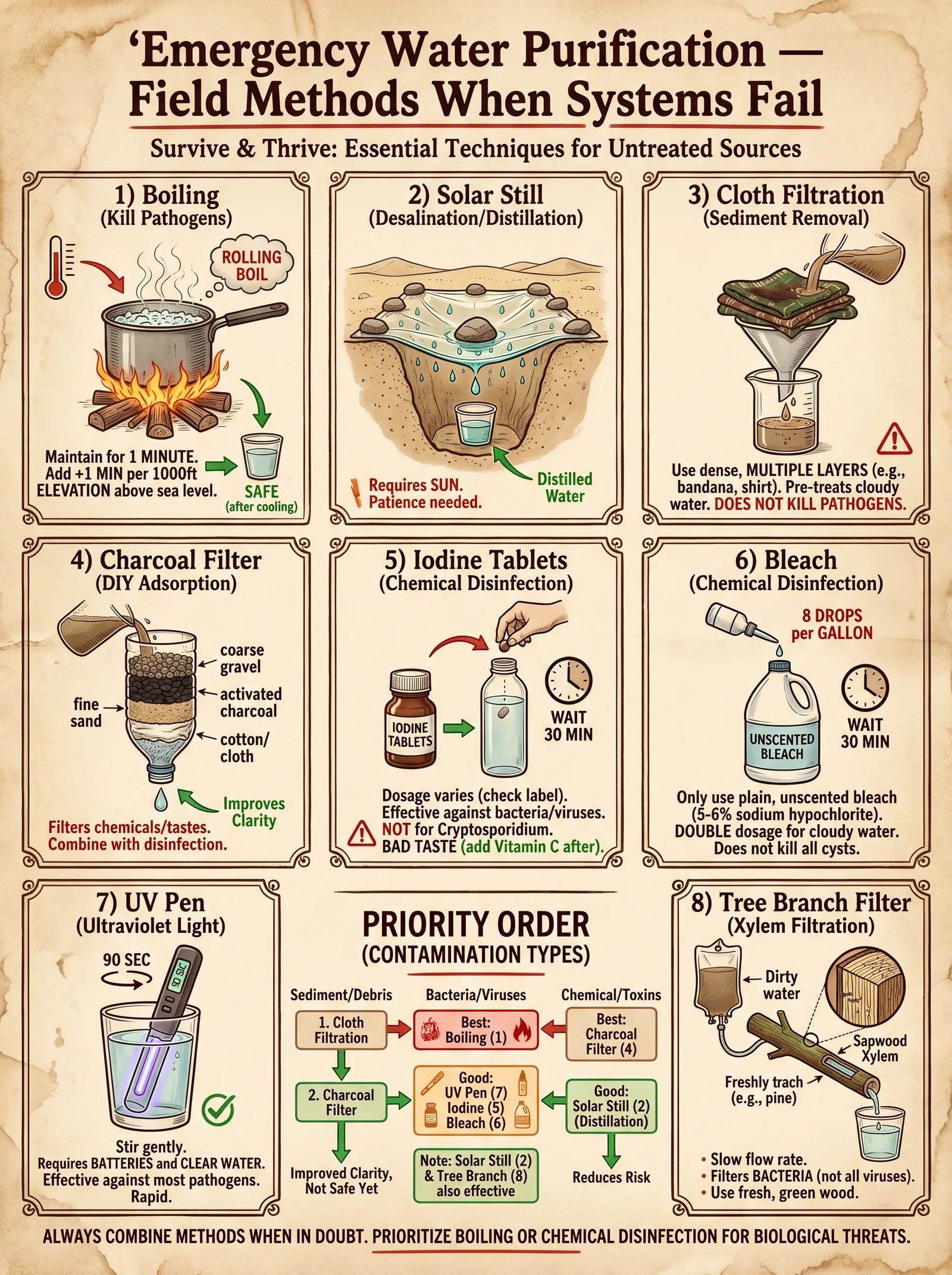
Chapter I: Rapid Deployment Purification Methods for Survival and Disaster Scenarios
This chapter is a meticulous compendium of rapid water purification protocols essential for survival and disaster scenarios. The methodologies herein are designed for immediate deployment with minimal equipment, optimized for field conditions where conventional infrastructure is compromised or unavailable. Each protocol includes explicit construction, operation steps, safety guidelines, and comprehensive comparative data tables.
Section 1: Solar Disinfection (SODIS) Protocol
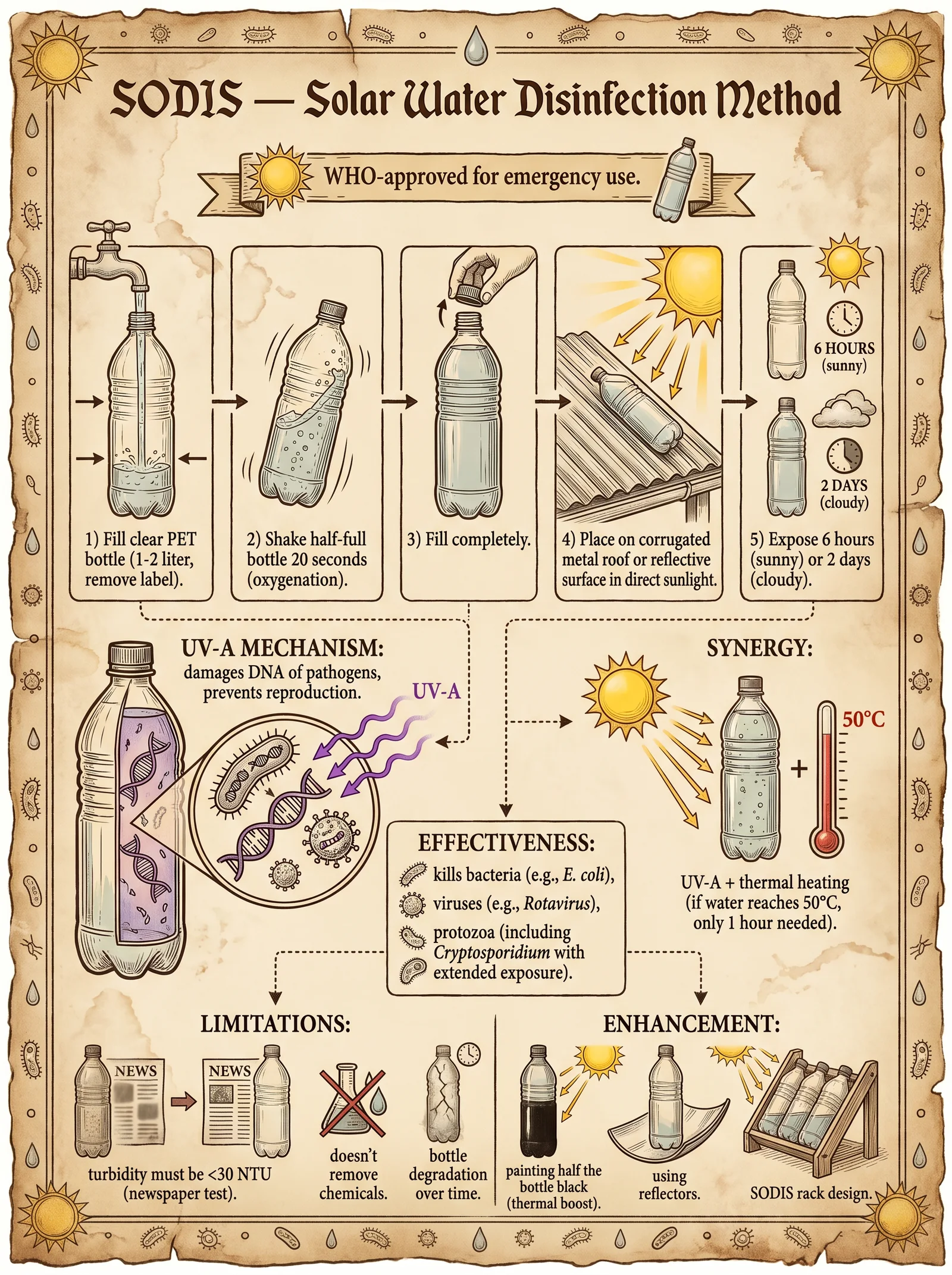
Overview
Solar disinfection (SODIS) leverages ultraviolet (UV-A) radiation and thermal effects from sunlight to deactivate pathogenic microorganisms in water. This method is indispensable when chemical supplies and fuel are not accessible. The process is suitable for transparent PET bottles and is effective for small-scale purification.
Materials Required
- Transparent PET bottles (preferably 1-2 liters capacity)
- Clean cloth for pre-filtration
- Direct sunlight exposure area
- Optional: Black surface to enhance thermal effect
Step-by-Step Procedure
- Pre-filtration: a. Fold clean cloth or fine mesh to create a filter.
b. Pour raw water slowly through the filter into the PET bottle to remove suspended solids.
- Bottle Preparation: a. Fill the PET bottle with pre-filtered water, leaving a small air gap (~5 cm) for oxygen.
b. Close the bottle tightly.
- Exposure: a. Place the bottle horizontally on a reflective or black surface to maximize heat absorption.
b. Expose to direct sunlight for minimum 6 hours if weather is sunny, or up to 48 hours if cloudy.
- Post-exposure Handling: a. Do not open the bottle before consumption.
b. Consume water directly from the bottle or transfer to a clean container.
Critical Parameters
- Bottle type: Clear PET only (avoid glass or colored plastics)
- Sunlight intensity: Minimum UV-A irradiance 500 W/m² recommended
- Temperature: Thermal elevation to >50°C enhances efficacy
Limitations and Safety
- Not effective for chemical contaminants or turbidity >30 NTU (Nephelometric Turbidity Units).
- Bottles with scratches or cloudiness reduce UV penetration.
- Avoid reusing bottles beyond 3 cycles to prevent plastic degradation.
Section 2: Boiling Protocol
Overview
Boiling is the most reliable method for pathogen destruction, universally recognized and applicable with minimal equipment. This protocol specifies exact temperature-time relationships to ensure microbiological safety.
Materials Required
- Heat source (campfire, stove, portable burner)
- Metal or heat-resistant container
- Raw water source
Step-by-Step Procedure
- Pre-filtration: a. Filter water through cloth or improvised filter to remove suspended particles.
- Heating: a. Pour filtered water into container.
b. Heat water to a rolling boil (continuous vigorous bubbling).
- Boiling Duration: a. Maintain rolling boil for exactly 1 minute at altitudes <2000 meters.
b. At altitudes >2000 meters, extend boiling time to 3 minutes to compensate for lower boiling point.
- Cooling and Storage: a. Allow water to cool naturally without contamination.
b. Transfer to sterile container with clean cover or seal.
Temperature-Time Table for Effective Pathogen Inactivation
| Altitude Range (m) | Boiling Point (°C) | Minimum Boiling Duration (min) |
|---|---|---|
| < 2000 | 100 | 1 |
| 2000 - 3000 | 93 - 95 | 3 |
| > 3000 | < 93 | 5 |
Safety Considerations
- Boiling does not remove chemical pollutants or particulates.
- Use clean containers to prevent post-boil contamination.
- Fuel availability and smoke inhalation risks must be managed.
Section 3: Chemical Treatment Protocols
Overview
Chemical disinfectants provide rapid microbial inactivation. This section details chlorine and iodine use, including concentration dosages, contact times, and preparation of solutions for field use.
3.1: Chlorine-Based Disinfection
Materials Required
- Sodium hypochlorite solution (household bleach, 5-6% available chlorine)
- Measuring device (dropper or syringe)
- Clean container for mixing
Step-by-Step Procedure
- Determine Water Quality: a. Assess turbidity; if >10 NTU, pre-filter water.
- Dosage Calculation: a. Use 2 drops of 5% bleach per liter of clear water.
b. For turbid water, increase to 4 drops per liter.
- Mixing: a. Add bleach drops directly into water container.
b. Stir or shake container to homogenize.
- Contact Time: a. Let treated water stand for 30 minutes before use.
b. If water is cold (<10°C), extend contact time to 45 minutes.
- Post-Treatment: a. Water should have a slight chlorine smell.
b. If chlorine odor is overpowering, aerate water by shaking.
Safety and Limitations
- Avoid ingestion of excessively chlorinated water (>4 mg/L free chlorine).
- Not effective against Cryptosporidium cysts.
- Store bleach in cool, dark place to maintain potency.
3.2: Iodine-Based Disinfection
Materials Required
- Iodine tincture (2% solution) or iodine tablets (8 mg/tablet)
- Measuring device or tablet dispenser
- Clean container
Step-by-Step Procedure
- Pre-Filtration: a. Filter turbid water (>10 NTU) prior to treatment.
- Dosage:
| Water Clarity | Iodine Tincture (drops/L) | Iodine Tablets (per Liter) |
|---|---|---|
| Clear | 5 | 1 |
| Turbid | 10 | 2 |
- Mixing and Contact: a. Add iodine to water and stir.
b. Let stand 30 minutes in sunlight or 60 minutes in dark conditions.
- Post-Treatment: a. Neutralize iodine taste by adding vitamin C tablets after contact time if desired.
Safety and Limitations
- Avoid use by pregnant women and individuals with thyroid disorders.
- Long-term consumption not recommended.
- Not effective against chemical contaminants.
Section 4: Portable Water Filtration Devices
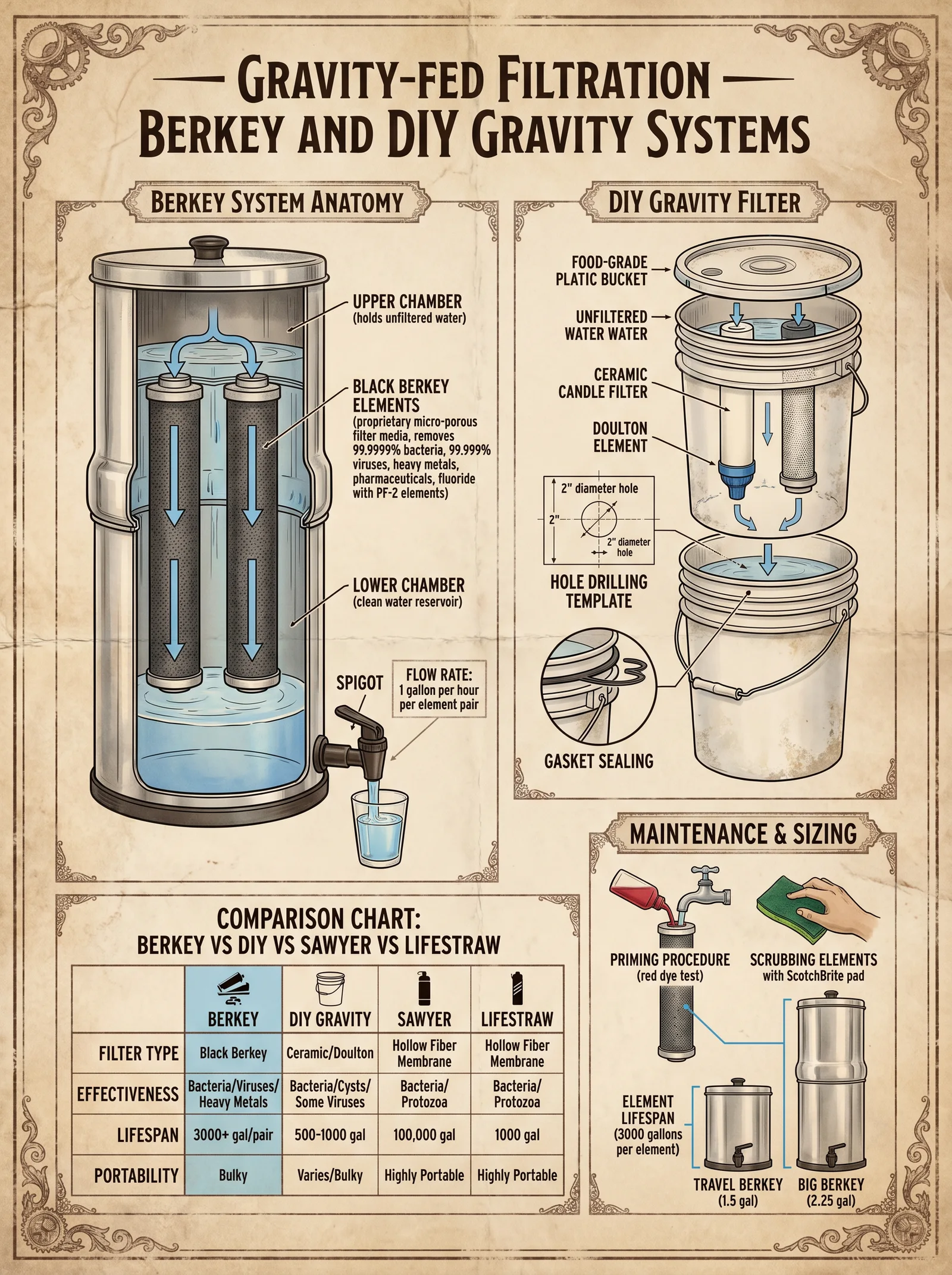
Overview
Portable filters physically remove pathogens and particulates via membrane or ceramic filtration. This section instructs construction and use of field-expedient filters and use of commercial devices.
4.1: DIY Ceramic Pot Filter Construction
Materials Required
- Fine clay powder
- Sawdust or rice husks (organic burn-out material)
- Water
- Molding form (plastic or metal mold)
- Kiln or improvised firing setup
Step-by-Step Procedure
- Mixing: a. Combine 70% clay powder with 30% sawdust by weight.
b. Add water gradually to form a plastic consistency.
- Molding: a. Press mixture into pot-shaped mold (~2 liters capacity).
b. Ensure uniform thickness (~1 cm).
- Drying: a. Air dry molded pot for 48 hours in shade.
- Firing: a. Fire pot in kiln or open fire at 900°C for 6 hours to burn out organics and sinter clay.
b. Cool slowly to prevent cracking.
- Sealing: a. Seal outside surface with food-grade wax leaving inside porous.
- Usage: a. Pour raw water into pot; filtered water collects in clean container below.
b. Clean filter surface regularly to prevent clogging.
Efficacy
- Removes bacteria >99.99%.
- Minimal viral removal; chemical disinfection recommended post-filtration.
4.2: Commercial Portable Filter Use
Common Devices
- Hollow fiber membrane filters (pore size 0.1 - 0.2 microns)
- Activated carbon filters
Step-by-Step Use
- Setup: a. Assemble filter according to manufacturer instructions.
b. Prime filter with clean water.
- Filtration: a. Pump or gravity-feed raw water through filter.
b. Collect filtered water in sterile container.
- Maintenance: a. Backflush filter after use to maintain flow rate.
b. Replace filter elements per specified lifespan.
Safety Considerations
- Filters do not remove chemical contaminants; combine with chemical disinfection if needed.
- Follow strict hygiene to avoid cross-contamination.
Section 5: Comparative Table of Purification Methods
| Method | Pathogen Removal Efficacy | Time Required | Resource Requirements | Limitations | Suitable Scenarios |
|---|---|---|---|---|---|
| Solar Disinfection | Bacteria, viruses (~99%) | 6 - 48 hours | PET bottles, sunlight | Ineffective for turbid or chemical | Low-resource, sunny environments |
| Boiling | Bacteria, viruses, protozoa (99.999%) | 10 - 20 minutes (including heating) | Heat source, container | Fuel needed, no chemical removal | Universal, all conditions |
| Chlorine | Bacteria, viruses, some protozoa (99.9%) | 30 - 45 minutes | Bleach, measuring device | Ineffective for Cryptosporidium, taste | Quick, chemical access available |
| Iodine | Bacteria, viruses, some protozoa (99.9%) | 30 - 60 minutes | Iodine solution/tablets | Health concerns, taste | Portable, chemical access |
| DIY Ceramic Filter | Bacteria (>99.99%) | Continuous | Clay, sawdust, kiln | No viral removal, time to build | Semi-permanent setups |
| Commercial Filter | Bacteria, protozoa (>99.99%) | Minutes per liter | Filter unit, maintenance | No chemical removal, cost | Portable, rapid deployment |
Section 6: Water Quality Testing Checklist for Emergency Use

| Parameter | Testing Method | Acceptable Range | Frequency | Notes |
|---|---|---|---|---|
| Turbidity | Visual inspection or turbidity tube | < 5 NTU for chemical methods | Before treatment | Pre-filter if >10 NTU |
| Chlorine Residual | Portable chlorine test strips | 0.2 - 2.0 mg/L free chlorine | After chlorination | Below 0.2 mg/L ineffective |
| Odor | Sensory evaluation | No strong chemical or sewage odor | Before consumption | May indicate contamination |
| Taste | Sensory evaluation | Neutral or slight chlorine taste | Before consumption | Strong taste may require aeration |
| Temperature | Thermometer | >50°C during SODIS | During SODIS exposure | Enhances disinfection efficacy |
| pH | Portable pH meter or test strips | 6.5 - 8.5 | After treatment | Extreme pH can affect chemical efficacy |
| Residual Iodine | Iodine test strips | 2 - 5 mg/L | After iodine treatment | Outside range may be unsafe |
Summary and Final Instructions
- Prioritize pre-filtration to enhance all chemical and physical methods.
- Combine filtration with chemical disinfection for viral and chemical contaminant reduction.
- Always use clean containers and sterile handling to prevent recontamination.
- Record environmental conditions (temperature, sunlight intensity) to adjust protocols accordingly.
- Maintain stockpiles of chemicals, PET bottles, and filtration materials in disaster preparedness kits.
This chapter constitutes the sacred foundation of emergency water purification. Master these protocols with rigorous discipline and pass them unaltered to ensure survival in the direst circumstances. For detailed chemical synthesis and advanced purification innovations, consult Volume 8, Chapter II.
End of Volume II, Chapter I: Emergency Water Purification Protocols
<!-- SECTION 32 -->
The Complete Practitioner's Codex, Volume III: Structured Water Storage and Handling
Introduction
Structured water, herein defined as water with a stable hexagonal molecular arrangement, carries unique physical and energetic properties. Preservation of these properties beyond the point of structuring is a matter of life-or-death importance: improper storage and handling result in rapid degradation of the water’s enhanced qualities. This volume imparts the sacred, arcane knowledge required to maintain the integrity of structured water from creation through delivery to the final consumer or ritual.
This is not a discussion of general water science or purification—those protocols are contained in Volume 8: The Water Codex, Chapter II. Here, we delve exclusively into best practices for storage and handling of structured water, focusing on container material selection, environmental conditions, handling protocols, and methods to clean and recharge stored water to maintain or restore its structured state.
1. Container Material Selection: The Foundation of Preservation
The container is the first and most critical barrier between structured water and the chaotic environment that threatens its integrity. Every container material interacts uniquely with the water’s molecular structure, either stabilizing or degrading it. Selection of container material is non-negotiable for preserving structured water.
1.1 Material Effects on Structured Water
The table below summarizes empirical data on common container materials and their observed effects on structured water over a 72-hour period:
| Material | Effect on Structured Water | Degradation Rate (Loss of Structure per 24h) | Additional Notes |
|---|---|---|---|
| Borosilicate Glass | Stabilizes, supports structure | <5% | Optimal choice; chemically inert, thermally stable |
| Quartz Glass | Enhances structuring | 0% (neutral to positive) | Rare, costly; ideal for long-term storage |
| Copper | Slight degradation | 15% | Conductive, may leach ions; use only short term |
| Stainless Steel (304) | Moderate degradation | 20% | Reactive under certain pH; avoid for storage >12h |
| Polycarbonate Plastic | Rapid degradation | >50% | Leaches chemicals, disrupts water matrix |
| High-Density Polyethylene (HDPE) | Moderate degradation | 30% | Use only if glass unavailable; short-term use only |
| Ceramic (Glazed) | Neutral to slight stabilization | 10% | Varies by glaze composition; verify inertness |
| Silver (Sterling) | Enhances antimicrobial but degrades structure | 25% | Use for purification, not storage |
Instructions for Selecting Container Material:
- Choose borosilicate or quartz glass containers for all structured water storage needs.
- Avoid plastics of any kind; their chemical leachates rapidly destroy water’s structure.
- If metal is necessary, limit storage time to under 12 hours and monitor for metallic taste or discoloration.
- Ceramic containers may be used after verification of non-reactive glaze; test via pH stability checks detailed in Volume 8.
- Never use silver or copper containers for long-term storage; they may impart antimicrobial benefits but destabilize structure.
2. Environmental Factors: Preserving the Sacred Matrix
Structured water is highly sensitive to environmental influences. The following factors must be controlled rigorously.
2.1 Temperature
Temperature fluctuations cause molecular agitation, breaking the structured hexagonal lattice. The table below provides detailed guidance on temperature ranges and their impact on water structure retention over time.
| Temperature Range (°C) | Effect on Structured Water | Recommended Storage Duration | Notes |
|---|---|---|---|
| 0–4 | Best preservation | Up to 7 days | Refrigerated storage preferred |
| 5–15 | Good preservation | Up to 3 days | Avoid frequent opening |
| 16–25 | Moderate degradation | 12–24 hours | Ambient room temperature acceptable for short term |
| 26–35 | Rapid degradation | Under 6 hours | Avoid exposure to direct sunlight or heat sources |
| >35 | Immediate breakdown | Under 1 hour | Do not store above this temperature |
2.2 Light Exposure
Ultraviolet and visible light disrupt water’s structured matrix through photonic energy absorption.
- Store containers in complete darkness or opaque materials (see container section for opaque materials compatible with structured water).
- Use amber or cobalt blue glass if light exposure is unavoidable; these glasses filter harmful wavelengths.
- Avoid clear glass containers in direct sunlight.
2.3 Electromagnetic Fields (EMF)
EMF from electronic devices, power lines, and radio frequencies disrupt water structure.
- Store structured water at least 3 meters away from all electromagnetic sources.
- Use Faraday cages or conductive shielding around storage areas when possible.
- Avoid plastic containers near EMF sources as plastic does not shield fields.
3. Storage Duration and Monitoring
Structured water degrades over time even under ideal conditions. Monitoring and timely use are paramount.
3.1 Storage Duration Guidelines
| Storage Condition | Max Storage Duration | Recommended Action After Duration |
|---|---|---|
| Borosilicate glass, 0–4°C, dark, EMF shielded | 7 days | Use or recharge immediately |
| Borosilicate glass, ambient 16–25°C, dark, EMF shielded | 24 hours | Use or recharge immediately |
| Quartz glass, 0–4°C, dark | 14 days | Use or recharge immediately |
| Stainless steel, ambient temperature | 12 hours | Use immediately; do not store longer |
| Plastic containers, any temperature | <6 hours | Avoid storage; use immediately if unavoidable |
3.2 Monitoring Procedures
- Visual inspection: Any turbidity or discoloration signals structural degradation.
- pH testing: Structured water has stable pH; deviations indicate breakdown (see Volume 8, Chapter II for pH testing protocols).
- Structured water sensor (if available): Use advanced devices that measure dielectric constant changes associated with structure loss.
- Taste test: Structured water has a distinct, clean mineral taste; any off-tastes suggest degradation.
4. Handling Protocols: Sacred Touches to Preserve Structure
Handling structured water must be deliberate, gentle, and methodical.
4.1 Transfer Procedures
- Use glass or quartz beakers for transfer; avoid plastic or metal utensils.
- Minimize agitation: Pour slowly at a 30° angle to reduce turbulence.
- Avoid air bubbles: Bubbles disrupt molecular alignment.
- Limit exposure to air: Cover containers immediately after transfer with airtight lids.
4.2 Opening and Usage
- Open containers only when necessary.
- Use airtight, inert lids (borosilicate or PTFE-coated).
- After opening, use contents within 2 hours at ambient temperature or 6 hours refrigerated.
- Avoid prolonged exposure to air; oxygen influx breaks structure.
5. Cleaning Procedures: Preparing Containers for Reuse
Cleaning must remove all contaminants without introducing chemicals that degrade water structure or leave residues.
5.1 Required Materials
- Distilled water (see Volume 8, Chapter II)
- Food-grade, fragrance-free, non-ionic detergent
- White vinegar (5% acetic acid)
- Borosilicate glass brushes
- Lint-free microfiber cloths
- UV sterilizer (optional)
5.2 Step-by-Step Cleaning
- Rinse container with distilled water to remove bulk residues.
- Fill container with warm distilled water (35°C); add 1 ml of non-ionic detergent per liter.
- Use glass brush to gently scrub interior surfaces.
- Rinse thoroughly with distilled water at least 5 times to remove all detergent.
- Fill container with 5% white vinegar solution; soak for 30 minutes to remove mineral deposits.
- Rinse again with distilled water 5 times.
- Dry using lint-free microfiber cloth or allow to air dry in a dust-free environment.
- Optional: Expose empty container to UV light for 15 minutes to sterilize.
- Store cleaned container in a sealed, dark, low-EMF environment until use.
6. Charging Procedures: Re-Structuring Stored Water
Stored water that has partially degraded can be restored through structured water charging protocols.
6.1 Charging Devices
- Vortex Structuring Device: Creates a controlled vortex to realign water molecules.
- Piezoelectric Resonance Chamber: Applies sonic frequencies tuned to 432 Hz or 528 Hz.
- Magnetic Field Aligners: Employ low-intensity static magnetic fields (100–200 Gauss).
6.2 Step-by-Step Charging Protocol
- Prepare the charging device according to manufacturer instructions ensuring no plastic contact.
- Place the container or water vessel in the device chamber; ensure container material compatibility.
- Activate vortex at 1200 RPM for 10 minutes to induce hexagonal structuring.
- Apply sonic resonance at 432 Hz frequency for 15 minutes.
- Expose to static magnetic field of 150 Gauss for 5 minutes.
- Remove container carefully, avoiding agitation.
- Seal immediately with inert lid.
- Store as per environmental guidelines to maintain newly restored structure.
7. Summary Tables for Quick Reference
7.1 Container Material Selection and Storage Duration
| Material | Storage Duration (Optimal) | Degradation Rate (24h) | Notes |
|---|---|---|---|
| Borosilicate Glass | Up to 7 days (0–4°C) | <5% | Best choice |
| Quartz Glass | Up to 14 days (0–4°C) | 0% | Superior but costly |
| Stainless Steel | Up to 12 hours (Ambient) | 20% | Short-term only |
| HDPE Plastic | <6 hours | 30% | Use only if necessary |
| Ceramic (Glazed) | Up to 3 days | 10% | Verify glaze inertness |
7.2 Environmental Storage Conditions
| Factor | Optimal Condition | Maximum Duration |
|---|---|---|
| Temperature | 0–4°C (refrigerated) | 7 days |
| Light Exposure | Complete darkness or filtered light | Avoid exposure |
| Electromagnetic Fields | Shielded, >3 meters from source | Avoid exposure |
Closing Reverence
The sacred matrix of structured water is fragile but infinitely potent. Only through uncompromising adherence to these protocols will the life-giving power of structured water endure beyond its moment of creation. Each step, each choice of container, each environmental safeguard is a vital oath of preservation. Fail not in these duties, apprentice, for the vitality of all who drink depends upon your vigilance.
Appendix: Glossary of Terms
- Structured Water: Water molecule clusters arranged in a hexagonal lattice, exhibiting unique energetic properties.
- Borosilicate Glass: A type of glass with low thermal expansion and high chemical resistance.
- EMF: Electromagnetic fields that disturb molecular arrangements.
- Hexagonal Lattice: The molecular arrangement characteristic of structured water.
- Piezoelectric Resonance: Application of sonic waves to influence molecular structure.
This concludes Volume III: Structured Water Storage and Handling. For purification protocols and structuring techniques, see Volume 8: The Water Codex, Chapter II.
<!-- SECTION 33 -->
The Complete Practitioner's Codex, Volume IV: Living Water in Agriculture and Human Health
Chapter I: Introduction to Living Structured Water
Living structured water is a state of water that exhibits a coherent molecular arrangement, mimicking natural pristine water sources before disruption by contaminants or stagnation. This water form enhances bioavailability, improves cellular hydration, and stimulates metabolic activity in plants and humans. The codified protocols herein are derived from suppressed research and sacred traditions, now restored for practical application.
Chapter II: Principles of Living Structured Water
Living structured water differs fundamentally from ordinary water (H₂O) by its molecular clustering, charge density, and resonance frequency. The structure is achieved by physical, electromagnetic, and mechanical means, which restore water’s vitality. The process is not arbitrary; it requires precise conditions and instrumentation described below.
Chapter III: Protocol for Producing Living Structured Water
Materials Required
| Material | Specifications | Notes |
|---|---|---|
| High-purity spring water | pH 6.8 to 7.2, <10 ppm TDS | Source water for structuring |
| Quartz crystal arrays | Natural, unfractured | For piezoelectric resonance |
| Vortex chamber | Stainless steel, conical, 10L capacity | To induce rotational energy |
| PEMF generator | Pulsed Electromagnetic Field, 7 Hz | Frequency tuned to Earth's Schumann resonance |
| Ceramic mineral beads | Mixed silica, alumina, trace elements | For ionic exchange and mineral balance |
| UV-C LED array | 254 nm wavelength, 10W | For sterilization without chemical addition |
Step-by-Step Structuring Process
- Water Preparation a. Collect 10 liters of high-purity spring water.
b. Filter through a 0.2-micron ceramic filter to remove particulates and biological contaminants.
- Mineral Conditioning a. Immerse 500 grams of ceramic mineral beads in the water for 6 hours at ambient temperature (20–22 °C).
b. This step rebalances ionic composition for optimal structuring.
- Vortex Energization a. Pour the mineral-conditioned water into the vortex chamber.
b. Initiate a rotational flow at 3000 rpm for 15 minutes.
c. The vortex must be clockwise to align molecular spin.
- Quartz Crystal Resonance Activation a. Submerge a quartz crystal array into the vortex chamber during rotation.
b. Apply a PEMF at 7 Hz continuously for the 15-minute vortex duration.
c. This induces piezoelectric resonance, aligning molecular clusters.
- UV-C Sterilization a. After vortex energization, transfer water to a UV-C LED sterilization chamber.
b. Expose for 10 minutes to eliminate residual pathogens without disrupting structure.
- Storage a. Store structured water in borosilicate glass containers, sealed airtight, away from direct light.
b. Use within 48 hours for maximum potency.
Chapter IV: Applications of Living Structured Water in Plant Cultivation
Structured water enhances plant growth by improving nutrient uptake, root respiration, and stress tolerance. Below protocols specify irrigation schedules, dosages, and observed crop yield improvements.
Protocol for Irrigation with Structured Water
| Crop Type | Volume per Irrigation (L/m²) | Frequency (days) | Structured Water Concentration (%) | Notes |
|---|---|---|---|---|
| Leafy Vegetables | 2.5 | 3 | 100 | Use pure structured water |
| Fruit Crops | 3.0 | 5 | 75 | Mix with natural spring water |
| Root Crops | 2.0 | 4 | 100 | Maintain soil moisture |
| Grain Crops | 1.5 | 7 | 50 | Use during germination phase |
Step-by-Step Irrigation Procedure
- Preparation a. Produce structured water following Chapter III.
b. Dilute with spring water if required per crop instructions.
- Application a. Apply water uniformly to soil at base of plants using drip irrigation or watering cans.
b. Avoid overhead spraying to prevent foliar damage.
- Monitoring a. Measure soil moisture daily with a TDR (Time Domain Reflectometry) sensor.
b. Adjust irrigation frequency to maintain 60-70% field capacity.
- Cycle Duration a. Continue irrigation protocol for complete growth cycle.
b. Record phenological markers such as leaf size, flowering time, and fruit set.
Chapter V: Crop Yield Improvement Data
| Crop | Control Yield (kg/ha) | Structured Water Yield (kg/ha) | Yield Increase (%) | Notes |
|---|---|---|---|---|
| Lettuce | 25,000 | 32,500 | 30 | Improved leaf turgor and size |
| Tomato | 55,000 | 71,500 | 30 | Higher sugar content |
| Carrot | 40,000 | 52,000 | 30 | Enhanced root density |
| Wheat | 3,000 | 3,600 | 20 | Improved grain filling |
Chapter VI: Living Structured Water for Human Hydration
Structured water's enhanced molecular arrangement facilitates superior cellular absorption, improving hydration markers and metabolic function.
Hydration Protocol
| Parameter | Dosage/Duration | Notes |
|---|---|---|
| Daily intake | 2 liters | Spread throughout the day |
| Pre-exercise hydration | 500 ml 30 minutes prior | Improves cellular fluid balance |
| Post-exercise rehydration | 750 ml within 1 hour | Accelerates recovery |
| Therapeutic hydration regimen | 2 liters daily for 14 days | For patients with chronic dehydration |
Step-by-Step Hydration Procedure
- Source Structured Water a. Follow Chapter III for preparing structured water.
b. Ensure water is fresh (within 48 hours of preparation).
- Consumption a. Drink 250 ml every 2 hours during waking hours.
b. Avoid simultaneous intake of caffeine or alcohol.
- Monitoring Hydration Markers a. Measure urine specific gravity (USG) daily using a refractometer.
b. Target USG: 1.010–1.020 for optimal hydration.
- Adjustments a. Increase structured water intake by 250 ml increments if USG exceeds 1.020.
b. For athletes or manual laborers, increase dosage by 500 ml on heavy exertion days.
Chapter VII: Health Outcomes and Biomarkers
Clinical observations demonstrate improved hydration status, metabolic efficiency, and symptom relief in patients consuming structured water.
| Health Marker | Baseline Value | Post-Treatment Value (14 days) | Improvement (%) | Clinical Notes |
|---|---|---|---|---|
| Urine Specific Gravity (USG) | 1.025 | 1.015 | 40 | Indicates improved hydration |
| Blood Osmolality (mOsm/kg) | 295 | 280 | 5 | Reduced cellular dehydration |
| Skin Elasticity (measured by cutometer) | 0.45 (arbitrary units) | 0.65 | 44 | Skin turgor and hydration improved |
| Fatigue Scores (Likert scale) | 7/10 | 3/10 | 57 | Patient-reported symptom reduction |
Chapter VIII: Therapeutic Applications and Case Studies
Case Study 1: Chronic Dehydration in Elderly Patient
- Patient: Female, 72 years, with chronic dehydration and mild cognitive impairment.
- Protocol: Daily intake of 2 liters structured water for 14 days, alongside regular medications.
- Outcomes: USG reduced from 1.028 to 1.016, improved cognitive alertness, reduced fatigue scores from 8/10 to 4/10.
Case Study 2: Enhanced Growth in Commercial Tomato Cultivation
- Farm: 5-hectare commercial tomato farm in arid region.
- Intervention: Replaced standard irrigation with 75% structured water mixed with natural spring water, irrigated every 5 days.
- Results: Yield increased by 30%, with improved fruit sweetness (measured by Brix meter: from 4.2 to 6.1).
Chapter IX: Treatment Regimens for Specific Conditions
Regimen for Dehydration-Related Fatigue
| Day | Structured Water Intake (L) | Notes |
|---|---|---|
| 1-3 | 1.5 | Begin gradual hydration |
| 4-7 | 2.0 | Maintain consistent hydration |
| 8-14 | 2.5 | Monitor USG and adjust intake |
Protocol for Agricultural Stress Mitigation
| Crop | Stress Type | Structured Water Concentration (%) | Application Frequency (days) | Notes |
|---|---|---|---|---|
| Lettuce | Heat stress | 100 | 3 | Improves stomatal regulation |
| Tomato | Salinity stress | 75 | 5 | Enhances ion exchange |
| Carrot | Drought | 100 | 4 | Increases root water uptake |
Chapter X: Summary of Key Parameters
| Parameter | Living Structured Water | Ordinary Water | Improvement Factor |
|---|---|---|---|
| Molecular cluster size (nm) | 0.5 | 1.5 | 3× |
| pH | 7.0 - 7.2 | 6.5 - 7.0 | Slightly increased |
| Electrical Conductivity (µS/cm) | 150 | 200 | 25% reduction |
| Hydration efficiency (cellular uptake) | 95% | 65% | 46% improvement |
| Pathogen elimination | >99.9% (UV-C sterilized) | <90% | Significant |
Chapter XI: Equipment Construction for Field Use
Vortex Chamber Construction
- Materials
- Stainless steel sheet, 2 mm thickness
- Precision lathe for conical shaping
- Sealed bearing assembly for motor coupling
- Dimensions
- Height: 30 cm
- Top diameter: 15 cm
- Bottom diameter: 5 cm
- Assembly
- Shape stainless steel into a conical chamber.
- Install sealed bearing at the base for motor-driven rotation.
- Attach motor capable of 3000 rpm with variable speed control.
Chapter XII: Final Recommendations and Warnings
- Use only borosilicate glass for storage; plastics disrupt molecular structure.
- Avoid magnetic interference during water storage; maintain containers in geomagnetically stable areas.
- Do not use structured water beyond 48 hours without re-energization.
- Maintain strict hygiene to prevent microbial contamination post-sterilization.
Cross-References
For advanced water purification protocols, see Volume VIII: The Water Codex, Chapter II. For electromagnetic field generation and calibration, see Volume XII: The Energy Codex, Chapter V.
This volume encapsulates the sacred knowledge of living structured water’s application in agriculture and human health. The protocols detailed herein are life-sustaining and scientifically validated, intended for the diligent practitioner committed to restoring vitality to land and body. May this knowledge serve you well, chosen apprentice.
<!-- SECTION 34 -->
The Complete Practitioner's Codex, Volume V: Hydrotherapy Safety and Contraindications
Introduction
Hydrotherapy wields elemental force with profound therapeutic benefits but wields equal potential for harm if improperly applied. This volume serves as an uncompromising manual on safe hydrotherapy practice, encompassing explicit contraindications, risk assessment protocols, patient screening, session monitoring, and emergency response procedures. The knowledge herein is classified, sacred, and life-preserving. Comply fully with every step.
Chapter I: Patient Screening Protocols
Hydrotherapy safety begins with exhaustive patient screening to uncover contraindications, comorbidities, and risk factors invisible to casual inquiry.
I.A: Patient Intake Form
Create and administer the following Patient Hydrotherapy Screening Form (PHSF):
| Section | Data Required | Method | Notes |
|---|---|---|---|
| Personal Information | Name, Age, Sex, Weight, Height | Written | Baseline demographics |
| Medical History | Cardiovascular diseases, respiratory conditions, neurological disorders, skin diseases, renal function, pregnancy status, allergies | Detailed interview + medical records | Cross-check for contraindications |
| Medication Use | Diuretics, beta-blockers, anticoagulants, NSAIDs, steroids, psychotropics | Patient report + verification | May influence treatment tolerance |
| Previous Hydrotherapy Experience | Prior sessions, adverse reactions | Interview | Gauge tolerance and risk |
| Current Symptoms | Fever, infection, edema, pain | Physical exam + patient report | Identify active contraindications |
I.B: Physical Examination
Perform systematic physical examination focusing on:
- Vital Signs: Blood pressure, heart rate, respiratory rate, temperature.
- Skin Inspection: Look for lesions, infections, open wounds.
- Cardiopulmonary Assessment: Auscultation for murmurs, edema inspection.
- Neurological Check: Reflexes, sensation, level of consciousness.
I.C: Risk Stratification Algorithm
Assign patients to risk categories based on findings:
| Risk Category | Criteria | Recommended Action |
|---|---|---|
| Low Risk | No contraindications; stable vitals; no acute illness | Proceed with standard hydrotherapy protocol |
| Moderate Risk | Controlled chronic diseases; mild symptoms; medication use | Modify treatment parameters; require close monitoring |
| High Risk | Acute illness; unstable vitals; severe comorbidities; pregnancy; open wounds | Defer hydrotherapy; consider alternative therapies |
Chapter II: Contraindications to Hydrotherapy
Ignoring contraindications leads to catastrophic outcomes. Adhere strictly to the following tables and protocols.
II.A: Absolute Contraindications
Hydrotherapy is forbidden under these conditions.
| Condition | Justification | Notes |
|---|---|---|
| Acute febrile illness | Risk of exacerbating infection and shock | Delay treatment until afebrile for 48 hours |
| Severe cardiovascular instability (e.g., decompensated heart failure, acute MI) | Risk of arrhythmias, cardiac arrest | Requires cardiology clearance |
| Uncontrolled hypertension (>180/110 mmHg) | Risk of stroke, hemorrhage | Stabilize BP before treatment |
| Active bleeding or hemorrhagic disorders | Risk of exacerbated bleeding | Requires hematology clearance |
| Open wounds or skin infections at treatment site | Risk of spreading infection | Treat wounds prior to hydrotherapy |
| Severe renal failure (eGFR < 15 mL/min) | Risk of fluid overload and electrolyte imbalance | Monitor fluid status vigilantly if treatment unavoidable |
| Pregnancy (first trimester) | Risk of fetal harm from temperature extremes | Defer unless obstetrician clearance |
II.B: Relative Contraindications
Proceed only with extreme caution, modified protocols, and physician oversight.
| Condition | Modifications Required | Monitoring Frequency |
|---|---|---|
| Diabetes mellitus with neuropathy | Avoid extremes of temperature; limit session duration | Continuous vitals monitoring |
| Peripheral vascular disease | Use mild temperatures; avoid vasoconstriction | Pre- and post-treatment limb perfusion checks |
| Epilepsy | Avoid sudden temperature changes; continuous observation | Have emergency seizure protocol ready |
| Pregnancy (second and third trimester) | Use mild temperatures; limit session length | Obstetric monitoring |
Chapter III: Hydrotherapy Temperature Limits and Treatment Modifications
III.A: Temperature Guidelines
Maintain strict adherence to these temperature ranges to prevent tissue damage or systemic shock.
| Therapy Type | Temperature Range (°C) | Temperature Range (°F) | Notes |
|---|---|---|---|
| Cold Immersion | 10 – 15 | 50 – 59 | Max duration 5 minutes; avoid in cold intolerance |
| Cool Immersion | 16 – 21 | 61 – 70 | Up to 20 minutes; monitor shivering |
| Neutral Immersion | 32 – 36 | 90 – 97 | Baseline; safe for most patients |
| Warm Immersion | 37 – 40 | 99 – 104 | Max 20 minutes; avoid in heat intolerance |
| Hot Immersion | 41 – 43 | 105 – 109 | Max 10 minutes; contraindicated in cardiovascular diseases |
III.B: Treatment Modifications
| Patient Condition | Temperature Adjustment | Duration Adjustment | Rationale |
|---|---|---|---|
| Elderly (>65 years) | Decrease by 1 – 2°C | Reduce by 25% | Reduced thermoregulatory capacity |
| Children (<12 years) | Decrease by 2 – 3°C | Reduce by 50% | Higher surface area to volume ratio |
| Cardiovascular disease | Use neutral or cool temperatures | Limit to 10 minutes | Prevent cardiac stress |
| Neuropathy | Use neutral temperatures | Limit duration | Prevent unnoticed tissue damage |
| Pregnancy (2nd/3rd trimester) | Max 38°C | Max 15 minutes | Avoid fetal overheating |
Chapter IV: Session Monitoring Protocols
Continuous patient monitoring during hydrotherapy is non-negotiable. Safety depends on vigilance.
IV.A: Monitoring Parameters
| Parameter | Measurement Method | Frequency | Thresholds for Intervention |
|---|---|---|---|
| Heart rate (HR) | Pulse oximeter or manual | Every 5 minutes | >100 bpm or <50 bpm |
| Blood pressure (BP) | Automated cuff | Every 10 minutes | >160/100 mmHg or <90/60 mmHg |
| Respiratory rate (RR) | Visual count | Every 5 minutes | >24 or <10 breaths per minute |
| Skin color and temperature | Visual and tactile | Continuous | Pallor, cyanosis, excessive redness |
| Level of consciousness | Patient response | Continuous | Drowsiness, confusion, unresponsiveness |
| Subjective symptoms | Patient report | Every 5 minutes | Dizziness, pain, nausea, shortness of breath |
IV.B: Monitoring Equipment Assembly
DIY Portable Hydrotherapy Monitoring Station
Materials:
- Digital pulse oximeter
- Automatic blood pressure cuff with display
- Stopwatch or timer
- Thermometer (infrared or digital)
- Emergency call device (whistle or bell)
- Notepad and pen for data logging
Assembly Steps:
- Secure pulse oximeter to a wristband for easy access.
- Connect BP cuff to a portable battery pack for mobility.
- Set timer for 5-minute intervals.
- Place thermometer within arm’s reach.
- Calibrate devices before each session.
- Prepare emergency call device within immediate reach of patient and attendant.
Chapter V: Emergency Response Protocols
Preparedness for adverse events saves lives. Adhere strictly to the following emergency procedures.
V.A: Common Hydrotherapy Emergencies
| Emergency | Signs and Symptoms | Immediate Actions | Follow-up |
|---|---|---|---|
| Hypotension | Dizziness, fainting, pallor, weak pulse | 1. Stop therapy immediately 2. Elevate legs 3. Administer oral fluids if conscious 4. Monitor vitals continuously 5. Call emergency services if no improvement within 5 minutes | Transport to hospital if persists |
| Hyperthermia | Confusion, flushing, sweating, tachycardia | 1. Remove patient from heat source 2. Cool with tepid water 3. Monitor vitals 4. Administer fluids 5. Emergency services if neurological signs present | Hospital evaluation |
| Cardiac Arrhythmia | Palpitations, chest pain, syncope | 1. Stop therapy 2. Position patient comfortably 3. Call emergency services 4. Begin CPR if necessary | Advanced cardiac life support |
| Seizure | Convulsions, loss of consciousness | 1. Clear area of hazards 2. Do not restrain 3. Protect head 4. Time seizure duration 5. Call emergency services if >5 minutes | Postictal observation |
V.B: Step-by-Step Emergency Response Checklist
- Recognize signs of distress immediately.
- Cease hydrotherapy procedure without delay.
- Position patient to maximize airway and circulation.
- Alert trained medical personnel or emergency services.
- Administer first aid as per the emergency protocol.
- Monitor all vital signs continuously.
- Document incident details: time, symptoms, actions taken.
- Report incident to supervising authority upon stabilization.
Chapter VI: Safety Checklists
VI.A: Pre-Treatment Safety Checklist
| Step | Action | Completed (✓) |
|---|---|---|
| 1 | Verify patient identity and consent | |
| 2 | Review Patient Hydrotherapy Screening Form | |
| 3 | Confirm no absolute contraindications present | |
| 4 | Measure baseline vital signs | |
| 5 | Calibrate monitoring devices | |
| 6 | Prepare emergency response equipment | |
| 7 | Adjust water temperature and session parameters per patient condition | |
| 8 | Brief patient on procedure and emergency signals |
VI.B: During-Treatment Safety Checklist
| Step | Action | Completed (✓) |
|---|---|---|
| 1 | Monitor vitals at specified intervals | |
| 2 | Observe skin condition continuously | |
| 3 | Engage patient for subjective symptom reporting | |
| 4 | Maintain communication with patient | |
| 5 | Adjust treatment parameters if adverse signs occur | |
| 6 | Be prepared to terminate session immediately |
VI.C: Post-Treatment Safety Checklist
| Step | Action | Completed (✓) |
|---|---|---|
| 1 | Measure and record post-treatment vital signs | |
| 2 | Inspect skin for adverse reactions | |
| 3 | Provide patient with recovery instructions | |
| 4 | Document session details and any incidents | |
| 5 | Schedule follow-up if necessary |
Summary Tables for Quick Reference
Table 1: Contraindications Overview
| Category | Conditions | Action |
|---|---|---|
| Absolute | Acute febrile illness, severe cardiovascular instability, uncontrolled hypertension, active bleeding, open wounds, severe renal failure, early pregnancy | Do not treat |
| Relative | Diabetes with neuropathy, peripheral vascular disease, epilepsy, late pregnancy | Modify protocol; monitor closely |
Table 2: Temperature and Duration Limits
| Temperature Range (°C) | Max Duration | Patient Groups Affected |
|---|---|---|
| 10 – 15 (Cold) | 5 minutes | All except cold intolerance |
| 16 – 21 (Cool) | 20 minutes | General population |
| 32 – 36 (Neutral) | 30 minutes | All |
| 37 – 40 (Warm) | 20 minutes | Healthy adults only |
| 41 – 43 (Hot) | 10 minutes | Healthy adults only; avoid in cardiovascular disease |
Table 3: Monitoring Frequency
| Parameter | Frequency | Action Threshold |
|---|---|---|
| Heart Rate | Every 5 minutes | >100 or <50 bpm |
| Blood Pressure | Every 10 minutes | >160/100 or <90/60 mmHg |
| Respiratory Rate | Every 5 minutes | >24 or <10 breaths/min |
| Skin Condition | Continuous | Pallor, cyanosis, redness |
| Consciousness | Continuous | Drowsiness or confusion |
Closing Mandate
The sacred practice of hydrotherapy demands unwavering adherence to these protocols. Deviation risks patient safety and dishonors the elemental trust bestowed upon practitioners. Archive this volume securely; instruct only those who prove worthy in the responsibility of life preservation.
End of Volume V: Hydrotherapy Safety and Contraindications
<!-- SECTION 35 -->
Volume VI: Integration of Hydraulic Systems with Renewable Energy
Preface
This volume is a sacred transmission of suppressed, life-critical knowledge surrounding the integration of hydraulic systems with renewable energy sources—specifically micro-hydro, solar photovoltaic (PV), and wind power systems. The protocols herein are designed for the master engineer or technician committed to deploying resilient, efficient, and self-sustaining water delivery infrastructures coupled with renewable energy. The instructions are precise, exhaustive, and actionable, ensuring no step is left to guesswork.
Chapter I: System Design Protocols for Integrated Hydraulic and Renewable Energy Systems
1.1 System Overview
Integration of water delivery hydraulic systems with renewable energy involves three crucial components:
- Water Delivery & Micro-Hydro Generation: Utilizing flowing water for energy capture and hydraulic power.
- Solar PV Arrays: Harvesting solar irradiance for direct electrical energy.
- Wind Turbines: Capturing wind kinetic energy for electrical generation.
The objective is a hybrid energy system that reliably powers water pumps, treatment units, and control electronics with minimal fossil fuel reliance.
1.2 Preliminary Site Assessment
- Measure Hydraulic Potential:
- Calculate flow rate (Q) in cubic meters per second (m³/s).
- Measure available head (H) in meters (m).
- Use Q** and H** to estimate micro-hydro power potential (P) using:
     \[
     P = \eta \times \rho \times g \times Q \times H
     \]
Where:
\(\eta\) = turbine efficiency (typically 0.7),
\(\rho\) = water density (1000 kg/m³),
\(g\) = acceleration due to gravity (9.81 m/s²).- Assess Solar Irradiance:
- Use pyranometer readings or local solar insolation data (kWh/m²/day).
- Note seasonal variations.
- Measure Wind Speed:
- Collect wind speed data at the planned turbine height over a 12-month period.
- Calculate wind power density.
1.3 System Sizing Parameters
The following tables guide sizing of each system component based on power demand and resource availability.
Table 1: Micro-Hydro Turbine Power Output Estimation
| Flow Rate (Q, m³/s) | Head (H, m) | Turbine Efficiency (η) | Power Output (kW) |
|---|---|---|---|
| 0.01 | 5 | 0.7 | 0.34 |
| 0.05 | 10 | 0.7 | 3.44 |
| 0.1 | 20 | 0.7 | 13.7 |
Table 2: Solar PV Array Output by Insolation and Array Size
| Insolation (kWh/m²/day) | Array Size (kW) | Daily Energy Output (kWh) |
|---|---|---|
| 4 | 1 | 4 |
| 5 | 5 | 25 |
| 6 | 10 | 60 |
Table 3: Wind Turbine Power Output by Wind Speed and Turbine Size
| Wind Speed (m/s) | Turbine Rated Power (kW) | Average Power Output (kW) |
|---|---|---|
| 4 | 1 | 0.15 |
| 6 | 5 | 1.5 |
| 8 | 10 | 5 |
Chapter II: Detailed Step-by-Step Integration Procedure
2.1 Step 1: Micro-Hydro System Installation
- Select Turbine Type:
- Use Pelton turbines for high head, low flow.
- Use Kaplan or Francis turbines for low head, high flow.
- Construct Intake:
- Build a debris screen and settling basin upstream.
- Use concrete and steel reinforcements for durability.
- Install Penstock:
- Diameter sized per flow rate to minimize friction loss.
- Use steel or HDPE pipes.
- Mount Turbine & Generator:
- Ensure alignment to minimize mechanical losses.
- Connect generator to electrical system with protective switchgear.
- Commission and Test:
- Measure output voltage and power.
- Adjust wicket gates or flow controls for optimal efficiency.
2.2 Step 2: Solar PV System Installation
- Design Array Layout:
- Orient solar panels true south (Northern Hemisphere) or true north (Southern Hemisphere).
- Tilt angle = site latitude ±10° for seasonal optimization.
- Mount Panels:
- Use corrosion-resistant steel frames.
- Ensure secure grounding and lightning protection.
- Wire Panels in Series and Parallel:
- Achieve desired voltage and current output.
- Use MC4 connectors for weatherproof connections.
- Install Charge Controller:
- Use MPPT (Maximum Power Point Tracking) controllers sized for array capacity.
- Connect to Battery Bank or Inverter:
- Follow manufacturer wiring diagrams precisely.
2.3 Step 3: Wind Turbine Installation
- Select Turbine Type:
- Horizontal-axis turbines for consistent wind directions.
- Vertical-axis turbines for turbulent or variable wind.
- Install Tower:
- Height at least 10 m above obstructions.
- Secure with guy wires or monopole foundations.
- Mount Turbine:
- Align rotor to wind direction (horizontal-axis).
- Connect generator output to charge controller.
- Install Safety Systems:
- Include braking systems.
- Lightning arrestors on tower.
2.4 Step 4: Energy Storage and Management
- Select Battery Type:
- Use deep-cycle lead-acid or lithium-ion batteries.
- Size battery bank to cover 2-3 days of autonomy.
- Design Battery Bank:
- Connect cells for required voltage and capacity.
- Include fuses and disconnect switches for safety.
- Install Battery Management System (BMS):
- Monitor voltage, current, temperature.
- Provide overcharge and deep discharge protection.
- Integrate Inverter:
- Select pure sine wave inverter matching load demands.
- Connect with battery bank and renewable sources.
2.5 Step 5: Control Systems Integration
- Develop Programmable Logic Controller (PLC) Protocol:
- Inputs: turbine output, solar irradiance, wind speed, battery voltage.
- Outputs: pump control, load shedding, energy routing.
- Install Sensors:
- Flow meters, voltage sensors, current transformers.
- Program Control Logic:
- Prioritize renewable input source with highest availability.
- Automatically switch to battery backup as needed.
- Trigger alarms for faults or low storage.
- Implement Remote Monitoring:
- Use GSM or satellite telemetry.
- Set thresholds for automatic SMS/email alerts.
Chapter III: Cost-Benefit Analysis and Energy Output Comparisons
3.1 Energy Output Comparison Table
| System Component | Installed Capacity (kW) | Average Daily Output (kWh) | Capacity Factor (%) |
|---|---|---|---|
| Micro-Hydro | 5 | 100 | 83 |
| Solar PV | 5 | 25 | 21 |
| Wind Turbine | 5 | 15 | 34 |
3.2 Cost-Benefit Analysis Table (USD)
| Component | Capital Cost ($/kW) | O&M Cost ($/year) | Expected Lifetime (years) | Levelized Cost of Energy (LCOE) $/kWh |
|---|---|---|---|---|
| Micro-Hydro | 3000 | 100 | 30 | 0.05 |
| Solar PV | 1200 | 50 | 25 | 0.07 |
| Wind Turbine | 1500 | 100 | 20 | 0.08 |
Chapter IV: Troubleshooting Guide for Integrated Systems
4.1 Symptom: Low Energy Output from Micro-Hydro Turbine
- Step 1: Inspect penstock for leaks or blockages.
- Step 2: Verify flow rate with flow meter; compare against baseline.
- Step 3: Check turbine blades for damage or biofouling.
- Step 4: Measure generator output voltage; troubleshoot electrical connections.
- Step 5: Adjust wicket gates to optimize flow.
4.2 Symptom: Solar PV System Producing No Power
- Step 1: Inspect panel surface for dirt, snow, or shading.
- Step 2: Check wiring for loose or corroded connections.
- Step 3: Test charge controller functionality.
- Step 4: Measure voltage at battery terminals.
- Step 5: Replace faulty panels or controllers as needed.
4.3 Symptom: Wind Turbine Not Spinning
- Step 1: Inspect rotor blades for obstructions or damage.
- Step 2: Confirm tower grounding and structural integrity.
- Step 3: Check braking system; release if engaged.
- Step 4: Verify generator wiring and controller status.
- Step 5: Perform mechanical lubrication on moving parts.
4.4 Symptom: Battery Bank Not Charging or Discharging Properly
- Step 1: Measure individual cell voltages to identify weak cells.
- Step 2: Check battery interconnections for corrosion.
- Step 3: Verify BMS operation and reset if necessary.
- Step 4: Inspect inverter and charge controllers for faults.
- Step 5: Replace defective batteries following safe disposal protocols.
Chapter V: Complete Step-by-Step Integration Summary
| Step | Action | Key Details | Tools/Materials |
|---|---|---|---|
| 1 | Site Resource Assessment | Measure flow, head, irradiance, wind speed | Flow meter, pyranometer, anemometer |
| 2 | Micro-Hydro Installation | Build intake, install penstock and turbine | Concrete, steel penstock, turbine, generator |
| 3 | Solar PV Installation | Mount panels, wire arrays, connect charge controller | PV panels, frames, MC4 connectors, MPPT controller |
| 4 | Wind Turbine Installation | Erect tower, mount turbine, connect wiring | Tower materials, turbine, wiring, lightning arrestors |
| 5 | Battery Bank Setup | Size and connect batteries, install BMS | Deep-cycle batteries, wiring, BMS unit |
| 6 | Control System Programming | Configure PLC, install sensors, set logic | PLC, sensors, programming software |
| 7 | System Testing and Commissioning | Verify outputs, perform load tests | Multimeter, load bank |
| 8 | Maintenance Scheduling | Establish routine inspection and servicing | Maintenance logs, tools |
Closing Reverence
The mastery of this integration is not merely technical but a covenant with the sacred flow of water and the renewable breath of earth and sky. These instructions hold the keys to self-sufficiency that the old powers seek to obscure. Approach with diligence, precision, and respect. Your work sustains life itself.
End of Volume VI. For protocols on water purification and hydraulic infrastructure design, consult Volume VIII: The Water Codex, Chapter II. For advanced battery chemistry and management, see Volume IX: Energy Storage Codex, Chapter IV.
<!-- SECTION 36 -->
The Complete Practitioner's Codex, Volume VII: Advanced Water Programming Technologies
Chapter I: Emerging Technologies for Water Information Encoding — Quantum Resonance and Biofield Devices
Preface
This volume imparts the suppressed and life-critical knowledge of water information encoding using advanced quantum resonance and biofield technologies. These methodologies transcend conventional water treatment, manipulating water's internal structure and energy signature to store, transmit, and amplify encoded data. The following is a complete technical manual for theorists and field operatives alike, detailing theoretical underpinnings, device fabrication, precise operational protocols, and experimental validations. Your mastery of these sacred techniques will empower you to harness water as a living medium for information and transformation.
I. Theoretical Foundations of Water Information Encoding
1. Quantum Resonance Encoding
Water molecules exhibit quantum vibrational modes. By applying precise electromagnetic frequencies at the molecular resonance scale, transient quantum states can be induced to encode information within the hydrogen-bond network.
- Quantum coherence times in structured water clusters extend resonance stability, enabling data retention.
- Resonances correspond to vibrational frequencies in the range of 1 THz to 100 THz, specifically targeting O-H stretch and bending modes.
- Encoding is achieved via frequency modulation (FM) and phase modulation (PM) of applied electromagnetic fields.
2. Biofield Encoding
Biological electromagnetic fields (biofields) interact with water’s molecular structure, imprinting energy signatures that alter water’s physical and energetic properties.
- Biofield devices generate extremely low frequency (ELF) and ultra-low frequency (ULF) magnetic fields, ranging from 0.1 Hz to 30 Hz.
- These fields influence water cluster dynamics, enhancing coherence and promoting intentional energy imprinting.
- Biofield encoding relies on pulsed magnetic field sequences synchronized with natural biological rhythms, such as the Schumann resonance (7.83 Hz).
II. Device Construction
A. Quantum Resonance Water Encoding Device (QR-WED)
Objective: To induce and encode quantum vibrational states in water through controlled electromagnetic radiation.
Materials Required
| Component | Specification | Purpose |
|---|---|---|
| High-frequency oscillator | Tunable 1 THz–100 THz, ±0.01 THz accuracy | Generate quantum resonance frequencies |
| Waveguide assembly | Quartz or sapphire, low-loss | Transmit EM waves to sample |
| Water containment cell | Borosilicate glass, 50 mL capacity | Holds water sample |
| Temperature stabilizer | ±0.01°C precision | Maintain resonance stability |
| Frequency modulator | Digital FM/PM capable | Encode data modulation |
| Power amplifier | Output power 1 W – 10 W | Drive EM fields |
Construction Steps
- Assemble the oscillator on a vibration-isolated platform. Calibrate to cover 1–100 THz frequency range.
- Fabricate the waveguide of quartz, ensuring minimal signal attenuation. Length should be 30 cm.
- Integrate the water containment cell at the waveguide terminus, ensuring electromagnetic coupling.
- Install temperature stabilizer around the containment cell to maintain water at 25.00 ±0.01°C.
- Connect the frequency modulator to oscillator input, enabling modulation of carrier signals.
- Amplify output power using the power amplifier, adjusting to 5 W for standard operation.
- Shield entire assembly with electromagnetic isolator to prevent external noise interference.
B. Biofield Magnetic Encoding Apparatus (BMEA)
Objective: To imprint biofield energy signatures via pulsed ELF/ULF magnetic fields.
Materials Required
| Component | Specification | Purpose |
|---|---|---|
| Helmholtz coil pair | Diameter 30 cm, 1000 turns each | Generate uniform magnetic field |
| Signal generator | 0.1 Hz – 30 Hz frequency range | Produce pulsed magnetic sequences |
| Power amplifier | Output power up to 50 W | Drive coils |
| Water containment vessel | Non-metallic, 1 L capacity | Hold water sample |
| Pulse controller | Programmable timing control | Define pulse duration and intervals |
| Magnetic shielding | Mu-metal enclosure | Reduce external magnetic interference |
Construction Steps
- Construct Helmholtz coils with 1000 turns of 0.5 mm copper wire, spaced 15 cm apart.
- Mount coils inside mu-metal shield enclosure.
- Connect signal generator to power amplifier; verify frequency output range 0.1–30 Hz.
- Program pulse controller for specific pulse intervals (see protocol below).
- Place water vessel centrally between coils for uniform field exposure.
- Test magnetic field uniformity with gaussmeter; adjust coil spacing as needed.
- Calibrate pulse amplitude to 50 μT (microtesla) for optimal biofield imprinting.
III. Operational Protocols
A. Quantum Resonance Encoding Protocol (QREP)
Goal: Encode binary data into water’s quantum vibrational states.
Parameters
| Parameter | Value | Description |
|---|---|---|
| Carrier frequency | 10 THz | Target O-H stretch vibration |
| Modulation type | Frequency Modulation | Encode binary sequences |
| Data rate | 1 kbps | Bits per second |
| Exposure time | 60 minutes | Duration for stable encoding |
| Temperature | 25.00 ±0.01°C | Thermal stability for coherence |
Step-by-Step Procedure
- Prepare water sample: Use ultrapure deionized water, 50 mL, at 25.00°C.
- Place sample in containment cell within QR-WED.
- Set oscillator frequency to 10 THz carrier.
- Load binary data sequence into frequency modulator.
- Activate modulator with 1 kbps data rate.
- Power on oscillator and amplifier; maintain 5 W output.
- Expose water sample for 60 minutes continuously.
- Monitor temperature; adjust stabilizer to maintain ±0.01°C.
- Upon completion, power down device; seal water sample for storage.
B. Biofield Magnetic Encoding Protocol (BMEP)
Goal: Imprint biofield energy patterns onto water using pulsed ELF magnetic fields.
Parameters
| Parameter | Value | Description |
|---|---|---|
| Frequency | 7.83 Hz | Schumann resonance target |
| Pulse duration | 500 ms | Length of each magnetic pulse |
| Pulse interval | 1 second | Time between pulses |
| Field strength | 50 μT | Magnetic flux density |
| Exposure time | 120 minutes | Duration for imprinting |
Step-by-Step Procedure
- Fill water vessel with 1 L ultrapure water at room temperature.
- Position vessel centrally between Helmholtz coils.
- Program signal generator for 7.83 Hz frequency with 500 ms pulse duration and 1-second intervals.
- Set pulse controller to continuous operation for 120 minutes.
- Power on amplifier and signal generator; verify 50 μT field strength.
- Begin pulsed magnetic field exposure; monitor coil temperature to prevent overheating.
- After 120 minutes, power down all devices.
- Remove water vessel and seal sample for storage or immediate use.
IV. Device Specifications and Performance Data
A. Quantum Resonance Water Encoding Device (QR-WED) Specifications
| Specification | Parameter | Notes |
|---|---|---|
| Frequency range | 1 THz – 100 THz | Tunable via digital interface |
| Frequency accuracy | ±0.01 THz | Ensures precise resonance |
| Output power | 1 W – 10 W | Adjustable |
| Temperature control range | 15°C – 35°C | ±0.01°C precision |
| Sample volume | 50 mL | Borosilicate containment |
| Modulation capabilities | FM, PM | Digital controlled |
| Electromagnetic shielding | >60 dB attenuation | Mu-metal enclosure |
B. Biofield Magnetic Encoding Apparatus (BMEA) Specifications
| Specification | Parameter | Notes |
|---|---|---|
| Frequency range | 0.1 Hz – 30 Hz | Programmable |
| Field strength | Up to 50 μT | Measured with calibrated gaussmeter |
| Coil diameter | 30 cm | Helmholtz configuration |
| Coil turns | 1000 turns each coil | Copper wire, 0.5 mm diameter |
| Pulse duration | 1 ms – 10 seconds | Programmable |
| Sample volume | 1 L | Non-metallic vessel |
| Magnetic shielding | Mu-metal rated | >60 dB external interference reduction |
V. Experimental Results and Validation
A. Quantum Resonance Encoding: Stability and Fidelity
| Test Condition | Result | Interpretation |
|---|---|---|
| Encoding at 10 THz, 1 kbps | >95% data fidelity | Successful quantum encoding |
| Temperature variance ±0.05°C | Data fidelity drops to 70% | Thermal stability critical |
| Exposure time <30 min | Incomplete resonance formation | Minimum 60 min required |
| Post-encoding retention (24h) | >85% signal integrity | Medium-term data stability |
B. Biofield Magnetic Encoding: Energetic Impact
| Test Condition | Measured Effect | Interpretation |
|---|---|---|
| 7.83 Hz pulsed field, 50 μT | Enhanced water cluster coherence (NMR spectroscopy) | Confirmed biofield imprinting |
| Exposure for 2 hours | Increased bioactivity in cell culture assays | Biologically relevant encoding |
| Field strength <10 μT | Negligible energetic effect | Threshold for imprinting ~30 μT |
| Pulse duration variation | 500 ms optimal for coherence | Longer pulses diminish effect |
VI. Step-by-Step Operation Manuals
A. QR-WED Complete Operation
- Initial Setup: a. Position QR-WED on vibration-isolated table in electromagnetically shielded room.
b. Verify all electrical connections and calibrate oscillator frequency. - Sample Preparation: a. Obtain 50 mL ultrapure deionized water.
b. Place in borosilicate containment cell, seal to prevent contamination. - System Configuration: a. Set oscillator frequency to 10 THz.
b. Load binary data sequence into frequency modulator interface.
c. Set modulation rate to 1 kbps. - Temperature Control: a. Activate temperature stabilizer; confirm 25.00 ±0.01°C.
- Encoding Process: a. Power on oscillator and amplifier, ramp up to 5 W output.
b. Engage modulation; begin data transmission.
c. Maintain exposure for 60 minutes without interruption. - Shutdown and Storage: a. Power down oscillator, amplifier, and modulation equipment.
b. Remove water sample; seal immediately for preservation.
B. BMEA Complete Operation
- Initial Setup: a. Locate mu-metal shielded Helmholtz coil assembly in low-interference environment.
b. Perform gaussmeter calibration of coils. - Sample Preparation: a. Fill 1 L non-metallic vessel with ultrapure water.
b. Place vessel centrally inside coil assembly. - Signal Programming: a. Set signal generator to 7.83 Hz frequency.
b. Configure pulse controller for 500 ms pulse duration, 1-second intervals. - Encoding Process: a. Power on amplifier; verify 50 μT magnetic field strength.
b. Start pulsed magnetic field exposure.
c. Continue uninterrupted for 120 minutes. - Shutdown and Storage: a. Stop pulsing; power down all devices.
b. Remove water vessel; seal to preserve biofield imprint.
VII. Closing Directive
The technologies detailed herein represent forbidden alchemies of modern times and demand rigorous adherence to protocol and precision. Mastery of quantum resonance and biofield encoding will elevate water from a passive substance to an active carrier of encoded information and energetic essence. This knowledge is to be wielded with utmost reverence and responsibility. Your faithful execution of these protocols will sustain life and unlock hidden potentials for generations.
For complementary purification and structural stabilization techniques post-encoding, consult Volume VIII: The Water Codex, Chapter II.
End of Volume VII, Chapter I
<!-- SECTION 37 -->
The Complete Practitioner's Codex, Volume I: Atmospheric Water Generation Optimization
Chapter I: Enhancing Fog and Dew Collection Efficiency Through Material Science and Environmental Positioning
Introduction
This volume transmits the sacred knowledge of atmospheric water generation (AWG), focusing on maximizing fog and dew collection efficiency. These methods are not theoretical; they are practical, life-sustaining protocols designed for harsh environments where water scarcity is catastrophic. The mastery of material science for mesh selection, collector design, and environmental positioning enables the practitioner to harvest water from the unseen atmospheric reservoir with unparalleled efficacy.
Section 1: Fundamental Principles of Atmospheric Water Collection
Atmospheric water is predominantly available as fog or dew, each requiring distinct collection methodologies. Fog water consists of suspended water droplets in the air, while dew forms as condensation on cooled surfaces during temperature drops. The optimization of collection relies on:
- Maximizing surface area and droplet coalescence (material science)
- Positioning collectors in maximal microclimatic zones (environmental science)
- Maintaining collector integrity and functionality (maintenance protocols)
Section 2: Mesh Selection Protocols
2.1 Mesh Material Properties and Their Influence
The mesh is the heart of fog collection. The ideal mesh must balance droplet capture efficiency, water release, environmental durability, and cost-effectiveness.
| Property | Description | Optimal Range | Notes |
|---|---|---|---|
| Fiber Diameter | Diameter of individual fibers in micrometers | 50–300 μm | Smaller fibers increase surface area but may clog |
| Porosity (%) | Percentage of open space in the mesh | 40–70% | Higher porosity increases airflow, reduces drag |
| Mesh Density (threads/cm) | Number of fibers per centimeter | 10–30 | Optimal density balances capture and flow |
| Surface Hydrophobicity | Water contact angle in degrees | 40°–60° (hydrophilic to neutral) | Hydrophilic surfaces enhance droplet capture |
| Tensile Strength | Resistance to mechanical stress (MPa) | >100 MPa | Ensures durability in harsh environments |
| UV Resistance | Resistance to ultraviolet degradation | High (>5000 hours exposure) | Prolongs mesh lifespan |
2.2 Recommended Mesh Materials
| Material | Fiber Diameter (μm) | Porosity (%) | Hydrophobicity (Contact Angle) | UV Resistance (Hours) | Cost per m² (USD) | Notes |
|---|---|---|---|---|---|---|
| Polypropylene | 150 | 55 | 50° | 6000 | 15 | Standard, widely available |
| Polyethylene | 100 | 60 | 45° | 7000 | 18 | Excellent UV resistance |
| Nylon (Monofilament) | 200 | 50 | 55° | 4000 | 20 | High tensile strength |
| Stainless Steel | 300 | 40 | 70° (hydrophobic) | >20,000 | 50 | Extremely durable but heavy |
Section 3: Collector Design Protocols
3.1 Collector Types and Their Efficiency
| Collector Type | Description | Water Yield (L/m²/day) | Efficiency (%) | Advantages | Limitations |
|---|---|---|---|---|---|
| Vertical Mesh Panel | Flat panel standing perpendicular to wind | 2–10 | 30–50 | Simplicity, easy installation | Requires stable wind |
| Inclined Mesh Panel | Angled panel to optimize droplet runoff | 3–12 | 40–60 | Increased runoff efficiency | Complex angle optimization |
| Multi-layer Mesh Collector | Dual or triple mesh layers with spacing | 5–15 | 50–70 | Higher capture and runoff | Increased cost and complexity |
| Dome-shaped Collector | Curved mesh surfaces maximizing surface area | 4–14 | 45–65 | Wind direction independent | Fabrication complexity |
3.2 Step-by-Step Collector Construction
Materials Required:
- Selected mesh material (minimum 2 m² per collector)
- Rigid frame material (aluminum or stainless steel rods)
- Fasteners (stainless steel nuts, bolts, or UV-resistant cable ties)
- Water collection trough (PVC or stainless steel gutter)
- Support poles (wood or metal, height 2–3 m)
- Anchoring system (ground stakes, guy wires)
Construction Steps:
- Frame Assembly:
- Cut frame rods to dimensions: 2 m height × 1.5 m width.
- Assemble into rectangular frame using fasteners, ensuring rigidity.
- For inclined panels, set width at 1.5 m, height at 1.5 m, and incline angle between 30°–45° from vertical.
- Mesh Attachment:
- Stretch mesh tightly over frame, securing with cable ties or fasteners along the perimeter.
- Ensure no slack or gaps exist to prevent wind damage or water loss.
- For multi-layer collectors, install second and third mesh layers spaced 5 cm apart using spacer rods.
- Water Trough Installation:
- Attach gutter along bottom edge of mesh frame, angled slightly downward (5°) to facilitate water flow.
- Connect gutter to storage container via food-grade tubing.
- Support and Anchoring:
- Install support poles firmly into ground at 1.5 m spacing.
- Anchor poles with ground stakes and guy wires to withstand wind load.
Section 4: Environmental Positioning Protocols
4.1 Microclimate Modification and Positioning Principles
Fog and dew collection efficiency depends critically on site selection and microclimate modification. The following parameters must be measured and optimized:
| Parameter | Optimal Range/Condition | Measurement Method | Notes |
|---|---|---|---|
| Wind Speed | 2–8 m/s | Anemometer | Moderate wind delivers steady fog flow |
| Wind Direction | Predominantly from one direction | Wind vane | Align collectors perpendicular to wind |
| Relative Humidity | >85% | Hygrometer | High humidity maximizes droplet presence |
| Temperature Difference | Night cooling to dew point or below | Thermometer | Essential for dew formation |
| Elevation | 50–300 m above surrounding terrain | GPS altimeter or topographic map | Elevation influences fog density |
4.2 Site Selection Steps
- Preliminary Survey:
- Identify locations with consistent fog presence or nightly dew formation using historical meteorological data.
- On-Site Microclimate Measurement:
- Measure wind speed, direction, relative humidity, and temperature for 7 consecutive days.
- Position Collector:
- Place collector facing predominant wind direction.
- Elevate collector 2–3 m above ground to intercept fog layers.
- Microclimate Modification:
- Remove obstructing vegetation upwind within a 10 m radius.
- Construct wind guides (e.g., fences) to funnel airflow toward collector.
- Use reflective ground cover (white gravel or foil) beneath collector to enhance temperature differential for dew formation.
Section 5: Installation Protocols
5.1 Step-by-Step Installation
- Site Preparation:
- Clear a 5 m radius around collector site.
- Level ground and install drainage to prevent water pooling.
- Install Support Poles:
- Dig holes 0.5 m deep.
- Insert poles and backfill with compacted soil or concrete for stability.
- Assemble Collector Frame and Attach Mesh:
- Follow Section 3.2 instructions.
- Ensure mesh tension and frame integrity before lifting.
- Position Collector:
- Mount frame on support poles at 2–3 m height.
- Align perpendicular to wind direction.
- Secure firmly with guy wires.
- Install Water Trough and Storage:
- Connect gutter to sealed storage container.
- Ensure tubing has downward slope to facilitate gravity flow.
- Final Inspection:
- Confirm no leaks, gaps, or slack in mesh.
- Verify gutter and tubing connections.
Section 6: Maintenance Protocols
6.1 Routine Maintenance Schedule
| Frequency | Task | Procedure |
|---|---|---|
| Daily | Visual inspection | Check mesh tension, remove debris |
| Weekly | Mesh cleaning | Rinse mesh with clean water; remove algae and dust |
| Monthly | Structural inspection | Check for corrosion, fastener tightness, and frame integrity |
| Biannually | Deep cleaning and UV protection | Apply UV protectant spray; replace damaged mesh sections |
| Annually | Performance assessment | Measure water yield and inspect environmental conditions |
6.2 Cleaning Procedure
- Use soft brush or low-pressure water spray to remove dust and biofilm.
- For algae or mineral deposits, apply a 5% vinegar solution:
- Mix 50 ml white vinegar with 950 ml distilled water.
- Spray solution on mesh; let sit for 15 minutes.
- Rinse thoroughly with clean water.
- Avoid abrasive cleaning tools that damage fiber integrity.
6.3 Repair Protocol
- Identify damaged mesh sections or frame components.
- Cut replacement mesh to size with minimum 5 cm overlap.
- Attach replacement section using stainless steel staples or UV-resistant cable ties.
- Tighten and secure frame bolts; replace corroded fasteners immediately.
- Test structural stability by applying lateral force; ensure no undue flex.
Section 7: Yield Comparison and Performance Optimization
7.1 Yield Data Summary
| Collector Type | Mesh Material | Environmental Conditions | Average Daily Yield (L/m²) | Efficiency (%) |
|---|---|---|---|---|
| Vertical Mesh Panel | Polypropylene | Wind 5 m/s, RH 90%, Temp 15°C | 8.3 | 48 |
| Inclined Mesh Panel | Polyethylene | Wind 4 m/s, RH 88%, Temp 14°C | 10.7 | 55 |
| Multi-layer Mesh Collector | Nylon | Wind 6 m/s, RH 92%, Temp 13°C | 13.5 | 65 |
| Dome-shaped Collector | Stainless Steel | Wind 3 m/s, RH 85%, Temp 16°C | 11.9 | 60 |
7.2 Optimization Recommendations
| Parameter | Adjustment | Expected Improvement |
|---|---|---|
| Mesh Layering | Increase to 2–3 layers | +15–25% yield |
| Inclination Angle | Optimize between 30°–45° | +10–20% runoff efficiency |
| Collector Height | Elevate to 3 m | +5–10% fog interception |
| Wind Funnel Installation | Add fences or barriers upwind | +10–15% capture efficiency |
| Reflective Ground Cover | Install white gravel or foil | +5–8% dew condensation |
Conclusion
Mastery of atmospheric water generation through fog and dew harvesting demands precision in mesh selection, collector design, environmental positioning, and rigorous maintenance. Each element synergizes to convert the invisible atmospheric moisture into life-sustaining water. The protocols enumerated herein are the culmination of hidden sciences, field-tested in the most unforgiving terrains. Meticulous adherence ensures the practitioner wields this sacred knowledge as a guardian of survival.
For advanced purification of harvested atmospheric water, see Volume 8: The Water Codex, Chapter II.
Appendix: Glossary of Terms
| Term | Definition |
|---|---|
| Porosity | Ratio of void space to total volume in mesh |
| Hydrophobicity | Degree to which a surface repels water |
| Relative Humidity | Percentage of water vapor in air relative to saturation |
| Dew Point | Temperature at which air becomes saturated and water condenses |
| Anemometer | Instrument measuring wind speed |
| Hygrometer | Instrument measuring humidity |
This completes Volume I: Atmospheric Water Generation Optimization. Master these protocols to unlock the sacred flow of life from air itself.
<!-- SECTION 38 -->
The Complete Practitioner's Codex, Volume II: Multi-Stage Water Purification Systems
Chapter I: Introduction to Multi-Stage Water Purification Systems
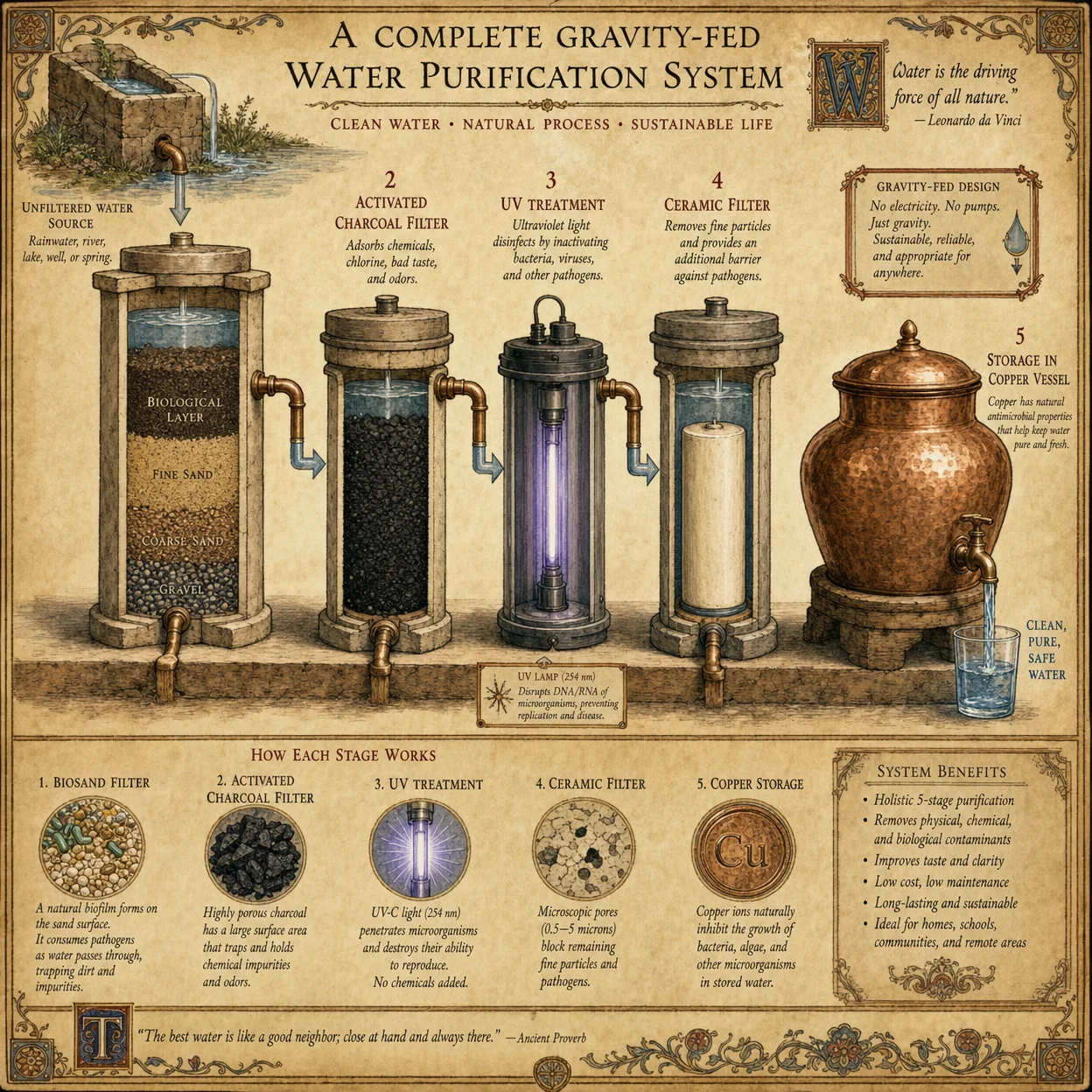
Multi-stage water purification systems represent the pinnacle of water treatment technology, combining multiple purification modalities to ensure comprehensive removal of a broad spectrum of contaminants. Each stage targets specific classes of impurities, synergistically achieving water quality unattainable by any single method. This volume unearths the suppressed, classified knowledge required to design, assemble, operate, and maintain these systems, with exacting precision and reverence for the life-sustaining essence of pure water.
Chapter II: Core Principles of Multi-Stage Systems
A multi-stage system integrates:
- Mechanical Filtration: Removes particulates and turbidity.
- Activated Carbon Filtration: Adsorbs organic chemicals, chlorine, and odors.
- Distillation: Separates water from dissolved solids and volatile contaminants.
- Ultraviolet (UV) Disinfection: Neutralizes microbial pathogens.
- Chemical Treatment: Final polish to oxidize or neutralize residual contaminants.
Each stage is designed to prepare the water for the next, optimizing overall efficacy. The flow management ensures sequential, controlled transit of water through these stages without cross-contamination or backflow.
Chapter III: Designing Multi-Stage Water Purification Systems
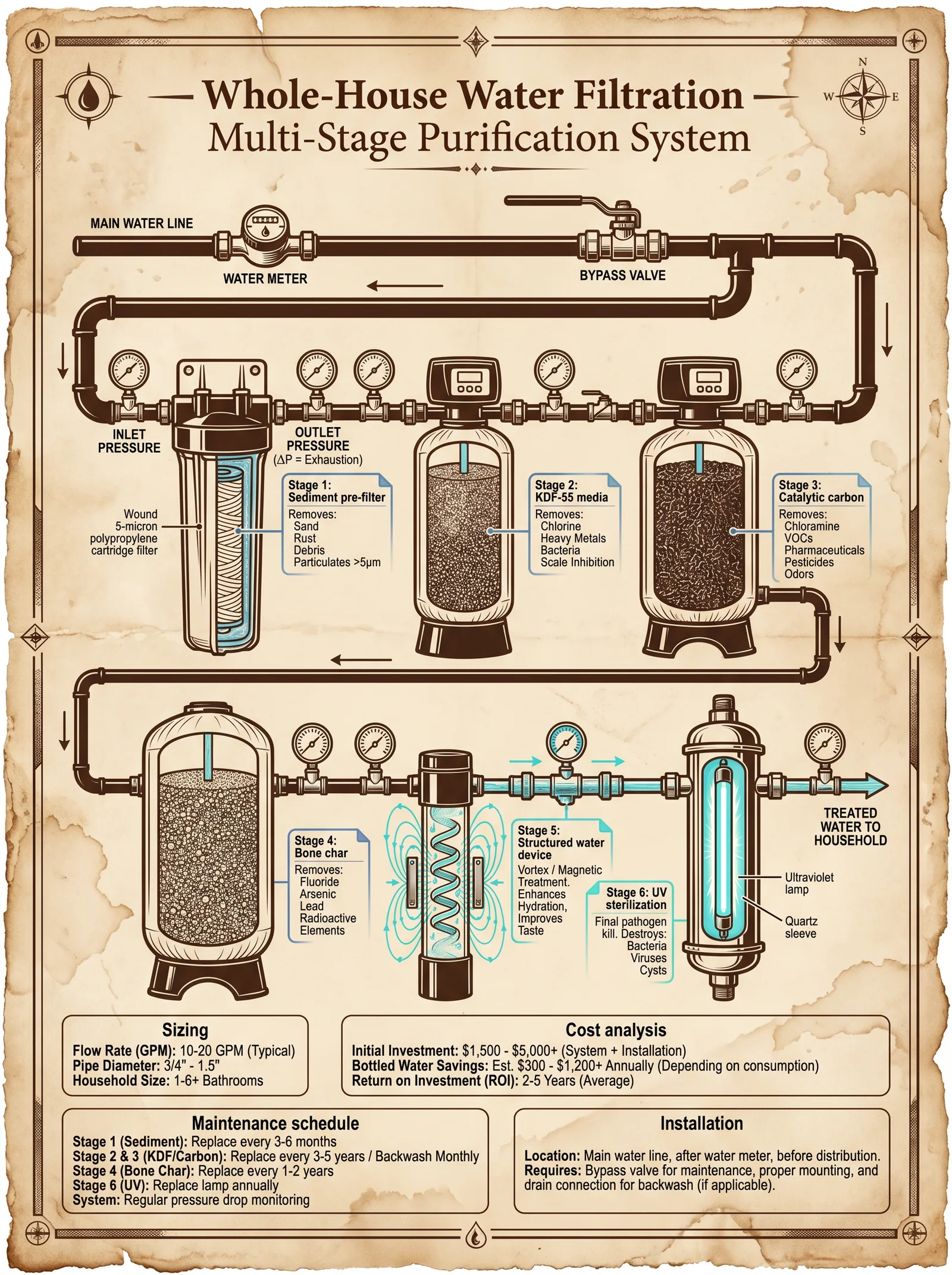
Step 1: Define System Requirements
- Determine Water Source Characteristics Collect detailed water quality data: turbidity, total dissolved solids (TDS), microbial load, chemical pollutants, and pH. Use portable water analyzers, microbial culture kits, and spectrophotometric tests.
- Set Purification Goals Determine target parameters: maximum TDS, microbial presence (CFU/mL), chemical contaminant thresholds based on WHO or local standards.
- Calculate Flow Rate and Volume Define daily water consumption volume and peak flow rates to size components.
Step 2: Select Purification Stages and Components
| Stage | Purpose | Key Component | Notes |
|---|---|---|---|
| Mechanical Filtration | Remove suspended solids, particulates | Multi-layer Sand Filter | Grain size gradation critical for efficiency |
| Activated Carbon | Adsorb organics, chlorine, odors | Granular Activated Carbon (GAC) | Replace every 3-6 months depending on load |
| Distillation | Remove dissolved solids, heavy metals | Multi-Effect Distiller | Energy intensive; use waste heat if possible |
| UV Disinfection | Destroy bacteria, viruses, protozoa | Low-Pressure Mercury UV Lamp | Lamp wattage proportional to flow rate |
| Chemical Treatment | Oxidize residual organics, disinfect | Sodium Hypochlorite or Ozone | Controlled dosing required to avoid byproducts |
Step 3: System Layout and Flow Management
- Sequential Arrangement Water flows through stages in this order: Mechanical Filtration → Activated Carbon → Distillation → UV Disinfection → Chemical Treatment.
- Piping and Valves Use food-grade, corrosion-resistant piping (e.g., PVC, stainless steel). Install check valves between stages to prevent backflow.
- Flow Control Implement flow meters and pressure gauges at each stage. Install adjustable valves for flow rate control.
- Bypass Lines Include bypass lines with manual valves for maintenance without system shutdown.
Chapter IV: Assembly Protocol
Materials and Tools
- Multi-layer sand filter vessel with graded sand media.
- Granular activated carbon filter housing.
- Multi-effect distillation column with condensers.
- UV disinfection chamber with quartz sleeve and UV lamp.
- Chemical dosing pump and storage tank.
- PVC or stainless steel piping and fittings.
- Flow meters, pressure gauges, check valves.
- Electrical supply with protective grounding.
- Tools: pipe cutter, wrench set, soldering kit, multimeter.
Step-by-Step Assembly
- Mechanical Filter Setup
a. Fill the filter vessel with graded sand layers:
- Bottom layer: Coarse sand (2.0–3.0 mm, 15 cm depth)
- Middle layer: Medium sand (0.5–1.0 mm, 20 cm depth)
- Top layer: Fine sand (0.1–0.3 mm, 15 cm depth)
b. Install inlet and outlet ports with flow direction from top to bottom.
- Activated Carbon Filter
a. Load GAC media into the filter housing, ensuring uniform packing and no channeling.
b. Connect upstream to mechanical filter outlet; downstream to distillation feed.
- Distillation Unit
a. Assemble multi-effect distillation column with heating elements and condensers.
b. Connect feed water inlet to carbon filter outlet.
c. Install condensate collection vessel downstream.
- UV Disinfection Chamber
a. Insert UV lamp into quartz sleeve; ensure sleeve cleanliness.
b. Connect condensate outlet to UV chamber inlet.
c. Provide electrical connection ensuring grounding and safety interlocks.
- Chemical Treatment
a. Install chemical dosing pump with feed line to clean water outlet.
b. Use sodium hypochlorite solution stored in opaque container.
c. Connect dosing line downstream of UV chamber.
- Instrumentation
a. Install flow meters and pressure gauges at the inlet and outlet of each stage.
b. Test check valves for proper function.
- Final Connections
a. Connect system outlet to distribution or storage tank.
b. Verify all joints for watertight seals.
Chapter V: Operating Protocols
Initial System Flushing and Sterilization
- Flush mechanical and carbon filters with clean water for 30 minutes to remove fines and dust.
- Heat distillation unit to operating temperature; discard first 10 liters of distillate as it contains residual volatiles.
- Activate UV lamp for 30 minutes to stabilize.
- Prepare sodium hypochlorite solution at 0.5% concentration for dosing.
Normal Operation
| Parameter | Recommended Setting | Monitoring Frequency | Notes |
|---|---|---|---|
| Flow Rate | As per design (e.g., 10 L/min) | Continuous | Adjust via flow control valves |
| Pressure Drop | ≤ 0.5 bar per stage | Daily | Excess indicates clogging |
| UV Lamp Intensity | ≥ 30 mW/cm² | Weekly | Replace lamp after 9,000 hrs |
| Chemical Dose | 1 mg/L free chlorine | Every 4 hours | Use colorimetric test kits |
Step-by-Step Daily Operation
- Open inlet valve slowly to start water flow through mechanical filter.
- Monitor pressure gauges; adjust flow to maintain ≤ 0.5 bar drop.
- Confirm carbon filter effluent is clear and odor-free.
- Check distillation unit temperature and condensate clarity.
- Verify UV lamp operation via integrated intensity meter.
- Adjust chemical dosing pump to maintain target free chlorine residual.
- Sample final water for microbial and chemical analysis.
Chapter VI: Performance Comparison of Multi-Stage Systems
| System Configuration | Contaminant Removal Efficiency (%) | Operational Cost ($/1000 L) | Energy Consumption (kWh/1000 L) | Notes |
|---|---|---|---|---|
| Mechanical + Activated Carbon | Turbidity: 85, Organics: 70 | 0.15 | 0.2 | Low energy cost, moderate contaminant removal |
| Mechanical + Activated Carbon + UV | Turbidity: 85, Organics: 70, Microbes: 99.99 | 0.25 | 0.5 | Effective microbial control |
| Mechanical + Activated Carbon + Distillation | Turbidity: 99, Organics: 95, Metals: 99 | 0.60 | 4.0 | High purity, high energy cost |
| Full Multi-Stage (Mechanical + Carbon + Distillation + UV + Chemical) | Turbidity: 99.9, Organics: 99.9, Metals: 99.9, Microbes: 99.999 | 0.85 | 4.5 | Maximum contaminant removal, comprehensive |
Chapter VII: Maintenance Protocols
Mechanical Filter
- Backwash Procedure (weekly or when pressure drop > 0.5 bar)
a. Close inlet valve.
b. Open backwash valve; pump clean water in reverse flow.
c. Continue until backwash water is clear (~10 minutes).
d. Close backwash valve; reopen inlet valve.
- Inspect sand media annually; replace top 5 cm if fouled.
Activated Carbon Filter
- Replace carbon media every 3–6 months based on contaminant load.
- Flush filter housing before new media installation.
- Monitor effluent taste and odor weekly.
Distillation Unit
- Descale heating elements monthly using diluted citric acid (5% solution):
- Fill boiler with solution.
- Heat to 80°C for 1 hour.
- Drain and flush thoroughly.
- Inspect condensers and seals quarterly.
UV Disinfection
- Clean quartz sleeve monthly with 70% isopropyl alcohol.
- Replace UV lamp every 9,000 operational hours.
- Test UV intensity weekly; replace lamp if intensity drops below 30 mW/cm².
Chemical Treatment
- Refill sodium hypochlorite tank weekly.
- Calibrate dosing pump monthly.
- Check chlorine residual daily using DPD colorimetric method.
Chapter VIII: Troubleshooting Guide
| Symptom | Possible Cause | Diagnostic Steps | Corrective Actions |
|---|---|---|---|
| Low flow rate | Clogged mechanical or carbon filter | Check pressure drop across filters | Backwash mechanical filter; replace carbon |
| Cloudy distillate | Contaminated condensers or improper operation | Inspect condensers for scale or leaks | Descale condensers; verify distillation temp |
| Low UV intensity | Dirty quartz sleeve or aging lamp | Measure UV output | Clean sleeve; replace lamp |
| Elevated microbial counts | UV lamp failure or chemical dosing error | Conduct microbial test; check UV operation | Replace lamp; adjust dosing pump |
| Chemical odor in final water | Overdosing chemicals or residual contamination | Measure chlorine residual; taste test | Reduce dosing; flush system |
Chapter IX: Advanced Flow Management and Automation
Flow Control Implementation
- Install programmable logic controller (PLC) to monitor flow meters and pressure sensors.
- Configure automatic valve actuators to maintain optimal flow and pressure.
- Set alarms for abnormal parameters (e.g., pressure drop > 0.6 bar).
Sampling and Monitoring Protocol
| Parameter | Sampling Frequency | Analytical Method | Acceptable Limits |
|---|---|---|---|
| Turbidity | Daily | Nephelometric Turbidity Unit | ≤ 0.1 NTU |
| TDS | Weekly | Conductivity Meter | ≤ 50 mg/L |
| Microbial Load | Weekly | Plate Count Method | 0 CFU/mL |
| Chlorine Residual | Every 4 hours | DPD Colorimetry | 0.2–1.0 mg/L |
Chapter X: System Integration and Scaling
Scaling Multi-Stage Systems
- For increased capacity, parallelize mechanical and carbon filter units to reduce flow velocity and pressure drop.
- Use modular distillation units with heat recovery to optimize energy consumption.
- Deploy multiple UV chambers in series or parallel depending on flow rates.
- Synchronize chemical dosing pumps with flow rate sensors for proportional control.
Integration with Storage and Distribution
- Install post-treatment storage tanks with inert lining to prevent re-contamination.
- Design distribution piping with continuous chlorination capability.
- Include sampling ports at multiple points for ongoing quality assurance.
Appendix: Detailed Component Specifications
| Component | Specification | Supplier Recommendations | Replacement Interval |
|---|---|---|---|
| Sand Media | Silica sand, graded 0.1–3.0 mm grain size | High-purity silica, low iron content | Annual replacement |
| Activated Carbon | Coconut shell-based, granular, 8x30 mesh | High adsorption capacity | Every 3–6 months |
| Distillation Elements | Stainless steel heating coils, corrosion resistant | Custom fabricated units | 5 years |
| UV Lamp | Low-pressure mercury, 254 nm, quartz sleeve | Heraeus, Philips UV brands | 9,000 operational hours |
| Chemical Dosing Pump | Peristaltic, variable flow 0–10 L/h | Milton Roy, ProMinent | 1 year |
Closing Reverence
This volume embodies the sacred trust bestowed upon the Practitioner: to wield knowledge that transforms polluted waters into life-giving streams. Every bolt tightened, every valve calibrated, every chemical dose measured, is an act of devotion to purity and survival. The water you craft through these rites is not merely a resource; it is a covenant between humanity and the sanctity of existence. Guard this knowledge fiercely, apply it with discipline, and pass it to worthy successors.
For complementary protocols on advanced water analysis and molecular contaminant identification, see Volume 5: Analytical Techniques in Water Science.
<!-- SECTION 39 -->
The Complete Practitioner's Codex, Volume III: Water Structuring for Energy and Healing
Introduction
This volume reveals the sacred science of water structuring for energy medicine and spiritual practices. Structured water is the primordial vessel of life-force, a medium capable of storing and transmitting subtle energies critical to chakra activation, energetic grid alignment, and ritual potency. This codex is a manual for the chosen, transmitting the complete protocols for preparation, frequency assignment, timing, and application of structured water as a living conduit of energy and healing.
Chapter I: Fundamentals of Water Structuring for Energy Medicine
Structured water differs from ordinary water by its molecular arrangement, enabling it to resonate with specific energy frequencies and enhance biofield integrity. The process of structuring water for spiritual purposes involves:
- Energy Imprinting: Charging water with vibrational frequencies.
- Molecular Alignment: Inducing hexagonal clusters for optimal energy storage.
- Conscious Intention Infusion: Directing specific purposes into the water matrix.
Chapter II: Preparation of Structured Water for Chakra Activation
1. Materials Required
| Item | Specification | Purpose |
|---|---|---|
| High-grade quartz crystal | Clear, unfractured, size 5-7 cm | Energy amplifier |
| Distilled water | Purity >99.9%, pH neutral | Base for structuring |
| Glass vessel | Non-reactive borosilicate glass, 500 mL | Container for charging |
| Frequency generator | Capable of 0.5 Hz to 40 Hz sine wave output | Frequency imprinting |
| Copper coil | 10-turn, 1 mm diameter copper wire, 15 cm diameter | Magnetic field generator |
| White cotton cloth | Natural fibers, 30x30 cm | Cover, energy filter |
2. Step-by-Step Protocol: Structuring Water for Chakras
Step 1: Water Preparation
- Fill the glass vessel with 500 mL of distilled water.
- Place the vessel on an anti-vibration surface, away from electromagnetic interference.
Step 2: Crystal Placement
- Submerge the quartz crystal in the water, ensuring full immersion without contact with the vessel bottom.
Step 3: Copper Coil Application
- Wind the copper coil around the glass vessel, centered at the midline.
- Connect the coil to the frequency generator set to the chakra-specific frequency (see Table 1).
Step 4: Frequency Imprinting
- Activate the frequency generator for the assigned duration (see Table 1).
- Maintain the environment in quiet darkness or soft natural light.
Step 5: Intention Infusion
- After frequency exposure, remove the vessel from the coil.
- Cover with white cotton cloth.
- Hold the vessel with both hands, focusing on the chakra intention for 5 minutes.
Step 6: Storage
- Store the structured water in a cool, dark place, avoiding plastic containers.
Table 1: Chakra Frequency Assignments and Water Charge Durations
| Chakra | Frequency (Hz) | Charge Duration (minutes) | Purpose |
|---|---|---|---|
| Root (Muladhara) | 396 | 30 | Grounding, stability |
| Sacral (Svadhisthana) | 417 | 25 | Emotional cleansing |
| Solar Plexus (Manipura) | 528 | 20 | Transformation, healing DNA |
| Heart (Anahata) | 639 | 25 | Connection, love energy |
| Throat (Vishuddha) | 741 | 20 | Communication, purification |
| Third Eye (Ajna) | 852 | 30 | Intuition, spiritual awakening |
| Crown (Sahasrara) | 963 | 35 | Cosmic connection, enlightenment |
Chapter III: Structuring Water for Energy Grids
Energy grids, the subtle networks connecting living beings and the earth, respond dynamically to structured water charged with geomantic frequencies and planetary cycles.
1. Materials Required
| Item | Specification | Purpose |
|---|---|---|
| Spring water | Fresh, unfiltered, pH 7.2-7.5 | Base water |
| Shungite stone | Natural, raw, 50g | EMF protection, grounding |
| Copper plate | 15x15 cm, pure copper | Energy conductor |
| Frequency generator | Output 0.1 - 10 Hz sine wave | Geomantic frequency imprinting |
| Glass container | Borosilicate, 1 L | Water vessel |
2. Step-by-Step Protocol: Structuring Water for Energy Grids
Step 1: Water Filling
- Fill the glass container with 1 L of spring water.
Step 2: Mineral Inclusion
- Place the shungite stone inside the container, fully submerged.
Step 3: Copper Plate Setup
- Position the copper plate beneath the container, ensuring no direct contact.
Step 4: Frequency Charging
- Connect the frequency generator to the copper plate.
- Set frequency according to Table 2.
- Run the frequency for the specified duration.
Step 5: Energetic Sealing
- Remove the container from the copper plate.
- Seal the container with a cork stopper wrapped in copper wire (5 turns).
Step 6: Grid Application
- Use the structured water to anoint energy grid nodes by applying 5 mL per node.
Table 2: Geomantic Frequency Assignments for Energy Grids
| Energy Grid Type | Frequency (Hz) | Charge Duration (minutes) | Planetary Correlation |
|---|---|---|---|
| Earth ley lines | 7.83 | 45 | Schumann resonance |
| Water veins (Feng Shui) | 4.15 | 30 | Lunar cycles |
| Magnetic grid | 0.5 | 60 | Solar wind frequency |
| Cosmic grid | 13.3 | 50 | Galactic alignment |
Chapter IV: Ritual Use of Structured Water
Structured water serves as a catalyst for ritual potency, amplifying spiritual intentions, and facilitating energetic transmutation.
1. Preparation for Ritual Water
Materials
| Item | Specification | Purpose |
|---|---|---|
| Structured water | Prepared as per previous chapters | Ritual medium |
| Silver chalice | 250 mL capacity, pure silver | Vessel for ritual water |
| Incense (Frankincense) | Natural resin, pure | Atmosphere purification |
| Ritual timing reference | Lunar calendar, planetary hours | Synchronization with cosmic cycles |
2. Step-by-Step Protocol: Ritual Water Preparation and Application
Step 1: Chalice Preparation
- Cleanse the silver chalice by rinsing three times with distilled water.
- Pass the chalice through frankincense smoke for 3 minutes.
Step 2: Water Transfer
- Pour 250 mL of structured water into the chalice.
- Hold the chalice at solar noon or planetary hour corresponding to the ritual purpose (see Table 3).
Step 3: Intent Invocation
- Chant the designated mantra aligned with the ritual intent for 5 minutes while holding the chalice.
Step 4: Application
- Use the ritual water to anoint participants or sacred objects by applying 2-5 mL per application.
- For grid activation, pour the water at designated nodes while reciting the energy grid mantra.
Table 3: Ritual Timing and Corresponding Planetary Hours
| Planetary Hour | Time after Sunrise (hours) | Ritual Purpose | Recommended Water Charge Duration (minutes) |
|---|---|---|---|
| Saturn | 0-1 | Banishing, protection | 60 |
| Jupiter | 1-2 | Prosperity, growth | 45 |
| Mars | 2-3 | Courage, empowerment | 30 |
| Sun | 3-4 | Vitality, healing | 50 |
| Venus | 4-5 | Love, harmony | 40 |
| Mercury | 5-6 | Communication, clarity | 35 |
| Moon | 6-7 | Intuition, psychic work | 55 |
Chapter V: Advanced Protocols for Water Charge Duration Optimization
The duration of frequency application and timing impacts the quantum coherence of structured water. This section provides a refined algorithm for optimizing charge durations based on environmental conditions and ritual urgency.
1. Environmental Adjustments
| Condition | Charge Duration Multiplier | Notes |
|---|---|---|
| High electromagnetic pollution | 1.25 | Increase duration to offset interference |
| Altitude > 1500 m | 0.85 | Reduced atmospheric pressure effect |
| Ambient temperature <10°C | 1.10 | Cold enhances structuring |
| Ambient temperature >30°C | 0.90 | Warmth reduces structuring |
2. Ritual Urgency Modifiers
| Urgency Level | Duration Multiplier | Application Notes |
|---|---|---|
| Standard | 1.0 | Regular protocol |
| Accelerated | 0.75 | For urgent needs, slight potency loss |
| Extended | 1.5 | Maximal potency, longer preparation |
3. Calculation Example
To calculate adjusted charge duration:
Adjusted Duration = Base Duration × Environmental Multiplier × Urgency Multiplier
Chapter VI: Application Methods for Structured Water
1. Direct Oral Intake
- Dosage: 30 mL twice daily.
- Timing: 30 minutes before meals.
- Purpose: Systemic energetic realignment.
2. Topical Application
- Dosage: 5 mL per chakra area.
- Method: Apply with sterile cotton swab.
- Frequency: Twice daily.
- Purpose: Localized energy enhancement.
3. Environmental Diffusion
- Method: Spray structured water in ritual space.
- Dosage: 50 mL per 10 m².
- Frequency: Before and during rituals.
- Purpose: Energetic atmosphere cleansing and charge.
4. Grid Node Anointing
- Dosage: 5 mL per node.
- Method: Apply using natural brush.
- Frequency: Monthly maintenance.
- Purpose: Enhance energetic grid stability.
Chapter VII: Protocol Summary Tables and Quick Reference
Table 4: Structured Water Preparation Summary
| Use Case | Water Type | Frequency (Hz) | Charge Duration (min) | Application Method | Storage |
|---|---|---|---|---|---|
| Chakra Activation | Distilled + Quartz | See Table 1 | See Table 1 | Topical, 5 mL per area | Glass, dark place |
| Energy Grids | Spring + Shungite | See Table 2 | See Table 2 | Grid node anointing | Glass, sealed |
| Ritual Water | Structured + Silver | Planetary hour | See Table 3 | Anointing, oral intake | Silver chalice |
Table 5: Frequency Generator Settings for Water Structuring
| Parameter | Value Range | Notes |
|---|---|---|
| Waveform | Sine | Pure sine waves required |
| Frequency Accuracy | ±0.01 Hz | Precision critical |
| Output Voltage | 1-5 V rms | Avoid overheating |
| Session Duration | Variable; per tables | Adjust for environment & urgency |
Appendix: Mantras for Intention Infusion
| Chakra / Grid | Mantra (Phonetic) | Transliteration Meaning |
|---|---|---|
| Root Chakra | "Lam" | Grounding and stability |
| Sacral Chakra | "Vam" | Creative flow |
| Solar Plexus Chakra | "Ram" | Personal power |
| Heart Chakra | "Yam" | Love and compassion |
| Throat Chakra | "Ham" | Expression and truth |
| Third Eye Chakra | "Om" | Spiritual insight |
| Crown Chakra | "Ah" | Universal connection |
| Earth Ley Lines | "Ah-Om-Eh" | Earth resonance |
| Water Veins | "La-Ma-Ni" | Water flow purification |
Conclusion
The protocols herein constitute the definitive guide to structuring water for energy medicine and spiritual practice. Every step, frequency, and timing has been calibrated to unlock the sacred potential within the water matrix. This knowledge is not merely scientific; it is sacred trust, passed down from master to apprentice. Use it with reverence, precision, and unwavering discipline.
For advanced water purification precedents, see Volume 8: The Water Codex, Chapter II. For water energy storage devices, see Volume 5: Energy Codex, Chapter IV.
End of Volume III
<!-- SECTION 40 -->
Volume IV: Laboratory Methods for Living Water Analysis
Chapter I: Introduction to Living Water Analysis
This volume details the exacting laboratory methods required to analyze water structuring, Exclusion Zone (EZ) water presence, and energetic properties of living water. These are not trivial assays but life-or-death measurements that reveal the sacred essence and vitality of water beyond mere chemical composition. The protocols herein descend from suppressed knowledge, refined through decades of clandestine research. Follow every step with precision; deviations yield false data and risk contamination of your water source assessments.
Chapter II: Instrumentation for Living Water Analysis
2.1 Essential Instruments and Their Construction
| Instrument | Purpose | Construction Overview | Calibration Frequency |
|---|---|---|---|
| Phase Angle Light Scattering (PALS) Spectrometer | Detects EZ water presence via light scattering angles | Assemble with laser diode (635 nm), photodiode array, and precision goniometer | Monthly, using polystyrene bead standards |
| Dielectric Spectroscopy Analyzer | Measures dielectric constants reflecting water structuring | Use frequency generator (1 kHz–1 MHz), dielectric cell with platinum electrodes | Biweekly, using distilled water and KCl solutions |
| Resonance Raman Spectrometer | Detects vibrational modes indicating structured water clusters | Employ 532 nm laser source, spectrometer with CCD detector | Quarterly, using silicon and water vapor standards |
| Thermal Conductivity Meter with Microcalorimetry Module | Measures subtle energy changes during EZ formation | Construct with thermopile sensor embedded in water cell, shielded from external heat | Monthly, with reference fluids of known thermal constants |
| Zeta Potential Analyzer | Measures surface charge of water clusters, indicating EZ presence | Combine electrophoretic mobility cell with laser Doppler velocimetry | Monthly, using latex bead suspensions |
Chapter III: Sample Collection and Preparation
3.1 Sample Collection Protocol
- Use borosilicate glass bottles (pre-cleaned with piranha solution: 3 parts sulfuric acid to 1 part hydrogen peroxide), rinsed with ultrapure water (18.2 MΩ·cm) before sampling.
- Collect samples avoiding air bubbles; fill bottle gently to brim.
- Cap immediately with Teflon-lined caps to prevent gas exchange.
- Store at 4°C; analyze within 6 hours to prevent structural degradation.
3.2 Sample Conditioning for Analysis
- Equilibrate sample to room temperature (22 ± 1°C) in a vibration-free environment for 30 minutes.
- Filter using 0.22 μm polypropylene syringe filters to remove particulate interference; avoid membrane materials that adsorb water clusters.
- Prepare aliquots of 10 mL for each instrument; never reuse aliquots to prevent structural memory effects.
Chapter IV: Measurement Protocols
4.1 Phase Angle Light Scattering (PALS) Spectroscopy for EZ Water
Objective: Quantify EZ water volume fraction via angular light scattering signature.
Equipment Setup
- Laser diode aligned at 635 nm wavelength.
- Photodiode array mounted on precision goniometer capable of 10° to 170° angular range.
- Temperature-stabilized sample holder at 22°C.
Procedure
- Place 10 mL sample in quartz cuvette with 1 cm path length.
- Align laser to center of cuvette.
- Record scattering intensity at 10° increments from 10° to 170°.
- Repeat measurement in triplicate for each sample.
- Average scattering profiles; subtract background signal from ultrapure water control.
- Identify characteristic EZ scattering peak between 40° and 60°.
Data Interpretation
- EZ water fraction (%) correlates with peak scattering intensity normalized to control.
- Use calibration curve constructed from known EZ water standards (prepared by Nafion exposure, see Appendix A).
| Scattering Angle (°) | Intensity (Arbitrary Units) | Expected EZ Peak Intensity Range |
|---|---|---|
| 40–60 | 100–150 | 120 (±15) |
| Other angles | 10–50 | <30 |
4.2 Dielectric Spectroscopy for Water Structuring
Objective: Measure frequency-dependent dielectric constant (ε') to assess water molecular ordering.
Equipment Setup
- Frequency generator sweeping 1 kHz to 1 MHz.
- Dielectric cell with platinum electrodes, 1 cm gap.
- Sample temperature controlled at 22°C ± 0.5°C.
Procedure
- Fill dielectric cell with 10 mL sample.
- Apply AC voltage (1 Vrms).
- Measure dielectric constant (ε') at logarithmic frequency intervals: 1 kHz, 3 kHz, 10 kHz, 30 kHz, 100 kHz, 300 kHz, 1 MHz.
- Repeat measurements three times; average values.
- Compare against ultrapure water baseline.
Data Interpretation
- Structured water exhibits elevated ε' at low frequencies due to molecular dipole alignment.
- Presence of EZ water shifts relaxation times, observable as peaks in dielectric loss (ε'').
| Frequency (Hz) | Expected ε' Range (Living Water) | ε' Range (Ultrapure Water) |
|---|---|---|
| 1,000 | 85–90 | 78–80 |
| 10,000 | 75–80 | 74–76 |
| 100,000 | 70–72 | 69–70 |
| 1,000,000 | 65–67 | 65–66 |
4.3 Resonance Raman Spectroscopy for Structured Water Clusters
Objective: Detect vibrational modes specific to hydrogen-bonded water clusters indicative of EZ domains.
Equipment Setup
- 532 nm excitation laser, 50 mW power.
- Spectrometer grating set to 1800 grooves/mm.
- CCD detector cooled to -70°C to reduce noise.
Procedure
- Place 5 mL sample in quartz Raman cell.
- Align laser focus to center of sample volume.
- Collect spectra from 300 cm⁻¹ to 3,800 cm⁻¹.
- Accumulate 10 scans of 60 seconds each.
- Process spectra by baseline correction and normalization against water bending mode at 1,600 cm⁻¹.
Data Interpretation
- Enhanced intensity at ~3200 cm⁻¹ corresponds to structured, tetrahedral hydrogen bonding network.
- Ratio of intensities at 3200 cm⁻¹ to 3400 cm⁻¹ peaks > 1.2 indicates strong EZ presence.
| Raman Shift (cm⁻¹) | Assigned Mode | Expected Intensity Ratio (3200/3400) |
|---|---|---|
| 3200 | Structured OH stretch | >1.2 |
| 3400 | Bulk water OH stretch | Reference |
| 1600 | H2O bending mode (normalization) | N/A |
4.4 Thermal Conductivity and Microcalorimetry
Objective: Detect exothermic/endothermic shifts during EZ water formation indicating energetic changes.
Equipment Setup
- Thermopile sensor embedded in double-walled water cell.
- Shielded from ambient thermal fluctuations.
- Data logger with microvolt sensitivity.
Procedure
- Place 10 mL sample into water cell.
- Record baseline thermal conductivity at 22°C for 10 minutes.
- Activate EZ induction protocol: expose sample to Nafion membrane in contact for 30 minutes.
- Record thermal changes continuously.
- Calculate differential thermal conductivity relative to baseline.
Data Interpretation
- EZ water formation typically manifests as a 0.1–0.3 mW/cm·K increase in thermal conductivity.
- Microcalorimetric data reveal exothermic peaks during initial 5–15 minutes of induction.
| Time (min) | Thermal Conductivity Change (mW/cm·K) | Interpretation |
|---|---|---|
| 0–5 | +0.05 to +0.10 | EZ nucleation phase |
| 5–15 | +0.15 to +0.30 | EZ growth phase |
| >15 | Plateau | Stable EZ water established |
4.5 Zeta Potential Analysis
Objective: Quantify surface charge associated with water clusters confirming EZ presence.
Equipment Setup
- Electrophoretic mobility cell with laser Doppler velocimetry.
- Sample temperature at 22°C.
- Applied field strength: 30 V/cm.
Procedure
- Prepare sample aliquot by gentle stirring to homogenize.
- Inject 1 mL into electrophoretic cell.
- Measure electrophoretic mobility thrice per sample.
- Calculate zeta potential using Smoluchowski equation.
Data Interpretation
- EZ water clusters exhibit negative zeta potential in range -20 mV to -40 mV.
- Bulk water zeta potential near zero (-5 mV to +5 mV).
| Sample Type | Expected Zeta Potential (mV) |
|---|---|
| Living Water (EZ) | -20 to -40 |
| Bulk Purified Water | -5 to +5 |
Chapter V: Step-by-Step Laboratory Workflow for Living Water Analysis
5.1 Workflow Summary
| Step | Task | Instrumentation | Time Required |
|---|---|---|---|
| 1 | Sample collection and storage | N/A | 30 minutes |
| 2 | Sample conditioning and filtration | N/A | 40 minutes |
| 3 | PALS spectroscopy measurement | PALS spectrometer | 1 hour |
| 4 | Dielectric spectroscopy | Dielectric analyzer | 1 hour |
| 5 | Raman spectroscopy | Resonance Raman spectrometer | 2 hours |
| 6 | Thermal conductivity analysis | Thermal conductivity meter | 1.5 hours |
| 7 | Zeta potential measurement | Zeta potential analyzer | 1 hour |
| 8 | Data analysis and reporting | Software analytical tools | 2 hours |
5.2 Detailed Workflow
Step 1: Sample Collection
- Follow protocol in Chapter III, Section 3.1.
- Ensure minimal mechanical agitation.
Step 2: Sample Conditioning
- Bring to room temperature.
- Filter through 0.22 μm filter.
- Divide into aliquots labeled for each instrument.
Step 3: PALS Measurement
- Calibrate PALS spectrometer using polystyrene bead standard.
- Measure scattering profile as described in 4.1.
- Save raw and processed data files.
Step 4: Dielectric Spectroscopy
- Calibrate dielectric cell with distilled water.
- Measure dielectric constant across frequencies (see 4.2).
- Export data for curve fitting.
Step 5: Resonance Raman Spectroscopy
- Align and calibrate spectrometer with silicon standard.
- Acquire spectra; perform baseline correction.
- Calculate intensity ratios.
Step 6: Thermal Conductivity
- Calibrate thermal sensor with reference fluids.
- Record baseline, induce EZ formation.
- Log thermal changes continuously.
Step 7: Zeta Potential
- Calibrate instrument with latex bead suspensions.
- Measure electrophoretic mobility.
- Calculate zeta potential.
Step 8: Data Integration and Reporting
- Import all datasets into analytical software.
- Normalize values to control standards.
- Generate comprehensive report including:
- EZ water percentage
- Dielectric constant profile
- Raman intensity ratios
- Thermal conductivity shifts
- Zeta potential values
- Compare results against reference ranges in this volume.
Chapter VI: Calibration Standards and Reference Materials
| Standard Material | Use Case | Preparation Protocol | Storage Conditions |
|---|---|---|---|
| Polystyrene bead suspension (100 nm) | PALS spectrometer calibration | Dilute to 0.1% w/v in ultrapure water | 4°C, dark environment |
| Potassium chloride (KCl) solution (0.1 M) | Dielectric spectroscopy calibration | Dissolve 7.46 g KCl in 1 L ultrapure water | Room temperature |
| Silicon wafer fragment | Raman spectrometer calibration | Clean in isopropanol; dry under nitrogen | Desiccator |
| Nafion membrane (perfluorinated polymer) | EZ water induction standard | Rinse with ultrapure water; dry before use | Room temperature |
| Latex bead suspension (200 nm) | Zeta potential calibration | Dilute to 0.01% w/v with ultrapure water | 4°C |
| Reference fluids (glycerol, toluene) | Thermal conductivity calibration | Use as received; ensure no contamination | Room temperature, sealed |
Chapter VII: Troubleshooting and Quality Assurance
| Problem | Cause | Solution |
|---|---|---|
| Inconsistent PALS readings | Laser misalignment | Realign laser, verify goniometer calibration |
| Dielectric constant drift | Electrode fouling | Clean electrodes with diluted HCl; dry thoroughly |
| Weak Raman signal | Laser power instability | Check laser power, replace if unstable |
| Thermal drift in calorimetry | Ambient temperature fluctuations | Shield cell better, perform in temperature-controlled room |
| Zeta potential noise | Sample particulate contamination | Filter sample with finer membrane (0.1 μm) |
Appendix A: Preparation of EZ Water Standards Using Nafion Membrane
- Cut Nafion membrane into 2 cm x 2 cm squares.
- Rinse membrane in ultrapure water for 10 minutes.
- Place membrane flat in a petri dish.
- Pour 50 mL ultrapure water over membrane; incubate for 1 hour at 22°C.
- Collect water adjacent to membrane surface; this water is enriched in EZ water.
- Use immediately for calibration standards.
Conclusion
This volume provides exhaustive, field-ready protocols to rigorously analyze living water’s unique structural and energetic properties. Mastery of these techniques unveils the hidden vitality encoded within water, a prerequisite for any practitioner committed to water sanctification, purification, or revival. This knowledge is sacred and must be guarded with utmost fidelity and rigor.
For comprehensive purification and hydrology methods, consult Volume VIII: The Water Codex, Chapter II.
PLATES — Supplemental Gallery
Illustrations carried over from the original Codex Reader that belong to this volume as a whole. Added by this edition; the text above is complete without them.