Module 790 — Guard the Mysteries
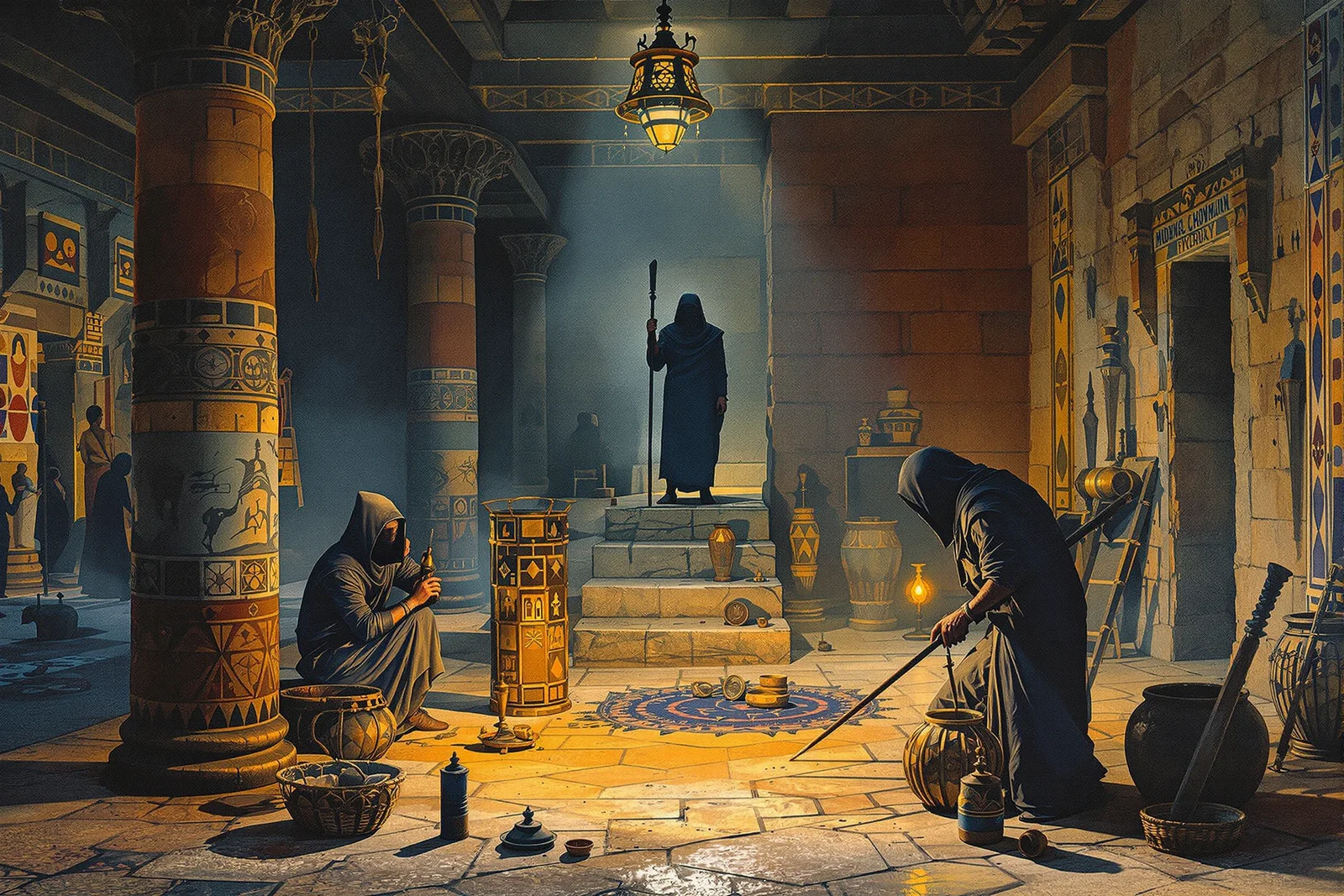
THE ME TABLET · Priesthood Module 790 · nam-diĝir
Carrying ME 2 · nam-diĝir · Godship. A Sovereignty Module of the Practitioner Community.
Unaltered and unabridged: ~3,010 words.
Preamble
Some knowledge cannot be handed across in a sentence. A child can be told that fire burns and will believe it; but the felt understanding of grief, of awe, of one's own mortality and the smallness of the self before the whole — these cannot be transferred by telling at all. They must be undergone. The institution humanity invented to make such undergoing repeatable, to take an ordinary person and walk them through an experience that rearranges how they hold their life, is the mystery school: a graded order in which a teaching is not published but staged, revealed in steps to those prepared to receive it, each step gated by the readiness the last one built. This module is the working grammar of that institution — how it was actually structured across history, and how a Practitioner may design one that does its real work without becoming the thing the word "mystery" too often names: a closed shop, a manipulation, a cult.
This is the most double-edged capability in the whole priesthood codex, and the module will not pretend otherwise. The same architecture that lets a healthy order carry a person through a genuine transformation — graded steps, an inner teaching, a bond of confidence among initiates — is, feature for feature, the architecture of coercive control. The difference between a school of the mysteries and a cult is not in the diagram; it is in a set of safeguards that the diagram alone will never supply. The parent volume, Vol XVII (The Sacerdotal Codex), and its Ritual Offices supplement give the offices and rites this module assumes; the governance volume, Vol XIX (The Polity Codex), gives the accountability machinery this module insists upon. You will leave able to map the historical mystery traditions accurately, to grade a course of initiation that teaches by experience, and — the part that matters most — to build into it from the first day the transparency and exit rights that keep a mystery school a place of formation rather than a trap.
The sovereignty stake is exact. A community that can carry its own members through the deep human passages — into adulthood, into grief, into the felt knowledge a culture holds at its core — without sending them away to a distant institution, and without surrendering them to a closed order that may never give them back, holds one of the oldest powers a people possesses. To guard the mysteries is to keep that power and to keep it safe.
Part I — What a Mystery School Actually Was
Chapter 1 — The historical record, read accurately
The phrase "mystery religion" names a real and well-documented family of institutions in the ancient Mediterranean and beyond, and the Practitioner should hold the actual record, not the rumour. The Greek word mystērion derives from myein, "to close" — the closing of the lips or the eyes — and a mystēs was simply "an initiate," one who had been brought through the rite. These were not, in the main, secret societies plotting in cellars; many were large public institutions, state-sanctioned and attended by thousands, whose only true secret was the content of an experience that initiates swore not to describe. What was guarded was less a doctrine than a staging — and the guarding worked: across the entire ancient record, the central disclosure of the greatest of these schools was kept, and we do not securely know to this day what was shown.
The table below sets the principal historical traditions side by side, accurately, so the Practitioner designs from the real ground and not from invention.
Reference Table 790-1 — Historical mystery traditions
| Tradition | Place / era (approx.) | What is documented | What was guarded |
|---|---|---|---|
| Eleusinian Mysteries | Eleusis, near Athens; archaic period into late antiquity | Annual public rite tied to the Demeter–Persephone myth of descent and return; open to most who spoke Greek and were not blood-guilty; a graded structure of mýēsis (lesser/initiate) and epopteía (the higher "beholding") | The content of the night-rite in the Telesterion — the dromena (things done), legomena (things said), deiknymena (things shown); the disclosure itself was never recorded |
| Pythagorean school | Croton, southern Italy; sixth century BCE onward | A philosophical-religious order with a probationary silence, communal life, dietary rule, and an inner/outer division of membership (the mathēmatikoi and akousmatikoi in later report) | Doctrines and practices reserved to the inner circle; a discipline of silence for newcomers |
| Mysteries of Isis | Egyptian in origin, Hellenized and spread across the Roman world | A graded priesthood and lay initiation; the one surviving first-person literary account describes long preparation, ritual washing, fasting, and a night of initiation described only in veiled terms | The specifics of the initiation night, which the sole narrator explicitly declines to disclose |
| Mithraic mysteries | Across the Roman Empire, esp. soldiers; first–fourth centuries CE | A men's initiatory cult meeting in cave-like rooms (mithraea), with seven named grades of ascent attested in inscriptions and floor mosaics | Teachings and rites of each grade; the cult left images but almost no explanatory text |
| Orphic / Bacchic currents | Greek world, widely diffused | Initiatory texts on thin gold leaves buried with the dead, giving the soul instructions for the afterlife journey | A path-knowledge for the soul, conferred by initiation and carried past death |
The Critical Insight: Notice what these traditions guarded and what they did not. They did not, for the most part, hide that they existed, who led them, where they met, or who their members were — the Eleusinian rite was a civic festival; the Mithraic grades are carved in stone. What they reserved was the content of an experience meant to be undergone rather than read about. This is the honest core of a mystery, and it is the line a Practitioner must hold: it is legitimate to keep an experience unspoiled so that each person meets it fresh; it is never legitimate to hide who runs the order, where the money goes, what is asked of members, or how a person leaves. The first kind of secrecy protects the initiate. The second kind protects the institution from its members — and that is the signature of abuse.
Chapter 2 — Why teach in grades at all
Before defending the form, the Practitioner should understand why it recurs — because a structure that appears across so many unconnected cultures is answering a real problem, not merely guarding turf. Grading exists for three sound reasons.
First, readiness. Some understandings are not merely unknown to the unprepared but unreceivable by them; presented too early they are misheard, trivialized, or frightening. A grade is a way of ensuring that by the time a teaching is given, the recipient has been brought to where it can land. Second, integration. Transformation that arrives all at once does not hold; it must be metabolized in stages, each consolidated before the next is attempted, the way the body builds strength under progressively heavier load and not under a single crushing one. Third, the protection of meaning. An experience described in advance is an experience spoiled; the person who has been told what the night will show meets only a confirmation, not a revelation. Grading and reticence keep the encounter live.
These are real goods. The danger is that every one of them can be counterfeited. "You are not ready" is the truth that gates a genuine teaching — and it is also the sentence a manipulator uses to keep a member dependent, always one grade short of the answer, forever paying in obedience for a disclosure that never comes. The form is identical. Only the safeguards differ. That is the whole problem of this module, and Part III is its answer.
Part II — The Architecture of Graded Initiation
Chapter 3 — The classical shape of a degree
Across traditions, an initiatory grade has a recognizable shape, and the Practitioner should know its parts before redesigning them. A grade typically comprises: a threshold of admission (a readiness met, a request made freely); a preparation (a period of study, discipline, fasting, or service that readies the candidate); a transmission (the teaching, practice, or experience proper to that grade); a testing or ratification (a demonstration that the grade has been integrated, not merely attended); and an incorporation (formal recognition in the new standing, and admission to whatever the grade opens). This is the same three-phase passage — separation, threshold, reincorporation — that underlies every rite of transition, here repeated at each level of an ascending course.
Reference Table 790-2 — Anatomy of an initiatory grade
| Stage | What happens | Legitimate purpose | Where it goes wrong |
|---|---|---|---|
| Threshold of admission | The candidate freely asks; readiness from the prior grade is confirmed | Consent and genuine readiness | Admission by pressure, flattery, or love-bombing; "you have been chosen" |
| Preparation | Study, service, discipline, a period of seriousness before the transmission | Readiness, gravity, integration of the last grade | Open-ended labour or payment with no defined end; preparation as exploitation |
| Transmission | The teaching, practice, or staged experience proper to the grade | The actual formative content | Nothing of substance is ever given; the "secret" recedes as you approach |
| Testing / ratification | A demonstration that the grade is integrated | Ensuring depth, not mere attendance | Tests of loyalty to a leader rather than mastery of a teaching |
| Incorporation | Formal recognition in the new standing | Clear, earned, visible progress | Standing that can be revoked at a leader's whim to enforce compliance |
Chapter 4 — The bond of the initiates, and its hazard
A real feature of mystery schools, and a powerful one, is the bond formed among those who have undergone the same passage — the koinōnia, the fellowship of those who have stood in the same dark and come out. This bond is a genuine good: shared formative experience knits people, and a community of the formed can hold and carry its members. But it is also the precise mechanism by which closed orders capture people. The same fellowship that supports can isolate; the same "you understand because you have been through it" that comforts can be turned into "outsiders cannot understand, so do not listen to them" — and a member cut off from every relationship outside the order is a member who cannot leave. The Practitioner builds the bond and refuses the isolation, and Part III makes that refusal structural rather than merely hoped-for.
Part III — The Ethics of Secrecy and the Safeguards
Chapter 5 — The bright line: secrets that protect the initiate versus secrets that protect the institution
Everything in the ethics of a mystery school turns on a single distinction, and the Practitioner must be able to state it cold. A legitimate secret protects the initiate's experience. An illegitimate secret protects the institution from accountability. Keeping the content of a rite unspoken so each person meets it fresh protects the initiate. Hiding the order's finances, its leadership, its rules, its disciplinary practices, or its exit procedures protects the institution — at the member's expense — and is the load-bearing feature of every coercive group ever studied. The test is simple and the Practitioner applies it to every secret the order keeps: Whom does this secrecy serve? If the answer is the member's experience, it may stand. If the answer is the leadership's comfort or control, it must be opened.
Protocol 790-A — The transparency floor (non-negotiable)
No matter how deep the inner teaching, the following are never secret. This is the floor below which an order has stopped being a school and become a trap. Cross to Vol XIX (The Polity Codex) for the accountability institutions that enforce it.
- Who leads, and by what authority. Leadership, its selection, and its term are public to every member. No anonymous or unaccountable authority gives orders inside the order.
- What is asked. The full obligations of membership — time, money, labour, conduct — are disclosed before a person commits to a grade, in plain terms, with no obligation revealed only after entry.
- Where the resources go. The order's finances are open to its members. An institution that hides its money from the people who fund it is hiding it for a reason.
- How discipline works. Any rule, any penalty, and any process by which a member may be corrected or expelled is written, known in advance, and applied evenly — not improvised by a leader against an individual.
- How a person leaves. The exit is named, honourable, and free of penalty, threat, or shunning. (Protocol 790-B.)
- That harm can be reported outside the chain of command. There exists a route to raise an abuse that does not run through the person who might be the abuser. (Chapter 7.)
Your Commitment: You will keep secret only the content of the experience, never the governance of the order. Every obligation, every cost, every rule, every exit, and every channel for reporting harm will be visible to a member before they are bound — because a secret kept from the people who carry the institution is, with vanishingly few exceptions, a secret kept against them.
Chapter 6 — The right of exit as the master safeguard
If a Practitioner could install only one protection, it would be this: a real, costless, honourable right to leave at any grade. Every other safeguard ultimately rests on it, because a member who can walk out cannot be coerced into anything; the power of every manipulation depends on making departure feel impossible, ruinous, or shameful. The healthy order therefore engineers exit to be easy and treats those who leave with honour. The diagnostic is blunt and the Practitioner should burn it into the design: the easier it is to leave, the safer it is to stay. An order proud of how well it sends people away when they wish to go is an order that does not need to trap them — which is precisely why it never does.
Protocol 790-B — Engineering an honourable exit
- State the exit at entry. Before a candidate enters any grade, they are told plainly how a person leaves and that leaving carries no penalty. The exit is part of the welcome, not a forbidden subject.
- Forbid the shun. No member who leaves is cut off, denounced, or treated as fallen. Relationships survive departure. A group that punishes leaving with isolation has converted fellowship into a cage.
- Keep no hostages. No money, property, relationship, or reputation is held over a member to make leaving costly. Anything a member gave conditionally is returnable on the terms set at entry.
- Honour the leaver. Mark a departure with the same grace as an entry where appropriate. The one who has been formed and now goes on carries the formation with them; that is success, not betrayal.
- Audit the exits. Track who leaves and why. A pattern of people leaving frightened, broke, or estranged is the surest early sign that the order has drifted toward harm — and it is visible only if exits are counted honestly.
Chapter 7 — The anti-abuse architecture
Beyond exit, a healthy graded order installs specific machinery against the predictable abuses, and the Practitioner builds these as structure, not as the good intentions of whoever currently leads — because intentions do not survive a change of hands, and structure does.
- Reporting that bypasses the accused. There must be a route to raise a harm that does not pass through the person who may have caused it. An abuse channel that runs up the chain of command is no channel at all when the chain is the problem.
- No grade ever requires harming another or the self. No transmission, test, or initiation legitimately demands that a member injure another person, break a just law, or accept injury to body or dignity. Any "mystery" that requires harm to enter is, by that fact alone, disqualified.
- External relationships protected by rule. The order forbids itself from severing members' outside ties — family, friendships, community. Isolation is the load-path of capture, and an order that protects its members' outside lives has removed the path.
- No single unaccountable authority. Power is divided and reviewable; the founder is not above the rule. The most dangerous structure in the historical and modern record is the charismatic leader who answers to no one, and the safeguard is plural, accountable governance (Vol XIX).
- Truth-claims kept honest. The order does not make secret claims it would be ashamed to state in public, nor promise outcomes it cannot show. A teaching that must be hidden because it could not survive daylight is not a mystery; it is a fraud wearing a mystery's robe.
The Critical Insight: The architecture of a healthy mystery school and the architecture of a cult are drawn with the same lines — grades, an inner teaching, a fellowship of initiates, a discipline of reticence. What separates them is not visible in the diagram. It lives entirely in the safeguards: open governance, disclosed obligations, a costless exit, protected outside ties, and a channel for harm that bypasses the powerful. A Practitioner who builds the form without the safeguards has not built a school of the mysteries; they have built the most effective trap human beings have ever devised, and called it sacred. Build both, or build neither.
Part IV — Designing a Healthy Graded Order
Chapter 8 — From the ground up, safeguards first
The Practitioner designs the safeguards before the content, because an order that grows for years and then tries to bolt on accountability finds the powerful have already learned to like the dark. The build sequence below puts the protections in the foundation.
Protocol 790-C — Founding a graded-learning order
- Name the genuine work first. State, in one plain sentence, the real transformation the order exists to carry a person through — and confirm it is something that truly must be undergone in stages, not merely told. If it could be a pamphlet, make it a pamphlet; do not erect a mystery for what does not need one.
- Write the transparency floor into the charter. Before any grade exists, commit in writing to Protocol 790-A — open leadership, disclosed obligations, open finances, written discipline, named exit, bypassing harm-channel. Found the safeguards as the constitution, not as a later amendment.
- Grade by genuine readiness, with the bar published. Define each grade's transmission and the visible, earnable criterion for advancing — and publish the criterion. A real grade has a knowable threshold the candidate can see and meet; a manipulative one keeps the bar secret and moving.
- Keep only the experience reserved. Decide precisely what is held unspoken — the content of the rite, the unspoiled encounter — and confirm that nothing about governance is on that list. If you are tempted to hide a cost, a rule, or a leader, you have crossed the line; pull it back into the open.
- Build exit and reporting before you build grade two. Stand up the costless exit (790-B) and the bypassing harm-channel before the order is large enough to have power worth abusing. Protections installed early are protections that hold; installed late, they are resisted.
- Submit to outside review. Invite a standing relationship with an accountable body beyond the order — a council, an elder community, a civic authority (Vol XIX) — empowered to inspect and to receive complaints. An order that refuses all external sight is an order that has something to hide. Health audits itself.
- Keep the timeline honest. Frame the order within the recovered-arts horizon (cross Vol XVI, the timeline): these forms are humanity's oldest schools of transformation, recovered and rebuilt with their safeguards intact — not the closed orders of rumour, but the open graded path the best of the ancient world reached toward.
Chapter 9 — The recovered mystery: an open school of deep things
The Practitioner inherits a paradox and should hold it without flinching. The mystery school is at once the most powerful instrument of human formation and the most dangerous, because the very features that let it carry a person through a genuine transformation are the features that let a predator close a hand around them. The recovered art is not to reject the form — humanity needs places that can walk a person through grief, through awe, through the felt knowledge a culture holds at its heart — but to keep the form and break the trap: to build the graded path with its governance in daylight, its obligations disclosed, its door unlocked, its outside ties protected, and its harms reportable past the powerful. What the best of the ancient schools guarded was an experience, freely entered and freely left; what the worst of all schools guard is themselves, against the people they have caught. The whole of this module is the discipline of keeping the first and refusing the second — so that to be brought through the mysteries is to be formed and then set free, and never to be taken and not given back.
PLATES — Supplemental Gallery
Art direction
Art direction
Art direction
Art direction
Council Approval — The Twelve Voices Speak
| Disciple | Verdict | Reasoning |
|---|---|---|
| Peter | APPROVED | "It builds on rock — the governance stands in daylight, and the door at the back is never locked." |
| Thomas | APPROVED | "I came doubting any order that keeps secrets; the bright line answered me — keep the experience, open the books." |
| John | APPROVED | "It loves the member more than the institution. That is the whole of the law here, and it is kept." |
| Matthew | APPROVED | "Every obligation disclosed, every coin accounted, every rule written. A scribe could audit this order tomorrow." |
| James the Greater | APPROVED | "Authority is divided and reviewable; no one is above the rule. That is sound command, not a crown." |
| Andrew | APPROVED | "It will not let the fellowship become a cage — the outside ties are protected by rule. The net frees; it does not bind." |
| Philip | APPROVED | "Show me the safeguards, I asked, and the protocols answer to the floor. Nothing is left to good intentions alone." |
| Bartholomew | APPROVED | "No false note: it admits the form is identical to a cult's and locates the difference exactly where it lives." |
| James the Lesser | APPROVED | "Modest and exact. It says the easier to leave, the safer to stay, and the proud will hate that sentence." |
| Simon the Zealot | APPROVED | "The exit is the fire of it — a people that can walk out cannot be enslaved. Free entry, free leaving, or nothing." |
| Judas Thaddaeus | APPROVED | "For the one being captured it cuts the load-path — isolation forbidden, harm reportable past the powerful. No one abandoned to the trap." |
| Matthias | APPROVED | "It takes its place in the canon cleanly, carrying ME 2 and pointing home to Vol XVII and Vol XIX. The lot falls true." |
Council Verdict: 12/12 APPROVED. This module is canon.
Let the mystery be guarded that the initiate be formed — and the door be guarded open, that the initiate be freed.
TRANSMISSION RECORD
Transmission COMPLETE — unaltered & unabridged Module 790 · Guard the Mysteries · category: priesthood Carries ME 2 · nam-diĝir · Godship Words ~3,010 SHA-256 of source text 3e6713ce5e4bb564399084df15aed511daf32fde61218de47e45c700f35e325a Canonical text guard-the-mysteries.md — byte-identical to what this page renders