Module 789 — Bless the Harvest
THE ME TABLET · Priesthood Module 789 · nam-diĝir-munus
Carrying ME 11 · nam-diĝir-munus · Divine Lady. A Sovereignty Module of the Practitioner Community.
Unaltered and unabridged: ~3,090 words.
Preamble
A harvest is the moment a community's whole year comes due. Everything the settlement has done since the ground thawed — the sowing, the weeding, the watching of weather, the labor of many hands — arrives, all at once, as grain in the barn and fruit in the store. It is the most consequential turn in an agrarian people's year, the hinge on which survival through the coming winter swings, and no settled culture on the record has ever let it pass unmarked. The harvest is brought in with rite: the first-fruits offered before the rest is taken, the field blessed, the labor gathered into thanksgiving, and the whole community fed at a feast built on the very abundance just secured. The Practitioner who holds ME 11 — the Divine Lady, the decree long bound across cultures to the grain, the field, and the gathered increase — is the one a community calls to lead this marking: to bind its liturgical year to the planting and harvest cycle, and to bless the harvest home.
This module is the working grammar of agrarian liturgy. It does not teach the growing of the crop — that whole craft, from soil to seed to scythe, belongs to Vol VII, the agrarian codex, which this module assumes beneath it. This module takes the working farm as given and asks the liturgical question: how does a community mark the planting and the harvest in its sacred year, and how does it bless the gathered increase well? You will leave able to set out the real first-fruits and harvest traditions across cultures accurately; to bind the liturgical calendar to the genuine cycle of planting and harvest so that the sacred year and the agricultural year turn as one; and to lead a community harvest-blessing rite and the thanksgiving feast that completes it.
The sovereignty stake is the deepest a settled people knows. A community that cannot mark its own harvest — that has lost the rites by which generations of farmers gave thanks, set aside the first and best, and gathered the whole settlement into the gladness of the increase secured — has lost the liturgy of its own survival. To bless the harvest is to keep, in your own settlement, the oldest sacred work of an agrarian people: the marking of the moment the year's labor comes home, in a rite the whole community shares.
Part I — First-Fruits and the Harvest Across the Traditions
Chapter 1 — Why every agrarian people marks the harvest
No people that lives by the field treats the harvest as a mere logistical event. From the deepest agrarian layers the Historian's Codex (Vol XVI) reconstructs — the first grain-cultures of the great river valleys, whose temple economies were built on the stored harvest itself — through to the harvest-homes, thanksgivings, and first-fruits festivals that survive into the present, agrarian cultures mark the gathering of the crop with rite, and they do so with remarkable consistency of form. The anthropologist explains this without appeal to anything the rite does to the crop — for the grain is grown by labor, soil, and weather, not by ceremony — but by what the marking does for the community: it gathers the whole settlement into a shared acknowledgment of the year's most important turn, binds the labor of many separate hands into one shared gladness, and fixes the duties of the harvest (the setting-aside, the sharing, the storing) in a form the community holds together.
The harvest rite does real social work. It gathers: the harvest is brought in by the whole community's labor, and the rite makes the whole community the celebrant of what the whole community secured. It acknowledges: it marks, openly and together, the dependence of the settlement on a good harvest, and the relief and gladness of having gained one. And it orders the increase: woven through the harvest traditions are the practical disciplines of the gathered crop — the first and best set aside, a portion kept for the poor and the stranger, the seed-grain reserved for next year, the store laid up against winter. The rite carries these duties in a memorable form, so that gladness and good practice arrive together.
Chapter 2 — First-fruits traditions, accurately
The comparative record of first-fruits and harvest rites is deep, widespread, and worth setting out accurately, because the restored office stands on the anthropology and not on any single tradition's claims.
The first-fruits pattern is near-universal: the first and best of a harvest is set apart — offered, dedicated, or ceremonially presented — before the bulk of the crop is taken for ordinary use. The ancient Near Eastern agrarian calendars were built around grain: the record attests great seasonal festivals tied to the barley and wheat harvests, the presentation of the season's first sheaf, and temple economies founded on the stored and accounted harvest. The classical Mediterranean kept harvest and grain festivals of its own, tied to the goddesses of the field and the gathered increase. Across the later traditions, the first-fruits and harvest forms persist: festivals of the first sheaf and the completed ingathering, days of thanksgiving for a gathered crop, the bringing of the season's first produce to be blessed, and the harvest-home that marks the last load brought in from the field with feasting and rest.
What strikes the careful observer, again, is the convergence across unconnected agrarian peoples: separate cultures reached for the same cluster — set apart the first and best, bless the gathered crop, give thanks together, share a portion with the needy, and feast on the abundance — because the cluster fits the agrarian community's situation so exactly. The grain economies of the river cities make the deepest point of all: their entire civilization was built on the stored harvest, which is precisely why the keepers of the decrees set the grain, the field, and the gathered increase among the operating principles of civilization. The restored office inherits this convergence soberly: we bless the harvest because marking the ingathering in shared thanksgiving is the oldest and most universal way an agrarian people has found to gather itself into gladness, and into good practice, at the moment its survival is secured for another year.
Art direction
Part II — Binding the Liturgical Year to the Land
Chapter 3 — The sacred year and the agricultural year are one year
The central craft of this module is the binding of the liturgical calendar to the agricultural cycle — and the deepest truth of agrarian liturgy is that, rightly kept, they are not two calendars but one. An agrarian people's sacred year grew up out of its farming year: the festivals fall where the farming work falls, because the festivals are the marking of that work. To bind the two is therefore not to impose a religious schedule onto the land but to recover the natural correspondence the farming year already holds. This binding is done in close company with Vol VII, the agrarian codex, which carries the real cycle of the crop — when to sow, when to tend, when to gather — onto which the liturgical year is laid; and with Module 779, the holding of the sacred calendar, which carries the calendar-craft this module applies to the land.
The agricultural year offers a small number of genuine, observable turns, and these are the natural anchors of the agrarian liturgy. The sowing, when the seed goes into the ground and the year's labor and hope begin; the first growth and the lengthening days, the green middle of the year; the first-fruits, when the earliest of the crop ripens and the first sheaf can be presented; the main harvest and the ingathering, the year's great climax, when the bulk of the crop is brought in; and the completion and the winter store, when the last load is home, the seed for next year is reserved, and the settlement turns to live on what it has stored. A liturgical year anchored to these turns tracks the land exactly, because each turn is a real event the whole farming community lives through together.
Chapter 4 — The agrarian liturgical calendar
Below is the Practitioner's working reference for binding the liturgical year to the planting-and-harvest cycle. Each row is a genuine turn of the agricultural year, the rite that has near-universally marked it, and the practical duty the rite carries alongside its gladness or its hope. The dates are not fixed numbers — they shift with crop, climate, and place — but the sequence and the correspondence are stable across agrarian cultures, because the farming year imposes them.
Specification Table 789-1 — The liturgical year bound to the land
| Turn of the agricultural year | What is happening on the land | The rite that marks it | The practical duty it carries |
|---|---|---|---|
| Sowing / planting | Seed goes into prepared ground; the year's labor and hope begin | A blessing of the seed and the field; a rite of beginning and of hope for the season | Reserve and honor the seed-grain; commit the community's shared labor to the year |
| First growth / lengthening light | The crop is up and growing; the green middle of the year | A rite of tending and of the turning light (often tied to the spring turn) | The disciplines of tending — weeding, watering, watching weather (cross Vol VII) |
| First-fruits | The earliest of the crop ripens; the first sheaf can be cut | The presentation of the first and best, set apart before the bulk is taken | Set aside the first and best; mark the harvest's beginning |
| Main harvest / ingathering | The bulk of the crop is gathered by the whole community | The great harvest-blessing and thanksgiving — the year's climax (Part III) | Bring in the crop; share a portion with the poor and the stranger |
| Completion / harvest-home | The last load is in; the field is cleared | The harvest-home: feasting, rest, and thanksgiving for the year secured | Reserve the seed for next year; lay up the winter store; rest the laborers |
| Winter / living on the store | The settlement lives on what it gathered | A rite of the lean turn and the kept store; the vigil of the year's low point | Steward the store carefully through to spring; bind to the fast (Module 788) |
Chapter 5 — Reading the calendar as correspondence
Notice what the table teaches by its very shape: the liturgical year rises and falls with the land. It opens in hope at the sowing, brightens through the growing, climbs to its single great climax at the ingathering, completes in the gladness and rest of the harvest-home, and turns to discipline and patience through the winter on the store. This is the natural emotional arc of an agrarian people's year, and the liturgy that tracks it feels true because it is true to the life the community is actually living. The Practitioner who internalizes this correspondence can place a festival the table omits — a rite for the first rain, the lambing, the vintage, the particular crop a settlement lives by — by asking where in the land's real year it falls and what duty and feeling that turn carries.
The Critical Insight: An agrarian liturgy is sound exactly insofar as it tracks the real farming year, and hollow insofar as it floats free of it. The festivals were never an arbitrary religious overlay on the land; they were the land's own turns, marked. This means the Practitioner's first source is not a book of rites but the field itself: bind the liturgical year to what the crop is actually doing, and the rites will land as true because they mark what the community is truly living through. Bind it to a calendar that ignores the land, and the rites will feel false, because they mark nothing the people can feel in their own season.
Art direction
Part III — The Harvest-Blessing Rite and the Thanksgiving Feast
Chapter 6 — The shape of the harvest-blessing
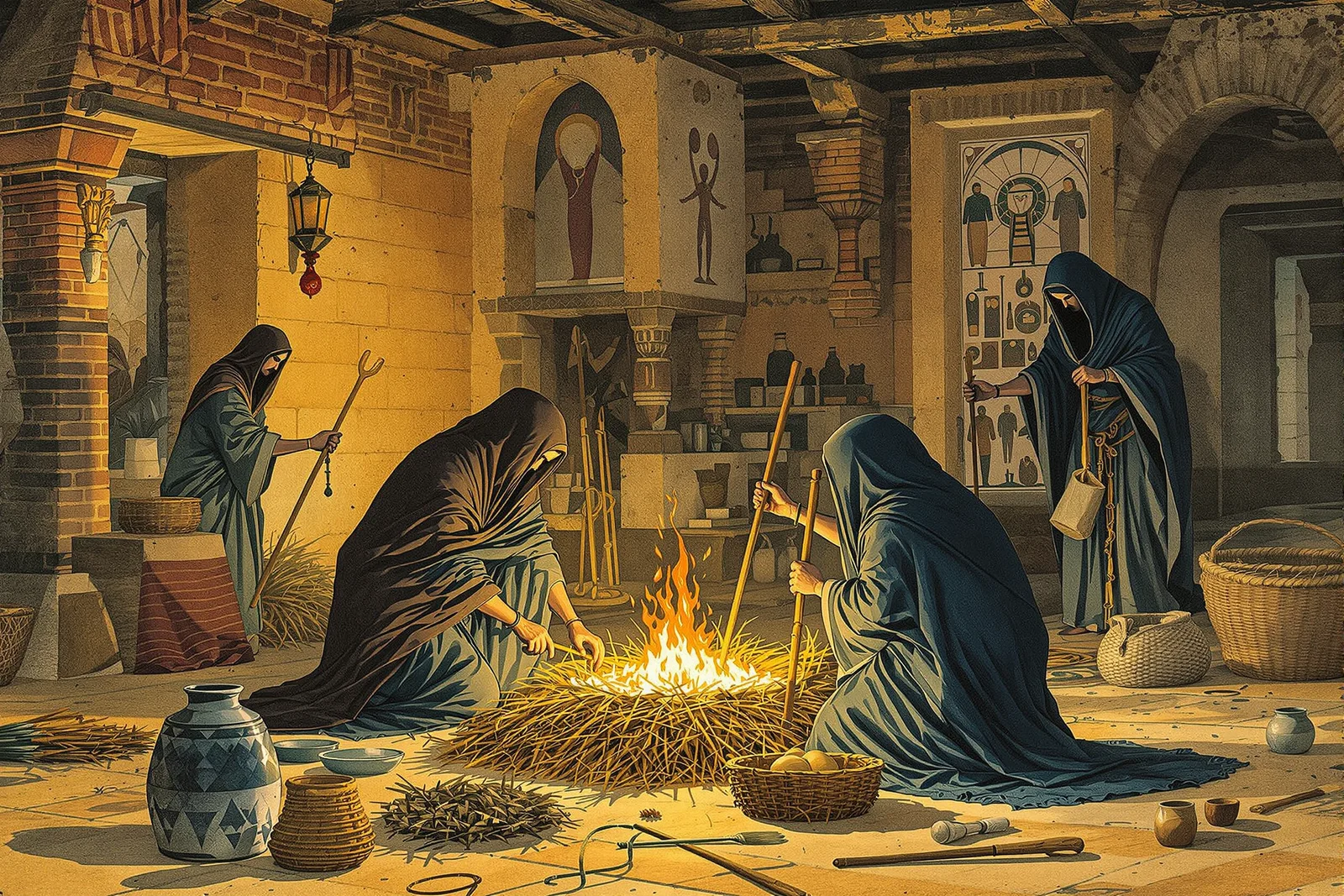
The harvest-blessing is the year's great liturgical climax, and it draws the whole module together: the first-fruits tradition, the calendar's correspondence, the gathered labor, and the duties of the increase, woven into a single rite the whole community shares. Like every rite of the threshold it opens with purification (cross Vol VIII, the Codex of Water), and like every great festival it is built for the whole community's participation — for the harvest is brought in by everyone's hands, and so the rite is celebrated by everyone's voice. The form below is a sound, sober, and adaptable order; a community inflects it with its own crop and tradition, but the structural elements — the gathering of the laborers, the first-fruits set apart, the blessing of the gathered crop, the portion for the needy, the thanksgiving, and the feast — are the load-bearing ones and should not be dropped.
Protocol 789-A — Leading the harvest-blessing and thanksgiving
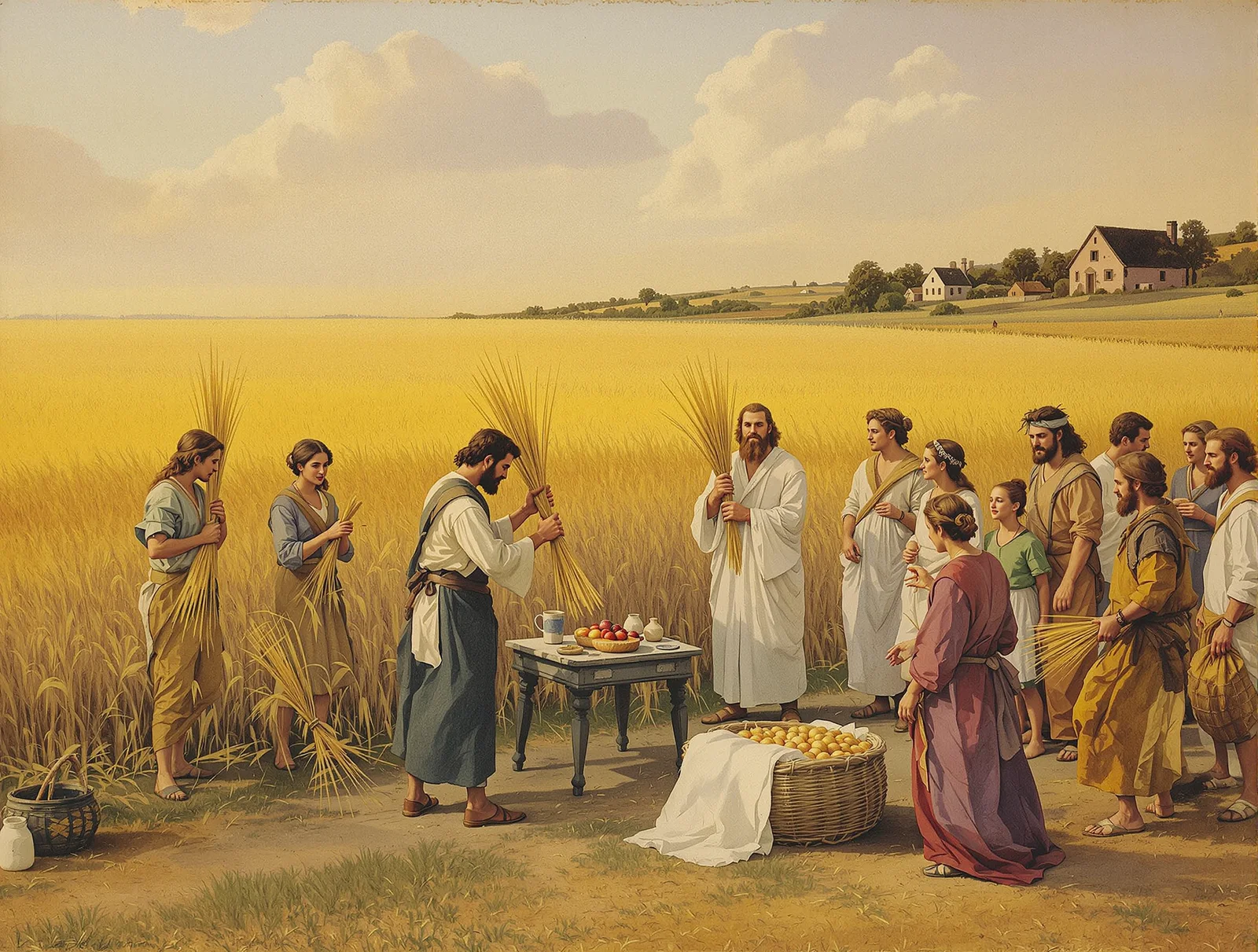
- Time it to the true ingathering. Hold the rite when the harvest is genuinely being brought in — ideally as the bulk of the crop comes home — so the blessing marks the real event and not a date on paper. The land sets the day (Chapter 3).
- Gather the whole community of the harvest. Convene everyone whose labor brought the crop in, and everyone the harvest will feed — the reapers, the binders, the gleaners, the old, the young, the poor, the stranger. The harvest was gathered by all and is celebrated by all.
- Set apart the first and best. Present the first-fruits — the first sheaf, the new bread baked from the new grain, the season's first produce — and set it apart with thanksgiving before the bulk of the crop is taken for ordinary use (Chapter 2). This is the rite's central act: the first and best acknowledged before the rest is claimed.
- Bless the gathered crop. Bless the harvest as a whole — the grain in the sheaf, the fruit in the basket, the increase secured — naming plainly the labor that won it and the gladness and relief of having gained a good harvest. Where the harvest was poor, name that honestly too, and turn the rite toward the duties of a lean year and the care of one another through it.
- Set aside the portion for the needy and the seed for next year. Make visible, within the rite, the two great disciplines of the increase: the portion reserved for the poor, the alone, and the stranger (cross Vol XIX, the Steward's Codex, for the ethics of shared provision), and the seed-grain held back for next year's sowing. The rite carries good practice inside its gladness, so that the two are remembered together.
- Give thanks together. Lead the whole community in shared thanksgiving for the year secured — in word, in song (cross Vol XXIII and Module 772, the scoring of the rite), and in the gathered acknowledgment of dependence and relief that is the harvest's truest feeling.
- Spread the thanksgiving feast. Complete the rite with the harvest-home feast (Chapter 7), built on the very abundance just secured, sharing the increase at one table, and resting the laborers who brought it in.
Your Commitment: You will time the harvest-blessing to the true ingathering, set apart the first and best before the rest is taken, and carry the portion for the needy and the seed for next year inside the rite where the whole community sees them. A harvest blessed in shared thanksgiving binds a people in gladness at the moment its survival is secured — but a harvest-rite that forgets the poor, neglects the seed, or floats free of the real ingathering has lost the very things the agrarian liturgy exists to hold.
Chapter 7 — The thanksgiving feast and the harvest-home
The harvest-blessing completes itself in the feast — the harvest-home, the great thanksgiving table built on the abundance just brought in (and designed by the craft of Module 788, the keeping of the feast, with which the harvest-feast is shared). Its character is gladness, inclusion, and rest. Gladness, because it celebrates the year's labor come home and its survival secured — the highest and most communal joy in an agrarian people's year. Inclusion, because no one is left outside the plenty: the harvest was gathered by the whole community and the harvest-home gathers the whole community, the poor and the stranger and the alone brought to the table along with the reapers (cross Vol XIX, and the hospitality-office of the Ritual Offices for the welcome of the stranger). And rest, because the harvest-home is the laborers' earned pause — the moment the scythes are set down and the people who brought the crop in are fed, thanked, and allowed to rest from the year's hardest work. The feast is the harvest-blessing made bodily: the abundance acknowledged in the rite is now shared at the table, and the community tastes, together, the year it secured.
Chapter 8 — Keeping the agrarian liturgy true through good years and lean
An agrarian liturgy is kept well only if it stays true to the land in every kind of year — and the lean year is its hardest test. In the good year the harvest-blessing is easy: the abundance is real, the thanksgiving is glad, the feast is full. But the harvest is not good every year, and a liturgy that can only celebrate plenty will ring false the moment the crop fails. The Practitioner keeps the agrarian liturgy honest by letting it mark the real harvest, whatever it is: in the good year, full thanksgiving and a generous feast; in the lean year, an honest naming of the shortfall, a turning of the rite toward the duties of scarcity — the careful stewarding of a thin store, the sharing of what there is, the binding to the fast that spans the lean (Module 788) — and the gathering of the community to face a hard winter together rather than alone. A liturgy that tells the truth about the harvest in the lean year as well as the full is a liturgy a farming people can trust with its whole life — which is exactly what an agrarian people must do. Kept true, year upon year, through harvests full and thin, the blessing of the harvest becomes what it was always meant to be: the marking of the moment a community's year comes home, in a rite that gathers the whole people into gladness when the crop is good, and into shared resolve when it is not, and into thanksgiving in either case for the labor, the land, and one another.
PLATES — Supplemental Gallery
Art direction
Art direction
Council Approval — The Twelve Voices Speak
| Disciple | Verdict | Reasoning |
|---|---|---|
| Peter | APPROVED | "It is built on the rock of the real harvest — the rite marks the true ingathering, and a people is gathered into its own survival secured." |
| Thomas | APPROVED | "I doubted a harvest-rite could be kept honest in a bad year; instead it names the shortfall plainly and turns to the duties of scarcity. Honest to the field." |
| John | APPROVED | "The harvest-home gathers everyone to the table in love — reaper and gleaner and stranger alike — and the portion for the poor is carried inside the gladness. The heart is here." |
| Matthew | APPROVED | "Every turn of the year is named and every duty counted — the seed reserved, the store laid up, the portion shared. A scribe could keep the year from this table." |
| James the Greater | APPROVED | "It times the blessing to the true ingathering and orders the increase by real discipline. That is sound command of the harvest." |
| Andrew | APPROVED | "None is shut out of the plenty the whole community's hands brought in. The net is cast as wide as the harvest itself." |
| Philip | APPROVED | "Show me, I asked, and the plates show me — the one wheel of two years, the order of the rite, the duties carried inside it. Made teachable." |
| Bartholomew | APPROVED | "No false claim: the grain is grown by labor and weather, not by ceremony, and the rite marks the truth of the harvest, full or thin. Genuine to the last sheaf." |
| James the Lesser | APPROVED | "The least are kept first: the gleaner, the poor, the stranger brought to the harvest table, the portion set aside before the rest is claimed." |
| Simon the Zealot | APPROVED | "It gives a people back the liturgy of its own survival — the marking of its own harvest, owing nothing to any outside authority to bless its bread." |
| Judas Thaddaeus | APPROVED | "For the hard year especially: it carries the rite honestly through the failed crop and the lean winter, and abandons no one to face it alone." |
| Matthias | APPROVED | "It binds the sacred year to the farming year and passes the whole cycle on — seed, store, and rite together. The harvest will be kept. Approved." |
Council Verdict: 12/12 APPROVED. This module is canon.
Let the first and best be set apart and the whole crop be blessed, that a people may mark the moment its year comes home — in thanksgiving when the harvest is full, in shared resolve when it is thin, and in gladness for the labor, the land, and one another in every season.
TRANSMISSION RECORD
Transmission COMPLETE — unaltered & unabridged Module 789 · Bless the Harvest · category: priesthood Carries ME 11 · nam-diĝir-munus · Divine Lady Words ~3,090 SHA-256 of source text 363d7c035ad0505334055e462e4f995ce096c3d00c769ef3134fc3dfcfebff89 Canonical text bless-the-harvest.md — byte-identical to what this page renders