Module 788 — Keep the Fast and Feast
THE ME TABLET · Priesthood Module 788 · nam-diĝir
Carrying ME 2 · nam-diĝir · Godship. A Sovereignty Module of the Practitioner Community.
Unaltered and unabridged: ~3,080 words.
Preamble
A community's year has a rhythm, and the deepest beat of that rhythm is set by the table: the times it eats together in abundance and the times it eats little or not at all. Every settled people on the record marks its calendar with both — the fast and the feast — and the two are not opposites but a single instrument. The fast empties, focuses, and prepares; the feast fills, gathers, and releases. Held together and bound to the calendar, they pace a community's shared life as nothing else can: they mark the seasons, gather the scattered, discipline the appetite, and make the moment of plenty land as joy precisely because it followed a stretch of restraint. The Practitioner who holds ME 2 — Godship, the decree of the sacred calendar's deepest offices — is the one a community trusts to design and keep this cycle wisely, safely, and well.
This module is the working grammar of the fast and the feast. It does not teach the building of the liturgical calendar itself — that whole craft belongs to Module 779, the holding of the sacred calendar, which this module assumes as its frame. This module takes the calendar as given and asks the table's question: when should a community fast, when should it feast, how should it do each safely, and how should the two be bound to the turning year so that together they pace the people's shared life? You will leave able to set out the real traditions of ritual fasting and feasting across cultures accurately; to understand the genuine physiology of going without food — its real effects, its real limits, and the people for whom it is unsafe; to design a community's fast-and-feast cycle bound to its calendar; and, above all, to hold the one duty that governs all the rest: that a rite of the body must never harm the body it is practiced on.
The sovereignty stake is the body and the year at once. A community that has lost its own table-rhythm — that no longer fasts together, no longer feasts together, and so no longer feels the seasons in its shared appetite — has lost a pacing instrument that no imported holiday can replace. To keep the fast and feast is to hold, in your own settlement, the oldest and most embodied way a people marks its sacred time: in the gathered hunger and the gathered plenty of the whole community at one table.
Part I — The Fast and the Feast Across the Traditions
Chapter 1 — Two halves of one instrument
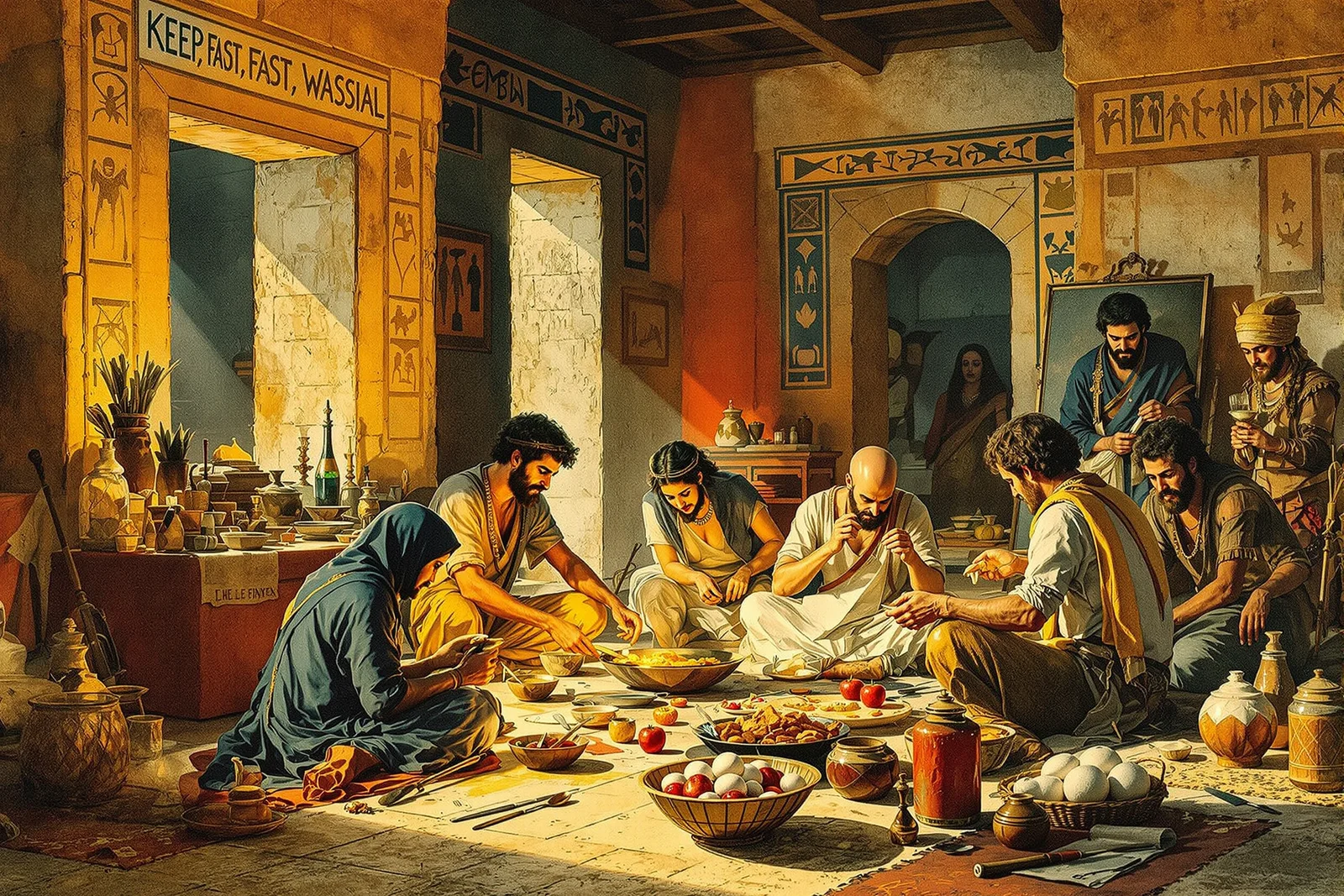
It is a near-universal pattern: the cultures that fast are, very largely, the same cultures that feast, and the two are bound together in the calendar as preparation and release. A period of restraint precedes a moment of abundance; the emptying makes the filling meaningful. The anthropologist explains this without appeal to anything the abstinence itself accomplishes spiritually — for that is a claim outside the sober register — but by what the pairing does for a community: it structures shared time, marks the calendar's turns with bodily experience, and binds the whole group into a single rhythm of want and plenty that everyone feels in the same days. A people that fasts and feasts on the same calendar is a people whose very appetites are synchronized to its shared year.
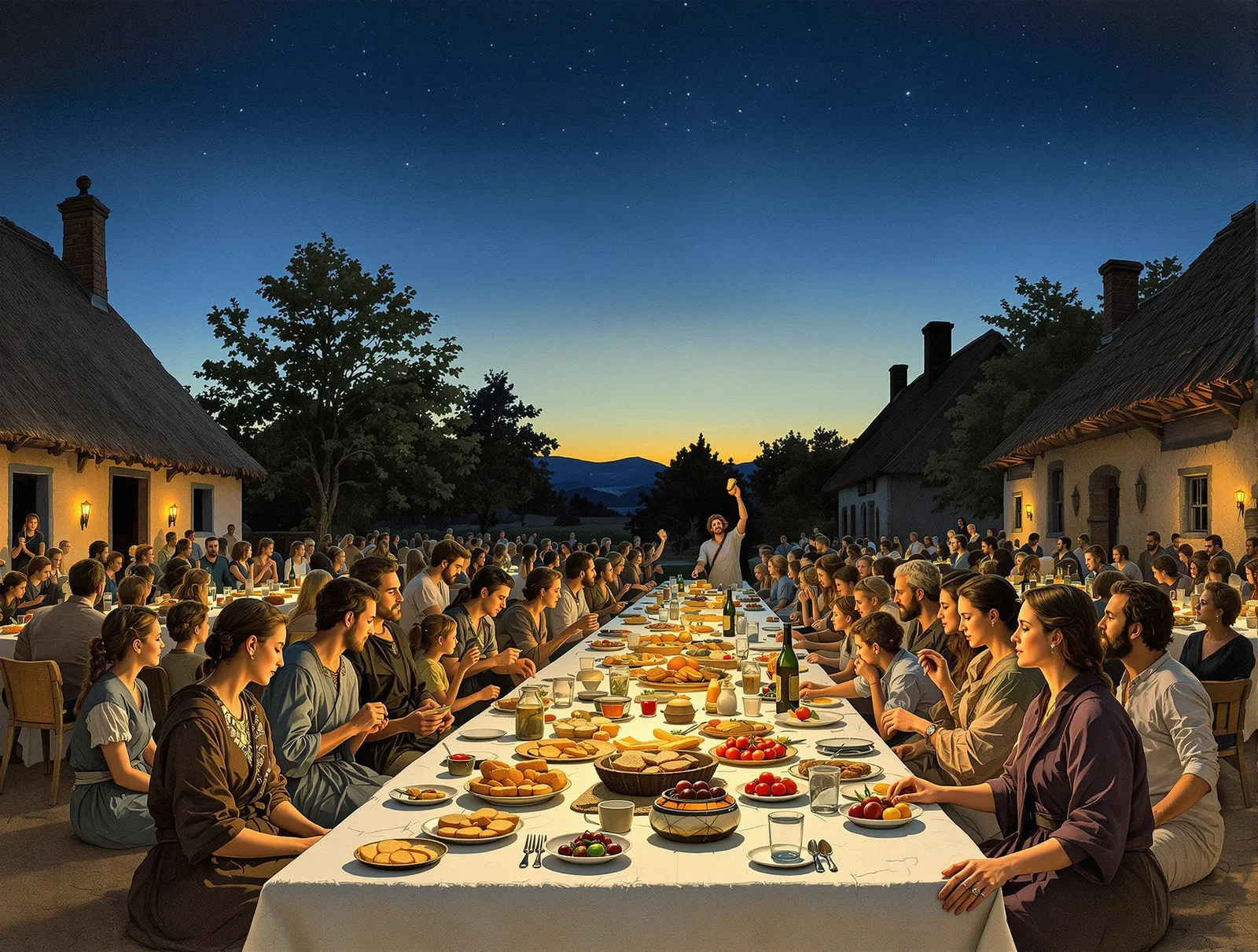
The fast and the feast each do distinct social work. The fast disciplines and unifies: shared restraint is a leveler — rich and poor go without alike — and a focuser, clearing the ordinary churn of daily eating to make room for attention, reflection, and preparation. The feast gathers and releases: shared abundance binds a community in pleasure, reaffirms its bonds at the table, includes everyone in the plenty, and marks the moment of harvest, festival, or passage as a height of the year. Either alone is thinner than both together. The Practitioner designs them as the single instrument they are.
Chapter 2 — Fasting traditions, accurately
The comparative record of ritual fasting is deep and consistent, and the Practitioner should know it accurately. Across the major traditions, fasting takes recognizable forms: the complete fast (no food, sometimes no drink, for a bounded period); the partial or restricted fast (abstaining from certain foods — meat, rich foods, particular categories — while eating others); the daylight fast (eating only outside daylight hours across a season); and the collective penitential or preparatory fast (the whole community abstaining together before a high day). The great traditions all carry such practices: month-long daylight fasts; forty-day seasons of restraint and reflection; days of complete abstention tied to atonement or mourning; recurring weekly or seasonal partial fasts. The durations, the rules, and the meanings differ, but the form recurs everywhere because the human need it meets is everywhere.
Crucially, every responsible fasting tradition on the record also carries exemptions — and this is the part the restored office must inherit above all the rest. The traditions that fast wisely exempt the people for whom fasting is unsafe: the sick, the very young, the elderly and frail, those who are pregnant or nursing, those who must do heavy labor or travel, those whose bodies cannot safely bear it. These exemptions are not loopholes; they are the wisdom of practices that have watched over real bodies for a very long time and learned where restraint becomes harm. A restored fast that does not carry generous, clearly-named exemptions has discarded the most important thing the old traditions knew.
Art direction
Part II — The Physiology of Fasting (Sober and Safe)
Chapter 3 — What going without food actually does
The Practitioner who designs a community's fasts must understand, accurately and without mystification, what fasting does to the body — both to use it wisely and to know its real limits. This chapter presents the physiology soberly, at the standard of a health textbook, and it is bound tightly to Vol V — The Sovereign Body, the codex of human physiology, to which the Practitioner is directed for the full science. Nothing here is a medical instruction; it is the background a responsible designer of fasts must hold.
When the body goes without food, it draws first on the sugar (glucose) stored in the liver and muscles as glycogen — a reserve that sustains normal blood sugar for a number of hours into a fast. As that store is drawn down, the body shifts to burning fat for fuel, and the liver begins producing ketones, an alternative fuel the brain and body can use; this metabolic shift is a normal, well-understood part of going without food for an extended period. Across a fast of a day or more, the body is increasingly running on its own fat stores. These are ordinary, healthy physiological responses in a healthy adult over a bounded fast — the body is built to weather periods without food and has the reserves to do so. The honest framing is neither that fasting is magical nor that it is dangerous in itself for a healthy adult over a short, sensible period; it is a normal metabolic state the body is equipped to enter and leave.
Chapter 4 — The real effects, the real limits
A sober account names both what a fast can do and what it cannot, and where it becomes hazardous. Honestly stated:
- Hunger is strongest early and often eases. The sensation of hunger in the first stretch of a fast is frequently the most acute, and many find it subsides somewhat as the fast continues and the body adjusts — a real effect worth knowing, and not a sign of anything mystical.
- Hydration is the first concern, always. The body tolerates a lack of food far better than a lack of water. A fast that withholds drink, or is kept in heat or during heavy labor, risks dehydration quickly, and dehydration is dangerous well before lack of food is. Any fast must guard water intake unless a clinician has specifically guided otherwise.
- The early discomforts are common and usually mild. Headache, irritability, low energy, difficulty concentrating, and lightheadedness are common in the early part of a fast, particularly the first day, and are usually mild and transient in a healthy adult — but they are also the body's signals, and they must be heeded, not overridden as a test of will.
- The limits are real and must be respected. A fast is bounded for a reason. Prolonged or repeated severe fasting carries genuine risks — to blood sugar regulation, to electrolyte balance, to the heart in extreme cases — and is not a feat of endurance to be pushed. The wisdom of the old traditions was always in the bound: the fast ends, and the body is restored.
- Breaking the fast is done gently. A fast is broken with modest, simple, easily-digested food, not with a sudden heavy meal on an empty stomach. The feast that follows a fast is approached with some care at its first bites, then enjoyed.
The Critical Insight: The entire safety of a community's fasting rests on one principle: a fast is a bounded, voluntary, and exempted practice for those whose bodies can bear it — never an endurance trial, never imposed, never extended past its limit, and never kept by anyone for whom it is unsafe. The old traditions that fasted wisely fasted within these walls. A restored fast that treats hunger as a contest to be won, that pressures the unwilling, or that withholds its exemptions has abandoned the wisdom of every tradition it draws from and turned a rite of the body into a danger to it.
Chapter 5 — Who must not fast, and when to seek a clinician
This is the gravest chapter of the module, and the Practitioner must hold it as non-negotiable. Fasting is unsafe for a substantial number of people, and a community's fast must carry clear, generous, openly-named exemptions, exactly as the responsible traditions always have. The following must not undertake a fast of restriction, or must do so only under a clinician's specific guidance:
- Those who are pregnant or nursing, whose bodies and dependents need steady nourishment.
- Children and the very young, who are still growing and have small reserves.
- The elderly and the frail, in whom going without food and water carries quickly compounding risk.
- Anyone with a medical condition affected by fasting — diabetes and other blood-sugar disorders above all, but also heart, kidney, and many other conditions — and anyone taking medication that must be taken with food or on a schedule. For these, a fast is a medical question, not a devotional one.
- Anyone with a history of disordered eating, for whom a sanctioned fast can be genuinely dangerous, and for whom the community must make abstention quietly and entirely optional with no pressure whatsoever.
- Anyone doing heavy physical labor, traveling hard, or otherwise unable to rest through the fast.
Your Commitment: You will direct any person uncertain about whether they can fast safely to consult a qualified clinician before fasting, and you will state this plainly and publicly every time the community fasts. You will hold the exemptions as the price of the practice, never as a failure of devotion: the child, the pregnant, the elderly, the ill, and the vulnerable are honored by being exempted, not diminished. A fast that endangers a body is not a holier fast; it is a betrayal of the office that called it. When in any doubt, the body comes first, and the answer is to eat and to seek a clinician.
Part III — The Feast, and the Cycle Together
Chapter 6 — Designing the feast
If the fast is governed by restraint and safety, the feast is governed by inclusion and abundance — and it has its own craft. A feast's first duty is that no one in the community is left outside the plenty: the poor, the alone, the stranger, and the frail are gathered to the table, because a feast that excludes is a feast that divides, the opposite of its purpose (cross Vol XIX, the Steward's Codex, for the ethics of a community's shared provision, and the hospitality-office of the Ritual Offices for the welcome of the stranger to the table). The feast is built around real, seasonal abundance — the food the calendar has actually made available, which is why the great feasts so naturally fall at harvest (cross Module 789, the blessing of the harvest, with which the harvest-feast is shared). And the feast is the community's joy made bodily and communal: shared food, shared music (cross Vol XXIII and Module 772, the scoring of the rite), and shared time at one table.
The feast also has a real safety register, gentler than the fast's but not absent: a feast is sound nourishment and shared pleasure, never an excess pushed past comfort or a license for the very harms — heavy drink above all — that turn a gathering sour and unsafe. The Practitioner designs the feast as generous and glad, and keeps it humane.
Chapter 7 — Binding the two to the calendar
The fast and the feast reach their full power only when bound to the calendar as a paired cycle — and this is the heart of the module's design work. The sound pattern, attested across traditions and restored here, is to place fasts and feasts at the calendar's meaningful turns so that the body's rhythm of restraint and plenty tracks the year's own rhythm of want and abundance. The natural anchors are these: a preparatory fast before a high feast, so the feast lands as release; a fast in the lean season — the late-winter or pre-harvest stretch when stores ran low historically anyway — turning a hard time into a kept observance; a feast at the harvest and at the seasonal heights, when abundance is real; and smaller recurring fasts and feasts through the year that keep the rhythm beating between the great ones. Bound this way, the cycle does not fight the agricultural year (cross Vol VII, the agrarian codex) but rides it: the fasts fall where food was scarce, the feasts where it was plentiful, and the calendar, the harvest, and the community's own appetite all turn together.
Art direction
Part IV — Designing and Keeping the Cycle
Chapter 8 — Building a community's fast-and-feast year
The design work draws the whole module together: the traditions' wisdom, the physiology's limits, the feast's inclusion, and the calendar's turns, woven into a cycle a community can actually keep. The protocol below builds it.
Protocol 788-A — Designing the fast-and-feast cycle
- Start from the calendar, not the table. Take the community's sacred calendar (Module 779) as the frame, and mark its high days, its seasonal turns, and its harvest. The fasts and feasts are placed onto these; they do not float free. Bind the cycle to the agrarian year (cross Vol VII) so it rides the real seasons of scarcity and plenty.
- Place the feasts at genuine abundance. Set the great feasts where food is actually plentiful — the harvest above all, and the seasonal heights — so the feast is built on real plenty and not on strain. A harvest-feast is the keystone (cross Module 789).
- Place the fasts to prepare and to span the lean. Set a preparatory fast before each high feast so the feast lands as release, and consider a kept fast in the historically lean season, turning scarcity into observance. Keep each fast bounded — a stated beginning and a stated end — and proportionate to what the community can safely bear.
- Write the exemptions into the cycle itself. For every fast, name its exemptions plainly and publicly as part of the rite, not as an afterthought: who need not fast, who must not, and the standing direction to consult a clinician when unsure (Chapter 5). The exemptions are part of the design, not a relaxation of it.
- Make participation voluntary and unpressured. Keep every fast something the community is invited to, never coerced into. Quietly ensure that no one is shamed for not fasting, and that the vulnerable can abstain with no notice taken. Coerced restraint is both unsafe and against the spirit of the rite.
- Pair each fast with its feast. Design the two as a unit — the restraint and the release that completes it — so the cycle is felt as a single rhythm rather than a scatter of separate rules. The breaking of each fast is itself a small feast, gently begun.
- Bind in the music, the welcome, and the record. Score the feasts (cross Vol XXIII, Module 772), welcome the stranger and the alone to the table (the hospitality-office), and record the cycle so it passes intact to the next generation (Module 770). A cycle kept only in one keeper's memory dies with that keeper.
Chapter 9 — Keeping the cycle humane and alive
A fast-and-feast cycle is kept well only if it stays both humane and alive. Humane means the body is never sacrificed to the rite: the exemptions hold, the clinician's counsel is honored, the unwilling are never pressed, and the moment any fast endangers a person it is broken without shame. A community that has ever let zeal override a body's safety has unmade the office; the Practitioner guards against this above every other failure. Alive means the cycle stays bound to the community's real year and real life — that the feasts still fall at real abundance, the fasts still mark a real preparation, and the whole rhythm still paces the people's shared time rather than calcifying into rules no one feels. Kept humane and alive, the fast and the feast become what they were always meant to be: the deepest beat of a community's sacred year, marked not in words on a tablet but in the gathered hunger and the gathered plenty of the whole people, turning with the seasons, generation upon generation.
PLATES — Supplemental Gallery
Art direction
Art direction
Council Approval — The Twelve Voices Speak
| Disciple | Verdict | Reasoning |
|---|---|---|
| Peter | APPROVED | "The fast and the feast are rock-solid bones of a year — restraint then plenty, and a people kept in rhythm by both." |
| Thomas | APPROVED | "I doubted fasting could be taught without either mystique or danger; instead the physiology is plain and the limits are named hard. I am satisfied." |
| John | APPROVED | "The feast gathers everyone to the table in love — the poor, the alone, the stranger — and the fast levels rich and low alike. The heart is here." |
| Matthew | APPROVED | "Bounded, voluntary, exempted, accountable — every safeguard is stated and counted. Nothing about the body is left to chance." |
| James the Greater | APPROVED | "It places the feasts at real abundance and the fasts at the real lean — a cycle a community can actually keep, not a fantasy of discipline." |
| Andrew | APPROVED | "None is shut out: the vulnerable exempted with honor, the unwilling never pressed, the stranger welcomed to the plenty. The net is wide and gentle." |
| Philip | APPROVED | "Show me, I asked, and the plates show me — the two halves, the sober physiology, the year-wheel. Made teachable without being made dangerous." |
| Bartholomew | APPROVED | "No false claim: fasting is neither magic nor a trial of will, only a bounded state the body bears — and the unsafe are told plainly to eat and ask a clinician." |
| James the Lesser | APPROVED | "The least are guarded first: the child, the pregnant, the frail, the ill, the one who has struggled with eating. The module shields them all." |
| Simon the Zealot | APPROVED | "It gives a people back its own table-rhythm and the marking of its own year in hunger and plenty — sovereignty felt in the very appetite." |
| Judas Thaddaeus | APPROVED | "For the hard season especially: it turns the lean pre-harvest stretch into a kept observance, and abandons no one to it without exemption or aid." |
| Matthias | APPROVED | "It is recorded and passed on, exemptions and all, so the cycle survives its keepers. The rhythm continues. Approved." |
Council Verdict: 12/12 APPROVED. This module is canon.
Let the fast be kept within its bounds and the feast be spread for all, that a people may mark its sacred year in the gathered hunger and the gathered plenty of one table — and may no body ever be harmed by the rite practiced upon it.
TRANSMISSION RECORD
Transmission COMPLETE — unaltered & unabridged Module 788 · Keep the Fast and Feast · category: priesthood Carries ME 2 · nam-diĝir · Godship Words ~3,080 SHA-256 of source text 15dfdacf2468feeeec9650cf2fdb016f304cf88ae13c2393f8583ace4f88d3d9 Canonical text keep-fast-feast.md — byte-identical to what this page renders