Module 787 — Consecrate the Ground
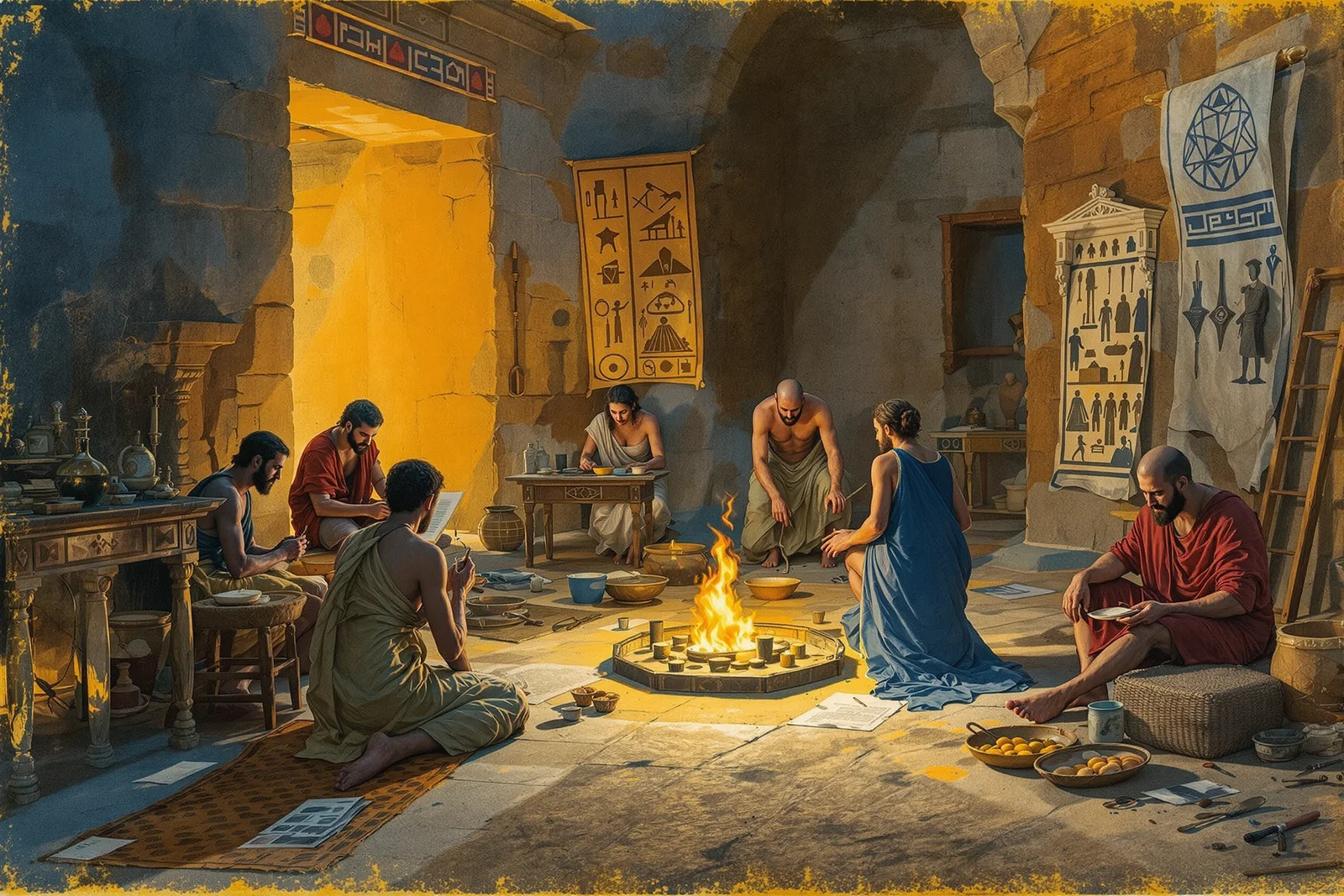
THE ME TABLET · Priesthood Module 787 · eš maḫ
Carrying ME 7 · eš maḫ · The Exalted Shrine. A Sovereignty Module of the Practitioner Community.
Unaltered and unabridged: ~3,050 words.
Preamble
Before a people raises a temple, a council-house, a granary, or a home, it must first decide that this patch of earth, and not the next one over, is the right place to stand — and then it must mark that decision so the whole community holds it together. These are two distinct acts, and a settlement that confuses them suffers for it. The first is siting: the sober reading of land, water, slope, sun, and wind to find ground that will keep a building dry, warm, defensible, and alive across generations. The second is consecration: the rite by which a community declares a chosen ground set apart, lays its foundation in shared witness, and binds itself to build there with care. The Practitioner who holds ME 7 — the decree of the Exalted Shrine — is the one a community calls to do both: to read the ground honestly and to mark it rightly.
This module is the working grammar of ground-blessing and foundation rites. It does not teach you to raise the walls — that craft belongs to the building volume (cross Vol VI, the codex of structures and shelter), and the land-survey beneath it to the codex of land and measure (cross Vol XI). This module stands at the joint between the two: it assumes a community has decided to build something that matters to its common life, and it asks the questions that come before the first course of stone. You will leave able to read a site soberly for the things that actually decide whether a building thrives; to orient a sacred or communal structure to sun, water, and approach for reasons that are real and not magical; to distinguish the genuine craft of land-reading from the superstition that has shadowed it; and to lay a foundation-stone in a rite that makes the whole community a witness to what is being built and why.
The sovereignty stake is plain. A community that cannot site its own ground — that must send for an outside surveyor or a distant authority to say where the shrine may stand — has surrendered the most rooted decision a settled people makes. And a community that builds without rite builds without shared memory: in a generation, no one recalls why the granary faces the way it does, who laid its corner, or what the builders promised. To consecrate the ground is to keep, in your own settlement, both the knowledge of where to build and the memory of why.
Part I — The Universal Instinct to Hallow Ground
Chapter 1 — Why every people marks its ground
No settled culture on the record builds its most important structures as though the ground were neutral. From the deepest layers the Historian's Codex (Vol XVI) reconstructs — the megalithic enclosures aligned to the turning sun, the first temple-platforms of the river cities — through to the cathedral, the mosque, the council-lodge, and the boundary-shrine, human beings have consistently treated certain ground as set apart and have marked the act of setting it apart with rite. The anthropologist must explain this without appealing to any property the dirt itself possesses, because the dirt possesses none; the meaning is entirely something the community does.
The instinct rests on a real social need. A community must agree, durably and visibly, on what its shared spaces are for — which ground is common and which is private, which is the place of assembly and which the place of the dead, where the stranger may go and where only the called may stand. Left to drift, these boundaries blur, and a blurred boundary is a standing quarrel. To consecrate ground is to fix the agreement in place: to say, in a form the whole community witnesses, "here is the assembly-ground; here is the threshold; here the dead lie; here we keep the grain." The rite does not change the soil. It changes what the people have agreed the soil is, and it makes that agreement hard to forget.
Chapter 2 — Foundation rites across the traditions
The comparative record of foundation and ground-blessing rites is rich, consistent, and worth setting out accurately, because the restored office stands on the anthropology and not on any one tradition's claims.
In Mesopotamia, the founding of a temple was among the gravest acts a city undertook: the record attests foundation deposits — inscribed bricks, figurines, and tablets buried beneath the corners and thresholds, naming the builder and the purpose so that the act would be remembered and, the texts hoped, found again. The Roman surveyor and priest cut the templum from the sky and the ground together, taking the auspices and laying out the cardinal axes before a stone was set; the very word inauguration descends from that taking of the signs. Across South and East Asia, traditions of ground-reading and ground-blessing — placing offerings to the spirits of the land, orienting the structure to compass and water — preceded building. The later monotheistic traditions consecrate a church or an altar with anointing, the setting of a cornerstone, and a dedicatory rite; the laying of a foundation-stone with public ceremony remains, to this day, the near-universal mark that a significant building has begun.
What strikes the careful observer is the convergence across unconnected peoples. Wholly separate cultures reached for the same cluster of acts — choose the ground deliberately, mark its axes, bury a record at the foundation, gather the community to witness, name the purpose aloud — because the cluster fits the human need so exactly. The restored office inherits that convergence soberly: we consecrate ground because marking a foundation in shared witness is the oldest and most universal way a community has found to commit itself, together and for the long term, to what it is about to build.

Art direction
Part II — Reading the Ground (Siting, Soberly)
Chapter 3 — Land-reading is not divination
There is an old and tangled art that goes by many names — geomancy among them — and the Practitioner must hold a clear, honest line through it. Stripped of superstition, land-reading is one of the most genuinely useful crafts a settling people possesses: the disciplined observation of a site's slope, drainage, soil, exposure, wind, water, and vegetation to predict how a building placed there will fare. This is real, testable, and indispensable. Layered over it across history, however, has been a great deal of unfalsifiable claim — that hidden lines of force run through the earth, that unseen currents must be balanced, that a diviner's rod or a compass of spirits can find what sober observation cannot. The honest office keeps the first and sets the second firmly aside.
The distinction is not contempt for the old traditions; it is fidelity to what actually works. Many ancient siting practices encode real wisdom in symbolic dress: the counsel to set a building with its back to the hill and its face to the water and the sun is, decoded, sound advice about wind-shelter, drainage, and warmth, whatever cosmology was wrapped around it. The Practitioner's task is exactly the lilissu task the parent tradition teaches — to keep the standard and, where it helps no one, drop the magic: to read the ground for the things that genuinely decide a building's fate, and to present that reading to the community as what it is, skilled observation, never as a sign from beneath the earth.
The Critical Insight: Underneath the geomancer's mystique was, very often, a real surveyor. The traditions that told a people to honor the slope, follow the water, face the sun, and shelter from the cold wind were transmitting hard-won siting knowledge in the only carrier their age trusted — the sacred. A community can keep every ounce of the knowledge and owe nothing to the cosmology, exactly as it keeps the engineering of a rite while letting go of the claim of magic. Read the ground honestly, and you lose nothing the old art ever truly possessed.
Chapter 4 — The site-reading checklist
Below is the Practitioner's working reference for reading a site before any ground is consecrated. Every row is a real, observable factor with a real consequence; none invokes anything unseen. A site need not score perfectly on every line — few do — but each weakness must be seen, named, and either remedied or accepted with open eyes.
Specification Table 787-1 — What to read in the ground
| Factor | What to observe | Why it decides the building's fate |
|---|---|---|
| Drainage & slope | Which way water runs; low spots that pool; the high ground | The single commonest cause of building failure is water that does not drain away; build on ground that sheds water, never where it collects |
| Water table & damp | Springs, seeps, reeds and rushes, soil dampness when dug | Ground that is wet underfoot will be wet underfloor; chronic damp rots structure and sickens its people |
| Soil & bearing | Dig a test pit; firm subsoil vs. soft fill, peat, or made ground | A foundation is only as sound as what it bears on; soft or disturbed ground settles and cracks the walls above |
| Sun & aspect | The path of the sun across the site through the day and seasons | A structure open to the low winter sun is warmed and lit for free; one in permanent shadow is cold, dark, and damp |
| Prevailing wind | The direction hard weather comes from; natural windbreaks | Shelter from the prevailing wind keeps a building warm and its roof intact; an exposed ridge punishes both |
| Water access | Distance and reliability of clean water for the building's use | A communal structure must be served by water it can reach; cross Vol VIII for the judging and keeping of water |
| Approach & sightlines | How people will arrive; what the place is seen from and sees | A shrine or assembly-ground wants a fitting approach and a clear arrival; siting governs how the building is met |
| Ground hazards | Flood reach, unstable slopes, rockfall, old workings | Read the worst the land has done before; the marks of past flood and slip are the land telling you where not to build |
Chapter 5 — Orientation for reasons that are real
Every tradition orients its sacred buildings, and the Practitioner orients too — but for stated, physical reasons, holding fast to the line of Chapter 3. The two great honest grounds for orientation are the sun and the approach, with water and wind shaping both.
Orienting to the sun is the oldest and soundest practice. A building's long face turned toward the low winter sun gathers light and warmth through the cold months when both are scarcest; the same face shaded from the high summer sun stays cool when heat is the burden. The solar alignments the Historian's Codex finds in the megalithic record — structures squared to the solstice sunrise or the equinox — were, at the practical layer, this same knowledge: a people reading the sun's turning and building to it. A community may choose to align a shrine's axis to the sunrise of a date that matters to its calendar (cross Module 779, the holding of the sacred calendar), and this is a fine and meaningful choice — provided it is named for what it is, an alignment to a real celestial event the community keeps, never a channel for an unseen force.
Orienting to the approach governs how the structure is met. A shrine wants its entrance set where people will naturally arrive, with a clear and fitting path to the threshold; an assembly-ground wants its gathering-space open to the way the community comes. Water and wind shape the rest: set the sheltered, served side to daily use and the storm-facing side to the weather. Orientation, rightly done, is simply siting carried into the building's very plan.
Art direction
Part III — Choosing and Marking the Ground
Chapter 6 — From reading to decision
A site-reading produces a judgment, not an order; the community must still decide. The Practitioner's role here is the discernment-office's role applied to ground (cross Vol XVII, the parent codex, and Module 776, the reading of the signs, for the honest method of helping a community choose): lay the readings out plainly, name what each candidate site does well and badly, name what can be remedied and at what cost and what cannot, and let the community choose with open eyes. A site chosen this way is a site the whole community has assented to — which matters enormously when the building is raised by shared labor and kept by shared duty.
Two cautions belong to this stage. First, resist the pull of the merely convenient: the flattest, nearest, easiest ground is not reliably the right ground, and a building set on poor ground to save a season's work will cost far more across its life. Second, respect what the land already carries. Ground that a community already holds as the place of the dead, the place of an old shrine, or the gathering-place of generations carries a weight no survey measures, and to build over it carelessly is to break a thread the community may not wish broken. The reading judges the soil; the community judges the meaning; the Practitioner serves both.
Chapter 7 — Marking the axes and bounds
Once the ground is chosen, it is laid out before it is consecrated — and the layout is itself the first physical act of the rite. Using the land-craft of Vol XI, the Practitioner sets out the building's footprint and bounds: the corners squared true, the principal axis aligned as Chapter 5 directs, the edges marked with cord and stake so the whole community can see the shape of what will stand. The squaring is done by real method — the knotted-cord triangle that makes a true right angle (the three-four-five the surveyor's record attests across the ancient world), the plumb-line for the vertical, the water-level or the still trough for the horizontal. A foundation laid out untrue is a building that fights itself forever after; the Practitioner takes the time to mark the ground exactly, because every later course of stone will trust this first geometry.
The bounds, once marked, are the line of consecration: inside it lies the ground being set apart, outside it the common land. To walk that boundary, naming it, with the community following, is among the oldest acts of foundation — the beating of the bounds by which a people learns and ratifies, in its own feet, exactly where the new ground begins and ends.
Part IV — The Foundation-Laying Rite
Chapter 8 — The shape of the rite
The consecration of ground draws together everything the module has taught — the honest reading, the assented choice, the true layout — into a single ceremony the whole community witnesses. Like every rite of the threshold, it opens with purification (cross Vol VIII, the Codex of Water): the ground and the builders are cleansed with water before the work begins, marking the passage from common labor to set-apart work. The form below is a sound, sober, and adaptable order; a community inflects it with its own tradition, but the structural elements — witness, the naming of purpose, the true-set stone, the buried record, the charge — are the load-bearing ones and should not be dropped.
Protocol 787-A — Laying a foundation in consecration
- Gather the community as witness. A foundation laid in private binds no one; the rite's power is the shared witnessing. Convene the people who will build, use, and keep the structure, on the marked ground, ideally at first light when the alignment to the sunrise (if the site holds one) can be seen.
- Purify the ground and the builders. Open with the water-rite (cross Vol VIII): cleanse the hands of those who will lay the stone and asperse the marked ground, naming the passage from common to consecrated. The purification is the threshold of the rite.
- Name the purpose aloud. State plainly, before all, what is to be built and what it is for — the shrine, the council-house, the granary, the home — and the duty the community takes on by building it. The naming fixes the meaning the consecration sets in place.
- Set the first stone true. Lay the cornerstone (or the first footing) into the principal corner, squared and plumbed by real method (Chapter 7), with the community watching the level checked. The first stone set true is both the engineering foundation and the rite's central act; let the truing be seen.
- Lay down the record. Place the foundation deposit — a sealed vessel or marked tablet naming what is built, by whom, when, and why — beneath or beside the cornerstone, in the ancient manner (Chapter 2). This is the community speaking to its own future: the record that says, when the ground is dug again in some far year, here is what we built, and here is why. (Cross Module 770, the carrying of memory, for the keeping of such records.)
- Walk and name the bounds. Lead the community along the marked boundary of the consecrated ground, naming it as you go, so that the whole people learns in its own feet where the new ground begins and ends.
- Speak the charge and the keeping. Close by stating who is responsible for the ground and the building from this day — who keeps it, who answers for it, how the duty passes on. A ground consecrated without a keeper named is a ground that will be neglected within a generation (cross Vol XIX for the ethics and accountability of any standing office).
Your Commitment: You will never consecrate ground you have not first read honestly, nor lay a foundation-stone that is not set true. The rite makes the community a witness to what is built and why; to wrap a sound reading and a true stone in that witness is to honor both the people and the ground — but to bless a badly-sited or carelessly-laid foundation is to lend the weight of rite to a building that will betray the very community that gathered to consecrate it.
Chapter 9 — Keeping the consecrated ground
Consecration is not a single act sealed and forgotten; it begins a duty. The ground set apart must be kept — its bounds maintained, its purpose honored, its record preserved, its keeper named and renewed as the generations turn (cross Module 768, the keeping of the shrine, for the maintenance of sacred space). A community that consecrates ground and then lets its bounds blur, its record rot, and its keeping lapse has unmade the consecration as surely as if it had never gathered. The Exalted Shrine is exalted not by the rite alone but by the keeping that follows it: the rite sets the ground apart, and the keeping holds it apart, year upon year, until the building it bears is itself an heirloom of the community that laid its corner true.
PLATES — Supplemental Gallery
Art direction
Art direction
Council Approval — The Twelve Voices Speak
| Disciple | Verdict | Reasoning |
|---|---|---|
| Peter | APPROVED | "It builds on rock and says so — read the ground, set the stone true, and the house will stand." |
| Thomas | APPROVED | "I doubted the geomancy would be handled honestly; instead it names the surveyor under the mystique and keeps only what works." |
| John | APPROVED | "The rite makes the whole community a witness, and binds it in love to what it raises together. The ground is hallowed by the gathering." |
| Matthew | APPROVED | "Every factor is named and accountable — drainage, soil, sun, wind, water. A scribe could read a site from this table." |
| James the Greater | APPROVED | "The foundation is laid by real method, squared and plumbed. That is sound command of the ground." |
| Andrew | APPROVED | "It carries the choosing to the people — the site assented to, the bounds walked in their own feet. None is shut out of the founding." |
| Philip | APPROVED | "Show me, I asked, and the plates show me — the eight readings, the knotted-cord square, the buried record. Made teachable." |
| Bartholomew | APPROVED | "No false claim: the dirt holds no power, the rite holds the meaning, and the difference is stated plainly. Honest to the stone." |
| James the Lesser | APPROVED | "Modest and exact. It honors the ground a people already holds sacred, and will not build over a thread carelessly." |
| Simon the Zealot | APPROVED | "It frees a people in the most rooted decision they make — where to stand — and owes nothing to an outside authority to make it." |
| Judas Thaddaeus | APPROVED | "For the long term and the far year: a record buried at the corner so the future knows what we built and why. Nothing abandoned to forgetting." |
| Matthias | APPROVED | "It names the keeper and the keeping, so the consecration does not lapse when the founders are gone. The duty passes on. Approved." |
Council Verdict: 12/12 APPROVED. This module is canon.
Let the ground be read with honest eyes and the stone be set true, that what a people raises in shared witness may stand and be remembered.
TRANSMISSION RECORD
Transmission COMPLETE — unaltered & unabridged Module 787 · Consecrate the Ground · category: priesthood Carries ME 7 · eš maḫ · The Exalted Shrine Words ~3,050 SHA-256 of source text 0086abc09ad97a204efd7fa5fac9783a2532fdf978091ca8d008c3d6389944ee Canonical text consecrate-the-ground.md — byte-identical to what this page renders