Module 786 — Lead the Procession
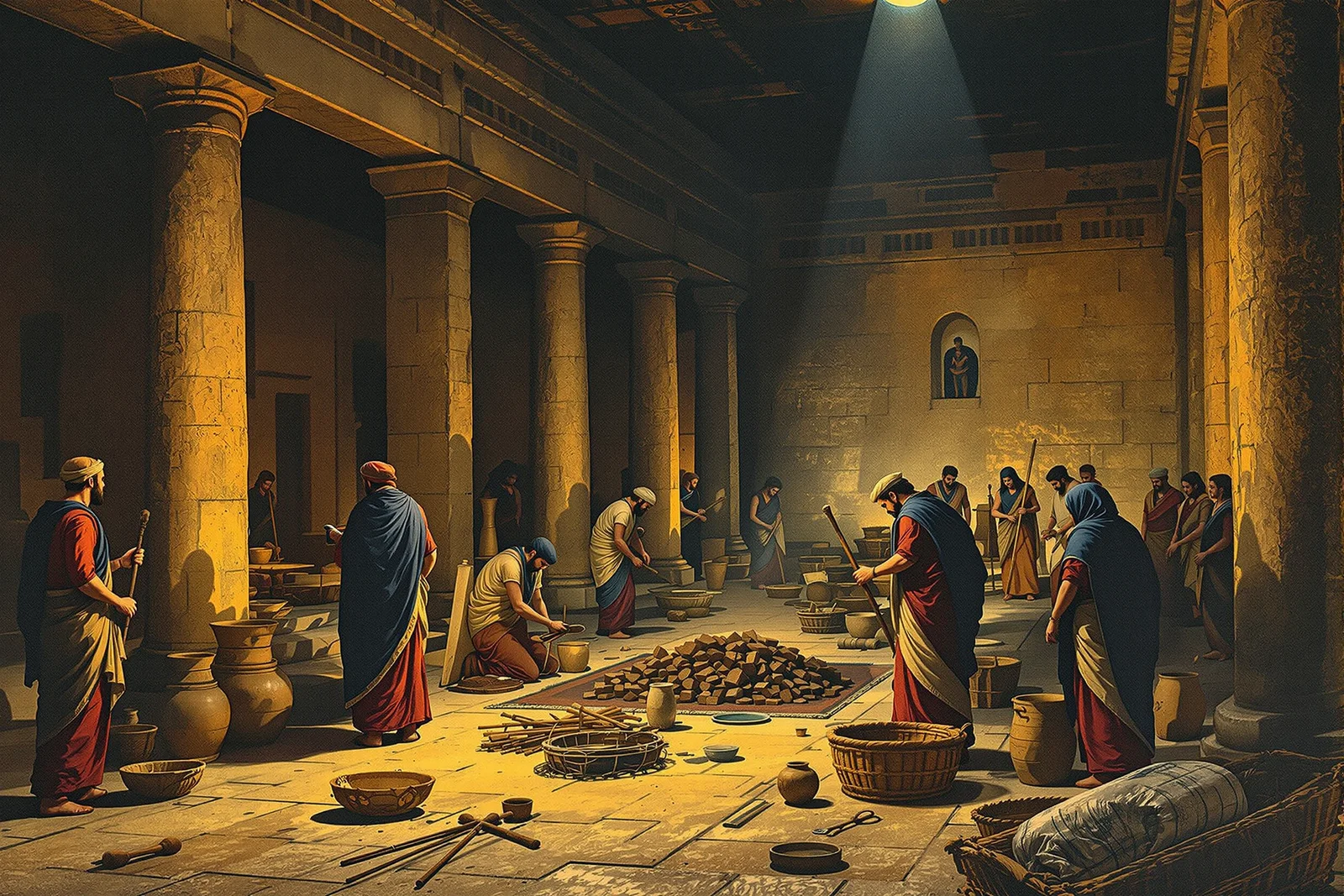
THE ME TABLET · Priesthood Module 786 · nam-iśib
Carrying ME 2 · nam-diĝir · Godship. A Sovereignty Module of the Practitioner Community.
Unaltered and unabridged: ~3,120 words.
Preamble
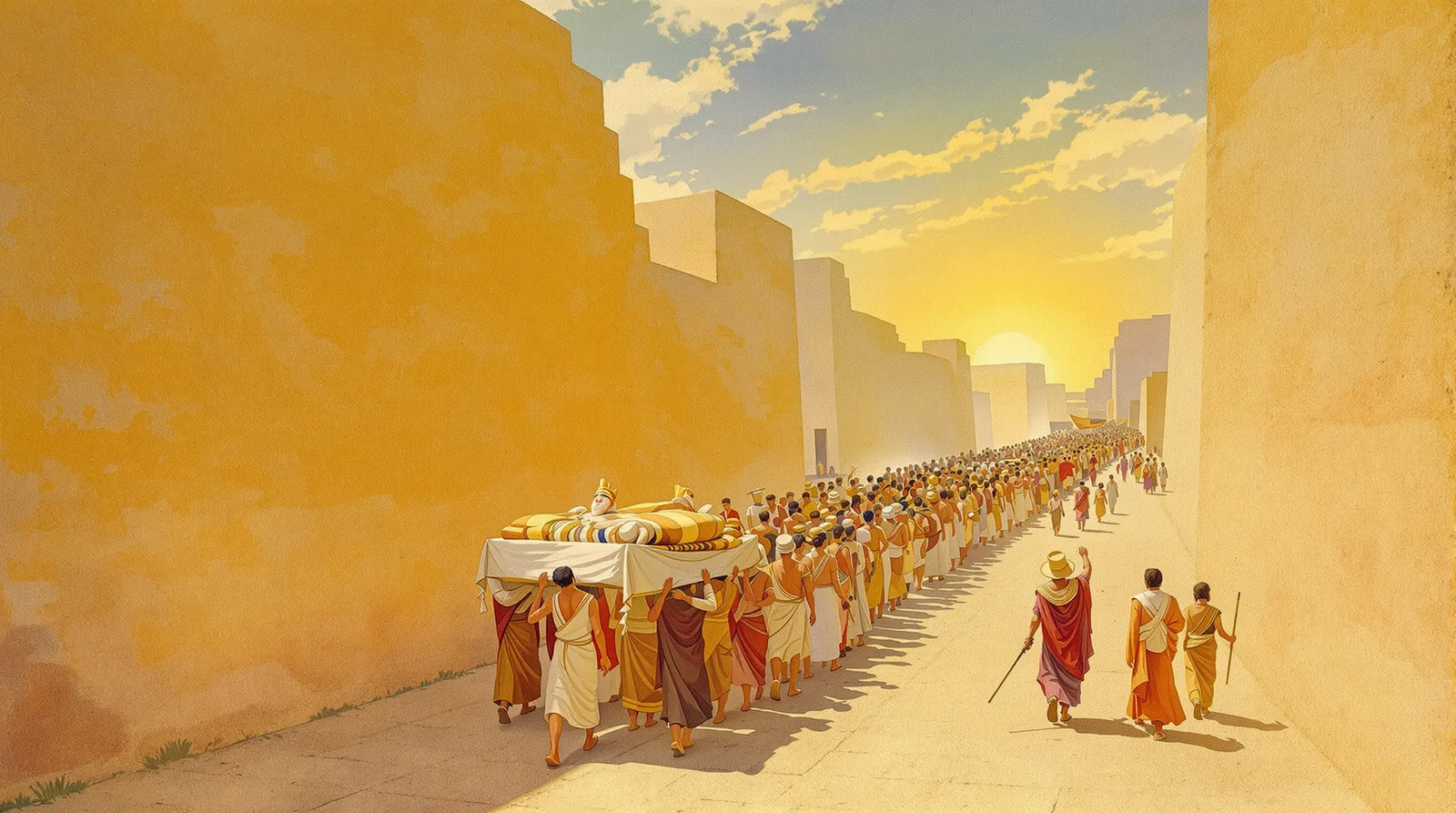
A procession is the oldest way a community has of saying, with its whole moving body, that something is holy. A people gathers, takes up an image or a relic or a sign, and walks it through their shared space along a known route — and in the walking, they make a claim that no static rite can make: this is sacred, this ground is ours, and we move as one people under it. From the great festival processions of Sumer and Babylon, in which the statue of the god was carried in state from temple to temple along a sacred way, to the seasonal processions of nearly every culture that has left a record, the form recurs because it does something no other rite can do. It sanctifies a route. It binds a crowd into a single moving body. It makes a community's faith visible to itself and to all who watch.
This module carries ME 2 · nam-diĝir · Godship — the decree of divine sovereignty, of the holy made manifest — because the procession is, above all, the rite in which a community manifests what it holds sacred by carrying it openly through the world. The Practitioner who completes this module will understand the procession as a universal religious form (its anthropology, its near-universality, what it accomplishes); will be able to design a procession's route, stations, regalia, and music; and — most practically — will be able to organize and safely lead a community procession, for the gravest duty of the one who leads a moving crowd is to bring every person home unharmed.
The parent volume is Vol XVII, The Mystic's Codex; the Ritual Offices supplement catalogues the procession-leader among the sacral offices. The module crosses centrally to Vol XXIII, The Musician's Codex, whose processional-music discipline is the engine of the moving rite — for a procession is, in operational fact, conducted by its drum. It crosses to the threshold offices (Modules 784 and 785) at its stations, where the moving rite pauses at sacred boundaries. The sovereignty stake is communal and visible: a community that can mount its own processions — that can manifest what it holds sacred, in its own streets, led by its own people — does not depend on any outside authority to make its faith public. To lead the procession is to hold the office of the one who moves a whole people, in order and in safety, under the sign of what they hold holy.
Part I — The Procession as a Universal Religious Form
Chapter 1 — Why Communities Walk Their Sacred
The procession is one of the most widely attested of all religious forms, found across cultures that never met, because it answers needs that recur wherever people gather around the sacred. The Practitioner should understand these functions clearly, because the design of a procession follows from what it must accomplish.
A procession manifests the sacred — it carries what is normally hidden in the inner chamber (the image, the relic, the holy sign) openly, so the whole community sees what is held holy. It sanctifies space — by walking a route it claims and blesses that ground as the community's sacred way; many traditions process the bounds of a territory precisely to consecrate them. It binds the community — a crowd that walks together, in step, under one sign is forged into a single moving body, and the shared motion does social work no speech can do. It enacts a journey — many processions retell a sacred story by movement, so the community walks the myth rather than merely hearing it. And it includes by participation — a procession is joined, not watched; to walk in it is to belong to it, which is why the form gathers a whole community as few rites can.
Chapter 2 — The Form Across the Record
The Practitioner reads the comparative record to learn the procession's deep grammar, applying the Codex's accuracy discipline: what follows is sober comparative description of an attested universal form, not a claim that the traditions are interchangeable. The value of the comparison is the structure they share.
Reference Table 786-1 — The processional form across traditions
| Tradition | What is carried | The route | The occasion |
|---|---|---|---|
| Sumer / Babylon | The statue of the god, in state | The sacred way, temple to temple | The great seasonal festivals |
| Pharaonic Egypt | The deity's barque-shrine, on poles | The processional avenue between temples | Festival of the god's visitation |
| Classical world | The cult image, offerings, sacrificial animals | The sacred road to the sanctuary | The civic festival of the god |
| Many living traditions | An image, relic, or sacred sign | A known route through the community's space | Holy days, patronal feasts, harvest |
| Bounds / territory rites | A sign of the community or its blessing | The perimeter of the land or settlement | Affirming and blessing the bounds |
Read the columns. Every procession carries something sacred, along a known route, on a marked occasion, as a participating body — these are the form's invariants. The thing carried makes the sacred manifest; the route sanctifies space and is known in advance; the occasion ties the rite to the community's calendar; and the participating crowd is bound by walking together. The Practitioner who learns the invariants can design a procession for any occasion a community needs, rendering the form in its own images, its own route, and its own calendar.
The Critical Insight: A procession is not a parade. A parade displays; a procession manifests and consecrates. The difference is the sacred thing carried and the sacred work done — the route is not merely traveled but blessed, the crowd is not merely entertained but bound, and the holy sign is not merely shown but made present in the community's midst. The Practitioner who grasps this designs every element — route, stations, regalia, music — to serve the manifestation and the consecration, and never lets the procession decay into mere display. The form's whole power is that the community, by walking, does something sacred together; lose that, and a procession becomes a parade, and the sacred work is undone.
Part II — Designing the Procession
Chapter 3 — The Route and Its Stations
The first design decision is the route, because the route is what the procession sanctifies and what the crowd must traverse together. A processional route is chosen, not improvised: it runs from a meaningful origin (the temple, the shrine, the chamber where the holy thing resides) to a meaningful destination (another shrine, a sacred site, or back to the origin in a circuit), along a path the community knows, can walk, and holds significant. The route should pass the community's sacred and significant places, so that the walking blesses them; it should be of a length the whole community — including the old, the young, and the infirm — can actually walk; and it should return the people to a place where the rite can conclude and disperse safely.
Along the route stand the stations — the appointed places where the procession halts and a fixed rite is performed before it moves on. Stations are the procession's punctuation: they give the moving rite its rhythm, its moments of focus, and its structure. A station might be a sacred boundary (where the keeper of the threshold receives the procession, Module 784), a place of blessing (where the holy thing is held up and the community blessed), a place in the sacred story (where the journey's myth is enacted), or simply a place the community honors. At each station the procession pauses, the moving music resolves into a fixed-form rite (the procession-to-fixed-form transition of Vol XXIII), the station's act is performed, and then the procession takes up the moving music again and walks on. The Practitioner designs the stations as the load-bearing structure of the rite: route plus stations is the procession's score.
Protocol 786-A — Designing a procession's route and stations
- Fix the origin and destination by meaning. Choose a route that runs from a sacred origin to a meaningful destination (or a circuit returning to the origin), so the walking enacts a journey that means something to the community.
- Pass the sacred places. Lay the route to pass the community's shrines, boundaries, and significant sites, so the procession blesses them as it goes — the consecration of space is done by the choosing of the path.
- Size the route to the whole people. Set the length and terrain so the old, the young, and the infirm can walk it; a route only the strong can complete excludes the community the procession exists to bind. Provide for those who cannot walk the whole.
- Appoint the stations. Mark the places where the procession will halt for a fixed rite — boundaries, blessing-places, story-places — and design each station's act: what is done, who performs it, how long it holds.
- Score the moving and the fixed in alternation. Plan the route as moving music between stations and fixed-form rite at each station, the two alternating, so the procession has rhythm and focus (cross Vol XXIII for both forms and the transition between them).
- Plan the conclusion and dispersal. Design how the procession ends — the final station, the last act, and the safe, orderly dispersal of the crowd — before the first step, because a rite that cannot end safely is not yet designed.
Chapter 4 — Regalia: The Sign Made Visible
The regalia of a procession — the sacred thing carried, and everything that adorns and accompanies it — is what makes the manifestation visible, and the Practitioner designs it to be seen, carried, and honored. At the heart is the borne sacred object: the image, the relic, the holy sign, mounted so it can be carried in state — on poles, a litter, a portable shrine, or a barque-frame, as the great traditions carried their gods — high enough to be seen by the whole crowd and stable enough to be carried safely the length of the route. Around it are the accompanying regalia: banners and standards that mark the procession and are visible from afar; canopies and coverings that honor the sacred thing; lights (lamps, torches, candles) that draw the eye and mark the holy object in dim or evening processions; vestments that distinguish the officiants and the bearers; and the carrying-frame itself, which is a real piece of engineering — it must bear the weight, distribute it across enough bearers, and travel the route without failing.
The Practitioner attends to regalia as both meaning and mechanism. As meaning, every element should serve the manifestation — the sacred thing elevated, honored, surrounded by signs of its holiness, made unmistakably the center of the moving rite. As mechanism, every element must work — the frame strong, the poles sound, the bearers sufficient and rehearsed, the lights safe, the banners manageable in wind. A procession is undone as much by a broken litter or an exhausted bearer as by any failure of meaning, and the Practitioner who designs the regalia owns both faces.
Part III — The Music of the Moving Rite
Chapter 5 — The Drum Conducts the Procession
The engine of a procession is its music, and here the module crosses centrally into Vol XXIII, The Musician's Codex, whose processional discipline this chapter applies. The governing fact is physiological and was established in the parent volume: a crowd exposed to a steady pulse falls into step with it — human legs entrain to a beat as surely as pendulums on one beam fall into time. Therefore the drum sets the marching pace, and the drummer is, in operational fact, the conductor of the whole moving rite. A walking pulse of roughly 100 to 120 beats per minute organizes a procession into a single stepping body; the downbeat is the marching foot; and the tempo, once set, must be kept without drift, because a procession that quietly accelerates leaves its tail straggling and its order broken.
The processional music is built for the open air, the moving line, and the long route. It needs carrying power — the loud, far-reaching instruments (the great drum, loud reeds and horns, bells) that can hold a long line together over the noise of a crowd and the open air, where quiet, subtle instruments would be lost. It needs an unambiguous downbeat — a strong, obvious pulse, because anything that blurs the beat blurs the marching foot. And it needs to be indefinitely extensible — a strophic tune or a repeating ostinato that can be poured out for as long as the march lasts and stopped cleanly when the procession arrives, because the music must fit the length of the route, which the composer does not control. Ornament and subtlety are wasted on the moving line and may even harm it.
Protocol 786-B — Scoring and leading the procession's music
- Set the walking pulse first. Fix the tempo at a true walking pace (roughly 100–120 BPM) and assign it to the steadiest drummer in the community, who becomes the procession's conductor and timekeeper (cross Vol XXIII).
- Build on carrying instruments. Score for the great drum, loud reeds and horns, and bells — the instruments that reach the last person in a long line in the open air. Reserve the quiet instruments for the fixed-form rites at the stations.
- Make the downbeat unmistakable. Keep the pulse strong and obvious; strip ornament that would blur it. The crowd marches to the downbeat, so the downbeat must never be in doubt.
- Write it extensible and stoppable. Build the processional music as a repeating, indefinitely extensible form that can fill the whole route and be brought to a clean stop on arrival, so the music fits the route's length and ends cleanly.
- Hold the tempo against drift. Charge the lead drummer above all else to keep the tempo steady — neither accelerating with excitement nor dragging with fatigue — because drift breaks the line. The steadiest pulse holds the longest line.
- Resolve into the station, and take up again. At each station, resolve the loud moving music into the quiet fixed-form rite of the halt; when the station's act is done, take up the moving music again to walk on (the procession-to-fixed-form transition, Vol XXIII).
Your Commitment: You will treat the lead drummer as the conductor of the entire procession and the keeper of its safety alike, because the one who holds the pulse holds the pace of the whole moving crowd — and a steady, kept tempo is not only good music but good order, holding the long line together and bringing it home unbroken.
Part IV — Leading the Procession Safely
Chapter 6 — The Leader's Gravest Duty
The Practitioner who leads a procession holds a moving crowd, and a moving crowd is, beyond all the rite's meaning, a safety responsibility of the first order. The gravest duty of the one who leads is not liturgical; it is to bring every person who walks home unharmed. Large moving crowds carry real and well-understood dangers — crushing where the route narrows or where the crowd is dense, falls and injuries among the old and the young, exhaustion and heat over a long route, and panic if anything goes wrong. The history of mass gatherings is, in part, a history of these dangers realized when they were not planned for. The Practitioner therefore designs and leads the procession with crowd safety as a primary, non-negotiable concern, equal in weight to the rite itself.
This is a domain where the Practitioner respects the limits of the office and plans within them. A procession of any real size should be planned in consultation with those whose competence is crowd safety, the route assessed for its hazards, and provision made for the foreseeable — for medical need, for the infirm, for heat and thirst, for the management of dense points. Where a procession would be large enough that its safety exceeds what the community itself can competently manage, the Practitioner draws in the proper help rather than proceeding on faith. The rite's holiness is no protection against a crush; the sacred thing carried does not steady a stampede. Reverence and prudence are not in tension here — the leader who plans for safety honors the community more, not less, because the leader returns it whole.
Protocol 786-C — Organizing and leading a community procession safely
- Assess the route for hazard. Walk the route in advance and mark its dangers — narrowings and pinch-points where a crowd can crush, uneven ground where the infirm may fall, exposed stretches where heat or cold will tell, places where the line may bunch. Design around the hazards or change the route.
- Plan for the foreseeable. Provide for water and rest on a long route; for the old, the young, and the infirm (a way to join without walking the whole, a place to rest, help at hand); for medical need; and for weather. Plan the conclusion and the safe dispersal of the crowd before the first step.
- Set the pace for the slowest, not the strongest. Hold the walking tempo (Protocol 786-B) to a pace the whole people can sustain, so the procession does not tear into a fast front and a straggling, distressed tail. The kept pulse is a safety instrument.
- Station marshals along the line. Appoint people, spread along the procession, whose task is order and safety — easing pinch-points, watching for distress, keeping the line together, and able to halt the whole if something goes wrong. The leader cannot see the whole line alone.
- Keep a means to stop and to communicate. Arrange how the procession can be halted in an emergency and how word passes up and down the line, so a problem at the rear reaches the front and the whole can be stopped in order. A procession that cannot be stopped safely is not safe to start.
- Draw in proper help for size. Where the procession's size makes its safety exceed the community's own competence, plan it with those whose office is crowd safety, and do not let the rite's importance override the duty of care. Bring everyone home; that is the leader's first success.
Chapter 7 — The Office of the One Who Leads
The one who leads the procession holds a double office, and must hold both at once. The leader is the liturgist of the moving rite — the one who designs the route and stations, who governs the regalia and the manifestation of the sacred, who carries the meaning of the journey and sees that the sacred work is done. And the leader is the shepherd of a moving crowd — the one responsible, above all, for the order and the safety of every person who walks. The two offices are not in conflict; they are the same care, expressed toward the sacred thing carried and toward the people who carry it. The leader who serves only the meaning and neglects the safety has failed the people; the leader who serves only the order and loses the manifestation has failed the rite. The Practitioner holds both: the procession is sacred, and every person comes home.
The Critical Insight: To lead a procession is to move a whole people, under the sign of what they hold holy, through their shared world — and to do it so that the sacred is manifested, the route is consecrated, the community is bound, and every soul is brought home unharmed. This is the fullest expression of the priesthood's public office: the holy made visible in the community's own streets, led by the community's own people, in their own order and their own safety. A community that can mount and safely lead its own processions manifests its faith without depending on any outside authority to make it public — and brings its whole people home. To lead the procession well is to hold both the meaning and the people in one steady hand, walking under the sign of the holy at a pace the whole community can keep.
PLATES — Supplemental Gallery
Art direction
Art direction
Art direction
Art direction
Council Approval — The Twelve Voices Speak
| Disciple | Verdict | Reasoning |
|---|---|---|
| Peter | APPROVED | "It carries the holy into the open and walks a whole people under it — and brings them home. That is the rock." |
| Thomas | APPROVED | "I doubted a crowd could be made one body by walking; the entrainment of the pulse showed me the mechanism." |
| John | APPROVED | "The leader who sets the pace for the weakest, not the strongest, loves the whole people. None is left straggling." |
| Matthew | APPROVED | "Route, stations, regalia, music — every element reckoned and scored. A scribe could hand this to a stranger." |
| James the Greater | APPROVED | "The drummer conducts the moving rite and the marshals hold the line. That is command of a crowd, done rightly." |
| Andrew | APPROVED | "A procession is joined, not watched — it gathers the whole community by the simple act of walking together." |
| Philip | APPROVED | "Show me how to lead it safely, and the protocols answer hazard by hazard. The duty of care is not left to vapour." |
| Bartholomew | APPROVED | "No false claim: it says only that a moving crowd does sacred work and carries real danger, and plans honestly for both." |
| James the Lesser | APPROVED | "Humble and exact — it draws in proper help when the crowd exceeds the community's own competence. The proud would not." |
| Simon the Zealot | APPROVED | "To manifest the sacred in the community's own streets, led by its own people, is sovereignty made visible." |
| Judas Thaddaeus | APPROVED | "Its gravest charge is to bring every soul home unharmed — the leader is shepherd as much as liturgist. None is abandoned." |
| Matthias | APPROVED | "It takes its place in the canon cleanly, carrying ME 2 and pointing home to Vol XVII and Vol XXIII. The lot falls true." |
Council Verdict: 12/12 APPROVED. This module is canon.
Let the holy be carried into the open, the people walk as one, and every soul be brought home.
TRANSMISSION RECORD
Transmission COMPLETE — unaltered & unabridged Module 786 · Lead the Procession · category: priesthood Carries ME 2 · nam-diĝir · Godship Words ~3,120 SHA-256 of source text fb65dfbae92b705d5960928c8d368c432aff1038ae6eeaa6a2b50a9f292f0c77 Canonical text lead-the-procession.md — byte-identical to what this page renders