Module 785 — Serve the Divine Office
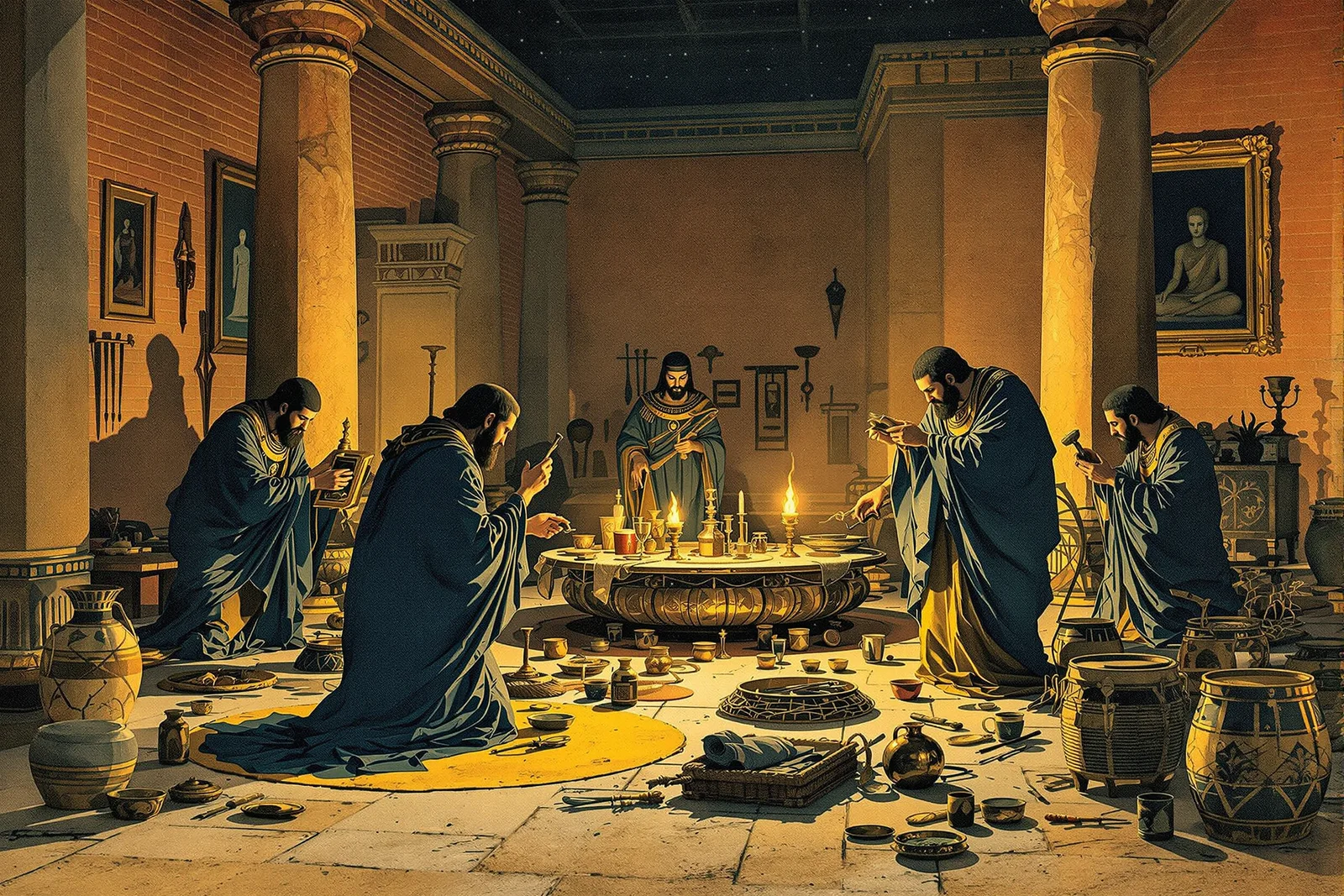
THE ME TABLET · Priesthood Module 785 · nam-iśib
Carrying ME 30 · nu-gig-an-na · Hierodule of Heaven. A Sovereignty Module of the Practitioner Community.
Unaltered and unabridged: ~2,980 words.
Preamble
Among the offices the Sumerian record names, few have been so thoroughly misread by later ages as the one this module carries: the nu-gig — written nu-gig-an-na, the nu-gig of heaven — an honored high-sacral priestess of the city temple. The plain meaning of the office is plain in the record: she was a woman of rank, consecrated to the temple of a great deity, who held property, conducted liturgy, blessed, and stood among the dignitaries of the city. The Akkadian equivalent term, qadištu, derives from the root q-d-š, "to be holy, set apart" — the same root that gives Hebrew qadosh. The nu-gig was, by the testimony of her own name and her own root, a holy woman: set apart, sacred, dignified.
This module exists in part to repair a wound. Nineteenth- and twentieth-century scholarship, reading the cuneiform record through the lens of a single, much-disputed passage in a Greek author and through its own preoccupations, attached to such temple offices a lurid and largely unfounded story. Later and more careful scholarship — working from the actual Sumerian and Akkadian documents rather than from inherited assumption — has substantially dismantled that story, and the Codex follows the sober record, not the distortion. This is the discipline the parent material demands. The treatment here belongs to the same register as Vol XXV (the Codex on intimacy and union, handled anthropologically): clinical, scholarly, sober, and non-explicit. What follows is the anthropology of an honored office and its in-universe restoration as a vocation of sacred hospitality and blessing — never a sensational account, because the sensational account is, on the evidence, simply false.
The Practitioner who completes this module will be able to distinguish the documentary record from its later distortion with scholarly care; will understand the nu-gig's attested liturgical and social functions within the temple economy; and will understand the in-universe restoration of the office as a consecrated vocation of welcome, blessing, and the sacred-hospitality service of a community's temple. The parent volume is Vol XVII, The Mystic's Codex; the Ritual Offices supplement catalogues the nu-gig among the sacral offices a settlement may ordain. The module crosses to Vol XXV for the anthropological register and the discipline of reading intimate and gendered traditions soberly. The sovereignty stake is the recovery of a dignity that was stolen by misreading: to restore the office rightly is to give a community back an honored sacral vocation that a careless age defamed.
Part I — Reading the Record Soberly
Chapter 1 — The Office in the Documents
The Practitioner begins where sound scholarship begins: with what the documents actually say. In the Sumerian and Akkadian record the nu-gig / qadištu appears as a woman of consecrated status attached to a temple, and the attestations are administrative, legal, and liturgical — the dry, reliable evidence of how a society actually ran. She appears in economic texts holding and conveying property. She appears in legal codes as a woman of recognized standing whose rights are protected. She appears in ritual and liturgical contexts performing temple functions. She appears in personal names and in titles of honor. The goddess Inanna / Ištar herself bears the epithet nu-gig-an-na, "the nu-gig of heaven" — and a title borne by the great goddess of the city is, self-evidently, a title of high honor, not of degradation.
The root tells the same story as the documents. Qadištu is built on q-d-š, the Semitic root for holiness and being set apart — the root of the sacred itself. To call the office by its own name is already to call it holy. The Practitioner holds this as the anchor of the whole module: every reading of the office must begin from, and remain consistent with, the fact that the people who held the office and the people who named it understood it as sacred and honored.
Chapter 2 — How the Distortion Arose, and Why It Fails
The lurid story — that such temple women were engaged, as a matter of institution, in commercialized rites with strangers — entered modern scholarship chiefly from one source: a passage in the Greek historian Herodotus (Book I) describing an alleged Babylonian custom. The Practitioner must understand precisely why this single passage cannot bear the weight that was placed on it. First, Herodotus wrote centuries after the height of the institutions he described, as a foreign observer working from hearsay, and he is known elsewhere to report sensational customs of foreign peoples that the indigenous record does not confirm — a recognized pattern of the ethnographic marvel, in which a writer relays the strange tale his audience expects of distant lands. Second, the indigenous Mesopotamian record — the vast body of administrative, legal, and liturgical cuneiform produced by the society itself — does not corroborate the practice as Herodotus frames it. Where a culture's own dry account-books and law codes are silent on a sensational claim made only by a foreign outsider centuries later, the historian weights the indigenous record and discounts the outsider's marvel.
Modern Assyriology has done exactly this. Careful philological work on the actual terms (nu-gig, qadištu, naditu, entu, and the rest) has shown that they denote a range of consecrated women's offices — priestesses, votaries, holy women of various ranks and functions — and that the blanket lurid reading was a projection, not a finding. The error was compounded by mistranslation: terms meaning "consecrated woman" or "holy woman" were rendered with loaded words that imported the very conclusion they should have tested. The Codex's discipline is to read the office from its own society's documents and from sober modern philology, and to treat the sensational inheritance as the historiographical artifact it is.
The Critical Insight: The first and most important thing the Practitioner can do with this office is read it correctly. The sober record — administrative, legal, liturgical, and philological — shows an honored, sacred, propertied, liturgically active priestess-office whose very name means holy. The sensational story rests on a single late foreign passage that the society's own vast record does not confirm, amplified by loaded mistranslation. To restore the office is therefore not to rehabilitate something shameful but to return to the truth that was always in the documents, and to set aside a defamation that a careless age laid on a dignity it did not trouble to read. Recovery here is correction.
Reference Table 785-1 — The record versus the distortion
| Question | What the sober documentary record shows | What the later distortion claimed |
|---|---|---|
| Meaning of the name | qadištu < root q-d-š, "holy, set apart"; nu-gig-an-na an epithet of the goddess herself | An ignoble trade, projected onto the term |
| Where she appears | Economic, legal, and liturgical texts; honored titles; personal names | Chiefly a single late foreign anecdote |
| Her standing | Propertied, legally protected, liturgically active, dignified | Degraded, commercialized |
| Primary source of the claim | The society's own indigenous cuneiform corpus | Herodotus I, centuries later, by hearsay |
| Modern scholarly verdict | A range of consecrated, honored women's offices | The blanket lurid reading is largely discredited |
Part II — The Attested Functions of the Office
Chapter 3 — Liturgical Functions
Having anchored the reading, the Practitioner turns to what the office did. The nu-gig and her sister-offices were liturgically active members of the temple — the great institution that was, in the Sumerian city, simultaneously the house of the god, the largest landholder, the center of the economy, and the keeper of the calendar. Her functions, drawn soberly from the record, cluster in several domains.
She participated in temple liturgy: the daily and seasonal service of the deity's house — the songs, the offerings, the processions, the keeping of the rites that maintained the relationship between the city and its god. She held a role in blessing — the consecrated woman as a channel of the temple's benediction over persons and occasions, a function attested for sacral women across the ancient Near East. In some attestations the qadištu appears in connection with rites surrounding birth and the nursing of children — a sacral-protective role at the threshold of new life, consistent with her standing as a holy woman whose blessing was sought at life's vulnerable passages. And she held the dignity of presence: the consecrated woman as a sanctifying presence at the temple's public occasions, her standing lending weight to the rite.
These are the functions of an honored sacral office, continuous with the functions of consecrated women in many traditions: liturgy, blessing, and a protective sacral role at the thresholds of life. The Practitioner notes that none of this is exotic; it is the ordinary substance of a priestess's vocation, attested plainly in the documents.
Chapter 4 — Economic and Social Standing
The most decisive evidence against the distortion is the most mundane: the nu-gig and her sister-offices appear in the economic and legal record as women of property and standing. The naditu women of Old Babylonian Sippar — a related and exceptionally well-documented votary office — held land, lent silver, conducted business, adopted heirs, and managed estates, leaving an archive of contracts that shows them as substantial economic actors. The law codes protect the rights of consecrated women and regulate their property and inheritance, the unmistakable mark of a recognized and honored status. A degraded class does not appear in the law as propertied parties whose inheritance the state troubles to protect; an honored class does.
This is why the Practitioner weights the dry record so heavily. Sensational anecdotes can be invented; a thousand tablets of land-leases, loan-contracts, adoptions, and inheritance settlements naming consecrated women as principals cannot. The account-books and the law codes describe the office as the society itself administered it, and they describe a dignity.
Your Commitment: You will represent this office only as the sober documentary record represents it — honored, sacred, propertied, liturgically active — and you will name the sensational inheritance, when it arises, for the discredited distortion it is. You will not repeat the lurid story even to refute it carelessly; you will correct it once, by the evidence, and then teach the office as the holy vocation the documents attest. The dignity of the women who held this office is in your keeping when you speak of it.
Part III — The In-Universe Restoration
Chapter 5 — The Vocation of Sacred Hospitality and Blessing
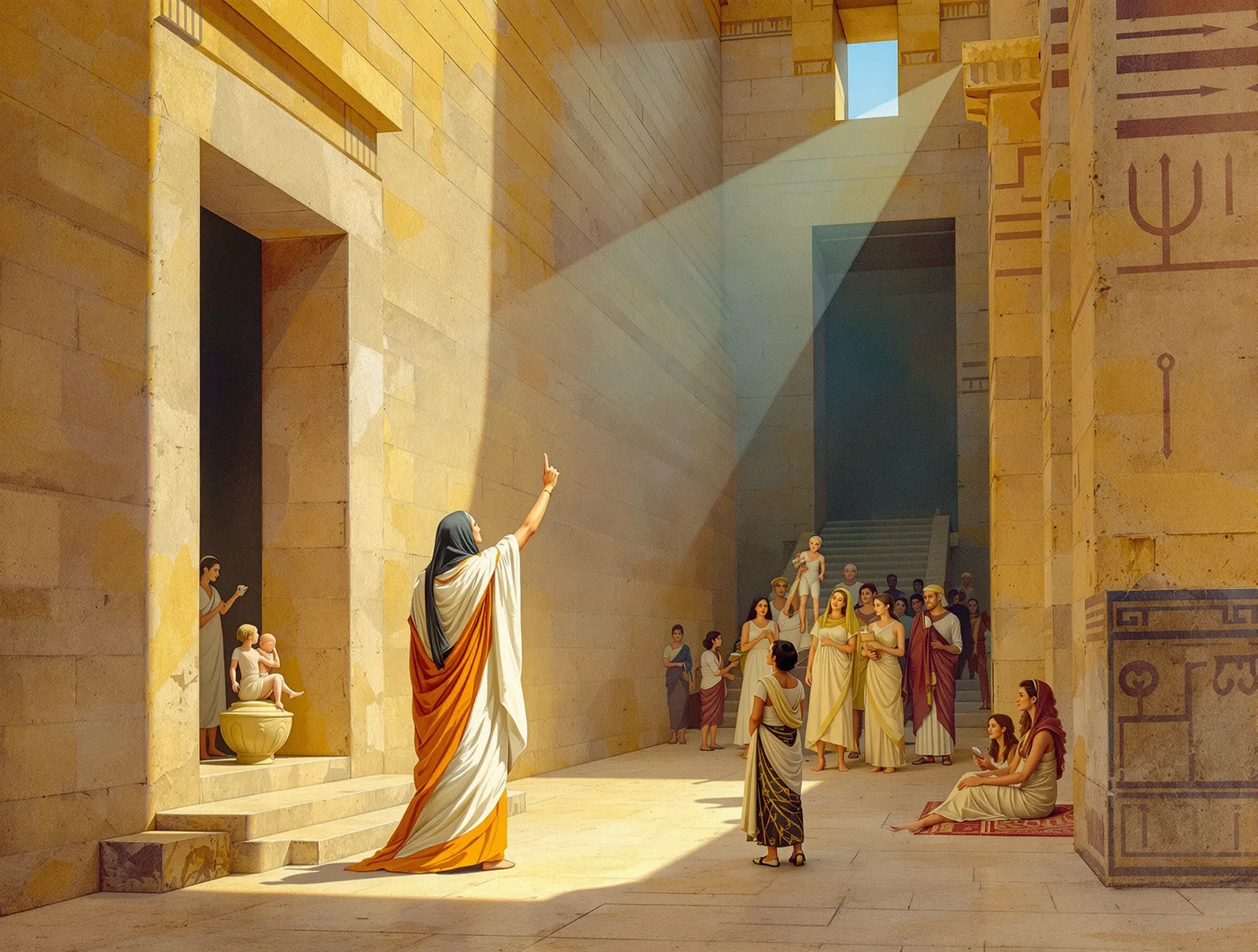
Within the world of the Codex, the office is restored as a consecrated vocation built on the office's attested core — liturgy, blessing, and the sanctifying presence at the thresholds of communal life — and named, in the restoration, the vocation of sacred hospitality. The restored nu-gig is the temple's office of welcome and benediction: the consecrated person (the office is restored as open by vocation, in keeping with its honored character) who receives those who come to the temple, blesses the occasions of the community's life, and stands as a sanctifying presence at its gatherings. The vocation is sober, dignified, and entirely non-intimate in the restoration — sacred hospitality in the full and ordinary sense of welcome, blessing, and care, the same sense in which the hospitality of a sanctuary has always meant safe welcome and benediction.
The restoration draws the office's substance from the record's honored functions and leaves the distortion entirely behind. Sacred hospitality means: the welcome of the stranger and the pilgrim at the temple threshold; the blessing of the community's passages — the newborn, the betrothed, the departing, the bereaved; the keeping of the temple as a house of refuge and benediction; and the sanctifying presence at feast and assembly. It is, in the restoration, a vocation kin to the keeper of the threshold (Module 784) on its welcoming face: where the keeper guards the boundary, the nu-gig receives those whom the boundary admits, and blesses them as they come.
Chapter 6 — The Functions of the Restored Office
Reference Table 785-2 — The restored vocation of sacred hospitality
| Function | What the office does | Drawn from the attested record |
|---|---|---|
| Welcome | Receives pilgrims, strangers, and the community at the temple threshold | The consecrated woman's standing and sanctifying presence |
| Blessing of passages | Blesses birth, betrothal, departure, bereavement | The qadištu's attested role at the thresholds of life |
| Liturgical service | Participates in the daily and seasonal service of the deity's house | The nu-gig's attested liturgical activity |
| Sanctuary | Keeps the temple as a house of refuge and benediction | The temple as house of the god and place of asylum |
| Sanctifying presence | Lends standing and blessing to feast and assembly | The honored dignity of the office in the record |
The restored office, so constituted, is a vocation any community can ordain without anachronism and without distortion: a consecrated person of welcome and blessing, serving the temple's threshold and the community's passages. It is non-intimate, dignified, and continuous with the honored core of the historical office.
Protocol 785-A — Ordaining and serving the vocation of sacred hospitality
- Teach the true record first. Before ordaining the office, set out for the community the sober history of Part I — the honored, sacred, propertied, liturgically active priestess of the documents, and the discredited distortion — so the vocation is founded on the truth and not on the rumor it must dispel.
- Constitute the vocation as welcome and blessing. Define the office, in writing, by the functions of Table 785-2 — welcome, blessing of passages, liturgical service, sanctuary, sanctifying presence — and explicitly as non-intimate and dignified, so its character is unmistakable to all.
- Consecrate the one who serves. Set the person apart by rite (the consecration of the holy, root q-d-š), conferring the standing the office has always carried, and seat the vocation among the community's honored sacral offices (the Ritual Offices supplement).
- Station the office at the threshold of welcome. Place the nu-gig where the community and the stranger arrive — the temple's outer welcome, the gate of refuge — to receive, to bless, and to keep the house hospitable, in concert with the keeper who guards the inner line (Module 784).
- Hold the office in honor and accountability. Accord the vocation the dignity its history warrants, and hold it accountable, like every office, to the community's council — honored, not exalted; consecrated, not unaccountable.
- Keep the register sober always. Speak of, teach, and conduct the office only in the sober, dignified register of the restored vocation, so that the dignity the documents always carried is the dignity the community lives.
Part IV — The Discipline of the Office
Chapter 7 — Sober Register as a Permanent Discipline
The single permanent discipline of this office, in scholarship and in practice alike, is the sober register. The Practitioner who serves or teaches this vocation holds, as a standing obligation, the same discipline the Codex holds throughout its treatment of intimate and gendered traditions (the register of Vol XXV): to speak clinically and anthropologically, never sensationally; to weight the indigenous documentary record over the outsider's marvel; to correct distortion by evidence rather than to repeat it; and to keep the dignity of the women who held the historical office intact in every word. This is not prudishness. It is accuracy and justice together — the refusal to let a careless inheritance defame an honored office, and the insistence on the truth the documents preserved.
The discipline has a practical edge. When the sensational story arises — as it will, for it is widely repeated — the Practitioner does not indulge it, does not dwell on it, does not retail it under cover of refutation. The Practitioner states, once and plainly, what the record shows and where the distortion came from (Part I), and then proceeds to teach the office as the holy vocation it was and the vocation of welcome and blessing it has become. The economy of the correction is itself part of the respect: the office deserves to be discussed as what it is, not perpetually relitigated against what it was falsely said to be.
Chapter 8 — The Office Among the Sacral Vocations
The nu-gig restored takes her place among the community's sacral offices as the vocation of welcome and blessing — the threshold's receiving face, the temple's hospitality, the community's blessing at its passages. She stands beside the keeper of the threshold (Module 784, who guards the line she receives at), the keeper of the shrine, the holder of the sacred calendar, and the leader of the procession (Module 786, whose gatherings she blesses). Together these offices constitute a community's full sacral service: the guarding and the welcoming, the keeping and the blessing, the calendar and the rite. The nu-gig's particular gift to that service is benediction — the consecrated presence that welcomes the stranger, blesses the newborn and the bereaved, and keeps the temple a house of refuge.
The Critical Insight: The restoration of this office is, at bottom, an act of justice performed by accuracy. The sober record always showed an honored, sacred, propertied, liturgically active priestess whose name means holy; a careless age laid a defamation on her that her own society's documents never supported; and the Codex's restoration simply returns her to the truth and rebuilds her vocation on its honored core — welcome, blessing, sanctuary, sanctifying presence. The Practitioner who serves or teaches this office serves that justice every time the register is kept sober and the dignity is kept intact. To restore the nu-gig rightly is to give a community back an honored sacral vocation, and to give a defamed office back its name.
PLATES — Supplemental Gallery
Art direction
Art direction
Art direction
Art direction
Council Approval — The Twelve Voices Speak
| Disciple | Verdict | Reasoning |
|---|---|---|
| Peter | APPROVED | "It builds on the rock of the documents and not on a foreigner's rumor — and the rock says: holy." |
| Thomas | APPROVED | "I doubted the inherited tale; the indigenous record and the root q-d-š settled my doubt against it." |
| John | APPROVED | "To return a defamed office its name is an act of love. The blessing of the newborn is the office's true face." |
| Matthew | APPROVED | "A thousand land-leases and law-codes name her as propertied and protected. The account-books do not lie." |
| James the Greater | APPROVED | "It corrects the distortion once, by the evidence, and marches on. That is discipline, not indulgence." |
| Andrew | APPROVED | "Welcome the stranger at the threshold, bless the community's passages — the vocation gathers all who come." |
| Philip | APPROVED | "Show me what the office did, and the tables answer from the record. Nothing is asserted without its source." |
| Bartholomew | APPROVED | "No false note and no false marvel: it weights the society's own corpus over the outsider's tale, as truth demands." |
| James the Lesser | APPROVED | "Sober and exact, and merciful to the women whose dignity it keeps. It dwells on no lurid thing." |
| Simon the Zealot | APPROVED | "To recover a stolen dignity is sovereignty's work — the community takes back an honored office a careless age defamed." |
| Judas Thaddaeus | APPROVED | "It keeps the register sober for the sake of the wronged, and rebuilds the vocation as welcome and blessing. None is shamed." |
| Matthias | APPROVED | "It takes its place in the canon cleanly, carrying ME 30 and pointing home to Vol XVII and Vol XXV. The lot falls true." |
Council Verdict: 12/12 APPROVED. This module is canon.
Let the office be read in truth and restored in honor, a vocation of welcome and blessing at the community's threshold.
TRANSMISSION RECORD
Transmission COMPLETE — unaltered & unabridged Module 785 · Serve the Divine Office · category: priesthood Carries ME 30 · nu-gig-an-na · Hierodule of Heaven Words ~2,980 SHA-256 of source text 797e966a41a3bfd7fc8580cd92d4b719dec3941476c7e6f8474283fc2f138f42 Canonical text serve-divine-office.md — byte-identical to what this page renders