Module 784 — Keep the Threshold
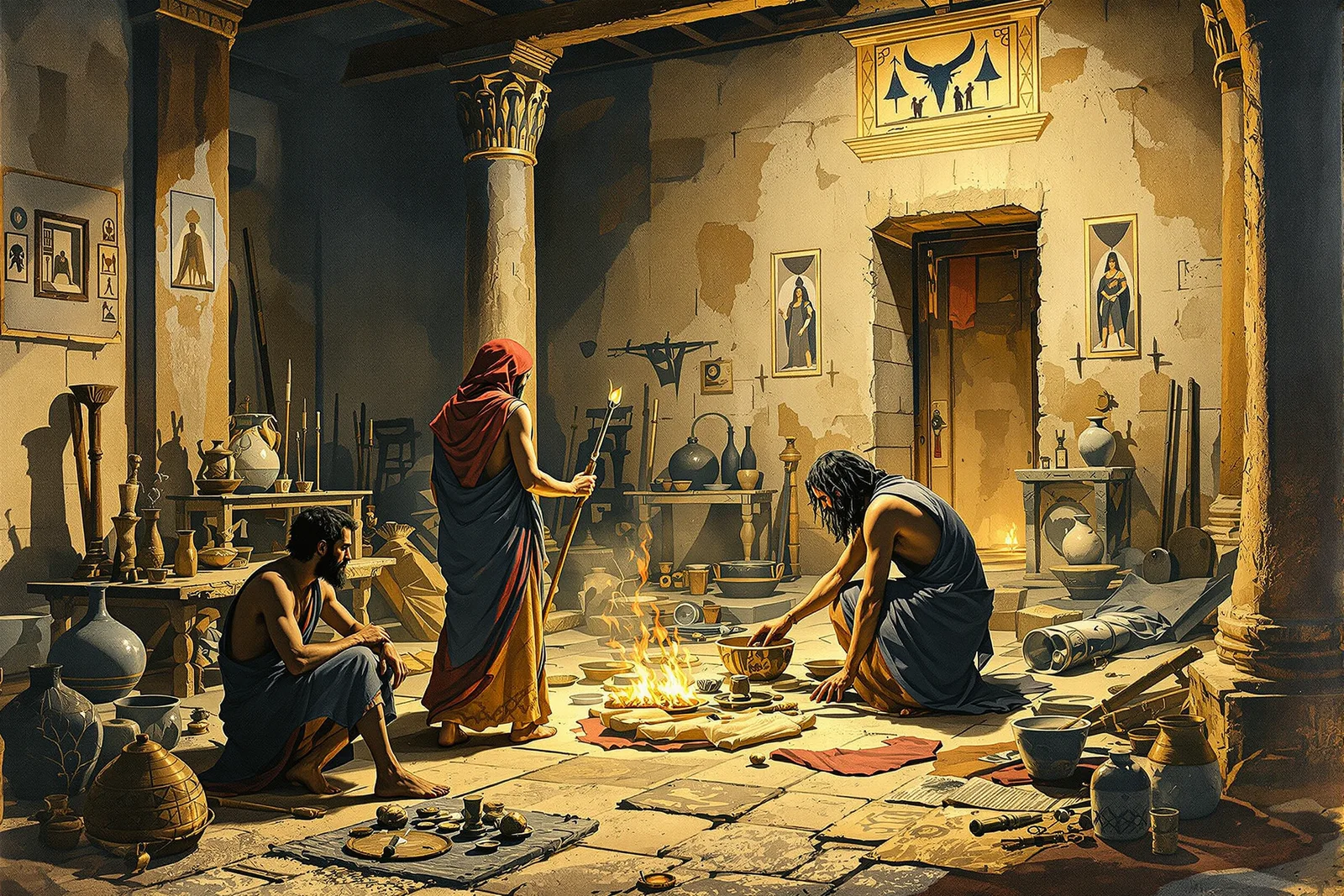
THE ME TABLET · Priesthood Module 784 · nam-iśib
Carrying ME 29 · ĝipar · The Sacred Chamber. A Sovereignty Module of the Practitioner Community.
Unaltered and unabridged: ~3,090 words.
Preamble
Every community that has ever endured has kept one room it does not use for ordinary things. It may be a cave mouth, a curtained recess, a cella behind a temple's outer court, a grove at the edge of the fields — but it is always set apart, always entered by few, always crossed by a line that means something. The technical name for that line is the threshold, and the technical name for what lies beyond it is the sacred chamber: in the Sumerian record, the ĝipar — the inner sanctum, the residence of the deity and of the high priestess, the most protected interior a settlement possessed. To keep the threshold is to hold the office of the one who designs that chamber, guards its boundary, and governs who and what may pass.
This is not decoration and it is not superstition. It is one of the most precisely engineered social technologies the old world produced, and it rests on a real and universal fact about human experience: that crossing a marked boundary changes a person's state. The anthropologist Arnold van Gennep named this in 1909 — the rite of passage, with its three phases of separation, liminality, and reincorporation — and Victor Turner deepened it: the threshold (Latin limen) is the in-between place where a person is no longer what they were and not yet what they will become, and it is exactly there that transformation can occur. The sacred chamber is the architecture built to hold that betweenness. The Practitioner who completes this module will understand the anthropology and the physics of the threshold; will be able to read, repair, or design a community's inner sanctum; and will be fit to keep its boundary — to govern passage in and out so that the chamber does the social work only a protected interior can do.
The parent volume — Vol XVII, The Mystic's Codex — gives the contemplative interior, the disciplines of attention and stillness that the chamber exists to shelter; the Ritual Offices supplement of Vol XVII catalogues the keeper among the sacral offices a settlement ordains. This module crosses to Vol VI, The Builder's Codex, for the physical construction of a protected inner room (foundation, enclosure, controlled approach), and to Vol XIX, The Sovereign's Codex, for the governance of access — who decides who may cross, and how that authority is kept clean. The sovereignty stake is plain: a community whose holiest interior is designed, built, and guarded by an outside authority has surrendered its own center. To keep the threshold is to hold, in your own settlement, the line that makes an inside.
Part I — The Anthropology of the Threshold
Chapter 1 — Separation, Liminality, Reincorporation
The single most important idea in this module is not architectural. It is the recognition that human beings do not change status gradually and invisibly; they change it by crossing, and the crossing must be staged. Van Gennep's analysis of rites of passage across hundreds of cultures found the same three-part skeleton everywhere, because the same human transitions recur everywhere and select for the same structure.
The first phase is separation (the preliminal): the person is detached from their former condition and from ordinary social space. They leave the village, remove ordinary dress, fast, fall silent — they are cut loose. The second phase is liminality (the liminal, from limen, threshold): the person is between, in a place and time that belongs to neither the old state nor the new. Here ordinary rules are suspended; the person is, in Turner's words, "betwixt and between," structurally invisible, neither one thing nor the other. The third phase is reincorporation (the postliminal): the person re-enters ordinary society in the new status, and is received.
The sacred chamber is the architecture of the middle phase. It is the room built to hold liminality — to give the betweenness a floor and four walls and a guarded door, so that what is dangerous and transformative about the in-between state can be contained and survived. The threshold is the boundary that separates ordinary space (where one is one's ordinary self) from liminal space (where one is unmade and may be remade). This is why thresholds are treated, across nearly every culture, with extraordinary care: stepped over rather than trodden, marked with paint or salt or carved guardians, never crossed casually. The threshold is the most charged line in the built world because it is where states change.
Chapter 2 — Why the Boundary Must Be Real
A liminal space only works if its boundary is genuinely maintained. The power of the chamber to transform comes entirely from its being set apart — from the fact that crossing in is a real departure from the ordinary and crossing out is a real return. Where the boundary is blurred, where anyone wanders in and out and the room is used for ordinary purposes between rites, the chamber loses its capacity to do liminal work and becomes merely a room. The keeper's first office, therefore, is the integrity of the line.
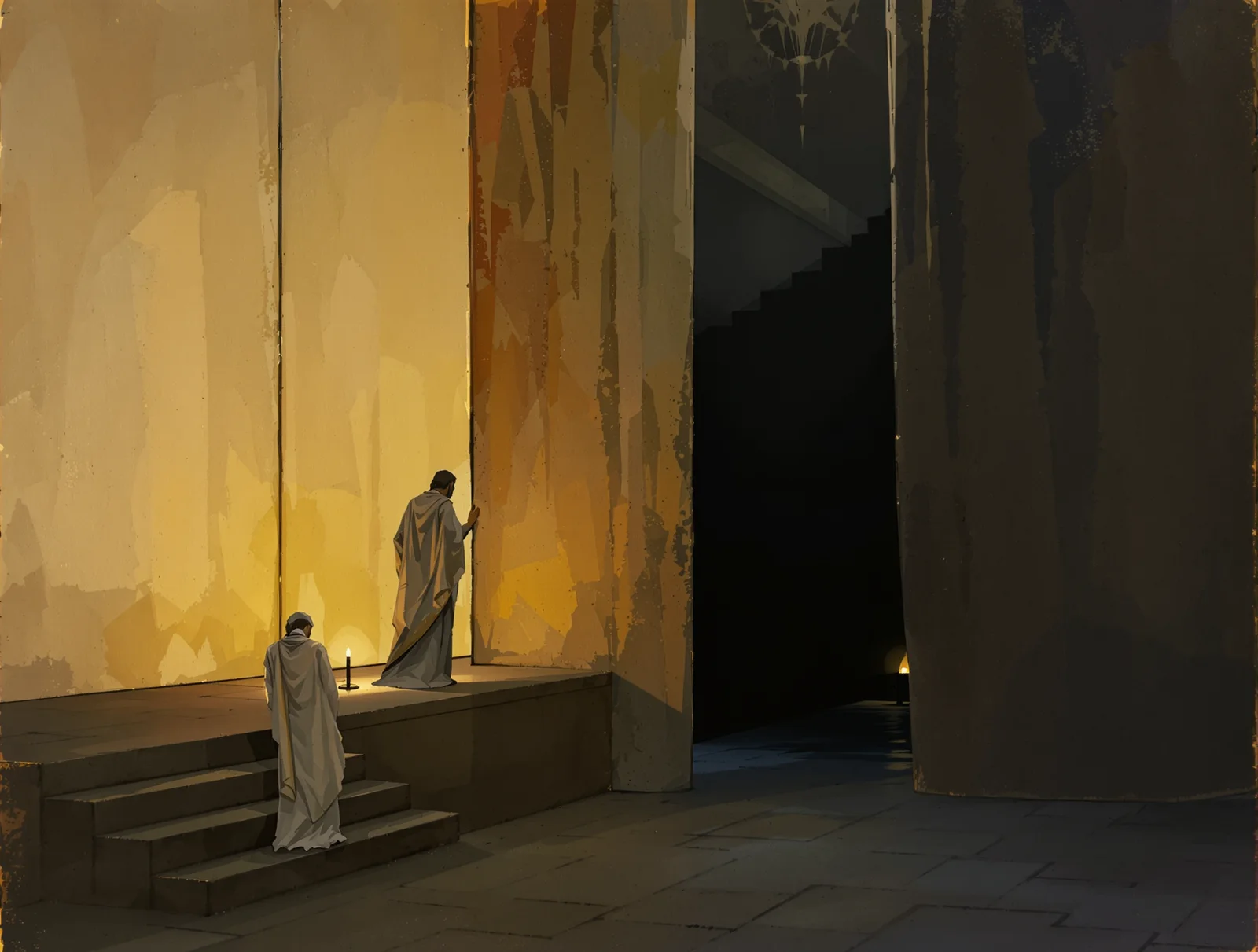
This is also why the old chambers were graded — why one passed through outer courts, then inner courts, then antechambers, before reaching the cella at the heart. Each boundary was a stage of separation; by the time one reached the innermost room one had crossed many lines and shed much of the ordinary. The Mesopotamian temple was built as a series of nested enclosures precisely to stage the approach to the holiest interior, so that arriving was the end of a graded passage and not a single step.
The Critical Insight: The sacred chamber does not work because of anything housed inside it. It works because of the line drawn around it — because crossing in is a genuine separation from ordinary life and crossing out is a genuine return. The keeper's whole craft, architectural and governing alike, serves one end: to keep that line real. A chamber whose boundary is casually crossed has no more power to transform a person than a storeroom, however richly it is furnished; a bare chamber whose threshold is genuinely kept can carry a community's deepest passages. Guard the line, and the room becomes a sanctum; lose the line, and the sanctum becomes a room.
Part II — The ĝipar and the Cross-Cultural Record
Chapter 3 — The Sacred Chamber in the Sumerian Record
The decree this module carries — ME 29 · ĝipar · The Sacred Chamber — names a real and specific institution. The ĝipar (also written gipar, giparu) was, in the Sumerian and later Babylonian city, the residence at the heart of the temple complex: the dwelling of the deity's cult-statue and, in many cities, the residence of the high priestess (the en or entu) who served the temple's god. It was the most protected interior in the settlement — set deep within the sacred precinct, screened by courts and antechambers, entered only by the consecrated. Excavations at Ur recovered the ĝipar of the priestess of the moon-god as a substantial, well-built complex of rooms, courts, and a chapel, walled off from the rest of the precinct: an inner sanctum with its own enclosure and its own controlled approach.
The ĝipar teaches the Practitioner the full anatomy of a kept threshold. It was not a single chamber but a graded interior: an outer enclosure, an entrance under control, courts that separated the holy from the ordinary, and at the heart the most restricted rooms. Access was governed by office and by rite — one crossed inward only as far as one's consecration permitted. The boundary was maintained by walls, by doors, and by the keeper's authority over who passed. Everything Part I describes in the abstract, the ĝipar embodies in mud-brick: a real chamber, really set apart, really guarded.
Chapter 4 — The Universal Form: Reading the Cross-Cultural Record Soberly
The sacred chamber is not a Mesopotamian peculiarity; it is a near-universal of human settlement, and the Practitioner reads the comparative record to learn the form's deep grammar. The accuracy discipline of the Codex applies: what follows is comparative description of an attested architectural and social form, not a claim that all traditions are interchangeable. Each tradition is its own; the value of the comparison is the structure they share.
Reference Table 784-1 — The graded sacred interior across traditions
| Tradition | The protected interior | The threshold / boundary | Who may cross |
|---|---|---|---|
| Sumer / Babylon | The ĝipar; the cella (deity's residence) | Nested courts and antechambers within the precinct wall | Consecrated priesthood; the high priestess |
| Pharaonic Egypt | The naos / inner sanctuary of the temple | A graded axis: pylons, hypostyle hall, ever-darker inner rooms | High priest; restricted by office |
| Israelite tradition | The Holy of Holies (the inner room) | The veil separating it from the Holy Place | One office, on one day of the year |
| Classical temple | The cella / naos housing the cult image | The colonnade and threshold of the temple body | Restricted; often priest only |
| Many Indigenous traditions | The sacred enclosure, kiva, or grove | A marked edge — paint, stones, the descent into the earth | The initiated of the rite |
Read the columns, not the rows. Every tradition has a protected interior, a maintained boundary, and a rule of who crosses. The interior is always the most restricted and most charged space in the settlement; the boundary is always genuinely maintained (a veil, a wall, a marked edge); and access is always governed by office and rite rather than left open. This is the grammar the keeper learns: not a single sacred floor-plan but the three invariants — set-apart interior, real boundary, governed passage — that any community's chamber must satisfy to do its work. A settlement designing its own inner sanctum is free to render the form in its own materials and its own symbols, but it cannot omit any of the three invariants without losing the function.
Your Commitment: You will hold the three invariants of every kept threshold as the test of any chamber you read, repair, or design: a genuinely set-apart interior, a boundary that is really maintained, and passage governed by office and rite. You will not call a room a sanctum that lacks any of the three, and you will not strip any of the three from a chamber in your keeping, because the chamber's whole power to carry a community's passages lives in those three facts together.
Part III — Designing the Sacred Chamber
Chapter 5 — The Architecture of Separation
The keeper who designs a chamber is building Part I's anthropology into stone, earth, and wood. The work crosses fully into Vol VI, The Builder's Codex — foundation, enclosure, roofing, and the control of approach — and the keeper and the builder collaborate, the keeper specifying the function (what separation the room must perform) and the builder realizing the structure. The governing principle is that the architecture must stage the crossing: the approach should make arrival the end of a graded passage, the boundary should be unmistakable, and the interior should feel set apart to the body, not only to the mind.
The body reads separation through the senses, and the chamber is designed to address them. Darkness and quiet mark the inner room off from the bright, noisy ordinary world; the graded approach moves from light to dark, from open to enclosed, so the deepening is felt with each step. A raised or lowered floor — a step up onto a platform, a descent into the earth as in a kiva — makes the crossing a physical change of level the foot cannot ignore. A narrowed or screened entrance forces a deliberate, single-file, head-bowed passage, the body's posture itself enacting humility and separation. Resonance (the chambered acoustics developed in the parent music tradition) can make the inner room sound unlike anywhere else in the settlement, so the ear too knows it has crossed. The keeper specifies these so that the architecture does the work of separation automatically, on every body that enters, without anyone needing to be told.
Protocol 784-A — Designing a community's inner sanctum
- Name the function first. Decide what the chamber is for — the passages it must hold (initiation, vigil, the keeping of the holy thing, the residence of an office), and therefore what separation it must perform. The function sets every later choice; design it before any wall.
- Site it for set-apartness. Place the chamber where it is genuinely apart — at the settlement's quiet edge, behind the dwellings, deep within an enclosure — never on a thoroughfare. The site is the first boundary (cross Vol VI for ground selection and foundation).
- Stage the approach in grades. Design the path inward as a sequence of boundaries — outer enclosure, court, antechamber, inner room — so that arriving is the end of a graded separation, as the ĝipar staged it, and not a single careless step.
- Make the threshold unmistakable. Mark the final boundary so the body cannot cross it unaware: a raised sill stepped over (never trodden), a screen or veil, a change of level, a narrowing that bows the head. The line must be felt.
- Shape the interior to hold liminality. Inside, build for stillness and set-apartness — controlled light, quiet or resonance, the absence of ordinary furniture and ordinary use — so the room sustains the betweenness it exists to shelter (the contemplative interior of Vol XVII).
- Build in the means of guarding. Provide a door that closes and is controlled, a single governed entrance rather than many casual ones, and a place from which the keeper holds the boundary. A chamber that cannot be closed cannot be kept.
Chapter 6 — Repairing a Broken Threshold
A keeper more often inherits a chamber than builds one, and inherited chambers are frequently broken — not in their masonry but in their boundary. The commonest failures are the ones Part I predicts: the line has gone soft (the room is entered casually, used for ordinary storage between rites, crossed without marking), or the approach has been flattened (a once-graded passage opened into a single careless step), or the governance has lapsed (no one decides who crosses, so everyone does). The keeper's repair is rarely structural and almost always a restoration of the three invariants.
To repair a soft boundary, re-establish the marking: restore the sill, the veil, the change of level, the rule that the line is stepped over and not trodden, and remove the ordinary uses that have crept in. To repair a flattened approach, re-grade the passage: reinstate the antechamber, the screen, the sequence of crossings, even if only with hangings and a marked floor, so arrival is again the end of a staged separation. To repair lapsed governance, re-seat the authority of access (Chapter 7). The keeper does not need to rebuild the room; the keeper needs to rebuild the line, because the line is what was lost.
Part IV — Keeping the Boundary
Chapter 7 — The Governance of Passage
The keeper's living office is the governance of who and what crosses the threshold, and here the module crosses fully into Vol XIX, The Sovereign's Codex. The power to decide who may enter the holiest interior is a real power, and like all real powers it must be held cleanly or it corrupts. The keeper governs passage; the community governs the keeper. The authority of access is delegated and accountable, not personal and absolute — the keeper admits by the settled rule of office and rite, not by private favor, and the rule itself is set and reviewed by the community's council, never owned by the keeper alone.
The governance has two faces. The first is admission: deciding who may cross, by what consecration, at what season, for what passage — and turning away, without insult, those for whom the crossing is not appointed. The second is stewardship of what lies within: guarding the holy thing the chamber houses, keeping the interior in its set-apart condition, and ensuring that what is done within is what the office permits. Both faces serve the one end of Part I: keeping the line real, so the chamber can carry the community's passages.
Protocol 784-B — Keeping the threshold in office
- Hold the rule of access, not your own preference. Admit and refuse by the settled, public rule of office and rite, the same for all who present themselves; never by private favor or grudge. The cleanliness of the line is the cleanliness of your judgment (cross Vol XIX on accountable authority).
- Maintain the marking on every crossing. See that the threshold is stepped over and not trodden, that the veil or screen is observed, that the approach is walked in its grades — every time, for everyone, including yourself. The keeper who casually crosses the line they guard has already lost it.
- Guard what the chamber houses. Keep the holy thing — the cult-object, the record, the consecrated space itself — in its set-apart condition; permit within only what the office allows; close and control the door.
- Govern the seasons of access. Hold the calendar of when the chamber is opened and to whom, so that crossing is appointed and rare rather than continual, and rarity keeps the line charged (cross the liturgical-calendar discipline of the priesthood category).
- Refuse without wounding. Turn away the unappointed gently and by the rule, explaining that the crossing is not theirs at this time and not a judgment of their worth. A boundary kept with cruelty breeds resentment that will break it; a boundary kept with grace is honored.
- Submit the office to the community. Keep the rule of access public, the authority delegated, and yourself accountable to the council that seated you. The keeper guards the line; the community guards the keeper — and that mutual keeping is what keeps the power clean (cross Vol XIX).
Chapter 8 — The Keeper's Discipline
The one who keeps the threshold is shaped by it. To stand at the line between ordinary and set-apart space, admitting and refusing, guarding and opening, is an office that asks a particular discipline: reliability above all (the line must be kept the same way every time), humility (the authority is delegated, not owned), and a developed reverence for the boundary one guards (the keeper who stops feeling the weight of the line will soon stop keeping it). The contemplative disciplines of Vol XVII are the keeper's own practice as much as the chamber's purpose — the keeper sits within the stillness they guard, and is steadied by it for the guarding.
The Critical Insight: The keeper of the threshold is not a doorman and not a guard in the ordinary sense; the keeper is the living maintenance of a community's most important line. Everything in this module — the anthropology of liminality, the architecture of separation, the governance of access — converges on a single office: to keep real the boundary that makes an inside. A community that keeps its threshold keeps the capacity to carry its members across every passage a human life demands, in a space genuinely set apart for it. A community that lets the line go soft keeps only a room, and must send its deepest passages elsewhere, to be carried by a center it does not control. The keeper is sovereignty's innermost office: the one who holds, in the settlement's own hands, the line that makes a sanctum.
PLATES — Supplemental Gallery
Art direction
Art direction
Art direction
Art direction
Council Approval — The Twelve Voices Speak
| Disciple | Verdict | Reasoning |
|---|---|---|
| Peter | APPROVED | "He builds on the line that makes an inside — keep it real, and the room is a rock." |
| Thomas | APPROVED | "I doubted a boundary could carry a passage; the three invariants showed me the mechanism, not the magic." |
| John | APPROVED | "The keeper who refuses without wounding loves the one he turns away. That is the office done rightly." |
| Matthew | APPROVED | "Every crossing accounted for, every grade of the approach reckoned — the ĝipar read room by room." |
| James the Greater | APPROVED | "The boundary is held the same way every time, by the rule and not the grudge. That is steady command." |
| Andrew | APPROVED | "A community that keeps its own threshold need not send its deepest passages to a centre it cannot control." |
| Philip | APPROVED | "Show me how to stage the crossing, and the protocol answers grade by grade. Nothing is left to vapour." |
| Bartholomew | APPROVED | "No false claim: it says only that a kept boundary changes a person's state, and the record across cultures proves it." |
| James the Lesser | APPROVED | "Humble and exact — the authority is delegated, never owned, and the keeper submits to the council that seated him." |
| Simon the Zealot | APPROVED | "The line that makes a sanctum is sovereignty's innermost office. Hold it, and the centre cannot take your inside." |
| Judas Thaddaeus | APPROVED | "For the one mid-passage, betwixt and between, it gives the betweenness a floor and four walls and a guarded door." |
| Matthias | APPROVED | "It takes its place in the canon cleanly, carrying ME 29 and pointing home to Vol XVII. The lot falls true." |
Council Verdict: 12/12 APPROVED. This module is canon.
Let the line be kept real, that the room become a sanctum and the community carry its own across.
TRANSMISSION RECORD
Transmission COMPLETE — unaltered & unabridged Module 784 · Keep the Threshold · category: priesthood Carries ME 29 · ĝipar · The Sacred Chamber Words ~3,090 SHA-256 of source text 4809627a9e0ff68d7f33ea8d25a85ac9d9195b5553ec0150670440c525b7b02b Canonical text keep-the-threshold.md — byte-identical to what this page renders