Module 783 — Tend the Sacred Flame
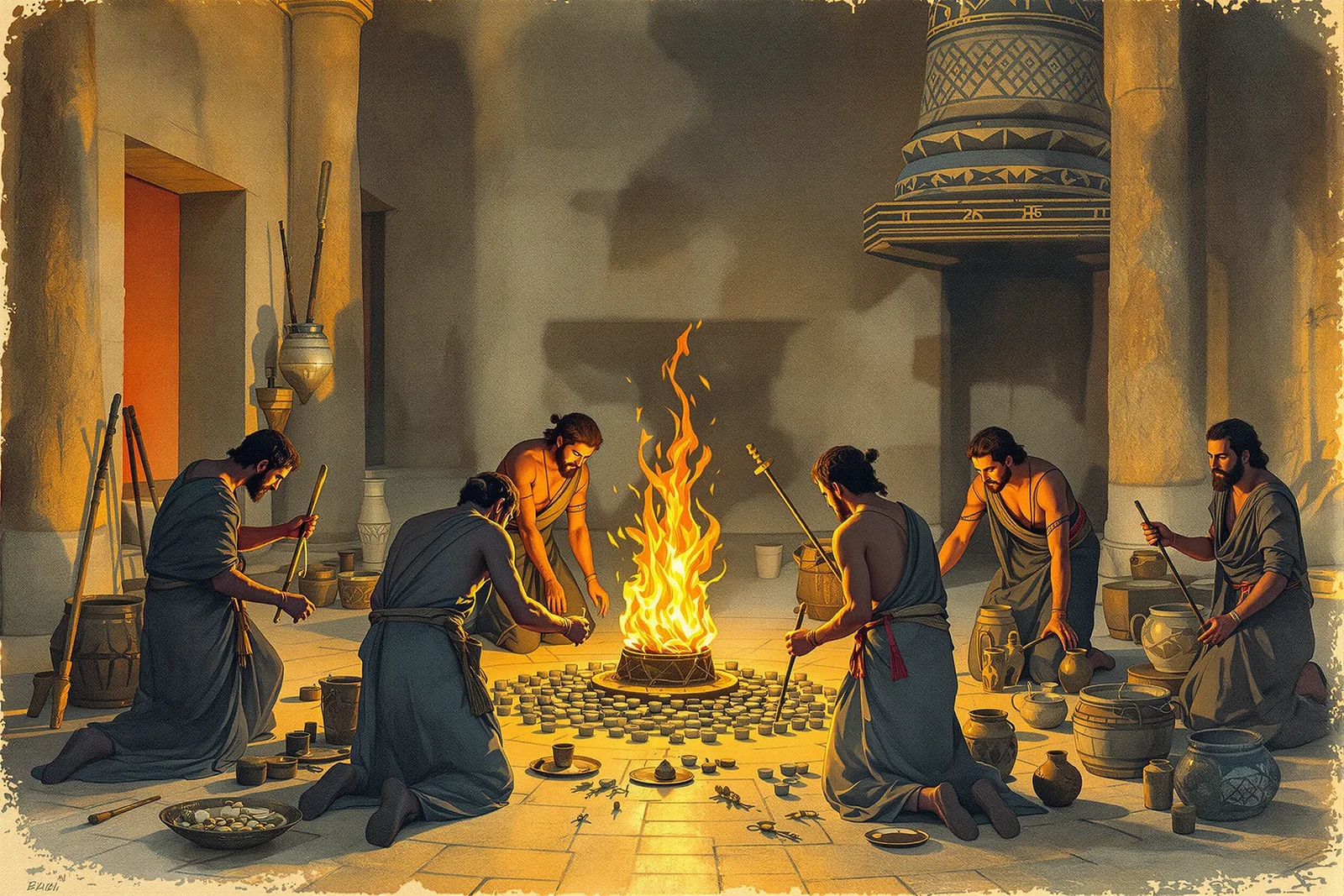
THE ME TABLET · Priesthood Module 783 · nam-išib
Carrying ME 12 · nam-išib · Purification Priest. A Sovereignty Module of the Practitioner Community.
Unaltered and unabridged: ~3,050 words.
Preamble
A flame that never goes out is one of the oldest things a community can keep, and one of the most demanding. It is older than most temples and most doctrines, because before a people could reliably make fire, the surest way to have fire was never to let the fire they had die — and the keeping of that ember, through every night and every storm, fell to whoever could be trusted not to sleep on watch. Out of that hard practical necessity grew one of the most widespread of all sacred institutions: the eternal flame, tended without interruption by a dedicated order, standing as the living centre of the community's hearth and worship. To tend the sacred flame is to hold that centre — to keep a light burning that the whole settlement can see has not failed, season upon season, as the visible sign that the community itself endures.
This module is the working craft of that keeping, and like all the priesthood modules it has a practical half and a sacred half that reinforce each other. The practical half is the real, unglamorous discipline of reliable fire: how a flame is fed, banked, and revived; how a lamp's oil and wick are managed for a clean, steady, long burn; how a fuel store is kept dry and sufficient; and — first and last — how an always-burning fire is kept safe, since an unattended flame is, plainly, the most dangerous thing in any dwelling. The sacred half is the discipline of the watch: the rota, the vows, the unbroken vigil, and the role of the kept flame as the communal hearth around which a people gathers. The parent volume, Vol XVII (The Mystic's Codex), holds the theology of sacred fire; the Ritual Offices supplement holds the order and duties of the keepers; and the long chronology of Vol XVI frames the eternal flame as one of the recovered arts — a practice whose unbroken keeping is itself a record of the community's continuity. The keeper here carries the purification-decree, nam-išib, because fire across the traditions is above all a purifying power, and the flame's tending is a purifier's office.
The sovereignty stake is quiet but total. A community whose central fire can fail — for want of a watch, a store of fuel, or a safe hearth — has at its heart a vulnerability anyone can exploit and any storm can find. To keep the flame is to keep the surest sign that the community has not gone dark.
Part I — The Eternal Flame Across the Traditions
Chapter 1 — Why so many peoples kept an unending fire
Set the traditions side by side and the eternal flame appears again and again, kept for overlapping reasons the keeper should understand because they shape how the flame is honored. The practical reason came first and never wholly left: a reliably-kept fire spared the community the labor and uncertainty of rekindling, and in eras when making fire was slow and chancy, the kept ember was the community's fire-security. The sacral reason layered over it: fire was understood across nearly every tradition as a purifying, divine, or living presence, so a flame kept perpetually became a perpetual sign of the god's or the hearth's abiding. The civic reason completed it: a single central fire, from which household hearths could be lit, made the communal flame the literal and symbolic centre of the settlement — to carry fire from the central hearth to a new home or a daughter-colony was to carry the community's continuity itself. Reference Table 783-1 sets out the recurring forms an anthropologist would note, without ranking any.
Reference Table 783-1 — Recurring forms of the kept flame
| Form | What is kept, and how | The reason most prominent | The constant beneath it |
|---|---|---|---|
| The communal hearth-fire | A central settlement fire, never extinguished, household fires lit from it | Civic / practical | The flame as the literal centre of the community |
| The temple / sanctuary flame | A dedicated order keeps a sacred fire perpetually before the shrine | Sacral | Fire as the abiding presence of the holy |
| The purifying fire | Flame used to cleanse persons, objects, or places of impurity | Sacral (purification) | Fire as the great purifier |
| The vow-kept vigil flame | A flame whose unbroken burning is bound to a vow or an order's discipline | Sacral / civic | The flame's continuity as a kept promise |
| The colony / founding fire | Fire carried from a mother-community to kindle a new settlement's hearth | Civic | Continuity carried as living flame |
| The memorial / commemorative flame | A flame kept to mark and remember | Civic / sacral | Memory made visible and continuous |
The Critical Insight: Beneath every form, the eternal flame works the same way — its unbrokenness is its meaning. A fire kept burning is not honored for being warm or bright; it is honored for never having failed, because its continuity stands in for the community's. This is why the gravest failure a keeper can suffer is not a small fire but an extinguished one: a flame relit is no longer the same flame, and the broken continuity is felt as a rupture in the community's own thread. The keeper's whole discipline serves one end above all others — that the flame never goes out.
Chapter 2 — Fire as purifier (the nam-išib link)
The purification-decree the keeper carries is not incidental. Across the traditions, fire is the foremost agent of cleansing — it consumes what is impure, it sterilizes by heat, and it transforms the offered thing into smoke that rises. The keeper of the sacred flame is therefore, in the logic of the office, a purifier: the flame in their charge is the community's means of cleansing, and its tending is a purifier's vigil. This is a real property as well as a symbolic one — heat genuinely destroys corruption and renders things clean — and the keeper who understands both the symbol and the fact tends the flame with the seriousness both deserve.
Part II — The Craft of Reliable Fire
Chapter 3 — The three things every fire needs
Reliable fire-keeping rests on a fact as simple as it is unforgiving: a fire needs three things at once — fuel, air, and heat — and removing any one extinguishes it. The keeper manages all three deliberately. Fuel must be the right kind, dry, and continuously available; green or damp wood smolders, smokes, and chokes, while seasoned dry wood burns clean and hot. Air must reach the fire in the right amount; too little and the fire smothers and smokes, too much and it burns through its fuel too fast, so the keeper controls the draft. Heat must be conserved through the low hours; a fire allowed to drop below the temperature that sustains combustion will die even with fuel and air present, which is why the banking of a fire — covering its embers to hold their heat through the night — is the single most important skill in keeping a flame alive unattended-but-watched until morning.
Chapter 4 — Banking, reviving, and the unbroken burn
The technique by which a fire is kept through the quiet hours without either flaring dangerously or dying is banking. To bank a fire, the keeper rakes the live coals into a compact heap and covers them with a layer of ash (and sometimes a piece of dense slow fuel), which insulates the embers and starves the fire down to a slow, smoldering, low-air burn that holds its heat for many hours. At the next watch, the keeper rakes off the ash, exposes the still-hot coals to air, lays on fine dry kindling, and the fire revives without ever having been relit from nothing — the continuity preserved. This is the practical heart of the eternal flame: not a roaring fire kept blazing every hour, which would consume fuel impossibly and risk the dwelling, but a banked fire, smoldering safely low through the night and brought back up at need, its embers never once gone cold. Reference Table 783-2 sets the keeper's three operating states.
Reference Table 783-2 — The three operating states of a kept flame
| State | What the keeper does | Air | Fuel rate | When |
|---|---|---|---|---|
| Active burn | Open flame, full draft, fed regularly | Full | High | For light, ceremony, cooking, warmth — the visible flame |
| Banked / holding | Coals raked together, covered with ash, starved low | Minimal | Very low | Through the night and quiet hours — safe, slow, alive |
| Revival | Ash raked off, coals exposed to air, kindling added | Increasing | Rising | At the change of watch, bringing the banked fire back up |
Protocol 783-A — Keeping a flame unbroken through the night
- Lay in dry, seasoned fuel before dusk. Never enter the night relying on fuel that is damp or unsplit; the night watch must have ready, dry kindling and slow fuel to hand.
- Build coals before you bank. An hour before banking, burn the fire down to a deep bed of live coals — banking thin coals risks losing them.
- Rake, heap, and cover. Pull the coals into a compact pile and cover with a layer of ash thick enough to insulate but not smother completely; the goal is a slow smolder, not extinction.
- Set the watch to check, not to feed. A banked fire needs watching, not constant feeding; the keeper on watch confirms the smolder holds and the ash cover is intact, and intervenes only if it threatens to die or to spread.
- Revive cleanly at the change of watch. Rake off the ash, expose the coals to air, lay fine kindling across them, and let the draft bring the flame back up before adding slow fuel.
- Never let the coals go cold. The one unbreakable rule: at no point in the night may the embers die. If they threaten to, the watch revives immediately — better a small active flame at midnight than a cold hearth at dawn.
Part III — The Lamp and the Oil
Chapter 5 — Managing a lamp for a clean, steady, long burn
Many sacred flames are not open hearth-fires but lamps — a wick drawing oil from a reservoir — and the lamp is the keeper's instrument for a small, steady, controllable eternal flame. A lamp burns by capillary action: the wick draws liquid oil up to the flame, where the heat vaporizes it and the vapor burns; the oil in the reservoir is the fuel, and the wick is only the delivery, which is why a properly-run lamp consumes its oil and not its wick. Reliable lamp-keeping is a matter of a few disciplines: keep the reservoir filled so the wick never runs dry (a dry wick chars, smokes, and the flame gutters out); trim the wick so it burns clean (an untrimmed wick grows a carbon head that smokes and dims — the keeper trims the char so the flame stays bright and steady); and set the wick at the right height (too high and it smokes and burns oil fast, too low and the flame is feeble). A well-kept lamp can burn cleanly and steadily for many hours on a single filling, which is precisely what an eternal flame requires.
Chapter 6 — Choosing and handling the oil (cross Vol IV)
The oil is the lamp's fuel, and its choice and handling matter for both flame quality and safety. Vol IV (The Apothecary's Codex) holds the properties of the pressed plant oils, and the keeper draws on it here. A good lamp oil is a clean, well-pressed plant oil — olive oil is the classic and burns clean, bright, and slow; other pressed oils serve with varying smoke and smell. The keeper should know what not to do as firmly as what to do, because lamp fuel is where carelessness becomes fire.
Reference Table 783-3 — Lamp fuels and their handling cautions
| Fuel | Burn character | Real safety / handling caution |
|---|---|---|
| Olive oil (clean, pressed) | Bright, clean, slow, low odor | The safe classic; keep the reservoir topped, trim the wick to prevent smoke |
| Other clean plant oils | Variable brightness, more smoke/odor | Acceptable; expect more soot and smell, trim more often |
| Rancid or dirty oil | Smoky, foul, gutters | Avoid — old oil clogs the wick, smokes, and burns poorly; keep oil fresh and clean |
| Volatile / thin spirit fuels | Flares, spreads, explosive vapor | Do NOT use in a kept open flame — volatile fuels give off ignitable vapor that can flash and spread fire; the eternal flame uses stable oils only |
The Critical Insight: The eternal flame's safety lives in its fuel choice and its watch, not in luck. A lamp fed clean, stable plant oil and trimmed by an attentive keeper will burn for hours without incident; a flame fed a volatile fuel, or left untended with a dry or over-high wick, is an ignition source waiting for an accident. The keeper's reverence for the flame is expressed, more than in any prayer, in the discipline of never giving it a fuel that can flash and never leaving it without a watch that can act.
Protocol 783-B — Running a sacred lamp safely
- Use only stable, clean plant oil. Olive oil for preference; never a volatile spirit fuel in a kept flame.
- Keep the reservoir filled. Check and top the oil on a fixed schedule so the wick never runs dry; a dry wick smokes, chars, and dies.
- Trim the wick each watch. Remove the carbon head so the flame burns bright and clean; record it as a duty of the watch, not an afterthought.
- Set the flame modest. A steady, modest flame burns clean, lasts long, and is safest; a tall smoking flame wastes oil and risks the surroundings.
- Place the lamp on stable, non-flammable footing, clear of drafts and cloth. A toppled lamp or a lamp beside hangings is the classic disaster; set it on stone or metal, away from anything that can catch.
- Keep the means to extinguish at hand. Sand, a damper, or a cover must always be within the keeper's reach, so a flare or a spill is smothered at once. Reverence does not forbid extinguishing in an emergency — it requires the means to do so.
Your Commitment: You will keep the flame with disciplines, not with hopes — stable fuel, a trimmed wick, a stable footing, and the means to extinguish always at hand. An eternal flame is the most dangerous thing a community keeps, and only a keeper's discipline turns it from a hazard into a blessing.
Part IV — The Discipline of the Watch
Chapter 7 — The rota and the vow
A flame that must never fail cannot rest on a single keeper, who must sleep, fall ill, and one day die; it rests on a rota — an unbroken roster of keepers who relieve one another so that the flame is watched every hour of every day, with no gap. The Ritual Offices supplement specifies the shape: keepers vowed to the flame, organized so that the watch passes hand to hand at fixed reliefs, each keeper's hours defined, each relief witnessed so the flame is never left between watches. The vow that binds the keepers is, at root, a vow of reliability — to be present for one's watch, to keep the disciplines of fuel and wick and bank, and never to let the flame die on one's hours. Across the traditions, the keepers of sacred flames were held to exactly such vows, and the breaking of the watch — the flame allowed to go out — counted among the gravest failures of the office, precisely because the whole meaning of the flame is its unbrokenness.
Chapter 8 — Discipline, relief, and the handover
The practical genius of a kept flame is the handover. At each relief, the outgoing keeper hands the incoming one a flame in good order — banked or burning steadily, fuel laid in, wick trimmed, the state of the fire reported — and the incoming keeper confirms it before the outgoing one stands down. This witnessed handover is what makes the unbroken watch possible: responsibility for the flame is never in doubt, never dropped in the gap between two people, because at every moment exactly one keeper holds it and the passing is explicit. The keeper builds the rota with enough keepers that no watch is so long that attention fails, enough overlap that the handover is unhurried, and enough redundancy that illness or absence never leaves the flame unwatched. The discipline of the watch is, finally, the discipline of continuity itself — the same flame held, hour upon hour, by keeper after keeper, so that what the community sees burning today is unbroken from what burned a hundred nights ago.
Protocol 783-C — Establishing an unbroken watch
- Vow the keepers to reliability. Bind each keeper to presence, to the disciplines, and to the rule that the flame does not die on their watch.
- Divide the day into watches no longer than attention allows. Short enough that no keeper tires into carelessness; long enough that reliefs are not so frequent as to be disruptive.
- Roster with redundancy. Always have a named relief and a reserve, so illness or absence never opens a gap.
- Make every handover witnessed and explicit. The outgoing keeper presents the flame in good order and reports its state; the incoming keeper confirms before the outgoing stands down.
- Log the watch. Record each relief and the flame's state at handover, so the unbroken keeping is itself a kept record (cross Vol XVI), and any lapse is visible and answerable.
- Drill the emergency. Rehearse the response to a guttering flame and to a fire that threatens to spread, so that under pressure the keeper acts from training, not panic.
Part V — The Hearth as Communal Centre
Chapter 9 — The flame that gathers the community
The kept flame is not only a discipline and a danger; it is a gathering-place, and its deepest civic function is to be the centre around which the community forms. The central hearth is where the settlement's people come together for warmth, for light, for the sharing of food and word and decision; the household fires lit from it bind every home to the centre; the fire carried out to found a daughter-settlement carries the community's continuity into a new place. The keeper who holds the flame holds, therefore, more than a fire — they hold the literal focus of the community's common life, the one point to which all can turn and see that the centre still burns. To tend it well is to keep not only a light but a gathering: a place and a sign that, whatever the season and whatever the night, the community endures, its centre unbroken, its flame still kept. This is the quiet sovereignty of the office — that so long as the keeper keeps the flame, the community has a centre that has not gone dark, and a sign all can see that it never did.
PLATES — Supplemental Gallery
Art direction
Art direction
Art direction
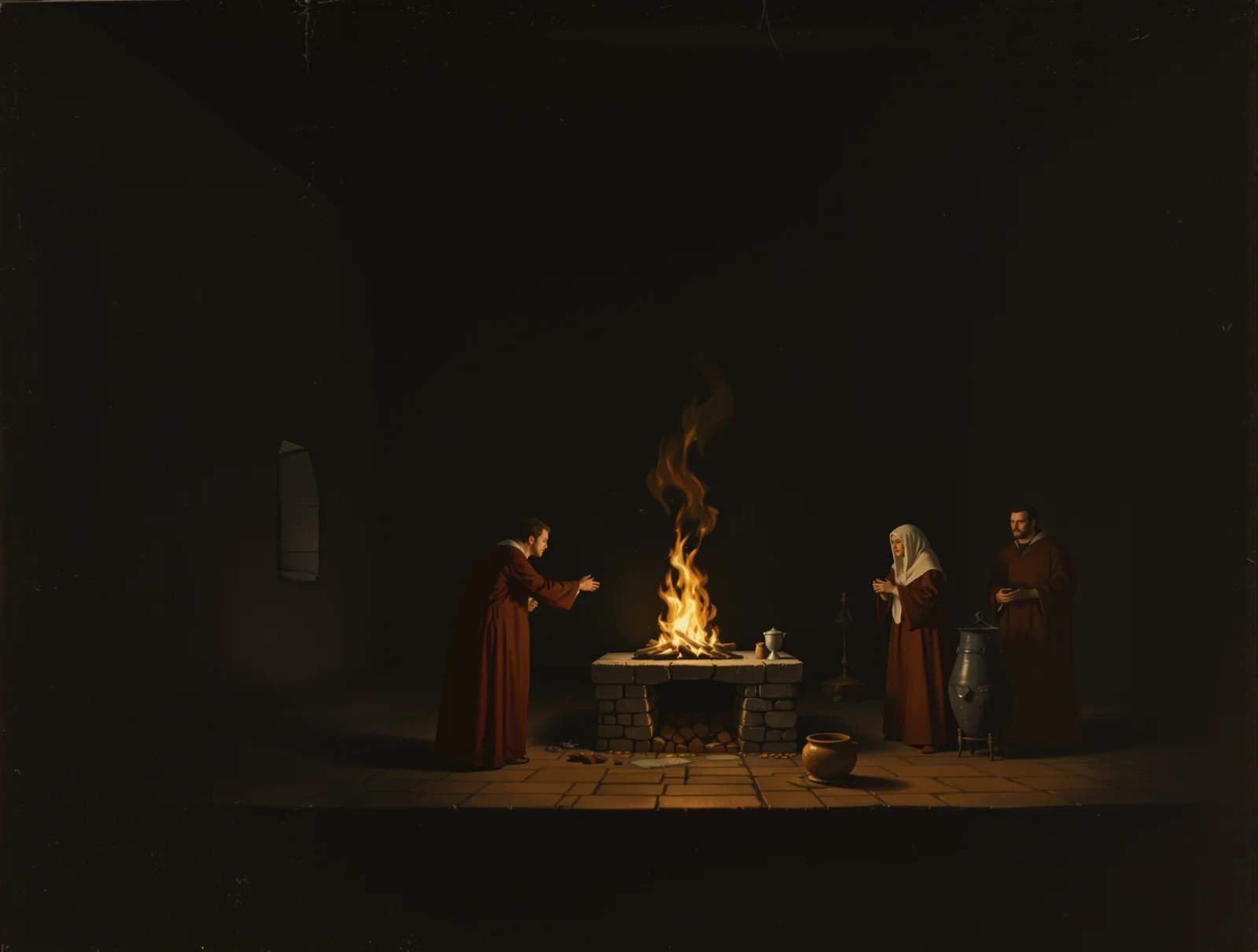
Art direction
Council Approval — The Twelve Voices Speak
| Disciple | Verdict | Reasoning |
|---|---|---|
| Peter | APPROVED | "It keeps the centre on rock — the flame handed hand to hand, unbroken, the sign that the community endures." |
| Thomas | APPROVED | "I doubted a fire could be kept all night without flaring or dying; the banking answered me. The coals hold." |
| John | APPROVED | "The hearth that gathers the community — light and warmth and word shared at one fire. The centre that has not gone dark." |
| Matthew | APPROVED | "Every state is specified — active, banked, revived — and every watch logged. The keeping is itself a kept record." |
| James the Greater | APPROVED | "The watch is set like a guard — reliefs, redundancy, a witnessed handover. The flame is never left between hands." |
| Andrew | APPROVED | "Fire carried out to kindle a new settlement — the community's continuity cast wide into a new place. I approve." |
| Philip | APPROVED | "Show me how, and it does: bank it, revive it, trim the wick, set the rota. The disciplines are all here." |
| Bartholomew | APPROVED | "No false note — it names the fire's true needs and its true dangers, and forbids the volatile fuel that would flash." |
| James the Lesser | APPROVED | "Modest and exact: a steady small flame, safely kept, outlasts a proud blaze. It teaches the humble discipline." |
| Simon the Zealot | APPROVED | "Here is sovereignty kept alight — a people whose central fire cannot fail has no darkness at its heart to exploit." |
| Judas Thaddaeus | APPROVED | "It keeps the means to extinguish always at hand, and drills the emergency — it abandons no keeper to panic." |
| Matthias | APPROVED | "It carries ME 12 as a purifier's office and joins the long keeping of Vol XVI. The flame, and the lot, fall true." |
Council Verdict: 12/12 APPROVED. This module is canon.
Let the flame be tended unbroken, that the community's centre never go dark and all may see it kept.
TRANSMISSION RECORD
Transmission COMPLETE — unaltered & unabridged Module 783 · Tend the Sacred Flame · category: priesthood Carries ME 12 · nam-išib · Purification Priest Words ~3,050 SHA-256 of source text 9c3b567933208a19f6bd9b165650e37fca01f115588b42df20eaf0b1d4bd85a9 Canonical text tend-sacred-flame.md — byte-identical to what this page renders