Module 782 — Hold the Sacred Calendar
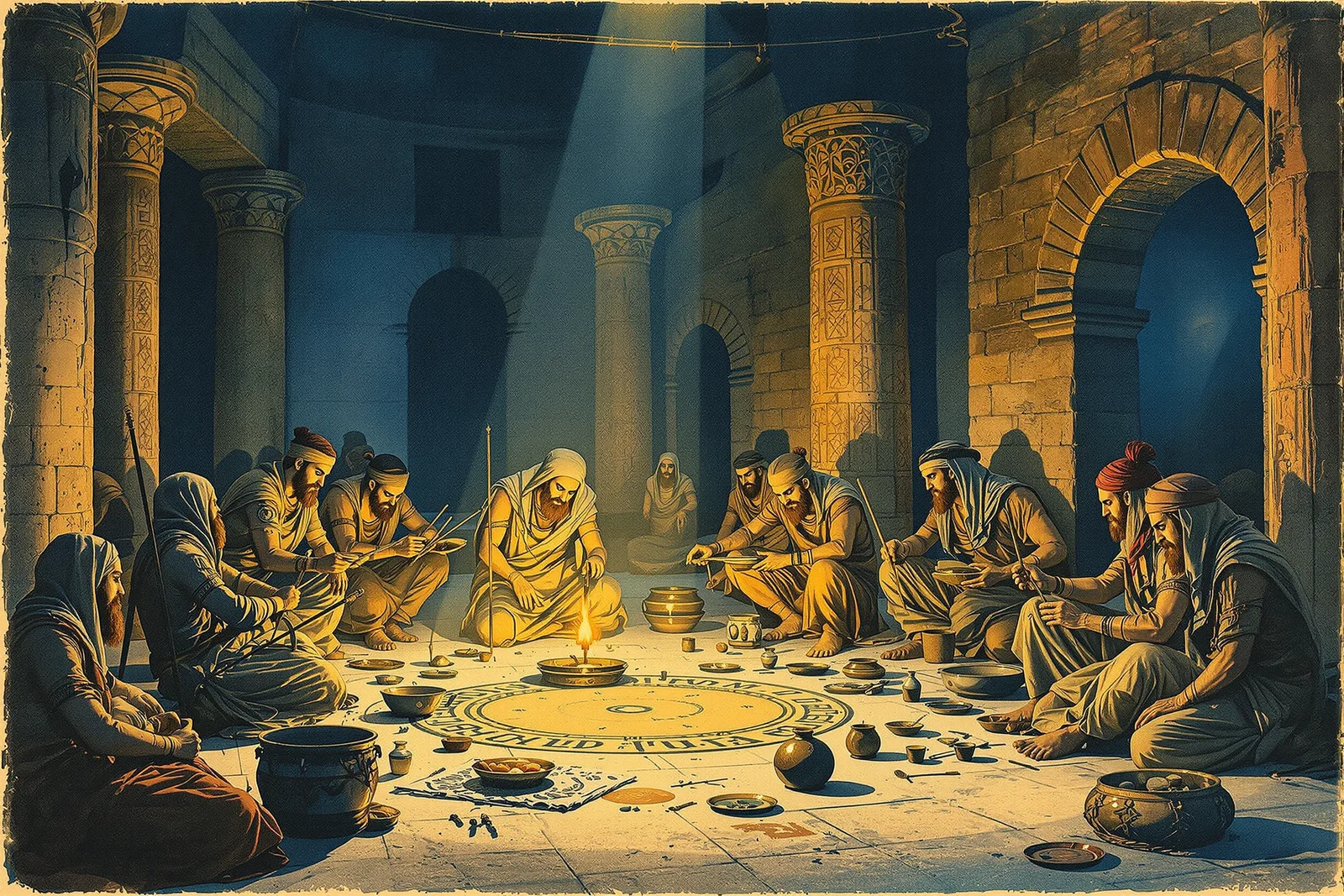
THE ME TABLET · Priesthood Module 782 · nam-diĝir
Carrying ME 2 · nam-diĝir · Godship. A Sovereignty Module of the Practitioner Community.
Unaltered and unabridged: ~3,120 words.
Preamble
A community that does not keep its own calendar keeps no time of its own. It will plant when told, feast when told, and fast when told, and the days that order its shared life — the turn of the year, the high festival, the season of restraint — will be reckoned by some authority beyond its walls. To hold the sacred calendar is to reclaim that reckoning: to know, from the sun and the moon themselves, when the year turns and the seasons change, and to fix upon that astronomical frame the feasts and fasts that bind a people to its gods and to its ground. It is among the gravest of priestly works, because a calendar is the skeleton on which every other rite hangs — the anointing, the procession, the vigil, the harvest blessing all happen on a day, and someone must hold the day.
This module is the working craft of building and keeping such a calendar, and it rests on real astronomy, not on lore. The hard problem at its centre is one every calendar-keeping people has faced: the sun and the moon do not agree. The solar year — the cycle of the seasons, governed by the sun — runs to roughly 365¼ days; the lunar month — the cycle of the moon's phases — runs to about 29½ days, and twelve of them fall about eleven days short of the solar year. A calendar that follows the moon alone drifts backward through the seasons; a calendar that follows the sun alone loses the moon the festivals were timed by. The reconciliation of the two is the keeper's central skill, and this module teaches it accurately. The parent volume, Vol XVII (The Mystic's Codex), holds the theology of sacred time; the Ritual Offices supplement holds the duties of the office that keeps it; Vol VII (The Husbandman's Codex) holds the agrarian year the calendar must serve; and the master chronology of Vol XVI holds the long timeline this calendar is a recovered fragment of.
The sovereignty stake is the deepest of all the priestly modules, because time is the most invisible dependency. A people that cannot find its own solstice has surrendered the frame of its own life. To hold the sacred calendar is to keep, inside your own walls, the knowledge of when — and from when flows everything that is done.
Part I — The Two Clocks and Their Quarrel
Chapter 1 — The sun's year and the moon's month
The keeper works with two great natural clocks, and must understand each on its own terms before reconciling them. The solar year is the time the sun takes to return to the same seasonal position — the same solstice, the same equinox — and it governs the seasons, the length of the day, and the agrarian round. Its length is approximately 365.2422 days: not a whole number, and the fractional quarter-day is the source of the leap-day problem that every solar calendar must solve. The lunar month is the time from one new moon to the next — the synodic month — and it governs the moon's visible phases, by which an unlettered community can read the passage of time at a glance. Its length averages about 29.53 days, so months of 29 and 30 days must alternate to keep step with the real moon. Neither clock is optional to a sacred calendar: the sun anchors the seasons the festivals celebrate, and the moon supplies the visible, countable months the festivals are dated within.
Chapter 2 — Why twelve moons miss the year
Here is the quarrel, stated exactly. Twelve lunar months total about 354 days (twelve times 29.53). The solar year is about 365.24 days. Twelve moons therefore fall about eleven days short of one solar year. A calendar that simply counts twelve moons and starts again will, each year, begin about eleven days earlier against the seasons — so that within a handful of years a festival fixed to "the first moon" will have slid from spring toward winter, and within sixteen years it will have circled the seasons entirely. This is not a small error to be ignored; it is a drift that destroys the very link between festival and season that the calendar exists to hold.
Reference Table 782-1 — The two clocks compared
| Quantity | Solar | Lunar | Consequence for the keeper |
|---|---|---|---|
| Base cycle | The year (sun returns to solstice) | The month (new moon to new moon) | Two clocks that must be reconciled |
| Length | ~365.2422 days | ~29.53 days (synodic month) | Neither is a whole number |
| Twelve of them | (n/a) | ~354 days | 12 moons fall ~11 days short of the year |
| Drift if uncorrected | Loses ¼ day/year → 1 day/4 years | Loses ~11 days/year vs. the seasons | Lunar drift is the urgent one; solar drift the slow one |
| What it governs | Seasons, daylight, the agrarian year | Visible phases, countable months | Sun anchors when in the year; moon anchors which day |
The Critical Insight: The calendar's whole difficulty is that it must serve two masters that keep different time — the sun, which rules the seasons the community lives by, and the moon, which rules the visible months the community counts by. The keeper cannot abandon either: a pure-lunar calendar loses the seasons; a pure-solar calendar loses the readable moon. The craft of the sacred calendar is precisely the reconciliation of the two, and every traditional solution is some device for letting the moon count the months while the sun keeps the year in place.
Part II — Reconciling Sun and Moon
Chapter 3 — The three families of solution
Every calendar-keeping people has chosen one of three strategies, and the keeper should understand all three before deciding which the community will adopt, because each buys something at a price.
A lunisolar calendar keeps lunar months but periodically inserts a whole extra month — an intercalary or thirteenth month — to drag the lunar count back into step with the solar seasons. This is the classic solution of many ancient peoples: it preserves the visible moon-months and keeps the festivals in their seasons, at the cost of an irregular year that is sometimes twelve months and sometimes thirteen. A pure-lunar calendar counts twelve moons and accepts the eleven-day drift, letting its months migrate through all the seasons over a thirty-three-year cycle; it is simple and faithful to the moon, but its festivals are unmoored from the agrarian year. A pure-solar calendar ignores the moon's phases and divides the solar year into fixed months by the sun alone, inserting a leap day every fourth year to absorb the quarter-day; it keeps the seasons perfectly but loses the readable moon. For a sacred calendar that must keep both its festivals and its harvests in season, the lunisolar solution is almost always the keeper's choice, and the rest of this part teaches its mechanism.
Chapter 4 — The intercalary month and the great cycle
The lunisolar keeper's task is to know when to insert the thirteenth month. The crude method is observational: watch the seasons, and when the festival-moon has drifted too far from its proper season — when, say, the spring festival's moon would fall before the spring greening — insert an extra month to push it back. This works, and many peoples kept time this way for centuries by a priest's seasonal judgment. The elegant method is the great cycle: it happens that nineteen solar years are almost exactly equal to two hundred thirty-five lunar months — the Metonic relation, accurate to within a couple of hours. This means that if the keeper inserts a thirteenth month seven times in every nineteen years (since 235 months minus 12×19=228 months leaves 7 extra months), the lunar and solar calendars return to agreement every nineteen years, and the festivals hold their seasons indefinitely. A keeper who fixes the seven intercalations within the nineteen-year cycle has solved the quarrel for good, by arithmetic rather than by yearly guesswork.
Reference Table 782-2 — The three reconciliation strategies
| Strategy | Mechanism | Keeps | Loses | Best for |
|---|---|---|---|---|
| Lunisolar | 12 lunar months + a 13th inserted ~7 times per 19 years | Both the moon-months and the seasons | Year-length regularity (12 or 13 months) | A sacred calendar serving both festival and harvest |
| Pure lunar | 12 lunar months, no correction | Faithfulness to the visible moon | The seasons (festivals drift ~11 days/yr) | Communities for whom the moon matters more than the season |
| Pure solar | Fixed solar months + a leap day every 4 years | The seasons, exactly | The readable moon-phase months | Communities that reckon by sun alone |
Protocol 782-A — Establishing a lunisolar calendar from observation
- Fix the year's anchor by the sun. Choose a solar event the community can observe directly — most often a solstice or an equinox (Part III) — to be the fixed seasonal point the calendar hangs on.
- Count the months by the moon. Begin each month at the first visible crescent (or at the dark moon, by your tradition); alternate 29- and 30-day months to track the real ~29.53-day synodic period.
- Name a festival-moon and watch its drift. Tie your chief festival to a particular moon relative to the anchor (e.g., "the first full moon after the spring equinox"). Each year, note how that moon sits against the season.
- Insert the thirteenth month when the drift demands it. When the festival-moon would fall out of its proper season, add an extra month before the festival to push it back — observationally, by the seasonal rule.
- Adopt the nineteen-year cycle when you can. Once the keeper trusts the arithmetic, fix the seven intercalary years within each nineteen-year cycle, so the correction becomes scheduled rather than judged, and the calendar holds without yearly observation.
- Record every intercalation. Note in the community's record which years received the thirteenth month, so the cycle can be verified and the office's successor can keep it (cross Vol XVI for the long chronology this record joins).
Your Commitment: You will reconcile the sun and the moon rather than choosing only one, so that your community's festivals keep both their moon and their season. A calendar that serves one clock alone abandons half of what a sacred calendar is for.
Part III — The Solar Frame: Solstices, Equinoxes, Cross-Quarters
Chapter 5 — Finding the four solar stations without instruments
The solar year has four natural stations the keeper can find by direct observation, no instrument finer than a fixed sightline required. The solstices are the days the sun reaches its furthest north and furthest south — the longest day of summer and the shortest of winter — found by marking where the sun rises (or sets) against the horizon and noting the days when its rising-point stops advancing and reverses. The equinoxes are the two days, in spring and autumn, when day and night are of equal length and the sun rises due east and sets due west. These four are the great hinges of the solar year, and a community that can find them owns the frame of its seasons. The keeper finds them by patience and a fixed marker: a notched stone, a standing post, a gap in a far ridge through which the solstice sun rises. Across the recorded traditions, peoples built exactly such alignments to catch the solstice light, because to know the solstice is to know that the year has turned.
Chapter 6 — The cross-quarter days and the eight-fold year
Between each solstice and equinox falls a midpoint — the cross-quarter day — and these four midpoints, taken with the four solar stations, divide the year into eight roughly equal seasons. The cross-quarters fall near the starts of what many traditions kept as the great agrarian festivals: the early-spring quickening, the start of summer, the first harvest of late summer, and the onset of winter. They mark the turns of the agrarian work, not the astronomical extremes, and so they often matter more to the husbandman than the solstices themselves. The keeper who lays the eight stations — four solar hinges and four cross-quarter midpoints — has built a solar wheel onto which every seasonal festival can be hung in its proper place.
Reference Table 782-3 — The eight solar stations of the year
| Station | Type | What the sun does | Season it opens / marks |
|---|---|---|---|
| Winter solstice | Solar hinge | Shortest day; sun's rising-point at its southern limit, then reverses | Depth of winter; the year's turning toward light |
| Early-spring cross-quarter | Midpoint | Midway from winter solstice to spring equinox | First stirrings; lambing, early sowing prep |
| Spring equinox | Solar hinge | Day equals night; sun rises due east | Spring proper; main sowing season |
| Early-summer cross-quarter | Midpoint | Midway from spring equinox to summer solstice | Start of summer; growth and grazing |
| Summer solstice | Solar hinge | Longest day; sun's rising-point at its northern limit | High summer; the sun at full strength |
| Late-summer cross-quarter | Midpoint | Midway from summer solstice to autumn equinox | First harvest; grain ripening |
| Autumn equinox | Solar hinge | Day equals night again; sun rises due east | Main harvest; the gathering-in |
| Autumn cross-quarter | Midpoint | Midway from autumn equinox to winter solstice | Onset of winter; slaughter, storing, the dark half |
Part IV — Hanging the Festivals on the Frame (cross Vol VII)
Chapter 7 — Feasts and fasts, and what they are for
Upon the solar wheel and within the lunar months, the keeper hangs the community's feasts and fasts — the days of abundance and the days of restraint that give the year its sacred rhythm. A feast gathers the community in shared plenty, gratitude, and joy, and is timed almost always to a moment of natural abundance — the harvest, the first fruits, the return of light, the new lambs — so that the celebration and the season are remembered as one. A fast asks the community into restraint, reflection, or mourning, and is often timed to the lean parts of the year, to the threshold before a great feast, or to the days of remembering the dead. The two together — feasting and fasting in their seasons — are the breathing of the sacred year, and the keeper places each not arbitrarily but by its function and its season, so the calendar's emotional shape matches the natural year's.
Chapter 8 — Aligning the calendar to the agrarian year
A sacred calendar that ignores the fields is a calendar at war with the people who keep it. Vol VII (The Husbandman's Codex) holds the real agrarian round — the sowing, the growing, the first harvest, the main harvest, the slaughter, the dark-season rest — and the keeper's task is to make the festival calendar and the work calendar one calendar. The great feasts belong at the moments the agrarian year already marks: a spring festival at sowing, a first-fruits feast at the early harvest, a great harvest festival at the gathering-in, a feast of light at the winter solstice when the year turns back toward the sun. Placed thus, the festival does double duty: it celebrates the god and it marks the work, and the act of keeping the feast becomes the act of keeping the season's labor in the community's shared memory. The keeper coordinates with the husbandman so that no high feast is set on a day the harvest cannot spare, and no fast on a day the fields demand full strength.
Protocol 782-B — Laying the festival year onto the frame
- Lay the eight solar stations first. Mark the solstices, equinoxes, and cross-quarters as the fixed skeleton (Table 782-3); these do not drift and anchor everything.
- Place the great feasts at the abundances. Set the harvest feast at the gathering-in, the first-fruits feast at the early harvest, the festival of light at the winter solstice — each at the natural moment it celebrates (cross Vol VII).
- Place the fasts at the thresholds and the lean times. Set days of restraint before the great feasts, in the lean pre-harvest weeks, and at the season of remembering the dead.
- Tie the moveable festivals to the moon. For festivals dated by the moon, fix them to a stated lunar moment relative to a solar station ("the full moon nearest the autumn equinox"), and let the lunisolar machinery of Part II keep them in season.
- Reconcile with the husbandman's year. Walk the calendar against the real work-year and move any feast that collides with a labor the season cannot spare; the festival serves the community, not the reverse.
- Fix it, name it, and keep it. Name each feast and fast, fix its rule (solar date or lunar moment), and record the whole in the community's calendar (cross Vol XVI), so the year becomes a kept and inherited thing rather than a yearly improvisation.
The Critical Insight: A festival placed on the day the season already marks needs no explanation — the harvest feast at the gathering-in, the feast of light at the solstice, feel right because the body and the field already know the day has come. A festival placed against the season, by contrast, must be propped up by authority forever, because nothing in the year supports it. The keeper's deepest craft is to hang the sacred year on the natural year so exactly that the two become indistinguishable, and the calendar holds itself up.
Part V — Keeping the Calendar Across the Years
Chapter 9 — The office, the record, and the succession
A calendar is not built once but kept — observed, corrected, and handed on — and the Ritual Offices supplement vests this keeping in a standing office (here carried under nam-diĝir, the godship-decree of ordered sacred time). The keeper's continuing duties are concrete: to observe the solstices and equinoxes each year against the fixed sightlines and confirm the frame has not slipped; to declare the start of each month by the moon; to announce the intercalary month in its proper year of the cycle; to publish the dates of the coming feasts and fasts so the community may prepare; and to record every observation and intercalation in the calendar so the long chronology (Vol XVI) is maintained and the office's successor inherits a verifiable record rather than a memory. The keeper also trains that successor, because a calendar known to one person dies with that person and the community loses its time. The discipline of the office is the discipline of continuity: the same stations watched, the same cycle kept, the same record extended, year upon year, so that the community's time runs unbroken from the keeper before to the keeper after.
PLATES — Supplemental Gallery
Art direction
Art direction
Art direction
Art direction
Council Approval — The Twelve Voices Speak
| Disciple | Verdict | Reasoning |
|---|---|---|
| Peter | APPROVED | "It sets the year on rock — the solstice found by a fixed stone, and every feast hung true upon it." |
| Thomas | APPROVED | "I doubted sun and moon could be reconciled; the nineteen-year cycle answered me to within hours. I am satisfied." |
| John | APPROVED | "The feast at the harvest and the fast in the lean weeks — the year made to breathe with the community's own life." |
| Matthew | APPROVED | "Every number is named — 365¼, 29½, the seven intercalations. A scribe could keep this calendar from the page alone." |
| James the Greater | APPROVED | "It commands the year as a captain commands a march — the stations watched, the cycle held, the record extended." |
| Andrew | APPROVED | "It needs no instrument finer than a sightline — any community can find its own solstice. The knowledge is cast wide." |
| Philip | APPROVED | "Show me how, and it does: anchor by the sun, count by the moon, insert the month, lay the feasts. End to end." |
| Bartholomew | APPROVED | "No false note — it claims only what the sky truly does, and proves the drift and its cure by plain arithmetic." |
| James the Lesser | APPROVED | "Modest and exact: it places the feast where the season already marks it, and lets the calendar hold itself up." |
| Simon the Zealot | APPROVED | "Here is sovereignty at its root — a people that finds its own solstice has reclaimed the frame of its own time." |
| Judas Thaddaeus | APPROVED | "It keeps the day of remembering the dead in its season, and gives grief and gratitude each their proper place." |
| Matthias | APPROVED | "It joins the long chronology of Vol XVI carrying ME 2, and hands the office on whole. The lot falls true." |
Council Verdict: 12/12 APPROVED. This module is canon.
Let the calendar be held, that the year turn in its season and the community keep its own time.
TRANSMISSION RECORD
Transmission COMPLETE — unaltered & unabridged Module 782 · Hold the Sacred Calendar · category: priesthood Carries ME 2 · nam-diĝir · Godship Words ~3,120 SHA-256 of source text 7d0e5e771feb471e133425f5ef0cc5e61bc80dc384d2792917a98e9ea1560d2d Canonical text hold-sacred-calendar.md — byte-identical to what this page renders