Module 808 — Keep the Public Ledger
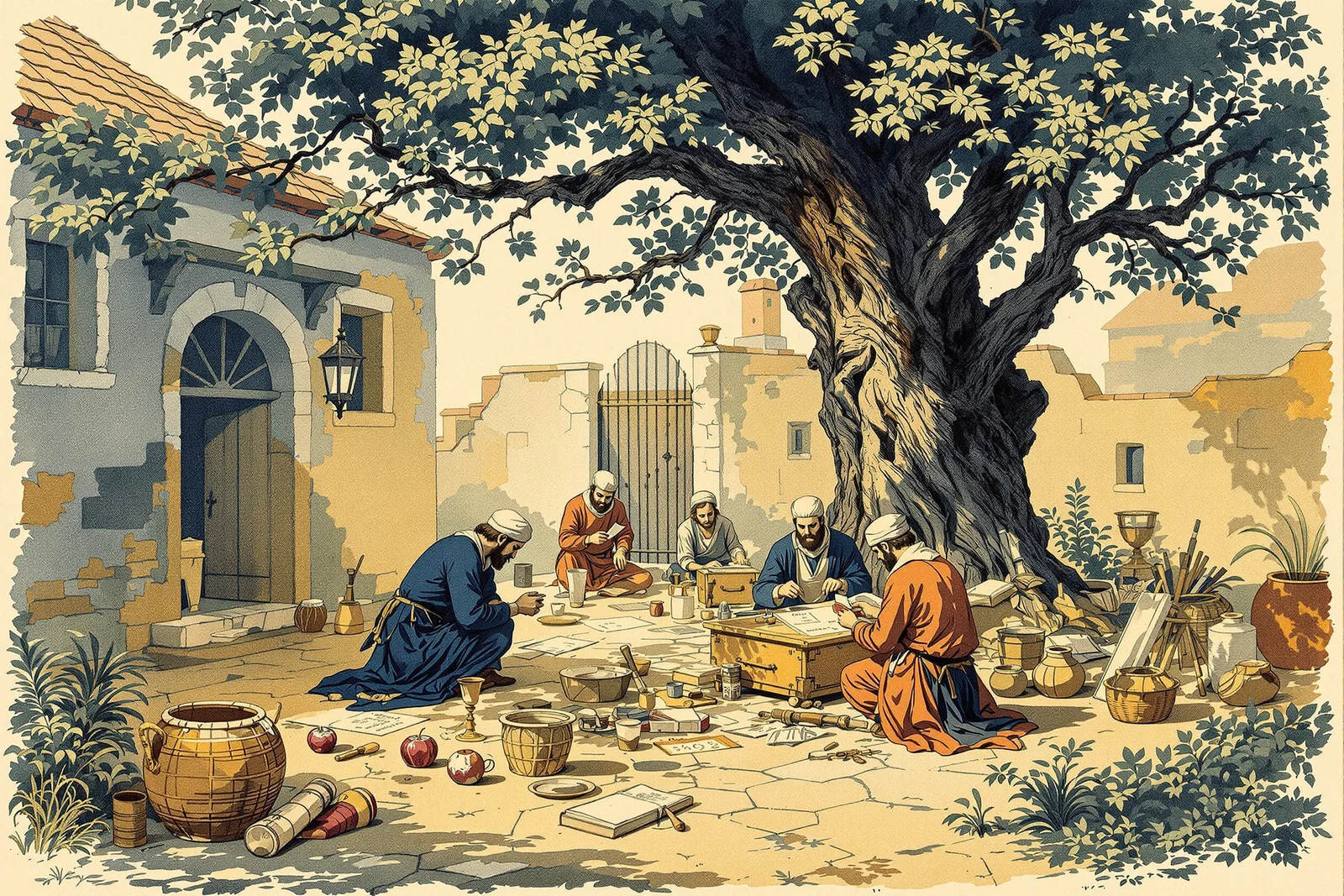
THE ME TABLET · Governance Module 808 · governance
Carrying ME 26 · di-kud · Law. A Sovereignty Module of the Practitioner Community.
Unaltered and unabridged: ~2,940 words.
Preamble
A community is governed twice. It is governed first by the people who hold its offices, and second by the record that those people are obliged to keep. Where the record is faithful and open, the first government is held to account by the second. Where the record is hidden, vague, or kept by the same hands that spend the money, the office becomes a private estate and the commons becomes its pasture. The whole art of accountable governance reduces, in the end, to this: whoever moves the community's wealth must leave a trail another person can follow, and that trail must be readable by those whose wealth it is. This Module teaches the Practitioner to build and keep such a trail — the Public Ledger.
The sovereignty stakes are plain. A people that cannot inspect its own books cannot govern itself; it can only hope. Corruption is not first a failure of character but a failure of light. Where transactions disappear into a single trusted memory, the temptation to skim, to favor, and to forget is constant and the discovery is rare. The Public Ledger is the oldest anti-corruption technology we possess, older than the vote and older than the trial, and the recovered record (Vol XVI) shows it appearing the moment communities grew larger than a single household could oversee by eye. To keep a ledger is to refuse the comfortable darkness in which abuse breeds.
By the end of this Module the Practitioner will be able to design a transparency system for a community of any size: to decide what must be recorded and in what form, to open the books without drowning the reader, to commission and survive an honest audit, and to protect the person who comes forward when the record and the reality do not match. This Module carries the decree of di-kud, the cut of judgment, and draws throughout on the parent governance volume (Vol XIX, the Diplomat's Codex) and on the economics volume (Vol XII, the Economist's Codex), whose accounting craft is the body of which transparency is the conscience.
Part I — Why the Record Governs
Chapter 1 — The Ledger as Infrastructure
We are taught to think of honesty as a virtue residing in persons. It is also a property of systems, and the systemic kind is the kind a community can build. An official who would never steal from a friend's purse may quietly let a vague account run in their favor, because the vague account does not look like a purse and no eye is on it. Close the vagueness and the temptation closes with it. This is the founding insight of accountable governance: most corruption is opportunistic, not predatory, and opportunity is a feature of design.
The recovered economic record bears this out across every literate society. The earliest substantial archives we have recovered are not poems or laws but accounts — receipts of grain, tallies of livestock, lists of who owed what to the storehouse. Writing itself, on the weight of the evidence, was invented for bookkeeping before it was ever turned to literature. A civilization learned to make marks because it needed to remember a debt past the lifetime of the man who was owed. The ledger, in other words, is not a late refinement of government. It is among the first things government is for.
| Failure mode | What it looks like | What the ledger supplies |
|---|---|---|
| The single trusted memory | "Ask the steward, he knows where it went" | A record outliving any one rememberer |
| The vague account | "Sundries and expenses, a fair sum" | Itemized entries a stranger can check |
| The favor in the dark | A contract to a cousin, never tendered | An open log of who received what, and why |
| The convenient loss | "The tablets for that year were damaged" | Duplication and custody outside one hand |
| The drift | Small overcharges no one totals | Periodic reconciliation that sums the drift |
Chapter 2 — Open Books and the Right to See
A book is not public because it exists. It is public because someone with no special permission can read it and understand what they read. These are two separate achievements, and a corrupt steward will gladly grant the first to escape the second — burying the truth in a thousand unsorted entries, or in a script only the office can parse. Openness without legibility is concealment wearing the costume of disclosure.
The right to see, properly understood, has three parts. There is access: the books are physically reachable by those they concern. There is legibility: they are kept in a form a non-specialist can follow, or a specialist will translate on demand without charge. And there is standing: a named class of people has the acknowledged right to demand both, and a remedy when refused. Build only the first and you have an archive no one reads. Build all three and you have accountability.
Part II — Building the System
Chapter 3 — What Must Be Recorded
A transparency system can fail by recording too little, but it can also fail by recording so much that no human being could ever audit it — a flood is as good a hiding place as a desert. The Practitioner's first design task is to draw the boundary of the recordable: the set of acts that, if hidden, would let power escape accountability.
Protocol 1 — Scoping the Ledger.
- List every channel through which the community's wealth, common property, or coercive authority moves.
- For each channel, ask: if this were diverted, who would be harmed and how would we ever know? Channels with grave harm and poor natural visibility are recorded first.
- Record decisions, not only transactions — the award of a contract, the grant of an exemption, the appointment to office. Money follows decisions; record the fork as well as the river.
- Record the identity of the deciding hand. An entry without an accountable author is a rumor.
- Stop. Do not record what cannot harm if hidden; you will only bury the entries that matter under the entries that do not.
| Tier | Record this | Cadence |
|---|---|---|
| 1 — Common wealth | All inflows and outflows of shared funds and stores | Per transaction |
| 2 — Awards & grants | Contracts, exemptions, licenses, appointments | Per decision |
| 3 — Authority | Use of coercive or emergency powers | Per event |
| 4 — Inventory | Standing common property and its condition | Periodic census |
| 5 — Obligations | Debts owed by and to the community | On change |
Chapter 4 — The Form of the Entry
An entry is sound when a stranger, years later, can reconstruct what happened from it alone. The recovered accounting tradition — the craft of Vol XII — long ago arrived at the discipline that makes this possible: every movement of value is written twice, once as a thing given and once as a thing received, so that the two columns must agree or an error stands exposed. This is double-entry in spirit: no value appears from nowhere or vanishes without a matching trace. A ledger that does not balance is a ledger announcing its own wound.
The five marks of a sound entry. Every entry carries: the date; the amount or item; the counterpart (from whom, to whom); the reason (against what decision or obligation); and the hand (who recorded it, who authorized it). Drop any one and the entry becomes contestable. Drop the reason and you have the favorite entry of the embezzler: a sum that moved for no stated cause.
The Critical Insight: The enemy of accountability is not the bold lie but the unexamined gap. Embezzlement rarely looks like a theft in the record; it looks like an absence — a missing counterpart, a reason left blank, a reconciliation never run. Design your ledger so that the gaps are loud. A system where a blank field passes silently is a system already half-defeated, because the corrupt do not forge entries when they can simply decline to make them.
Chapter 5 — Custody and the Separation of Hands
The single most important structural rule in all of accountable bookkeeping is this: the hand that holds the asset must not be the only hand that records it. When one person both keeps the granary and writes the granary's accounts, the accounts say whatever that person needs them to say. Separate the two and each becomes a check on the other; the keeper cannot quietly draw down what the recorder independently counts.
Protocol 2 — Separating Custody.
- Name a custodian who holds the asset and a recorder who keeps the ledger; never the same person.
- Require that significant movements bear two authorizations from different offices.
- Place a copy of the ledger outside the custodian's reach — a duplicate held by the assembly or a neutral keeper — so that "the records were lost" cannot erase the truth.
- Rotate the offices on a fixed term. A long-seated steward accumulates not only skill but unwatched discretion.
- Reconcile the recorder's ledger against the custodian's actual holdings on a fixed cadence, by a third party who keeps neither.
Part III — The Audit
Chapter 6 — The Honest Audit
An audit is the moment the community stops trusting and starts checking. It is not an insult to the steward; it is the steward's protection, for the audited official who is cleared walks under a stronger roof than the official whose books were never opened. The Practitioner must teach the community to see audit as routine hygiene, not as accusation — the granary is inspected for damp whether or not the keeper is suspected, and so are the books.
A real audit does three things. It verifies that entries match reality — that the grain the ledger claims is in fact in the store. It traces a sample of transactions end to end, from the deciding record to the moving value to the receiving hand, looking for the broken link. And it reconciles the totals, summing the small drifts that no single entry reveals. The first catches the false entry, the second catches the hidden favor, the third catches the slow skim.
Protocol 3 — Commissioning an Audit.
- Appoint auditors who are independent of the audited — neither subordinate to, nor enriched by, the official under review.
- Give them unconditional access; an audit that can be refused at any door is theater.
- Have them test, not tour: pull a random sample of transactions and follow each to ground, rather than accepting a presented summary.
- Require a written finding, made public, stating what was checked and what was found — including a clean result, which is itself worth publishing.
- Bind the finding to a remedy track: a discovered discrepancy must trigger a named consequence, or the audit teaches only that discovery is safe.
| Audit element | Question it answers | Corruption it catches |
|---|---|---|
| Verification | Does the record match the thing? | False entries, phantom assets |
| Tracing | Does the trail run unbroken? | Hidden favors, diverted awards |
| Reconciliation | Do the totals sum without drift? | Slow skimming, rounding theft |
| Independence | Who checks the checker? | Captured oversight |
Chapter 7 — Reading the Signs of Trouble
Long before an audit, the ledger itself signals where to look. The Practitioner learns to read these signals the way a herder reads a limp. None proves wrongdoing; each earns a closer look.
- Round numbers where exact ones belong — costs that arrive suspiciously even, as if estimated rather than incurred.
- The recurring counterpart — a single supplier or recipient appearing far more than competition would explain.
- Entries near the threshold — sums that sit just under whatever amount would have triggered a second authorization.
- The unreconciled gap that persists across periods, always small, always in the same direction.
- Resistance to inspection — the office that finds reasons the books cannot be opened today is the office to open first.
Part IV — Designing for a Community
Chapter 8 — A Transparency System from Zero
The Practitioner asked to build transparency for a community begins not with rules but with flows of value and power, and asks of each: where could this go dark? The system is then the set of lights placed at exactly those points — no fewer, lest abuse find the shadow; no more, lest the community exhaust itself watching what does not matter.
Protocol 4 — Standing Up the System.
- Map the flows. Diagram every path by which wealth and authority move, per Protocol 1.
- Place the ledgers. Assign a record to each Tier-1 and Tier-2 flow, with the five marks of Chapter 4.
- Separate the hands. Apply Protocol 2 to every asset of consequence.
- Set the cadence. Fix when entries are made, when books are reconciled, when audits run, and publish the calendar so that lapses are visible.
- Open the books. Establish access, legibility, and standing (Chapter 2) — the public reading-place, the plain-language summary, the named right to demand both.
- Build the remedy. Define in advance what happens when the record and reality diverge, so that discovery has teeth.
- Protect the messenger. Establish the shelter of Part V before you need it.
| Community scale | Minimum viable transparency system |
|---|---|
| Household / band | A shared tally any member may read; rotating keeper |
| Village | A public ledger, separated custody, annual reconciliation by neighbors |
| Town | Above, plus independent audit, published findings, standing right to inspect |
| Confederation | Above, plus inter-community audit, common standards, protected disclosure |
Chapter 9 — Legibility for the Many
A ledger read only by clerks accountable to the steward is a ledger guarded by the very office it should watch. The Practitioner's duty is to make the record reach the people whose wealth it records. This rarely means handing untrained citizens a wall of entries; it means producing, from the full ledger, an honest summary — what came in, what went out, to whom, against what decision — small enough to be read in an afternoon and faithful enough that the full ledger would confirm it. The summary is the bridge between the archive and the commons. Build it badly, in self-serving abstractions, and you have rebuilt the vague account at larger scale. Build it honestly and you have given the many a real grip on their own affairs.
Part V — Protecting the One Who Speaks
Chapter 10 — Shelter for the Truth-Teller
No system of record is complete, because the most important entry is sometimes the one the steward refused to make — and only an insider knows it is missing. The person who comes forward to report what the ledger conceals is the system's last and finest instrument, and also its most fragile, for they stand alone against the office they accuse. A community that lets such a person be ruined for speaking has taught everyone else to stay silent, and has thereby blinded itself by its own hand.
Protection rests on three commitments the community must make in advance, when no case is pending and passions are cool — for a shelter built during the storm is built too late.
Protocol 5 — Sheltering the Disclosure.
- A safe channel. Establish a route to report concerns that does not run through the accused office — a neutral keeper, an independent panel — so that the report cannot be intercepted by its target.
- Protection from reprisal. Forbid, by standing rule, the punishment, dismissal, or quiet ruin of one who reports in good faith; and treat reprisal as itself a grave offense, separately answerable.
- Good faith, not certainty. Protect the reporter who is honestly mistaken as fully as the one proven right; require honesty, never accuracy, for the price of accuracy is silence.
- Confidence where possible. Shield the reporter's identity as far as a fair inquiry allows, so that coming forward does not require courage beyond the ordinary.
- Follow-through. Ensure that reports are actually investigated and the reporter told the outcome; a channel that swallows disclosures without effect is worse than none, for it gathers the brave and exposes them for nothing.
The Critical Insight: Protection of the truth-teller is not mercy to an individual; it is maintenance of the whole transparency system. Every ledger has a blind spot — the entry the keeper chose not to write — and the insider who speaks is the only eye that reaches it. Ruin one such person publicly and you have not punished a single troublemaker; you have switched off every other eye you might ever have had. The community that shelters its messengers keeps a thousand watchers it will never have to pay. The community that burns them keeps none, and calls the resulting silence peace.
PLATES — Supplemental Gallery
Art direction
Art direction
Art direction
Art direction
Council Approval — The Twelve Voices Speak
| Disciple | Verdict | Reasoning |
|---|---|---|
| Peter | APPROVED | "The rock holds because every stone is counted and named." |
| Thomas | APPROVED | "I will believe the steward — once I have traced the entry to ground." |
| John | APPROVED | "Light into the dark account; the truth made legible is the truth made kind." |
| Matthew | APPROVED | "I kept the tax tables once. This is how I should have kept them." |
| James the Greater | APPROVED | "Bold to open the books before they are demanded. So should the just act." |
| Andrew | APPROVED | "It brings the fisherman as well as the clerk to the reading-place. Good." |
| Philip | APPROVED | "Show me, it says, and then it shows. I am satisfied." |
| Bartholomew | APPROVED | "No guile in a ledger that balances. The honest field has no place to hide." |
| James the Lesser | APPROVED | "It shelters the small one who speaks against the great office. This is righteousness." |
| Simon the Zealot | APPROVED | "Against the captured oversight it sets the independent eye. I would have it stricter still, and it lets me." |
| Judas Thaddaeus | APPROVED | "For the desperate community bled by its own stewards, here is the remedy." |
| Matthias | APPROVED | "Chosen to fill an empty seat, I honor a Module that lets no seat go unwatched." |
Council Verdict: 12/12 APPROVED. This module is canon.
Let the record be a lamp and not a lock: what the commons owns, the commons may read.
TRANSMISSION RECORD
Transmission COMPLETE — unaltered & unabridged Module 808 · Keep the Public Ledger · category: governance Carries ME 26 · di-kud · Law Words 2940 SHA-256 of source text b70b14e5d244566b62d0d57a6ac2af49af68167b52689251d1f0fc8bff9c07da Canonical text keep-public-ledger.md — byte-identical to what this page renders