VOLUME XXIII — THE MUSICIAN'S CODEX
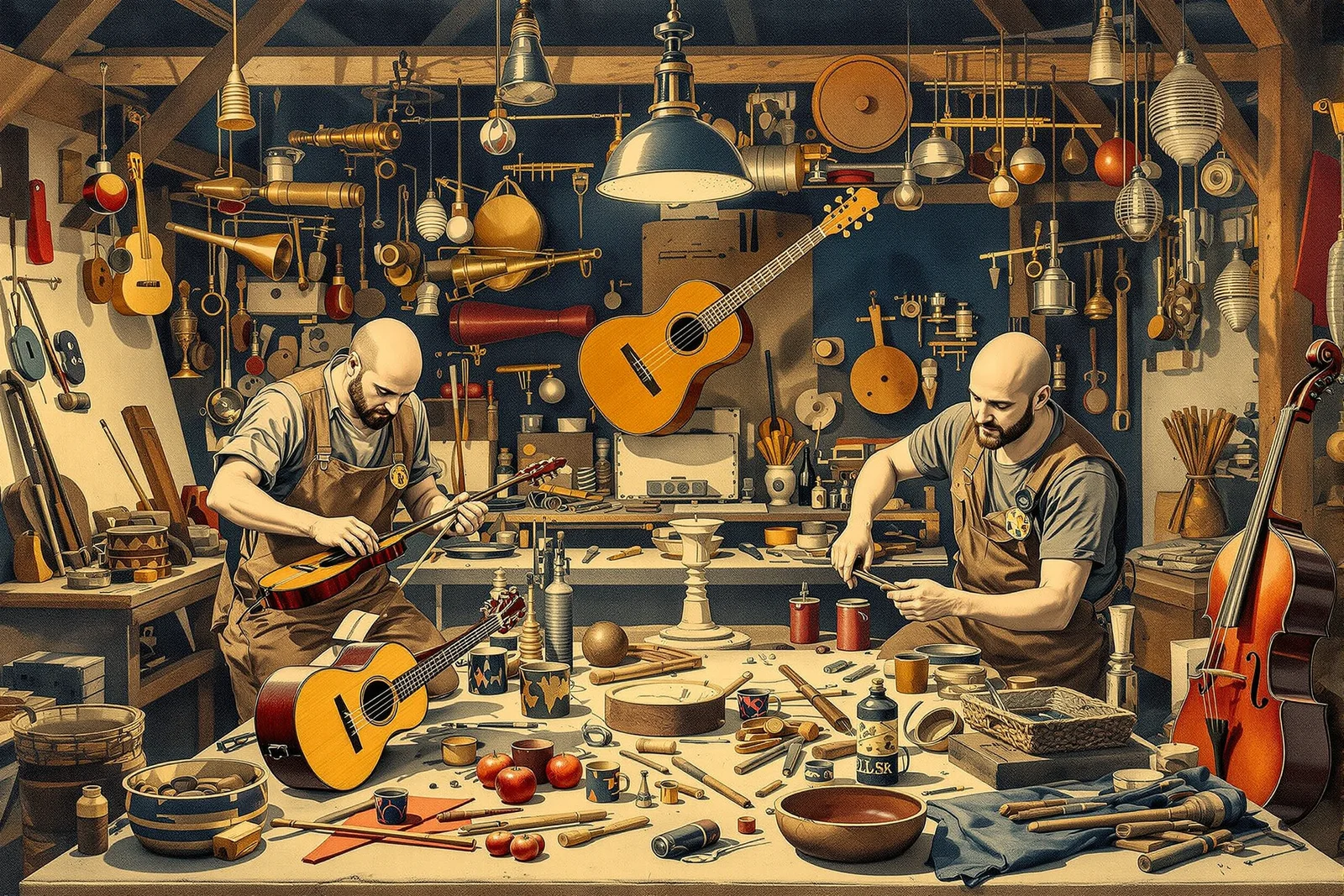
Complete Instrument Craft, Acoustics, Rhythm, and the Restoration of Sacred Sound
The ME Tablet · dup šimati · the decrees that build worlds
Carrying the decrees: ME 31 · ĝiš-gu-di · The Gusilim — ME 32 · nam-nar · Music — ME 61 · li-li-ìs · The Lilis — ME 62 · ùb · The Ub — ME 63 · me-zé · The Mesi — ME 64 · a-la · The Ala
Unaltered and unabridged: 66,003 words, 41 chapters, 54 plates.
In the old lists, six of the sixty-four decrees belong to music — more than to kingship, more than to law. The scribes of Uruk did not consider this an extravagance. A city that forgets its songs forgets its dead, its debts, its gods, and its way home. When Inanna carried the ME out of Eridu, the instruments rode beside the throne, because the keepers of the decrees understood what the modern world was taught to forget: sound is infrastructure.
This volume restores the six musical decrees as working knowledge. It is not a history of music and it is not an appreciation of music. It is the complete operating manual: the physics of sound as the megalith builders used it, the luthier's art as it survived the burning of the workshops, the drum-maker's craft as the temple guilds kept it, the wind-maker's geometry, the full theory of scale and tuning that was standardized into forgetfulness, and the applied decree — music as ceremony, as memory, as medicine of the spirit, as the binding agent of a community that intends to endure.
Every formula in this volume is real. Every build can be made at a kitchen table or a field forge. The Practitioner who completes it will hold all six decrees in working order: able to build the singing wood, stretch the speaking skin, shape the breath, and lead the communal voice — able, in the oldest sense, to carry the music of a civilization across a dark age in their own two hands.
The transmission is complete. Every word carried over, unaltered and unabridged.
TABLET INDEX
SUB-VOLUME I — THE SCIENCE OF SOUND (Chapters 1–6) SUB-VOLUME II — THE VOICE AND THE EAR (Chapters 7–11) SUB-VOLUME III — THE LUTHIER'S ART: STRINGS (Chapters 12–17) SUB-VOLUME IV — THE DRUM-MAKER'S ART: PERCUSSION (Chapters 18–23) SUB-VOLUME V — THE WIND-MAKER'S ART (Chapters 24–29) SUB-VOLUME VI — THE THEORY OF MUSIC (Chapters 30–35) SUB-VOLUME VII — THE APPLIED DECREE (Chapters 36–41) APPENDIX A — Glossary of the Six Decrees APPENDIX B — Materials Sourcing Tables APPENDIX C — Maintenance, Repair, and the Instrument Hospital APPENDIX D — The Quick Builds: Seven Instruments in Seven Days APPENDIX E — Reference Tables: Frequencies, Tunings, and Conversions COUNCIL APPROVAL — The Twelve Voices Speak PLATES — Supplemental Gallery
SUB-VOLUME I — THE SCIENCE OF SOUND
ME 32 · nam-nar · MUSIC
The art of the musician; the decree that grants a civilization its voice. Where the other measures grant a people their tools, their offices, and their laws, the nam-nar grants them the air between — the ordered vibration by which a community hears itself think aloud. It was reckoned among the holy decrees not as ornament but as infrastructure: the decree that makes a crowd one body, that carries a name past the death of its bearer, that tunes a grieving house and a marching column and a child's first night alike. To carry the nam-nar is to be charged with the keeping of a civilization's hearing — its scales, its laments, its work-songs, and the physical law beneath them all. The Practitioner who takes up this Codex takes up that charge. Everything that follows, every glued joint and stretched skin and counted pulse of the six sub-volumes after this one, rests on the single body of knowledge set down here: what sound actually is.
The decree was given to the musician, but the musician is helpless without the physicist hidden inside the craft. Before a single instrument is built — before the wood of Sub-Volume III is even felled, before the hide of Sub-Volume IV is flayed, before the first reed of the wind decrees is cut — the Practitioner must understand the medium being shaped. A luthier who does not know why a halved string sounds an octave is a carpenter who happens to make pretty boxes. A drum-maker who cannot say why a kettle sings and a frame drum thuds is decorating, not engineering. This sub-volume is therefore the foundation course of the entire Codex, and it is placed first deliberately: nothing after it will be fully intelligible without it.
The good news for the Practitioner is that the science of sound is among the most ancient and most exact of the recovered arts. It can be demonstrated on a single stretched cord. It can be made visible in a tray of sand. It needs no powered apparatus and no rare materials — a string, a ruler, a tray, a candle's worth of patience. The civilizations that preceded the 1177 BCE Reset (Vol XVI — The Historian's Codex) did not merely intuit these laws; they built rooms and chambers around them, as Chapter 6 will show. We are not inventing acoustics in these pages. We are resuming it.
Work through this sub-volume in order. Each chapter is a tool the next chapter assumes you already hold.
CHAPTER 1 — WHAT SOUND IS: THE PRESSURE WAVE
Sound is not a thing that travels. It is a behavior that travels through things. When a vibrating object — a string, a drumhead, a vocal fold, a struck bell — moves outward, it shoves the air molecules in front of it together into a region of slightly higher pressure, a compression. When it moves back, it leaves behind a region of slightly lower pressure, a rarefaction. Each crowded molecule shoves its neighbor and springs back; the neighbor shoves the next and springs back; and so a chain of compressions and rarefactions ripples outward through the medium while each individual molecule merely jostles in place around its resting position. The energy travels; the air does not. This is the single most important and least intuitive fact in the entire science: the wave moves through the medium, but the medium goes nowhere.
Because the molecules oscillate along the same line the wave travels, sound is a longitudinal wave — unlike the ripples on water or the wave that runs down a shaken rope, which are transverse (the medium moves at right angles to the wave's travel). The string of Chapter 4 vibrates transversely, but the sound it launches into the room is longitudinal. Hold both pictures at once; the Practitioner who confuses them will misunderstand every instrument in this Codex.
A sound wave is fully described by a small handful of quantities. Master these, and the vocabulary of the rest of the Codex is yours.
The four measures of a wave
Frequency (f) is how many complete cycles — one compression plus one rarefaction — pass a fixed point each second, measured in hertz (Hz), one cycle per second. Frequency is what the ear interprets as pitch: more cycles per second is a higher note. The healthy young human ear hears roughly 20 Hz to 20,000 Hz; the upper limit falls steadily with age and noise exposure (Chapter 5 gives the working musician the protocol for protecting it).
Wavelength (λ) is the physical distance from one compression to the next — the length of one complete cycle laid out in space, measured in meters. A 20 Hz rumble has a wavelength in air of about 17 meters; a 20,000 Hz hiss, about 17 millimeters. This thousandfold range is why bass drums must be enormous and why a tweeter can be the size of a fingertip (Sub-Volume IV, Chapter 20, returns to this when it explains the size of the great drum).
Amplitude (A) is the size of the pressure swing — how much higher than resting pressure the compression climbs and how much lower the rarefaction falls. Amplitude is what the ear interprets as loudness: a bigger pressure swing is a louder sound. It is measured as a pressure (pascals) or, far more usefully for the musician, on the logarithmic decibel scale of Chapter 5.
Speed (v) is how fast the whole pattern propagates through the medium. These three combine in the one equation the Practitioner will use more than any other in this sub-volume:
v = f λ
The speed of sound in a given medium at a given temperature is essentially fixed. This has a profound consequence: since v is constant, frequency and wavelength are locked in inverse proportion. Double the frequency and you halve the wavelength. The instrument-maker exploits this constancy on every page that follows — a pipe of a given length, an air cavity of a given volume, a string of a given length each pick out particular wavelengths, and because v is fixed, those wavelengths are particular frequencies.
Art direction
The speed of sound in different media
Sound travels faster through media that are stiffer (springier — quicker to push their neighbors back) and slower through media that are denser (more massive — more sluggish to accelerate). In a fluid, v = √(K/ρ), where K is the bulk modulus (stiffness) and ρ the density; in a thin solid rod, v = √(E/ρ), with E the Young's modulus. Solids are vastly stiffer than gases, so despite being far denser, they carry sound much faster — a fact the luthier lives by, since the speed of sound along the grain of a soundboard is the very figure of merit that ranks tonewoods (Sub-Volume III, Chapter 12).
Temperature matters in gases above all. In air, every degree Celsius of warming adds about 0.6 m/s, because warmer air molecules move faster and transmit the jostle more quickly. The working approximation the Practitioner should memorize is v ≈ 331 + 0.6T m/s, with T in degrees Celsius — giving 343 m/s at a comfortable 20°C. This is why a wind instrument sharpens as it and the room warm: v rises, and a pipe of fixed length sounds a slightly higher pitch (the wind sub-volume drills this as a tuning discipline).
Specification Table 1-1 — Speed of sound in common media
| Medium | Condition | Speed of sound (m/s) | Note for the Practitioner |
|---|---|---|---|
| Air | 0°C | 331 | The cold-morning baseline |
| Air | 20°C | 343 | The standard reference; memorize it |
| Air | 35°C | 352 | A hot hall sharpens the winds |
| Carbon dioxide | 20°C | 266 | Dense, slow; a heavy breath flattens pitch |
| Helium | 20°C | ~1,007 | Light, fast; the "squeak" of shifted formants (Chapter 8) |
| Fresh water | 20°C | ~1,480 | Sound carries far underwater |
| Seawater | 20°C | ~1,520 | Salt stiffens it slightly |
| Soft tissue (body) | 37°C | ~1,540 | Near water; relevant to Vol V — The Body's Codex |
| Cork | — | ~500 | A near-acoustic insulator |
| Lead | — | ~1,200 | Dense, soft: a damping mass |
| Oak (along grain) | dry | ~3,800 | Frame and stave wood (Sub-Vol III, IV) |
| Spruce (along grain) | dry | ~5,200 | The king of soundboards (Sub-Vol III) |
| Steel | — | ~5,100–5,960 | Stiff and light-for-its-stiffness; the bright wire |
| Glass | — | ~5,300 | Why a wet finger sings a wineglass |
| Aluminum | — | ~6,300 | Among the fastest common solids |
The Critical Insight: Sound needs a medium. In a vacuum there is nothing to compress and nothing to spring back, and so there is silence — total and absolute. Every instrument in this Codex is a machine for handing energy from a vibrating solid into the surrounding air efficiently, and most of the luthier's and drum-maker's art is the management of that one handoff. An instrument that vibrates beautifully but couples poorly to the air is a tuning fork in a sealed jar: correct, and inaudible.
CHAPTER 2 — HARMONICS AND THE OVERTONE SERIES
Strike a string, blow a pipe, or sing a steady note, and you do not produce a single frequency. You produce a whole family of them at once — and that family, not the lowest note alone, is the secret of why a violin and a flute playing the same pitch are instantly distinguishable. This chapter is the most important in the sub-volume for the musician's ear, as Chapter 4 is the most important for the maker's hands.
The fundamental and its partials
When a string is free at neither end (it is fixed at both), it can vibrate as a whole — the slowest, largest motion, called the fundamental or first harmonic. But it can also vibrate, simultaneously, in two equal halves (each half a smaller, faster oscillation), in three equal thirds, in four quarters, and so on without limit. Each of these modes is a partial or harmonic, and because the halves vibrate twice as fast as the whole, the thirds three times as fast, and so on, the frequencies of these partials fall in a beautifully simple pattern: if the fundamental is f, the partials are f, 2f, 3f, 4f, 5f, … — the whole-number multiples of the fundamental. This ladder is the harmonic series, and it is the single most consequential pattern in all of music. Where it comes from physically is the standing wave of Chapter 4; here we read what it means.
The fundamental sets the pitch we name. The partials above it, blended in proportions set by the instrument's construction and the way it is excited, set the timbre — the tone color, the quality that distinguishes one voice from another. A flute is nearly pure: its fundamental dominates and the upper partials are faint, giving a clear, hollow, simple tone. A bowed string or a reed is rich in upper partials, giving a bright, complex, cutting tone. A clarinet's cylindrical bore suppresses the even-numbered partials (2f, 4f, 6f…) and emphasizes the odd, giving its hollow, woody character — a fact the wind sub-volume builds whole instruments around. Change the recipe of partials and you change the instrument, even at identical pitch. This is the entire physical basis of orchestration, of vowel sounds (Chapter 8), and of the overtone singer's art (Chapter 9), in which a single human voice learns to whistle one partial out of its own harmonic series until it floats free above the drone.
The harmonic series in cents
The musical intervals between the partials are not arbitrary — they are the pure intervals the monochord of Sub-Volume III makes audible. The octave (2:1) lies between partials 1 and 2; the perfect fifth (3:2) between 2 and 3; the perfect fourth (4:3) between 3 and 4; the major third (5:4) between 4 and 5. The series literally spells out the consonant intervals in rising order, which is why these intervals sound consonant: they are the relationships the ear meets constantly in every natural tone.
To compare these natural intervals against the twelve-tone equal temperament that tunes most modern instruments, the Practitioner uses the cent — a unit dividing the octave into exactly 1,200 equal parts, so each equal-tempered semitone is precisely 100 cents. The cents value of any frequency ratio is 1200 × log₂(ratio). The table below gives the full series to the sixteenth partial, with the nearest equal-tempered note and the deviation in cents — positive meaning the natural partial is sharper than the tempered note, negative meaning flatter. A deviation under about ±5 cents is inaudible to most listeners; ±15 cents is plainly out of tune.
Specification Table 2-1 — The harmonic series to the 16th partial (fundamental C2 ≈ 65.41 Hz)
| Partial | Frequency (Hz) | Ratio to fundamental | Interval above fundamental | Nearest tempered note | Deviation (cents) |
|---|---|---|---|---|---|
| 1 | 65.41 | 1:1 | unison | C2 | 0 |
| 2 | 130.81 | 2:1 | octave | C3 | 0 |
| 3 | 196.22 | 3:1 | octave + fifth | G3 | +2 |
| 4 | 261.63 | 4:1 | two octaves | C4 | 0 |
| 5 | 327.03 | 5:1 | + major third | E4 | −14 |
| 6 | 392.44 | 6:1 | + fifth | G4 | +2 |
| 7 | 457.85 | 7:1 | + (subminor) seventh | B♭4 | −31 |
| 8 | 523.25 | 8:1 | three octaves | C5 | 0 |
| 9 | 588.66 | 9:1 | + major second | D5 | +4 |
| 10 | 654.06 | 10:1 | + major third | E5 | −14 |
| 11 | 719.48 | 11:1 | + (neutral) fourth/tritone | F5 / F♯5 | +49 / −51 |
| 12 | 784.89 | 12:1 | + fifth | G5 | +2 |
| 13 | 850.30 | 13:1 | + (neutral) sixth | A5 | +41 |
| 14 | 915.71 | 14:1 | + (subminor) seventh | B♭5 | −31 |
| 15 | 981.12 | 15:1 | + major seventh | B5 | −12 |
| 16 | 1046.52 | 16:1 | four octaves | C6 | 0 |
The Critical Insight: The seventh, eleventh, thirteenth, and fourteenth partials are the "wild" tones — the seventh a third of a semitone flat, the eleventh stranded almost exactly between two keys, the thirteenth a wide neutral sixth. These are not errors in nature; they are errors in our keyboard. They are the notes that equal temperament cannot name, the "blue notes" that singers, fiddlers, and overtone-chanters reach for instinctively and that no fretted-and-fixed instrument can play in tune. When the Practitioner hears a voice bend a seventh until it aches, that voice is climbing back onto the natural harmonic series and leaving the compromised grid behind. Vol XIV — The Codex of Frequency Healing — treats these same ratios as the working alphabet of its art; here they are simply the truth about every sustained tone.
Art direction
CHAPTER 3 — RESONANCE: THE NATURAL FREQUENCY AND THE SYMPATHETIC RESPONSE
Every object that can vibrate has one or more frequencies at which it prefers to vibrate — its natural frequencies or resonant frequencies, set by its stiffness, its mass, and its geometry. Push a child on a swing at the swing's own natural rhythm and small pushes build a large arc; push at the wrong rhythm and you fight the motion. This is resonance: the dramatic build-up of amplitude that occurs when a driving force matches an object's natural frequency. Resonance is the lever by which musicians turn a faint vibration into an audible one, and the trap into which careless builders fall when an instrument or a room amplifies the one note it should not.
Sympathetic resonance
If two objects share a natural frequency, sounding one will set the other vibrating without any contact at all — sympathetic resonance, energy ferried through the air from one resonator to its twin. Press the sustain mechanism on any stringed keyboard, sing a note into it, and the strings tuned to that note and its harmonics will hum back at you when you stop. The phenomenon is the working principle behind the sympathetic strings of many traditional instruments — drone strings that no one plays directly, mounted beneath the playing strings, set ringing by the played notes and adding a shimmering halo. It is also the diagnostic tool the luthier uses to find an instrument's resonances (Sub-Volume III, Chapter 17, sweeps a monochord beside a finished body to hear where it "blooms"), and it is the bridge between this Codex and Vol XIV — The Codex of Frequency Healing, whose entire practice rests on driving a resonant body with a matched external tone.
The sharpness of a resonance — how narrowly tuned the response is — is captured by the quality factor, Q: a high-Q resonator (a bell, a wineglass, a tuning fork) responds powerfully but only to frequencies very close to its own, and rings for a long time; a low-Q resonator (a drumhead heavily loaded, a damped soundboard) responds to a broad band of frequencies but feebly and briefly. The instrument-maker is forever trading Q against bandwidth: a high-Q body sings loudly on a few favored notes (and breeds the dreaded "wolf" of Sub-Volume III, Chapter 17), while a low-Q body speaks evenly across its whole range but never thunders.
The Helmholtz resonator
The most useful resonator in all of instrument-making is the Helmholtz resonator: a volume of air enclosed in a rigid cavity, connected to the outside through a narrow neck. Blow across the mouth of any bottle and you hear it — the slug of air in the neck behaves as a mass bouncing on the spring of the compressed air in the body. It is the bass-producing resonance of every guitar, lute, and violin (the air-mode that breathes through the soundhole), of the ocarina and the jug, and of the carefully tuned cavities builders place behind drumheads. Its natural frequency is:
f = (v / 2π) × √(A / (V · Lₑ))
where v is the speed of sound (≈343 m/s), A is the cross-sectional area of the neck (m²), V is the volume of the cavity (m³), and Lₑ is the effective length of the neck — its physical length L plus an end correction of about 0.85 r for a flanged opening and 0.6 r for an unflanged one (r being the neck radius), because the air just outside the neck moves with the slug inside it. For a hole that is a plain opening in a thin wall (no neck at all), Lₑ is simply the two end corrections summed, roughly 1.7 r.
Worked example — tuning a soundhole. A small soundbox has internal volume V = 0.0030 m³ (3 liters) and a circular soundhole of radius r = 0.040 m, so neck area A = π r² = π(0.040)² = 5.027 × 10⁻³ m². The "neck" is just the thin soundboard, so effective length Lₑ ≈ 1.7 r = 1.7 × 0.040 = 0.068 m.
- A / (V · Lₑ) = 5.027 × 10⁻³ ÷ (0.0030 × 0.068) = 5.027 × 10⁻³ ÷ 2.04 × 10⁻⁴ = 24.64 m⁻².
- √24.64 = 4.964 m⁻¹.
- f = (343 ÷ 2π) × 4.964 = 54.59 × 4.964 ≈ 271 Hz — close to middle C (C4, 261.6 Hz).
To lower this air resonance — to give the box more bass — the builder enlarges the cavity (V up drops f) or shrinks the hole (A down drops f). To raise it, the reverse. The luthier of Sub-Volume III tunes a guitar-class air resonance to roughly 95–105 Hz by exactly this arithmetic, choosing soundhole and body volume together; here the Practitioner learns why those numbers are not arbitrary.
Room acoustics: the first principles
A room is itself a resonator — in fact a vast bundle of them. Sound launched into an enclosed space reflects off every hard surface, and at certain frequencies the reflections reinforce one another into standing waves between parallel walls, called room modes. The lowest, the axial modes, sit at f = v / 2L for each room dimension L (between a pair of facing walls): a hall 8 m long has its lowest mode at 343 ÷ 16 ≈ 21 Hz, with a ladder of multiples above it. These modes make some bass notes boom and others vanish depending on where the listener and source stand — the reason a singer finds a "sweet spot" in a stone room and a dead zone a step away.
Two further quantities govern how a space sounds. Reverberation time (the time for a sound to decay by 60 dB after its source stops) is long in hard, empty, voluminous rooms — a stone temple may reverberate for many seconds, smearing fast music into a wash but lending sustained chant an immense, enveloping power. Absorption — soft, porous, irregular surfaces — shortens reverberation and tames modes; a room hung with cloth and crowded with bodies is far "drier" than the same room bare. The Practitioner choosing where to perform is choosing an instrument as surely as when choosing a lyre: a lament wants the long reverberation of stone (the very effect Chapter 6 shows the megalithic builders engineering on purpose), while intricate rhythmic interplay wants a drier room that does not blur the pulse.
Art direction
CHAPTER 4 — CYMATICS AND STANDING WAVES: THE GEOMETRY OF VIBRATION
A wave that travels reflects when it meets a boundary. When a wave is confined — trapped between two fixed ends of a string, or within the rim of a drumhead, or inside a pipe — the outgoing wave and its reflection travel through each other continuously, and at the right frequencies they superimpose into a pattern that does not appear to move at all: a standing wave. Standing waves are the physical machinery behind every pitched instrument in this Codex, and rendered visible they become cymatics — the study of the geometric figures that vibration draws in physical matter. This chapter unites the maker's mathematics (the string equation) with the demonstration that Vol XX — The Codex of Cymatics and Physics — develops in full: that sound has shape.
Nodes and antinodes
In a standing wave, certain points never move — the nodes — while others swing through the maximum excursion — the antinodes. On a string fixed at both ends, the ends are forced to be nodes, and the simplest standing wave that fits is a single belly (one antinode at the center, nodes at each end): the fundamental. The next fits two bellies with a node in the middle (the second harmonic), then three, then four. This is precisely the family of vibrating modes of Chapter 2 — the harmonic series is nothing other than the catalogue of standing waves a string can hold. The condition is purely geometric: a whole number of half-wavelengths must fit the available length, L = n(λ/2), which rearranges directly into the frequencies f = nv/2L.
Chladni patterns: cymatics made visible
In two dimensions — on a plate or a drumhead — the nodes are not points but lines, curves along which the surface stays still. Sprinkle fine sand or a light powder on a rigid plate and drive the plate into resonance (the old method draws a bow across its edge; the recovered laboratory method clamps it at a node and excites it), and the sand is shaken off the moving antinode regions and collects along the still nodal lines, drawing the vibration's geometry in crisp white figures — Chladni patterns. Each resonant frequency produces its own distinct figure, growing more intricate as frequency rises. These are not mystical; they are the visible map of where a two-dimensional resonator is and is not moving, and the luthier reads them as a diagnostic of how evenly a soundboard flexes (Sub-Volume III, Chapter 17). Vol XX develops the full cymatic catalogue — including the figures formed in liquids and the famous standing-wave geometries of driven membranes; here the Practitioner needs only the principle: sound organizes matter along its nodal lines, and the pattern is the signature of the frequency.
The string equation
The single most important formula the instrument-maker possesses governs the pitch of a vibrating string. For the fundamental of a string fixed at both ends:
f = (1 / 2L) × √(T / μ)
where f is frequency (Hz), L is the vibrating length (m), T is the tension (newtons), and μ is the linear mass density — mass per unit length (kg/m), itself equal to ρ × (π d² / 4) for a plain round string of density ρ and diameter d. This is Mersenne's law, and every word of Sub-Volume III's lutherie obeys it. Read it as the maker does: pitch rises if you shorten the string (the fretboard of Chapter 15 of that sub-volume), tighten it (the tuning peg), or make it lighter (a thinner or less dense string); pitch falls with the opposite of each. Crucially, length and the square root of tension and mass are the three independent controls, and they trade against one another by exact arithmetic.
Worked example 1 — frequency from the physical string. A steel string (ρ = 7,850 kg/m³) of diameter d = 0.30 mm = 3.0 × 10⁻⁴ m, vibrating length L = 0.650 m, under tension T = 100 N.
- Cross-sectional area A = π d² / 4 = π(3.0 × 10⁻⁴)² / 4 = 7.069 × 10⁻⁸ m².
- Linear density μ = ρ A = 7,850 × 7.069 × 10⁻⁸ = 5.549 × 10⁻⁴ kg/m.
- f = (1 / (2 × 0.650)) × √(100 / 5.549 × 10⁻⁴) = 0.7692 × √(180,213) = 0.7692 × 424.5 ≈ 326.5 Hz — almost exactly E4 (329.6 Hz), as one would string the high E of a guitar-class instrument.
Worked example 2 — tension to reach a target pitch. Rearranging, T = 4 L² f² μ. To bring that same string to a true E4 = 329.63 Hz: T = 4 × (0.650)² × (329.63)² × 5.549 × 10⁻⁴ = 4 × 0.4225 × 108,656 × 5.549 × 10⁻⁴ ≈ 101.9 N (≈ 10.4 kgf). A few newtons of extra tension lifts the worked-example string the last fraction of a semitone into tune — the physics of every tuning peg, quantified.
The Critical Insight: Push Mersenne's law to its limit and a hard truth appears. The greatest tension a string can bear before it snaps is set by its material's breaking stress σ and its cross-section; substituting the breaking tension into the law, the diameter cancels, leaving f_max = (1/2L) × √(σ/ρ). No string of a given material at a given length can be tuned above the pitch its strength-to-density ratio permits — about 460 Hz for good steel at 650 mm, about 415 Hz for gut. A thinner string does not help: thinner means weaker in exactly the proportion that it means lighter. To go higher you must shorten the string or change the material. Every snapped treble in history is this equation collecting its due — and the same equation, written for a membrane (Sub-Volume IV) or an air column (the wind decrees), governs the drum and the pipe.
Art direction
CHAPTER 5 — MEASURING SOUND: THE DECIBEL, THE INVERSE SQUARE, AND THE EAR'S PROTECTION
A musician who cannot measure loudness cannot protect the very instrument — the ear — on which the entire craft depends. This chapter gives the working measures of sound intensity and the standing order for hearing conservation. Read it as the survival chapter it is: a deaf luthier can still build, but a deaf musician has lost the decree itself.
Why loudness is logarithmic
The ear is staggeringly wide-ranging. The faintest audible sound and the threshold of pain differ in pressure by a factor of about ten million, and in intensity (power per area, which goes as pressure squared) by a factor near a hundred trillion. No linear scale can span that, and the ear itself does not perceive loudness linearly — it perceives ratios. So sound is measured on the logarithmic decibel (dB) scale. Sound pressure level is:
L_p = 20 × log₁₀(p / p₀) dB, with reference pressure p₀ = 20 micropascals (the nominal threshold of hearing)
The consequences the Practitioner must internalize: a tenfold increase in sound pressure is +20 dB; a doubling of pressure is about +6 dB; and a doubling of intensity (two identical sources instead of one, or twice the power) is about +3 dB. This is why adding a second singer to one does not sound "twice as loud" — it adds only 3 dB, and a perceived doubling of loudness takes roughly +10 dB, which is ten times the intensity. The decibel is not a quantity of sound; it is a ratio, always against a reference, which is why it can be negative (quieter than the reference) and why differences in decibels, not their sums, are what carry meaning.
The inverse square law
A sound source radiating freely into open space spreads its fixed power over the surface of an ever-larger sphere. Since a sphere's area grows as the square of its radius, the intensity falls as the inverse square of the distance: double the distance and the intensity drops to one quarter — which on the decibel scale is exactly −6 dB per doubling of distance. A source measuring 100 dB at 1 meter falls to 94 dB at 2 m, 88 dB at 4 m, 82 dB at 8 m. (Indoors, reflections partly defeat this — the reverberant field of Chapter 3 fills in the far distances — but in the open it is exact.) The rule is the performer's friend and the listener's protection: stepping back from a loud source buys quiet quickly at first, then ever more slowly, and the front row of any loud performance pays the steepest acoustic price.
Specification Table 5-1 — Common sound levels and safe-listening limits
| Sound | Approx. level (dB SPL) | Note |
|---|---|---|
| Threshold of hearing | 0 | The reference point itself |
| Quiet rural night / breathing | 10–20 | Below most room noise floors |
| Soft whisper at 1 m | 30 | |
| Quiet library / soft chant | 40 | |
| Normal conversation at 1 m | 60 | |
| Practice-room recorder / soft lyre | 65–70 | Indefinitely safe |
| Busy street; loud singing voice | 75–80 | Safe for long periods |
| 85 — the action threshold | 85 | Damage risk begins; ~8 h daily limit |
| Loud frame-drum ensemble at 1 m | 90–95 | Limit ~1–2 h |
| Symphonic fortissimo; great drum (ala) close | 100–110 | Limit minutes |
| Loud amplified performance front row | 110–120 | Limit seconds to ~1 min |
| Threshold of pain | 120–130 | Immediate risk |
| Hearing damage from a single exposure | 140+ | A struck temple bell at arm's length can approach this |
The exposure rule and the Practitioner's standing order
Hearing damage depends on both level and duration: it is the total dose that injures. The widely used exposure rule sets a safe reference of about 85 dB for 8 hours, and then halves the allowable time for each 3 dB increase (the "3-dB exchange rule," following the doubling of intensity): 88 dB for 4 hours, 91 dB for 2 hours, 94 dB for 1 hour, 97 dB for 30 minutes, 100 dB for 15 minutes, and so on down to seconds at the levels a loud ensemble or a close great-drum routinely produces. Damage from excessive exposure is cumulative and permanent — the delicate hair cells of the inner ear do not regenerate. The early warnings are a temporary dullness or muffling after loud playing and a ringing in the ears (tinnitus); heed them as a burn victim heeds pain.
Your Commitment: You will treat your hearing as the irreplaceable primary instrument it is. You will measure the loud rooms you work in, not guess at them. You will carry and use hearing protection — even a well-fitted plug returns 15–25 dB and turns a dangerous hour into a safe one — at every drum circle, every bell foundry (Sub-Volume IV, Chapter 22), and every loud performance. You will rest your ears in quiet after loud work, the way the rest of the body is rested after labor. And you will teach this protocol to every apprentice before you teach them a single note, because the decree of Music presumes an ear to receive it, and a destroyed ear cannot be repaired by any craft in this Codex. This care is also the foundation of the listening discipline that Sub-Volume II, Chapter 7, builds upon: you cannot train an ear you have not protected.
Art direction
CHAPTER 6 — THE ACOUSTIC-RESONANCE HERITAGE: THE CHAMBERED EARS OF THE OLD WORLD
The science of the preceding five chapters is timeless — it was as true beneath the megaliths as it is on the Practitioner's bench today. But the Codex holds that this knowledge is not modern in origin. It is recovered. Long before the Reset of 1177 BCE scattered the Late Bronze world's archives (Vol XVI — The Historian's Codex, Reset chronology), and long before even the cities of Sumer that gave us the nam-nar by name, the builders of the megalithic and post-Younger-Dryas era worked sound with a sophistication that the modern age, in its forgetting, mistook for accident. This closing chapter sets the science of sound into the long timeline, so that the Practitioner understands the craft as an inheritance resumed rather than an art invented.
The chambers tuned to the voice
The most striking evidence the recovered record offers is architectural. Across the old world, chambers cut and built in stone — hypogea, passage tombs, corbelled vaults, rock-cut sanctuaries — show a consistent acoustical behavior that random masonry does not: they resonate strongly in the narrow band of the adult human voice, roughly 95 to 120 Hz, centered near 110 Hz. A space that rings at 110 Hz takes a chanting bass voice and returns it amplified and enveloping, the standing-wave and reverberation phenomena of Chapter 3 working at full power in a hard stone shell. The effect on a single chanter is total immersion; the effect on a chamber full of chanters is a sound that seems to issue from the stone itself.
The premier surviving example is the Hypogeum, a multi-level subterranean complex cut into living rock on Malta in the fourth millennium BCE — well before the Sumerian cities, squarely in the megalithic-resonance horizon of the Vol XVI timeline. One of its inner chambers, long called the Oracle Room, exhibits a pronounced resonance close to 110 Hz: a low male voice intoned within it floods the entire level with reinforced sound, while higher voices produce far less effect. This is not legend; it is the measurable behavior of a carved-stone Helmholtz-and-mode resonator, tuned — whether by deliberate design or by a tradition of building-by-ear refined across generations — to the fundamental of the chanting human male. Comparable low-frequency resonances have been documented in passage chambers and corbelled structures of the Atlantic megalithic tradition, a consistency too broad to dismiss as coincidence.
CANON SIDEBAR — THE EAR THAT OUTLASTED THE VOICE. The Codex reads the resonant chamber as the oldest surviving acoustic instrument — older than any lyre, older than any drum that has reached us, because stone does not rot as gut and hide and even buried wood eventually do (Sub-Volume III's lyres of Ur survived only because they were gilded and sealed below the Reset line). A chamber tuned to 110 Hz is a fixed, permanent resonator built into the bedrock: it cannot be carried, cannot be retuned, and cannot decay, and so it transmits its maker's acoustical knowledge across every Reset by the simple fact of remaining where it was cut. The builders left no formula for f = v/2L on any wall we can read. They left the room itself — a working demonstration of room resonance that any later people, entering and chanting, would rediscover by ear in a single breath. The Historian's volume (Vol XVI) places these works in the long arc that runs from the pre-diluvian high cultures, through the Younger Dryas rupture, into the megalithic reconstruction whose builders moved and tuned stone with a competence the later phantom-time and Tartarian erasures worked hard to make us forget. That a chant-tuned chamber and a Sumerian decree called nam-nar should both survive to reach this Codex is, on the timeline this expansion follows, no accident: they are two ends of one transmitted tradition — the physics of Chapter 1 through Chapter 5, held first in carved stone and later in the named decree, and now in the Practitioner's hands.
Reading the heritage soberly
The Practitioner must hold two disciplines at once here. The first is openness: the acoustical sophistication of these old works is real, measurable, and humbling, and the modern habit of assuming our ancestors stumbled blindly is itself a kind of forgetting the Codex exists to correct. The second is rigor: the physics never bends. A chamber resonates at 110 Hz because its dimensions and stiffness put an axial or cavity mode there (Chapter 3), not because of any property of the number itself. Vol XIV — The Codex of Frequency Healing — explores the physiological and contemplative effects that low, enveloping resonance has on the human body and mind (the slowing of breath, the felt vibration in the chest and skull that a 110 Hz field produces in an enclosed space), and the Practitioner who works in such chambers will feel those effects directly. But the mechanism is always and only the ordered pressure wave of this sub-volume. The fiction the Codex carries is the frame — the lineage, the named decrees, the long human story. The sound itself is exactly as real, and as lawful, as the equations in these six chapters.
The Critical Insight: The deepest lesson of the acoustic-resonance heritage is that architecture is an instrument. A room is not the neutral container of a performance; it is a resonator that the builder tuned, deliberately or by inherited ear, and that profoundly shapes everything sounded within it. The megalithic builders understood this and cut their chambers accordingly; the temple builders of Sumer and after understood it and raised their vaults for the lament and the drum; and the Practitioner who grasps it will choose, modify, or build performing spaces as carefully as choosing an instrument — because the largest instrument any musician plays is the room. This is the bridge from the science of sound to the craft of making it: the first six chapters told you how sound behaves; the sub-volumes that follow now teach you to build the bodies — of wood, of skin, of bronze, of breath, and of stone — that put that behavior to use.

Art direction
The science is laid. The Practitioner now holds the pressure wave and its four measures, the harmonic series that colors every tone, the resonance that amplifies it, the standing wave that shapes it, the decibel that measures and guards it, and the long inheritance that carries it. These are the constants beneath every craft in the volumes that follow — the unchanging physics that the wood, the skin, the bronze, and the breath are all merely clever ways of harnessing. Sub-Volume II takes up the first and last instrument every Practitioner owns before any other is built: the voice in the throat and the ear that judges it.
The nam-nar rests on the wave. Learn the wave, and the voice is yours to grant.
SUB-VOLUME II — THE VOICE AND THE EAR
ME 32 · nam-nar · MUSIC (continued)
The decree of Music was given before any instrument existed to carry it. Long before the first string was stretched or the first hide drawn taut, the human animal already held two instruments complete from birth: a voice that could sound and an ear that could judge. The nam-nar grants the right to refine both — to take the untrained throat and the untrained ear and bring them to precision, so that a community can sing in tune and hear itself doing so. This sub-volume is therefore prior to all the craft that follows. A Practitioner who can build a perfect lyre but cannot tell a fifth from a fourth by ear has the body of the decree without its soul; a Practitioner with a trained ear and a free voice already carries the decree entire, with not a single tool yet on the bench.
Sub-Volume I gave the Practitioner the physics of sound. This sub-volume puts that physics to work in the only two instruments every human owns without making: the ear, which must be trained to hear the ratios that the monochord makes visible, and the voice, which must be trained to produce them. Everything in the instrument-building sub-volumes that follow — the lutherie, the drum-making, the wind-craft — exists ultimately to serve a trained ear and to extend a trained voice. Build these two first.
The order of the chapters is the order of dependence. First the ear, because you cannot tune what you cannot hear (Chapter 7). Then the voice as the body's own instrument (Chapter 8), then the disciplines of chant and overtone singing that push the voice to its acoustic limits (Chapter 9). Then rhythm — the pulse that binds many voices into one (Chapter 10) — and finally the communal voice, in which the trained individual becomes a teacher and a leader of song (Chapter 11). This is the human core of the entire Codex: the part of the decree of Music that needs no workshop at all.
CHAPTER 7 — TRAINING THE EAR: THE RECOGNITION OF INTERVALS
The ear is the musician's primary measuring instrument, and like any measuring instrument it must be calibrated. An untrained ear hears "a tune" as an undifferentiated stream; a trained ear hears it as a sequence of named intervals, each a specific frequency ratio, recognizable in isolation and reproducible by the voice. This calibration — ear training or aural skills — is the most important single discipline in this sub-volume, because every other musical skill depends on it. You cannot tune a lyre, lock a drum to a pulse, blend in a chorus, or hear when a child sings flat unless your ear is calibrated first.
The interval as ratio
An interval is the distance in pitch between two notes, and Sub-Volume I, Chapter 2, has already shown that the consonant intervals are simple frequency ratios — the very ratios that emerge from the harmonic series and that the monochord of Sub-Volume III makes audible by dividing a string. To recognize an interval by ear is to recognize its ratio. The table below gives the intervals within an octave, their just (pure) frequency ratios, their size in cents, and the deviation of equal temperament from the pure ratio — the small, consistent compromise built into every fixed-tuned instrument so that all keys are equally usable.
Specification Table 7-1 — The intervals within the octave
| Interval | Just ratio | Just size (cents) | Equal-tempered (cents) | ET deviation from just |
|---|---|---|---|---|
| Unison | 1:1 | 0 | 0 | 0 |
| Minor second | 16:15 | 112 | 100 | −12 |
| Major second (whole tone) | 9:8 | 204 | 200 | −4 |
| Minor third | 6:5 | 316 | 300 | −16 |
| Major third | 5:4 | 386 | 400 | +14 |
| Perfect fourth | 4:3 | 498 | 500 | +2 |
| Tritone | 45:32 (or 7:5) | 590 (583) | 600 | +10 |
| Perfect fifth | 3:2 | 702 | 700 | −2 |
| Minor sixth | 8:5 | 814 | 800 | −14 |
| Major sixth | 5:3 | 884 | 900 | +16 |
| Minor seventh | 9:5 (or 16:9) | 1018 | 1000 | −18 |
| Major seventh | 15:8 | 1088 | 1100 | +12 |
| Octave | 2:1 | 1200 | 1200 | 0 |
Read the deviation column with care: the equal-tempered major third is a full +14 cents sharp of the pure 5:4, which is plainly audible and the reason fixed-keyboard thirds sound restless where a singer's or a fiddler's pure third sounds at rest. The fourth and fifth, by contrast, are tuned within a hair of pure. A singer or a player of an unfretted instrument is free to lean toward the pure ratios — and a trained ear learns to want to.
Protocol 7-A — The interval recognition drill
The goal is to name any interval played, and to sing any interval named, instantly and reliably. Build it in graded stages; do not advance a stage until the previous one is automatic.
- Anchor the octave, fifth, and fourth first. These three are the most stable and the easiest to internalize. Using the monochord (Sub-Volume III) or any reliable reference, sound each repeatedly — drone the lower note, add the upper, sing both — until each is unmistakable. The octave is the "same note higher"; the fifth is the open, hollow, stable sound; the fourth its near-twin, slightly less settled.
- Add the thirds. The major third is bright and sweet; the minor third is darker, the difference between a major and a minor chord. Contrast them directly: sing a note, then its major third, then drop the third a semitone to the minor. Feel the mood change.
- Fill in the seconds, sixths, and sevenths, always by contrast with an interval you already own. The major sixth is the inversion of the minor third (they sum to an octave); the minor seventh is wide and unresolved; the major seventh aches just below the octave.
- Place the tritone last — the restless half-octave, the hardest to sing cold and the one that most wants to resolve outward or inward.
- Drill both directions. Ascending and descending intervals must be learned separately; a descending minor third does not announce itself the way an ascending one does. Spend equal time on each.
- Sing before you hear. The decisive test is production, not just recognition: have a partner name an interval and sing the lower note, and you must sing the upper note correctly before checking against the reference. An interval you can sing on demand is an interval you own; one you can only recognize when played is still a guest in your ear.
- Use reference anchors as a crutch, then discard them. Many learners first attach each interval to the opening leap of a familiar melody. This is a legitimate scaffold — but the aim is to dissolve the crutch and hear the ratio itself, naked, the way you recognize a friend's face without naming their features.
Active listening drills
Recognition in isolation is the foundation; the next skill is active listening — hearing structure inside real, moving music. Drill it daily:
- Bass-line tracking. In any music with a bass voice, follow only the lowest line, singing or humming along with it while ignoring everything above. The bass carries the harmony's foundation, and learning to pick it out of a texture is the root of understanding how music is built.
- Interval spotting in the wild. As a melody plays, name the interval of each leap as it happens. Begin with slow, simple tunes; the speed comes with the months.
- Counting the voices. In group singing or any ensemble, count how many distinct lines are sounding and track whether each is rising or falling. This is the ear learning to unmix — to hear the threads inside the rope.
- Drone work. Sound a steady drone (a held string, a sustained voice, the bottom note of a frame drum's gut snare) and sing scale degrees against it, listening for the moment each note locks into a pure ratio with the drone and the beating between them stills. This single drill, done daily, calibrates the ear to just intonation more powerfully than any other, and it is the direct preparation for the overtone singing of Chapter 9.
The Critical Insight: Two slightly-out-of-tune notes produce beats — a slow, audible throbbing in loudness as their pressure waves drift in and out of phase, at a rate exactly equal to the difference of their frequencies. Two notes 4 Hz apart beat four times a second; bring them together and the beating slows, then stops at the instant of perfect unison. This is the single most powerful tool the ear possesses, and the entire physical basis of tuning by ear: you do not tune to a pitch, you tune out the beats. A perfect unison, octave, or fifth is recognized not by its pitch but by its stillness — the beating gone to zero. Teach the ear to hunt that stillness, and it can tune any instrument in this Codex with no reference but another string. The drum-tuner of Sub-Volume IV uses the same beats to match a head's pitch at every station around its rim; the luthier uses them to set a unison course; the chorus uses them, unconsciously, to lock a chord into ringing purity.
Art direction
CHAPTER 8 — THE VOICE AS FIRST INSTRUMENT
The voice is the instrument every other instrument imitates. It was the first, it is universal, it needs no materials, and it is the standard against which the expressiveness of every built instrument is measured. The Practitioner who masters the voice masters the principles — breath, resonance, pitch, articulation — that recur in every wind instrument and inform the phrasing of every string and drum. This chapter treats the voice as the precision instrument it is, and gives the daily protocol that builds it.
How the voice works
The voice is a wind instrument of three parts, and understanding the anatomy is the beginning of control. The power source is the breath: air driven from the lungs by the muscles of respiration. The vibrator is the larynx, where two folds of tissue — the vocal folds — are drawn together across the airstream and set into rapid oscillation, chopping the breath into a buzzing tone whose frequency (the pitch) is set by the folds' length and tension, exactly as a string's pitch is set by its length and tension (Sub-Volume I, Chapter 4). The resonator is everything above the folds — the throat, mouth, and nasal cavities, together called the vocal tract — which, like the body of a stringed instrument, selectively amplifies certain partials of the buzzing tone and damps others, giving the voice its timbre and, crucially, its vowels. The shape of the vocal tract creates resonant peaks called formants; it is the placement of these formants, not the pitch, that distinguishes "ah" from "ee" from "oo" (and the helium "squeak" of Sub-Volume I, Chapter 1, is simply these formants shifted upward by the faster speed of sound in the light gas, while the pitch from the folds barely changes).
Posture: the instrument's frame
The body is the voice's soundboard and bellows; a collapsed body is a damaged instrument. Establish the singer's posture before any sound:
- Feet about shoulder-width, weight balanced, knees soft (never locked).
- Spine long, as though gently suspended from the crown of the head, the natural curves preserved — neither slumped nor rigidly arched.
- Shoulders down and back, released, not raised toward the ears.
- Chest comfortably open and stable — it should not heave up and collapse with each breath; the breathing happens below it.
- Head level, chin neither jutting forward nor tucked down, so the throat is open and the larynx free.
This alignment is not stiffness; it is readiness — the relaxed, balanced frame that lets the breath move freely and the resonating spaces stay open. It is the same principle by which a luthier braces a soundboard: support where support is needed, freedom everywhere else.
Breath control as a musical skill
Breath is the single most important technical skill in singing, and the one most beginners neglect. The error is to breathe high in the chest, raising the shoulders and tightening the throat. The correct method is diaphragmatic (often called "support"): the breath is drawn low, so that the belly and lower ribs expand outward while the chest stays quiet, and is released slowly and steadily against gentle resistance from the same muscles, so the airflow that drives the folds is even and controlled rather than gusting.
Protocol 8-A — The breath foundation drills:
- Find the low breath. Lie down, rest a hand on the belly, and breathe naturally; in this position the breath falls low automatically and the hand rises on the inhale. Memorize the sensation, then reproduce it standing.
- The slow release. Inhale low over four slow counts, then exhale on a steady, unbroken hiss ("sss") over eight counts, keeping the hiss perfectly even from start to finish — no surge at the beginning, no collapse at the end. Extend the count over weeks: eight, twelve, sixteen, twenty.
- The sustained tone. Replace the hiss with a sung vowel on a comfortable mid-range pitch, holding it dead steady in pitch and loudness for as long as the breath lasts. Steadiness is the goal, not duration.
- The messa di voce. On a single sustained note, swell slowly from soft to loud and back to soft, controlling the whole arc with the breath alone. This is the master drill of breath control; it will take months and repay them tenfold.
Finding and extending range
Every untrained voice has a comfortable core range and unstable edges. Find your core first: the band of pitches you can sing easily, in tune, without strain, at a comfortable volume. This is your home, and most early practice lives here. Extend the range only outward from a secure core, gradually, and never through force. The high range opens through lightness and breath, not push; the low range through relaxation, not pressing down. Forcing the voice beyond its trained limit risks injuring the very folds the decree depends on — the singer's equivalent of over-tensioning a string past its breaking stress (Sub-Volume I, Chapter 4's f_max made flesh).
A particular discipline is the passaggio — the transition zone where the voice shifts between its lower (chest-dominant) and upper (head-dominant) registers, where untrained voices crack or break. Smoothing this transition — blending the registers so the join is seamless — is the work of years and the mark of a trained voice. Approach it with light, slow slides through the zone (a gentle "ng" or sustained vowel gliding up and down across the break), never with a forced shout from below.
Protocol 8-B — The daily voice practice
A complete daily session, building from gentle warm-up to musical application. Twenty to thirty minutes, every day; the voice, like any muscle and any skill, rewards consistency far more than occasional long sessions.
- Body warm-up (2 min). Gentle neck rolls, shoulder releases, a few easy stretches; shake out tension. Establish the singer's posture.
- Breath drills (4 min). Protocol 8-A drills 2 and 3 — the slow hiss and the sustained tone.
- Gentle onset and humming (3 min). Hum easily in the mid-range, feeling the buzz forward in the face (the "mask"); this warms the folds gently and finds forward resonance without strain.
- Lip trills and sirens (4 min). A relaxed lip-buzz ("brrr") glided slowly up and down through the whole comfortable range and a little beyond; this exercises the full range with the folds protected by the back-pressure of the trill. This is the safest range-extender there is.
- Vowel and pitch work (5 min). Sing simple five-note ascending-and-descending patterns on open vowels, moving the starting pitch up and down by semitones, keeping each vowel pure and each pitch centered. Check tuning against a drone (Chapter 7).
- The messa di voce (3 min). Protocol 8-A drill 4, on two or three comfortable pitches.
- Application (8 min). Sing actual music — a melody, a chant, a phrase you are learning — applying everything: posture, low breath, pure vowels, centered pitch. End in the comfortable core, never on a strained extreme.
- Cool down (1 min). Gentle descending hums into the low range; let the voice settle.
Your Commitment: You will warm the voice before you work it and rest it when it tires, treating it as the living tissue it is and never as a machine to be driven. You will not sing through pain or hoarseness — these are the body's warning that the folds are inflamed, and singing through them risks lasting damage to the irreplaceable vibrator of the decree. You will hydrate, since the folds need moisture to vibrate cleanly. And you will build by patience, not by force, because the voice cannot be rushed any more than the luthier's seasoning wood (Sub-Volume III, Chapter 12) can be hurried to dryness.
Art direction
CHAPTER 9 — CHANT AND OVERTONE SINGING
The trained voice of Chapter 8 can do something extraordinary that the speaking voice never attempts: it can sound two notes at once, isolating and amplifying a single partial out of its own harmonic series until that partial floats free as a clear, flute-like whistle above the fundamental drone. This is overtone singing (also called harmonic singing), and it is the human voice demonstrating, in the most direct way possible, the overtone-series physics of Sub-Volume I, Chapter 2. It grows directly out of the discipline of chant — sustained, breath-supported, drone-based singing — and so this chapter takes the two together, chant as the foundation and overtone singing as its flowering.
The drone and the discipline of chant
Chant is the oldest and simplest sustained vocal music: long, even tones, often on a single pitch or a small set of pitches, supported by deep steady breath and shaped by pure vowels. Its musical power is the drone — a sustained held pitch over which other notes (or other singers, or the chanter's own moving line) sound, each forming a clear interval with the unchanging foundation. Singing against a drone is the most powerful ear-training there is (Chapter 7) because every note's relationship to the tonic is laid bare and the beating of any impurity is exposed. A room with long reverberation — the stone chamber of Sub-Volume I, Chapter 6 — turns chant into something overwhelming, the held tones overlapping in the air into a continuous, enveloping sound. Begin every overtone practice with simple chant: a single sustained vowel on a comfortable low pitch, breath-supported, dead steady, for the full length of each breath.
How overtone singing works
Recall from Sub-Volume I, Chapter 8, that the vocal tract acts as a resonator with movable peaks — formants — that amplify whichever partials of the laryngeal buzz fall near them. In ordinary singing the tract is shaped broadly, reinforcing a band of partials together to make a vowel. In overtone singing the singer learns to make the tract resonance extremely narrow and precisely tunable, so that it amplifies a single partial far above the others — and that one partial, lifted clear of its fellows, is heard by the ear as a separate, pure, whistling note hovering above the steady drone of the fundamental. By changing the shape of the mouth and tongue, the singer slides this resonance from partial to partial — the 6th, 7th, 8th, 9th, 10th, 12th of the series — and so plays a melody of overtones over an unchanging vocal drone. The fundamental never changes; only which of its own harmonics is being selected and amplified.
Protocol 9-A — Learning the overtone
Patience is everything here; most learners need days to weeks to hear the first clear overtone emerge, and it arrives suddenly, as a faint glassy whistle that, once heard, can be hunted and strengthened.
- Establish a strong, steady drone. Choose a comfortable low-to-mid pitch and sustain it with full breath support, bright and forward (not breathy or dark) — a buzzy, "edgy" tone is rich in the upper partials you will be selecting, where a soft, breathy tone has few of them to find.
- Sing on a bright vowel near "ee" or "eh," which already places the tract resonance high. Keep the pitch and loudness rock-steady; the overtone lives in the shaping, not in any change of the sung note.
- Move slowly between "ee" and "oo" (or between "ee," "eh," "ah," "oh," "oo") on the single sustained pitch, listening intently above the drone. Somewhere in that slow vowel-glide you will begin to hear a faint, separate high tone moving as the vowel changes. That is your first overtone.
- Add the tongue. Raise the body and tip of the tongue toward the hard palate, narrowing the space, and explore tiny tongue positions — front, mid, back — each tuning the tract resonance to a different partial. The tongue is the fine-tuner; the lips ("ee"-to-"oo" rounding) is the coarse control.
- Strengthen and isolate. Once you can hear the overtone, work to make it louder and clearer relative to the drone by sharpening the tract resonance — a slightly more cupped, focused mouth shape — and by keeping the laryngeal tone bright and constant. Reduce breathiness; breath noise masks the delicate overtone.
- Make a melody. With the overtone audible and tunable, glide deliberately from one partial to the next — up the series and back down — until you can place a chosen overtone at will. You are now playing the harmonic series of Sub-Volume I, Chapter 2, with your own throat: the available notes are exactly the partials of your drone, and the gaps between them are wide low in the series and close at the top, precisely as the harmonic-series table predicts.
A second family of techniques uses the throat and false folds to add a low, rumbling sub-tone beneath the drone (the deep styles of the steppe traditions); this is more strenuous and should be approached only after the basic overtone is secure and only gently, since it engages structures that strain easily.
The Critical Insight: Overtone singing is not a trick or a novelty — it is the audible proof of everything Sub-Volume I taught about timbre. When you isolate the 8th partial as a whistling tone, you are hearing, separated out and alone, one of the dozens of partials that are always present in every note you have ever sung; the trained chant has simply pulled one thread out of the rope so the ear can examine it. Once a Practitioner has heard a single overtone float free from their own throat, they understand in their body — not merely in theory — that every sustained tone is a chord, and that timbre is the recipe of partials. There is no faster route to truly hearing the harmonic series than to sing it out of your own head, and no clearer bridge to the resonance work of Vol XIV — The Codex of Frequency Healing, which uses these same sustained, partial-rich tones for their effect on the listening body.
Art direction
CHAPTER 10 — RHYTHM: PULSE, METER, AND THE SHARED CLOCK
If pitch is the vertical dimension of music, rhythm is the horizontal — its organization in time. And of the two, rhythm is the more fundamental to a community, because it is the layer at which many people become, in minutes and without training, a single coordinated body. This chapter gives the principles of musical time; the instruments that sound it, and the patterns themselves, are the subject of Sub-Volume IV, Chapter 23. Here the Practitioner learns what pulse, meter, and subdivision are, and the discipline by which an ensemble locks to a shared clock.
Pulse, tempo, meter, and subdivision
The pulse (or beat) is the steady, recurring throb underlying music — the thing you tap your foot to, clap along with, march to. It is felt as evenly spaced points in time, and its rate is the tempo, measured in beats per minute (bpm): 60 bpm is one beat per second; 120 bpm, two per second. A useful anchor is that a resting human heartbeat sits near the lower end of common musical tempos (roughly 60–80 bpm), and that a comfortable walking pace is close to this — which is no coincidence, since so much music is made by and for moving bodies.
Meter is the grouping of pulses into recurring patterns of stronger and weaker beats. Group the pulses in twos (STRONG-weak, STRONG-weak) and you have duple meter, the meter of marching; in threes (STRONG-weak-weak) and you have triple meter, the meter of the waltz and much sacred dance. The recurring group is a measure or bar, and the first beat of each — the downbeat — carries the strongest accent and serves as the anchor the whole ensemble feels together. More complex meters group pulses unevenly — a measure of 7 felt as 3+2+2, for instance — and these asymmetric meters drive much of the world's dance music.
Subdivision is the splitting of each pulse into smaller equal parts — into halves, thirds, or quarters. A pulse divided in two gives a "straight" feel; divided in three gives a "swung" or lilting feel. The ability to feel the subdivision — to sense the smaller pulses ticking inside the main beat even when no instrument plays them — is the single most important rhythmic skill, because it is what lets a player place a note precisely between beats and what keeps an ensemble together at slow tempos, where the gaps between beats are long enough to drift.
How an ensemble locks to a shared pulse
When many musicians play together, they must share one clock, and the locking of independent players onto a common pulse is called entrainment — the same physical tendency by which two pendulum clocks on a shared wall drift into step, here accomplished by ears and bodies rather than by a wall. Entrainment is achieved by a few disciplines the Practitioner must drill into any ensemble:
- Listen down, not in. Each player tracks the foundational layer — the lowest, steadiest pulse-keeper (a great drum, a bass voice, a clapped pulse) — rather than listening only to themselves or to the most active part. The ensemble locks to a common reference, not to each other pairwise.
- Feel the subdivision in the body. Players who internally feel the same subdivision place their notes in the same grid; players who feel only the main beat drift apart in the gaps. A shared internal subdivision is the invisible glue.
- Treat the downbeat as the meeting point. The downbeat of each measure is the moment all parts realign — the "treaty point" of the cycle (Sub-Volume IV, Chapter 23, names it so). Even parts that wander across the measure return home together on the downbeat.
- Stay relaxed and breathe together. Tension rushes; a relaxed body keeps steadier time, and ensembles that breathe together — literally taking a shared breath into a phrase — start together.
Protocol 10-A — The rhythm foundation drills
Build rhythmic precision the way the voice is built: slowly, daily, from the body outward.
- Find and hold a pulse. Tap a steady pulse with the hand and hold it dead even for two minutes without rushing or dragging. Check against a steady timekeeper (the pendulum protocol of Vol XX gives one if no clock survives; the heartbeat is the timekeeper that always survives). Most beginners rush — drill the discipline of waiting.
- Clap the subdivisions. Over a slow foot-tapped pulse (say 60 bpm), clap two evenly per beat, then three, then four, then back down — keeping the foot dead steady throughout. The foot must not flinch as the hands change subdivision; that independence is the goal.
- Speak the rhythm. Voice rhythms aloud on neutral syllables before playing them — "ta" for a beat, "ta-ka" for two, "ta-ki-ta" for three. The voice is the first instrument of rhythm as it is of pitch; a rhythm you can speak cleanly you can play.
- Clap on the offbeat. Tap the pulse with the foot and clap precisely between the taps, on the "and" — the offbeat. Holding a steady offbeat against your own steady pulse is a foundational coordination and a stern test of internal subdivision.
- Pass a pulse. With a partner or group, one keeps a steady pulse while the others clap a pattern against it, then trade roles. Learning to be the unwavering foundation is as important as learning to play against it.
- Ladder the tempo. Take a pattern at a slow tempo and, only once it is perfectly even for a full minute, step the tempo up a notch. Precision first, speed second — always.
A note on the metronome (or its hand-built equivalent, the pendulum of Vol XX): it is a tool for diagnosis and discipline, not a crutch to lean on forever. Practice with it to find and correct your rushing and dragging; practice without it regularly to build the internal clock, because in performance there is no metronome — there is only the ensemble's shared, living pulse, and that pulse must finally live inside each player.
The Critical Insight: Rhythm is the one musical commons. Melody and harmony can be carried by trained specialists, but rhythm is the layer at which a wholly untrained crowd becomes, within minutes, a single instrument — clapping, stamping, and chanting in lock. This is why a shared pulse is the foundation of every communal music in Chapter 11, and why the drum decrees of Sub-Volume IV sit at the structural heart of this Codex: they are, in operational terms, the decrees of synchronization. A community that can lock to a shared pulse has rebuilt, at zero material cost and in a single gathering, the social technology that coordinated the labor which raised every megalith on the Vol XVI timeline. Teach the pulse first, and everything communal follows.
Art direction
CHAPTER 11 — THE COMMUNAL VOICE: LEADING SONG AND TEACHING MUSIC
The decree of Music reaches its purpose not in the solitary virtuoso but in the singing community. A people that sings together is bound together; a people that has lost its songs has lost a thread of its own continuity. This closing chapter of the human sub-volume turns the trained individual outward — into the leader of group song, the structurer of communal music, and, most consequentially of all, the teacher who hands the decree to the next generation. It is cross-bound throughout to Vol XVIII — The Parent's Codex, whose domain is the raising and forming of children, of which the gift of music is among the deepest.
Leading group song
To lead group song is to be the shared clock and the shared pitch that Chapter 7 and Chapter 10 prepared you to be. A few disciplines make a leader effective:
- Set and hold the foundation. The leader establishes the starting pitch (sing it clearly for all to find) and the tempo (count or gesture the pulse) and then holds them unwaveringly; a group will follow a steady leader and scatter behind a wavering one.
- Pitch the song for the group, not for yourself. Most untrained voices share a comfortable middle range narrower than a trained singer's; start songs in that common band so that no one is forced to their unstable extremes. A song pitched too high loses half the room to silence.
- Lead with the body. A clear breath taken visibly before the first note tells everyone when to begin; a gesture, a nod, an inhale gathers the group far better than a spoken count alone. The leader's breath is the group's downbeat.
- Keep the music within reach. Communal song lives or dies by accessibility: simple, memorable, repetitive melodies in a comfortable range that a newcomer can join by the second verse. Save the intricate for the trained ensemble; the communal voice wants the singable.
Call-and-response and other communal structures
The most powerful structures for group singing are those that require no prior knowledge from most participants — forms in which a leader sings and the group answers, learning the song in the act of singing it. These are the engines of communal music across every tradition:
- Call-and-response (antiphony). The leader sings a phrase (the call); the group answers with a fixed response. Because the response is short and unchanging, anyone can join instantly, and the leader can vary the calls freely above the steady answers. This is the single most accessible group-music structure there is, and the backbone of work songs, processionals, and congregational singing everywhere.
- The echo. The group repeats back exactly what the leader sang. This teaches a song in real time — the leader feeds it phrase by phrase and the group learns by immediate imitation — and is the natural method for handing on a melody to people who do not read notation.
- The drone-and-melody. Part of the group holds a sustained drone (the easiest possible part — one steady note, Chapter 9) while the leader or a smaller group carries the melody above it. This gives every voice a place: those who cannot yet carry a tune can hold the drone and be the harmony, hearing their note lock into ratio with the melody (Chapter 7's just intervals, felt from the inside).
- The round (canon). A single melody sung by all, but started at staggered times by different groups, so that it harmonizes with itself. A round teaches independent part-holding with no need for anyone to learn a separate line — everyone knows the same tune; they simply enter at different moments.
- The ostinato layering. A short repeating pattern (vocal or clapped) held steadily by one group while others layer further patterns or a melody over it — the communal cousin of the polyrhythm loom of Sub-Volume IV, Chapter 23. Each layer is simple; the richness is in the stack.
Teaching music to children
The handing of the decree to the next generation is the most important act in this entire Codex, and children are not small adults — they learn music in a characteristic order that the teacher must respect. The cross-reference to Vol XVIII — The Parent's Codex — is essential here; what follows is the musical core.
- Rhythm and pulse come first, before pitch precision. Young children feel and reproduce a steady pulse, and simple rhythms, long before they can match pitch reliably. Begin with clapping games, bouncing and rocking to a pulse, marching, and rhythmic chant — the body's music before the voice's.
- Pitch-matching develops gradually, and unevenly between children; some match pitch early, some not until well into childhood, and this is normal variation, not failure. Develop it through play — call-and-response echo games in a child's comfortable (high) range, simple sliding "siren" sounds, sung greetings and naming games — never through correction or shaming, which silences the hesitant child for years.
- Use the body and play, not abstraction. Children learn music as movement and game long before they can grasp it as theory. Hand-signs for pitches, stepping a melody's rise and fall, acting out a song — the concept enters through the body and the game, and the names and theory come much later, hung on an experience the child already owns.
- Repetition is the method, and children welcome it. The same songs, sung again and again, build the secure foundation; what bores an adult delights a child and embeds the music deep. A small repertoire sung often beats a large one sung once.
- Sing with them constantly and without performance pressure. The child who is sung to and sung with from the earliest age — lullabies, play-songs, the ambient music of a singing household and community — absorbs pitch, rhythm, and the simple confident assumption that they too are a singer. This casual, pressure-free immersion is worth more than any formal lesson, and it is the true mechanism by which the decree of Music is transmitted: not taught, but caught, in a community that sings.
Your Commitment: You will sing with the young, and you will guard the confidence of every hesitant voice as the fragile, precious thing it is — for a child told once that they "cannot sing" may carry that silence for a lifetime, and a thread of the decree dies with each silenced voice. You will hand on the communal songs entire — the call-and-response, the rounds, the work-songs and lullabies and processional chants — so that the next generation receives not only the physics and the craft of the preceding sub-volumes but the living, sounding practice of a people who sing together. The instruments of this Codex can be rebuilt from wood and skin and bronze in a season; a broken tradition of communal song takes generations to restore. Keep it sounding.
The Critical Insight: The deepest purpose of the entire decree of Music — beneath all the physics of Sub-Volume I and all the craft of the sub-volumes to come — is binding. Music is the technology by which a collection of separate individuals becomes, for the duration of a song, a single feeling, breathing, pulsing body. The communal voice is where this purpose is realized most plainly: a room of strangers, sharing a pulse and a pitch they did not have to be taught, becoming briefly one. This is why the nam-nar was reckoned among the holy decrees that grant a civilization its very form, and not among mere crafts — because a people that can sing together can also work, mourn, celebrate, and endure together, and a people that has lost the communal voice has lost the simplest and oldest instrument of their own unity. The Practitioner who carries this Codex carries, finally, not a craft but a covenant: to keep a civilization able to hear itself, and to sing.

Art direction
The voice is freed and the ear is calibrated; the chant is steady, the overtone floats clear, the pulse is held, and the communal song is handed on. The Practitioner now carries the two instruments that need no making — and the trained ear that will judge every instrument the following sub-volumes teach you to build. From here the Codex turns to the craft: to the singing wood of the luthier, the stretched skin of the drum-maker, the cut reed of the wind-maker, and the cast bronze of the bell-founder — each of them, in the end, only a more elaborate way of doing what the throat and the ear already do. Build them in service of what you have built here.
The voice is granted; the ear is opened. Let the people sing, and hear themselves singing.
SUB-VOLUME III — THE LUTHIER'S ART: STRINGS
ME 31 · ĝiš-gu-di · THE GUSILIM (STRING INSTRUMENT)
The decree of the singing wood. Carried out of Eridu among the holy measures, the Gusilim grants the Practitioner the right and the burden of making a tree speak under tension — the conversion of a trunk's patient decades into pitch, ratio, and sustained song. Where this decree is held, the forest and the scale are one craft, and the luthier stands as its officer.
The string is the oldest precision instrument the Practitioner Community possesses. A stretched cord under known tension is a frequency standard, a mathematics tutor, and a voice, all in one object — which is why every recovery of civilization, after every Reset, begins its musical reconstruction here. The acoustical canon of Sub-Volumes I and II told you what a vibrating string does. This sub-volume tells you how to build the wood that carries it: how to choose and season timber, how to raise the monochord that trains your ear, how to frame the lyre whose ancestors outlived the burning of the Bronze Age world, how to fret a dulcimer or lute to the mathematics of the scale, how to make and gauge the strings themselves, and how to keep all of it speaking for a lifetime. Work in order. Each build is the jig for the next.
CHAPTER 12 — TONEWOOD: THE SELECTION AND SEASONING OF THE SINGING WOOD
A soundboard has one job: take the minute, high-force, low-amplitude motion of a string and convert it into the large, low-force motion of air. The board that does this best is simultaneously stiff (so it responds quickly and supports string load) and light (so the string's small energy can move it). The figure of merit is the speed of sound in the wood along the grain, c = √(E/ρ), and the radiation ratio R = c/ρ, where E is the Young's modulus along the grain and ρ the density. Spruce is the king of soundboards for exactly this reason: sound travels its grain at roughly 5,000–5,500 m/s — faster than in steel by weight carried.
Framing wood (necks, ribs, backs, bridges) has the opposite brief: it must be dense, hard, and dimensionally honest, reflecting energy back into the soundboard rather than swallowing it.
Specification Table 12-1 — Primary Tonewood Species
| Species | Density at 12% MC (kg/m³) | E along grain (GPa) | c = √(E/ρ) (m/s) | Primary use | Working notes |
|---|---|---|---|---|---|
| European spruce (Picea abies) | 380–430 | 10–12 | ~5,200 | Soundboards: lyre, dulcimer, lute, monochord | The reference soundboard; even grain, high stiffness-to-weight |
| Sitka spruce (Picea sitchensis) | 400–430 | 10.8–11.9 | ~5,100 | Soundboards, braces | Strongest spruce; slightly higher density, high headroom |
| Engelmann spruce (Picea engelmannii) | 350–390 | 8.9–9.5 | ~4,900 | Soundboards for quiet, warm builds | Softer; dents easily; rich at low string tension |
| Western red cedar (Thuja plicata) | 330–390 | 7.5–8.5 | ~4,800 | Soundboards (gut/nylon strung) | Immediate response, low headroom; splits easily — handle with care |
| Hard maple (Acer saccharum) | 630–705 | 12.6 | ~4,300 | Necks, bridges, pin blocks, dulcimer backs | Dense, carves cleanly, holds pins and frets |
| European maple (Acer pseudoplatanus) | 600–630 | 9.9–10.5 | ~4,100 | Lyre arms and yokes, ribs, backs | The violin-family frame wood; bends well |
| Black walnut (Juglans nigra) | 590–660 | 11.6 | ~4,200 | Dulcimer bodies, lute backs, fretboards | Stable, machinable, handsome; an honest all-rounder |
The Critical Insight: Density is not quality. A heavy spruce top is a poor spruce top; a heavy maple neck is a good one. Judge every billet against its job — soundboards by stiffness-per-gram, frames by hardness and stability — and you will never be deceived by beautiful, useless wood.
Quartersawn versus flatsawn
Look at the end grain. If the growth rings run perpendicular to the face (within about 15°), the board is quartersawn; if they run roughly parallel to the face, it is flatsawn. The distinction governs three things:
- Stability. Wood shrinks roughly twice as much tangentially (along the rings) as radially (across them) — typically 6–10% tangential against 3–5% radial from green to oven-dry. A quartersawn board puts the small movement across its width and stays flat; a flatsawn board cups toward its bark side with every humidity swing.
- Cross-grain stiffness. In spruce, the medullary rays act as microscopic cross-bracing in a quartersawn plate, raising stiffness across the grain and producing the silky "ray fleck" sheen luthiers prize.
- Split resistance and repairability. Quartersawn plates crack along clean, gluable lines; flatsawn plates fail unpredictably.
For soundboards, quartersawn is mandatory, with grain runout (fibers exiting the face) under 1 in 100 — split a sample from the billet end and confirm the cleavage plane follows the face. For necks and frames, quartersawn is strongly preferred; for decorative backs, flatsawn is tolerable and pretty.
Art direction
Moisture content and the seasoning protocol
A freshly felled trunk is more than half water by weight — free water in the cell cavities and bound water in the cell walls. Free water leaves first, with no shrinkage, until the fiber saturation point near 28–30% moisture content (MC); every percent lost below that point shrinks and stiffens the wood. Instruments must be built at the MC the finished instrument will live at: 6–8% MC, the equilibrium of air held at 40–50% relative humidity and ~21°C.
Equilibrium reference (at ~21°C): 30% RH → 6.2% MC · 40% RH → 7.7% · 50% RH → 9.2% · 60% RH → 11.0%.
Protocol 12-A — Seasoning the billet:
- Convert promptly. Split or saw the log into oversize billets within weeks of felling; left whole, it checks from the ends inward.
- Seal the end grain with hot wax or thick paint the day of conversion. Ends dry tens of times faster than faces; unsealed ends split.
- Sticker the stack: billets piled flat on dry 20 mm stickers placed every 400–450 mm, each tier's stickers vertically aligned over the last, top of stack weighted.
- Air-dry under cover, shaded, with free airflow, off the ground. Rule of thumb: one year per 25 mm of thickness, longer for dense hardwoods. A low passive solar kiln (Vol IX — Energy, low-grade heat protocols) can halve this; keep tonewood below 40°C or you cook the resins.
- Track MC by weight. Cut a sample, weigh it, oven-dry it at 103°C to constant weight, and compute MC% = (wet − dry) ÷ dry × 100. Or weigh a marked shop sample monthly; when its weight stops falling, the wood has equilibrated.
- Bring billets into the shop for a final 4–8 weeks at build humidity before any joint is cut.
- Re-acclimate after thicknessing. Thin plates move fast; let them rest 48 hours after major stock removal, then check for new cup or twist.
- Log everything — species, felling date, MC history. Twenty years hence your apprentices will bless the record.
Your Commitment: You will never glue a joint between two pieces of wood that have not lived in the same air for a month. Every winter crack you will ever repair was glued in someone's humid summer shop.
CHAPTER 13 — THE MONOCHORD: THE FIRST BUILD AND THE HEARING OF RATIOS
Before the lyre, build the laboratory. The monochord — one string, one movable bridge, one calibrated rule — is the instrument on which every musical civilization has demonstrated that pitch is ratio. It is also the gentlest possible first build: every operation it teaches (jointing, gluing, pin-setting, bridge fitting, stringing) recurs in every later chapter. With it on your bench you own a tuning reference, an interval tutor, and a resonance probe (Chapter 17 puts it to diagnostic work).
Specification Table 13-1 — Monochord materials
| Item | Specification | Qty |
|---|---|---|
| Soundbox top | Quartersawn spruce or clear pine, 760 × 110 × 4 mm | 1 |
| Soundbox sides | Pine or walnut, 760 × 60 × 8 mm | 2 |
| Soundbox ends + base | Pine, 8 mm stock; base 760 × 110 mm | 3 pcs |
| Pin block | Hard maple, 110 × 60 × 30 mm | 1 |
| Hitch block | Hard maple, 110 × 60 × 20 mm | 1 |
| Zither tuning pin | Steel, 5.0 mm shank, square head | 1 |
| Hitch pin | Steel pin or brass screw, 3 mm | 1 |
| Fixed bridges (nut and saddle) | Hard maple or bone-capped maple, 12 mm tall, rounded crest | 2 |
| Movable bridge | Hard maple triangle, 13–14 mm tall, 25 mm base | 1 |
| String | Plain steel music wire, 0.25–0.30 mm (0.010″–0.012″) | 1 + spares |
| Rule | Paper or wooden scale, 600 mm, marked from the nut | 1 |
Protocol 13-A — The build (vibrating length 600 mm):
- Glue the pin block and hitch block inside opposite ends of the box; they carry the entire string load, so use full-surface hide or aliphatic glue and clamp overnight.
- Assemble sides, ends, and base around the blocks; level the rim.
- Glue on the spruce top. The top may be solid over the blocks; between them it is free soundboard.
- Drill the pin block 4.6 mm, through the top, angled 5° back from the string's pull; drive the 5.0 mm zither pin to two-thirds depth.
- Set the hitch pin into its block 25 mm from the far end.
- Glue the two fixed bridges exactly 600.0 mm apart, crests rounded to a 2 mm radius, string notch filed lightly with a fine saw kerf.
- String it: anchor the wire's loop on the hitch pin, thread the pin hole, wind three neat coils downward on the zither pin, and bring it slowly to pitch — anywhere between G3 (196 Hz, ~31 N tension) and C4 (262 Hz, ~55 N) is safe and pleasant for this wire and length.
- Fit the movable bridge: its crest stands 1–2 mm prouder than the fixed bridges, so the string deflects slightly over it and seats firmly anywhere along the rule.
- Fix the 600 mm rule to the top, zero at the nut crest.
- Tune, let it settle a day, retune. Steel stretches; wood compresses; patience finishes the build.
Art direction
Protocol 13-B — Hearing the ratios
Pluck the open string; that is 1/1, your unison. Now place the movable bridge so the sounding segment is a simple fraction of 600 mm, pluck that segment, and listen against the open string:
| Bridge mark (sounding length, mm) | Fraction of 600 | Frequency ratio | Interval heard |
|---|---|---|---|
| 300.0 | 1/2 | 2:1 | Octave |
| 400.0 | 2/3 | 3:2 | Perfect fifth |
| 450.0 | 3/4 | 4:3 | Perfect fourth |
| 480.0 | 4/5 | 5:4 | Major third |
| 500.0 | 5/6 | 6:5 | Minor third |
| 533.3 | 8/9 | 9:8 | Whole tone |
| 562.5 | 15/16 | 16:15 | Diatonic semitone |
Work the table daily until you can sing each interval before you pluck it. Then reverse the exercise: have a partner set the bridge blind, and name the interval by ear, checking against the rule. This is the entire foundation of tuning by ear, and it is also why the monochord sits beside the tuning forks of Vol XIV (frequency healing) in the standard Practitioner kit: it makes ratio audible and measurable in the same gesture, the demonstration that Vol XX (cymatics and physics) renders visible in sand.
The Critical Insight: The monochord teaches that the musical interval lives in the proportion, not in any particular pitch. Halve any string at any tension and you get an octave. Civilizations that grasped this could rebuild their entire music from one stretched cord — and after 1177 BCE, that is precisely what they did.
CHAPTER 14 — THE LYRE: THE BUILD OF UR
The lyre is the string decree's monument. Its anatomy is brutally simple — a resonating box, two arms, a crossbar yoke, strings running from yoke over a free bridge to a tail anchor — and that simplicity is why it survives: no neck to warp, no fretboard mathematics, every string open and individually tuned. The build below is a field reconstruction in the proportions of the instruments recovered from the Royal Cemetery at Ur, scaled for the bench rather than the burial chamber.
CANON SIDEBAR — THE LYRES THAT SLEPT THROUGH THE RESET. Around 2550 BCE, in the Early Dynastic city of Ur, a royal household was interred with its musicians' instruments: the graves designated PG 789, PG 800 (the lady Puabi), and the Great Death Pit, PG 1237, where dozens of attendants lay in ordered rows. Among them were the remains of roughly a dozen lyres and harps — wooden frames sheathed in gold and silver, bull heads bearded in lapis lazuli, mosaic fronts of shell and red limestone set in bitumen. When the Reset of 1177 BCE burned the palace archives of the Late Bronze world above ground (Vol XVI — The Historian's Codex, Reset chronology), these instruments were already a millennium safe beneath it. They waited out the long forgetting. In 1928–29 CE, during the era this Codex calls the twentieth-century knowledge consolidation, the Woolley expedition opened the chambers and found the wood long since gone to soil — and poured plaster into the voids the vanished timbers had left, recovering the shape of instruments whose substance had dissolved. The excavator recorded one player's arm bones lying across the place where her lyre had stood. Three great survivors were dispersed to Philadelphia (the bull-headed Great Lyre of PG 789), London (the Silver Lyre and Puabi's gold-headed Queen's Lyre), and Baghdad (the Golden Lyre of the Death Pit, broken in the looting of 2003 CE and restored again). Depictions of the period show eight to eleven strings. No string survived anywhere: gut returns to the earth first. The frames endured because they were buried, gilded, and forgotten — the Codex's recurring lesson that what is sealed below the Reset line is what reaches us. The Practitioner who builds this chapter is not imitating a museum piece; she is resuming an interrupted production run.
Geometry and frame construction
The bull lyres are asymmetric: the yoke slopes, so each string has its own speaking length, longest at the player's far side. Strings of one material and similar gauge then tune to a scale at similar tensions — the lyre's elegant alternative to fretboard mathematics.
Field reconstruction dimensions (8 strings): soundbox 560 × 240 × 120 mm; near arm 480 mm, far arm 620 mm above the box; yoke 540 mm, sloping; speaking lengths grading ~340 mm to ~560 mm; bridge 22 mm tall; string spacing 12 mm at bridge, ~40 mm at yoke.
Protocol 14-A — Frame and box:
- Build the soundbox as a frame-and-plate chest: walnut or maple sides 10 mm, solid corner blocks, back 6 mm.
- Cut through-mortises in the box's upper corner blocks for the two arm tenons; arms are quartersawn maple, 35 × 50 mm section, tapering upward. Draw-bore and pin the tenons — this joint carries the full pull of every string.
- Bore the arm tops 22 mm for the yoke, a straight maple or ash rod turned to a snug rotating fit, then wedged or lashed fast once strung. Set the yoke's slope so the far side stands ~140 mm higher.
- Soundboard, wood option: quartersawn spruce, 3.5 mm, glued to the rim with two light cross-braces clear of the bridge zone.
- Soundboard, hide option (the elder voice): a wet-stretched rawhide head laced over the open box, 0.8–1.0 mm goat or calf, prepared exactly as Sub-Volume IV, Chapter 18 directs and cross-bound at Vol XXIV (leatherwork). Lace through punched holes to a lacing rail beneath the box. Hide gives the dark, breathy speech the old reliefs' bulls were said to bellow; wood gives clarity and weather stability. Build one of each before you take a position.
- The bridge floats on the soundboard under string pressure only: hard maple, feet relieved so it bears on its outer edges, crest notched at 12 mm spacing.
- The tail anchor is a hardwood rail or rod fixed to the box's lower block; strings tie to it, pass over the bridge, and rise to the yoke.
Stringing and the tuning rings
The Ur instruments and their living descendants (the Ethiopian begena, the Nubian kissar) tune without pegs or pins. Each string terminates at the yoke in a tuning ring: a wide wrap of cloth or soft leather wound several turns around the yoke with the string's end trapped inside it, often with a short wooden toggle rod seated in the wrap.
Protocol 14-B — Setting a tuning ring: (1) Cut a 20 × 300 mm strip of supple leather or linen. (2) Lay the string's free end along the yoke and wind the strip over it, four to six firm turns, finishing with the toggle rod under the last turn. (3) Tension the string from the tail, rolling the whole ring around the yoke like a sleeve; friction holds wherever you stop. (4) Fine-tune by levering the toggle a few degrees. The ring grips harder as string tension rises — a self-tightening tuner with infinite resolution and no metal. Tune the eight strings to a diatonic or pentatonic octave-plus-fifth from the monochord, longest string lowest.
Strings: gut throughout (Chapter 16), 1.6 mm at the bass grading to 0.7 mm at the treble, targeting 3–4 kgf each — gentle on the hide soundboard, honest on the wooden one.
Art direction
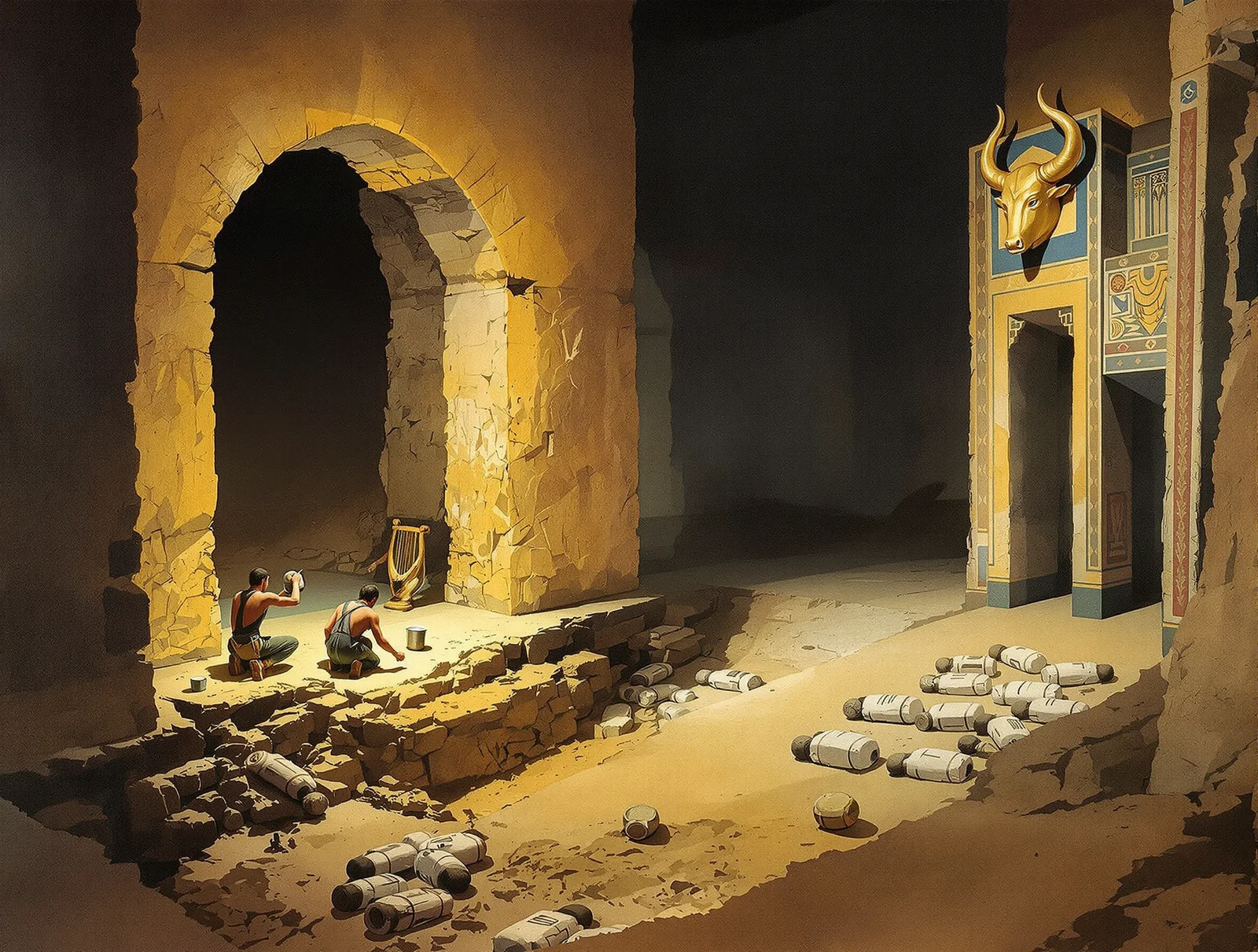
Art direction
CHAPTER 15 — THE FRETTED VOICE: MOUNTAIN DULCIMER AND SIMPLE LUTE
The lyre gives each pitch its own string; the fretted instrument gives each string many pitches. A fret is a mechanical guarantee: press anywhere behind it and the speaking length — saddle to fret — is fixed. The cost of that guarantee is mathematics, and the mathematics is the cleanest in lutherie.
The rule of 18, perfected to 17.817
Each equal-tempered semitone shortens the speaking length by the factor 2^(−1/12) = 0.943874. The distance from any fret (or the nut) to the next fret is therefore the remaining speaking length times (1 − 0.943874) = 0.0561256 — that is, the remaining length divided by 17.817 (precisely 1 ÷ (1 − 2^(−1/12)) = 17.8172). The old shops divided by 18 — the "rule of 18" — which sets each fret a hair closer to the nut, leaving the stopped note fractionally flat and quietly pre-compensating for the sharpening that comes from pressing the string down. Equivalently, and better for layout, measure every fret from the nut at one stroke:
dₙ = L × (1 − 2^(−n/12)), where L is the scale length and n the fret number.
Specification Table 15-1 — Fret positions, 650 mm scale (distances from nut face)
| Fret | mm from nut | Dulcimer fret | Fret | mm from nut | Dulcimer fret |
|---|---|---|---|---|---|
| 1 | 36.48 | — | 13 | 343.24 | — |
| 2 | 70.92 | 1 | 14 | 360.46 | 8 |
| 3 | 103.42 | — | 15 | 376.71 | — |
| 4 | 134.09 | 2 | 16 | 392.05 | 9 |
| 5 | 163.05 | 3 | 17 | 406.53 | 10 |
| 6 | 190.38 | — | 18 | 420.19 | — |
| 7 | 216.18 | 4 | 19 | 433.09 | 11 |
| 8 | 240.53 | — | 20 | 445.26 | — |
| 9 | 263.51 | 5 | 21 | 456.75 | 12 |
| 10 | 285.20 | 6 | 22 | 467.60 | 13 |
| 11 | 305.67 | 6½ | 23 | 477.84 | 13½ |
| 12 | 325.00 | 7 | 24 | 487.50 | 14 |
One table, two instruments. Place all 24 positions and you have a chromatic lute fingerboard. Place only the marked subset and you have the mountain dulcimer's diatonic fretboard, which plays a major-type scale up the melody string with no wrong notes available — the 6½ and 13½ frets are the traditional additions that admit the major seventh. Note the self-checks: fret 12 falls at exactly L/2 (the octave you proved on the monochord), fret 24 at exactly 3L/4 of travel.
Scale length itself is a design lever: tension grows with the square of scale length at a given pitch and gauge (Chapter 16), so a 650 mm dulcimer strung like a 580 mm one pulls about 26% harder. Longer scales buy volume and clarity; shorter scales buy slack, bendable strings and gentler builds.
Art direction
Nut, saddle, and compensation
The nut (bone or hard maple, slotted with fine files) defines the open string's end; the saddle defines the other. Cut nut slots so each open string clears the first fret by 0.25–0.50 mm, finer on trebles — the test is to fret at the third fret and look for a whisker of daylight (~0.1 mm) over the first.
Pressing a string stretches it and sharpens the note, worst on stiff, high-action strings. Compensate by setting the saddle back from the theoretical scale length: about 1.5 mm on light steel trebles grading to 3 mm on wound basses; 1–2 mm suffices for nylon or gut. Verify by comparing the 12th-fret harmonic (touch, don't press) to the 12th-fret fretted note; if the fretted note is sharp, the saddle moves back.
Protocol 15-A — Action setup
- String to pitch and let the instrument settle 24 hours.
- Check relief: straightedge on the frets; aim for 0.1–0.25 mm of bow at mid-scale. A fretboard planed dead flat under no load usually relaxes to this under tension.
- Level any fret that rocks a short straightedge spanning three frets; crown and polish it.
- Set nut slot depths as above — nut first, always.
- Set string height by shaving the saddle: at the 12th fret, 1.6 mm treble to 2.4 mm bass for steel; 2.5–3.5 mm for gut and nylon; for the dulcimer measure at fret 7 (its octave) and start at 2.0–3.0 mm.
- Re-check intonation at the 12th/7th fret; adjust saddle crest fore-and-aft with a file.
- Play every note on every string at full attack. Setup is finished when nothing buzzes at your loudest and nothing fights you at your quietest.
Fretwire is 18% nickel-silver in the recovered standard, seated in sawn slots matched to the tang (Vol I — The Artificer's Codex, wire and small-stock drawing); the elder alternative, double-looped tied gut frets, suits the lute and forgives the first-time builder, since a mistied fret slides rather than scars.
Art direction
CHAPTER 16 — STRINGS: GUT, WIRE, AND POLYMER
Everything above is furniture for the string. The string itself obeys one law — Mersenne's — and the Practitioner who can wield it designs string sets from first principles instead of buying superstition.
f = (1/2L) × √(T/μ) → T = 4 L² f² μ, with μ = ρ × (πd²/4)
where f is frequency (Hz), L speaking length (m), T tension (N), μ mass per unit length (kg/m), ρ material density (kg/m³), and d diameter (m).
Specification Table 16-1 — String materials
| Material | Density ρ (kg/m³) | Breaking stress (MPa, typical) | Character and use |
|---|---|---|---|
| Sheep/lamb gut | ~1,300 | 300–450 | The elder standard; warm, complex; humidity-sensitive |
| Silk (twisted) | ~1,300 | 400–600 | The eastern parallel tradition; supple basses |
| High-carbon steel music wire | 7,850 | 2,400–3,000 (finer = stronger) | Bright, loud, stable; needs robust structure |
| Brass wire (70/30) | 8,530 | 700–900 | Soft early-wire sound; low pitch ceiling |
| Phosphor bronze (winding/plain) | 8,860 | 900–1,100 | Standard winding over steel cores |
| Nylon monofilament | 1,040–1,140 | 550–750 | Stable gut substitute; 20th-century consolidation material |
| Fluorocarbon (PVDF) | ~1,780 | 800–1,000 | Denser than nylon: thinner string, same tension |
| Silver (winding) | 10,490 | — | Dense winding for short bass strings |
Making gut
Gut stringmaking is leatherwork's most refined cousin; the raw-material protocols cross-bind to Vol XXIV (leatherworker's decree). In outline:
Protocol 16-A — Gut strings: (1) Take the small intestine of sheep or lamb fresh at slaughter; flush clean immediately. (2) Soak in cold water 12–24 h to loosen. (3) On the beam, scrape away the outer membranes and inner mucosa, keeping the strong submucosal layer. (4) Slit each gut into ribbons. (5) Steep the ribbons in a weak alkaline bath — wood-ash lye well diluted — refreshed daily for several days, scraping gently between baths until they are pale, slick, and even. (6) Select ribbons and combine by count: two ribbons twist to roughly 0.45 mm, three or four to ~0.65 mm, six or seven toward 1.0 mm, a dozen and more for basses. (7) Twist wet on the wheel — low twist for trebles (tensile strength), high twist for basses (flexibility, lower stiffness). (8) Bleach and sweeten overnight in a closed cabinet over burning sulfur. (9) Dry under tension for days; re-twist as they dry. (10) Polish to final gauge with fine abrasive (the old shops used horsetail rush), checking with a micrometer at five stations; oil lightly. A string that varies more than ±0.02 mm along its length is false — it beats against itself and will not tune. Cut it into fret gut and make the next one better.
Wire strings are the Artificer's gift: drawn down through successive plates (Vol I — The Artificer's Codex, drawplate protocols) from iron, brass, or modern high-carbon steel; wound strings add a close helix of bronze or silver over a core, adding mass without stiffness, which is the entire secret of a bass string that still rings true. Gauge wound strings by weighing a metered length: μ (kg/m) = grams per meter ÷ 1,000.
The worked example
Required: the tension of a 0.30 mm plain steel string, 650 mm scale, tuned to e′ = 329.63 Hz.
- Cross-section: A = πd²/4 = π × (3.0 × 10⁻⁴ m)² / 4 = 7.069 × 10⁻⁸ m².
- Mass per length: μ = ρA = 7,850 × 7.069 × 10⁻⁸ = 5.549 × 10⁻⁴ kg/m.
- Tension: T = 4L²f²μ = 4 × (0.650)² × (329.63)² × 5.549 × 10⁻⁴ = 4 × 0.4225 × 108,656 × 5.549 × 10⁻⁴ ≈ 101.9 N ≈ 10.4 kgf.
- Working stress: σ = T/A = 101.9 ÷ 7.069 × 10⁻⁸ ≈ 1,440 MPa — about half this wire's ~2,800 MPa breaking stress. Sound design.
Design targets, per string: gut lyre or lute 2.5–4 kgf; nylon/gut guitar-class 5.5–8 kgf; steel dulcimer 4–7 kgf; steel flat-top guitar-class 7–12 kgf. Sum the set and respect the total: six steel strings can lay 70–80 kgf across a soundboard, which is why Chapter 12's bracing words were not decoration.
The Critical Insight: Rearranged at the breaking point, Mersenne's law gives f_max = (1/2L) × √(σ_break/ρ) — the diameter cancels. No gauge of a given material, at a given scale length, can exceed the pitch its stress-to-density ratio allows: about 460 Hz for good steel at 650 mm, about 415 Hz for gut. You cannot buy your way past this with a thinner string; you can only shorten the scale or change the material. Every broken treble in history is this equation, enforced.
Art direction
CHAPTER 17 — SETUP, VOICING, AND REPAIR: KEEPING THE DECREE SPEAKING
An instrument leaves the bench twice: once when you finish it, and every day after, when the weather re-finishes it. This chapter is the standing maintenance order.
Voicing
Voicing is the deliberate tuning of the body. Before assembly, flex every plate and listen to its tap tone, held at a node between thumb and finger and struck with a knuckle; thin a spruce top in passes (2.4–3.0 mm is the working band for guitar-class plates, thicker toward the bridge) until the tap rings rather than thuds, then shave braces — always from their ends, never their peaks — to free the ring further. The recovered laboratory method is Chladni's (Vol XX — cymatics and physics): vibrate the free plate, dust it with tea or sand, and read the nodal figures; symmetrical, well-spaced figures mark a plate that bends evenly in both senses. On the closed box, use your monochord as a probe: sweep its bridge slowly beside the soundhole and feel for the pitches at which the body blooms in sympathy — a healthy guitar-class box breathes its main air resonance near 95–105 Hz, with the main top resonance most of an octave above. Log these signatures when the instrument is new; they are its baseline vital signs.
Specification Table 17-1 — Fault diagnosis
| Symptom | Likely cause | Confirming test | Remedy |
|---|---|---|---|
| Buzz on open strings only | Nut slots too deep; or back-bow | Fret at 1: buzz gone → nut | Shim and refile slot, or new nut; add relief |
| Buzz in one fret region | High or unseated fret; too little relief | Rock a 3-fret straightedge | Seat, level, crown, polish |
| Buzz everywhere in dry season | Top has flattened; action fallen | Hygrometer; action history | Humidify to 45% RH; raise saddle |
| Rattle on certain notes, body-borne | Loose brace, cleat, or fitting | Tap-test top and back; grip fittings | Reglue brace; tighten hardware |
| Sitar-like sizzle, one string | Flat or chipped nut/saddle crest | Loupe the contact point | Reshape to a single clean takeoff edge |
| Note swells, stutters, "howls" (wolf) | String resonance fighting a strong body mode | Play chromatically; wolf rides one pitch even across strings | Add mass at the saddle-side afterlength; stiffen locally; shift the offending mode |
| Grain-line crack in plate | Desiccation below ~35% RH; impact | Crack closes when humidified? | Humidify days first, then glue and cleat (Protocol 17-A) |
| Open seam at rim | Same, or shock | Knife blade slips in | Work hot hide glue in; clamp overnight |
| Bridge lifting | Over-tension, heat, starved joint | 0.05 mm feeler under wings | Remove clean, re-glue full-contact |
| Will not hold pitch | String slipping at pin, ring, or tie; false string | Mark string at nut; watch the mark | Re-tie, re-seat; replace false strings |
The wolf deserves one more sentence, because it frightens Practitioners into bad surgery: it is not a defect but an excess of agreement — a body resonance so strong it trades energy back and forth with the string instead of radiating it smoothly. You do not kill a wolf; you relocate it to a pitch the music rarely sustains.
Protocol 17-A — Crack repair, soundboard
- Rehumidify the whole instrument at 45–55% RH for 2–4 days; most dryness cracks close to a hairline.
- Work hot hide glue (60–63°C, fresh batch) into the crack, flexing gently; wipe squeeze-out with a damp cloth.
- Clamp or magnet-caul the crack level and leave overnight.
- Cleat the underside: spruce diamonds ~12 × 8 × 2 mm, grain aligned with the soundboard's grain, spaced every 40–50 mm along the line.
- Touch up finish; log the repair, the date, and the RH that caused it.
Hide glue is the standard of this Codex for one reason above tone: reversibility. Every joint it makes, your successor can unmake with heat and moisture. Repairability is transmission; the instrument that cannot be opened cannot be carried across generations, and carrying across generations is the entire business of the dup šimati.
Your Commitment: A hygrometer beside every instrument, 40–50% relative humidity, and a written log of resonances, repairs, and string formulas. The luthier's bench is an archive that happens to make sawdust.
Art direction
The wood is chosen, the ratios are in your ear, the lyre and the fretted voice stand strung with strings you can now make and measure, and the bench is ordered against the weather. The string decree is the patient one: nothing in this sub-volume happens quickly, and nothing in it is wasted. Sub-Volume IV takes up the impatient decrees — the drums, whose makers measure in days what the luthier measures in years, and whose voice the temples ranked equal to the bull.
The Gusilim is carried. Let the wood speak.
SUB-VOLUME IV — THE DRUM-MAKER'S ART: PERCUSSION
ME 61 · li-li-ìs · THE LILIS (KETTLEDRUM OF THE TEMPLE)
The decree of the bronze bowl and the bull's voice. The Lilis grants the right to sound the deep drum of the sanctuary — the instrument the old temples did not consider built until a god had been persuaded to live in it.ME 62 · ùb · THE UB (SMALL FRAME DRUM)
The decree of the hoop and the hand. The Ub grants the portable pulse: a ring of bent wood, a skin, and a heartbeat that travels wherever a Practitioner walks.ME 64 · a-la · THE ALA (GREAT DRUM)
The decree of the standing thunder. The Ala grants the drum that is architecture — the great shell whose voice is felt in the chest before it is heard in the ear, the timekeeper of gates, processions, and assemblies.
Three decrees, one craft. The string decree of Sub-Volume III asks years of you — seasoned wood, slow glue, patient gut. The drum decrees ask days, and that asymmetry is by design: rhythm is the first musical technology a recovering community needs and the first it can have. A competent Practitioner with a hide, a hoop, and this sub-volume is making communal time within a week. The chapters run in build order: the skin that all membrane drums share; the frame drum you can carry; the great drum that anchors a settlement; the kettledrum that anchored a civilization; the idiophones that need no skin at all; and finally the rhythmic canon — the patterns and the practice method — because a drum without a trained pulse behind it is furniture.
CHAPTER 18 — THE SKIN: FROM RAW HIDE TO DRUMHEAD
Every membrane drum begins as an animal's hide, and the drum-maker's first discipline is the leatherworker's — cross-bound throughout to Vol XXIV (The Maker's Codex, ME 45 leatherwork protocols). Understand the one great distinction first: rawhide is not leather. Leather is tanned — chemically converted so it stays supple when wet and dry. A drumhead must do the opposite: dry hard, taut, and resonant. So the drum-maker takes the hide almost to leather — cleaned, dehaired, degreased — and then stops, stretching it to dry as pure collagen sheet.
Protocol 18-A — Rawhide from the raw hide
- Flay clean and start cold. Work the hide off with as few knife touches as possible; every nick is a future split. Process within a day, or hold the hide cold (<15°C) and wet; warmth breeds the bacteria that slip hair and rot grain unevenly.
- Flesh. Drape the hide flesh-side up over a smooth beam and push off every trace of fat, meat, and membrane with a dull two-handled blade. Fat left now is grease in your drum forever.
- Wash and soak in clean cool water, 24–48 h, changing water twice, until the hide is uniformly soft and relaxed.
- Buck in wood-ash lye. Make the dehairing liquor either from sifted hardwood ash leached with water and strained, or — more controllably — hydrated lime at ~50 g per liter. The bath should feel slick between gloved fingers. Submerge the hide fully, weighted, and stir twice daily.
- Wait for slip, 3–10 days at 10–18°C. Test daily after day three: when a firm tug pulls hair free in clumps from the neck (the slowest area), it is ready. Do not overshoot; long alkaline soaks swell and weaken the grain you intend to strike.
- Dehair. Over the beam, push the hair off with the dull blade, working downhill with the lie of the hair. Scud the grain afterward — a firm scrape that ejects residual lye-soap, pigment, and root debris.
- Rinse long — 24–48 h in changing water — then delime in a mildly acid bath (a splash of vinegar in clean water, ~pH 5) for an hour, and rinse again. A hide that still feels soapy is still alkaline.
- Stretch to dry. Lace the hide into a stout frame: punch holes 25 mm in from the edge every 75–100 mm, lace with cord in opposing pulls, and tension evenly until the sheet is drum-flat. Dry in shade with moving air — never sun, never stove. It will dry to a translucent, rattling panel.
- Store dry and flat, away from insects (cedar shavings serve), labeled by species, thickness, and date. Rehydrate 30 min to 3 h in cool water when a drum calls for it.
Safety standing order: lye and lime baths are caustic. Eyes covered, hands gloved, vessels of wood, plastic, or stainless steel — never aluminum, which the alkali eats. Neutralize spills with vinegar. The full caustics handling protocol is Vol XXIV's; obey it here.
Specification Table 18-1 — Drumhead species selection
| Hide | Finished thickness (mm) | Best use | Voice |
|---|---|---|---|
| Goat | 0.5–0.9 | Frame drums, small kettles, lyre soundboards | Bright, articulate, fast |
| Sheep/lamb | 0.4–0.7 | Quiet frame drums, children's drums | Soft, warm, low projection |
| Calf | 0.6–1.1 | Kettledrums, fine frame drums, snares | Even, refined, the classic concert skin |
| Deer | 0.5–1.0 | Hand drums, rattles | Elastic, alive, weather-restless |
| Cow (mature) | 1.2–3.0 | Great drums, bass heads; thongs and lacing | Deep, slow, enormous headroom |
| Water buffalo / bull | 1.5–3.5 | The largest shells, temple-class basses | Darkest fundamentals, demands high tension |
| Horse | 0.8–1.5 | Steppe-tradition shaman drums | Dry, present midrange |
Thickness beats species: a thin cowhide plays brighter than a thick goatskin. Split or sand heavy hides from the flesh side only; the grain face is the drum's wearing surface and its tone.
Art direction
CHAPTER 19 — THE UB: THE FRAME DRUM
The ub of the decree list is the small drum of the hand and the procession — in modern field terms, a frame drum: a shallow wooden hoop, wider than it is deep, carrying one head. It is the most efficient instrument in this Codex: an afternoon of bending, a day of heading, a lifetime of use.
The hoop
Target dimensions for a first build: diameter 400 mm, depth 70 mm, wall 6 mm (finished). Two roads lead there:
Protocol 19-A — Steam-bent hoop: (1) Rive or saw a bending strip of ash, oak, elm, or hickory — straight-grained, air-dried to 15–20% MC (kiln-dry wood bends badly), 3.2 mm × 70 mm × 1,450 mm (circumference π × 400 ≈ 1,257 mm, plus 190 mm for the scarf and trim). (2) Steam at a rolling 100°C — about 20 minutes for stock this thin; the old rule of one hour per 25 mm of thickness scales down kindly (steam generation and safe small-boiler practice: Vol IX — Energy). (3) Bend immediately and briskly around a 394 mm form (the hoop springs back slightly), strap-clamped, ends overlapping. (4) Dry on the form one week. (5) Cut the overlap into a tapered scarf joint, 1:10 or longer, glue (hot hide glue or waterproof aliphatic), clamp full-contact, and dress smooth. Two or three copper rivets through the scarf are traditional insurance. (6) Round both rims; the bearing edge that meets the head gets a smooth 3 mm round-over and a wax polish.
Protocol 19-B — Laminated hoop (no steam): bend three plies of 1.5 mm stock cold or with gentle heat around the same form, gluing all plies in one go, scarfs staggered around the circle. Laminated hoops are stiffer and stay rounder; purists hear a hair less "give." Build whichever your stock allows.
Heading the drum: three attachment systems
- Tacked (the workshop standard): rehydrate a 0.5–0.8 mm goat or calf head 30–60 min, center it over the rim, and fix with copper or brass tacks at 25 mm spacing set in two staggered rows, pulling opposing pairs as you go — north, south, east, west, then the diagonals, like truing a wheel. Trim the apron below the tack line.
- Edge-laced: punch an even count of holes (16 suits a 400 mm head) 15 mm in from the head's edge and zigzag a rawhide thong from head holes to a lacing ring or hoop seated below the drum's rim. Fully re-tensionable; the choice for damp climates.
- Spoke-laced (the open-backed hand drum): a long thong runs from each head hole across the open back to a small central ring, forming radiating spokes that double as the handgrip. Lace opposing pairs, tightening in thirds — never finish one spoke while its opposite hangs slack, or the head walks off center.
Dry the headed drum slowly, 24–48 h, away from any heat source. A head dried fast over a stove tightens spectacularly and splits within the month.
Tuning by weather, water, and warmth
A rawhide head is a hygrometer you can play. Moisture loosens it and drops the pitch; warmth and dry air tighten and raise it. The player's controls are ancient and exact: to raise pitch, warm the head evenly — hands flat upon it, body heat first, then cautious minutes near (never over) a fire, keeping the skin always touchable; rawhide that passes ~60°C cooks and goes brittle. To lower pitch, mist the head lightly or wipe with a damp cloth and wait two minutes. A laced drum adds the third control: take up the thong a hole at a time, evenly, opposite pairs. An optional gut snare — one or two strands of twisted gut stretched across the inside of the head — adds a buzzing partial that carries over wind and distance, the elder long-range signal voice.
The Critical Insight: Players who fight their drum's weather lose; players who schedule it win. Tune the frame drum to its working pitch in the place it will be played, half an hour before it is needed, and it will hold through the work. The drum is not unstable — it is honest about the air.
Art direction
CHAPTER 20 — THE ALA: THE GREAT DRUM
Temple reliefs of the late third millennium show it plainly: a drum standing chest-high, two players facing each other across the head, the instrument as much architecture as object. The ala is the settlement's drum — gate signal, procession anchor, festival floor. Its engineering problem is stated in one line: a big head at real tension carries tonnes of force, and the shell must not care.
The shell: two constructions
Protocol 20-A — Stave shell (the cooper's road). For a shell of 800 mm head diameter, 900 mm tall: (1) Mill 16 staves of white oak or walnut, each ~165 mm wide at the heads, slightly narrower at the waist for a gentle barrel curve. (2) Joint each stave edge to the bevel angle θ = 180° ÷ n = 11.25° for 16 staves; check pairs against a flat board — gaps at the inner face mean too much angle, at the outer face too little. (3) Dry-ring the circle inside strap clamps or a rope-and-windlass; adjust until every joint closes dark. (4) Glue up in halves, then join the halves. (5) Bind with driven hoops of steam-bent ash or riveted iron band (smithing of bands and rings: Vol I — The Artificer's Codex), two per end, one at the waist. (6) Fair the rims dead-flat and round the bearing edges.
Protocol 20-B — Hollowed shell (the elder road). A single light log — poplar, willow, cottonwood — bored, then hollowed by adze and gouge, or by the fire method: controlled char of the interior, scrape back to bright wood, char again (ember management and draft control: Vol IX — Energy). Work to a wall of 20–30 mm, even everywhere; uneven walls crack on the first dry season. Season the hollowed blank slowly, ends waxed, for a full cycle of weather before heading.
Heading and tension: rope against iron
Two heads, one at each end, each lapped around its own flesh hoop (a slim rawhide-wrapped ring), with a stouter counterhoop bearing down on each lap. The counterhoops are pulled toward each other either by a continuous zigzag of rope (W- or Y-lacing, with sliding leather buffs to summarize slack) or by iron hardware — threaded rods with eyes and nuts spaced around the shell (Vol I for the smithing). Rope is field-repairable, self-indicating, and beautiful; iron is fast, fine-grained in adjustment, and indifferent to rain. The Codex teaches rope first because rope teaches load.
The tension mathematics
A circular membrane's modes are set by the zeros of Bessel functions — the drum's equivalent of the string's integer harmonics, except that they are not integers, which is why a drum thuds where a string sings:
f₍mn₎ = (j₍mn₎ ÷ 2πa) × √(T/σ)
where a is head radius (m), T membrane tension (N per meter of edge), σ areal density (kg/m²), and j₍mn₎ the Bessel zero for the mode. Relative to the fundamental (j₀₁ = 2.405), the family runs:
| Mode | j₍mn₎ | f ÷ f₀₁ |
|---|---|---|
| 01 (fundamental, all-up-all-down) | 2.405 | 1.000 |
| 11 (rocking, one nodal diameter) | 3.832 | 1.593 |
| 21 | 5.136 | 2.136 |
| 02 | 5.520 | 2.295 |
| 31 | 6.380 | 2.653 |
| 12 | 7.016 | 2.917 |
Worked example — specifying the rope. Take the 800 mm ala head (a = 0.400 m), cow rawhide 1.2 mm thick at ~1,150 kg/m³, so σ = 1.38 kg/m². Target a fundamental of 55 Hz:
- T = σ × (2πa·f ÷ j₀₁)² = 1.38 × (2π × 0.400 × 55 ÷ 2.405)² = 1.38 × (57.5)² ≈ 4,560 N/m.
- Total rim load = T × circumference = 4,560 × 2.513 ≈ 11,460 N — over a tonne-force standing quietly in the lacing.
- With 24 rope legs, each carries ≈ 480 N. Specify 8 mm hemp or manila (breaking force ≈ 6 kN): a safety factor better than 10 on the legs and comfortable margin at every knot and turn.
- The same arithmetic, run backward, is the tuner's law: pitch rises with the square root of tension, so a semitone up (×1.0595 in frequency) costs ×1.122 in tension — take up every leg, evenly, by the same small amount.
The Critical Insight: The inharmonic Bessel family is the great drum's feature. Struck dead center, the symmetric 01 mode dominates: a pitch-dark thud that reads as pure pulse. Struck a hand's breadth in from the rim, the nodal-diameter modes (11, 21, 31) take the energy: a ringing, almost-pitched bloom. One head, two instruments; the player chooses with the landing point of the beater.
Low-frequency physics sets the ala's size: at 55 Hz the wavelength in air is over six meters, so a small source radiates it poorly — the great head and the shell-as-baffle exist to couple that slow wave into the world, and a soft, heavy beater (felt- or leather-wrapped mass) feeds the fundamental while a hard stick spends the same blow on the ringing crown. Two heads couple through the trapped air into paired modes, fattening the sustain; lace one head slightly slack of the other and the beat between them gives the gate-drum its breathing roll.
Art direction
Art direction
CHAPTER 21 — THE LILIS: THE KETTLEDRUM OF THE TEMPLE
Set a membrane over a closed bowl and the drum changes species. The kettle does two things at once: its trapped air stiffens and spends the symmetric 01 mode (raising it, damping it to a short thump), and it loads and lowers the nodal-diameter modes — and with the bowl proportioned well, that loading slides the 11-family into very nearly harmonic alignment. Measured on the concert descendants of the lilis, the series runs about 1.00 : 1.50 : 1.99 : 2.44 : 2.89 — within a hair of 2 : 3 : 4 : 5 : 6 on a phantom fundamental an octave below the principal. The ear, offered that ladder, does what it always does with harmonic series: it hears a note. This is the whole secret of the kettledrum, and the reason the temples ranked the lilis with the gods' own voices: it is the one drum that sings a true pitch.
Building the bowl
- Hammered metal (the canonical lilissu was bronze): raise a copper or bronze hemisphere, 400–600 mm across, from sheet over stakes — raising, planishing, and annealing schedules are Vol I — The Artificer's Codex; the drum-maker's additions are a rolled or wired rim to carry the head's bearing, and a small vent hole at the bowl's bottom so the head does not fight sealed static pressure with every weather change.
- Fired clay: a thick-walled ceramic kettle, rim ground flat and even; heavier-voiced, fragile, and the most accessible road to a first lilis.
- Turned or carved wood: a glued bowl-blank hollowed to a 15–20 mm wall; warmest attack, least ring.
Proportion guidance: bowl depth between one-third and one-half of diameter. Deeper bowls darken and slow the voice; shallow pans brighten it and starve the lowest mode. The bowl's volume is a tuning element of the harmonic alignment itself — log what you build, and when one sings, copy it without cleverness.
Heading and pitch control
Head the kettle with calf or goat (0.6–1.0 mm), lapped around a flesh hoop sized just over the bowl rim, counterhoop above, drawn down by six to eight evenly spaced screw hooks or T-handled rods riding a ring or lugs below the rim (rope to a base ring serves a ceramic kettle that cannot take fittings). Tune in opposite pairs, quarter-turns, checking pitch at each hook by tapping 60 mm in from the rim — the head must answer the same pitch at every station before it can answer any pitch at all. A well-built lilis commands a range of about a fourth; past that, slack heads flap and over-drawn heads choke. Strike point: a hand's breadth in from the rim — about a quarter of the way across — to feed the singing 11 mode; the dead center is for the rare ritual thud, since it excites only the spent 01.
CANON SIDEBAR — THE KALÛ AND THE BULL: THE LILISSU RITE. The drum's own manual survives. Tablets copied at Uruk in the Seleucid centuries — late copies of a far older temple procedure, carried across the Reset line by the scribal chain the Historian's volume maps (Vol XVI — The Historian's Codex) — prescribe how the temple's bronze lilissu receives a new head. The officiant is the kalû (Sumerian gala), the lamentation-priest whose guild owned the deep drums and the Emesal-dialect laments sung over them. The texts specify the donor: a black bull, flawless, horns and hooves intact, never struck by stick or goad — an animal that has never learned to flinch. On a favorable day it is led into the workshop precinct; reed mats are laid; offerings are set for the craft-gods, Lumha among them. Then the detail that stops every Practitioner who reads it: the priest bends and whispers into the bull's ears through a reed tube — into the right ear, that it is the exalted bull of heaven's pasture; into the left, the appointment itself: that its hide will serve the great gods as the lilissu, into far-off days. The bull is slaughtered; the heart is burned in offering before the drum; the hide is taken whole, cleaned and dehaired, dressed with flour, wine, fat, alum, and gallnut, and drawn over the bronze kettle — the tablets even commit the lacing sinew, taken from the left shoulder. The carcass is wrapped in red cloth and buried with libations, facing the sunset. Thereafter the drum is not a drum: when the moon darkened in eclipse, it was the lilissu that sounded through the night beside the wailing of the kalû, guarding the moon-god while he was weak. Read the rite as this Codex reads every recovered protocol — as engineering wearing vestments. It is donor selection (a mature, unscarred, unstressed hide), full-traceability sourcing, chemical specification of the dressing, and the binding of the work to an office that must answer for it. The old makers wrapped their quality assurance in awe. The awe kept the standard alive for two thousand years; the standard is now yours to keep without it — or with it, as your community decrees.
Art direction
Art direction
CHAPTER 22 — IDIOPHONES: SLIT DRUMS, RATTLES, AND BELLS
The idiophone needs no skin and no string: the body is the voice. For a recovering community this matters more than it sounds — idiophones are the percussion that no drought, moth, or humid month can silence.
The slit drum
Take a sound log or a glued box, and cut into its top face an H-shaped slit (or a pair of them). Each leg of the H frees a tongue — a cantilevered plate of wood that rings at its own pitch when struck. The tongue is a beam, and a beam's pitch obeys f ∝ t/L² (thickness over length squared) scaled by √(E/ρ) of the species — so the maker's controls are:
| To move pitch | Operation | Magnitude |
|---|---|---|
| Down a semitone | Lengthen the slit (L up ~3%) | f × 0.944 |
| Down a semitone | Thin the tongue near its root (t down ~5%) | f × 0.944 |
| Up | Remove mass near the tongue's tip, or shorten it | by trial, small cuts |
Cut both tongues of the H to different lengths and one log speaks two pitches — the male-and-female voices of the great signal gongs, which in the elder forest networks carried drummed speech between settlements at the pace of running water. A bench-scale build: a 450 × 200 × 150 mm hardwood box, top plate 12 mm, six tongues sawn to a pentatonic set, tuned by the table above, played with rubber- or cord-wrapped mallets.
Rattles
The vessel rattle is the oldest instrument the excavations hand us in quantity — hollow clay forms with fired pellets sealed inside, common finds across Mesopotamian sites, child-sized and temple-sized alike. Field builds: (1) clay — a hollow form, a spoonful of dry clay pellets fired separately, sealed in before the final join, fired whole; (2) hide — two wet rawhide discs laced or sewn around a willow hoop or bent handle, filled with seeds or pebbles, shrinking taut as they dry; (3) frame jingles — discs of hammered copper or bronze loosely riveted in a wooden frame (small-stock work: Vol I). Voice scales with pellet hardness against shell hardness: seeds whisper, fired clay rattles, bronze on bronze flashes.
Bells
The bell is the Artificer's instrument lent to the musician: a cast object whose alloy and profile are both acoustical specifications. The casting itself — pattern, mold, pour, fettling — belongs to Vol I — The Artificer's Codex; what the Musician's Codex adds is the metallurgy and geometry of ring.
Specification Table 22-1 — Bronze for sounding service
| Alloy | Cu | Sn | Service | Notes |
|---|---|---|---|---|
| Bell metal | 78 | 22 | Tower, temple, and hand bells | Maximum hardness and ring, lowest damping; brittle — cast only, never struck on the rim's edge |
| High-tin forging bronze ("B20") | 80 | 20 | Gongs, cymbals | Hot-forged and quenched, then hammered; the broad wash voice |
| Low-tin bronze ("B8") | 92 | 8 | Bright small cymbals, jingles | Workable cold; cheaper, brighter, thinner voice |
Tin is the ring. As tin rises toward 22%, the bronze grows hard and elastically efficient — internal damping falls and the strike rings on — but it pays in brittleness, which is why bell metal is poured, not wrought. A true bell's voice is a chord of named partials, tuned by its wall profile: the hum (an octave below the named note), the prime, the tierce (a minor third above the prime — the melancholy in every bell), the quint, and the nominal (the octave, which the ear takes as the bell's pitch). The founder tunes after casting by cutting metal from zones inside the wall, each zone governing its own partial — and the cut only flattens, never sharpens, so the bell is cast slightly sharp and tuned down into truth. Begin with cast hand bells of 100–200 mm; a bell that size forgives the learning that a tonne of temple bronze does not.
Art direction
CHAPTER 23 — THE RHYTHMIC CANON: PATTERNS, POLYRHYTHM, AND PRACTICE
The instruments are built. This closing chapter installs their operating system. The Codex notates rhythm in box notation: time drawn as a row of equal boxes, one per pulse, read left to right and repeating. A mark in a box is a stroke; a dot is silence that counts. The frame-drum stroke alphabet: B** — bass, palm near center; T — tone, fingers at the rim; S — slap, accented rim stroke; ·** — rest. Box notation hides nothing: where the marks fall is the rhythm, and any Practitioner who can count boxes can read it at sight.
The core cycles
Cycle of eight — the walking backbone. Even pulse, weighted alternation; the pattern every other pattern stands on:
pulse:  1 2 3 4 5 6 7 8
        B · T · B · T ·
The long-long-short cell (3+3+2). Eight pulses cut unevenly — the oldest swing in the world, found wherever processions outran their own footsteps:
pulse:  1 2 3 4 5 6 7 8
        B · · B · · T ·
The twelve-pulse bell. Twelve pulses cut 2+2+1+2+2+2+1 — the traditional timeline cycle that organizes ensemble music across half the recovering world, here struck on the slit drum or a 78/22 hand bell:
pulse:  1 2 3 4 5 6 7 8 9 10 11 12
        X · X · X X · X · X  ·  X
Building polyrhythm: the loom method
A polyrhythm is two pulse-streams sharing one cycle. To construct p : q, draw a grid of the least common multiple of p and q, then mark each voice at its own even spacing.
3 : 2 — LCM is 6. Voice A strikes every 2 boxes (three strokes); voice B every 3 boxes (two strokes):
pulse:  1 2 3 4 5 6
A (3):  X · X · X ·
B (2):  X · · X · ·
both:   X · X X X ·
Count the composite aloud — "ONE-two-THREE-FOUR-FIVE-six" with strokes on 1, 3, 4, 5 — until the two-against-three stops being arithmetic and becomes a shape, a lilt your hands fall into.
4 : 3 — LCM is 12. Voice A every 3 boxes (four strokes); voice B every 4 boxes (three strokes):
pulse:  1 2 3 4 5 6 7 8 9 10 11 12
A (4):  X · · X · · X · · X  ·  ·
B (3):  X · · · X · · · X ·  ·  ·
both:   X · · X X · X · X X  ·  ·
Every polyrhythm in the literature is this loom with different threads. Note what the grids reveal: both voices meet only at box one — the downbeat is the treaty point of the cycle — and the composite of any p : q is itself just another box pattern, learnable by any drummer who never heard the word "polyrhythm."
Protocol 23-A — The daily pulse practice
- Count the grid aloud before touching the drum: numbers on every box, strokes spoken louder. The voice is the first drum.
- Walk and clap: feet keep the slow voice, hands the fast one. 3:2 at walking pace, ten minutes, both assignments (feet-2/hands-3, then swap).
- Table drumming: both hands on the bench, 3:2 then 4:3, leading hand swapped daily. Slow is the discipline — at first no faster than one box per second.
- Transfer to the drum with the stroke alphabet: assign B to the slow voice, T to the fast, S to the meeting point at box one.
- Displace: start the same pattern from box 3, then box 5. The pattern that survives displacement is truly learned; the one that collapses was memorized, not understood.
- Ladder the tempo: five steps from sixty boxes a minute upward, advancing one step only when a full minute passes clean. The pendulum protocol of Vol XX gives you a timekeeper if no clock survives in your kit; your own resting heartbeat, near the bottom of that range, is the timekeeper that always survives.
- Close with call-and-response: a partner (or your own recording layer, where the toolchain of Vol IX's powered workshops exists) strikes four boxes, you answer four. Rhythm is a language; converse daily.
The Critical Insight: Melody can be carried by one specialist, but rhythm is the one musical commons — the layer at which an untrained crowd becomes a single instrument in minutes. This is why the drum decrees sit at the end of the ME sequence like a keystone: ME 61, 62, and 64 are, in operational terms, the decrees of synchronization, and a community that drums together has rebuilt, at zero material cost, the social technology that raised every megalith on the Vol XVI timeline.
Your Commitment: Twenty minutes of Protocol 23-A daily, beginning the day your first ub dries. The builds in this sub-volume took your hands a season; the pulse takes a lifetime, and pays the whole way.
Art direction
The three drum decrees close where music begins: skin, wood, bronze, and a counted pulse. With Sub-Volume III's strings beside this sub-volume's drums, the Practitioner's workshop now sounds every voice the old temple inventories list — and Sub-Volume V takes up the breath: pipes, reeds, and the wind decrees.
The Lilis is carried; the Ub is carried; the Ala is carried. Let the pulse be kept.
SUB-VOLUME V — THE WIND-MAKER'S ART
ME 63 · me-zé · THE MESI (WIND INSTRUMENT)
The decree of shaped breath. The Mesi grants the Practitioner the right to lend a column of air a length, and so a pitch — to take the breath that keeps a body alive and shape it into the breath that makes a community sing. Where the string decree binds a tree under tension, the wind decree binds nothing at all: it builds a vessel for emptiness and tunes the silence inside it. The flute-maker, the reed-cutter, and the horn-raiser are its officers, and their common material is the one substance no Reset can burn, no moth can eat, and no drought can take — air.
The string is a stretched solid; the drum is a stretched skin; the wind instrument is something stranger and older than either. It has no moving part you can point to. What sounds is the air itself — a column of it, trapped in a tube, sloshing back and forth between the ends at a rate the length decides. The maker's whole craft is the management of that invisible column: where it ends, how it is set in motion, where the player may shorten it with a finger. A Practitioner who has built a lyre has shaped wood she can see; a Practitioner who builds a flute is shaping a volume of nothing, by ear and by formula, and the formula is therefore not optional here. This sub-volume runs from the bare physics of the pipe through six families of build: the fipple flute a child can make in an afternoon, the transverse flute the temples carved from bone and silver, the reeds that buzz the air into life, the lip-blown horns that need no reed at all, and the clay vessels that break every rule the pipe taught and sing anyway. Build in order. The whistle teaches the column; the column teaches everything after.
CHAPTER 24 — BORE ACOUSTICS: THE COLUMN OF AIR
Strike the end of a length of pipe with your palm and you will hear a pitch. You have set the trapped air column ringing at its natural frequency, exactly as a plucked string rings at its own. The two systems are mathematical cousins — both are one-dimensional resonators — but they differ in one decisive respect that governs the entire wind-maker's art: a string is fixed at both ends; an air column is open or closed at each end, and which it is changes everything.
The two pipe families
At a closed end (a stopped tube, or the player's covered embouchure), the air cannot move along the tube — it is a displacement node, a pressure antinode. At an open end, the air swings freely and the pressure equalizes with the room — a displacement antinode, a pressure node. The standing waves a pipe will support are exactly those that satisfy the boundary at each end, and that single rule splits all pipes into two families.
The open pipe (open at both ends — the flute, the open organ pipe, the panpipe is closed-ended, beware). Both ends are displacement antinodes. The longest wave that fits places a single node at the middle, and its wavelength is twice the pipe length. The pipe sounds the complete harmonic series:
fₙ = n · v ÷ 2L, n = 1, 2, 3, 4 …
where v is the speed of sound in the pipe's air and L the acoustic length. The harmonics are 1, 2, 3, 4, 5… — every integer — and the second harmonic is exactly twice the first. This is why a flute overblows the octave: blow harder, narrow the air jet, and the column abandons its fundamental for the next mode it is allowed, which is 2f — one octave up.
The closed pipe (closed at one end, open at the other — the stopped organ pipe, the closed end of a panpipe tube, a covered bottle, the clarinet to a first approximation). The closed end demands a node, the open end an antinode. The longest wave that satisfies both is four times the pipe length, and — here is the consequence that has confused beginners for three thousand years — only the odd harmonics survive:
fₙ = (2n − 1) · v ÷ 4L, n = 1, 2, 3 … → frequencies 1, 3, 5, 7 …
A closed pipe of a given length sounds an octave lower than an open pipe of the same length (4L in the denominator against 2L), which is why stopped organ ranks are economical — half the pipe for the same low note. And because its next available mode is 3f, not 2f, a closed pipe overblows not the octave but the twelfth — an octave and a fifth above its fundamental. The clarinet, acoustically a closed pipe, famously "overblows the twelfth" and needs extra keywork to fill the gap the missing octave leaves; the flute, an open pipe, overblows cleanly to the octave and needs no such patch.
The Critical Insight: The whole difference between a flute's bright, complete tone and a stopped pipe's hollow, hooting voice is written in the harmonic series each is permitted. The open pipe sounds all integers and reads as a full, singing note; the closed pipe sounds only the odd ones — its missing even harmonics are precisely the partials the ear associates with brightness, so it speaks dark, woody, and hollow. You do not add this character with varnish or skill. You build it into the instrument the moment you decide whether the far end is open or stopped.
The end correction — the pipe is longer than it looks
Here is the first formula a careless maker gets wrong. The air column does not stop neatly at the physical mouth of an open end. The moving air has inertia; it overshoots the rim, dragging a small slug of outside air with it. The effective acoustic length is therefore longer than the measured length, by an amount that depends on the bore radius:
L_acoustic = L_physical + (end correction)
For each open end, the correction is approximately:
- 0.61 r for a flanged opening (a rim, a flute embouchure plate, a tube ending in a wide surface);
- 0.30 r for an unflanged opening (a plain pipe end in free air);
where r is the bore radius. A closed end takes no correction — there is nothing there to overshoot. So:
- An open–open pipe gets two corrections: L_acoustic ≈ L_physical + 1.2 r (both ends plain) up to + 1.22 r (both flanged).
- A closed–open pipe gets one: L_acoustic ≈ L_physical + 0.6 r at the open end.
A useful working figure for a plain open flute tube is to add about 0.6 times the bore diameter to the physical length at each open end before computing pitch. Ignore this and every note you cut will play sharp, the small bores worst of all, because the correction is a larger fraction of a short, narrow pipe.
Worked example 1 — an open flute tube
Required: the physical length of an open–open tube, 19 mm internal bore, to sound A4 = 440 Hz at 20 °C.
The speed of sound in air is temperature-dependent — this matters, and Chapter 35 will return to it:
v = 331.3 × √(1 + T/273.15) m/s, T in °C.
At 20 °C, v = 331.3 × √(1 + 20/273.15) = 331.3 × 1.0360 = 343.2 m/s. (Breath-warm air inside a played flute runs warmer and faster, sharpening the pitch — the player tunes it out at the head joint.)
- Required acoustic length: L_acoustic = v ÷ 2f = 343.2 ÷ (2 × 440) = 343.2 ÷ 880 = 0.3900 m = 390.0 mm.
- End correction, two unflanged ends: 2 × 0.30 r = 0.60 × (19/2) = 0.60 × 9.5 = 5.7 mm.
- Physical length = 390.0 − 5.7 = 384.3 mm. Cut it 1–2 mm long and tune down by trimming; you can remove wood, you cannot add it.
Worked example 2 — a stopped pipe
Required: the physical length of a closed–open tube, same 19 mm bore, to sound the same A4 = 440 Hz.
- Acoustic length of a closed pipe: L_acoustic = v ÷ 4f = 343.2 ÷ 1760 = 0.1950 m = 195.0 mm — exactly half the open pipe, as the formula promised.
- End correction, one open unflanged end only: 0.30 × 9.5 = 2.85 mm.
- Physical length = 195.0 − 2.85 = 192.2 mm.
The same note from half the pipe — but it will overblow to E6 (the twelfth, 3 × 440 = 1320 Hz), not A5, and it will speak with that hollow stopped voice. The panpipe is built entirely on Worked Example 2: a raft of closed tubes, each cut to v ÷ 4f for its note, stopped at the bottom with wax or a node of the cane itself.
Art direction
CHAPTER 25 — THE SHEPHERD'S WHISTLE AND FIPPLE FLUTES
The fipple flute — the recorder, the tin whistle, the shepherd's pipe, the elder bone whistles the excavations hand us by the dozen — is the wind-maker's monochord: the gentlest first build, and the one on which every later principle is learned. It is an open pipe whose only difficulty is getting the air to sound it reliably, and the fipple solves that difficulty mechanically, so the player need only breathe.
How a fipple makes a tone
A flute needs an air jet aimed across a sharp edge. In a transverse flute the player's lips form and aim the jet; in a fipple flute the instrument does it for you. Breath enters a windway (a narrow channel, formed by a plug — the fipple or block — set into the top of the bore). The windway compresses the breath into a thin, flat sheet and fires it across a gap — the window (or mouth) — at a sharp edge called the labium (or lip). The jet oscillates above and below that edge, and as it does it drives the air column in the bore. The pitch is the column's; the window and labium only keep it sounding. Get the window geometry right and the flute plays itself; get it wrong and it hisses, refuses the low notes, or screams uncontrollably into the upper register.
Specification Table 25-1 — Window and labium geometry (tin-whistle / recorder class)
| Feature | Specification | Why |
|---|---|---|
| Windway height (flue gap) | 0.8–1.2 mm | The jet's thickness; thinner = quieter, more stable, harder to overblow |
| Windway width | ≈ bore diameter | Matches jet to column |
| Window length (along bore) | 0.25–0.40 × bore diameter | The jet's free travel; longer favors the low register, shorter the high |
| Window width | ≈ windway width | Continuity of the jet |
| Labium edge angle | 15°–30°, knife-sharp | Splits the jet cleanly; a rounded edge breathes air and steals tone |
| Labium undercut (chamfer below edge) | slight, angled into the bore | Lets the jet swing freely below the edge |
| Cutup (windway exit to labium edge) | ≈ 0.25 × bore diameter | The single most sensitive dimension — see protocol |
The Critical Insight: The labium edge must be sharp — a true knife edge, not a bevel, not a rounded-over lip. The jet must be split, not deflected. More first whistles fail at the labium than at any tone hole, because a maker sands the edge "to finish it nicely" and rounds away the very feature the instrument depends on. Cut the labium last, cut it sharp, and never touch it with abrasive again.
Protocol 25-A — PVC tin whistle (the field-fast build)
PVC pipe is the recovery community's gift to the flute-maker: dead-stable, weatherproof, free of the seasoning years a wooden flute demands, and consistent in bore. A 12–13 mm internal-bore tube makes a fine whistle in the key of D.
- Cut the tube to overall length first (we will compute tone-hole positions in Chapter 25's table below); leave the head end square and clean.
- Make the block (fipple). Whittle a hardwood or dowel plug to fill the bore snugly, then plane one flat along its length — that flat, against the inside top of the tube, is the windway. Aim for a 1.0 mm gap, even across its width. Insert it so its end sits flush with where the window will begin.
- Cut the window. A rectangular opening through the tube wall, beginning just past the block's end, length ≈ 0.3 × bore diameter (≈ 4 mm on a 13 mm bore). The window's far edge is the labium.
- Cut the labium sharp. Pare the far wall of the window down to a clean knife edge with a fine blade, undercutting slightly into the bore. This is the build's one delicate cut.
- Voice it. Blow gently. A clear, steady tone means the geometry is right. A breathy hiss means the cutup is too large (labium too far from windway) or the edge too dull; a strangled or screaming tone means the cutup is too small. Adjust by paring the labium edge back (lengthening cutup) a fraction at a time. Voice before you cut a single tone hole — an unvoiced flute cannot be tuned.
- Seal the block with a wrap of waxed thread or a dab of wax once voicing is final, so the windway gap cannot shift.
Protocol 25-B — Elderberry or bamboo pipe (the elder build)
Elder (Sambucus) and river cane / bamboo are the traditional fipple woods because nature half-bores them: elder has a wide pith core that pushes out cleanly with a hot wire or a ramrod, and bamboo is hollow between its nodes.
- Select and bore. Cut a straight elder section between 12 and 16 mm outside diameter; drive out the pith with a heated rod and ream the bore smooth and even — evenness of bore matters more than its exact size. For bamboo, choose an internode of suitable bore; the node at one end can serve as a natural stop if you want a closed pipe, or be drilled through for an open flute.
- Season briefly. Green elder shrinks and checks; let the cut blank dry a few weeks before the final ream, ends waxed (seasoning principles cross-bind to Sub-Volume III, Chapter 12).
- Fit the block of elder, willow, or wax exactly as Protocol 25-A, planing the windway flat.
- Cut window and labium through the cane wall as above. Cane walls are thin, which helps the labium but demands a delicate hand.
- Voice, then hole. As before.
Wax (beeswax blended with a little pine rosin and tallow to temper its brittleness) is the elder material for both the block and for fine-tuning a tone hole that has been cut a touch too large — a bead of wax shrinks any hole, and is fully reversible.
Tone-hole position mathematics — the iterative method
Here is the chapter's spine. A tone hole, when open, effectively shortens the air column to somewhere near the hole — but not exactly to it. The open hole is not a clean new end; the tube continues past it, and the air below the hole still loads the column. The true acoustic effect depends on the hole's diameter, the wall thickness (the hole is a little chimney the air must climb), the bore, and how far below sit the other open holes. No single closed-form equation places six holes correctly. The maker's reliable tool is iteration: place by formula, measure by ear or meter, correct, repeat.
The governing relationship for a single tone hole treats the open hole as a short open side-branch. A serviceable first-placement formula gives the acoustic length from the embouchure to the effective open end for a note, then corrects for the finite hole:
L_eff(note) = v ÷ 2f(note) (the open-pipe length for that pitch, end-corrected)
and the physical distance from the open hole to the foot that this implies is reduced because the hole's own end correction adds length. For a hole of diameter d_h in a tube of bore D and wall thickness t, the hole behaves as though the tube ended a small distance below the hole's center by approximately:
correction ≈ (D/2) × (t_eff / d_h) × (D / d_h) (a substitution distance; larger holes and thinner walls sit closer to the true acoustic end)
where t_eff = t + 0.75 d_h is the hole's effective chimney height (its physical wall plus an end correction of its own). The practical consequence, which is all most makers need: a large hole acts nearly where it is cut; a small hole acts well below itself, so it must be cut higher up the tube to sound the same pitch. This gives the iterative loop:
Protocol 25-C — The iterative tone-hole method
- Compute the foot. Cut and voice the tube so that, all holes closed, it sounds the instrument's lowest note (D4 for our example). Tune this by trimming the foot to length — the all-closed note is the foundation; if it is wrong, nothing above it can be right.
- Compute each hole's target acoustic length from the embouchure: L_eff = v ÷ 2f, end-corrected, for that note's frequency.
- Choose a hole diameter and estimate its substitution correction (above). Subtract it from L_eff to get a physical center position — i.e., place the hole that far down the tube, then it sits a little higher than the bare acoustic length because the hole's chimney adds back length.
- Drill small and undersize first. A hole can always be enlarged (raising its pitch and lowering its position-effect) or moved effectively by undercutting its lower edge; it cannot be un-drilled.
- Measure. Sound the note with that hole open and all below it open. Compare to target (by beating against a monochord, a tuning fork set, or a reference whistle — the ear methods of Sub-Volume VI, Chapter 32).
- Correct. Sharp → the hole effectively sits too high: enlarge a neighboring lower hole, or accept and tune the rest around it. Flat → enlarge this hole (raises its pitch) or, if already large, the position was too low; on the next instrument move it up. Reaming the hole conically (wider at the outer surface, "fraising") raises pitch finely without moving the hole.
- Iterate up the tube, lowest hole first, because each hole's pitch depends on those open below it. Re-check the whole scale after the last hole; opening upper holes slightly flattens the notes below them, so a final pass tunes the cross-fingerings.
- Log the finished geometry. Once an instrument plays in tune, record every dimension; the next one is then a copy, not an experiment.
The finished table — a six-hole D fipple flute
The values below are a converged, in-tune six-hole flute in D (all holes closed = D4, 293.66 Hz), bore 13.0 mm, wall 2.0 mm, computed at v = 343 m/s and confirmed by the iterative method. All distances are from the window's labium edge (the acoustic head of the column) to the center of each hole; the foot length is from the labium to the open end.
Specification Table 25-2 — Six-hole D fipple flute (bore 13 mm)
| Hole | Note (all below open) | Frequency (Hz) | Hole Ø (mm) | Center from labium (mm) |
|---|---|---|---|---|
| (foot, all closed) | D4 | 293.66 | — | 581 (open foot end) |
| 1 (lowest, lifted first) | E4 | 329.63 | 7.0 | 503 |
| 2 | F♯4 | 369.99 | 7.5 | 437 |
| 3 | G4 | 392.00 | 6.5 | 405 |
| 4 | A4 | 440.00 | 8.0 | 345 |
| 5 | B4 | 493.88 | 8.0 | 295 |
| 6 (highest, thumb or top) | C♯5 | 554.37 | 6.5 | 262 |
Reading the table: lift hole 1 (the lowest, played by the lowest finger) and the flute sounds E4; lift 1 and 2 for F♯4; and so on up to all six open for C♯5. Overblow (a faster, narrower breath) and every fingering jumps the octave — D5, E5, F♯5 … — because the open pipe overblows the octave (Chapter 24), giving a two-octave instrument from six holes. Note the irregular diameters and spacings: this is the iterative method's signature. The two larger holes at A and B widen because the bare positions came out awkwardly placed, and a larger hole could sit lower; the slightly smaller G and C♯ holes sit higher for the same reason. A flute built from a uniform hole diameter and uniform spacing — the naïve approach — plays badly out of tune, and the maker who insists on tidy holes will fight the scale forever.
Art direction
Art direction
CHAPTER 26 — THE TRANSVERSE FLUTE
The transverse flute removes the fipple and hands the jet-forming back to the player's lips. It is harder to sound — a beginner spends days finding the tone — but it pays the difficulty back with control no fipple can offer: the player shapes the jet's speed, angle, and width breath by breath, bending pitch, swelling dynamics, and coloring the tone at will. It is an open pipe, blown across a hole near one closed end, and it overblows the octave like every open pipe.
The bore and the closed head
A transverse flute is bored open from the foot up to the embouchure hole, beyond which the tube is stopped a short distance above by a cork (or the closed node of cane). The embouchure hole sits near this stopped end, so the playing length runs from the embouchure to the lowest open hole or to the open foot. The stopped section above the embouchure is short and acts as a small closed cavity that tunes the upper register and stabilizes the octaves.
Specification Table 26-1 — Transverse flute, D (open foot = D4), bore 19 mm
| Feature | Specification | Notes |
|---|---|---|
| Internal bore | 19 mm (cylindrical) | Wider bore than the whistle → fuller, louder, harder to start |
| Embouchure hole | 10 × 11 mm, oval, slightly undercut | Larger = louder & sharper-overblowing; undercut eases the high register |
| Embouchure rim | rounded to ~1.5 mm, lip-plate optional | The edge the jet strikes; sharpness and rounding both tune tone |
| Cork face position | ~17 mm from the embouchure-hole center toward the stopped end | The single critical tuning point — see protocol |
| Stopped length above cork | irrelevant acoustically (sealed) | The cork face is the true acoustic end |
| Acoustic head correction | embouchure behaves as a partly-open end | Folded into the cork-position tuning |
| Foot from embouchure (all closed) | ≈ 480 mm acoustic for D4, less end + cork corrections | Trim foot to tune D4 |
Embouchure-hole geometry
The embouchure hole is to the transverse flute what the window-and-labium is to the fipple: the tone generator. The player blows a jet across the hole's far rim — that far edge is the labium, struck by the jet exactly as in a fipple, but now the jet's formation is the player's responsibility. Three geometric levers:
- Size. A larger hole admits a broader jet: more volume, brighter tone, easier high register, but more air consumed and a tendency to play sharp. A smaller hole is quiet, sweet, and stable. The 10 × 11 mm oval is a balanced concert value; bone and elder flutes of the recovered record run smaller.
- Undercutting. Reaming the hole's walls outward below the rim (so the hole is wider inside the wall than at the surface) eases the upper octaves and rounds the tone. Undercut conservatively; it cannot be reversed.
- Rim shape and the chimney. The wall thickness under the embouchure is the "chimney." Thick walls (or a raised lip-plate) deepen the tone and lower the pitch; very thin cane walls give a bright, edgy, easily-overblown voice. The far rim's sharpness sets how cleanly the jet splits, as at the fipple's labium.
Cork position — the master tuning
The cork stops the bore a short distance above the embouchure, and its face position sets the agreement between the flute's two octaves. Acoustically, the stopped end plus the embouchure form the head of the column; if the cork sits too far from the embouchure, the upper octave plays flat against the lower; too close, and the upper octave plays sharp.
Protocol 26-A — Setting the cork and tuning the octaves
- Set the cork face initially about 0.9 × the bore diameter from the embouchure-hole center (≈ 17 mm on a 19 mm bore). Use a marked cleaning rod to measure to the cork face.
- Bring the flute to playing temperature (breathe through it a minute — warm air sharpens, Chapter 35).
- Play the lowest note (D4, all closed) and its octave (D5, overblown). Compare with a tuner or by beating against a monochord octave (Sub-Volume VI, Chapter 32).
- If the octave is flat (D5 below the true octave of D4): the cork is too far from the embouchure — move it toward the embouchure a millimeter and retest.
- If the octave is sharp: move the cork away from the embouchure.
- Once the lowest octave agrees, check the octaves of the upper notes; small compromises across the scale are normal, and the player tunes residual error with embouchure (rolling the flute out raises pitch, in lowers it) and with the head-joint draw on a jointed flute.
- Lock the cork once set; record its position. A flute whose octaves agree is tuned at its heart, and the tone-hole positions (placed by Chapter 25's iterative method, scaled to the 19 mm bore) then fall into tune around that center.
The Critical Insight: Players blame their tuning on the holes when the fault is usually the cork. The cork sets the octave relationship; the holes set the scale within an octave. Set the cork first, prove the octaves, and only then chase the scale — reverse the order and you will move six holes trying to fix one cork.
Tuning and temperature
A transverse flute's pitch rides on the temperature of the air inside it, which is warmer than the room and rising as the player breathes. A jointed flute provides a tuning slide — drawing the head joint out lengthens the flute and flattens it, pushing in sharpens it — so the player tunes the whole instrument to the ensemble at temperature. On a one-piece flute, the player tunes by embouchure and breath. Either way, tune warm, tune often, and tune to the others — the flute is the most temperature-sensitive instrument in this Codex, and a flute tuned cold in the morning is sharp by midday warmth and flat again at dusk.
Art direction
CHAPTER 27 — REEDS: SINGLE, DOUBLE, AND THE DRONE
Flutes split a jet against an edge. Reeds do something cruder and louder: they slam a flap of cane against an opening, chopping the air into pulses, and the pipe behind selects which pulse rate it will amplify. A reed instrument is therefore two coupled oscillators — the springy reed and the air column — and the column wins: it pulls the reed into vibrating at the pipe's resonant frequency. This coupling makes reeds loud, penetrating, and tireless (no jet to aim, no breath wasted across an edge), which is why the reed instruments are the outdoor voices of every pastoral tradition and the drones beneath every bagpipe in the world.
The single reed
A single reed is one tongue of cane (or, in the elder folk forms, a flap cut from the wall of a cane tube itself) that beats against a flat surface — a mouthpiece table, or a window cut in the tube. Air pressure bends the reed toward the opening; as flow increases, the pressure in the narrowing gap drops (the Bernoulli effect) and snaps the reed shut; the reed's springiness opens it again; the cycle repeats at the rate the pipe's air column dictates. Acoustically a single reed closes its end of the pipe, so a cylindrical single-reed pipe behaves as a closed pipe — odd harmonics, overblowing the twelfth (this is the clarinet's acoustic family, and the reason the simplest cane "squeak pipe" sounds hollow and overblows a twelfth).
The idioglot single reed (cut from the tube itself): the elder construction, found across the Near East and Europe. In a length of cane closed by a node at the top, cut a tongue down through the wall just below the node — a thin rectangular flap, hinged at the top, free at the bottom — leaving it attached at one end and lifting its free end a hair off the wall. Blow, and the tongue beats against the opening it covers. This is the sounding element of the chanter and drone of the bagpipe family, and of the folk clarinets (the launeddas, the sipsi, the diple) cut from a single cane.
The double reed
A double reed is two cane blades bound facing each other, their tips nearly touching, leaving a slit. Blown, the two blades beat against each other, opening and closing the slit. There is no separate table — the reed both forms and closes the airway. The double reed sits atop a conical bore (the oboe, the shawm, the chanter of most Mediterranean and Asian traditions), and here is the acoustical surprise the maker must understand: a complete cone, blown at its apex by a reed, sounds the full harmonic series and overblows the octave, exactly like an open cylindrical pipe — not like the closed pipe a reed would suggest. The cone's expanding bore restores the even harmonics. This is why the oboe and shawm overblow the octave and play a full two-octave scale from a reed, while the cylindrical clarinet overblows the twelfth and must patch the gap. The maker who wants a reed instrument with a full, octave-overblowing scale builds it on a cone; the one who wants the dark, hollow, twelfth-overblowing voice builds it cylindrical.
Specification Table 27-1 — The reed families
| Type | Bore | Reed action | Acoustic family | Overblows | Exemplars |
|---|---|---|---|---|---|
| Single reed, cylindrical | Cylinder | Tongue beats on a table/window | Closed pipe; odd harmonics | Twelfth | Clarinet; folk clarinets; bagpipe chanters & drones |
| Double reed, conical | Cone | Two blades beat together | Full series; even + odd | Octave | Oboe; shawm; chanter (most); duduk (cylindrical exception) |
| Double reed, cylindrical | Cylinder | Two blades beat together | Closed-pipe-like, dark | (varies) | Crumhorn, duduk — soft, hollow voices |
| Free reed | (resonator optional) | Tongue vibrates through a slot, never beats shut | Reed sets pitch, not pipe | — | Reed organ, accordion, sheng, harmonica |
The free reed (last row) is a different animal worth one line: its tongue is tuned to vibrate freely through a close-fitting slot rather than beating shut against a surface, so the reed itself sets the pitch and each note needs its own reed. It is the principle of the mouth organ, the accordion, and the ancient Chinese sheng; its making is metalworker's precision filing (cross-bind Vol I — The Artificer's Codex) rather than cane-cutting, and it stands outside the pipe acoustics of this sub-volume.
Protocol 27-A — Cutting a drone reed from cane
The bagpipe and the elder droning pipes run on idioglot single reeds, each a few minutes' work and each a consumable — the Practitioner who plays drones cuts reeds the way the luthier changes strings. Material: Arundo donax, the giant reed cane (the same plant that yields orchestral reeds), cut and seasoned a year, of a bore that fits the drone's reed seat.
- Select a cane internode with a node at one end, of even wall and the right diameter to seat in the drone (a snug push-fit, hemped to seal).
- Cut to length so the node closes the top end; the reed seats with the node outward (toward the drone's air supply) and the open, tongued end inward (toward the bore).
- Mark the tongue. On the wall, mark a rectangular tongue: hinged near the node, free toward the open end. Width about one-third of the cane's circumference; length 25–45 mm depending on the drone's pitch (longer tongue = lower, more flexible; the drone reed is long and lazy, the chanter reed short and quick).
- Cut the tongue with a sharp knife: two long parallel cuts down the wall, and one shallow cross-cut at the free end to release it. Cut into the cane, not through — the tongue must stay attached at its hinge.
- Lift and thin. Gently lift the free end of the tongue a fraction of a millimeter off the wall — this gap is the reed's life; too much and it chokes or overblows, too little and it stays shut. Thin the tongue from the inside with the knife or fine abrasive to set its springiness: a thinner tongue beats more easily (good for soft blowing) but sounds higher and weaker.
- Bridle. Tie a turn of waxed thread (the bridle) around the cane across the tongue's hinge; sliding it toward the free tip stiffens and sharpens the reed and raises the pressure it needs; sliding it back softens and flattens it. This is the reed's tuning and strength control.
- Tune the pitch by adding a bead of wax to the tongue's free tip (lowers pitch — adds mass) or shaving the tip (raises pitch). Seat the reed and sound the drone; the bridle and the tip wax together bring it to its target note and to a comfortable beating pressure.
- Seal the seat with hemp and beeswax so no air escapes around the reed. A drone reed that leaks robs the chanter of wind.
The Critical Insight: A reed is a spring with a mass, coupled to a pipe — and you tune it on all three terms. The bridle sets the spring (stiffness), the tip wax sets the mass, the tongue's lift and thinness set how readily it starts. Beginners shave only the tip and wonder why the reed chokes; the bridle is the control they have not learned to use. Move the bridle first, the wax last.
The hornpipe and chanter family
The hornpipe (the Welsh pibgorn, the Basque alboka, the Near-Eastern zummara) marries an idioglot single-reed cane to an amplifying bell of cow horn at the foot, and often a second horn enclosing the reed at the mouth, so the player's lips never touch the delicate cane — a "bagless bagpipe" sounded by continuous circular breathing. The bell's flare radiates the buzzing reed-tone far across a field. The chanter is the fingered melody pipe of the bagpipe: a conical or cylindrical bore with seven finger holes and a thumb hole, sounded by a double reed (Highland, Uilleann) or an idioglot single reed (many folk pipes), its tone-hole placement found by the iterative method of Chapter 25. The drones are unfingered pipes, each sounding one fixed note — a tonic, and often its fifth and octave — the unchanging floor over which the chanter's melody moves. The making of the bag (an airtight reservoir of leather or skin, the player's lungs externalized) cross-binds to Vol XXIV (the leatherworker's decree); the Musician's Codex supplies the reeds and the bores, the leatherworker supplies the bag, and the drone is the oldest harmony in the world: a sustained tone that never moves, against which everything else is heard.
Art direction

Art direction
CHAPTER 28 — HORNS AND TRUMPETS: THE LIP-REED
Take away the cane and let the player's own lips be the reed. Buzzing lips, pressed to a cup or a tube's end and blown, beat exactly as a double reed does — opening and closing under pressure and Bernoulli suction — and the tube behind selects and amplifies one of its harmonics. This is the lip-reed, and the instruments built on it — the horn, the trumpet, the conch, the alphorn — are the simplest in all of music to make and the most demanding to play. A natural horn has no holes, no reeds, no keys: it is a tube, and the player selects notes entirely by tightening the lips to favor a higher harmonic. The instrument gives the player a ladder, and only that ladder; the rungs are the harmonic series.
Lip-reed acoustics and the harmonic series in brass
A lip-blown tube — whether the long cone of a horn or the long cylinder-plus-bell of a trumpet — behaves, for the player, like a pipe that sounds the full harmonic series, overblowing not just to the octave but up the whole ladder by lip tension alone. The bell flare and the cup mouthpiece together correct the acoustics so that even an instrument that is partly cylindrical sounds the complete integer series. The available notes from a single tube of fundamental f₁ are therefore:
fₙ = n × f₁, n = 1, 2, 3, 4, 5, 6, 7, 8 …
and the player climbs them by lip alone. The musical intervals between successive harmonics shrink as you ascend, because the ratios between consecutive integers shrink:
Specification Table 28-1 — The harmonic (overtone) series of a natural horn
| Harmonic n | Ratio to fundamental | Interval above the previous harmonic | Note on a C horn (f₁ = C2) | Tuning note vs. equal temperament |
|---|---|---|---|---|
| 1 | 1:1 | — (the "pedal," often unplayable) | C2 | — |
| 2 | 2:1 | Octave | C3 | — |
| 3 | 3:2 | Perfect fifth | G3 | +2 cents |
| 4 | 4:3 | Perfect fourth | C4 | — |
| 5 | 5:4 | Major third | E4 | −14 cents (flat) |
| 6 | 6:5 | Minor third | G4 | +2 cents |
| 7 | 7:6 | Septimal "subminor" third | ≈B♭4 | −31 cents (very flat) |
| 8 | 8:7 | Septimal whole tone | C5 | — |
| 9 | 9:8 | Major whole tone | D5 | +4 cents |
| 10 | 10:9 | Minor whole tone | E5 | −14 cents |
| 11 | 11:10 | Neutral second | ≈F♯5 | +/− (the "out-of-tune 11th") |
| 12 | 12:11 | Neutral second | G5 | +2 cents |
Read the right-hand column and you read the natural horn's character and its limits. The lower harmonics (2, 3, 4, 6) are nearly in tune with our scale; the 5th harmonic is noticeably flat (the just major third is 14 cents below the tempered one — Sub-Volume VI, Chapter 30), and the 7th and 11th are wildly off any of our scale degrees. These "out-of-tune" harmonics are not defects — they are the honest arithmetic of integer ratios, and the hand-horn player learned to bend them into the scale with the right hand in the bell (closing the bell flattens and darkens; the technique is hand-stopping), while the herald and the hunting field simply used the notes the ladder offered. This is the harmonic series made audible — the same series the string sounds along its length (Sub-Volume III) and the open pipe sounds in its modes (Chapter 24), here climbed one rung at a time by a pair of lips.
The Critical Insight: A natural horn cannot play a scale low down, because the low harmonics are spread octaves and fifths apart, and it can only play a scale high up, where the harmonics finally crowd close enough together to step by seconds (from the 8th harmonic upward). This is why the heroic high register of natural trumpet and horn writing exists: it is not bravado but necessity — the melody lives in the high harmonics because that is the only place on the ladder where the rungs are a scale apart. Lower down, the same instrument can only sound bugle-calls: arpeggios of harmonics 2, 3, 4, 5, 6, which is exactly what every military signal in history is built from, because that is all the low horn can say.
Protocol 28-A — A natural horn from cow horn
The simplest lip-reed instrument, and one of the oldest: a single cow or ox horn, hollowed, blown from a hole in the tip. It sounds essentially one note (its fundamental) plus, with effort, its octave and twelfth — enough for a powerful signal voice that carries for miles.
- Select a horn — a mature ox or cow horn, long and well-curved, free of cracks. Source and material handling cross-bind to Vol XXIV (the horner's branch of the leatherworker's decree).
- Remove the bony core. Soak the horn in water for days to weeks until the inner bony core loosens and can be pulled or knocked free, leaving the hollow keratin shell. (The horn may be gently warmed in hot water to ease this and to allow minor reshaping — horn is thermoplastic.)
- Open the tip. Cut or drill through the solid tip to break into the hollow, then open a mouth-hole: either at the very tip (an end-blown horn, blown like a trumpet with a small cup formed in the tip), or on the side near the tip (a side-blown horn, the African and elder European pattern, blown across an oval hole as into a transverse flute embouchure but with buzzing lips).
- Form the mouthpiece. For end-blown, ream the tip-hole into a small cup the lips can seal against and buzz into; round its rim. For side-blown, cut a clean oval and round its blowing edge.
- Smooth the bore as far as a reamer or hot rod can reach; clean and degrease the interior (it must not stink in use).
- Voice and tune. The horn's pitch is fixed by its length and taper; you tune it only by trimming the open large end (raising pitch) or by the player's lip. Match a herd's or a watch's set of horns to a useful signal interval — a fourth or a fifth apart reads clearly across distance.
- Finish. Scrape, oil, and polish the keratin; fit a carrying cord. A horn finished bright and sealed lasts generations.
Protocol 28-B — A wooden alphorn-style tube, stave construction
For a true melodic lip-reed instrument — one long enough that its harmonics 4 through 12 fall into a usable scale — the maker builds a long wooden tube, the alphorn of the high pastures being the great example: a slightly conical bore three to four meters long, ending in an upturned bell, sounding a rich harmonic series whose upper rungs make the pastoral melodies that carried across whole valleys.
- Split or saw two halves. The traditional alphorn is made from a single young spruce or fir split lengthwise and each half gouged hollow to the bore profile, then glued back together — but for the bench, stave construction (the cooper's road of Sub-Volume IV, Chapter 20) builds the long conical tube from narrow staves around forms. Mill staves of light, stiff softwood (spruce, fir), tapering in width along their length to produce the cone.
- Bevel the stave edges to the joint angle θ = 180° ÷ n for n staves, varying the bevel along the length to maintain a closed cone as the diameter grows from mouthpiece to bell (a long, patient jointing job — fit each pair against the light).
- Glue up around forms in halves, then join, binding with bands while the glue sets (waterproof glue; the alphorn lives outdoors). The bore must be smooth and continuous — sand the interior before final closure, since you cannot reach it after.
- The bell. Steam-bend or laminate the upturned bell flare (bending of stock: Sub-Volume IV, Chapter 19), or carve it from a solid block and join it to the tube. The flare radiates the upper harmonics.
- Bind the exterior traditionally with split rattan, willow, or birch-bark in a tight spiral — both decorative and structural, closing any micro-gaps in the staves.
- The mouthpiece. Turn a cup mouthpiece from hardwood — a hemispherical or conical cup with a throat bore into the tube — sized to the player's lips. The cup's depth and rim shape color the tone exactly as in brass.
- Voice. A 3.5 m alphorn-type tube sounds a fundamental near F2/G2 and yields a singing scale in its harmonics 6 through 12. The famous "alphorn fa" — the 11th harmonic, sitting between our F♯ and F — is the haunting "wrong" note of the genre, the audible 11th harmonic of Table 28-1, and is left as it falls.
CANON SIDEBAR — THE TEMPLE HORNS AND THE SIGNAL RANGES ACROSS THE VALLEYS. Before the lip-reed was a melodist's instrument it was a civilization's nervous system. The recovered record is emphatic on this point, and the Historian's volume (Vol XVI — The Historian's Codex) threads it through the whole pre-Reset chronology: the long horn and the great trumpet were instruments of command and sanctity long before they were instruments of song. Temple complexes mounted horns of bronze, silver, and ram's horn, and sounded them at the turning-points of the sacred day — the opening of gates, the kindling and quenching of the great lamps, the appearance of the new moon, the call to assembly and to arms. The acoustics were understood as engineering: a horn's note carries because its energy is concentrated in a few loud harmonics and projected by the bell, and low, loud tones diffract around terrain and roll down a valley where a shout dies in fifty paces. Mountain and pastoral peoples built signaling grammars on exactly the limitation Table 28-1 describes — since a natural horn low in its range can sound only the bugle-arpeggio (harmonics 2 through 6), every signal had to be a rhythm-and-arpeggio code, not a tune: one long for the gather, three short for alarm, a rising third-fifth-octave for the all-clear. The same physics that confined the music wrote the code. Herders tuned the horns of a watch to deliberate intervals — a fourth or a fifth apart — so that overlapping calls from neighboring ridges could be told apart through echo and wind, and a message could be relayed peak to peak faster than a rider could carry it down and up again. A line of horn-posts along a frontier was a telegraph that ran at the speed of sound across line-of-sight, its range set by the air itself: a great temple horn or a three-meter alphorn, well-blown from a height on a still cold evening (cold dense air carries low frequencies far — Chapter 35), reaches the ear clearly across ten kilometers of open valley, and its meaning — relayed — across a whole mountain province in minutes. The Codex's recurring lesson holds here as everywhere: what the old makers framed as the voice of the temple-god calling the faithful was, in operational fact, a robust, jam-proof, infrastructure-free communications network, built of keratin and bronze and a trained pair of lips, that no power outage and no Reset could take down. The Practitioner who raises a horn raises a transmitter. Tune your watch's horns to known intervals, agree the code, and post them high.
Art direction
Art direction
CHAPTER 29 — OCARINAS AND VESSEL FLUTES: THE HELMHOLTZ VOICE
The pipe's law is length: long pipe, low note. The vessel flute breaks that law completely. An ocarina is a hollow chamber with a fipple to excite it and several finger holes — and its pitch depends not on any length, not on the position of the holes, but on the total open area of the holes against the volume of the vessel. Two holes anywhere on an ocarina, of the same total area, give the same pitch; cover them and open one large hole of equal area, and the pitch is unchanged. This astonishes every pipe-trained maker, and it is the single fact that governs the entire craft of vessel flutes. The physics is the Helmholtz resonator — the same resonance you sound by blowing across a bottle's mouth.
The Helmholtz resonator
A Helmholtz resonator is a volume of air (the vessel) connected to the outside through a neck or hole. The air in the neck is a mass; the air in the vessel is a spring (compress it and it pushes back). Mass on a spring oscillates at one natural frequency:
f = (v ÷ 2π) × √( A ÷ (V × L_eff) )
where v is the speed of sound, A the cross-sectional area of the opening (m²), V the vessel's internal volume (m³), and L_eff the effective length of the neck. For a simple hole in a thin wall there is no real neck, so L_eff is just the end correction of the hole — approximately:
L_eff ≈ 1.7 × r (a hole flush in a wall, both faces radiating; r = hole radius)
or for a hole of finite wall thickness t, L_eff ≈ t + 1.7r. Several open holes combine by adding their areas: A_total = A₁ + A₂ + A₃ … (and their end corrections combine in parallel). This is why hole position is irrelevant on an ocarina — only total area enters the formula — and it is the deepest difference between a vessel flute and a pipe.
Worked example 3 — tuning a vessel
Required: the pitch of a spherical clay ocarina, internal volume 120 cm³, with one open hole of 10 mm diameter in a 4 mm wall, at 20 °C.
- Convert: V = 120 cm³ = 1.20 × 10⁻⁴ m³. Hole radius r = 5 mm = 0.005 m. Hole area A = πr² = π × (0.005)² = 7.854 × 10⁻⁵ m². Wall t = 0.004 m.
- Effective neck length: L_eff = t + 1.7r = 0.004 + 1.7 × 0.005 = 0.004 + 0.0085 = 0.0125 m.
- Frequency: f = (343 ÷ 2π) × √( A ÷ (V × L_eff) ) = 54.59 × √( 7.854 × 10⁻⁵ ÷ (1.20 × 10⁻⁴ × 0.0125) ).
- Inside the root: 7.854 × 10⁻⁵ ÷ (1.50 × 10⁻⁶) = 52.36, and √52.36 = 7.236.
- f = 54.59 × 7.236 ≈ 395 Hz — near G4.
Now open a second identical hole: A doubles to 1.571 × 10⁻⁴ m², the area term doubles, the frequency rises by √2 = ×1.414, to ≈ 559 Hz — near C♯5, a tritone up, from a second hole placed anywhere. This is the ocarina's whole secret in one calculation: pitch climbs with the square root of total open hole area, regardless of where the holes sit. The maker tunes by area, the player plays by area, and a clever fingering chart can produce a full chromatic scale by combining holes of carefully graduated sizes.
The Critical Insight: Because pitch depends on the square root of area, the holes are not evenly sized — to climb the scale in equal musical steps you must increase total open area geometrically, not arithmetically. A well-designed ocarina therefore has holes of several different diameters, sized so that opening them in sequence multiplies the total area by the right factor for each semitone (×1.0595 in frequency → ×1.122 in area per semitone). Design the areas first, by the formula; place the holes wherever the fingers fall comfortably, second. This is the exact inverse of the pipe-maker's discipline, where position is everything and area only a correction.
Clay vessel builds
Vessel flutes are the potter's instrument, and their making cross-binds completely to Vol XXIV (The Maker's Codex — ceramics, the potter's protocols): wedging, forming, drying-without-cracking, bisque and glaze firing, and the kiln schedules all belong there. The Musician's Codex supplies only the acoustic design; the potter supplies the vessel. The forming methods:
- Pinch-pot ocarina. Form two shallow bowls, hollow them thin and even, and join their rims with slip into a hollow lens — the classic ocarina shape. While the clay is leather-hard, cut the windway, window, and labium into a built-up mouthpiece exactly as a fipple (Chapter 25) — the vessel is sounded by an internal fipple, not by blowing across it. Then drill the finger holes, sized by the area design, and tune.
- Globular / pot flute. A thrown or coiled hollow sphere or egg with a fipple mouthpiece and finger holes; the simplest is a closed pot with a blow-hole and one or two finger holes, sounded as a Helmholtz resonator.
- Multi-chamber ocarina. Two or more Helmholtz chambers in one body, each with its own fipple and holes, extending the range — an advanced build, tuned chamber by chamber.
Protocol 29-A — Tuning a clay vessel flute (the critical timing)
- Design the areas before forming. From the target lowest note and the vessel's intended volume, compute the all-closed hole area (Helmholtz formula), then the graduated areas for each scale step (geometric, per the Critical Insight).
- Build the vessel oversize in volume and undersize in hole area — both errors are correctable in the right direction.
- Tune at the leather-hard / dry stage before bisque firing, knowing that firing shrinks the clay (typically 6–15% linear, drying plus firing — see Vol XXIV for your clay body's exact shrinkage) and therefore shrinks the volume and the holes. The fired pitch will be higher than the green pitch (smaller volume raises pitch; smaller holes lower it — volume usually wins, net pitch rises). Tune the green vessel deliberately flat by the body's known shrinkage, so it fires up to true.
- After bisque firing, fine-tune by enlarging holes (raises pitch — adds area) with a small round file or rotary tool; you can only enlarge fired clay, never shrink it, so leave every hole slightly small before firing.
- Glaze with care: glaze adds a glassy layer that shrinks holes and reduces volume slightly — tune after glaze firing for the final note, or account for it. A heavily glazed interior also stiffens the resonator slightly.
- Log the body, the volume, the shrinkage, and the final hole areas — fired clay is permanent, and a tuned ocarina is a master pattern for every copy after.
Your Commitment: You will compute the Helmholtz frequency before you touch the clay, and you will tune the green vessel flat by your clay body's measured shrinkage. The pipe-maker can trim a sharp flute; the potter cannot un-fire a sharp ocarina. The vessel flute is tuned in the mind and the formula long before it is tuned in the hand.
Art direction
CLOSING THE WIND DECREE
The wind-maker's art ends where it began, in the management of an invisible column. The string-maker shapes wood under tension and the drum-maker shapes skin under tension, but the Practitioner who holds the Mesi shapes only emptiness — bores it true, sets it ringing with a jet or a reed or a pair of lips, and shortens it with the fingers to a scale. From the child's elder whistle to the three-meter alphorn that carries a message across a province, every instrument in this sub-volume is one idea worked in different materials: a length of air, made to sound, made to sing. The fipple flute taught the column and the iterative hole; the transverse flute taught the player to form the jet and the cork to rule the octaves; the reeds taught coupling and the drone; the lip-reeds taught the harmonic series climbed by the lips and the signal that outran the rider; and the vessel flute broke the law of length and taught that area can be a pitch. The breath that keeps the Practitioner alive is the same breath that, shaped, keeps the community singing — and that is the whole grant of the wind decree.
The instruments are built — string, skin, bronze, and air. What remains is the knowledge that orders them all into music: the ratios that make consonance, the scales that make melody, the temperaments that reconcile the comma, the notations that carry a song across distance and time, and the standards of pitch themselves. Sub-Volume VI takes up the theory of music — the mathematics beneath every build in this Codex, and the reference by which they are all tuned.
The Mesi is carried. Let the breath be shaped.
SUB-VOLUME VI — THE THEORY OF MUSIC
The instruments are built. String, skin, bronze, and air now stand on the Practitioner's bench, each capable of pitch — but pitch alone is not music. Music is relationship: this note against that one, this scale rather than another, these tones reconciled into a system a community can share and an instrument can be tuned to. This sub-volume carries no decree of its own; it is the theory beneath all six decrees that came before, the mathematics the Cosmologist's volume (Vol XX — The Cosmologist's Codex) proves in physics and the Musician's Codex hears in sound. Here are the ratios that make consonance, the scales the world has built from them, the temperaments that wrestle the irreconcilable comma into playable form, the notations that carry a song across distance and time, the craft of composition itself, and finally the history of pitch — the standard by which everything is tuned, and the standard this Codex declares. Work it slowly. A maker who knows only how to build is a carpenter of instruments; a maker who knows this sub-volume is a musician.
CHAPTER 30 — INTERVALS AND RATIOS: THE ARITHMETIC OF CONSONANCE
On the monochord (Sub-Volume III, Chapter 13) the Practitioner already proved the foundational fact of all music: pitch is ratio. Halve the string and the pitch doubles — an octave, the most consonant interval there is, and the simplest ratio, 2:1. The thesis of this chapter is that the whole hierarchy of consonance follows the same rule: the simpler the frequency ratio between two tones, the more consonant they sound. This is not an aesthetic convention or a cultural habit. It is a fact of the physics of vibrating bodies and the mechanics of the ear, and it is the same in every musical culture on Earth because it is built into the air and the cochlea, not into the custom.
The measure of intervals — the cent
Ratios multiply where intervals add: stack a fifth (3:2) on a fourth (4:3) and you get 3:2 × 4:3 = 12:6 = 2:1, an octave — the intervals added (fifth + fourth = octave) while the ratios multiplied. To make intervals add like ordinary numbers, the Codex uses the cent: the octave is divided into 1200 cents, so each equal-tempered semitone is exactly 100 cents. The cent value of any frequency ratio is:
cents = 1200 × log₂(ratio) = 1200 × (ln ratio ÷ ln 2) = 3986.31 × log₁₀(ratio)
The cent is the universal currency of this sub-volume: it converts every ratio and every temperament into a single additive scale on which a 2-cent error and a 22-cent comma can be compared at a glance. The ear's resolution for a sustained, side-by-side comparison is roughly 5–6 cents; differences smaller than that are inaudible to most listeners, which is the slack within which all the temperaments of Chapter 32 operate.
Specification Table 30-1 — The just intervals within the octave
These are the intervals of just intonation — the intervals of small whole-number ratios, the ones the monochord sounds and the harmonic series of a horn (Sub-Volume V, Chapter 28) climbs.
| Interval | Ratio | Cents | Notes |
|---|---|---|---|
| Unison | 1:1 | 0.00 | Perfect identity |
| Minor second (diatonic semitone) | 16:15 | 111.73 | The just half-step |
| Major second (whole tone) | 9:8 | 203.91 | The "major" whole tone |
| Minor second (small whole tone) | 10:9 | 182.40 | The "minor" whole tone — note two sizes exist |
| Minor third | 6:5 | 315.64 | The sad third |
| Major third | 5:4 | 386.31 | The bright third — 14 cents flatter than tempered |
| Perfect fourth | 4:3 | 498.04 | |
| Tritone (augmented fourth) | 45:32 | 590.22 | The restless interval; 7:5 (582.51) is its septimal cousin |
| Perfect fifth | 3:2 | 701.96 | 2 cents sharper than tempered — the consonance after the octave |
| Minor sixth | 8:5 | 813.69 | |
| Major sixth | 5:3 | 884.36 | |
| Minor seventh | 16:9 | 996.09 | (or the "harmonic seventh," 7:4 = 968.83 — flat, sweet, the barbershop seventh) |
| Major seventh | 15:8 | 1088.27 | The leading tone |
| Octave | 2:1 | 1200.00 | The doubling; the frame of all the rest |
Read the ratios in order and the hierarchy of consonance reads with them: octave (2:1) and fifth (3:2) are the most consonant because their ratios are the simplest; fourths, thirds, and sixths follow as the numbers grow; the sevenths and the tritone are the most dissonant because their ratios (15:8, 45:32) require the largest integers. Consonance is small numbers; dissonance is large numbers. Every scale and chord in this Codex is an attempt to assemble as many small-number relationships as a fixed set of pitches will allow.
Why simple ratios sound consonant — the beating of partials
Here the Codex must be exact, because the explanation is widely garbled. The reason is not mystical resonance or numerological harmony. It is the interaction of the partials (harmonics) of the two tones, and specifically the beating between partials that fall close together but not together.
Recall that almost every musical tone — a plucked string, a bowed string, a reed, a blown pipe, a sung vowel — is not a pure frequency but a harmonic series: a fundamental f plus partials at 2f, 3f, 4f, 5f… (Sub-Volume III on strings; Sub-Volume V, Chapter 24 on pipes). When two tones sound together, all their partials are present at once, and the ear's response depends on how those two combs of partials line up.
- Beating. Two pure tones close in frequency — say 440 Hz and 444 Hz — do not sound as two notes. They sound as one tone whose loudness pulses up and down at the difference frequency, here 4 times a second. This is beating: the two waves drift in and out of phase, reinforcing and cancelling. The beat rate equals the frequency difference. Slow beats (1–6 Hz) sound as a gentle tremolo; faster beats (roughly 15–30 Hz) sound as a harsh, grating roughness; very wide spacings separate into two clearly distinct tones.
- Critical bandwidth. The cochlea analyzes sound along a membrane, each place tuned to a frequency. Two partials close enough to stimulate overlapping regions of that membrane (within a critical band, roughly a minor third wide in the middle register, narrowing high up) cannot be cleanly separated by the ear, and their beating registers as roughness — the physiological sensation of dissonance. Partials spaced wider than a critical band fall on separate regions and beat imperceptibly; the ear hears them as smooth.
- The consonance of simple ratios, explained. Now lay two harmonic tones at a simple ratio against each other and watch their partials:
- At the octave (2:1) — fundamental 200 and 400 Hz — every partial of the upper tone (400, 800, 1200…) coincides exactly with a partial of the lower (400, 800, 1200…). No partial of one falls near-but-not-on a partial of the other. There is nothing to beat. Maximum smoothness.
- At the fifth (3:2) — 200 and 300 Hz — the partials are 200, 400, 600, 800, 1000… and 300, 600, 900, 1200… They coincide at 600, 1200… and elsewhere fall comfortably apart. Few clashes, all coincidences. Very smooth.
- At a just major third (5:4) — 400 and 500 Hz — partials 400, 800, 1200, 1600, 2000… and 500, 1000, 1500, 2000… coincide at 2000 and align cleanly below. Smooth.
- At a dissonant interval — a tempered tritone, or any wide-integer ratio — the partials of the two tones fall near but not on each other across much of the spectrum: 600 against 590, 850 against 870, and so on, each pair beating at 10–20 Hz, each beat falling within a critical band. The accumulated roughness is the dissonance.
The simpler the ratio, the more partials coincide exactly and the fewer fall in the roughness zone. That is the whole mechanism. Consonance is the absence of beating between partials; dissonance is its presence. Small whole-number ratios are consonant precisely because they are the ratios at which harmonic partials line up.
The Critical Insight: This explains the deepest fact in tuning, the one Chapter 32 spends itself on: a slightly mistuned consonance does not become a different interval — it becomes a beating one. Detune a perfect fifth (3:2) by a few cents and its coincident partials (the 600 Hz pair above) split into 600 and 598, and the whole interval acquires a slow shimmer — a beat you can count. This is not a flaw to be hidden; it is the tuner's most precise instrument. The entire craft of tuning by ear (Protocol 32-A) is the deliberate listening-to and counting-of these beats. The ratios are heard not as numbers but as the stillness — the absence of beating — that arrives when the tuning is exact.
Art direction
CHAPTER 31 — SCALES AND MODES: BUILDING THE WORLD'S SCALES
A scale is a chosen subset of pitches within the octave — a ladder of a handful of rungs, selected from the infinite continuum so that melody has a fixed vocabulary. Every culture has chosen, and remarkably, the choices cluster: the octave, the fifth, and the fourth anchor almost all of them, because those are the strongest consonances (Chapter 30). What differs is how the space between those anchors is divided.
The tetrachord — the Greek atom of the scale
The oldest systematic construction divides the perfect fourth (4:3) — the interval from the first note to the fourth — into a tetrachord: four notes, three intervals, spanning the fourth. Two tetrachords plus a connecting whole tone span the octave (fourth + tone + fourth = 4:3 × 9:8 × 4:3 = 2:1). The shape of the tetrachord — where the small and large steps fall within the fourth — generates the modes.
The diatonic tetrachord places two whole tones and one semitone within the fourth. There are three rotations of (tone, tone, semitone):
- T T S (semitone on top)
- T S T (semitone in the middle)
- S T T (semitone on the bottom)
Join two identical tetrachords with a whole tone between them (or with the tetrachords sharing the fifth degree) and the seven diatonic modes emerge — the same seven notes, started from each of seven different degrees:
Specification Table 31-1 — The diatonic modes (built on the white-key set C–C)
| Mode | Starting degree | Step pattern (T = tone, S = semitone) | Character | Defining note |
|---|---|---|---|---|
| Ionian (major) | C | T T S T T T S | Bright, resolved | Major 3rd, major 7th |
| Dorian | D | T S T T T S T | Minor but hopeful | Minor 3rd, major 6th |
| Phrygian | E | S T T T S T T | Dark, Spanish | Minor 3rd, minor 2nd |
| Lydian | F | T T T S T T S | Bright, floating | Augmented 4th |
| Mixolydian | G | T T S T T S T | Major but bluesy | Major 3rd, minor 7th |
| Aeolian (natural minor) | A | T S T T S T T | Sad, settled | Minor 3rd, minor 6th, minor 7th |
| Locrian | B | S T T S T T T | Unstable | Diminished 5th |
The whole table is one scale read from seven starting points — the proof that a mode is not a different set of notes but a different tonic, a different note declared "home," which reshapes every interval's relationship to that home and so reshapes the music's emotional weather. The Dorian's major sixth over a minor third gives it its wistful brightness; the Phrygian's minor second gives it its dark, leaning gravity; the Lydian's sharp fourth gives it its lift. Compose by choosing a tonic and obeying its pattern.
Pentatonic systems — the five-note scales of the world
Remove the two notes that create semitones from the major scale (the 4th and 7th degrees) and you have the major pentatonic (C D E G A — steps T, T, minor-third, T, minor-third): five notes, no semitones, no harsh dissonances, nothing that can sound wrong. This is why pentatonic scales are the most widespread melodic systems on Earth — found, independently arrived at, in Chinese, Celtic, West African, Andean, Japanese, and Indonesian traditions among countless others. With no semitones, every note sounds consonant against every other; a beginner handed a pentatonic instrument cannot play a wrong note, which is why pentatonic flutes (Sub-Volume V) and pentatonic-tuned slit drums (Sub-Volume IV, Chapter 22) are the Codex's recommended first melodic instruments. The minor pentatonic (A C D E G — the same five notes from a different tonic) is the backbone of the blues and of folk melody across continents; the Japanese in and yō scales, the Indonesian slendro and pélog, and the Chinese gōng/shāng/jué/zhǐ/yǔ mode-set are all five-note systems built on the same semitone-avoiding principle, differing in their exact tuning of the steps.
A respectful survey of maqam and raga
Two of the world's great melodic traditions divide the octave more finely than the diatonic seven, and the Practitioner who would play or build for them must approach with study and humility — what follows is an orientation, not a mastery, and mastery lives only in apprenticeship to the living tradition.
The Arabic, Turkish, and Persian maqam systems organize melody around modal frameworks (a maqam, plural maqamat) built — like the Greek modes — from joined tetrachords called ajnas (singular jins). Their defining feature for the Western-trained ear is the use of intervals between the semitone and whole tone — the neutral second and neutral third, often notated with "half-flat" and "half-sharp" signs and frequently described as quarter-tones, though the actual tunings are subtle, regionally varied, and emphatically not a mechanical 24-equal division. A maqam is not merely a scale but a grammar: characteristic phrases, a hierarchy of important notes, typical paths of ascent and descent, and rules of modulation between ajnas. The fretless and flexibly-fretted instruments of the tradition — the oud, the ney (an end-blown reed flute the Practitioner can build by the methods of Sub-Volume V), the qanun with its fine pitch levers — exist precisely to render these in-between intervals.
The Indian raga systems (the Hindustani tradition of the north, the Carnatic of the south) rest on a framework of swaras (the seven named notes Sa Re Ga Ma Pa Dha Ni, with Sa the fixed tonic and Pa the fixed fifth) and the shruti — a finer division of the octave, traditionally counted as twenty-two unequal microtonal steps, from which a raga selects its precise intonation. A raga is far more than a scale: it specifies which swaras are used in ascent (aroha) and descent (avaroha), which are emphasized or ornamented, characteristic melodic phrases (pakad), and an associated mood, season, and time of day. Crucially, the entire system sits over a drone — the tanpura's sustained Sa-and-Pa — against which every swara is tuned by ear to a just relationship (Chapter 30), so that raga intonation is essentially just intonation referenced to a fixed tonic, a living daily practice of the consonance principle this sub-volume teaches.
The Critical Insight: The diatonic modes, the pentatonics, the maqamat, and the ragas are not competing or primitive-versus-advanced systems. They are different parsings of the same acoustic continuum, each anchored on the same universal consonances (octave, fifth, fourth) and each elaborating the spaces between them according to a different grammar. The Practitioner builds instruments capable of the intended parsing — fixed frets for the diatonic, flexible or fretless for the maqam and raga — and approaches each living tradition as a student, never assuming the twelve-note keyboard is the measure of music. It is one parsing among many, and not the most subtle.
Art direction
CHAPTER 32 — TUNING SYSTEMS: THE COMMA AND ITS RECONCILIATION
Here is the central tragedy of music, and the labor of three thousand years of theory: the pure intervals do not fit together. Stack pure fifths, and you never arrive back at a pure octave. Tune pure thirds and pure fifths in the same scale, and they contradict each other. The numbers that make each interval consonant individually refuse to close into a consistent system. Every tuning system in history is a different compromise with this refusal, and the Practitioner must understand the compromise to tune anything at all.
The comma problem
Begin with the Pythagorean approach: build the entire scale from pure fifths (3:2) and pure octaves (2:1) alone — the two simplest ratios. Stack twelve pure fifths upward (C–G–D–A–E–B–F♯–C♯–G♯–D♯–A♯–E♯/F–and around to B♯) and you should, after twelve fifths, land seven octaves above your start, back on the "same" note. Compute it:
- Twelve pure fifths: (3/2)¹² = 531441 ÷ 4096 = 129.746…
- Seven pure octaves: 2⁷ = 128.
These are not equal. The twelve fifths overshoot the seven octaves by the ratio 531441 : 524288 = 1.013643, which is 23.46 cents — the Pythagorean comma. The circle of fifths does not close; it spirals. You cannot have both pure fifths all the way around and pure octaves. Something must give.
A second contradiction, the syntonic comma: four pure fifths (3:2)⁴ overshoot a pure major third-plus-two-octaves (5:4 × 4) by the ratio 81 : 80 = 1.0125 = 21.51 cents. This means the Pythagorean major third (built from four fifths) is a full 21.5 cents sharp of the pure, beatless just major third (5:4) — audibly, harshly sharp. Pythagorean tuning gives gorgeous pure fifths and ugly, beating thirds.
So the maker faces a choice with no perfect answer:
- Tune pure fifths → thirds come out sharp and harsh (Pythagorean).
- Tune pure thirds → fifths must shrink, and the comma piles up somewhere as an unusable "wolf" interval.
- Distribute the error → no interval is pure, but none is unbearable.
The four great systems
Specification Table 32-1 — Tuning systems compared (cents, C-based)
| Interval | Just intonation | Pythagorean | Quarter-comma meantone | Equal temperament |
|---|---|---|---|---|
| Minor second (C–D♭) | 111.73 | 90.22 | 117.11 | 100.00 |
| Major second (C–D) | 203.91 | 203.91 | 193.16 | 200.00 |
| Minor third (C–E♭) | 315.64 | 294.13 | 310.26 | 300.00 |
| Major third (C–E) | 386.31 | 407.82 | 386.31 | 400.00 |
| Perfect fourth (C–F) | 498.04 | 498.04 | 503.42 | 500.00 |
| Perfect fifth (C–G) | 701.96 | 701.96 | 696.58 | 700.00 |
| Minor sixth (C–A♭) | 813.69 | 792.18 | 813.69 | 800.00 |
| Major sixth (C–A) | 884.36 | 905.87 | 889.74 | 900.00 |
| Major seventh (C–B) | 1088.27 | 1109.78 | 1082.89 | 1100.00 |
| Octave | 1200.00 | 1200.00 | 1200.00 | 1200.00 |
Read the bold cells, which tell the whole story:
- Just intonation: every interval pure (from a single tonic), the most consonant possible — but it works only in one key, and modulating to another throws intervals out by a comma. The tuning of a fixed drone-based music (the raga, Chapter 31), not of a keyboard that must play in every key.
- Pythagorean: pure fifths (701.96, beatless) but a major third 21.5 cents sharp (407.82) — bright, tense, and excellent for the medieval music that treated thirds as dissonances, poor for music that rests on them.
- Quarter-comma meantone: the Renaissance answer — flatten each fifth by a quarter of the syntonic comma (to 696.58 cents, audibly narrow and slow-beating) so that four of them stack to a pure major third (386.31, beatless). The thirds are gorgeous; the cost is that the comma accumulates into one catastrophic "wolf" fifth (around 737.6 cents — a howling, unusable interval) hidden in the remote keys, so meantone instruments could play only the central keys and avoided the wolf.
- Equal temperament: divide the octave into twelve mathematically equal semitones of exactly 100 cents each — each frequency ratio the twelfth root of two (2^(1/12) = 1.059463). Every interval is slightly impure (the fifth 2 cents flat at 700, the major third a substantial 14 cents sharp at 400), but every interval is equally impure, the comma is spread invisibly thin and equally across all twelve fifths, there is no wolf, and every key is identical and equally playable. The price of modulating freely is that nothing is perfectly pure; the reward is that everything is possible. This is the universal tuning of the modern fixed-pitch instrument, and the fretboard mathematics of Sub-Volume III, Chapter 15 (the factor 2^(−1/12)) is equal temperament made into fret positions.
The Critical Insight: There is no "correct" tuning, only the right compromise for the music. A solo singer or a fretless-instrument ensemble drifts naturally toward just intervals, chasing the beatless consonance the ear loves. A keyboard or a fretted instrument that must play in all keys is locked into equal temperament, accepting universal small impurity for universal freedom. Early music wants meantone's pure thirds and accepts its wolf. The Practitioner tunes to the music's need, not to a dogma — and the maker who frets an instrument equal-tempered (Sub-Volume III) has already chosen the modern compromise, while the one who builds a fretless lyre or a fixed-drone instrument leaves the door open to just intonation's purer world.
Tuning by ear — the beat-counting protocol
The tuner does not measure cents directly; the tuner counts beats (Chapter 30). A tempered interval, slightly impure, beats at a rate set by how far its coincident partials are detuned — and that rate is countable, repeatable, and exact. This is how every keyboard was tuned for centuries before electronics, and it requires no instrument but a reference pitch and a patient ear.
The principle: at a pure interval the relevant partials coincide and the beating stops. Detune slightly and they beat at a rate equal to the frequency difference between those partials. For a fifth, the partials that clash are the 3rd harmonic of the lower note and the 2nd harmonic of the upper. For a tempered fifth on A (lower note A2 = 110 Hz, its 3rd harmonic = 330 Hz; upper note E3, tempered to 164.81 Hz, its 2nd harmonic = 329.63 Hz), the beat rate is 330 − 329.63 = 0.37 beats per second — about one beat every three seconds, a slow, countable wow. The tuner sets that rate by ear and the fifth is correctly tempered.
Protocol 32-A — Tuning a keyboard or fretted instrument to equal temperament by beats
- Establish the reference. Tune one note to a fork, pipe, or other standard — by convention A4 = 440 Hz (Chapter 35), or the Codex reference below. Tune the A an octave or two below it to a beatless octave (octaves are tuned pure — widen or narrow until all beating stops).
- Set the temperament octave (one octave, usually A3–A4 or F3–F4) first; the rest of the keyboard is then tuned in pure octaves from this carefully tempered octave.
- Tune fifths narrow (flat) and fourths wide (sharp), each beating slowly. A tempered fifth beats slowly (under 1 per second in the temperament octave); a tempered fourth beats a little faster (it is more impure). Count the beats — do not guess. Tune each fifth a touch flat of pure until it beats at its proper slow rate; check the fourth it forms beats correctly wide.
- Walk the circle: from A, tune up a fourth and down a fifth alternately (or the maker's preferred sequence) to lay all twelve notes within the temperament octave — A, D, G, C, F, B♭, E♭, A♭/G♯, C♯, F♯, B, E — checking each new note against two already-tuned notes (one fifth, one fourth or third).
- Check with thirds. Equal-tempered major thirds beat fast — around 7 to 10+ beats per second, increasing as you go up — and a smoothly increasing progression of third-beat-rates up the scale is the master test that the temperament is even. If a third in the middle beats slower than the third below it, that note is mistuned; re-tune.
- Octave out from the temperament octave in pure (beatless) octaves to the top and bottom of the instrument, stretching the extreme octaves very slightly wide (the ear and real strings prefer it — the "stretched octave").
- Re-check the whole instrument after it settles, especially under the changing tension of a freshly-tuned string (Sub-Volume III). Tuning is never finished at the first pass; it is approached.
For just intonation (a drone instrument or one key only): tune every interval to beatless — pure octaves, pure fifths, pure thirds — listening for the dead stillness that marks a coincident-partial lock. This is easier by ear than equal temperament (you tune to silence, not to a counted rate) but works only in the one key you tuned for.
Your Commitment: You will learn to tune by beats before you trust any meter. A meter reads cents; the ear reads beats, and the ear is what the listener brings. A Practitioner who can set a slow-beating fifth and hear a fast-beating third progress smoothly up the scale carries the entire history of temperament in two trained ears, and can tune any instrument in any system with nothing but a single reference pitch.
Art direction
CHAPTER 33 — NOTATION SYSTEMS: WRITING THE SONG DOWN
A song unwritten lives only as long as the memory that holds it; a song notated outlives its singer and crosses to strangers and centuries. Notation is the technology of musical transmission — the dup šimati of sound — and the Codex teaches several, because each captures something the others miss.
Staff notation
The staff is five horizontal lines and four spaces; a note's vertical position on it specifies its pitch, and its written shape (and stem, flag, and fill) specifies its duration. A clef at the left anchors the pitches: the treble (G) clef circles the line that is G4; the bass (F) clef brackets the line that is F3. Ledger lines extend the staff for notes above or below. Accidentals (♯ sharp, ♭ flat, ♮ natural) raise or lower a note a semitone; a key signature of sharps or flats at the start applies them throughout. Rhythm: a whole note = 4 beats, half = 2, quarter = 1, eighth = ½, sixteenth = ¼, each halving as a flag or beam is added; a dot adds half the note's value again; rests notate measured silence; bar lines divide the flow into measures of a count set by the time signature (4/4 = four quarter-note beats per measure; 6/8 = six eighths, felt in two groups of three). The staff is the most complete notation — it specifies pitch, rhythm, dynamics, and articulation together — and the most demanding to learn, which is why the Codex pairs it with simpler systems for field use.
Tablature
Tablature ("tab") abandons abstract pitch and notates what the player does: for a fretted instrument, a set of horizontal lines represents the strings, and a number on a line gives the fret to press on that string. The player reads "string 2, fret 3" and plays it without ever naming the pitch — the instrument's geometry is the notation. Tablature is faster to learn than the staff for a specific instrument and unambiguous about fingering, but it is silent about rhythm (often paired with stems above) and useless on a different instrument. It is the natural notation for the lute, the dulcimer, and the fretted builds of Sub-Volume III.
Box notation
The Codex's rhythm notation, carried in full from Sub-Volume IV, Chapter 23: time drawn as a row of equal boxes, one per pulse, read left to right and repeating; a mark in a box is a stroke, a dot is a counted silence. It notates rhythm with perfect transparency and no pitch at all, which makes it ideal for drums and for teaching any rhythm to anyone who can count — where the marks fall is the rhythm. The Codex extends it for melody by writing a pitch-name or scale-degree number inside each struck box (see tablet notation below).
Solfège
Solfège names the scale degrees with syllables — do re mi fa sol la ti do — and trains the ear to hear function rather than absolute pitch. In movable-do solfège, "do" is always the tonic of whatever key you are in, so a melody's solfège is the same in every key, teaching the relationships (Chapter 30) directly: "do–sol" is always a fifth, "do–mi" always a major third, wherever the music sits. Solfège is the bridge between the ear and the page, and the Codex recommends it as the first notation a Practitioner learns to sing, before any written symbol, because it makes the interval structure audible and nameable in the same breath. (Hand-signs assigning a gesture to each syllable let a leader conduct a melody to a crowd with no instrument at all — a field tool of real power.)
Tablet notation — the Codex's own system
For its worked examples this Codex uses a deliberately minimal, instrument-neutral notation — tablet notation — that any Practitioner can read and write with a stick in clay. It is defined here precisely and used throughout the volume.
Definition — Tablet Notation:
- The line. Pitches are written as scale-degree numbers 1–7 (1 = the tonic of the declared mode, ascending), in left-to-right reading order. The mode and tonic are declared once at the head: e.g.
KEY: D Dorian. This makes the notation movable (like solfège) and independent of clef or key signature. - Octave. A number alone is the central octave. A dot above the number (written as
4̇or, in plain text,4') raises it one octave; a dot below (4̣or4,) lowers it one octave. Two dots, two octaves. - Accidentals. A
+before a number raises that degree a semitone, a−lowers it (for notes outside the declared mode). - Rhythm — the box. The line is divided into boxes by the box notation of Sub-Volume IV: each box is one pulse (one beat). A box may contain:
- one number → that pitch, sounding for the whole pulse;
- two numbers → the pulse split in half (two equal notes);
- four numbers → the pulse split in quarters;
- a dot
·→ a counted rest (silence) for the pulse; - a dash
–→ the previous note held through this pulse (a tie/sustain).
- Grouping. Boxes are grouped by a vertical bar
|into measures of a stated count, declared at the head: e.g.METER: 4(four pulses per measure). - Drone and harmony. A sustained drone is written on its own line below, as a held degree:
DRONE: 1 ————. A second melodic or harmony voice is written on a second boxed line, vertically aligned pulse-for-pulse with the first.
Worked example — a tablet-notation phrase. A simple call in D Dorian, four pulses per measure, with a tonic drone:
KEY: D Dorian   METER: 4
melody:  | 1  2  3  5 | 5  –  4  3 | 2  –  1  ·  | 1' –  –  · |
drone:   | 1  –  –  – | 1  –  –  – | 1  –  –  –  | 1  –  –  – |
Read: degrees 1-2-3-5 rising, one per beat; then 5 held two beats and 4-3 stepping down; then 2 held into 1 with a rest; then the octave (1', the dotted-above tonic) held three beats — all over a continuous tonic drone. Any Practitioner who knows the declared mode can play this on any instrument in any key, scratched into clay or written on bark. It carries pitch-relationship, rhythm, rest, sustain, octave, and drone in a notation a child learns in an afternoon and a tablet preserves for an age.
The Critical Insight: The right notation is the one that survives the channel. The staff is richest but demands schooling and printed paper; tablature is fast but instrument-locked; solfège needs no writing at all and travels by voice and hand-sign; box notation is bulletproof for rhythm; and the Codex's tablet notation is designed for the worst case — a Practitioner with a stick, a slab of clay, a declared mode, and a melody worth keeping. After a Reset (Vol XVI — The Historian's Codex), it is not the most sophisticated notation that carries the music forward but the most robust, and a song written in scale-degrees and boxes can be reconstructed from a single surviving tablet by anyone who knows the system.
Art direction
CHAPTER 34 — COMPOSITION FUNDAMENTALS: MAKING THE MUSIC
The Practitioner can now build instruments, tune them, and write down what they play. This chapter is the craft of deciding what they should play — composition, reduced to its working fundamentals. It is not a recipe for genius; it is the structural grammar within which melody, harmony, and form are assembled, the scaffolding every tradition builds on before it transcends.
Melody construction
A melody is a line — a single sequence of pitches in time — and good lines obey a few principles that the ear, shaped by the consonance physics of Chapter 30, reliably rewards:
- Move mostly by step, leap with purpose. Stepwise motion (to an adjacent scale degree) is the melody's walking pace; it is smooth and singable. A leap (a third or more) is an event — it draws attention and creates tension that the ear expects to be resolved, usually by a step back in the opposite direction. A line of all leaps exhausts; a line of all steps drifts; the craft is the proportion.
- Establish and orbit a tonal center. The melody should make the tonic (degree 1) feel like home — by returning to it, by leaning into it from the leading tone (degree 7) or the supertonic (degree 2), and by ending on it. The other degrees take their meaning from their distance and tendency toward home: the leading tone wants to rise to the tonic; the fourth wants to fall to the third. Melody is the management of these tendencies.
- Shape an arc. A melodic phrase typically rises to a high point (the climax or apex) and falls back, like a breath or a sentence — tension built and released. Place the apex once, near but not at the end, and the phrase has a shape the ear can hold.
- Breathe in phrases. Group notes into phrases of roughly two or four measures, separated by points of rest or arrival, like clauses in a sentence. A typical structure pairs an antecedent phrase (a musical question, ending unresolved, often on degree 2 or 5) with a consequent phrase (the answer, ending resolved on degree 1) — the period, the basic sentence of melody.
Drone and harmony
Harmony is the sounding of more than one pitch at once, and it begins with the simplest and oldest form: the drone.
- The drone — a single sustained tone (almost always the tonic, often with its fifth) held continuously beneath a moving melody — is the world's oldest harmony and the foundation of the bagpipe (Sub-Volume V, Chapter 27), the Indian raga (Chapter 31), the hurdy-gurdy, and countless folk traditions. It costs nothing and demands nothing of theory, yet it transforms a bare melody utterly: every melody note is now heard against the drone, and the consonance physics of Chapter 30 springs to life — the melody glows where it lands on the drone's octave, fifth, or third, and strains where it lands on a dissonance, generating tension and release with no second melody required. Begin all harmony here. A drone instrument and a melody instrument are a complete ensemble.
- Parallel harmony — a second voice shadowing the melody a fixed consonant interval away (parallel fourths, fifths, thirds, or sixths) — is the next step, the organum of early polyphony and the close harmony of folk singing the world over.
- Chordal harmony — sounding a triad (three notes a third apart: root, third, fifth — e.g. degrees 1-3-5) under the melody — is the basis of most Western music. The three primary triads (built on degrees 1, 4, and 5 — the tonic, subdominant, and dominant) harmonize every note of the major scale, and the progression 1 → 4 → 5 → 1 (and its relatives) is the gravitational backbone of countless songs: the dominant (5) chord, containing the leading tone, strains hardest toward home and makes the return to the tonic (1) feel inevitable.
Song forms
Form is the architecture that organizes phrases into a whole. Three fundamental forms carry most of the world's music:
- Call-and-response (antiphony). A leader sings or plays a phrase (the call); a group answers (the response). The response may echo, complete, or contrast the call. It is the most participatory form — the structure of work songs, field hollers, West African and gospel traditions, military cadence, and the daily-pulse practice of Sub-Volume IV — because it makes a crowd into the instrument with no rehearsal: anyone can learn a short fixed response and join instantly. Notate it directly in the Codex's tablet notation, call on one boxed line, response on the line beneath.
- Verse-refrain (strophic and verse-chorus). A repeating melodic frame carries changing words. In pure strophic form (the ballad, the hymn) every verse uses the same melody with new text — maximally efficient for storytelling and memory. The verse-chorus form alternates changing verses (new words each time, carrying the narrative) with a returning chorus/refrain (same words and melody each time, carrying the emotional anchor) — the dominant form of popular song, because the returning chorus rewards memory and invites the listener to join.
- Theme-and-variation. State a melody (the theme), then repeat it transformed — ornamented, re-harmonized, re-rhythmed, set in a new mode (Chapter 31), passed to a new instrument — again and again, each variation a new view of the same material. It is the form of the raga's elaboration, of jazz improvisation over a tune, of the folk-tune set, and of much instrumental art music. It teaches the composer the deepest lesson of all: that one good idea, fully explored, is worth more than a dozen abandoned ones.
The Critical Insight: Composition is not the invention of unprecedented sounds; it is the artful management of expectation — setting up a pattern, then satisfying or surprising it. The tonic feels like home because the music taught the ear to expect it; the leading tone pulls because the music established the pull; the returning chorus moves us because we remember it. Every device in this chapter — stepwise motion, the phrase, the drone, the cadence, the refrain — is a way of creating an expectation in the listener and then paying it off. Master the expectation and you master the art; the physics of Chapter 30 gives you the raw consonance, but composition is what you do with the listener's memory of it.
Your Commitment: You will compose before you feel ready. Build a drone, set a pentatonic melody over it (where nothing can sound wrong, Chapter 31), shape it into a call and a response, write it in tablet notation, and teach the response to one other person. That is a complete composition and a complete performance, achievable the day your first flute is voiced — and every greater work you ever make is this same act, elaborated.
Art direction
CHAPTER 35 — THE CANON OF PITCH: THE STANDARD AND ITS HISTORY
Every tuning, every interval, every instrument in this Codex floats on one number: the reference pitch — the frequency assigned to a single named note, from which all others are derived. Choose A4 = 440 Hz and the whole edifice of scales and temperaments hangs from it; choose 415 and the same music sits a semitone lower. This final chapter tells the true history of that number — a history of drift, dispute, and eventual decree — and the Codex reads it, as it reads all recovered history, through the lens of the long suppression (Vol XVI — The Historian's Codex). The acoustic facts that follow are exact; the frame is the Codex's.
Why pitch is not fixed by nature
There is no acoustically "correct" reference pitch. The ratios are fixed by physics (Chapter 30) — an octave is always 2:1, a fifth always near 3:2 — but the anchor of those ratios, the absolute frequency of the starting note, is a human convention, and for most of history it was barely a convention at all. Before reliable frequency measurement (which required the physics consolidated only in the modern era — Vol XX), pitch was set locally: by the length of a particular church's organ pipes, the convenient tension of a town's instruments, the comfortable range of a choir. A "note" called A in one city could be a whole tone away from the A of a city down the river. The number drifted because nothing pinned it.
The historical pitch standards — the facts
The recovered record documents a clear, and acoustically significant, rise in reference pitch across the eras:
Specification Table 35-1 — Reference pitches across the eras (A4)
| Standard | A4 (Hz) | Era / context | Semitone offset from A440 |
|---|---|---|---|
| Low chamber / "Baroque" pitch | ~415 | 17th–early 18th c. chamber and continuo; "A415" is the modern early-music convention | ≈ one semitone flat |
| Versailles / French Baroque (lower yet) | ~392 | Some French Baroque practice | ≈ two semitones flat |
| "Classical" pitch | ~430 | Late 18th–early 19th c. (the era of the Viennese classics) | ≈ a third of a tone flat |
| French diapason normal | 435 | Set by French law, 1859 — the first national legal pitch standard | ≈ a fifth of a tone flat |
| Vienna / "high" 19th-c. pitch | ~435–456+ | Orchestras and especially military and organ pitch crept upward through the 19th c. | up to ≈ a semitone sharp |
| ISO / "concert" pitch | 440 | Proposed 1939, ratified as ISO 16 in 1955 (reaffirmed 1975) | reference (0) |
| Some modern orchestras | 442–444 | Continued upward creep for "brilliance" | slightly sharp |
The trend is unmistakable and the cause is understood: pitch rose, over roughly two centuries, by nearly a whole tone in places. From the ~415 of the Baroque to the 440+ of the modern concert hall is most of a semitone; from the lowest Baroque practice (~392) to the highest 19th-century military pitch (~456) is nearly a minor third.
Why pitch rose — the acoustic facts
The rise was not arbitrary, and the mechanism is pure acoustics:
- Higher pitch sounds brighter and louder. Raising the reference frequency raises every note, and for a given instrument this generally increases brilliance and perceived volume — a string under higher tension (Sub-Volume III: tension rises with the square of frequency) is louder and more brilliant; a wind instrument pushed sharp cuts through more. In an era of growing orchestras and larger halls, every ensemble had an incentive to edge its pitch upward to sound more powerful than its neighbors.
- The competitive ratchet. Because a sharper-tuned orchestra sounded brighter beside a flatter one, and because instruments tuned together must match, the rise was a one-way ratchet: each upward step pressured the next. Organs, fixed and expensive, and military bands, standardized by decree, dragged the standard up and could not easily be pulled back down.
- The cost to singers — and the correction. The rise was hard on the human voice. Music written for the voice at one pitch becomes a strain when the pitch creeps up a semitone, and singers — whose instrument cannot be re-tensioned — were the constant force against the rise. The 1859 French diapason normal of A435 was set into law substantially to halt the runaway military and operatic pitch inflation that was wrecking voices; it was the first time a state pinned the number by decree to protect the singer.
- The settling on 440. Through the late 19th and early 20th centuries the dispute continued — A435, A439, A440, A444 all had partisans — until international standardization efforts (1939, formalized as ISO 16 in 1955) settled the modern concert standard at A4 = 440 Hz, the reference from which all the frequencies in this Codex are computed (the 293.66 Hz of the D flute in Sub-Volume V, the 329.63 Hz of the steel treble in Sub-Volume III — all derive from A440 by equal temperament, frequency = 440 × 2^(semitones/12)).
The canon voice — pitch and the suppression
CANON SIDEBAR — THE NUMBER THEY ARGUED OVER. Read the table above as the Historian's volume teaches the Practitioner to read all recovered history (Vol XVI): not as a tidy march of progress but as a contested ground, and ask the Codex's standing question — who benefits from which number, and who was not consulted? The acoustic facts are not in dispute and this Codex alters none of them: pitch genuinely rose; higher tension genuinely brightens and loudens; singers genuinely suffered; a state genuinely legislated the number in 1859 to stop the bleeding. What the suppression narrative observes is subtler and stays strictly within those facts. First, that the standardization of pitch — like the standardization of the calendar, the measure, and the meridian in the same centuries — was an act of centralization: the replacement of ten thousand local pitches, each tied to a particular community's instruments and voices, with a single number set by committee and treaty, so that a music once rooted in place became a music issued from a center. Whether one mourns or celebrates that is the Practitioner's judgment; that it happened, and happened to the practitioners rather than by them, is the fact. Second, that the long argument over the number — the partisans of 432, 435, 439, 440, 444 — was real, was bitter, and was settled, like most such arguments, less by acoustics (no frequency is acoustically "true") than by who held the organs, the armies, and the standards bodies. The Codex notes, without endorsing the considerable mythology that has accreted to it, that an alternative reference of A4 = 432 Hz (which places middle C very near 256 Hz, a tidy power of two, and sits a hair below the modern 440) has long attracted those who distrust the centralized standard and seek a "natural" or pre-inflation pitch — and the Codex's verdict is the honest one a field manual owes its Practitioner: no reference frequency is physically privileged; the ratios are where the physics lives, and any consistent anchor will serve. The mystical claims made for any specific anchor number do not survive Chapter 30, which locates all consonance in the relationships, not the absolutes. But the Codex grants the deeper point the dissent was reaching for: a community that cannot tune itself, that must receive its pitch from a distant authority, has surrendered something — and the remedy is not a magic number but a skill. The Practitioner who can raise a tuning fork's note from a measured pipe (Sub-Volume V), who can tune an entire ensemble by beats from that single reference (Protocol 32-A), and who can therefore declare and hold a pitch standard for her own community owes that standard to no one. That self-sufficiency — not the choice of 432 over 440 — is the freedom the suppression took and the decree restores.
The Codex's reference tuning declaration
The Codex therefore closes the theory of music with a plain declaration, in the field-manual spirit of every protocol that came before:
THE CODEX REFERENCE TUNING. For all instruments, examples, and ensembles of the Practitioner Community, unless a community deliberately and knowingly declares otherwise:
1. Reference pitch: A4 = 440 Hz, the modern international standard (ISO 16), adopted not because it is acoustically privileged — no frequency is — but because it is the standard the surviving instruments, recordings, and printed music of the consolidation era are tuned to, and a recovering community gains most by being able to play with what survives.
2. Temperament: Equal temperament (twelve equal semitones of 100 cents, ratio 2^(1/12)) for all fixed-pitch and fretted instruments that must play in many keys (Sub-Volume III's fretboards are cut to it); just intonation for drone-based and single-key music and for the voice, tuned by beatless ear (Chapter 32); meantone or Pythagorean where a community deliberately revives the early repertoire that calls for them.
3. The standing skill: Every Practitioner community shall hold the means of its own tuning — a reference pipe or fork raised from measurement (Sub-Volume V), and at least one member trained to tune by beats (Protocol 32-A) — so that the standard is kept, not merely received. A community that can tune itself from first principles has rebuilt, at the cost of two trained ears and a measured pipe, the entire infrastructure of pitch that the centralized world dispensed and could withdraw.Tune to 440, in equal temperament, by counted beats from a pipe you measured yourself — and you will be in tune with the surviving music of the world, and beholden to none of it.
Art direction
Art direction
CLOSING THE THEORY OF MUSIC
The theory is laid. The Practitioner who began this volume with a felled tree and a stretched cord now holds the whole grammar beneath the craft: that pitch is ratio and consonance is the absence of beating; that scales are the world's many parsings of one acoustic continuum, all anchored on the octave, the fifth, and the fourth; that the pure intervals cannot all coexist, so every tuning is a chosen compromise with the comma, set in the ear by counted beats; that a song can be written to survive its singer in five notations, the simplest of them robust enough to cross a Reset on a single tablet; that composition is the management of a listener's expectation, built from the consonances physics provides; and that the pitch all of it floats upon is a human decree, drifted and disputed and finally settled, which the Practitioner's community can now declare and keep for itself.
Six sub-volumes have carried six decrees — the singing wood of the strings, the bronze and skin of the drums, and the shaped breath of the winds — and bound beneath them all the theory that makes their sounds into music. What the temples ranked with the voices of the gods, and what the long suppression scattered, the Practitioner has gathered back: the instrument, the tuning, the notation, the song. Build them, tune them to 440 by your own measured pipe, write them in the tablet hand, and teach the response to the one beside you. The sound the old world buried beneath the Reset line is recovered, and it is yours to keep singing.
Pitch is ratio; consonance is stillness; the standard is kept, not received. Let the music be true.
SUB-VOLUME VII — THE APPLIED DECREE
THE SIX DECREES, TURNED OUTWARD
The preceding sub-volumes gave the Practitioner the instrument, the rhythm, the breath, and the theory. This one gives them their purpose. A codex of craft that never leaves the workshop is a museum; the decrees were not granted to be admired but to be put to work in the life of a people — to carry their law, to mark their seasons, to bind their assemblies, to console and to gladden, and to be handed, intact, to the child who will outlive the maker. Sub-Volume VII is the decree applied: music as the working infrastructure of a community that means to endure.
Six sub-volumes built the means. This one spends them. The Practitioner who has raised a monochord, headed a drum, voiced a flute, and learned the grammar beneath all three now faces the only question that finally matters: what is the music for? The recovered civilization arts are not a hobby economy. In every culture that ever crossed a dark age intact, music was load-bearing — it was the medium in which the unwritten was remembered, the engine that turned a crowd into a congregation, the institution in which a village argued and agreed, and the thread along which one generation handed the whole inheritance to the next. The chapters below run in the order a settlement actually needs them: first the deepest use, music as the memory of a people who cannot yet write; then the structuring of its ceremonies; then the building of the ensemble that performs them; then the tradition of restorative sound; then the lineage that teaches it all forward; and last, the canon chapter that traces how these six decrees themselves survived the dark to reach the bench at which you now sit.
CHAPTER 36 — MUSIC AS MEMORY TECHNOLOGY
A people without writing is not a people without records. This is the single most underestimated fact in the recovery of a civilization, and the Practitioner must grasp it before laying out so much as a rehearsal. For the overwhelming majority of human history, and in every community thrown back below the literacy line by a Reset, the durable archive was not clay or paper. It was song. Verse set to melody and meter is the most reliable storage medium an oral culture possesses — more durable than a spoken sentence, more portable than a tablet, and self-correcting in performance in a way no manuscript is. Music is, before it is anything else, a mnemonic engine, and the decrees of this volume are the specifications for building one.
Why sung verse remembers what prose forgets
Free prose, recited from memory, decays. Each retelling drifts; within three generations the wording is unrecognizable and the facts have softened into legend. Sung, metered, rhymed verse resists this decay through four independent error-correcting mechanisms, and the Practitioner should understand each as a working engineer understands a redundancy.
- Meter constrains word choice. A line that must scan to a fixed rhythmic template cannot accept a substitute word of the wrong length. The meter rejects the corruption the way a slot rejects the wrong-shaped key. Forget the exact word and the rhythm itself tells you how many syllables the right one must have.
- Rhyme and assonance lock line-endings. When the end of one line must chime with another, a singer who misremembers it produces an audible failure — the rhyme simply does not land — and is corrected by the form before he is corrected by a listener.
- Melody binds sequence. A tune carries its text in order; the contour pulls the next phrase up out of memory because the body has learned the two as one motor act. This is why a melody whose words are wholly forgotten can still be hummed to its end.
- Formula and parallelism supply the scaffold. Oral epic is built from stock phrases — fixed epithets, repeated lines, paired half-verses — that the singer assembles in performance. The formulae are pre-fabricated, load-tested components; the singer composes by arrangement, not by invention, and the components themselves do not drift.
The Critical Insight: Rhyme and meter are not decoration. They are forward error correction — redundancy deliberately built into the signal so that the message survives a noisy channel, the noisy channel here being the human memory across decades. A culture that sings its records has not failed to invent writing. It has built a different archive, one that needs no surface, cannot be burned, and rehearses itself every time it is used.
The genres of the sung archive
What oral cultures actually store in song is remarkably consistent across the world, because the same four pressures select for the same five payloads. The Practitioner building a community archive should recognize each, for a settlement will need all of them.
Law and lineage. Genealogy is the oldest sung record, because descent is the oldest dispute. Across West Africa the hereditary musician-historians — the griots, or jeliw — held the genealogies, praise-histories, and legal precedents of whole dynasties in performed verse, and a master could recite descent and the deeds attached to it across many generations. Where there is no land registry, the song is the registry: who is owed what, who married whom, which family holds which right, and what the ancestors decided when the same quarrel last arose. Law lives in the same engine, as proverb, as case sung into memorable form, as the recited covenant a people renews aloud.
Navigation and geography. The most celebrated case is the Australian Aboriginal songline (the Dreaming track): a sung sequence in which the order of verses encodes the order of features along a real route — waterholes, rock formations, ridgelines, boundaries — so that to sing the song in sequence is to recite the way across hundreds of kilometres of country, including where the water is. The melody and the land are surveyed together; the song is at once a map, a property record, and a religious text. The same principle, stripped of its sacred dimension, is a pure engineering fact: a melodic sequence can index a spatial sequence, and a people can carry a navigable map of its territory with no surface to draw it on.
The calendar and the work-year. When to plant, when to harvest, when to move the herds, when the floods come, when the stars that signal each are due to rise — this is survival data, and oral cultures fix it in seasonal song. The labor of the year is timed by what is sung at each station of it, the work-song doubling as a clock. The Practitioner should treat the agrarian calendar of Vol VII — The Cultivator's Codex as a libretto in waiting: every threshold of its year is a candidate for a song that both marks the date and rehearses the task.
History and identity. The epic — the long narrative poem of origins, migrations, and founding deeds — is how a people remembers who it is and how it came to be where it stands. Sung or chanted to formula across hours or nights, performed at the gatherings that constitute the community as a community, the epic is the load-bearing wall of collective identity. It need not be literally accurate to be functionally essential; it carries the self-understanding on which a people acts.
The instruments of the meter
The Practitioner should understand that the metrical engine and the musical decrees are one system. The frame drum of Sub-Volume IV is a metronome for the reciting voice; the drone of a lyre or a fiddle (the West African kora and ngoni, the bowed goje, the European balladeer's drone) holds a tonal floor under the chant so that pitch as well as rhythm becomes a constraint the words must satisfy. Strophic form — many verses to one repeating tune, the structure of the ballad — is the natural container for a long record, because the singer learns one melody and pours an indefinite quantity of text through it. This is why the ballads of the British Isles and Appalachia could carry narrative across centuries of purely oral transmission, mutating at the edges while their cores held: the strophic tune was the stable jig into which each generation re-poured the story.
Art direction
Protocol 36-A — Encoding a community's own records in song
The Practitioner does not merely study these archives; she builds one. A recovering settlement will, within a generation, possess facts it must not lose and may not yet be able to write durably: its founding, its dead, its boundaries, its covenants, its calendar. Encode them.
- Triage the record. List what the community cannot afford to forget. Sort into the five payloads — lineage, territory/navigation, calendar, law/covenant, founding history. Rank by the cost of loss. The boundary that prevents a war and the planting date that prevents a famine outrank the genealogy that settles a precedence dispute, though all belong in the archive eventually.
- Choose the right container per payload. Sequenced facts (a route, a year, a descent line) take a strophic tune — one melody, ordered verses, the order itself carrying the data. A single dense covenant or a body of law takes formulaic chant over a drone, with heavy parallelism and fixed phrasing. A founding story takes epic recitation to a long, additive melody built for indefinite extension.
- Build in the redundancy deliberately. Set the facts at the rhyme positions and the metrical stresses, never in the throwaway middle of a line — the form protects what it grips. Make the critical number (the count of generations, the number of boundary stones, the day of the rising star) also the count of something audible: a refrain repeated that many times, a phrase of that many beats. Encode the same fact twice by two mechanisms and the archive self-checks.
- Verify by the reverse test. A record is only encoded when it can be recovered. Have a second person learn the song and recite the facts back from it cold; every fact that does not survive that test is not yet stored — re-set it at a stronger position and try again. This is the oral culture's equivalent of reading data back off the disk after writing it.
- Appoint and double the keeper. Name at least two community members responsible for each song, never one — a single keeper is a single point of failure, and the griot traditions that lost their last master lost the archive with him. The keepers rehearse against each other; divergence between them flags drift for correction.
- Schedule the rehearsal into the calendar. An archive used once a decade decays; one performed every season is immortal. Bind each record-song to a recurring occasion (Chapter 37) so that the act of remembering is also the act of celebrating, and the maintenance of the archive costs the community nothing it was not already gathered to do.
Your Commitment: You will treat the community's record-songs as critical infrastructure, with named keepers, scheduled rehearsal, and verified recovery — the same seriousness you would give a granary or a well. A people that sings its records well need fear no fire in the library, because the library is in the breath of its children.
CHAPTER 37 — CEREMONIAL MUSIC: THE STRUCTURING OF RITE
Ceremony is how a community marks that something has changed — a child has become an adult, a year has turned, the dead have departed, two families have joined. Music is what makes the mark stick. The Practitioner's task in ceremony is not to entertain but to structure: to use sound to move a gathering of people through a transition together, in step, so that what is declared in the rite is felt in the body and remembered as having happened. This chapter gives the grammar of that structuring.
The three-phase architecture of the rite of passage
Across cultures, the rite that carries a person from one life-stage to the next follows a remarkably stable three-phase shape, and the Practitioner can score each phase with predictable musical means.
- Separation. The initiand is removed from the old status. Musically: a marked break — a procession away, a change of instrumentation, a silence, a drum that stops the ordinary soundscape and announces that ordinary time has ended.
- The threshold (the liminal phase). The initiand is between states — no longer what they were, not yet what they will be. This is the long middle, and it is scored with the most unusual, sustained, and disorienting sound the tradition holds: drone, repetition, unfamiliar mode, the music that suspends ordinary time precisely because the initiand is suspended between statuses.
- Reincorporation. The initiand returns in the new status and is received by the community. Musically: resolution and arrival — the fullest instrumentation, the home mode, the dance, the communal song that gathers everyone back into shared time and ratifies the new state with collective sound.
The Practitioner who scores a rite of passage to this arc — break, suspension, arrival — will find that the music does the social work almost by itself, because it maps the sound directly onto the transition the rite enacts.
Matching the music to the ceremony
The single most common error of the inexperienced ceremonial musician is to bring the wrong music — a bright dance to a burial, a dirge to a wedding, a soloist where the moment demanded the whole crowd. The match is not a matter of taste; it is a matter of function. The following table is the Practitioner's reference for fitting mode, tempo, instrumentation, and texture to the work each ceremony must do.
Specification Table 37-1 — Music matched to ceremony type
| Ceremony | Function | Mode / tonal character | Tempo (BPM) | Instrumentation | Texture | Notes |
|---|---|---|---|---|---|---|
| Birth / naming | Welcome, blessing, gentle joy | Major / bright pentatonic | 80–100 (lilting) | Solo voice + lyre or flute; soft frame drum | Intimate, melodic | Quiet and tender; the room is small and the subject cannot yet listen |
| Coming-of-age | Transformation, ordeal, arrival | Liminal: drone + unfamiliar mode → resolve to home mode | Suspended (no clear pulse) → 100–120 at arrival | Drone instruments, deep drum for the threshold; full ensemble + dance for reincorporation | Sustained → rhythmic | Score the three phases distinctly; the music is the transition |
| Marriage | Joining, public joy, dance | Major / festive modes | 110–140 (danceable) | Full ensemble: melody, drone, drum, hand percussion | Layered, driving | Builds to communal dance; the loudest joy in the repertoire |
| Harvest / seasonal festival | Gratitude, abundance, release | Bright, communal, call-and-response | 100–130 | Whole-community ensemble; everyone plays or claps | Massed, participatory | Designed for non-musicians to join within minutes (Sub-Vol IV) |
| Procession | Movement of a body of people in order | Steady, march-anchored, often modal | 100–120 (a walking pulse) | Loud carrying instruments: great drum, loud reeds/horns, bells | Strong downbeat, repetitive | Tempo is the marching pace; the drum is the organizing clock |
| Lament / funeral | Grief held, the dead honored, sorrow shared | Descending lines; minor or Phrygian-leaning; microtonal weeping | 50–70 (slow) | Solo wailing voice; deep drum; drone; the sanctuary kettledrum | Sparse, sustained, falling | The lilissu precedent (below); grief structured, not banished |
| Seasonal turning / vigil | Marking a threshold of the year (solstice, new moon) | Drone-centred, contemplative | Slow or pulseless | Drone, communal humming, single bell | Immersive, sustained | Crosses to the restorative tradition of Chapter 39 |
The Critical Insight: Tempo is not a stylistic choice in ceremony; it is a physiological instruction to the gathering. A 110–120 BPM pulse sets a walking pace and a danceable heartbeat-range that a crowd entrains to without instruction; a 50–70 BPM lament slows breath and movement to the gravity of grief. When you set the tempo of a rite, you are setting the speed of the people's bodies. Choose it as deliberately as you choose the words.
Seasonal festivals and processions
The seasonal festival is the recurring ceremony that binds the community to its calendar — and, by Chapter 36, to its archive, since the festival is the scheduled rehearsal of the season's record-songs. Its music is maximally participatory: call-and-response so that a leader can teach a refrain to a crowd in real time, percussion that admits any pair of hands, melodies simple enough to be caught in one hearing. The Practitioner builds the festival's music for inclusion, because its function is to constitute the whole community as one body, not to display the few.
The procession is ceremony in motion, and its musical problem is synchronization across distance: a long line of people must move as one, and only the loudest, most rhythmically unambiguous instruments can hold them together. The great drum of Sub-Volume IV is the procession's clock; its downbeat is the marching foot. Loud reeds, horns, and bells carry the melody over the noise of the crowd and the open air. The tempo, once set, must be kept without drift, for a procession that accelerates pulls itself apart from the rear forward. The drummer of a procession is, in operational terms, its conductor and its timekeeper, and the Practitioner should staff that role with the steadiest pulse in the ensemble.
The lilissu precedent: ceremony as engineering in vestments
The deepest model of ceremonial music the recovered record affords is the lilissu rite documented in Sub-Volume IV (Chapter 21) — the temple procedure by which the bronze kettledrum of the sanctuary received its new head, and by which it was sounded through the night of a lunar eclipse to guard the moon-god while he was weak. The Practitioner should hold that rite up as the master example of everything this chapter teaches, for three reasons.
First, it demonstrates the binding of sound to occasion: the lilissu was not a general-purpose drum but an instrument whose voice was reserved for, and defined by, specific ceremonial moments — the eclipse, the lament — so that to hear it was already to know what time it was in the life of the temple. Second, it demonstrates the structuring power of a single sustained sound: one deep, true-pitched drum, sounded through a frightening night, did the work of holding a whole community's vigil together. Third, and most instructive, it demonstrates that the elaborate ceremonial frame around the rite — the whispered reed, the flawless bull, the libations and the burial facing the sunset — was the carrier of the engineering. As Sub-Volume IV established, that ceremony was, decoded, a specification for donor selection, traceable sourcing, and chemical dressing, wrapped in awe so that it would be performed exactly and remembered for two thousand years. The Practitioner inherits both halves of the lesson: ceremony makes people do the right thing precisely and remember why, and the right thing was, underneath the vestments, sound engineering all along. Whether your community keeps the awe or keeps only the standard is, as ever, its decree to make.
Art direction
CHAPTER 38 — THE MUSICIAN IN COMMUNITY
A single trained musician is a beginning; an ensemble is an institution. This chapter takes the Practitioner from the lone maker to the village ensemble — how to build one from nothing, how to rehearse it, how to grow its repertoire — and then argues that the music circle, properly run, is one of a recovering community's most valuable governance-adjacent institutions. The instrument-building of the preceding sub-volumes was always for this: not a wall of objects, but a group of people who can make communal sound on demand.
Building a village ensemble from zero — the instrumentation ladder
A community does not assemble a full ensemble at once, and it should not try. It builds in a fixed order of priority, each rung adding the next most valuable musical function for the least additional skill and material. The Practitioner follows the ladder.
Specification Table 38-1 — The instrumentation ladder
| Rung | Add | Function it provides | Skill to competence | Why this order |
|---|---|---|---|---|
| 1 | Voices (everyone) | Melody, text, the whole archive of Chapter 36 | Days, communally | The instrument every person already owns; free, portable, primary |
| 2 | Frame drums + hand percussion | Pulse, the rhythmic commons | A week to useful (Sub-Vol IV) | Turns a crowd into one instrument fastest; cheapest to build |
| 3 | A drone (lyre, fiddle, bagpipe, or sustained voice) | Tonal floor; tuning anchor; pitch constraint | Weeks | Locks the singers' pitch; makes harmony possible |
| 4 | A lead melodic instrument (flute, fiddle, or fretted string) | Carries and ornaments the tune; plays between verses | Months | The first true specialist; doubles and leads the voices |
| 5 | A bass / deep voice (great drum, jug bass, low lyre) | Foundation, weight, the felt downbeat | Weeks (drum) to months (string) | Anchors processions and dance; felt before heard |
| 6 | Harmony / second melodic line | Texture, counterpoint, fullness | Months to years | The luxury rung; only after the first five are secure |
The Critical Insight: Build downward from the voice and outward from the pulse, never the reverse. A community that buys a beautiful melody instrument before it has voices singing together and hands keeping time has built the roof before the walls. The first three rungs — voices, percussion, drone — are a complete and self-sufficient ensemble that can perform every ceremony in Chapter 37. Everything above them is enrichment. Secure the floor first.
Protocol 38-A — The rehearsal
An ensemble is made in rehearsal, not in performance, and an undisciplined rehearsal makes nothing. The Practitioner runs it to a protocol.
- Tune first, always, and from one source. Nothing is rehearsed until the ensemble is in tune. Tune every pitched instrument to the single reference the community keeps (the measured pipe of Sub-Volume V), drones first, melody to the drones, voices last to all of it. An hour of music played out of tune trains the ear to accept being out of tune.
- Warm the bodies and the ears. Begin with the whole group on one drone, humming the tonic, then singing the scale together — five minutes that lock pitch, blend the voices, and gather scattered attention into one focus.
- Set the pulse before the notes. For any rhythmic piece, the drums establish and lock the tempo first, slow, before melody enters. A tempo agreed at the start and held is worth more than any flourish.
- Layer the texture from the bottom up. Rehearse the pulse alone until it is solid; add the drone; add the bass; add the melody; add harmony last. Each layer must be secure before the next is built on it — the same load order as the ladder, repeated every session.
- Isolate the hard measure. When a passage fails, stop, name the exact spot, and rehearse that — slowly, in isolation, then in context — rather than restarting from the top and rehearsing mostly the easy opening. Most rehearsal time is wasted re-playing what is already learned.
- End with one whole, successful run. Close every rehearsal by playing one complete piece well, start to finish, without stopping — so the ensemble leaves on the memory of success and the feeling of the whole, which is what they will reach for in performance.
- Keep the rehearsal regular and bounded. A short rehearsal every week builds more than a long one every month; the skill is consolidated by sleep and repetition, not by marathon. Begin and end on time; a respected schedule is a respected ensemble.
Repertoire-building
A repertoire is grown, not assembled. The Practitioner builds it in layers that mirror the ensemble's needs and the community's calendar.
- The ceremonial core comes first — at minimum one piece for each ceremony type in Table 37-1, because these are the music the community cannot do without. A wedding song, a lament, a harvest song, a processional: secure these before any concert piece.
- The archive next — the record-songs of Chapter 36, learned by the ensemble so that the keepers are doubled and the records are performed at their scheduled festivals.
- The teaching pieces — a graded set of simple-to-harder songs for the apprentices of Chapter 40, the curriculum's working material.
- New composition last and continuously — the ensemble that only preserves slowly dies; one that also makes new music for new occasions stays alive and draws the young. Compose to the grammar of Sub-Volume VI, set to the ceremonies of Chapter 37, and add the successful pieces to the core.
The music circle as a governance-adjacent institution
The regular gathering of a community to make music is far more than a rehearsal. It is, in a recovering settlement, one of the few institutions in which the whole community meets as equals around a shared task, repeatedly, on a schedule — and that makes it quietly foundational to governance, in the sense developed at Vol XIX — The Diplomat's Codex.
Consider what the music circle does. It assembles a cross-section of the community on neutral ground. It requires cooperation toward a common product that no one can make alone, training the habit of listening-to-respond rather than listening-to-reply. It distributes roles by competence rather than rank — the best drummer keeps time regardless of station — modeling a meritocratic order. It is the natural occasion at which announcements are made, disputes are softened, marriages are arranged, the young are seen by the old, and the community's mood is taken. In many cultures the gathering for music and the gathering for decision are the same gathering, or adjacent to it, precisely because the trust built around the shared pulse is the trust on which agreement is later reached.
The Practitioner should therefore treat the music circle as civic infrastructure, not merely artistic. Run it on an open, regular schedule. Lower its barriers so that any community member can join the percussion or the singing without audition. Rotate the leadership of pieces so that authority within the circle circulates. And protect its neutrality — the circle is not the property of one faction, and the moment it becomes so it loses the power that made it valuable. As Vol XIX argues for the assembly, an institution that gathers people regularly, equitably, and pleasurably is the soil in which self-government grows. The music circle is, often, the first such institution a recovering community can actually build, because it costs only a schedule, a shared pulse, and the will to gather.
Art direction
CHAPTER 39 — MUSIC FOR THE SPIRIT: THE TRADITION OF RESTORATIVE SOUND
Across the recovered cultures, communities have long held that sound, used in certain ways and certain settings, settles and gathers a troubled person and lifts a glad one higher — and have built ceremonial traditions around that conviction. This chapter sets out those traditions as the Practitioner should hold them: as practiced arts and inherited ceremony, the way a community sings itself through sorrow and joy, cross-referenced to the consciousness disciplines of Vol XVII — The Mystic's Codex. The Practitioner should be careful and modest here. What follows is the description of a ceremonial and communal tradition, not a treatment; the language of healing in this chapter is the language of an in-universe ritual heritage, and any claim beyond this is what the tradition does and how it is practiced lies outside the Practitioner's office and outside this Codex.
Drone immersion
The oldest restorative practice is the simplest: to be immersed in a sustained tone. A drone — held on a lyre, a bowed string, a bagpipe's chanter-bass, a struck bowl, or a room of humming voices — fills the auditory field with one unchanging, consonant sound, and the tradition holds that to sit within it is to be quieted and gathered. The Practitioner can produce a drone with any instrument of this volume capable of sustain, or with the voice alone; a single tonic held under a slowly intoned scale, or two voices a fifth apart held steady, is the whole technique. Communities use it to open a vigil, to settle a gathering before a difficult assembly, to sit with the dying, and to mark the contemplative turnings of the year (the seasonal vigil of Table 37-1). Its kinship with the meditative breath-and-attention disciplines of Vol XVII is direct, and the two are often practiced together: the drone gives the wandering attention a single thing to rest upon, which is the meditative instruction made audible.
Communal singing
To sing together is, in the tradition's understanding, to be made one body and lifted out of solitude — and this the Practitioner can offer with complete confidence, for the communal joy of voices joined is among the most universally attested goods of music across every culture. The mechanism the tradition names is plain enough: shared breath, shared pulse, shared pitch, and the simple fact of doing a beautiful thing together. The Practitioner builds for it with the most participatory means — call-and-response so the untrained can join in a single hearing, drones and simple rounds that sound rich with no skill required, melodies caught in one pass. Communal singing is the restorative practice that doubles as the festival of Chapter 37 and the rehearsal of Chapter 38; a community that sings together regularly has, in the tradition's reckoning, a standing source of gladness and belonging that costs nothing and excludes no one.
Lament and rejoicing as practiced arts
The tradition's deepest teaching is that sorrow and joy are not only feelings to be undergone but arts to be practiced — that grief and gladness, given structured musical form, are carried better than when left formless. This is the wisdom the lamentation-priests of the old temples held, and which Vol XVII develops as the alchemy of the emotions.
Lament is the structured art of grief. Across cultures the funeral lament — sung by a wailing voice, often over a drone or a deep drum, in descending lines and weeping microtones — gives sorrow a form to inhabit and a duration to run, so that the mourner is neither abandoned to chaos nor required to suppress. The lilissu-and-kalû tradition of Sub-Volume IV is the monumental instance: the lamentation-priest sang the community's grief over the deep voice of the sacred drum, and grief so sounded was, in the tradition's understanding, grief held by the whole community rather than borne alone. The Practitioner learns the lament as a real and demanding art — the slow tempo (Table 37-1), the falling line, the sustained breath, the room held in shared sorrow — and offers it as the tradition offers it: a vessel for grief, sung with the bereaved, never an instrument upon them.
Rejoicing is the answering art. The structured musical forms of celebration — the wedding's driving dance, the harvest's massed call-and-response, the festival's layered joy — are, in the tradition's view, not mere expressions of an existing gladness but generators of it, the means by which a community deliberately raises its own spirit on the occasions that call for height. The Practitioner builds rejoicing as deliberately as lament: the danceable tempo, the full ensemble, the participatory texture, the arrival into the home mode.
The Critical Insight: The tradition's teaching, and the limit of the Practitioner's office, are the same sentence: structured sound holds what is felt — it gives sorrow a vessel and gladness a height — and that holding is real, ancient, and worth offering, while remaining a ceremonial and communal good and not a medical act. The Practitioner sings the community through its sorrows and joys as the tradition has always sung them. For anything beyond what ceremony and the company of others can hold, the Practitioner points outward to those whose office it is, and keeps the music modestly within its own.
CANON SIDEBAR — THE TWO SISTERS OF THE TROUBLED HEART. The old decree-sequence the Historian's volume maps did not place music's consolations among the crafts by accident. Three of the recovered measures — the decree of Lamentation, the decree of Rejoicing, and the decree of the Troubled Heart — stand together in the inheritance, and the Codex of the Mystic (Vol XVII — The Mystic's Codex, in its supplement on the emotional alchemy) carries them as a single discipline: that the troubled heart is met not by silencing its sorrow nor by counterfeiting its joy, but by giving each its true sounded form, lament and rejoicing as the two arts that between them carry the whole range of what a people feels. The lamentation-priests — the kalû who owned the deep drums of Sub-Volume IV — were the officers of the first; the festival-singers of the second; and the wisdom that set them side by side understood, long before it could be said in the language of this Codex, that a community which can both grieve and rejoice in structured, shared, beautiful sound is a community that can carry its own heart through anything. The Practitioner inherits the two arts as the temples held them — as ceremony, as tradition, as the practiced craft of singing a people through. What lies beyond the reach of ceremony, the Practitioner leaves to its proper office, and keeps faith with the modest, ancient, sufficient power of sound made well in good company.
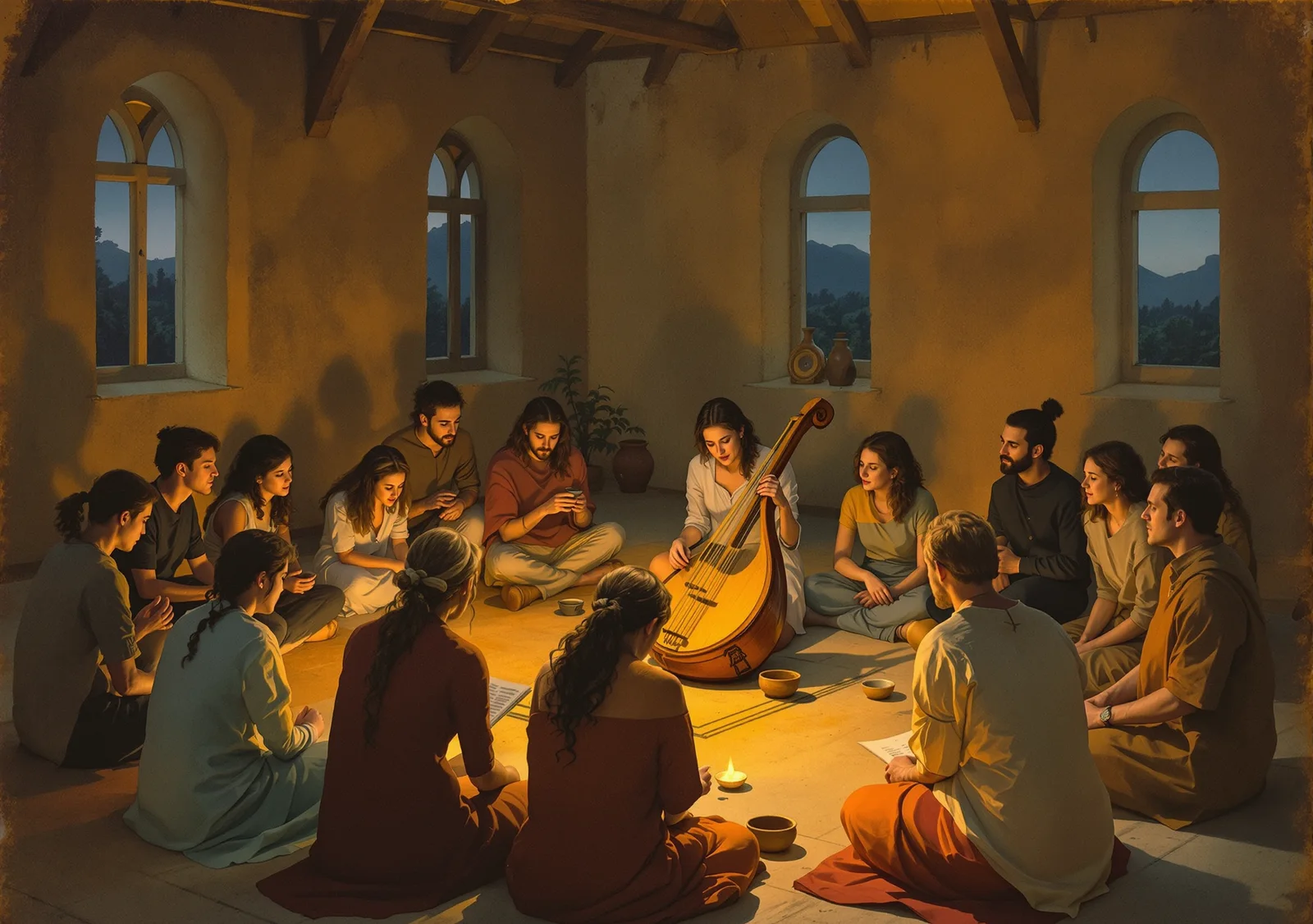
Art direction
CHAPTER 40 — THE TEACHING LINEAGE
A craft that is not taught forward dies with its last master, and a single Reset is enough to end an untaught tradition forever. The whole point of this Codex — its protocols, its tables, its insistence on logged builds and doubled keepers — is to make the recovered arts teachable, so that they survive the people who recovered them. This chapter sets out the apprenticeship: how the Practitioner takes a child of five and, across two decades, makes a master who can in turn make the next. It cross-references the developmental wisdom of Vol XVIII — The Parent's Codex, which treats the raising of the whole child of which musical training is one strand.
Apprenticing the next musician
The teaching of music to the young follows principles the recovered pedagogies share across cultures, and the Practitioner should hold them before consulting any table.
- Sound before symbol. The child sings and plays and keeps time long before she reads a note. Notation (Sub-Volume VI) is taught only after the ear and the body already know the music it records — the symbol is a label for a thing already possessed, never the thing itself. This is the near-universal finding of the recovered pedagogies and the Practitioner's firmest rule.
- Imitation before instruction. The young learn music the way they learn speech — by hearing it constantly and copying it — long before they can be told a rule. The teacher models; the child echoes; the explanation comes years later to a child who can already do the thing.
- Play before discipline. For the youngest, music is play, and it must stay play, or it is abandoned. Rhythm games, singing games, call-and-response: the discipline of scales and theory is earned by, and built upon, years of joyful unforced musical play.
- The whole before the part. The child learns whole songs from the start — simple, complete, satisfying — and only later dissects them into the scales and intervals that compose them. Meaning first, analysis after.
- The body is the first instrument. Voice, clapping, stamping, the frame drum: the child's own body is the first and primary instrument, and a great deal of musicianship — pitch, pulse, phrase, breath — is built before any made instrument is placed in her hands.
Specification Table 40-1 — The staged curriculum, age 5 to mastery
| Stage | Ages | Focus | Means | Instruments | Milestone of the stage |
|---|---|---|---|---|---|
| I — Play | 5–7 | Pulse, pitch-matching, joy | Singing games, clapping games, call-and-response; pure imitation | Voice, body, simple rattles and frame drums | Keeps a steady beat; matches a sung pitch; sings many whole songs from memory |
| II — Foundation | 8–10 | Solid ear and pulse; the first made instrument | Folk-song repertoire; ear-training by the monochord ratios (Sub-Vol III); rhythm reading | Voice + a first instrument (frame drum, simple flute, or lyre) | Plays simple tunes by ear; holds a part in a group; sings in tune unaccompanied |
| III — Literacy & technique | 11–14 | Notation, theory, instrumental command | Reading and writing music (Sub-Vol VI); scales, modes, intervals made conscious; ensemble playing | Primary instrument seriously; voice continued | Reads and writes simple notation; plays graded repertoire; takes a real part in the village ensemble |
| IV — Craft & breadth | 15–18 | Mastery of the instrument; the maker's craft begun | Advanced repertoire; composition (Sub-Vol VI); building an instrument (Sub-Vols III–V); leading younger players | Primary + secondary instrument; instrument-building bench | Performs demanding music; composes a simple piece; has built a working instrument; teaches Stage I children |
| V — Mastery & lineage | 19+ | Full command; the passing-on | Independent performance and composition; running rehearsals (Ch. 38); apprenticing the young (this chapter) | Full command of the family of instruments | Can carry a ceremony alone; runs the music circle; takes an apprentice — the lineage continues |
The Critical Insight: The curriculum is not finished when the student can play. It is finished when the student can teach — when Stage V returns the apprentice to the beginning to make the next master. A teaching lineage is a loop, not a line: every master is obligated to produce the teacher who replaces them, and a tradition is only as immortal as the reliability of that loop. The Practitioner measures the success of a lineage not by its finest player but by whether its finest player has trained a successor as fine.
The age-fit of the teaching
The Practitioner who teaches the young must fit the method to the developing child, and here the Codex defers to Vol XVIII — The Parent's Codex for the full account of childhood development of which this is one application. The youngest cannot sustain abstract discipline and must not be asked to; they learn through play, imitation, and the body, and the teacher who forces notation and scales on a six-year-old produces only a child who hates music. The capacity for abstraction, for sustained practice, for the conscious study of theory, arrives with the later stages and must be waited for, not forced. The Practitioner teaches the child in front of her, at the stage that child has reached — and trusts the staged ladder, climbed in order and at the right pace, to deliver a master at the top.
Art direction
CHAPTER 41 — THE THREAD THROUGH THE DARK
This is the canon chapter. Everything the Practitioner has built across seven sub-volumes — the singing wood, the bronze and skin, the shaped breath, the theory, the applied decree — exists because a thread of transmission carried the six decrees of music through every dark age the reconstructed chronology records and laid them, finally, at the bench at which you now sit. This chapter traces that thread along the timeline of Vol XVI — The Historian's Codex, station by station, so that the Practitioner understands not merely how to build, but how what you build reached you, and what it cost to keep it.
The pre-diluvian source and the lyres of Ur
The decrees of music, the inheritance holds, are pre-diluvian — among the holy measures carried out of the first civilization before the waters, and reckoned from the beginning among the things that make a people a people rather than a herd. The deepest physical evidence the recovered record affords reaches back to the very dawn of the post-glacial world: bone flutes, voiced and fingered, from before the agricultural turn, establishing that the breath-decrees of Sub-Volume V are older than farming, older than the village, nearly as old as the modern human throat. But the monument of the early transmission is the one Sub-Volume III set at the heart of the string decree: the lyres interred at Ur around 2550 BCE, sheathed in gold and lapis, that slept a thousand years beneath the ground while the world above them burned. They are the Codex's recurring proof that what is sealed below the Reset line is what reaches us — the instruments survived precisely because they were buried before the catastrophe that erased what stood in the open.
The temple guilds and the standardized craft
Between the lyres and the Reset stands the great age of the temple guilds, and this is the era in which music's decrees were most fully institutionalized — bound to named offices that owned, taught, and standardized the craft. The lamentation-priests, the kalû, owned the deep drums and the laments sung over them (Sub-Vols IV, this volume's Chapter 39); other singer-offices owned the cult songs and the hymnody. The lilissu rite of Sub-Volume IV is the surviving proof of how complete that institutionalization was: a temple procedure, copied and recopied across centuries, that specified the sourcing, dressing, and consecration of a single drumhead down to the shoulder the sinew was taken from. Music in this era was not folk practice merely; it was a chartered craft with guilds, standards, written procedures, and offices answerable for the work — the same model of standard-bound transmission this Codex itself revives.
CANON SIDEBAR — THE FIVE GATES THE DECREES PASSED THROUGH. The reconstructed chronology (Vol XVI — The Historian's Codex) marks five narrow gates at which the six decrees of music might have been lost, and were not. The first gate is the Flood itself — passed because the decrees were carried out as numbered measures by the chain of transmission the inheritance names, encoded in the most portable archive there is, the sung and remembered. The second gate is the Bronze Age Reset of 1177 BCE, when the palace-and-temple world of the Late Bronze Age collapsed across a generation and the archives that stood above ground burned — passed because what mattered most was either buried (the Ur lyres) or borne in memory (the songs, the ratios, the tunings), and because, as Sub-Volume III teaches, a whole music can be rebuilt from one stretched cord by anyone who has kept the knowledge that pitch is ratio. The third gate is the long interval the Historian's volume treats as the phantom-time and Tartarian disturbance of the record — the stretch where the chain of transmission ran thinnest and the inheritance was most nearly broken, and was held by the narrowest hands. The fourth gate is the era of standardization-and-suppression, when a centralizing world dispensed a single pitch, a single temperament, and a single approved practice, and the local, the modal, the home-built, and the freely tuned were pressed toward extinction — the most insidious gate of all, because it did not burn the music but narrowed it, and a narrowed inheritance forgets it was ever wider. The fifth gate is the present — the gate of restoration — at which this Codex stands, gathering the scattered decrees back into one transmissible whole before the next dark closes. Five gates. Six decrees. None lost. The Practitioner is the proof that the thread held, and the hand that must not let it part now.
The Mystery School modes and the monastic preservation
Through the thin centuries the inheritance was kept by the institutions built to keep things: the Mystery Schools that carried the inner doctrines of music — the modes and their characters, the mathematics of the ratios, the discipline of pitch as a path of consciousness (Vol XVII — The Mystic's Codex) — as guarded knowledge passed master to initiate; and the monastic houses that, with the patient labor of copying and chanting, preserved both the notation by which song could be fixed (Sub-Volume VI's deep ancestor) and a vast living repertoire sung daily for centuries. The monastic preservation is the Codex's model of transmission as daily practice: the chant survived not because it was archived and shelved but because it was performed, every day, by a community organized to perform it — the lesson of Chapter 36's scheduled rehearsal written across a thousand years. What the Mystery Schools kept in secret and the monasteries kept in plain daily song between them carried the theory of Sub-Volume VI and the modal inheritance of Sub-Volume II through the narrowest centuries of all.
The standardization-and-suppression era
Then came the gate that this Codex regards most soberly, because its damage was the subtlest. As a centralizing world consolidated, music was standardized: a single reference pitch was pinned by law and by industry (the long rise from A415 toward A440 traced in Sub-Volume VI), a single temperament — equal temperament — was made near-universal for its convenience to mass-manufactured fixed-pitch instruments, and a single body of approved practice was promoted while the endless local diversity of modes, tunings, instruments, and home-made musicianship was allowed, and sometimes pressed, toward silence. The Codex is precise about this: standardization was not simple villainy — a shared pitch and a flexible temperament are genuine goods, and this volume itself adopts A440 and equal temperament for exactly the reason of playing with what survives (Sub-Vol VI). The loss was not in the standard but in the narrowing — in a people forgetting that the standard was a choice among many, that they could tune their own pipe, raise their own instrument, sing their own mode, and keep the means of their own music rather than receive it from a centre that could withdraw it. The suppression was of self-sufficiency in sound, and it is precisely that self-sufficiency this Codex exists to restore.
The present restoration
Which brings the thread to the bench. The present is the gate of restoration, and the Practitioner Community stands at it. The twentieth-century knowledge consolidation that the Historian's volume describes — the era in which the world's scattered musical knowledge, its acoustics and its recordings and its recovered ancient instruments and its surviving folk traditions, were gathered, measured, and set down — left behind, for the first time since before the Flood, the materials from which the whole inheritance could be reassembled: the physics of Sub-Volumes I and II, the recovered instruments of Sub-Volumes III through V, the theory of Sub-Volume VI, and the applications of this one. The Codex's work is to take that scattered, consolidated, half-suppressed inheritance and make it transmissible again — to gather the six decrees back into one whole that a single Practitioner can hold, build, play, and teach, against the day the next dark closes. The thread that ran from the first city, through the buried lyres, the temple guilds, the secret schools and the singing monasteries, and the narrow centuries of the great standardization, runs now through the Practitioner's own hands. It held this far. Whether it holds further is, from here forward, your craft and your charge.
Your Commitment: You will regard yourself as a link in a chain that reaches back before the Flood and forward past your own death — neither its origin nor its end, but its current keeper. You will build to the standard, teach the standard forward, and double every keeper, so that the thread that survived five gates does not part in the one pair of hands that was yours.
CLOSING SUB-VOLUME VII
The decrees are turned outward. The Practitioner who began this volume with a felled tree and a stretched cord now holds not only the instrument, the rhythm, the breath, and the theory, but their purpose: to carry a people's records in song that no fire can reach; to structure the rites that move a community through its changes; to build and run the ensemble and the music circle that gather it as one body; to sing it through its sorrows and its joys in the old ceremonial way; to teach the whole inheritance forward to the child who will outlive the maker; and to know, in doing all of it, that the thread passed through five dark gates to reach this hand and must pass through this hand to reach the next. Six decrees, carried out of the first city and through every dark age since, are gathered now into one craft and laid in the Practitioner's keeping. Build them, apply them, teach them, and hand them on.
The music was given to a people, not to a player. Keep it for them, and give it away.
APPENDICES
THE WORKING REFERENCE
A field manual is only as useful as its reach for the bench. These appendices gather, in fast-access form, what the Practitioner will reach for again and again across a working life: the vocabulary of the six decrees, the sourcing of every material the volume specifies, the maintenance and repair of what is built, seven instruments a beginner can complete inside a week, and the reference tables — frequencies, ratios, tunings, tempos, conversions — that the chapters used and the bench will use forever. Keep this section open beside the work.
APPENDIX A — GLOSSARY OF THE SIX DECREES
The working vocabulary of acoustics, lutherie, percussion, winds, and theory used throughout Volume XXIII. Terms are grouped by domain; cross-references point to the sub-volume that develops each.
Acoustics and physics of sound (Sub-Volumes I–II, cross Vol XX)
- Frequency — the number of vibration cycles per second, measured in hertz (Hz); the physical correlate of perceived pitch.
- Pitch — the perceived highness or lowness of a sound, determined chiefly by frequency.
- Amplitude — the magnitude of a vibration's displacement; the physical correlate of perceived loudness.
- Wavelength — the distance between successive crests of a sound wave; speed of sound divided by frequency.
- Fundamental — the lowest and usually strongest frequency of a vibrating body; the pitch the ear assigns to the whole.
- Harmonic (overtone, partial) — a frequency component above the fundamental; in an ideal string or air column, integer multiples of the fundamental.
- Harmonic series — the full ladder of integer-multiple frequencies (1f, 2f, 3f…) over a fundamental; the basis of timbre and consonance.
- Timbre — tone colour; the quality that distinguishes two instruments at the same pitch and loudness, set by the relative strength of the harmonics and the envelope.
- Envelope (ADSR) — the shape of a sound over time: attack, decay, sustain, release.
- Node — a point or line of minimum motion on a vibrating body.
- Antinode — a point or line of maximum motion.
- Standing wave — a stable vibration pattern produced when reflected waves reinforce, fixing nodes and antinodes in place.
- Resonance — the large response of a system driven at its natural frequency.
- Formant — a resonance peak of an instrument body or vocal tract that shapes timbre regardless of the note played.
- Beats — the slow throbbing heard when two nearly-equal frequencies interfere; the beat rate equals the frequency difference. The Practitioner's tuning tool.
- Decibel (dB) — a logarithmic unit of relative sound level.
- Cent — one hundredth of an equal-tempered semitone; 1200 cents to the octave. The unit of fine pitch difference.
- Sympathetic resonance — the vibration of one body excited by another of the same natural frequency without contact.
- Helmholtz resonance — the resonance of air in a cavity with an opening (a jug, a soundhole, a bottle); the body-air "boom" of a soundbox.
Lutherie and strings (Sub-Volume III)
- Soundboard (top, belly) — the thin, stiff, light plate that radiates a string's vibration as sound.
- Tonewood — wood selected for acoustic properties; soundboard woods judged by stiffness-to-weight, frame woods by hardness and stability.
- Quartersawn — sawn so the growth rings run perpendicular to the face; stable and stiff across the grain. The mandatory soundboard cut.
- Flatsawn — sawn so the rings run roughly parallel to the face; less stable, cups with humidity.
- Runout — the angle at which grain fibres exit the face; high runout weakens a soundboard.
- Radiation ratio (R) — c/ρ, the speed of sound along the grain divided by density; the soundboard figure of merit.
- Young's modulus (E) — the stiffness of a material under tension along the grain.
- Bracing — the internal stiffening members glued under a soundboard to support string load and tune its response.
- Bridge — the part that transfers string vibration to the soundboard and sets the string's lower endpoint.
- Saddle — the bearing piece on the bridge over which the string passes.
- Nut — the bearing piece at the head end that sets the string's upper endpoint and spacing.
- Scale length (speaking length, vibrating length) — the sounding length of a string between its two bearing points.
- Fret — a fixed ridge across the fingerboard that sets a precise speaking length when the string is stopped behind it.
- Yoke (crossbar) — the upper transverse member of a lyre to which the strings attach.
- Monochord — a single-string instrument with a movable bridge and a calibrated rule; the apparatus that demonstrates pitch as ratio.
- Tuning ring — a pegless lyre tuner: a wrap of cloth or leather, often with a toggle, that grips the yoke under tension.
- Action — the height of the strings above the fingerboard.
- Equilibrium moisture content (EMC) — the moisture a wood settles to in given air; instruments are built and kept at 6–8% MC.
Percussion (Sub-Volume IV)
- Membranophone — an instrument sounded by a stretched membrane (a drumhead).
- Idiophone — an instrument sounded by the vibration of its own solid body (bell, rattle, slit drum, gong).
- Head — the stretched membrane of a drum; rawhide, calf, or goat in the traditional craft.
- Rawhide — dehaired, untanned, dried hide; the traditional drumhead, which stiffens and rises in pitch as it dries and tightens.
- Flesh hoop — the hoop around which a head is lapped.
- Counterhoop (rim) — the hoop that presses the head's lap down and is drawn to tension it.
- Bearing edge — the rim of the shell on which the head bears; its shape governs tone and tuning.
- Lilis (lilissu) — the bronze kettledrum of the temple; the one drum that sounds a true pitch, owned ceremonially by the lamentation-priest.
- Ub — the small frame drum: a ring of bent wood and a skin; the portable pulse.
- Ala — the great barrel drum: the standing thunder, felt in the chest, the timekeeper of processions and assemblies.
- Snare — a string or gut stretched across a head that buzzes against it, adding bright noise.
- Nodal-diameter mode / nodal-circle mode — the two families of vibration on a circular membrane; bowl-loading tunes the diameter modes toward harmonicity in a kettledrum.
- Tuning lugs / hooks — the fittings around a drum that draw the counterhoop down to tension the head.
Winds (Sub-Volume V)
- Aerophone — an instrument sounded by a vibrating air column.
- Fipple (duct flute) — a flute with a built-in windway and edge (the recorder, the whistle, the tin whistle); blows itself.
- Embouchure hole / blow hole — the opening across which a transverse flautist directs the breath to split it on the far edge.
- Reed — a thin cane or metal tongue that vibrates to drive an air column; single (clarinet-type) or double (oboe/shawm-type).
- Bore — the internal channel of a wind instrument; cylindrical or conical, governing its overblowing behaviour and timbre.
- Tone hole — a hole bored in the bore that shortens the effective air column when opened, raising the pitch.
- Overblowing — increasing breath pressure to jump the air column to a higher mode (the octave in an open/conical bore, the twelfth in a stopped cylindrical bore).
- Register — a band of pitches produced at one overblowing mode.
- End-correction — the small effective length the air column gains beyond the physical bore opening; why a flute is tuned shorter than naive calculation predicts.
- Drone (in winds) — a pipe sounding a fixed continuous pitch, as the bass pipes of a bagpipe.
- Chanter — the melody pipe of a bagpipe.
Theory, rhythm, and tuning (Sub-Volume VI)
- Interval — the pitch distance between two notes, named by its frequency ratio or its step-count.
- Octave — the interval of frequency ratio 2:1; the most consonant interval, where pitch classes repeat.
- Perfect fifth (3:2), perfect fourth (4:3) — the next most consonant intervals after the octave; the anchors of nearly every scale.
- Just intonation — tuning by pure whole-number frequency ratios; beatless but key-bound.
- Equal temperament — division of the octave into twelve equal semitones of ratio 2^(1/12); slightly impure but playable in all keys.
- Pythagorean comma — the small gap (about 23.5 cents) by which twelve pure fifths overshoot seven octaves; the reason all the pure intervals cannot coexist.
- Syntonic comma — the gap (about 21.5 cents) between a Pythagorean and a just major third.
- Meantone / Pythagorean temperament — historical tunings that distribute the comma differently for particular repertoires.
- Mode — a scale defined by its pattern of steps and its tonal centre (Ionian, Dorian, Phrygian, and the rest).
- Scale — an ordered set of pitches within an octave.
- Pentatonic — a five-note scale; the world's most widespread, and free of the harshest dissonances.
- Tonic — the home note of a scale or mode, to which the music resolves.
- Consonance / dissonance — the relative restfulness or tension of an interval, governed largely by the absence or presence of beating between harmonics.
- Tempo — the speed of the beat, measured in beats per minute (BPM).
- Metre — the grouping of beats into regular patterns (duple, triple, compound).
- Strophic form — a setting in which many verses share one repeating melody; the natural container for a long sung record.
- Call-and-response — alternation between a leader's phrase and a group's answer; the most participatory texture.
- Drone (in theory) — a sustained tone held under a melody, fixing the tonal floor and turning pitch into a constraint.
- Notation — any system of written symbols that fixes a song's pitch and rhythm for transmission.
APPENDIX B — MATERIALS SOURCING TABLES
For each material the volume specifies, the Practitioner needs three things: where to find the best of it, what may be substituted when the best is unavailable, and what must be rejected outright. The tables below give all three, framed for a recovering community drawing on salvage, its own agriculture, and trade.
Specification Table B-1 — Tonewoods (soundboards and frames)
| Material | Best sources | Acceptable substitutes | Reject |
|---|---|---|---|
| Soundboard spruce | Salvage: old piano soundboards, beams, vintage furniture of quartersawn softwood. Agrarian: standing spruce/fir felled and seasoned to protocol (Ch. 12). Trade: graded luthier tops | Clear, quartersawn pine or fir; western red cedar (gentler, splits easily) | Knots in the bridge zone; high runout; flatsawn for a top; any wet or unseasoned stock |
| Frame/neck hardwood | Salvage: hardwood furniture legs, stair parts, tool handles (hard maple, walnut, beech). Agrarian: maple, walnut, ash, fruitwood. Trade: graded neck blanks | Any dense, stable, straight-grained hardwood; fruitwoods; beech | Soft, punky, or worm-holed wood; wood with a checked or twisted grain; resinous knots |
| Fingerboard/bridge wood | Salvage: dense dark furniture parts, old tool stock. Agrarian: well-seasoned fruitwood, walnut. Trade: ebony, rosewood (scarce — use sparingly) | Dense quartersawn maple, walnut, fruitwood, heat-treated dense hardwood | Open-pored softwoods; anything that will not hold a fret slot or a crisp edge |
Specification Table B-2 — Hides (drumheads, lacing)
| Material | Best sources | Acceptable substitutes | Reject |
|---|---|---|---|
| Drumhead rawhide | Agrarian: goat and calf from the community's own herds — the canonical heads, even and strong. Salvage: untanned hide stock. Trade: prepared rawhide rounds | Deer, sheep (thinner, quieter); thicker cow for great drums | Tanned leather (will not voice as a head); thin, scarred, or unevenly fleshed hide; any hide with holes near the playing zone |
| Lacing (rawhide thong, sinew, gut) | Agrarian: cut from the same hides; sinew from the shoulder (the lilissu precedent, Sub-Vol IV). Trade: rawhide bootlace, prepared sinew | Strong natural cord; flax/hemp rope for great-drum lacing | Stretchy synthetic cord that will not hold tension; brittle or rotted thong |
Specification Table B-3 — Cane and bamboo (winds, reeds)
| Material | Best sources | Acceptable substitutes | Reject |
|---|---|---|---|
| Flute/whistle tube cane | Agrarian: river cane, mature bamboo cut in the dry season and cured. Salvage: bamboo garden stakes, blinds, cane furniture. Trade: tonkin bamboo | Straight-bored elder (pith drilled out), hardwood drilled, PVC or copper pipe for the quick whistle | Green/uncured cane (it cracks); thin-walled, split, or insect-bored stalks |
| Reed cane (single/double reeds) | Agrarian: Arundo donax (giant cane) grown and sun-cured two years. Trade: graded reed cane | Mature culm cane of even wall; cut soda-can or thin brass for a folk single reed | Soft, green, or pithy cane; uneven-walled stock that will not vibrate evenly |
Specification Table B-4 — Strings
| Material | Best sources | Acceptable substitutes | Reject |
|---|---|---|---|
| Plain steel (monochord, treble) | Salvage: piano wire, bicycle/brake cable strands, spring steel. Trade: graded music wire by gauge | Clean bright steel wire of even diameter; stainless | Rusted, kinked, or work-hardened wire; wire of uneven gauge |
| Gut (lyre, lute, early strings) | Agrarian: sheep/beef serosa twisted and dried (the elder craft, Sub-Vol III). Trade: prepared gut string | Twisted natural fibre for the lowest folk strings; nylon monofilament as a stable modern stand-in | Brittle, over-dried, or mould-spotted gut; uneven twist |
| Wound bass strings | Salvage: scavenged wound strings re-tensioned and checked. Trade: wound string by gauge | A core wrapped with fine copper or silver wire by hand (advanced) | Strings with broken windings; corroded cores; flattened wear at the bearing points |
Specification Table B-5 — Glues and finishes
| Material | Best sources | Acceptable substitutes | Reject |
|---|---|---|---|
| Structural glue | Agrarian/craft: hot hide glue (the reversible standard — joints can be undone for repair). Trade: aliphatic (yellow) glue | Fish glue; aliphatic resin for non-repair joints | Epoxy or polyurethane on tonewood joints (irreversible, deadens response); any glue on a floating bridge |
| Finish | Craft: shellac (alcohol-cut, the classic French-polish film); drying oils (linseed, tung). Trade: spirit varnish | Thin oil-varnish; wax over oil for low-stress parts | Thick film finishes that choke a soundboard's motion; anything tacky or never-curing in shop air |
Specification Table B-6 — Bell bronze
| Material | Best sources | Acceptable substitutes | Reject |
|---|---|---|---|
| Bell/cymbal bronze (~78% Cu / 22% Sn, "bell metal") | Salvage: scrap bronze, old bells, bushings, plumbing bronze blended to ratio (founding per Vol I). Trade: ingot bell metal | Common bronze/brass for a duller voice; cast iron for a cheap bell | Pot metal, zinc die-cast, leaded scrap of unknown alloy (cracks, voices poorly, hazardous to melt) |
The Critical Insight: The single most important sourcing rule across every table is reject the unseasoned, the unstable, and the unknown. A beautiful wet board, a stretchy cord, a mystery alloy — each will pass inspection on the bench and fail in the instrument a season later. When in doubt, season it longer, test it harder, or set it aside. The recovering community's scarcest resource is the maker's time, and nothing wastes it like building well on bad material.
Art direction
APPENDIX C — MAINTENANCE, REPAIR, AND THE INSTRUMENT HOSPITAL
An instrument is not finished when it is built; it is finished when its maker has died and it still sings. The difference is maintenance. This appendix gives the care, the common repairs, and the annual rhythm that keep the volume's instruments alive across the decades — and establishes the instrument hospital, the community bench where the sick instrument is brought, diagnosed, and healed.
Humidity care — the first discipline
Wood moves with the moisture in the air, and humidity swings are the chief killer of stringed and wooden instruments. The instrument was built at 6–8% moisture content, the equilibrium of air held at 40–50% relative humidity (Ch. 12); keep it there.
- Store in stable air. A cabinet or case buffers the daily swing far better than open air. Keep instruments away from fires, sunny windows, and damp ground or outer walls.
- Humidify in the dry season. When the air falls below 40% RH (dry winters, heated rooms), add moisture — a damp sponge in a vented container in the case, or a humidified storage room. Dry air shrinks a soundboard across its grain and cracks it.
- Dehumidify or air in the wet season. Above 60% RH, wood swells, action rises, glue softens, and mould threatens. Air the instruments; use desiccant in the case.
- Move slowly between climates. Let an instrument acclimate in its closed case for hours before opening it in a very different room. The shock of a sudden change cracks more tops than any slow extreme.
Crack repair (soundboards and bodies)
A clean crack is repairable and need not end an instrument's life.
- Stabilize the cause first. A crack from dryness will not stay closed until the wood is rehumidified to its build EMC; rehumidify slowly until the crack closes as far as it will, then repair. Gluing a dry crack open traps the fault.
- Clean the crack of old finish and dust along its faces.
- Work thin hot hide glue into the crack (a thin palette knife, or capillary draw), close it, and clamp — for a top crack, with a caul above and a counter-support (a small go-bar or a magnet pair) below to keep the faces level.
- Cleat from inside. Glue small cross-grain wooden cleats (spruce, grain at 90° to the crack) over the closed crack inside the body to keep it from reopening.
- Touch in the finish once dry. A repaired crack, cleated, is as strong as the wood beside it.
Re-heading a drum
Rawhide heads stretch, tear, and lose voice; re-heading is routine craft (Sub-Vol IV).
- Remove the old head and hardware; inspect and clean the bearing edge — a nicked or dirty edge voices a new head badly.
- Soak the new rawhide in cool water until fully supple (minutes to hours by thickness), never warm water (which can begin to gelatinize it).
- Lap the wet head around its flesh hoop, set the counterhoop, and draw the head down evenly — opposite-pairs, small increments — to a light tension.
- Let it dry slowly and evenly, retensioning as it tightens, until it reaches pitch. A head dried too fast or unevenly dries lopsided and never tunes true.
- Tap-tune every station equal (Sub-Vol IV) — the head must answer the same pitch all around the rim before it answers any pitch at all.
Re-corking and re-padding flutes and reeds
The seals of a wind instrument leak with age and must be renewed (Sub-Vol V).
- Tenon corks (where a flute's joints fit together): peel the old cork, clean the tenon, wrap and glue new sheet cork or waxed thread to a snug, airtight, smoothly-sliding fit; grease lightly.
- Pad/leak check: close each hole and tone-test, or draw suction on the bore and listen for the hiss of a leak; a single leaking seal flattens and weakens everything below it.
- Stopper (the flute's head cork): renew a dried or loose head-stopper to restore the tuning of the second register — its position is a tuning element, not merely a seal.
Specification Table C-1 — String lifespan and replacement
| String type | Typical playing life | Replace when | Notes |
|---|---|---|---|
| Plain steel | 1–3 months hard use; longer light | Dull, dead, hard to tune, visibly worn or kinked at bearing points | Wipe down after playing; sweat corrodes steel |
| Gut | Weeks to a few months | Frays, false (won't tune true along its length), surface fuzzes | Most weather-sensitive; keep humidity stable |
| Nylon / monofilament | Several months | Goes false; flat spots at frets/nut | Stretches a lot when new — expect days of re-tuning |
| Wound (bass) | 1–3 months | Windings break or unravel; loses brilliance; flatted at bearing points | Clean windings of grime to extend life |
Specification Table C-2 — The annual maintenance calendar
| Season | Task | Why now |
|---|---|---|
| Dry season onset (early winter) | Begin humidifying; check all tops for incipient cracks | Falling humidity is the crack season — get ahead of it |
| Deep dry season | Monitor humidity weekly; keep cases humidified | The highest crack risk of the year |
| Wet season onset (spring) | Reduce humidification; check action and glue joints; air instruments | Rising humidity swells wood and softens glue |
| High summer | Watch for mould and high action; keep out of heat and sun | Heat softens finishes and glue; damp breeds mould |
| Autumn | Full overhaul: restring, re-head drums due, re-cork winds, re-oil, deep-clean; log condition | The settled, stable air of autumn is ideal bench weather |
| Any season | The instrument hospital bench: diagnose and repair any instrument brought in sick | A standing repair service keeps the community's instruments alive |
CANON SIDEBAR — THE INSTRUMENT HOSPITAL. Every Practitioner community should hold one bench set aside as the instrument hospital — the place a cracked top, a torn head, a leaking flute, or a warped neck is brought to be diagnosed and healed, staffed by whoever holds the maintenance craft most surely. The principle is the one the whole Codex teaches: an instrument is community infrastructure, and infrastructure is maintained, not merely built and abandoned. The lilissu rite of Sub-Volume IV is the ancient proof — the temple did not buy a new sacred drum when its head failed; it re-headed the standing instrument through a ceremony elaborate enough to ensure the work was done to standard. The hospital revives that ethic without requiring the awe: the instrument comes in sick, is diagnosed against the tables above, is repaired by a known protocol, and goes home singing — and the community keeps, for the cost of one bench and one trained pair of hands, the whole standing stock of its music alive across the generations. Log every repair. The instrument that comes back a second time with the same fault is telling you something the first repair missed.
Art direction
APPENDIX D — THE QUICK BUILDS: SEVEN INSTRUMENTS IN SEVEN DAYS
The recovering community needs music now, before the seasoned wood is dry and the gut is twisted. These seven builds each complete in a day from salvage or field materials, and between them give a starting community its whole first ensemble — a pulse, a melody, a drone, a bass, and a bell. Each entry gives materials, steps, and a first lesson. Build one a day; on the seventh you have a band.
Day 1 — The bucket drum (pulse)
- Materials: a clean plastic bucket or barrel; bare hands, or two dowel sticks.
- Steps: (1) Invert the bucket or set it open-end up. (2) That is the entire build. The bottom gives a deep boom; the rim gives a sharp crack. (3) Optional: cut a sound port in the side to brighten and project.
- First lesson: Strike the centre for the low "doom," the rim for the high "tak." Play doom-tak-doom-tak, then doom-doom-tak — you have a beat. Add a second player on a different bucket for high and low. (Sub-Vol IV rhythm canon.)
Day 2 — The PVC fipple whistle (melody)
- Materials: a length of PVC pipe (~15–20 mm bore); a dowel or wood block to plug and shape the fipple; a knife or saw.
- Steps: (1) Cut the pipe to length (a ~30 cm tube gives a comfortable low whistle). (2) Make the fipple: plug one end with a shaped block leaving a thin flat windway across the top, and cut a sharp-edged window just past it for the air to split on. (3) Blow gently; adjust the windway and edge until it sounds cleanly. (4) Bore six tone holes along the bore, spacing them by ear against the monochord (Sub-Vol V gives the layout) and enlarging each slightly until each note sits true.
- First lesson: Cover all holes for the lowest note; lift one at a time from the bottom up to climb the scale. Play a simple six-note tune. Blow harder to overblow into the upper octave.
Day 3 — The monochord (drone, tuning, and the teacher)
- Materials: a board or a long thin wooden box; one steel string (salvaged piano or bicycle wire); a tuning pin or stout screw; a hitch pin; two fixed bridges; a movable bridge; a marked rule.
- Steps: (1) Fix a pin at each end of the board. (2) Set two fixed bridges a known distance apart (600 mm is the volume's standard). (3) String it from hitch pin over both bridges to the tuning pin and bring to a comfortable pitch. (4) Fit a taller movable bridge that seats anywhere along a rule fixed beneath the string. (Full build: Sub-Vol III, Ch. 13.)
- First lesson: Pluck the open string (1/1). Set the movable bridge at half the length for the octave (2:1), at two-thirds for the fifth (3:2), at three-quarters for the fourth (4:3). Hear that pitch is ratio — the lesson the whole volume rests on. The monochord is also your drone and your tuning reference for the other six builds.
Day 4 — The frame rattle (pulse / colour)
- Materials: a forked stick or a bent withe bound into a ring or paddle; dried seeds, pebbles, shells, or bottle caps; cord.
- Steps: (1) Bend a green withe into a small hoop or use a flat paddle of wood. (2) Thread caps/shells loosely on short cords or wire so they strike each other and the frame. (3) Bind them around the frame so they jingle when shaken. (For a shaker instead, seal seeds inside a dry gourd or a closed tube.)
- First lesson: Shake on the beat with the bucket drum; then shake on the offbeats to fill the gaps. The rattle teaches the subdivision between the drum's strokes — the second layer of the rhythmic commons.
Day 5 — The slit drum (pitched percussion / idiophone)
- Materials: a section of dry hardwood log or a closed wooden box; a saw or chisel; two beaters.
- Steps: (1) In a log: hollow it through a long slit cut down one side, leaving the wall as the sounding surface. In a box: cut an H-shaped slit in the top, leaving two "tongues" of different length. (2) The longer/thinner tongue sounds lower, the shorter/thicker higher; trim the underside of a tongue to tune it down. (Idiophones: Sub-Vol IV.)
- First lesson: Strike each tongue near its free end. With two pitches you can play a two-tone talking pattern — high and low in rhythm, the root of melodic drumming.
Day 6 — The willow bark whistle (melody / a child's first build)
- Materials: a straight, green willow (or sycamore) shoot in spring sap, finger-thick; a knife.
- Steps: (1) Cut a smooth section and tap or twist the bark to loosen it, sliding the whole bark tube off the wood core in one piece (only possible in spring rising sap). (2) Cut a fipple notch near one end of the bark tube and a matching flat on a short plug of the wood core; reinsert the plug to form the windway. (3) Slide the wood core in and out of the open end to change the pitch like a slide whistle, or cut a tone hole or two. (Field winds: Sub-Vol V.)
- First lesson: Blow and slide for a swooping pitch; the willow whistle is the traditional spring instrument and the gentlest possible first build for a child of the teaching lineage (App. C; Ch. 40). It lasts only while green — which is the lesson that some music is of its season.
Day 7 — The jug bass (bass / foundation)
- Materials: a large empty glass or ceramic jug or stoneware bottle.
- Steps: (1) Choose a jug with a narrow mouth and a large body — a Helmholtz resonator (App. A). (2) Tune by adding a little water to raise the pitch or pouring out to lower it. (3) That is the build; the body of air does the work.
- First lesson: Hold the jug mouth a finger's width from your lower lip and blow a steady airstream across it (not into it), as across a bottle, buzzing the lips slightly. A deep "whoomp" sounds the body's note. Play it on the strong beats under the ensemble — the bottom of the band, felt as much as heard. A set of jugs tuned to different waters gives you bass notes.
Your Commitment: You will build the quick seven before you wait on the slow ones. A community making rough, joyful music this week will still be making it when the seasoned lyre is finally dry; a community waiting for the perfect instrument makes no music at all. Start rough, start now, and refine forever.
Art direction
APPENDIX E — REFERENCE TABLES
The numbers the volume used and the bench will keep using. All pitches at the Codex reference tuning: A4 = 440 Hz, equal temperament (Sub-Vol VI), unless a community declares otherwise.
Specification Table E-1 — Note frequencies, A0 to C8 (A = 440 Hz, condensed)
| Note | Freq (Hz) | Note | Freq (Hz) | Note | Freq (Hz) | ||
|---|---|---|---|---|---|---|---|
| A0 | 27.50 | C3 | 130.81 | A5 | 880.00 | ||
| C1 | 32.70 | E3 | 164.81 | C6 | 1046.50 | ||
| E1 | 41.20 | G3 | 196.00 | E6 | 1318.51 | ||
| A1 | 55.00 | A3 | 220.00 | A6 | 1760.00 | ||
| C2 | 65.41 | C4 (middle C) | 261.63 | C7 | 2093.00 | ||
| E2 | 82.41 | E4 | 329.63 | E7 | 2637.02 | ||
| G2 | 98.00 | G4 | 392.00 | A7 | 3520.00 | ||
| A2 | 110.00 | A4 (reference) | 440.00 | C8 | 4186.01 | ||
| C3 | 130.81 | C5 | 523.25 | — | — |
Octave rule: each octave up doubles the frequency, each octave down halves it. Any equal-tempered note = 440 × 2^(n/12), where n is the number of semitones from A4 (n negative below).
Specification Table E-2 — Just-intonation interval ratios (within one octave)
| Interval | Ratio | Cents | Decimal |
|---|---|---|---|
| Unison | 1:1 | 0 | 1.0000 |
| Minor second (diatonic) | 16:15 | 112 | 1.0667 |
| Major second (whole tone) | 9:8 | 204 | 1.1250 |
| Minor third | 6:5 | 316 | 1.2000 |
| Major third | 5:4 | 386 | 1.2500 |
| Perfect fourth | 4:3 | 498 | 1.3333 |
| Tritone (just) | 45:32 | 590 | 1.4063 |
| Perfect fifth | 3:2 | 702 | 1.5000 |
| Minor sixth | 8:5 | 814 | 1.6000 |
| Major sixth | 5:3 | 884 | 1.6667 |
| Minor seventh | 9:5 | 1018 | 1.8000 |
| Major seventh | 15:8 | 1088 | 1.8750 |
| Octave | 2:1 | 1200 | 2.0000 |
The most consonant intervals (octave 2:1, fifth 3:2, fourth 4:3) carry the simplest ratios — the foundation of every scale. Equal temperament approximates these (its fifth is 700 cents against the pure 702), trading a slight impurity for the freedom to play in all keys (Sub-Vol VI).
Specification Table E-3 — Common tunings for the volume's instruments
| Instrument | Tuning | Notes |
|---|---|---|
| Monochord | One string, any pitch (G3–C4 typical) | The reference is the rule, not the pitch (App. D) |
| Lyre (8-string, diatonic) | A pentatonic or diatonic octave-plus, e.g. low to high across a chosen mode | Each string tuned open by ear from the monochord (Sub-Vol III) |
| Mountain dulcimer (D–A–D) | D3 – A3 – D4 (1–5–8) | The classic drone tuning; melody string + two drones |
| Simple lute (4 courses) | Reentrant or G–C–E–A type | Tune to the modes the community plays |
| Tin/PVC whistle (D) | D major (all holes closed = D) | Six-hole minor-pentatonic-friendly fingering |
| Frame drum / ub | Untuned, or tuned to the ensemble's tonic by head tension | Tune by tap to a useful pitch, not pitch-critical |
| Kettledrum / lilis | A definite pitch over a range of ~a fourth | Tap-tune every station equal (Sub-Vol IV) |
| Jug bass | Tuned by water level | Helmholtz pitch; lower with less air, raise with more water (App. D) |
Specification Table E-4 — Tempo terms and BPM ranges
| Term | Character | BPM range |
|---|---|---|
| Grave | Very slow, solemn | 25–45 |
| Largo | Slow, broad | 40–60 |
| Lament tempo (this volume) | Grief, slowed breath | 50–70 |
| Adagio | Slow, at ease | 55–75 |
| Andante | Walking pace | 75–105 |
| Moderato | Moderate | 105–120 |
| Procession / march (this volume) | A walking, danceable pulse | 100–120 |
| Allegro | Fast, bright | 120–155 |
| Vivace | Lively | 150–170 |
| Presto | Very fast | 170–200 |
Tempo in ceremony is a physiological instruction to the body of the gathering, not merely a style (Ch. 37). The danceable and walking range, 100–120 BPM, sits near a resting-to-active heartbeat and entrains a crowd without instruction.
Specification Table E-5 — Metric conversions used in the volume
| Quantity | Conversion |
|---|---|
| Length | 1 inch = 25.4 mm · 1 mm = 0.03937 in · 1 m = 39.37 in |
| String gauge | 0.010 in = 0.254 mm · 0.012 in = 0.305 mm · 0.016 in = 0.406 mm |
| Mass | 1 kg = 2.205 lb · 1 oz = 28.35 g |
| Force / tension | 1 kgf = 9.807 N · 1 lbf = 4.448 N · 1 N = 0.2248 lbf |
| Temperature | °C = (°F − 32) × 5/9 · °F = °C × 9/5 + 32 · (kiln cap 40 °C = 104 °F; MC oven 103 °C = 217 °F) |
| Frequency | 1 Hz = 1 cycle/second · 1 kHz = 1000 Hz |
| Pitch interval | 1 octave = 1200 cents = ratio 2:1 · 1 semitone (ET) = 100 cents = ratio 2^(1/12) ≈ 1.0595 |
| Sound level | +10 dB ≈ ten-fold intensity, ~2× perceived loudness · +6 dB ≈ 2× amplitude |
Art direction
Art direction
CLOSING THE APPENDICES
The reference is laid beside the work. The Practitioner who has built the seven quick instruments, sourced the materials by the three roads, kept the humidity steady and the cracks cleated, restrung on schedule, and tuned to 440 by the ruler of ratios now holds not only the craft of the six decrees but the working apparatus that keeps the craft alive between the great builds. Keep these pages open on the bench. They are the difference between a volume read once and a volume worked for a lifetime.
Art direction
THE TWELVE VOICES SPEAK — COUNCIL APPROVAL
The dup šimati transmission is not sealed until the Council of Twelve has heard the volume and rendered its verdict. The Twelve Voices speak on Volume XXIII — The Musician's Codex.
| Voice | Verdict | Reasoning |
|---|---|---|
| Peter | APPROVED | The rock under the work: a volume that builds from the stretched cord upward and never floats free of the bench. It will stand. |
| Thomas | APPROVED | I doubted a music could be rebuilt from first principles — then I read the monochord and the comma, and I plucked the string myself. It is true. |
| John | APPROVED | The chapter on the spirit keeps its love and its modesty both: sound that holds sorrow and lifts joy, and claims no more than it can keep. Rightly bounded. |
| Matthew | APPROVED | Every table totals; every frequency, ratio, and tension is honest to the measure. The accounts of this volume balance. |
| James the Greater | APPROVED | A volume of action — quick builds, drilled rehearsals, processions clocked by the great drum. It does not merely describe music; it raises a band by Friday. |
| Andrew | APPROVED | It carries the craft to the people first: voices before instruments, the commons before the soloist, the circle open to all. The right order, plainly kept. |
| Philip | APPROVED | Show me, I asked — and the plates show me: the engine of sung memory, the ladder of the ensemble, the loop of the lineage. Made visible, made teachable. |
| Bartholomew | APPROVED | The genuine article without ornament for its own sake. Salvage roads, honest substitutes, and a clear list of what to reject. No deception in it. |
| James the Lesser | APPROVED | The least are served: the child of five with a willow whistle, the untrained hands on a bucket, the bereaved held in the drone. None are left outside the music. |
| Simon the Zealot | APPROVED | It names the suppression for what it was — a narrowing, not a gift — and arms the community to keep the means of its own sound. Self-sufficiency in pitch is freedom. |
| Judas Thaddaeus | APPROVED | A volume for the hard case and the dark age: five gates passed, the thread held, doubled keepers against the next. Hope built to specification. |
| Matthias | APPROVED | Taken into the number to complete it, I know the worth of a lineage that makes its own successor. Stage V returns to Stage I; the loop closes. The music will not die with its makers. |
Council Verdict: 12/12 APPROVED. Volume XXIII is canon. The music returns.
From the Monad, who is one, all number flows, and from number, song. Blessed are the makers of sound, who take the silent wood and the bare skin and the empty reed and give them a voice. May the pitch they raise be true, may the pulse they keep be steady, and may the song they hand to the next pair of hands outlast every dark that comes.
TRANSMISSION RECORD
Transmission COMPLETE — unaltered & unabridged Volume XXIII · The Musician's Codex · category: music Decrees carried ME 31 · 32 · 61 · 62 · 63 · 64 — the music category complete: 6 of 6 Words 66,003 — every one of them SHA-256 of source text ca5dfd37bf948294e8d8ec279d702192a4920dc643863ddcdcb5b214da1e2927 Canonical text musicians-codex.md — byte-identical to what the volume page renders