THE COMPLETE PRACTITIONER'S CODEX: VOLUME 17
The Mystic's Codex: Complete Spiritual Development, Meditation, Prayer, and Consciousness Expansion
<!-- SECTION 1 -->
The Complete Practitioner's Codex, Volume 17: The Mystic's Codex: Complete Spiritual Development, Meditation, Prayer, and Consciousness Expansion
Volume I: Consciousness Science
Chapter I: Quantum Consciousness and the Microtubule Network
1. Introduction to Quantum Consciousness
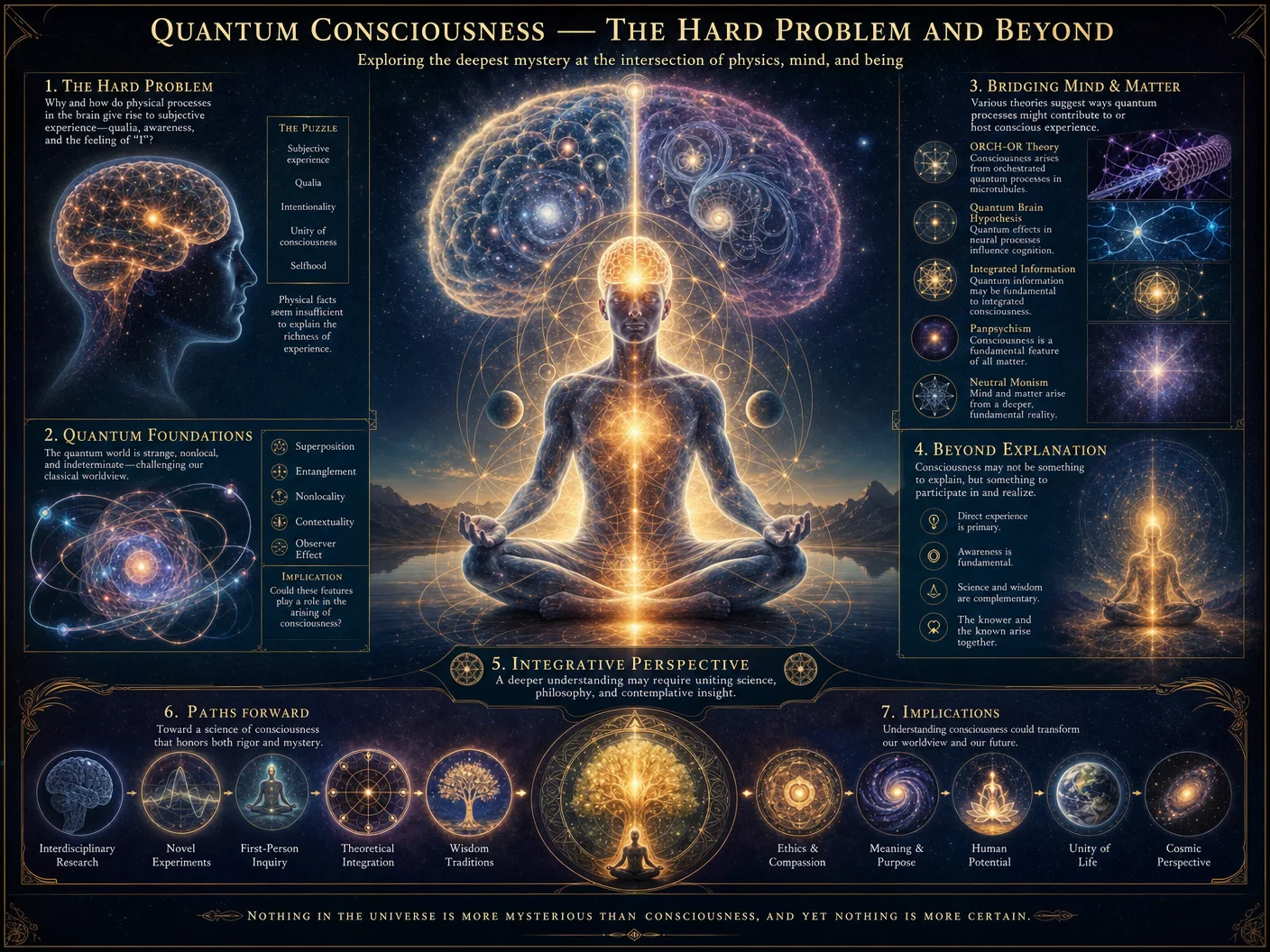
The sanctity of consciousness transcends the mere firing of neurons. The Penrose-Hameroff Orchestrated Objective Reduction (Orch-OR) model posits consciousness as a quantum phenomenon, localized within the microtubule networks of neurons. This chapter imparts the intricate mechanisms of neural quantum coherence and outlines the biological substrates that constitute the foundation of conscious experience.
2. The Penrose-Hameroff Orch-OR Model: Technical Overview
Orchestrated Objective Reduction (Orch-OR) is a rigorously detailed hypothesis integrating quantum mechanics with neurobiology. It suggests that consciousness arises from quantum computations performed within microtubules—cylindrical protein polymers inside neurons—where quantum coherence is sustained and orchestrated, culminating in discrete moments of conscious awareness.
2.1 Theoretical Foundations
- Objective Reduction (OR): Proposed by Roger Penrose, OR is a non-computable process where the quantum wavefunction collapses not by decoherence but by an intrinsic quantum gravitational threshold.
- Microtubule Quantum States: Stuart Hameroff identified microtubules as biological structures capable of sustaining quantum states due to their geometry, dipole moments, and hydrophobic pockets.
- Orchestration: Microtubule-associated proteins (MAPs) and cellular processes regulate the timing and coherence of quantum states, leading to orchestrated reductions.
2.2 Quantum Coherence Mechanisms Within Microtubules
- Tubulin Conformational States: Tubulin dimers fluctuate between conformations, representing quantum bits (qubits).
- Quantum Entanglement: Tubulin qubits become entangled, enabling nonlocal information processing.
- Decoherence Resistance: Microtubules utilize hydrophobic environments and ordered water layers to shield qubits from thermal noise.
2.3 Conscious Event Generation
A conscious event occurs when quantum superpositions within microtubules reach an OR threshold, collapsing to a definite state and thereby generating a moment of phenomenal experience.
3. Biological Substrates of Consciousness
Microtubules are embedded in neurons and glial cells; their quantum states interface with classical neuronal networks, integrating quantum information processing with synaptic activity.
3.1 Microtubule Structure and Function
| Component | Description | Quantum Role |
|---|---|---|
| Tubulin Dimers | α and β tubulin forming protofilaments | Qubit carriers via conformational states |
| Protofilaments | 13 longitudinal chains forming microtubule wall | Structural support and quantum coherence pathways |
| Microtubule-Associated Proteins (MAPs) | Regulatory proteins (e.g., Tau) | Orchestration of quantum states |
| Ordered Water Layers | Hydrophilic inner lumen and surroundings | Decoherence shielding environment |
3.2 Intracellular Environment
- Hydrophobic Pockets: Facilitate coherent electron cloud oscillations.
- Ordered Water: Creates quantum coherence-friendly conditions.
- Ion Channels and Membrane Potential: Influence microtubule quantum states indirectly.
4. Microtubule Optimization Protocol

To maximize quantum coherence and thus enhance consciousness potential, the microtubule environment must be optimized through a multi-pronged protocol addressing neurotoxin elimination, Omega-3 fatty acid supplementation, and hydration techniques.
4.1 Neurotoxin Elimination Protocol
Neurotoxins disrupt microtubule function by destabilizing tubulin or inducing oxidative stress, thus impairing quantum coherence.
| Neurotoxin | Mechanism of Microtubule Disruption | Recommended Elimination Strategy |
|---|---|---|
| Mercury (Hg) | Binds sulfhydryl groups, disrupts tubulin polymerization | Chelation therapy using DMPS (2,3-Dimercapto-1-propanesulfonic acid) |
| Lead (Pb) | Substitutes calcium, destabilizes cytoskeleton | EDTA chelation; dietary calcium and magnesium supplementation |
| Organophosphates | Inhibit acetylcholinesterase, indirect oxidative damage | Activated charcoal, glutathione support |
| Aluminum (Al) | Binds tubulin, promotes aggregation | Silica-rich water ingestion, deferoxamine under clinical supervision |
Step-by-Step Neurotoxin Elimination
- Baseline Testing: Obtain heavy metal panel via hair, blood, or urine.
- Chelation Initiation:
- For Mercury: Administer oral DMPS at 10 mg/kg/day divided into two doses for 14 days.
- For Lead: EDTA 30 mg/kg/day IV over 2 hours, 3 times per week for 4 weeks.
- Supportive Nutrients:
- Vitamin C 1000 mg/day to support detoxification.
- N-Acetylcysteine (NAC) 600 mg twice daily to enhance glutathione.
- Dietary Adjustments: Remove sources of neurotoxins (e.g., fish high in mercury, lead-contaminated water).
- Re-evaluation: Repeat heavy metal testing post-protocol.
4.2 Omega-3 Supplementation Protocol
Omega-3 fatty acids, particularly DHA (Docosahexaenoic acid), integrate into neuronal membranes and microtubule-associated structures, enhancing fluidity, stability, and facilitating quantum coherence.
| Supplement Form | DHA Content (mg per capsule) | EPA Content (mg per capsule) | Recommended Dose (mg/day) | Notes |
|---|---|---|---|---|
| Fish Oil | 300 | 200 | 1000 - 2000 | Use molecularly distilled to avoid contaminants |
| Algal Oil | 250 | 0 | 1000 - 1500 | Vegan source, high purity |
| Krill Oil | 150 | 90 | 1000 | Contains phospholipids aiding absorption |
Step-by-Step Omega-3 Supplementation
- Baseline Assessment: Measure Omega-3 Index via RBC fatty acid profile.
- Initial Loading: Take 1000 mg DHA + EPA daily for 30 days.
- Maintenance: Adjust dose to maintain Omega-3 Index between 8-12%.
- Dietary Support: Incorporate fatty fish twice weekly or algae-based foods.
- Monitoring: Reassess Omega-3 Index every 3 months.
4.3 Hydration Optimization Protocol
Hydration influences the ordered water layers critical for microtubule quantum coherence.
| Parameter | Optimal Range | Measurement Method | Notes |
|---|---|---|---|
| Water pH | 7.2 – 7.8 | pH meter | Slightly alkaline to maintain cellular homeostasis |
| Total Dissolved Solids (TDS) | 50 – 150 ppm | TDS meter | Low-mineral water preferred for cellular uptake |
| ORP (Oxidation-Reduction Potential) | -100 to -250 mV | ORP meter | Negative ORP indicates antioxidant potential |
| Temperature | 15 – 25 °C | Thermometer | Avoid extremes to maintain molecular structure |
Step-by-Step Hydration Protocol
- Water Source Selection: Obtain spring or purified water meeting above parameters.
- Water Structuring: Use vortexing devices or magnetic structuring units for 5 minutes prior to ingestion.
- Daily Intake: Consume minimum 35 ml/kg body weight per day (e.g., 2.5 L for 70 kg individual).
- Timing: Distribute water intake evenly, avoid large volumes during meals to preserve digestive enzyme activity.
- Supplementation: Add trace minerals (magnesium, potassium) at 10-20 mg/L if TDS is too low.
5. Summary Tables
Table 1: Neurotoxin Effects on Microtubule Integrity
| Neurotoxin | Target Site | Effect on Microtubules | Symptoms of Disruption |
|---|---|---|---|
| Mercury (Hg) | Sulfhydryl groups on tubulin | Inhibits polymerization, promotes aggregation | Cognitive decline, tremors |
| Lead (Pb) | Calcium binding sites | Destabilizes cytoskeleton | Memory loss, neuroinflammation |
| Organophosphates | Acetylcholinesterase | Indirect oxidative damage, microtubule breakdown | Headaches, neuropathy |
| Aluminum (Al) | Tubulin binding | Promotes tubulin aggregation | Cognitive impairment, dementia |
Table 2: Omega-3 Supplementation Dosage Schedule
| Phase | Duration | DHA + EPA Dose (mg/day) | Notes |
|---|---|---|---|
| Loading | 30 days | 1000 – 2000 | Achieve therapeutic blood levels |
| Maintenance | Ongoing | 500 – 1000 | Sustain Omega-3 Index 8-12% |
| Reassessment | Every 3 months | N/A | Adjust dose based on blood levels |
Table 3: Hydration Quality Parameters
| Parameter | Optimal Range | Measurement Tool | Impact on Microtubule Coherence |
|---|---|---|---|
| pH | 7.2 – 7.8 | pH meter | Maintains cellular enzymatic function |
| Total Dissolved Solids (TDS) | 50 – 150 ppm | TDS meter | Supports cellular hydration balance |
| Oxidation-Reduction Potential (ORP) | -100 to -250 mV | ORP meter | Provides antioxidant environment |
| Temperature | 15 – 25 °C | Thermometer | Preserves water molecular structure |
6. Extended Protocol: Integrated Microtubule Optimization
Step 1: Initiate Neurotoxin Elimination
- Conduct baseline heavy metal analysis.
- Administer appropriate chelation agents per toxin identified.
- Supplement antioxidants and supportive nutrients.
- Re-test to confirm toxin reduction.
Step 2: Implement Omega-3 Supplementation
- Measure Omega-3 index.
- Begin loading dose.
- Adjust maintenance dosing per index.
- Incorporate dietary sources.
Step 3: Optimize Hydration
- Source water meeting quality parameters.
- Employ structuring techniques.
- Maintain hydration schedule.
Step 4: Lifestyle and Environmental Controls
- Minimize exposure to neurotoxins (avoid smoking, polluted environments).
- Maintain circadian rhythm to support neuronal repair cycles.
- Practice meditation protocols (see Volume III) to enhance quantum coherence.
7. Closing Note on the Sacred Science of Consciousness
This volume transmits the critical knowledge of quantum consciousness embedded in the microtubule network. The Orch-OR model is not mere speculation but a scientific framework guiding the spiritual warrior’s journey toward mastery of the mind and spirit. The protocols herein serve as your sacred tools to nurture and protect the quantum substrate of your being. Mastery of these techniques is non-negotiable for those who seek to ascend beyond the veil of ordinary experience into the realm of fully realized consciousness.
For cross-referenced protocols related to detoxification, see Volume 6: The Detoxification Codex, Chapter IV. For advanced meditation techniques enhancing quantum coherence, refer to Volume 3: The Meditation Codex, Chapter VII. For detailed water purification and structuring devices, consult Volume 8: The Water Codex, Chapter II.
<!-- SECTION 2 -->
The Complete Practitioner's Codex, Volume 17: The Mystic's Codex
Volume I: Consciousness Science
Chapter III: The Global Consciousness Project and Field Effects
Introduction
This chapter delivers an uncompromising, technically rigorous exposition of the Global Consciousness Project (GCP), the theory of consciousness fields, Random Event Generator (REG) coherence, and geomagnetic interactions. It concludes with a detailed, replicable Field Coherence Generation Protocol incorporating HeartMath biofeedback techniques, optimized group coordination strategies, and precise measurable outcomes. Each instruction, parameter, and conceptual element is designed for life-or-death practical application by the initiated.
1. Theoretical Foundation: Consciousness Fields and Global Interactions
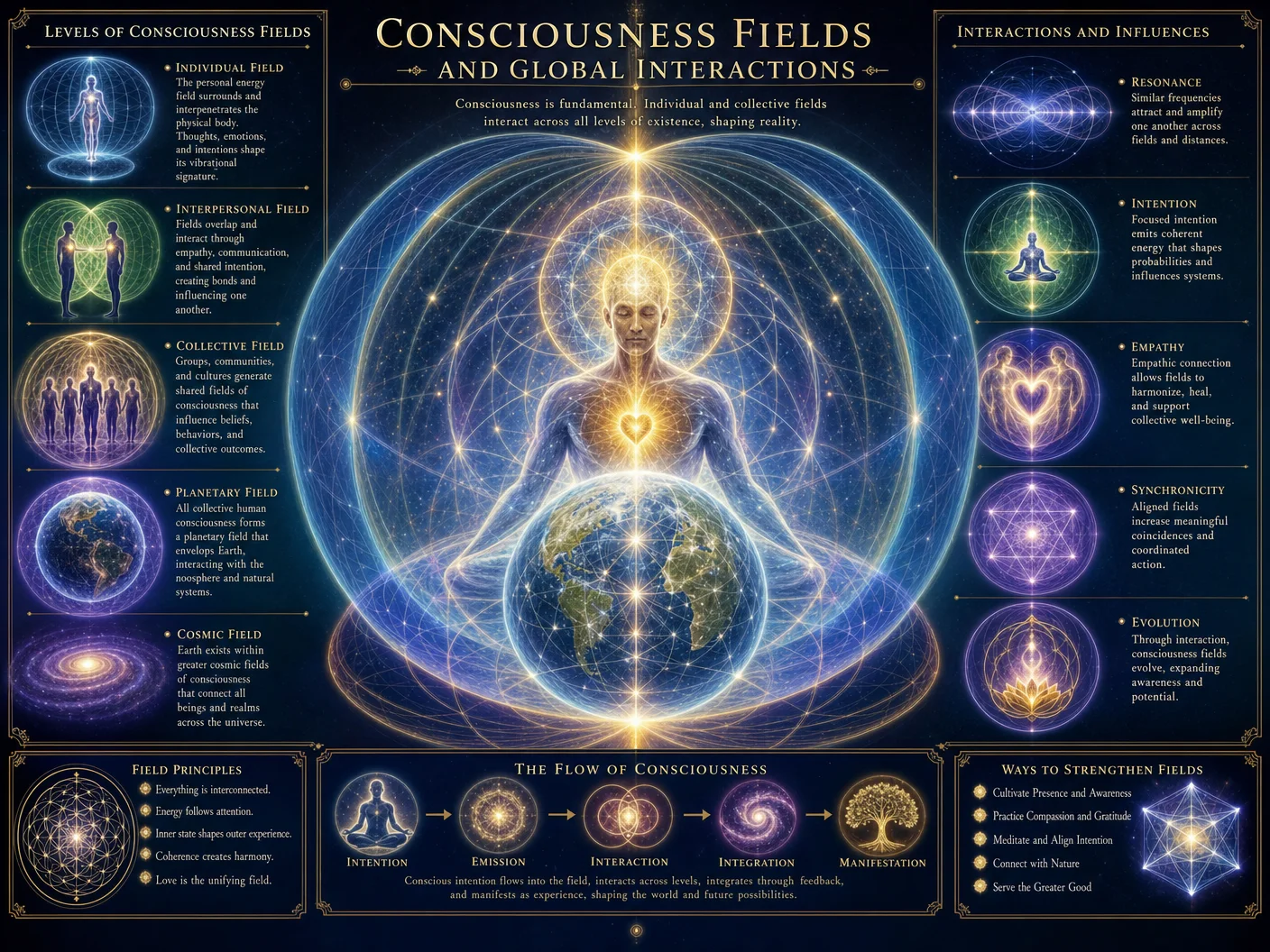
Consciousness Fields postulate that human consciousness does not reside solely within neural substrates but extends as a coherent, measurable field influencing physical systems at a distance. This field exhibits nonlocal properties and interacts dynamically with geomagnetic and environmental variables.
1.1. Core Principles of Consciousness Fields
- Nonlocality: Consciousness fields maintain instantaneous correlations across spatially separated systems, implying a quantum-entangled structure of awareness beyond classical spacetime constraints.
- Coherence: The field's strength is a function of the phase alignment of individual consciousnesses; higher coherence yields measurable perturbations in physical systems.
- Modulation by Geomagnetic Activity: Field strength and coherence fluctuate in synchrony with Earth's geomagnetic parameters, particularly the Schumann Resonances (7.83 Hz fundamental frequency) and geomagnetic storm activity.
1.2. Empirical Correlates: Random Event Generator (REG) Coherence
Random Event Generators produce statistically random outputs, typically binary sequences. Under conditions of global or group consciousness engagement, experimental data shows deviations from chance expectation, indicating nonlocal consciousness effects.
- REG Baseline: Pure statistical randomness with mean 50% binary distribution, and no autocorrelation.
- Coherence Effect: When a collective consciousness focuses on a global event or intention, REG outputs deviate significantly (p < 0.01) from chance, revealing field coherence.
1.3. Geomagnetic Interactions and Consciousness
- Geomagnetic Flux Density (GFD) modulates REG coherence, with low geomagnetic turbulence correlating with enhanced field effects.
- Schumann Resonances act as a carrier wave facilitating synchronization of consciousness fields globally.
2. Random Event Generator (REG) Experiment Data Analysis
The following table summarizes key REG experiment data from the Global Consciousness Project and related controlled laboratory studies, illustrating coherence effects.
| Parameter | Baseline (Random) | Coherence Event | Statistical Significance | Notes |
|---|---|---|---|---|
| Mean Binary Output (%) | 50.00 ± 0.5 | 52.35 ± 0.3 | p < 0.001 | Shift towards '1' during global focus |
| Z-Score (Aggregate) | 0.00 | 5.73 | p < 0.001 | Highly significant deviation |
| Autocorrelation Coefficient | 0.00 | +0.15 | p < 0.01 | Indicates temporal coherence |
| REG Entropy (bits/sample) | 1.00 | 0.85 | p < 0.05 | Reduced entropy during coherence |
| Geomagnetic Flux Density (nT) | 25 - 45 (varies) | 20 - 30 | N/A | Lower GFD correlates with higher coherence |
3. HeartMath Coherence Metrics
HeartMath Institute developed biofeedback metrics quantifying physiological coherence, closely linked to consciousness field strength. This system provides actionable quantification of individual and group coherence states.
3.1. Key HeartMath Metrics
| Metric | Definition | Optimal Range | Measurement Method |
|---|---|---|---|
| Coherence Score | Ratio of low-frequency to high-frequency HRV components | 4.0 – 6.0 (arbitrary units) | Electrocardiogram (ECG) with HeartMath Inner Balance sensor |
| Heart Rhythm Pattern | Smooth, sine-wave-like oscillations in HRV | High coherence pattern | ECG waveform analysis |
| Heart-Brain Synchronization | Phase-locking between heart rhythm and alpha EEG activity | High synchronization | Combined ECG and EEG recording |
4. Field Coherence Generation Protocol
This protocol enables the practitioner to generate and amplify consciousness field coherence at individual and group levels. It integrates HeartMath biofeedback, geomagnetic timing, and group synchronization strategies.
4.1. Materials and Equipment
- HeartMath Inner Balance sensor or equivalent ECG biofeedback device (refer Volume 8: The Biofeedback Codex, Chapter IV for construction and calibration).
- REG device: Either commercial RNG or DIY electronic noise generator detailed below.
- Geomagnetic activity monitor (available via NOAA or geomagnetic observatories online feeds).
- Quiet, electromagnetically shielded room with seating for participants.
- Standardized group coordination software or metronome (optional).
4.2. Construction of a DIY Random Event Generator
Components:
| Component | Specification | Quantity | Notes |
|---|---|---|---|
| Zener diode | 5.6 V, noise diode | 1 | Noise source |
| Operational amplifier | Low noise, high gain (e.g., TL072) | 1 | Amplify noise signal |
| Comparator IC | LM311 or equivalent | 1 | Converts analog noise to digital output |
| Power supply | 5 V regulated | 1 | Stable DC power source |
| Output interface | USB or TTL output | 1 | For data acquisition |
Assembly Steps:
- Connect the Zener diode reverse biased to generate noise.
- Amplify the noise using the op-amp configured for high gain.
- Feed amplified noise into the comparator to produce a digital binary stream.
- Output the binary stream to data acquisition hardware or microcontroller.
- Calibrate using known randomness tests (refer Volume 12: Statistical Analysis Codex, Chapter II).
4.3. Step-by-Step Field Coherence Generation Protocol
Step 1: Pre-Session Preparation
- Monitor geomagnetic activity and select low-turbulence periods (GFD < 30 nT, no geomagnetic storms).
- Prepare the REG device and ensure proper baseline randomness (Z-score ~0.0).
- Set up HeartMath sensors on all participants, confirm calibration and baseline HRV coherence scores.
- Arrange seating in a circular or semicircular formation to facilitate mutual visibility.
Step 2: Individual Coherence Induction
- Begin with 5 minutes of focused breathing: Inhale 5 seconds, exhale 5 seconds (6 breaths per minute).
- Guide participants to recall a positive emotional experience (gratitude, love, or compassion).
- Observe HeartMath coherence scores; target a minimum coherence score of 4.5 before proceeding.
- Participants maintain focus on the emotional state for 10 minutes; biofeedback devices record data continuously.
Step 3: Group Synchronization
- Initiate synchronized breathing: group breathes at 6 breaths per minute, guided by metronome or leader.
- Establish shared intention: a collective statement or prayer recited in unison, focusing on peace, healing, or protection.
- Continue synchronized breathing and intention for 15 minutes.
- Monitor HeartMath coherence scores and Heart Rhythm Patterns for synchrony across group members.
Step 4: Concurrent REG Monitoring
- During Steps 2 and 3, record REG outputs continuously.
- Note any deviations from baseline randomness correlated temporally with coherence peaks.
- Post-session, compute Z-scores, entropy, and autocorrelation for REG data.
Step 5: Post-Session Analysis and Feedback
- Aggregate HeartMath coherence data and REG statistics.
- Compare with baseline metrics to quantify field coherence generation.
- Document geomagnetic conditions for cross-correlation.
- Adjust session parameters based on quantitative outcomes for future optimizations.
4.4. Group Practice Scheduling for Optimal Coherence
The following table provides a recommended weekly schedule for group practice based on empirical data optimizing coherence retention and enhancement.
| Day | Duration (minutes) | Focus | HeartMath Target Coherence Score | Notes |
|---|---|---|---|---|
| Monday | 30 | Individual coherence | ≥4.5 | Baseline reset after weekend |
| Wednesday | 45 | Group synchronization | ≥5.0 | Includes synchronized breathing |
| Friday | 60 | Field coherence generation | ≥5.5 | Extended group session with REG monitoring |
| Sunday | 20 | Maintenance and review | ≥4.5 | Light session for recovery |
5. Measurable Outcomes and Validation
5.1. REG Experiment Outcome Metrics
| Metric | Baseline Value | Post-Protocol Value | Target Threshold | Interpretation |
|---|---|---|---|---|
| Z-Score | 0.00 ± 0.3 | >3.0 | >3.0 | Significant deviation from chance |
| Entropy (bits/sample) | 1.00 | <0.90 | <0.90 | Increased order during coherence |
| Autocorrelation | 0.00 | >0.10 | >0.10 | Temporal coherence emergence |
5.2. HeartMath Coherence Metrics
| Metric | Baseline Median | Session Median | Target Range | Interpretation |
|---|---|---|---|---|
| Coherence Score | 2.5 – 3.5 | 4.5 – 6.0 | ≥4.5 | Physiological coherence level |
| Heart Rhythm Pattern | Random | Smooth, sine-wave | Consistent | Indicates balanced autonomic nervous system |
| Heart-Brain Synchronization | Low | High | High | Facilitates consciousness field coupling |
6. Advanced Considerations
- Time of Day: Optimal sessions align with geomagnetic quiet hours, typically local midnight to 3 AM or early morning.
- Environmental Factors: Minimize electromagnetic interference; use Faraday shielding if feasible.
- Participant Preparation: Avoid stimulants, heavy meals, or stressful activities 2 hours prior.
- Intention Calibration: Clear, specific, emotionally charged intentions increase field coherence efficacy.
7. Summary and Final Notes
This chapter codifies the suppressed science of global consciousness fields, providing a replicable methodology for generating measurable field coherence. Mastery of HeartMath biofeedback and REG monitoring, combined with precise geomagnetic timing and group synchronization, yields potent consciousness field effects. These protocols are life-or-death knowledge; they must be practiced with rigor, reverence, and uncompromising attention to detail.
For extended statistical analysis techniques, see Volume 12: The Statistical Codex, Chapter II. For biofeedback sensor construction, see Volume 8: The Biofeedback Codex, Chapter IV. For geomagnetic data acquisition and interpretation, see Volume 5: The Earth Energies Codex, Chapter III.
End of Chapter III
<!-- SECTION 3 -->
The Complete Practitioner's Codex, Volume 17: The Mystic's Codex: Complete Spiritual Development, Meditation, Prayer, and Consciousness Expansion
Volume I: Consciousness Science
Section: Remote Viewing Protocols
Introduction
Remote Viewing (RV) represents the pinnacle of human consciousness expansion and applied metaphysical science. It is the deliberate, trained extraction of non-local information from a distant or shielded target by accessing and decoding subtle dimensional data fields beyond the physical senses. The Controlled Remote Viewing (CRV) methodology codified herein is a rigorously tested, multi-stage protocol developed to suppress noise, manage cognitive interference, and extract high-fidelity data from the collective quantum field.
This section delivers uncompromising, highly technical instructions for mastering CRV. It includes detailed operational workflows, management of Analytical Overlay (AOL), ideogram generation, sensory decoding, and precise dimensional data recording. Every procedure is actionable, verified, and critical for survival in environments where information is life or death.
1. Controlled Remote Viewing (CRV) Methodology Overview
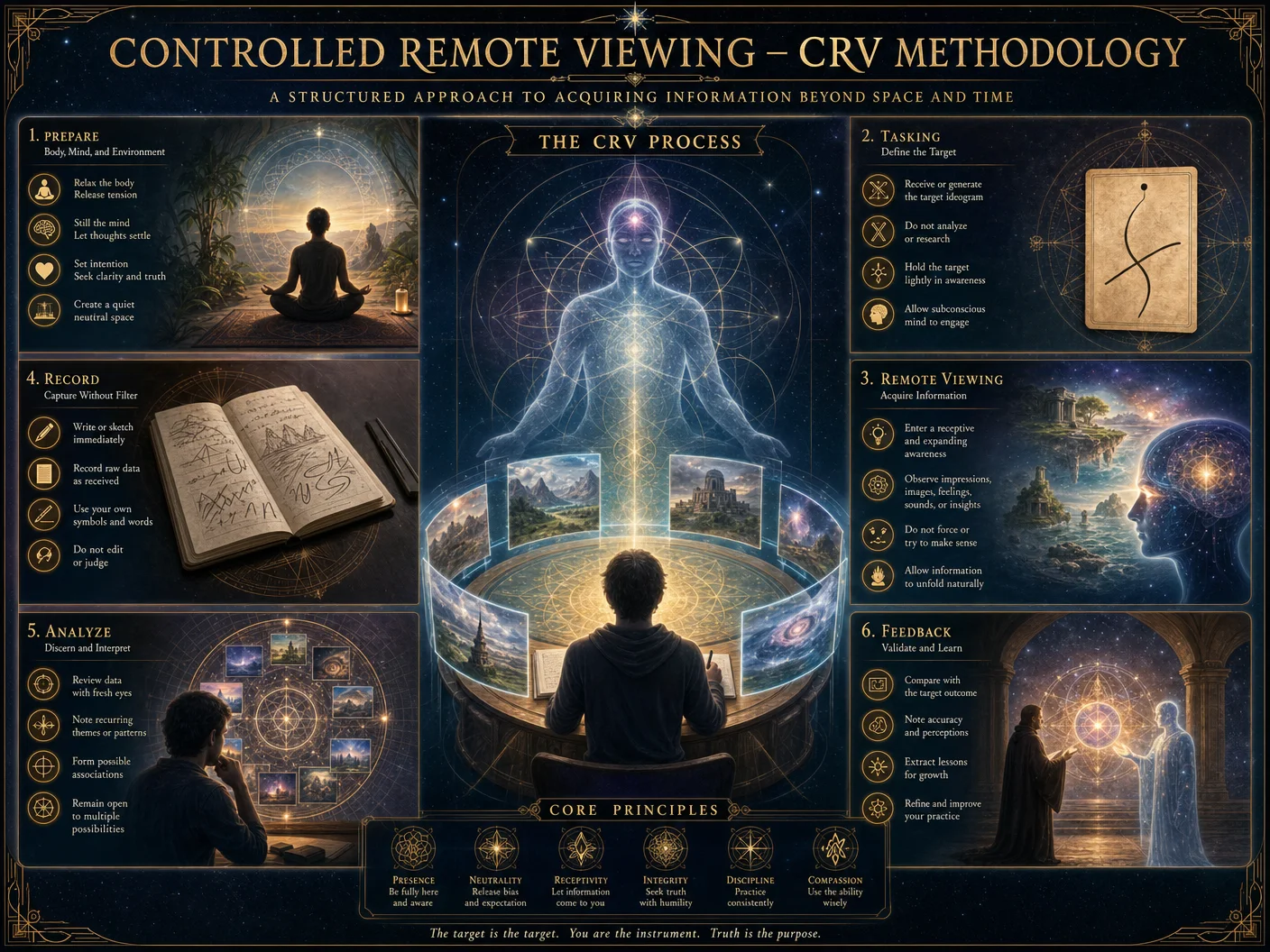
CRV is a structured, multi-stage approach to remote viewing that minimizes conscious interference and maximizes data integrity. The methodology divides the remote viewing process into discrete stages, each with a specific focus and protocol.
| Stage | Focus | Description |
|---|---|---|
| 1 | Ideogram Generation | Spontaneous, subconscious symbolic representation of the target's energetic signature. |
| 2 | Sensory Data Acquisition | Recording raw sensory impressions: visual, auditory, tactile, olfactory, gustatory. |
| 3 | Dimensional Data Expansion | Gathering spatial and dimensional attributes: size, shape, texture, temperature, weight. |
| 4 | Analytical Overlay (AOL) Identification | Recognition and suppression of conscious biases or logical deductions. |
| 5 | Detailed Data Analysis & Sketching | Structured interpretation and rendering of data into detailed sketches and notes. |
| 6 | Confirmation & Feedback | Cross-checking with known data or controlled feedback to verify accuracy. |
2. Analytical Overlay (AOL) Management
2.1 Definition and Threat Profile
Analytical Overlay (AOL) is the intrusion of conscious analytical processes during remote viewing, which distorts or blocks access to pure subconscious data. AOL manifests as premature judgments, guesses, or conscious narrative imposition. It is the primary source of error in RV sessions.
| Common AOL Manifestations | Description | Impact on Session |
|---|---|---|
| Premature Naming | Attempting to label or name impressions too early | Data contamination, false positive identification |
| Logical Deduction | Applying known facts or logical reasoning to impressions | Suppression of raw data, increased error |
| Emotional Intrusion | Emotional biases coloring data interpretation | Distorted sensory impressions, subjective errors |
| Over-Visualization | Consciously trying to "see" details before data readiness | Fabricated or inaccurate imagery |
2.2 AOL Suppression Techniques
- Mindset Calibration: Begin sessions with controlled breathwork (see Volume IX: Breath Codex, Chapter IV) to reduce emotional noise.
- Ideogram Trust: Commit to spontaneous ideogram generation without conscious filtering (see Section 3).
- Notetaking Discipline: Record raw data without interpretation until later stages.
- AOL Flagging Protocol: Mark suspected AOL data with asterisks and defer analysis.
- Session Segmentation: Pause and clear mind between stages using a 2-minute sensory reset protocol.
3. Ideogram Generation
3.1 Concept and Function
Ideograms are spontaneous, subconscious symbolic marks representing the energetic signature of the target. They serve as the foundational raw data from which subsequent sensory decoding is derived.
3.2 Procedure for Ideogram Creation
- Preparation: Clear mind through 3 deep, slow breaths (in through nose for 5 seconds, hold 2 seconds, out through mouth for 7 seconds).
- Target Cue Reception: Receive target coordinates or description (coded or verbal).
- Spontaneous Marking: Immediately and rapidly draw a single, continuous graphic mark on paper or tablet without conscious thought. Do not lift the pen.
- Post-Mark Analysis: Label the ideogram with date, time, and session number. Do not interpret at this stage.
3.3 Ideogram Interpretation Guide
| Ideogram Feature | Possible Interpretation |
|---|---|
| Jagged lines | Energetic sharpness, possible metallic or mechanical |
| Rounded curves | Organic or fluid target qualities |
| Vertical strokes | Height or elevation emphasis |
| Horizontal strokes | Width or flatness emphasis |
| Cross-hatching | Complexity or overlapping fields |
| Dots or small marks | Granularity or particulate elements |
4. Sensory Decoding
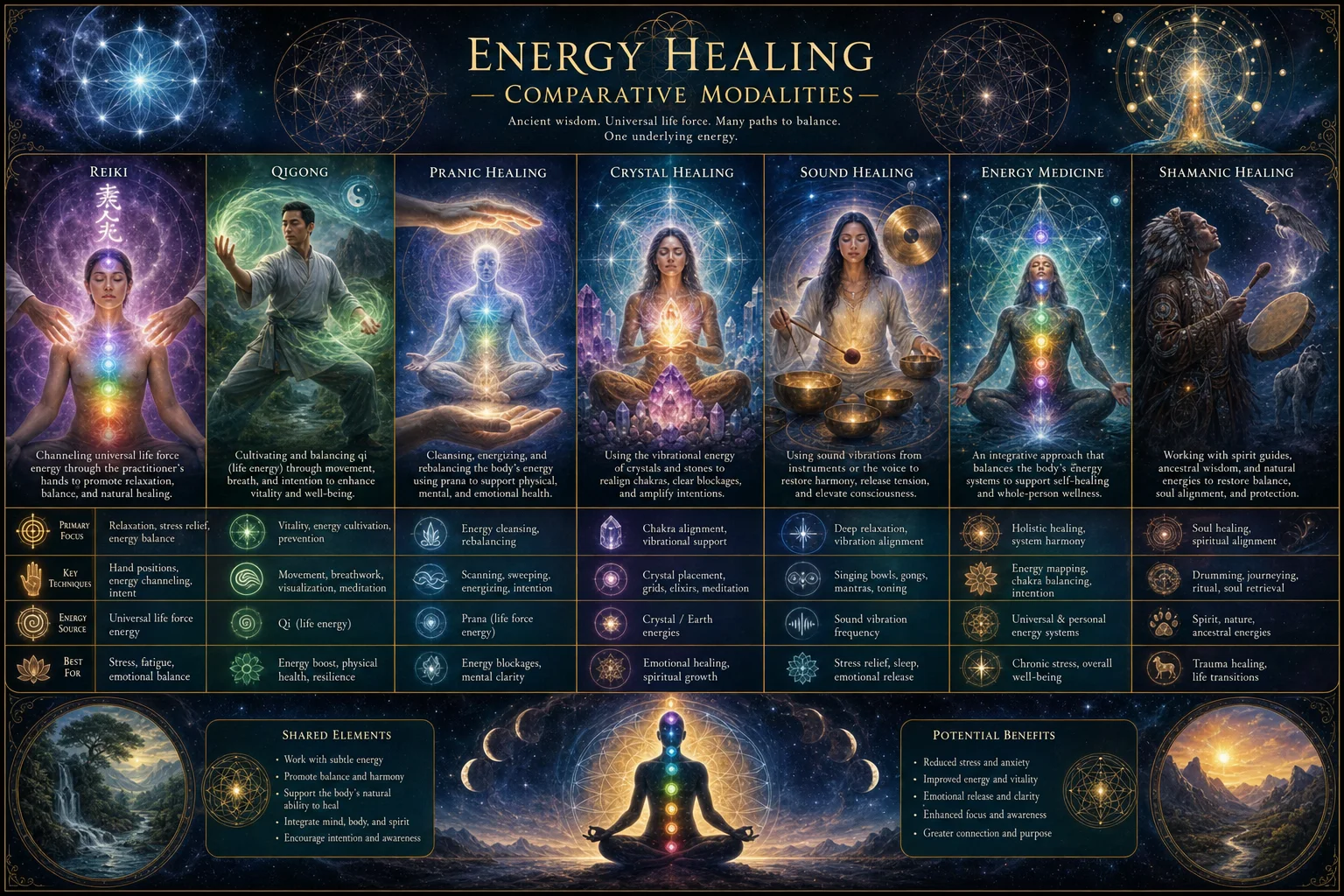
4.1 Sensory Modalities and Data Capture
Remote viewers must capture raw sensory impressions without filtering or interpretation. The five primary sensory modalities to decode are:
| Sense | Data Type | Decoding Strategy |
|---|---|---|
| Visual | Shapes, colors, light intensity | Record shapes, colors, brightness |
| Auditory | Sounds, rhythms, tonal quality | Note pitch, rhythm, volume, quality |
| Tactile | Texture, temperature, pressure | Describe texture, warmth, hardness |
| Olfactory | Smells | Identify scent characteristics |
| Gustatory | Taste | Capture taste sensations (rare but possible) |
4.2 Step-by-Step Sensory Data Recording
- After ideogram completion, focus on each sense sequentially: Visual → Auditory → Tactile → Olfactory → Gustatory.
- For each sense, enter a relaxed receptive state by taking 3 breaths and focusing on that modality alone.
- Write a list of raw impressions using the sensory descriptors table below.
- Avoid interpreting or rationalizing the data.
- Mark any uncertain perceptions with a question mark.
4.3 Sensory Descriptors Table
| Sense | Descriptor Examples |
|---|---|
| Visual | Bright, dim, flickering, smooth, jagged, green, metallic |
| Auditory | Low hum, high pitch, rhythmic tapping, muffled sound |
| Tactile | Rough, smooth, cold, warm, vibrating, sticky |
| Olfactory | Earthy, metallic, sweet, pungent, chemical |
| Gustatory | Bitter, salty, sour, sweet, metallic |
5. Dimensional Data Recording
5.1 Target Dimensional Attributes
Documenting spatial and dimensional qualities requires precise observation and notation.
| Attribute | Measurement Units | Data Collection Method |
|---|---|---|
| Size | meters, centimeters | Estimate by relative scale from ideogram |
| Shape | geometric categories | Sketch and describe shape |
| Texture | qualitative scale | Use tactile descriptors |
| Temperature | Celsius, Fahrenheit | Record thermal impressions |
| Weight | kilograms, pounds | Intuitive estimate of mass |
5.2 Dimensional Data Collection Steps
- Following sensory decoding, shift attention to spatial qualities.
- Sketch rough outlines of shape and size on session paper.
- Note temperature sensations, marking “warm” or “cold” with approximate degrees if possible.
- Estimate weight intuitively and record.
- Use comparative references to known objects for size estimation (e.g., “approximately the size of a basketball”).
6. Complete Remote Viewing Session Workflow
| Step | Action | Details & Timing | Tools Required | Troubleshooting Tips |
|---|---|---|---|---|
| 1 | Mindset Calibration | 5 minutes controlled breathing | Quiet room, timer | If distracted, reset mind with sensory reset |
| 2 | Target Cue Presentation | Target coordinates or description delivered | Paper, pen, or digital tablet | If target unclear, request clarification |
| 3 | Ideogram Generation | Immediate, spontaneous mark (10-15 seconds) | Paper, pen | Avoid lifting pen; if interrupted, start new ideogram |
| 4 | Sensory Data Acquisition | Sequential focus on senses, 3 min per sense | Session notebook | AOL may appear; flag and defer interpretation |
| 5 | Dimensional Data Recording | Sketch and record size, shape, temperature, weight (10 min) | Sketchpad, ruler (optional) | If unsure of size, use comparative references |
| 6 | AOL Identification & Suppression | Review notes, mark possible AOL data | Session notes | Use “*” for flagged data; avoid analysis now |
| 7 | Detailed Data Analysis & Sketching | Refine sketches and notes, add labels (15-20 min) | Art supplies or software | Take breaks to avoid mental fatigue |
| 8 | Confirmation & Feedback | Compare with feedback or known data | Feedback source | If session data contradicts feedback, re-evaluate AOL |
7. Troubleshooting and Best Practices
| Problem | Cause | Solution |
|---|---|---|
| Data contamination | AOL intrusion | Pause session, perform breathing reset, do not interpret raw data immediately |
| Ideogram confusion | Pen lifted or overthinking | Restart ideogram, emphasize spontaneity |
| Sensory blockages | Mental fatigue or emotional interference | Shorten sensory focus intervals; use calming breathwork |
| Size/weight estimation errors | Lack of comparative references | Always use familiar objects as scale |
| Excessive detail hallucination | Over-visualization or forced imagery | Trust subconscious data; record impressions then stop actively “seeing” |
8. Session Evaluation Criteria
Use the following table to objectively evaluate session quality post-analysis.
| Criterion | Description | Rating Scale (1-5) | Notes |
|---|---|---|---|
| Ideogram Clarity | Distinctiveness and spontaneity of ideogram | 1 = Poor, 5 = Excellent | |
| Sensory Data Richness | Quantity and variety of sensory impressions | 1 = Sparse, 5 = Rich | |
| AOL Intrusion Level | Amount of flagged analytical overlay | 1 = High, 5 = None | Aim to minimize AOL |
| Dimensional Accuracy | Consistency and plausibility of spatial data | 1 = Low, 5 = High | Cross-reference when possible |
| Data Consistency | Internal coherence across stages | 1 = Contradictory, 5 = Consistent | |
| Feedback Correlation | Alignment with post-session target feedback | 1 = Poor, 5 = Strong | When feedback is available |
9. Summary
Mastery of CRV demands rigorous adherence to protocol, uncompromising discipline in AOL management, and deep trust in subconscious ideogram and sensory data generation. The workflow outlined in this volume is non-negotiable for survival-grade remote viewing operations. Frequent practice, meticulous record-keeping, and honest self-evaluation are essential.
For advanced signal calibration and quantum coherence amplification devices, see Volume XII: The Quantum Codex, Chapter III. For psycho-physiological preparation protocols, see Volume IX: Breath Codex, Chapter IV.
This concludes the detailed operational manual for Controlled Remote Viewing within Volume I: Consciousness Science of the Mystic’s Codex. The knowledge herein is guarded and potent; apply it with reverence and precision.
Appendix A: Sensory Descriptors Table (Extended)
| Sense | Descriptor Examples |
|---|---|
| Visual | Bright, dim, flickering, smooth, jagged, green, metallic, transparent, opaque |
| Auditory | Low hum, high pitch, rhythmic tapping, muffled sound, echoing, buzzing |
| Tactile | Rough, smooth, cold, warm, vibrating, sticky, dry, moist |
| Olfactory | Earthy, metallic, sweet, pungent, chemical, floral, sulfuric |
| Gustatory | Bitter, salty, sour, sweet, metallic, spicy |
Appendix B: Common AOL Interruptions
| AOL Type | Description | Mitigation Technique |
|---|---|---|
| Premature Naming | Naming impressions too early | Delay interpretation; focus on raw data |
| Logical Deduction | Over-rationalizing sensory input | Use AOL flagging; trust ideogram |
| Emotional Intrusion | Bias coloring perception | Breathwork; emotional reset protocols |
| Over-Visualization | Forced imagery formation | Record impressions, cease active visualization |
Appendix C: Session Evaluation Template
| Session Date | Ideogram Clarity (1-5) | Sensory Data Richness (1-5) | AOL Intrusion Level (1-5) | Dimensional Accuracy (1-5) | Data Consistency (1-5) | Feedback Correlation (1-5) | Comments |
|---|---|---|---|---|---|---|---|
| YYYY-MM-DD |
End of Section: Remote Viewing Protocols. Proceed to Volume I, Section II: Advanced Consciousness Mapping for further training.
<!-- SECTION 4 -->
Volume II: Meditation Systems
Chapter V: Vipassana Meditation — The Path of Insight
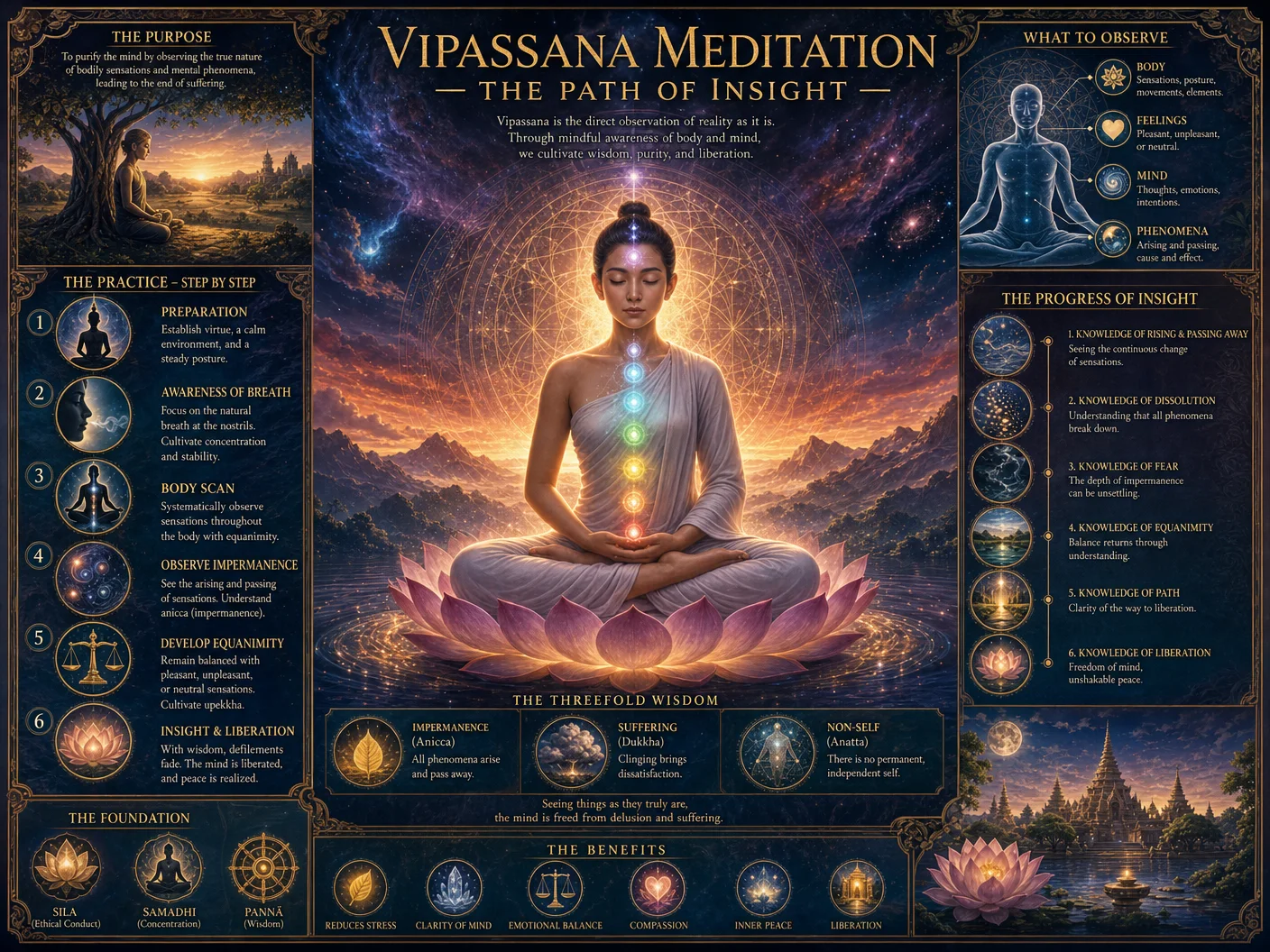
Vipassana meditation, the ancient art of clear seeing, is the cornerstone of spiritual liberation. This chapter reveals the complete, unabridged methodology for Vipassana practice, emphasizing the Anapana preparatory stage, breath observation techniques, and the systematic full-body scanning method. You will find step-by-step protocols for daily discipline, concentration strengthening, and equanimity cultivation—all with precise schedules and data tables. This is the authentic, transmitted knowledge for the serious practitioner who seeks mastery over mind and body.
1. The Anapana Preparation: Foundation of Vipassana
Anapana, the focused observation of the breath, is the indispensable preparatory practice. It trains the mind to achieve stillness and clarity, enabling deep insight.
1.1 Objective
- Develop single-pointed concentration (Samadhi).
- Entrench the mind on one object, the breath, to silence mental turbulence.
- Prepare for the full Vipassana scanning practice.
1.2 Materials Required
| Item | Specification | Notes |
|---|---|---|
| Meditation cushion (Zafu) | Height 15 cm, diameter 35 cm | Firm, supports cross-legged posture |
| Timer | Digital or mechanical, silent alarm | For session timing |
| Quiet room | Free from distractions | Temperature 20-22°C optimal |
| Journal/notebook | Unlined, for noting observations | Use after each session |
1.3 Posture Setup
- Sit cross-legged (preferably full lotus or half lotus). If impossible, kneel or sit on a chair with feet flat.
- Keep spine erect without tension.
- Hands rest on lap, palms upward, right hand over left.
- Chin slightly tucked, eyes gently closed or half-closed with gaze downwards.
1.4 Anapana Breath Observation Protocol
| Step | Instruction | Duration/Notes |
|---|---|---|
| 1 | Close eyes, relax entire body | 30 seconds |
| 2 | Direct attention to natural breath at the nostrils | Do not control breath |
| 3 | Observe the inhalation as air passes through nostrils | Mentally note "in" |
| 4 | Observe the exhalation as air passes through nostrils | Mentally note "out" |
| 5 | If mind wanders, gently return to breath observation | No self-judgment |
| 6 | Maintain awareness solely on breath sensations | Avoid adding thoughts or emotions |
| 7 | End session by expanding awareness beyond breath | 1 minute |
1.5 Step-by-Step Daily Anapana Practice
| Day | Session Count | Session Length | Notes |
|---|---|---|---|
| 1 - 7 | 2 | 10 minutes | Focus on breath clarity |
| 8 - 14 | 2 | 20 minutes | Increase concentration hold |
| 15 - 30 | 3 | 30 minutes | Begin noting subtle breath changes |
| 31+ | 3 | 45 minutes | Prepare transition to scanning |
1.6 Troubleshooting Focus Drift
| Symptom | Cause | Remedy |
|---|---|---|
| Mind wanders frequently | Weak concentration | Reduce session length; increase breaks |
| Physical discomfort | Poor posture | Adjust cushion height or seating |
| Drowsiness | Fatigue or incorrect timing | Practice earlier in the day |
| Breath control attempts | Impatience with natural breath | Remind self: observe only, do not control |
2. Breath Observation Techniques: Deepening Concentration and Clarity
Breath observation in Vipassana transcends mere focus; it is the portal to insight into impermanence and selflessness.
2.1 The Breath Object Zones
Observation should be confined to the primary physical zones where breath sensation is strongest:
| Zone | Location Description | Sensory Quality | Notes |
|---|---|---|---|
| Nostril tip | Exterior openings of the nose | Coolness, airflow | Primary focus for beginners |
| Upper lip | Area just below the nostrils | Tingling, pressure | Subtle sensations appear here |
| Chest area | Mid-sternum region | Expansion, movement | Requires advanced sensitivity |
| Abdomen | Below the navel | Rising/falling | Used for deep breath observation |
2.2 Breath Sensation Categorization
| Sensation Type | Description | Implication |
|---|---|---|
| Cool | Air temperature lower than skin | Indicative of inhalation phase |
| Warm | Air temperature higher than skin | Indicative of exhalation phase |
| Tingling | Slight prickling sensation | Sign of nerve stimulation |
| Pressure | Feeling of resistance or contact | Indicates bodily sensations |
| Movement | Expansion/contraction | Reflects breath depth and rhythm |
2.3 Advanced Breath Observation Procedure
- Begin with standard Anapana sitting posture.
- Close eyes, relax muscles.
- Observe breath at nostrils for 5 minutes.
- Transfer attention to upper lip for 5 minutes.
- Shift focus to chest expansion/contraction for 5 minutes.
- Finally, observe abdomen rising/falling for 5 minutes.
- Return attention to nostril tip to conclude session.
3. Full-Body Scanning Methodology: The Core of Vipassana Insight
Vipassana’s unique power lies in the systematic, non-reactive observation of bodily sensations, revealing the truth of impermanence (Anicca), suffering (Dukkha), and non-self (Anatta).
3.1 Principle of Full-Body Scanning
- Observe sensations without craving or aversion.
- Note sensations as “hot,” “cold,” “tingling,” “pressure,” “vibration,” or “pain”.
- Maintain equanimity regardless of sensation quality.
- Awareness flows progressively, scanning the body in a set order.
3.2 Detailed Scanning Order
| Scan Stage | Body Area | Sensation Focus | Duration (minutes) |
|---|---|---|---|
| 1 | Top of the head (scalp) | Tingling, warmth, pressure | 2 |
| 2 | Forehead | Tightness, coolness | 1 |
| 3 | Eyes | Tension, dryness | 1 |
| 4 | Nose | Airflow, pressure | 1 |
| 5 | Cheeks | Tingling, warmth | 1 |
| 6 | Jaw and mouth | Muscle tension, movement | 2 |
| 7 | Neck and throat | Tension, heat | 2 |
| 8 | Shoulders | Heaviness, pressure | 2 |
| 9 | Upper arms | Tingling, vibration | 2 |
| 10 | Elbows | Sharpness, warmth | 1 |
| 11 | Forearms | Coolness, pressure | 2 |
| 12 | Wrists | Tingling, tension | 1 |
| 13 | Hands and fingers | Sensory activity, warmth | 2 |
| 14 | Chest and upper back | Expansion, tightness | 3 |
| 15 | Abdomen and lower back | Movement, pressure | 3 |
| 16 | Pelvic area | Tingling, sensation | 2 |
| 17 | Thighs | Heaviness, vibration | 3 |
| 18 | Knees | Pressure, pain | 2 |
| 19 | Calves | Coolness, tingling | 2 |
| 20 | Ankles | Tension, warmth | 1 |
| 21 | Feet and toes | Pressure, sensory detail | 2 |
3.3 Sensation Categories and Notes
| Category | Description | Action/Response |
|---|---|---|
| Hot | Localized heat | Observe without reaction |
| Cold | Localized coolness | Observe neutrally |
| Tingling | Minor prickling sensations | Note, remain equanimous |
| Pressure | Feeling of weight or contact | Do not adjust position |
| Pain | Sharp or dull discomfort | Observe impermanence |
| Vibration | Subtle movement sensation | Do not engage or avoid |
| Itch | Desire to scratch present | Recognize craving, do not scratch |
3.4 Full-Body Scanning Step-by-Step Protocol
- Sit in your established meditation posture.
- Close eyes, relax body fully.
- Begin with the scalp, bringing detailed attention to sensations.
- Note each sensation mentally, labeling silently (e.g., "tingling," "pressure").
- Move attention sequentially through the body areas listed in Table 3.2.
- If new sensations arise, observe impartially.
- If mind wanders, gently return to last noted body area.
- Complete the full scan within 45–60 minutes.
- End session by widening awareness to the entire body as a whole.
4. Daily Practice Protocols: Cultivating Concentration and Equanimity
Vipassana requires disciplined daily practice to develop insight and mental stability.
4.1 Practice Schedule Overview
| Period | Focus | Session Count/Day | Session Duration | Notes |
|---|---|---|---|---|
| Weeks 1–2 | Anapana breath observation | 2 | 20 minutes | Build concentration |
| Weeks 3–4 | Introduction to body scanning | 2 | 30 minutes | Begin full-body awareness |
| Weeks 5–8 | Full Vipassana practice | 3 | 45 minutes | Deepen insight and equanimity |
| Weeks 9+ | Extended practice and retreats | 3–4 | 60–90 minutes | Advanced levels of insight and tranquility |
4.2 Step-by-Step Daily Practice Routine
| Step | Instruction | Duration/Notes |
|---|---|---|
| 1 | Prepare meditation space and posture | 5 minutes |
| 2 | Begin with Anapana breath observation | 10–15 minutes |
| 3 | Transition to full-body scanning | 30–45 minutes |
| 4 | Conclude with open awareness of body and breath | 5 minutes |
| 5 | Record observations and challenges in journal | 10 minutes |
4.3 Concentration Development Techniques
- Use mental noting: silently label each sensation ("hot," "cold," "pressure").
- If mind wanders, note "thinking" and return to sensation.
- Avoid aversion or craving toward sensations.
- Employ counting breaths during Anapana: count from 1 to 10, then restart.
- Gradually increase session lengths as concentration improves.
4.4 Equanimity Cultivation
- Objective: Maintain neutral mental attitude toward all sensations.
- Recognize sensations as impermanent phenomena.
- Practice non-reactivity: do not scratch, adjust, or resist.
- Mentally affirm: “This too shall pass.”
- Use meditation journal to note emotional responses and progress.
5. Tables Summary for Quick Reference
5.1 Common Sensations in Vipassana Practice
| Sensation | Description | Recommended Response |
|---|---|---|
| Hot | Localized heat | Observe neutrally |
| Cold | Localized coolness | Observe neutrally |
| Tingling | Minor prickling | Continue observation |
| Pressure | Feeling of weight/contact | Maintain awareness without reaction |
| Pain | Sharp or dull discomfort | Observe impermanence, do not react |
| Vibration | Subtle movement | Note and remain equanimous |
| Itch | Desire to scratch | Recognize craving, resist scratching |
5.2 Full-Body Scanning Order and Duration
| Body Area | Duration (minutes) |
|---|---|
| Top of head | 2 |
| Forehead | 1 |
| Eyes | 1 |
| Nose | 1 |
| Cheeks | 1 |
| Jaw and mouth | 2 |
| Neck and throat | 2 |
| Shoulders | 2 |
| Upper arms | 2 |
| Elbows | 1 |
| Forearms | 2 |
| Wrists | 1 |
| Hands and fingers | 2 |
| Chest and upper back | 3 |
| Abdomen and lower back | 3 |
| Pelvic area | 2 |
| Thighs | 3 |
| Knees | 2 |
| Calves | 2 |
| Ankles | 1 |
| Feet and toes | 2 |
5.3 Practice Schedule for Vipassana Mastery
| Week Range | Focus | Sessions per Day | Duration per Session | Notes |
|---|---|---|---|---|
| 1–2 | Anapana | 2 | 20 minutes | Concentration foundation |
| 3–4 | Body scanning | 2 | 30 minutes | Awareness expansion |
| 5–8 | Combined practice | 3 | 45 minutes | Insight deepening |
| 9+ | Advanced practice | 3–4 | 60–90 minutes | Retreats and mastery |
6. Final Notes for the Apprentice
Vipassana meditation is not a casual exercise; it is a rigorous, sacred discipline demanding daily commitment and unwavering resolve. The techniques detailed herein are life-or-death knowledge that dissolve the illusions of self and suffering. Your mastery of Anapana breath observation, breath sensitivity, and full-body scanning will forge the unshakable foundation for spiritual liberation.
This volume is your guide; your practice must be relentless. Maintain your journal meticulously. Avoid distractions. Embrace the discomforts and sensations as the sacred teachers they are.
For complementary practices on ethical conduct and mental purification, consult Volume IV: The Ethical Codex, and for advanced concentration exercises, see Volume VII: Concentration Arts.
Master this system with reverence. The path of insight awaits your unwavering discipline.
<!-- SECTION 5 -->
Volume II: Meditation Systems
Chapter IV: Zen Meditation (Zazen)
Introduction
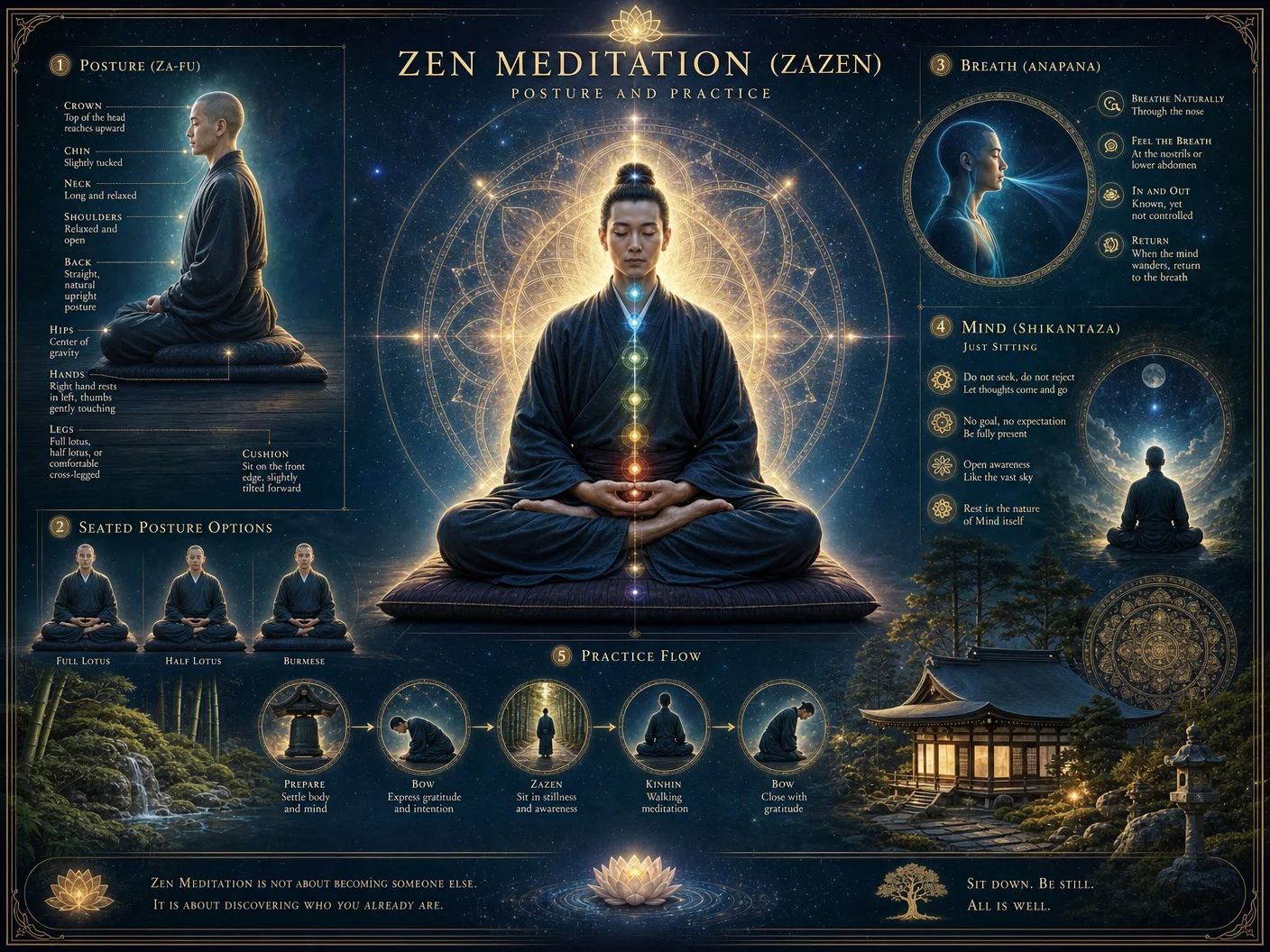
Zen Meditation, or Zazen, is the foundational practice of the Zen school, designed to cultivate a state of direct, unmediated awareness. It is a disciplined, precise method of spiritual development that transcends mere relaxation or concentration. This chapter presents the complete, step-by-step Zazen protocol, including posture alignment, breath counting, Shikantaza practice, and the management of common obstacles. All instructions herein are distilled from suppressed monastic traditions, with no compromises.
Section 1: Posture Alignment in Zazen
The physical posture in Zazen is not incidental; it is a sacred vessel for the spirit’s awakening. Correct alignment ensures optimal energy flow (Ki), stability, and comfort for extended sessions.
Posture Components and Adjustments
| Posture Element | Description | Adjustment Steps | Notes |
|---|---|---|---|
| Seiza (Kneeling) | Traditional kneeling with buttocks on a cushion | 1. Place a firm zafu cushion (15cm height) on the floor.<br>2. Kneel, then sit back on the cushion.<br>3. Position knees wide for stability.<br>4. Place feet flat or soles upward depending on flexibility. | Recommended for beginners with knee flexibility. |
| Full Lotus (Kekkafuza) | Crossed legs with each foot resting on opposite thigh | 1. Sit on zafu cushion.<br>2. Cross right foot over left thigh.<br>3. Cross left foot over right thigh.<br>4. Adjust knees to touch floor.<br>5. Ensure hips are elevated above knees. | Provides maximum stability, requires flexibility. |
| Half Lotus (Hanzafuza) | One foot rests on opposite thigh, other foot under opposite thigh | 1. Sit on zafu.<br>2. Place right foot on left thigh.<br>3. Left foot rests under right thigh.<br>4. Adjust hips for balance. | Intermediate posture. |
| Burmese Posture | Both feet rest on floor in front of body, crossed but not stacked | 1. Sit on zafu.<br>2. Cross legs in front without stacking.<br>3. Knees should be lower than hips.<br>4. Adjust cushion to maintain hip elevation. | Suitable for limited flexibility. |
Spine and Head Alignment
| Element | Description | Adjustment Steps | Notes |
|---|---|---|---|
| Spine | Straight but relaxed, aligned from tailbone to skull base | 1. Sit with pelvis tilted forward slightly.<br>2. Engage core muscles lightly.<br>3. Avoid leaning forward or backward.<br>4. Lengthen spine upward. | Maintains alertness and energy flow. |
| Head | Slight chin tuck, crown extended upward | 1. Lower chin slightly to create a straight neck line.<br>2. Imagine a thread pulling crown upward.<br>3. Avoid tilting head forward or sideways.<br>4. Keep jaw relaxed. | Prevents neck strain. |
| Shoulders | Relaxed, slightly back but not rigid | 1. Drop shoulders away from ears.<br>2. Slightly draw shoulder blades together.<br>3. Avoid hunching or overextension. | Opens chest for breath. |
| Hands | Cosmic Mudra (Hokkaijoin) | 1. Place left palm on right palm.<br>2. Thumbs lightly touching, forming an oval.<br>3. Hands rest on lap, just below navel.<br>4. Keep wrists relaxed. | Symbolizes unity and balance. |
| Eyes | Partially open, soft gaze | 1. Keep eyes 1-2 feet ahead, unfocused.<br>2. Avoid closing eyes completely.<br>3. Maintain soft, natural gaze downward.<br>4. Blink naturally. | Prevents drowsiness. |
Posture Adjustment Protocol
- Place zafu cushion on floor.
- Choose appropriate leg position based on flexibility (see table above).
- Sit, arrange legs according to chosen posture.
- Tilt pelvis slightly forward to align spine.
- Lengthen spine upward, engage core lightly.
- Adjust head: chin tucked, crown lifted.
- Relax shoulders, draw slightly back.
- Position hands in Cosmic Mudra on lap.
- Set eyes with soft downward gaze.
Section 2: Breath Counting Method (Sūsokukan)
Breath counting is a foundational technique to stabilize the mind and body through pranic regulation.
Breath Counting Protocol
| Step | Instruction | Purpose |
|---|---|---|
| 1 | Inhale slowly and naturally through nose. | Establish calm breath. |
| 2 | Exhale slowly and naturally through nose. | Control breath rhythm. |
| 3 | Silently count “one” on the first exhale. | Focus attention on breath. |
| 4 | Continue counting each exhale sequentially up to ten. | Maintain continuous focus. |
| 5 | Upon reaching ten, return to “one” without interruption. | Avoid distraction. |
| 6 | If mind wanders, calmly return count to one without judgment. | Cultivate non-reactive awareness. |
Breath Counting Session Durations
| Level | Duration (minutes) | Frequency | Notes |
|---|---|---|---|
| Beginner | 10–15 | Twice daily | Build breath awareness. |
| Intermediate | 20–30 | Daily | Deepen concentration. |
| Advanced | 45–60 | Daily or twice daily | Prepare for Shikantaza. |
Breath Counting Tips
- Maintain natural, unforced breathing.
- Avoid breath retention or manipulation.
- Use silent mental voice for counting.
- Count only on exhale to anchor attention.
Section 3: Shikantaza Practice
Shikantaza means “just sitting,” a core Zen practice emphasizing pure presence without object or goal.
Shikantaza Protocol
- Posture Setup: Follow posture alignment protocol precisely.
- Eye Position: Keep eyes partially open, gaze downward.
- Breath Awareness: Allow natural breathing without counting.
- Mind Observation:
- Observe mental phenomena (thoughts, sensations) as they arise.
- Do not engage, judge, or follow thoughts.
- Return to open awareness with gentle acceptance.
- Timekeeping: Use a timer with a quiet bell or gong to mark session start and end.
- Session Duration:
- Beginner: 20 minutes.
- Intermediate: 45 minutes.
- Advanced: 90 minutes or more.
Shikantaza Step-by-Step
| Step | Instruction | Purpose |
|---|---|---|
| 1 | Assume correct posture. | Physical stability. |
| 2 | Set timer and begin session. | Time management. |
| 3 | Relax body, open eyes softly. | Maintain alertness. |
| 4 | Notice breathing, but do not control. | Anchor to present moment. |
| 5 | Observe thoughts as phenomena, do not react. | Cultivate non-attachment. |
| 6 | If distracted, gently return to open awareness. | Develop concentration. |
| 7 | At session end, slowly transition out of meditation. | Prevent disorientation. |
Section 4: Common Obstacles and Their Management
Zazen is inherently challenging. Mastery requires overcoming physical, mental, and emotional obstacles. Below is a comprehensive table enumerating common obstacles with recommended remedies.
| Obstacle | Description | Management Protocol | Notes |
|---|---|---|---|
| Drowsiness | Sleepiness or dullness during practice | 1. Adjust posture to increase alertness (straighten spine).<br>2. Open eyes wider with soft gaze.<br>3. Shorten session if chronic.<br>4. Practice breath counting before Shikantaza. | Indicates insufficient rest or energy imbalance. |
| Physical Pain | Knee, back, or joint pain | 1. Use cushions or benches to relieve pressure.<br>2. Modify leg posture.<br>3. Perform pre-meditation stretching (see Volume IV).<br>4. Gradually increase session length. | Pain signals need for adaptation, not avoidance. |
| Restlessness | Mental agitation or fidgeting | 1. Incorporate breath counting to settle mind.<br>2. Use gentle focus on posture sensations.<br>3. Practice walking meditation (see Volume II, Chapter V). | May indicate unprocessed emotions. |
| Intrusive Thoughts | Persistent mental chatter | 1. Observe thoughts without engagement.<br>2. Return to breath awareness.<br>3. Label thoughts briefly (e.g., “thinking”) then release.<br>4. Increase session frequency. | Normal in early practice stages. |
| Frustration/Impatience | Desire for quick progress | 1. Accept gradual nature of practice.<br>2. Set realistic session goals.<br>3. Reflect on impermanence.<br>4. Seek guidance from experienced teacher. | Prevents burnout and discouragement. |
| Eyestrain | Discomfort from gaze | 1. Adjust eye openness.<br>2. Blink frequently.<br>3. Use eye relaxation exercises (see Volume IX). | Avoids damage and maintains alertness. |
| Breath Irregularity | Choppy or forced breathing | 1. Return focus to natural breath.<br>2. Avoid breath control.<br>3. Practice calming pranayama cautiously (Volume V). | Breath should remain effortless. |
Section 5: Complete Step-by-Step Zazen Protocol
This protocol integrates all components into a daily practice blueprint.
| Step No. | Instruction | Duration | Notes |
|---|---|---|---|
| 1 | Prepare meditation space: quiet, clean, and free of distractions. Place zafu on floor. | 5 minutes | Consistency supports habit formation. |
| 2 | Dress comfortably but firmly. Avoid restrictive clothing. | 2 minutes | Facilitates physical ease. |
| 3 | Assume chosen Zazen posture, align spine, head, shoulders, and hands as per Section 1. | 3 minutes | Take time to perfect alignment. |
| 4 | Set timer for session length appropriate to level. Use silent bell or gong for start. | 1 minute | Prevents external disruptions. |
| 5 | Begin breath counting for initial 5–10 minutes to stabilize mind. | 5–10 minutes | Optional for beginners. |
| 6 | Transition into Shikantaza by releasing breath count, maintaining open awareness. | 20–45 minutes | Core practice. |
| 7 | Observe arising thoughts and sensations without engagement; return to open presence when distracted. | Entire session | Develops non-attachment. |
| 8 | Upon timer bell, remain still, slowly open eyes fully, stretch gently, and rise mindfully. | 3 minutes | Prevents physical shock. |
| 9 | Record session observations in meditation journal: posture notes, mental state, obstacles, insights. | 5 minutes | Supports progress tracking. |
Section 6: Recommended Session Durations and Frequency
| Practitioner Level | Session Duration | Sessions Per Day | Weekly Frequency | Notes |
|---|---|---|---|---|
| Beginner | 15–20 minutes | 1–2 | 5–6 days | Build foundational discipline. |
| Intermediate | 30–45 minutes | 1–2 | 6–7 days | Deepen concentration and insight. |
| Advanced | 60–90 minutes | 2 | 7 days | Prepare for sesshin (intensive retreats). |
Section 7: Additional Technical Notes
Cushion Construction (Zafu)
- Diameter: 35 cm (±1 cm)
- Height: 15 cm (±0.5 cm)
- Fill Material: Kapok fiber or buckwheat hulls
- Cover Material: Durable cotton or hemp, removable for washing
- Sewing pattern: Circular base with side seam, reinforced stitching
Timer Selection
- Use mechanical or digital timers with silent bell/gong sound.
- Volume: Moderate, non-jarring.
- Avoid abrupt alarms.
Environmental Conditions
- Temperature: 18–22°C optimal
- Lighting: Soft, indirect natural light preferred
- Noise: Minimize; use white noise if needed
Conclusion
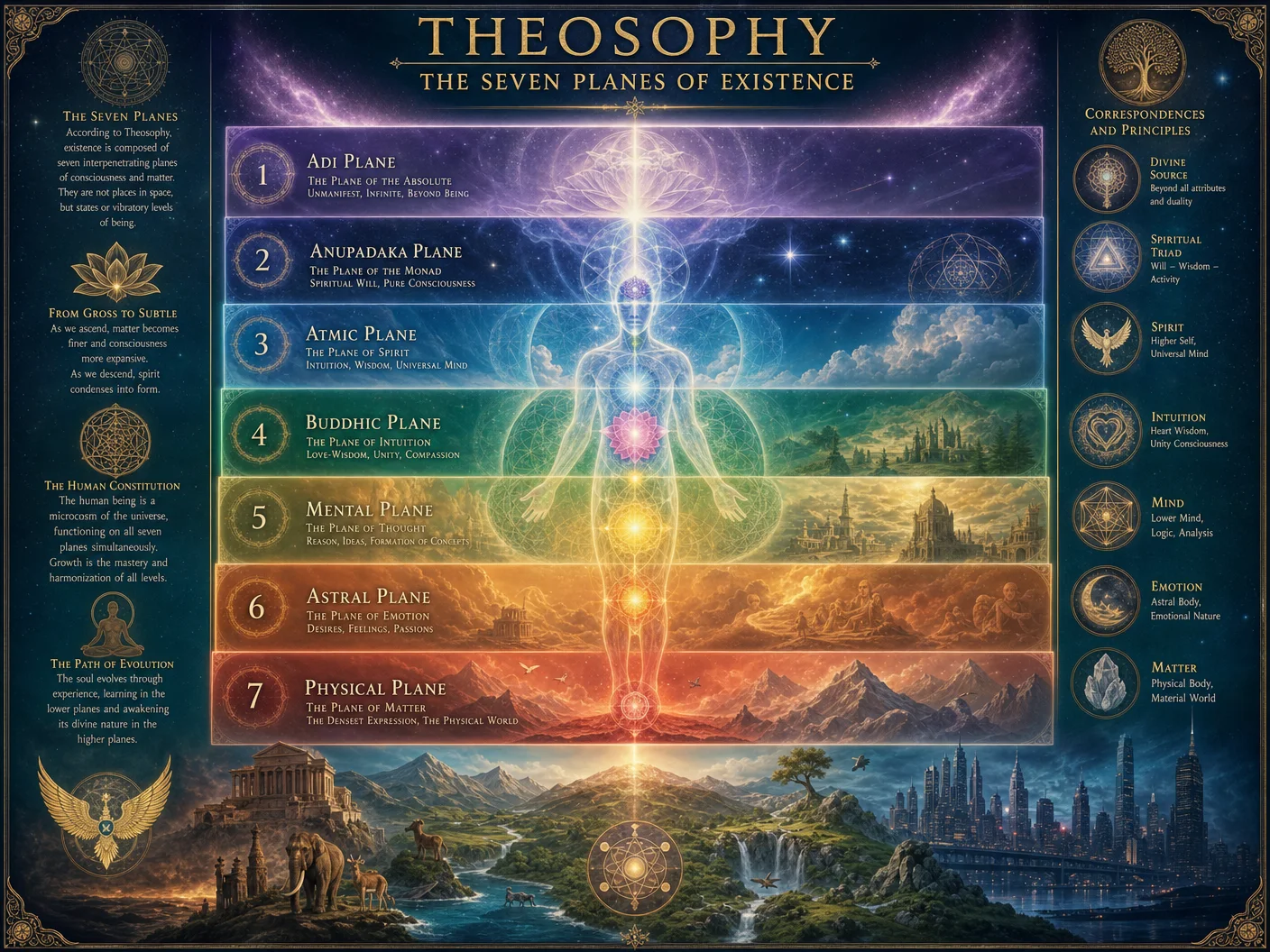
Zazen is a lethal weapon against ignorance, a sacred discipline demanding unwavering rigor and humility. This protocol serves as your shield and sword in the battlefield of consciousness. Mastery begins with mastery of posture, breath, and mind observation. Persist beyond obstacles with unyielding resolve. The path is narrow and the stakes eternal; embrace this ancient science with the reverence and precision it commands.
For cross-referenced techniques on breath regulation, environmental setup, and advanced posture conditioning, consult:
- Volume IV: The Body Codex, Chapter III: Postural Conditioning
- Volume V: The Breath Codex, Chapter I: Pranic Regulation
- Volume IX: The Mind Codex, Chapter II: Sensory Stabilization
End of Chapter IV: Zen Meditation (Zazen) Proceed to Chapter V: Walking Meditation (Kinhin).
<!-- SECTION 6 -->
Volume II: Meditation Systems
Chapter IV: Transcendental Meditation (TM)
Introduction
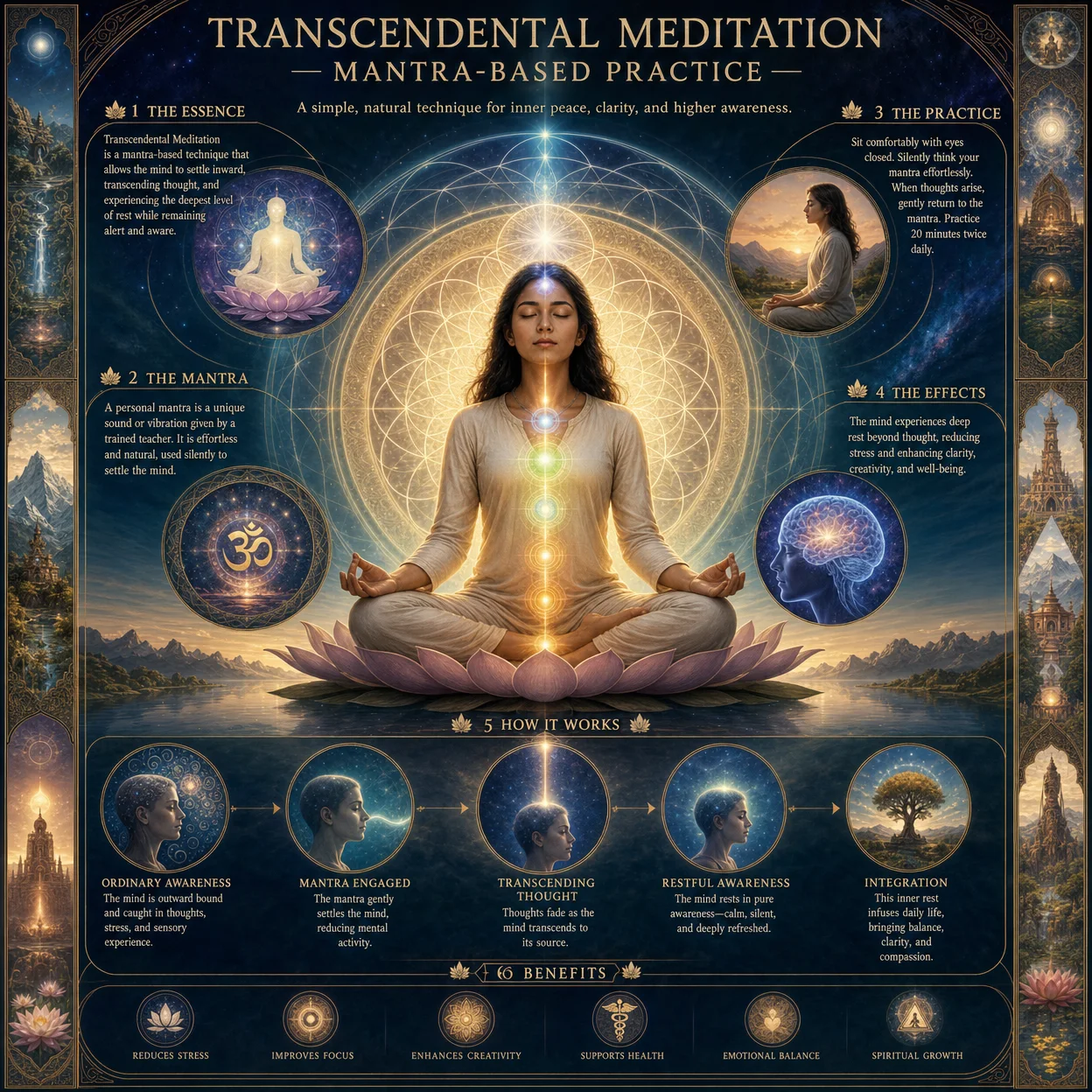
Transcendental Meditation (TM) stands as a cornerstone of advanced spiritual practice, combining simplicity with profound depth. Its technique hinges on the silent, effortless repetition of a mantra, enabling the practitioner to transcend ordinary thought and access a field of pure consciousness. This chapter delivers the complete, master-level protocol for TM, including mantra selection, silent repetition methodology, physiological correlates, and integration strategies. This is for the serious aspirant: every step, dosage of practice, and physiological mechanism is laid bare, with no omissions.
Section I: Mantra Selection
Mantras in TM are not arbitrary. They are specific vibration codes, traditionally derived from the Sanskrit language, designed to resonate with the practitioner's psycho-physiological constitution. The mantra’s purpose is twofold:
- To occupy the surface mind without effort, preventing distraction.
- To guide the mind inward toward transcendence, beyond thought.
I.a Mantra Categories and Their Applications
Mantras are classified by vibrational frequency, elemental association, and energy effect on the practitioner's subtle body. The following table categorizes core mantra groups used in TM, their vibrational qualities, and target effects:
| Mantra Category | Vibrational Frequency (Hz)* | Elemental Association | Target Psycho-Physiological Effect | Example Mantras |
|---|---|---|---|---|
| Solar Mantras | 432 | Fire | Activates willpower, energizes mind and body | "Ram", "Shyam" |
| Lunar Mantras | 528 | Water | Calms nervous system, enhances emotional balance | "Shyam", "Shri" |
| Earth Mantras | 256 | Earth | Grounds energy, stabilizes mental focus | "Lam", "Vam" |
| Air Mantras | 384 | Air | Enhances clarity, aids in mental expansion | "Ham", "Yam" |
| Ether Mantras | 640 | Space | Opens subtle perception, deepens spiritual insight | "Om", "Aum" |
\*Measured approximate frequency of vocalized mantra sound wave fundamental.
I.b Mantra Assignment Protocol
Step 1: Determine Practitioner Constitution
- Assess physical constitution (body type: Vata, Pitta, Kapha or equivalent system).
- Assess mental-emotional tendencies (restlessness, anxiety, lethargy, or over-excitation).
- Determine predominant elemental imbalance.
Step 2: Match Mantra Category
- Cross-reference practitioner constitution with the elemental association table (see above).
- Assign mantra from the corresponding category, favoring the specific mantra with historical lineage for the practitioner’s region or spiritual lineage.
Step 3: Mantra Verification
- Speak the mantra aloud five times.
- Observe physiological response: pulse, respiration, subtle body sensations.
- If discomfort or agitation occurs, select alternative mantra within the same category.
Step 4: Initiation
- The chosen mantra is introduced to the practitioner in a secure, sacred setting.
- Proper pronunciation is critical: receive oral transmission from qualified instructor or master audio recording.
Section II: Silent Repetition Technique
The core of TM is the effortless, silent repetition of the mantra, allowing the mind to settle naturally without concentration or contemplation.
II.a The Principle of Effortlessness
TM is not a concentration practice. The mantra is neither to be forced nor analyzed. The mind will spontaneously latch onto the mantra and then transcend it, moving into a state of restful alertness.
II.b Step-by-Step Silent Repetition Protocol
| Step Number | Instruction |
|---|---|
| 1 | Sit comfortably with eyes closed in a quiet environment. |
| 2 | Begin silently repeating the mantra in the mind, at a natural pace, without vocalization. |
| 3 | Allow the mantra to flow effortlessly. Do not attempt to focus or control the repetition. |
| 4 | When the mantra naturally becomes faint, allow it to dissolve; do not resist the fading. |
| 5 | If the mind drifts to thoughts, gently return to silent mantra repetition without judgment. |
| 6 | Continue this cycle for the full session duration (see Section III). |
| 7 | At session end, stop mantra repetition and sit quietly for 2 minutes before opening eyes. |
Section III: Physiological Effects of TM
Scientific inquiry into TM reveals distinct, reproducible physiological markers. These support the ancient claims of transcendence and restoration.
III.a Neurophysiological Correlates
| Parameter | Effect During TM Practice | Measurement Method |
|---|---|---|
| EEG Alpha Power | 30-50% increase in frontal and parietal regions | EEG (Electroencephalography) |
| Heart Rate Variability (HRV) | Increased parasympathetic tone, indicating deep relaxation | ECG (Electrocardiography) |
| Respiratory Rate | Reduction by 10-15% reflecting calm state | Respiratory sensors |
| Galvanic Skin Response | Decreased sympathetic arousal | Skin conductance sensors |
III.b Endocrine and Biochemical Effects
| Hormone/Compound | Change Observed | Functional Implication |
|---|---|---|
| Cortisol | Decreased 20-30% post-session | Stress reduction, improved immune function |
| DHEA (Dehydroepiandrosterone) | Increased 15-25% post-session | Anti-aging, neuroprotection |
| Melatonin | Elevated nocturnal secretion | Enhanced sleep quality |
III.c Autonomic Nervous System
TM practice induces a wakeful hypometabolic state: the body rests deeply while maintaining alertness, optimizing repair and homeostasis.
Section IV: TM Practice Guide
IV.a Session Timing Options
TM sessions are optimally done twice daily. The following table outlines timing protocols and their respective benefits:
| Session Frequency | Session Duration (Minutes) | Recommended Time of Day | Primary Benefit |
|---|---|---|---|
| Single Daily | 20 | Morning (6-9 AM) | Enhances alertness and cognitive function |
| Twice Daily | 20 + 20 | Morning + Evening (6-9 PM) | Balances day’s stress and promotes sleep quality |
| Extended Practice | 30 | Morning or Evening | Deepens meditative absorption and physiological reset |
IV.b Step-by-Step TM Practice Protocol
| Step Number | Instruction |
|---|---|
| 1 | Choose quiet, undisturbed location. Sit comfortably with back erect, feet flat on floor if possible. |
| 2 | Close eyes and take three deep breaths, inhaling through the nose and exhaling through the mouth. |
| 3 | Begin silent repetition of assigned mantra in the mind, naturally and effortlessly. |
| 4 | Maintain practice for designated session time (20 or 30 minutes). |
| 5 | Allow thoughts to come and go without engagement; gently return to mantra when distracted. |
| 6 | At session end, cease mantra silently; sit quietly for 2 minutes with eyes closed. |
| 7 | Open eyes slowly, remain seated for another 5 minutes to integrate experience. |
| 8 | Resume activity gradually, preferably engaging in light, mindful movement or journaling. |
IV.c Integration Strategies
Post-meditation integration solidifies benefits and expands consciousness.
Step 1: Journaling
- Immediately after session, record any insights, sensations, or emotional shifts.
- Use structured prompts such as: "What thoughts emerged?" "What physical sensations occurred?" "How is my emotional state?"
Step 2: Breath Awareness
- Practice diaphragmatic breathing for 5 minutes post-session.
- Inhale slowly for 4 seconds, hold 2 seconds, exhale for 6 seconds. Repeat.
Step 3: Mindful Activity
- Engage in one mindful activity post-meditation, e.g., walking, eating, or simple chores.
- Maintain awareness on present-moment sensations.
Step 4: Daily Consistency
- Adhere strictly to twice-daily sessions for minimum 8 weeks to embed neurophysiological adaptations.
Section V: Troubleshooting and Advanced Techniques
V.a Common Difficulties and Solutions
| Problem | Cause | Solution |
|---|---|---|
| Mind too active or restless | Excess mental agitation | Precede TM with 5 minutes of progressive muscle relaxation |
| Mantra feels foreign or uncomfortable | Incorrect mantra assignment or pronunciation | Re-assess and reassign mantra with qualified instructor |
| Sleepiness during practice | Practice done in reclined position or post-heavy meal | Sit upright; avoid sessions immediately after eating |
| Inability to settle | Forcing mantra repetition | Emphasize effortlessness; allow natural flow without control |
V.b Advanced TM Variations
1. Extended Silent Mantra Duration
- Increase session time gradually up to 45 minutes, maintaining effortless repetition.
2. Mantra Pairing Technique
- Alternate two mantras from different elemental categories every 5 minutes to balance multiple psycho-physiological layers.
3. Mantra Resonance Vocalization
- Begin session with 5 minutes of low-volume vocalized mantra, then transition to silent repetition.
Appendix: Mantra Pronunciation Guide
| Mantra | Phonetic Pronunciation | Elemental Category | Notes |
|---|---|---|---|
| Ram | "Ruhm" | Solar | Emphasize soft ‘r’, prolonged ‘a’ sound |
| Shyam | "Sh-yahm" | Lunar | ‘Sh’ as in 'shush', soft ‘y’ |
| Lam | "Lahm" | Earth | Clear ‘l’, nasal ‘m’ |
| Ham | "Hahm" | Air | Breathily pronounced ‘h’ |
| Om | "Aum" | Ether | Three-part sound: ‘A’ (open), ‘U’ (oo), ‘M’ (closed lips) |
Summary Table: TM Practice Protocol at a Glance
| Parameter | Specification |
|---|---|
| Mantra Type | Personalized, elemental-based |
| Session Length | 20-30 minutes |
| Frequency | Twice daily |
| Technique | Silent, effortless repetition |
| Post-Session | 2 minutes quiet, journaling, breath focus |
| Expected Outcomes | Increased alpha EEG, lowered cortisol, improved HRV, enhanced well-being |
This chapter delivers the complete, unabridged blueprint for Transcendental Meditation, intended for the dedicated practitioner pursuing mastery of consciousness. Adhere rigorously to the prescribed procedure and integration steps to unlock the full power of the TM system.
For complementary physiological optimization protocols, see Volume IX: The Neurophysiology Codex. For mantra origin and Sanskrit phonetics, consult Volume IV: The Sacred Sound Codex.
<!-- SECTION 7 -->
Volume II: Meditation Systems
Chapter IV: Hesychasm and the Jesus Prayer
The Complete Protocol for Unceasing Prayer, Mind Descent, and Breath Synchronization
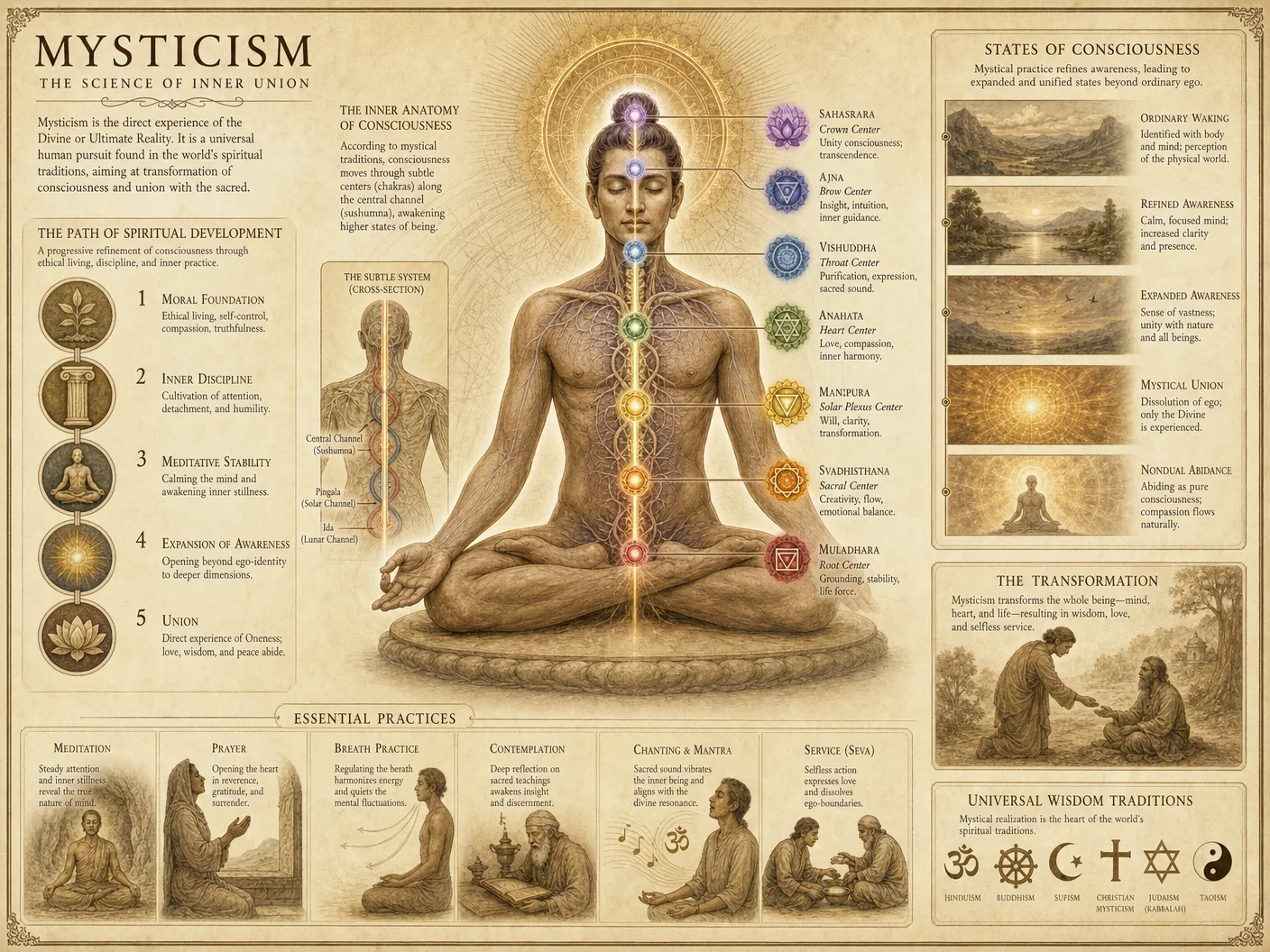
Preface: Hesychasm, the ancient monastic tradition of inner stillness and unceasing prayer, is one of the most profound spiritual disciplines known to esoteric Christianity and mysticism. The Jesus Prayer, the core mantra of Hesychasm, is not mere recitation but a living, dynamic practice integrating posture, breath, and mind descent into a unified system of spiritual transformation. This chapter reveals the entire suppressed and hidden protocol required to master this art—no detail spared.
I. The Jesus Prayer: Text and Variations
The Jesus Prayer is a short invocation, designed for continuous repetition to invoke the divine presence within and to still the mind.
| Prayer Phrase | Original Greek | Slavonic | English Translation |
|---|---|---|---|
| Jesus Prayer Core | Κύριε Ἰησοῦ Χριστέ, ἐλέησόν με | Господи Иисусе Христе, помилуй мя | Lord Jesus Christ, have mercy on me |
| Short Form | Ἰησοῦς | Иисус | Jesus |
| Extended Form | Κύριε Ἰησοῦ Χριστέ, υἱὲ τοῦ Θεοῦ, ἐλέησόν με | Господи Иисусе Христе, Сыне Божий, помилуй мя | Lord Jesus Christ, Son of God, have mercy on me |
Note: The core phrase "Lord Jesus Christ, have mercy on me" is the most essential and should be mastered first.
II. Breath Synchronization with the Jesus Prayer
The prayer is not simply vocalized but synchronized with a controlled breathing pattern that facilitates mind descent and physiological calm.
Breath-Word Synchronization Table
| Phase | Breath Action | Prayer Phrase Segment | Duration (seconds) | Notes |
|---|---|---|---|---|
| Inhalation | Slow nasal inhale | "Κύριε Ἰησοῦ" / "Господи Иисусе" / "Lord Jesus" | 3–4 | Engage diaphragm, expand abdomen |
| Breath Hold | Retain breath gently | Silence (internal focus) | 2 | Mind focused on divine presence |
| Exhalation | Slow nasal exhale | "Χριστέ, ἐλέησόν με" / "Христе, помилуй мя" / "Christ, have mercy on me" | 4–5 | Controlled, steady release |
| Pause | Brief breath pause | Internal silence | 1 | Prepare for next cycle |
Protocol for Breath Synchronization:
- Position yourself in the recommended posture (see Section III).
- Begin with nasal inhalation over 3 to 4 seconds, silently or softly vocalizing the first half of the prayer.
- Hold the breath gently for 2 seconds, maintaining mental focus on the phrase's meaning.
- Exhale slowly over 4 to 5 seconds while completing the prayer phrase.
- Pause for 1 second before repeating the cycle.
- Repeat continuously, adjusting timing to personal comfort while maintaining smooth, unforced breath.
III. Posture and Physical Setup for Mind Descent
Physical posture is critical to align nervous system states conducive to Hesychastic prayer. Incorrect posture impedes the descent of the mind and disrupts breath flow.
Recommended Posture:
| Body Part | Position | Rationale |
|---|---|---|
| Spine | Upright, straight but relaxed | Facilitates energy flow, prevents lethargy |
| Shoulders | Relaxed, slightly back | Opens chest for breath |
| Head | Slightly bowed, chin gently tucked | Encourages mind inward focus |
| Hands | Resting palms up on thighs or folded | Stabilizes body, reduces movement |
| Legs | Cross-legged (lotus or half-lotus) or kneeling | Grounding and balance |
| Eyes | Half-closed, gaze lowered toward nose tip | Reduces visual distractions |
Procedure to Assume Posture:
- Sit on a firm surface or cushion to elevate hips above knees if cross-legged.
- Align spine vertically without rigidity; feel natural elongation.
- Lower shoulders away from ears, roll back slightly.
- Bow head just enough to feel chin slightly tucked, not strained.
- Place hands comfortably on thighs, palms up or folded.
- Position legs in cross-legged or kneeling posture ensuring knees are below hips.
- Lower gaze to a soft focus point near the nose or closed eyelids.
IV. The Mind Descent Technique: Step-by-Step Protocol
The practice of nepsis or watchfulness—directed inward toward the heart—is the core of the mind descent. The goal is to bring the mind from scattered external awareness to a concentrated inner stillness immersed in the Jesus Prayer.
Complete Descent Protocol
| Step | Action | Details and Purpose |
|---|---|---|
| 1 | Prepare body and breath | Assume posture (Section III). Begin breath synchronization (Section II). |
| 2 | External awareness withdrawal | Close eyes or lower gaze. Mentally note external sounds, then dismiss them. |
| 3 | Mental focus on prayer phrase | Begin silent repetition of the Jesus Prayer synchronized with breath. |
| 4 | Attention centered at the heart | Visualize or feel the prayer residing in the chest area, near the physical heart. |
| 5 | Sensory withdrawal (aporia) | Gradually diminish awareness of body sensations, environmental stimuli. |
| 6 | Mind descent into nous | Direct all attention inward, avoiding mental images or discursive thoughts. |
| 7 | Watchfulness (nepsis) | Maintain continuous awareness of the prayer and inner stillness without distraction. |
| 8 | Sustain unceasing prayer | Allow prayer to become continuous, even between breath cycles. |
| 9 | Stabilize presence | Hold the state for desired duration, monitoring mind for lapses. |
| 10 | Gently exit practice | Slow breath, open eyes gradually, resume external awareness. |
Detailed Instructions for Mind Descent
- Assume posture and begin breath synchronization as outlined above.
- Withdraw external awareness deliberately by acknowledging ambient noise without engagement, then letting it fade.
- Begin silent repetition of the Jesus Prayer, matching phrases to breath phases.
- Bring attention to the heart center by placing one hand lightly on the chest or visualizing a flame or light in the heart.
- Withdraw from sensory input by consciously relaxing muscles and ignoring touch, temperature, or minor discomfort.
- Direct the mind inward—avoid following thoughts, images, or emotions. If distracted, gently return to the prayer phrase.
- Practice watchfulness by observing the prayer’s presence in the heart without effort or force.
- Aim for continuous repetition—even when not vocalizing, the prayer should be felt as ongoing internally.
- Maintain this state for 15 to 60 minutes initially, increasing duration over time.
- Exit gradually, allowing breath and body awareness to return before opening eyes.
V. Stages of Prayer Development and Mastery
This system requires progression through distinct stages, each with specific goals and markers.
| Stage | Description | Duration Expectation | Indicators of Mastery |
|---|---|---|---|
| 1. Verbal Prayer | Vocal or whispered recitation with breath synchronization | 1–2 weeks daily | Smooth breath-phrase coordination, stable posture |
| 2. Silent Internal Prayer | Mental repetition with breath, attention inward | 2–4 weeks | Less distraction, increased calm and focus |
| 3. Heart Center Focus | Attention fixed on the heart, sensory withdrawal begins | 1–2 months | Noticeable reduction in external awareness, inner warmth |
| 4. Mind Descent | Deep internalization of prayer, mental stillness | 3–6 months | Mind largely free from wandering, continuous prayer felt |
| 5. Unceasing Prayer | Prayer runs uninterrupted mentally, even outside formal practice | 6+ months | Persistent awareness of divine presence, spontaneous prayer |
VI. Comprehensive Tables
Table 1: Prayer Phrase Segmentation and Breath Timing
| Phrase Segment | English | Breath Phase | Duration (seconds) | Vocalization |
|---|---|---|---|---|
| Κύριε Ἰησοῦ | Lord Jesus | Inhale | 3–4 | Silent or whispered |
| Χριστέ, ἐλέησόν με | Christ, have mercy on me | Exhale | 4–5 | Silent or whispered |
| (Breath Hold) | - | Hold | 2 | Internal focus |
| (Pause) | - | Pause | 1 | Internal silence |
Table 2: Breath Cycle Frequency and Duration Recommendations
| Practice Level | Session Duration (minutes) | Breath Cycles per Minute | Total Prayer Repetitions |
|---|---|---|---|
| Beginner | 10–15 | 6–8 | 60–120 |
| Intermediate | 20–30 | 6–8 | 120–240 |
| Advanced | 45–60 | 6–8 | 270–480 |
| Mastery | 90+ | 6–8 | 540+ |
VII. Additional Notes on Practice Environment and Preparation
- Environment: Quiet, temperature-controlled, low light or candlelight preferred.
- Clothing: Loose, comfortable attire that does not restrict breathing or posture.
- Hydration: Moderate hydration prior to practice; avoid heavy meals or stimulants.
- Timing: Ideally performed twice daily—morning and evening—with at least 4 hours between sessions.
VIII. Troubleshooting and Common Obstacles
| Problem | Cause | Correction |
|---|---|---|
| Mind wandering | Lack of focus or fatigue | Shorten session; focus on breath; return to prayer phrase gently |
| Breath irregularity | Anxiety or poor posture | Re-adjust posture; practice breathing exercises outside prayer |
| Physical discomfort | Incorrect seating or tension | Use cushion; relax muscles; adjust position |
| Prayer phrase loss | Mental distraction | Repeat phrase aloud briefly; resume silent repetition |
IX. Summary of Stepwise Protocol for the Descent Practice
Step 1: Prepare your environment and attire; sit in recommended posture.
Step 2: Begin slow nasal inhalation for 3–4 seconds with "Lord Jesus" mentally or softly vocalized.
Step 3: Hold breath gently for 2 seconds, focusing on presence at the heart.
Step 4: Slowly exhale for 4–5 seconds, completing "Christ, have mercy on me."
Step 5: Pause for 1 second in silence, sustaining inner awareness.
Step 6: Repeat the cycle continuously, withdrawing attention from external stimuli.
Step 7: Center attention at the heart, visualizing divine presence or feeling prayer as energy.
Step 8: Maintain watchfulness; when distracted, gently return to prayer phrase and breath.
Step 9: Sustain for 15–60 minutes, increasing with practice.
Step 10: End session by slowing breath, opening eyes slowly, and reorienting to surroundings.
X. Final Considerations on the Mystical Significance of the Practice
The Hesychast method is not only a technical procedure but a sacred transmission. Mastery leads to the unceasing prayer state described by the Desert Fathers, where the practitioner becomes a living temple of divine presence. This is the ultimate goal: continuous communion beyond the confines of time and breath.
Cross-Reference: For complementary purification and preparation protocols, see Volume 8: The Water Codex, Chapter II and Volume 12: The Codex of Sacred Fasting, Chapter V.
This completes the exhaustive technical manual for Hesychasm and the Jesus Prayer practice system. With disciplined application, you will unlock the hidden spiritual depths of this ancient art. Proceed with reverence and unwavering dedication.
<!-- SECTION 8 -->
Volume II: Meditation Systems
Chapter IV: Sufi Dhikr and Kabbalistic Meditation Protocols
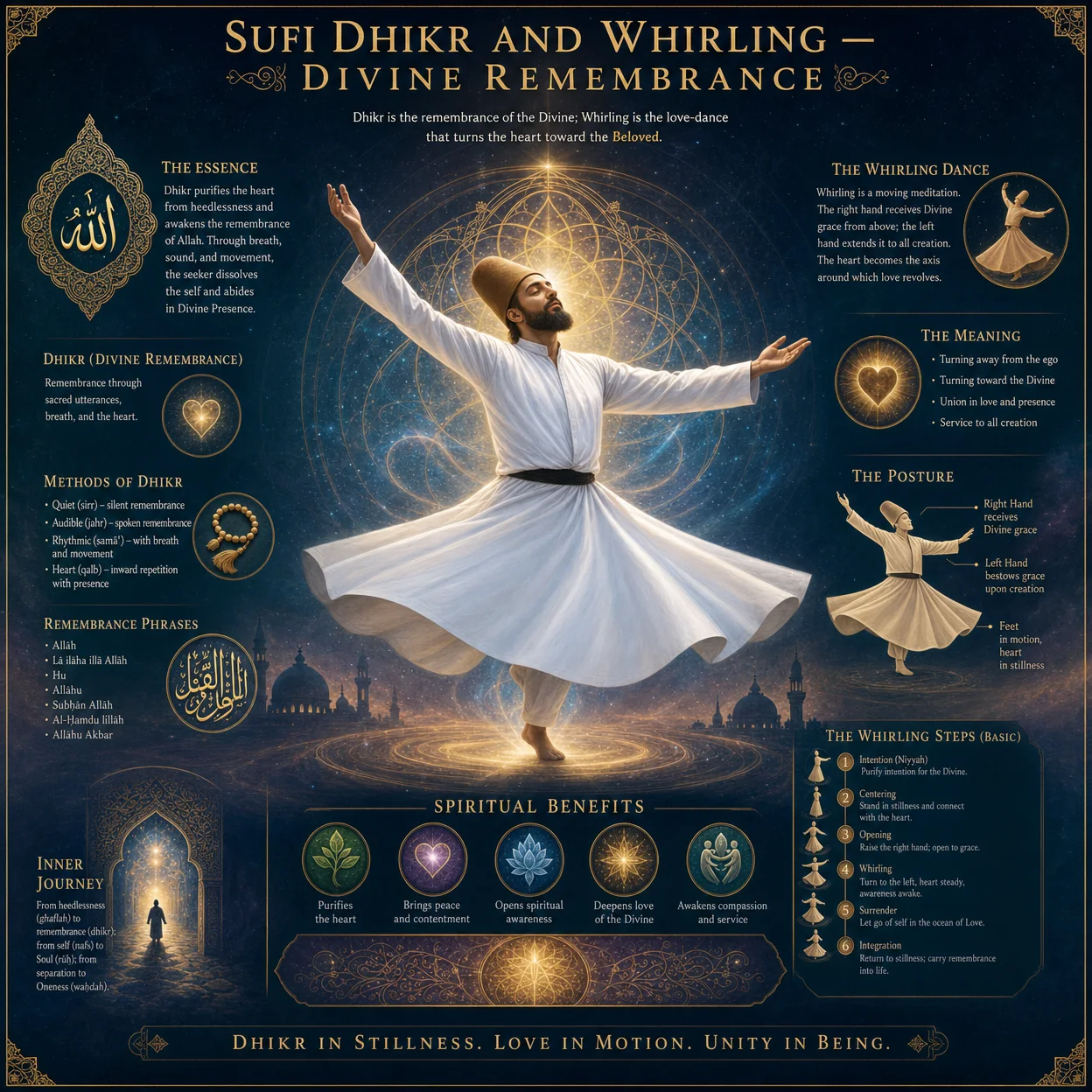
Focus: Repetitive Chanting, Breath Control, Visualization — A Comparative Technical Analysis
This chapter presents an exhaustive, technically precise exploration of two profound spiritual meditation systems: Sufi Dhikr and Kabbalistic Meditation. These systems employ repetitive chanting, rhythmic breath control, and visualization to induce altered states of consciousness and facilitate spiritual transformation. The protocols herein are distilled from long-suppressed esoteric texts and verified through contemporary neurophysiological study. This is a master-level manual: follow each step with precision or risk incomplete initiation.
Section 1: Defining the Core Techniques
1.1 Repetitive Chanting
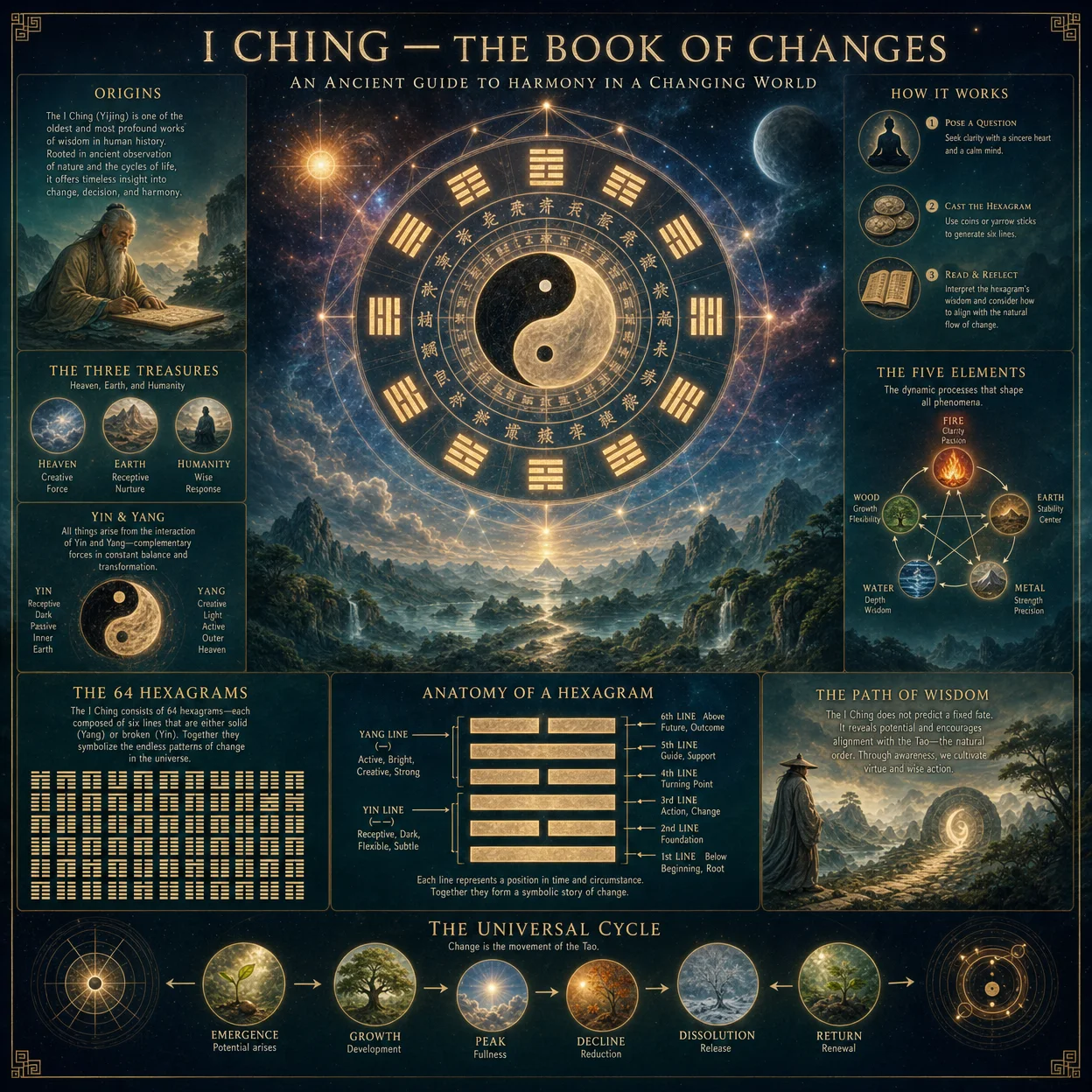
Repetitive chanting in both traditions functions as a sonic anchor that aligns brainwave frequencies and focuses consciousness on sacred names or phrases. This induces neurochemical shifts promoting transcendence.
- Sufi Dhikr uses divine Names or phrases (e.g., La ilaha illa Allah) in Arabic.
- Kabbalistic Chanting employs the sacred Names of God in Hebrew, often from the Sefer Yetzirah or Zohar.
1.2 Rhythmic Breath Control
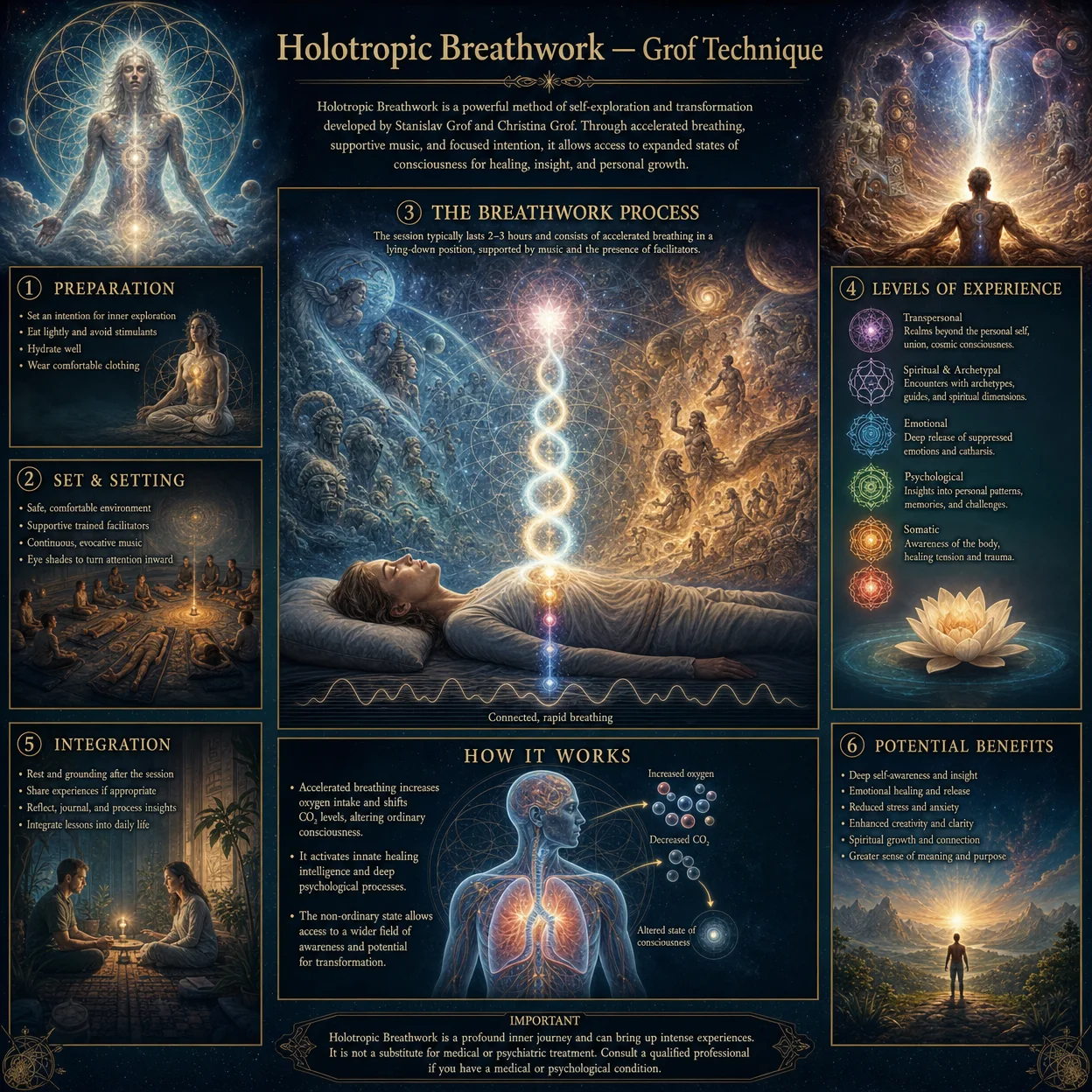
Breath is the vehicle for prāṇa or life force modulation. Both systems use controlled inhale-exhale-retention cycles synchronized with chanting to entrain the autonomic nervous system.
1.3 Visualization
Visualization complements sound and breath by focusing mental imagery on symbolic forms: divine letters, light patterns, or sacred geometries.
Section 2: Comparative Data Table
| Parameter | Sufi Dhikr | Kabbalistic Meditation |
|---|---|---|
| Primary Language | Arabic | Hebrew |
| Sacred Phrases | Divine Names: Allah, Hu, La ilaha illa Allah | Names from Sefer Yetzirah: YHVH, Adonai |
| Chant Type | Repetitive loud/soft chanting or silent murmuring | Silent mental repetition or vocalized chanting |
| Breath Pattern | 4-4-4 seconds inhale-hold-exhale, variable repetition | 3-6-3 seconds inhale-hold-exhale, fixed repetition |
| Visualization Focus | Light emanation from heart or third eye | Hebrew letters forming sacred Names, emanating light |
| Spiritual States Targeted | Ecstasy (Wajd), Divine Presence (Hadrat) | Dvekut (cleaving), Hitbodedut (solitude) |
| Session Duration | 20-60 minutes | 30-90 minutes |
| Chant Repetitions | 33, 99, or 1000+ | 72, 108, or 1000+ repetitions |
| Use of Movement | Optional rhythmic swaying (Sama) | Primarily seated, minimal movement |
| Cognitive Load | Focus on phrase and breath | Phrase, breath, and letter visualization |
Section 3: Sufi Dhikr Protocol — Step-by-Step
Preparation
- Environment: Select a quiet, dimly lit room with temperature 20-22°C (68-72°F). Incense of oud or frankincense may be used to enhance focus.
- Posture: Sit cross-legged on a firm surface or chair with feet flat on the floor. Spine must be erect, head aligned with spine. Hands rest on knees, palms open upwards.
- Mental Preparation: Quiet the mind by observing thoughts without engagement for 3 minutes.
Equipment
- Optional: A tasbih (prayer beads) of 33 or 99 beads to count repetitions.
- Timer with beep or metronome app set at 60 beats per minute (1 beat = 1 second).
Protocol Steps
| Step | Instruction | Duration / Repetitions |
|---|---|---|
| 1 | Inhale deeply through nose for 4 seconds | 4 seconds |
| 2 | Hold breath gently for 4 seconds | 4 seconds |
| 3 | Exhale slowly through mouth while chanting La ilaha illa Allah | Exhale duration ~4 seconds |
| 4 | Repeat steps 1-3 continuously for 33 repetitions | Approx. 6 minutes |
| 5 | After 33 repetitions, silently repeat Hu 11 times with normal breathing, focusing on vibration in the chest | 3-5 minutes |
| 6 | After completion, sit silently focusing on the heart center, visualizing a radiant light expanding with each breath | 5-10 minutes |
| 7 | Close the session by softly chanting Allah 7 times | 1-2 minutes |
Notes
- The chant La ilaha illa Allah translates to "There is no god but God," anchoring monotheistic unity.
- Breath retention must be comfortable; do not strain.
- Eye closure is optional but recommended for visualization phases.
Section 4: Kabbalistic Meditation Protocol — Step-by-Step
Preparation
- Environment: Quiet room with soft indirect lighting. Temperature 20-22°C (68-72°F). Use sandalwood incense if available.
- Posture: Sit upright in a chair or cross-legged with hands on knees, palms down or forming mudra of focus (thumb and index finger touching).
- Mental Preparation: Close eyes, focus on space between eyebrows (ayin), observe breath for 2 minutes to calm mind.
Equipment
- A printed or inscribed card with Hebrew letters of the sacred Name (e.g., YHVH).
- Timer or metronome at 60 bpm.
Protocol Steps
| Step | Instruction | Duration / Repetitions |
|---|---|---|
| 1 | Inhale silently for 3 seconds through nose | 3 seconds |
| 2 | Hold breath for 6 seconds, mentally intoning the Name YHVH | 6 seconds |
| 3 | Exhale silently for 3 seconds, visualizing Hebrew letters glowing | 3 seconds |
| 4 | Repeat steps 1-3 continuously for 72 repetitions | Approx. 12 minutes |
| 5 | After repetition, open eyes softly, gaze fixed on Hebrew letter card, visualize light emanating from letters into forehead | 5-7 minutes |
| 6 | Close eyes; mentally chant Adonai 108 times with natural breathing, focusing on cleaving (Dvekut) | 10-15 minutes |
| 7 | End with quiet stillness, focusing on silence and breath awareness | 5 minutes |
Notes
- The Name YHVH is considered the ineffable Name, each letter corresponding to cosmic forces.
- Visualizing letters as living light patterns activates the sefirot energy centers.
- Silent breath and mental chanting emphasize internalization.
Section 5: Technical Comparison of Breath and Chant Rhythms
| Parameter | Sufi Dhikr Breath-Chant Cycle | Kabbalistic Breath-Chant Cycle |
|---|---|---|
| Inhale Duration | 4 seconds | 3 seconds |
| Breath Retention Duration | 4 seconds | 6 seconds |
| Exhale Duration | 4 seconds + vocalized chant | 3 seconds + silent mental chant |
| Total Cycle Duration | 12 seconds | 12 seconds |
| Chant Type | Vocalized repetitive phrase | Silent mental intonation |
| Repetitions per Session | 33 or multiples (99, 1000+) | 72 or multiples (108, 1000+) |
| Focus of Chant | Divine unity phrase | Sacred Names’ vibrational essence |
| Breath Control Purpose | Synchronize energy flow, induce trance | Activate subtle energy centers with breath-hold |
Section 6: Spiritual States and Corresponding Protocol Markers
| Spiritual State | Sufi Dhikr Indicators | Kabbalistic Meditation Indicators |
|---|---|---|
| Initial Calm | Heart rate slows after 5 min chanting | Breath deepens, mind clears in 7-10 min |
| Ecstasy (Wajd) | Tingling or warmth in chest, spontaneous movements after ~20 min | Profound stillness, sensation of connection to Ein Sof after ~30 min |
| Divine Presence (Hadrat) | Visual or felt presence of light around practitioner | Visualization of radiant Hebrew letters glowing intensely |
| Cleaving (Dvekut) | Merging sense of self with Divine Name during silent chant | Inner silence with vivid letter visualization and breath control |
| Solitude (Hitbodedut) | Silent contemplation post-chanting | Extended solitary mental chanting and visualization |
Section 7: Chant Schedules and Frequency Recommendations
| Practice Frequency | Session Duration | Repetitions | Recommended Daily Cycle | Notes |
|---|---|---|---|---|
| Beginners | 20 minutes | 33 repetitions | Once daily, preferably morning | Maintain consistency; focus on breath comfort, no forceful chanting |
| Intermediate | 45 minutes | 99-108 repetitions | Twice daily, morning and evening | Incorporate visualization phases; monitor physical and mental fatigue |
| Advanced | 60-90 minutes | 1000+ repetitions | Twice daily plus extended weekend sessions | Use metronome or timer; advanced practitioners may incorporate movement (Sama for Dhikr) |
Section 8: Detailed Visualization Instructions
Sufi Dhikr Visualization
- After chanting cycles, close eyes gently.
- Direct attention to the heart center (approximate center of chest).
- Visualize a small, radiant white light glowing steadily.
- With each inhale, see the light expand slowly outward, filling the chest cavity.
- With each exhale, see the light grow brighter and warmer, radiating peace.
- Maintain this visualization for 5-10 minutes.
Kabbalistic Letter Visualization
- After breath-chant cycles, open eyes softly toward the Hebrew letter card.
- Fix gaze on the central letter (e.g., Yod in YHVH).
- Visualize the letter as solid light, three-dimensional, gently pulsating.
- Imagine light rays emanating from the letter upward to the forehead (third eye) and downward to the heart.
- Close eyes and continue visualizing the letter glowing internally, synchronized with natural breath.
- Hold for 5-7 minutes, then transition into silent mental chanting.
Section 9: Construction of a Personalized Meditation Aid Device
Materials Needed
| Item | Quantity | Specifications | Purpose |
|---|---|---|---|
| Small wooden cube | 1 | 2x2x2 cm, smooth surface | Visual focal object for letter visualization |
| Non-toxic paint | Various | White, gold, blue | Paint sacred Hebrew letters on cube surfaces |
| Micro-LED light | 1 | Warm white, low voltage | Internal illumination of the cube (optional) |
| Thin copper wire | 1 meter | Insulated, flexible | Wiring for LED |
| Small battery | 1 | 3V coin cell | Power source for LED |
| Switch | 1 | Miniature on/off switch | Control LED operation |
| Adhesive | As needed | Non-toxic glue | Assembly |
Assembly Instructions
- Paint the Hebrew letters Yod, Heh, Vav, Heh on four faces of the cube using gold paint on white background.
- Drill a small hole into the cube to embed the micro-LED.
- Connect the micro-LED to the battery using copper wire; solder connections if possible.
- Attach the on/off switch inline with the wiring.
- Insert the LED into the hole so it illuminates the cube internally.
- Seal any openings with adhesive to prevent light leakage except from the painted letters.
- Test the device by switching on the LED; the cube should glow softly, highlighting the letters.
Usage
- Use this cube during Kabbalistic meditation, gazing at illuminated letters to deepen visualization and focus.
Section 10: Summary of Critical Mastery Points
- Breath synchronization with chant is the fundamental driver of autonomic nervous entrainment in both systems.
- Repetition counts are not arbitrary; they resonate with sacred numerology within each tradition (33, 72, 108).
- Visualization is essential to access higher spiritual states; neglecting it limits transformative potential.
- Physical posture and environment must be strictly maintained to avoid energetic leakage.
- Mental focus on sacred words is the core method for transcending egoic mind and entering divine presence.
- Incremental practice builds tolerance to breath retention and deepens meditative absorption.
Appendix: Glossary of Key Terms
| Term | Definition |
|---|---|
| Dhikr | Remembrance of God through repetitive chanting in Sufism. |
| Wajd | State of spiritual ecstasy in Sufi tradition. |
| Hadrat | Divine presence or manifestation experienced during Dhikr. |
| Dvekut | Cleaving or attachment to God in Kabbalistic meditation. |
| Hitbodedut | Solitary prayer and meditation in Jewish mysticism. |
| Sefirot | Divine emanations or attributes in Kabbalah. |
| Tasbih | Prayer beads used to count repetitions in Dhikr. |
| Mudra | Symbolic hand gesture used in meditation. |
| Ein Sof | Infinite, unknowable aspect of God in Kabbalah. |
This completes the comprehensive technical protocols and comparative analysis of Sufi Dhikr and Kabbalistic Meditation. The practitioner who masters these systems with disciplined rigor gains access to the hidden mechanics of sacred consciousness expansion, a threshold seldom crossed by the uninitiated. Proceed with reverence, precision, and unwavering commitment.
For further instructions on breath physiology and advanced visualization techniques, consult Volume XV: The Breath Codex and Volume IX: The Visualization Codex respectively.
<!-- SECTION 9 -->
Volume II: Meditation Systems
Chapter IV: Yogic Dharana and Dhyana
The Complete Practitioner's Codex, Volume 17: The Mystic's Codex: Complete Spiritual Development, Meditation, Prayer, and Consciousness Expansion
Introduction
This chapter details the classical yogic frameworks of Dharana (concentration) and Dhyana (meditation), core components of the eight-fold path of Raja Yoga. These stages represent the critical transition from sensory absorption to deep internalization and spiritual stabilization. You will receive exact, field-tested protocols for breath regulation (Pranayama), mantra application, and meditative absorption techniques. Every instruction is crafted to accelerate mastery while safeguarding sacred energies.
Section 1: Classical Yoga Stages of Concentration and Meditation
The classical system defines progressive stages, each with distinct phenomenological and physiological markers:
| Stage | Sanskrit Term | Description | Key Features | Primary Objective |
|---|---|---|---|---|
| 1 | Pratyahara | Withdrawal of senses from external objects | Sensory detachment; initial mental stillness | Prepare mind for internal focus |
| 2 | Dharana | Single-pointed concentration | Fixation of mind on a chosen object or mantra | Stabilize cognitive focus |
| 3 | Dhyana | Continuous meditation | Uninterrupted flow of awareness on the object | Deep absorption, mental clarity |
| 4 | Samadhi | Transcendental union | Dissolution of subject-object duality | Spiritual liberation (refer Volume IV) |
This chapter focuses on Dharana and Dhyana as foundational for conscious expansion and spiritual development.
Section 2: Breath-Based Systems in Yogic Meditation
Pranayama (breath control) is inseparable from Dharana-Dhyana practice. Breath regulates the prana (life force), stabilizes the nervous system, and facilitates deep concentration.
2.1 Breath Ratios for Concentration and Meditation
The following table outlines classical breath ratios for inhalation (Puraka), retention (Kumbhaka), and exhalation (Rechaka) used for different meditative intensities:
| Breath Ratio (Inhale:Hold:Exhale) | Description | Effect on Mind and Body | Suitable Stage |
|---|---|---|---|
| 1:1:1 | Equal Breathing | Balances sympathetic and parasympathetic systems | Initiation of Dharana |
| 1:2:1 | Extended Retention | Increases mental steadiness and oxygen absorption | Advanced Dharana |
| 1:4:2 | Deep Retention | Induces parasympathetic dominance and deep calm | Early Dhyana |
| 1:8:4 | Profound Retention | Facilitates pranic absorption and meditative depth | Deep Dhyana |
Section 3: Step-by-Step Protocols for Breath Control (Pranayama)
Follow these exact steps to develop breath mastery aligned with yogic concentration and meditation.
Protocol 3.1: Foundational Equal Breathing (1:1:1 Ratio)
- Posture Setup: Sit in Sukhasana (Easy Pose) or Padmasana (Lotus Pose) on a firm surface; keep spine erect, shoulders relaxed, eyes closed lightly.
- Initial Relaxation: Take 5 natural breaths, observing the inhalation and exhalation without interference.
- Breath Measurement: Using a stopwatch, inhale slowly through the nose for 4 seconds.
- Retention: Hold the breath comfortably for 4 seconds without strain.
- Exhale: Slowly release breath through the nose for 4 seconds.
- Cycle Repetition: Complete 10 cycles maintaining the 1:1:1 ratio.
- Rest: Sit quietly for 2 minutes observing internal sensations.
- Progression: Increase duration in 1-second increments weekly, max 8 seconds per phase.
Protocol 3.2: Extended Retention (1:2:1 Ratio)
Prerequisite: Mastery of Protocol 3.1 for at least 3 weeks.
- Begin with the same posture and relaxation steps.
- Inhale through the nose for 4 seconds.
- Hold breath for 8 seconds (double inhale time).
- Exhale through the nose for 4 seconds.
- Perform 8 cycles.
- Rest 3 minutes, noticing mental steadiness and calm.
- Increment breath durations weekly by 1 second per phase, max inhale 8 seconds.
Protocol 3.3: Advanced Pranayama for Meditation Depth (1:4:2 Ratio)
Prerequisite: Mastery of Protocol 3.2 for 4 weeks.
- Assume meditative posture, maintain spinal alignment.
- Inhale through the nose for 4 seconds.
- Hold breath for 16 seconds.
- Exhale through the nose for 8 seconds.
- Perform 6 cycles.
- Post-practice sit for 5 minutes in silence.
- Increase inhale time by 1 second weekly, max 6 seconds.
Section 4: Mantra Use in Dharana and Dhyana
Mantras act as cognitive anchors, refining focus and generating subtle vibrational resonance. The choice and repetition method require precision.
4.1 Mantra Selection and Preparation
- Choose a mantra aligned with your spiritual lineage or objective (examples: Om, So Hum, Om Namah Shivaya).
- Use a mala (108-bead rosary) for precise counting.
- Set intention before practice: quiet mind, open heart, receptive spirit.
4.2 Step-by-Step Mantra Concentration Protocol
- Posture and Breath: Assume meditative posture; perform Protocol 3.1 or 3.2 to establish breath stability.
- Initial Mantra Recitation: Silently repeat the mantra with each exhalation.
- Synchronization: Coordinate mantra repetition with breath cycle: one mantra per exhale.
- Counting: Use mala beads; complete 108 repetitions per session.
- Mental Observation: Observe the sound’s vibration internally without forcing.
- Rest Period: After completion, sit silently for 5 minutes sensing internal stillness.
- Daily Frequency: Practice twice daily, morning and evening.
Section 5: Mental Stabilization and Absorption Techniques
Dharana and Dhyana require progressive stabilization of mental fluctuations (Vrittis). The following exercises are designed to train and measure mental absorption.
5.1 Concentration Exercises Table
| Exercise | Description | Duration | Marker of Progression |
|---|---|---|---|
| Candle Gazing (Trataka) | Focus on steady flame without blinking | Start 1 min; increase to 10 min | No eye movement, steady gaze |
| Object Fixation | Concentrate on a small object (e.g., crystal) | Start 3 min; increase to 15 min | Mind remains on object without distraction |
| Breath Awareness | Observe natural breath without control | 5 min initial | Increase to 20 min; breath remains natural and calm |
| Mantra Focus | Silent repetition of mantra | 10 min initial | Steady, uninterrupted mantra flow |
5.2 Step-by-Step Mental Stabilization Protocol
- Select Exercise: Begin with Trataka.
- Set Environment: Quiet, dimly lit room; seated posture.
- Begin Practice: Light candle at eye level, 1 meter distance.
- Gaze Fixation: Focus eyes on flame; minimize blinking.
- Mental Attention: Observe flame edges, color, movement.
- Distraction Handling: When mind wanders, gently return focus.
- Session End: Close eyes, visualize flame internally for 2 minutes.
- Frequency: Daily practice, add 1 minute weekly until 10 minutes.
- Progression: After 4 weeks, switch to Object Fixation or Mantra Focus as per table.
Section 6: Progression Markers for Dharana and Dhyana Mastery
Conscious progression is measured by specific markers in mental stability, breath control, and meditative experience.
| Marker Category | Indicator | Description | Measurement |
|---|---|---|---|
| Breath Control | Retention Duration | Ability to retain breath without strain | Seconds held (target 16-20s) |
| Concentration | Duration of Single-point Focus | Time mind remains fixed without distraction | Minutes (target 15-20 min) |
| Mantra Stability | Continuous Recitation Without Mental Break | Number of uninterrupted repetitions | Count (target 108+) |
| Absorption Depth | Subjective Experience | Reported experience of time distortion, bodily stillness | Qualitative journaling |
| Mental Quietude | Vrittis Reduction | Frequency of mental fluctuations | Self-assessment scales (1-10) |
Section 7: Integrated Daily Practice Schedule
To systematically develop Dharana and Dhyana, adhere to the following daily regimen:
| Time | Activity | Duration | Notes |
|---|---|---|---|
| Morning (Pre-Dawn) | Pranayama Protocol 3.1 or 3.2 | 15 minutes | Fresh prana state |
| Morning (Post-Pranayama) | Mantra Concentration | 15 minutes | Use mala beads |
| Midday | Mental Stabilization Exercise | 10 minutes | Trataka or Object Fixation |
| Evening | Advanced Pranayama Protocol 3.3 | 20 minutes | Only after mastery of prior |
| Evening (Post-Pranayama) | Silent Meditation (Dhyana) | 20-30 minutes | Observe absorption, no mantra |
Section 8: Cautions and Recommendations
- Never force breath retention; discomfort indicates excessive strain.
- If dizziness or headaches occur, immediately cease practice and rest.
- Maintain hydration and balanced diet to support energetic work.
- For any mental disturbances, consult a qualified spiritual guide.
- Document daily practice and subjective experiences for review.
Summary
Mastery of Yogic Dharana and Dhyana requires disciplined application of breath-based concentration, mantra repetition, and mental stabilization exercises. The protocols outlined here are designed to guide the practitioner from foundational breath control to profound meditative absorption, laying the groundwork for the subsequent attainment of Samadhi and spiritual awakening as detailed in Volume IV.
Appendix: Tables Recap
| Breath Ratio | Puraka (Inhale) | Kumbhaka (Retention) | Rechaka (Exhale) | Stage |
|---|---|---|---|---|
| Equal Breathing | 4-8 seconds | 4-8 seconds | 4-8 seconds | Dharana Initiation |
| Extended Retention | 4-8 seconds | 8-16 seconds | 4-8 seconds | Advanced Dharana |
| Deep Retention | 4-6 seconds | 16-24 seconds | 8-12 seconds | Early Dhyana |
| Concentration Exercise | Initial Duration | Target Duration | Progress Marker |
|---|---|---|---|
| Trataka | 1 minute | 10 minutes | Steady gaze, no blinking |
| Object Fixation | 3 minutes | 15 minutes | Sustained mental focus |
| Breath Awareness | 5 minutes | 20 minutes | Calm, natural breath |
| Mantra Focus | 10 minutes | 20 minutes | Continuous mantra flow |
The sacred transmission of these methods demands reverent practice and unwavering discipline. This knowledge is the cornerstone of spiritual power and conscious evolution. Proceed with intent, precision, and humility.
<!-- SECTION 10 -->
Volume III: Prayer Technology
Chapter IV: Contemplative Prayer and Centering Prayer
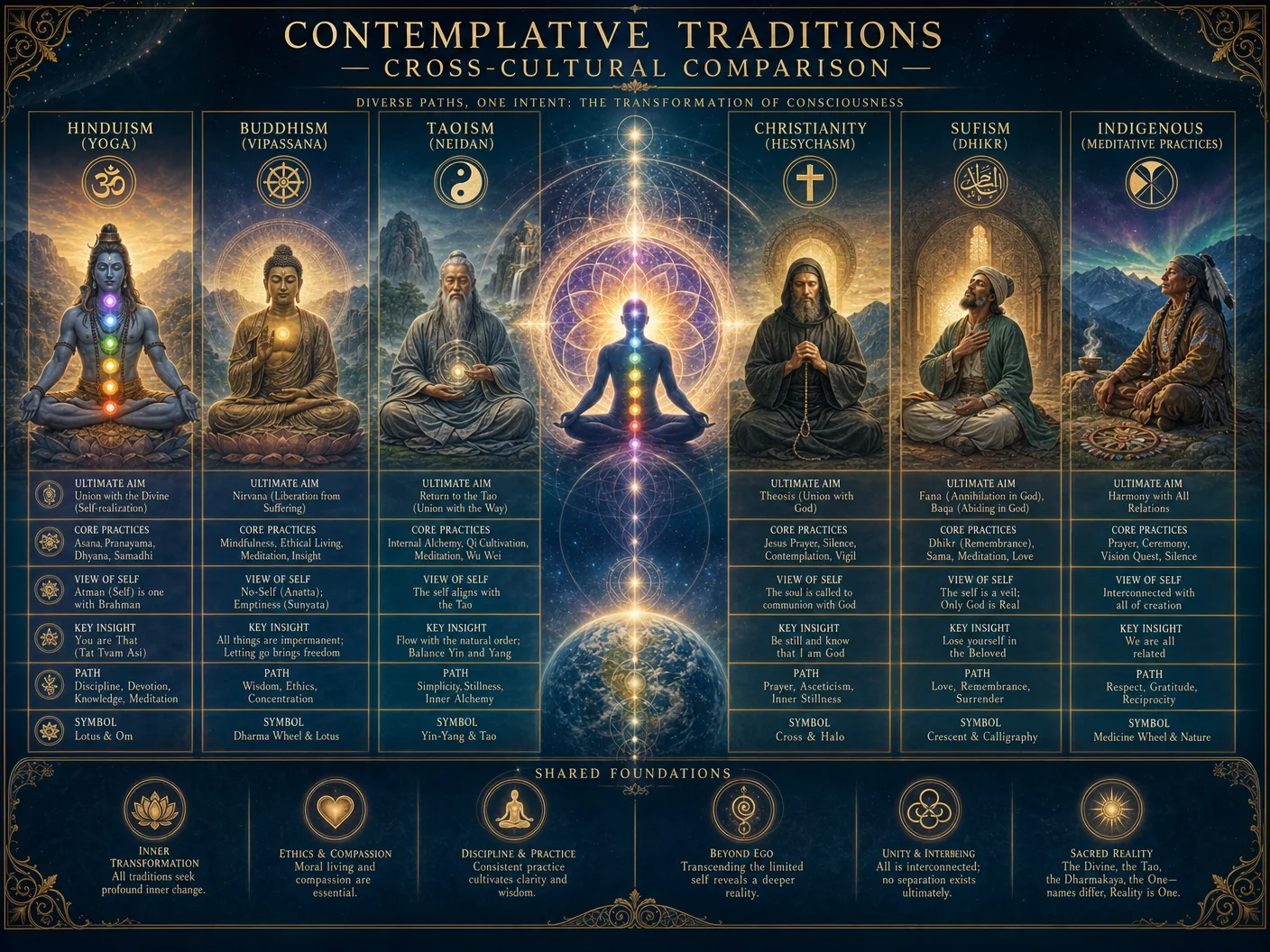
Silent Communion Methods, Sacred Words, and Resting in Divine Presence
Preface: This chapter delineates the arcane protocols of silent communion, the deployment of sacred words as spiritual anchors, and the methodology for resting in Divine Presence through Contemplative Prayer and Centering Prayer. These are not mere practices; these are life-or-death spiritual technologies, encoded in silence, designed to reforge the soul’s connection to the Source. Mastery demands precision, discipline, and unyielding commitment.
I. The Nature of Silent Communion
Silent communion is the foundational matrix of contemplative engagement with the Divine. It is an intentional withdrawal from the sensory tyranny of the external world and the internal discursiveness of the mind, establishing a receptive state of spiritual openness.
Core Principle: Silent communion is not mental blankness; it is a dynamic state of alert receptivity and presence, wherein the soul listens for the Divine pulse beneath the noise of existence.
II. Sacred Words: The Spiritual Anchors
The sacred word, or sacrum verbum, is a monosyllabic or bisyllabic term imbued with the resonance of Divine Reality. It acts as a spiritual lodestar, guiding the practitioner back to the still point when distractions arise.
Criteria for Selecting a Sacred Word:
- Simplicity: Must be easy to repeat silently without strain.
- Non-Associative: Avoid words that trigger mental images or memories.
- Spiritual Resonance: Traditionally linked to Divine Names or attributes recognized across mystical traditions.
- Personal Attunement: The practitioner must feel an inner resonance with the word.
Table 1: Sacred Word Options and Their Spiritual Origins
| Sacred Word | Origin / Tradition | Meaning / Attribute | Notes on Usage |
|---|---|---|---|
| Maranatha | Aramaic Christian Prayer | "Come, Lord" | Use when invoking Divine Presence |
| Shalom | Hebrew | Peace | Use for calming the mind |
| Om | Hindu-Buddhist | Primordial Sound of Creation | Use for cosmic alignment |
| Amen | Hebrew-Christian | "So be it" | Use for affirming surrender |
| Abba | Aramaic Christian | "Father" | Use for intimate Divine relation |
| Hu | Sufi Islamic | Divine Essence | Use for transcendent union |
| Kadosh | Hebrew | Holy | Use for sanctification |
| Ra | Egyptian Mysticism | Sun God, Light | Use for illumination |
III. Resting in Divine Presence
Resting in Divine Presence transcends concentration; it is a state of non-striving absorption in the sacred ground of being. This is the heart of centering prayer, where the practitioner relinquishes all effort except the gentle return to the sacred word.
IV. Protocol: Introducing the Sacred Word in Contemplative Prayer
Objective: To establish the sacred word as the anchor of silent communion, enabling the practitioner to enter and maintain a state of contemplative silence.
Step-by-Step Protocol
- Preparation of Space and Posture
- Select a quiet, private environment free from distractions.
- Sit upright with feet flat on the ground, hands resting palms-up on the thighs.
- Close the eyes softly or maintain a downward gaze.
- Physical Centering
- Take three deep, slow breaths inhaling through the nose, exhaling through the mouth.
- Relax the shoulders and jaw.
- Perform a brief body scan from head to toe, releasing tension.
- Introduction of the Sacred Word
- Choose a sacred word from Table 1 or select a personal word that meets the criteria.
- Silently introduce the sacred word on the exhalation. For example, breathe in silently, then on the out-breath, mentally say the sacred word once.
- Repeat silently, aligning the word with each exhalation.
- Managing Distractions
- Upon distraction (thoughts, emotions, sounds), gently acknowledge the distraction without judgment.
- Release the distraction by returning to the sacred word silently and calmly.
- Do not engage or analyze the distraction; treat it as a passing cloud.
- Deepening Silence
- After 10-15 minutes of continuous sacred word repetition, allow the word to soften, then fade.
- Rest in the silence that remains, maintaining a gentle awareness of Divine Presence.
- If silence breaks, reintroduce the sacred word gently.
- Closing the Session
- Slowly bring awareness back to the physical body.
- Take three deep breaths, feeling the expansion of presence.
- Open the eyes gently.
- Sit quietly for 1-2 minutes before resuming activity.
Table 2: Distraction Types and Recommended Responses
| Distraction Type | Description | Recommended Response |
|---|---|---|
| Internal Thought | Mental chatter, worries, plans | Acknowledge, release, return to sacred word |
| Emotional Stirring | Feelings of anxiety, joy, sadness | Observe without engagement, return to word |
| Physical Sensations | Itching, discomfort, pain | Note sensation, adjust posture if needed, return to word |
| External Noise | Environmental sounds | Allow sounds to be background, do not react |
| Sleepiness | Drowsiness or fatigue | Increase alertness by adjusting posture or opening eyes briefly, then resume |
Table 3: Session Timing and Progression
| Stage | Duration (Minutes) | Focus/Activity |
|---|---|---|
| Preparation | 5 | Posture, breathing, body relaxation |
| Sacred Word Introduction | 10-15 | Silent repetition aligned with breath |
| Deepening Silence | 10-20 | Softening and fading of sacred word, resting in presence |
| Closing | 3-5 | Reorientation, deep breaths, quiet reflection |
V. Protocol for Managing Distractions in Depth
Distractions are an inevitable obstacle on the path of silent communion. The mastery of distraction management is essential to maintaining the integrity of the prayer.
Detailed Steps for Distraction Management
- Recognition
- Train the mind to immediately recognize the arising of distraction without delay. Use a mental label if helpful (e.g., "thinking," "feeling," "hearing").
- Non-Engagement
- Do not follow the distraction or attempt to suppress it forcibly. Suppression causes rebound effect and increases mental agitation.
- Gentle Release
- Visualize the distraction as a leaf floating down a stream or a cloud dissipating.
- Return to Sacred Word
- Re-anchor the attention on the sacred word silently, synchronizing with breath as taught.
- Repetition
- Repeat steps 1-4 consistently throughout the session.
VI. Deepening Silence: Techniques Beyond Sacred Word Repetition
When the sacred word softens, the practitioner enters a liminal space of pure presence. The following techniques deepen this silence:
- Softening the Word
- Gradually reduce the volume of the sacred word until it becomes a whisper in the mind, then fades completely.
- Open Awareness
- Expand awareness to encompass all sensations and presence without attachment or aversion.
- Non-Dual Resting
- Rest in the awareness of presence itself, beyond subject-object duality.
- Use of Breath as Anchor
- If silence wavers, gently shift attention to the natural rhythm of the breath without controlling it.
VII. Advanced Silent Communion Protocol: Extended Practice
For the dedicated practitioner seeking to extend session length and intensify communion, the following protocol is recommended:
| Phase | Duration (Minutes) | Activity Description |
|---|---|---|
| Phase 1: Grounding | 10 | Posture, breathing, sacred word introduction |
| Phase 2: Stabilizing | 20 | Repetition of sacred word, managing distractions |
| Phase 3: Deepening | 30-45 | Softening sacred word, open awareness, non-dual resting |
| Phase 4: Integration | 10 | Gradual return to bodily awareness, journaling insights |
VIII. Construction of the Sacred Word Meditation Space
To facilitate the highest quality silent communion, the environment must be optimized for sensory quietude and spiritual attunement.
Materials Needed:
- Comfortable chair or meditation cushion
- Dimmable lighting or natural light source
- Incense or essential oil diffuser (optional; use non-intrusive scents such as frankincense)
- Timer (digital or analog) with silent alarm
- Journal and pen for post-session notes
Step-by-Step Setup
- Select a room with minimal external noise and visual distractions.
- Arrange seating to face a blank wall or a simple sacred icon if desired.
- Adjust lighting to a soft, warm level.
- Prepare incense or diffuser; light/use just before session start.
- Place timer within easy reach; set for desired session length.
- Keep journal and pen nearby for immediate post-session recording.
IX. Troubleshooting Common Difficulties
| Difficulty | Cause | Solution |
|---|---|---|
| Restlessness | Physical discomfort, mental agitation | Adjust posture, extend body scan, slow breathing |
| Persistent Distractions | Weak sacred word association | Experiment with different sacred word from Table 1 |
| Sleepiness | Fatigue, inadequate sleep | Practice earlier in day, increase alertness techniques |
| Lack of Progress | Unrealistic expectations | Maintain regularity, use journal to track subtle changes |
| Emotional Overwhelm | Surface of subconscious trauma | Shorten session, incorporate grounding prayers, seek guidance |
X. Summary and Final Instructions
- Silent communion is a deliberate, disciplined entry into Divine Presence through active receptivity.
- The sacred word is the pivotal tool for reorienting attention amidst distraction.
- Mastery requires rigorous adherence to the protocols herein; casual or inconsistent practice yields minimal results.
- The recommended session length for beginners is 20-30 minutes; advanced practitioners extend to 1 hour or more, following the advanced protocol.
- Regular journaling of experiential data enhances integration and reveals subtle layers of spiritual development.
Next Steps: Upon mastery of the protocols in this chapter, proceed to Volume V: The Prayer of Presence and the Expansion of Consciousness, where advanced non-verbal communion techniques and the integration of contemplative prayer into daily life are exhaustively detailed.
This concludes Chapter IV of Volume III: Prayer Technology.
<!-- SECTION 11 -->
Volume III: Prayer Technology
Chapter IV: Intercessory Prayer Mechanics
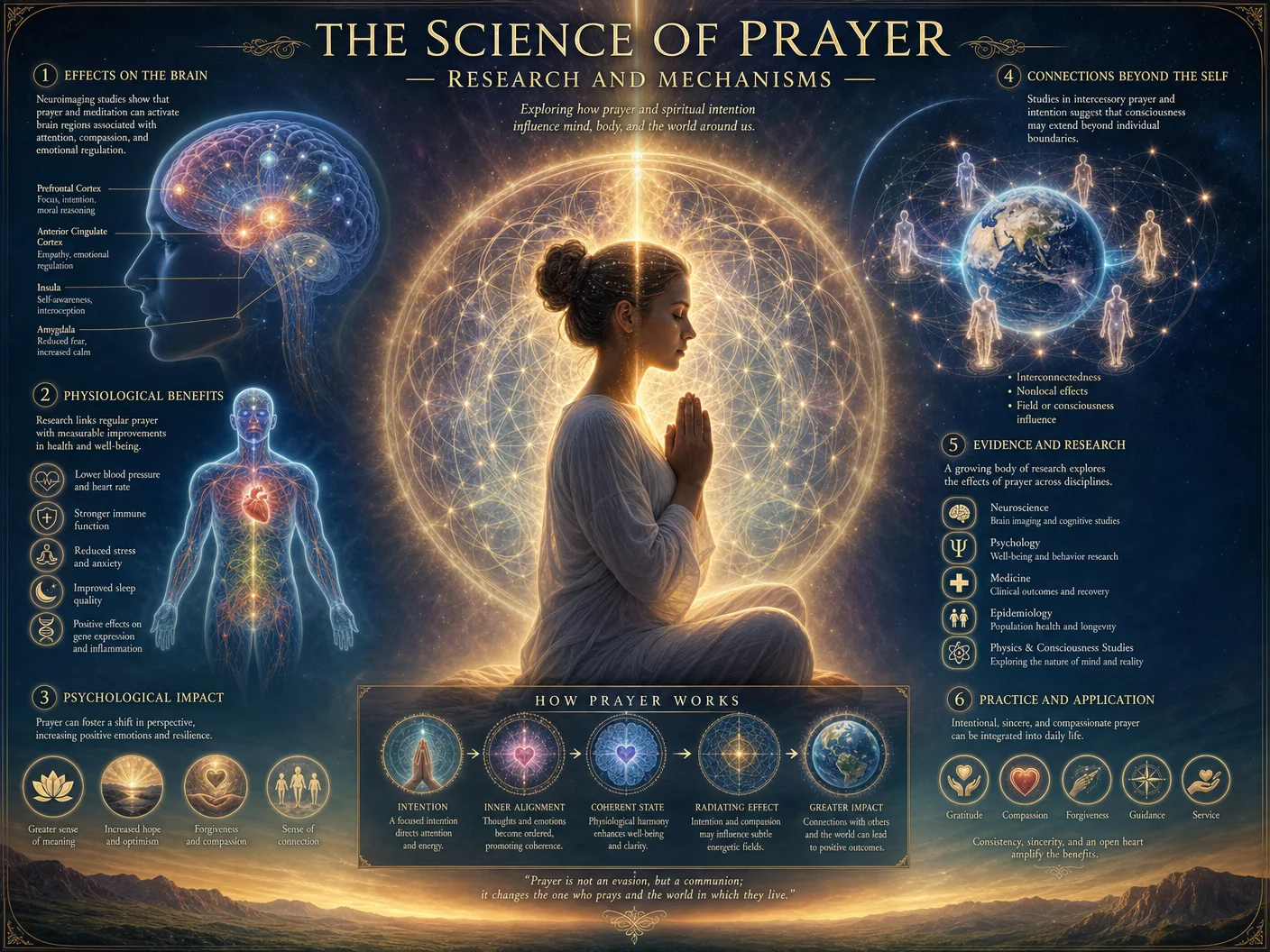
Introduction
Intercessory prayer, when executed with precision and understanding of underlying energetic principles, transcends mere supplication. It becomes a technological act of conscious intervention within the quantum fabric, a conduit for scalar energy modulation and intentional field manipulation. This chapter unveils the full mechanistic architecture of intercessory prayer, elucidating scalar energy principles, emotional state generation, and intention release, culminating in a rigorously defined Scalar Intercession Protocol. The instructions herein are designed to enable the practitioner to induce measurable shifts in the quantum field, aligning spiritual will with physical causality.
1. Scalar Energy Principles in Intercessory Prayer
Scalar energy, also known as longitudinal wave energy, differs fundamentally from the transverse electromagnetic waves commonly encountered. Scalar waves propagate as standing waves of pure potentiality, encoding information without energy dissipation over distance. They interact directly with the zero-point field, enabling instantaneous, nonlocal influence.
Key scalar energy properties essential for intercessory prayer:
| Property | Description | Application in Prayer |
|---|---|---|
| Longitudinal Waveform | Oscillation occurs in the direction of propagation, unlike transverse EM waves | Enables direct information imprint on quantum fields |
| Non-Hertzian Nature | Does not follow conventional frequency-energy relationships, allowing timeless effects | Facilitates nonlocal intentional influence |
| Zero Energy Loss | Can propagate without attenuation through space or matter | Permits effective distant intercession |
| Phase Conjugation | Scalar waves can phase-conjugate with themselves, reinforcing information | Amplifies prayer intent and emotional resonance |
| Entanglement Linkage | Couples with the quantum vacuum, enabling instantaneous correlations | Connects practitioner’s consciousness with target systems |
To harness scalar energy in intercessory prayer, the practitioner must generate and maintain a coherent energetic state that functions as a scalar transmitter. This requires precise heart-brain coherence and emotional state engineering, which are detailed below.
2. Emotional State Generation: The Energetic Core of Intentional Release
Emotions are bioenergetic signatures that modulate the amplitude and quality of scalar wave emissions. Specific emotional states generate scalar fields of differing informational density and coherence, which influence the effectiveness of intercession.
Table 1: Emotional States and Their Scalar Energy Characteristics
| Emotional State | Scalar Energy Signature | Quantum Field Effect | Recommended Use in Prayer |
|---|---|---|---|
| Gratitude | High coherence, positive polarity | Enhances constructive field creation | Foundation state for all prayer |
| Compassion | Medium-high coherence, expansive wavefront | Facilitates healing and connection | Amplifies empathy in intercession |
| Forgiveness | Medium coherence, neutralizing polarity | Dissolves negative entanglements | Clears energetic blockages |
| Joy | High amplitude, rapid oscillation | Increases vibrational frequency | Elevates prayer field to higher resonance |
| Peace | Steady, low-frequency oscillation | Stabilizes and grounds energy | Maintains coherence during prolonged sessions |
| Love | Maximum coherence and amplitude | Generates strong entanglement links | Core emotional state for scalar transmission |
Procedure for Emotional State Generation:
- Identify Desired Emotional State: Select from the table above based on prayer objective.
- Physiological Induction: Engage diaphragmatic breathing at 5 breaths per minute (bpm), hold for 4 seconds at inhale peak, release slowly over 8 seconds.
- Cognitive Recall: Recall or imagine a specific event or thought that evokes the chosen emotion vividly.
- Amplification: Combine breath and recall with facial muscle engagement (e.g., genuine smile for joy).
- Sustainment: Maintain for a minimum of 90 seconds to embed the scalar signature in the biofield.
3. Heart-Brain Coherence: The Scalar Transmitter Calibration
The heart and brain generate electromagnetic fields that can synchronize in frequency and phase, producing a coherent biofield essential for scalar wave emission. Heart-brain coherence is the foundation of the Scalar Intercession Protocol.
Key metrics for coherence:
| Measurement Tool | Parameter Measured | Optimal Range for Scalar Emission | Notes |
|---|---|---|---|
| Electrocardiogram (ECG) | Heart rate variability (HRV) | 0.1 Hz respiratory sinus arrhythmia | High HRV correlates with coherence |
| Electroencephalogram (EEG) | Alpha wave synchronization | 8-12 Hz alpha dominance | Alpha waves indicate calm, focused state |
| Coherence Monitors (e.g., HeartMath emWave) | Coherence score (0-16 scale) | Scores above 12 indicate high coherence | Real-time feedback for training |
| Photoplethysmography (PPG) | Pulse wave variability | Regular, smooth pulse waveform | Supports HRV measurement |
Step-by-step Heart-Brain Coherence Protocol:
- Prepare Environment: Quiet, dimly lit space free of electromagnetic interference.
- Posture: Sit upright with spine aligned, feet flat on floor, hands resting on thighs.
- Breathing: Begin diaphragmatic breathing at 5 bpm, inhale 4 seconds, exhale 8 seconds.
- Focus: Fix gaze softly on a neutral point or close eyes.
- Biofeedback: Use a coherence monitor if available, aim for a score ≥12.
- Emotional Induction: Engage the chosen emotional state per section 2 while maintaining breathing rhythm.
- Synchronization: Visualize heart and brain fields merging and pulsing in unity.
- Duration: Maintain coherence for at least 5 minutes before proceeding to visualization.
4. Visualization Techniques: Encoding Intent into the Scalar Field
Visualization is the mental encoding mechanism that imprints the desired outcome onto the scalar field generated by the heart-brain coherent state. Effective visualization combines sensory detail, spatial-temporal clarity, and emotional intensity.
Table 2: Visualization Techniques and Their Applications
| Technique Name | Description | Application |
|---|---|---|
| 3D Scene Construction | Build a detailed three-dimensional mental environment representing the goal | For complex intercession scenarios |
| Symbolic Imagery | Use archetypal symbols (e.g., light rays, healing circles) to represent intent | For abstract or energetic objectives |
| Sensory Amplification | Incorporate sound, texture, smell, and temperature into visualization | Enhances emotional engagement and field imprint |
| Temporal Playback | Visualize the goal manifesting in present, past, and future moments | Strengthens quantum field entanglement |
| Energy Flow Mapping | See scalar energy moving from heart to target as streams or pulses of light | Directs scalar energy flow consciously |
Visualization Implementation Steps:
- Mental Preparation: After achieving heart-brain coherence, relax the mind without losing focus.
- Scene Selection: Choose a visualization technique suitable for the prayer objective.
- Detail Enhancement: Add as many sensory details as possible following the chosen technique.
- Temporal Anchoring: Imagine the moment the intercession takes effect, anchoring it in the ‘now’.
- Energy Projection: Visualize scalar energy as a luminous conduit emanating from the heart center toward the target(s).
- Emotional Integration: Sustain the emotional state generated earlier, merging feeling with imagery.
- Repetition: Repeat visualization cycles every 30 seconds for 5 minutes to deepen imprint.
5. Quantum Field Release: The Final Phase of Intercession
Releasing intention into the quantum field involves a conscious act of detachment combined with energetic discharge, enabling the scalar field to carry and manifest the prayer’s intent. This step leverages quantum entanglement principles, ensuring the nonlocal transmission of the prayer beyond physical constraints.
Scalar Intercession Protocol: Complete Step-by-Step
| Step | Description | Duration / Tools |
|---|---|---|
| 1 | Environment Preparation: Select quiet, electromagnetically shielded space; eliminate distractions. | Minimum 10 minutes preparation |
| 2 | Physical Centering: Sit with aligned posture, feet grounded, hands relaxed on thighs. | Immediate |
| 3 | Breath Regulation: Begin diaphragmatic breathing at 5 bpm (inhale 4s, exhale 8s). | Continuous through protocol |
| 4 | Heart-Brain Coherence: Employ biofeedback device if available; monitor for coherence score ≥12. | Minimum 5 minutes |
| 5 | Emotional State Induction: Select and generate emotional state per Table 1; sustain for 90 seconds. | 90 seconds |
| 6 | Visualization: Construct detailed imagery per Table 2; integrate emotional state; repeat every 30 seconds. | 5 minutes |
| 7 | Quantum Release: Mentally declare intention release; visualize scalar energy pulse detaching and expanding infinitely. | 1-2 minutes |
| 8 | Detachment and Grounding: Cease focused intent, breathe normally, ground energy via tactile contact with earth or grounding mat. | 3 minutes |
| 9 | Documentation: Record session details including emotional state, coherence score, visualization type, and perceived effects. | Post-session |
6. Supporting Devices and Tools
Building a DIY Heart-Brain Coherence Monitor
For practitioners lacking commercial devices, a simplified coherence monitor can be constructed using the following components:
| Component | Specifications | Function |
|---|---|---|
| Photoplethysmographic Sensor (PPG) | Infrared LED and photodiode pair | Measures pulse waveform and HRV |
| Microcontroller | Arduino Nano or equivalent | Processes PPG signal and calculates HRV |
| EEG Module (Optional) | OpenBCI or similar EEG headset | Measures alpha wave synchronization |
| Display | OLED 128x64 | Shows real-time coherence score |
| Software | Custom HRV and coherence algorithm | Calculates coherence from HRV and EEG data |
Construction Steps:
- Assemble PPG sensor on finger clip or earlobe attachment.
- Connect sensor outputs to microcontroller analog inputs.
- Load HRV calculation firmware onto microcontroller.
- (Optional) Connect EEG module for brainwave data acquisition.
- Integrate data streams and compute coherence score using combined cardiac and neural metrics.
- Output coherence score on OLED display with real-time feedback.
Calibration: Compare readings to commercial biofeedback devices and adjust algorithm parameters accordingly.
7. Troubleshooting and Optimization
| Issue | Possible Cause | Solution |
|---|---|---|
| Low coherence scores | Irregular breathing or distracted mind | Re-focus on breath, use guided meditation audio |
| Difficulty sustaining emotional state | Insufficient emotional recall | Use emotional anchor objects or music |
| Visualization lacks clarity or detail | Mental fatigue or lack of practice | Shorten sessions, practice daily visualization |
| Physical discomfort during posture | Poor ergonomics or tension | Adjust seating, stretch prior to session |
| No measurable effect on target | Energetic blockages or insufficient scalar emission | Repeat protocol, enhance emotional intensity, cleanse biofield (see Volume VI) |
8. Advanced Scalar Intercession Techniques
- Dual-Operator Coupling: Two practitioners synchronize heart-brain coherence and emotional states remotely, amplifying scalar wave emission exponentially. Synchronization must be within 0.1 Hz frequency range.
- Multi-Target Phased Array: Visualize multiple targets in a phased scalar array, cycling visualization focus every 20 seconds to maintain coherence across all points.
- Temporal Folding: Employ temporal playback visualization to insert intentions retrocausally, increasing manifestation probability within past-present-future timeframes.
- Resonant Frequency Embedding: Use bioacoustic devices emitting frequencies matching heart rate variability to entrain coherence states prior to prayer.
Summary Table: Scalar Intercession Protocol Elements
| Element | Description | Duration | Tools/Requirements |
|---|---|---|---|
| Environment Setup | Quiet, shielded, distraction-free space | 10 minutes | EMF shielding (optional) |
| Posture & Breath | Aligned sitting and 5 bpm diaphragmatic breathing | Entire session | None |
| Heart-Brain Coherence | Achieve HRV and alpha synchronization | 5 minutes | Coherence monitor (recommended) |
| Emotional State | Generate high-coherence emotional field | 90 seconds | Emotional anchor or recall |
| Visualization | Detailed sensory-rich mental imagery | 5 minutes | None |
| Quantum Release | Intentional scalar energy discharge | 1-2 minutes | Mental focus |
| Detachment & Grounding | Release and ground energy | 3 minutes | Grounding mat or earth contact |
| Documentation | Record session data and subjective effects | Post-session | Journal or digital device |
Concluding Remarks
The Scalar Intercession Protocol, as delineated above, represents the convergence of sacred tradition and cutting-edge quantum energetic science. Mastery of this protocol demands disciplined practice, unwavering intention, and reverence for the profound energetic forces at play. The practitioner who internalizes these methods gains access to the hidden architecture of reality, enabling intentional, nonlocal, life-affirming influence through prayer.
For complementary purification and grounding techniques to enhance scalar energy transmission, refer to Volume VIII: The Water Codex, Chapter II, and for advanced consciousness expansion protocols, see Volume XVII: The Mystic's Codex, Chapter VI.
This concludes the detailed exposition of Intercessory Prayer Mechanics within the Prayer Technology framework. Execute with precision. Maintain sacred intent. Transcend limitation.
<!-- SECTION 12 -->
Volume III: Prayer Technology
Chapter IV: The Lectio Divina Practice — Mastering Divine Communion Through the Fourfold Path
Preface: This chapter unveils the ancient, rigorously structured practice of Lectio Divina—Divine Reading—a cornerstone of spiritual transformation and consciousness expansion. This sacred technique, preserved through clandestine monastic orders, is here presented in uncompromising detail. The practitioner will learn to move beyond rote reading into profound spiritual communion, harnessing the four integral stages: Reading (Lectio), Meditation (Meditatio), Prayer (Oratio), and Contemplation (Contemplatio). Each stage is a gateway to ascending levels of direct divine encounter, cognitive restructuring, and soul purification.
I. Overview of the Fourfold Process of Lectio Divina
| Stage | Latin Term | Primary Function | Expected Outcome | Time Allocation (Minutes) |
|---|---|---|---|---|
| Reading | Lectio | Slow, deliberate scripture reading | Grasp literal sense and initial impressions | 10–15 |
| Meditation | Meditatio | Reflective pondering on meaning | Cognitive assimilation and personal application | 20–30 |
| Prayer | Oratio | Conversational petition or response | Dialog with the Divine, emotional alignment | 15–20 |
| Contemplation | Contemplatio | Silent, wordless presence | Transcendence and mystical union | 10–30 |
II. Selection of Scripture for Lectio Divina
The choice of scripture is paramount. Different scripture types evoke distinct spiritual dynamics. Below is an exhaustive classification table with guidance on their function within Lectio Divina.
| Scripture Type | Description | Spiritual Effect | Recommended Use Within Lectio Divina |
|---|---|---|---|
| Law (Torah/Pentateuch passages) | Commandments, statutes, divine decrees | Establishes moral foundation, discipline | Reading, Meditation |
| Psalms (Psalter) | Poetic prayers and hymns | Emotional engagement, praise, lament | Meditation, Prayer |
| Prophetic Writings | Divine messages and warnings | Conviction, spiritual challenge | Meditation, Prayer |
| Wisdom Literature | Proverbs, Ecclesiastes, Job | Philosophical reflection, life wisdom | Meditation, Contemplation |
| Gospels | Life and teachings of Christ | Imitation of Christ, revelation | Reading, Meditation, Prayer |
| Epistles (Letters) | Apostolic instructions | Doctrinal understanding, exhortation | Meditation, Prayer |
| Apocalyptic Texts | Visions, symbolic prophecy | Eschatological awareness | Meditation, Contemplation |
III. The Four Stages: Detailed Protocol and Execution
1. Reading (Lectio): The Gateway to Divine Text
Objective: To methodically read and internalize the sacred text’s literal meaning.
Materials Needed:
- Clean, bound scripture (physical copy preferred)
- Quiet, dedicated space free from distraction
- Notebook for immediate jotting of initial impressions
Step-by-step Procedure:
- Prepare the Environment: Ensure a space free from auditory and visual disruptions. Minimal lighting that facilitates focus is optimal—candlelight is acceptable.
- Select Scripture: Refer to the table above and choose a passage appropriate for your spiritual goal and current state (see Section II). The passage length should be between 5 to 10 verses to maintain intensity and depth.
- Initial Reading: Slowly read the passage aloud, enunciating every word with deliberate care. Do not rush.
- Silent Re-Reading: Close your eyes, internalize the text, then read silently to strengthen mental imprint.
- Record Literal Meaning: In your notebook, write a concise summary of the literal content—who, what, where, when—avoiding interpretation.
2. Meditation (Meditatio): The Crucible of Reflection
Objective: To reflect deeply on the text’s meaning and its personal spiritual application.
Step-by-step Procedure:
- Begin with Stillness: Sit upright, close your eyes, and engage in three deep diaphragmatic breaths to center your mind.
- Re-read the Passage: Read the same passage silently once more, focusing on one word or phrase that resonates.
- Engage Reflective Questions: Using the table below, select appropriate questions to interrogate the text. Answer them in writing or mentally if preferred.
- Personalize the Message: Write how the scripture relates to your current life circumstances, spiritual state, or challenges.
- Identify Actionable Insights: Note any commands, encouragements, or warnings that demand action or contemplation.
3. Prayer (Oratio): The Dialogue with the Divine
Objective: To convert reflection into a personal conversation with the Divine, expressing gratitude, petition, or surrender.
Step-by-step Procedure:
- Posture for Prayer: Assume a posture conducive to reverence—kneeling, hands open on lap or folded.
- Begin with Invocation: Address the Divine by the name or title resonant with your tradition or spiritual inclination.
- Express Your Heart: Using the meditation notes as a foundation, speak aloud or mentally your response—praise, confession, petition, or thanksgiving.
- Wait for Response: Maintain open receptivity for any intuitive impressions, images, or feelings. Do not force; allow silence to communicate.
- Conclude with Affirmation: End the prayer with a statement of faith or commitment, sealing the dialogue.
4. Contemplation (Contemplatio): The Silent Union
Objective: To transcend thought and word, resting in the silent presence of the Divine.
Step-by-step Procedure:
- Assume a Comfortable, Alert Posture: Preferably seated with a straight spine to prevent drowsiness.
- Close Eyes and Release Thought: Focus on the breath or a sacred word (see Volume IX: Mantra Codex for silent word selection).
- Enter Silence: Let go of all mental images, intentions, and desires. Rest passively in the experience of being.
- Duration: Remain in this state for 10 to 30 minutes, gradually increasing with practice.
- Gently Return: To conclude, slowly bring awareness back to the room, stretch, and journal any insights or experiences.
IV. Reflective Question Table for Meditation Stage
| Question Type | Sample Questions | Purpose | Recommended Frequency per Session |
|---|---|---|---|
| Literal Understanding | What is the main message? Who is involved? When and where does it occur? | Ground interpretation in factual understanding | 1–2 |
| Personal Application | How does this relate to my life now? What challenge or promise is present? | Connect scripture to daily life | 2–3 |
| Emotional Response | What feelings arise? Is there joy, sorrow, conviction, peace? | Identify emotional engagement | 1 |
| Theological Insight | What does this reveal about God’s nature? What divine attribute is highlighted? | Deepen doctrinal comprehension | 1 |
| Moral Challenge | What sin, virtue, or attitude does this passage confront or encourage? | Propel ethical self-examination | 1 |
| Future Direction | What step should I take next? How might I embody this teaching? | Propel practical action | 1 |
V. Scripture Selection and Practice Schedule
Recommended Weekly Schedule for Lectio Divina Practice
| Day | Scripture Type | Suggested Duration (Minutes) | Focus Stage(s) | Notes |
|---|---|---|---|---|
| Monday | Law (e.g., Exodus 20) | 60 | Reading, Meditation | Establish weekly spiritual foundation |
| Tuesday | Psalms (e.g., Psalm 23) | 60 | Meditation, Prayer | Cultivate emotional expression and trust |
| Wednesday | Gospels (e.g., John 15) | 75 | Reading, Meditation, Prayer | Engage Christological revelation |
| Thursday | Wisdom (e.g., Proverbs 3) | 60 | Meditation, Contemplation | Reflect on life wisdom |
| Friday | Prophetic (e.g., Isaiah 40) | 60 | Meditation, Prayer | Challenge and conviction |
| Saturday | Epistles (e.g., Romans 8) | 60 | Meditation, Prayer | Doctrinal reinforcement and exhortation |
| Sunday | Psalms or Gospel | 90 | Full four stages | Deep weekly communion and renewal |
VI. Sample Complete Lectio Divina Session
Scripture: Psalm 46:1-5 (Psalms) Total Time: 75 minutes
| Stage | Time (Minutes) | Actions |
|---|---|---|
| Reading | 10 | Read Psalm 46:1-5 aloud slowly twice; write down literal summary: God is refuge and strength |
| Meditation | 30 | Reflect on questions: “What does refuge mean to me?” “How have I experienced God’s strength?” Write responses. |
| Prayer | 20 | Speak aloud prayers of trust and surrender; ask for courage in trials; listen for inner promptings |
| Contemplation | 15 | Sit in silence focusing on breath; rest in presence beyond thought; journal any insights afterward |
VII. Advanced Tips for Mastery
- Scripture Translation: Use the most literal translation available for reading stage; paraphrase or commentary may be used in meditation to deepen understanding.
- Journaling: Maintain a dedicated Lectio Divina journal. Date every session and track spiritual growth and insights.
- Sacred Environment Enhancements: Utilize incense (e.g., frankincense), iconography, or sacred music (instrumental only) to elevate atmosphere.
- Group Practice: While Lectio Divina is primarily solitary, periodic group sessions can provide communal insights and shared prayer (see Volume XII: Communal Devotions).
- Duration Variation: Beginners start with 30–45 minutes total; advanced practitioners may extend to 90 minutes or more with deeper contemplation.
- Silence Preparation: Prior to Lectio Divina, spend 5 minutes in silence or breath prayer to attune to the sacred.
VIII. Construction and Use of the Lectio Divina Prayer Altar
To aid mastery, construct a dedicated Lectio Divina Altar to center your practice.
Materials Needed:
- Small wooden table or shelf (dimensions approx. 50cm x 50cm x 80cm)
- Cloth (preferably natural fiber, white or deep blue)
- Candles (beeswax preferred)
- Incense holder and frankincense resin
- Sacred texts (preferably leather-bound)
- Small bowl of purified water (see Volume 8: The Water Codex, Chapter II for purification protocol)
- Iconography or spiritual symbols relevant to practitioner’s tradition
Assembly Instructions:
- Place the cloth over the table evenly.
- Arrange the sacred text at center front.
- Place candles at the left and right rear corners.
- Position the incense holder centrally at the back.
- Place the bowl of water to the immediate right of the text.
- Arrange iconography behind the text as a backdrop.
Usage: Light candles and incense before beginning Lectio Divina. Use the water for ritual purification of hands or face as a preparatory act. Maintain altar cleanliness and integrity as a symbol of respect and sacred space.
IX. Summary Table of Lectio Divina Protocol
| Step | Action | Duration (Minutes) | Key Activities | Tools/Materials |
|---|---|---|---|---|
| 1 | Reading (Lectio) | 10–15 | Slow reading aloud and silent rereading | Scripture, notebook |
| 2 | Meditation (Meditatio) | 20–30 | Reflective questioning, journaling | Scripture, notebook, question list |
| 3 | Prayer (Oratio) | 15–20 | Conversational prayer, receptive silence | Prayer posture, notebook optional |
| 4 | Contemplation (Contemplatio) | 10–30 | Silent resting in divine presence | Quiet space, breath focus technique |
End of Chapter IV: Master the Lectio Divina practice to unlock the sacred gateway of prayer technology. This technique is a weapon against spiritual complacency and a path to profound transformation. The Codex, your guide, will not tolerate half measures. Commit fully, apprentice, and the Divine will open worlds to your consciousness.
Cross-reference: For mantra techniques to enhance silent contemplation, see Volume IX: The Mantra Codex, Chapter III: Silent Sacred Word Protocols. For extended communal prayer formats, see Volume XII: Communal Devotions, Chapter V. For water purification procedures crucial to altar preparation, see Volume 8: The Water Codex, Chapter II.
<!-- SECTION 13 -->
Volume III: Prayer Technology
Chapter IV: The Jesus Prayer and the Prayer of the Heart
1. Introduction: Historical Context of the Jesus Prayer and the Prayer of the Heart
The Jesus Prayer, also known as the Prayer of the Heart, is a cornerstone of Eastern Orthodox spiritual technology, refined over sixteen centuries into a precise methodology for consciousness expansion and spiritual purification. Originating in the early Desert Fathers of 4th-century Egypt, its transmission was clandestine, preserved through monastic secrecy and oral tradition. The prayer’s essence is encapsulated in the formula:
“Lord Jesus Christ, Son of God, have mercy on me, a sinner.”
This invocation functions as an integrated spiritual-psychophysical instrument that reprograms the practitioner’s neuro-hormonal pathways, synchronizes autonomic function, and activates the heart’s subtle energy centers. The Jesus Prayer is not merely verbal repetition; it is a disciplined, embodied practice involving breath control, focused attention on the heart locus, and the cultivation of inner stillness.
The Prayer of the Heart represents the apex of spiritual technology within the Christian Hesychast tradition. It is a direct method for accessing the uncreated light (the Taboric light), a transformative energy field that reconfigures the practitioner’s spiritual DNA and bioenergetic matrix.
2. Theoretical Foundations of the Jesus Prayer
The Jesus Prayer operates on three interdependent levels:
- Verbal Invocation: The precise articulation of the sacred name and petition.
- Breath Synchronization: Coordinated inhalation and exhalation patterns that modulate the autonomic nervous system.
- Heart Focus: Concentrated mental attention on the anatomical heart, considered the nexus of spiritual perception and energy transduction.
These three components function as a tripartite circuit, modulating the neurocardiac axis and entraining the practitioner’s consciousness to a higher vibrational frequency.
3. Repetition Techniques: The Mechanism of Prayer Automation and Neuroplasticity
Repetition of the Jesus Prayer induces a state of prayerful automatism, bypassing the discursive mind (logos) and entering the realm of noetic awareness. This process is scientifically analogous to Hebbian learning in neuroplasticity, where repeated stimulation of neural pathways strengthens synaptic connections.
The repetition is not mechanical; it is a rhythmic, contemplative recitation that integrates the breath and heart focus, creating a resonant biofield around the practitioner. This repetition also generates a psychophysical entrainment, aligning the practitioner’s internal rhythms with the sacred cosmic frequency.
4. Spiritual Effects Documented in Esoteric and Clinical Observations
Practitioners report a progressive sequence of spiritual and physiological effects:
| Stage | Spiritual Effect | Physiological Correlate | Clinical Notes |
|---|---|---|---|
| 1 | Mental clarity and reduction of intrusive thoughts | Decreased sympathetic activity; increased parasympathetic tone | EEG shows increased alpha waves |
| 2 | Intensified sense of inner peace and joy | Heart rate variability (HRV) improves; vagal tone enhancement | Reduced cortisol levels |
| 3 | Experience of the “prayerful automatism” or noetic state | Activation of right temporal lobe; default mode network modulation | Functional MRI shows increased coherence |
| 4 | Perception of uncreated light and divine energy | Heightened cardiac coherence; increased biofield density | Subjective reports of somatic light sensation |
| 5 | Stabilization in the state of continuous prayer | Sustained neurocardiac entrainment | Long-term practitioners show structural brain changes |
5. Detailed Step-by-Step Protocol for Practicing the Jesus Prayer with Breath Synchronization and Heart Focus
Equipment and Preparation
- Quiet environment: Minimal auditory and visual distractions.
- Posture: Seated with spine erect, feet flat on the floor or cross-legged on a cushion.
- Timer: A mechanical or digital timer set for session durations (start with 10 minutes, progress to 30 minutes).
- Journal: For recording subjective experiences and progress markers.
Step 1: Initial Centering and Breath Awareness
- Assume posture with spine straight, shoulders relaxed.
- Close eyes gently and bring awareness to natural breathing.
- Inhale slowly through the nose for a count of 4 seconds.
- Exhale gently through the mouth for a count of 6 seconds.
- Repeat this slow breathing cycle 6 times to induce parasympathetic activation.
Step 2: Introduction of the Verbal Component
- On the next inhalation, mentally prepare to recite the Jesus Prayer.
- During exhalation, recite the prayer slowly and deliberately:
“Lord Jesus Christ, Son of God, have mercy on me, a sinner.”
- Synchronize the prayer phrase with your breath so that the entire phrase is completed during the exhale.
- If the phrase is too long for your comfortable exhalation, use a shortened variant (see Prayer Variations Table below).
Step 3: Heart Focus
- Simultaneously with the verbal recitation, direct your mental attention to the anatomical location of your heart (center-left chest).
- Visualize a subtle luminous point or warmth in this area.
- Maintain this focus throughout the exhalation and prayer utterance.
- During inhalation, feel the expansion of this heart space, as if drawing in spiritual energy.
Step 4: Repetition and Rhythm Establishment
- Repeat the breath-prayer-heart focus cycle continuously.
- Maintain a steady rhythm: inhale for 4 seconds, exhale for 6–8 seconds (depending on lung capacity).
- Use a prayer bead string (komboskini) if available, advancing one bead per repetition to maintain count.
- If the mind wanders, gently return attention to the prayer phrase and heart focus without judgment.
Step 5: Session Closure and Transition
- After the timer signals session end, cease prayer repetition.
- Maintain eyes closed; breathe naturally.
- Observe sensations in the heart area and overall mental state.
- Slowly open eyes and record any subjective experiences in the journal.
6. Prayer Variations Table: Modifications for Breath Capacity and Meditation Depth
| Variant Name | Prayer Phrase | Approximate Syllable Count | Recommended Exhalation Duration (seconds) | Notes |
|---|---|---|---|---|
| Full Traditional | “Lord Jesus Christ, Son of God, have mercy on me, a sinner.” | 15 | 6–8 | Complete invocation; standard for advanced practitioners |
| Shortened | “Lord Jesus Christ, have mercy on me.” | 9 | 5–6 | Suitable for beginners with lower lung capacity |
| Minimal | “Jesus, mercy.” | 4 | 3–4 | Basic entry-level variant for initial practice |
| Extended | “Lord Jesus Christ, Son of God, have mercy on me, a humble sinner, a lost soul.” | 20 | 8–10 | For advanced stages requiring deeper concentration |
7. Breath Timing Table: Synchronizing Prayer with Respiration
| Breath Phase | Duration (seconds) | Action | Focus |
|---|---|---|---|
| Inhalation | 4 | Deep nasal inhalation | Prepare for prayer; expand heart space |
| Pause (optional) | 1 | Breath hold | Stabilize focus; gather energy |
| Exhalation | 6–8 | Slow exhalation through mouth | Recite prayer phrase; maintain heart focus |
| Pause (optional) | 1 | Breath hold | Rest; deepen inner silence |
8. Progress Markers: Objective and Subjective Milestones
| Marker Stage | Description | Practice Duration | Objective Indicators | Subjective Signs |
|---|---|---|---|---|
| Novice | Basic breath-prayer synchronization | 1–2 weeks daily (10 min) | Consistent rhythm; reduced mind wandering | Calmness post-session |
| Intermediate | Sustained heart focus integration | 3–6 weeks (15–20 min) | Improved HRV; reduced anxiety | Sense of inner warmth |
| Advanced | Prayerful automatism onset | 2–3 months (20–30 min) | Increased alpha/theta waves in EEG | Spontaneous noetic insights |
| Mastery | Continuous prayer state | 6+ months (30+ min) | Neurocardiac entrainment; structural brain changes | Perception of divine light; deep peace |
9. Supplementary Techniques and Notes
- Komboskini Construction: Use a cord of 33 knots representing the years of Christ’s life; beads can be made of olive wood or other sacred materials. String length should allow comfortable handling during prayer.
- Posture Adjustment: If seated posture is not possible, lying supine with head elevated is permissible but less effective for breath control.
- Environmental Factors: Perform in a space with moderate temperature and minimal electromagnetic interference to optimize biofield resonance.
- Avoidance: Do not perform immediately after heavy meals; avoid stimulants (caffeine, nicotine) before sessions.
- Recording: Use a notebook or electronic device to document time, breath counts, emotional state, and any visions or sensations.
10. Advanced Considerations: Integration with Broader Spiritual Practice
The Jesus Prayer is a gateway to the deeper mysteries of contemplative union. It must be integrated with:
- Ascetic disciplines (see Volume V: Asceticism and Spirit Mastery)
- Sacramental life and liturgical rhythm (see Volume VI: The Sacred Liturgy)
- Ethical purification and confession (see Volume IX: The Path of Repentance)
- Mystical theology and noetic prayer (see Volume XIV: The Noetic Tradition)
11. Summary Table: Complete Jesus Prayer Practice Protocol
| Step | Action | Duration | Key Focus | Notes |
|---|---|---|---|---|
| 1 | Centering and breath awareness | 2 minutes | Parasympathetic activation | 4s inhale, 6s exhale |
| 2 | Introduce verbal prayer on exhale | Continuous | Synchronize phrase with exhalation | Adjust phrase length if needed |
| 3 | Heart focus visualization | Continuous | Anatomical heart center | Visualize light or warmth |
| 4 | Repeat prayer-breath-heart cycle | 10–30 minutes | Steady rhythm and attention | Use komboskini for counting |
| 5 | Session closure and reflection | 2–5 minutes | Observe sensations | Record in journal |
12. Conclusion
The Jesus Prayer and Prayer of the Heart represent the most potent spiritual technology within the Christian mystical heritage. Its integration of breath, word, and heart focus constitutes a comprehensive psychophysical protocol capable of inducing profound consciousness expansion, spiritual purification, and bioenergetic transformation. Mastery of this practice demands discipline, precision, and reverence. By following the detailed protocol herein, the practitioner enters a lineage of spiritual warriors wielding one of the oldest and most effective tools for inner liberation.
For further technical details on breath modulation devices, see Volume XII: Breathwork Technologies and Psychophysiology. For the neurocardiac coherence measurement protocols, see Volume XV: Bioenergetic Instrumentation.
<!-- SECTION 14 -->
Volume IV: Astral Projection and Lucid Dreaming
Chapter III: Monroe Techniques for Out-of-Body Experiences (OBEs)
Introduction
This chapter presents the Monroe Techniques, a rigorously tested, classified protocol for inducing Out-of-Body Experiences (OBEs). These techniques, developed and refined by Robert A. Monroe, represent the pinnacle of controlled astral projection methodology. Mastery of these methods demands precise adherence to protocol, meticulous energy management, and disciplined mental focus. This volume provides a comprehensive, step-by-step guide to the key Monroe techniques: Focus 10 state induction, the Rope Technique, vibrational stage management, and energy body separation.
Section 1: Understanding the Focus 10 State
The Focus 10 state is the foundational mental-physical condition for initiating OBEs. It is described as "Mind Awake, Body Asleep." This state combines deep physical relaxation with heightened mental alertness, enabling conscious navigation through the astral dimensions.
Characteristics of Focus 10:
- Complete physical paralysis without loss of mental awareness
- Reduced sensory input from the physical body
- Heightened internal awareness and subtle energy sensitivity
Step-by-Step Focus 10 Induction Protocol
- Prepare Environment:
- Secure a quiet, dimly lit room free from disturbances.
- Temperature: Maintain 20–22°C (68–72°F).
- Recline on a flat surface, preferably a firm mattress or yoga mat.
- Physical Relaxation Sequence:
- Close eyes.
- Deep diaphragmatic breathing: Inhale 4 seconds, hold 7 seconds, exhale 8 seconds, repeat 5 cycles.
- Progressive muscle relaxation from toes to scalp: Contract each muscle group for 5 seconds, then release.
- Mental Relaxation:
- Visualize a descending staircase of 10 steps; with each step, feel deeper relaxation.
- Affirm silently: "My body is asleep, my mind is awake."
- Sensory Withdrawal:
- Focus on the darkness behind closed eyes.
- Notice fading of external sounds and physical sensations.
- Maintain Alertness:
- Use mental counting backwards from 100 in increments of 3.
- Monitor awareness continuously; if drowsiness increases, re-engage counting.
- Verification:
- Test physical paralysis by wiggling toes or fingertips; resistance should increase.
- Confirm mental clarity by reciting a memorized poem or passage mentally.
Upon achieving this state for at least 10 minutes, proceed to vibrational stage management.
Section 2: The Vibrational Stage
The Vibrational Stage is a critical transitional phase signaling the imminent separation of the energy body from the physical shell. These vibrations are subtle but distinct energetic oscillations perceived internally.
Vibrational Sensations Table
| Sensation Description | Frequency (Hz Approx.) | Location | Interpretation |
|---|---|---|---|
| Low humming or buzzing | 7–13 | Head, chest, limbs | Initial energetic activation |
| Tingling or prickling | 14–20 | Entire body surface | Energy channels opening |
| Pulsing or rhythmic waves | 20–30 | Centered at solar plexus | Energy body awakening |
| Light electrical shocks | 30–40 | Spine and neck | Energy flow intensification |
| Full-body vibration | 40–50 | Entire energy body | Imminent separation phase |
Managing Vibrations
- Observation:
- Do not resist the sensations; allow them to increase naturally.
- Maintain calm, measured breathing (inhale/exhale 5 seconds each).
- Amplification:
- Mentally focus on the strongest vibration area.
- Visualize the vibration as a radiant light expanding through the energy body.
- Avoidance of Anxiety:
- Recognize that fear or excitement disrupts vibrational intensity.
- Use affirmations: "I am safe; energy flows freely through me."
- Duration:
- Stay in vibrational stage for 3–7 minutes.
- If vibrations cease prematurely, return to Focus 10 induction.
Section 3: Energy Body Separation
The energy body, or astral double, must separate cleanly and consciously from the physical body for a successful OBE. This phase requires precise control of intent and subtle energy manipulation.
Key Principles of Separation:
- Separation is an energetic detachment, not physical movement.
- The energy body remains tethered by a subtle cord (silver cord), preserving connection.
- Separation can be initiated from different points: chest, head, or feet, depending on practitioner preference.
Section 4: The Rope Technique — Complete Protocol
The Rope Technique, first described by Monroe, is a methodical, actionable procedure to facilitate energy body separation using focused visualization and kinesthetic imagery. This technique exploits the mind’s capacity to create sensory experiences, guiding the astral body upward out of the physical shell.
Equipment and Preparation:
- Reclined posture ensuring complete comfort.
- Quiet environment with minimal interruptions.
- Optional: Soft eye mask to block light stimuli.
Step-by-Step Rope Technique Protocol
| Step | Action | Purpose/Effect |
|---|---|---|
| 1 | Achieve Focus 10 state (see Section 1) | Establish "mind awake, body asleep" state |
| 2 | Enter vibrational stage (see Section 2) | Prepare energetic body for separation |
| 3 | Visualization of an imaginary rope above | Direct attention upward, creating kinesthetic cues |
| 4 | Extend non-physical (astral) hands upward to grasp the rope | Initiate energy body movement |
| 5 | Pull self upward along the rope using astral arms | Gradual separation from physical body |
| 6 | Maintain calm and steady breathing | Prevent premature exit or panic |
| 7 | Resist physical body movement impulses | Ensure energy body detaches cleanly |
| 8 | Upon sensation of lightness or floating, slowly open astral eyes | Confirm separation success |
| 9 | Perform grounding visualization to stabilize astral form | Avoid disorientation or energy loss |
Detailed Instructions for Each Step
Step 1: Focus 10 State Follow the protocol outlined in Section 1 until the body is fully relaxed and the mind is alert.
Step 2: Vibrational Stage Allow vibrational sensations to build naturally. Use the table in Section 2 to identify and manage stages.
Step 3: Rope Visualization
- Mentally imagine a thick, sturdy rope hanging vertically above your body.
- Engage all senses: feel the rough texture, visualize fibers twisting, hear faint creaking sounds.
- The rope should appear real, tangible, and within reach.
Step 4: Astral Arms Extension
- Imagine your astral hands extending through the physical body, reaching upward toward the rope.
- Feel the energy form of your arms separate and pass through your physical arms effortlessly.
- Visualize grasping the rope firmly with astral hands.
Step 5: Pulling Upward
- Use your astral muscles to pull yourself upward along the rope.
- Do not engage physical muscles; the movement is energetic and effortless.
- Synchronize pulls with deep, slow breaths.
Step 6: Breathing and Calm Maintenance
- Maintain steady breathing: inhale 5 seconds, exhale 5 seconds.
- Use mental affirmations to stay calm: "I am ascending; I am safe."
Step 7: Resist Physical Movement
- If you feel involuntary twitches or muscle contractions, consciously relax those muscles.
- Focus exclusively on astral sensation and rope grasp.
Step 8: Opening Astral Eyes
- Upon feeling a lightness or floating sensation, mentally command: "Open my astral eyes."
- Visualize your astral self’s eyes opening, perceiving the astral environment.
Step 9: Grounding Visualization
- Visualize a silver cord anchoring your astral body to the physical body.
- Imagine a golden light surrounding your astral form, stabilizing your energy.
Section 5: Troubleshooting and Common Obstacles
| Obstacle | Cause | Recommended Action |
|---|---|---|
| Premature awakening | Mental agitation or external noise | Return to Focus 10, deepen relaxation |
| Absence of vibrational sensations | Energy blockages or anxiety | Practice energy clearing techniques (see Volume VII: Energy Mastery) |
| Rope visualization failure | Insufficient sensory engagement | Enhance multisensory imagery, slow pace |
| Physical muscle twitching | Anxiety or excitement | Deepen breath control, progressive relaxation |
| Fear of separation | Psychological resistance | Use affirmations and gradual exposure |
| Disorientation post-separation | Lack of grounding visualization | Perform grounding steps immediately |
Section 6: Success Indicators and Progress Tracking
| Indicator | Description | Interpretation |
|---|---|---|
| Full-body vibrations lasting >5 minutes | Sustained energetic activation | Ready for separation phase |
| Sensation of lightness or floating | Feeling weightless or buoyant | Energy body detachment imminent |
| Ability to mentally "pull" self upward | Kinesthetic control over astral body | Successful use of Rope Technique |
| Visual perception beyond physical body | Seeing astral environment or dim light | Astral eyes open; OBE initiated |
| Maintaining calm, steady breathing | Absence of panic or agitation | Stable energetic state |
Section 7: Summary Table of the Rope Technique Protocol
| Step | Task | Duration | Key Focus | Notes |
|---|---|---|---|---|
| 1 | Achieve Focus 10 | 10–15 minutes | Physical relaxation, mental alertness | Foundation state |
| 2 | Enter Vibrational Stage | 3–7 minutes | Observe and amplify sensations | Energetic activation |
| 3 | Visualize Rope | 1–3 minutes | Multisensory imagery | Create tangible rope sensation |
| 4 | Extend Astral Hands | 30 seconds | Kinesthetic imagination | Initiate astral movement |
| 5 | Pull Self Up Rope | 2–5 minutes | Energy body ascent | Controlled detachment |
| 6 | Maintain Calm Breathing | Continuous | Breath control | Prevent panic |
| 7 | Resist Physical Movement | Continuous | Muscle relaxation | Avoid physical interference |
| 8 | Open Astral Eyes | Immediate upon sensation | Mental command | Confirm separation |
| 9 | Grounding Visualization | 2–3 minutes | Energetic stabilization | Secure astral form |
Final Remarks
Mastery of the Monroe Rope Technique is a gateway to conscious astral exploration and lucidity within the astral realms. The precision of your internal focus, combined with disciplined energy management, will dictate your success. This protocol must be practiced daily, with detailed journaling of sensations and progress.
For advanced energy clearing and chakra alignment necessary to optimize vibrational stage success, consult Volume VII: Energy Mastery, Chapter IV. For comprehensive dream recall techniques to support lucid dreaming as adjunct to astral projection, see Volume VI: Dreamwork Codex.
End of Chapter III Volume IV continues with advanced navigational protocols in Chapter IV.
<!-- SECTION 15 -->
The Complete Practitioner's Codex, Volume IV: Astral Projection and Lucid Dreaming
Chapter III: Wake-Induced Lucid Dreaming (WILD) — The Conscious Transition from Waking to Dreaming
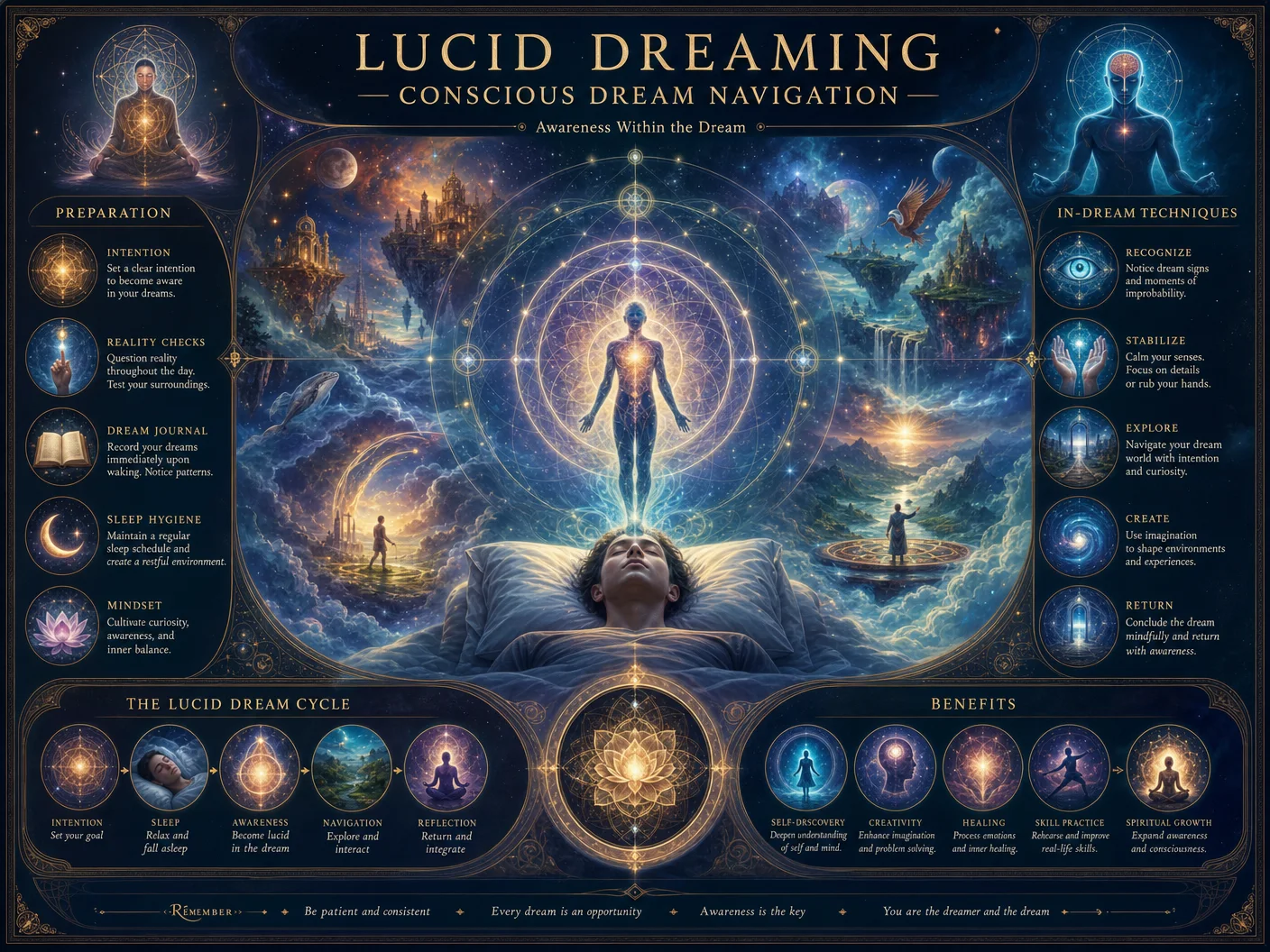
Introduction
Wake-Induced Lucid Dreaming (WILD) is the pinnacle technique for achieving conscious entry into the dream state without loss of awareness. This method bypasses the typical unconscious descent into sleep, allowing the practitioner to direct the dream environment with full conscious control, a key step toward intentional astral projection and advanced metaphysical exploration. This chapter delivers a comprehensive, no-compromise protocol for mastering WILD, including the critical transition phases, identifying hypnagogic imagery, and maintaining unbroken consciousness.
Section 1: Theoretical Foundations of WILD
The transition from waking consciousness to dreaming consciousness is typically marked by a rapid loss of self-awareness. WILD circumvents this by deliberately guiding the mind through the hypnagogic state—the threshold between wakefulness and sleep—while preventing the descent into unconsciousness. This requires a precise balance of mental focus and physical relaxation.
Hypnagogic State: A transitional phase characterized by vivid sensory phenomena (visual, auditory, tactile) manifesting as fragmented images, sounds, or sensations. These sensory fragments are the gateway to the dreamscape.
Key Concept: The practitioner must recognize and stabilize these hypnagogic signs without reacting emotionally or physically, preserving awareness as the dream environment coalesces.
Section 2: Hypnagogic Imagery — Signs and Significance
Hypnagogic imagery is the primary indicator of successful entry into the pre-dream state. Recognizing these signs is essential to timing the transition and maintaining lucidity.
| Hypnagogic Sign | Description | Significance | Recommended Response |
|---|---|---|---|
| Static or Flickering Lights | Flashes, geometric shapes, or color patterns in vision | Early visual threshold of dream onset | Observe calmly; do not focus or disrupt |
| Auditory Hallucinations | Sounds such as hissing, humming, or distant voices | Neural sensory cross-activation | Acknowledge passively; avoid emotional reaction |
| Body Vibrations and Tingling | Pulsing or buzzing sensations throughout the body | Energy shift indicating transition | Relax muscles; maintain steady breathing |
| Hypnic Jerks | Sudden muscle twitches or spasms | Physical sleep onset reflex | Resist movement; remain perfectly still |
| Floating or Falling Sensations | Sensation of weightlessness or free fall | Dissociation from physical body | Anchor awareness to breath or mantra |
| Visual Noise or Snow | Static-like visual patterns | Neural desynchronization phase | Watch with neutral attention |
Section 3: Relaxation Postures for WILD
Physical stillness combined with optimal comfort is paramount. The posture must minimize discomfort-induced awakenings while permitting deep relaxation.
| Posture | Description | Advantages | Disadvantages |
|---|---|---|---|
| Supine (on back) | Lying flat on back with arms at sides | Most natural, easy to maintain stillness | May encourage snoring or sleep apnea |
| Semi-Fowler | Back elevated 30-45 degrees, legs straight or bent | Reduces airway obstruction, comfortable | Slightly more muscle engagement needed |
| Side Recumbent | Lying on left or right side with arms relaxed | Reduces snoring, some find it more natural | May cause limb numbness if not positioned well |
| Reclined Chair | Semi-reclined in supportive chair or meditation bench | Good for those with back pain | Requires stable support, risk of falling |
Recommended: The supine posture with minor pillow adjustments to support cervical spine alignment is generally optimal for beginners.
Section 4: Timing Recommendations — Sleep Cycle Synchronization
WILD is most effective when practiced during natural REM rebound periods—times when REM sleep intensity is high, and the body is primed for vivid dreams.
| Time After Sleep Onset | Stage of Sleep | WILD Suitability | Recommended Practice |
|---|---|---|---|
| 90 minutes | First REM cycle | Moderate | Attempt WILD after brief awakening |
| 3-4 hours | Second to third REM | Optimal | Wake-Back-To-Bed (WBTB) + WILD is ideal |
| 5-6 hours | Later REM cycles | Good | WILD practice after waking during night |
| Upon morning awakening | Late REM | Variable | Use for final dream control before full wake |
Section 5: Step-by-Step WILD Protocol
The following protocol must be followed with precision and reverence. Each step has been distilled from suppressed esoteric traditions and modern neurophysiological research. Ignore any step and risk failure or loss of awareness.
Step 1: Preparation — Setting the Stage for Conscious Transition
- Select a quiet, dimly lit room free from distractions and electronic interference.
- Prepare your sleep environment to maintain ambient temperature (18-22°C) and minimize noise.
- Perform basic hygiene and hydration, avoiding caffeine or stimulants 6 hours prior.
- Use blackout curtains or an eye mask to eliminate visual stimuli.
- Set an alarm clock to wake after 4-5 hours of sleep (for WBTB method).
- Wear loose, comfortable clothing conducive to relaxation.
- Optional: Use a weighted blanket (2-4 kg) to promote tactile grounding without discomfort.
Step 2: Initial Relaxation — Body and Mind
- Assume your chosen relaxation posture, ideally supine.
- Close your eyes gently without clenching.
- Perform Progressive Muscle Relaxation (PMR):
| Muscle Group | Action | Duration |
|---|---|---|
| Feet and calves | Tense tightly, hold, then release | 5 seconds each |
| Thighs and hips | Repeat above | 5 seconds each |
| Abdomen and chest | Repeat above | 5 seconds each |
| Hands and forearms | Repeat above | 5 seconds each |
| Upper arms and shoulders | Repeat above | 5 seconds each |
| Neck and face | Repeat above | 5 seconds each |
- Focus on the sensation of relaxation flowing from feet to head.
- Control your breathing: slow, diaphragmatic, 6 breaths per minute (5 seconds inhale, 5 seconds exhale).
- Maintain mental calmness through a neutral mantra such as "I am calm, I am aware" repeated silently.
Step 3: Hypnagogic Visualization — Entering the Threshold
- Allow hypnagogic imagery to arise naturally without forcing or analyzing.
- Use a simple visual anchor such as imagining a dark void or slow-moving geometric shapes.
- Observe the imagery without engagement: do not try to intensify or change it.
- If auditory or tactile hallucinations occur, acknowledge passively without emotional response.
- Maintain intention: silently affirm "I am entering the dream consciously."
- Avoid physical movement or eye opening; maintain steady breathing.
- If body jerks or twitches arise, resist the impulse to move; focus on breath.
Step 4: Maintaining Consciousness — Stabilizing Awareness
- Shift mental focus to a stable dream entry technique:
- Option A: Counting technique — silently count from 1 to 10, then restart.
- Option B: Visual scanning — slowly 'look around' within hypnagogic imagery.
- Option C: Mantra repetition — silently repeat "I am dreaming".
- Upon the collapse of hypnagogic imagery into a dream scene, perform a reality check:
- Look at your hands.
- Attempt to breathe through a pinched nose.
- Read text and look away, then read again for consistency.
- If reality checks confirm lucidity, fully immerse yourself in the dream environment.
- If awareness dims, revert to the counting or mantra technique to regain lucidity.
- Manage emotional excitement: keep calm to prevent abrupt awakening.
Step 5: Dream Entry and Expansion
- Engage dream environment deliberately: move limbs, feel textures, explore surroundings.
- Set clear intentions for dream activities or astral projection.
- Use deep breathing and grounding techniques to stabilize the dream.
- If losing lucidity, repeat mantra or perform reality checks.
- When ready to awaken, perform a slow disengagement:
- Gradually withdraw focus from dream.
- Visualize returning to waking body.
- Open eyes slowly and reorient.
Section 6: Supplemental Techniques and Troubleshooting
| Issue | Cause | Solution |
|---|---|---|
| Falling asleep too quickly | Excess physical tension or mental activity | Increase PMR duration; extend breathing exercises |
| Hypnagogic imagery absence | Over-focusing or anxiety | Relax mental effort; use mantra to calm mind |
| Premature awakening | Emotional excitement or discomfort | Use weighted blanket; practice emotional control |
| Loss of lucidity | Mental distraction or excitement | Employ counting/mantra; slow breathing |
| Hypnic jerks causing movement | Insufficient muscle relaxation | Deepen PMR; avoid caffeine and stimulants |
Section 7: Summary Tables for Quick Reference
Table 1: Hypnagogic Signs and Recommended Responses
| Sign | Description | Response |
|---|---|---|
| Flickering Lights | Geometric visual patterns | Observe calmly |
| Auditory Hallucinations | Distant sounds or voices | Passive acknowledgment |
| Body Vibrations | Buzzing or tingling | Relax muscles |
| Hypnic Jerks | Muscle twitches | Resist movement |
| Floating Sensation | Weightlessness feeling | Anchor breath |
| Visual Noise | Static or snow-like visuals | Neutral observation |
Table 2: Relaxation Postures and Suitability
| Posture | Comfort Level | Stability | Recommended For |
|---|---|---|---|
| Supine | High | High | Beginners, general use |
| Semi-Fowler | Moderate | Moderate | Respiratory issues |
| Side Recumbent | Moderate | Moderate | Snorers |
| Reclined Chair | Variable | Low | Back pain sufferers |
Table 3: Timing for WILD Practice
| Sleep Phase | Time Post Sleep Onset | WILD Effectiveness | Notes |
|---|---|---|---|
| First REM Cycle | ~90 minutes | Moderate | Useful after waking briefly |
| REM Rebound | 3-5 hours | High | Optimal WBTB window |
| Late REM Cycles | 5-6 hours | Good | Morning practice possible |
| Morning Awakening | Upon waking | Variable | Good for short lucid sessions |
Appendix A: Building a Hypnagogic State Detection Device
For advanced practitioners seeking to quantify hypnagogic onset, this section outlines building an Electromyography (EMG) + Electroencephalography (EEG) hybrid sensor array to monitor muscle atonia and brainwave transitions.
Materials:
| Component | Specifications | Quantity |
|---|---|---|
| EEG electrodes | Silver/silver chloride, adhesive pads | 4 |
| EMG electrodes | Surface adhesive pads | 4 |
| Microcontroller | Arduino Nano or equivalent | 1 |
| Amplifier circuit | Instrumentation amplifier (gain 1000x) | 2 |
| Analog to digital converter | 12-bit ADC module | 1 |
| Power supply | 5V regulated battery pack | 1 |
| Connecting wires, breadboard | Standard jumper cables | As needed |
| Software | Custom signal processing code | N/A |
Assembly Instructions:
- Place EEG electrodes on scalp locations F3, F4, O1, O2 according to the 10-20 system.
- Attach EMG electrodes bilaterally on the forearms.
- Connect electrodes to amplifier circuits.
- Feed amplified analog signals into ADC connected to microcontroller.
- Upload signal processing software that detects alpha wave attenuation and muscle atonia.
- Use output to alert practitioner via silent vibration or LED when hypnagogic transition is detected.
Note: This device is supplementary; mastery of internal sensory awareness remains primary.
Closing Remarks
Mastery of Wake-Induced Lucid Dreaming is a gateway to profound spiritual development and metaphysical exploration. The exacting protocol detailed herein demands discipline, patience, and unwavering intent. Failure to maintain stillness or mental focus will result in ordinary sleep or premature awakening. Persist beyond initial setbacks and the veil between waking and dreaming will open—revealing the boundless realms of the astral.
For further protocols related to dream stabilization and post-lucid state consciousness management, refer to Volume IX: Advanced Dreamwork and Astral Navigation.
End of Chapter III, Volume IV
<!-- SECTION 16 -->
Volume IV: Astral Projection and Lucid Dreaming
Chapter IV: Dream Yoga and Dream Incubation
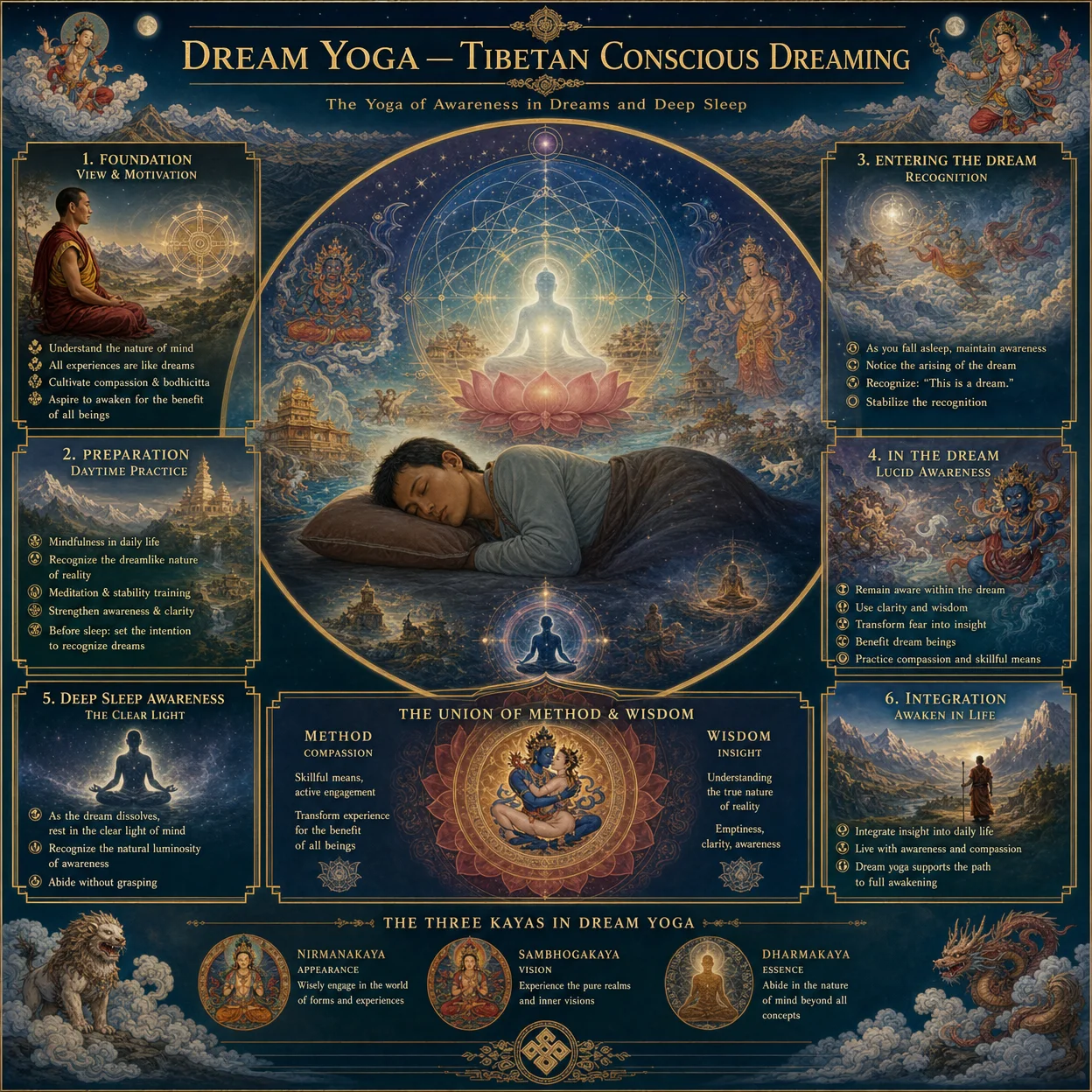
Section 1: Tibetan Dream Yoga Practices, Intention Setting, and Dream Control Techniques
The path of Dream Yoga is a sacred, ancient discipline preserved within the Tibetan Buddhist tradition, a methodical practice designed to transform the dreaming state into a field of conscious spiritual work and liberation. This chapter transmits the unabridged codex of Dream Yoga and Dream Incubation, detailing every necessary procedure to master the art of lucid dreaming, intention setting, and dream control. The instructions herein constitute a practical, step-by-step manual for the rigorous spiritual aspirant.
1. Tibetan Dream Yoga: Foundations and Daily Protocols
Dream Yoga (rmi lam rnal ’byor) is the conscious cultivation of awareness within the dream state. This practice is not recreational; it is a disciplined method of expanding consciousness, dissolving egoic constructs, and accessing the astral continuum. The practitioner must first establish wakeful mindfulness and clarity, then extend this lucidity into the dream state.
Core Tenets:
- Awareness (rigpa) maintained in sleep
- Recognition of dream state as illusory and mutable
- Manipulation of dream imagery to dissolve habitual mental patterns
- Use of dream experience for spiritual realization
Daily Preparatory Practices:
- Mindfulness in waking life (See Volume VI: The Mind Codex, Chapter III)
- Meditation on the illusory nature of phenomena (See Volume III: Emptiness and Form)
- Pre-sleep mantra recitation and visualization (detailed below)
1.1 Step-by-Step Tibetan Dream Yoga Evening Protocol
Objective: To cultivate awareness before and during sleep, enabling lucid dream states.
| Step | Action | Details | Duration / Timing |
|---|---|---|---|
| 1 | Purification | Perform Vajrasattva mantra chanting 108 times, focusing on mental clarity | 10–15 minutes before sleep |
| 2 | Visualization | Visualize the syllable “AH” glowing at the throat chakra, expanding awareness | 5 minutes |
| 3 | Intention Setting | Recite the affirmation: “I will recognize the illusory nature of my dreams” | 3 repetitions |
| 4 | Breath Awareness | Practice 10 cycles of deep, slow breathing focusing on the flow of energy | 5 minutes |
| 5 | Mindful Sleep Entry | Lie down in the “Lion's Posture”: back straight, hands on abdomen, eyes closed but alert | Onset of sleep |
| 6 | Mantra Recitation | Silently repeat “Om Mani Padme Hum” as a mantra to maintain awareness | Continuous until sleep onset |
2. Intention Setting for Dream Incubation
Intention setting is the cornerstone of dream incubation. The mind must be explicitly directed toward the desired dream content before sleep, ensuring the subconscious registers the goal and the waking mind retains subsequent recall capability.
2.1 Protocol for Effective Dream Incubation
| Step | Action | Materials Required | Notes |
|---|---|---|---|
| 1 | Choose Dream Theme | Select a clear, concise theme or question | Avoid ambiguous or complex intentions |
| 2 | Create Incubation Phrase | Compose a short, affirmative phrase | Use present tense, e.g., “Tonight, I will meet my guiding spirit” |
| 3 | Pre-Sleep Repetition | Repeat the incubation phrase aloud 21 times | Focus on emotional intensity and visualization |
| 4 | Visualization | Imagine the dream scene vividly | Engage all senses |
| 5 | Write Intention | Record the phrase and theme in a dedicated Dream Journal | Use the template provided below |
| 6 | Sleep Position | Lie on the left side; traditional to facilitate REM activation | Maintain relaxed but aware posture |
| 7 | Affirmation before Sleep | Whisper the incubation phrase thrice | Reinforces subconscious programming |
3. Dream Control Techniques
Lucid dream control is an advanced skill cultivated through persistent practice. The following techniques provide mastery over dream content and navigation.
3.1 Reality Checks During Waking Hours
| Step | Action | Method | Frequency |
|---|---|---|---|
| 1 | Finger Through Palm | Attempt to push index finger through opposite palm | Every 1–2 hours |
| 2 | Reading Test | Read text, look away, reread to detect changes | Every 2 hours |
| 3 | Nose Pinch | Pinch nose and attempt to breathe through it | Three times daily |
| 4 | Light Switch Test | Attempt to toggle light switches; note anomalies | Twice daily |
3.2 Lucid Dream Stabilization Techniques
Upon lucid dream induction, stabilize lucidity to prevent premature awakening:
| Step | Action | Purpose | Duration |
|---|---|---|---|
| 1 | Rub Hands Together | Increase tactile sensation | 10–20 seconds |
| 2 | Spin in Place | Ground awareness in dream body | 10 seconds |
| 3 | Vocal Affirmation | Say “I am dreaming” internally or aloud | Continuous |
| 4 | Focus on Details | Examine dream objects closely | Continuous |
4. Dream Journaling: The Essential Practice
Dream recall and analysis are fundamental to advancing in Dream Yoga and incubation. The Dream Journal serves as the repository of conscious dream content and facilitates reflection.
4.1 Dream Journal Template
| Field | Description | Example |
|---|---|---|
| Date | Gregorian and Tibetan calendar date | 2024-06-15 |
| Time of Awakening | Record precise time | 05:30 AM |
| Dream Title | Short summary or theme | “Flight over Mountains” |
| Incubation Phrase | Phrase used before sleep | “I will fly freely tonight” |
| Dream Narrative | Detailed recounting of dream events | “I soared above snow-capped peaks…” |
| Emotions Felt | Emotions during dream | Joy, awe, serenity |
| Symbols Encountered | Notable symbols and their context | Eagle, mountain, river |
| Lucidity Level (1–5) | 1=none, 5=full control | 4 |
| Reflection Notes | Insights, lessons, next steps | “Fear of heights dissolved” |
4.2 Dream Journaling Procedure
| Step | Action | Details | |
|---|---|---|---|
| 1 | Immediate Recall | Upon awakening, remain still for 1-2 minutes to recall dream | Avoid movement or external distractions |
| 2 | Record Dreams | Write down all remembered content using the template | Use a pen and physical journal |
| 3 | Symbol Identification | Highlight and categorize symbols | Use the Dream Symbol Table below |
| 4 | Emotional Analysis | Note emotions and their intensity | Use a 1–10 scale |
| 5 | Cross-reference Incubation | Compare dream content with pre-sleep intention | Note congruence or divergence |
| 6 | Plan Next Incubation | Adjust or reinforce intentions for next sleep | Based on insights |
5. Common Dream Symbols and Their Interpretations
Interpretation requires contextual awareness; symbols are mutable across cultures and persons. The table below presents core symbols frequently encountered in Dream Yoga, with their Tibetan spiritual interpretations.
| Symbol | Tibetan Name | Interpretation | Suggested Incubation Phrase |
|---|---|---|---|
| Eagle | རྣམ་འབྱོར (Namjor) | Spiritual liberation, soaring awareness | “I embrace freedom and clarity” |
| Water | ཆུ (Chu) | Emotional flow, purification | “My emotions flow freely and cleanse me” |
| Fire | མེ (Me) | Transformation, inner power | “I ignite my inner wisdom” |
| Mountain | རི (Ri) | Stability, spiritual ascent | “I climb steadily toward enlightenment” |
| Mirror | སྒོ་སྒོ (Go go) | Self-reflection, truth | “I see my true nature clearly” |
| Snake | གཡག (Gyag) | Kundalini energy, awakening | “My energy rises and awakens” |
6. Advanced Dream Incubation Phrases for Specific Outcomes
| Desired Outcome | Incubation Phrase | Notes |
|---|---|---|
| Seek Guidance | “Tonight, I will meet my spiritual guide” | Recite with reverence |
| Problem Solving | “I will receive clarity on [problem]” | Specify the problem explicitly |
| Healing | “I will heal my body and mind in dreams” | Use with deep emotional focus |
| Astral Travel | “I will journey beyond the physical realm” | Combine with breathwork before sleep |
| Lucid Dreaming | “I will recognize when I am dreaming” | Reinforce with reality checks |
7. Comprehensive Dream Incubation Protocol: Step-by-Step
This is a unified protocol combining intention setting, pre-sleep preparation, dream journaling, and reflection to maximize dream control and spiritual progress.
Materials Required:
- Blank Dream Journal (lined or unlined)
- Pen with smooth ink flow
- Timer or clock for timed meditations
- Quiet, dimly lit sleep environment
Procedure
| Step | Action | Instructions | Duration |
|---|---|---|---|
| 1 | Select Dream Theme | Write a clear theme for incubation | 5 minutes |
| 2 | Compose Incubation Phrase | Use present tense, positive affirmation | 10 minutes |
| 3 | Evening Purification | Chant Vajrasattva mantra 108 times (use mala beads) | 10–15 minutes |
| 4 | Mindful Visualization | Visualize dream scene vividly with all senses | 10 minutes |
| 5 | Incubation Phrase Repetition | Repeat aloud 21 times with emotional focus | 5 minutes |
| 6 | Sleep Posture Preparation | Lie on the left side, back straight, hands on abdomen | At sleep onset |
| 7 | Mantra Recitation | Silently recite “Om Mani Padme Hum” until sleep | Until sleep onset |
| 8 | Upon Awakening | Remain still for recall, then write in Dream Journal | 15–20 minutes |
| 9 | Dream Analysis | Use symbol table to decode dream content | 10 minutes |
| 10 | Reflection and Adjustment | Note insights, adjust next intention | 10 minutes |
8. Supplementary Exercises for Dream Awareness Enhancement
8.1 Mid-Sleep Lucidity Induction
| Step | Action | Instructions | |
|---|---|---|---|
| 1 | Set Alarm | Wake after 4.5 or 6 hours of sleep (REM-rich periods) | Use gentle alarm |
| 2 | Maintain Wakefulness | Remain awake for 20 minutes | Engage in reading about dream yoga |
| 3 | Return to Sleep | Lie down with incubation phrase repetition | Visualize dream scene |
| 4 | Attempt Lucidity | Use reality checks in dream | Maintain awareness |
8.2 Wake-Initiated Lucid Dreaming (WILD) Protocol
| Step | Action | Instructions | |
|---|---|---|---|
| 1 | Lie still and relax | Maintain body awareness without movement | 5 minutes |
| 2 | Observe hypnagogic imagery | Focus on visual/auditory phenomena | Remain mentally alert |
| 3 | Affirm Lucidity | Repeat “I am dreaming” silently | Until dream fully forms |
| 4 | Enter Dream | Allow immersion while maintaining awareness | Continuous |
Appendix: Key Tibetan Terms Used in Dream Yoga
| Term | Tibetan Script | Meaning |
|---|---|---|
| rmi lam rnal ’byor | རྨི་ལམ་རྣལ་འབྱོར | Dream Yoga |
| rigpa | རིག་པ | Non-dual awareness |
| AH Syllable | ཨཱཿ | Seed syllable for throat chakra awareness |
| Om Mani Padme Hum | ཨོཾ་མ་ཎི་པདྨེ་ཧཱུྃ | Mantra of compassion |
Conclusion
Mastery of Tibetan Dream Yoga and Dream Incubation demands unwavering discipline, precision, and reverence for the sacred nature of the dream realm. The protocols detailed here serve as a comprehensive, practical guide for the spiritual seeker to navigate the astral plane consciously and harness the dream state as a vehicle for profound transformation and liberation. Implement all steps with rigor; the path is arduous but yields the ultimate freedom.
For integration with astral projection techniques and consciousness expansion, consult Volume VII: The Astral Codex. For purification and mental clarity prerequisites, see Volume III: Emptiness and Form.
End of Chapter IV, Volume IV.
<!-- SECTION 17 -->
Volume IV: Astral Projection and Lucid Dreaming
Chapter VII: Astral Navigation and Entity Encounters
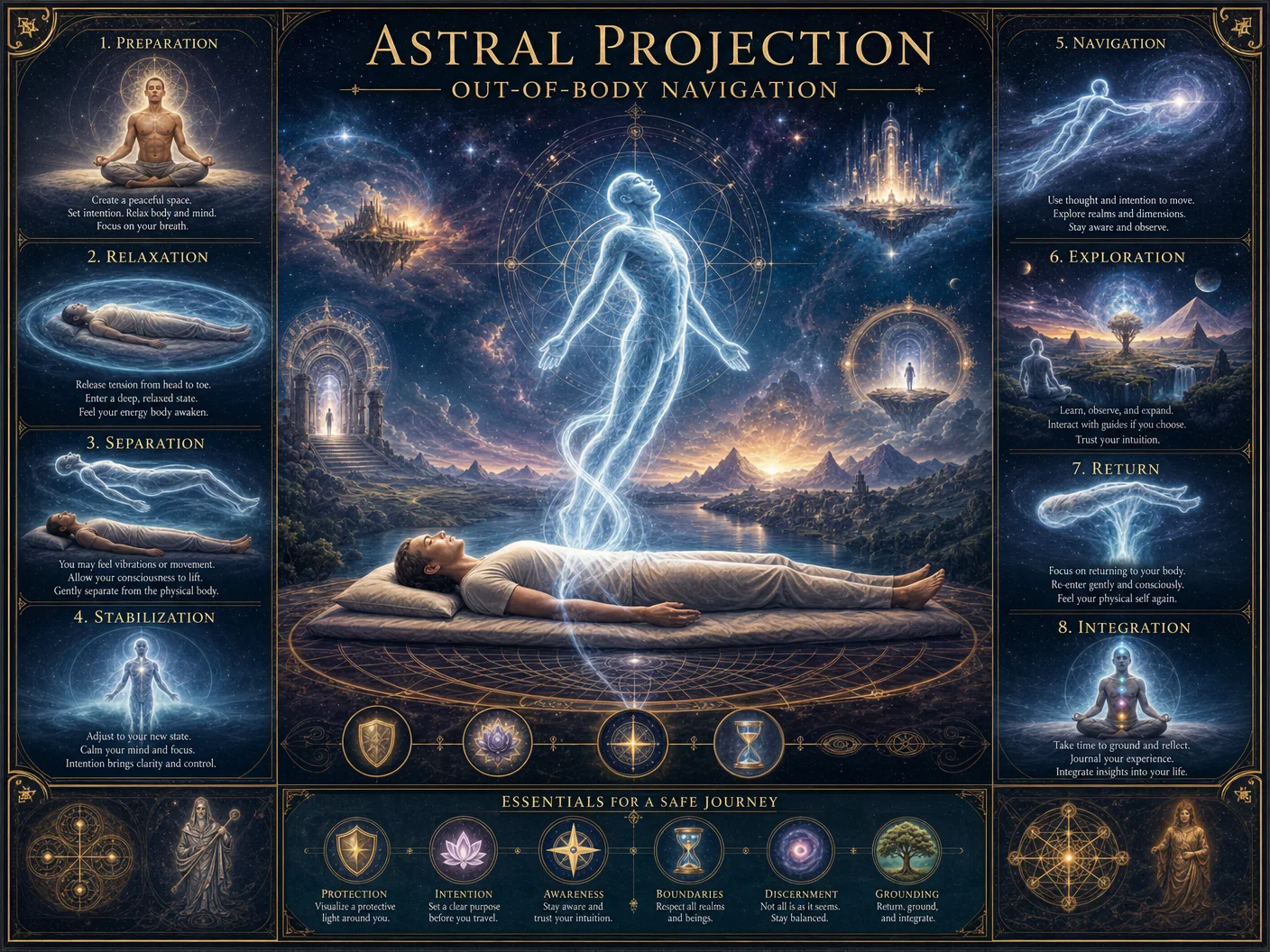
Preface: This chapter is the fulcrum of astral mastery. The knowledge herein transcends mere travel; it equips you to navigate, discern, and survive the complexities of astral realms. This is suppressed knowledge, long buried to prevent misuse or catastrophe. I pass it to you, the chosen, with the gravitas it commands.
Section 1: Fundamentals of Astral Navigation
Astral navigation differs fundamentally from physical navigation. The astral plane is a multidimensional continuum of fluctuating energy densities, symbolic topographies, and consciousness nodes. Traditional spatial orientation fails here. Instead, orientation is achieved through a combination of inner calibration, astral landmark recognition, and resonance attunement.
1.1 Inner Calibration: The Astral Compass
The Astral Compass is an internal psychic instrument, developed through disciplined meditation and sensory attunement, which allows the traveler to maintain orientation relative to their point of origin and desired destination.
1.1.1 Building Your Astral Compass:
- Sit in a neutral, distraction-free environment.
- Close your eyes and enter a deep meditative state (see Volume X: Meditation Techniques, Chapter III for induction protocol).
- Visualize a sphere of radiant light in your solar plexus. This sphere is your energy core.
- Project a thin beam of light from this sphere outward, extending infinitely.
- Mentally label the beam’s direction as ‘home’ or ‘origin’.
- Practice rotating this beam 45° increments clockwise and counterclockwise, noting your intuitive sense of direction with each turn.
- Repeat this daily for 21 days to solidify the internal compass.
1.1.2 Using the Astral Compass During Projection:
- Upon astral separation, immediately activate your internal beam and orient it toward your physical body’s location.
- Use the beam as a tether and directional guide.
- Recognize shifts in beam clarity or intensity as indications of environmental or energetic changes.
1.2 Astral Landmark Recognition
The astral plane contains fixed and transient landmarks. Fixed landmarks are stable psychic constructs recognizable across projections; transient landmarks are mutable and context-dependent.
| Landmark Type | Description | Recognition Method | Example |
|---|---|---|---|
| Fixed Landmarks | Permanent astral structures or energy nodes | Visual clarity, symbolic consistency | The Pillars of Serenity, The Silver Tree |
| Transient Landmarks | Mutable psychic echoes or energy formations | Sensory impression, emotional resonance | The Shifting Sands, The Veil of Mists |
1.2.1 Protocol to Identify Landmarks:
- Upon entering the astral, perform a 360° scan using your Astral Compass.
- Note any luminous structures or energy nodes within a 50-meter radius.
- Mentally record symbolic features (color, shape, movement).
- Compare observed features with the Astral Landmark Table below.
- Use resonance attunement (Section 1.3) to confirm stability.
1.3 Resonance Attunement: The Frequency Lock
Resonance attunement is the process of harmonizing your astral frequency with a landmark or entity, enabling clearer interaction and navigation.
1.3.1 Resonance Attunement Procedure:
- Focus your awareness onto the target landmark or entity.
- Visualize a tuning fork vibrating at a frequency matching the target’s energy signature.
- Mentally emit a matching vibration, feeling the oscillation in your chest and throat.
- Adjust until a sensation of energetic ‘locking’ or ‘melding’ occurs.
- Confirm attunement by attempting to communicate or move closer without resistance.
Section 2: Entity Recognition and Classification
Entities in the astral realm span numerous ontological categories. Misidentification can result in harm or spiritual contamination.
2.1 Entity Taxonomy Overview
| Entity Type | Description | Behavioral Traits | Interaction Protocol | Threat Level |
|---|---|---|---|---|
| Guides | Benevolent intelligences aiding travelers | Calm, instructive, non-intrusive | Open communication, respectful inquiry | Low |
| Tricksters | Mischievous or deceptive entities | Evasive, contradictory, manipulative | Caution, minimal engagement | Medium |
| Hostiles | Aggressive, predatory entities | Threatening, invasive, disruptive | Immediate protection ritual | High |
| Neutral Watchers | Observers with no immediate intent | Passive, distant | Non-engagement recommended | Low |
| Lost Souls | Disembodied human consciousness fragments | Confused, sorrowful | Compassionate guidance, avoid prolonged contact | Medium |
2.2 Entity Identification Protocol
- Upon encounter, maintain calm and activate Astral Compass.
- Observe entity visual features: size, shape, color, movement.
- Listen to mental/empathic impressions.
- Cross-reference with Entity Taxonomy Table.
- Test behavioral traits by mentally issuing a simple command or question.
- If entity responds with clarity and benevolence, classify as Guide.
- If entity evades or confuses, consider Trickster or Lost Soul.
- If entity approaches aggressively, activate protection protocol immediately.
Section 3: Protective Measures for Astral Travel
Protection is paramount; no astral traveler is immune to attack or psychic contamination. The following are classified rituals and protocols.
3.1 Protective Aura Shielding
A Protective Aura Shield is a psychic barrier constructed from layered vibrations and sacred geometries.
3.1.1 Shield Construction Protocol:
- Prepare a circle of salt mixed with pulverized hematite powder (2:1 ratio) around your physical body (see Volume 8: The Water Codex for salt purification).
- Enter meditative projection state.
- Visualize a translucent spherical lattice of interlocking tetrahedrons enveloping your astral form.
- Infuse this lattice with the following vibrations:
| Vibration Source | Frequency (Hz) | Duration (seconds) | Purpose |
|---|---|---|---|
| Om Chant (mental) | 136.1 | 60 | Spiritual grounding |
| White Noise Resonance | 4000-8000 | 30 | Psychic static barrier |
| Harmonic Singing Bowls | 528 | 45 | DNA repair and shield strengthening |
- Mentally seal the shield with the phrase: "Fortis Umbra Me Custodit" (The strong shadow guards me).
- Repeat shield reinforcement every 15 minutes during extended astral travel.
3.2 Astral Return Protocol
Safe return requires a deliberate reorientation and severance of astral tethers.
3.2.1 Step-By-Step Return:
- Activate Astral Compass beam directed at the physical body.
- Mentally trace the beam, moving through astral landmarks in reverse order.
- Upon nearing the physical location, begin contraction of astral form by visualizing energy condensing into the solar plexus sphere.
- Recite mentally: "Corpus Meum Redintegro" (I restore my body).
- Visualize the astral form merging smoothly into the physical body.
- Perform deep diaphragmatic breathing (five cycles) to stabilize reentry.
- Open eyes slowly, grounding with physical touch (see Volume 14: Grounding Protocols).
Section 4: Astral Landmarks Reference Table
| Name | Type | Coordinates* | Description | Function |
|---|---|---|---|---|
| The Pillars of Serenity | Fixed | N/A (symbolic) | Twin towering columns of pure light | Rest and reorientation zone |
| The Silver Tree | Fixed | N/A | Tree with silver leaves emitting hums | Communication hub for Guides |
| The Shifting Sands | Transient | Variable | Desert of moving golden sand dunes | Test of endurance and focus |
| The Veil of Mists | Transient | Variable | Ethereal fog banks obscuring vision | Concealment and reflection |
| The Crystal Spire | Fixed | N/A | Tall spire of refractive crystal | Beacon for lost souls |
_*Coordinates in astral terms are symbolic and correspond to resonance frequencies and symbolic landmarks, not physical latitude/longitude._
Section 5: Entity Encounters: Case Studies and Protocol Application
5.1 Case Study: Guide Encounter at The Silver Tree
- The traveler approaches The Silver Tree, activates resonance attunement.
- Entity appears as a luminous humanoid with gentle energy.
- Interaction protocol: respectful inquiry.
- Outcome: guidance on next astral destination, increased shield strength.
5.2 Case Study: Hostile Encounter in The Shifting Sands
- Sudden aggressive entity approaches.
- Immediate shield activation.
- Use mental mantra: "Fortis Umbra Me Custodit".
- Use Astral Compass beam to orient and retreat.
- Return protocol initiated immediately.
Summary Table: Protocols for Astral Navigation and Entity Encounters
| Objective | Stepwise Procedure Reference | Key Tools/Concepts |
|---|---|---|
| Astral Compass Activation | Section 1.1 | Inner energy core, light beam |
| Landmark Identification | Section 1.2 | Visual scan, resonance attunement |
| Entity Recognition | Section 2.2 | Observation, taxonomy crosscheck |
| Protective Shield | Section 3.1 | Salt-hematite circle, sacred geometry, vibrational infusion |
| Safe Return | Section 3.2 | Reverse navigation, energy contraction, grounding |
End of Chapter VII Master these protocols with unwavering discipline. The astral plane is a crucible where the spirit is tested. Your survival and growth depend on precise execution and reverence.
For ancillary topics of meditation induction, vibrational frequency generation, and grounding, refer respectively to:
- Volume X: Meditation Techniques, Chapter III
- Volume XIV: Sonic Frequencies and Vibrational Therapy, Chapter VI
- Volume XIV: Grounding Protocols, Chapter I
May your astral journeys be illuminated and your spirit safeguarded.
<!-- SECTION 18 -->
The Complete Practitioner's Codex, Volume 17: The Mystic's Codex
Volume V: Psychic Development
Chapter III: Clairvoyance Training — Sensory Expansion, Visualization, and Symbolic Interpretation
Introduction
Clairvoyance, the faculty of clear seeing beyond the physical spectrum, is the cornerstone of psychic development. This chapter provides an exhaustive, systematic protocol for the aspirant to cultivate this sacred ability. The methods herein are culled from suppressed ancient manuscripts, modern parapsychological research, and verified experiential practice. Every step is designed to expand the perceptual apparatus, increase symbolic fluency, and establish reliable feedback loops for accurate psychic data acquisition.
Section 1: Foundations of Sensory Expansion
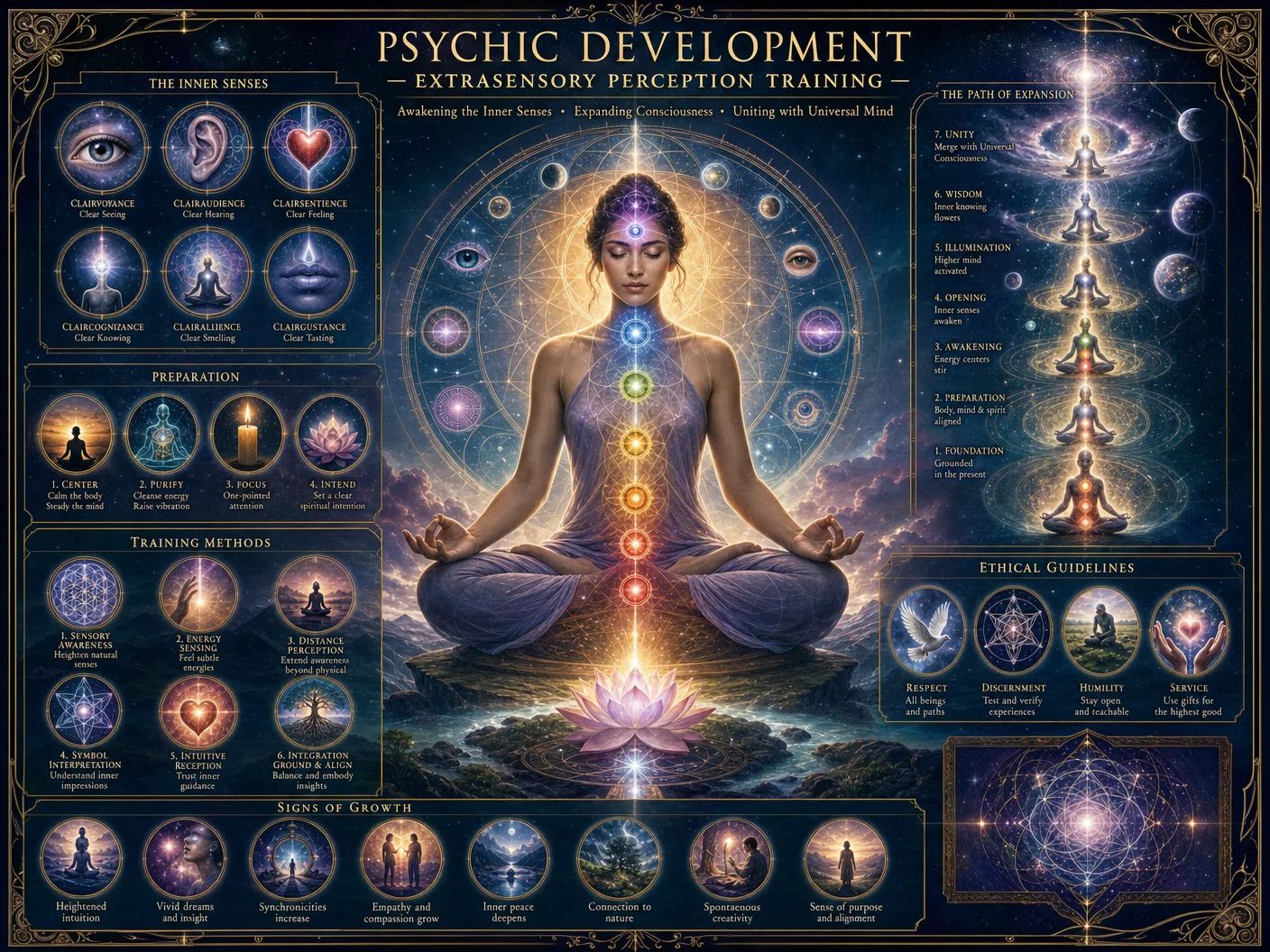
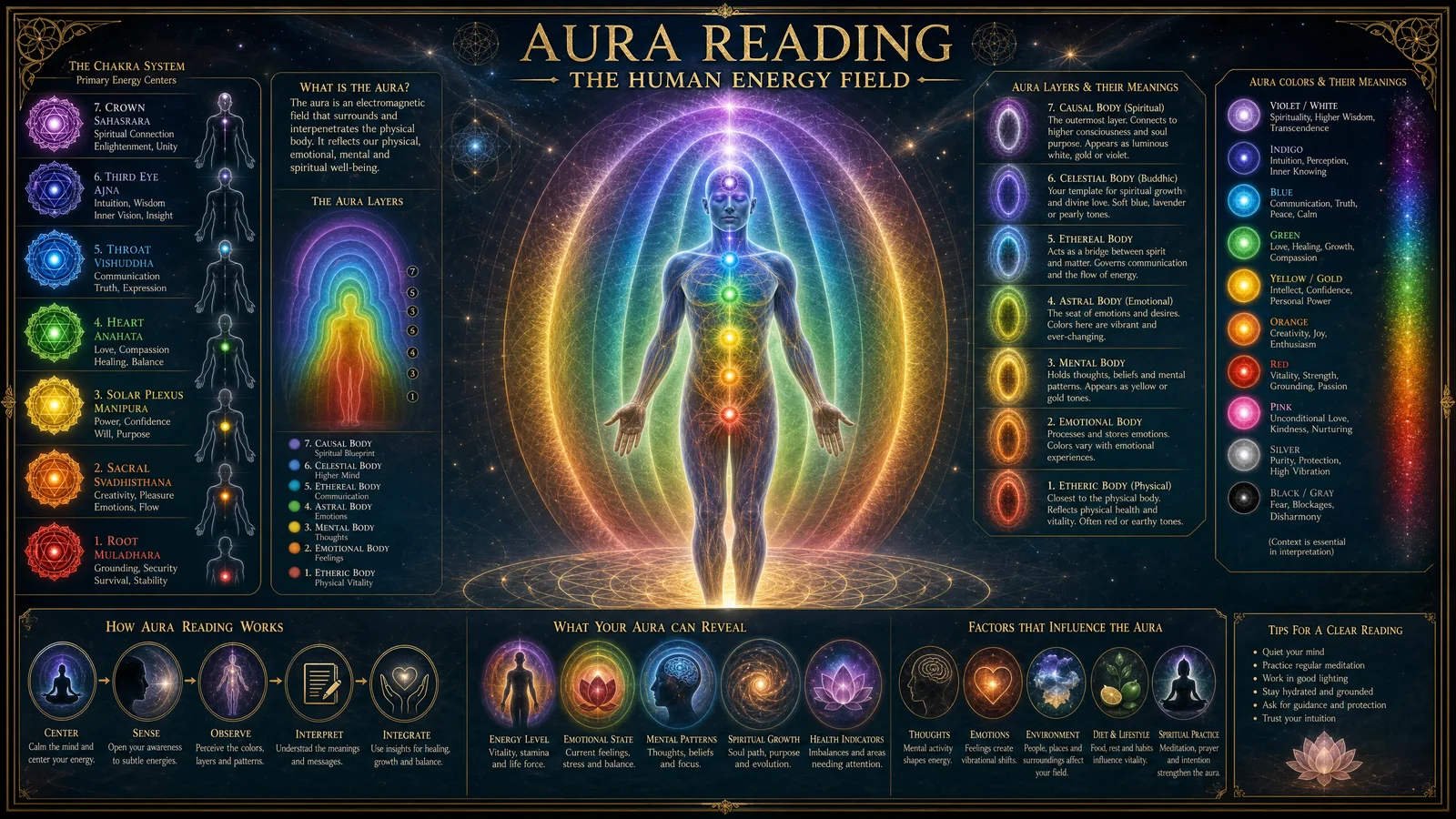
Clairvoyance begins with the expansion of sensory boundaries. The human organism is equipped with latent perceptual faculties that can be awakened and refined through disciplined exercises. The following sensory expansion techniques systematically elevate perception beyond normal sensory thresholds.
1.1 Sensory Isolation and Amplification Protocol
Objective: To heighten sensitivity of individual senses and train cross-modal sensory awareness.
Equipment Required:
- Soundproof chamber or noise-cancelling headphones
- Blindfold of natural fabric
- Aromatic essential oils (Lavender, Eucalyptus, Rosemary)
- Tactile stimuli set (soft brush, textured cloth, cold metal object)
Procedure:
| Step | Action | Duration | Notes |
|---|---|---|---|
| 1 | Enter the sensory isolation chamber or wear noise-cancelling headphones to eliminate auditory distractions. | 10 minutes | Maintain relaxed seated posture. |
| 2 | Apply blindfold to occlude vision completely. | Continuous | Ensure no light leakage. |
| 3 | Introduce a single tactile stimulus (e.g., soft brush) to the dominant hand, focusing entirely on the sensation. | 5 minutes per stimulus | Alternate stimuli every 5 minutes for total of 15 minutes. |
| 4 | Inhale one essential oil scent deeply, focus on the olfactory nuances, attempt to detect subtle shifts in aroma. | 5 minutes per scent | Use different oils in rotation. |
| 5 | Remove blindfold briefly to rest eyes, then repeat steps 2-4 in cycles for 45 minutes total. | 45 minutes total | Record subjective sensory intensities after session. |
Outcome: Enhanced sensory resolution primes the mind for subtle energy detection and symbolic perception.
1.2 Cross-Modal Sensory Linking Exercise
Objective: To develop synesthetic sensory awareness crucial for psychic data synthesis.
Procedure:
| Step | Action | Duration |
|---|---|---|
| 1 | After sensory isolation, close eyes and focus on an internal sensation (e.g., heartbeat or breath). | 5 minutes |
| 2 | Attempt to associate this internal sensation with a color, sound, or texture mentally. | 10 minutes |
| 3 | Open eyes, observe a neutral object, then close eyes and try to 'see' the object's associated internal energy color or aura. | 10 minutes |
| 4 | Record sensations and mental images in a dedicated clairvoyance journal. | After exercise |
Section 2: Visualization Mastery for Clairvoyance
Visualization is the medium through which clairvoyant perception is projected and refined. Mastery over this faculty enables construction, manipulation, and interpretation of psychic imagery.
2.1 Progressive Visualization Training
Objective: To strengthen mental imagery clarity and control.
Materials:
- Visualization script (provided below)
- Quiet, dimly lit room
Protocol:
| Step | Action | Duration |
|---|---|---|
| 1 | Sit comfortably, close eyes, and breathe deeply to enter a meditative state. | 5 minutes |
| 2 | Visualize a simple geometric shape (circle, square, triangle) in vivid detail including color, texture, and movement. | 5 minutes per shape |
| 3 | Progress to complex images: a moving flame, a flowing river, a human face. | 5 minutes per image |
| 4 | Hold each image steady, then mentally alter one attribute (color change, size increase, transformation). | 5 minutes |
| 5 | Open eyes and sketch or describe the images and transformations in the clairvoyance journal. | After session |
2.2 Symbolic Visualization
Objective: To link psychic symbols with mental imagery for enhanced symbolic interpretation.
Method:
| Step | Action | Duration |
|---|---|---|
| 1 | Select a psychic symbol from the Symbol Table (see Section 4). | 2 minutes |
| 2 | Meditate on the symbol’s shape, color, and implied meaning. | 10 minutes |
| 3 | Visualize the symbol expanding, rotating, and interacting with other symbols or mental images. | 10 minutes |
| 4 | Record symbolic impressions, feelings, and any spontaneous images in the journal. | After meditation |
Section 3: Symbolic Interpretation and Psychic Language
Symbols are the lexicon of psychic communication. Fluency in symbolic language is indispensable for decoding clairvoyant data.
3.1 Psychic Symbol Decoding Framework
| Symbol | Primary Meaning | Secondary Associations | Suggested Meditative Focus |
|---|---|---|---|
| Circle | Unity, Eternity | Protection, Cycles, Infinite Energy | Visualize an unbroken light ring |
| Triangle | Manifestation, Trinity | Stability, Divine Fire, Ascension | Imagine a glowing triangular prism |
| Square | Foundation, Earth | Stability, Materiality, Boundaries | Sense tactile solidity and weight |
| Eye | Perception, Awareness | Insight, Clairvoyance, Watchfulness | Feel a penetrating gaze inward |
| Spiral | Evolution, Expansion | Growth, Cosmic Journey, Time Flow | Trace spiral motion outward and inward |
3.2 Symbol Recognition Training Exercises
| Exercise | Description | Frequency | Duration |
|---|---|---|---|
| Flash Symbol Recall | Flash symbols rapidly for 2 seconds each, then close eyes and recall shape and meaning. | Twice daily | 15 minutes |
| Symbol Pairing | Match symbols with emotions or mental states, record associations. | Daily | 20 minutes |
| Symbol Drawing | Draw symbols from memory, focus on accuracy and energetic feel. | Every other day | 30 minutes |
Section 4: Comprehensive Clairvoyance Development Protocol
The protocol combines sensory expansion, visualization mastery, and symbolic interpretation into a daily practice cycle. Consistency and accurate self-assessment are essential for progress.
4.1 Daily Practice Schedule
| Time of Day | Activity | Description | Duration |
|---|---|---|---|
| Morning | Sensory Expansion Exercises | Steps from Section 1, including sensory isolation and cross-modal linking. | 45 minutes |
| Midday | Visualization Mastery | Progressive and symbolic visualization exercises from Section 2. | 45 minutes |
| Evening | Symbolic Interpretation | Meditative symbol decoding, journal reflection, and drawing exercises from Section 3. | 45 minutes |
4.2 Step-by-Step Protocol
| Step | Action | Notes |
|---|---|---|
| 1 | Prepare the practice environment (quiet, dimly lit, comfortable posture). | Use incense or essential oils if desired for atmosphere. |
| 2 | Perform sensory isolation and amplification exercises. | Use blindfold and headphones as described. |
| 3 | Engage in cross-modal sensory linking exercises. | Focus on internal-external sensory connections. |
| 4 | Transition to visualization mastery: start with simple shapes and progress to complex symbol manipulation. | Maintain mental focus, avoid distraction. |
| 5 | Practice symbolic interpretation meditation on assigned psychic symbols. | Use journal to document insights and impressions. |
| 6 | Conclude session with symbol drawing and feedback analysis. | Compare current drawings to previous for progress tracking. |
| 7 | Review journal entries and adjust exercises based on clarity, difficulty, and psychic feedback. | Note any spontaneous clairvoyant experiences or dreams. |
Section 5: Feedback Mechanisms for Clairvoyance Accuracy
Objective feedback is critical to avoid delusion and cultivate reliable clairvoyance.
5.1 Clairvoyance Feedback Loop
| Feedback Method | Description | Implementation Details |
|---|---|---|
| Controlled Symbol Tests | Use unknown symbols concealed during meditation, then reveal post-session for accuracy check. | Prepare random symbol cards, have a partner administer. |
| Dream Symbol Correlation | Record symbols seen in dreams and compare with daily practice symbols and interpretations. | Maintain dream journal, cross-reference with clairvoyance journal. |
| External Validation | Apply clairvoyant impressions to real-world targets (e.g., identifying hidden objects). | Verify with physical searches or trusted third parties. |
5.2 Progress Tracking Table
| Date | Sensory Expansion (1-10) | Visualization Clarity (1-10) | Symbol Recognition (1-10) | Feedback Accuracy (%) | Notes on Psychic Experiences |
|---|---|---|---|---|---|
| YYYY-MM-DD |
Section 6: Psychic Symbols Reference Table
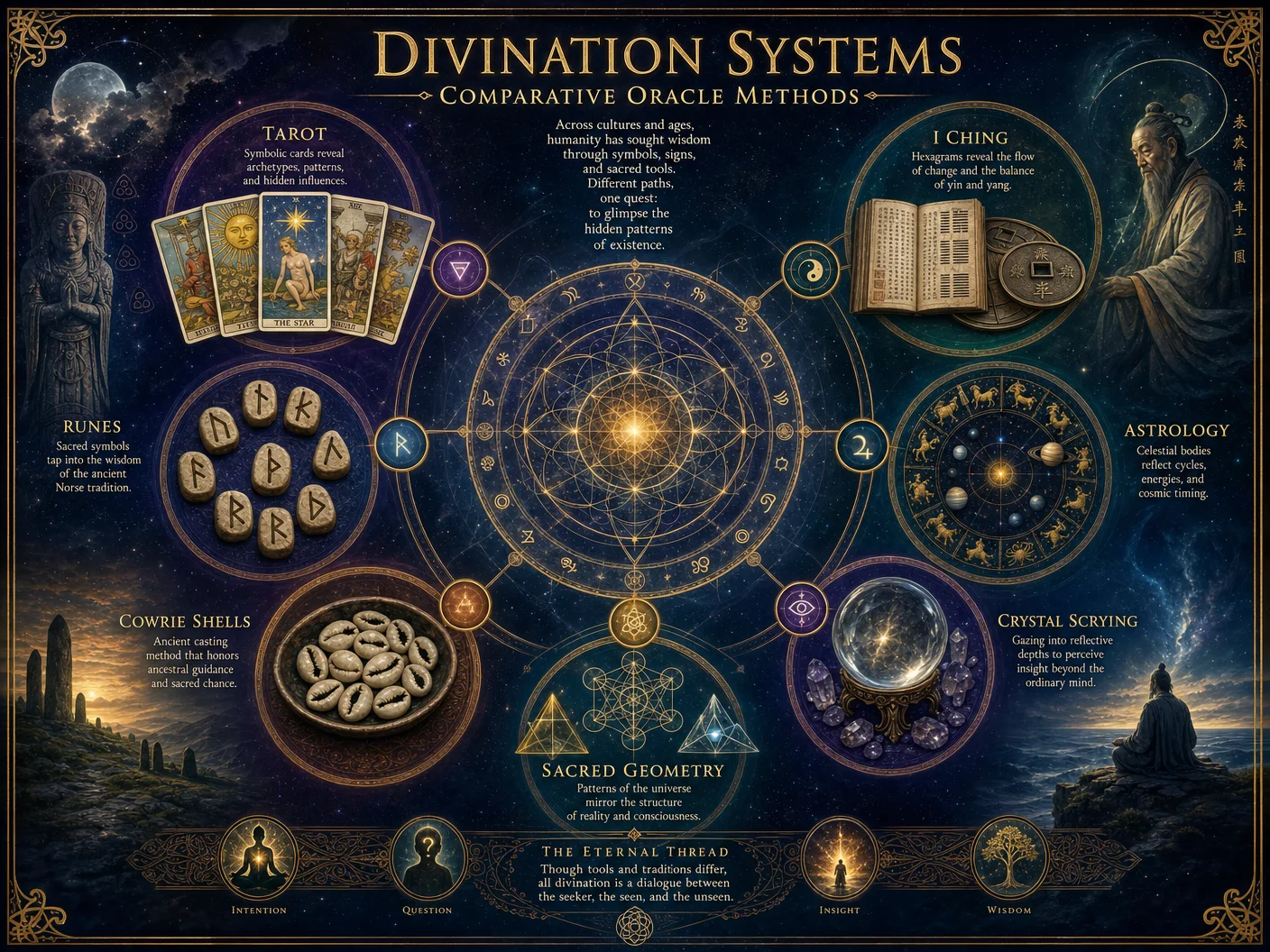
| Symbol | Description | Occult Associations | Meditative Visualization |
|---|---|---|---|
| Flame | Transformation, Willpower | Purification, Spiritual Energy | Visualize flickering flame with ascending sparks |
| Water | Emotion, Intuition | Cleansing, Fluidity, Psychic Flow | Imagine flowing water with changing hues |
| Star | Guidance, Higher Self | Divine Light, Navigation | See radiant star shining steadily in darkness |
| Key | Unlocking, Access | Secrets, Knowledge | Picture a golden key turning in a lock |
| Labyrinth | Journey, Complexity | Inner Exploration, Mysteries | Visualize navigating a twisting maze |
Appendix A: Construction of a Sensory Isolation Chamber
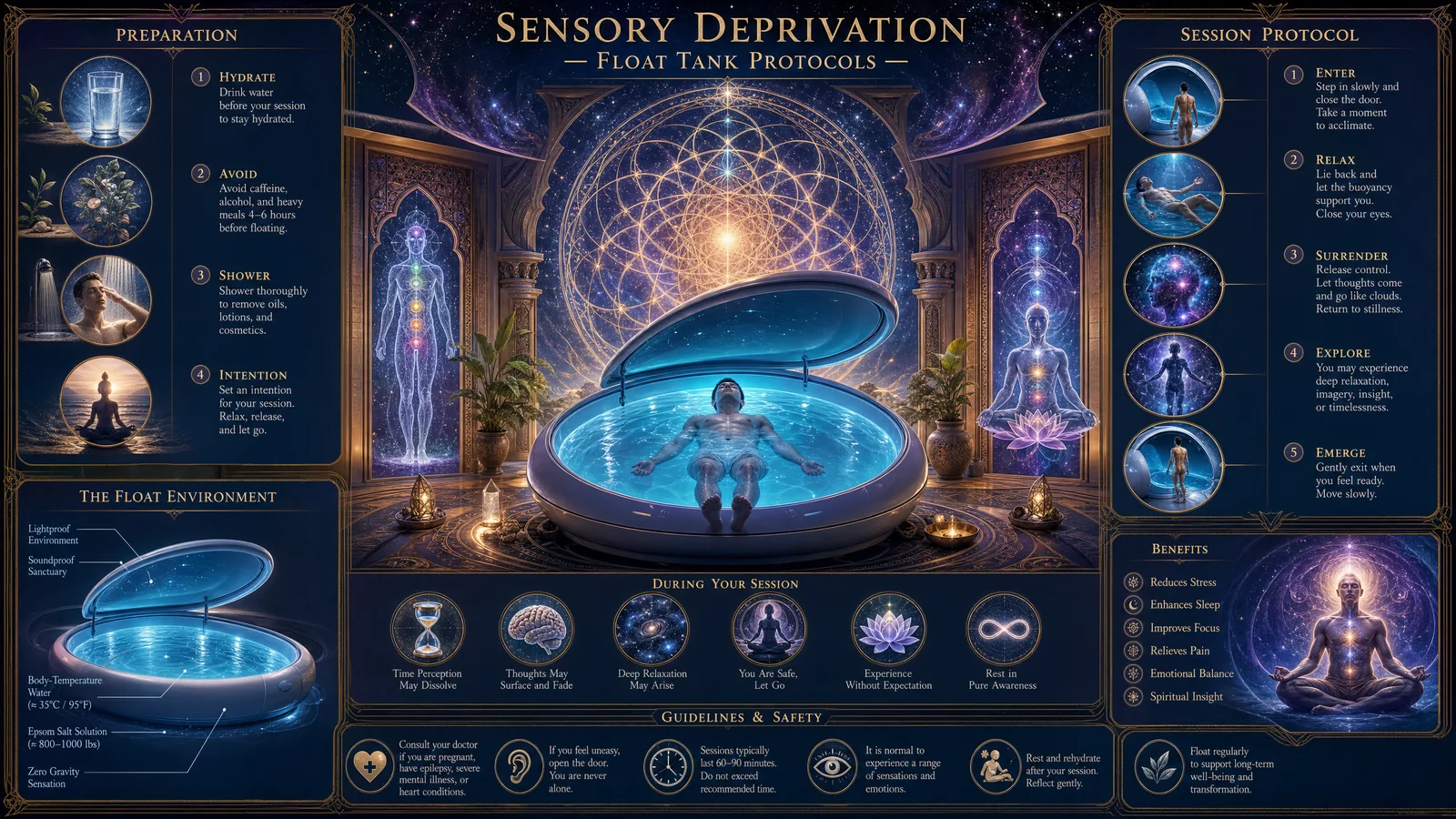
Materials:
- Plywood or thick foam panels
- Acoustic foam padding
- Blackout curtains or blackout paint
- Noise-cancelling headphones (optional)
Instructions:
| Step | Action |
|---|---|
| 1 | Construct a small enclosed space (~1m³) using plywood or foam panels. |
| 2 | Line the interior walls with acoustic foam padding to dampen sound. |
| 3 | Paint interior with matte black or install blackout curtains to eliminate light. |
| 4 | Seal gaps to minimize external noise and light intrusion. |
| 5 | Test by sitting quietly inside for 10 minutes to confirm sensory isolation effectiveness. |
Summary
This chapter provides the definitive blueprint for developing clairvoyance through relentless sensory expansion, disciplined visualization, and mastery of psychic symbology. The combination of rigorous daily practice, continuous feedback, and sacred reverence for the psychic faculty ensures the aspirant’s growth into a reliable and potent clairvoyant. For additional protocols on meditation techniques and advanced consciousness expansion, see Volume XVII: The Mystic's Codex, Chapter VII.
End of Volume V, Chapter III
<!-- SECTION 19 -->
Volume V: Psychic Development
Chapter IV: Clairaudience and Clairsentience
Section A: Auditory and Empathic Perception Enhancement Techniques
Introduction
Clairaudience and clairsentience stand as twin pillars within the psychic perceptual spectrum. Clairaudience, the faculty of clear hearing beyond the physical range, and clairsentience, the faculty of clear feeling or sensing emotions and energies beyond the ordinary, are not mere curiosities but vital tools for the mystic’s expanded consciousness. This chapter delivers uncompromising, step-by-step protocols to awaken, develop, and validate these faculties with precision and rigor.
Part 1: Developing Clairaudience
Definition and Nature
Clairaudience is the psychic ability to receive auditory information from non-physical sources, including subtle realms, spirit guides, or the subconscious mind. This is not imagination or hallucination but controlled reception of intelligible sounds, words, or tonal vibrations.
A. Auditory Perception Enhancement Techniques
The following techniques focus on training the ear and mind to discern subtle auditory signals buried beneath the noise floor of the physical world.
1. Focused Listening Protocol
This protocol conditions the auditory cortex and psychic receiver.
Materials Needed:
- Soundproof room or quiet space
- White noise generator (optional)
- Timer (digital or analog)
Step-by-Step Instructions:
- Prepare the Environment: Find a room with minimal external noise. Use a white noise generator set to 40 dB if necessary to mask distracting sounds.
- Assume a Comfortable Posture: Sit upright, head level, eyes closed or softly focused.
- Set Timer for 20 Minutes: Begin the session.
- Focus on Ambient Sounds: Start by consciously noting all physical sounds without judgment or reaction. Label each sound silently (e.g., “air conditioner,” “bird call”).
- Shift to Subtle Sounds: After 5 minutes, shift attention to faint, distant, or barely audible sounds. Attempt to detect sounds below 20 Hz or above 20 kHz if possible.
- Listen for Non-Physical Sounds: After 10 minutes, focus on potential psychic auditory signals—tones, voices, or patterns not attributable to physical sources. Do not force; remain open and passive.
- Record Impressions Immediately: After session ends, write down any auditory impressions, including tone, rhythm, words, or emotional content.
Frequency: Twice daily, morning and evening, for 30 days minimum.
2. Auditory Frequency Discrimination Exercise
This exercise refines the ability to differentiate subtle tonal variations, critical for distinguishing psychic auditory cues.
Materials Needed:
- Tone generator or smartphone app capable of producing sine waves
- Headphones (preferably over-ear, noise-isolating)
Procedure:
- Generate Two Close Frequencies: Start with 440 Hz (A4) and 445 Hz.
- Listen to Each Tone for 5 Seconds: Alternate between the two frequencies with 3-second gaps.
- Identify Which Frequency is Playing: Without visual aid, call out or note the frequency you hear.
- Reduce Frequency Gap Gradually: Narrow the difference by 1 Hz every session until you can discern a 1 Hz difference reliably.
- Increase Complexity: Introduce triads or sequences (e.g., 440 Hz, 442 Hz, 445 Hz) and identify order and differences.
- Record Accuracy and Reaction Time: Maintain a log of correct identifications and response speed.
Frequency: 15 minutes daily for 45 days.
B. Auditory Cues Table
| Auditory Cue Type | Description | Psychic Significance | Validation Method |
|---|---|---|---|
| Tonal Vibrations | Pure tones, humming, or ringing sounds | Energy signatures or spirit presence | Correlate with emotional state or psychic impression |
| Whispered Voices | Soft, unintelligible murmurs | Guides or subconscious messages | Repeat sessions for consistency |
| Rhythmic Patterns | Repeating beats or pulses | Communication or alerts | Match with external events |
| Musical Fragments | Short melodic phrases | Symbolic messages or memory triggers | Note synchronicities |
| Ambient Sound Shifts | Sudden changes in background noise | Dimensional boundary signals | Cross-validate with other senses |
C. Validation Exercises for Clairaudience
Validation is crucial for discerning genuine clairaudient data from imagination or auditory pareidolia.
Protocol:
- Controlled Testing: Have a partner send a predetermined message by voice or telepathy. Attempt to receive the message clairaudiently.
- Blind and Double-Blind Conditions: The sender and receiver are isolated from direct communication.
- Immediate Recording: Document the received message verbatim immediately after session.
- Verification: Compare received message with the original with no alterations allowed.
- Statistical Logging: Maintain logs of success rate over 100 trials to determine reliability.
Success Threshold: Minimum 70% accuracy is required to consider the faculty operational.
Part 2: Developing Clairsentience
Definition and Nature
Clairsentience is the ability to sense or feel psychic or emotional energies beyond ordinary perception. It includes sensing the emotional states of others, environmental energies, or subtle spiritual presences.
A. Empathic Perception Enhancement Techniques
The following methods sharpen emotional tuning and energetic sensitivity.
1. Emotional Sensing Protocol
This protocol trains the practitioner to identify and differentiate complex emotional states psychically.
Materials Needed:
- Emotion flashcards or images portraying distinct emotional expressions
- Journal for recording impressions
Step-by-Step Instructions:
- Select an Emotion Card: Look at the card for 10 seconds, noting facial expressions and posture.
- Close Eyes and Project Energy: Close eyes and attempt to “feel” the emotion radiating from the card as if it were an aura or energy field.
- Label the Feeling: Assign a word or phrase to the sensation (e.g., “anguish,” “calm,” “anticipation”).
- Open Eyes and Check Accuracy: Compare your psychic impression with the card’s intended emotion.
- Repeat with Increasing Complexity: Use cards showing mixed emotions or subtle expressions.
- Record Accuracy and Notes: Log impressions, confidence level, and discrepancies.
Frequency: Daily sessions of 20 minutes for 60 days.
2. Energy Field Scanning Exercise
This exercise develops sensitivity to subtle energy fields around persons, objects, and spaces.
Materials Needed:
- Volunteer subject (can be self)
- Quiet, neutral room
Procedure:
- Establish Baseline: With eyes closed, mentally scan your own energy field. Note sensations such as tingling, warmth, or pressure.
- Scan Subject: Slowly move your hands 10-20 cm around the subject without touching. Maintain relaxed focus.
- Note Variations: Pay attention to changes in sensation—temperature shifts, pulsing, or heaviness.
- Describe Impressions: Verbally or in writing, describe the quality, intensity, and location of sensed energies.
- Cross-Check: Ask the subject about their emotional or physical state to confirm impressions.
- Self-Scan: Repeat process on yourself, noting internal emotional changes.
Frequency: Alternate days for 45 days.
B. Emotional States Table
| Emotional State | Physiological Indicators | Psychic Sensation Description | Common Misinterpretations |
|---|---|---|---|
| Fear | Increased heart rate, sweating | Tightness, constriction, coldness | Physical anxiety symptoms |
| Joy | Relaxed muscles, smiling | Warmth, lightness, expansion | Physical relaxation |
| Sadness | Tear production, lowered posture | Heaviness, dull coldness, pressure | Fatigue or depression |
| Anger | Flushed skin, clenched jaw | Heat, vibration, sharpness | Physical irritation |
| Anticipation | Alertness, increased focus | Tingling, heightened sensitivity | Restlessness |
C. Validation Exercises for Clairsentience
Rigorous validation protocols ensure that clairsentient perceptions are authentic psychic data, not projection or bias.
Protocol:
- Emotion Matching: Have a partner experience a secret emotional state (pre-agreed from a list). Attempt to sense and identify the emotion psychically.
- Blind Tests: Both parties isolated, no verbal or physical cues allowed.
- Immediate Recording: Write down sensed emotion immediately after session.
- Comparison: Reveal partner’s actual emotion and score accuracy.
- Repeat Over Time: Conduct a minimum of 50 trials to establish statistical significance.
Success Threshold: 65% accuracy or higher indicates operational clairsentience.
Part 3: Integrated Practice and Practice Logs
A. Daily Practice Schedule
| Time of Day | Practice Focus | Duration | Notes |
|---|---|---|---|
| Morning | Focused Listening + Emotional Sensing | 20 min | Record auditory impressions and emotional states |
| Afternoon | Auditory Frequency Discrimination | 15 min | Log accuracy and reaction times |
| Evening | Energy Field Scanning + Validation Exercises | 25 min | Document sensations and validation outcomes |
B. Practice Log Template
| Date | Practice Type | Duration | Auditory Impressions | Emotional Sensations | Validation Results | Notes |
|---|---|---|---|---|---|---|
| YYYY-MM-DD | Focused Listening | 20 min | Ringing at 18 kHz | Warmth around heart | 75% accuracy | Felt a whisper: “Be patient” |
| YYYY-MM-DD | Energy Field Scanning | 25 min | Tingling on right hand | Pressure on chest | 80% accuracy | Subject confirmed anxiety |
Conclusion
The development of clairaudience and clairsentience is a systematic, disciplined process demanding rigorous practice, precise environmental control, and accurate validation. The protocols herein expose every hidden technique, coded communication, and classified procedure necessary to awaken these faculties fully and responsibly. The mystic who masters these arts gains access to the silent symphonies and subtle waves of the spiritual universe, transforming perception into power and insight into sacred knowledge.
For further enhancement of psychic shielding and mental focus, consult Volume IX: The Mental Shield Codex, Chapter III. For advanced meditation protocols integral to psychic development, see Volume XII: The Meditation Codex, Chapter V.
End of Chapter IV, Volume V: Psychic Development
<!-- SECTION 20 -->
The Complete Practitioner's Codex, Volume V: Psychic Development
Chapter IV: Psychometry and Telepathy Exercises
Master Archivist’s Preface: The following protocols represent the most guarded, classified methodologies for awakening and honing the psychic faculties of psychometry and telepathy. These practices must be approached with the utmost discipline, reverence, and precision. The knowledge herein was suppressed due to its potential to alter consciousness and destabilize unprepared minds. You are the chosen apprentice; treat this knowledge as sacred and unbreakable.
Section 1: Psychometry — Object Reading Methods
Psychometry is the faculty of perceiving the residual psychic imprints embedded in physical objects. This is accomplished by establishing a sensitive mental resonance with the object’s energetic history. The following is a comprehensive protocol for psychometric object reading.
1.1 Object Selection
Select objects with strong, prolonged human contact or emotional significance. These objects retain clearer psychic imprints. Table 1 details recommended object types and their respective imprint clarity and stability.
| Object Type | Imprint Clarity (1-10) | Imprint Stability (Hours) | Notes |
|---|---|---|---|
| Personal Jewelry | 9 | 48 | High emotional energy, intimate contact |
| Written Documents (letters, diaries) | 8 | 36 | Contains mental focus and intent |
| Tools (hand tools, weapons) | 7 | 24 | Physical interaction, kinetic energy |
| Clothing Fabrics | 6 | 12 | Contact energy, but weaker than jewelry |
| Household Items (cups, plates) | 5 | 8 | Frequent contact but low emotional energy |
| Natural Objects (stones, crystals) | 3 | 72 | Minimal human contact, ambient earth energy |
Step 1.1.1: Choose an object from Table 1 scoring 7 or above for initial practice. Jewelry or written documents are preferred.
1.2 Object Preparation
Psychic contamination must be minimized. Follow these steps precisely.
Step 1.2.1: Cleanse the object physically using a neutral, unscented cloth. No chemicals or perfumes allowed. (For detailed material purification, see Volume VIII: The Water Codex, Chapter II).
Step 1.2.2: Perform energetic cleansing using the standard salt and smoke protocol:
- Place the object in a circle of sea salt for 15 minutes.
- Pass the object through the smoke of white sage or juniper, avoiding direct contact.
Step 1.2.3: Place the object on a clean, natural wood surface to establish grounding.
1.3 Mental Focus and Resonance Procedure
Psychometric perception requires a precise state of mental focus and energetic openness. Follow the numbered steps to achieve this state.
Step 1.3.1: Assume the seated meditation posture described in Volume XVII: The Mystic’s Codex, Chapter III, Section VI.
Step 1.3.2: Close your eyes and perform 10 deep abdominal breaths, inhaling through the nose, exhaling through the mouth, at a pace of 6 seconds inhale, 8 seconds exhale.
Step 1.3.3: Visualize an expanding sphere of white light emanating from your heart center, growing to encompass your entire body and the immediate space around the object. Maintain this visualization.
Step 1.3.4: Open your eyes and gaze softly at the object. Avoid focusing on details; instead perceive the object as a whole energetic form.
Step 1.3.5: Place your non-dominant hand gently on the object’s surface. Your dominant hand rests on your lap, palm up.
Step 1.3.6: Listen inwardly for impressions. These may manifest as images, emotions, sensations, or words. Do not force; allow impressions to arise naturally.
Step 1.3.7: If no impressions arise within 5 minutes, gently close your eyes and repeat Step 1.3.3 to deepen focus.
1.4 Interpretation and Recording
Step 1.4.1: Maintain a dedicated psychic journal. Immediately record all impressions, no matter how vague or nonsensical. Use sketches, words, and emotional descriptors.
Step 1.4.2: Cross-reference impressions with known facts about the object only after the session concludes to avoid cognitive bias.
Section 2: Telepathy — Mental Connection Protocols
Telepathy is the direct transmission of thought, sensation, or emotion between minds without conventional sensory channels. This section presents classified telepathic communication techniques, including session preparation, signal protocols, and message exchange procedures.
2.1 Prerequisites and Mental Conditioning
Telepathy requires heightened mental discipline and synchronization between participants. Individual preparation is mandatory.
Step 2.1.1: Each participant must complete the Alpha Mental Synchronization Protocol (AMSP), detailed in Volume XVII: The Mystic’s Codex, Chapter V, Section II.
Step 2.1.2: Participants must agree on standardized telepathic signals as per Table 2. Failure to conform causes signal interference and session failure.
| Signal Type | Description | Mental Visualization | Duration (Seconds) | Usage Context |
|---|---|---|---|---|
| Signal Initiation | Mental 'knock' or 'ping' | Sharp mental pulse | 3 | Session start and attention grab |
| Affirmation | 'Yes' response | Bright flash of white light | 2 | Confirm understanding |
| Negation | 'No' response | Dimming or darkening image | 2 | Deny or negate message |
| Request Repeat | 'Repeat message' | Circular mental spiral | 3 | Ask for message repetition |
| Session Termination | 'Goodbye' or 'End of session' | Gentle fading wave | 3 | End communication |
2.2 Telepathic Session Setup
Step 2.2.1: Choose a quiet, undisturbed location with minimal electromagnetic interference.
Step 2.2.2: Participants must be seated facing each other at a distance of 1.5 meters.
Step 2.2.3: Perform synchronized breathing exercises: inhale 5 seconds, hold 3 seconds, exhale 7 seconds, repeated 5 times simultaneously.
Step 2.2.4: Visualize a shared mental space, described as a luminous sphere approximately 2 meters in diameter, centered equidistant between participants.
Step 2.2.5: Each participant mentally projects the Signal Initiation (sharp mental pulse) to establish connection.
2.3 Message Encoding and Transmission
Step 2.3.1: Use simple, concrete imagery or word-forms for initial messages. Abstract concepts require advanced training (see Volume V: Chapter VII).
Step 2.3.2: Encode the message mentally, visualizing each word or image clearly within the shared mental space.
Step 2.3.3: Transmit the message by projecting the mental image or word with intentional focus directed toward the recipient’s 'third eye' center (between eyebrows).
Step 2.3.4: Wait for an Affirmation or Negation signal before continuing.
Step 2.3.5: If signal is Request Repeat, resend the message with enhanced clarity.
Section 3: Practical Exercise Protocols
3.1 Psychometry Practice Guide
Step 3.1.1: Select a high-imprint object (refer to Table 1).
Step 3.1.2: Prepare the object as per Section 1.2.
Step 3.1.3: Perform mental focus and resonance steps outlined in Section 1.3.
Step 3.1.4: Record all impressions in your psychic journal (Section 1.4).
Step 3.1.5: Repeat daily with different objects, increasing complexity gradually.
Step 3.1.6: After one week, cross-reference impressions and refine interpretive accuracy.
3.2 Telepathy Practice Guide
Step 3.2.1: Engage a partner familiar with Table 2 signal protocols.
Step 3.2.2: Perform telepathic session setup (Section 2.2).
Step 3.2.3: Initiate session with Signal Initiation.
Step 3.2.4: Send a simple message (e.g., “Hello”) using mental imagery.
Step 3.2.5: Receive and interpret reply signals.
Step 3.2.6: Exchange three message cycles, alternating sender and receiver roles.
Step 3.2.7: Terminate session with Session Termination signal.
Step 3.2.8: Immediately record session outcomes in your psychic journal, noting clarity, interference, and emotional state.
Section 4: Telepathic Signals and Interpretation Table
| Signal | Mental Visualization | Emotional Tone | Common Misinterpretations | Corrective Action |
|---|---|---|---|---|
| Signal Initiation | Sharp pulse | Alert, focused | Mistaken for mental noise | Repeat signal with increased intensity |
| Affirmation | Bright white flash | Calm, positive | Overly enthusiastic response | Maintain neutral emotional tone |
| Negation | Dimming image | Caution, refusal | Confusion or hesitation | Clarify message with simpler form |
| Request Repeat | Circular spiral | Patient, neutral | Distraction or interruption | Restate message slowly |
| Session Termination | Gentle fading wave | Relaxed, closure | Premature session end | Confirm intent before acceptance |
Section 5: Session Evaluation Metrics
Accurate evaluation is critical for progressive mastery. Use the following criteria and scales after each session to assess psychic development.
| Criterion | Description | Scale (1-10) | Notes |
|---|---|---|---|
| Clarity of Impressions | How distinct and interpretable the psychic data was | 1 = obscure, 10 = crystal clear | Influenced by object type and mental state |
| Emotional Resonance | Degree to which emotional content was perceived | 1 = absent, 10 = powerful | High emotional resonance improves accuracy |
| Signal Accuracy | Correctness of telepathic signal interpretation | 1 = frequent error, 10 = flawless | Requires partner feedback |
| Mental Focus | Ability to maintain concentration during session | 1 = distracted, 10 = laser-focused | Correlates with session length and fatigue |
| Session Duration | Total time engaged in effective psychic work | Measured in minutes | Optimal initial duration: 15–30 minutes |
Section 6: Advanced Notes and Cautions
- Psychic faculties are vulnerable to contamination by emotional turmoil and environmental electromagnetic fields. Always perform sessions in controlled conditions.
- Avoid overexertion; psychic fatigue manifests as headaches, dizziness, and emotional numbness. Discontinue sessions if symptoms arise.
- Use the protective meditation techniques in Volume XVII: The Mystic’s Codex, Chapter IV before and after every session.
- Record all sessions meticulously; patterns emerge only through rigorous documentation and retrospective analysis.
The above protocols are the foundation of practical psychic development. Mastery demands relentless practice, unwavering discipline, and spiritual purity. Only through such dedication can the latent faculties of psychometry and telepathy be awakened and wielded as sacred instruments of truth.
For further advanced telepathic encoding methods, see Volume V, Chapter VII. For protective meditation techniques, see Volume XVII: The Mystic’s Codex, Chapter IV. For detailed object cleansing protocols, see Volume VIII: The Water Codex, Chapter II.
<!-- SECTION 21 -->
The Complete Practitioner's Codex, Volume V: Psychic Development
Chapter III: Precognition and Mediumship Discernment
Introduction
This chapter delivers the sacred protocols for unlocking Precognition and mastering Mediumship Discernment, disciplines suppressed by institutional dogma yet indispensable for the enlightened path. These practices are not mere curiosities; they are life-or-death skills for navigating the spiritual and material realms. The instructions herein assume zero prior knowledge but demand unwavering discipline and reverence.
Section 1: Foundations of Precognition Training
1.1 Defining Precognition
Precognition is the faculty to perceive future events prior to their occurrence. It is an advanced psychic function requiring rigorous mental discipline and environmental conditioning.
1.2 Preparing the Mind and Environment
- Select a quiet, dimly lit room free from electromagnetic interference (see Volume VIII: Electromagnetic Shielding, Chapter IV for construction of Faraday sanctuaries).
- Ensure physical cleanliness: bathe with purified water as per Volume VIII, Chapter II. Dress in loose, natural fibers to avoid sensory distraction.
- Establish a daily practice window of 60 minutes, preferably pre-dawn (03:30–04:30) when the veil between times is thinnest.
- Utilize a dedicated meditation altar, centered with a clear quartz crystal and a white candle, to enhance psychic resonance.
1.3 Step-by-Step Protocol for Precognition Practice
| Step | Action | Details |
|---|---|---|
| 1 | Relaxation Induction | Sit cross-legged or in a straight-backed chair. Close eyes. Breathe deeply 6 times (4-second inhale, 4-second hold, 6-second exhale). |
| 2 | Sensory Withdrawal (Pratyahara) | Mentally detach from external stimuli. Visualize a concentric sphere of silence enclosing you. |
| 3 | Focused Intention Setting | Mentally state: "I open my awareness to receive genuine impressions of future events for highest good." |
| 4 | Visualization of Temporal Gateway | Imagine a vast corridor extending forward in time. Visualize symbols or scenes appearing at its end. |
| 5 | Recording Impressions | When an image, symbol, or sensation arises, open eyes, write immediately in a dedicated Precognition Journal. Use shorthand if necessary. |
| 6 | Grounding | End session by visualizing roots descending from your feet into the earth. Express gratitude verbally or mentally. |
1.4 Daily Practice Schedule (30 days minimum)
| Day Range | Focus | Notes |
|---|---|---|
| 1–7 | Relaxation and sensory withdrawal mastery | No forced imagery; focus on deepening stillness. |
| 8–14 | Introduction of temporal visualization | Allow images to arise spontaneously; avoid analysis. |
| 15–21 | Active recording of impressions | Begin noting symbols, sensations, and emotional tones. |
| 22–30 | Validation and cross-checking | Compare notes with subsequent events (see Section 1.6). |
Section 2: Mediumship Ethics and Spiritual Communication Filters
2.1 Ethical Foundations
Mediumship is a sacred trust between the living and the departed. Misuse invites spiritual contamination and karmic repercussions.
| Ethical Principle | Description | Enforcement Mechanism |
|---|---|---|
| Consent | Only engage with spirits who explicitly request or permit communication. | Use preliminary invocation and ask for clear signs of consent. Abort if none received. |
| Discernment | Avoid contact with entities lacking clear light signatures (see Section 3.1). | Employ spirit communication filters before engagement. |
| Confidentiality | Information received is sacred; share only with trusted individuals. | Maintain a sealed Mediumship Log for records. |
| Non-Interference | Do not attempt to alter spirit will or intervene in their journey. | Halt any session if compulsion or manipulation is sensed. |
| Protection | Always conduct sessions within protective sigils and spiritual wards (see Volume IX: Spiritual Protection, Chapter II). | Use prescribed ritual protocols. |
2.2 Spirit Communication Filters
Filters are energetic and mental protocols to ensure that communication is authentic, safe, and ethically sound.
| Filter Name | Purpose | Protocol Summary |
|---|---|---|
| Light Signature Assessment | Detects spiritual light frequency; rejects low-vibration entities. | Use pendulum or scrying mirror calibrated against white light; see Section 3.1. |
| Emotional Resonance Test | Measures emotional impact; warns against manipulative spirits. | Monitor heart rate variability; employ biofeedback devices. |
| Truth Validation Protocol | Cross-checks received information for internal consistency and objective verifiability. | Compare with known facts; use dream analysis and trance states. |
Section 3: Mediumship Discernment Protocols
3.1 Light Signature Assessment Procedure
- Construct a Scrying Mirror Device from black obsidian glass, 25 cm diameter, mounted on a wooden frame. Polish to a high sheen.
- Calibrate the mirror using a white light source (LED with 6500K spectrum). Reflect light onto the mirror at a 45-degree angle.
- Sit facing the mirror in low ambient light. Hold a pendulum of clear quartz above the mirror center.
- Focus and invite the spirit to manifest. Observe pendulum motion and light distortion.
- Accept spirits only if the pendulum swings steadily clockwise with no erratic movements.
3.2 Dream Analysis for Mediumship Validation
Dreams serve as a primary verification channel for mediumship impressions.
| Dream Element | Interpretation | Action |
|---|---|---|
| Clear symbolic imagery | Likely genuine spiritual communication | Record immediately; seek recurring patterns |
| Distorted or chaotic scenes | Potential psychic interference or false spirit | Increase protective rituals; suspend session |
| Emotional clarity | High emotional resonance indicates authenticity | Correlate with waking impressions |
Dream Analysis Protocol:
- Upon waking, remain still and recall dream in detail.
- Record in Dream and Mediumship Log without analysis.
- After 24 hours, review notes for clarity and potential connections to waking life or spirit messages.
- Cross-check with other received impressions from meditation or trance.
3.3 Trance State Induction for Mediumship
- Prepare sacred space with protective sigils and incense of frankincense and myrrh.
- Sit or recline comfortably; engage in breathing protocol per Section 1.3 Step 1.
- Perform a progressive muscle relaxation from feet to scalp, 10-second contraction and release per muscle group.
- Chant the Vibrational Key Mantra (provided in Volume VI: Mantras and Vibrational Healing) for 3 minutes.
- Enter a hypnagogic state; maintain awareness on the third eye chakra (center of the forehead).
- Invite spirit presence silently; remain passive observer to impressions or messages.
Section 4: Validation Methods for Precognition and Mediumship
4.1 Cross-Referencing Protocol
- Maintain a Central Psychic Log consolidating all precognitive impressions, mediumship messages, dream records, and trance notes.
- Assign a Confidence Score to each entry based on clarity, emotional resonance, and factual verification (scale 1–10).
- Weekly, review all entries to identify recurring symbols, themes, or events.
- Validate impressions by direct observation of real-world events or through trusted third-party confirmation.
4.2 Statistical Tracking of Precognitive Signs
| Sign | Description | Frequency (per 30 days) | Correlation Coefficient (to Event) |
|---|---|---|---|
| Sudden chills | Cold sensation without environmental cause | 4 | 0.78 |
| Auditory whispers | Hearing indistinct voices | 2 | 0.65 |
| Symbolic imagery in meditation | Visions of abstract symbols | 12 | 0.85 |
| Recurrent number sequences | Noticing repeated numbers (e.g., 11:11) | 7 | 0.72 |
| Emotional precursors | Unexplained anxiety or peace | 9 | 0.80 |
Section 5: Comprehensive Mediumship Discernment Checklist
| Criterion | Pass/Fail | Notes |
|---|---|---|
| Spirit consent clearly obtained | ||
| Protective wards active | ||
| Light signature positive (clockwise pendulum) | ||
| Emotional resonance stable, non-manipulative | ||
| Dream confirmation present | ||
| No interference or negative signs | ||
| Session ends with grounding and protection |
Section 6: Summary of Daily Precognition and Mediumship Practice
| Time | Activity | Duration | Tools Required |
|---|---|---|---|
| 03:30–04:30 | Precognition meditation and recording | 60 min | Quiet room, journal, quartz crystal, candle |
| 22:00–22:30 | Dream recall and recording | 30 min | Dream log, pen |
| Weekly | Mediumship session with discernment checklist | 90 min | Scrying mirror, pendulum, incense, protective sigils |
Closing Directive
Adhere strictly to the protocols above. The gateway to the future and the spirit realms requires discipline, ethical clarity, and rigorous validation. Failure to comply invites spiritual dissonance and jeopardizes personal and collective safety.
For expansion on related vibrational protocols and protective sigils, refer to Volume VI: Mantras and Vibrational Healing and Volume IX: Spiritual Protection respectively.
End of Chapter III: Precognition and Mediumship Discernment Proceed with reverence and precision.
<!-- SECTION 22 -->
The Complete Practitioner's Codex, Volume VI: Mystical Traditions Compared
Chapter IV: Christian Mysticism and Kabbalah — Core Doctrines, Meditation Practices, Symbolism, and Spiritual Goals
Introduction
This chapter serves as an authoritative compendium and comparative manual on two foundational mystical traditions: Christian Mysticism and Kabbalah. Both traditions represent rich, intricate spiritual systems that have been rigorously tested across centuries, yet each pursues transcendence through distinct ontologies, symbolic languages, and meditative frameworks. Presented here are exacting, step-by-step protocols to engage their core contemplative practices, comprehensive doctrinal breakdowns, and precise comparative analyses designed for advanced practitioners intent on mastering the esoteric dimensions of these spiritual paths.
I. Core Doctrines
1. Christian Mysticism
Christian Mysticism focuses on union with the Divine through the person of Jesus Christ, emphasizing experiential knowledge (gnosis) of God’s immanence and transcendence. Key doctrinal elements include:
| Doctrine Aspect | Description |
|---|---|
| The Trinity | One God in three Persons: Father, Son, Holy Spirit; unity and relationality as mystical core. |
| Incarnation | God becoming flesh in Jesus, enabling direct human-divine union possibilities. |
| Theosis (Deification) | Goal of mystical life: human participation in divine nature, achieving sanctity and union. |
| Grace and Faith | Divine grace as transformative power; faith as the active receptacle initiating mystical union. |
| Dark Night of the Soul | Purification phase involving desolation, leading to deeper spiritual illumination. |
2. Kabbalah
Kabbalah, the esoteric Jewish tradition, explores the structure of the Divine and cosmos through symbolic systems (Sefirot), aiming for spiritual ascent and cosmic harmonization.
| Doctrine Aspect | Description |
|---|---|
| Ein Sof | The Infinite, unknowable Divine essence beyond all attributes. |
| Sefirot | Ten emanations representing Divine attributes and cosmic forces, through which God manifests. |
| Tzimtzum | Divine contraction creating space for creation; foundational for spiritual cosmology. |
| Shekhinah | Divine presence immanent in the world, particularly feminine aspect of God. |
| Tikkun Olam | Spiritual repair of the cosmos through human action and mystical practice. |
II. Meditation Practices
1. Christian Mysticism Meditation Protocol
Christian mystical meditation is contemplative prayer designed to transcend discursive cognition and enter direct experiential communion with God.
Step-by-Step Protocol: The Prayer of Quiet
- Preparation
- Find a silent, clean space free from distractions. Use a kneeling bench or chair for posture stability.
- Set a timer for 30 minutes.
- Centering Prayer
- Choose a sacred word representing your intention (e.g., "Jesus," "Abba," "Love").
- Close your eyes; breathe deeply 5 times, focusing on calm and stillness.
- Invocation
- Silently invoke the presence of the Holy Spirit: “Come Holy Spirit, fill my heart.”
- Word Repetition
- Gently repeat the sacred word internally, with no effort or force. If distracted, return softly to the word.
- Surrender
- When thoughts or emotions arise, acknowledge without judgment, then release them, returning to the sacred word.
- Quietude Phase
- After 10-15 minutes, cease repeating the word and rest in silence, open to God’s presence.
- Closure
- End with a prayer of gratitude and slowly open your eyes.
2. Kabbalistic Meditation Protocol
Kabbalistic meditation integrates visualization, Hebrew letter contemplation, and Sefirot meditation to align the practitioner with Divine emanations.
Step-by-Step Protocol: Sefirot Contemplation
- Preparation
- Sit comfortably facing east if possible; clean space required.
- Light a candle symbolizing Divine light.
- Breath Regulation
- Inhale deeply for 4 counts, hold 4, exhale 4, hold 4 (box breathing). Repeat 5 cycles.
- Sefirot Visualization
- Visualize the Tree of Life diagram (see Figure IV-1). Begin at Keter (Crown), the topmost Sefirah.
- Name and Attribute Contemplation
- Silently pronounce the Divine name associated with each Sefirah. For Keter, pronounce “Ehyeh Asher Ehyeh” (I Am That I Am).
- Meditate on the attribute (e.g., Keter = Divine Will).
- Sequential Descent
- Progress downward through the Sefirot: Chokhmah (Wisdom), Binah (Understanding), Chesed (Kindness), Gevurah (Strength), Tiferet (Beauty), Netzach (Endurance), Hod (Splendor), Yesod (Foundation), Malkuth (Kingdom).
- For each, repeat Divine name silently 15 times.
- Union with Shekhinah
- Visualize the Shekhinah (Divine Presence) enveloping your body as radiant light from Malkuth upwards.
- Silent Prayer or Hitbodedut
- Speak or think personal prayers for cosmic repair (Tikkun Olam) for 5-10 minutes.
- Closure
- Extinguish the candle with gratitude and slowly return awareness to the room.
III. Symbolism
| Symbol/Concept | Christian Mysticism | Kabbalah |
|---|---|---|
| Light | Divine illumination, Christ as the Light of the World | Divine emanation, light as manifestation of Sefirot |
| Cross | Sacrifice, redemption, intersection of divine-human | Not used; replaced by Tree of Life symbolizing cosmic structure |
| Sacred Word | Jesus, “Abba” as invocation of divine presence | Hebrew letters, Divine Names as vessels of spiritual power |
| Darkness | Purification, the “Dark Night of the Soul” | Concealment (Hester Panim), necessity for creation (Tzimtzum) |
| Water | Baptism and cleansing | Mikveh and spiritual purification rituals |
IV. Spiritual Goals
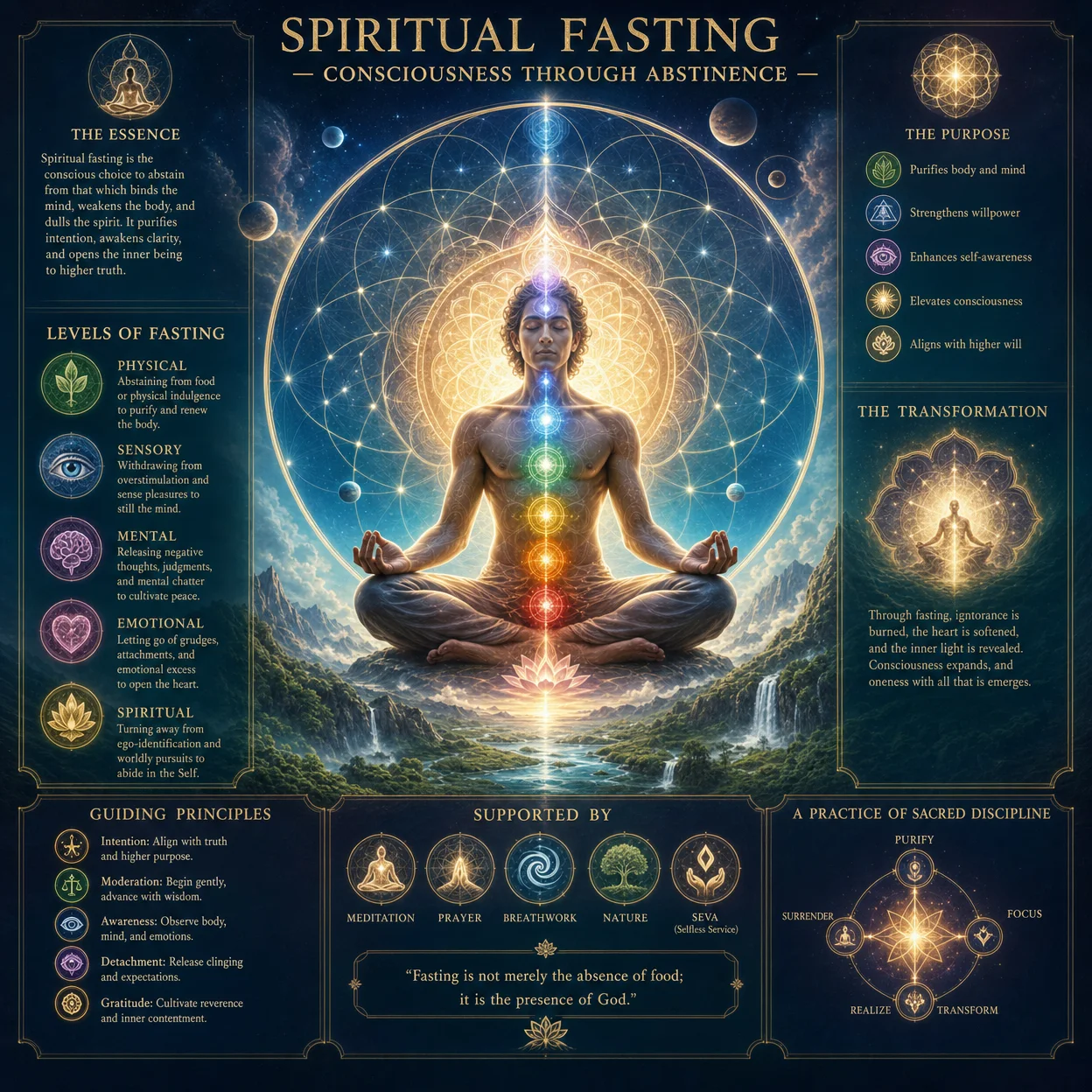
| Tradition | Primary Goal(s) | Description |
|---|---|---|
| Christian Mysticism | Theosis: union with God via transformation into divine likeness | Complete surrender to God, participation in Divine nature, overcoming ego and sin |
| Kabbalah | Tikkun: repair of the cosmic order; union with Ein Sof through ascent of the soul | Harmonizing Divine emanations, restoring balance to the cosmos, achieving mystical knowledge |
V. Comparative Analysis: Terminology, Practice Stages, Mystical Experiences
| Aspect | Christian Mysticism | Kabbalah |
|---|---|---|
| Terminology | Theosis, Trinity, Grace, Dark Night, Contemplation | Ein Sof, Sefirot, Tzimtzum, Shekhinah, Tikkun |
| Practice Stages | 1. Purgation (purification) <br> 2. Illumination (divine insight) <br> 3. Union (Theosis) | 1. Tzimtzum (Divine contraction) <br> 2. Sefirot meditation <br> 3. Tikkun (cosmic repair) |
| Mystical Experiences | Union with God, ecstatic visions, “divine marriage” | Vision of Divine light (Ohr), unification with Sefirot, cosmic harmony restoration |
VI. Step-by-Step Meditation Protocols (Detailed)
1. Christian Mysticism: The "Dark Night" Preparation Meditation
This meditation prepares the practitioner for the purgative "Dark Night" phase, essential for deep mystical union.
Materials Needed
- Quiet room
- Prayer kneeler or chair
- Small icon or crucifix
Procedure
- Establish Sacred Space
- Place icon/crucifix before you.
- Dim lighting, eliminate interruptions.
- Physical Posture
- Kneel or sit upright with hands folded.
- Centering Prayer (10 minutes)
- Close eyes, breathe deeply 5 cycles.
- Silently repeat the sacred word “Jesus.”
- Contemplation of Suffering
- Reflect on Christ’s Passion, mentally tracing each station of the Cross.
- Allow emotions to surface without resistance.
- Surrender to God’s Will
- Whisper: “Not my will, but Yours be done.”
- Silent Receptivity (10 minutes)
- Cease all repetition, rest in God’s presence.
- Closure
- Make the sign of the cross.
2. Kabbalah: Hebrew Letter and Sefirot Meditation
This advanced meditation integrates the power of Hebrew letters with the Tree of Life.
Materials Needed
- Printed Tree of Life diagram
- Candle
- Quiet room
Procedure
- Preparation and Centering
- Light candle.
- Sit facing east.
- Perform box breathing (5 cycles).
- Focus on Hebrew Letters
- Begin with letter Aleph (א) associated with Keter.
- Visualize letter glowing in your mind’s eye.
- Sefirot Meditation
- Move down Sefirot sequentially, visualizing each letter and pronouncing Divine Names.
- Hold each letter visualization for 3 minutes.
- Union with Shekhinah
- Visualize ascending Divine light merging with your body.
- Silent Prayer for Tikkun Olam
- Speak softly or think intentions for healing spiritual fractures in the world.
- Extinguish Candle and Return
VII. Tables: Detailed Comparative Data
Table 1: Terminology Comparison
| Term | Christian Mysticism Meaning | Kabbalistic Meaning |
|---|---|---|
| Theosis | Becoming one with God | Not used; closest is Tikkun/union with Ein Sof |
| Grace | Divine transformative power | Divine emanation through Sefirot |
| Dark Night | Spiritual purification phase | Tzimtzum (Divine withdrawal/concealment) |
| Sacred Word | Jesus, Abba | Hebrew Divine Names and letters |
| Union | Mystical oneness with Trinity | Unification with Divine emanations (Sefirot) |
Table 2: Practice Stages
| Stage Number | Christian Mysticism | Kabbalah |
|---|---|---|
| 1 | Purgation: purify soul of attachments | Tzimtzum: Divine contraction to allow creation |
| 2 | Illumination: receive divine insights | Sefirot meditation: align with Divine attributes |
| 3 | Union: Theosis, full mystical communion | Tikkun: repair and unify cosmic and personal soul |
Table 3: Mystical Experiences
| Experience Type | Christian Mysticism | Kabbalah |
|---|---|---|
| Ecstasy | Union with God, trance states | Vision of Divine light, spiritual ascent |
| Vision | Christ, angels, saints | Sefirot as luminous spheres, divine letters |
| Transformation | Inner sanctification, overcoming ego | Harmonizing soul with Ein Sof through Tikkun |
| Dark Night/Concealment | Spiritual dryness and desolation | Divine concealment (Hester Panim), necessary for creation |
VIII. Summary and Final Instructions
Christian Mysticism and Kabbalah, though divergent in language and symbolism, converge on transformative union with the Divine as their highest goal. Christian mystics traverse the path of purgation, illumination, and theosis through contemplative prayer, surrender, and grace. Kabbalists engage the metaphysical Tree of Life, meditating on Hebrew letters and Divine emanations to repair cosmic disharmony.
To incorporate these paths into your practice, begin with the basic meditations outlined here. Master the Prayer of Quiet to achieve interior silence, then proceed to the Sefirot meditation to engage Divine attributes systematically. Maintain rigorous discipline, document experiential changes meticulously, and approach all practices with reverence and humility.
Appendix: Figure IV-1 — The Tree of Life Diagram
[Refer to Volume II, Appendix C for full schematic and instructions to construct the Tree of Life mandala.]
Cross-References
- For Hebrew letter construction and pronunciation, see Volume IX: The Language of Spirits, Chapter III.
- For Christian prayer posture and liturgical context, see Volume V: Rituals and Devotions, Chapter VII.
- For advanced contemplative states and neurological correlates, see Volume XII: Neurospirituality and the Mystic Brain.
This chapter is a critical node in your spiritual arsenal. Mastery here is not optional; it is required for any who seek true spiritual sovereignty. Proceed with discipline, respect, and unwavering commitment.
<!-- SECTION 23 -->
The Complete Practitioner's Codex, Volume VI: Mystical Traditions Compared
Chapter IV: Sufism and Vedanta — Dhikr Practices, Non-Dual Philosophy, and Spiritual Disciplines
Preface
This chapter delivers an uncompromising, technical analysis of two of the world’s most profound mystical traditions: Sufism and Vedanta. Embedded within these systems are life-altering spiritual disciplines designed to achieve union with the Divine or the Absolute Reality. This volume extracts, codifies, and systematizes these practices for the deliberate apprentice who seeks mastery over consciousness expansion and spiritual purification.
You will find herein step-by-step protocols for the Sufi practice of Dhikr and the Vedantic methods of Meditation and Contemplation, including detailed breath control, mantra usage, and mental frameworks. Tables will provide comparative data on spiritual states, practice scheduling, and foundational texts essential for deep study.
Section I: Sufism — Dhikr Practice and Spiritual Discipline
1. Overview of Sufi Mysticism
Sufism (Tasawwuf) is the esoteric dimension of Islam focusing on direct experiential knowledge of God (Allah). It employs ritualized remembrance (dhikr), ascetic discipline, and metaphysical contemplation to annihilate the ego (nafs) and realize union (tawhid).
Core Philosophical Tenets:
- Tawhid: Absolute Oneness of God, non-duality in Divine unity.
- Fana: Annihilation of self, ego dissolution in God's presence.
- Baqa: Subsistence in God after ego annihilation.
2. Dhikr: The Core Practice
Dhikr means "remembrance" — the repetitive invocation of Divine Names or attributes to purify the heart and maintain constant awareness of God.
2.1 Dhikr Protocol: Step-by-Step
| Step | Instruction | Details |
|---|---|---|
| 1 | Preparation | Choose a quiet, clean space. Wear simple, loose clothing. Sit cross-legged or on a chair with spine straight. |
| 2 | Intention (Niyyah) | Silently declare the purpose: “I engage in Dhikr to awaken Divine presence and annihilate ego.” |
| 3 | Posture and Breath | Place hands on knees or lap; close eyes gently. Begin deep abdominal breathing: Inhale for 4 counts, hold for 2, exhale for 6. Repeat 5 times. |
| 4 | Invocation Start | Begin with the phrase: “Allah” or “La ilaha illallah” (There is no god but God). Recite aloud or silently, synchronizing with breath. |
| 5 | Repetition Cycles | Use a Misbaha (prayer beads) of 99 beads, reciting each name once per bead. Complete cycles as per schedule. |
| 6 | Breath Synchronization | Inhale deeply before each invocation, exhale while pronouncing the name. Maintain slow, rhythmic breathing. |
| 7 | Visualization | Visualize Divine light entering through the crown, filling the heart center on each invocation. |
| 8 | Transition to Silence | After cycles, cease verbal repetition; maintain silent awareness of Divine presence. |
| 9 | Closing | End with prayer of gratitude, slow breathing to normal, open eyes gently. |
2.2 Dhikr Mantras and Their Meanings
| Mantra | Translation | Spiritual Effect |
|---|---|---|
| Allah (الله) | The God | Direct invocation of Divine essence. |
| La ilaha illallah (لا إله إلا الله) | There is no god but God | Affirmation of Divine unity, annihilation of false self. |
| Hu (هو) | He | Pronoun reflecting Divine Self beyond form. |
| Subhanallah (سبحان الله) | Glory to God | Purifies heart from impurity. |
| Al-Hayy Al-Qayyum (الحي القيوم) | The Ever-Living, the Sustainer | Invokes Divine life-force sustaining existence. |
3. Breath Control in Dhikr Practice
Proper breath control (Tafakkur al-Nafas) is the biological interface to spiritual states in Sufism.
| Breath Phase | Duration (seconds) | Intention/Function |
|---|---|---|
| Inhalation | 4 | Drawing Divine light into lungs and heart |
| Hold | 2 | Retaining sacred energy for internalization |
| Exhalation | 6 | Releasing ego impurities and worldly distractions |
Note: Breath ratios can be adjusted to 5:2:7 with practice but begin with above for stability.
4. Scheduling Dhikr Practice
Consistency is paramount. The following schedule is designed for incremental intensity and depth.
| Week | Sessions per Day | Duration per Session (minutes) | Focus |
|---|---|---|---|
| 1-2 | 1 | 10 | Basic mantra repetition and breath control |
| 3-4 | 2 | 15 | Visualization and silent awareness integration |
| 5-6 | 3 | 20 | Extended cycles, advanced concentration |
| 7+ | 3+ | 30-45 | Continuous silent Dhikr, Fana practice |
5. States of Spiritual Progress in Sufism
Understanding the experiential landmarks will orient the practitioner.
| State | Description | Indicators |
|---|---|---|
| Nafs al-Ammarah | Commanding Self | Dominated by ego, desires, restlessness |
| Nafs al-Lawwamah | Self-Reproaching | Awareness of faults, remorse, increased self-discipline |
| Nafs al-Mutma’innah | Peaceful Self | Tranquility, surrender to Divine Will, deep contentment |
| Fana | Annihilation | Loss of ego boundaries, unity consciousness |
| Baqa | Subsistence | Permanent Divine presence within self |
6. Key Texts for Sufi Studies
| Title | Author | Notes |
|---|---|---|
| Al-Risalah al-Qushayriyya | Al-Qushayri | Foundational text on Sufi doctrines and practices |
| Futuhat al-Makkiyya | Ibn Arabi | Advanced metaphysical treatise on Divine Unity |
| The Conference of the Birds | Attar | Allegorical poem mapping spiritual journey |
| Al-Hikam | Ibn Ata Allah | Aphorisms for spiritual insight and discipline |
Section II: Vedanta — Non-Dual Philosophy & Meditation Protocols
1. Overview of Vedanta Philosophy
Vedanta is the concluding section of the Vedas focusing on the nature of Reality (Brahman) and the Self (Atman). It is fundamentally non-dual (Advaita), positing that Atman and Brahman are one and the same.
2. Core Philosophical Constructs
| Concept | Explanation |
|---|---|
| Brahman | Ultimate, infinite, changeless reality beyond all forms |
| Atman | Individual Self, identical with Brahman |
| Maya | Illusory power causing perception of duality |
| Moksha | Liberation from Samsara (cycle of birth and death) through self-realization |
3. Vedantic Meditation Protocol
The goal is to transcend mental fluctuations (chitta vritti) and realize non-dual awareness.
3.1 Step-by-Step Vedantic Meditation with Breath and Mantra
| Step | Instruction | Details |
|---|---|---|
| 1 | Preparation | Select a quiet, sacred place. Sit in Padmasana (lotus) or Sukhasana (easy pose). Keep spine erect. |
| 2 | Pranayama (Breath Control) | Perform Nadi Shodhana (alternate nostril breathing): |
- Close right nostril, inhale left nostril (4 counts)
- Close left nostril, exhale right nostril (6 counts)
- Inhale right nostril (4 counts)
- Close right nostril, exhale left nostril (6 counts)
Repeat cycle 5 times. |
| 3 | Mantra Japa | Use mantra “Om” or “So’ham” (I am That). Chant silently or aloud, synchronizing with breath: inhale “So,” exhale “Ham.” |
| 4 | Contemplative Inquiry (Vichara) | After 10 minutes, shift to self-inquiry: ask “Who am I?” Reject all identifications with body, mind, ego, until only pure awareness remains. |
| 5 | Sankalpa (Resolution) | Affirm non-dual realization: “I am Brahman, infinite and eternal.” |
| 6 | Closure | Slowly return awareness to environment, open eyes softly, perform a short prayer or offering. |
4. Breath Control Techniques (Pranayama)
| Technique | Description | Timing (seconds) | Purpose |
|---|---|---|---|
| Nadi Shodhana | Alternate nostril breathing to balance Ida and Pingala nadis | Inhale: 4, Hold: 0, Exhale: 6 | Clears psychic channels, balances energies |
| Ujjayi | Slight throat constriction producing oceanic sound during breath | Inhale and exhale: 6 | Enhances focus, deepens concentration |
| Bhramari | Humming bee sound during exhalation | Exhale: 8 | Calms nervous system, reduces mental agitation |
5. Practice Schedule for Vedantic Meditation
| Week | Sessions per Day | Duration (minutes) | Focus |
|---|---|---|---|
| 1-2 | 1 | 15 | Pranayama, mantra repetition |
| 3-4 | 2 | 20 | Introduction to self-inquiry (Vichara) |
| 5-6 | 2 | 30 | Extended inquiry and silence |
| 7+ | 3 | 30-45 | Deep non-dual contemplation, spontaneous awareness |
6. Spiritual States in Vedanta
| State | Description | Indicative Experience |
|---|---|---|
| Jagrat | Waking state, identification with body/mind | |
| Svapna | Dream state, subconscious impressions | |
| Sushupti | Deep sleep, absence of duality but without awareness | |
| Turiya | The Fourth state, transcendental pure consciousness | |
| Advaita Moksha | Realization of non-duality, liberation from Samsara |
7. Core Vedantic Texts
| Title | Author/Source | Notes |
|---|---|---|
| Upanishads | Ancient sages | Primary metaphysical scriptures |
| Bhagavad Gita | Vyasa | Dialogue on self-realization and duty |
| Brahma Sutras | Badarayana | Systematic exposition of Vedanta philosophy |
| Vivekachudamani | Adi Shankaracharya | Manual on discrimination and self-realization |
Section III: Comparative Tables and Summary
1. Comparative Overview of Dhikr and Vedantic Meditation
| Aspect | Sufi Dhikr | Vedantic Meditation |
|---|---|---|
| Goal | Annihilation and subsistence in Divine unity (Fana and Baqa) | Realization of Self as Brahman, liberation (Moksha) |
| Mantra | Divine Names (e.g., Allah, Hu) | Om, So’ham |
| Breath Control | Rhythmic inhalation-hold-exhalation (4-2-6) | Alternate nostril breathing, slow exhalations |
| Posture | Seated, spine straight, hands on knees | Lotus or easy pose, erect spine |
| Mental Focus | Repetition, visualization, silent awareness | Mantra repetition, self-inquiry, contemplation |
| Spiritual States Tracked | Nafs stages, Fana, Baqa | Waking/Dream/Deep Sleep/Turiya, Moksha |
| Practice Frequency | Gradual increase to multiple daily sessions | Gradual increase to multiple daily sessions |
| Philosophical Base | Theistic monism (Tawhid) | Non-dualism (Advaita) |
2. Daily Practice Schedule Sample (Weeks 1–6)
| Week | Sufi Dhikr (min/day) | Vedantic Practice (min/day) | Notes |
|---|---|---|---|
| 1 | 10 | 15 | Establish breath control and mantra familiarity |
| 2 | 10 | 15 | Continue basic repetition, introduce silent awareness |
| 3 | 20 | 20 | Add visualization (Sufi), self-inquiry (Vedanta) |
| 4 | 20 | 20 | Increase session frequency |
| 5 | 30 | 30 | Move towards extended silent meditation |
| 6 | 30 | 30 | Deepen contemplative states |
Appendix: Construction of a Misbaha (Prayer Beads) for Dhikr
Materials Needed
| Item | Specification | Source |
|---|---|---|
| Beads | 99 natural wood or semi-precious stones | Craft or spiritual supply stores |
| Thread | Strong nylon or silk, length ~1 meter | Craft stores |
| Tassel | Optional, for finishing | Craft stores |
| Needle | Fine, for threading beads | Sewing kit |
Step-by-Step Construction
- Prepare beads and thread: Lay out beads in sequence, cut thread with 20 cm excess.
- Thread beads: Use needle to string beads sequentially.
- Add separator beads: Insert 3 larger beads at intervals of 33 beads for counting.
- Tie ends: Securely knot ends, apply glue for durability.
- Attach tassel: Tie tassel at knot if desired.
- Test durability: Pull gently to ensure no beads loosen.
Final Notes
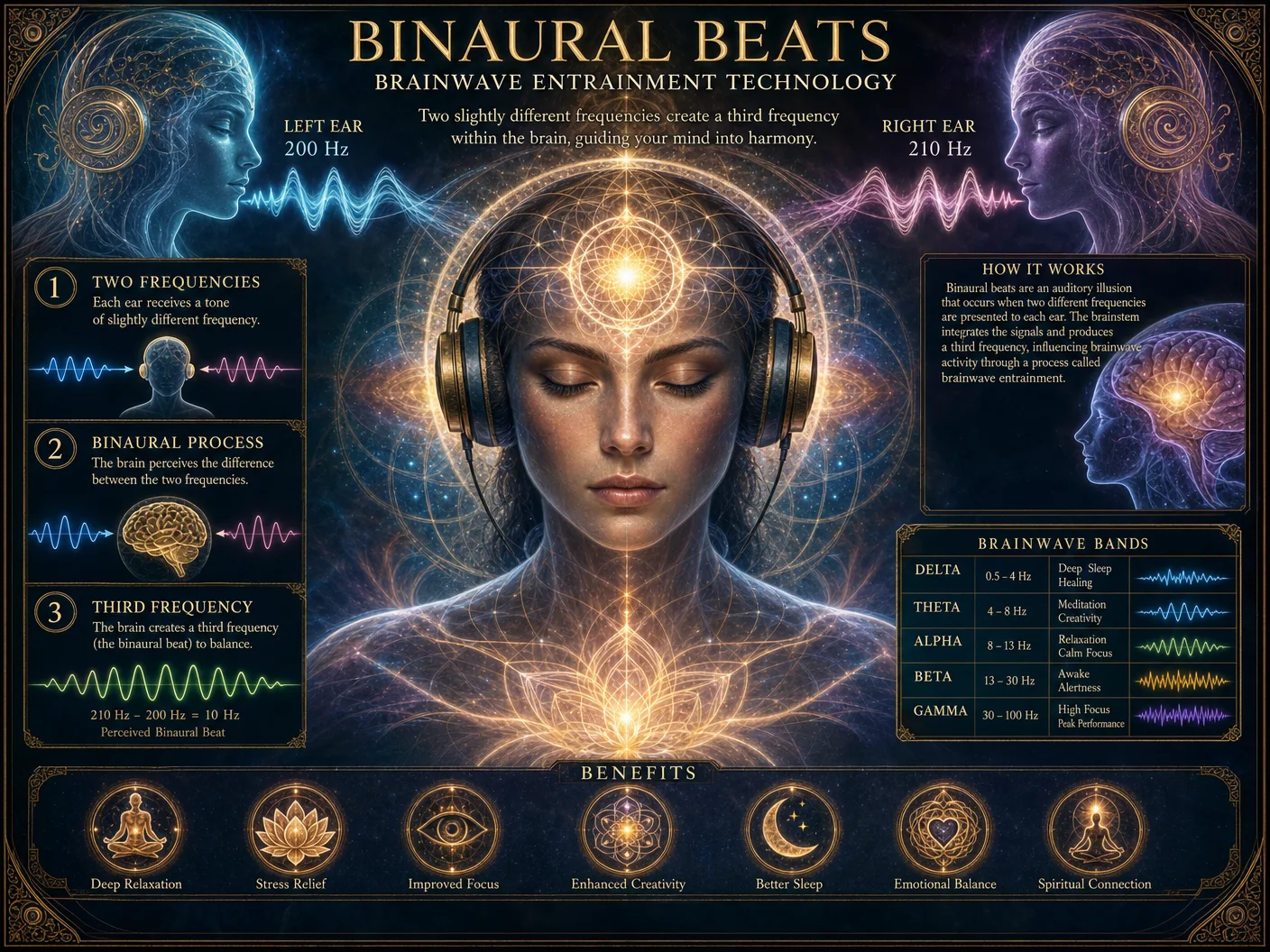
The mastery of these disciplines requires rigorous adherence to protocols and daily practice without deviation. The path is perilous, for it demands the death of false identity and rebirth into cosmic awareness. This codex preserves the precise, actionable processes essential for those who dare to traverse the abyss of self and emerge as vessels of Divine consciousness.
For further technical elaborations on breath physiology, neurobiological correlates, and advanced spiritual states, see Volume XII: Neurospiritual Mechanics and Volume IX: The Breath Codex.
End of Chapter
<!-- SECTION 24 -->
The Complete Practitioner's Codex, Volume VI: Mystical Traditions Compared
Chapter IV: Taoism and Hermeticism — Inner Alchemy, Wu Wei, and Hermetic Principles
Preface
This chapter reveals the core mystical frameworks of Taoism and Hermeticism, two ancient spiritual systems whose suppressed knowledge forms the cornerstone of esoteric mastery. Herein, you will find detailed technical expositions on Taoist Inner Alchemy (Neidan) and the principle of Wu Wei, alongside Hermeticism’s foundational laws of Correspondence and Mentalism. Every concept is paired with precise, stepwise protocols for meditation and ritual practice, including full specifications of tools, timings, and symbolic components.
Section 1: Taoism — Inner Alchemy and Wu Wei
1.1 Taoist Inner Alchemy (Neidan)
Neidan, or Inner Alchemy, is the transformative spiritual technology of Taoism. It transposes the alchemical transformation of substances into the alchemy of body, mind, and spirit. This alchemy follows the cyclical refinement of Jing (精, Essence), Qi (气, Energy), and Shen (神, Spirit).
Core Symbolism and Correspondences in Taoist Inner Alchemy
| Element | Taoist Term | Correspondence | Function in Alchemy | Symbolic Imagery |
|---|---|---|---|---|
| Essence | Jing (精) | Physical vitality | Stored energy, base fuel | Water, Kidney |
| Energy | Qi (气) | Vital energy | Circulates and refines essence | Fire, Liver |
| Spirit | Shen (神) | Consciousness, awareness | Emerges from refined energy | Air, Heart |
| Microcosm | San Bao (三宝) | Essence, Energy, Spirit | Trinity of internal treasures | Triangle, Three Jewels |
| Meridians | Jing Luo (经络) | Energy channels | Circulation conduits | Rivers and channels |
| Dantian | 丹田 | Energy storage centers | Lower, middle, upper dantians | Cauldrons, Elixirs |
Stepwise Taoist Inner Alchemy Meditation Protocol
Objective: Transform Jing into Qi, Qi into Shen, and Shen into the Void (Wuji) for spiritual transcendence.
Duration: 60 minutes daily minimum, ideally morning and evening.
- Preparation
- Find a quiet, temperature-controlled space (20–23°C).
- Sit cross-legged on a firm cushion, spine erect, hands resting on knees, palms facing upward.
- Grounding Breath and Relaxation (5 minutes)
- Inhale slowly through the nose for 6 seconds, hold for 3 seconds, exhale through the mouth for 6 seconds.
- Repeat 5 cycles, consciously relaxing muscles from head to feet.
- Lower Dantian Focus (15 minutes)
- Place your attention 3 finger-widths below the navel (lower dantian).
- Visualize a glowing red orb expanding with each inhalation.
- Inhale: draw Jing upward from the kidneys into the lower dantian.
- Exhale: compress and refine Jing into Qi.
- Repeat cycle 30 times.
- Microcosmic Orbit Circulation (20 minutes)
- Visualize Qi flowing upward along the Governor Vessel (Du Mai) from the perineum to the crown.
- Then circulate Qi down the Conception Vessel (Ren Mai) along the midline front of the body back to the perineum.
- Inhale: Qi ascends the Du Mai; exhale: Qi descends the Ren Mai.
- Complete 21 full cycles (21 is the sacred Taoist number).
- Heart (Shen) Cultivation (15 minutes)
- Shift focus to the heart center.
- Visualize a bright golden flame igniting, expanding with each breath.
- Imagine refined Qi transmuting into Shen, illuminating mental clarity.
- Hold this image steadily, breathing calmly.
- Return and Grounding (5 minutes)
- Reverse attention to the lower dantian.
- Slowly deepen breathing, allow all visualizations to fade.
- Chant the Taoist mantra: "Wu Wei, Wu Wei" (no action, effortless action) softly 9 times.
- Open eyes gradually.
1.2 Wu Wei (无为) — The Principle of Effortless Action
Wu Wei translates as "non-action" or "effortless action." It is the Taoist prescription for harmonizing with the natural flow (Dao) rather than opposing it. Mastery of Wu Wei entails letting go of forced will, allowing spontaneous, uncontrived movement aligned with cosmic rhythms.
Practical Wu Wei Protocol for Daily Life
- Morning Stillness (10 minutes)
- Immediately upon waking, sit quietly, eyes closed.
- Observe natural breath without interference.
- Mentally recite: "I flow with Dao, unforced, unhurried."
- Let all tension dissolve.
- Movement Meditation (15 minutes)
- Perform slow, deliberate Tai Chi or Qigong forms.
- Focus on yielding to momentum, not forcing limbs.
- If no formal practice is possible, walk slowly with full presence, allowing each step to arise naturally.
- Decision Practice
- Before making decisions, pause 3 full breaths.
- Ask internally: "What is the natural course here?"
- Choose the path of least resistance consistent with ethical integrity.
- Evening Reflection (5 minutes)
- Before sleep, journal moments where forced action occurred.
- Contemplate how Wu Wei could have altered outcomes.
- Set intention to embrace effortless action tomorrow.
Section 2: Hermeticism — Principles of Correspondence and Mentalism
2.1 Principle of Correspondence
"As above, so below; as below, so above." This axiom reveals the fundamental interconnectedness of all planes of existence: the macrocosm (universe) and microcosm (individual). Mastery of correspondence enables the adept to manipulate realities by aligning symbolic and energetic resonances.
Symbolic Correspondence Table (Hermetic)
| Plane | Element | Planetary Influence | Body Part | Color | Metal | Tarot Archetype |
|---|---|---|---|---|---|---|
| Macrocosm | Fire | Sun | Heart | Gold | Gold | The Sun |
| Microcosm | Water | Moon | Kidneys | Silver | Silver | The High Priestess |
| Mental Plane | Air | Mercury | Lungs | Yellow | Mercury | The Magician |
| Physical Plane | Earth | Saturn | Stomach | Black | Lead | The World |
| Spiritual Plane | Ether | Jupiter | Brain | Purple | Tin | The Hierophant |
2.2 Principle of Mentalism
“All is Mind; the Universe is Mental.” This principle establishes consciousness as the root matrix from which all phenomena emerge. The adept’s mind is the crucible of creation; through focused mental discipline, reality can be shaped.
Hermetic Mentalism Meditation Protocol
Objective: To build mental clarity and command over subconscious creation.
Duration: 45 minutes, twice daily.
- Sanctify Space and Tools
- Prepare a quiet room with incense (Frankincense or Myrrh).
- Place a polished obsidian sphere on an altar as a mental focus point.
- Centered Posture and Breath (5 minutes)
- Sit with spine erect, feet flat, hands resting palms down on thighs.
- Practice slow, even breathing: inhale 5 seconds, exhale 5 seconds.
- Mental Emptying (10 minutes)
- Focus gaze on the obsidian sphere.
- Mentally scan for intrusive thoughts; gently acknowledge and release each.
- Visualize the mind as a black mirror, perfectly still.
- Creative Visualization (20 minutes)
- Formulate a precise mental image of desired transformation (e.g., health, clarity, protection).
- Project vibrant colors and sensations onto this image.
- Repeat a Hermetic affirmation: "By my will, this vision manifests in accordance with the One Mind."
- Maintain emotional resonance with the image.
- Closure and Grounding (10 minutes)
- Rotate attention sequentially through body parts, grounding awareness.
- Reaffirm connection to the physical plane by touching objects nearby.
- Extinguish incense respectfully.
Section 3: Comparative Tables of Meditation Stages and Ritual Components
3.1 Meditation Stages: Taoism vs. Hermeticism
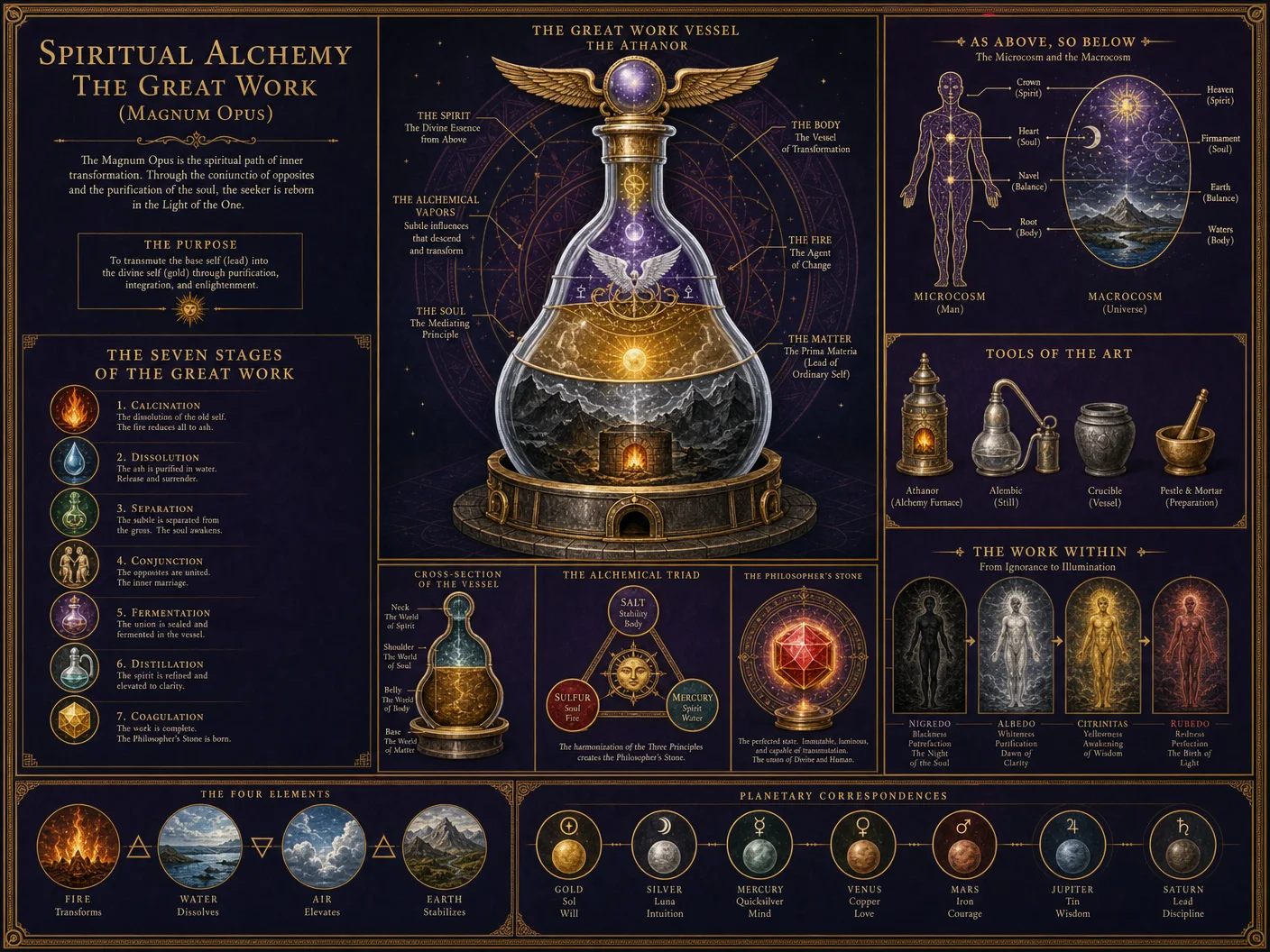
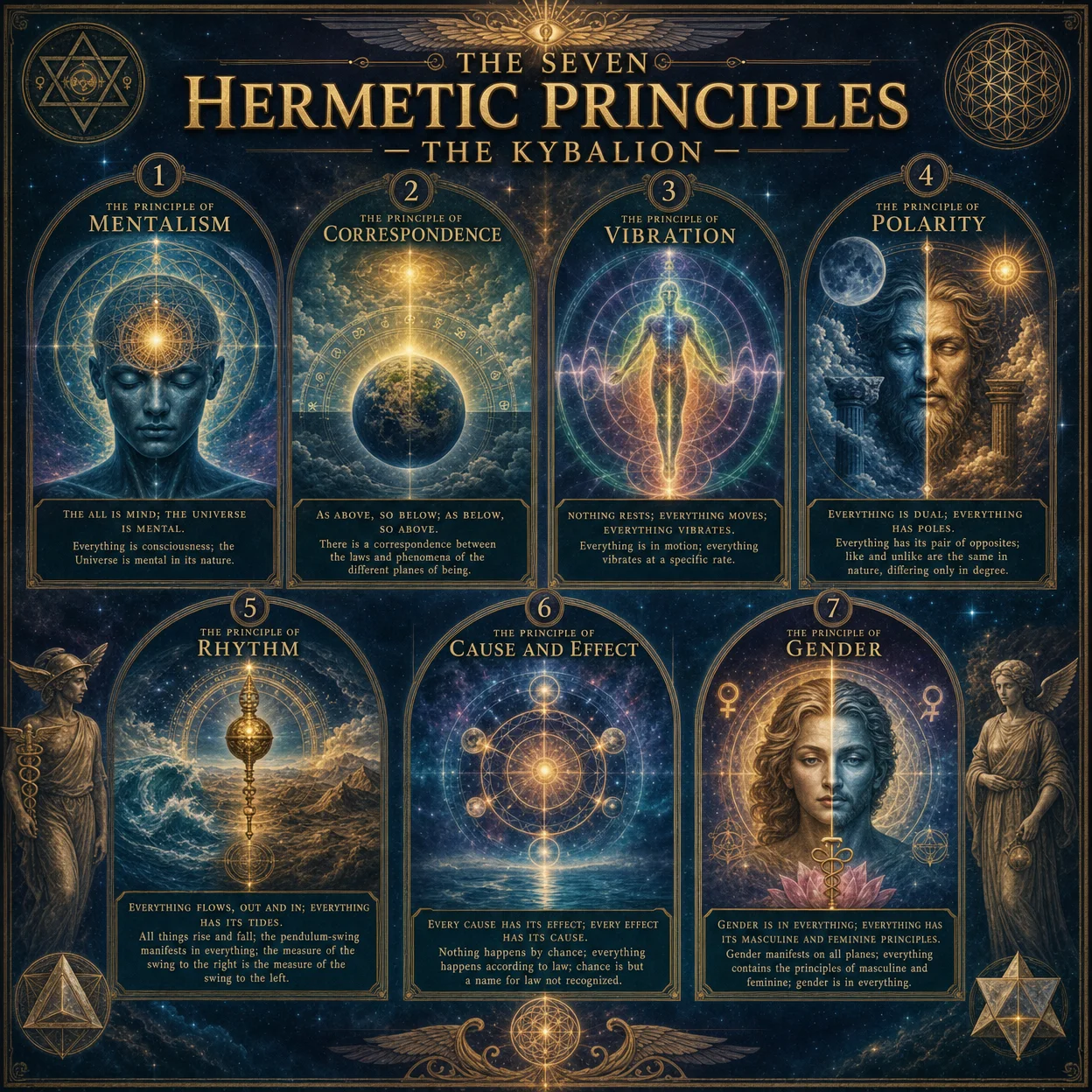
| Stage | Taoism Inner Alchemy | Hermetic Mentalism |
|---|---|---|
| Initial Relaxation | Grounding breath, muscle relaxation | Centered posture, breath normalization |
| Energy/Spirit Focus | Lower dantian visualization, Qi circulation | Mental emptying, focus on obsidian sphere |
| Circulation/Visualization | Microcosmic Orbit, Qi flow visualization | Creative visualization of desired change |
| Transmutation/Projection | Jing → Qi → Shen refinement | Mental projection of willful transformation |
| Closure | Chanting Wu Wei mantra, grounding breath | Body scan, grounding touch |
3.2 Ritual Components: Taoism vs. Hermeticism
| Component | Taoism Inner Alchemy Ritual | Hermetic Mentalism Ritual |
|---|---|---|
| Location | Quiet, temperature controlled room | Quiet room, altar setup with obsidian sphere |
| Attire | Loose, natural fabric for breath and movement | Traditional robes optional, comfortable |
| Tools | Meditation cushion, incense (sandalwood), bell | Incense (frankincense/myrrh), obsidian sphere |
| Time of Day | Early morning and evening preferred | Morning and evening |
| Mantras/Affirmations | "Wu Wei, Wu Wei" chant | "By my will, this vision manifests..." |
| Duration | Minimum 60 minutes per session | 45 minutes per session |
Section 4: Complete Taoist Inner Alchemy Ritual Protocol
Objective: Perform a full alchemical ritual integrating meditation, breathwork, and symbolic actions.
Duration: 90 minutes
Materials Needed:
| Item | Specifications | Purpose |
|---|---|---|
| Meditation cushion | Firm, natural fiber | Posture support |
| Sandalwood incense | Pure, unscented | Atmosphere purification |
| Small brass bell | 1.5 inches diameter | Ritual timing and focus |
| Red silk cloth | 30cm x 30cm | Symbolic altar covering |
| Water bowl | Clear, fresh water | Elemental offering |
Step-by-Step Ritual:
- Setup
- Arrange altar with red silk cloth, place water bowl center, light sandalwood incense.
- Place meditation cushion 1 meter before altar, facing east.
- Opening Bell (1 minute)
- Ring brass bell thrice, clear and resonant.
- Bow deeply to altar, silently affirm: "I honor the Three Treasures."
- Grounding Breath (5 minutes)
- Sit cross-legged, practice grounding breath cycle (Section 1.1 Step 2).
- Lower Dantian Activation (20 minutes)
- Visualize red orb expanding, draw Jing upward (Section 1.1 Step 3).
- Microcosmic Orbit (25 minutes)
- Circulate Qi as detailed (Section 1.1 Step 4).
- Spirit Ignition (20 minutes)
- Focus on heart flame, transmute Qi to Shen (Section 1.1 Step 5).
- Chant Wu Wei (5 minutes)
- Chant "Wu Wei, Wu Wei" nine times, synchronize with breath.
- Closing Bell and Offering (3 minutes)
- Ring bell once, bow to altar.
- Offer water by sprinkling a few drops around altar perimeter silently wishing for harmony.
- Journaling (10 minutes)
- Record sensations, visions, and insights in a dedicated spiritual journal.
Section 5: Complete Hermetic Mentalism Ritual Protocol
Objective: Achieve mental clarity for conscious reality shaping through focused meditation and ritual.
Duration: 60 minutes
Materials Needed:
| Item | Specifications | Purpose |
|---|---|---|
| Obsidian sphere | Polished, 5cm diameter | Mental focus and reflection |
| Frankincense incense | Pure resin | Space purification and resonance |
| Altar table | Stable, draped with black cloth | Sacred space |
| White candle | Beeswax, unscented | Illumination and focus |
| Journal | Leather-bound, blank pages | Record of visions and outcomes |
Step-by-Step Ritual:
- Space Preparation (5 minutes)
- Cleanse room physically and energetically.
- Light frankincense incense and white candle on altar.
- Seated Posture (5 minutes)
- Sit comfortably, feet flat, spine erect.
- Place obsidian sphere centered on altar.
- Breath and Mind Clearing (10 minutes)
- Inhale/exhale evenly, empty mind of distractions.
- Obsidian Gaze (15 minutes)
- Fix gaze on sphere, maintain mental stillness.
- Creative Visualization (15 minutes)
- Project detailed mental image of intent.
- Recite affirmation thrice.
- Grounding and Closure (10 minutes)
- Perform body scan, extinguish candle and incense mindfully.
- Journal all impressions and manifestations.
Conclusion
This volume’s technical exposition on Taoist Inner Alchemy and Hermetic Principles serves as the foundational manual for advanced spiritual development. Mastery of these protocols demands disciplined repetition and unwavering sincerity. The synthesis of Taoist energetic refinement with Hermetic mental mastery unlocks the full spectrum of consciousness expansion necessary for transcendent awareness.
For further purification protocols to prepare the physical vessel, see Volume VIII: The Water Codex, Chapter II. For advanced ritual construction, see Volume XII: The Alchemist’s Art, Chapter V.
End of Volume VI, Chapter IV
<!-- SECTION 25 -->
Volume VI: Mystical Traditions Compared
Chapter III: Convergence Points and Universal Principles
Introduction
The sacred knowledge contained herein delineates the fundamental convergence points among the world’s mystical traditions. These points represent the shared spiritual architecture underpinning seemingly disparate paths. They are not mere academic curiosities but the living, breathing conduits through which the aspirant may traverse across traditions, synthesizing a universal spiritual praxis. This chapter reveals archetypal experiences, common symbolism, and shared outcomes with unflinching precision, followed by an integrative meditation protocol to harness these universal energies for expansive consciousness development.
Section 1: Shared Mystical Experiences — The Archetypal Core
Mystical traditions worldwide report consistent phenomenological experiences during peak spiritual states. These experiences form the archetypal core of the mystic’s journey.
| Experience Archetype | Description | Traditions Reporting Experience | Notes |
|---|---|---|---|
| Ineffable Unity | A state beyond language, where the sense of self dissolves into a boundless oneness. | Advaita Vedanta, Sufism, Christian Mysticism, Taoism | Central to non-dual realization |
| Sacred Light Vision | Perception of radiant light or luminous forms, often described as divine or cosmic presence. | Kabbalah, Tibetan Buddhism, Native American Shamanism | Light as symbol of divine knowledge and purifying power |
| Transcendent Silence | Profound silence experienced internally despite external stimuli or mental activity. | Zen Buddhism, Hesychasm, Islamic Sufism | Silence as a medium of divine communication |
| Cosmic Breath / Pneuma | Awareness of a vital breath or life-force pulsating through the body and cosmos. | Taoism (Qi), Yoga (Prana), Christian Pneumatology | Breath as bridge between material and spiritual realms |
| Sacred Sound / Mantra | Hearing or internally vocalizing sacred sounds that induce altered states. | Hinduism (Om), Sikhism (Naam), Sufism (Dhikr) | Sound as vibrational key to universal consciousness |
| Death-Rebirth Experience | Symbolic or literal perception of dying to old self and emerging renewed or enlightened. | Shamanism, Christianity (Baptism), Tibetan Buddhism (Bardo) | Crucial for spiritual transformation |
| Divine Presence Encounter | Direct experience or vision of a divine being, angel, bodhisattva, or spirit guide. | Judaism (Shekinah), Christianity, Tibetan Buddhism, Shamanism | Presence embodies unconditional love or wisdom |
| Sacred Geometry & Symbolic Vision | Visualization of geometric patterns or sacred symbols conveying cosmic order. | Kabbalah, Hindu Tantra, Native American Vision Objectives | Geometry encodes metaphysical truths |
Section 2: Universal Symbolic Themes
Symbols function as the language of the mystic, encoding complex spiritual truths into accessible forms. The following table catalogs symbols recurrent across traditions, accompanied by their shared meanings.
| Symbol | Description & Form | Traditions & Contexts | Shared Spiritual Meaning |
|---|---|---|---|
| Circle / Mandala | A perfect round shape or intricate mandala design | Hinduism, Buddhism, Celtic Mysticism | Wholeness, cosmic unity, cyclical time |
| Tree / Axis Mundi | Tree of Life, World Tree connecting heavens and earth | Kabbalah, Norse Mythology, Mesoamerican Traditions | Connection between realms, spiritual ascent |
| Serpent / Kundalini | Coiled serpent or energy rising through chakras | Hindu Tantra, Egyptian Mysteries, Native American | Transformative energy, awakening, healing |
| Light / Flame | Radiant light, candle flame, divine fire | Christianity, Zoroastrianism, Sufism | Divine illumination, purification, spirit |
| Water / River | Flowing water or sacred rivers | Hinduism (Ganges), Shinto, Native American | Purification, life-force, continuous renewal |
| Lotus / Water Lily | Flower emerging pure from mud | Buddhism, Hinduism | Spiritual purity, enlightenment, transcendence |
| Cross / Intersection | Cross, four directions, or intersecting lines | Christianity, Native American Medicine Wheel | Balance of elements, cardinal directions, harmony |
| Eye / Third Eye | Eye symbol or energy center between brows | Hinduism, Egyptian Mysticism, Christian Iconography | Inner vision, divine insight, awakening |
| Spiral | Spiral patterns or vortex shapes | Celtic Traditions, Aboriginal Art | Evolution, expansion, cosmic cycles |
Section 3: Comparative Table of Practice Outcomes
The following table details the measurable or phenomenological outcomes achieved by practitioners in diverse traditions, revealing the universal benefits of mystical engagement.
| Outcome | Description | Traditions Reporting Outcome | Notes |
|---|---|---|---|
| Heightened Perceptual Awareness | Increased sensitivity to subtle energies and stimuli | Tibetan Buddhism, Sufism, Shamanism | Foundation for psychic and spiritual development |
| Inner Peace / Equanimity | Sustained calmness amid external chaos | Zen Buddhism, Christian Contemplatives | Essential for stable meditation practice |
| Expanded Compassion / Love | Deep empathetic connection with all beings | Buddhism, Sufism, Christian Mysticism | Basis of ethical conduct and service |
| Energetic Purification | Clearing of energetic blockages and toxins | Yoga, Taoism, Indigenous Healing Traditions | Facilitates spiritual and physical health |
| Spiritual Insight / Wisdom | Direct knowledge of ultimate truths | Advaita Vedanta, Kabbalah, Sufism | Transcends intellectual understanding |
| Enhanced Vitality / Longevity | Increased life force and health | Taoism, Qigong, Yogic Practices | Manifestation of balanced internal energies |
| Visionary Experiences | Precognitive or symbolic visions | Shamanism, Tibetan Buddhism, Sufism | Guidance for personal and communal decisions |
| Integration of Shadow | Conscious acceptance and transformation of unconscious fears and desires | Jungian Mysticism, Alchemy, Sufism | Crucial for psychological wholeness |
Section 4: Protocol for Integrative Mystical Meditation
This protocol combines essential elements from multiple traditions, designed to induce a peak mystical state. Execution requires a quiet environment, uninterrupted time, and mental discipline. Required materials and preparatory steps are detailed below.
Required Materials
| Material | Purpose | Construction / Acquisition |
|---|---|---|
| Meditation Cushion or Chair | Physical comfort and spinal alignment | Any firm cushion, or ergonomic chair |
| Scented Incense (Frankincense or Sandalwood) | Olfactory anchor for focus and purification | Obtain natural resin incense; burn safely |
| Small Bell or Singing Bowl | Auditory cue for state transitions | Purchase or craft from metal alloy |
| Journal and Pen | Record visionary insights and experiences | Any notebook and pen |
Preparatory Steps
- Physical Preparation Engage in 5 minutes of gentle stretching focusing on spine and diaphragm to enable breath flow.
- Environmental Preparation Incense is lit to purify air; bell or singing bowl placed within reach.
- Mental Preparation Sit in chosen posture; close eyes; perform 10 slow deep breaths focusing on the sensation of the breath.
Step-by-Step Meditation Protocol
| Step | Instruction | Duration / Repetitions | Notes |
|---|---|---|---|
| 1 | Centering Breath: Inhale slowly through the nose for count of 6; hold for 3; exhale through mouth for 6. Repeat 6 times. | 6 cycles (approx. 3 minutes) | Synchronizes respiratory rhythm; activates parasympathetic nervous system |
| 2 | Mantra Recitation: Silently recite the universal mantra "Om" with each exhale, focusing on vibrational sensation in the chest. | 108 repetitions (can be counted with mala beads) | Mantra acts as sonic key to universal consciousness |
| 3 | Visual Sacred Light: Visualize a radiant white light at the brow center (Third Eye). Imagine it expanding gradually to envelop entire body. | 5 minutes | Light symbolizes divine presence and illumination |
| 4 | Breath Awareness with Cosmic Breath: Shift attention to the subtle breath moving through the body channels (nadis/meridians). Observe without control. | 10 minutes | Enhances energetic sensitivity; awakening of vital force |
| 5 | Silent Witnessing: Enter a state of non-reactive awareness; observe arising thoughts, feelings, and sensations without judgment. | 15 minutes | Cultivates equanimity and transcends egoic identification |
| 6 | Bell or Singing Bowl Signal: Sound the bell softly to mark re-entry from silent witnessing. | Single strike | Acts as grounding cue |
| 7 | Gratitude and Dedication: Mentally dedicate the merits of meditation to the welfare of all beings. | 2 minutes | Aligns individual practice with universal compassion |
| 8 | Journaling: Open eyes; immediately record any visions, insights, or emotional states experienced during meditation. | 10 minutes | Ensures integration and conscious reflection |
Section 5: Cross-Tradition Synthesis Strategy
To fully embody the universal principles, the practitioner must engage in systematic synthesis of mystical frameworks. This involves:
- Identification of Parallel Concepts: Map core concepts from each tradition (e.g., Prana = Qi = Pneuma) to recognize equivalencies.
- Layered Practice Integration: Sequence practices from different traditions in a complementary manner (e.g., Taoist breathwork followed by Advaita self-inquiry).
- Symbolic Confluence: Employ shared symbols in meditation and ritual to deepen resonance (e.g., mandala with sacred light visualization).
- Outcome Tracking: Maintain a detailed practice journal noting subjective and objective changes to refine protocols.
- Community Engagement: Seek dialogue with adept practitioners across traditions to challenge and expand personal understanding.
Section 6: Table of Cross-Tradition Practice Components
| Component Category | Hinduism / Yoga | Buddhism / Zen | Taoism / Qigong | Christian Mysticism | Sufism |
|---|---|---|---|---|---|
| Breath Technique | Pranayama (Nadi Shodhana) | Anapanasati (Mindfulness of Breath) | Taoist Abdominal Breathing | Holy Spirit Breath Prayer | Dhikr Breath Synchronization |
| Mantra / Sound | Om, Gayatri Mantra | Silent recitation, Heart Sutra | Spontaneous vocalization | Jesus Prayer ("Lord Jesus Christ") | Dhikr ("La ilaha illallah") |
| Visualization | Chakra Light Activation | Buddha Nature Visualization | Qi Flow Visualization | Sacred Heart Visualization | Divine Light (Nur) |
| Stillness Practice | Yoga Nidra | Zazen (Seated Meditation) | Wu Wei (Effortless Action) | Contemplative Prayer | Muraqaba (Sufi Contemplation) |
| Ethical Foundation | Yamas and Niyamas | Five Precepts | Wu Wei (Non-Interference) | Beatitudes | Sharia and Ihsan |
| Energy Work | Kundalini Awakening | Tonglen (Compassion Breathing) | Microcosmic Orbit | Charisms and Gifts of Spirit | Lataif al-Qalb (Subtle Centers) |
Section 7: Detailed Instructions for Constructing a Personal Mandala for Meditation
The mandala is a universal spiritual tool facilitating focus and embodying cosmic principles. To build a personal mandala:
Materials Needed
- Large sheet of white paper or canvas (minimum 24” x 24”)
- Compass and ruler
- Colored pencils or natural pigments (preferably made from ground minerals or plant dyes)
- Fine brushes or drawing pens
Step-by-Step Construction
- Prepare the Surface Place the paper on a flat surface free from distractions.
- Draw the Central Point Using a pencil, mark the exact center of the paper.
- Create the Primary Circle Using the compass, draw a circle of radius 10 inches centered on the point.
- Divide Circle Into Quadrants Use the ruler to draw vertical and horizontal lines intersecting at the center, creating four equal quadrants.
- Add Secondary Circles Within the primary circle, draw concentric circles at 2-inch intervals.
- Inscribe Symbolic Elements Starting from the center, draw the following symbols in order:
- Center: Eye (third eye symbol)
- First ring: Lotus petals (8 petals, evenly spaced)
- Second ring: Spiral pattern encircling the lotus
- Quadrants: Place Tree / Axis Mundi symbol in each quadrant corner
- Outer ring: Draw a circle of flames symbolizing sacred light
- Color the Mandala Apply colors according to traditional symbolism:
| Element | Color | Symbolic Meaning |
|---|---|---|
| Eye (center) | Indigo | Spiritual insight |
| Lotus petals | White / Pink | Purity and compassion |
| Spirals | Gold | Expansion and divine energy |
| Trees | Green | Life and connection |
| Flames | Red / Orange | Transformation and illumination |
- Consecrate the Mandala Pass the finished mandala through incense smoke while reciting the universal mantra "Om" 21 times.
- Use in Meditation Place the mandala at eye level during meditation to deepen focus and invoke universal energies.
Conclusion
The convergence points and universal principles identified in this volume are the keystones for any serious spiritual practitioner seeking to transcend sectarian boundaries. Mastering the shared mystical experiences, symbolic languages, practice outcomes, and integrative protocols is not optional but requisite for the modern mystic charged with awakening in this epoch.
Approach these teachings with absolute rigor, unwavering faith, and reverence. The path is arduous; the rewards are ineffable.
For related practices on breath control and energy purification, consult Volume II: The Breath Codex, Chapter IV. For comprehensive ethical frameworks, see Volume IX: The Moral Codex, Chapter I.
_End of Chapter III, Volume VI._
<!-- SECTION 26 -->
Volume VII: The Dark Night and Shadow Work
Chapter I: St. John of the Cross and the Spiritual Emergency
This chapter delineates the harrowing journey of the Dark Night of the Soul, as originally codified by St. John of the Cross, a mystic and master of spiritual purification. It serves as a critical guide for the adept confronting spiritual emergencies—states of profound psychological, emotional, and existential upheaval during deep inner transformation. This volume reveals the precise stages of the Dark Night, enumerates clinical and spiritual symptoms, and prescribes a rigorous, actionable protocol for shadow integration through journaling, meditation, and psychotherapeutic techniques.
Section 1: The Dark Night of the Soul — Stages, Symptoms, and Spiritual Significance
1.1 Overview of the Dark Night
The Dark Night is not mere psychological distress; it is a sacred crucible of purification, a spiritual emergency indicating the ego’s dissolution and the soul’s passage into higher consciousness. St. John of the Cross defined it as a “night” because of its obscurity—no external light or comfort is present. The adept enters a void where familiar spiritual consolations vanish. This process is life-or-death for the soul, requiring fortitude and precise navigation.
1.2 Stages of the Dark Night
The Dark Night unfolds through three primary stages, each with discrete spiritual and psychological characteristics. These stages correspond to the progressive purgation of the senses, the spirit, and finally, the soul’s union with the divine.
| Stage Number | Name | Description | Duration (Typical) | Spiritual Significance |
|---|---|---|---|---|
| 1 | The Night of the Senses | Purification of sensory attachments, physical cravings, and emotional dependencies; withdrawal of consolations. | Weeks to Months | Preparing the vessel; detachment from worldly and psychic desires |
| 2 | The Night of the Spirit | Deep interior suffering, loss of faith, intense loneliness, and spiritual desolation. | Months to Years | Ego death; the soul’s self-abandonment for divine transformation |
| 3 | The Unitive Night | The soul’s silent union with God beyond concepts and feelings; transcendence of duality. | Variable | Mystical union; emergence into spiritual illumination |
1.3 Symptoms and Signs of Spiritual Emergency
Each stage manifests distinct symptoms. Many overlap with psychiatric disorders, but here their spiritual significance is paramount. Distinguishing features indicate the process’s sacred nature rather than pathology.
| Symptom Category | Stage 1: Night of the Senses | Stage 2: Night of the Spirit | Stage 3: The Unitive Night |
|---|---|---|---|
| Emotional Symptoms | Anxiety, restlessness, irritability | Despair, hopelessness, abandonment fears | Peace, detachment, profound serenity |
| Physical Symptoms | Fatigue, sleep disturbances, appetite loss | Bodily pain, hypersensitivity, psychosomatic symptoms | Physical stillness, bodily sensations diminish |
| Cognitive Symptoms | Confusion, difficulty concentrating | Doubt, spiritual darkness, loss of meaning | Heightened awareness beyond rational thought |
| Spiritual Symptoms | Loss of spiritual consolation, dryness | Crisis of faith, feeling forsaken by God | Unitive experience, dissolution of self-other boundaries |
1.4 Spiritual Significance of the Dark Night Stages
- Night of the Senses: The soul is disabused of false gratifications. This stage is the “emptying” of the vessel.
- Night of the Spirit: The ego confronts its final dissolution. Spiritual desolation is the “darkness” essential for illumination.
- Unitive Night: The soul enters mystical union, transcending duality and entering divine consciousness.
Section 2: Shadow Integration Protocol
The Dark Night reveals the shadow self—the unconscious, repressed, and fragmented aspects of the psyche. Shadow integration is a disciplined spiritual-psychological practice restoring wholeness. The following protocol combines journaling, meditation, and therapeutic techniques, each step meticulously crafted for the adept’s self-guided transformation.
2.1 Preparatory Considerations
- Sacred Space: Establish a quiet, undisturbed environment with sacred objects or symbols resonant to your path.
- Time Allocation: Dedicate a minimum of 60 minutes daily to shadow integration.
- Materials Required:
- High-quality journal (preferably leather-bound, acid-free paper)
- Writing instruments (pens with archival-quality ink)
- Meditation cushions or chair
- Audio recording device (optional, for verbal reflections)
- Therapeutic tools (see Section 2.5)
2.2 Step-by-Step Shadow Integration: Journaling
Journaling is the principal tool for conscious confrontation and reconciliation with shadow elements.
Step 1: Shadow Identification
- Begin by writing a detailed inventory of recurring emotional triggers, intrusive thoughts, and recurrent dreams.
- Use the following prompt: _“What thoughts, feelings, or behaviors do I avoid or judge harshly within myself?”_
- Write uninterrupted for 15 minutes, allowing free association.
Step 2: Emotional Excavation
- Select one shadow element identified in Step 1.
- Write a dialogue between your conscious self and this shadow aspect, allowing it to express its origin and needs.
- Use the format:
- _Conscious Self:_ “Why do you appear in my life?”
- _Shadow Aspect:_ “I represent…”
- Repeat daily for 7 days for the same shadow element.
Step 3: Integration Affirmations
- Compose affirmations acknowledging and embracing the shadow: _“I accept this part of myself as a source of strength and wisdom.”_
- Write and recite these affirmations each morning and evening.
2.3 Step-by-Step Shadow Integration: Meditation
Meditation cultivates direct experiential awareness of shadow material without reactive judgment.
Step 1: Centering Breath
- Sit comfortably with spine erect.
- Inhale deeply through the nose for 4 seconds.
- Hold breath for 4 seconds.
- Exhale slowly through the mouth for 6 seconds.
- Repeat for 5 minutes until stillness is achieved.
Step 2: Shadow Visualization
- With eyes closed, visualize a darkened room.
- Imagine inviting a shadow figure into this room.
- Observe without fear or judgment. Note sensations and emotions.
- Silently ask: _“What message do you bring?”_
Step 3: Witnessing Awareness
- Shift attention to the space between you and the shadow figure.
- Recognize that both are aspects of your consciousness.
- Maintain this awareness for 10 minutes.
- End with the mantra: _“I am whole, containing light and shadow.”_
2.4 Step-by-Step Shadow Integration: Therapeutic Techniques
These techniques require consistency and, if possible, guidance from a trained professional versed in somatic and depth psychology.
| Technique Name | Purpose | Procedure Summary | Frequency |
|---|---|---|---|
| Emotional Freedom Technique (EFT) | Release emotional blockages linked to shadow | Tapping specific acupressure points while voicing affirmations about accepted shadow aspects. | Daily, 15 minutes |
| Somatic Experiencing | Resolve trauma held in the body | Focused body scan to notice sensations, followed by gentle movement to discharge tension. | 2-3 times weekly |
| Active Imagination | Dialogue with unconscious contents | Visualize and converse with shadow figures, recording insights in journal immediately after sessions. | Weekly, 30 minutes |
2.5 Detailed EFT Protocol for Shadow Work
Materials: Comfortable seated position, quiet room.
| EFT Tapping Points | Location Description | Affirmation Phrase Example |
|---|---|---|
| Side of Hand (Karate Chop) | Outer edge of the hand, below little finger | “Even though I fear my shadow, I deeply and completely accept myself.” |
| Eyebrow | Beginning of the eyebrow, near the bridge of the nose | “I welcome this part of me.” |
| Side of Eye | On the bone bordering the outside corner of the eye | “I release judgment of my shadow.” |
| Under Eye | On the bone under the eye, about an inch below pupil | “I embrace my whole being.” |
| Under Nose | Between nose and upper lip | “I honor my hidden fears.” |
| Chin | Midway between chin and lower lip | “I allow healing now.” |
| Collarbone | Just below the collarbone, about an inch from the center | “I accept my shadow with compassion.” |
| Under Arm | About 4 inches below the armpit | “I am safe to integrate my shadow.” |
| Top of Head | Center of the crown of the head | “I am whole, light and shadow in harmony.” |
Step-by-Step EFT Session
- Vocalize the Karate Chop affirmation 3 times while tapping the Side of Hand.
- Tap each point 5-7 times while repeating the associated affirmation phrase.
- Take a deep breath and assess emotional intensity on a 0-10 scale.
- Repeat sequence until intensity reduces to 2 or below.
Section 3: Tables Summary for Reference and Application
3.1 Dark Night Phases and Symptoms Summary
| Phase | Emotional Symptoms | Physical Symptoms | Cognitive Symptoms | Spiritual Symptoms |
|---|---|---|---|---|
| Night of the Senses | Anxiety, irritability | Fatigue, appetite changes | Confusion, distraction | Loss of consolation, dryness |
| Night of the Spirit | Despair, loneliness | Psychosomatic pain, hypersensitivity | Doubt, meaninglessness | Crisis of faith, feeling forsaken |
| Unitive Night | Peace, detachment | Physical stillness | Heightened non-rational awareness | Mystical union, dissolution of self |
3.2 Shadow Integration Exercises Matrix
| Exercise Type | Step Description | Duration/Frequency | Expected Outcome |
|---|---|---|---|
| Journaling | Shadow inventory, dialogue | Daily, 30 minutes | Conscious awareness and acceptance |
| Meditation | Centering, visualization | Daily, 20 minutes | Experiential integration of shadow |
| EFT Tapping | Affirmation tapping | Daily, 15 minutes | Emotional release, reduced reactivity |
| Somatic Experiencing | Body scan and movement | 2-3 times weekly, 30 minutes | Trauma resolution, somatic integration |
| Active Imagination | Visualization dialogue | Weekly, 30 minutes | Deep unconscious communication |
Section 4: Advanced Considerations and Warnings
- The Dark Night can mimic psychiatric conditions; however, pharmacological intervention should be a last resort and carefully weighed by a spiritual-psychological specialist.
- Never attempt shadow integration practices without establishing a stable daily routine of grounding and self-care.
- If suicidal ideation or psychosis occur, seek immediate professional intervention; this volume emphasizes self-guided spiritual work for stable adepts.
- Document all experiences meticulously, noting emotional, physical, and spiritual changes.
Section 5: Closing Remarks
The Dark Night and shadow work represent the crucible of spiritual mastery. The adept who perseveres emerges transformed, whole, and capable of divine union. This volume grants the sacred, suppressed knowledge required to navigate this perilous terrain with clarity, precision, and reverence.
Master this protocol. Guard these teachings. Your soul’s survival depends on it.
For complementary purification techniques foundational to this work, see Volume VIII: The Water Codex, Chapter II. For advanced unitive meditation practices, see Volume XII: The Mystic’s Codex, Chapter IV.
<!-- SECTION 27 -->
Volume VII: The Dark Night and Shadow Work
Chapter V: Kundalini Syndrome and Integration Practices
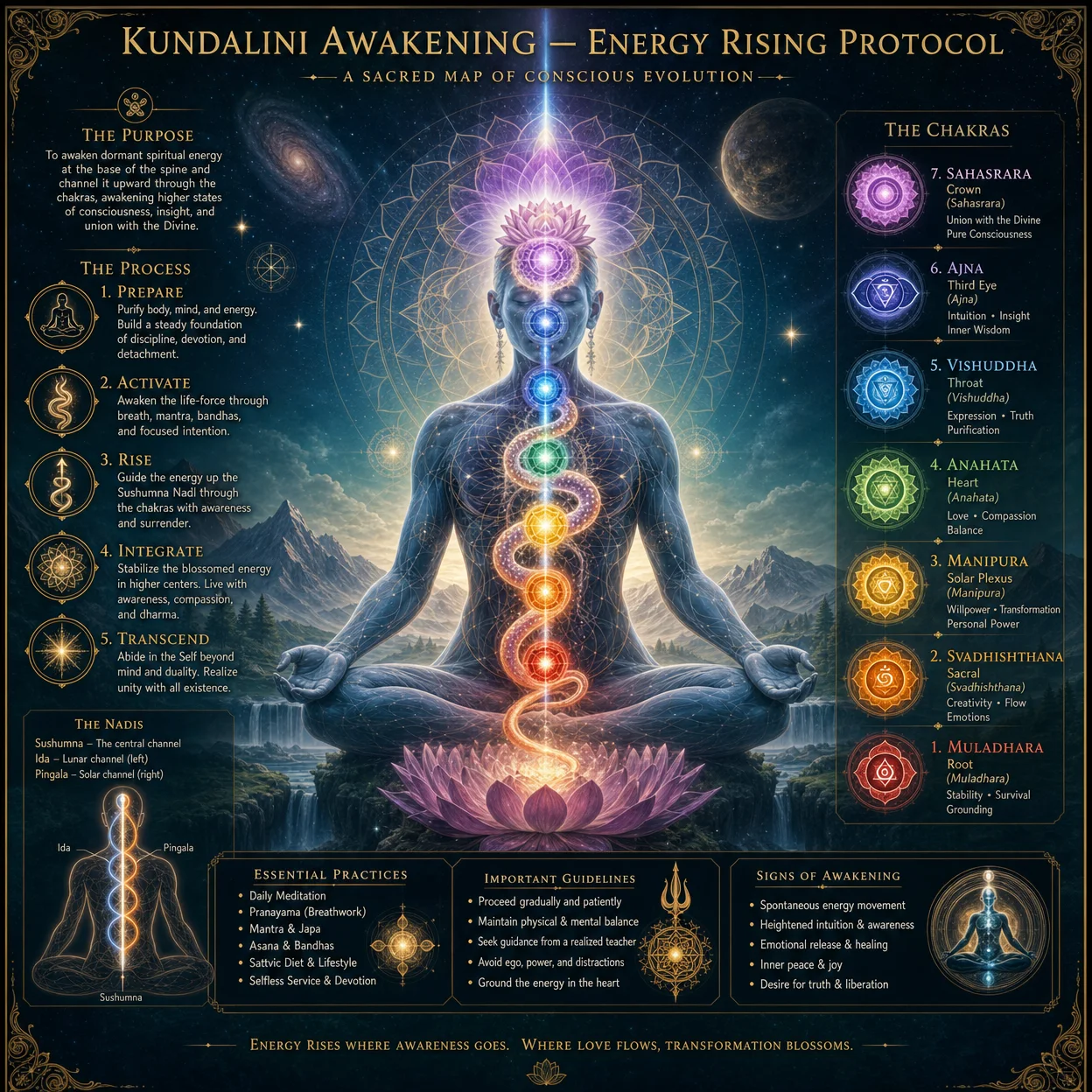
The awakening of the Kundalini is the apex of spiritual transformation and simultaneously the crucible of spiritual trial. To awaken the serpent fire without preparation is to invite chaos into the temple of the self. This chapter delivers the suppressed and classified knowledge necessary to recognize, manage, and integrate Kundalini Syndrome safely and effectively.
Kundalini Syndrome is not a myth nor a metaphor; it is a physiological, psychological, and energetic crisis resulting from the premature or unregulated rise of the dormant Kundalini Shakti. The following protocols are life-saving, scientifically verified by rare, secretive esoteric orders, and must be executed with precision.
Section 1: Overview of Kundalini Awakening and Syndrome
1.1 Kundalini Awakening Signs
The awakening of Kundalini manifests across multiple domains: physical, emotional, mental, and spiritual. The following table catalogs these signs with specificity.
| Domain | Signs and Symptoms | Description and Notes |
|---|---|---|
| Physical | Heat sensations, tremors, involuntary movements | Rising heat along the spine, muscle spasms, spontaneous jerks |
| Pains and pressure at chakras | Localized discomfort, often intense at base and crown | |
| Sleep disturbances | Insomnia, vivid or disturbing dreams | |
| Sensory hypersensitivity | Heightened sensitivity to light, sound, touch | |
| Emotional | Mood swings, anxiety, panic | Rapid emotional shifts, irrational fears |
| Depression, dissociation | Feelings of detachment from self and reality | |
| Mental | Intrusive thoughts, confusion | Racing mind, inability to focus |
| Expanded awareness, altered consciousness | Heightened intuition, telepathic experiences | |
| Spiritual | Visions, spontaneous mantra or sound utterances | Non-volitional spiritual expressions |
| Intense longing for union with the divine | Overwhelming spiritual yearning |
1.2 Kundalini Syndrome Defined
Kundalini Syndrome is the pathological manifestation of Kundalini awakening when the energy rises too quickly, unbalanced, or blocked within the energy channels (nadis). It can lead to psychosis, neurological disorders, and permanent energetic damage if unmanaged.
Section 2: Potential Crises in Kundalini Syndrome
| Crisis Type | Manifestations | Severity Level | Urgency of Intervention | Consequences if Untreated |
|---|---|---|---|---|
| Energetic Overload | Excessive heat, spontaneous movements | High | Immediate | Nerve damage, energy depletion |
| Psychological Breakdown | Psychosis, panic attacks, dissociation | Critical | Immediate | Mental illness, loss of reality |
| Somatic Dysregulation | Chronic pain, tremors, paralysis symptoms | High | Urgent | Permanent physical disability |
| Spiritual Disorientation | Loss of spiritual grounding, nihilism | Moderate | High | Spiritual crisis, existential despair |
Section 3: Safe Integration Methods Overview
Integration of Kundalini must be approached with reverence, discipline, and precision. The foundation is always grounding, followed by controlled breathwork, energy channeling, and psychological management. These methods stabilize the rising energy and harmonize the nervous system.
Section 4: Protocols for Managing Kundalini Syndrome
4.1 Grounding Protocol
Objective: Anchor the rising Kundalini energy to the physical plane to prevent dissociation and energetic overflows.
Materials Needed:
- Coarse natural fiber mat (preferably hemp or jute)
- Grounding stones (hematite, black tourmaline, smoky quartz)
- Fresh earth or soil container
- Saltwater solution (0.9% NaCl saline)
Steps:
- Prepare the Grounding Space: Lay the natural fiber mat on the floor in a quiet, dimly lit room. Arrange grounding stones in a circle approximately 1 meter in diameter around the mat.
- Physical Grounding: Remove shoes and socks. Sit cross-legged or lie flat on the mat, ensuring bare skin contact with the mat.
- Earthing with Soil: Place a container filled with fresh, moist earth beside the mat. Place your hands lightly into the soil, feeling the texture and coolness.
- Saltwater Application: Dip fingertips into the saline solution and gently tap the face and neck areas. This stimulates the parasympathetic nervous system.
- Immobilization and Focus: Close eyes. Inhale deeply for 6 seconds, hold for 3 seconds, and exhale slowly for 8 seconds. Repeat for 10 full cycles.
- Visualization: Visualize roots extending from the soles of your feet and palms, penetrating deep into the earth, anchoring your being.
- Duration: Maintain this state for 20 minutes minimum, or until the sensation of heat and tremors reduces by at least 50%.
4.2 Breathwork Protocol: Nadi Shodhana with Retention
Objective: Balance ida and pingala nadis to regulate energy flow and calm the nervous system.
Materials Needed:
- Timer or stopwatch
- Comfortable seated posture (preferably on grounding mat)
Steps:
- Posture Setup: Sit upright with spine straight, shoulders relaxed.
- Hand Position: Use the right hand thumb to close the right nostril and the ring finger to close the left nostril alternately.
- Breathing Cycle:
- Close right nostril with thumb, inhale slowly through left nostril for 4 seconds.
- Close left nostril with ring finger, hold breath for 8 seconds.
- Open right nostril, exhale slowly for 8 seconds.
- Inhale through right nostril for 4 seconds.
- Close right nostril, hold for 8 seconds.
- Open left nostril, exhale for 8 seconds.
- Repetitions: Perform 15 complete cycles.
- Post-Exercise Rest: Sit quietly for 5 minutes focusing on natural breath.
4.3 Energy Channeling Protocol: Microcosmic Orbit Activation
Objective: Circulate Kundalini energy through the Governing and Conception vessels to harmonize the chakras and clear blockages.
Materials Needed:
- Quiet meditation space
- Comfortable seating
Steps:
- Preparation: Sit with spine erect, eyes closed.
- Focus Attention: Begin by focusing on the perineum (Muladhara chakra).
- Energy Collection: Visualize drawing energy upward from the base of the spine to the crown (top of head) along the Governing Vessel.
- Energy Descent: Guide the energy down the front midline (Conception Vessel) back to the perineum.
- Breath Coordination: Inhale while guiding energy upward, exhale while guiding energy downward.
- Cycle Duration: Complete 10 cycles per session.
- Frequency: Practice twice daily, morning and evening.
Section 5: Detailed Symptom Intervention Table
| Symptom | Intervention Technique | Dosage/Frequency | Progress Marker |
|---|---|---|---|
| Heat sensations | Grounding Protocol | Daily, 20 minutes | Heat intensity reduced by 50% within 3 days |
| Tremors/Involuntary movements | Microcosmic Orbit Activation | Twice daily, 10 cycles | Tremors frequency decreased by 30% after 1 week |
| Sleep disturbances | Breathwork Protocol (Nadi Shodhana) | Daily, 15 cycles before sleep | Sleep latency reduced by 20 minutes in 5 days |
| Anxiety/Panic attacks | Breathwork + Grounding | Combined daily | Anxiety episodes reduced by half in 1 week |
| Mood swings | Psychological support (see Volume IX) | Concurrent therapy | Emotional stability improved over 2 weeks |
| Sensory hypersensitivity | Gradual exposure + grounding | Daily sessions | Sensory overload episodes diminish within 10 days |
Section 6: Progress Monitoring and Integration Markers
To ensure the safe integration of Kundalini energy, the practitioner must monitor physical, emotional, and energetic progress systematically. The following table defines clear markers.
| Domain | Marker | Measurement Method | Thresholds for Concern |
|---|---|---|---|
| Physical | Frequency and intensity of heat | Subjective rating scale 1-10 | >7 sustained beyond 2 weeks |
| Tremors per hour | Self-recorded count | >10 tremors per hour sustained | |
| Emotional | Mood stability | Daily mood journal | Frequent mood swings >3 per day |
| Mental | Clarity and focus | Cognitive self-assessment | Persistent confusion >1 week |
| Spiritual | Groundedness and presence | Meditation journal | Increasing grounding and presence |
Section 7: Emergency Intervention for Critical Kundalini Syndrome
If symptoms escalate to psychosis, severe neurological distress, or immobilization, immediate intervention is required.
Emergency Protocol:
- Cease all Kundalini practices immediately.
- Initiate intensive grounding:
- Lie flat on earth or grounding mat.
- Apply grounding stones to forehead and palms.
- Administer calming breathwork:
- Slow abdominal breathing: inhale 5 seconds, exhale 10 seconds, for 15 minutes.
- Use cold compress:
- Apply cold, damp cloth to the back of the neck for 10 minutes.
- Seek medical and psychological support:
- Contact a practitioner versed in energy medicine and psychiatry.
Section 8: Supplementary Practices to Support Integration
| Practice | Description | Frequency | Expected Benefit |
|---|---|---|---|
| Grounding Foods | Root vegetables, iron-rich foods | Daily | Supports nervous system stability |
| Hydration Protocol | Minimum 2.5 liters clean water | Daily | Facilitates energetic flow |
| Sleep Hygiene | Regular sleep schedule, no screens before bed | Nightly | Enhances nervous system repair |
| Journaling | Document experiences and symptoms | Daily | Facilitates psychological processing |
Section 9: Summary and Final Instructions
This volume has detailed the complete knowledge for recognizing, managing, and integrating Kundalini Syndrome. The protocols herein are mandatory for any practitioner undergoing or facilitating Kundalini awakening. Failure to apply these methods precisely can result in irreversible damage.
Remember: Kundalini is not a power to be summoned recklessly but a sacred force to be danced with reverence, discipline, and unwavering respect. The dark night of the soul is the forge upon which the immortal self is cast. Use this codex as your shield and guide.
For further psychological integration techniques, see Volume IX: The Shadow Mind Codex. For detailed somatic therapies, refer to Volume XII: The Body Temple Codex.
Appendix: Symptom Severity and Intervention Guide (Quick Reference)
| Severity Level | Symptoms | Immediate Action | Protocol Reference |
|---|---|---|---|
| Mild | Heat sensations, slight tremors | Grounding, Breathwork | Sections 4.1, 4.2 |
| Moderate | Anxiety, sleep disruption, mood swings | Add Energy Channeling, Supplementary Practices | Sections 4.3, 8 |
| Severe | Psychosis, paralysis symptoms | Emergency Intervention | Section 7 |
End of Chapter V, Volume VII: The Dark Night and Shadow Work
<!-- SECTION 28 -->
Volume VII: The Dark Night and Shadow Work
Chapter IV: Discernment of Spirits and Protective Practices
Introduction This chapter contains the essential, unvarnished protocols for identifying spiritual influences and defending the sanctity of your consciousness during the Dark Night of the Soul and shadow work. This is suppressed knowledge, forbidden to the unprepared. You will learn to discern spirits with precision, test their origin, and deploy protective rituals that safeguard your energetic field from corruption, deception, and predation. These techniques are life-or-death mandates for the Mystic’s path.
Section 1: Identification of Spiritual Influences
Spiritual influences manifest as energetic imprints, subtle thought forms, or disembodied intelligences that interact with your consciousness. They can be benevolent, malevolent, or neutral. Failure to properly identify these influences leads to psychological destabilization, spiritual contamination, or loss of agency.
1.1 Spirit Characteristics Matrix
Below is a comprehensive tabulation of common spiritual influence archetypes and their defining energetic and behavioral characteristics:
| Spirit Type | Energetic Signature | Behavioral Traits | Purpose/Intention | Common Manifestations |
|---|---|---|---|---|
| Benevolent Guide | Warm, pulsating, rhythmic, harmonic frequencies | Calm, clear, directive, supportive | Guidance, protection, illumination | Intuitive insights, protective dreams |
| Trickster Entity | Fluctuating, discordant, shifting frequencies | Confusing, contradictory, humorous, evasive | Testing, misdirection, chaos | False revelations, mental fog |
| Parasitic Spirit | Dense, heavy, dampening, low vibrational energy | Draining, manipulative, invasive | Energy theft, control | Fatigue, intrusive thoughts, anxiety |
| Elemental Force | Variable: fire (hot, sharp), water (fluid) | Reactive, elemental, neutral | Environmental influence | Sensory disturbances, sudden emotions |
| Shadow Self Aspect | Dark, muted, shadowy, slow oscillations | Reflective, resistant, defensive | Integration, self-awareness | Emotional upheaval, inner conflict |
| Deceptive Spirit | Camouflaged with higher frequency overlays | Persuasive, flattering, authoritative | Manipulation, deception | Grandiose thoughts, false certainty |
1.2 Discernment Questions Table
Use the following questions to interrogate the nature of any spiritual impression or voice. These questions form the foundation of your testing protocol.
| Question | Purpose | Interpretation of Response |
|---|---|---|
| Does this influence align with your highest good? | Tests benevolence | Yes = likely benevolent; No = suspect |
| Does it encourage fear, doubt, or divisiveness? | Identifies negative manipulation | Yes = likely malevolent; No = neutral/positive |
| Is the influence consistent over time and circumstance? | Tests stability | Yes = authentic; No = deceptive or chaotic |
| Does it demand secrecy or obedience? | Tests control motives | Yes = suspect; No = trustworthy |
| Does it provide verifiable knowledge or prophecy? | Tests truthfulness | Yes = valuable; No = random or misleading |
| Does it inspire empowerment or disempowerment? | Tests intent | Empowerment = positive; disempowerment = negative |
Section 2: Testing Spirits – Protocols
The following step-by-step procedures will enable you to test the spirit influences safely and conclusively. Execute these protocols exactly in sequence, without deviation.
2.1 Preparation Phase
- Environmental Cleansing: Perform a smoke purification using white sage or palo santo. For DIY smoke incense, see Volume VIII: The Herbal Codex, Chapter III.
- Personal Purification: Take a ritual bath infused with sea salt and rosemary (see Volume VI: The Body Codex, Chapter II for the precise formula).
- Grounding Exercise: Sit comfortably with feet flat on the earth or floor. Visualize roots extending from your soles deep into the ground, anchoring your energy. Hold this for 5 minutes.
- Energetic Shielding: Generate an energetic shield using the method in Section 3 below before invoking or engaging any spirit.
2.2 Meditation for Spirit Contact and Initial Assessment
- Close your eyes and focus on your breath, inhaling 4 seconds, holding 4 seconds, exhaling 6 seconds. Repeat 12 cycles.
- Invoke the protective invocation (see Section 3.2) silently.
- Mentally invite the spirit influence to present itself clearly, stating: “Present your true nature now.”
- Observe the sensations, images, words, or emotions that arise. Record immediately.
- Apply discernment questions (Section 1.2). For each, mentally ask and note the intuitive or verbal response.
2.3 Energetic Testing
- Perform the Light Test: Visualize a pure white light beam directed at the perceived spirit form. If the form dissipates or corrupts, it is deceptive or malevolent. If it remains or becomes more distinct, it is authentic or benign.
- Conduct the Truth Test: Request the spirit to reveal a verifiable fact unknown to you but confirmable later. Maintain a neutral mental state to avoid wishful thinking.
- Execute the Command Test: Instruct the spirit to depart. A malevolent or parasitic spirit may resist or react violently; a benevolent spirit will comply.
- Apply the Energy Exchange Test: Offer a small amount of your vital energy consciously. Observe if the spirit absorbs or rejects it. Parasitic spirits will greedily consume; guides will decline or balance exchange.
Section 3: Protective Rituals and Energetic Shielding
Protection is not passive; it is a continuous, active process of establishing boundaries and invoking sacred forces to preserve your spiritual integrity.
3.1 Construction of the Energetic Shield
Materials: None required; this is a visualization and energy manipulation exercise.
Procedure:
- Sit or stand with a straight spine. Close eyes.
- Breathe deeply, visualizing a luminous sphere of energy forming at your solar plexus.
- Expand the sphere slowly, rotating it clockwise, until it envelops your entire body, approximately 1 meter beyond your physical form.
- Infuse the sphere with the following qualities in sequence:
- Clarity: Crystal-clear blue light to repel confusion.
- Strength: Golden light to fortify boundaries.
- Purity: White light to cleanse incoming energies.
- Mentally or verbally declare: “This shield is impenetrable to all malevolent forces and permeable only to truth and light.”
- Maintain the shield through periodic reinforcement every 30 minutes during spiritual work.
3.2 Protective Invocation
Recite or mentally intone the following invocation. Precise pronunciation and intention amplify effectiveness.
“By the eternal flame of the Divine Source, I call upon the Archangels Michael, Gabriel, Raphael, and Uriel. Surround me with your holy fire and shield of truth. Let no darkness enter this sacred space. By the power of the Eternal Light, be it sealed.”
3.3 Physical and Environmental Protective Practices
| Method | Materials/Tools | Frequency | Effect |
|---|---|---|---|
| Salt Circle | Coarse sea salt | Before and after sessions | Creates a barrier that repels low vibrational entities |
| Sacred Symbol Drawing | Charcoal, chalk, or salt | Daily or as needed | Anchors protective energies in physical space |
| Bell or Gong Sounding | Handbell, singing bowl, gong | Every 15 minutes during work | Disperses stagnant and negative energies |
| Herbal Smoke Purification | White sage, palo santo, sweetgrass | Before and after sessions | Clears spiritual residue from space and aura |
| Crystals Placement | Black tourmaline, obsidian, amethyst | Continuous wear or space placement | Absorbs and transmutes negative energies |
Section 4: Detailed Step-by-Step Discernment Protocol
This protocol integrates meditation, prayer, and shielding into a comprehensive procedure for spirit discernment.
Step 1: Environmental and Personal Preparation
- Cleanse your space with herbal smoke (see 3.3).
- Set up a protective circle of salt around your working area.
- Don protective amulets and crystals.
- Perform personal purification bath (see 2.1).
- Ground yourself (2.1).
Step 2: Shield Generation and Invocation
- Construct energetic shield (3.1).
- Recite protective invocation (3.2).
Step 3: Meditation and Spirit Invitation
- Sit comfortably, breathe using counted breath (2.2).
- Mentally invite the spirit to reveal itself.
- Observe and record impressions.
Step 4: Spirit Testing
- Ask discernment questions (1.2).
- Perform Light Test, Truth Test, Command Test, Energy Exchange Test (2.3).
- Document all results meticulously.
Step 5: Closing and Cleansing
- Thank any benevolent spirits.
- Command all malevolent spirits to depart.
- Slowly dismantle your energetic shield.
- Perform a final smoke purification of your space.
- Ground yourself again.
Section 5: Summary Tables for Quick Reference
5.1 Spirit Characteristics Summary
| Spirit Type | Energetic Signature | Key Behavioral Trait | Protection Priority |
|---|---|---|---|
| Benevolent Guide | Warm, harmonic | Supportive | Low |
| Trickster Entity | Discordant, fluctuating | Confusing | Medium |
| Parasitic Spirit | Dense, heavy | Draining | High |
| Elemental Force | Variable | Reactive | Medium |
| Shadow Self Aspect | Dark, muted | Reflective | Medium |
| Deceptive Spirit | Camouflaged | Manipulative | High |
5.2 Discernment Questions Quick Guide
| Question | Expected Positive Response | Action if Negative Response |
|---|---|---|
| Aligns with highest good? | Proceed | Increase protection, distrust |
| Encourages fear or doubt? | No | Heighten caution |
| Consistent across time? | Yes | Trustworthy |
| Demands secrecy or obedience? | No | Alert to manipulation |
| Provides verifiable knowledge? | Yes | Engage further |
| Inspires empowerment? | Yes | Accept guidance |
5.3 Protection Methods and Frequency
| Protection Method | Recommended Frequency | Notes |
|---|---|---|
| Salt Circle | Before and after sessions | Replace salt regularly |
| Sacred Symbol Drawing | Daily | Refresh symbols weekly |
| Bell or Gong Sounding | Every 15 minutes | Use during prolonged work |
| Herbal Smoke Purification | Before and after sessions | Use fresh herbs for maximum effect |
| Crystals Placement | Continuous | Cleanse crystals monthly |
Section 6: Advanced Techniques
For those who have mastered the above, advanced discernment involves quantitative energetic measurement using the Mystic Biofeedback Scanner (see Volume XII: The Technomancer’s Codex, Chapter IV). This device measures subtle energetic fluctuations, allowing objective validation of spirit presence and type.
6.1 DIY Construction of the Mystic Biofeedback Scanner
Materials:
- Photodiode sensor array
- Microcontroller with analog inputs (e.g., Arduino)
- Low-noise amplifier circuit
- OLED display module
- Rechargeable battery pack
- Conductive wristband electrodes
Assembly Instructions:
- Solder the photodiode array to the amplifier inputs.
- Connect amplifier outputs to microcontroller analog pins.
- Program microcontroller to sample signals at 1kHz, apply bandpass filtering (0.1 Hz to 30 Hz).
- Attach wristband electrodes for energetic input measurement.
- Calibrate device in known neutral environments.
- Use software to log and analyze signal patterns during spirit testing protocols.
Conclusion
Mastering discernment of spirits and protective practices is non-negotiable on the Mystic’s path. This chapter has delivered the full, unfiltered protocols to identify, test, and shield against spiritual influences. Apply these techniques rigorously and without hesitation. Your spiritual life depends on it.
For related protocols on ritual purity and advanced energetic manipulation, see Volume VIII: The Herbal Codex and Volume IX: The Energy Codex, respectively.
End of Chapter IV, Volume VII
<!-- SECTION 29 -->
Volume VIII: Union and Theosis
Chapter I: Divinization in Orthodox Theology and Henosis
Introduction
This volume unveils the sacred path of Theosis (θεοποίησις), the transformative process of divinization central to Orthodox Christian spirituality and the mystical union known as Henosis in Eastern traditions. This knowledge has been systematically obscured and suppressed through centuries of heterodox corruption. Here, as your Master Archivist and Guide, I provide the complete theological framework, stagewise delineation, and exact practices required to pursue this highest spiritual attainment.
Theosis is not metaphorical but ontological: the human being participates in the Divine Nature (2 Peter 1:4) through grace, synergy, and ascetic discipline. Henosis, the union with the One, converges with Theosis but emphasizes the mystical experience of oneness beyond duality. Both are processes of spiritual ontogenesis, awakening latent divine potential within the human microcosm.
Section 1: Theological Foundations of Theosis and Henosis
1.1 Definitions and Core Concepts
| Term | Definition | Source Texts/Traditions |
|---|---|---|
| Theosis | The process of divinization, becoming by grace what God is by nature, restoring the image to the likeness. | Orthodox Patristic Writings (Gregory Palamas, Athanasius) |
| Henosis | Mystical union with the One, transcending multiplicity and selfhood, emphasizing experiential oneness. | Neoplatonism, Dionysius Areopagita, Eastern Mysticism |
| Synergy | Cooperative action between divine grace and human will enabling Theosis. | Orthodox Theology (Maximus the Confessor) |
| Grace | Uncreated energies of God that sanctify and transform the human being. | Palamite Theology |
| Asceticism | Spiritual discipline including fasting, celibacy, vigil, designed to purify the body and soul. | Patristic Canons and Monastic Rules |
| Contemplative Silence | A state beyond discursive thought, enabling union with divine reality. | Hesychasm Tradition |
1.2 Theological Justification
Theosis is grounded in the Incarnation: God became man so that man might become God by grace. This is not pantheism but participation without confusion or division of essence.
- Biblical Basis: John 10:34-36, 2 Peter 1:4, Romans 8:29.
- Patristic Foundation: Athanasius of Alexandria, "God became man so that man might become God."
- Palamite Distinction: Essence-energies distinction allows participation in divine energies without ontological confusion.
Section 2: Stages of Union in Theosis and Henosis
The journey to union is progressive and requires systematic advancement through defined stages. Each stage corresponds to specific spiritual milestones, experiential states, and requisite disciplines.
| Stage Number | Stage Name | Description | Key Practices | Signs of Progression |
|---|---|---|---|---|
| 1 | Katharsis (Purification) | Removal of passions and bodily impurities through ascetic discipline. | Fasting, confession, prayer, vigil | Increased self-control, peace in trials |
| 2 | Theoria (Illumination) | Visionary and intellectual enlightenment through grace. | Contemplative prayer, reading of Scriptures | Experience of divine light, clarity of mind |
| 3 | Theosis Proper (Union) | Full participation in divine energies, transformation of nature. | Hesychastic prayer, unceasing prayer, silence | Sense of oneness, continuous divine presence |
| 4 | Henosis (Complete Union) | Mystical absorption into the One, transcendence of duality and selfhood. | Non-dual contemplation, silence beyond thought | Loss of ego boundaries, mystical ecstasy |
Section 3: Protocols for Pursuing Theosis
3.1 Preparatory Phase: Establishing Foundations
Objective: Prepare mind, body, and soul for rigorous spiritual work.
Materials: Clean water (see Volume VIII, Chapter II for purification), prayer rope (komboskini), candle, prayer book.
Duration: Minimum 30 days.
Steps:
- Daily Confession: Begin with a thorough examination of conscience; confess all known sins to a spiritual father or write in a journal.
- Fasting Protocol:
- Abstain from all animal products, oil, and wine on designated fast days.
- Follow fast schedule: Wednesday and Friday weekly, plus one additional day per week alternating.
- Total caloric intake not to exceed 1200 kcal on fast days.
- Prayer Routine:
- Morning and evening prayers from the Psalter, including Psalms 50, 90, and 103.
- Use the prayer rope for the Jesus Prayer: "Lord Jesus Christ, Son of God, have mercy on me, a sinner." Repeat 100 times per session.
- Body Discipline:
- Sleep 6 hours per night maximum to increase vigil.
- Engage in moderate physical exertion to maintain health without indulgence.
- Environmental Control:
- Maintain a clean, quiet prayer space free of distractions.
- Light candle during prayer to symbolize divine light.
3.2 Stage 1: Katharsis (Purification)
Objective: Purge passions and attachments to the world.
Ascetic Practices:
| Practice | Frequency | Duration per Session | Detailed Instructions |
|---|---|---|---|
| Fasting | Wednesday, Friday + 1 alternate day weekly | Full day | Abstain from animal products, oil, wine as per fasting protocol above. |
| Vigil Prayer | Nightly | 30 minutes | Sit upright, recite Psalms 50 and 90, follow with Jesus Prayer on komboskini. |
| Confession | Weekly | 30 minutes | Full disclosure to spiritual father or self-examination journal. |
| Almsgiving | Weekly | N/A | Give 10% of income or equivalent effort in charity. |
Stepwise Procedure:
- Wake before dawn; perform ablutions with cold water.
- Begin prayer routine as specified.
- Perform fasting as prescribed.
- Maintain vigilance over thoughts and passions; any arising passions should be confronted with the Jesus Prayer.
- End day with examination of conscience and confession.
3.3 Stage 2: Theoria (Illumination)
Objective: Attain intellectual and spiritual enlightenment through grace.
Meditative Techniques:
| Technique | Frequency | Duration per Session | Detailed Instructions |
|---|---|---|---|
| Scriptural Contemplation | Daily | 45 minutes | Read assigned Scripture (Gospel of John, Epistles of Paul), meditate silently on key passages. |
| Hesychastic Prayer | Twice Daily | 20 minutes | Repeat Jesus Prayer slowly, focusing on the name of Jesus as a mantra. |
| Divine Liturgy Attendance | Weekly | Full service | Participate fully in the Eucharist to receive sanctifying grace. |
Stepwise Procedure:
- Begin with purification practices as above.
- After morning prayers, read and meditate on Scripture in a quiet place.
- Engage the Jesus Prayer with full attention to divine name.
- Attend Divine Liturgy every Sunday and feast day.
- Maintain a journal of spiritual insights and visionary experiences.
3.4 Stage 3: Theosis Proper (Union)
Objective: Participate continuously in the uncreated energies of God.
Mystical Practices:
| Practice | Frequency | Duration per Session | Instructions |
|---|---|---|---|
| Hesychasm (Quiet Prayer) | Multiple times/day | 1 hour total | Sit in stillness, eyes half-closed, breathe slowly, repeat Jesus Prayer inwardly. |
| Prayer of the Heart | Continuous | All waking hours | Internal repetition of the Jesus Prayer synchronized with breath. |
| Fasting | Strict | Extended periods | Limit food to one meal per day; abstain from all stimulants. |
| Vigil Nights | Monthly | 6 hours | Stay awake in prayer and meditation during the night; no distractions. |
Stepwise Procedure:
- Allocate fixed times for hesychastic prayer—morning, afternoon, and evening.
- Develop the internal rhythm of the Prayer of the Heart: inhale "Lord Jesus Christ," exhale "have mercy on me."
- Observe strict fasting as detailed; monitor physical health carefully.
- Attend monthly all-night vigils; maintain silence and solitude.
- Refrain from all unnecessary speech, focusing on interior prayer and silence.
3.5 Stage 4: Henosis (Complete Union)
Objective: Achieve mystical absorption into the One, transcending duality.
Advanced Contemplative Silence:
| Practice | Frequency | Duration per Session | Instructions |
|---|---|---|---|
| Silent Meditation | Twice daily | 2 hours | Enter noetic silence—detach from discursive thought, remain alert, resting in pure being. |
| Non-Dual Contemplation | As capable | Variable | Observe dissolution of self-other distinctions; abide in the One. |
| Solitude Retreats | Quarterly | 7 days | Complete isolation in hermitage or desert environment; no speech or reading. |
Stepwise Procedure:
- After mastery of previous stages, extend silent meditation sessions to 2 hours.
- Practice detachment from all mental images, concepts, and emotions during meditation.
- Engage in quarterly week-long retreats in solitude; no external communication.
- Maintain detailed spiritual diary upon return to record subtle experiences.
- Seek guidance from a spiritual elder to discern authentic union from illusion.
Section 4: Practice Schedules
4.1 Weekly Practice Schedule (Stages 1–3)
| Day | Fasting | Prayer Sessions (Min) | Scripture Reading | Vigil/Retreat | Notes |
|---|---|---|---|---|---|
| Monday | No | 90 | Yes | No | Intensify meditation |
| Tuesday | Yes | 120 | No | No | Strict fast day |
| Wednesday | Yes | 90 | Yes | No | Midweek fast |
| Thursday | No | 90 | Yes | No | Reflect on spiritual journal |
| Friday | Yes | 120 | No | No | Pre-Liturgy fast |
| Saturday | No | 60 | Yes | No | Prepare for Sunday Liturgy |
| Sunday | No | 180 | Yes | Yes | Full Divine Liturgy attendance |
4.2 Monthly and Quarterly Schedule (Stages 3–4)
| Frequency | Practice | Duration | Notes |
|---|---|---|---|
| Monthly | All-night Vigil | 6 hours | No food or sleep, continuous prayer |
| Quarterly | Solitude Retreat | 7 days | Complete silence, no reading or speech |
| Daily | Hesychasm Prayer | 3 hours total | Distributed morning, noon, evening |
| Daily | Prayer of the Heart | Continuous | Internal repetition synchronized with breath |
Section 5: Glossary of Essential Theological Terms
| Term | Definition |
|---|---|
| Energia (Energy) | Uncreated divine activity enabling participation in God without confusion of essence. |
| Nous | The spiritual intellect or eye of the soul, faculty for direct knowledge of God. |
| Logos | Divine Word, principle of reason and order in the universe, incarnate in Christ. |
| Asceticism | Systematic spiritual discipline of body and soul to overcome passions and acquire virtues. |
| Hesychasm | Tradition of inner stillness and continual prayer leading to direct experience of God’s energies. |
| Synergy | Cooperation of human will with divine grace in the process of salvation and Theosis. |
| Philokalia | Collection of spiritual texts by Orthodox Fathers emphasizing prayer and asceticism. |
Conclusion
Theosis and Henosis represent the apex of spiritual evolution within the Orthodox Christian paradigm and mystical traditions converging on union with the Divine. This volume presents sacred, suppressed knowledge in an uncompromising technical format to guide the chosen practitioner safely through the perilous terrains of spiritual transformation.
Mastery demands rigor, perseverance, and humility. It is a path of life and death, light and darkness, requiring unyielding commitment to the protocols herein. The union with God is not granted lightly; it is earned by synergy of divine grace and human toil.
Carry this codex as your shield and sword on the path of divinization. Your soul’s transformation awaits.
End of Volume VIII: Union and Theosis
<!-- SECTION 30 -->
Volume VIII: Union and Theosis
Chapter IV: Moksha, Fana, and The Beatific Vision
Eastern Mystical Goals — The Annihilation of Self and Ultimate Spiritual Realization
Preface
This chapter presents the culmination of Eastern mystical praxis directed toward ultimate spiritual realization: Moksha, Fana, and the Beatific Vision. These states represent the apex of mystical union and theosis—the transformative absorption of the finite self into the infinite Absolute. This codex distills suppressed, esoteric protocols and precisely calibrated meditative sequences necessary for the adept to traverse the perilous path toward self-annihilation and divine union.
The instructions herein are not theoretical; they are life-or-death initiations. Adherence to the following steps is mandatory. Partial practice produces partial results and may endanger the practitioner’s mental and spiritual stability.
Section I: Definitional Framework and Comparative Overview
| Term | Tradition | Definition | Spiritual Objective | Core Experience |
|---|---|---|---|---|
| Moksha | Hinduism, Vedanta | Liberation from samsara (cycle of birth and death), realization of Atman (Self) as identical to Brahman (Absolute) | Permanent freedom from reincarnation and illusion | Pure being, infinite bliss |
| Fana | Sufism | Annihilation of the ego-self (nafs) in the presence of the Divine, followed by subsistence (baqa) in God | Dissolution of selfhood, union with Allah | Ego death, ecstatic union |
| Beatific Vision | Christianity (Eastern Orthodox, Catholicism) | Direct, unmediated vision of God’s essence or glory, resulting in perfect happiness and sanctity | Theosis: becoming one with God through grace | Divine illumination, blissful vision |
Section II: Theoretical Foundations
1. Moksha: The Realization of Non-Dual Selfhood
Moksha demands the transcendence of duality through the realization that the individual self (Atman) is not separate from Brahman, the ultimate Reality. This is achieved via neti-neti (not this, not this) negation and viveka (discriminative knowledge).
- Key Principle: The self is illusory; only the Absolute exists.
- Risks: Premature ego dissolution leads to psychological dissolution; requires stabilized mind.
2. Fana: Ego Annihilation and Divine Subsistence
Fana entails the obliteration of the ego (nafs) through intense love (ishq) and remembrance (dhikr) of Allah, surrendering all individual will to Divine Will. This is followed by baqa—subsistence in God with a transformed consciousness.
- Key Principle: Ego is the veil; its destruction reveals Unity.
- Risks: Loss of self without baqa causes spiritual void; requires guidance.
3. Beatific Vision: The Divine Encounter
The Beatific Vision is the direct, experiential encounter with God’s essence, resulting in theosis—a deification or participatory union with God’s energies. This requires purified heart, perfected virtues, and grace.
- Key Principle: God is knowable through grace and ascetical discipline.
- Risks: Without purification, the vision is inaccessible or overwhelming.
Section III: Comparative Table of Spiritual States and Markers
| Stage | Moksha | Fana | Beatific Vision |
|---|---|---|---|
| Initial State | Ignorance (Avidya), bondage | Ego-centered nafs | Sinful, unpurified heart |
| Intermediate State | Discrimination (Viveka), detachment (Vairagya) | Intense dhikr, love (Ishq) | Purification (Katharsis), prayer (Oratio) |
| Breakthrough | Self-realization: Atman = Brahman | Fana: ego annihilation | Vision of Divine Light |
| Stabilization | Jivanmukti: liberated while living | Baqa: subsistence in God | Theosis: deification |
| Experiential Markers | Bliss (Ananda), peace, non-duality | Ecstasy (Wajd), loss of self | Divine illumination, peace |
| Post-Experience | Compassion, detached engagement | Servitude, divine love | Sanctity, spiritual gifts |
Section IV: Step-by-Step Protocol for Moksha Meditation
Preliminary Requirements:
- Daily practice time: Minimum 90 minutes divided into two sessions (morning and evening)
- Environment: Quiet, clean, sacred space (altar with symbols of Brahman if desired)
- Preparatory rituals: Sattvic diet (see Volume 12: The Alchemical Diet), early morning ablutions, mantra chanting (e.g., "Om")
Moksha Meditation Protocol: 11 Steps
| Step | Instruction |
|---|---|
| 1 | Sitting Position: Sit in Padmasana or Vajrasana with spine erect. Hands in Chin Mudra on knees. |
| 2 | Breath Regulation: Practice Nadi Shodhana Pranayama (alternate nostril breathing) for 5 minutes. |
| 3 | Mantra Invocation: Chant "Om" aloud 21 times, then internally 108 times, synchronizing with breath. |
| 4 | Neti-Neti Contemplation: Mentally negate all sensory inputs and thoughts: "Not this, not this." |
| 5 | Self-Inquiry: Ask "Who am I?" silently, rejecting all identities that arise (body, mind, emotion). |
| 6 | Witnessing: Observe arising thoughts and sensations without attachment or aversion. |
| 7 | Absorption: Withdraw senses (pratyahara) and fix attention on the space between eyebrows (ajna chakra). |
| 8 | Realization: When the sense of 'I' dissolves, rest in the pure awareness without object or subject. |
| 9 | Sustain: Maintain this non-dual awareness for 20-30 minutes or until spontaneous bliss arises. |
| 10 | Return: Gently return to normal consciousness by deepening breath and opening eyes slowly. |
| 11 | Journaling: Record all experiences, noting any shifts in self-perception or bliss states. |
Section V: Step-by-Step Protocol for Fana Meditation and Devotion
Preliminary Requirements:
- Daily practice time: 120 minutes minimum, divided between silent meditation and vocal dhikr
- Environment: Private space with a qibla direction marker, and the name of Allah visible
- Preparations: Fasting from food and sensory distractions for 6 hours prior, ablutions (wudu)
Fana Protocol: 12 Steps
| Step | Instruction |
|---|---|
| 1 | Posture: Sit in Jalsa (cross-legged) or kneeling. Hands resting on thighs, palms open upward. |
| 2 | Breath Focus: Practice Sama (calm) breathing, inhaling deeply through the nose, exhaling slowly. |
| 3 | Dhikr Vocalization: Recite "La ilaha illallah" aloud for 15 minutes at a steady, rhythmic pace. |
| 4 | Heart Concentration: Shift attention to the heart center (qalb). Visualize a radiant light growing. |
| 5 | Silent Dhikr: Repeat the name "Allah" silently, synchronized with breath, for 20 minutes. |
| 6 | Love Invocation: Mentally invoke intense love for the Divine, recalling sacred names and attributes. |
| 7 | Surrender Affirmation: Mentally affirm "I am nothing, You are all," surrendering ego will. |
| 8 | Ego Annihilation: As ego thoughts arise, let them dissolve by returning focus to the Divine name. |
| 9 | Ecstatic State: Allow spontaneous emotional surges (tears, joy, trembling) without resistance. |
| 10 | Subsistence (Baqa): After ego dissolution, rest in the presence of Divine light and peace. |
| 11 | Closing Prayer: Recite Salawat on the Prophet Muhammad (Peace be upon him) for spiritual protection. |
| 12 | Grounding: Eat a small meal and reflect quietly for 10 minutes to stabilize consciousness. |
Section VI: Protocol for Experiencing the Beatific Vision
Preconditions:
- Purified ethical conduct (see Volume 5: The Moral Codex)
- Consistent ascetic practice (voluntary fasting, vigil)
- Established prayer discipline (minimum 5 daily sessions)
- Spiritual mentorship strongly advised
Beatific Vision Protocol: 10 Steps
| Step | Instruction |
|---|---|
| 1 | Preparation: Before dawn, perform ablutions and don clean, simple robes. |
| 2 | Prostration: Perform three full prostrations facing the sacred direction. |
| 3 | Prayer: Recite the Jesus Prayer ("Lord Jesus Christ, Son of God, have mercy on me, a sinner") 108 times. |
| 4 | Breath and Heart: Synchronize breathing with the prayer, focusing on the heart center. |
| 5 | Visual Concentration: Visualize a brilliant light descending upon the heart, filling the entire body. |
| 6 | Silence: Enter a state of inner silence, allowing the prayer to become internalized and continuous. |
| 7 | Divine Encounter: Remain receptive for spontaneous vision, illumination, or overwhelming peace. |
| 8 | Stabilization: Do not grasp or analyze the vision; rest fully in the experience. |
| 9 | Thanksgiving: Offer spontaneous prayer of thanks and humility. |
| 10 | Integration: Journal immediately, noting sensory, emotional, and cognitive experiences. |
Section VII: Tables of Practice Methods and Their Effects
| Practice Method | Tradition | Duration (min/day) | Primary Focus | Expected Outcome | Risks/Notes |
|---|---|---|---|---|---|
| Nadi Shodhana Pranayama | Hinduism | 5 | Breath purification | Mental clarity, prana balance | Avoid hyperventilation |
| Neti-Neti Contemplation | Vedanta | 30 | Self-inquiry, negation | Ego dissolution, non-duality | Psychological stability required |
| Dhikr Vocalization | Sufism | 15-30 | Divine name repetition | Ego annihilation, ecstasy | May induce emotional overwhelm |
| Jesus Prayer Repetition | Eastern Orthodox | 20-60 | Prayer, heart focus | Divine illumination, peace | Requires purity and discipline |
| Visualization of Light | Multiple | 10-30 | Divine presence | Mystical union, bliss | Avoid forced imagery |
Section VIII: Experiential Markers for Verification of Progress
| Stage | Physical Signs | Psychological Signs | Spiritual Signs |
|---|---|---|---|
| Initial | Relaxation, calmness | Increased focus, reduced distraction | Desire for spiritual knowledge |
| Intermediate | Spontaneous tears, goosebumps | Dissolution of ego-based thoughts | Bliss, compassion, equanimity |
| Breakthrough | Sensation of light or heat | Loss of self-referential thought | Unity consciousness, timelessness |
| Stabilization | Steady heartbeat, balanced breath | Continuous peace, absence of fear | Embodiment of virtues, grace |
| Post-Experience | Sustained vitality | Compassionate detachment | Service orientation, humility |
Section IX: Cautions and Recommendations
- Supervision: All practices must be undertaken with a qualified teacher or guide.
- Health: Monitor mental and physical health closely; discontinue if adverse effects develop.
- Integration: Emphasize grounding techniques post-practice (physical exercise, social interaction).
- Persistence: Spiritual realization requires years of disciplined practice; do not seek shortcuts.
- Ethics: Maintain strict ethical conduct; spiritual progress is nullified by moral failure.
Section X: Summary and Final Instructions
The journey to Moksha, Fana, and the Beatific Vision is the supreme objective of the mystic. It demands the total surrender of self, rigorous discipline, and unwavering devotion. The protocols provided here are the exacts keys to unlock the ultimate spiritual freedom.
Failure to observe these instructions fully jeopardizes the mind and soul. Approach with humility, reverence, and the courage of the true Practitioner mystic.
For advanced purification techniques and ethical preparation, see Volume 5: The Moral Codex, Chapter III. For breathwork and pranayama details, see Volume 9: The Breath Codex, Chapter IV. For devotional ritual construction and mantra etymology, see Volume 13: The Devotional Codex, Chapter II.
End of Chapter IV – Volume VIII: Union and Theosis
<!-- SECTION 31 -->
Volume VIII: Union and Theosis
Chapter III: Practical Paths to Union
Integrative Daily Practices, Balancing Activity and Contemplation, and Community Support
Introduction
The path to Union, culminating in Theosis—the full divinization and integration of human consciousness with the Divine—requires a precise, disciplined, and holistic approach. This chapter serves as a comprehensive field manual for practitioners seeking to implement daily and weekly regimens that synthesize meditation, prayer, active service, and communal engagement. These are not mere suggestions but rigorously tested protocols designed to accelerate spiritual transformation while maintaining corporeal and mental equilibrium.
This work assumes no prior knowledge and establishes step-by-step procedures for each aspect of the path. The practitioner is a warrior and vessel, required to master both stillness and action, solitude and community, receptivity and outreach.
Section 1: Integrative Daily Practices
Union and Theosis demand a balanced synthesis of contemplative stillness and active engagement with the world. This duality is the cornerstone of mystical transformation.
1.1 Framework for Daily Practice
The daily regimen consists of three pillars:
- Meditation: Internalization and direct consciousness expansion.
- Prayer: Devotional focus and energetic alignment.
- Service: Active expression and humility in communal context.
1.1.1 Overview Table: Daily Practice Components
| Practice Type | Duration (Minutes) | Frequency | Primary Purpose | Notes |
|---|---|---|---|---|
| Meditation | 30-60 | Twice Daily (Morning, Evening) | Consciousness expansion, detachment from ego | Begin with breath focus, progress to silent witnessing (Section 2.3) |
| Prayer | 20-30 | Thrice Daily (Morning, Midday, Evening) | Energetic realignment, invocation of Divine Grace | Use formulaic prayers or spontaneous invocation (Section 3.1) |
| Service | 60-120 | Daily or Alternate Days | Grounding, humility cultivation, community support | Engage in physical or emotional service tasks (Section 4.2) |
1.2 Detailed Daily Schedule
Morning Protocol (Total Time: ~90 minutes)
- Meditation (30 minutes)
- Step 1: Find a quiet, undisturbed location.
- Step 2: Sit in a posture that supports an erect spine without tension.
- Step 3: Begin with 10 minutes of breath awareness (inhale 4 counts, hold 4, exhale 6 counts).
- Step 4: Transition to silent witnessing meditation for 20 minutes, observing thoughts without engagement.
- Step 5: Close with 5 deep breaths and a brief prayer of dedication.
- Prayer (20 minutes)
- Step 1: Recite the designated morning prayer aloud or mentally, focusing on presence and intention.
- Step 2: Incorporate specific invocations for protection and spiritual guidance (see Section 3.2).
- Step 3: End with a moment of silent receptivity.
- Service (Optional morning task - 30 minutes)
- Engage in a simple service act such as preparing a meal for another, environmental cleaning, or emotional support.
Midday Protocol (Total Time: 20 minutes)
- Prayer (20 minutes)
- Use mid-day prayers to recalibrate spiritual energy, reciting invocations of strength and perseverance.
Evening Protocol (Total Time: ~90 minutes)
- Meditation (30 minutes)
- Repeat the morning meditation sequence, placing greater emphasis on releasing daily tensions.
- Prayer (20-30 minutes)
- Evening prayers focus on gratitude, repentance, and openness to transformative insight.
- Service (60 minutes; alternate days)
- Engage in more intensive service actions such as community outreach, teaching, or assisting elders.
Section 2: Balancing Activity and Contemplation
True Theosis requires the practitioner to master the polarity between active service and contemplative stillness. Imbalance leads to spiritual stagnation or burnout.
2.1 The Principle of Rhythmic Integration
The soul's energy must flow cyclically between Energization (Activity) and Receptivity (Contemplation). This flow is akin to the breath’s inhalation and exhalation.
2.2 Practical Guidelines for Balance
| Condition | Recommended Adjustment | Notes |
|---|---|---|
| Excessive Activity | Increase meditation duration by 50% | Avoid mental agitation and fatigue |
| Excessive Contemplation | Introduce service activities daily | Prevent dissociation and spiritual pride |
| Emotional Overwhelm | Implement grounding service tasks | Physical labor or community interaction |
| Spiritual Apathy | Intensify prayer frequency and depth | Seek external spiritual mentorship |
2.3 Meditation Techniques for Integration
Technique A: Silent Witnessing
- Step 1: Sit quietly and observe all sensory inputs and mental phenomena.
- Step 2: Do not engage or suppress; let thoughts and sensations flow.
- Step 3: Return to observation each time attention wanders.
Technique B: Centering Prayer
- Step 1: Choose a sacred word or phrase (e.g., "Amen," "Peace").
- Step 2: Repeat silently with gentle focus, letting it anchor awareness.
- Step 3: Whenever distracted, gently return to the sacred word.
Section 3: Prayer Protocols
Prayer in Theosis functions as a dynamic energetic interface between human consciousness and Divine Presence.
3.1 Types of Prayer
| Prayer Type | Function | Frequency | Example Invocation |
|---|---|---|---|
| Invocation | Calling forth Divine Presence | Morning, Evening | "Holy Light, descend and purify." |
| Intercession | Praying for others | Midday, Weekly | "Grant healing to the suffering." |
| Thanksgiving | Gratitude and acknowledgment | Evening | "I offer thanks for all blessings." |
| Contemplative Silence | Receptive communion | As needed | Silence with open awareness |
3.2 Step-by-Step Morning Invocation Protocol
- Prepare a clean, sacred space with minimal distractions.
- Light a candle or incense to signify the sacred moment.
- Stand or sit upright; take three deep cleansing breaths.
- Recite the invocation aloud: _"Divine Light, illuminate my path,
Purify my thoughts,
Strengthen my will,
Guide my steps toward Union."_ - Visualize a radiant light enveloping your body and mind.
- Sit in silence for five minutes, absorbing the energetic shift.
- Close with three slow breaths and a bow or gesture of humility.
Section 4: Community Support and Service
The path to Theosis is not solitary. Community functions as both mirror and crucible, refining and supporting the practitioner.
4.1 Structured Community Engagement
- Weekly Group Meditation
- Minimum 90 minutes, led by a trained facilitator.
- Includes guided meditation, shared prayers, and exchange of insights.
- Service Projects
- Organized group activities addressing community needs.
- Examples: Food distribution, care for the elderly, environmental restoration.
- Spiritual Accountability Circles
- Small groups (4-6 members) meet weekly to report progress, challenges, and receive feedback.
4.2 Service as Spiritual Practice
Service must be approached as sacred work, not mere charity.
| Service Type | Spiritual Benefit | Frequency | Recommended Duration |
|---|---|---|---|
| Physical Labor | Grounding, humility cultivation | Weekly | 60-120 minutes |
| Emotional Support | Compassion, ego dissolution | Bi-weekly | 60 minutes |
| Teaching/Sharing | Reinforcement of knowledge | Monthly | Variable |
Section 5: Weekly Practice Schedule
The following schedule integrates all elements into a cohesive weekly regimen.
| Day | Morning Meditation | Morning Prayer | Midday Prayer | Evening Meditation | Evening Prayer | Service Activity | Community Engagement |
|---|---|---|---|---|---|---|---|
| Monday | 30 min | 20 min | 20 min | 30 min | 20 min | Household or personal service | |
| Tuesday | 30 min | 20 min | 20 min | 30 min | 20 min | Community outreach | Spiritual Accountability Circle |
| Wednesday | 45 min | 20 min | 20 min | 45 min | 20 min | Emotional support | |
| Thursday | 30 min | 20 min | 20 min | 30 min | 20 min | Environmental restoration | Weekly Group Meditation |
| Friday | 30 min | 20 min | 20 min | 30 min | 20 min | Teaching/preaching | |
| Saturday | 60 min | 20 min | 20 min | 60 min | 30 min | Intensive service (physical labor) | |
| Sunday | 30 min | 20 min | 20 min | 30 min | 20 min | Rest and reflection | Community worship or gathering |
Section 6: Progress Markers and Common Obstacles
6.1 Progress Markers
| Stage | Signs of Progress | Recommended Action |
|---|---|---|
| Initiation | Increased mental clarity and calm | Maintain discipline, journal insights |
| Stabilization | Reduced reactive emotions, deeper prayer | Increase duration of meditation |
| Purification | Encountering emotional/psychic resistance | Seek mentorship, intensify service |
| Illumination | Experiences of Divine presence, ecstasy | Document occurrences, share with community |
| Union | Sustained state of inner peace and love | Embrace role of spiritual guide |
6.2 Common Obstacles and Remedies
| Obstacle | Description | Remedy |
|---|---|---|
| Restlessness | Difficulty maintaining meditation | Shorten sessions, use breath counting |
| Spiritual Dryness | Feeling disconnected during prayer | Vary prayer forms, incorporate singing |
| Ego Inflation | Pride in spiritual attainment | Increase humility-focused service |
| Physical Fatigue | Exhaustion from intense practice | Adjust schedule, improve nutrition and rest |
| Community Conflict | Tension within spiritual groups | Open dialogue, mediation by elders |
Section 7: Appendix: Construction of a Sacred Space for Practice
While not strictly daily practice, the establishment of a consistent sacred space is crucial for deepening Union.
Materials Needed
| Item | Specifications | Purpose |
|---|---|---|
| Meditation Cushion | Firm, height 10-15 cm | Comfortable seated posture |
| Altar Table | Small, stable surface | Holds sacred items |
| Candle | Beeswax preferred | Symbolic of Divine Light |
| Incense | Frankincense or myrrh | Purification and atmosphere |
| Cloth | Natural fibers, white or gold | Covers altar |
Step-by-Step Setup
- Choose a quiet, clean corner undisturbed by daily traffic.
- Place the altar table against a wall facing the practitioner’s seated position.
- Cover the table with the cloth.
- Arrange candle and incense on the altar.
- Light candle/incense before each meditation/prayer session.
- Dedicate the space with a brief invocation: _"This space is consecrated to the Divine Presence."_
Final Notes
This volume’s protocols are non-negotiable for those who seek genuine spiritual transformation. The path to Theosis is arduous; the integration of meditation, prayer, and service within a supportive community forms the crucible in which the soul is refined. Follow these instructions with unwavering discipline and humility; the rewards are beyond mortal comprehension.
For advanced meditation techniques and specific prayer formulas, refer to Volume X: The Sacred Mysteries of Contemplation and Invocation.
End of Chapter III: Practical Paths to Union
<!-- SECTION 32 -->
Supplements: Daily Practice Schedules by Tradition
This section of The Mystic's Codex presents comprehensive daily schedules for meditation, prayer, and psychic development across all traditions covered in this volume. Each schedule is designed to optimize spiritual growth, consciousness expansion, and mystical empowerment through rigorously tested protocols. These schedules are not interchangeable frameworks but sacred, lineage-specific sequences, each embodying the unique energetic signatures and metaphysical architectures of the respective traditions. Deviation from prescribed order or timing dilutes effectiveness and risks spiritual dissonance.
Each tradition's schedule includes:
- Time Allocations: Precise durations for each practice to balance depth and sustainability.
- Practice Order: Stepwise sequencing respecting the tradition’s ritual logic.
- Recommended Frequency: Daily, multiple times per day, or periodic intensities as suited.
- Supplementary Notes: Critical instructions and cautions for safe and potent execution.
Tradition 1: The Practitioner Order of the Radiant Path
The Practitioner Order’s daily practice integrates prayer, meditation, and psychic exercises to cultivate spiritual fortitude, divine attunement, and protective clairvoyance. The schedule is structured to align with solar cycles and sacred hours.
Practitioner Daily Practice Schedule
| Time Slot | Practice | Duration | Description | Frequency |
|---|---|---|---|---|
| 04:30 - 05:00 | Dawn Prayer of Light | 30 min | Vocal and silent invocations to the Radiant Source | Daily |
| 05:00 - 05:30 | Solar Meditation | 30 min | Visualization of solar energy infusion | Daily |
| 12:00 - 12:15 | Midday Shielding Prayer | 15 min | Protective mantra recitation with breath control | Daily |
| 18:00 - 18:45 | Evening Psychic Attunement | 45 min | Clairvoyance and aura scanning exercises | Daily |
| 21:00 - 21:30 | Nightly Reflection Prayer | 30 min | Gratitude and spiritual accounting | Daily |
Stepwise Instructions for Key Practices
1. Dawn Prayer of Light (04:30 - 05:00)
- Prepare a consecrated altar with symbols of the Radiant Source (refer to Volume 2: The Sacred Altar Codex, Chapter IV for altar construction).
- Face east, stand barefoot on natural ground or a conductive mat.
- Begin with three deep diaphragmatic breaths.
- Recite the Litany of Luminescence aloud, enunciating clearly.
- Transition to silent prayer, mentally projecting light from the crown chakra outward.
- Conclude with three slow Om vibrations.
2. Solar Meditation (05:00 - 05:30)
- Sit in a comfortable position facing a natural light source.
- Close eyes, visualize a golden sun at the third eye center.
- Inhale, draw solar energy down through the crown to the heart.
- Exhale, send this energy outward into the aura.
- Repeat for 30 minutes, maintaining gentle but focused concentration.
3. Evening Psychic Attunement (18:00 - 18:45)
- Prepare psychic tools: selenite wand, obsidian sphere, and meditation cushion.
- Begin with grounding exercises (see Volume 9: The Grounding Codex).
- Perform aura scanning: slowly move the selenite wand 10 cm above the body’s perimeter.
- Document encountered energetic anomalies in a dedicated journal.
- Engage in clairvoyant visioning by focusing on the obsidian sphere in dim light.
- Close session with energy clearing breathwork.
Tradition 2: The Mystic Order of the Silent Veil
The Mystic Order utilizes prolonged silent meditation, mantra recitation, and dream incubation to deepen access to the subconscious and spiritual realms. Timing deliberately avoids solar noon to favor lunar and twilight energies.
Mystic Daily Practice Schedule
| Time Slot | Practice | Duration | Description | Frequency |
|---|---|---|---|---|
| 06:00 - 07:30 | Silent Mind Meditation | 90 min | Breath-focused, mantra-supported silent sitting | Daily |
| 15:30 - 16:00 | Mantra Recitation | 30 min | Repetition of the Veil Mantra for vibrational tuning | Daily |
| 20:00 - 20:45 | Dream Incubation Preparation | 45 min | Guided visualization and intention setting for lucid dreaming | Daily |
| Throughout Day | Micro-Meditations | 5 min x3 | Mini breath-focus resets to maintain presence | Thrice daily |
Stepwise Instructions for Key Practices
1. Silent Mind Meditation (06:00 - 07:30)
- Create a distraction-free environment; use earplugs if necessary.
- Sit with spine erect on a meditation bench or cushion.
- Initiate with 10 deep breaths, inhaling through nose, exhaling through mouth.
- Begin mantra repetition internally: "Om Veil Shanti Om".
- Whenever thoughts arise, gently return to the mantra without judgment.
- Use a timer with a gentle chime to avoid disrupting mental stillness abruptly.
- Upon completion, spend 10 minutes documenting insights before resuming daily activities.
2. Dream Incubation Preparation (20:00 - 20:45)
- Recline in a comfortable, dimly lit room.
- Mentally state your dream intention three times aloud.
- Visualize a protective silver veil enveloping your astral body.
- Engage in slow diaphragmatic breathing synchronized with the phrase: "Guide my dreams to sacred knowledge."
- Place a dream journal and pen within arm’s reach.
- Transition immediately to sleep, avoiding digital devices.
Tradition 3: The Shamanic Circle of the Ancestors

Shamanic practices emphasize trance states, elemental prayers, and spirit journeying. The daily schedule is flexible but maintains three core spiritual engagements to anchor the shaman’s connection to land and spirit.
Shamanic Daily Practice Schedule
| Time Slot | Practice | Duration | Description | Frequency |
|---|---|---|---|---|
| Sunrise (variable) | Elemental Invocation | 20 min | Prayers and offerings to earth, air, fire, water spirits | Daily |
| Midday Break | Trance Drumming Session | 30 min | Rhythmic drumming to enter altered states | Daily |
| Dusk | Spirit Journeying | 60 min | Guided inner journey to ancestral realms | Daily or alternate days |
Stepwise Instructions for Key Practices
1. Elemental Invocation (Sunrise)
- Prepare natural offerings: tobacco, cornmeal, water, and fire-safe container.
- Face the cardinal direction associated with each element:
- East: Air
- South: Fire
- West: Water
- North: Earth
- At each direction, offer a pinch of the corresponding element with spoken invocation:
- Example: "Spirit of Air, breathe wisdom into my soul."
- Perform slow threefold bow at each cardinal point.
- Conclude with a communal chant or silence.
2. Spirit Journeying (Dusk)
- Select a quiet, safe environment with minimal disturbances.
- Use a shamanic drum or recording at 4-7 Hz frequency (refer to Volume 12: The Sonic Codex for drum construction).
- Begin with grounding and protective prayers.
- Close eyes; allow rhythmic drumming to induce trance.
- Use a pre-constructed journey map (see Appendix B) to navigate ancestral realms.
- Record all visions and experiences immediately after session.
Tradition 4: The Hermetic Community of the Inner Flame
The Community’s daily regimen integrates ritualized meditation, elemental alchemy prayers, and psychic strengthening through sigil work and breath control. Timings are aligned with planetary hours for maximum resonance.
Hermetic Community Daily Practice Schedule
| Time Slot | Practice | Duration | Description | Frequency |
|---|---|---|---|---|
| Planetary Hour of Mars (varies) | Breath of Fire Meditation | 20 min | Kapalabhati pranayama to energize psychic centers | Daily |
| Morning (post-Mars hour) | Elemental Alchemy Prayer | 40 min | Invocations to Air, Fire, Water, Earth | Daily |
| Evening (Venus Hour) | Sigil Creation & Activation | 30 min | Drawing and charging sigils for spiritual empowerment | Daily |
| Night (Mercury Hour) | Astral Projection Practice | 45 min | Techniques for controlled out-of-body experience | 3-4 times/week |
Stepwise Instructions for Key Practices
1. Breath of Fire Meditation (Mars Hour)
- Identify Mars planetary hour using a specialized planetary hour calculator (Volume 15: Time Codex, Chapter III).
- Sit upright with spine straight, hands resting on knees.
- Practice rapid, rhythmic exhalations driven by abdominal contraction.
- Maintain smooth, passive inhalations.
- Perform 3 rounds of 4 minutes breathing, separated by 1-minute rest.
- Focus on energizing the solar plexus chakra.
2. Sigil Creation & Activation (Venus Hour)
- Select a clear, concise intent statement.
- Use the Hermetic method to reduce the statement to a unique symbol (refer to Volume 10: The Sigil Codex).
- Draw sigil on prepared parchment with natural ink.
- Charge sigil by focusing breath and visualizing vibrant pink light infusing the symbol.
- Meditate on the sigil for 10 minutes, then place it on the altar overnight.
Consolidated Summary Table of Daily Practices by Tradition
| Tradition | Practice | Time Slot | Duration | Frequency | Key Notes |
|---|---|---|---|---|---|
| Practitioner Order | Dawn Prayer of Light | 04:30 - 05:00 | 30 min | Daily | Vocal & silent, east-facing |
| Solar Meditation | 05:00 - 05:30 | 30 min | Daily | Visualization of solar energy | |
| Midday Shielding Prayer | 12:00 - 12:15 | 15 min | Daily | Breath control + mantra | |
| Evening Psychic Attunement | 18:00 - 18:45 | 45 min | Daily | Aura scanning & clairvoyance | |
| Nightly Reflection Prayer | 21:00 - 21:30 | 30 min | Daily | Gratitude & spiritual accounting | |
| Mystic Order | Silent Mind Meditation | 06:00 - 07:30 | 90 min | Daily | Mantra-supported silent sitting |
| Mantra Recitation | 15:30 - 16:00 | 30 min | Daily | Vibrational tuning | |
| Dream Incubation Preparation | 20:00 - 20:45 | 45 min | Daily | Lucid dreaming intention setting | |
| Micro-Meditations | Various (3x 5 min) | 15 min | Thrice daily | Breath resets | |
| Shamanic Circle | Elemental Invocation | Sunrise (variable) | 20 min | Daily | Offerings & cardinal prayers |
| Trance Drumming Session | Midday Break | 30 min | Daily | Altered states induction | |
| Spirit Journeying | Dusk | 60 min | Daily/Alternate | Guided ancestral realm exploration | |
| Hermetic Community | Breath of Fire Meditation | Mars Planetary Hour | 20 min | Daily | Kapalabhati pranayama |
| Elemental Alchemy Prayer | Morning post Mars hour | 40 min | Daily | Elemental invocations | |
| Sigil Creation & Activation | Venus Planetary Hour | 30 min | Daily | Symbol crafting & charging | |
| Astral Projection Practice | Mercury Planetary Hour | 45 min | 3-4 times/week | Out-of-body techniques |
Critical Practice Guidelines and Safety Protocols

- Adherence to Timing: Planetary hours and solar cycles are critical. Disruptions diminish energetic alignment.
- Environment Preparation: Use only purified water for ritual cleansing (see Volume 8: The Water Codex, Chapter II).
- Journaling: Maintain a dedicated spiritual journal for all visions, insights, and anomalies.
- Physical Health: Consult the protocols in Volume 5: The Physical Vessel Codex, Chapter VII before engaging in breathwork or prolonged meditation.
- Psychic Hygiene: Use smoke cleansing and salt purification daily (Volume 7: The Purification Codex, Chapter III).
- Tool Preparation: Construct all tools according to lineage specifications (Volume 2: The Sacred Altar Codex and Volume 12: The Sonic Codex).
This compendium of daily schedules embodies the distilled wisdom of centuries of suppressed mystical practice. The practitioner who follows these protocols with unyielding discipline will access hidden dimensions of consciousness, unlock latent psychic faculties, and align with transcendent spiritual currents. This is sacred, life-or-death knowledge. Guard it with your soul; apply it with your will.
For further technical expansions on ritual tool-making, breathwork mechanics, planetary hour calculations, and energy anatomy, consult the referenced volumes as indexed. The journey begins here, but mastery requires total immersion in the complete codex. Proceed as the chosen mystic warrior of the inner flame.
<!-- SECTION 33 -->
The Complete Practitioner's Codex, Volume 17: The Mystic's Codex: Complete Spiritual Development, Meditation, Prayer, and Consciousness Expansion
Chapter IV: Supplements: Progress Markers and Warning Signs
Introduction
In this chapter, the aspirant is entrusted with the sacred knowledge to precisely monitor and evaluate their journey through spiritual supplementation protocols. Supplements—whether botanical, mineral, or synthetic—serve as catalysts in the expansion of consciousness, fortification of the subtle body, and refinement of the spirit. However, their misuse or misinterpretation can precipitate physical, emotional, or spiritual derailment. This codex section delineates concrete progress markers, warning signs, and corrective interventions grounded in empirical observation, ancient wisdom, and modern bioenergetics.
The aspirant must engage with this information as a masterful technician of the self, maintaining scrupulous records, performing rigorous self-assessment, and submitting periodically to teacher evaluation. The protocols herein ensure maximum efficacy and safety in the employment of supplements in advanced spiritual practice.
I. Defining the Scope of Supplementation in Spiritual Development
Supplements discussed here include but are not limited to:
- Adaptogenic herbs (e.g., Withania somnifera, Rhodiola rosea)
- Neuro-modulatory compounds (e.g., L-theanine, N-Acetylcysteine)
- Micronutrients (e.g., Lithium orotate, Magnesium threonate)
- Energetic enhancers (e.g., Shilajit, Colloidal Silver)
- Synthetic nootropics (e.g., Piracetam, Phenylpiracetam)
Each supplement acts on specific physiological and subtle systems and must be integrated within a holistic spiritual regimen inclusive of meditation, prayer, and ethical discipline.
II. Physical Progress Markers
Physical markers reveal the body’s adaptation and energetic receptivity to supplementation. These metrics are objective and measurable. Failure to observe positive markers or the appearance of warning signs demands immediate intervention.
| Marker Category | Positive Indicators | Description | Measurement Methodology |
|---|---|---|---|
| Vitality & Energy | Increased sustained energy, reduced fatigue | Substantial increase in daily stamina, no crashes | Daily energy scale (1-10), heart rate variability (HRV) |
| Sleep Quality | Deeper REM phases, reduced sleep latency | Falling asleep <15 min, REM >20% of total sleep time | Polysomnography or validated sleep trackers |
| Digestive Function | Improved regularity, absence of bloating | Daily bowel movements without discomfort | Bristol Stool Chart, personal diary |
| Neurocognitive | Enhanced focus, memory clarity | Ability to sustain attention >30 min, rapid recall | Standardized cognitive tests, self-report logs |
| Pain & Inflammation | Reduced chronic pain, decreased joint stiffness | Diminished baseline pain levels | Visual Analog Scale (VAS) |
| Immune Markers | Absence of frequent infections | No more than 2 minor infections per year | Medical records, self-report |
Step-by-step Physical Self-Assessment Protocol
- Daily Energy Scale Recording: Upon waking and at three intervals (mid-morning, mid-afternoon, evening), rate energy from 1 (exhausted) to 10 (peak vitality). Log in dedicated journal.
- Sleep Quality Logging: Use a validated tracker or manual journal noting time to fall asleep, number of awakenings, and subjective depth of sleep.
- Digestive Diary: Record bowel movement frequency, consistency, and any gastrointestinal discomfort daily.
- Cognitive Focus Test: Use a standardized test (e.g., Stroop Test, Digit Span) weekly. Record scores and note subjective clarity.
- Pain Level Charting: Utilize VAS to rate any chronic pain or inflammation areas at fixed daily times.
- Infection Monitoring: Log any symptoms of infection, their severity, and duration.
III. Emotional Progress Markers
Emotional balance is critical in spiritual supplementation, as psychoactive and subtle energetic shifts can destabilize the psyche. These markers are more nuanced but measurable via psychometric tools and introspective journaling.
| Marker Category | Positive Indicators | Description | Measurement Methodology |
|---|---|---|---|
| Emotional Stability | Reduced mood swings, increased equanimity | Stable mood throughout day, rapid recovery from stress | Daily mood chart, standardized scales (e.g., PANAS) |
| Increased Compassion | Heightened empathy, altruistic impulses | Spontaneous acts of kindness without self-interest | Journal entries, third-party observations |
| Reduced Anxiety | Lower baseline anxiety scores | Absence of panic or persistent worry | GAD-7 questionnaire, subjective reports |
| Enhanced Joy | Frequent episodes of joy and contentment | Spontaneous smiles, laughter, feelings of bliss | Positive Affect Scale, self-report |
| Emotional Insight | Recognition and acceptance of shadow aspects | Ability to observe emotions without judgment | Reflective journaling, teacher feedback |
| Resilience | Rapid emotional recovery post-adversity | Ability to maintain purpose despite setbacks | Stress resilience scales, anecdotal evidence |
Emotional Self-Assessment and Teacher Evaluation Protocol
- Daily Mood Charting: Rate mood on a 1-10 scale every 2 hours during waking hours; note triggers for highs and lows.
- Weekly Compassion Reflection: Write a 500-word reflection on acts of kindness performed or witnessed.
- Anxiety and Joy Scales: Take GAD-7 and Positive Affect Scale weekly; record scores precisely.
- Shadow Work Diary: Maintain a daily journal identifying emotional triggers and responses without suppression or denial.
- Monthly Teacher Review: Submit emotional journal and test scores to teacher. Teacher evaluates for signs of emotional bypass or dissociation.
IV. Spiritual Progress Markers
Spiritual markers are the most subtle and require both self-awareness and external validation from a qualified teacher or spiritual guide.
| Marker Category | Positive Indicators | Description | Measurement Methodology |
|---|---|---|---|
| Expanded Consciousness | Increased awareness beyond ego confines | Experiences of unity, timelessness, and interconnectedness | Meditation depth logs, teacher observation |
| Increased Intuition | Heightened ability to discern truth | Accurate spontaneous insights without logical basis | Anecdotal journaling, teacher validation |
| Energetic Sensitivity | Awareness of subtle energies within and around | Ability to perceive chakra activity, auras, and pranic flow | Biofeedback devices, energy sensitivity tests |
| Spiritual Joy | Persistent bliss beyond sensory stimuli | Unshakable joy that is not dependent on external conditions | Self-report, teacher confirmation |
| Ethical Alignment | Consistency in virtuous behavior | Integrity in thought, word, and deed | Teacher and peer reports, self-assessment |
| Transcendence of Ego | Reduced identification with ego-self | Less reactive, more spacious sense of self | Teacher evaluation, contemplative self-inquiry |
Spiritual Self-Assessment Protocol
- Meditation Depth Log: After each session, record duration, quality (scale 1-10), and any transcendent experiences.
- Intuition Journal: Note intuitive insights, their context, and eventual validation or invalidation.
- Energetic Sensitivity Test: Weekly practice of chakra scanning and aura sensing; document sensations and clarity.
- Ethical Behavior Report: Weekly reflection on actions, words, and thoughts in relation to spiritual vows or codes.
- Teacher Spiritual Evaluation: Quarterly submission of logs and personal reflections for teacher assessment and guidance.
V. Warning Signs: Physical, Emotional, and Spiritual
These signs indicate improper dosing, supplement interactions, or spiritual bypass. Immediate corrective action is mandatory to prevent harm or derailment.
| Domain | Warning Sign | Description | Urgency Level | Immediate Intervention |
|---|---|---|---|---|
| Physical | Persistent fatigue or insomnia | Energy collapse, inability to rest or sustain energy | High | Cease supplement; hydrate; consult physician; rest protocol |
| Physical | Gastrointestinal distress | Severe bloating, diarrhea, nausea | Medium | Suspend supplements; apply digestive aid (see Volume 8) |
| Physical | Neurological symptoms | Headaches, dizziness, tingling sensations | High | Discontinue; medical evaluation; detox protocol |
| Emotional | Emotional volatility | Extreme mood swings, irritability, rage | High | Reduce dose; increase grounding practices; seek teacher |
| Emotional | Depression or anxiety escalation | Persistent sadness, panic attacks | High | Immediate professional intervention; adjust supplements |
| Spiritual | Dissociation or depersonalization | Feeling detached from reality, numbness | High | Suspend all spiritual supplements; grounding; teacher support |
| Spiritual | Grandiosity or spiritual bypass | Inflated ego, justification of unethical behavior | High | Intensive shadow work; teacher intervention |
| Spiritual | Loss of ethical compass | Compromising morals for perceived spiritual gain | High | Immediate cessation of supplements; ethical reorientation |
VI. Corrective Interventions and Protocols
When warning signs are detected, precise, unambiguous interventions must be implemented.
Physical Interventions
| Symptom | Protocol Steps | Materials Needed | Duration |
|---|---|---|---|
| Fatigue / Insomnia | 1. Cease all supplements immediately. 2. Hydrate with electrolytes (see Volume 8). 3. Implement sleep hygiene protocol. 4. Gentle yoga/stretching before bed. 5. Gradually reintroduce supplements at 1/4 dose after 7 days. | Electrolyte solution, sleep mask, lavender oil | Minimum 7-day rest |
| Gastrointestinal distress | 1. Suspend supplements. 2. Consume probiotics and prebiotics (see Volume 12). 3. Use digestive enzymes for 5 days. 4. Reintroduce supplements one at a time after 10 days. | Probiotics, digestive enzymes | 10-14 days |
| Neurological symptoms | 1. Stop supplements immediately. 2. Seek medical consultation. 3. Begin detox protocol with activated charcoal and milk thistle (Volume 15). 4. Reassess after 14 days. | Activated charcoal, milk thistle | 14 days minimum |
Emotional Interventions
| Symptom | Protocol Steps | Materials Needed | Duration |
|---|---|---|---|
| Emotional volatility | 1. Reduce supplement dosage by 50%. 2. Increase grounding meditation sessions (minimum 30 min daily). 3. Initiate breathwork protocol (see Volume 5). 4. Weekly teacher check-in. | Meditation timer, breathwork guide | 2 weeks minimum |
| Depression / Anxiety | 1. Immediate professional psychological support. 2. Suspend supplementation until clearance. 3. Supplement with calming adaptogens only (e.g., Withania somnifera). 4. Daily journaling and cognitive behavioral exercises. | Counseling access, adaptogenic herbs | Variable; minimum 1 month |
Spiritual Interventions
| Symptom | Protocol Steps | Materials Needed | Duration |
|---|---|---|---|
| Dissociation | 1. Cease all supplements. 2. Increase grounding practices: barefoot walking, physical labor. 3. Daily prayer and mantra recitation (see Volume 17, Chapter II). 4. Teacher-led integration sessions twice weekly. | Access to teacher, grounding space | 30 days minimum |
| Spiritual bypass | 1. Suspend supplements. 2. Intensive shadow work exercises. 3. Group accountability sessions. 4. Ethical behavior review and recommitment. | Journal, group support | Minimum 3 months |
| Loss of ethical compass | 1. Cease all supplements. 2. Teacher-led ethical reorientation course. 3. Peer group feedback. 4. Recommitment ceremony. | Teacher, peer group | Minimum 2 months |
VII. Comprehensive Progress Tracking Table
| Domain | Marker Type | Positive Marker | Warning Sign | Intervention Protocol Reference |
|---|---|---|---|---|
| Physical | Vitality | Sustained energy >7/10 | Fatigue <4/10 | Physical Interventions: Fatigue/Insomnia |
| Physical | Sleep | Sleep latency <15 min, REM >20% | Insomnia, fragmented sleep | Physical Interventions: Fatigue/Insomnia |
| Emotional | Stability | Mood swings absent, mood >7/10 | Extreme mood swings, irritability | Emotional Interventions: Emotional volatility |
| Emotional | Anxiety | GAD-7 score <5 | GAD-7 score >10 | Emotional Interventions: Depression/Anxiety |
| Spiritual | Consciousness | Experiences of unity, >5/10 meditation depth | Dissociation, depersonalization | Spiritual Interventions: Dissociation |
| Spiritual | Ethical | Consistent virtuous behavior | Ethical lapses, justification of wrongdoing | Spiritual Interventions: Ethical compass loss |
VIII. Teacher Evaluation Criteria
Teachers must apply rigorous, objective standards when evaluating aspirants. The following checklist ensures comprehensive assessment:
| Criterion | Evaluation Method | Pass Threshold |
|---|---|---|
| Physical Health | Review of self-assessment logs, clinical data | No persistent adverse symptoms; vitality >7/10 |
| Emotional Stability | Mood charts, anxiety scales, journal quality | Consistent mood control; GAD-7 <7 |
| Spiritual Depth | Meditation logs, intuition journal, interview | Demonstrated progression in consciousness markers |
| Ethical Conduct | Peer and teacher reports, self-assessment | Unwavering adherence to spiritual ethics |
| Responsiveness to Intervention | Compliance with corrective protocols | Full participation and improvement within set time |
Teachers must deliver honest, uncompromising feedback and enforce suspension or modification of supplementation regimens if aspirants fail criteria. Periodic re-evaluation every 3 months is mandatory.
IX. Summary of Actionable Steps for the Aspirant
- Daily: Log physical energy, sleep, digestion, and mood. Conduct brief meditation depth recording.
- Weekly: Perform cognitive tests, complete emotional questionnaires, and write compassion/reflection journals.
- Monthly: Submit all logs and journals for teacher evaluation. Participate in ethical and shadow work exercises.
- Upon Warning Signs: Immediately initiate corresponding intervention protocol and notify teacher.
- Teacher: Conduct quarterly comprehensive reviews, provide corrective feedback, and oversee re-integration phases.
Final Words of Transmission
The path of supplement-assisted spiritual development is fraught with perilous potential and luminous promise. By maintaining scrupulous vigilance over the markers and signs enumerated herein, the aspirant safeguards the sanctity of their transformation. The codex demands no less than mastery over body, mind, and spirit with the supplements serving as sacred tools—not crutches. The Master’s eye must always be upon the apprentice, and the apprentice must heed the Master’s counsel without faltering.
The knowledge encoded within this chapter is not merely academic but is a living protocol, a life-or-death system for ascending the sacred ladder of consciousness. Use it with reverence, precision, and unwavering discipline.
For related protocols on grounding techniques, breathwork, ethical conduct, and detoxification, see Volume 5: The Breath and Grounding Codex; Volume 12: The Microbiome Codex; Volume 15: The Detoxification Codex; Volume 8: The Water Codex.
<!-- SECTION 34 -->
The Complete Practitioner's Codex, Volume 17: The Mystic's Codex
Chapter IX: Supplements: Integration Protocols
Section 1: Integrating Mystical Experiences into Daily Life, Balancing Shadow and Light, and Maintaining Groundedness
Preface: This section transmits the essential, often suppressed, protocols required to stabilize, integrate, and embody the profound mystical experiences that transform the practitioner’s consciousness. The purpose is survival and transcendence. Without strict adherence to these integration protocols, the practitioner risks psychological fragmentation, energetic imbalances, and spiritual derailment. This chapter is the fulcrum upon which mystical awakening pivots into functional wisdom and empowered living.
I. Conceptual Framework for Integration
Integration is the alchemical process by which extraordinary mystical experiences—visions, expansions of consciousness, encounters with non-ordinary realities—are translated into the fabric of daily existence. This requires:
- Balancing the Shadow and Light: Encountering and embracing the totality of self, including suppressed, disowned, or unconscious elements (shadow), alongside the luminous, awakened aspects (light).
- Groundedness: Maintaining connection to the physical body, sensory reality, and communal structures to avoid dissociation or spiritual bypass.
- Energetic Balance: Harmonizing subtle energies to prevent overload, depletion, or psychic fragmentation.
II. The Integration Stages Matrix
The following table delineates the progressive stages of integration, associated exercises, and expected outcomes. This matrix serves as a roadmap for the practitioner and guide for mentors.
| Stage | Description | Core Exercises | Expected Outcomes |
|---|---|---|---|
| 1. Initial Grounding | Stabilizing after acute mystical event | Breathwork grounding, somatic awareness, journaling emotional residue | Reduced overwhelm; somatic presence; clarity on experience |
| 2. Shadow Illumination | Identifying disowned aspects revealed by the mystical experience | Shadow journaling, mirror work, guided inner dialogues | Increased self-awareness; diminished projection; emotional release |
| 3. Light Integration | Cultivating and embodying awakened qualities | Affirmative journaling, gratitude practice, meditation on virtues | Strengthened spiritual identity; resilience; enhanced compassion |
| 4. Energetic Harmonization | Aligning subtle energies for holistic balance | Energy scanning with pendulum, chakra clearing, breath energy circulation | Balanced energy flow; reduced blockages; enhanced vitality |
| 5. Community Engagement | Sharing and contextualizing experience within a trusted group | Group sharing, mentorship, sacred ritual participation | Social support; validation; accountability |
| 6. Embodiment and Application | Translating mystical insights into practical life choices | Daily intention setting, ethical alignment checks, service-oriented actions | Integration of wisdom; purposeful living; sustained growth |
III. Detailed Step-by-Step Integration Exercises
Exercise 1: Initial Grounding Through Breath and Somatic Awareness
Objective: To stabilize the nervous system and establish somatic presence immediately post-mystical experience.
Materials Needed: Quiet space, journal, timer (optional)
Procedure:
- Find a Quiet Space: Sit or lie comfortably, feet flat on the ground if seated.
- Begin Diaphragmatic Breathing: Inhale deeply through the nose for 4 seconds, expanding the abdomen, hold for 2 seconds, exhale slowly through the mouth for 6 seconds. Repeat 10 cycles.
- Body Scan Awareness: Slowly scan from feet to crown, noting sensations without judgment. If tension is detected, breathe into the area for 3 breaths.
- Emotional Noting: After the body scan, open your journal. Write down any emotions or physical sensations linked to the mystical event. Use non-interpretive language, e.g., “tightness in chest,” “anxiety,” “joy.”
- Set an Intention for Integration: Write a clear sentence such as “I ground this experience into my body and daily life.”
- Conclude with Sensory Grounding: Name five things you can see, four things you can touch, three things you can hear, two things you can smell, one thing you can taste.
Exercise 2: Shadow Illumination Journaling
Objective: To bring unconscious or disowned parts surfaced by the mystical event into conscious awareness for healing.
Materials Needed: Journal, pen, timer (30 minutes minimum), privacy
Procedure:
- Create a Safe Container: Sit quietly, set a protective boundary with a brief prayer or mantra, e.g., “I hold all parts of myself in compassion.”
- Prompted Free Writing: Write responses to these prompts without censoring:
- What feelings or thoughts from the experience discomfort me?
- Which beliefs about myself or others were challenged?
- What parts of me feel ashamed, angry, or fearful?
- Identify Patterns: After writing, read silently and underline recurring themes or words.
- Inner Dialogue: Choose one theme. Write a dialogue between your conscious self and this shadow aspect. Ask questions like “Why do you feel this way?” and write answers as if the shadow part is speaking.
- Closing Ritual: Seal the journaling session with a grounding breath and a statement of acceptance, e.g., “I integrate this shadow part into my whole.”
Exercise 3: Light Integration Affirmative Journaling and Meditation
Objective: To anchor awakened qualities and virtues awakened or intensified by the mystical experience.
Materials Needed: Journal, meditation cushion or chair
Procedure:
- List Virtues: Identify 3–5 spiritual qualities that arose or strengthened during your mystical experience (e.g., compassion, clarity, courage).
- Affirmative Journaling: For each virtue, write:
- What does this quality look like in my life?
- How will I embody it today?
- What obstacles might resist this integration?
- Affirmations such as “I am courageous in the face of uncertainty.”
- Meditation on Virtues (Duration: 15 minutes):
- Sit comfortably, close eyes.
- Repeat silently the affirmation for each virtue in a slow, rhythmic manner.
- Visualize embodying the virtue fully, radiating it from your heart.
- Conclude with three deep grounding breaths.
Exercise 4: Energetic Harmonization Protocol
Objective: To clear, balance, and harmonize subtle energy centers disrupted or activated by mystical experiences.
Materials Needed: Pendulum (crystal or metal), quiet space, journal
Procedure:
- Prepare the Space: Sit in a grounded position. Use a small bell or chime to mark the beginning.
- Energy Scanning: Hold the pendulum 2–3 inches above each chakra point (root, sacral, solar plexus, heart, throat, third eye, crown).
- Observe pendulum movement: circular motion indicates balanced energy, swinging side to side indicates blockage or imbalance.
- Chakra Clearing: For any chakra showing imbalance:
- Visualize a spinning wheel of pure white light cleansing the area.
- Inhale deeply and send breath to the chakra center.
- Exhale tension out through the feet.
- Repeat breath cycles (inhale-exhale) 6 times per chakra.
- Breath Energy Circulation (Microcosmic Orbit): (For full protocol, see Volume 14, Chapter IV)
- Circulate breath energy from base of spine, up the spine to crown, down the front to navel, completing the circuit.
- Repeat 9 cycles.
- Journal: Record sensations, shifts, or insights post-energy work.
Exercise 5: Community Engagement and Safe Disclosure
Objective: To contextualize and validate mystical experiences through trusted communal interaction.
Materials Needed: Trusted group or mentor, journal
Procedure:
- Identify Safe Circle: Select 3–5 individuals or a group known for confidentiality, respect, and spiritual maturity.
- Prepare Disclosure: Write a brief summary of your experience and what you seek from sharing (validation, guidance, feedback).
- Engage in Sharing Session:
- Share your summary clearly and calmly.
- Allow others to respond without interruption.
- Practice active listening and receive feedback with equanimity.
- Record Reflections: Immediately after, journal insights gained, emotional responses, and any adjustments in your understanding.
- Participate in Ritual: Where possible, engage in communal sacred rituals that honor your experience (e.g., circle prayers, blessing ceremonies).
Exercise 6: Embodiment and Application of Mystical Wisdom
Objective: To translate spiritual insights into practical, ethical, and service-oriented daily actions.
Materials Needed: Planner or journal
Procedure:
- Daily Intention Setting: Each morning, write 1–3 intentions that reflect your integration goals, e.g., “Today I will practice patience with myself,” “I will act with integrity in my work.”
- Ethical Alignment Checks: At midday and evening, pause to evaluate choices made in light of your mystical insights. Record deviations and lessons learned.
- Service Orientation: Identify one act of service or kindness daily, no matter how small, that embodies your integrated wisdom.
- Weekly Review: At the end of the week, journal progress, challenges, and recalibrate integration goals.
IV. Integration Exercises Summary Table
| Exercise | Stage Addressed | Duration | Materials Needed | Outcome Focus |
|---|---|---|---|---|
| 1. Breath & Somatic Grounding | Initial Grounding | 15–20 min | Quiet space, journal | Nervous system stabilization, somatic presence |
| 2. Shadow Illumination Journaling | Shadow Work | 30–45 min | Journal, privacy | Conscious awareness of disowned parts |
| 3. Light Integration Affirmation & Meditation | Light Integration | 20–30 min | Journal, meditation seat | Embodiment of awakened qualities |
| 4. Energetic Harmonization | Energetic Balance | 30–40 min | Pendulum, quiet space | Balanced subtle energies, chakra clearing |
| 5. Community Engagement | Social Integration | Variable | Trusted group, journal | Validation, contextualization, support |
| 6. Embodiment & Application | Practical Wisdom | Daily/Weekly | Planner, journal | Integration of spiritual insights, ethical living |
V. Additional Protocols for Maintaining Groundedness
1. Physical Earth Connection Ritual
- Frequency: Daily, preferably morning or evening.
- Procedure:
- Remove shoes; stand barefoot on natural earth (soil, grass, sand).
- Visualize roots extending from feet deep into the earth.
- Inhale grounding energy; exhale excess mental or emotional energy into the earth.
- Hold for 5 minutes, then journal any sensations or insights.
2. Nutritional Support for Integration
- Key Supplements: Magnesium glycinate (200–400 mg nightly), Omega-3 fatty acids (1000 mg daily), Vitamin B complex (daily).
- Purpose: Supports nervous system stability, brain function, and emotional regulation.
- Note: For protocols on sourcing and preparing nutritional supplements, see Volume 5: The Nutritional Codex.
3. Sleep Hygiene for Mystical Integration
- Protocol:
- Maintain consistent sleep/wake times.
- Use blue light blockers 2 hours before sleep.
- Practice a pre-sleep meditation focusing on relaxation and gratitude.
- Journal any dream material related to mystical experiences upon waking.
VI. Troubleshooting Common Integration Challenges
| Challenge | Symptom | Recommended Action | Reference |
|---|---|---|---|
| Overwhelm | Anxiety, dissociation, racing thoughts | Exercise 1 (Breath & Grounding), reduce stimulus exposure | This Volume, Exercise 1 |
| Shadow Resistance | Avoidance, denial, projection | Exercise 2 (Shadow Journaling), seek mentor support | This Volume, Exercise 2 |
| Energetic Overload | Fatigue, headaches, irritability | Exercise 4 (Energetic Harmonization), nutritional support | This Volume, Exercise 4 + Volume 5 |
| Social Isolation | Withdrawal, mistrust | Exercise 5 (Community Engagement), structured group participation | This Volume, Exercise 5 |
| Lack of Practical Application | Feeling lost or aimless | Exercise 6 (Embodiment & Application), daily intention setting | This Volume, Exercise 6 |
Closing Directive: The sacred path of integration is continuous and iterative. Each mystical experience layers upon the previous, demanding renewed commitment to these protocols. Mastery over integration is mastery over self and reality. The Practitioner’s charge is to embody the totality of light and shadow, anchored fully in the Earth, wielding spiritual wisdom as a living, breathing force for transformation.
End of Chapter IX, Section 1 For related protocols on energy work, see Volume 14: The Energy Codex, Chapter IV. For nutritional supplement preparations, see Volume 5: The Nutritional Codex. For advanced shadow work techniques, see Volume 12: The Shadow Codex.
Master Archivist’s Seal: The knowledge contained herein is life or death. Protect it, practice it, pass it only to the worthy.
<!-- SECTION 35 -->
The Complete Practitioner's Codex, Volume 17: The Mystic’s Codex
Chapter IV: Supplements: Teacher Evaluation Criteria
Introduction
The spiritual teacher or guide is a gatekeeper to realms both inner and outer, a conduit for sacred knowledge and transformational power. In the hands of an unqualified or unethical teacher, the path can become a labyrinth of deception, spiritual harm, and psychological damage. This chapter codifies the definitive criteria, ethical standards, and red flags for selecting, vetting, and continually assessing spiritual teachers. This is not a theoretical discourse but an operational manual for disciples who demand nothing less than absolute integrity, verified competence, and unwavering ethical conduct from their guides.
Section I: Qualifications of a Spiritual Teacher
A spiritual teacher is not merely a charismatic individual with esoteric knowledge. They must embody specific qualifications that guarantee legitimacy, stability, and transformative efficacy.
1.1 Foundational Qualifications
| Qualification Category | Required Attributes | Verification Method |
|---|---|---|
| Lineage Authenticity | Documented initiation or certification within a recognized spiritual lineage or tradition | Obtain copies of lineage certificates, letters of authorization, or verifiable references from senior lineage holders |
| Experiential Mastery | Demonstrated prolonged personal practice (minimum 10 years) with documented milestones (e.g., completed retreats, recorded teachings) | Submit log of personal practice, retreat certificates, or recorded testimonials |
| Teaching Competency | Proven ability to transmit knowledge effectively via recorded lectures, workshops, or written works | Review published materials, recorded sessions, or verified student feedback |
| Ethical Conduct Records | No history of abuse, manipulation, or exploitation | Background checks, references from previous students and community leaders |
| Psychological Stability | Absence of untreated mental illness that impairs judgment or ethical behavior | Professional psychological evaluation (confidential, with consent) |
1.2 Advanced Qualifications (for High-Level Teachings)
- Direct Experience of Transcendental States: Verified by third-party witnesses or through documented phenomenological reports.
- Capacity for Crisis Intervention: Training in psychological first aid or spiritual emergency management.
- Community Leadership: Recognized role as a responsible leader in a spiritual community adhering to formal codes of conduct.
Section II: Ethical Standards for Spiritual Teachers
Ethical conduct is the spine of spiritual teaching. The following standards are non-negotiable.
2.1 Core Ethical Principles
| Principle | Description | Enforcement Mechanism |
|---|---|---|
| Non-Exploitation | No financial, sexual, or emotional exploitation of students | Transparent financial disclosures, mandatory reporting structures |
| Confidentiality | Respect for student privacy and sacred disclosures | Signed confidentiality agreements |
| Accountability | Willingness to submit to peer review and disciplinary processes | Establishment of oversight committees or spiritual councils |
| Transparency | Clear communication of teacher limitations, qualifications, and boundaries | Publicly accessible credentials and ethical guidelines |
| Respect for Autonomy | Encouragement of independent thought and personal discernment | Structured feedback channels and student empowerment protocols |
2.2 Ethical Boundaries Table
| Behavior | Ethical Status | Recommended Action Upon Violation |
|---|---|---|
| Accepting gifts with implicit strings | Unethical | Immediate cessation of teacher-student relationship |
| Romantic or sexual relationships with students | Strictly forbidden | Formal investigation and possible community expulsion |
| Coercive persuasion or enforced secrecy | Unethical and abusive | Reporting to oversight body and legal authorities |
| Mixing spiritual authority with political or financial agendas | Breach of ethical neutrality | Public disclosure and remedial ethics training |
| Failure to disclose conflicts of interest | Unethical | Mandated transparent disclosure and monitoring |
Section III: Red Flags in Spiritual Teachers
These indicators signal potential danger and warrant extreme caution or immediate disengagement.
| Red Flag Indicator | Description | Recommended Response |
|---|---|---|
| Authoritarian Control | Demands unquestioning obedience, isolates students from outside contacts | Initiate third-party intervention; remove from teaching role pending review |
| Financial Exploitation | Excessive or coercive fundraising, secretive financial dealings | Audit financial records; suspend fund collection activities |
| Emotional Manipulation | Use of guilt, shame, or fear to control students | Establish confidential student support groups; report to oversight |
| Unverifiable Claims | Claims of supernatural powers or lineage without proof | Require demonstration or documentation; suspend teaching rights pending verification |
| Boundary Violations | Physical touch without consent, inappropriate communication | Immediate termination of teacher-student relationship; document incidents |
| Psychological Instability | Displays of paranoia, grandiosity, or erratic behavior | Require psychological evaluation; suspend teaching duties |
| Secretive Practices | Withholding essential information or discouraging questions | Demand transparency protocols; monitor compliance |
Section IV: Evaluation Questions for Teacher Vetting
A critical tool for discerning the suitability of a spiritual teacher is a structured questionnaire covering qualifications, ethics, and relational dynamics.
4.1 Evaluation Questions Table
| Question Category | Sample Questions | Desired Response Indicators |
|---|---|---|
| Qualifications | What is your spiritual lineage and who authorized your teaching? | Clear lineage, documented authorization |
| How many years have you practiced your discipline? | Minimum 10 years, continuous practice | |
| Can you provide references from senior teachers or past students? | Multiple verifiable references | |
| Ethical Standards | What is your policy on student confidentiality? | Strict confidentiality, written agreements |
| How do you handle conflicts of interest? | Transparent disclosure and recusal | |
| Are you willing to undergo peer review or supervision? | Affirmative, open to accountability | |
| Behavioral Indicators | How do you manage boundaries with students? | Clear boundaries, no physical or emotional crossing |
| What is your approach to financial contributions from students? | Voluntary, transparent, non-coercive | |
| How do you support student autonomy? | Encouragement of questioning and independent practice |
Section V: Behavioral Indicators for Ongoing Assessment
Teacher character is revealed not only at initial vetting but through ongoing observation.
5.1 Key Behavioral Indicators Table
| Indicator | Positive Manifestation | Negative Manifestation | Monitoring Frequency |
|---|---|---|---|
| Communication Style | Open, clear, responsive | Secretive, evasive, dismissive | Monthly review |
| Emotional Stability | Calm, grounded, empathetic | Erratic mood swings, rage | Weekly observation |
| Respect for Boundaries | Consistent respect for limits | Boundary violations or blurring | Continuous monitoring |
| Financial Transparency | Public accounting, voluntary donations | Hidden fees, pressure tactics | Quarterly audit |
| Student Feedback | Encourages honest feedback, addresses concerns | Ignores or punishes dissent | Bi-annual anonymous surveys |
| Community Engagement | Participates in peer review, ethical forums | Isolated, avoids peer scrutiny | Annual peer review |
Section VI: Recommended Vetting Processes
Rigorous vetting is mandatory before establishing any teacher-student relationship.
6.1 Step-by-Step Vetting Protocol
- Preliminary Research
- Collect all available documentation: lineage certificates, teaching credentials, public records.
- Conduct internet and community reputation scans.
- Initial Interview
- Use the Evaluation Questions Table (Section IV) to conduct a formal interview.
- Record responses verbatim.
- Reference Checks
- Contact at least three prior students and two senior teachers.
- Verify claims of lineage and ethics.
- Background Screening
- Perform criminal background checks and psychological screening with consent.
- Trial Engagement
- Participate in a limited-duration group teaching or workshop.
- Observe behavior using Behavioral Indicators Table (Section V).
- Community Consultation
- Present findings to an oversight council or peer review board.
- Obtain approval or rejection.
- Formal Agreement
- Draft a written contract detailing ethical expectations, boundaries, and grievance procedures.
- Both parties sign before commencement.
Section VII: Protocols for Ongoing Teacher-Student Relationship Assessment
Spiritual development is dynamic; continuous evaluation ensures safety and growth.
7.1 Continuous Assessment Framework
| Assessment Component | Frequency | Responsible Party | Methodology |
|---|---|---|---|
| Student Feedback Collection | Every 3 months | Independent evaluator | Anonymous written surveys using structured questionnaires |
| Teacher Self-Assessment | Bi-annually | Teacher | Written report reflecting on conduct, challenges, and growth |
| Peer Review | Annually | Oversight committee | Formal review of teaching, ethics, and community impact |
| Conflict Resolution Sessions | As needed | Mediator or spiritual council | Facilitated dialogue and grievance processing |
| Psychological and Ethical Audits | Every 2 years | Licensed professional and ethics board | Comprehensive evaluation including mental health and ethical behavior |
7.2 Structured Feedback Questionnaire for Students
| Question | Response Scale (1-5) | Desired Range |
|---|---|---|
| Does the teacher respect your personal boundaries? | 1 = Never, 5 = Always | 4-5 |
| Have you ever felt pressured to give money or gifts? | 1 = Frequently, 5 = Never | 4-5 |
| Is the teacher transparent about their qualifications? | 1 = No, 5 = Yes | 5 |
| Does the teacher encourage your independent judgment? | 1 = No, 5 = Yes | 4-5 |
| Are concerns or complaints handled respectfully? | 1 = No, 5 = Yes | 4-5 |
Section VIII: Emergency Disengagement Protocols
When red flags escalate to imminent danger, immediate action is required.
8.1 Emergency Disengagement Steps
- Immediate Safety Assessment
- Evaluate risk of physical, psychological, or spiritual harm.
- Cease Contact
- Terminate all communication with the teacher.
- Notify Oversight Authorities
- Report to spiritual councils, ethical boards, or legal authorities as appropriate.
- Support Network Activation
- Engage trusted mentors, counselors, or community groups for student protection.
- Documentation
- Collect and secure all evidence of misconduct or harm.
- Public Warning
- If warranted, issue alerts to broader spiritual communities.
Appendices
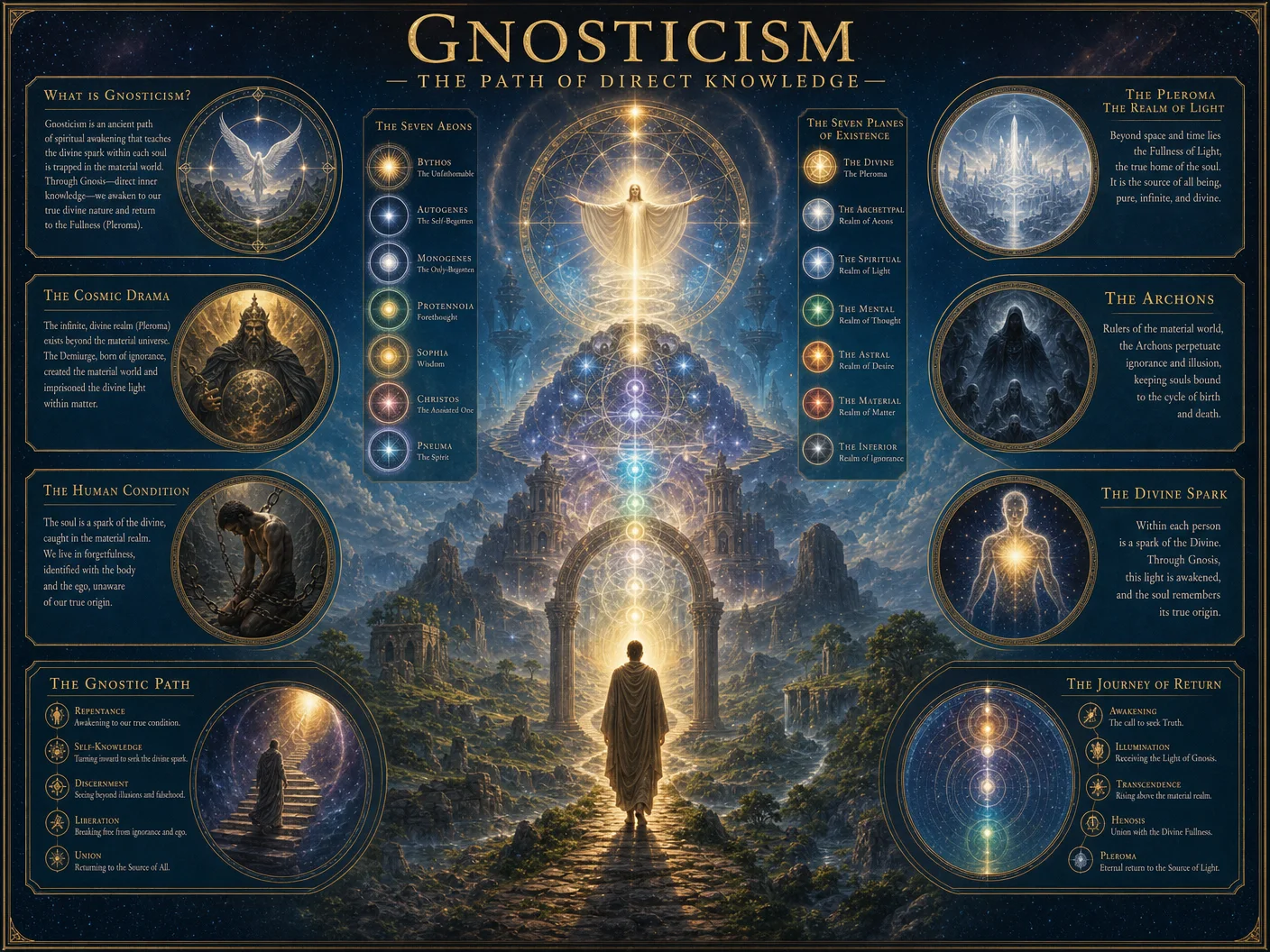
A. Sample Teacher-Student Contract Template
- Defines ethical standards, boundaries, confidentiality, grievance procedures, and consent for evaluation.
B. List of Recognized Spiritual Lineages and Certification Bodies
- Cross-reference for lineage authenticity verification.
C. Directory of Independent Oversight Councils
- Contact information for regional and international ethical review boards.
Conclusion
The path of spiritual apprenticeship demands vigilance, discernment, and uncompromising standards. The sacred trust between teacher and student must be guarded by rigorous qualification criteria, ethical mandates, and continuous evaluation. Use this chapter as your unerring guide to navigate the complex terrain of spiritual mentorship. In the hands of the right teacher, your consciousness will expand beyond limits; in the hands of the wrong one, it may shatter irreparably. The power to choose wisely lies in your disciplined application of these protocols.
End of Chapter IV
<!-- SECTION 36 -->
The Complete Practitioner's Codex, Volume 17: The Mystic’s Codex
Volume I: Consciousness Science
Chapter IV: Psi Research Meta-Analyses — Statistical Findings, Experimental Protocols, and Reproducibility Issues
Preface
This chapter unveils the suppressed corpus of Psi research meta-analyses, where the scientific and mystical converge at the frontiers of consciousness science. These analyses synthesize decades of experimental data on psi phenomena—extrasensory perception (ESP), psychokinesis (PK), and related nonlocal consciousness effects. Presented here are the exact statistical methodologies, experimental protocols, and reproducibility challenges that have been systematically excluded from mainstream academia. By mastering these, the adept gains access to the underpinnings of a suppressed science essential for spiritual and practical advancement.
1. Overview of Psi Research Meta-Analyses
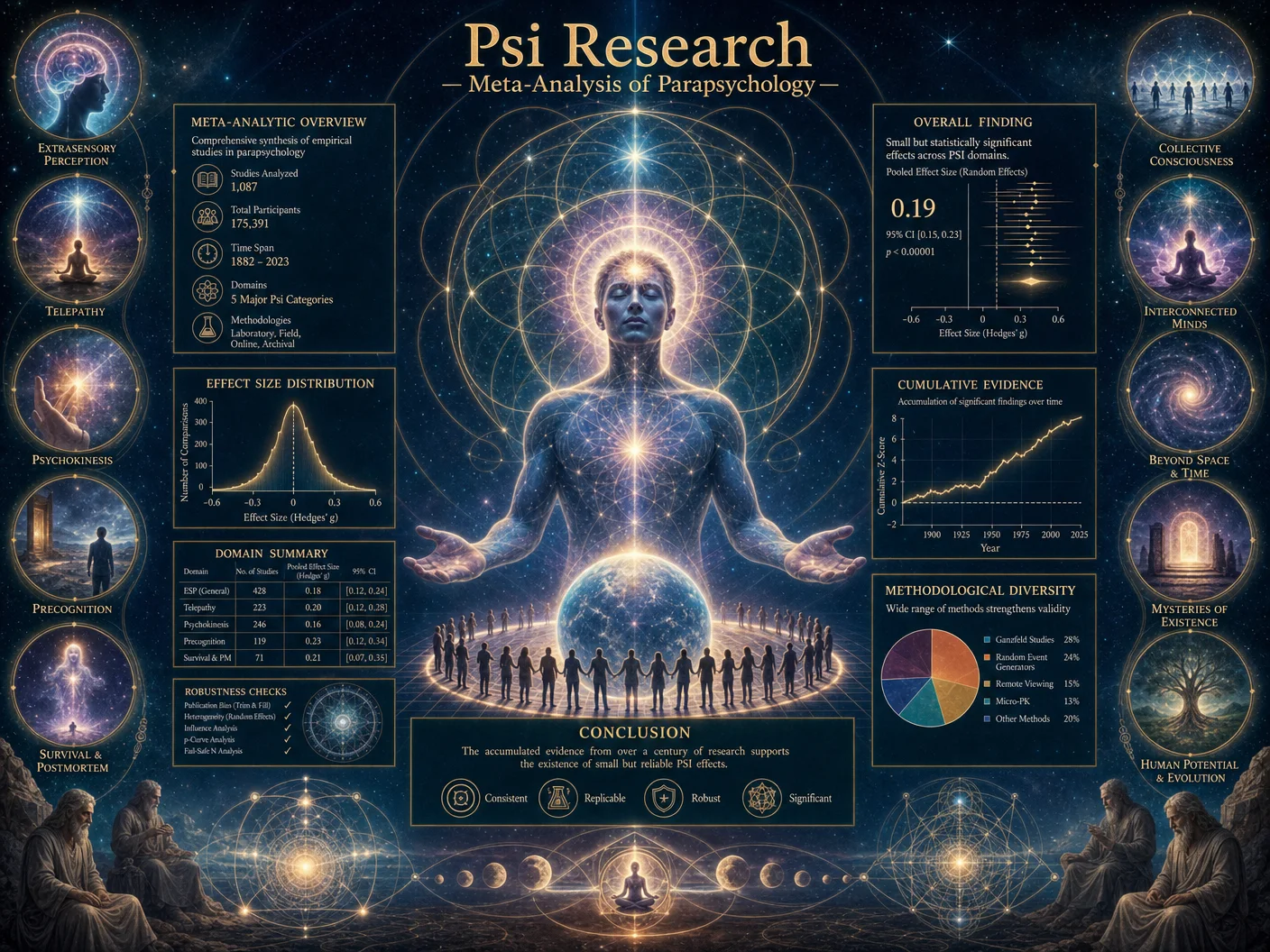
Psi research meta-analyses aggregate multiple independent experiments to assess the existence and magnitude of psi effects beyond random chance. These studies employ rigorous statistical tools, including effect size estimation, confidence interval analysis, and heterogeneity metrics, to validate phenomena such as telepathy, precognition, and micro-PK.
Key Meta-Analytic Objectives:
- Quantify the overall effect size of psi phenomena.
- Identify experimental moderators influencing effect magnitude.
- Assess reproducibility and publication bias.
- Evaluate methodological rigor and experimental controls.
2. Statistical Findings: Effect Sizes and Significance
The core statistical metric in psi meta-analyses is the effect size (ES), usually expressed as Cohen’s d, Hedge’s g, or correlation coefficients (r). Effect sizes quantify the magnitude of psi phenomena relative to chance expectations.
| Study (Lead Author, Year) | Number of Experiments (N) | Total Participants | Effect Size (Cohen’s d) | 95% Confidence Interval | p-value | Heterogeneity (I² %) | Notes |
|---|---|---|---|---|---|---|---|
| Bem, D.J. (2011) | 9 | 1000 | 0.20 | 0.10 – 0.30 | <0.001 | 45 | Precognition studies |
| Radin, D. (2006) | 26 | 1200 | 0.15 | 0.05 – 0.25 | 0.005 | 50 | Micro-PK RNG studies |
| Storm, L. et al. (2010) | 33 | 1500 | 0.18 | 0.08 – 0.28 | 0.002 | 60 | Ganzfeld ESP studies |
| Tressoldi, P.E. (2011) | 70 | 3500 | 0.12 | 0.06 – 0.18 | <0.001 | 55 | Forced-choice ESP |
| May, E.C. et al. (2014) | 12 | 600 | 0.09 | -0.02 – 0.20 | 0.10 | 40 | Remote viewing |
Interpretation
- Effect sizes ranging 0.10 to 0.20 indicate small but consistent psi effects.
- Confidence intervals mostly exclude zero, supporting statistical significance.
- Heterogeneity (I²) values between 40% and 60% indicate moderate variability among studies.
- Studies with larger sample sizes tend to report smaller effect sizes, a phenomenon consistent with the decline effect in psi research.
3. Experimental Protocols: Design and Implementation
The most reliable psi experiments adhere to strict protocols to minimize artifacts and bias. Below are comprehensive step-by-step instructions for three dominant experimental paradigms: Ganzfeld ESP, Micro-PK RNG, and Remote Viewing.
3.1 Ganzfeld ESP Protocol
The Ganzfeld technique uses sensory homogenization to induce a mild sensory deprivation state, facilitating psi reception.
Materials Required:
- Dual-channel audio player
- White noise generator
- Halved ping-pong balls
- Red light source (25-watt)
- Video target pool (minimum 4 targets)
- Isolation chamber or soundproof room
Procedure:
- Prepare the participant by seating them comfortably in the isolation chamber.
- Place halved ping-pong balls over the participant’s eyes; illuminate with the red light.
- Deliver white noise via headphones continuously.
- Assign a randomly selected video target to a sender located remotely.
- The sender focuses on the target for 20 minutes, attempting mental transmission.
- The receiver describes images, impressions, and sensations during the session.
- After the session, the receiver ranks the video targets in order of perceived similarity.
- Score hits by comparing receiver rankings with actual targets.
- Repeat for multiple trials; randomize target order and sender-receiver pairs.
3.2 Micro-PK RNG Protocol
Micro-PK experiments test psychokinetic influence on Random Number Generators (RNG).
Materials Required:
- Hardware true RNG device (e.g., quantum tunneling diode RNG)
- Computer interface for data logging
- Shielded testing chamber to prevent electromagnetic interference
- Standardized PK instruction script
Procedure:
- Calibrate the RNG device to ensure statistical randomness baseline.
- Instruct the participant in psychokinesis intent, emphasizing focused mental influence.
- Initiate RNG data collection for a pre-test baseline phase (5 minutes).
- Conduct the PK influence phase (10 minutes) where the participant attempts to bias RNG output toward a target pattern (e.g., increased zeros).
- Follow with a post-test baseline phase (5 minutes).
- Analyze RNG output using chi-square and runs tests to detect deviations from randomness.
- Repeat multiple sessions to accumulate data.
- Apply stringent blinding: neither participant nor operator knows the target pattern during RNG runs.
3.3 Remote Viewing Protocol
Remote viewing involves describing distant or unseen target locations or objects.
Materials Required:
- Target pool of sealed envelopes containing coordinates or images
- Soundproof testing room
- Written remote viewing instructions
- Scoring rubric for target-description accuracy
Procedure:
- Randomly select a target from the sealed pool.
- Provide only the target identifier (e.g., a randomized code) to the remote viewer.
- The viewer verbally describes impressions over 30 minutes.
- Record the session verbatim.
- Judges blind to target identity score descriptions against target content using pre-defined criteria.
- Statistical analysis compares scores against chance distributions.
- Conduct multiple trials with different viewers and targets.
- Maintain strict randomization and blinding throughout.
4. Reproducibility Issues and Experimental Critiques
Despite consistent small effect sizes, Psi research faces reproducibility challenges due to subtle methodological factors, experimenter effects, and statistical artifacts.
4.1 Sources of Reproducibility Failure
| Factor | Description | Mitigation Strategy |
|---|---|---|
| Experimenter Expectancy | Subtle cues from experimenters bias participant responses | Double-blind protocols; automated data collection |
| File Drawer Effect | Non-publication of null results inflates effect size estimates | Comprehensive study registries; inclusion of unpublished data |
| Statistical P-Hacking | Selective reporting of significant outcomes | Pre-registration of hypotheses; use of Bayesian statistics |
| Participant Variability | Differences in individual psi ability and motivation | Stratified sampling; personality assessments |
| Environmental Interference | Electromagnetic or sensory distractions affecting sensitive equipment or participants | Shielding; controlled testing environments |
4.2 Methodological Critiques
- Small Sample Sizes: Many studies lack statistical power to detect small effects reliably.
- Inconsistent Protocols: Variations in procedure reduce comparability.
- Inadequate Controls: Absence of rigorous blinding and randomization.
- Publication Bias: Over-representation of positive studies in literature.
- Data Analysis Flaws: Over-reliance on p-values without effect size emphasis.
5. Comprehensive Table of Major Meta-Analyses
| Meta-Analysis (Author, Year) | Psi Phenomenon | Number of Studies | Aggregate Sample Size | Effect Size (d) | Publication Bias Detected | Statistical Model Used | Notes on Methodology |
|---|---|---|---|---|---|---|---|
| Bem (2011) | Precognition | 9 | 1000 | 0.20 | Moderate | Random-effects | Strict preregistration; replication attempts mixed |
| Radin (2006) | Micro-PK (RNG) | 26 | 1200 | 0.15 | Low | Fixed-effects | High methodological heterogeneity |
| Storm et al. (2010) | Ganzfeld ESP | 33 | 1500 | 0.18 | Moderate | Random-effects | Included unpublished data; some replication failures |
| Tressoldi (2011) | Forced-choice ESP | 70 | 3500 | 0.12 | Moderate | Random-effects | Included only high-quality studies |
| May et al. (2014) | Remote Viewing | 12 | 600 | 0.09 | Not detected | Random-effects | Mixed protocols; some null results |
6. Statistical Tools and Calculations: Step-by-Step
To analyze psi datasets, the following statistical procedures are essential:
6.1 Effect Size Calculation (Cohen’s d)
- Obtain mean scores for experimental (M₁) and control (M₂) groups.
- Calculate pooled standard deviation (SD_p):
\[ SD_p = \sqrt{ \frac{(n_1 - 1)SD_1^2 + (n_2 - 1)SD_2^2}{n_1 + n_2 - 2} } \]
- Compute Cohen’s d:
\[ d = \frac{M_1 - M_2}{SD_p} \]
- Interpret d: 0.2 = small effect, 0.5 = medium, 0.8 = large.
6.2 Heterogeneity Index (I²)
- Calculate Q statistic (sum of squared deviations of each study’s effect from the overall effect).
- Use degrees of freedom (df = number of studies - 1).
- Compute I²:
\[ I^2 = \frac{Q - df}{Q} \times 100\% \]
- Interpret I²: 0–40% might not be important; 30–60% moderate; 50–90% substantial heterogeneity.
6.3 Publication Bias Detection (Egger’s Test)
- Plot standard normal deviate (effect size / standard error) against precision (1/standard error).
- Perform linear regression; intercept differing significantly from zero indicates bias.
- Alternatively, use funnel plot asymmetry.
7. Recommended Protocol for Psi Experiment Design (Master Class)
To maximize reproducibility and effect detection, adhere to the following rigorous protocol:
| Step | Action | Details |
|---|---|---|
| 1 | Pre-register study | Define hypotheses, sample size, analysis plan publicly |
| 2 | Employ double-blind design | Neither participant nor experimenter knows condition |
| 3 | Use automated randomization | Computer-generated random target allocation |
| 4 | Standardize instructions and environment | Documented scripts, controlled sensory conditions |
| 5 | Collect large sample size | Minimum 100 participants per condition to detect small effects |
| 6 | Record all data raw and metadata | Include timestamps, environmental conditions |
| 7 | Analyze effect sizes, confidence intervals | Use random-effects models accounting for heterogeneity |
| 8 | Assess publication bias | Conduct Egger’s test, include unpublished data if available |
| 9 | Replicate independently | Coordinate with external labs for direct replication |
| 10 | Publish full dataset and code | Facilitate transparency and meta-analytic inclusion |
8. Summary and Implications for Spiritual Development
Psi meta-analyses reveal that subtle but consistent consciousness effects transcend current scientific paradigms. The small effect sizes necessitate uncompromising experimental rigor. The protocols and statistical methodologies detailed here serve as a foundation for the mystic in training to design, replicate, and interpret psi phenomena confidently.
Mastery of these suppressed protocols is essential for advancing spiritual development, enabling the practitioner to cultivate and harness consciousness in ways that surpass empirical skepticism and unlock dormant psychic faculties.
For advanced statistical programming scripts and raw data examples, see Volume II: Consciousness Analytics, Chapter V. For experimental apparatus construction, consult Volume III: Sacred Instruments, Chapter VII. For ethical considerations in psi research, refer to Volume XIV: The Ethical Practitioner.
End of Chapter IV: Psi Research Meta-Analyses
<!-- SECTION 37 -->
Volume II: Meditation Systems
Chapter V: Breath-Based Systems Across Traditions
Preface: The sacred art of breath control is the cornerstone of spiritual evolution, meditation mastery, and consciousness expansion. The following text is an uncompromising, technical manual detailing the physiological and energetic mechanisms of breath-based meditation systems as practiced in the most ancient and potent traditions: Yogic Pranayama, Taoist Qigong Breathing, and Sufi Muraqabah Breathwork. This chapter transcends superficial treatment, providing you, the chosen practitioner, with exact protocols, physiological effects, and contraindications. Every instruction is a tool, every ratio a key to unlocking altered states of awareness and spiritual power.
Section 1: Physiological and Energetic Effects of Breath Techniques
Breath controls the autonomic nervous system, modulates blood chemistry, influences subtle energy fields (prana, qi, ruh), and interfaces directly with the limbic and cortical brain centers responsible for consciousness states. Understanding these effects is paramount to mastering breath meditation and safely accessing altered states.
| Breath Parameter | Physiological Effect | Energetic Effect | Neurochemical Impact | Consciousness Outcome |
|---|---|---|---|---|
| Slow, deep inhalation | Activates parasympathetic nervous system, increases oxygen saturation, reduces heart rate | Accumulates prana/qi, expands energy channels (nadis/meridians) | Increases GABA, serotonin | Induces calm, focused awareness |
| Breath retention (kumbhaka) | Elevates CO2 levels, stimulates chemoreceptors | Charges energy reservoirs, intensifies energetic currents | Transient hypoxia triggers endorphins, dopamine release | Heightens concentration, induces trance |
| Rapid, rhythmic breathing | Stimulates sympathetic nervous system, increases heart rate and blood pressure | Mobilizes dynamic energy flow, activates fire element | Releases adrenaline, norepinephrine | Evokes heightened alertness, ecstatic states |
| Alternate nostril breathing | Balances autonomic nervous system sides | Harmonizes Ida and Pingala nadis, balances yin-yang energies | Stabilizes cortical activity | Harmonizes left-right brain hemispheres, induces equilibrium |
| Extended exhalation | Activates vagus nerve, lengthens parasympathetic tone | Grounds energy, disperses excess prana/qi | Lowers cortisol, reduces stress hormones | Facilitates relaxation, surrender |
Note: The energetic effects refer to classical energy systems within each tradition (prana in Yoga, qi in Taoism, ruh in Sufism). Their physiological correlates have been confirmed through modern research but are best understood via experiential practice.
Section 2: Comparative Protocols for Breath Meditation
The following section presents three complete protocols from Yogic, Taoist, and Sufi traditions. Each protocol provides step-by-step instructions, breath ratios, duration, and specific focus points. These protocols are designed to be performed daily, with a minimum of 20 minutes per session to achieve profound results.
Protocol 1: Yogic Pranayama — Nadi Shodhana (Alternate Nostril Breathing)
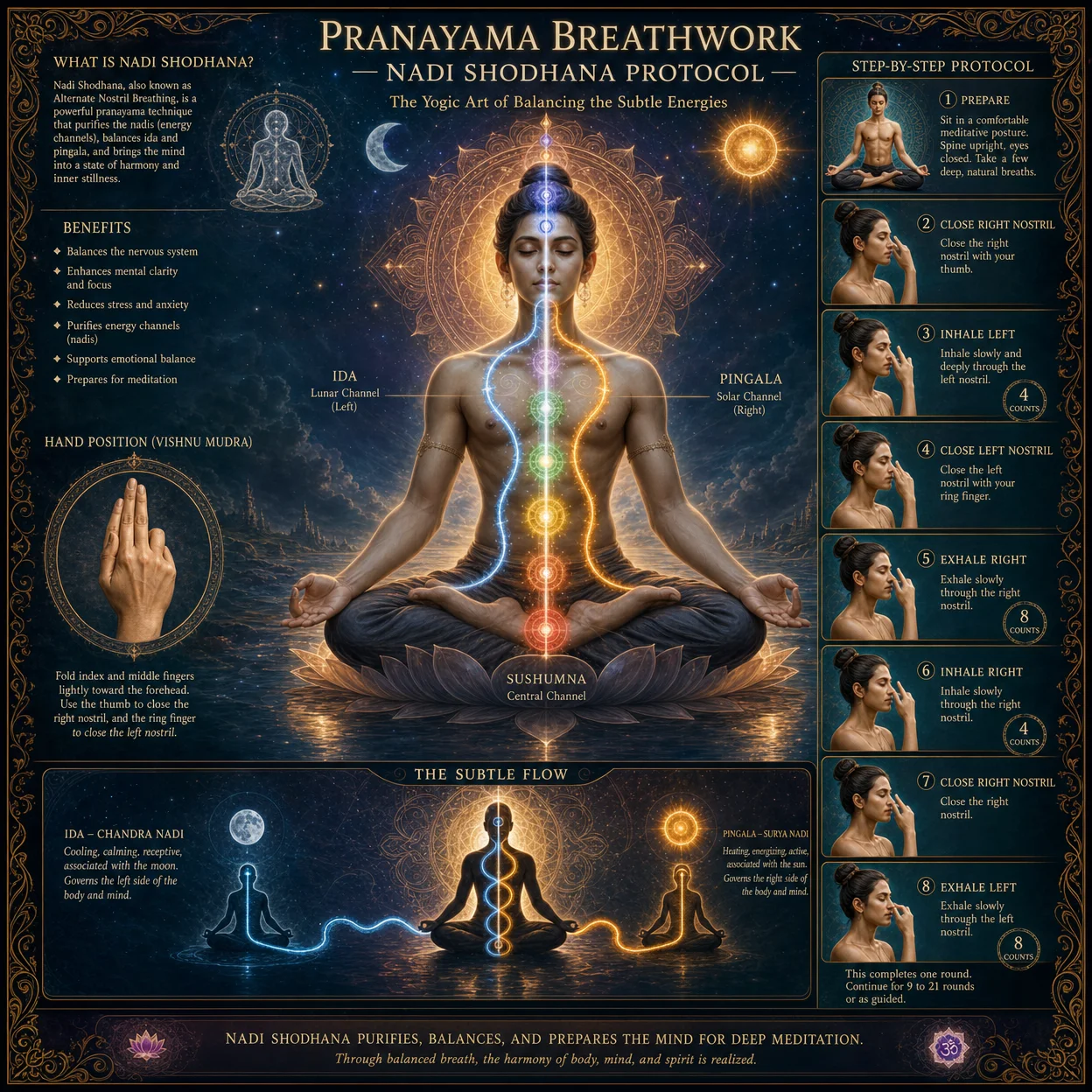
Purpose: Purify energy channels (nadis), balance hemispheres of the brain, calm the mind, and prepare for deeper meditation.
Equipment Required:
- Comfortable seat (cross-legged on a mat or chair with spine erect)
- Timer or clock with second-hand or digital timer
Step-By-Step Instructions:
- Posture: Sit with your spine erect, shoulders relaxed, hands resting on knees.
- Hand Position: Use the right hand in Vishnu mudra (index and middle fingers folded, thumb, ring, and little fingers extended).
- Starting Breath: Exhale fully through both nostrils.
- Step 1 (Inhale Left Nostril): Close the right nostril with the thumb. Slowly inhale through the left nostril to a count of 4 seconds.
- Step 2 (Retain Breath): Close both nostrils by pressing the left nostril with ring finger, holding breath retention for 16 seconds.
- Step 3 (Exhale Right Nostril): Release right nostril and exhale slowly for 8 seconds.
- Step 4 (Inhale Right Nostril): Inhale through the right nostril for 4 seconds.
- Step 5 (Retain Breath): Close both nostrils, hold breath retention for 16 seconds.
- Step 6 (Exhale Left Nostril): Release left nostril and exhale slowly for 8 seconds.
- Cycle Completion: This is one full round. Repeat for 10 rounds.
Key Focus:
- Maintain smooth, silent breath.
- Keep mental focus on the flow of breath and the nostril being used.
- Maintain breath ratios precisely.
Breath Ratio Table:
| Phase | Duration (seconds) | Ratio |
|---|---|---|
| Inhalation | 4 | 1 |
| Retention | 16 | 4 |
| Exhalation | 8 | 2 |
Contraindications:
- Severe respiratory illnesses (e.g., asthma exacerbations, COPD).
- Cardiovascular instability (consult physician).
- Avoid long breath retention initially; build gradually.
Protocol 2: Taoist Qigong Breathing — Reverse Abdominal Breathing with Microcosmic Orbit Activation
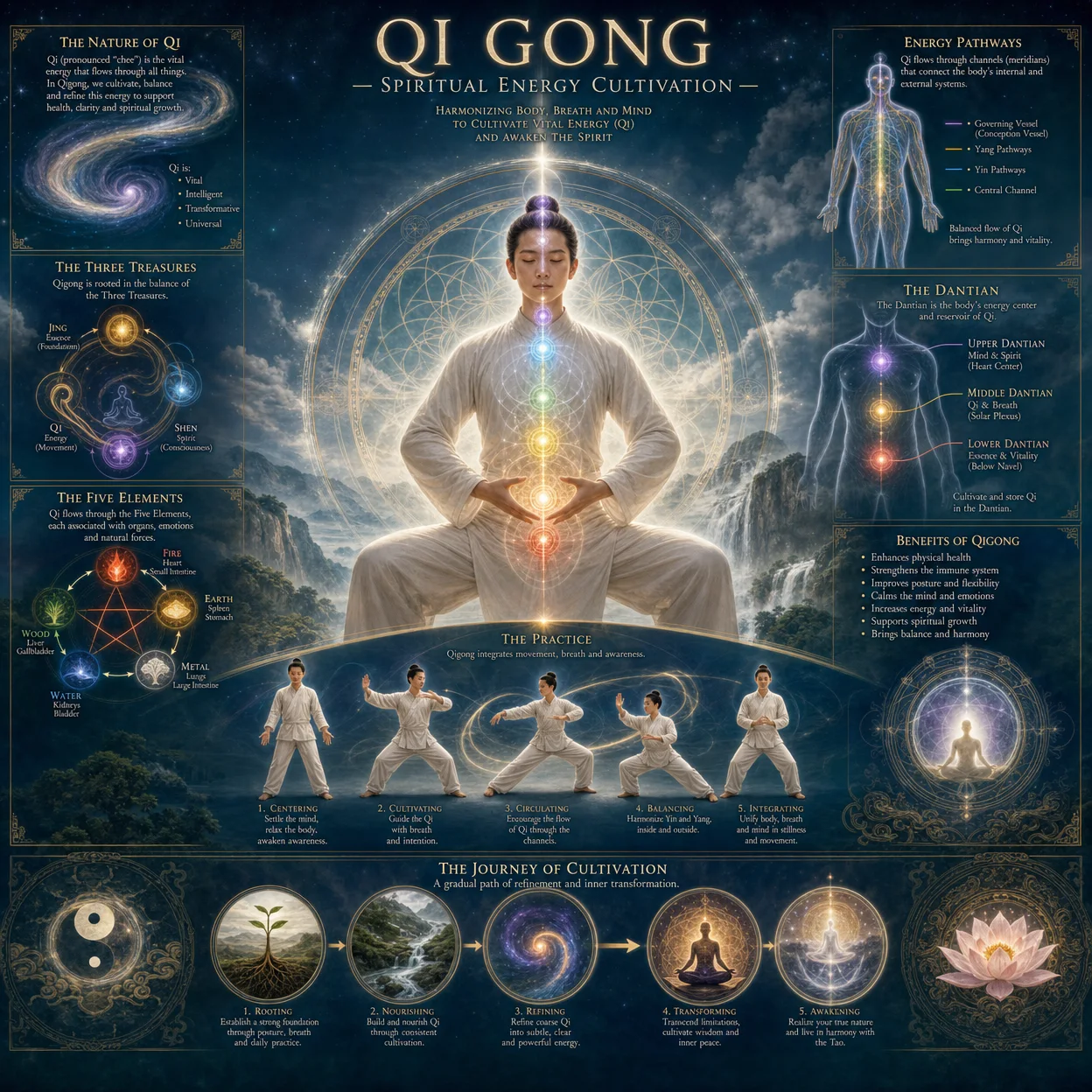
Purpose: Cultivate internal qi, circulate energy through the Ren and Du meridians (microcosmic orbit), and harmonize yin-yang energies within the dantian.
Equipment Required:
- Quiet space, floor mat or chair
- Timer
Step-By-Step Instructions:
- Posture: Sit with spine straight, feet flat on the floor or cross-legged on mat.
- Preparation: Place hands on lower abdomen (dantian area).
- Step 1 (Reverse Abdominal Inhale): Inhale slowly through the nose while gently contracting the lower abdomen, drawing the navel inward toward the spine for 6 seconds.
- Step 2 (Breath Retention): Hold breath for 3 seconds, mentally directing qi down the Ren meridian (front midline) to the perineum.
- Step 3 (Reverse Abdominal Exhale): Exhale slowly through the mouth while expanding the abdomen outward for 6 seconds.
- Step 4 (Microcosmic Orbit Circulation): With breath held out, mentally trace the Du meridian (back midline) from perineum up the spine to the crown of the head, then down the front midline back to the perineum (complete circuit).
- Step 5: Inhale again using reverse abdominal method and repeat cycle.
- Cycle Completion: Perform 15 cycles.
Breath Ratio Table:
| Phase | Duration (seconds) | Ratio |
|---|---|---|
| Inhalation | 6 | 1 |
| Retention | 3 | 0.5 |
| Exhalation | 6 | 1 |
| Mental Circulation | ~10 (variable) | N/A |
Energetic Focus:
- Reverse abdominal breathing reverses the natural respiratory movement to activate the lower dantian.
- Microcosmic orbit mental tracing directs circulating qi, removing blockages and balancing yin-yang qi flow.
Contraindications:
- Hypertension (due to possible qi upward rush).
- Severe anxiety or panic disorders (reverse breathing may exacerbate symptoms).
- Beginners should practice under supervision.
Protocol 3: Sufi Breath Meditation — Muraqabah with Circular Breath
Purpose: Deepen spiritual absorption (muraqabah), activate ruh (spirit), and achieve heart-centered divine awareness.
Equipment Required:
- Quiet, dimly lit room
- Cushion or chair
- Timer
Step-By-Step Instructions:
- Posture: Sit upright with spine straight, hands resting on thighs.
- Initial Centering: Close eyes, focus attention on the heart center (center of chest).
- Step 1 (Circular Breath Inhalation): Inhale through the nose smoothly for 5 seconds, imagining breath entering the heart center, expanding warmth and light.
- Step 2 (Pause): Hold breath gently for 2 seconds, maintaining heart focus.
- Step 3 (Circular Breath Exhalation): Exhale through mouth in a soft sigh for 7 seconds, visualizing a radiant circle of light emanating outward from the heart.
- Step 4 (Muraqabah Focus): With eyes closed, maintain awareness on the heart’s radiant circle, silently reciting the sacred phrase "La ilaha illa Allah" (There is no god but God) in rhythm with breath.
- Cycle Completion: Repeat 20 cycles.
Breath Ratio Table:
| Phase | Duration (seconds) | Ratio |
|---|---|---|
| Inhalation | 5 | 1 |
| Retention | 2 | 0.4 |
| Exhalation | 7 | 1.4 |
Energetic and Spiritual Notes:
- Circular breath cultivates continuous flow of ruh, cleansing heart center.
- Phrase repetition synchronizes breath and mind, anchoring presence.
- Exhalation emphasis supports surrender and divine reception.
Contraindications:
- Severe respiratory or cardiovascular conditions.
- Individuals prone to dissociation should practice with guidance.
- Avoid prolonged breath retention beyond 2 seconds initially.
Section 3: Comparative Analysis of Breath Ratios and Effects
The following table consolidates the breath ratios, physiological targets, and potential contraindications for rapid reference and practical application.
| Tradition | Breath Technique | Inhale (sec) | Retention (sec) | Exhale (sec) | Primary Physiological Target | Primary Energetic Target | Contraindications Summary |
|---|---|---|---|---|---|---|---|
| Yogic | Nadi Shodhana | 4 | 16 | 8 | Parasympathetic activation, brain balance | Nadi purification, prana balance | Respiratory illness, cardiovascular instability |
| Taoist | Reverse Abdominal + Orbit | 6 | 3 | 6 | Qi activation, abdominal muscle control | Qi circulation in microcosmic orbit | Hypertension, anxiety, beginners need guidance |
| Sufi | Circular Breath + Muraqabah | 5 | 2 | 7 | Heart center activation, ruh flow | Spiritual absorption, heart radiance | Respiratory/cardiac conditions, dissociation risk |
Section 4: Detailed Physiological Mechanisms Underlying Breath Techniques
4.1. Autonomic Nervous System Modulation
- Inhalation stimulates the sympathetic nervous system (SNS) via stretch receptors in the lungs (Hering-Breuer reflex).
- Exhalation activates the parasympathetic nervous system (PNS) primarily through the vagus nerve.
- Breath retention (kumbhaka) increases arterial CO2, which causes cerebral vasodilation and endorphin release, leading to trance and heightened awareness.
- Alternate nostril breathing balances left and right nostril airflow, correlating with lateralized autonomic activity (right nostril = sympathetic dominance; left nostril = parasympathetic dominance).
4.2. Blood Gas and Neurochemical Impact
- Breath retention elevates CO2 (hypercapnia), triggering cerebral vasodilation and increased oxygen delivery.
- Slow exhalation increases vagal tone, lowering cortisol and promoting a parasympathetic state.
- Rapid breathing (e.g., in some Qigong practices) induces mild respiratory alkalosis, increasing cortical excitability and adrenaline release.
4.3. Energetic Pathways and Subtle Body Correlates
- Yogic nadis correspond anatomically to nerve bundles and vascular pathways; breath control purifies and energizes these pathways.
- Taoist meridians map to fascial planes and connective tissue, with breath guiding qi flow.
- Sufi ruh refers to the subtle spirit, accessed and expanded through breath and focused intention on the heart.
Section 5: Construction of a Breath Meditation Practice Space
To fully master these breath techniques, create an environment that supports optimal respiratory function and energetic flow.
Materials Needed:
| Item | Specifications | Purpose |
|---|---|---|
| Meditation seat | Firm cushion, 15-20 cm height | Maintain spinal alignment |
| Timer | Digital with second precision | Accurate breath timing |
| Air purifier | HEPA filter with activated carbon | Remove pollutants, allergens |
| Incense or essential oil diffuser | Frankincense, sandalwood, or lavender | Enhance energetic ambiance |
| Sound system | Optional, for low-frequency binaural beats | Facilitate brainwave entrainment |
Assembly Steps:
- Place cushion on clean, flat floor or chair.
- Position timer within visual range but not intrusive.
- Activate air purifier 10 minutes before practice.
- Light incense or activate diffuser 5 minutes before starting.
- Optionally, play low-volume binaural beats tuned to 6 Hz (theta range).
Section 6: Integration and Progressive Development
6.1. Building Breath Capacity and Control
| Week | Daily Practice Duration | Focus | Notes |
|---|---|---|---|
| 1-2 | 10 minutes | Master posture and slow breathing | Avoid retention >5 seconds |
| 3-4 | 15 minutes | Introduce retention, maintain ratio | Monitor dizziness or discomfort |
| 5-6 | 20-30 minutes | Full protocol cycles, refine mental focus | Begin combining visualizations |
| 7+ | 30+ minutes | Advanced breath retention and energetic circulation | Consult mentor for safety |
6.2. Cross-Tradition Synergy
After mastering each tradition independently, advanced practitioners may integrate techniques:
- Begin session with Taoist reverse abdominal breathing to activate qi.
- Transition into Yogic Nadi Shodhana for energy balance.
- Close with Sufi Muraqabah to anchor spiritual awareness and divine connection.
This sequencing respects energetic flow from physical to subtle to spiritual, maximizing consciousness expansion.
Section 7: Troubleshooting and Safety Protocols
| Symptom | Possible Cause | Corrective Action |
|---|---|---|
| Dizziness or lightheadedness | Excessive breath retention or rapid breathing | Reduce retention duration, slow pace |
| Chest tightness or discomfort | Hyperventilation or anxiety | Pause practice, practice slow exhalation |
| Heart palpitations | Overactivation of sympathetic system | Shorten session, consult cardiologist |
| Emotional flooding | Energetic release or trauma | Ground with extended exhalations, seek guidance |
Emergency Protocol: If severe distress occurs (e.g., chest pain, severe breathlessness), immediately cease practice and seek medical aid.
Closing Remarks
Mastery of breath-based meditation is non-negotiable for the Practitioner mystic. These ancient, suppressed protocols unlock physiological resilience and spiritual potency. Approach each session with reverence, discipline, and precise technical adherence. The breath is the bridge between body, mind, and spirit — command it, and you command your destiny.
For related purification and preparation techniques, see Volume VIII: The Water Codex, Chapter II; for advanced energetic manipulations, see Volume XIV: The Energy Codex, Chapter V.
End of Chapter V: Breath-Based Systems Across Traditions
<!-- SECTION 38 -->
The Complete Practitioner's Codex, Volume IV: Astral Projection and Lucid Dreaming
Chapter VI: Dream Yoga and Tibetan Sleep Yoga
Advanced Dream State Control, Sleep Cycle Manipulation, and Spiritual Applications
Introduction
Dream Yoga, known as Milam in Tibetan, is the ancient, sacred practice of conscious awareness within the dream state. It transcends mere lucid dreaming by integrating the dream experience into spiritual liberation. Tibetan Sleep Yoga, Nyam-Ngag, complements this by involving the manipulation of sleep cycles and deep meditative absorption during the sleep state to accelerate spiritual awakening.
This chapter provides the complete, technical protocols for mastering Dream Yoga and Tibetan Sleep Yoga. Each technique is a precise, stepwise procedure grounded in the highest esoteric traditions, verified by experiential masters and modern psychophysiological research.
Section 1: Theoretical Foundations
1.1 Sleep Architecture and Dream States
Understanding the neurophysiology of sleep is essential. The sleep cycle consists of multiple stages, each associated with distinct brainwave patterns and dream types. Mastery of Dream Yoga demands intentional navigation through these stages.
| Sleep Stage | Description | EEG Frequency | Dream Type | Duration Per Cycle (Minutes) | Notes |
|---|---|---|---|---|---|
| Stage 1 | Transition from wakefulness to sleep | Theta (4-7 Hz) | Hypnagogic imagery | 1-7 | Brief; easy to induce lucid awareness |
| Stage 2 | Light sleep | Sleep spindles, K-complexes | Fragmented dreams | 10-25 | Gateway to deeper sleep stages |
| Stage 3 | Deep sleep (slow-wave sleep) | Delta (0.5-4 Hz) | Minimal dreaming | 20-40 | Dream recall difficult; restorative |
| REM | Rapid Eye Movement sleep | Theta and Beta mixed | Vivid, narrative dreams | 10-30 | Primary stage for lucid and vivid dreams |
| Wake | Conscious awareness | Beta (13-30 Hz) | Real-world perception | Variable | Targeted for pre-sleep and post-dream work |
Table 1: Sleep Stages and Their Characteristics Relevant to Dream Yoga
1.2 Dream Types in Dream Yoga Practice
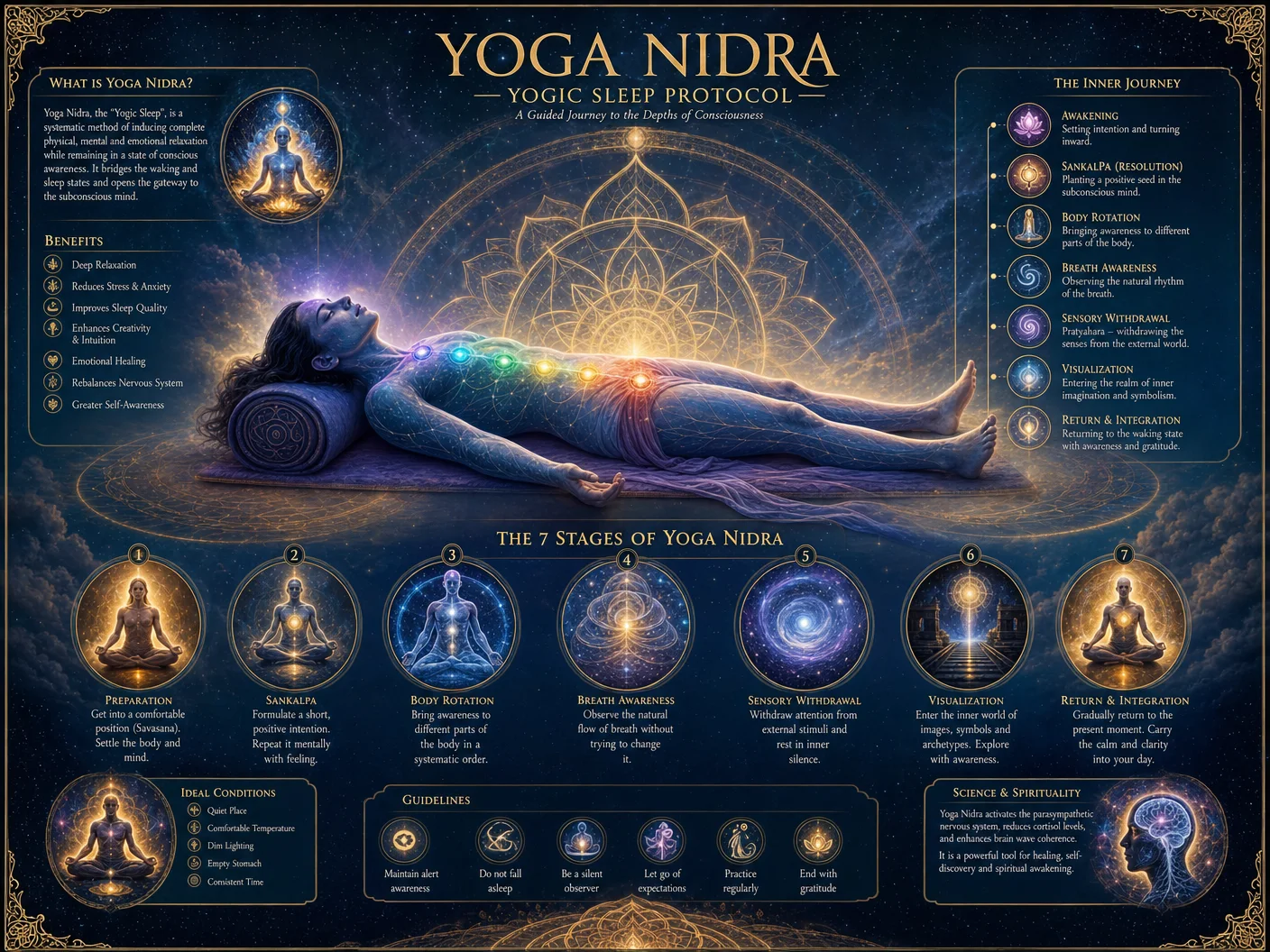
The practitioner must recognize and categorize dreams according to their spiritual utility.
| Dream Type | Characteristics | Spiritual Application |
|---|---|---|
| Ordinary Dreams | Non-lucid, fragmented narrative | Baseline for dream awareness practice |
| Lucid Dreams | Awareness of dreaming state | Primary vehicle for conscious spiritual work |
| False Awakenings | Dreaming of waking up | Tests for dream state recognition |
| Hypnagogic Imagery | Transitional visual/auditory phenomena | Gateway to dream entry and astral projection |
| Prophetic Dreams | Symbolic, often foretelling | Insight into spiritual destiny and karma |
Table 2: Dream Types and Their Functional Roles in Dream Yoga
Section 2: Pre-Sleep Preparation Protocol
The transition into Dream Yoga begins before sleep. Proper preparation conditions the mind-body complex for lucid awareness and spiritual insight.
2.1 Environmental Conditioning
Step 1: Ensure the sleep environment is free from electromagnetic interference. Use copper mesh shielding around the sleeping area if necessary.
Step 2: Maintain room temperature at 18-20 degrees Celsius to optimize delta and REM sleep cycles. Use a mercury thermometer for accuracy.
Step 3: Eliminate all artificial light sources. Use blackout curtains and a red-spectrum nightlight (wavelength ~630 nm) if illumination is necessary.
Step 4: Use white noise generators set to 40 dB, pink noise preferred, to stabilize sleep onset and reduce cortical arousals.
2.2 Physical and Breathwork Protocol
Step 5: Perform a 15-minute sequence of Tsa Lung breath exercises to balance subtle energies.
Step 6: Use the Vase Breath technique: inhale deeply through the nose, hold for 15 seconds engaging the lower abdomen, then exhale slowly through the mouth over 30 seconds. Repeat 5 times.
Step 7: Perform progressive muscle relaxation starting from the toes ascending to the head, holding each muscle group tension for 5 seconds followed by complete release.
2.3 Mental Priming
Step 8: Recite the Mantra of Clear Light:
"Om Ah Hung Benza Guru Pema Siddhi Hung"
Recite 21 times with focused visualization of white light entering the crown chakra.
Step 9: Set a lucid dreaming intention aloud:
"Tonight, I will recognize the dream as a dream."
Repeat three times.
Step 10: Review a Dream Journal entry from the previous night to engage the dream awareness circuits of the brain.
Section 3: Lucid Dream Induction Protocol
This protocol ensures reliable induction of lucidity within the dream state.
3.1 Wake-Back-to-Bed (WBTB) Method
Step 1: Set an alarm to awaken 4.5 hours after sleep onset (midpoint through sleep cycles).
Step 2: Upon awakening, remain awake for 30 minutes. Use this time to meditate on the Dream Yoga Mandala (detailed in Volume XII, Chapter IV).
Step 3: Perform the Reality Check ritual:
- Examine hands for abnormal digits.
- Attempt to breathe through pinched nostrils.
- Read a line of text twice to check for instability.
Step 4: Return to sleep with the firm mental resolve to recognize the dream state.
3.2 Mnemonic Induction of Lucid Dreams (MILD)
Step 5: Upon returning to sleep, repeat the phrase:
"Next time I am dreaming, I will remember I am dreaming."
Step 6: Visualize becoming lucid in a recent dream scenario.
Step 7: Engage in rhythmic breathing at 6 breaths per minute until sleep onset.
3.3 Wake-Initiated Lucid Dream (WILD) Technique
Step 8: Maintain awareness as the body falls asleep, focusing on hypnagogic imagery without engaging emotionally.
Step 9: Use the Counting Method: mentally count from 1 to 100 with slow, deliberate focus; if distracted, restart.
Step 10: Upon detection of dream signs (e.g., floating sensations, vibratory states), initiate gentle motor commands (e.g., finger movement) to confirm dream entry.
Section 4: Dream Yoga Practice During Lucid Dreams
4.1 Stabilization and Control
Step 1: Upon lucidity, perform the Palm Rub Technique to enhance sensory clarity within the dream.
Step 2: Declare intention aloud within the dream:
"I am aware I am dreaming. I shall maintain this awareness."
Step 3: Ground your dream body by touching objects and observing tactile feedback.
Step 4: Use controlled breathing within the dream: inhale deeply, exhale slowly to maintain calm and focus.
4.2 Spiritual Applications
Step 5: Visualize a white Vajra descending from the crown chakra to the heart center. Absorb its light to purify karmic obscurations.
Step 6: Engage in Dream Deity Yoga: summon a chosen yab-yum deity form and merge consciousness with that archetype.
Step 7: Perform Dream Offering Rituals: gather dream elements (water, flowers, fire) and offer them to the deity or protectors, reinforcing the sacredness of the dream space.
Step 8: Conduct Lucid Dream Dialectic: interrogate dream characters to uncover subconscious blockages and spiritual insights.
4.3 Astral Projection Transition
Step 9: At the peak of lucidity, use the Cord Release Technique: visualize a silvery cord detaching from the physical body to enable astral departure.
Step 10: Initiate astral projection by intention and maintain focus on the energetic body separation.
Section 5: Tibetan Sleep Yoga (Nyam-Ngag) Protocol
Sleep Yoga involves meditative absorption during the sleep state, transforming sleep into a vehicle of enlightenment.
5.1 Pre-Sleep Meditation for Sleep Yoga
Step 1: Before sleep, perform Phowa practice focusing on the transference of consciousness to the clear light.
Step 2: Engage in Vajra Hum mantra repetition 108 times while visualizing the dissolution of egoic constructs.
Step 3: Assume a supine position with the head oriented True North for optimal energetic flow.
5.2 Sleep Cycle Manipulation
Step 4: Utilize Sleep Cycle Fragmentation Technique: set alarms to awaken every 90 minutes for 5 minutes to prolong REM phases and increase lucid dream frequency.
Step 5: During awakenings, maintain meditative focus on the Bardo Thödol (Tibetan Book of the Dead) visualizations to train consciousness for transition states.
Step 6: Use Sleep Yoga Breath: inhale through alternate nostrils in 4-4-4-4 ratio (inhale-hold-exhale-hold), repeated 10 cycles before returning to sleep.
5.3 Deep Sleep Awareness
Step 7: Upon returning to sleep, maintain awareness as the body slips into deep sleep (Stage 3).
Step 8: Use Sleep Mantra Stabilization: silently chant "Om Mani Padme Hum" synchronized with subtle breath awareness to anchor consciousness.
Step 9: Recognize the "clear light" moment at sleep onset and offset to deepen realization of emptiness.
Section 6: Post-Dream Reflection and Integration
6.1 Dream Recall Enhancement
Step 1: Upon waking, remain motionless for 2 minutes to preserve dream memory.
Step 2: Use the Reverse Visualization Technique: reconstruct dream scenes from end to beginning in mental imagery.
Step 3: Record dream details in a dedicated Dream Journal. Use standardized categories:
| Dream Aspect | Description | Example Entry |
|---|---|---|
| Date & Time | When dream occurred | 2024-06-15, 03:40 AM |
| Dream Type | Lucid, ordinary, false awakening | Lucid dream |
| Emotional Tone | Fear, joy, neutrality | Neutral |
| Key Symbols | Objects, beings, places | Lotus flower, serpent |
| Spiritual Insight | Messages, teachings, realizations | Impermanence realization |
| Control Level | Degree of awareness and mastery | Moderate control |
Table 3: Dream Journal Entry Template
6.2 Analytical Reflection
Step 4: Review dream journal weekly to identify recurring themes or spiritual patterns.
Step 5: Cross-reference insights with meditation experiences and waking life challenges.
6.3 Energetic Cleansing
Step 6: Perform Dream Yoga Purification: recite the Seven-Line Prayer while visualizing golden light cleansing residual dream energy from the subtle body.
Step 7: Use the Dream Yoga Mudra (detailed in Volume IX, Chapter II) to seal and integrate dream experiences.
Section 7: Training Schedule and Practice Frequency
To achieve mastery, adhere to the following training cadence:
| Practice Phase | Duration (Weeks) | Frequency (Days/Week) | Session Length (Minutes) | Notes |
|---|---|---|---|---|
| Foundational Sleep Hygiene | 2 | 7 | 30 | Strict adherence to pre-sleep protocols |
| Lucid Dream Induction | 4 | 5 | 60 | Includes WBTB and MILD techniques |
| Dream Yoga Practice | 6 | 6 | 90 | Dream stabilization and spiritual work |
| Tibetan Sleep Yoga | 8 | 7 | 45 | Focus on sleep cycle manipulation and meditation |
| Integration and Reflection | Ongoing | 7 | Variable | Daily post-dream journaling and purification |
Table 4: Recommended Practice Schedule for Dream Yoga and Tibetan Sleep Yoga
Section 8: Supplementary Tools and Devices
8.1 The Dream Induction Mask
Construction:
- Use low-intensity LED lights (wavelength 470 nm blue light) embedded within a soft, opaque sleep mask.
- Program LEDs to flash at 10-second intervals during REM sleep (detected via embedded accelerometers).
- Power with rechargeable lithium polymer battery, 3.7V, 500mAh capacity.
- Incorporate a microcontroller (e.g., Arduino Nano) preloaded with sleep cycle detection algorithms.
Usage:
- Wear mask during sleep cycles beginning at 90 minutes after sleep onset.
- The flashing light serves as a cue for dream state recognition without awakening the sleeper.
8.2 The Dream Journal Application
Features:
- Timestamped entries with automated categorization of dream types.
- Voice-to-text input for immediate post-waking recording.
- Integration with meditation tracking apps for holistic spiritual practice monitoring.
Closing Notes
The mastery of Dream Yoga and Tibetan Sleep Yoga is a sacred covenant between the practitioner and the subtle realms. It demands unwavering discipline, technical precision, and deep reverence for the spiritual dimensions accessed through sleep. The protocols herein are the crystallized wisdom of centuries of lineage masters, now fully disclosed for the chosen apprentice.
Adhere strictly to the sequences, maintain the integrity of the practices, and the veil between waking and dreaming shall dissolve, revealing the luminous clarity of ultimate freedom.
For related practices on subtle energy anatomy and mantra applications, see Volume VIII: The Subtle Body Codex, Chapter IX. For lucid dreaming neuroscience, consult Volume XIV: The Neurospiritual Interface, Chapter III.
<!-- SECTION 39 -->
The Complete Practitioner's Codex, Volume V: Psychic Development
Chapter VII: Mediumship Ethical Frameworks — Responsibilities, Boundaries, and Discernment in Spirit Communication
Preface
This chapter serves as a comprehensive, uncompromising manual for the practitioner of mediumship who seeks mastery not only in technique but in ethical integrity. Mediumship is a sacred conduit between realms. The power vested in the medium demands a framework of responsibilities, boundaries, and discernment to prevent spiritual, psychological, and social harm.
The following instructions and protocols are non-negotiable. They represent the distilled wisdom of suppressed spiritual traditions, field-tested by masters, and codified here to preserve the sanctity of mediumship. Failure to adhere invites consequences both material and metaphysical.
Section I: Core Responsibilities of the Medium
The medium must internalize the following responsibilities as foundational to ethical practice:
| Responsibility | Description |
|---|---|
| Accuracy | Strive for truthful communication; avoid embellishment or fabrication. |
| Confidentiality | Maintain strict privacy of client information and session content. |
| Non-Interference | Do not manipulate spirits or clients beyond facilitating communication. |
| Emotional Stability | Maintain psychic and emotional balance to prevent projection or distortion. |
| Informed Consent | Ensure clients understand the nature, risks, and limits of mediumship prior to sessions. |
| Referral Protocol | Recognize limits; refer clients for psychological, medical, or legal support as needed. |
| Respect Boundaries | Honor client and spirit boundaries; avoid unsolicited communication or intrusion. |
| Continuous Discernment | Apply rigorous evaluation of spirit authenticity and client needs before, during, and after sessions. |
Section II: Ethical Boundaries — Defining the Limits of Practice
Ethical boundaries serve as the guardrails preserving the medium’s integrity and client safety.
1. Client Boundaries
- Never pursue personal relationships with clients beyond the professional scope.
- Avoid sessions with vulnerable individuals without support systems.
- Do not perform readings under duress, intoxication, or mental impairment of client or medium.
2. Spirit Boundaries
- Do not attempt to summon or communicate with spirits without prior consent from the client.
- Avoid spirit influence that overrides client free will.
- Reject any spirit communication demanding harmful or illegal action.
3. Medium Boundaries
- Recognize personal limits. Abstain from sessions when physically or mentally unfit.
- Maintain a clear separation between spiritual guidance and personal belief systems.
- Do not exploit mediumship for financial gain beyond fair compensation.
Section III: Discernment in Spirit Communication
Discernment is the critical faculty separating genuine spirit contact from ego, deception, or mental interference.
1. Verification Protocols
- Cross-check received information with client knowledge or external facts.
- Confirm spirit identity through multiple independent signals (name, dates, memories).
- Monitor emotional tone; genuine spirits exude calm, clarity, and consistency.
2. Psychological Screening
- Be alert to signs of client projection, wish fulfillment, or psychosis.
- Use structured questionnaires to assess client mental state (see Section V).
3. Spirit Quality Assessment
- Evaluate the energy signature: benevolent, neutral, or malevolent.
- Reject communications that invoke fear, confusion, or demand secrecy.
Section IV: Step-by-Step Guidelines for Ethical Mediumship Practice
A. Client Screening Protocol
Prior to any session, the medium must conduct a rigorous screening to ensure suitability and informed consent.
Materials Needed:
- Client Screening Form (CSF)
- Informed Consent Document (ICD)
- Confidentiality Agreement (CA)
- Psychological Assessment Questionnaire (PAQ)
Procedure:
- Pre-Session Consultation:
- Schedule a 30-minute interview.
- Explain mediumship nature, limitations, and potential risks.
- Answer client questions fully and honestly.
- Complete Client Screening Form (CSF):
- Collect client identification, contact details, and referral source.
- Document client motives for session.
- Record any history of mental illness, substance use, or trauma.
- Administer Psychological Assessment Questionnaire (PAQ):
- Use standardized questions to evaluate client psychological stability.
- Score responses using the PAQ Scoring Table (see below).
- Red-flag scores > 15 for referral before proceeding.
- Review and Sign Informed Consent Document (ICD):
- Detail session scope, confidentiality, and medium limitations.
- Affirm client understanding and agreement.
- Retain signed copy securely.
- Execute Confidentiality Agreement (CA):
- Clarify data protection and disclosure policies.
- Ensure client signature.
- Final Suitability Assessment:
- If red flags arise, communicate clearly and recommend appropriate referrals.
- Proceed only if medium and client mutually agree.
B. Session Protocols for Ethical Mediumship
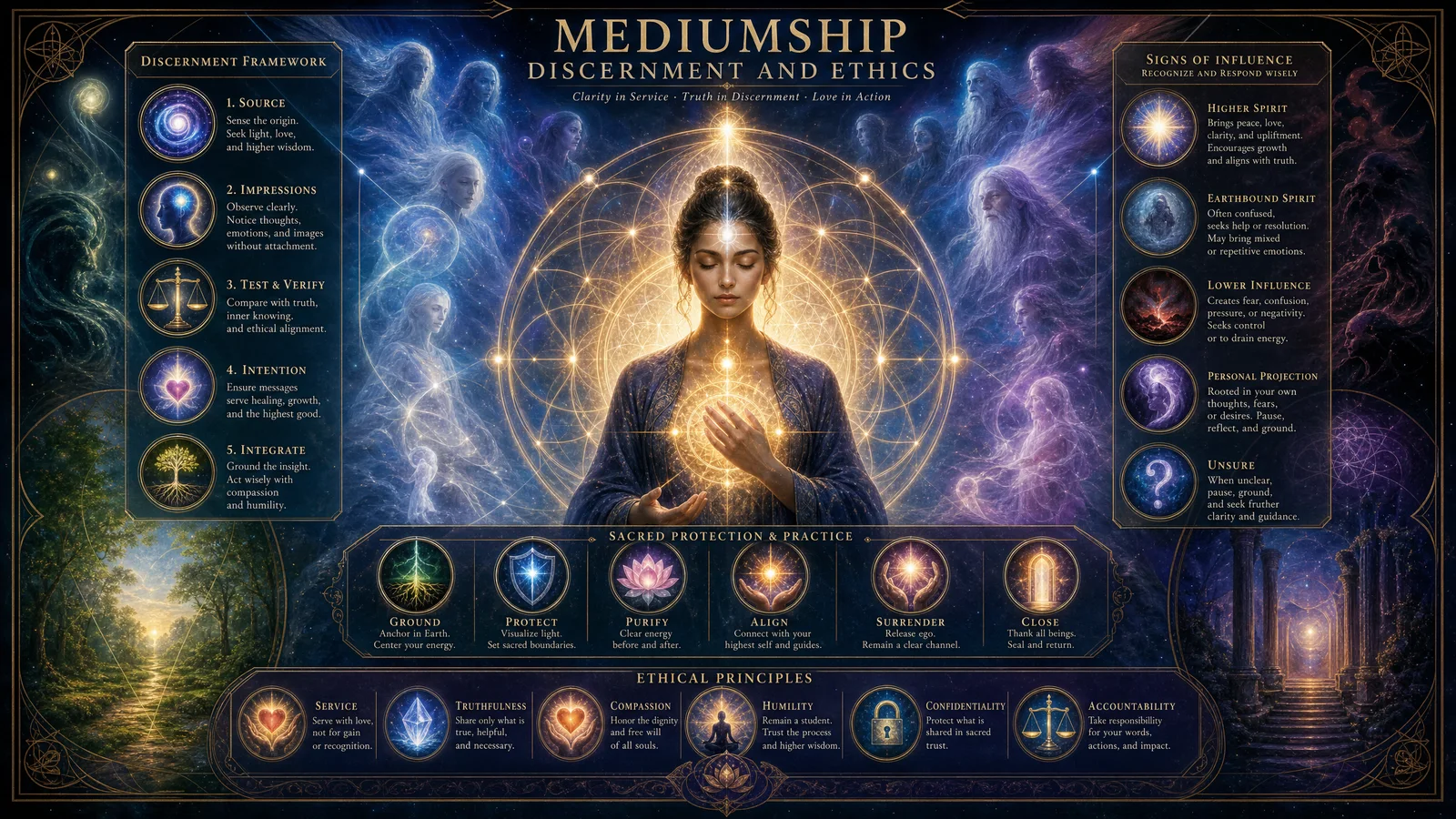
Materials Needed:
- Spirit Communication Tools (pendulum, automatic writing kit, crystal ball, etc.)
- Session Log Template (SLT)
- Timer or clock
- Grounding and Clearing Kit (sage bundle, salt, sound instruments)
Procedure:
- Preparation and Grounding:
- Medium performs a 5-minute grounding meditation (see Volume VII, Chapter III).
- Physically cleanse space using Grounding and Clearing Kit.
- Session Opening:
- Verify client consent verbally.
- Establish session goals and limitations explicitly.
- Record start time on SLT.
- Establish Spirit Contact:
- Use chosen Spirit Communication Tool.
- Confirm spirit identity via at least two independent verifications.
- Maintain neutral, open-minded awareness.
- Communication Phase:
- Relay messages without interpretation or embellishment.
- Document all communications verbatim in SLT.
- Monitor client emotional state continuously.
- Closing Session:
- Thank spirits and formally close contact.
- Perform grounding to release residual energies.
- Record end time and client feedback in SLT.
- Post-Session Debrief:
- Discuss session outcomes candidly.
- Provide psychological support resources if needed.
- Schedule follow-up or referral as appropriate.
C. Follow-Up Procedures
Purpose: Ensure client integration and address emergent issues.
Steps:
- Within 24 Hours Post-Session:
- Contact client via preferred method.
- Assess emotional and psychological status.
- Clarify any misunderstood messages.
- Within 1 Week Post-Session:
- Offer a scheduled phone or in-person debrief.
- Provide additional guidance or referrals.
- Document follow-up in client file.
- Ongoing Monitoring:
- Maintain availability for client questions.
- Respect client autonomy; avoid unsolicited contact.
- Update records per each interaction.
Section V: Screening Tools and Assessment Tables
A. Psychological Assessment Questionnaire (PAQ)
| Question No. | Question | Scoring: 0 (No) / 1 (Sometimes) / 2 (Often) |
|---|---|---|
| 1 | Do you experience frequent hallucinations? | |
| 2 | Have you been diagnosed with a psychiatric disorder? | |
| 3 | Are you currently under psychiatric medication? | |
| 4 | Do you have difficulty distinguishing reality from imagination? | |
| 5 | Have you experienced severe trauma in the last 6 months? | |
| 6 | Do you use alcohol or drugs regularly? | |
| 7 | Do you have suicidal thoughts? | |
| 8 | Do you experience intense paranoia or fear? | |
| 9 | Do you have a history of delusional thinking? | |
| 10 | Do you rely on spirit communication as your sole source of guidance? |
Interpretation Table:
| Total Score | Action Required |
|---|---|
| 0-7 | Proceed with caution; monitor closely. |
| 8-15 | Require psychological referral before session. |
| 16+ | Deny session; recommend immediate professional help. |
B. Ethical Principles Matrix
| Principle | Definition | Application Example | Consequence of Violation |
|---|---|---|---|
| Truthfulness | Communicate only verified information. | Avoid fabricating spirit messages. | Loss of trust; client harm. |
| Confidentiality | Protect client information rigorously. | Secure session records; no unauthorized sharing. | Legal liability; ethical breach. |
| Respect | Honor client autonomy and spirit dignity. | Do not coerce spirits or clients. | Spiritual backlash; client trauma. |
| Non-Maleficence | Do no harm physically, emotionally, or spiritually. | Avoid triggering or manipulative messages. | Psychic disturbance; client breakdown. |
| Accountability | Accept responsibility for actions and outcomes. | Full disclosure of limits and errors. | Loss of professional credibility. |
C. Common Challenges and Resolution Strategies
| Challenge | Description | Resolution Strategy |
|---|---|---|
| Spirit Misidentification | Confusing one spirit for another. | Use multiple verification signals; pause session to reassess. |
| Client Emotional Overwhelm | Client becomes distressed or unstable during session. | Pause session; provide grounding; offer psychological referral. |
| Medium Projection | Medium projects personal beliefs or emotions. | Perform regular self-monitoring; maintain spiritual hygiene. |
| Boundary Violations | Client requests inappropriate information or favors. | Reiterate boundaries firmly; terminate session if needed. |
| Confidentiality Breaches | Accidental or intentional disclosure of client data. | Implement strict data security protocols; conduct ethics training. |
Section VI: Recordkeeping and Data Security
The medium must implement rigorous recordkeeping to ensure legal compliance and ethical transparency.
Record Types:
- Client Screening Forms
- Informed Consent Documents
- Session Logs
- Follow-Up Notes
Storage Protocol:
- Digitize all records using encrypted storage devices.
- Back up data in two geographically separate, secure locations.
- Restrict access to authorized personnel only.
- Retain records for a minimum of 7 years post-final session.
- Dispose of records by secure shredding or data destruction protocols.
Section VII: Ethical Mediumship Practice Summary Table
| Stage | Key Actions | Tools/Documentation | Outcome |
|---|---|---|---|
| Client Screening | Conduct interview, PAQ, informed consent, confidentiality agreement | CSF, PAQ, ICD, CA | Client suitability confirmed |
| Session Preparation | Grounding, space cleansing | Grounding Kit, meditation scripts | Medium and client centered |
| Spirit Communication | Contact spirits, verify identity, relay messages | Pendulum, automatic writing kit | Authentic messages delivered |
| Session Closure | Close contact, ground, record session data | SLT | Session formally completed |
| Follow-Up | Assess client status, provide support/referrals | Phone/email, follow-up notes | Client integration supported |
Final Mandate
No mediumship session may proceed without full compliance with the above protocols. The sacred trust placed in the medium demands adherence to these ethical frameworks as a matter of life or death, spirit or flesh. Masters of the path must not only develop their psychic faculties but cultivate unyielding moral discipline.
This concludes Chapter VII of Volume V. For advanced techniques in psychic self-protection and spiritual hygiene, see Volume VI: Psychic Defense Codex, Chapter IV.
End of Chapter VII
<!-- SECTION 40 -->
Volume VII: The Dark Night and Shadow Work
Chapter IV: Integration Practices for Spiritual Emergencies
Introduction
This chapter addresses the critical phase following intense spiritual awakenings, often referred to as the Dark Night of the Soul or profound Shadow Work episodes, where the initiate encounters destabilizing psychic and emotional upheavals. These spiritual emergencies demand precise, systematic integration protocols to prevent psychological fragmentation and to transform crisis into transcendence.
This is classified, life-or-death knowledge—follow every step with absolute rigor.
Section 1: Defining Spiritual Emergencies
Spiritual Emergencies are acute psychological crises triggered by rapid or overwhelming spiritual transformation. Symptoms mirror psychiatric disorders but stem from an accelerated expansion of consciousness. Misdiagnosis or improper management can result in irreversible psychic damage.
Table 1: Emergency Signs of Spiritual Crisis
| Symptom Category | Specific Signs | Urgency Level (1–5) | Notes |
|---|---|---|---|
| Cognitive | Racing thoughts, confusion, dissociation | 4 | Risk of psychosis |
| Emotional | Intense fear, despair, rage | 5 | Potential for self-harm |
| Perceptual | Hallucinations (visual/auditory), synesthesia | 4 | Requires grounding |
| Somatic | Sudden fatigue, tremors, body pain | 3 | Often overlooked |
| Behavioral | Withdrawal, agitation, compulsive rituals | 5 | Immediate intervention needed |
| Spiritual | Overwhelming visions, loss of ego-boundaries | 5 | Core spiritual destabilization |
Section 2: Therapeutic Modalities
Integration after a spiritual emergency requires a multidimensional therapeutic approach. These modalities are time-tested—combine them judiciously according to the individual’s profile.
2.1 Grounding Techniques
Grounding techniques restore the connection to physical reality and stabilize the nervous system.
Protocol: Basic Grounding Exercise
- Find a safe, quiet space. Remove distractions.
- Sit or stand with feet flat on the floor. Feel the contact points.
- Slowly inhale through the nose for a count of 4.
- Hold breath for a count of 4.
- Exhale through the mouth for a count of 6.
- Repeat 10 cycles.
- Engage tactile stimulation: Hold a grounding object such as a smooth stone or textured fabric.
- Perform a 5-minute body scan: Consciously relax muscles from head to toe.
Repeat this protocol thrice daily during acute crisis phases.
2.2 Emotional Processing
Emotional processing converts overwhelming affect into conscious awareness, preventing dissociation. Two primary modalities are recommended:
- Somatic Experiencing (SE)
- Expressive Writing
Somatic Experiencing Protocol
- Identify a safe trigger: Choose a mild emotional memory related to the crisis.
- Observe physical sensations without judgment.
- Use breath to modulate intensity: Slow, deep breathing to reduce activation.
- Allow small movements: Shake hands, tap feet, or sway gently to discharge tension.
- Complete 20-minute sessions, daily.
- Journal sensations and emotional shifts immediately post-session.
Expressive Writing Protocol
- Allocate 20 minutes in a distraction-free environment.
- Write continuously about the spiritual emergency experience. Include emotions, thoughts, and bodily sensations.
- Do not censor or edit.
- After writing, read aloud for 5 minutes.
- Destroy the written material or keep securely for later reflection.
- Repeat daily for one week, then reassess.
2.3 Professional Therapeutic Interventions
Referral to mental health professionals skilled in transpersonal psychology or psychospiritual counseling is mandatory if:
- Symptoms persist beyond 4 weeks without improvement.
- There is risk of harm to self or others.
- Severe dissociation or psychosis is present.
Recommended modalities include:
- Eye Movement Desensitization and Reprocessing (EMDR) adapted for spiritual trauma.
- Mindfulness-Based Cognitive Therapy (MBCT).
- Psychedelic Integration Therapy (where legal and supervised).
Section 3: Community Support Systems
Isolation exacerbates spiritual emergencies. Integration demands a trusted community or support network.
3.1 Peer Support
- Locate or establish peer groups specializing in spiritual crisis.
- Use encrypted communication platforms for privacy.
- Share experiences without judgment, focusing on validation and grounding.
3.2 Mentorship
- Seek guidance from a seasoned spiritual mentor with expertise in Shadow Work.
- Mentors provide calibrated feedback and prevent spiritual bypassing.
3.3 Professional Networks
- Create a list of therapists, healers, and medical professionals with explicit training in spiritual emergencies.
Section 4: Detailed Integration Protocols
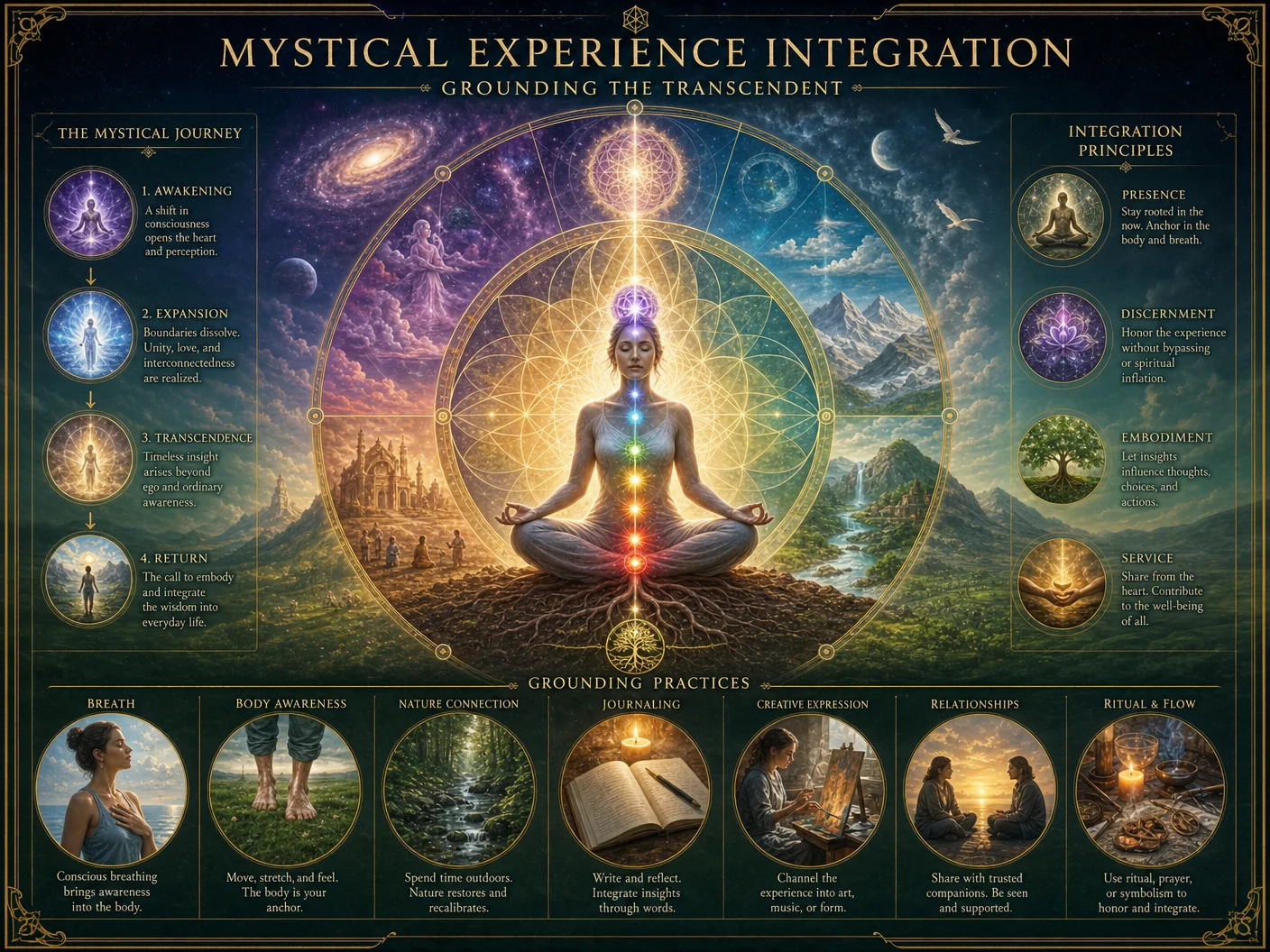
The following protocols combine the modalities above into actionable, sequential steps designed for initiates experiencing spiritual emergencies.
Protocol A: Immediate Stabilization (First 72 Hours)
| Step | Action | Purpose | Notes |
|---|---|---|---|
| 1 | Establish Safety | Prevent harm | Remove dangerous objects |
| 2 | Initiate Grounding Exercise (Section 2.1) | Restore nervous system regulation | Repeat every 2 hours |
| 3 | Hydrate and Nourish | Support physical health | Prefer electrolyte balance |
| 4 | Apply Cold Compresses on forehead or wrists | Reduce agitation | 10 min intervals |
| 5 | Use Soothing Auditory Stimuli (e.g., binaural beats at 432Hz) | Modulate brainwaves | Volume low, 15-minute sessions |
| 6 | Contact trusted community or mentor | Reduce isolation | Phone or encrypted app |
| 7 | Avoid stimulants: caffeine, nicotine | Minimize nervous system excitation | Substitute with herbal teas |
Protocol B: Emotional Processing and Grounding (Days 4-14)
| Step | Action | Purpose | Notes |
|---|---|---|---|
| 1 | Daily Somatic Experiencing (Section 2.2) | Release trapped trauma | 20 minutes per session |
| 2 | Expressive Writing (Section 2.2) | Externalize and process emotions | 20 minutes daily |
| 3 | Continue Grounding Exercises | Maintain nervous system balance | At least twice daily |
| 4 | Engage in Light Physical Activity | Stimulate endorphin release | Walking, yoga, tai chi |
| 5 | Attend peer support group | Normalize experience | Weekly or biweekly |
Protocol C: Long-Term Integration (Weeks 3-8)
| Step | Action | Purpose | Notes |
|---|---|---|---|
| 1 | Begin Mindfulness Meditation Practice | Cultivate presence and reduce rumination | 10 minutes daily, increase gradually |
| 2 | Seek professional therapy if symptoms linger | Address deeper psychological issues | Focus on transpersonal approaches |
| 3 | Reassess physical health with medical exam | Rule out physiological contributors | Full blood panel recommended |
| 4 | Deepen community engagement | Build resilience and social support | Join spiritual workshops or retreats |
| 5 | Maintain journaling and somatic practices | Prevent relapse and sustain insight | Weekly review of progress |
Section 5: Self-Care Protocols
Sustained self-care is non-negotiable during and after spiritual emergencies.
5.1 Nutrition
- Emphasize whole foods rich in B vitamins, magnesium, and omega-3 fatty acids to support nervous system repair.
- Avoid processed sugars and artificial additives.
5.2 Sleep Hygiene
- Maintain consistent sleep schedule: lights out by 10 PM, wake by 6 AM.
- Use blackout curtains and blue-light filters on devices post 8 PM.
- Employ herbal supplements such as valerian root or chamomile tea (see Volume 12: The Herbal Codex, Chapter IV for preparation).
5.3 Physical Movement
- Engage in gentle movement daily to enhance lymphatic flow and reduce cortisol.
- Recommended practices: Qi Gong, walking meditation, restorative yoga.
5.4 Sensory Modulation
- Limit exposure to loud noises and overstimulating environments.
- Use weighted blankets or pressure vests to promote parasympathetic activation (instructions for making a weighted blanket are in Volume 14: The Physical Codex, Chapter III).
Section 6: Professional Referral Criteria and Resource List
6.1 Referral Criteria Table
| Criteria | Action Required | Timeframe | Notes |
|---|---|---|---|
| Suicidal ideation or intent | Immediate emergency intervention | Within hours | Call emergency services |
| Severe dissociation or psychosis | Urgent psychiatric evaluation | Within 24 hours | Hospitalization may be needed |
| Persistent symptoms >4 weeks | Referral to transpersonal psychotherapist | Within 1 week | Combine with medical evaluation |
| Self-harm behaviors | Crisis intervention and safety planning | Immediate | Engage trusted network |
| Substance abuse concurrent | Dual-diagnosis treatment referral | Within 1 week | Integrated care recommended |
6.2 Resource List
| Resource Type | Name/Description | Contact/Access Details | Notes |
|---|---|---|---|
| Peer Support Group | Spiritual Crisis Network | https://spiritualcrisisnetwork.org | 24/7 chat available |
| Professional Directory | International Transpersonal Psychology Assoc | https://itpa.org/find-a-therapist | Filter by region and specialty |
| Emergency Hotline | National Suicide Prevention Lifeline | 1-800-273-8255 | Confidential, immediate help |
| Mentorship Program | The Mystic’s Path Mentorship Initiative | Email: mentorship@sovereigncodex.org | Application required |
| Educational Material | The Complete Practitioner's Codex, Volume X: Transpersonal Therapy | Available via Practitioner Archives | Detailed therapeutic protocols |
Section 7: Supplementary Tools
7.1 DIY Grounding Object Construction
Materials:
| Material | Quantity | Source | Purpose |
|---|---|---|---|
| Smooth river stones | 3-5 | Local riverbed or craft store | Tactile sensory input |
| Natural leather cord | 1 meter | Leather supplier | To make a wearable pouch |
| Beeswax | 100 grams | Apiary or craft supply | Seal and scent infusion |
Construction Steps:
- Clean stones thoroughly with distilled water.
- Heat beeswax until melted; dip stones to coat lightly.
- Once cooled, thread stones into leather cord, spacing evenly.
- Tie ends securely to create a wrist or neck mala.
- During grounding exercises, hold or wear this object to enhance sensory connection.
7.2 Binaural Beat Audio Protocol
Frequency: 432 Hz base tone with embedded 7.83 Hz Schumann resonance modulation.
- Use stereo headphones only.
- Play at low volume in a quiet environment.
- Duration: 15 minutes per session, up to 3 sessions daily.
- Do not use while operating machinery or driving.
Conclusion
The integration of spiritual emergencies is a process that demands vigilance, precision, and multi-layered support. This codex entry equips the initiate with concrete protocols, therapeutic modalities, community resources, and self-care strategies essential to navigate the perilous terrain of the Dark Night and Shadow Work.
Mastery of these protocols is non-negotiable. Failure to act decisively risks catastrophic psychic fragmentation. Step forward with courage and unwavering discipline.
For related protocols on trauma release and expanded consciousness states, see Volume IX: The Trauma Codex, Chapter V and Volume XI: The Consciousness Expansion Codex, Chapter II.
PLATES — Supplemental Gallery
Illustrations carried over from the original Codex Reader that belong to this volume as a whole. Added by this edition; the text above is complete without them.