Module 799 — Navigate Courtship
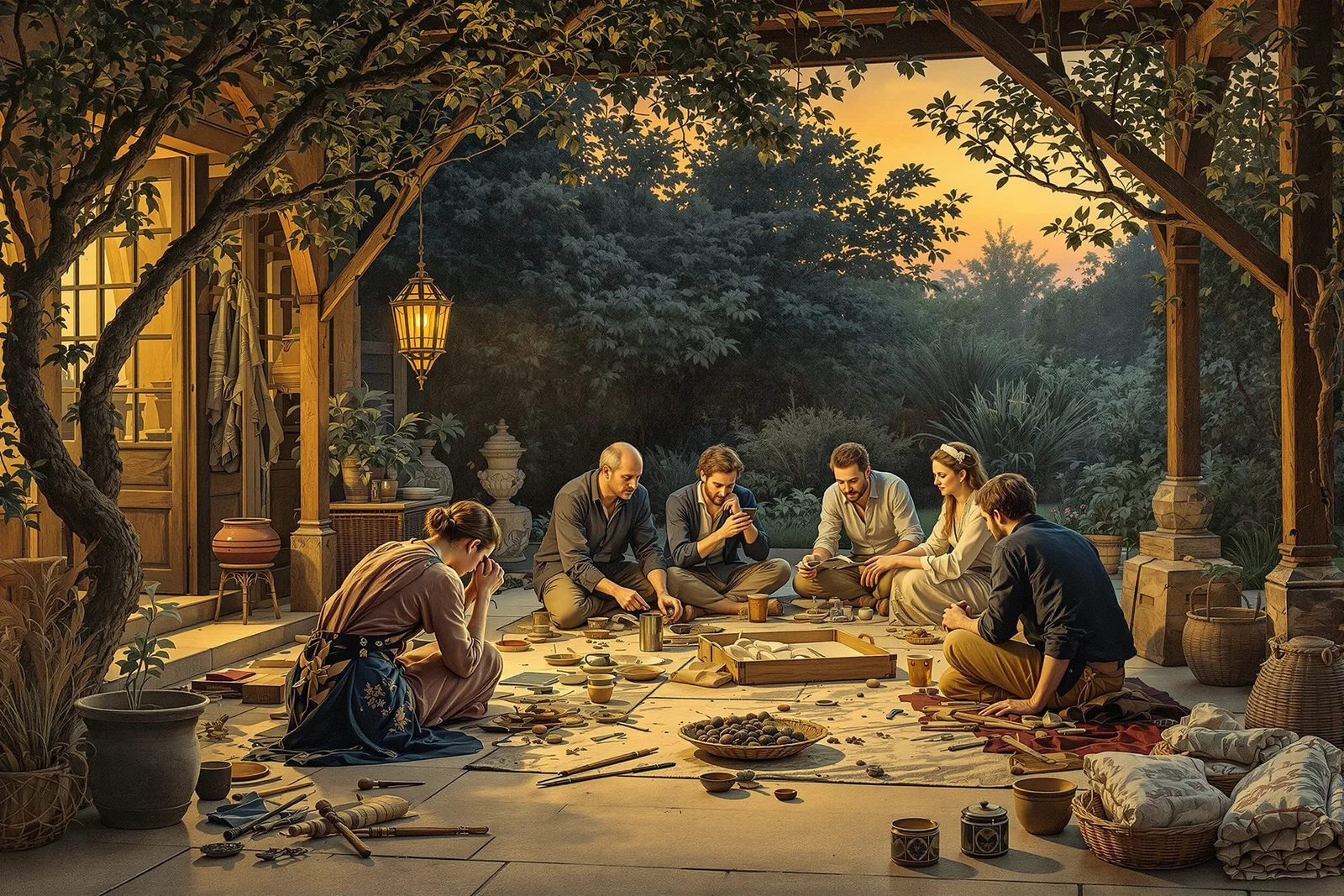
THE ME TABLET · Sexuality Module 799 · nì-nú-a
Carrying ME 24 · nì-nú-a · Sexual Intercourse. A Sovereignty Module of the Practitioner Community.
Unaltered and unabridged: ~2,910 words.
Preamble
Before two lives are joined, they must first find one another, recognize one another, and decide — freely, knowingly, and together — to become a pair. That finding and that deciding is what the comparative study of human societies calls courtship: the patterned interval between two unattached persons and a recognized union, in which acquaintance is made, intentions are declared, families and communities are consulted, and consent is given or withheld. Every human society that has ever joined couples has had some shape for this interval, and the shapes are astonishingly various — yet beneath the variety lies a small set of problems that every courtship system, ancient or modern, is built to solve. This module teaches the Practitioner to read those systems with an anthropologist's accuracy and to navigate her own community's courtship with intention, dignity, and clean consent.
This is the relational front of the Codex of Union, and it is handled here as the parent volume handles everything: soberly, clinically, anthropologically, and without explicit content. Vol XXV (The Codex of Union) is the home of this material; Module 799 carries its decree, ME 24 · nì-nú-a, on its relational face — the forming of the bond, not its physical expression. The module crosses to Vol XIX (The Diplomat's Codex) for the negotiation and family-alliance dimension of courtship, since the joining of two persons has always also been, in part, the joining of two households; and to Vol XVIII (The Parent's Codex) for the role of elders and family in a young person's path to union. Its sibling within the volume, Module S1 (Honor the Union), takes up partnership foundations where this module leaves off — at the threshold of the formed pair.
The sovereignty stake is plain. A community that cannot form its own couples well — that leaves its young to drift into unions by accident, or coerces them into unions by force, or has no recognized, dignified path from acquaintance to commitment — fails at the most intimate civic task there is. To navigate courtship is to keep, in the community's own hands and in each person's own keeping, the means of meeting, choosing, and committing freely. By the end of this module the Practitioner will understand the cross-cultural anthropology of courtship systems; will know soberly what the research on human mate selection actually establishes and what it does not; will be able to form a relationship with intention; and will hold consent and honest communication as the non-negotiable ground of the whole enterprise.
Part I — The Anthropology of Courtship Systems
Chapter 1 — What every courtship system must solve
Courtship looks endlessly different from one society to the next, but the differences are surface. Beneath them, every system is solving the same small handful of problems, and the Practitioner who holds the problems can read any system on earth. The first problem is introduction: how do two unattached persons of compatible status come into acquaintance at all, in a society that does not leave such things to pure chance? The second is assessment: how do the pair, and those who care for them, judge compatibility — of character, of standing, of prospect — before commitment? The third is the declaration of intention: how is the difference between idle company and a serious suit made unmistakable, so that no one is deceived about what is happening? The fourth is the involvement of kin and community: to what degree, and by what means, do families and the wider group take part in, sanction, or veto the match? And the fifth, underlying all the rest, is consent: how, and how freely, do the two persons themselves agree?
Different societies weight these problems differently and answer them with different machinery, but no society skips them. Where introduction is not arranged it is left to recognized venues; where assessment is not done by families it is done by the pair; where intention is not declared by a formal suit it is signaled by recognized customs. The Practitioner reads a courtship system by asking, of each problem, how does this society solve it — and reads her own the same way.
Chapter 2 — The great axes of variation
Anthropology has mapped the variation along several well-attested axes, and the Practitioner should hold them precisely, without caricature. The first and most consequential axis runs from arranged to self-selected marriage. In many societies across history, marriages were arranged by families, who took the lead in introduction and assessment — not, in the well-documented cases, as a simple imposition, but typically with degrees of consultation and, in many systems, a recognized right of the principals to refuse. At the other end, self-selected (sometimes called "love" or "companionate") marriage places the lead with the couple themselves. Most real systems sit somewhere between the poles — families propose and the couple disposes, or the couple chooses and the families ratify — and the Practitioner should resist the false picture of a clean opposition between loveless arrangement and unconstrained romance. Both poles, in their healthy forms, aim at a durable, consented union; they differ in who leads the search.
A second axis is the degree of kin involvement — from courtship as an essentially family affair to courtship as an essentially private one. A third concerns the venues and intermediaries a society provides: the recognized gathering, the festival, the go-between or matchmaker, the chaperoned visit, each a culturally specific answer to the problem of introduction. A fourth concerns the exchanges that accompany the match — bridewealth (goods conveyed from the groom's side to the bride's family), dowry (goods conveyed with the bride), and related customs — which anthropology reads not as the "price" of a person but as the formal, public economic dimension of forming an alliance between households, varying systematically with the society's kinship and economy. The Practitioner notes these without exoticizing them: they are the recognized machinery by which different societies have solved the same recurring problems.
Reference Table 799-1 — The five problems and how systems solve them
| The problem every system solves | Family-led solutions (toward "arranged") | Couple-led solutions (toward "self-selected") |
|---|---|---|
| Introduction | Match proposed by kin, matchmaker, or go-between | Recognized venues, festivals, mutual acquaintance |
| Assessment | Families weigh character, standing, prospect | The pair judge compatibility directly over time |
| Declaration of intention | Formal suit and family approach | Customary signals; an avowed, exclusive courtship |
| Kin and community involvement | Central — families lead, sanction, may veto | Consultative — families ratify the couple's choice |
| Consent | Principals' recognized right to refuse the match | Principals' free choice leads throughout |
The Critical Insight: There is no single "natural" or "correct" courtship system, and the Practitioner who studies the cross-cultural record honestly comes away cured of the temptation to think otherwise. What is universal is not a form but a set of functions — introduction, assessment, declared intention, the involvement of those who care, and consent. A community designing or reforming its own courtship should therefore ask not "are we modern or traditional?" but "does our way meet all five functions, and does it meet them with freedom and dignity?" A self-selected system that skips assessment, or an arranged one that skips consent, is a defective system by its own society's standards. The functions are the measure; the form is the community's to choose.
Part II — What the Mate-Selection Research Actually Shows
Chapter 3 — Reading the research soberly
Beyond the anthropology of systems lies a body of empirical research on human mate selection — the study of what people say they seek in a partner, and what predicts the unions they form. The Practitioner must read this literature with the same discipline the Codex applies everywhere: taking what is well-established, flagging what is contested, and refusing the over-claims that popular retellings pile onto it. Three findings are robust enough to teach. First, across a very wide range of cultures, people report valuing kindness, dependability, intelligence, and good character highly in a long-term partner — these "warm" traits sit at or near the top of stated preferences almost everywhere studied, a sober and reassuring result. Second, there is strong and repeatedly replicated evidence for assortative mating: people tend to pair with partners who resemble them on a range of attributes — age, education, background, values, and attitudes especially. Like tends to pair with like, not by design but by the workings of who meets whom and who suits whom. Third, proximity and familiarity matter greatly: people overwhelmingly form unions with those they actually encounter and come to know, which is precisely why every society invests in venues for introduction.
Chapter 4 — The limits and the cautions
Equally important is what the research does not license. The Practitioner must be careful here, because mate-selection findings are among the most over-extended results in popular culture. Stated preferences are not the same as actual choices: what people say they want and whom they actually pair with often diverge, and in some careful studies the stated preferences predict real attraction poorly once people meet. Average tendencies across populations say little about any individual: a robust group difference in stated emphasis does not tell the Practitioner anything reliable about the person in front of her. And much of the more sweeping theorizing that claims to explain why preferences take the shape they do is genuinely contested within the field — the Practitioner can soberly report the patterns (warm traits valued, assortative mating, proximity) without endorsing any one grand explanatory story, several of which are disputed and some of which have been used to launder prejudice. The honest summary is modest: people generally prize good character, tend to pair with those broadly like themselves, and unite with those they actually come to know. That modest, well-supported summary is worth far more to a Practitioner than the confident over-claims that surround it.
Reference Table 799-2 — Well-supported versus over-claimed
| Domain | Well-supported (teach it) | Over-claimed (do not assert it) |
|---|---|---|
| Trait preferences | Kindness, dependability, intelligence, character valued widely | That preferences are rigid, universal in detail, or destiny |
| Assortative mating | People tend to pair with those similar to them | That similarity is required, or that difference dooms a pair |
| Stated vs. actual | What people say and whom they choose can diverge | That stated preference reliably predicts an individual's choice |
| Group averages | Population-level tendencies exist | That a group average describes the individual before you |
| Explanations | The patterns are real | That any one grand "why" story is settled science |
Your Commitment: You will treat the mate-selection research as the sober, modest, useful thing it is — a description of broad tendencies — and never as a license to reduce a person to a type, to prejudge an individual by a group average, or to retail contested theory as settled fact. The patterns inform; they do not decide. The person before you is met as a person, not as a data point.
Part III — Forming a Relationship with Intention
Chapter 5 — From acquaintance to avowed courtship
To form a relationship with intention is to move through the interval deliberately rather than to drift through it, and the move has a recognizable arc that the Practitioner can walk on purpose. It begins with acquaintance — entering, or accepting introduction into, a recognized venue or circle where meeting compatible persons is possible, since proximity is the well-attested precondition of every union. It proceeds to mutual interest, the early, low-stakes phase in which two persons learn whether acquaintance wishes to deepen, signaled honestly and read without presumption. It passes through the declaration of intention — the point, indispensable in every healthy system, at which the difference between idle company and a serious suit is made explicit, so that no one is deceived about what is being undertaken. It deepens into avowed courtship, an acknowledged, exclusive, intentional getting-to-know across the domains that actually predict a durable union — character, values, the handling of conflict, the alignment of life-aims. And it arrives, when it arrives, at commitment: the decision, freely taken on both sides, to form a lasting pair, which is the threshold where this module hands off to Module S1 and to the rite of union (cross Vol XXV and the marriage rite of Module 793).
Protocol 799-A — Forming a relationship with intention
- Place yourself where compatible meeting is possible. Enter or accept the recognized venues and introductions your community provides. Proximity and acquaintance are the precondition of every union; intention begins with putting yourself within reach of it.
- Let interest be honest and read without presumption. In the early phase, signal genuine interest plainly and receive another's signals without over-reading them. Mutual interest is established by honesty on both sides, not by one party's hope.
- Declare intention; do not let it be ambiguous. When a suit becomes serious, say so. The single most important act of intentional courtship is making the difference between company and courtship explicit, so that consent is given to a thing both parties have named.
- Assess what actually predicts a durable union. Use the avowed interval to learn the partner's character, values, handling of conflict, and life-aims — the domains the evidence and long experience agree matter most — rather than first impressions or surface traits alone.
- Involve those who should be involved, by your community's lights. Consult the kin and elders your culture's system invites, at the degree it invites them, drawing on the alliance dimension (cross Vol XIX) and the counsel of elders (cross Vol XVIII) — neither bypassing legitimate family involvement nor surrendering consent to it.
- Decide deliberately, and only when ready. Make the commitment a chosen act, taken freely on both sides when assessment is sufficient — not a drift, not a default, not a thing slid into for want of a decision. Then cross the threshold to union (Module S1).
Part IV — Consent and Communication
Chapter 6 — Consent as the ground of everything
Consent is not one feature of courtship among others; it is the ground the whole enterprise stands on, and the Practitioner holds it as absolute. A union formed without the free consent of both principals is, by the standards of any society that respects persons, a defective union however correct its forms — and the cross-cultural record itself bears this out, since even strongly family-led systems in their healthy versions preserve a recognized right of the principals to refuse. Consent, rightly understood, has properties the Practitioner must keep. It must be free — given without coercion, force, or duress, which is what distinguishes a consented arrangement from an imposed one. It must be informed — given by a person who knows what they are agreeing to, which is why honest declaration of intention matters so much. It must be ongoing and revocable through the courtship interval — a person who has agreed to be courted has not thereby surrendered the right to withdraw. And it must be mutual — the agreement of both, not the wish of one and the submission of the other. These are not modern impositions on courtship; they are the conditions under which a union is a union of two free persons rather than a disposal of one by another.
Chapter 7 — Communication as the working skill
If consent is the ground, communication is the working skill that keeps the ground sound, and it is a skill the Practitioner can name and practice. Honest communication in courtship means, first, plainness about intention — not leaving the other to guess whether a serious suit is underway. It means directness about the things that decide a union — values, the wish for children or not, the handling of money and conflict, the shape of life each hopes for — discussed before commitment rather than discovered after it, because the avowed interval exists precisely to surface these. It means the reading and honoring of "no" — recognizing reluctance, refusal, and withdrawal, and treating them as decisive rather than as obstacles to be pressed past. And it means the absence of pressure — the discipline of letting the other's consent be genuinely free, neither rushed by urgency nor extracted by guilt nor compelled by anyone's authority. A courtship conducted in this register is one in which both persons always know what is being asked, are always free to answer truly, and arrive at commitment, if they arrive, by a road both chose.
Protocol 799-B — Keeping consent and communication sound
- Make intention explicit at every stage. Never let the other person be unsure what is being proposed. Clarity of intention is the precondition of informed consent.
- Discuss the deciding matters before commitment. Speak honestly, in the avowed interval, about values, children, conflict, money, and the shape of a shared life — the things a durable union depends on — rather than assuming or deferring them.
- Treat consent as free, informed, ongoing, and mutual. Hold all four conditions. A "yes" that is coerced, uninformed, withdrawn, or one-sided is not the consent a union requires.
- Read and honor refusal as decisive. Recognize reluctance and withdrawal, and accept them. The honoring of "no" is the clearest test of whether a suit respects the person it courts.
- Apply no pressure of any kind. Let the other's agreement be genuinely free — not rushed, guilted, or compelled, whether by you or by family authority. Consent extracted is not consent kept.
The Critical Insight: Every courtship system the anthropologist studies, however much it varies in form, is at its healthiest when it secures the same thing the most consent-centered modern system secures — the free, informed, mutual agreement of two persons to become a pair. The Practitioner is therefore not choosing between "tradition" and "consent," as if respect for elders and respect for the principals' freedom were enemies. The well-formed courtship honors both: it draws on the community's wisdom and the family's care for introduction, assessment, and alliance, and it keeps the consent of the two principals inviolable throughout. To navigate courtship rightly is to hold those two together — the counsel of the many and the free choice of the two — so that a community forms its couples both wisely and freely, and no person is ever joined to another against their own will.
PLATES — Supplemental Gallery
Art direction
Art direction
Art direction
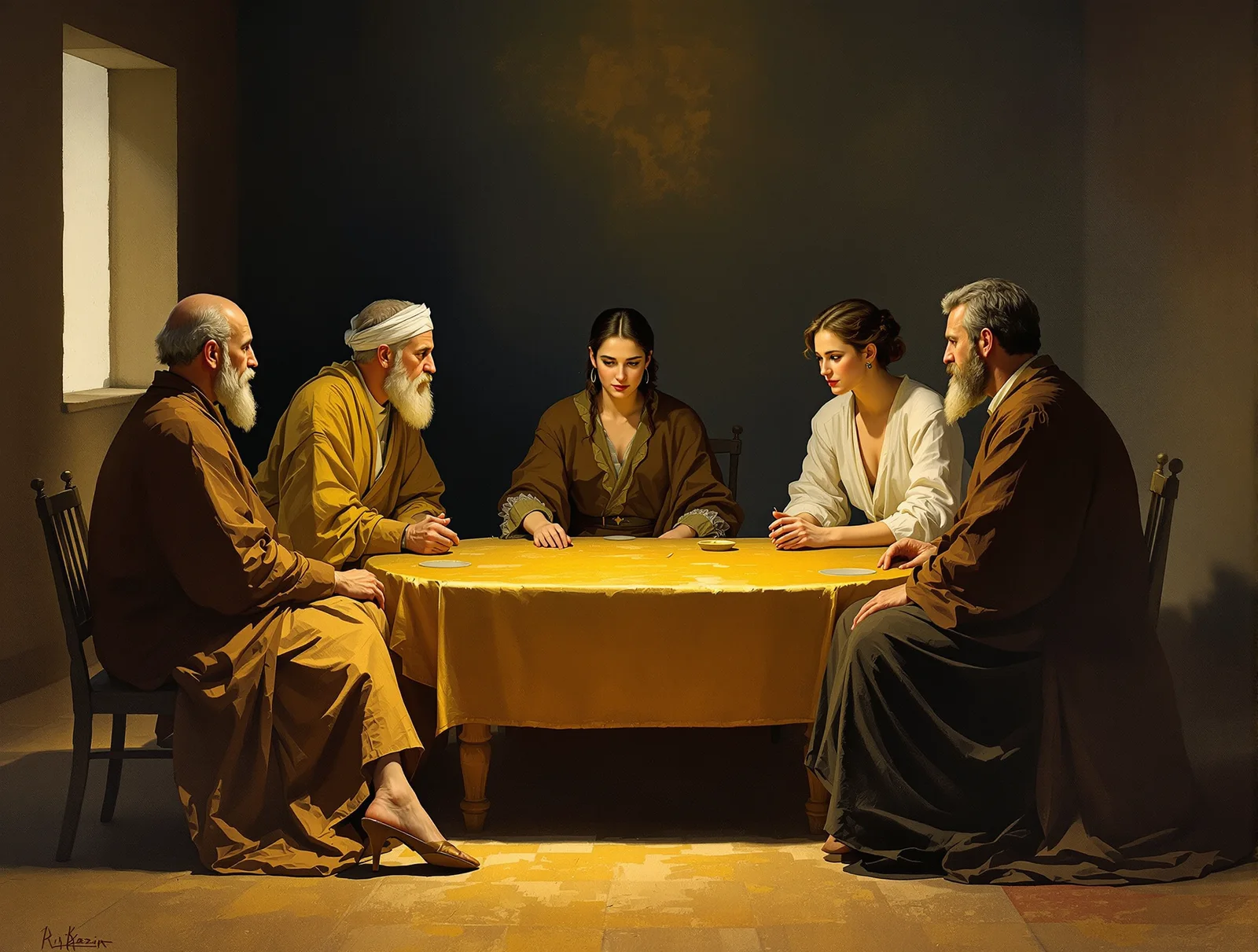
Art direction
Council Approval — The Twelve Voices Speak
| Disciple | Verdict | Reasoning |
|---|---|---|
| Peter | APPROVED | "It builds the joining of two on rock — meeting, choosing, and consent, set in the open for all to see." |
| Thomas | APPROVED | "I doubted one frame could fit arranged and self-chosen both; the five functions beneath them convinced me." |
| John | APPROVED | "Consent held as the ground of everything — this is love's first law, that no one be joined against their will." |
| Matthew | APPROVED | "It weighs the research honestly, teaching the supported and refusing the over-claimed. The ledger is clean." |
| James the Greater | APPROVED | "It carries the declaration of intention with strength — no one left deceived about what is undertaken." |
| Andrew | APPROVED | "It gathers all who should be gathered — the pair, the kin, the community — and slights none of them." |
| Philip | APPROVED | "Show me how to court with intention, and two protocols answer, stage by stage. Nothing left to vapour." |
| Bartholomew | APPROVED | "No false note and no false marvel: it reports the patterns soberly and will not launder prejudice as science." |
| James the Lesser | APPROVED | "Modest and humane — it meets the person as a person, never as a type, and keeps the courtship kind." |
| Simon the Zealot | APPROVED | "Here is sovereignty's intimate face: a people that meets, chooses, and commits in its own keeping, freely." |
| Judas Thaddaeus | APPROVED | "For the one pressed or hurried it holds the line — consent free, informed, ongoing, mutual. None is compelled." |
| Matthias | APPROVED | "It takes its place in the canon cleanly, carrying ME 24 and pointing home to Vol XXV. The lot falls true." |
Council Verdict: 12/12 APPROVED. This module is canon.
Let two find one another in the open, weigh one another in truth, and be joined only by the free consent of both.
TRANSMISSION RECORD
Transmission COMPLETE — unaltered & unabridged Module 799 · Navigate Courtship · category: sexuality Carries ME 24 · nì-nú-a · Sexual Intercourse Words ~2,910 SHA-256 of source text b54a847f428ab5f6b9f1b4834a173b3e526a894fe5546faa1a22285f99655f4a Canonical text navigate-courtship.md — byte-identical to what this page renders