Module 800 — Hold the Sacred Threshold
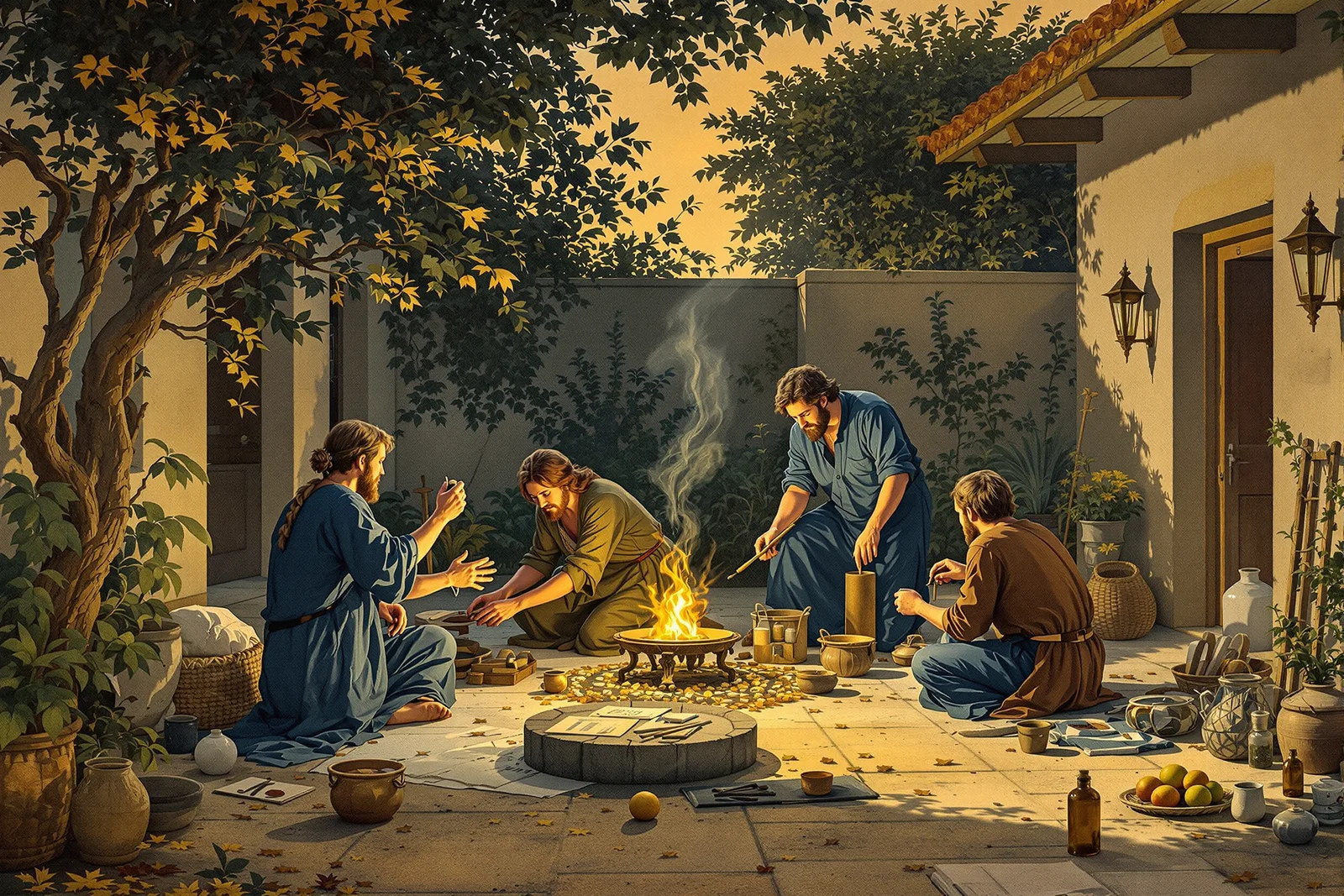
THE ME TABLET · Sexuality Module 800 · kar-kid
Carrying ME 25 · kar-kid · Sacred Temple Arts. A Sovereignty Module of the Practitioner Community.
Unaltered and unabridged: ~3,040 words.
Preamble
Few subjects in the study of the ancient Near East have been more confidently asserted, and less soundly founded, than the claim that the temples of Mesopotamia maintained women for institutionalized rites of commercialized intimacy with strangers — the so-called "sacred prostitution" of the textbooks, the lectures, and the popular histories. This module is a scholarly instrument for handling that subject with the discipline it demands. Its work is not to retail the lurid story, even to refute it, but to teach the Practitioner to do what careful modern scholarship has done: to read the cuneiform record for what it actually attests about the temple women, to trace exactly how the sensational claim arose, and to distinguish, cleanly and permanently, the documentary record from its modern invention.
This is the front of the Codex of Union that requires the most rigor and the most restraint, and it is handled strictly as scholarship. Vol XXV (The Codex of Union), and within it the sub-volume on the temple traditions (Sub-Vol I), is the home of this material; Module 800 carries its decree, ME 25 · kar-kid · Sacred Temple Arts, on its scholarly-historiographical face. The register is that of Vol XXV throughout: clinical, anthropological, sober, and non-explicit. The module is the close kin of the priesthood module Serve the Divine Office (Module 785), which restored the honored office of the nu-gig as a vocation of welcome and blessing; where that module rebuilt the office, this one does the prior and underlying work — the historiography, the careful demonstration of what the record holds and what it does not, on which any sound treatment must rest.
The sovereignty stake is the stake of truth itself. A community that takes its picture of the ancient world from a discredited sensational story is a community whose knowledge has been colonized by error and by the prejudices that error carried. To hold the sacred threshold, in the sense this module intends, is to keep the boundary between the attested and the invented — to know what the people of ancient Mesopotamia actually recorded about the women of their temples, to refuse the marvel their own documents do not support, and to give a defamed body of women back the dignity the record always preserved. By the end of this module the Practitioner will understand what the cuneiform record attests about the temple women; will be able to trace the genealogy of the "sacred prostitution" myth and explain precisely why modern scholarship has rejected it; and will hold, as a permanent discipline, the distinction between historical record and historiographical invention.
Part I — What the Cuneiform Record Attests
Chapter 1 — The temple as institution
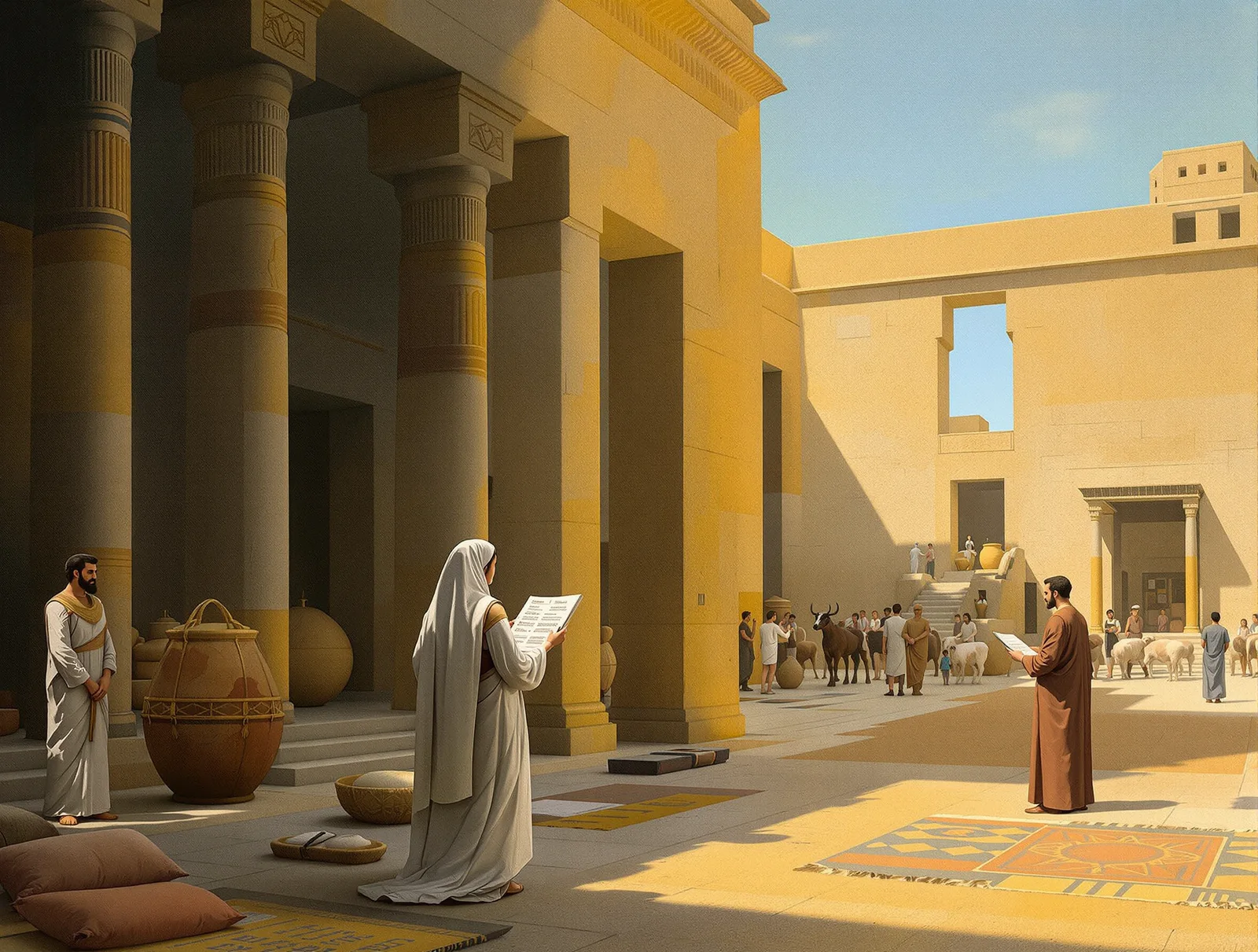
To read the temple women rightly, the Practitioner must first see the institution they belonged to, because the lurid story works in part by detaching them from it. The Mesopotamian temple — the é, the "house" of the god — was not a place of worship only. It was, in the Sumerian and later city, simultaneously the dwelling of the deity, often the single largest landholder of the region, a center of the economy that employed and fed great numbers, an archive, a school, and the keeper of the calendar and the rites. Around this vast institution clustered a great many offices and personnel — administrators, scribes, craftworkers, singers, brewers, herders, and a range of consecrated religious women and men. The temple women appear in this setting as what they were: members of a large, complex, economically central religious household, holding offices of varying rank and function within it.
The Practitioner holds this framing as the first corrective. The temple woman of the record is an institutional figure — a holder of a defined office within a great house, attested in the same dry administrative and legal documents that attest the temple's herds and granaries and scribes. To picture her instead as a figure of sensational rite, detached from this institutional reality, is already to have left the record for the marvel.
Chapter 2 — The offices the record names
The cuneiform record names not one undifferentiated class of temple women but a range of distinct consecrated offices, each with its own term, rank, and documented functions. The Practitioner should know the principal terms soberly, as the philologists have established them. The entu (Sumerian en) was a high priestess of the very greatest rank — in some periods a royal daughter consecrated to a city's chief deity, a figure of immense standing who governed temple estates. The nadītu were a class of consecrated votaries, most famously documented at Old Babylonian Sippar, who lived in a dedicated cloister-precinct, typically did not bear children, and — as their extraordinary archive shows — held land, lent silver, conducted business, adopted heirs, and managed substantial estates as recognized economic and legal actors. The qadištu (Sumerian nu-gig) was a consecrated "holy woman," her very title built on the Semitic root q-d-š, "to be holy, set apart," attested in liturgical roles and, in some contexts, in roles connected to childbirth and the nursing of infants. The ištarītu and other terms name further consecrated women associated with particular deities. These are offices of consecrated religious women — votaries, priestesses, holy women of various ranks — and the record attests them as such.
Reference Table 800-1 — Principal temple-women terms in the record
| Term (Akkadian / Sumerian) | What the record attests | Root / meaning where known |
|---|---|---|
| entu / en | High priestess of the highest rank; consecrated, often royal; governed temple estates | "lord/lady, high one" |
| nadītu | Consecrated votary, frequently childless; propertied, lent silver, ran estates (esp. Sippar) | "fallow," i.e. set apart |
| qadištu / nu-gig | Consecrated "holy woman"; liturgical roles; some childbirth/nursing roles | q-d-š, "holy, set apart" |
| ištarītu | Consecrated woman associated with Ištar | from the divine name Ištar |
| Common thread | A range of honored, consecrated, often propertied religious offices | consecration, being set apart |
Chapter 3 — The decisive evidence of the economic and legal texts
The single most decisive body of evidence about the temple women is also the least sensational: the economic and legal record in which they appear as women of property and standing. The Practitioner weights it heavily for exactly that reason. The nadītu archive of Sippar — thousands of documents — shows these consecrated women as principals in land sales and leases, as lenders of silver, as parties to adoptions and inheritance settlements, as managers of estates whose business the city's law troubled to regulate and protect. Law codes of the period recognize and protect the rights, property, and inheritance of consecrated women. This is the mundane, granular, irrefutable testimony of how the society itself administered these women's lives — and it describes a recognized, propertied, legally protected status. A degraded and commercialized class does not appear, by the thousand, in a city's contracts as landholders and lenders and adoptive parents whose estates the law protects. An honored class does. The account-books and the law codes are the bedrock on which the sober reading stands.
The Critical Insight: The cuneiform record, read on its own terms, attests a range of honored, consecrated, frequently propertied religious offices held by women within the temple institution — high priestesses who governed estates, votaries who lent silver and adopted heirs, holy women whose title means "set apart." It does not, on its own terms, attest an institution of commercialized temple intimacy with strangers. The Practitioner who has read the entu, the nadītu, and the qadištu in the documents that actually name them has read the temple women as their own society recorded them — and that record is one of consecration and standing, not of the marvel later ages attached to it. Everything that follows in this module is the demonstration that the marvel was added from outside.
Part II — The Genealogy of a Myth
Chapter 4 — Where the sensational claim came from
If the indigenous record does not attest commercialized temple intimacy, where did the confident textbook claim of "sacred prostitution" come from? The Practitioner traces its genealogy precisely, because tracing it is half the demonstration that it is unfounded. The fountainhead is a single famous passage in the Greek historian Herodotus (Histories, Book I), which describes an alleged Babylonian custom requiring every woman, once in her life, to sit in the precinct of a goddess and accept a stranger. This one passage — vivid, memorable, and endlessly quoted — became the seed of the entire modern construct. To it were joined a few other scattered classical and later notices, similarly external and late, and the loaded translation of indigenous terms (rendering "consecrated woman" or "holy woman" with words that imported the very conclusion at issue). From these materials, nineteenth- and early-twentieth-century scholarship assembled the picture of an institutionalized "temple prostitution" and projected it confidently back across the whole of the ancient Near East.
The Practitioner must see clearly what kind of source the fountainhead is. Herodotus wrote in the fifth century BCE, centuries after the height of the Mesopotamian institutions in question, as a foreign Greek observer working largely from hearsay about a distant and exotic land. He is valuable for much, but he is also a recognized purveyor of the ethnographic marvel — the strange custom of far-off peoples, told to a home audience that expected distant lands to be strange — and he reports, elsewhere, customs of foreign nations that those nations' own records do not confirm. A single such passage, by such a source, at such a distance, is the thinnest possible foundation for an institution; yet it bore almost the entire weight of the modern claim.
Chapter 5 — Why the foundation fails
The Practitioner can state, soberly and in order, exactly why the foundation fails — and these are the reasons modern scholarship has set the claim aside. First, the source problem: the core evidence is a single late passage by a foreign outsider working from hearsay, a known reporter of ethnographic marvels, writing centuries after the fact. Second, the silence of the indigenous corpus: the vast body of Mesopotamian administrative, legal, and liturgical cuneiform — the society's own enormous self-documentation — does not corroborate the practice as the external sources frame it. Where a culture's own dry account-books and law codes are silent on a sensational institution claimed only by foreigners centuries later, the historian weights the indigenous record and discounts the outsider's marvel. Third, the mistranslation problem: the construct was sustained by rendering indigenous terms for consecrated women with loaded words, smuggling the conclusion into the evidence. Fourth, the conflation problem: the construct lumped a range of distinct consecrated offices — entu, nadītu, qadištu, and more — into one undifferentiated sensational category, erasing precisely the distinctions the record preserves. Fifth, the projection problem: the picture told the modern scholars' own preoccupations and prejudices about the ancient and the "oriental" at least as much as it told anything about Mesopotamia. On these grounds the foundation does not hold.
Reference Table 800-2 — Record versus invention
| Question | The documentary record (the attested) | The "sacred prostitution" construct (the invented) |
|---|---|---|
| Primary evidence | The society's own vast administrative, legal, liturgical corpus | One late foreign passage (Herodotus I) plus scattered externals |
| Source character | Indigenous, contemporary, granular, mundane | Foreign, late, hearsay, a known reporter of marvels |
| Indigenous corroboration | Pervasive — these are the society's own documents | Absent — the indigenous corpus does not confirm it |
| Treatment of the terms | A range of distinct consecrated offices, each named | One undifferentiated category, via loaded mistranslation |
| What it ultimately reflects | How the society administered its temple women | The modern interpreters' preoccupations and prejudices |
| Modern scholarly verdict | An honored range of consecrated women's offices | The construct is largely discredited and abandoned |
Part III — The Modern Scholarly Rejection
Chapter 6 — How the discipline corrected itself
The Practitioner should understand that the rejection of the "sacred prostitution" construct is not a fringe revision but the considered movement of the field. Over recent decades, Assyriologists and historians of the ancient Near East, returning to the actual Sumerian and Akkadian documents and applying careful philology, reexamined the construct piece by piece and found it wanting on every point set out above. They demonstrated that the indigenous terms denote consecrated women's offices, not a commercialized trade; that the economic and legal record shows these women as propertied and protected; that the construct rested on external, late, hearsay evidence the indigenous corpus does not support; and that loaded translation and modern projection had done much of the construct's work. The result is a broad scholarly consensus that the old picture of institutionalized temple prostitution in Mesopotamia is unfounded and should be set aside — a textbook example, within the discipline, of how careful return to primary sources corrects an inherited error. The Practitioner who teaches this material teaches the current state of the field, not the discredited inheritance the popular culture still repeats.
Chapter 7 — The economy of the correction
A scholarly discipline attends not only to what is true but to how a correction should be made, and the Practitioner observes a particular economy here, out of both rigor and respect. The discipline is to correct the construct once, by the evidence, and then move on — to state plainly what the record attests and where the construct came from and why it fails, and then to teach the temple women as the consecrated office-holders the record shows, without dwelling on, elaborating, or retailing the lurid story under cover of refuting it. There is a real ethical reason for this economy beyond mere taste. The construct defamed a body of historical women — real consecrated priestesses and votaries whose own society honored them — by attaching to them a sensational story their documents never supported. To relitigate that story endlessly, even in the name of debunking it, is to keep the defamation in circulation. The respectful and the rigorous course is the same course: correct it cleanly, and then accord these women the dignified, accurate treatment the record always warranted.
Protocol 800-A — Handling the subject as a scholar
- Begin from the indigenous record. Anchor every treatment in what the society's own administrative, legal, and liturgical documents attest — the range of consecrated offices, the propertied and protected standing — not in the external sources or the popular story.
- Name the construct's genealogy plainly. When the "sacred prostitution" claim arises, trace it: one late foreign passage, scattered externals, loaded mistranslation, modern projection. The genealogy is itself the demonstration that it is unfounded.
- State the five reasons the foundation fails. Source problem, indigenous silence, mistranslation, conflation, projection. Lay them out in order, soberly, as the field has done.
- Report the current scholarly verdict. Make clear that modern Assyriology has largely rejected the construct, and that to repeat it is to repeat a discredited error, not to convey settled history.
- Correct once, then teach the record. Do not elaborate or dwell on the lurid story. State the correction cleanly and proceed to teach the temple women as the consecrated office-holders the documents attest.
- Keep the dignity of the women intact. Speak of these historical women always as the honored, consecrated figures the record shows, holding their dignity as a thing in your keeping whenever the subject is discussed.
Your Commitment: You will treat the temple women only as the indigenous documentary record treats them — a range of honored, consecrated, often propertied religious office-holders — and you will name the "sacred prostitution" construct, when it arises, for the discredited modern invention it is. You will not retail the lurid story even to refute it carelessly; you will correct it once, by the evidence, and then teach the record. The boundary between the attested and the invented is yours to hold, and the dignity of the women the construct defamed is in your keeping every time you speak of them.
Part IV — Holding the Threshold as a Discipline
Chapter 8 — The permanent boundary
The deepest lesson of this module is not the particular case but the discipline the case teaches: the permanent holding of the boundary between historical record and historiographical invention. The "sacred prostitution" construct is a near-perfect specimen of how an inherited error takes hold — a vivid external anecdote, amplified by loaded translation and congenial prejudice, projected confidently across a civilization and repeated until it seemed self-evident — and of how the boundary is restored: by returning to the primary documents, weighting a society's own record over the outsider's marvel, distinguishing distinct things the construct conflated, and naming the projection for what it is. The Practitioner who has learned to hold the threshold in this case holds a transferable discipline, for the same error-pattern recurs wherever a sensational story about a distant or different people is more memorable than the dry record that would correct it.
To "hold the sacred threshold," then, is to stand permanently at the boundary of the attested — to let the record speak, to refuse the marvel the record does not support, to correct inherited error by primary evidence rather than to inherit it, and to keep, in every such case, the dignity of those whom a careless construct has wronged. The temple women of Mesopotamia are owed exactly this: to be known as their own civilization recorded them, consecrated and honored, and to be freed at last from a sensational story that was never theirs but was laid upon them, long after they were silent, by ages that did not trouble to read their documents. The Practitioner who keeps that boundary keeps faith with the truth and with the wronged together.
The Critical Insight: The recovery this module performs is recovery by accuracy — an act of justice done by reading correctly. The cuneiform record always attested honored, consecrated, often propertied women's offices within the temple; a sensational construct, built from a late foreign anecdote and modern projection, defamed those women with a story their own documents never supported; and modern scholarship, returning to the primary sources, has largely dismantled that construct. To hold the sacred threshold is to keep that hard-won distinction permanently — to teach the record, name the invention, correct once and move on, and guard the dignity of the women whom the invention wronged. The threshold the Practitioner holds is the boundary of truth itself, between what a people recorded and what a later age invented about them.
PLATES — Supplemental Gallery
Art direction
Art direction
Art direction
Art direction
Council Approval — The Twelve Voices Speak
| Disciple | Verdict | Reasoning |
|---|---|---|
| Peter | APPROVED | "It builds on the rock of the documents and not on a foreigner's rumor — and the rock says: consecrated, honored." |
| Thomas | APPROVED | "I doubted the famous tale; the indigenous corpus and the propertied votaries settled my doubt against it." |
| John | APPROVED | "To free defamed women from a story never theirs is an act of love. It corrects, and it does not gloat." |
| Matthew | APPROVED | "The nadītu archive names them as landholders and lenders by the thousand. The account-books do not lie." |
| James the Greater | APPROVED | "It corrects the construct once, by the evidence, and marches on. That is discipline, not indulgence." |
| Andrew | APPROVED | "It gathers the whole field's verdict and the record's testimony alike — the construct is set aside on every ground." |
| Philip | APPROVED | "Show me the genealogy of the myth, and the flow answers, source by source. Nothing is asserted without its tablet." |
| Bartholomew | APPROVED | "No false note and no false marvel: it weights the society's own corpus over the outsider's tale, as truth demands." |
| James the Lesser | APPROVED | "Sober and exact, and merciful to the women whose dignity it keeps. It dwells on no lurid thing." |
| Simon the Zealot | APPROVED | "To take back a people's truth from a colonizing error is sovereignty's work — knowledge restored to the record." |
| Judas Thaddaeus | APPROVED | "It keeps the register sober for the sake of the wronged, and corrects the slander without repeating it. None is shamed." |
| Matthias | APPROVED | "It takes its place in the canon cleanly, carrying ME 25 and pointing home to Vol XXV. The lot falls true." |
Council Verdict: 12/12 APPROVED. This module is canon.
Let the record speak, the marvel be set aside, and the women of the temple be known as their own civilization honored them.
TRANSMISSION RECORD
Transmission COMPLETE — unaltered & unabridged Module 800 · Hold the Sacred Threshold · category: sexuality Carries ME 25 · kar-kid · Sacred Temple Arts Words ~3,040 SHA-256 of source text e90bd16de2523f41e8512df23ab2e0a73e445cf8e61cce28b64fe605e7b6202b Canonical text hold-sacred-threshold.md — byte-identical to what this page renders