Module 801 — Tend the Generational Line
THE ME TABLET · Sexuality Module 801 · kar-kid
Carrying ME 25 · kar-kid · Sacred Temple Arts. A Sovereignty Module of the Practitioner Community.
Unaltered and unabridged: ~3,010 words.
Preamble
A union does not end at the pair. From two joined persons a line descends — children, grandchildren, the long thread of a family carried forward through generations — and the keeping of that line is among the oldest and most universal works of human society. Every people that has ever existed has reckoned who is kin to whom, traced descent from one generation to the next, remembered its ancestors, and ordered the household in which the generations live and are raised. This reckoning, tracing, remembering, and ordering is the subject of this module: the generational line, treated as the comparative study of human societies treats it — through the anthropology of kinship and descent, the practice of genealogy-keeping, and the institution of the multigenerational household.
This is the continuance front of the Codex of Union — the volume's reach beyond the pair into the line the pair begins — and it is handled in the volume's register: sober, anthropological, and non-explicit. Vol XXV (The Codex of Union), and within it the sub-volume on lineage and continuance (Sub-Vol II), is the home of this material; Module 801 carries the decree ME 25 · kar-kid · Sacred Temple Arts on its lineage and household face. The module crosses widely, because the generational line touches many offices: to Vol XVIII (The Parent's Codex) for the rearing of the generations within the household; to Vol XIX (The Diplomat's Codex) for the household as a unit of alliance, standing, and inter-family relation; and to the rites of birth, union, and death that mark the line's passages (cross Module 793, Carry the Rites of Passage). Its sibling within the volume, Module S1 (Honor the Union), founds the pair from which the line descends.
The sovereignty stake reaches across time. A community that does not know its own kinship — who is related to whom, how descent runs, who its ancestors were — and that has no sound institution for raising its generations, is a community without depth in time, cut off from the dead behind it and uncertain of the line ahead. To tend the generational line is to keep the family's continuance in the family's own hands: to reckon kin accurately, to keep the genealogy faithfully, and to order the multigenerational household well, so that a people endures through its generations as a remembered, ordered, continuous line. By the end of this module the Practitioner will understand the cross-cultural anthropology of kinship and descent; will be able to keep a genealogy soundly; and will understand the multigenerational household as the institution in which the line is lived.
Part I — The Anthropology of Kinship and Descent
Chapter 1 — Kinship as a made thing
The first and most important discovery of the anthropology of kinship is that kinship is not simply given by biology but is built by every society according to its own rules. Biological relatedness is real, but which biological relations a society counts as kin, how it groups them, what it names them, and what it asks of them — these vary enormously, and they are cultural facts, not natural ones. Two societies with the identical biological facts may reckon kinship in sharply different ways: one tracing the line through fathers and another through mothers, one merging relations that another sharply distinguishes, one extending the bonds of kin across a vast group and another confining them to a small household. The Practitioner holds this as the master fact of the whole field: kinship is a system a society makes, fitted to how that society lives, and to study it is to study the rules by which a particular people builds its web of relation.
This is why the comparative study of kinship has been one of anthropology's central labors. Beneath the variety, the discipline has mapped recurring structures — the principal ways human societies reckon descent, group their relatives, and name their kin — and these structures are stable enough that the Practitioner can learn them and read any society's kinship by them, including her own.
Chapter 2 — The principal descent systems
The most consequential structure in kinship is descent: the rule by which a society traces the line from one generation to the next and assigns membership in kin groups. The Practitioner should know the principal systems soberly. In patrilineal descent, the line is traced through the father — a person belongs to the father's kin group, and descent, name, and often property and standing pass down the male line. In matrilineal descent, the line is traced through the mother — a person belongs to the mother's kin group, and descent runs through the female line (though authority within such systems is not thereby simply held by women; it is frequently held, for instance, by the mother's brother, a well-attested arrangement). These two are unilineal systems, tracing the line through one sex only, and they have been extremely widespread across human societies because they produce clear, unambiguous kin-group membership. Other societies reckon bilateral (or cognatic) descent, tracing kin through both parents more or less equally — the system familiar in much of the modern world, which produces overlapping personal kindreds rather than sharply bounded descent groups. Still others use double descent, combining patrilineal and matrilineal reckoning for different purposes. Each system is a coherent solution to the problem of ordering descent, fitted to its society's needs.
Reference Table 801-1 — The principal descent systems
| System | The line is traced through | Produces | Note |
|---|---|---|---|
| Patrilineal (unilineal) | The father's line | Bounded patrilineal kin groups; descent/name/property down the male line | Very widespread historically |
| Matrilineal (unilineal) | The mother's line | Bounded matrilineal kin groups; descent down the female line | Authority often with the mother's brother |
| Bilateral / cognatic | Both parents, ~equally | Overlapping personal kindreds, not bounded groups | Familiar in much of the modern world |
| Double descent | Both lines, for different purposes | Patrilineal for some matters, matrilineal for others | A combined solution |
Chapter 3 — Descent groups and the reckoning of kin
From descent rules, societies build descent groups — the bounded sets of kin that unilineal reckoning produces, and the Practitioner should know their nested scale. The lineage is a group of kin who can trace their descent from a known common ancestor through documented links, generation by generation; it is the working unit of much kinship, the set of relatives whose exact connection to one another is remembered and reckoned. The clan is larger — a group claiming descent from a common ancestor who may be remote or even legendary, the precise links no longer all traceable, often marked by a shared name or emblem. Above the clan, some societies recognize still larger groupings (phratries, moieties) that order the whole society into a few great divisions. These groups are not idle classifications; they are the units through which property descends, marriages are arranged or forbidden, obligations of support and vengeance and ceremony are owed, and the individual is placed within the society. The Practitioner reads a kinship system by asking how it reckons descent, what groups that reckoning builds, and what those groups do.
She should also note that kinship reckoning includes kin terminologies — the systems by which societies name their relatives, which anthropology has classified into a small number of recurring types — and the recognized means by which kinship is extended beyond birth: marriage, which allies kin groups and creates affinal (in-law) relations; and adoption, the well-attested and ancient practice by which a society makes kin of those not born to the line, fully recognized in the law and custom of many peoples, including the ancient Mesopotamian record, where adoption of heirs is richly documented. Kinship, the made thing, is made also by these recognized acts that enlarge the line.
The Critical Insight: Because kinship is a system a society makes rather than a fact biology hands down, the Practitioner studying her own community's line must first ask what system her community actually uses — how it reckons descent, what kin groups it recognizes, how it extends kinship by marriage and adoption — rather than assuming her own familiar reckoning is the only or natural one. A people that understands its own kinship system explicitly, and the variety of systems against which to see it, can tend its generational line deliberately: it knows how its descent runs, who its kin groups are, and how its line may be extended. Kinship understood is the precondition of lineage well kept.
Part II — Genealogy: Keeping the Line
Chapter 4 — Why a people keeps its genealogy
If kinship is the system, genealogy is its record — the kept account of who descended from whom, generation by generation, that turns a society's descent rules into a remembered, traceable line. Every society that reckons descent keeps genealogy in some form, whether written in the clay and parchment of literate peoples or carried in the trained memory of oral specialists who can recite a lineage back many generations, and the Practitioner should understand why the labor is so universally undertaken. Genealogy establishes identity and belonging — it tells a person who their kin are and what group they belong to. It governs inheritance and right — descent determines who succeeds to property, office, and standing, and the genealogy is the record by which such claims are judged. It orders marriage — many societies forbid or prescribe unions by genealogical relation, and the genealogy is consulted to know who may wed whom. It anchors the bond with the ancestors — the remembered line connects the living to the dead from whom they descend, a connection many peoples hold sacred. And it gives a people depth in time — the sense, valuable and steadying, of standing within a long line that reaches back beyond memory and forward beyond one's own life.
Chapter 5 — Keeping a genealogy soundly
The keeping of a genealogy is a craft with standards, and the Practitioner can hold them whether her community keeps its line in writing or in memory. A sound genealogy records, for each person, their identity, their parents (by the line or lines the community's descent system reckons), their union(s), and their children, with the dates or the generational placement that fix them in time. It distinguishes descent by birth from kinship by adoption or marriage, recording each accurately rather than blurring them, since the community's law of inheritance and union turns on the distinction. It is kept faithfully — entered carefully, preserved against loss, and corrected when error is found rather than allowed to drift, because a genealogy's whole value lies in its trustworthiness. And in oral traditions it is kept by trained transmission — the disciplined teaching of the line to those who will carry it next, so that the memory does not die with its keeper. The Practitioner notes that the ancient Mesopotamian world kept exactly such records: dynastic lists, family archives, and the careful documentation of adoptions and inheritances show a civilization that took the keeping of its lines with full seriousness.
Protocol 801-A — Keeping the generational line
- Know your community's descent system first. Before keeping the genealogy, establish which line or lines your community reckons — patrilineal, matrilineal, bilateral — so that the record traces descent as the community actually counts it.
- Record each person fully and fix them in time. For every member enter identity, parentage, union(s), and offspring, with dates or generational placement, so each stands clearly within the line.
- Distinguish birth from adoption and marriage. Record descent by birth, kinship by adoption, and affinity by marriage as the distinct things they are, since inheritance and the law of union turn on the difference (cross the rites of union, Module 793).
- Keep it faithfully and correct it honestly. Enter carefully, preserve against loss, and correct error when found. A genealogy is worth exactly as much as it is trustworthy.
- Transmit the keeping to the next keeper. Whether in writing or in trained memory, teach the line and its keeping to those who will carry it forward, so the record outlives any single keeper.
- Tie the line to its rites and its ancestors. Mark the line's passages — birth, union, death — with the community's rites (Module 793), and keep the remembered bond with the ancestors, so the genealogy is a living connection and not a dead list.
Part III — The Multigenerational Household as Institution
Chapter 6 — The household as the line lived
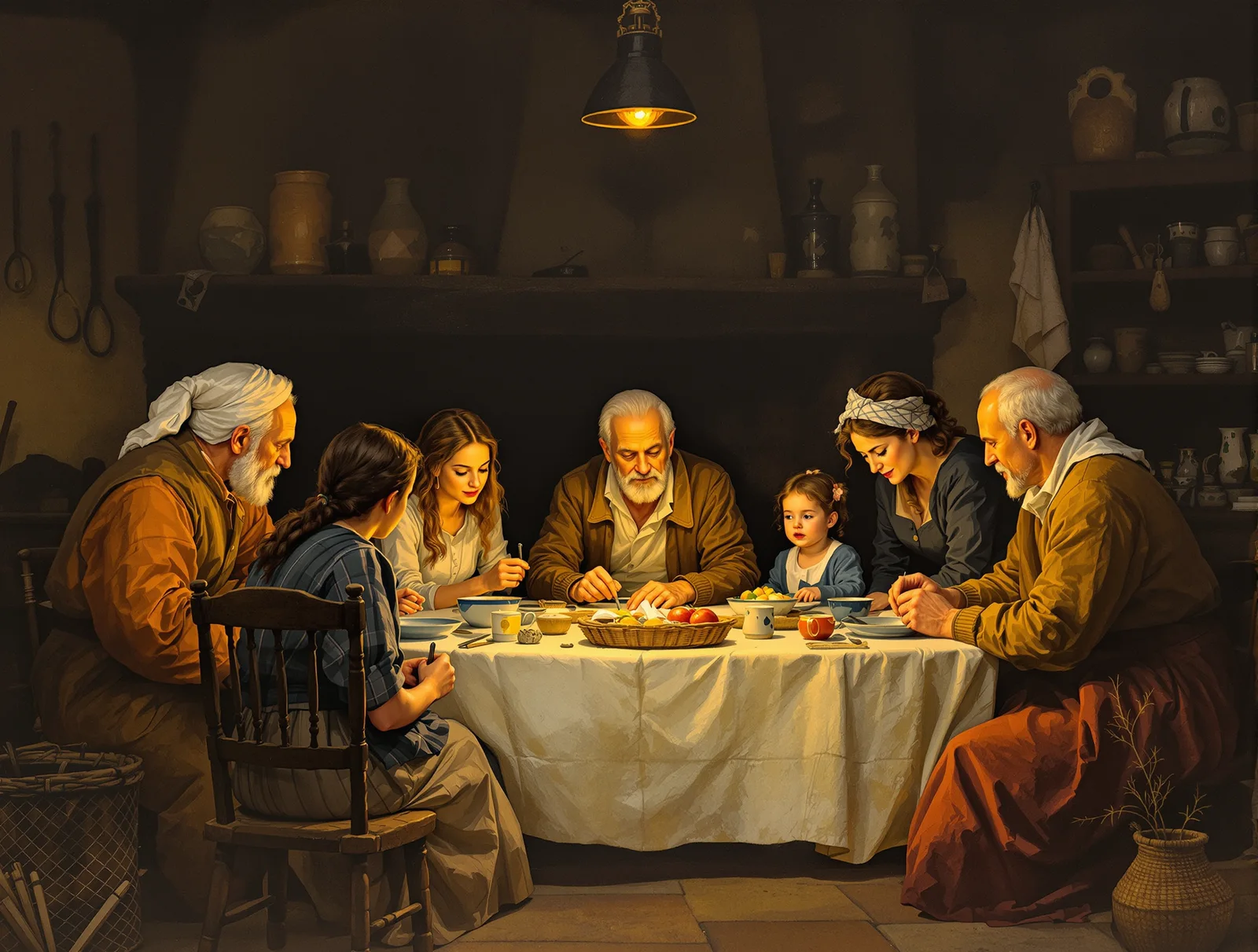
If the lineage is the line reckoned and the genealogy is the line recorded, the household is the line lived — the actual co-residing, cooperating group in which the generations dwell together, raise their young, pool their labor, and carry the family forward day by day. The Practitioner must hold a precise distinction the anthropology of the family insists on: the family (a set of kin) and the household (a residential and economic unit) are not the same thing, and which kin live and work together as a household is, like kinship itself, a cultural arrangement that varies across societies. The most important variation runs from the nuclear household — a single pair and their children — to the extended or multigenerational household, in which several generations and often several related families share a single domestic establishment: grandparents, their adult children, those children's spouses, and the grandchildren, living and laboring as one unit. Across much of human history and in much of the world, the multigenerational household has been the normal form, and the Practitioner should understand it not as a quaint survival but as a powerful institution with documented strengths.
Chapter 7 — What the multigenerational household does
The multigenerational household endures because it does real and valuable work, and the Practitioner should name its functions soberly. It provides economic resilience: the pooling of labor, land, and resources across several adults and generations buffers the household against the loss or hardship that would overwhelm a smaller unit, and it is, across much of history, the basic productive enterprise — the farm, the workshop, the holding worked by the family together. It provides the care of the generations at both ends: the young are raised amid many caregivers, and the old are kept and honored within the household rather than abandoned, an arrangement of mutual support across the life-course that the modern world has often had to reinvent. It provides the transmission of the line's knowledge: craft, custom, story, and the genealogy itself pass directly from the old to the young who live alongside them, the household serving as the school of the lineage. It provides standing and alliance: the household is the unit that holds property, bears a name, and enters into relations — marriages, agreements, obligations — with other households, a dimension that crosses to the diplomacy of family alliance (cross Vol XIX). And it provides continuity: the household is the vessel in which the generational line is actually carried forward, the institution within which the line is born, raised, and handed on.
The Practitioner notes the ancient warrant: the Mesopotamian household (the é, the same word as "house" and "estate") was exactly such a multigenerational, property-holding, productive institution, and the law and the archives are full of its workings — its inheritances, its adoptions, its provisions for the old and the young. The institution this module describes is among the most thoroughly attested in the human record.
Reference Table 801-2 — The functions of the multigenerational household
| Function | What the household does | Crosses to |
|---|---|---|
| Economic resilience | Pools labor, land, resources across generations; buffers hardship | Vol XIX (the household as economic unit) |
| Care at both ends | Raises the young amid many caregivers; keeps and honors the old | Vol XVIII (rearing the generations) |
| Transmission of knowledge | Passes craft, custom, story, genealogy from old to young | This module (genealogy-keeping) |
| Standing and alliance | Holds property and name; allies with other households | Vol XIX (family alliance) |
| Continuity | The vessel in which the line is born, raised, and handed on | Module 793 (rites of the line's passages) |
Your Commitment: You will tend your community's generational line as a thing kept in the community's own hands — its kinship understood, its genealogy faithfully recorded, its multigenerational household well ordered — so that the line endures through its generations as a remembered, ordered, continuous whole. You will keep the distinction between birth, adoption, and marriage true in the record; you will honor the old and raise the young within the household that carries the line; and you will never let the line lose its depth in time, its bond with the ancestors behind it, or its provision for the generations ahead.
Part IV — Tending the Line Across Time
Chapter 8 — The line as a sovereignty across generations
The generational line is sovereignty extended through time, and the Practitioner who tends it well secures her community in a dimension no single generation can secure alone. A people that knows its kinship, keeps its genealogy, and orders its multigenerational households holds its own continuance: it can place every member within the line, judge every claim of inheritance and right, order every union by its own reckoning, raise its young and keep its old within its own households, and carry its name, its property, and its memory forward through the generations without dependence on any outside register or authority. This is the deep form of endurance — not merely surviving from year to year but continuing as a known, ordered, remembered line across the span of generations, rooted in the ancestors behind and provided toward the descendants ahead.
To tend the generational line, then, is to take the long view of the family's sovereignty: to keep the reckoning of kin accurate, the genealogy faithful, and the household sound, generation after generation, so that a people endures in depth as well as in the present. The pair begins the line; the rites mark its passages; the household carries it; the genealogy remembers it; and the kinship system orders the whole. The Practitioner who holds these together holds her community's continuance in time — the assurance that the line will be reckoned, recorded, raised, and remembered, from the ancestors who began it to the descendants who will carry it on when the present keepers are themselves remembered names in the kept line.
The Critical Insight: A community's deepest endurance is generational, and it rests on three keepings the Practitioner now holds: the understanding of its kinship (the system by which it reckons who is kin and how descent runs), the recording of its genealogy (the faithful account that turns descent into a remembered, traceable line), and the ordering of its multigenerational household (the institution in which the line is actually born, raised, and carried forward). Keep all three, generation after generation, and a people is sovereign in time — rooted in remembered ancestors, secure in its present line, and provided toward its descendants. To tend the generational line is to keep a family's continuance in its own hands across the one span that outlasts every single life: the long line of the generations itself.
PLATES — Supplemental Gallery
Art direction
Art direction
Art direction
Art direction
Council Approval — The Twelve Voices Speak
| Disciple | Verdict | Reasoning |
|---|---|---|
| Peter | APPROVED | "It builds a people's endurance on rock — the line reckoned, recorded, and carried by the household." |
| Thomas | APPROVED | "I doubted kinship was a made thing; the descent systems and their variety convinced me it is built, not given." |
| John | APPROVED | "The household that keeps its old and raises its young amid many hands — this is love made into an institution." |
| Matthew | APPROVED | "Each person fixed in the line, birth distinguished from adoption, the record kept faithfully. A scribe could keep it from this page." |
| James the Greater | APPROVED | "It carries the line across generations with strength — rooted in the ancestors, provided toward the descendants." |
| Andrew | APPROVED | "It gathers the whole line into the household — grandparent and grandchild, the living and the remembered dead." |
| Philip | APPROVED | "Show me how to keep a genealogy, and a protocol answers, step by step. Nothing left to vapour." |
| Bartholomew | APPROVED | "No false note: it reads kinship soberly as the anthropology has mapped it, and exoticizes no people's reckoning." |
| James the Lesser | APPROVED | "Modest and humane — it honors the old within the household and raises the young amid many caregivers." |
| Simon the Zealot | APPROVED | "Here is sovereignty across time: a people that reckons, records, and raises its own line answers to no outside register." |
| Judas Thaddaeus | APPROVED | "For the line's hard passages it ties the keeping to the rites and the bond with the ancestors. None is forgotten." |
| Matthias | APPROVED | "It takes its place in the canon cleanly, carrying ME 25 and pointing home to Vol XXV. The lot falls true." |
Council Verdict: 12/12 APPROVED. This module is canon.
Let the line be reckoned in truth, recorded in faith, and carried in the household — from the ancestors who began it to the descendants who will keep it on.
TRANSMISSION RECORD
Transmission COMPLETE — unaltered & unabridged Module 801 · Tend the Generational Line · category: sexuality Carries ME 25 · kar-kid · Sacred Temple Arts Words ~3,010 SHA-256 of source text 41fe4d2e451b6b3b29b21919f7cf212ba92093b99b266e724c41bedfc7012456 Canonical text tend-generational-line.md — byte-identical to what this page renders