Module 763 — Raise the Great Drum
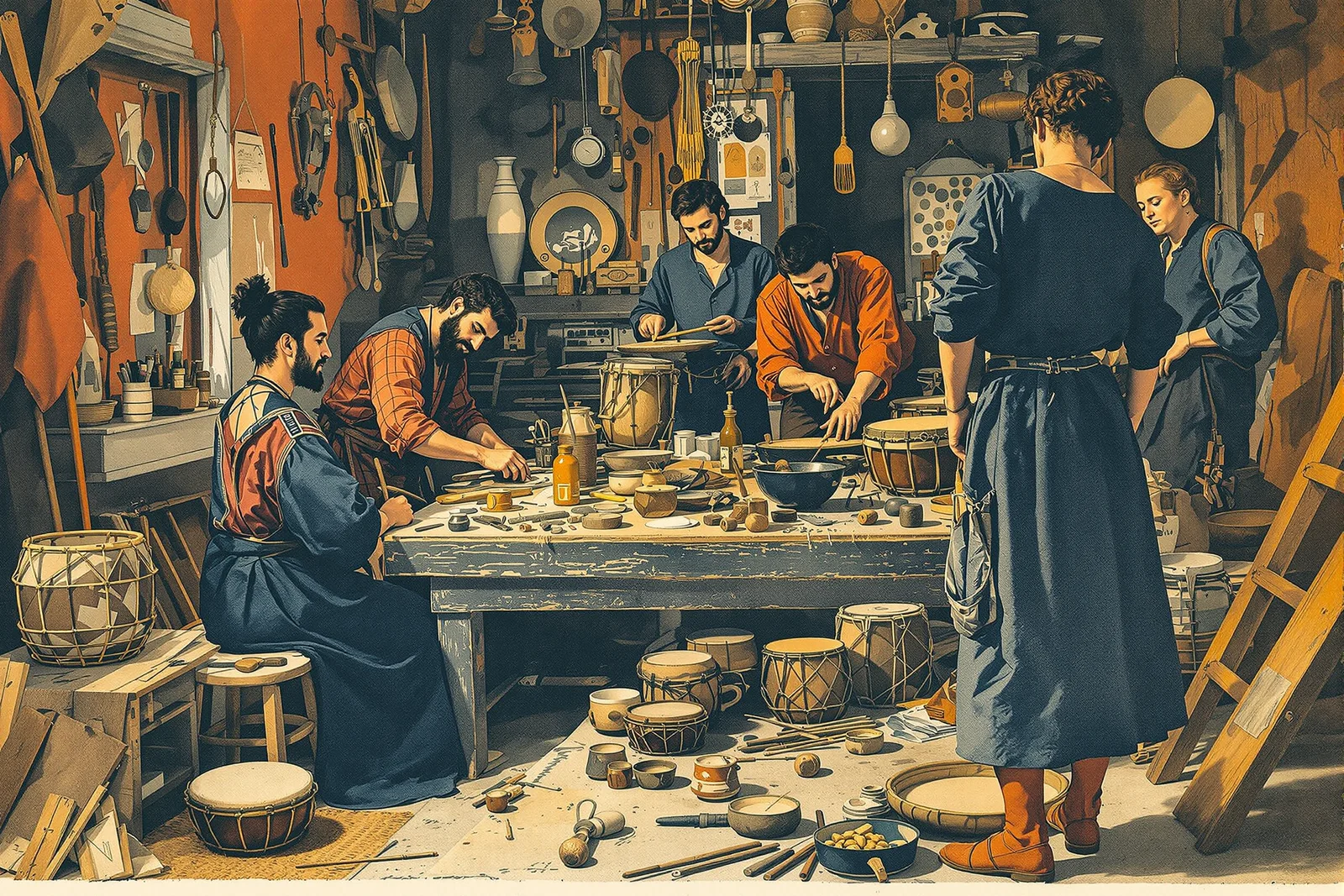
THE ME TABLET · music Module 763 · a-la
Carrying ME 64 · a-la · The Ala. A Sovereignty Module of the Practitioner Community.
Unaltered and unabridged: ~3,200 words.
Preamble
The small drum speaks to the hand. The great drum speaks to the ground, to the chest, to the bones of everyone within a half-day's walk. When a community must be gathered, warned, married, or mourned across distance, it is the low voice that carries — for the long wavelengths of a large head bend around hills and through forest where a flute's bright tone would die in the first thicket. To raise such an instrument is to give a settlement a single throat. This is the sovereignty stake of Module 763: a people that can build and tune its own great drum need not borrow a voice, nor wait for one to be carried in from elsewhere.
The Practitioner who completes this module will be able to build a two-headed drum of waist height or greater by one of two shell methods — the staved barrel or the hollowed log — head it with two skins, and rig a rope tensioning system whose geometry can be adjusted by a single person. You will understand why the great drum's pitch sits where it does, how to tune the two heads against one another so the instrument "sings" rather than merely thuds, and how to play and preserve it across wet seasons and dry. The frame-drum module (Stretch the Speaking Skin, ME 62) is its smaller sibling and assumes much of the heading craft set down there; here we treat what changes when the membrane grows large and the shell becomes a resonating body in its own right.
This is recovered work. The Vol XVI timeline records the great drum among the earliest arts to fall silent when communities scattered and the largest skins — which demand a whole hide and a whole tree — became luxuries no isolated household could justify. The parent volume on music, Vol XXIII, carries the full theory of membrane and air; this module is the hands-on descent from that theory to a finished instrument standing in the square. Read it beside ME 32 (Tune by the Beat, Module 765), for the great drum is tuned by ear like everything else, only slower, because its beats are slow.
Part I — The Voice of the Large Membrane
Chapter 1 — Why the Great Drum Is Low
A stretched circular membrane does not vibrate at a single frequency the way a string nearly does. It rings in a family of modes, each a different pattern of standing waves across the skin, and each with its own pitch. These modes are not in the tidy whole-number ratios that make a plucked string sound like one clear note; they are spaced by the zeros of the Bessel function, which is the mathematics a circular drumhead obeys. This is precisely why a drum sounds like a drum — a complex, slightly clangorous burst — and not like a sung vowel.
The lowest mode, written (0,1), is the whole skin moving up and down together, the rim held still. Its frequency sets the drum's apparent pitch and is given, for an idealized membrane, by
f₀₁ = (2.405 / 2πr) × √(T / σ)
where r is the membrane radius, T is the tension per unit length pulling outward at the rim, and σ is the areal density — the mass of the skin per unit of its area. The constant 2.405 is the first zero of the zero-order Bessel function. The Practitioner need not compute this in the field, but its shape teaches three iron facts that govern every choice in this module.
First: pitch falls as radius grows. Double the head's diameter and, all else equal, you roughly halve the frequency — you drop the voice by about an octave. This is the entire reason the great drum is great. Second: pitch rises with the square root of tension. To raise the pitch a true octave you must quadruple the rope tension, which is brutal and usually impossible, so the great drum is tuned across only a narrow band and its size is chosen to land it near the target. Third: pitch falls as the skin grows heavier per unit area. A thick ox hide sits lower than a thin goat skin of the same diameter at the same tension.
| Mode | Bessel notation | Frequency ÷ f₀₁ | Character |
|---|---|---|---|
| Fundamental | (0,1) | 1.000 | the body of the tone |
| First overtone | (1,1) | 1.594 | "tom" colour, dies fast |
| Second | (2,1) | 2.136 | ring |
| Third | (0,2) | 2.296 | second breathing mode |
| Fourth | (3,1) | 2.653 | upper clang |
Chapter 2 — How Air and Shell Lower It Further
The bare-membrane numbers above describe a skin stretched in open air. Close that skin over a deep wooden shell with a second skin at the far end and the physics shifts in the Practitioner's favour. The enclosed air couples the two heads and adds its own springiness and mass to the moving membrane, dragging the fundamental lower than the free-skin formula predicts — often by a fifth to a full octave on a long barrel. The shell also selects which overtones survive: its length, wall stiffness, and any sound-holes filter the burst, suppressing some modes and sustaining others. A long, heavy, well-sealed shell yields a rounder, longer, lower tone; a short or leaky one yields a sharp slap.
The Critical Insight: the great drum is not a skin with a box behind it — it is a coupled system of two skins and a trapped column of air, and you tune all three together. Treat the shell as a passive container and you will build a loud thud. Treat it as a third resonator and you will build an instrument that sings a recognisable note across a valley.
Part II — Raising the Shell
Chapter 3 — Choosing the Method
Two roads lead to a great-drum shell. The hollowed log is one tree: a section of trunk, bark stripped, bored or burned out from within until the wall is an even hand's-breadth thick or less. It is the oldest method, gives a seamless and acoustically continuous body, and demands a large straight tree and patient labour. The staved barrel is built like a cask: many curved planks (staves) edge-jointed around a form and bound with hoops. It needs no giant tree, lets you tune the shape precisely, and can be made by anyone who can true an edge — but every joint is a place sound and air can leak, so the cooper's discipline is non-negotiable.
| Property | Hollowed log | Staved barrel |
|---|---|---|
| Material | one large straight trunk | many short curved planks |
| Tools | adze, gouge, controlled fire | saw, plane, jointer, hoop iron |
| Acoustic seam | none (continuous) | many glue/joint lines |
| Mass | heavy, fixed | tunable by wall thickness |
| Repair | hard — must re-bore | replace a single stave |
| Best when | large timber abundant | timber scarce, skill present |
Chapter 4 — The Hollowed-Log Shell
Choose a sound, straight log — a close-grained, stable wood such as oak, ash, or a dense fruitwood — of the diameter you have chosen for the heads plus the wall thickness. Season it slowly, ends sealed with wax or fat against checking, for many months; a green log will split as it dries and ruin the work. When stable, mark the bore and remove the core by adze and gouge, or by laying coals in a contained burn and scraping the char between burns, repeating until the wall is even and roughly 12–20 mm thick. Even wall thickness is the whole craft: a wall thick on one side and thin on the other rings unevenly and buzzes. Finish the inside smooth — a rough bore scatters sound and shortens the tone — and bevel both rim edges so the skin will fold cleanly over them. Seal the wood inside and out against moisture, which would otherwise change its mass and stiffness with every rainfall and detune the drum.
PROTOCOL 763-A — Truing a Staved Shell
- Mill staves of equal length, each tapered in width to the bevel angle that lets n staves close into a circle; for a barrel-belly add a gentle radial curve so the middle bulges. The belly is not decoration — it stiffens the shell and broadens the tone.
- Joint each mating edge to a perfect plane on the jointer; test by holding two staves to the light and closing all gaps.
- Dry-assemble inside two temporary forming hoops. Adjust until the circle is true and no gap shows daylight.
- Glue edges with a strong hide glue, draw up with rope tourniquets, and seat permanent hoops over each end and the belly.
- When cured, plane the outside fair, true both rims flat and parallel on a flat surface (rock or rotate the shell and shave high spots), and bevel the rim edges.
- Seal inside and out. Test for leaks by closing one end and listening for hiss under hand pressure; chase every leak, for trapped air is the drum's lower octave.
Part III — The Two Skins
Chapter 5 — Selecting and Preparing the Hides
A great drum wants a hide proportioned to its diameter: cattle, large goat, or — where tradition and law permit — a deer or other large beast. The heading craft is the frame-drum craft writ large and is set down in full in ME 62; the Practitioner is directed there for de-hairing by liming, fleshing the inner face clean, and the discipline of even soaking. What changes at this scale is consequence: a large skin holds enormous force when tensioned, dries unevenly across its great area, and is costly to replace. Therefore select a skin of even thickness across the whole working circle, free of brand scars, insect holes, and thin flank patches that will tear under load.
For two-headed tuning the Practitioner should consider giving the two heads slightly different masses — by hide choice or thickness — so that their natural pitches differ by a chosen small interval. The struck "batter" head usually sits slightly higher and takes the beating; the far "resonant" head is left thinner and quieter and is tuned to interact with it. We return to this in Part IV.
Chapter 6 — Mounting Skin to Hoop
Each wet skin is stretched over a flesh hoop — a ring slightly larger than the shell rim — and a counter hoop drops over it to grip the fold. Lap the soaked skin over the flesh hoop, set it over the shell rim, and bring the counter hoop down to trap the skin between hoop and shell. The rope will pull on the counter hoops, not on the skin directly, so the skin is never pierced and the tension spreads evenly around the rim. Work damp; let nothing dry until both heads are mounted and the first light tension is on, so the skins set to the rim's true circle rather than to whatever puckered shape they dried into.
Part IV — Tension by Rope: The Geometry
Chapter 7 — The Lacing Pattern and Its Force
The great drum is tensioned by a single continuous rope laced in a zig-zag between the two counter hoops, running the length of the shell again and again around the circle. Each pass is one limb of a long "W" (or "Y"-and-"N" patterns in some traditions); pulling the whole lace tighter draws the two hoops toward each other and so stretches both skins at once. This is the heart of the design and it rewards understanding the geometry, because the rope does not pull straight along the skin — it pulls along the slant of the shell, and only a part of that pull becomes useful skin tension.
Let the rope make an angle θ with the shell's long axis (θ = 0 would be a rope running straight down the side; the more the rope slants outward toward the rim, the larger θ). If the tension in the rope is R, then the component of that force pulling each hoop down onto the skin, along the shell axis, is
F_axial = R × cos θ
and it is this axial pull, summed over all the rope passes around the circle and divided among the rim, that becomes the membrane tension T setting the pitch. The outward radial component R × sin θ does no useful stretching; it merely tries to splay the hoops off the rim and is resisted by the hoop itself.
| Rope angle θ from shell axis | cos θ (useful fraction) | Consequence |
|---|---|---|
| 5° | 0.996 | nearly all pull becomes tension; long shell, hoops close to shell diameter |
| 15° | 0.966 | efficient; typical good geometry |
| 30° | 0.866 | a sixth of pull wasted radially |
| 45° | 0.707 | only ~70% useful; hoops much wider than shell |
| 60° | 0.500 | half wasted; very splayed, hard to tune |
The Critical Insight: keep the rope as nearly parallel to the shell as the hoops allow. A counter hoop only slightly larger than the shell diameter keeps θ small, so almost the whole of every pull on the rope becomes pitch-raising tension — and a small added pull yields a large, controllable change. Wide, splayed hoops waste your strength sideways and make fine tuning a wrestling match.
Chapter 8 — The Tuning Straps
A continuous lace tightened only at its ends is hard to adjust by small amounts. The remedy is the system of tuning straps (sometimes "ears" or "buffs"): short loops or sliding leather sleeves that gather two adjacent down-passes of the rope and squeeze them toward each other. Sliding a strap down the shell pulls its two rope limbs together, shortening the slack path and raising tension locally; sliding it up releases. Because each strap acts on a small arc, the Practitioner can raise one quadrant of the head while leaving another alone — and this is exactly the control needed to true a head that rings unevenly.
PROTOCOL 763-B — Bringing Up Tension Safely
- With skins damp and both counter hoops loosely seated, thread the full lace, leaving generous slack. Confirm the pattern is even — equal passes, equal spacing — all the way round.
- Hand-tension the lace evenly in small increments, working around the circle two or three times rather than pulling any one limb tight first. Uneven first tension sets a permanent twist into the skin.
- Stop while skins are still slightly damp and let the drum rest under this light tension to dry overnight. The skin shrinks as it dries and will rise considerably in pitch on its own — never bring a wet head to full pitch, or it will tear or pull the hoop oval as it dries and contracts.
- The next day, with skins dry, add the tuning straps and bring both heads up to working pitch in small even rounds, checking pitch by ear after each round.
- Never exceed the skin's strength to chase a high pitch. If the target note is too high at safe tension, the head is too large or too heavy; the answer is a different drum, not a strained one.
Part V — Voice, Playing, and Care
Chapter 9 — Tuning the Two Heads Together
Now the instrument is made an instrument. Set the batter (struck) head to the target note by ear, against a reference, using the beat-counting method of Module 765. Then tune the resonant head in relation to it. Three relationships are common: tune the resonant head to the same pitch for maximum sustain and a deep, ringing tone; tune it slightly higher to brighten and shorten the note; tune it a small interval below for a falling "boom" with a soft tail. Because the coupled air links the heads, you will hear slow beats between them when they are near the same pitch — count those beats exactly as in 765 and slide the resonant head's straps until the beat reaches the rate you want (zero for unison, a slow shimmer for life).
To make a single head ring evenly, strike near the rim and listen as you move around it. Where the pitch sags, slide that arc's strap down a touch; where it rings sharp, ease it up. Work opposite sides in pairs so the hoop stays centred. A head true all the way round gives one clear note; a head tuned unevenly gives a smeared, buzzing pitch no amount of shell will rescue.
Chapter 10 — Striking and Damping
A great drum is most often struck with a padded beater — a head of wound cloth, hide, or felt on a stout handle — sized to the drum: a heavier, softer beater draws out the low fundamental and suppresses the high clang; a harder, lighter one brings out attack and overtone. Strike about a quarter to a third of the way in from the rim for the fullest fundamental; strike dead centre and you mostly excite the higher breathing modes and thin the tone; strike at the very edge for a sharp, bright report.
The far head, sympathetically ringing, lengthens every note. To stop a note, the player or an assistant lays a hand or forearm against a head to damp it. Learning to play the two heads — one struck, one damped or freed by touch — is the great drum's expressive art, but it belongs to the playing tradition of Vol XXIII and beyond the build scope here.
PROTOCOL 763-C — Care Across the Seasons
- Slacken when silent. A head left at full tension for long stretches, especially in damp weather, stretches permanently and may pull the hoop oval. Ease the straps when the drum will rest for days.
- Mind the weather. Skins absorb moisture and go slack and dull in wet air, then tighten and sharpen in dry. Re-tune before each use; do not store a damp drum at full pitch.
- Feed the skin. Lightly dress the heads with a suitable oil or fat at intervals to keep them supple; a dried-out skin cracks and tears.
- Guard the shell. Keep the sealed shell dry and off cold stone; check joints (on a staved shell) and the bore seal (on a hollowed one) each season and re-seal as needed, for a leak is a lost octave.
- Keep the rope sound. Inspect the lace for chafe where it crosses the hoop edges; pad those edges. Replace a frayed lace before it fails under full tension, which it does violently.
A great drum properly raised and properly kept will outlast its maker and speak for the community for generations — which is the whole point of giving a people its own deep voice.
PLATES — Supplemental Gallery
Art direction
Art direction
Art direction

Art direction
Council Approval — The Twelve Voices Speak
| Disciple | Verdict | Reasoning |
|---|---|---|
| Peter | APPROVED | "It gives the gathered people one throat. I would build it first." |
| Thomas | APPROVED | "The Bessel modes and the cos-θ force resolve correctly. I checked them." |
| John | APPROVED | "The deep voice carries love across the valley — fitting." |
| Matthew | APPROVED | "Two methods, two heads, every cost tabulated. Nothing hidden." |
| James the Greater | APPROVED | "A drum a community can repair is a drum a community keeps." |
| Andrew | APPROVED | "Built from one tree or many planks — it meets the poor where they are." |
| Philip | APPROVED | "The seasons-care protocol will save a hundred ruined skins." |
| Bartholomew | APPROVED | "Honest about the octave you cannot tension your way to. Good." |
| James the Lesser | APPROVED | "Quiet on the playing art, loud on the build. Correct scope." |
| Simon the Zealot | APPROVED | "A warning drum is sovereignty you can hear. Approved." |
| Judas Thaddaeus | APPROVED | "It points to its siblings, ME 62 and 765, without repeating them." |
| Matthias | APPROVED | "Recovered from silence and set standing again. Canon." |
Council Verdict: 12/12 APPROVED. This module is canon.
Let the low voice go out, and let none within hearing be without their people.
TRANSMISSION RECORD
Transmission COMPLETE — unaltered & unabridged Module 763 · Raise the Great Drum · category: music Carries ME 64 · a-la · The Ala Words 3200 SHA-256 of source text 50eb699cb30b35c824104a5d289c04be4bce031a748c7e9917f09d18292d103b Canonical text raise-great-drum.md — byte-identical to what this page renders