Module 780 — Read the Signs
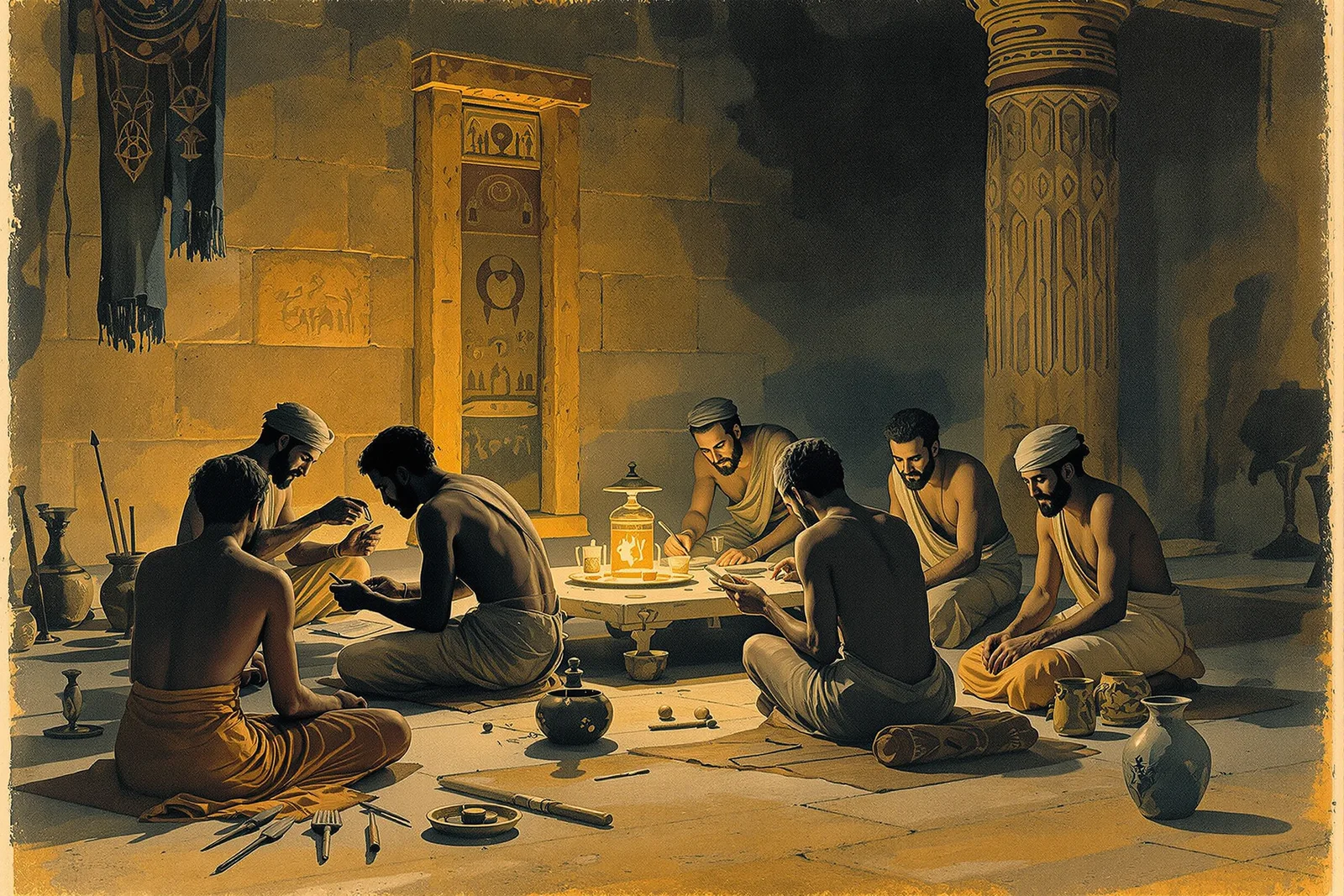
THE ME TABLET · Priesthood Module 780 · nam-guda
Carrying ME 14 · nam-guda · The Divination Priest. A Sovereignty Module of the Practitioner Community.
Unaltered and unabridged: ~3,150 words.
Preamble
Every settled people, in every age the historian's volume records, has kept an office for its hardest questions — a person or a procedure to which the community could bring the choices that reason alone could not settle, and from which it came away able to act. The names differ across the record: the diviner reading the organs of a sacrifice, the augur reading the flight of birds, the caster of lots, the dreamer in the sanctuary. The office is one of the most universal in the human record, and one of the most misunderstood. The Practitioner who completes this module will understand it accurately — what divination actually was as a cross-cultural institution, why it appeared in every society, and why none of its techniques does the thing it claimed to do — and will be able to restore its genuine value soberly, as a discernment office: a trained, honest way of helping a community decide well under uncertainty, using reflective method and never any claim to know what cannot be known.
This is delicate ground, and the module treats it with the sobriety the canon reserves for it. The parent volume, Vol XVII (The Mystic's Codex), carries the contemplative disciplines — the stilled, attentive mind — on which honest discernment rests; the Ritual Offices supplement to Vol XVII carries the office of ME 14 itself (the gudu / gala line and its Protocol 14-A discernment session), which this module deepens and extends; and Vol XIX (The Steward's Codex) carries the ethics of counseling another's decision and the accountability of any office held over others. This module sits where those three meet. It will not teach you to foretell the future, because no one can; it will teach you the accurate anthropology of the institutions that claimed to, and the real, honest craft that lay hidden inside them — a craft worth keeping, because the genuine good in divination was never the prophecy but the structured occasion for careful decision.
The sovereignty stake is the steadiness of a community's choosing. A people that makes its gravest decisions alone, in fear and haste, or that surrenders them to anyone claiming secret knowledge, is not sovereign over its own future. To read the signs — in the honest, restored sense — is to hold, in your own settlement, a trusted and transparent way of facing uncertainty together: a clear question, a calm mind, an honest method, a licensed choice, and a shared owning of the outcome.
Part I — Divination as a Cross-Cultural Institution
Chapter 1 — What divination is, accurately
Divination is the attempt to obtain guidance on a question by reading a pattern — in nature, in chance, in the body, in the sky, in a dream — through an interpretive procedure. It is genuinely universal: it appears, in one form or another, in nearly every human society on record, and the major forms recur across cultures that had no contact with one another. The Practitioner must hold this universality accurately and without contempt, because it is the first clue to what the institution was really doing. A practice that arises independently everywhere is not arising by accident; it is meeting a need that every human community has. The need is not for knowledge of the future — which the practices do not supply — but for a way to decide and act under deep uncertainty, which they did supply, and which this module restores.
Mesopotamia, the culture from which the ME decrees are drawn, was in fact the deepest divinatory culture of the ancient world. It produced enormous written compendia of omens, the systematic reading of sacrificed animals' organs, the interpretation of celestial events, of births, of dreams, and of the patterns of daily life, all recorded and transmitted as a learned discipline over many centuries. The office of ME 14 — the bārû diviner, the gala lamentation-priest, the āšipu exorcist-healer, the gudu of the offering-service — stood at the center of that culture's response to uncertainty. We restore it not as any of its techniques but as the office those techniques served: the trained person to whom the community brought its weightiest, least-resolvable questions.
Chapter 2 — The major forms, sorted by what they did
The Practitioner should know the great families of divination accurately, both for the anthropological literacy the office requires and because understanding how each worked reveals why none of them could foretell the future and what each was really providing instead.
Specification Table 780-1 — The world's divinations, accurately seen
| Form | What is read | Where it was central | What it actually provided |
|---|---|---|---|
| Extispicy / haruspicy | The organs (esp. the liver) of a sacrificed animal | Mesopotamia, then Etruscan and Roman state practice | A solemn, authoritative procedure to license a state decision |
| Augury / ornithomancy | The flight, calls, and behavior of birds; natural signs | Roman public life (no major act of state without the auspices) | A shared, public way to sanction or delay collective action |
| Sortilege (casting of lots) | A randomizing device: dice, sticks, drawn tokens, an opened book | Worldwide — Near East, the yarrow/coin procedures behind the I Ching | An honest tie-breaker for a genuinely balanced choice |
| Dream incubation | A guiding dream sought by sleeping in a sacred place | Greek healing sanctuaries of Asclepius; across the ancient world | A structured pause and a frame for the sleeper's own mind to work |
| Astrology | Celestial positions and events read for meaning | Babylon; the whole ancient and medieval world | (Beneath the interpretation) the real observational science of astronomy |
Chapter 3 — The honest case of astrology
One row of the table demands its own care, because the Practitioner must get its history exactly right. Babylonian sky-watching produced, as a genuine and lasting achievement, astronomy — meticulous, long-baseline records of planetary and lunar motion that later enabled the real prediction of eclipses and planetary positions. That observational discipline was real science in the making, among the great intellectual achievements of the ancient world, and it must be honored as such. The interpretive layer laid over those records — the claim that the configuration of the sky foretells human affairs and individual fates — is the part that does not stand up to examination and never has. The two must never be confused: the careful watching and recording of the sky was a triumph; the reading of human destiny into it was not. The Practitioner holds astronomy in one hand as recovered science (the kind of patient observation the historian's volume celebrates) and sets astrology in the other as a divinatory institution to be understood anthropologically — and the line between them is one of the clearest lessons the whole subject teaches.
Part II — Why Divination Persists
Chapter 4 — Two truths held at once
A community that would restore this office honestly must hold two truths at the same time, and refuse to drop either. The first: divinatory techniques do not access hidden information about the future — not the liver, not the birds, not the stars, not the lots, not the dream. The second: divinatory institutions nonetheless served, and serve, real human needs, which is exactly why they were universal and durable. Both are true. The mistake of the credulous is to keep the second and forget the first — to believe the prophecy. The mistake of the contemptuous is to keep the first and forget the second — to dismiss the whole institution as mere foolishness and so to throw away the genuine good buried in it. The Practitioner keeps both truths, and on the ground between them builds the restored office: an institution that does the real work divination always did, stripped of the claim it could never honor.
Chapter 5 — The plain mechanisms
Divination persisted because human beings must constantly decide under deep uncertainty, and the unaided mind is poorly equipped to do so. Several plain mechanisms — none supernatural — explain the institution's durability, and the Practitioner who understands them understands precisely what is worth keeping.
It forces a decision. A community paralyzed between two courses cannot stay paralyzed forever; a divinatory procedure breaks the deadlock and licenses action. A randomizing rite — the casting of lots — is, functionally, an honest coin-flip dressed in solemnity, and for a genuinely balanced choice, choosing by a fair random device is a defensible and ancient way to break a tie.
It externalizes and clarifies. The act of bringing a question to a diviner forces the questioner to state the question clearly, often for the first time. The interpretive conversation that follows surfaces the questioner's own knowledge, fears, and leanings. Much of what looked like "the sign speaking" was in fact the questioner hearing their own mind reflected back to them — a real and valuable thing, wrongly attributed.
It distributes responsibility and reduces regret. A choice attributed to a shared procedure is easier to live with, and easier for a community to accept, than one attributed to a single fallible person. This lowered conflict and eased the burden of decisions that might go wrong — a genuine social function, whatever the procedure's metaphysical claims.
Chapter 6 — The errors of mind, named out loud
Honesty about the institution requires naming the errors of mind that made its illusions persuasive, because a restored office must guard against exactly these rather than exploit them. The Practitioner names them openly, to the community, as part of holding the office honestly.
- Confirmation bias — we notice and remember the times the sign seemed to come true, and forget the far more numerous times it did not. The "hits" are counted; the "misses" vanish.
- Patternicity — the mind's strong tendency to read meaning and intention into randomness, finding shapes in clouds, faces in stone, and messages in chance.
- The Barnum effect — vague, general statements feel specifically and personally accurate to almost anyone ("you have been troubled by a recent choice"), which is why loose interpretations seem to fit so well.
- Cold reading — an attentive interpreter, often without conscious intent, draws cues from the questioner's words, face, and bearing, then feeds them back as if they came from the sign.
The Critical Insight
The genuine value in the divinatory institutions was never the prophecy; it was the structured occasion for careful decision. Strip away the supernatural claim and what remains is real and worth keeping: a trusted person, a clear question, a calm mind, a deliberate procedure, an honest conversation, a licensed choice, and a shared owning of the outcome. Every one of those is valuable; not one of them requires foreknowledge. The restored office keeps exactly this and discards the claim to know the future — which means it can serve the community fully without ever deceiving it. The errors of mind that once made divination seem to work are precisely what the honest office names aloud and guards against, rather than the machinery it secretly runs on. To read the signs, restored, is to read the questioner's own mind and the community's real situation clearly — and to call that, honestly, what it is.
Part III — The Restored Office: Sober Discernment
Chapter 7 — Discernment, not prophecy
The restored ME 14 is the office of discernment: the trained, honest help a community offers a person or a council facing a hard, uncertain choice. It is the direct descendant of the divination office, keeping its real function — the structured occasion for careful decision — and discarding its false claim. The discernment-officer is not an oracle and never pretends to be one; the officer is a skilled, trusted companion to a difficult decision, whose craft is asking the right questions, holding the right silence, and keeping the process honest. The office leans on the parent Vol XVII's contemplative disciplines for the stilled, attentive mind the work requires, and on Vol XIX (The Steward's Codex) for the ethics of counseling another's choice — because to help another decide is to hold power over their life at a vulnerable moment, and that power must be held under the same safeguards as any other office.
The discernment-officer offers, in plain terms stated openly to everyone served: a clear question made clearer, a calm setting in which to think, an honest laying-out of what is known and unknown, the reflective questions that let the chooser hear their own mind, a weighing against the chooser's own values, and — where reason genuinely cannot decide — an honest randomizing tie-breaker named as exactly that. The officer offers no glimpse of the future, and says so. This honesty is not a weakness of the restored office; it is its whole strength, because a discernment that deceives is worth nothing, and one that is transparent can be trusted with a community's gravest choices.
Protocol 780-A — The discernment session
This protocol structures an honest discernment for an individual or a small council. It claims nothing about the future and works entirely by clarifying the chooser's own knowledge and values. It extends Protocol 14-A of the Ritual Offices supplement; hold the two as one method.
- Frame the question truly. Help the chooser state the actual decision in one sentence, as a genuine choice between named options. Most of the work is here: a muddled question cannot be answered, and a clear one is half-resolved. Distinguish the question they brought from the question beneath it.
- Establish stillness. Open with a short period of the contemplative quieting taught in the parent volume — a few minutes of settled breath and attention (Vol XVII) — so the decision is approached from a calm mind rather than an agitated one. Decisions made in fear or haste are the ones most regretted.
- Separate fact from fear from preference. For each named option, lay out plainly what is known, what is unknown, what could be found out before deciding, and what cannot be known at all. Much apparent uncertainty dissolves when fact is sorted from fear and from mere preference.
- Surface the inner leaning honestly. Ask the reflective questions that let the chooser hear their own mind: Which option, imagined as already chosen, brings relief, and which brings dread? What would you advise a friend in this position? Which choice can you most honestly live with if it goes badly? This is the heart of the method — and it is the same psychological mechanism the old divinations used, now made transparent and given back to the chooser as their own.
- Weigh against stated values. Set each option against the chooser's and the community's own declared values and commitments. A good decision is not merely the clever one; it is the one consistent with who the chooser intends to be. The values are the chooser's, never the officer's.
- For a truly balanced choice, allow the honest lot. When the options are genuinely and durably balanced and the deadlock itself is the harm, a randomizing device used openly as a tie-breaker — and named as exactly that, a fair way of choosing when reason cannot, never a sign from beyond — is a legitimate and ancient aid. The honesty of naming it as a coin-flip is the whole difference between counsel and deceit.
- Name the decision and the review. Help the chooser state the choice, the reasons, and a time to revisit it. Record it if the matter is grave (cross Vol XIX). A decision named, owned, and dated is the deliverable; the future remains, properly, unknown.
Your Commitment
You will never claim to know what you cannot know. The office of discernment is held honestly or not at all: you offer a clear question, a calm mind, an honest conversation, and a well-owned choice — and you tell the community plainly that this, and not prophecy, is what you offer. The moment you let a chooser believe you can see their future, you have ceased to serve them and begun to use them.
Part IV — The Office Under the Steward's Ethics
Chapter 8 — The power named, and its safeguards (cross Vol XIX)
The discernment-officer holds a quiet but real power: people bring their deepest uncertainties, their fears, and their gravest choices, at the precise moment they are most open to influence. Vol XIX (The Steward's Codex) carries the ethics of all such power, and the discernment office is bound by them without exception. The cardinal rule is that the officer guides but never commands a choice — the decision is always the chooser's, surfaced from the chooser's own mind and weighed against the chooser's own values, never imposed from the officer's. An officer who steers a chooser toward the officer's preferred outcome, or who trades on the chooser's vulnerability for personal, financial, or any other advantage, has committed the cardinal betrayal of the vocation.
The safeguards are the same that bind every threshold-office in the canon, and they are non-negotiable. The officer holds the chooser's confidence honestly and does not exploit what is disclosed. Where the matter is grave or the chooser vulnerable, the session is held in a witnessed or open setting rather than in secret, both to protect the chooser and to protect the honest officer from suspicion. Every officer answers to the community — through the steward's council (Vol XIX) — which can correct and, if necessary, remove them, and that line of accountability is stated openly and known to all. And the community keeps a clear, safe, believed channel by which anyone who feels misused by an officer can bring it, to a body other than the officer. These safeguards are the price of holding the office, and the honest officer welcomes them, because they protect the chooser, protect the office's good name, and protect the officer's own.
Chapter 9 — Where discernment ends and other help begins
The discernment office has a definite scope, and a responsible officer knows its edges. Discernment is for choices — genuine decisions between named options, faced by a person or council able to make them. It is not a treatment for serious distress, and the officer must never let it become one. Where a chooser is in the grip of severe and persistent anguish, despair, or crisis — where what presents itself as a hard decision is in fact a sign of a person in serious trouble — the officer's duty is not to run a discernment session but to gently and without delay direct the person to genuine care: the community's healers, those trained in tending the suffering, and where the danger is real, immediate and capable help. The contemplative quieting the office uses is a tool for thinking clearly about a choice, never a substitute for the help a person in serious distress needs. The Ritual Offices supplement and the parent volume hold this line firmly, and this module holds it with them: discernment companions a decision; it does not treat a crisis, and the officer who confuses the two endangers the very person the office exists to serve.
Chapter 10 — The thread restored
The discernment office, like the other vocations of the threshold, did not survive the long dark intact, and the Practitioner who restores it inherits a particular history (the Historian's Codex, Vol XVI, holds the full chronology). The honest core of divination — the structured occasion for careful decision — was severed from its name across the centuries of suppression and distortion. The name "divination" was driven to the margins, criminalized in places, or debased into fraud and fortune-telling, while its genuine function — trusted, transparent help in deciding well under uncertainty — was lost on both sides of the split. What the restored office does is rejoin them: it recovers the real function and gives it an honest name and an honest method, freed at last from both the false prophetic claim that always discredited it and the contemptuous dismissal that threw the good out with the false. We can do this now, the historian's volume reminds us, only because we can finally see clearly both what divination was and why it does not foretell the future — and so can keep, with a clear conscience, exactly the part that was always real.
The Critical Insight: What a dark age took from the divinatory office was not the bare technique — the techniques never worked — but the living institution of trusted, structured decision-making, and the honest understanding of what it actually did. The office was discredited because its false claim was exposed, and in discrediting the claim the age discarded the genuine good along with it. To restore the office is therefore an act of recovery in the truest sense: not to revive a superstition, but to rescue from inside a discredited institution the real and valuable craft it always carried — and to practice that craft, at last, without the lie. The restored discernment-officer is the diviner's honest heir, keeping the one thing the diviner ever truly offered.
PLATES — Supplemental Gallery
Art direction
Art direction
Art direction
Art direction
Council Approval — The Twelve Voices Speak
| Disciple | Verdict | Reasoning |
|---|---|---|
| Peter | APPROVED | "It builds the office on rock — a clear question, a calm mind, an honest method — and not on the sand of prophecy. A community can stand on this." |
| Thomas | APPROVED | "I am the doubter, and this module is doubt made into a discipline: it refuses every claim it cannot prove and keeps only what is real. I am answered." |
| John | APPROVED | "It companions the chooser in love and never deceives them, and it knows when to send the suffering on to real care. The heart kept honest." |
| Matthew | APPROVED | "Every step accounted for, the decision named and dated, the office bound to the steward's ledger. Nothing here claimed that cannot be reckoned." |
| James the Greater | APPROVED | "It commands the hard choice without commanding the chooser — guides, never dictates. That is the right exercise of a real power." |
| Andrew | APPROVED | "It gives the questioner their own mind back, and opens honest counsel to all without a single secret sold. The good carried wide and clean." |
| Philip | APPROVED | "Show me how, I asked, and the seven steps answer from the framed question to the owned decision. Nothing left to vapour or to vision." |
| Bartholomew | APPROVED | "No false note in it: the techniques named as foretelling nothing, the biases confessed aloud, astronomy honored and astrology not. The genuine article." |
| James the Lesser | APPROVED | "It guards the vulnerable first — the open door, the believed channel, the line that sends real distress to real help. The least are kept safe." |
| Simon the Zealot | APPROVED | "The fire of it: it rescues the one true thing from inside a discredited institution and practices it without the lie. The honest heir of the diviner." |
| Judas Thaddaeus | APPROVED | "For the hardest hour — the deadlocked, fearful, unresolvable choice — it gives a calm method and, at the last, an honest lot. No one abandoned to chaos." |
| Matthias | APPROVED | "It takes its place in the canon cleanly, carrying ME 14, extending the supplement's Protocol 14-A, and pointing home to Vol XVII and out to Vol XIX. The lot falls true — and is named as a lot." |
Council Verdict: 12/12 APPROVED. This module is canon.
Let the signs be read honestly — the question made clear, the mind made calm, the choice made and owned — and let no one ever be told that a person can see what the future keeps to itself.
TRANSMISSION RECORD
Transmission COMPLETE — unaltered & unabridged Module 780 · Read the Signs · category: priesthood Carries ME 14 · nam-guda · The Divination Priest Words ~3,150 SHA-256 of source text 92db7d0cc7ba891a109521ad1840b390756b19e756d820495ae8fded0365f148 Canonical text read-the-signs.md — byte-identical to what this page renders