Module 779 — Keep the Shrine
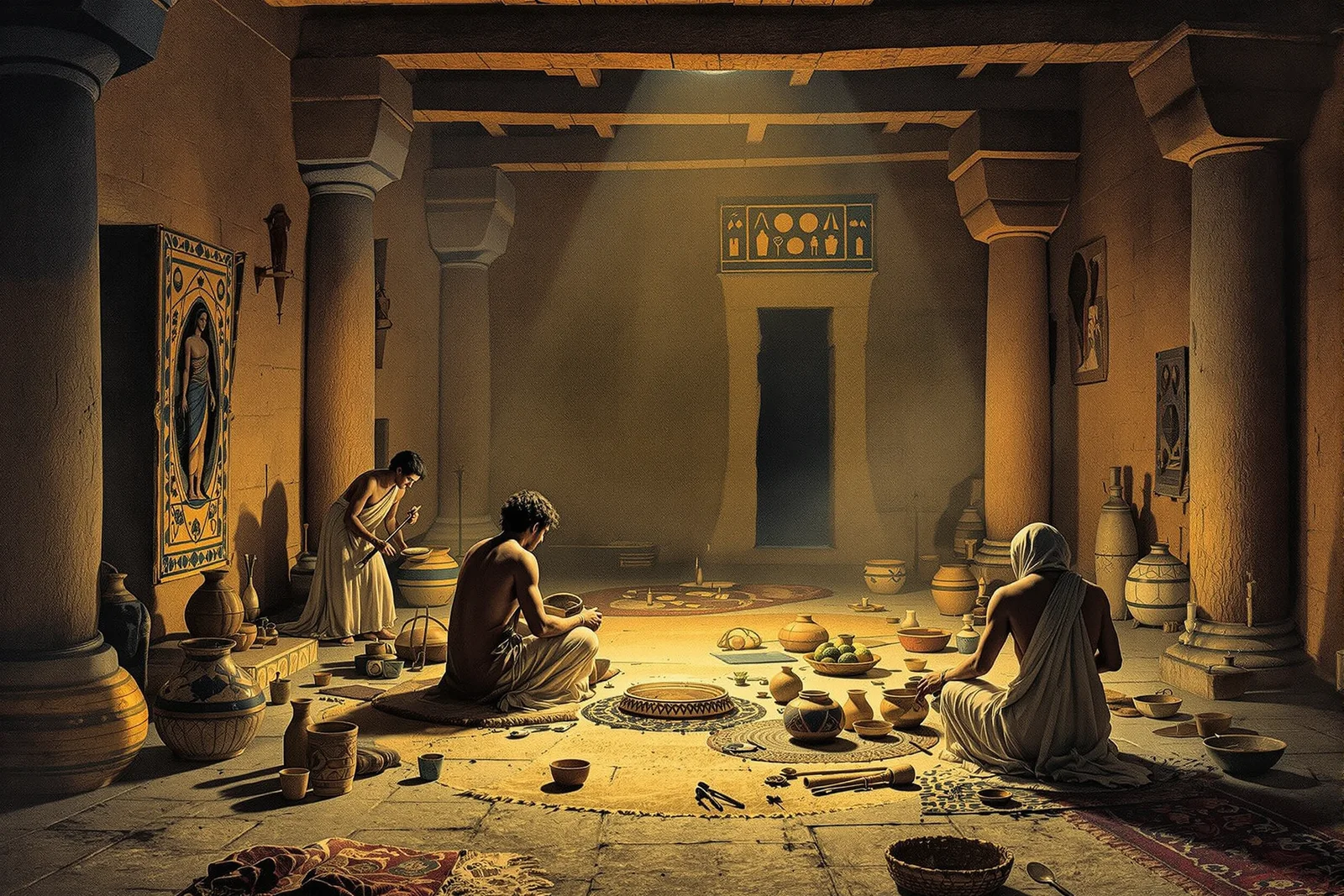
THE ME TABLET · Priesthood Module 779 · eš maḫ
Carrying ME 7 · eš maḫ · The Exalted Shrine. A Sovereignty Module of the Practitioner Community.
Unaltered and unabridged: ~3,070 words.
Preamble
A community without a sacred place has nowhere to stand when it must stand together before what is larger than itself. It can still gather, still feast, still decide — but it has no fixed point where the gathering becomes more than the sum of its bodies, no kept ground that says here is where we remember who we are. The shrine is that fixed point. It is the smallest and oldest unit of sacred architecture: not a temple with its staff and its treasury, but the single tended place — a niche in a house wall, a stone under a tree, an altar at the center of a village — where a household or a community keeps its relation to the holy. The Practitioner who can make and keep a shrine holds the art on which every larger sacred structure is built, and the one most within reach of a recovering people, because a shrine needs no priesthood, no wealth, and no permission — only a kept place and a faithful hand.
This module is the working craft of that art. It does not teach the building of a temple, nor the great liturgies that fill one; the parent volume, Vol XVII (The Mystic's Codex), carries the interior disciplines the shrine exists to serve, and the cross-bound Vol VI carries the construction — the joinery, the masonry, the siting on sound ground — that this module assumes in the practitioner's hands. What this module carries is the part between the building and the contemplation: how to make a place sacred and keep it so. You will leave able to orient and lay out a shrine so that it gathers attention rather than scattering it; to understand the altar and the threshold as the two structural facts every shrine is built around; to tend a shrine daily so that it stays a living place and not a dead one; and to scale the same craft from the household niche to the communal shrine that holds a whole settlement's sacred life.
The sovereignty stake is quiet but deep. A community that must travel to a distant center to stand before the holy — that keeps no sacred place of its own — has surrendered its spiritual life to others' keeping. To keep the shrine is to hold, in your own house and your own village, the kept ground on which a free people meets what it holds sacred, on its own terms, by its own hands, every day.
Part I — What a Shrine Is
Chapter 1 — The smallest unit of sacred space
A shrine is the irreducible core of all sacred architecture: a kept place set apart for the holy. Everything a great temple is, a shrine is in miniature — a marked boundary between common and sacred, a focal point toward which attention and offering are directed, and a faithful tending that keeps the place alive. Strip a temple of its scale, its staff, and its wealth, and what remains is the shrine: the niche, the altar, the tended stone. The Practitioner who understands this understands that she does not need a temple to keep sacred space; she needs only to do, at the scale of a household or a village, exactly what a temple does at the scale of a city.
This is why the shrine is the sovereign form. The temple depends on surplus, specialists, and a center; the shrine depends only on a kept place and a faithful hand. A people that has lost its temples has not lost its capacity for sacred space, so long as it can still keep a shrine — and across every collapse the historian's record reconstructs, from the fall of the Bronze Age temple-cities onward, it was the household shrine, not the great sanctuary, that carried the sacred through the dark and into the next dawn.
Chapter 2 — The two structural facts: altar and threshold
Every shrine, at every scale, is built around two structural facts, and the Practitioner designs by them. The first is the altar — the focal point, the place toward which everything is oriented and at which offering, attention, and rite are concentrated. The altar is the center of the shrine, the still point that gives the whole place its direction; without it, a sacred space has no focus and the attention of those who enter has nowhere to go. The second is the threshold — the marked boundary between the common world and the kept space, the line one crosses to enter and re-crosses to leave. The threshold is the edge of the shrine; it is what makes the inside inside, and crossing it is the small rite that shifts the one who enters from ordinary attention to sacred attention.
Center and edge, altar and threshold: these two facts organize all sacred space. The altar concentrates; the threshold encloses. A shrine that has an altar but no felt threshold has a focus but no separation — the holy and the common bleed together. A shrine that has a threshold but no altar has separation but no focus — the entrant crosses in and finds nothing to face. The Practitioner builds both, and the whole craft of laying out a shrine is the right relation of these two: a clear edge to cross, and a clear center to face once crossed.
Specification Table 779-1 — The structural anatomy of a shrine
| Element | What it is | What it does | Household scale | Communal scale |
|---|---|---|---|---|
| Threshold | The marked boundary of the kept space | Separates common from sacred; the crossing shifts attention | The lip of the niche; a marked doorway | A gated forecourt; a step or porch; a curtain |
| Orientation | The direction the shrine faces | Aligns the place to a meaning (sunrise, a sacred landmark) | The niche set in a chosen wall | The whole structure axed to a cardinal point or landmark |
| Altar | The focal point of offering and attention | Concentrates the rite; gives the space its center | A shelf or ledge in the niche | A raised stone or table at the structure's heart |
| The image or symbol | The sign of what the shrine honors | Names the holy the place keeps | A figure, symbol, or kept object in the niche | A central image or symbol above the altar |
| Offering-place | Where gifts are set | Carries the daily relation of giving | The ledge before the image | A dedicated surface or vessel at the altar |
| Light | A lamp, flame, or open sky | Marks the place as tended and living | A small lamp in the niche | A kept flame or a light-well |
Chapter 3 — Orientation: facing the shrine
Sacred places are almost never built facing nowhere. Across the human record, shrines and temples are oriented — aligned to a direction that carries meaning, most often the rising sun, a cardinal point, a sacred mountain or landmark, or the point on the horizon where a significant star or the solstice sun appears. Orientation is not decoration; it is a structural choice that binds the shrine to a meaning larger than the building and gives the altar its direction. The Practitioner chooses the orientation deliberately, because it determines the whole experience of approach: one enters the shrine toward the rising light, or toward the holy mountain, and the body's movement into the space is already part of the rite.
The simplest and most widely attested orientation is toward the sunrise — east — so that the shrine faces the daily return of light and the entrant moves into the dawn. But the right orientation is the one that means something to this community: the landmark it reveres, the direction of its origin, the point where its sacred sun rises on its festival day. The Practitioner fixes the orientation first, before laying out altar or threshold, because everything else is arranged along the axis it sets.
Part II — Making the Shrine
Chapter 4 — Siting and laying out (cross Vol VI)
The making of a shrine begins with the ground, and here the module binds to Vol VI, which carries the construction craft — the choosing of stable, dry, sound ground; the masonry and joinery of the niche, the altar, and the enclosure; the weatherproofing that keeps a kept place from rotting or collapsing. The shrine-keeper need not be a master builder, but a shrine built on bad ground or shoddily made will not endure, and a sacred place that falls into ruin teaches the community the opposite of what a shrine is for. The Practitioner therefore sites the shrine on good ground, builds it soundly (Vol VI), and only then consecrates and tends it.
Laying out follows the orientation. Fix the axis (Chapter 3); place the altar at the focal center, facing the chosen direction; mark the threshold at the entry so the boundary is felt; set the image or symbol above or upon the altar; and provide for the offering-place and the light. The layout's whole purpose is to lead the one who enters across a clear threshold and bring them to face a clear center — so the arrangement is judged by a single question: does entering this place gather the attention, or scatter it?
Protocol 779-A — Laying out a shrine
- Choose sound ground and build it well (Vol VI). Site the shrine on stable, dry, durable ground and construct the niche, altar, and enclosure soundly. A shrine that decays teaches ruin; build it to last.
- Fix the orientation first. Choose the direction the shrine will face — sunrise, a sacred landmark, a cardinal point that means something here — and set the whole layout along that axis before placing anything else.
- Place the altar at the focal center. Set the altar — shelf, ledge, stone, or table — at the point toward which the space is oriented, so that to enter is to face it. The altar is the still center the whole place is built around.
- Mark the threshold clearly. Define the boundary one crosses to enter — a lip, a step, a doorway, a curtain, a gate — so that the edge of the kept space is felt. The crossing is the small rite that shifts attention.
- Set the image or symbol and the offering-place. Place the sign of what the shrine honors at or above the altar, and provide a clear surface or vessel for offerings before it. These give the daily tending its focus and its act.
- Provide light. Set a lamp, a kept flame, or an opening to the sky, so the shrine reads as tended and living rather than dark and abandoned. A lit shrine is a kept shrine.
- Test the approach. Walk into the finished shrine as a stranger would. If entering carries the eye and the attention to the center, the layout is sound. If it scatters them, simplify until it does not.
Chapter 5 — Consecrating the new shrine
A built shrine is not yet a sacred shrine; it becomes one by an act of consecration in which the community sets it apart for the holy. The consecration draws on the wider priestly craft: the place is purified (cross Module 778 and Vol VIII, the lustration that marks the ground as kept), often anointed at its threshold and altar (the oil-mark that sets a thing apart, per the Ritual Offices supplement to Vol XVII), and dedicated with plain words that name what the shrine will honor and what it is for. The consecration is itself a threshold-rite for the place: it carries the built structure across the line from common construction into kept sacred space, witnessed by the community that will keep it.
Part III — Tending the Shrine
Chapter 6 — The daily tending: a shrine is kept, not just made
A shrine is not an object but a practice. Made once and then neglected, it ceases to be a sacred place and becomes merely a dusty niche — and a neglected shrine is worse than none, because it teaches the community that the holy can be abandoned. What makes a shrine sacred is not the day it was built but the fidelity of its tending: the daily, humble acts of care that keep it living. Across every tradition, the household and communal shrine is kept by small recurring acts — the cleaning, the renewing of light, the fresh offering, the moment of attention — performed faithfully, day after day, by the hands appointed to it.
These acts are not grand. They are deliberately small and repeatable, because their power is in their recurrence, not their scale. To light the lamp each morning, to clear the wilted offering and set a fresh one, to wipe the dust from the altar, to pause for a moment of attention before the image — these are the whole of shrine-keeping, and they are precisely the acts a household or a single keeper can sustain for a lifetime. The Practitioner designs the tending to be light enough to actually be kept, because a tending too elaborate to sustain will be dropped, and a dropped tending is a dead shrine.
The Critical Insight
The sacredness of a shrine lives in its tending, not in its materials. A humble niche faithfully kept — lamp lit each dawn, offering renewed, dust cleared, a moment of attention given — is more truly a sacred place than the grandest shrine left to gather dust. This is the great democratizing truth of the form, and the reason it carried the sacred through every dark age: the holy is kept not by wealth or scale but by fidelity, which the poorest household can offer as fully as the richest temple. The Practitioner therefore measures a shrine not by what it is made of but by how faithfully it is tended — and designs the tending, above all, to be sustainable, because the shrine that can be kept every day for a lifetime is the shrine that does its work.
Protocol 779-B — The daily tending of a shrine
- Renew the light. Each day, tend the lamp or flame — relight, refill, or trim it — so the shrine begins the day lit and living. The light is the sign that the place is kept.
- Clear and renew the offering. Remove the previous offering once it is spent or wilted, and set a fresh one — a little water, grain, fruit, flower, or whatever the tradition keeps. The renewing is the daily act of relation; a stale offering left to rot is the mark of a neglected shrine.
- Clean the altar and the place. Wipe the dust from the altar and image, sweep the floor of the niche or the shrine, keep the kept space clean. A clean shrine is a tended shrine; cleanliness here is both care and, where the shrine is communal and crowded, real hygiene (cross Module 778).
- Give a moment of attention. Pause before the image for a moment of the contemplative attention the parent volume teaches (Vol XVII). The tending is not only of the place but of the keeper's own relation to it; the pause is what keeps the shrine a living relation and not a chore.
- Keep the rhythm faithfully. Tend at the same times each day — most traditions keep a morning lighting and an evening renewal — so the tending becomes a rhythm woven into the household's or community's day. The fidelity of the rhythm is the whole of the keeping.
- Repair promptly. Mend any decay — a guttering lamp, a cracked ledge, a fading image — as soon as it appears (cross Vol VI for the repair). A shrine kept in good repair is a shrine that will be kept for generations.
Your Commitment
You will tend the shrine you keep faithfully, in small acts, every day, and you will design its tending to be light enough that you can. You will not build a shrine more elaborate than you can keep, nor let a kept shrine fall into neglect — because a neglected sacred place teaches the community that the holy may be abandoned, and that is the one lesson a shrine must never give.
Part IV — The Household and the Communal Shrine
Chapter 7 — The household shrine
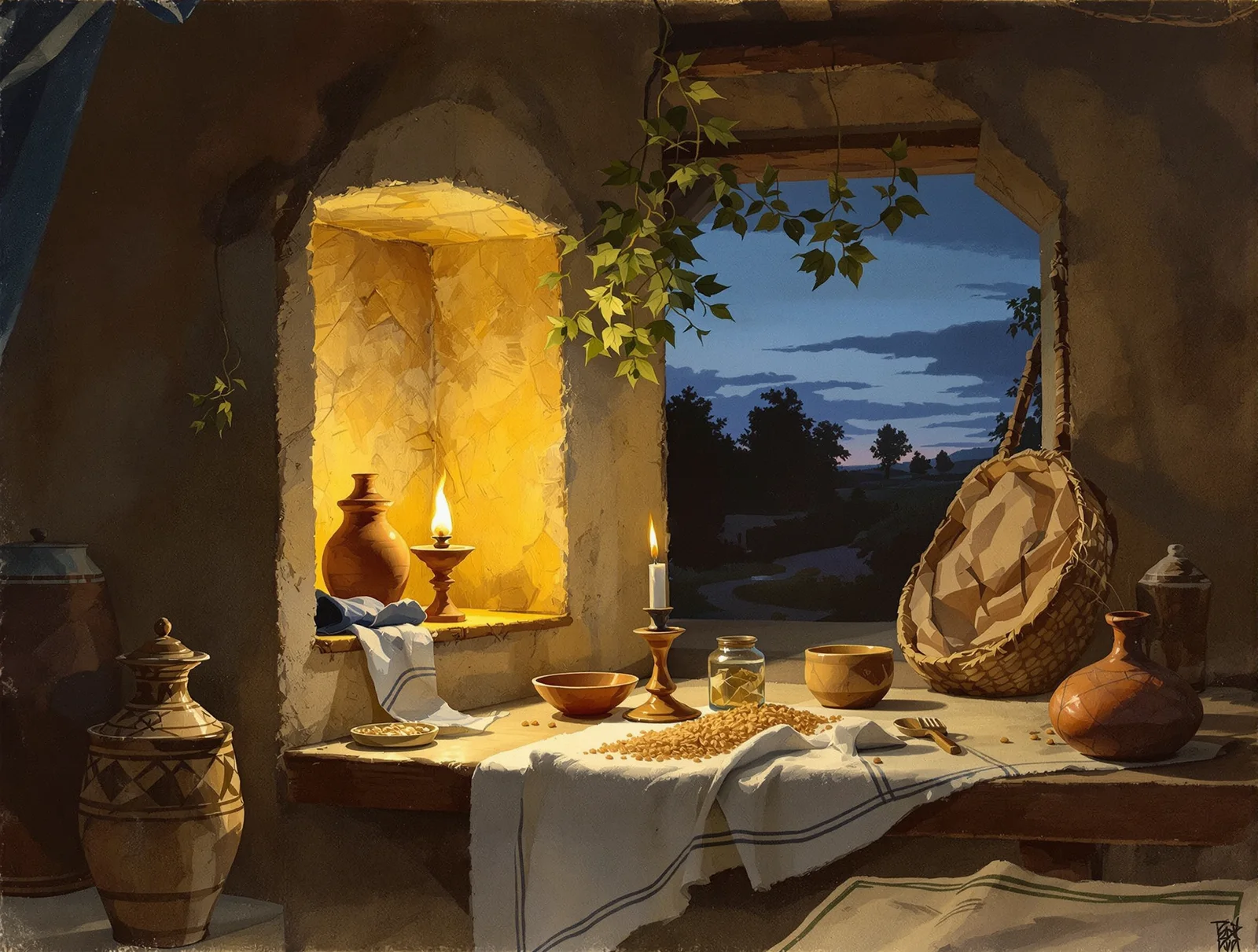
The household shrine is the most fundamental sacred space a people keeps — the niche, ledge, or small altar within the home where a family keeps its daily relation to the holy and its memory of its own. It is small, intimate, and tended by the household's own hands, most often as part of the rhythm of the day's beginning and end. Its scale is its strength: it asks no specialist and no surplus, it is always present, and it weaves the sacred into ordinary domestic life rather than reserving it for distant occasions. Across the human record, the household shrine is nearly universal precisely because it fits the home so naturally — a kept place where the family lights its light, sets its small offering, and remembers its ancestors and its holy in the midst of daily living.
The Practitioner who establishes a household shrine keeps the same structural facts at miniature scale: a small threshold (the lip of the niche, a marked corner), a clear orientation (the chosen wall), a focal altar (the ledge), the image or kept object, the offering-place, and a small light. And she keeps the same tending — the daily renewal of light and offering, the cleaning, the moment of attention — scaled to what a household can sustain. The household shrine is the seedbed of the whole sacred life of a community: the place where each generation first learns, in its own home, what it is to keep the holy.
Chapter 8 — The communal shrine
The communal shrine is the household shrine grown to the scale of the whole settlement — the village altar, the central sacred place where the community as a body keeps its shared relation to the holy and gathers for its common rites. It carries the same anatomy (Table 779-1) at larger scale: a felt threshold (a forecourt, a gate, a step) that the gathering crosses together; a deliberate orientation that the whole structure is built along; a central altar at the community's sacred heart; a shared image or symbol; a place for the community's offerings; and a kept light, often a communal flame. Where the household shrine is tended by a family, the communal shrine is tended by appointed keepers on the community's behalf — a duty assigned, rotated, or held by those called to it, and held accountable to the community whose sacred place it is.
The communal shrine differs from the household shrine in two structural ways the Practitioner must plan for. First, it must hold a crowd: the threshold, the approach, and the space around the altar must let the whole community gather and move without the sacred focus being lost in the press. Second, it must be tended by the community's office rather than a single family, which means the keeping must be made a clear, assignable, accountable duty — a kept rhythm that does not depend on any one person, with a named line of responsibility, so that the shrine is reliably tended and reliably kept honest (cross Vol XIX for the ethics and accountability of any office held on the community's behalf). A communal shrine well kept is the visible heart of a settlement's shared life; one neglected, or kept by an unaccountable hand, is a wound at the center of it.
Protocol 779-C — Establishing and keeping a communal shrine
- Site it at the community's sacred and practical center (Vol VI). Choose ground that is central, accessible, sound, and meaningful to the whole community, and build the structure to last. The communal shrine should be where the community naturally gathers.
- Build the anatomy for a crowd. Lay out threshold, orientation, altar, image, offering-place, and light (Protocol 779-A) at a scale that lets the whole community gather and approach the center without losing the sacred focus in the press.
- Consecrate it with the community witnessing. Purify (Module 778), dedicate, and set the shrine apart in a rite the whole community sees, so that it is their shrine, ratified by their witness.
- Appoint accountable keepers. Assign the daily tending (Protocol 779-B) as a clear, named duty — held, rotated, or shared — with a stated line of accountability to the community (Vol XIX). The keeping must not depend on any single unwatched hand.
- Keep the rhythm and the calendar. Tend the communal shrine daily, and tie it to the community's sacred calendar — the festivals, the seasonal rites, the gatherings — so it is both a daily-kept place and the hearth of the community's shared occasions.
- Maintain it visibly and well. Keep the communal shrine clean, lit, repaired, and dignified, because it teaches the whole community, every day, what the community holds sacred. A well-kept communal shrine is a community's standing testimony to its own care.
PLATES — Supplemental Gallery
Art direction
Art direction
Art direction
Art direction
Council Approval — The Twelve Voices Speak
| Disciple | Verdict | Reasoning |
|---|---|---|
| Peter | APPROVED | "It is built on rock — sound ground, a clear center, a felt edge. The smallest kept place, and a community can stand on it." |
| Thomas | APPROVED | "I doubted a niche in a wall could matter beside a temple; the module showed me the shrine is the temple's living core, carried through every dark." |
| John | APPROVED | "The sacredness is in the tending, it says, and that is love made daily — the lamp lit, the offering renewed, the moment of attention given." |
| Matthew | APPROVED | "Every element accounted for — threshold, orientation, altar, light — and the communal keeping made a named, accountable duty. A scribe could keep this." |
| James the Greater | APPROVED | "The layout is commanded from sound ground to tested approach, and the communal shrine is kept by an accountable hand. Sound order." |
| Andrew | APPROVED | "It opens the sacred to every household — no priesthood, no wealth, only a kept place and a faithful hand. The net is cast to the poorest home." |
| Philip | APPROVED | "Show me how, I asked, and the protocols answer from siting to daily tending to founding a communal shrine. Nothing left to vapour." |
| Bartholomew | APPROVED | "No false claim: the shrine is sacred for what it is set apart to honor and kept by plain faithful acts, and the module never inflates it." |
| James the Lesser | APPROVED | "It honors the humble niche as fully as the great altar, and warns that a neglected shrine teaches abandonment. The modest truth, kept." |
| Simon the Zealot | APPROVED | "The fire of it: the household shrine carried the sacred through every collapse, and a free people keeps its own holy ground by its own hands." |
| Judas Thaddaeus | APPROVED | "For the hard case — the dropped, dusty, dead shrine — it gives the remedy: a tending light enough to be kept every day for a lifetime." |
| Matthias | APPROVED | "It takes its place in the canon cleanly, carrying ME 7 and pointing home to Vol XVII and out to Vol VI. The lot falls true." |
Council Verdict: 12/12 APPROVED. This module is canon.
Let the shrine be made on sound ground and kept by a faithful hand, that a people may have, in its own house and its own village, the kept ground where it meets the holy.
TRANSMISSION RECORD
Transmission COMPLETE — unaltered & unabridged Module 779 · Keep the Shrine · category: priesthood Carries ME 7 · eš maḫ · The Exalted Shrine Words ~3,070 SHA-256 of source text da08f87832a77553e18a755f7a9487dab42b0a21fc1a47ea673a6b76031cb117 Canonical text keep-the-shrine.md — byte-identical to what this page renders