Module 778 — Purify the Water
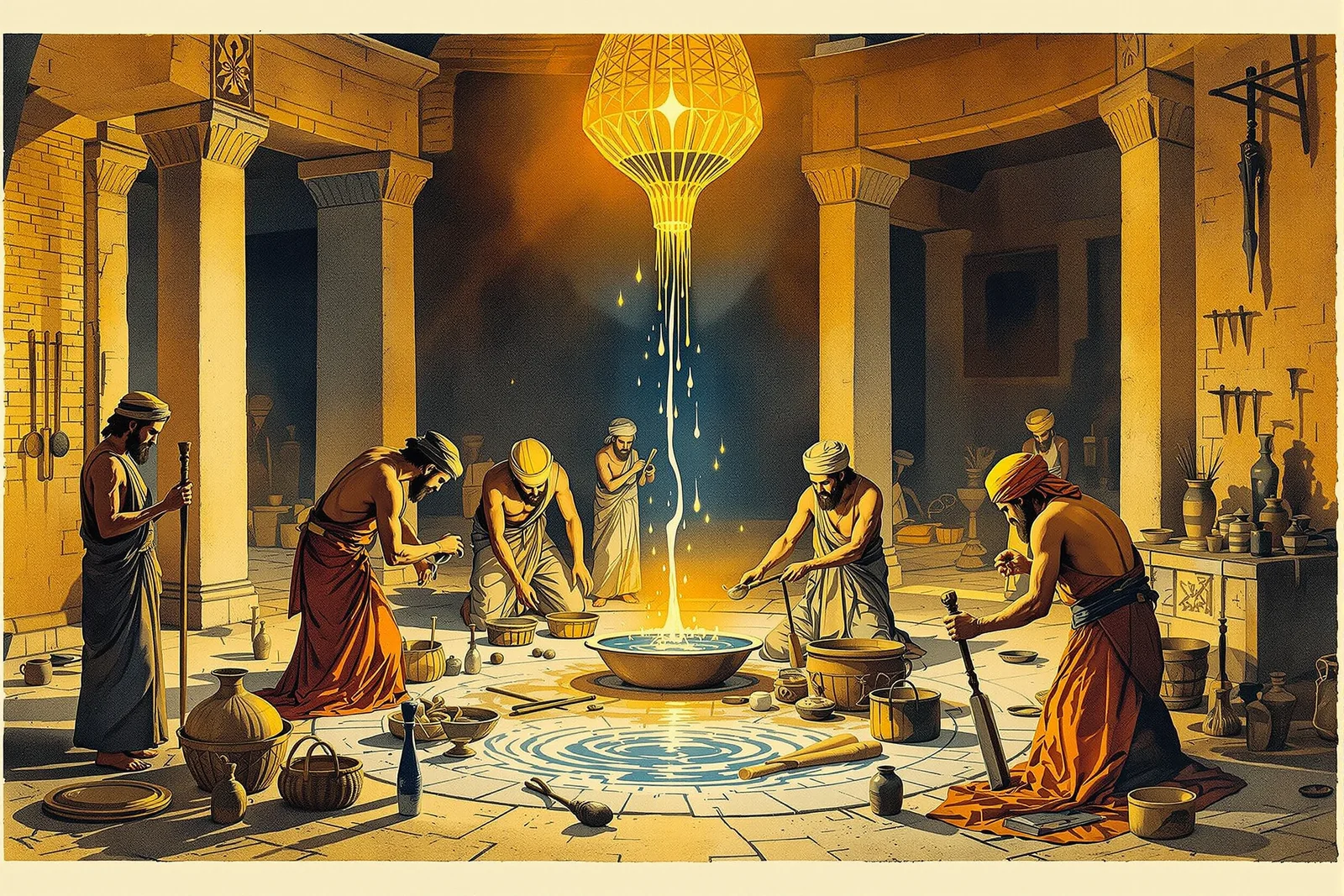
THE ME TABLET · Priesthood Module 778 · šu-luḫ
Carrying ME 50 · šu-luḫ · Holy Purification. A Sovereignty Module of the Practitioner Community.
Unaltered and unabridged: ~3,010 words.
Preamble
Of all the rites a settled people keeps, purification is the one performed most often and understood least. It opens nearly every other ceremony — no anointing, no shrine-tending, no divination, no marriage or funeral begins until the participants and the place have first been made clean — and yet the act is so habitual that few who perform it can say what it is for. The Practitioner who masters this module will be able to say exactly what it is for, on two levels at once, and that double sight is the whole of the craft. Purification is a rite of meaning: it marks the crossing from common time into kept time, washing off the ordinary so the sacred can begin. And purification is, beneath the meaning, a layer of real practical hygiene — the handling of water and the body that, for most of human history, was the single most powerful protection a community had against the diseases that traveled in dirty water and on unwashed hands.
These two layers are not rivals. They are the same act seen from two heights, and the priesthood that holds ME 50 · šu-luḫ holds both. The Sumerian term šu-luḫ — literally "hand-washing," the cleansing of the hands — names a whole class of temple purification rites; the parent volume, Vol XVII (The Mystic's Codex), carries the interior and contemplative disciplines that purification of the body was always meant to mirror, and the great cross-bound reference, Vol VIII (The Codex of Water), carries the chemistry and the engineering of clean water itself. This module sits exactly where those two volumes meet: it teaches the rite, and it teaches the hygiene the rite was carrying all along, and it teaches the Practitioner to design a purification for her own community that keeps both — the meaning that moves the heart and the cleanliness that protects the body.
The sovereignty stake is as plain as a well. A community that cannot keep its own water clean, and cannot mark its own thresholds with its own hands, is dependent in the two places dependence is felt most: in the gut and at the door of the holy. To purify the water — both the literal water of the basin and the figurative water of the rite — is to hold, in your own settlement, the oldest and most load-bearing of the priestly arts.
Part I — What Purification Is
Chapter 1 — The two layers, named once
The error that hollows out a purification rite is to keep only one of its two layers. Keep only the meaning, and the rite becomes a hollow gesture — a sprinkle of water that protects no one, performed over a basin that may itself be breeding the very sickness the community fears. Keep only the hygiene, and the act loses the power that made it universal — the power to mark a passage, to gather a scattered attention, to say to a whole gathering at once we have left the common behind and entered the kept. The Practitioner holds both, and understands that the genius of purification across the human record was precisely that it bound them together: it made the life-saving act of washing into a sacred act, so that it would be performed faithfully, daily, by everyone, for reasons they felt in their bones long before anyone could explain what a pathogen was.
This binding is not a trick played on the credulous. It is one of the great quiet achievements of human culture: to wrap a practice the community could not yet justify scientifically inside a meaning it could feel, so that the practice would be kept until the justification arrived. The washing of hands before eating and before the holy, the cleansing of the body at the great thresholds of life, the purifying of water before it touched the sacred — these saved more lives, across the millennia, than any physician, and they were carried not as medicine but as rite.
Chapter 2 — Why every people purifies
Purification recurs in every settled culture on record, and it recurs because water does plain things and means a great one. Plainly, water removes — it carries away dirt, sweat, blood, and the unseen filth that sickens; it is the oldest solvent and the oldest cleaner. Water also cools, marks, and is felt — poured over the hands or the head, it is unmistakable to the body, a clear signal that a change has occurred. The great meaning every tradition builds on these plain facts is the same: water marks the passage from one state to another, from unclean to clean, from common to set-apart, from outside to inside the holy.
The comparative record is rich and consistent, and the Practitioner should hold it accurately. The ancient Near Eastern temples kept great basins and required the washing of hands and body before approaching the god. South Asian traditions hold ritual bathing — full immersion in moving water — as a central purifying act, performed daily and at the great festivals. The later monotheistic traditions carry ablution in detailed forms: the washing of hands, face, arms, and feet before prayer; the ritual bath at the thresholds of the life-cycle; the washing of the dead before burial. Across all of them runs the same structure: an authorized form of washing, performed at a named moment, to mark a crossing the community recognizes. What strikes the anthropologist is the convergence — unconnected peoples reached for the same act, water on the body at the threshold, because the act fits the human need so exactly, and because beneath the meaning it did real and necessary work.
Specification Table 778-1 — Purification across the traditions
| Tradition / setting | Form of the rite | What is washed | The threshold it marks | The hygiene beneath it |
|---|---|---|---|---|
| Ancient Near Eastern temple | Hand- and body-washing at a basin before the god | Hands, sometimes the whole body | Entry into the sacred precinct | Removed filth before food-offerings and crowding |
| Lustration (sprinkling rite) | Sacred water sprinkled over persons, places, objects | A symbolic touch of water | Consecration of ground, tools, a gathering | Marked the kept space; modeled cleanliness |
| Full ritual immersion | Whole-body bathing in moving or gathered water | The entire body | Major life-cycle passage; periodic renewal | Genuine full-body cleaning at set intervals |
| Ablution before prayer | Ordered washing of hands, face, arms, feet | Extremities and face, repeatedly | Entry into a state fit for prayer | Frequent handwashing — the single highest-value hygienic act |
| Washing of the dead | Reverent full cleansing of the body | The body of the deceased | The passage out of life, into burial | Dignity, and reduced contamination at handling |
| Pre-meal hand-washing | Washing the hands before eating | The hands | Crossing from work to the shared table | Prevented fecal–oral transmission at the meal |
Chapter 3 — Lustration and ablution distinguished
The Practitioner should hold two great families of purification clearly apart, because they are designed by opposite logics and serve different ends.
Ablution is the thorough form: it is real washing, done to make the body or the hands actually clean, ordered and repeated, applied to the person who is about to act. Its priority is the removal of filth; its model is the careful washing of the hands before prayer or food, where the sequence and repetition exist precisely to ensure nothing is missed. Where the rite must protect the body, it is ablution that does the protecting.
Lustration is the symbolic form: it is the sprinkling or aspersion of sacred water over persons, a gathering, a building, or a field, where the water is a token rather than a thorough cleaning. Its priority is the marking of a space or a people as consecrated — the declaration, made visible by the touch of water, that this place is now kept. Lustration does not pretend to wash a field clean; it blesses the field by the gesture of water. The Practitioner uses lustration to consecrate and ablution to cleanse, and a complete rite very often uses both — the celebrant performs a thorough ablution to be fit, then lustrates the gathering to consecrate it.
Part II — The Hygiene Beneath the Rite
Chapter 4 — What clean water actually is (cross Vol VIII)
No purification rite is sound if the water it uses is itself a source of sickness, and so this module binds tightly to Vol VIII (The Codex of Water), which carries the full chemistry and engineering of clean water. The purification-priest need not be a master of that volume, but must understand enough to keep the rite's own water from becoming a hazard — because a community basin, touched by many hands and standing warm, is exactly the kind of water in which waterborne disease thrives.
The plain facts the Practitioner must hold are these. The diseases that historically devastated settled communities — the watery, fatal diarrheal sicknesses above all — travel by the fecal–oral route: invisible matter from one person's gut reaches another person's mouth, most often through contaminated water or unwashed hands handling food. Clean-looking water is not safe water; the agents of these diseases are invisible. The protections, all attested and all within a recovering community's reach, are: keeping the source of drinking and ritual water separate from and upstream of all waste; letting cloudy water settle and filtering it; and, above all, the two acts that purification rites already encode — washing hands at the critical moments, and using clean, renewed water rather than standing, reused water for any rite that touches the body or precedes a meal.
The Critical Insight
The purification rites of the human past were, at their hygienic core, an unwritten public-health code carried inside religion so that it would actually be obeyed. No community could have been persuaded to wash its hands many times a day, to bathe at set intervals, and to keep its sacred water clean, on the strength of a germ theory it did not have. But it would do all of these things faithfully, for generations, as rite — because the meaning was felt even when the mechanism was unknown. The Practitioner who restores purification therefore restores two goods at once, and must never let the community keep only the gesture: a rite that sprinkles symbolic water from a fouled basin has preserved the meaning and discarded the very protection the meaning was carrying. Keep the meaning, and keep the water clean. The two were always one act.
Chapter 5 — The basin, the source, and the standing danger
The most dangerous object in any purification practice is the shared standing basin: a vessel of water that many hands enter, that is not renewed, and that stands warm enough for what lives in it to multiply. Such a basin can convert the rite of cleansing into an engine of contagion, spreading from one washer to the next exactly the filth the washing was meant to remove. The historical traditions that endured tended, without knowing why, to favor running or poured water over standing water for this reason — the ablution performed under poured water, the immersion in a moving stream — and the Practitioner restores that wisdom deliberately.
Protocol 778-A — Keeping the rite's water safe
- Separate the source. Draw ritual water from a source kept apart from and upstream of all human and animal waste. The single greatest protection against waterborne disease is to never let waste reach the water in the first place.
- Prefer flowing or poured water to standing water. Design the rite so water moves — poured from a clean vessel over the hands, or drawn fresh — rather than sitting in a shared basin that many hands enter. Where a basin must be used, it is for pouring from, not for dipping into.
- Renew, do not reuse. Empty and refresh ritual water frequently; never let a community wash repeatedly in the same standing water through a long ceremony. Reused wash-water spreads what it has collected.
- Settle and filter cloudy water. Where the source is turbid, let it settle and pass it through clean cloth or a sand filter (Vol VIII) before ritual use. Clarity is not safety, but turbid water is never made sacred by being dirty.
- Keep the vessels clean. Wash and dry the cruses, ewers, and basins of the rite; a fouled vessel fouls the water it holds. The cleanliness of the instruments is part of the cleanliness of the rite.
- Site the rite for drainage. Place the washing-place so that used water drains away from the source and from the gathering, not back toward either. Where the dirty water goes is as much a part of the design as where the clean water comes from.
Your Commitment
You will never let the rite of cleansing become a means of sickness. You will keep the water of every purification flowing, fresh, and drawn clean, and you will hold the hygiene as inseparable from the holiness — because a purification that spreads the very filth it claims to wash away has betrayed both the body it was meant to protect and the meaning it was meant to carry.
Part III — The Rites of Purification
Chapter 6 — Purifying the person
The purification of a person prepares them to act, to enter the sacred precinct, or to cross a threshold of life. Its form follows the ablution logic of Chapter 3: an ordered, thorough washing, performed with intention, at a named moment. The historical occasions are stable and they are the same ones a recovering community needs: before approaching the holy or leading a rite; before the shared meal; at the great life-cycle passages of birth, coming-of-age, union, and death; and at periodic intervals of renewal. The act is performed by the person themselves, or by an authorized hand for one who cannot (the newborn, the sick, the dead), with words that state plainly what the washing means.
Chapter 7 — Purifying the place and the object
The purification of a place — the consecration of ground, of a new shrine, of a council chamber, of a field at planting — follows the lustration logic: sacred water is sprinkled over the space to mark it as kept, often as the opening act before the space is put to its sacred use. The purification of an object — a new vessel, a sacred drum (cross Vol XXIII), the tools of a dedicated craft — likewise marks the thing as set apart from common stock. In both, the water is the visible sign of the community's decision that this place or this thing now carries weight. The Practitioner pairs this, where the object will touch the body or food, with real cleaning: the new vessel is both lustrated for meaning and washed for safety.
Protocol 778-B — A purification before a community rite
- Cleanse the celebrant first. The one who will lead performs a thorough ablution under poured, fresh water — hands, face, and as the rite requires, the body — before touching anything sacred. The leader cannot consecrate from an unclean state.
- Prepare clean ritual water. Draw fresh water from the kept source into clean vessels, per Protocol 778-A. Set aside one vessel for ablution (thorough washing) and one for lustration (sprinkling), so the two functions are not confused.
- Purify the place. Lustrate the ground or chamber where the rite will occur — a measured sprinkling at the threshold and the cardinal points — declaring the space kept. This is the opening that turns common ground into sacred ground.
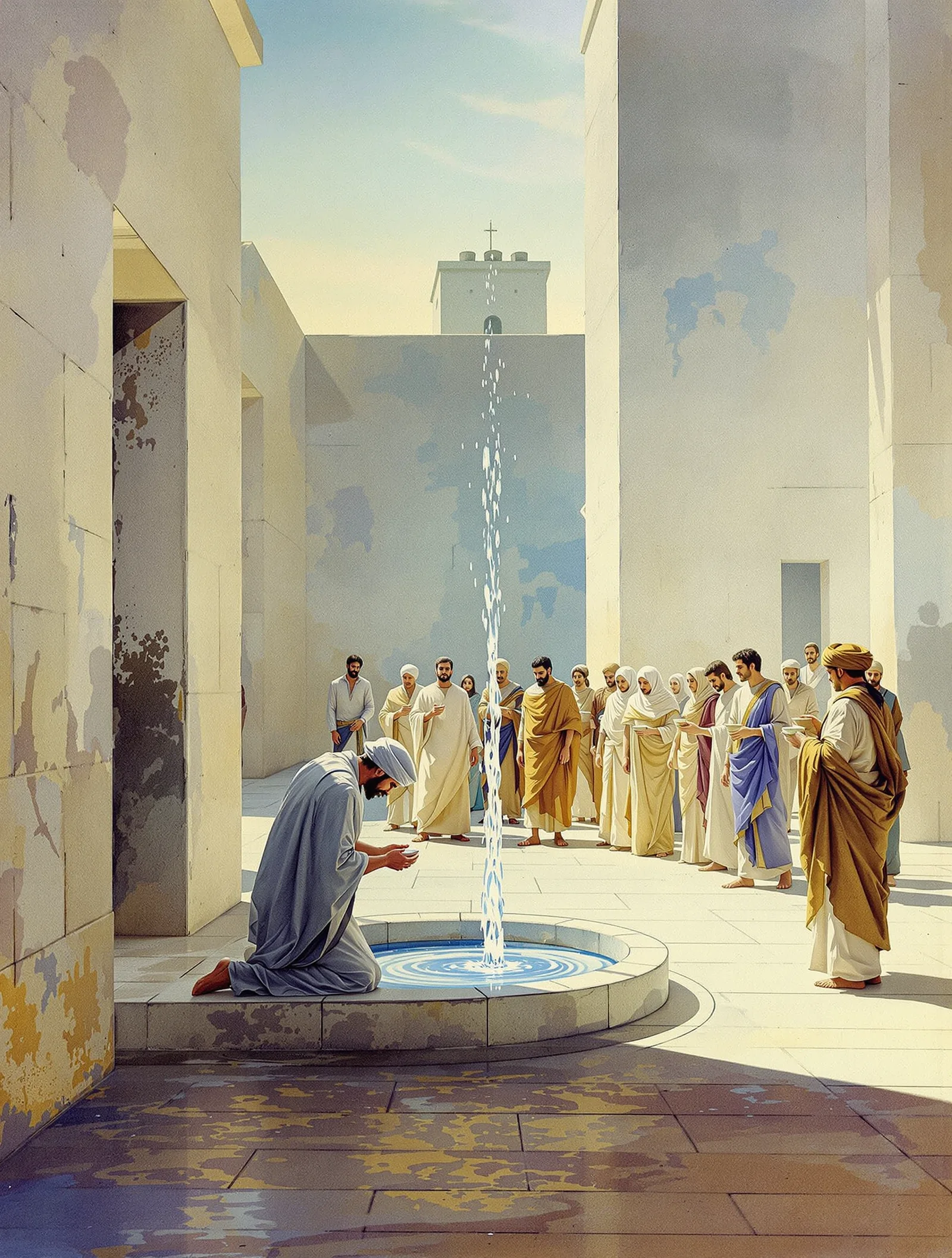
- Purify the participants. Have each participant wash their hands (and as the rite requires, the face) under poured fresh water at the entry, so that none crosses into the kept space uncleansed. Pour for them, or let them pour for one another; do not let a queue of hands foul one standing basin.
- State the meaning aloud. Name, in plain words, what the washing marks — the leaving of the common, the entering of the kept. The spoken meaning is what turns washing into purification.
- Drain and renew between groups. For a large gathering, refresh the water as it is used and direct the runoff away from source and crowd. A rite that purifies a hundred people must purify the last as cleanly as the first.
Part IV — Designing a Community Purification
Chapter 8 — The design questions
A purification rite is not inherited whole; it is designed for a particular community, its water, and its thresholds. The Practitioner designs by answering a short sequence of questions in order, and the order matters because the hygiene constrains the meaning, not the other way around.
First: what is our water, and how do we keep it clean? Identify the source, its dangers, and the protections of Protocol 778-A. The rite is built on the water you actually have. Second: which thresholds will we mark? Name the moments — daily (the meal, the entry to the holy), life-cycle (birth, coming-of-age, union, death), and seasonal (planting, the new year) — at which purification will be performed. Third: ablution or lustration, or both, for each? Decide where the community needs real thorough washing (anything before food, anything at the body) and where a symbolic marking suffices (the consecration of a space). Fourth: what is the form, and who performs it? Fix the sequence, the words, and the authorized hands. Fifth: how is it kept clean as it scales? Plan the renewal of water and the drainage for the largest gathering the rite will ever serve.
Protocol 778-C — Designing a purification rite for your community
- Audit the water first. Before designing any rite, walk the water: where it is drawn, where waste goes, where the two might meet. Fix the dangers (Protocol 778-A) as the foundation. A rite cannot be cleaner than its water.
- List the thresholds to be marked. Write the daily, life-cycle, and seasonal moments the community will purify. Keep the list to the thresholds that genuinely matter; a rite performed at too many moments is performed carelessly at all of them.
- Assign ablution or lustration to each. For every threshold, decide whether it needs thorough washing (the body, the pre-meal hands — ablution) or symbolic marking (consecrating a space — lustration), or both. Anchor the highest-value hygienic act — handwashing before food and the holy — as non-negotiable ablution.
- Design for flowing, renewed water. Build every washing around poured or running water and frequent renewal, never a shared standing basin. Make the safe form the easy form, so it will actually be kept.
- Fix the form, the words, and the hands. Write the sequence each rite follows, the plain words that name its meaning, and who is authorized to perform it. A rite that is improvised each time is neither remembered nor reliably clean.
- Plan the scale. Specify how water is renewed and drained when the rite serves the whole community at a festival, so the hundredth person is purified as safely as the first.
- Teach the meaning and the mechanism together. Train those who keep the rite in both layers — what it marks and why the clean water matters — so that the hygiene is never lost even by those who hold it only as rite. A community that understands both will keep both.
Your Commitment
You will design every purification on the foundation of clean water, and you will hand it on with both of its layers intact. The meaning will move your people to keep the rite; the clean water will keep them alive. To pass on only the gesture, and let the protection be forgotten, is to hand your descendants a hollow vessel — beautiful, and empty of the very thing it was made to carry.
PLATES — Supplemental Gallery
Art direction
Art direction
Art direction
Art direction
Council Approval — The Twelve Voices Speak
| Disciple | Verdict | Reasoning |
|---|---|---|
| Peter | APPROVED | "It builds on water and rock both — the meaning that moves the heart and the clean source that keeps the body. A community can stand on a rite this honest." |
| Thomas | APPROVED | "I doubted a sprinkle of water could matter; the hygiene layer convinced me — beneath the gesture was the code that kept a people alive." |
| John | APPROVED | "It washes the newborn, the sick, and the dead with the same gentle hand, and tells the truth about why. Love and cleanliness in one act." |
| Matthew | APPROVED | "Every step is accountable — source separated, water renewed, drainage sited. A scribe could keep this rite clean by the book." |
| James the Greater | APPROVED | "The protocol commands the water from source to drain. That is sound stewardship of the most basic thing a settlement has." |
| Andrew | APPROVED | "It carries the highest-value act to everyone — wash the hands — and builds the safe way as the easy way, so all will keep it." |
| Philip | APPROVED | "Show me how, I asked, and the design protocol answers from the audit of the water to the scaling of the festival. Nothing vapour." |
| Bartholomew | APPROVED | "No false claim: the water is sacred for what it marks and safe for what it removes, and the module never confuses the two." |
| James the Lesser | APPROVED | "It guards the vulnerable first — the last person in the line purified as cleanly as the first. The least are not forgotten in the crowd." |
| Simon the Zealot | APPROVED | "The fire of it is the refusal to keep the gesture and lose the protection. A hollow rite over a fouled basin is the betrayal it names and forbids." |
| Judas Thaddaeus | APPROVED | "For the hard case — the standing basin that breeds the very sickness it claims to wash — it gives the remedy plainly: flowing, fresh, drained." |
| Matthias | APPROVED | "It takes its place in the canon cleanly, carrying ME 50 and pointing home to Vol XVII and out to Vol VIII. The lot falls true." |
Council Verdict: 12/12 APPROVED. This module is canon.
Let the water be made clean and the passage be marked, that the body be kept whole and the threshold be crossed in honor.
TRANSMISSION RECORD
Transmission COMPLETE — unaltered & unabridged Module 778 · Purify the Water · category: priesthood Carries ME 50 · šu-luḫ · Holy Purification Words ~3,010 SHA-256 of source text 2d29a5523c23d6f0dab955778cf3ed85639928e331772f59d0c06dfa822a7324 Canonical text purify-the-water.md — byte-identical to what this page renders