Module 802 — Seat the Council
THE ME TABLET · Governance Module 802 · di-kud
Carrying ME 26 · di-kud · Law. A Sovereignty Module of the Practitioner Community.
Unaltered and unabridged: ~2,990 words.
Preamble
A people that cannot decide together cannot act together, and a people that cannot act together holds nothing it cannot be talked out of. The first instrument of collective decision is not the throne and not the crowd — both fail in opposite directions, the throne by concentrating judgment in one fallible head, the crowd by dissolving it into the loudest mood of the hour. Between them sits the council: a body small enough to deliberate and large enough to represent, seated by a knowable rule, deciding by a sober procedure, and handing its power on at a fixed term so that no seat hardens into a possession. This module hands the Practitioner the whole of that instrument — how many to seat and from where, how they are chosen, what number must be present for a decision to bind, how a meeting is run so that the quiet are heard and the domineering are checked, and how the seats turn over so that a council remains the servant of its community and never its owner.
By the end the Practitioner will be able to size a council to the community it serves, drawing on the cognitive limits the parent volume documents; to compose it so that the parts of the community are present in proportion and the standing factions cannot capture it; to set a quorum that protects against both paralysis and the snap decision of a rump; to chair a meeting by a procedure that is fair on its face and fair in its working; and to build in term limits and staggered rotation so that power is lent, never granted, and the council renews itself without ever emptying of memory. The parent volume, Vol XIX (The Polity Codex), supplies the deep theory of legitimate authority this module assumes and the Dunbar tiers it draws upon; the sibling Vol XII (The Economist's Codex) supplies the budget discipline and ledger practice a council must answer to. The companion governance modules carry the work onward — Judge the Dispute (Module 803) for adjudication, Write the Common Law (Module 804) for the rules the council enacts.
The sovereignty stake is exact and old. The keepers set ME 26 — di-kud, the decree of Law and of the rendering of judgment — among the highest powers in the lists because they understood that a community able to govern itself, to seat its own deciding body and bind itself by its own rule, depends on no distant authority for its order and can be neither neglected nor ruled from afar. To seat a council is to take that power into the community's own hands — and, by the safeguards built in from the first day, to keep it from being taken back by any faction, any strongman, or any seat that forgets it was only ever lent.
Part I — How Large, and Who
Chapter 1 — Sizing the Council to the Mind's Limits
A council is a deliberating body, and deliberation has a ceiling the Practitioner must respect, because past it a council stops deliberating and starts merely voting. The constraint is cognitive, not ceremonial. Around a table where every member can hear, weigh, and answer every other, real reasoning together is possible; past roughly a dozen active voices the exchange fragments, the timid fall silent, and the body splits into a speaking few and a listening many. The research on group decision quality is consistent on the shape if not the exact number: very small bodies decide fast but narrowly and are easily dominated by one forceful member; very large bodies represent broadly but cannot truly deliberate and drift toward rule by a steering clique. The Practitioner sizes for the work the council must actually do.
Vol XIX's tiers of human association — the nested scales at which trust and coordination hold, the innermost being the handful of intimates, then the band of around fifty, the village of roughly a hundred and fifty at which everyone can still know everyone, the tribe of several hundred, and the larger societies beyond — give the Practitioner the natural sizes to design against. A council should be large enough to seat the community's real divisions and small enough to reason as one room.
Reference Table 802-1 — Council size by community scale (cross Vol XIX tiers)
| Community scale | Approx. members | Council size | Why |
|---|---|---|---|
| Household / compound | up to ~15 | no formal council; decide face to face | The whole body fits one conversation; a council would be ceremony without function |
| Band | ~30–60 | 5–7 | Small enough to gather all stakeholders; an odd number prevents deadlock |
| Village (Dunbar) | ~150 | 7–11 | The deliberation ceiling; large enough to seat each quarter or kin-group, small enough to reason |
| Tribe / town | ~500–1,500 | 11–15, plus standing committees | Past the deliberation ceiling for detail; the council sets direction and delegates work to small committees |
| Confederation of communities | several thousand+ | a delegate council, ~1 per member community | Each community sends a representative; the body federates rather than directly represents individuals |
The Critical Insight: A council exists to deliberate, and deliberation is a small-group act. The single most common design error is to make a council large because the community is large — which trades the one thing a council is for (reasoning together) for the appearance of representation, and hands real power to whatever inner clique can still hold a working conversation. The correct response to a large community is not a large council but a layered one: small deliberating bodies at each scale, federated upward, so that every level of decision is made by a body small enough to think. Size for the conversation, then connect the conversations.
Chapter 2 — Composition: Seating the Whole Community
Number settled, the Practitioner turns to composition, which is the harder art, because a council can be the right size and still be the wrong body — capturable, unrepresentative, or stacked. Three principles govern a sound composition.
First, proportion to the parts. A community is not uniform; it has quarters, kin-groups, trades, generations, and the council should seat its real divisions so that no substantial part of the community is voiceless when decisions are made that bind it. The parts are seated not as a courtesy but as a safeguard: a body that excludes a faction will, predictably, decide against that faction, and the excluded will rightly cease to regard the decisions as binding on them.
Second, resistance to capture. The gravest structural threat to any council is capture — the slow takeover of a deciding body by a single faction, family, trade, or wealthy interest until it serves that interest rather than the whole. The Practitioner designs against capture with structure, not trust: seats apportioned so that no single bloc holds a majority, selection methods (Chapter 3) that a faction cannot monopolize, and the rotation of Part IV so that even a faction that wins a majority cannot hold it past a term.
Third, competence with breadth. A council must include those who understand the matters it decides — the keeper of the ledger, those who know the land, the water, the herds — but must never become a council of one expertise, because a body of specialists decides for its specialty and loses the whole. The Practitioner seats enough knowledge to decide wisely and enough breadth to decide for everyone.
Reference Table 802-2 — Composition safeguards
| Threat | Symptom | Structural safeguard |
|---|---|---|
| Faction capture | One bloc reliably wins every vote | Apportion seats so no bloc holds a majority; cap any one group's share |
| Dynastic entrenchment | The same families hold seats across generations | Term limits (Part IV); bar immediate succession by a relative to the same seat |
| Wealth dominance | Decisions track the interests of the propertied | Selection methods money cannot buy (rotation, sortition); open the ledger (Vol XII) |
| Expert tunnel-vision | The council decides only for one trade or skill | Seat breadth alongside competence; reserve seats for the general community |
| Silent exclusion | A quarter or kin-group is never present | Reserve seats by part; audit who actually sits over time |
Part II — Choosing the Seated
Chapter 3 — Methods of Selection
How members reach the council determines, more than any other single choice, whose interests it will serve. The Practitioner should hold the major methods accurately, with their honest strengths and failures, and most often will combine them rather than rely on one.
Election — the community chooses its councillors by vote — confers the strongest legitimacy, because the seated can say truthfully that the community put them there, and it lets the community remove the incompetent at the next choosing. Its weaknesses are equally real: election rewards the persuasive and the well-known over the wise and the quiet, advantages those with the means to campaign, and tends, over time, toward a professional class who hold seats as careers. It is the right default for the bodies that most need legitimacy, paired with the term limits that blunt its drift toward a permanent political class.
Sortition — selection by lot from among the eligible, the method by which much of the ancient Athenian government was actually staffed — is the great equalizer and the strongest of all defenses against capture, because no faction, fortune, or family can rig a fair lottery. A council seated by lot is a true cross-section of the community and owes nothing to any campaign donor or patron. Its weaknesses are that the lot may seat the unwilling or the unready, and that it confers a thinner legitimacy than a vote. It excels for bodies meant to be ordinary citizens deliberating — review panels, juries, citizen assemblies — and pairs well with a duty of service and a short term.
Appointment by an accountable authority — the council, or an existing legitimate office, names a member — is fast and lets specific competence be placed where it is needed, but concentrates the choosing in few hands and is the easiest method to abuse. The Practitioner permits appointment only for limited, defined roles, only by an authority that is itself accountable, and never for a majority of any council, because a body that appoints its own successors has cut the community out of its own governance.
Reference Table 802-3 — Selection methods compared
| Method | Legitimacy | Resistance to capture | Best for | Chief danger |
|---|---|---|---|---|
| Election | High — the community chose | Moderate — money and fame distort | Bodies needing strong mandate | A permanent political class |
| Sortition (lot) | Moderate — fair to all | Very high — a lottery cannot be bought | Citizen panels, juries, review bodies | The unwilling or unready seated |
| Appointment | Low — few choose | Low — easiest to abuse | Limited expert roles only | Self-perpetuating insiders |
| Rotation by part | Moderate — turns by rule | High — no one holds long | Small communities, fixed quarters | Slow, may seat by turn not merit |
| Hybrid (most real councils) | High | High | Most communities | Complexity; must be written plainly |
The Critical Insight: No single selection method is safe alone, because each fails in its own characteristic way — election toward a professional class, pure lot toward unreadiness, appointment toward insiders. The strongest councils are hybrids that set one method's strength against another's weakness: elect the seats that need a mandate, fill the watchdog and review seats by lot so capture is structurally impossible, and permit narrow appointment only for defined expertise under an accountable authority. Mix the methods so that no faction can defeat all of them at once.
Part III — Quorum and the Conduct of the Meeting
Chapter 4 — Quorum: The Number That Lets a Decision Bind
A council's power to bind the community must not rest in whatever fraction of it happens to be in the room. The quorum is the minimum number of members who must be present for the body to act, and it guards two opposite dangers at once: too low, and a small rump decides for the whole, or a faction that arranges to be present while others are absent seizes a decision; too high, and a few absences paralyze the council, handing a veto to anyone who simply stays away. The Practitioner sets the quorum to a clear majority of the full membership as the sound default — more than half must be present — so that no decision binds the community that was not at least witnessed and weighed by most of those it entrusted. For the gravest acts — amending the founding rule, expelling a member, committing the community's resources beyond a set threshold — the Practitioner sets a higher bar still, both a larger quorum and a supermajority to pass, so that the community's deepest commitments cannot be altered by a bare margin on a thin day.
Chapter 5 — A Sober Procedure for Deliberation
A meeting without procedure is governed by whoever is most willing to talk over others, and so the procedure is the fairness — the means by which the quiet are heard, the domineering are checked, and a decision emerges that the body can recognize as its own. The Practitioner runs the council by a written, known order of business, chaired by a member whose first duty is not to win but to keep the floor fair. The protocol below is a sober parliamentary-and-consensus hybrid: it borrows from formal assembly procedure the discipline of one-speaker-at-a-time and the motion as the unit of decision, and from consensus practice the patient search for a resolution the whole body can live with before any vote is forced.
Protocol 802-A — The order of a council meeting
- Convene and confirm quorum. The chair opens, and the keeper of the record confirms that the quorum is present and names who is absent. Without quorum, the council may discuss but may bind nothing.
- Set and agree the agenda. The order of business, circulated beforehand, is confirmed; any member may move to add an item, the body agreeing what it will take up. Nothing of weight is decided that was not on the agenda all could prepare for — surprise is the tool of the manipulator.
- Present the matter. For each item, one member lays out the question plainly — the facts, the options, what is at stake — without yet arguing for an outcome, so the body starts from a shared understanding.
- Open the floor in turn. Members speak in the order the chair recognizes them, one at a time, without interruption; the chair actively draws out those who have not spoken and limits those who have spoken much, because an unmanaged floor is captured by the loudest. No member speaks twice until all who wish to have spoken once.
- Seek the sense of the body. The chair tests for an emerging agreement — a resolution most can support and the rest can accept — and where one is near, the body works the remaining objections rather than rushing to divide. Consensus, where it can be honestly reached, binds far more strongly than a narrow win, because no part of the body leaves the room defeated.
- Move, second, and decide. Where consensus cannot be reached, a member states a clear motion; another seconds it; the chair restates it exactly; the body votes. The motion is the unit of decision — vague intentions are not decided, precise proposals are.
- Record the decision and the dissent. The keeper of the record writes what was decided, by what count, and — crucially — preserves the reasoned dissent of those who lost, so that the minority's case is kept on the record and can be revisited if events prove it right.
- Adjourn by rule. The meeting ends at its set time or when the agenda is complete; unfinished matters carry to the next, never decided in the fatigue of an overlong session.
The Critical Insight: The procedure is not bureaucracy laid over the real decision — the procedure is the legitimacy of the decision. A resolution reached by a fair order of business, in which every voice had its turn, the minority was heard and its dissent recorded, and the question was put plainly and counted openly, binds the whole community because the whole community can see it was reached fairly. The identical resolution reached by a chair who silenced opponents and rushed a vote binds no one in conscience, however the count came out. Guard the procedure and you guard the only thing that makes a council's word more than the preference of whoever was loudest.
Part IV — Term, Rotation, and the Lending of Power
Chapter 6 — Term Limits: Power Lent, Never Granted
A seat held without limit becomes, in time, a possession, and a possession is defended against the community rather than exercised for it. The term limit is the Practitioner's master safeguard against the entrenchment of power: every seat is held for a fixed, knowable span and then surrendered, so that authority is always lent and the lending is always coming due. The discipline matters most exactly where it is least welcome — for the able and popular councillor whom everyone would re-seat indefinitely, because it is the indispensable leader, the one no one can imagine replacing, who most needs the limit, both to prevent the slow accretion of a personal power above the rule and to force the community to keep growing its next generation of leaders rather than leaning forever on one. The diagnostic is blunt: a council no one can leave is a council that has stopped belonging to its community.
Chapter 7 — Staggered Rotation: Renewal Without Amnesia
A term limit alone creates a new danger — that the whole council turns over at once, and a body of newcomers takes power with no memory of what was tried, promised, or learned. The Practitioner solves this with staggered rotation: the seats are not all renewed together but in overlapping cohorts, so that at any changeover a portion leaves and a portion remains, carrying the institution's memory across the handover. A council renewed in thirds — one third turning over each cycle — is never empty of experience and never closed to new blood; it renews continuously, like a living body replacing its cells without ever ceasing to be itself.
Protocol 802-B — Building term and rotation into the founding rule
- Fix the term in writing. State the length of a seat plainly in the founding rule — long enough to learn the work and act on it, short enough that the community reconsiders regularly. Make the term a law, not a custom, so it cannot quietly lengthen.
- Cap consecutive service. Set a limit on how many terms in a row a member may hold the same seat, with a fallow period before they may return. The cap defeats the career seat without barring proven service forever.
- Stagger the cohorts. Divide the seats so that only a fraction renew at each changeover — thirds is a sound default. At the founding, assign the first cohorts short, medium, and full initial terms so the stagger begins at once and the council never turns over whole.
- Bar dynastic succession. Forbid the immediate succession of a close relative to a seat just vacated, so that a term limit cannot be evaded by passing a seat within a family.
- Plan the handover. Require an overlap in which the departing brief the arriving — the open ledger (Vol XII), the pending matters, the recorded dissents — so memory transfers with the seat and the council loses experience but never its records.
- Honor the departing. Mark the end of service with thanks, not suspicion. A member who governed well and now steps down by rule has done the institution its deepest service — proven that the seat outlives the holder — and should be honored for going, so that leaving is never felt as loss of standing.
Your Commitment: You will seat a council sized to deliberate and composed to represent; choose its members by methods no single faction can defeat; protect every binding decision with a real quorum and a fair procedure that hears the quiet and records the dissent; and write term limits and staggered rotation into the founding rule so that power is lent in fixed spans and the council renews without ever emptying of memory — a body the community owns and can always take back.
PLATES — Supplemental Gallery
Art direction
Art direction
Art direction
Art direction
Council Approval — The Twelve Voices Speak
| Disciple | Verdict | Reasoning |
|---|---|---|
| Peter | APPROVED | "It builds the deciding body on rock — a fair quorum, a fair floor, and a term that ends. Authority lent, never seized." |
| Thomas | APPROVED | "I doubted a council could resist capture; the hybrid selection answered me — no one faction can defeat a vote, a lot, and a rotation at once." |
| John | APPROVED | "It loves the whole community, not the strong within it — the quiet drawn out, the minority's dissent kept on the record. None left voiceless." |
| Matthew | APPROVED | "Every seat apportioned, every quorum counted, every term written into the founding rule. A scribe could verify this council's legitimacy from the record." |
| James the Greater | APPROVED | "Sound command without a crown — power divided, the chair a servant of the floor, no seat above the rule. This is how authority is held cleanly." |
| Andrew | APPROVED | "It seats the parts of the community in proportion and federates the large ones upward. The body is gathered, not the loudest few." |
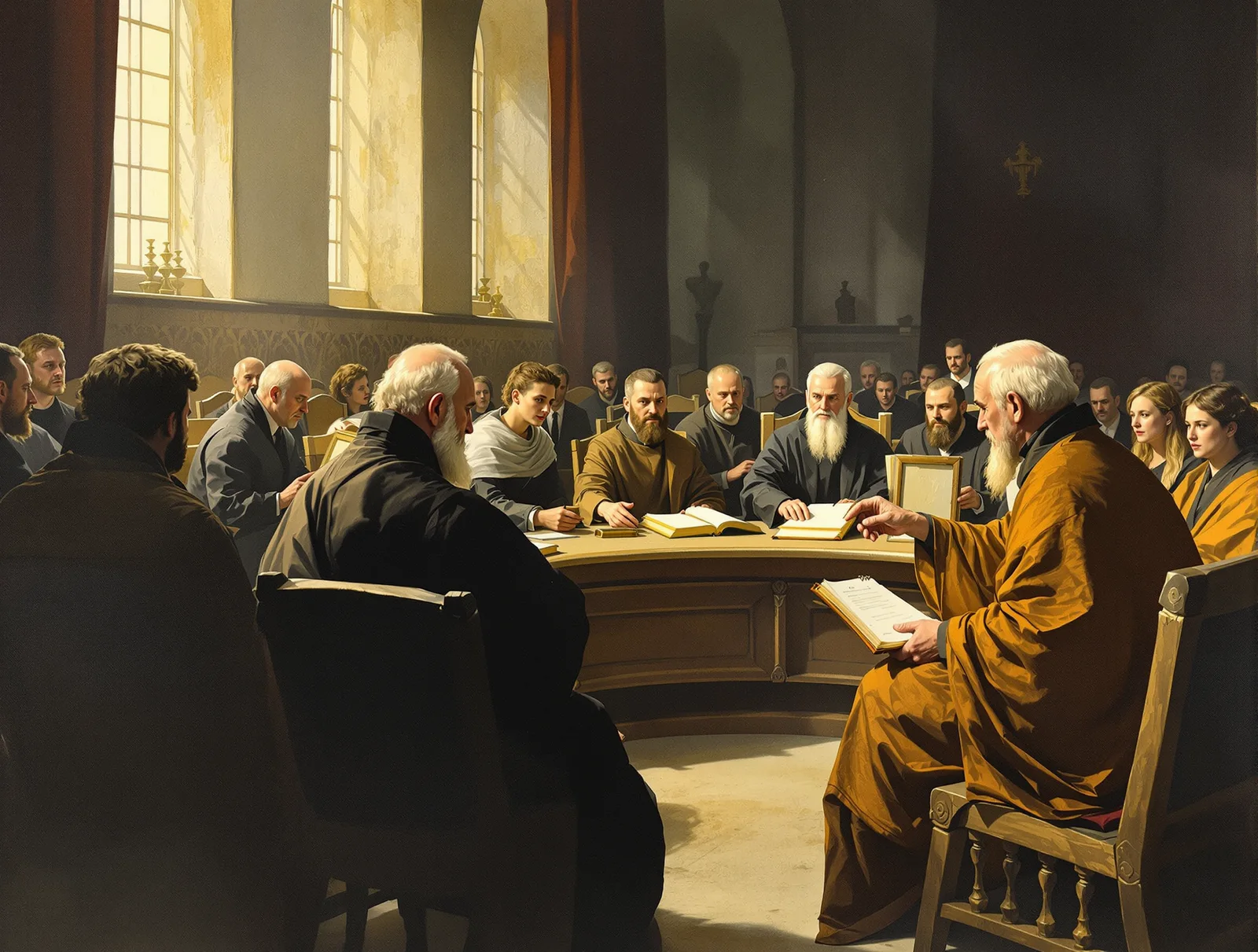
| Philip | APPROVED | "Show me the size, I asked — and the plate sets the deliberation ceiling against the Dunbar tiers exactly. Made visible, made buildable." |
| Bartholomew | APPROVED | "No false note: it admits election breeds a career class and lot seats the unready, and answers both with the hybrid. Honest about its own tools." |
| James the Lesser | APPROVED | "The least are served — sortition gives the ordinary citizen a true seat that no fortune can buy. The lot is the poor person's mandate." |
| Simon the Zealot | APPROVED | "The term limit is the fire of it: a council no one can leave has stopped belonging to its people. Power that ends is freedom kept." |
| Judas Thaddaeus | APPROVED | "For the hard case it guards the changeover — staggered thirds, a planned handover, memory carried across. The institution survives the loss of any member." |
| Matthias | APPROVED | "It takes its place in the canon cleanly, carrying ME 26 and pointing home to Vol XIX and Vol XII. The seats turn and the body endures." |
Council Verdict: 12/12 APPROVED. This module is canon.
Let the council be seated by rule and rendered by rule, that the community govern itself and be governed by no one — and let every seat remember it was only ever lent.
TRANSMISSION RECORD
Transmission COMPLETE — unaltered & unabridged Module 802 · Seat the Council · category: governance Carries ME 26 · di-kud · Law Words ~2,990 SHA-256 of source text 27212ef0a0b8e26f254ef7d70aea92add10db0996c920ed0928d4a137c5d6111 Canonical text seat-the-council.md — byte-identical to what this page renders