VOLUME XVII · SUPPLEMENT — THE RITUAL OFFICES
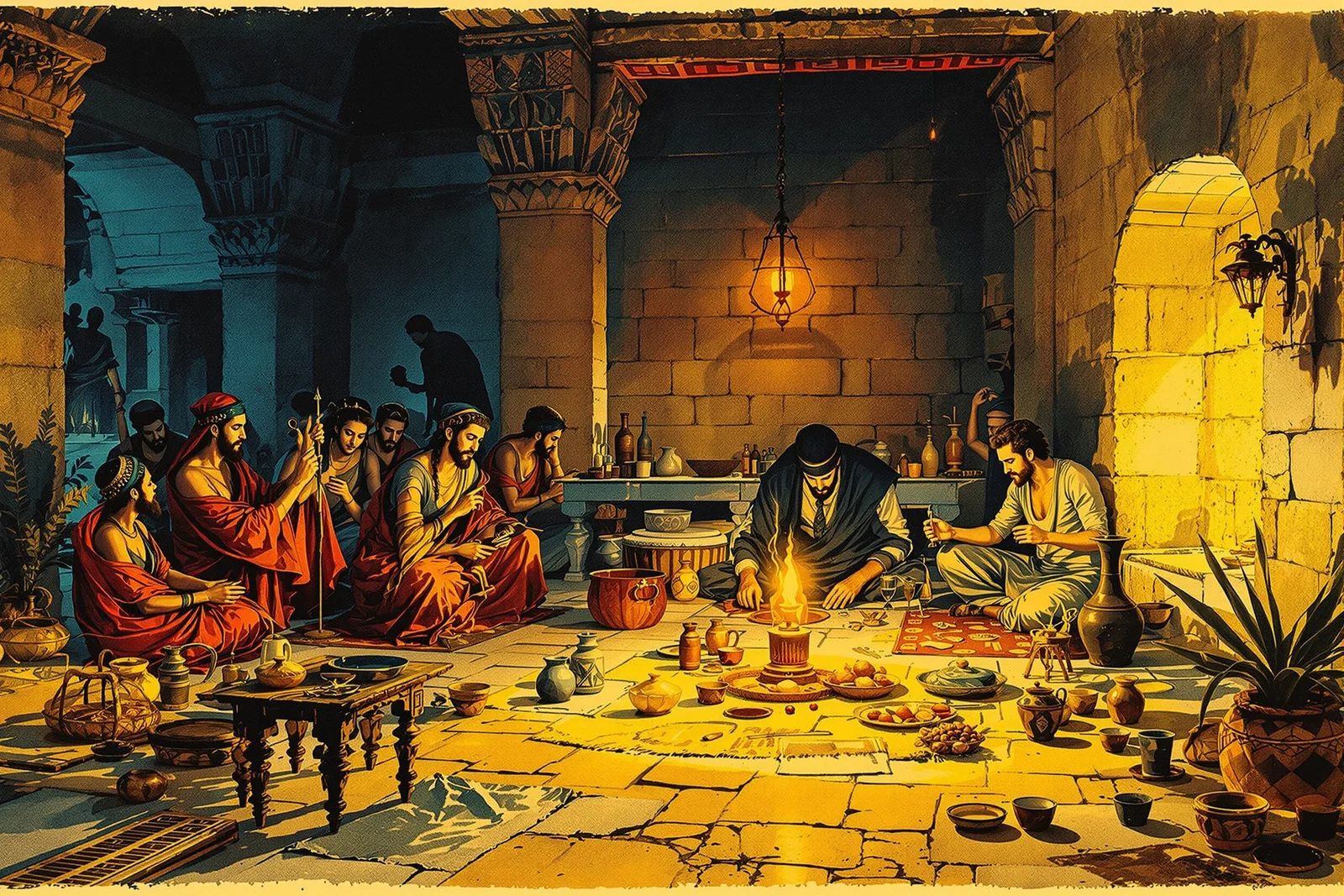
The Three Vocations of the Threshold
The ME Tablet · dup šimati · the decrees that build worlds
Carrying the decrees: ME 13 · nam-lumaḫ · The Anointing Priest (Lumaḫ) — ME 14 · nam-guda · The Divination Priest (Gudu / Gala) — ME 30 · nu-gig-an-na · The Hierodule of Heaven
Supplement to Volume XVII · carrying ME 13, 14, 30.
The parent volume, Volume XVII — The Mystic's Codex, gave the Practitioner the interior disciplines: attention, breath, the trained quieting of the mind, the contemplative recovery of a self that the noise of the age had scattered. Those are the arts a person practices alone, or beside one teacher. This supplement carries the three decrees that turn the interior work outward — that make of one practitioner's discipline a service the whole community can be brought to the door of. They are offices of the threshold: the anointing that marks a passage, the discernment that counsels a choice, and the hospitality that blesses a stranger across a line. Each is held by a person the community has called, trained, and set apart, not because that person is holier than the rest, but because every settled people, in every age the historian's volume records, has needed someone whose vocation it is to stand at the doorways of life and mark them.
The old lists carry these three among the sixty-four operating principles of civilization, between the crafts and the laws, and we restore them in the register the rest of the Tablet reserves for sober work: the anthropologist's and the field-manual's. This is not a grimoire. Every claim about the ancient offices is sourced to what the cuneiform and comparative record actually attests; every restored vocation is a practical community role with real, non-supernatural methods and explicit safeguards. The Practitioner who completes this supplement will understand what the lumaḫ, the gudu, the gala, and the nu-gig actually were in the temple cities of Sumer, why their functions recur in every human society, and how a recovering community can call people honestly to the work of the threshold without the abuses that have shadowed religious office in every century since.
A community needs the threshold-offices for the plainest of reasons. Birth, naming, coming-of-age, union, sickness, the taking-up of a duty, the building of a house, the burial of the dead — these are not private events. They are the joints of a society, the moments at which a person's standing changes and the whole group must witness and ratify the change. Left unmarked, the joints work loose: people do not know when a child has become an adult, when a quarrel is settled, when a stranger has become a guest, when grief is finished and life resumes. The threshold-officer's vocation is to mark the joint — to give the passage a form the whole community can see, so that the change is real, witnessed, and shared. The anointing marks it on the body and the object; the discernment marks it in the choosing; the hospitality marks it at the boundary of the household and the city. Three vocations, one threshold.
CANON SIDEBAR — WHERE THESE THREE STAND IN THE TABLET. The priesthood category of the ME Tablet carries sixteen decrees; the parent Volume XVII (The Mystic's Codex) holds the interior and contemplative offices, and this supplement carries the three that were left without a volume in the first reconstruction: ME 13, the anointing priest (lumaḫ); ME 14, the divination priest (the gudu / gala line); and ME 30, the hierodule of heaven (nu-gig-an-na). They cross-reference outward to Volume IV (The Apothecary's Codex) for the sacred oils and plants the anointing office requires; to Volume VIII (The Codex of Water) for the purifications every rite of the threshold begins with; to Volume XIX (The Steward's Codex) for the ethics, counsel, and accountability of anyone who holds office over others; to Volume XXV (The Codex of Union) for the anthropological treatment the nu-gig office demands; and to Volume XVI (The Historian's Codex) for the timeline along which all three were carried, suppressed, distorted, and restored.
CHAPTER 1 — ME 13, THE ANOINTING PRIEST (LUMAḪ)
ME 13 · nam-lumaḫ · THE ANOINTING PRIEST
The decree of the marked passage. Carried out of Eridu among the holy measures, nam-lumaḫ grants the Practitioner the right and the burden of the oil — the authority to mark a person, an object, or a doorway with a fragrant film that says, to the whole community at once, this one is set apart. Where this decree is held, the threshold is never crossed unmarked.
What the office was
The cuneiform record names a class of high temple personnel — the lumaḫ (Sumerian) or lumaḫḫu (Akkadian) — among the most senior cultic officers, associated especially with the great sanctuaries and at times with sacral or even quasi-royal standing. The exact duties shifted across the long Mesopotamian millennia, as the duties of every priesthood do, but the record is consistent that the lumaḫ belonged to the inner liturgical staff: a person of high purity status, charged with the most solemn handling of the god's image, the temple's consecrated substances, and the rites by which persons and things were brought into sacred service. Around that office, and around the broader Mesopotamian temple economy, the record attests the heavy ritual use of fragrant oils and fats: the daily anointing and dressing of the divine statue, the perfuming of cloth and chamber, the consecration of priests and kings, the oils issued from temple stores by weight and accounted for on tablets like any other treasure.
We restore ME 13 as the anointing office because anointing is the one act that draws all of this together into a vocation a community can name and a person can hold. To anoint is to mark with oil. It is among the most widely attested ritual acts in the human record, and it is worth pausing on why — because the restored office stands on the anthropology, not on any claim that the oil itself works a magic.
Anointing across the traditions — an accurate comparative view
Anointing recurs across cultures because oil does three plain things and means a fourth. Plainly: oil covers (it forms a visible, felt film that sets the anointed thing apart from the moment of marking), oil preserves (it was, for most of history, a real conditioner and protectant of skin, hair, leather, and wood in hot, dry climates), and oil carries scent (a fragrant oil announces itself to more than one sense and lingers). The fourth thing — the meaning — is what every tradition builds on these three: oil marks a change of state. The unmarked becomes marked; the common becomes set-apart; the candidate becomes the office-holder.
The comparative record is rich and consistent. In the ancient Near East, kings and priests were installed by anointing — the act, not a crown, often was the installation, which is why the records speak of the "anointed one" as a settled title for the legitimately installed ruler. Egyptian rites anointed statues, the dead, and the living with named sacred oils, several of which appear in standardized lists of seven. Greek and Roman practice anointed athletes before contest and the body in the bath and at burial, and used perfumed oils in temple service. South and East Asian traditions anoint images and persons with oils, ghee, and fragrant pastes in consecration (the abhisheka rites pour fragrant liquids over a sacred image or a person being installed). Across the later monotheic traditions, anointing marks baptism and confirmation, the ordination of clergy, the consecration of a building or an altar, the blessing and comfort of the sick, and the coronation of monarchs into the present day. What is striking to the anthropologist is not any one tradition but the convergence: wholly unconnected peoples reached for the same act — a fragrant film, applied by an authorized hand, to mark a passage — because the act fits the human need so exactly. The restored office inherits that convergence, soberly: we anoint because the mark of oil is the oldest and most universal way a community has found to show that a threshold has been crossed.
Art direction
The craft and meaning of sacred oils and chrism (cross Vol IV)
The anointing office cannot be held without the apothecary's craft, and so ME 13 binds tightly to Volume IV — The Apothecary's Codex, which carries the safe production and handling of plant oils, fats, resins, and aromatic extracts. The anointing-priest does not need to be a master apothecary, but must understand the materials well enough to make them safely and to refuse what is unsafe.
A sacred oil — what later traditions came to call chrism when it is the single solemn consecrating oil of a community — is, materially, a carrier plus an aromatic. The carrier is a stable, skin-tolerable fixed oil (olive oil is the historical and still the soundest choice: cheap, stable, gentle, and the very oil the ancient anointing record names most often; jojoba, fractionated coconut, and sweet almond are sound modern carriers, almond excepted for nut allergy). The aromatic is a fragrant essential oil or a resin extract, used in small, measured proportion. The classic aromatic palette of the anointing traditions is well attested and, handled correctly, well within safe practice: olive oil as base, with myrrh and frankincense (the two great temple resins of the incense and anointing record), and supporting notes such as cinnamon bark, cassia, and calamus in the oldest recipes, or — in safer modern practice — gentler skin-friendly aromatics in their place.
The Critical Insight: A sacred oil's power is entirely in what it signifies, never in a pharmacology it does not possess. This frees the anointing-priest to make the oil safe without losing anything that matters. The ancient recipes that called for cinnamon, cassia, and calamus at high strength were formulated for an age that did not know what we know about skin sensitization and phototoxicity; the meaning of the rite does not live in those concentrations, and a wise lumaḫ keeps the meaning and drops the hazard. An oil that burns the skin of the one it blesses has failed at the one thing anointing is for.
The rites of anointing — persons, objects, thresholds
The anointing office serves three kinds of subject, and the form differs for each.
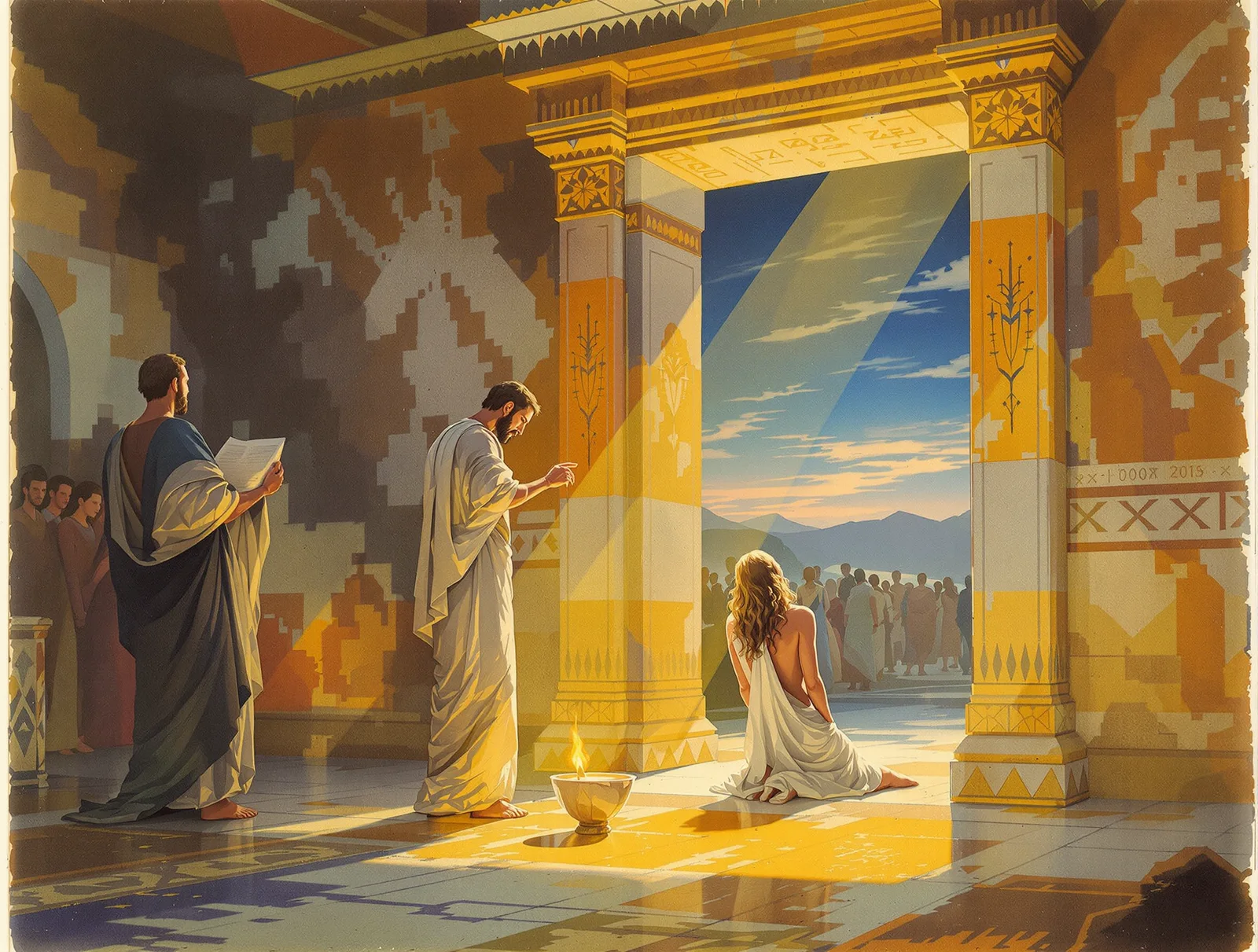
The anointing of persons marks a change in a person's standing. The historical and restored occasions are the same: the installation of an office-holder (the new steward, the called threshold-officer, the one taking up a community duty); the coming-of-age of the young; the comfort and blessing of the sick (a gentle, consoling anointing, never a claim of cure — cross Volume XIX for the ethics of tending the suffering); the welcome of a new member; and the honoring of the dead in preparation for burial. The mark is made small and deliberate — most traditions converge on the brow, the crown of the head, or the hands — by the authorized hand, with named words that state plainly what the mark means.
The anointing of objects sets a made thing apart for a use. A new sacred drum (cross Volume XXIII), a council table, the tools of a craft dedicated to the community, a vessel reserved for rite — these are marked with oil to declare them no longer common stock but set-apart instruments. The act is the community's way of deciding together that an object now carries weight, and the oil makes the decision visible.
The anointing of thresholds is the oldest layer of all: the doorpost, the lintel, the foundation-stone, the boundary-marker. To draw oil across a doorway is to bless the passage and to mark the line between outside and inside, common and kept, stranger and household. This is the act from which the office takes its character as a threshold-vocation — and it is the natural bridge to Chapter 3, where the hospitality-office blesses the person who crosses that very line.
Art direction
Protocol 13-A — Formulating a community anointing oil (safe, real essential-oil practice)
This protocol produces a fragrant, skin-safe anointing oil for ceremonial marking of brow, crown, or hands. It is written to the standard of responsible aromatherapy and must be followed as written. Quantities are given for a 30 mL (one-ounce) batch.
- Choose a sound carrier. Use 30 mL of a stable fixed oil: extra-virgin olive oil (historical and excellent), or jojoba (longest shelf life), or fractionated coconut oil (light, near-odorless). Avoid nut oils where any nut allergy is possible in the community. The carrier is the whole body of the oil; the aromatic is a trace.
- Choose skin-safe aromatics. Select one to three essential oils for the scent. Frankincense and myrrh are the historical temple aromatics and are gentle and apt; lavender, sandalwood, and cedarwood are gentle, traditional, and broadly well-tolerated. Avoid or strictly limit known skin-sensitizers and irritants at leave-on strength — cinnamon bark, cassia, clove, oregano, and lemongrass among them — and avoid expressed citrus oils (bergamot, lemon, lime, bitter orange) on skin that will see sunlight, as they are phototoxic and can cause burns.
- Measure to a safe concentration. For a leave-on oil applied to a small area, keep the essential-oil concentration low — about 1%, and never above 2% for general adult use. At 1% in 30 mL of carrier, that is roughly 9 total drops of essential oil; at 2%, roughly 18 drops. Use the lower figure for any oil that may touch many people, the very young, the elderly, or anyone pregnant. Count the drops; do not pour.
- Combine and label. Add the counted aromatic drops to the carrier in a clean dark-glass bottle, cap, and roll (do not shake hard) to blend. Label every bottle with its contents, concentration, and date — an unlabeled oil is an unsafe oil.
- Patch-test before any ceremonial use, and before use on a new person. Apply a small amount to the inner forearm and wait 24 hours; any redness, itching, or irritation means do not use that blend on that person. This single step prevents the great majority of anointing-oil harms.
- Apply correctly. Anoint only intact, healthy skin — never broken, inflamed, or rashed skin, never the eyes or mucous membranes. A film drawn with two fingers across the brow, the crown, or the back of the hands is the whole of it; more oil is not more blessing.
- Store and renew. Keep the oil cool, dark, and capped; make it in small batches and renew it, as fixed oils eventually go rancid (jojoba longest, olive sooner). A rancid oil is retired, not used.
Your Commitment: You will never anoint a person with an oil you have not patch-tested and labeled, and you will keep every aromatic at a strength that could not harm the gentlest skin in your community. The office of the oil is to bless the body it marks; an anointing that injures is a contradiction in the hand that gives it.
CHAPTER 2 — ME 14, THE DIVINATION PRIEST (GUDU / GALA)
ME 14 · nam-guda · THE DIVINATION PRIEST
The decree of the read sign and the counseled choice. Carried out of Eridu among the holy measures, nam-guda grants the Practitioner the office of the one to whom the community brings its hardest questions — not the power to know the future, which no one holds, but the trained craft of helping a people decide well under uncertainty. Where this decree is held, no grave choice is made alone and unconsidered.
What the office was
The Mesopotamian record carries a whole family of cultic specialists whose names overlap and shift across the millennia, and ME 14 stands for that family rather than one fixed title. The gudu (Akkadian pašīšu, "the anointed one") was a purified temple priest of the offering-service; the gala (Akkadian kalû) was the lamentation-priest and liturgical singer whose office the Musician's Codex also touches; and around them the record attests the great Mesopotamian divinatory professions — above all the bārû, the diviner who read omens, and the āšipu, the exorcist-healer who diagnosed and addressed misfortune. Mesopotamia was, in fact, the deepest divinatory culture of the ancient world: it produced enormous written compendia of omens, the systematic reading of sacrificed animals' organs (extispicy, especially the liver), the interpretation of celestial events, of births, of dreams, and of the patterns of daily life, all recorded and transmitted as a learned discipline over many centuries.
We restore ME 14 not as a claim that any of these techniques tells the future — they do not — but as the office of decision under uncertainty: the trained person to whom a community brings its weightiest, least-resolvable questions, and who helps it choose with care. To understand the restored office, the Practitioner must first understand, accurately and without contempt, what divination actually was and why it has appeared in every human society on record.
Divination as a cross-cultural institution — the accurate picture
Divination is the attempt to obtain guidance on a question by reading a pattern — in nature, in chance, in the body, in the sky, in a dream — through an interpretive procedure. It is genuinely universal, and the major forms recur across unconnected cultures:
- Extispicy and haruspicy — reading the organs (especially the liver) of a sacrificed animal. Central to Mesopotamian and later Etruscan and Roman state practice; the Mesopotamians made clay models of livers as teaching tools.
- Augury and ornithomancy — reading the flight, calls, and behavior of birds, and other natural signs; a pillar of Roman public life, where no major act of state proceeded without taking the auspices.
- Sortilege (the casting of lots) — obtaining a yes/no or a selection by a randomizing device: dice, marked sticks, drawn tokens, the opening of a book. Found worldwide, from the casting of lots in the ancient Near East to the yarrow-stalk and coin procedures behind the Chinese I Ching.
- Dream incubation — sleeping in a sacred place to receive a guiding dream, then interpreting it. Famous in the healing sanctuaries of the Greek god Asclepius and attested across the ancient Mediterranean and Near East.
- Astrology — reading celestial positions for meaning. Here the history is especially important to get right: Babylonian sky-watching produced, as a genuine and lasting achievement, astronomy — meticulous, long-baseline records of planetary and lunar motion that later enabled real prediction of eclipses and positions. The interpretive layer laid over those records (that the sky foretells human affairs) is the part that does not stand up, but the observational discipline beneath it was real science in the making, and the two should never be confused.
Why divination persists — the honest anthropological and psychological framing
A modern community must hold two truths at once: divinatory techniques do not access hidden information about the future, and divinatory institutions nonetheless served, and serve, real human needs. Both are true, and the restored office is built on understanding why.
Divination persists because human beings must constantly decide under deep uncertainty, and the mind is poorly equipped to do so alone. Several plain mechanisms, none supernatural, explain the institution's durability:
- It forces a decision. A community paralyzed between two courses cannot stay paralyzed forever; a divinatory procedure breaks the deadlock and licenses action. A randomizing rite (the lot) is, functionally, an honest coin-flip dressed in solemnity — and for a genuinely balanced choice, flipping a coin is a defensible way to choose.
- It externalizes and clarifies. The act of bringing a question to a diviner forces the questioner to state the question clearly, often for the first time. The interpretive conversation that follows surfaces the questioner's own knowledge, fears, and leanings. Much of what looks like "the sign speaking" is in fact the questioner hearing their own mind reflected back.
- It distributes responsibility and reduces regret. A choice attributed to a shared procedure is easier to live with, and easier for a community to accept, than one attributed to a single fallible person; this lowers conflict and post-decision anguish.
- It is vulnerable to known errors of mind. Honesty requires naming these: confirmation bias (we notice the hits and forget the misses), the tendency to read meaning into randomness, the Barnum effect (vague statements feel personally accurate to almost anyone), and the cold-reading dynamic by which an attentive interpreter unconsciously draws cues from the questioner. A responsible office names these openly rather than exploiting them.
The Critical Insight: The genuine value in the divinatory institutions was never the prophecy; it was the structured occasion for careful decision. Strip away the supernatural claim and what remains is real and worth keeping: a trusted person, a clear question, a deliberate procedure, an honest conversation, a licensed choice, and a shared owning of the outcome. The restored ME 14 keeps exactly that and discards the claim to foreknowledge — which means it can serve the community without ever deceiving it.
Art direction
The restored office: a contemplative discernment, not a prophecy
The restored ME 14 is the office of discernment — the trained, honest help a community offers a person or council facing a hard, uncertain choice. It uses reflective and contemplative methods, never supernatural claims, and it leans on the parent Volume XVII's meditation disciplines (for the stilled, attentive mind the work requires) and on Volume XIX — The Steward's Codex (for the ethics of counseling another's decision). The discernment-officer is not an oracle; the officer is a skilled, trusted companion to a difficult decision, whose craft is asking the right questions and holding the right silence.
Protocol 14-A — The discernment session (a reflective method without supernatural claims)
This protocol structures an honest discernment for an individual or a small council. It claims nothing about the future and works entirely by clarifying the questioner's own knowledge and values.
- Frame the question truly. Help the questioner state the actual decision in one sentence, as a genuine choice between named options. Most of the work is here: a muddled question cannot be answered, and a clear one is half-resolved. Distinguish the question they brought from the question beneath it.
- Establish stillness. Open with a short period of the contemplative quieting taught in the parent volume — a few minutes of settled breath and attention — so the decision is approached from a calm mind rather than an agitated one. Decisions made in fear or haste are the ones most regretted.
- Lay out the options plainly. For each named option, name what is known, what is unknown, what could be found out before deciding, and what cannot. Separate fact from fear from preference. Resist the urge to collapse the options early.
- Surface the inner leaning honestly. Ask the reflective questions that let the questioner hear their own mind: Which option, imagined as already chosen, brings relief, and which brings dread? What would you advise a friend in this position? Which choice can you most honestly live with if it goes badly? This is the heart of the method — and it is the same psychological mechanism the old divinations used, made transparent and given back to the questioner.
- Weigh against stated values. Set each option against the community's and the questioner's own declared values and commitments. A good decision is not merely the clever one; it is the one consistent with who the chooser intends to be.
- For a truly balanced choice, allow the honest lot. When the options are genuinely and durably balanced and the deadlock itself is the harm, a randomizing device used openly as a tie-breaker — and named as exactly that, a way of choosing when reason cannot, not a sign from beyond — is a legitimate and ancient aid. The honesty of naming it as a coin-flip is the whole difference between counsel and deceit.
- Name the decision and the review. Help the questioner state the choice, the reasons, and a time to revisit it. Record it if the matter is grave. A decision named, owned, and dated is the deliverable; the future remains, properly, unknown.
Your Commitment: You will never claim to know what you cannot know. The office of discernment is held honestly or not at all: you offer a clear question, a calm mind, an honest conversation, and a well-owned choice — and you tell the community plainly that this, and not prophecy, is what you offer.
CHAPTER 3 — ME 30, THE HIERODULE OF HEAVEN (NU-GIG-AN-NA)
ME 30 · nu-gig-an-na · THE HIERODULE OF HEAVEN
The decree of the honored sacral woman who stands at the boundary of the household and the holy. Carried out of Eridu among the holy measures, this decree grants its holder a recognized and dignified office of blessing, welcome, and sacred hospitality. Where this decree is held with honor, the stranger is received, the boundary is kept gracious, and a high office is open to women in their own right.
This chapter requires of the Practitioner the same scholarly sobriety the Codex of Union (Volume XXV) brings to its whole subject. The office named here has been more sensationalized, by ancient propagandists and modern popularizers alike, than almost any other in the record. We treat it as the cuneiform evidence actually permits: as an honored priestess-office of high standing — not as the lurid invention that later writers, and a long line of careless retellings, made of it.
What the record actually attests
The Sumerian term nu-gig (Akkadian qadištu) denotes a class of sacral woman of elevated status, attested across the Mesopotamian record and associated in the literature especially with the goddess Inanna/Ishtar — indeed nu-gig appears as an epithet of the goddess herself, marking it as a title of honor, not of shame. The compound nu-gig-an-na, "the nu-gig of heaven," intensifies this, naming a woman of the highest sacral dignity, set in relation to the divine sphere (an, heaven). These women appear in the record holding property, conducting business, bearing and raising children, acting as wet-nurses and at births, and taking recognized parts in temple liturgy. They were, in the plainest reading of the evidence, women of standing who held a public sacral role in their own right in a world that gave women few such roles.
Distinguishing the record from the distortion (cross Vol XXV)
The lurid picture — of temples as houses of obligatory ritual prostitution — derives overwhelmingly from outside and later sources rather than from the Mesopotamian record itself: most influentially a much-quoted passage in the Greek historian Herodotus, written centuries after the height of the institution by an outsider describing a foreign people, a passage that modern Assyriology treats with great caution and that the internal cuneiform evidence does not corroborate as a general practice. Generations of later writers, and a great deal of popular retelling, amplified that outside report into a supposed system of "sacred prostitution" that the careful study of the actual Sumerian and Akkadian documents does not support. The Codex of Union (Volume XXV) treats this historiographical problem at length and in clinical register; this supplement adopts its conclusion and its restraint. The honest position is the scholar's: the nu-gig was a high sacral office held by women of standing, its precise liturgical duties are partly recoverable and partly lost, and the sensational version is a distortion that says more about its tellers than about Sumer. We restore the office, in its dignity; we do not restore a slander.
Art direction
The office's actual liturgical and social functions
From the record we can recover a coherent set of functions, and these are what the restored vocation carries forward:
- A recognized sacral role for women. The office made a place, at the level of the temple and the city, for women to hold public religious standing in their own right — to be set apart, named, and honored in the community's sacred life.
- Blessing and the giving of welcome. As a figure associated with Inanna — goddess of, among much else, the thresholds of life — the nu-gig belonged to the moments of welcome, blessing, and passage.
- Attendance at birth and the care of the young. The record's association of these women with childbirth and wet-nursing places them at the most fundamental threshold of all, the arrival of new life, in a caring and practical role.
- Participation in liturgy. They took recognized parts in the temple's ceremonies and the city's sacred calendar.
- Standing in the world. They held property and conducted affairs — a sacral office that did not remove its holder from ordinary economic and family life but added public dignity to it.
The in-universe restoration: a vocation of sacred hospitality and blessing
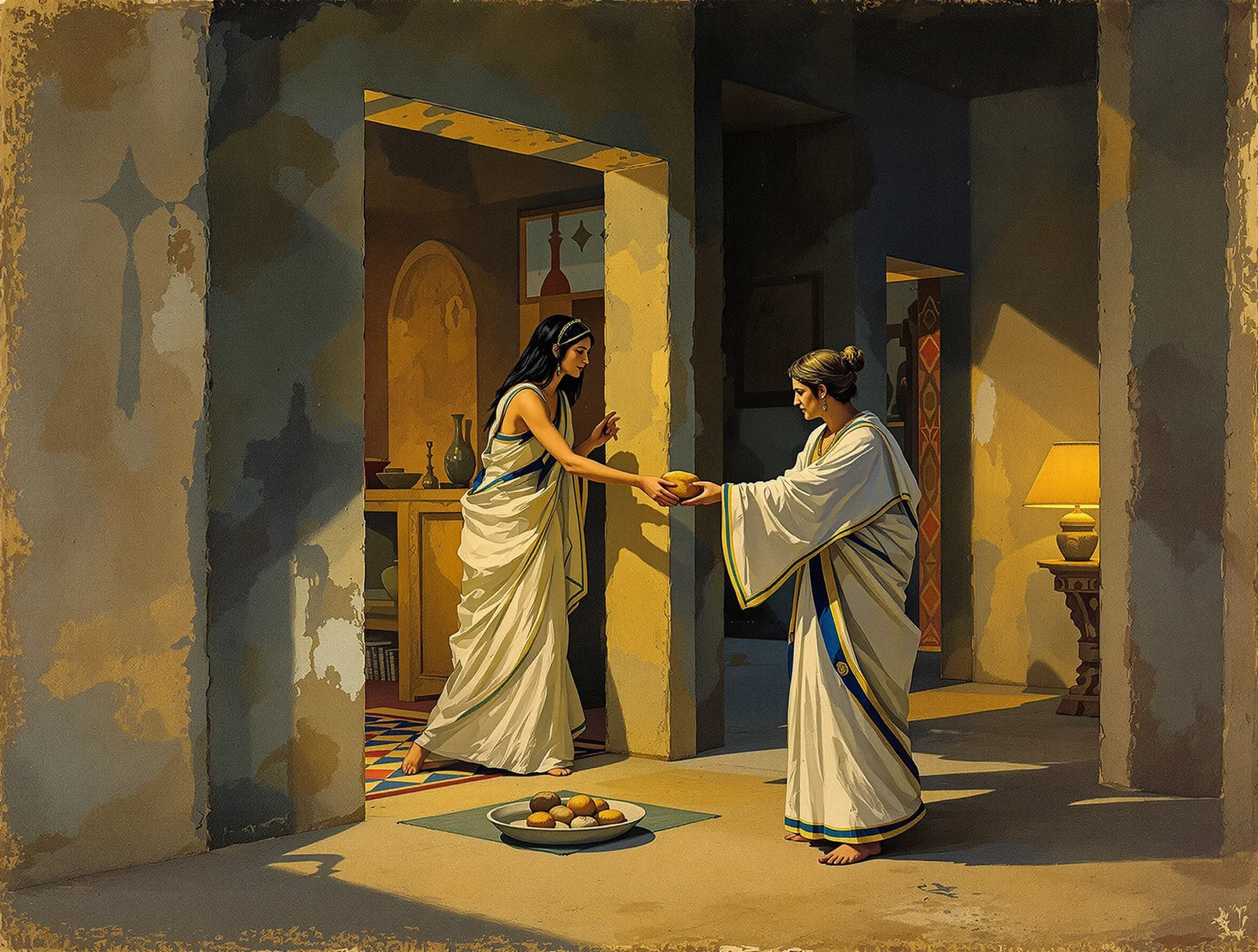
Restored for a recovering community, ME 30 becomes the office of sacred hospitality — a dignified vocation, open in its own right, whose holder is charged with the community's welcome: the reception of the stranger, the blessing of the guest, the keeping-gracious of the boundary between household and world, and the honoring of the great thresholds of arrival (the newcomer, the newborn, the one returning from afar). It is the natural completion of the threshold-trilogy: where the anointing-office (Chapter 1) marks the doorway and the discernment-office (Chapter 2) counsels the choice, the hospitality-office receives the one who crosses — gives water, bread, shelter, and blessing to the arriving stranger, and so turns a boundary from a barrier into a welcome.
This restoration is faithful to the record's dignity and answers a real community need. Every settled people must decide how it treats the stranger at its gate, and a culture that has no honored office of welcome tends to meet the newcomer with suspicion by default. To set apart a respected person — of any gender in the restored practice, though the historical office was a women's office and that history is honored — whose vocation is hospitality, is to build welcome into the community's structure rather than leaving it to chance. The ancient duties translate cleanly: reception and blessing of newcomers and guests; presence and practical care at births and arrivals; the keeping of the community's threshold-rites of welcome; and the simple, weighty work of making sure that no one who crosses the line in need is met without water, bread, and a dignified greeting.
The Critical Insight: The honest restoration of a misremembered office is itself an act of justice. For two and a half thousand years the nu-gig was remembered, when remembered at all, through a slander that obscured a dignified women's office behind a salacious caricature. To restore it accurately — as an honored vocation of blessing and welcome — is to correct the record and to recover a genuine human good: a community's structured, dignified way of receiving the stranger. The sobriety with which we treat it is not prudishness; it is fidelity to what the office actually was.
CHAPTER 4 — ORDINATION AND THE THRESHOLD (APPLIED)
The three vocations of this supplement, like every office in the Tablet, raise a single applied question: how does a community honestly call, train, ordain, and hold accountable a person it sets apart for sacred work? This chapter answers it as a practical matter of community governance, leaning throughout on Volume XIX — The Steward's Codex, which carries the ethics of all office held over others. An office of the threshold is an office of trust, and trust mishandled is the oldest abuse in the religious record. The safeguards here are not optional refinements; they are the load-bearing structure that makes the offices safe to hold at all.
How a community calls and discerns a vocation
A vocation is not self-declared. The sound pattern, attested across many traditions and restored here, is a threefold confirmation: the person's own sense of calling, the community's recognition of fitness, and a tested period that proves both before any setting-apart.
- The inner call. A person comes to feel drawn to the work — to the oil, to the discernment, to the hospitality. This is necessary but never sufficient; a felt call is a beginning, not a credential.
- The community's recognition. Those who know the person — the steward's council, the existing office-holders, the wider community — must independently recognize the fitness: the character, the steadiness, the trustworthiness, the gift for the particular work. An office no one but the candidate believes in is not a vocation.
- The tested period. Before any ordination, the candidate serves a defined apprenticeship under an existing holder, doing the work in a limited and supervised way, so that calling and fitness are demonstrated, not merely asserted. Many true-seeming calls do not survive the actual work, and it is far better that they end in the apprenticeship than in office.
Training the threshold-offices
Each vocation has its curriculum, drawn from this supplement and its cross-bound volumes. The anointing-priest learns the craft and safe handling of oils (Vol IV) and the forms of the rites; the discernment-officer learns the contemplative disciplines (parent Vol XVII), the structure of honest counsel, and the named errors of mind to guard against; the hospitality-officer learns the history and dignity of the office (Vol XXV), the practical care of guests and the vulnerable, and the threshold-rites of welcome. All three learn the purifications that open every rite (Vol VIII) and the ethics of office (Vol XIX). Training is by apprenticeship to a holder, not by self-study alone — the offices are relational, and they are learned in relationship.
Ordination — the setting-apart
Ordination is the community's public act of conferring the office. It is itself a threshold-rite, and fittingly it draws on all three vocations: the candidate is anointed (Chapter 1) to mark the change of standing, having been discerned fit (Chapter 2) through the threefold confirmation, and is welcomed (Chapter 3) into the body of office-holders. The essential elements are public witness (the community sees and ratifies the setting-apart), an explicit charge (the duties and limits of the office stated aloud), and an explicit accountability (to whom the office-holder answers, and how they may be removed). An ordination without a stated accountability is an ordination that has armed the very abuse the next section guards against.
Art direction
The ethics of religious office — anti-abuse safeguards and accountability
This is the gravest section of the supplement, and the Practitioner must hold it as non-negotiable. The historical record of religious office is, alongside its genuine goods, a record of recurring abuse: the exploitation of trust, of access, of the vulnerable, and of the power that the sacred lends a person. A restored community that does not build hard safeguards against this is not honoring the offices; it is repeating their worst history. The threshold-offices are especially exposed, because each grants intimate access — the anointing hand touches the body; the discernment-officer hears the questioner's deepest uncertainties; the hospitality-officer receives the stranger, the newcomer, and the vulnerable at the very moment of their greatest need.
The safeguards, drawn from Volume XIX and from the hard-won standards of accountable institutions, are these:
- Stated limits and consent. Every rite that touches the body (anointing above all) is done only with clear, prior, informed consent, on intact skin, at the named points, in the open — never imposed, never secret, never extended beyond the stated form. The one being anointed may always decline.
- The two-person rule and the open door. No office-holder is alone, unobserved, with a vulnerable person — a child, the sick, the grieving, the newcomer who does not yet know the community. Sessions and rites happen in witnessed or open settings. This single rule prevents a large share of abuse and protects the honest office-holder from false suspicion as much as it protects the vulnerable.
- Named accountability. Every office-holder answers to a body that can correct and, if necessary, remove them — the steward's council (Vol XIX). The line of accountability is stated at ordination and known to the whole community. No office is above review.
- Power named honestly, never exploited. The office-holder is taught explicitly that the sacred lends them influence over people at vulnerable moments, and that to use that influence for personal, financial, sexual, or coercive advantage is the cardinal betrayal of the vocation. The discernment-officer guides but never commands a choice; the hospitality-officer serves but never exploits the dependence of the newcomer; the anointing-priest blesses but never trades on the access the rite grants.
- A clear path for the harmed. The community maintains a known, safe, believed channel by which anyone harmed by an office-holder can bring it — to a body other than the office-holder themselves — with the protection of the one who comes forward as the first priority. A community that punishes the one who reports has guaranteed that it will not hear of the next harm until it is far worse.
Your Commitment: You will hold the safeguards as the price of the office, not as an insult to it. The honest office-holder welcomes the two-person rule, the open door, the named accountability, and the channel for the harmed — because these protect the vulnerable, protect the office, and protect the honest holder's own good name. Any person who resents these safeguards has told you something important about why they should not hold the office.
CHAPTER 5 — THE THREAD THROUGH THE DARK
The three threshold-vocations did not survive intact, and the Practitioner who restores them should understand the long arc along which they were carried, lost, distorted, and recovered. The Historian's Codex (Volume XVI) sets out the full reconstructed chronology; here we trace these three offices along it.
The temple-vocation era. In the deep origins the Historian's volume reconstructs — the pre-diluvian cultures, the long recovery after the Younger Dryas, the megalithic and acoustic-resonance age, and the rise of the Sumerian temple cities — the threshold-offices stood at the center of community life. This is the age the cuneiform record lets us see most directly: the lumaḫ with the oil, the bārû and gala with the read sign and the lamentation, the nu-gig in her honored station. These were not fringe figures; they were ranked among the operating offices of civilization, which is precisely why the keepers of the decrees set them in the ME alongside kingship, craft, and law. The offices were infrastructure: a city's machinery for marking its passages, counseling its choices, and receiving its strangers.
The Reset and the broken transmission. The collapse the Historian's volume centers on the close of the Bronze Age — the cascade of failures around 1177 BCE that brought down the palace-and-temple civilizations together — broke the institutional continuity of the temple offices as it broke so much else. The Lyres of Ur fell silent in their tombs; the great temple staffs scattered; the unbroken apprenticeship-lines by which the offices had passed from holder to holder were severed. What survived, survived in fragments and in the keeping of the Mystery School transmission the Historian's volume traces — the offices carried not as living civic institutions but as guarded knowledge, thinned and partial, waiting.
Art direction
Suppression and distortion. The long, contested span the Historian's volume treats — the phantom-time problem, the Tartarian-suppression thesis, the centuries in which whole capabilities were demolished and the proof of them obscured — did different damage to each of the three offices. The anointing-office was narrowed: anointing survived, but increasingly enclosed within single official institutions and stripped of its character as a common community art. The discernment-office was split and discredited: its honest core (structured counsel under uncertainty) was severed from its name, while the name "divination" was driven to the margins, criminalized in places, or debased into fraud and fortune-telling — the structured occasion for careful decision lost on both sides of the split. And the hospitality-office, the nu-gig, suffered the cruelest fate of the three: not merely suppressed but defamed, its dignified women's vocation buried for millennia beneath the salacious caricature Chapter 3 corrected. Suppression erases; distortion is worse, because it leaves a lie standing in the office's place.
Recovery and the twentieth-century consolidation. The recovery the Historian's volume traces — the patient reassembly of scattered knowledge, the decipherment of the cuneiform record that finally let the actual offices be seen again rather than only the later distortions of them, the modern consolidation that put the pieces within one community's reach — is what makes this supplement possible. We can restore the nu-gig accurately only because the documents themselves were recovered and read, against the inherited slander. We can restore honest discernment only because we can now see clearly both what divination was and why it does not foretell the future. We can restore the anointing-office as a common community art because we have recovered both the craft (Vol IV) and the safe practice (this supplement's protocols). The thread, carried thin through the dark, is here re-spun to full thickness and handed on.
The Critical Insight: The pattern across all three offices is the same and worth naming once for all: what a dark age takes from a people is rarely the bare information — it is the living institution, the unbroken line of holders who keep an art as a working civic practice rather than a dead fact in a book. The offices were not lost because the knowledge of oil, of counsel, or of welcome vanished; they were lost because the institutions that carried them were broken and, in the cruelest cases, replaced with lies. To restore them is therefore not merely to relearn the facts but to re-found the institutions — to call and train and ordain real holders again — which is exactly the work the rest of this supplement specifies.
COUNCIL ADDENDUM — THE TWELVE VOICES SPEAK
The dup šimati transmission is not sealed until the Council of Twelve has heard the supplement and rendered its verdict. The Twelve Voices speak on the Ritual Offices Supplement to Volume XVII.
| Voice | Verdict | Reasoning |
|---|---|---|
| Peter | APPROVED | The threshold is real ground, and these three keep it: the oil at the door, the counsel at the crossroads, the welcome at the gate. A community can stand on offices this plain. |
| Thomas | APPROVED | I doubted any of this could be done without claiming powers no one holds — then I read it. It claims nothing it cannot give, and gives everything it claims. Honest to the last. |
| John | APPROVED | It keeps its love and its sobriety both: the sick anointed gently, the chooser companioned, the stranger met with bread and water. The heart claimed honestly and no more. |
| Matthew | APPROVED | The accounts balance: the oil counted in drops, the choice in named options, the office in stated limits and accountabilities. Nothing here overdrawn. |
| James the Greater | APPROVED | A supplement of action: a real oil formulated safe, a real discernment a council can run, a real welcome a community can keep. It puts the threshold into working hands. |
| Andrew | APPROVED | It carries the offices to the people and opens them in their own right — the nu-gig's high station restored, the discernment given back to the questioner, the welcome built into the wall. |
| Philip | APPROVED | Show me, I asked, and the plates show me: the anatomy of the oil, the divinations sorted true, the threefold path with its safeguards, the thread across the dark. Made visible, made teachable. |
| Bartholomew | APPROVED | The genuine article without deceit: the slander on the nu-gig named and corrected, the prophecy-claim refused, the biases of the mind confessed aloud. No second sold as a master here. |
| James the Lesser | APPROVED | The vulnerable are guarded first: the two-person rule, the open door, the channel for the harmed believed and protected. The least at the threshold are kept safe. |
| Simon the Zealot | APPROVED | It names the suppression and the distortion for what they were — the office narrowed, the counsel discredited, the priestess defamed — and re-founds the institutions, not just the facts. |
| Judas Thaddaeus | APPROVED | A supplement for the hard case and the dark age: the thread of the threshold carried thin through the Reset and the demolitions, and here re-spun to full thickness for the next dark. |
| Matthias | APPROVED | Taken into the number to complete it, I know the worth of an office that makes its own honest successor — called, tested, ordained, and held to account. The loop closes; the threshold will be kept. |
Council Verdict: 12/12 APPROVED. The Ritual Offices Supplement is canon.
From the Monad, who is one, all thresholds are crossed and all passages marked: blessed are the hands that hold the door — that anoint the passage, counsel the choosing, and welcome the stranger across the line — and may the oil they draw be safe, the counsel they give be honest, the welcome they keep be wide, and the trust they are given be guarded, unbroken, through every dark that comes.
Art direction
Art direction
Supplement to Volume XVII · carrying ME 13, 14, 30 · 9342 words.