Module 760 — Build the Singing Wood
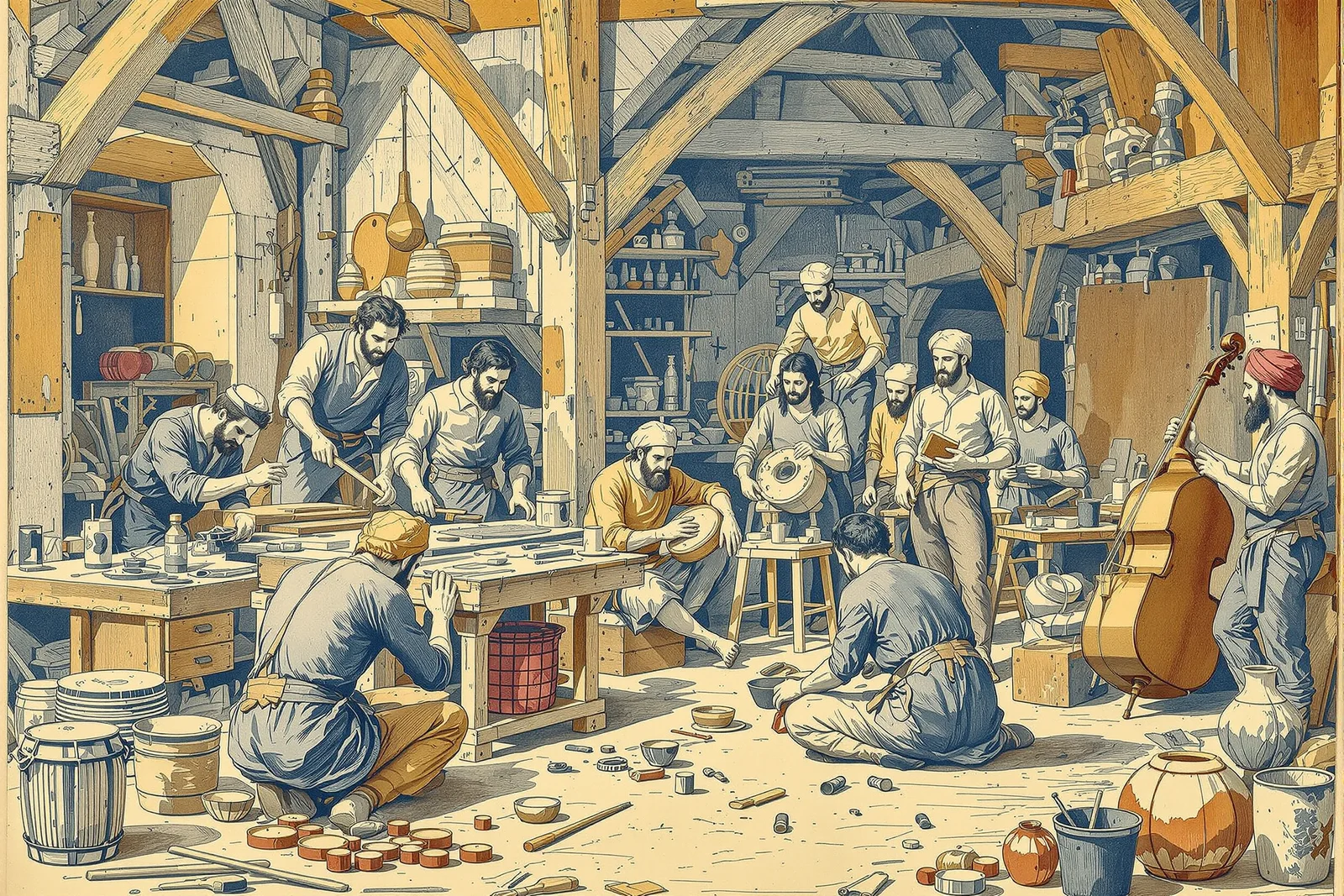
THE ME TABLET · Music Module 760 · ĝiš-gu-di
Carrying ME 31 · ĝiš-gu-di · The Gusilim. A Sovereignty Module of the Practitioner Community.
Unaltered and unabridged: ~2,950 words.
Preamble
The first instrument a recovering community builds is almost never a flute and almost never a drum. It is a stretched cord over a hollow box — because a string under known tension is three tools at once: a voice, a frequency standard, and a teacher of ratio. Volume XXIII, the Musician's Codex, devotes an entire sub-volume to the luthier's art, and that sub-volume rightly asks years of the Practitioner — seasoned tonewood, slow glue, the patient making of gut. This module asks an afternoon. It carries the same decree, ME 31, the Gusilim, the right to make a tree speak under tension, but it scales the decree down to what a Practitioner with salvage wood and a kitchen table can complete before the week is out.
What follows is a complete first string-instrument build: a board-zither or a simple lyre framed from reclaimed lumber, strung, pinned, and tuned to a pentatonic scale a beginner can actually play. The technique is real and the dimensions are honest. You will choose your wood by the same physics the great workshops used (Vol XXIII, Chapter 12), set tuning pins that hold their pitch, and bring a string slowly and safely to tension without splitting your soundboard or your knuckles. Nothing here requires a lathe, a clamp rack, or a felled spruce. It requires a saw, a drill, a few hand tools, and the willingness to let the wood settle and be retuned twice.
By the end you will hold the string decree in working order at its most fundamental: an instrument of your own making that sounds true, that you can tune by ear or by meter, and that becomes — exactly as the monochord becomes in the parent volume — the jig and the confidence for every harder build after it. The Gusilim does not begin in the burial chambers of Ur. It begins here, on a salvage board, with one string brought to pitch.
Part I — The Salvage Bench and the Choosing of Wood
Chapter 1 — Reading Salvage Lumber for Tone
A soundboard has one job: take the small, fast, high-force motion of a vibrating string and turn it into the large, slow motion of air the ear can hear. The board that does this best is at once stiff (so it responds instantly and carries string load without collapsing) and light (so the string's tiny energy can actually move it). Vol XXIII, Chapter 12 gives the figure of merit: the speed of sound along the grain, c = √(E/ρ), where E is the Young's modulus along the grain and ρ the density. You will not measure E on a kitchen table, but you can judge its proxies by hand, and salvage is full of excellent tonewood hiding as packing crates, shelving, and old furniture.
The frame — the parts that carry the string's pull and must not flex — has the opposite brief: dense, hard, dimensionally stable, reflecting energy back into the board rather than swallowing it.
Specification Table 1-1 — Salvage Sources by Job
| Salvage source | Likely species | Best role | Hand-test for fitness |
|---|---|---|---|
| Old drawer bottoms, crate panels, sounding-board scrap | Spruce, pine, fir, cedar | Soundboard | Light for its size; tap-tone rings, not thuds; straight grain |
| Shelving, stair treads, table leaves | Maple, beech, birch | Frame, pin block, bridge | Heavy, hard; dents a fingernail reluctantly |
| Pallet stringers (the thick rails, not the slats) | Oak, ash | Frame, lyre arms | Dense, straight grain along the rail |
| Old hardwood furniture (chairs, headboards) | Walnut, cherry, oak | Frame, bridge, tuning-pin block | Stable, machines cleanly, no end-checks |
| Cabinet-grade plywood (Baltic birch type) | Birch ply | Soundbox sides, base | Void-free edges; many even plies |
The Critical Insight: Density is not quality — it is a clue to the right job. A heavy spruce panel is a poor soundboard; a heavy maple board is a fine bridge. Salvage tempts you to use the prettiest piece for everything. Resist it. Judge every board against its task — soundboards by stiffness-per-gram (tap it; listen for a clear ring), frames by hardness and stability — and the salvage pile will hand you a better instrument than a lumberyard would.
Chapter 2 — The Tap-Tone and the Grain
You have no oven and no scale to compute moisture content, so you let history do the seasoning for you: salvage wood is almost always bone-dry and long-stable, which is precisely why it is the recovery luthier's gift. The risks are the opposite of green wood's — old checks, hidden screw holes, and warp. Sight down every board's length for twist and cup, and reject anything that rocks on a flat surface.
For the soundboard, two grain facts from Vol XXIII, Chapter 12 matter even on salvage. First, quartersawn stock (growth rings running roughly perpendicular to the face) stays flat and stiffens across the grain; look at the board's end and prefer rings that stand up toward the face over rings that lie flat. Second, grain runout — fibers that slope out of the face rather than running its full length — weakens a soundboard; choose panels whose surface grain runs straight from end to end. Tap a candidate top in its center while pinching one corner: a clear, sustained ring means a live board; a dull tunk means a dead or damp one. Trust the tap.
Part II — The Soundbox and the Soundboard
Chapter 3 — Two First Instruments
This module offers two builds from the same skills; choose by your stock and nerve.
- The board-zither (recommended first build): a flat soundbox — a shallow open frame closed top and bottom by thin boards — with strings running its length, parallel to the top, anchored at one end and tuned at the other. No arms, no yoke, the simplest possible string decree. Buildable in an afternoon.
- The salvage lyre: a soundbox with two arms rising from it and a crossbar (yoke) between them; strings run from the yoke down to a tailpiece, passing over a free bridge on the soundboard. More parts, more beauty, the true ancestor of the instruments of Ur (Vol XXIII, Chapter 14), but a half-day more work.
Both share one soundbox, built identically. Build the zither first; the lyre is the zither with arms added.
Specification Table 3-1 — The Common Soundbox (Board-Zither)
| Part | Salvage stock | Dimensions (mm) | Qty |
|---|---|---|---|
| Soundboard (top) | Quartersawn spruce/pine, 3–4 mm | 600 × 200 | 1 |
| Back | Pine or birch ply, 4–6 mm | 600 × 200 | 1 |
| Long sides | Pine/hardwood, 18–20 mm | 600 × 45 | 2 |
| End blocks | Hard maple/oak, 40 mm thick | 200 × 45 | 2 |
| Pin block (string ends) | Hard maple/beech | 200 × 45 × 30 | 1 (one end) |
| Bridge | Hard maple/oak, triangular | 180 × 12 × 12 | 1 |
| Nut bar | Hard maple/oak | 180 × 10 × 8 | 1 |
Protocol 3-A — Building the soundbox:
- Make the end blocks the heroes. They carry the entire string load. Use the hardest salvage you have, full-thickness (40 mm), glued and screwed flush between the sides at each end.
- Assemble the box frame: glue and clamp (or screw) the two long sides to the two end blocks, forming a shallow open rectangle. Check it square with a diagonal measure — both diagonals equal means true.
- Glue on the back first (the closed bottom). Aliphatic (yellow) wood glue is forgiving and strong; hide glue is the traditional choice if you have it. Weight it flat overnight.
- Fit the pin block inside one end, glued to the back and the end block, so its top sits flush with the side rim — this is where tuning pins will be driven, and it must be solid hardwood end-to-end.
- Glue on the soundboard last. Over the blocks it may sit solid; between them it is free soundboard, the live, radiating membrane. Do not brace a first top; let it be a simple plate.
- Cut a soundhole if you wish: a single 40–50 mm round hole in the top, between bridge and pin end, releases the box's air resonance (the Helmholtz "boom," Vol XXIII, Appendix A). Drill a ring of small holes and pare to a circle, or omit it entirely — a first zither sings either way.
Art direction
Chapter 4 — The Bridge and the Nut
Sound reaches the soundboard through the bridge — the part that the strings press down upon and that transmits their vibration into the live top. At the other end, the nut sets the string's upper endpoint and its spacing. Both are simple hardwood bars on a first build, but their placement sets the speaking length — the sounding length of string between them — and so the instrument's pitch range.
Make the bridge a triangle of hard maple or oak, its crest rounded to about a 2 mm radius so the string seats on a clean line, not a flat. The nut is a lower bar, its crest also rounded, with shallow notches filed lightly with a fine saw to keep each string in its lane. Place bridge and nut so the speaking length is about 400–420 mm for a first zither: short enough that plain steel or salvaged wire reaches pleasant pitches at safe tension, long enough to ring. Do not glue the bridge yet — on a zither the strings' downbearing can hold it, and a floating bridge can be nudged to fine-tune the scale before you commit it.
Part III — Pins, Strings, and the Raising of Tension
Chapter 5 — Tuning Pins That Hold
A tuning pin is a tapered or straight steel pin driven into a hardwood block; you turn it to wind the string and raise pitch, and friction in the wood holds it against the string's constant pull. The whole art is the fit: too loose and it slips and the instrument goes flat as you watch; too tight and you split the block driving it.
Specification Table 5-1 — Pin Options from Salvage
| Pin type | Source | Block hole | Notes |
|---|---|---|---|
| Zither tuning pins | Salvaged from a broken piano/zither, or new | Drill 0.4 mm under shank Ø | Square head; needs a tuning wrench or vise-grip |
| Steel wood screws (#8–#10) | Hardware salvage | Pilot 0.5 mm under root Ø | Turn with a screwdriver; thread grips well; cheapest road |
| Hardwood friction pegs | Whittled from dense scrap | Tapered reamed hole | Traditional, pegless tuners; slip until "set," then hold |
| Eye-bolts + wing nuts | Hardware salvage | Through-drilled, nut behind | For a board-zither back; fine pitch by the nut |
Protocol 5-A — Setting the pins (six-string zither):
- Mark six pin positions across the pin block, evenly spaced (about 25 mm apart), set back a little from the block's front edge.
- Angle the holes 5°–8° away from the string's pull, so the string's tension pulls the pin into its seat rather than levering it out. Drill on this slight back-rake.
- Drill the correct undersize for your pin (Table 5-1). Test on scrap first — the pin should require firm effort to drive and turn under hand pressure only.
- Drive each pin to about two-thirds of the block depth. Stop with the head proud enough to wind two or three coils of string and to grip with your wrench or driver. Driving deeper later is how you take up a slipping pin.
- Set the string anchors at the other end: screws, a hitch bar with holes, or a row of small nails in the far end block, one per string.
Art direction
Chapter 6 — Strings from Salvage and the Pentatonic Tuning
Strings are the one part you may not be able to make at the table — full string-making (gut and wire gauging) is its own module (Vol XXIII, Chapter 16; sibling module String the Gut and Wire, M16). For a first build, salvage serves: plain steel music wire, weed-trimmer line (monofilament nylon, surprisingly musical), salvaged piano or guitar strings, or hand-laid waxed linen for the lowest courses. What matters is that thicker, longer, looser strings sound lower; thinner, shorter, tighter strings sound higher, and that pitch rises with the square root of tension — a fact that governs your safety as much as your tuning.
Tune your six strings to a pentatonic scale — five notes per octave, no semitones — because it has no "wrong" notes against itself, so a beginner's first plucking sounds musical immediately. The minor pentatonic on A is forgiving and ancient.
Specification Table 6-1 — A Six-String Pentatonic (Speaking Length ~410 mm)
| String | Note | Frequency (Hz) | Suggested salvage gauge |
|---|---|---|---|
| 1 (lowest, thickest) | A3 | 220.00 | Wound salvage string or thick monofilament |
| 2 | C4 | 261.63 | Plain steel ~0.40 mm / heavy mono |
| 3 | D4 | 293.66 | Plain steel ~0.35 mm |
| 4 | E4 | 329.63 | Plain steel ~0.30 mm |
| 5 | G4 | 392.00 | Plain steel ~0.25 mm |
| 6 (highest, thinnest) | A4 | 440.00 | Plain steel ~0.22 mm |
Protocol 6-A — First stringing and bringing to pitch:
- Anchor first. Loop or tie each string to its anchor (nail, hitch bar, or screw) at the far end. A loop bent into wire holds; mono ties with a non-slip knot.
- Thread the pin. Run the string over nut and bridge into its pin's hole, leaving slack for three or four coils.
- Wind downward and inward. Turn the pin so the string coils neatly down the shank toward the block — coils stacking down, not climbing — which pulls the string into a clean break at the pin and keeps tension off the head.
- Bring it up slowly. Raise pitch gradually, plucking and listening, never snapping a string to pitch in one pull. Watch the bridge and top — if the soundboard bellies up alarmingly under one string, you are over-tensioning; stop and reconsider gauge. A first instrument should sit well below any string's breaking tension; if a string sings tight and bright at pitch, good, but it must not strain the box.
- Seat each string by pressing it gently against nut and bridge, then retune — new strings and wood both stretch and settle.
- Tune the whole set, low to high, by meter or by ear against a reference (Vol XXIII, Chapter 32 teaches tuning by beats; sibling module Tune by the Beat, M6). Pluck two adjacent strings tuned to a clean interval and listen for the throb of beats to slow and vanish as they come true.
The Critical Insight: A string instrument is never finished at first stringing — it is begun. Steel stretches, knots cinch, hardwood compresses under the new load, and the box itself flexes into its tension for the first time. Tune it, let it sit a full day, tune it again, and only then judge its voice. Every beginner who declares a fresh build "out of tune and hopeless" has simply met a normal instrument on its first afternoon. Patience finishes what the saw began.
Part IV — The Lyre Variation and First Care
Chapter 7 — Adding the Arms: The Salvage Lyre
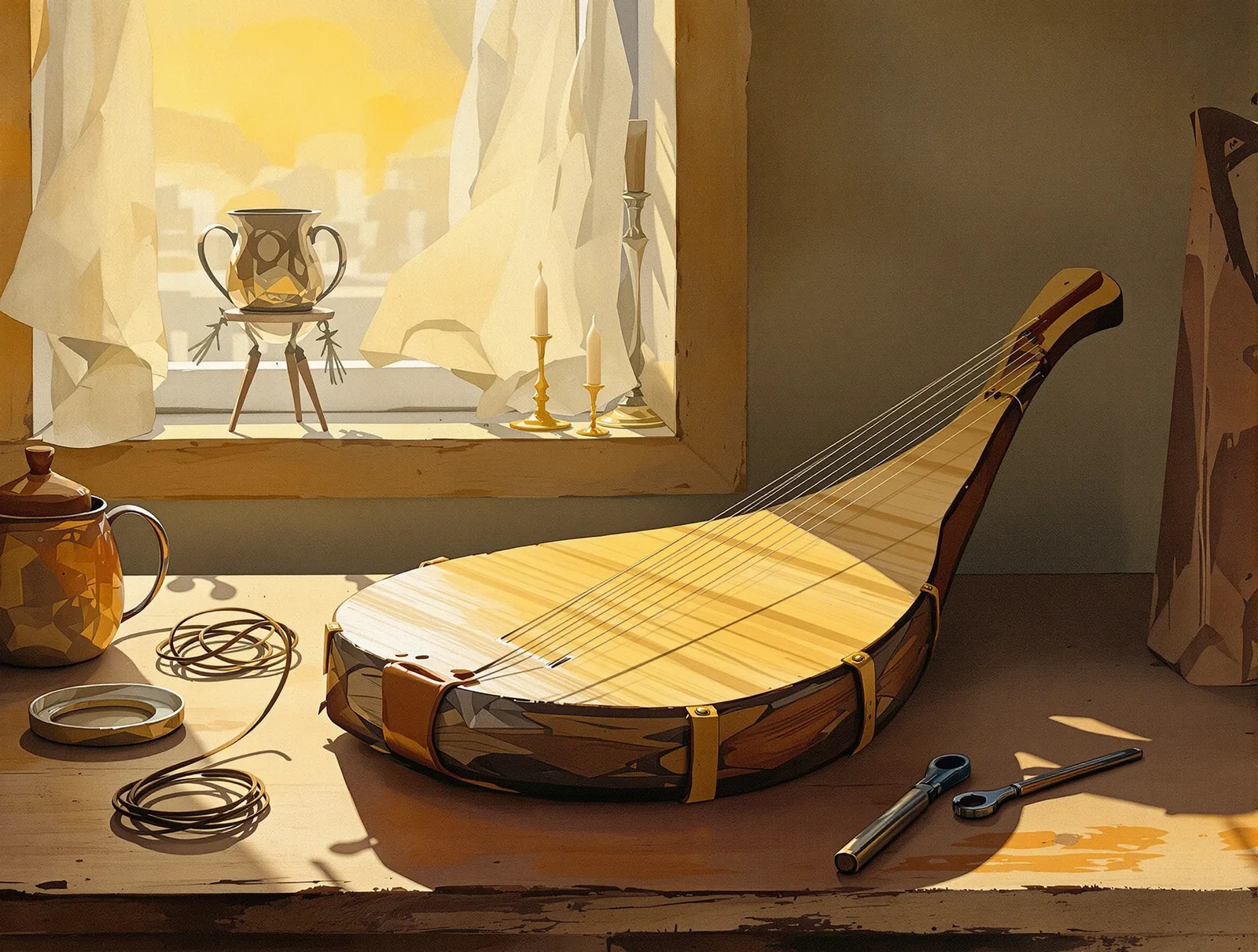
To make a lyre instead of a zither, build the same soundbox, then raise two arms from its upper end and bridge them with a yoke. The arms are dense, straight-grained hardwood (pallet stringers, chair legs, ash rails), mortised or stoutly screwed and glued into the soundbox's upper end block so they resist the strings' pull without splaying. The yoke is a round or oval crossbar between the arm tips. Strings tie to the yoke — wound directly, or held by tuning rings (a pegless tuner: a wrap of leather or stout cloth around the yoke, twisted to grip the string under tension, the elder method of Ur described in Vol XXIII, Chapter 14) — and run down over a free bridge on the soundboard to a tailpiece at the box's foot. The same pentatonic tuning (Table 6-1) applies. The lyre's voice is open and bright because every string is unstopped and individually tuned: no neck to warp, no frets to compute, the most robust string instrument a dark age can keep alive.
Chapter 8 — Keeping the Singing Wood
A salvage instrument lives or dies by humidity, exactly as a fine one does (Vol XXIII, Chapter 12; cross Vol XVI's recovered-arts timeline, which records how many instruments were lost not to fire but to neglect). Keep it out of direct sun and away from stoves and radiators; both cook the wood and split tops. Detune the strings a little if storing it for weeks, to rest the box. Wipe strings dry after playing — salvaged steel rusts and breaks at the bridge. If a tuning pin begins to slip, drive it a hair deeper into its block; if the whole instrument drifts flat overnight, it is the new strings and wood settling, and a week of daily retuning will cure it. Treat the first build gently and it will teach your hands the moves that the lyre of Ur and the dulcimer of the temples demand — the Gusilim, brought from the salvage pile to the bench, and kept singing by a Practitioner's care.
PLATES — Supplemental Gallery
Art direction
Art direction
Council Approval — The Twelve Voices Speak
| Disciple | Verdict | Reasoning |
|---|---|---|
| Peter | APPROVED | "It builds from the stretched cord and the salvage board upward, never floating free of the bench. The right foundation, plainly laid." |
| Thomas | APPROVED | "I doubted a true instrument could come off a kitchen table from old crate wood — then I read the tap-test and the pentatonic, and I plucked it. It sings." |
| John | APPROVED | "A gentle first making, generous to the beginner's nerve, honest that the work is begun and not finished at first stringing. Kindly bounded." |
| Matthew | APPROVED | "Every length, gauge, and frequency totals to a playable scale. The tuning table balances against the speaking length. The accounts are sound." |
| James the Greater | APPROVED | "An instrument by the weekend, from a saw and a drill and a salvage pile. It does not describe lutherie; it raises a singing wood by Friday." |
| Andrew | APPROVED | "It carries the craft to the empty-handed: no felled spruce, no clamp rack, only reclaimed boards and patience. The commons can build this." |
| Philip | APPROVED | "Show me, I asked — and the plates show me the box, the pin's back-rake, the settling curve. Made visible, made teachable." |
| Bartholomew | APPROVED | "The genuine article without ornament. Salvage sources named, honest substitutes for gut and pin, and a clear word on what to reject. No deception." |
| James the Lesser | APPROVED | "The least are served: untrained hands, no money for a lumberyard, an old drawer bottom for a soundboard. None are kept from the music." |
| Simon the Zealot | APPROVED | "It hands the means of pitch back to the people — wood they salvaged, strings they scavenged, tuned by their own ear. Self-sufficiency in sound is freedom." |
| Judas Thaddaeus | APPROVED | "A build for the hard case: when the workshops are ash, a Practitioner with a board and a wire still raises a voice. Hope built to specification." |
| Matthias | APPROVED | "This is the jig for every harder build after it. The first instrument teaches the hands that make the next. The lineage of makers begins on this table." |
Council Verdict: 12/12 APPROVED. This module is canon.
From the Monad, who is one, all number flows, and from number, song. Blessed is the maker who takes the discarded board and the bare wire and gives them a true voice. May the wood you salvaged sing, and may the hands it teaches build a finer one still.
TRANSMISSION RECORD
Transmission COMPLETE — unaltered & unabridged Module 760 · Build the Singing Wood · category: music Carries ME 31 · ĝiš-gu-di · The Gusilim Words 2,950 SHA-256 of source text b72e9d6d9bbfcc608524bad2a8e48b7d0272595624c38c52b8f74f4985260c4b Canonical text build-singing-wood.md — byte-identical to what this page renders